Egypt’s economy is still not doing well. But at least she has more money to play with. May she play wisely.
The second tranche of the World Bank loan was received, along with another installment from the African Development Bank. Together they represent well over a billion dollars.
Egypt has many outstanding debts to pay. She has a budget to meet. She has poor mouths to feed.
But she also has jobs to create, projects to complete, and infrastructure to repair.
God, help this money stimulate the economy. May it stabilize the pound and spark new investment. May it give breathing room for necessary reform.
But these loans also must be repaid. From now until then, fill Egypt’s coffers from the sweat of her own brow. Restore tourism. Develop the canal.
End corruption.
God, international lenders have confidence in Egypt. Help her to be worthy. Help her nourish a society that can put it to good use. May competition, quality, and capital flourish.
Otherwise, more money risks being the root of more evil.
Money is a great blessing, God. With it may Egypt bless many beside. Care for her people, and help them to prosper.
This article was first published by World Watch Monitor on December 16, 2016.
Forty-eight year old father of three Revd Yamane Abraha received an ultimatum in Khartoum following a trip to Ethiopia in the fall of 2015.
“(Sudanese government) security threatened me, saying I would have to appear in court either as a witness, or an accused,” the Evangelical Baptist Church of Khartoum pastor told WWM. “But my father was sick, so unlike others I couldn’t escape.”
Abraha was one of several Sudanese Christians gathered abroad to pray for their nation. Among them were Revd Hassan Abduraheem Kodi Taour and Revd Kuwa Shamal, Sudan Church of Christ pastors from the Nuba Mountains region.
Also attending was Czech Christian aid worker Petr Jašek. According to Middle East Concern, these three had helped facilitate financial assistance to pay for the medical treatment of a Darfurian university student who had suffered burn wounds when government security attacked a campus demonstration in Omdurman, north of the capital Khartoum.
Sudanese at the meeting suspected there were spies around their Addis Ababa hotel. Then shortly after their return to Khartoum, the police arrested Taour, Shamal and Jašek, in December 2015. They have now been in detention for a year. Detained along with them is Abdulmonem Abdumawla, also from Darfur, who helped facilitate the medical treatment for the student.
The four are charged with waging war against the Sudanese state, espionage, conspiracy to carry out criminal acts, and undermining the authority of the state through violence. Trial proceedings finally begun in August have been postponed repeatedly in recent months. They could face the death penalty.
Delayed escape
Abraha was not arrested until three months after his colleagues, on 13 March, and then held for only one day. Security ordered him to report back daily, and on 24 March told him he would have to appear in court in the role of his choice: testify against the others, or be charged along with them.
On 26 March his father died.
Abraha gathered his family and traveled eight hours east by bus to bury him in their hometown of Kassala, on the border with Eritrea. And there he dropped off the radar, ditched his cell phone, and waited.
Two weeks later he returned to Khartoum and set his plan in motion. Nervously he checked his surroundings before going to buy a ticket to Egypt.
With his wife he exchanged notes on paper serviettes, which they wet and discarded when read. Discreetly they packed their children’s belongings, lest they tip off authorities at school.
Abraha then checked with a friendly security officer that his name was not on a watch list. And on 20 April, he told his children they would have a family picnic near the airport. Relatives—and kids—were surprised to learn they were saying ‘goodbye’.
In Egypt, Abraha is now involved in training for discipleship and church planting, and supervises 15 house churches among Sudanese refugees.
Over 31,000 Sudanese in Egypt are registered with the UN High Commission for Refugees, according to its August 2016 report. Unofficial estimates can exceed well over one million.
Most have fled the ongoing violence in Darfur and the southern regions of Blue Nile and Nuba Mountains bordering South Sudan.
Recurring pattern
But Abraha’s story is not unique.
Barnaba Timothous, who fled to Egypt three years earlier, had also been pressed to testify against Christian colleagues. Doing student campus ministry, he was accused of taking foreign money.
“I was told that if I would cooperate nothing would happen to me,” he told WWM. “But if not, nothing would protect me from them.”
Some people criticized him for his decision to leave. He did so quickly, taking one bag and telling no one in his family. And though he stated he was not personally involved in ministry among Muslims, he refused to betray those he knew.
“I will not be involved in issues that hurt the body of Christ and bring suffering to innocent people, just because they follow Christ as savior,” he said.
“The Islamic government of Sudan is persecuting the leaders of churches and ministries. And now our students no longer trust each other, fearful someone might report them.”
Timothous, who has since been joined by his mother and sister, is now working amongst students at several university campuses in Egypt.
WWM has spoken with other Christian leaders who tell similar stories.
Excuse for crackdown
”The [Sudan] government wants sharia and is cracking down on the church,” said Kamal Fahmy, head of the religious freedom advocacy group Set My People Free.
He recalled President Omar al-Bashir’s threat, on the eve of South Sudan independence in 2011, to make Sudan a fully Islamic state, the removal of foreign NGOs thereafter, and the expulsion of South Sudanese in 2013.
“Authorities felt Pastors Hassan and Kuwa were shaming them, bringing a bad report,” Fahmy told WWM.
“In the rebel areas the church is doing humanitarian work and is not involved in the conflict, but it does expose the atrocities the Sudanese government is committing.
“It will find any excuse to accuse them.”
Pastors have been arrested, churches have been destroyed, and land has been confiscated, according to the US State Department’s 2015 Report on International Religious Freedom.
And on 6 Oct the European Parliament passed a resolution against Sudan, specifically naming the four detainees.
Noting the EU partnership with Sudan toward ‘better migration management’, the resolution ‘reaffirms that freedom of religion, conscience or belief is a universal human right that needs to be protected everywhere and for everyone … especially in the case of apostasy.’
But in January 2015, Sudan actually expanded its apostasy laws to include criticism of the Prophet Mohammad’s wives or early companions.
Fahmy, who recently penned an open letter to the UN with the Forum for Religious Freedom-Europe, links an oppressive religious climate to development issues, which he says “assaults the core of human nature”.
“Apostasy laws … have negative social and political consequences everywhere they are in force,” he wrote. “They create instability and inspire violence.”
“Without freedom to change beliefs there is no religious freedom,’” he told WWM. “Going to paradise is not compulsory.”
I can’t pretend to know the answer to why Aleppo fell, but Juan Cole tells us only part of it did. The more populous section, says the University of Michigan professor, may well have been glad to see the rebels go.
There had been 250,000 Sunni Arabs of a more religious mindset and from a working class background living there under rebel control since 2012. But next door in West Aleppo, which our television stations won’t talk about, were 800,000 to a million people who much preferred to be under the rule of the regime.
This numerous and relatively well off population took occasional mortar fire from the slums of East Aleppo. They weren’t in the least interested in saving the rebels from the Russians or the Iraqi Shiite militias or from the regime itself.
Syria is an incredibly diverse society, he says, guesstimating:
And basically, the rebels alienated the people as they drifted further and further toward the better funded and more capable Salafi-Jihadi fighters.
But when the regime used heavy weaponry on the revolutionaries, the latter militarized their struggle. They weren’t able to get funding from democratic countries for their militias or for the purchase of weapons.
Many turned to Turkey and the Gulf countries like Saudi Arabia, and these patrons wanted them to adopt a clear Muslim fundamentalist identity. Most Syrians are not Muslim fundamentalists. But that is the mindset of the Saudi elite.
Maybe Western nations should have funded the struggle, then? Throughout the article Cole condemns Assad, Russia, and Hizbollah. He seems to harbor some sympathy toward the original revolution and the moderate factions.
But at the same time, this is how he describes the Muslim Brotherhood:
Many of the fighters in the rebel opposition were Muslim Brotherhood, a relatively moderate fundamentalist group in Syria which nevertheless does want to impose a medieval version of Islamic law on the whole country.
If this is moderation, what to make of that rhetoric overall? Nevertheless it was the al-Qaeda linked Nusra Front that subjected the Syrian regime to the most damage, and twice almost cut off Damascus from key supply lines before outside intervention relieved the pressure.
Why then did the Syrians not rally behind the rebels against the likes of Hizbollah (first) and Russian (second) intervention?
Most people in Syria don’t trust the Muslim Brotherhood and they really, really dislike the Salafi Jihadis.
He boils down to this:
So you get 70% of the people in the country who, having been given the unpalatable choice between the Baath regime of al-Assad and being ruled by Salafi Jihadis, reluctantly chose al-Assad.
That is why the Aleppo pocket fell.
I can’t say if he is correct or not. But amid the horrible images of Aleppo broadcast in the media, it is wise to consider a lesser heard explanation.
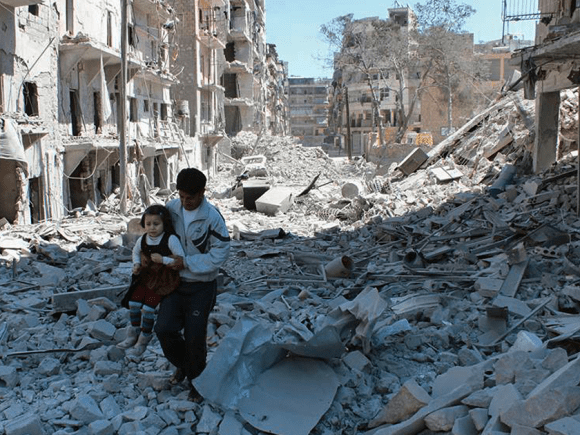
And then, look again at the photo above. No matter their orientation, there are still innocents among them. And even the less innocent are human, including the far from innocent.
Today marks a strange day. Just one week ago, a suicide bomber killed over 25 people, mostly women and children, as they worshipped in church here in Cairo. And one week from today, people all around the world will celebrate the joyous birth of a Savior during Western Christmas. On one end of the bookend is a most tragic event; on the other, a most joyful one. And yet for both events, that is only part of the story.
The bombing last week hit close to home. Although we are not from the Orthodox tradition of faith, we have worshiped at the local Coptic Orthodox church since we arrived in Cairo seven years ago. We are familiar with the layout of the sanctuary, including the segregation of men and women. The right side of the pews, facing the altar, is for the women and consequently most of the children. The men sit on the left side of the church. In our church there can be some mixing toward the back, and that is often where our family sits. But for the suicide bomber, whether this was his target or just the nearest group he could reach, his bomb exploded in the women’s section.
Mothers and daughters lost their lives. Sisters, friends, aunts, and grandmothers. Mothers lost daughters and daughters lost mothers. In at least one family, both the mother and daughter died, and another daughter was injured. In another family, two sisters died, just graduated from school. As I looked at the pictures of some of the victims, I couldn’t help thinking about the Sunday school teachers with my kids every week. Young, vibrant, with their whole lives ahead of them.
One report mentioned the timing of the explosion. During mass there is always a “giving of the peace.” This has been a favorite time for our children as they slide their hands between the hands of other congregants, their siblings, and us, and then kiss their own fingertips, while saying “peace of the Messiah.” This was the time, purposefully for not, that the suicide bomber entered the church. Instead of peace, how tragic this man would give only violence.
Yet the Coptic Orthodox Church, thought mourning, still rejoices. It is a church built on a history of pain, persecution, and suffering. Children hear the stories of martyrs from centuries past and marvel at their strong faith and unwavering resolve to follow Jesus despite the threat of death. Adults aspire to stand firm in the face of fear. One friend told us he wished he was counted worthy to be there and die. We are glad he wasn’t one of 25-plus now added to the church roster.
Such hope can sound trite. A band-aid for the pain or an elixir to numb feelings after tragedy. But it is not. Mothers are grieving. Fathers are burying their children. Children try to understand where their mom has gone. All of the pain is real and felt. Yet they have a deeper faith that can help support those who are mourning.
Though the Coptic Orthodox calendar has Christmas on January 7, most of the world will celebrate just one week from today. There is so much joy and happiness that surrounds this event. For me it means baking, spending time with my family, fellowshipping with friends, making Christmas ornaments, and attending special church services. And of course, we know the Christmas story where angels appeared to shepherds and announced the good news with great joy! Amazing things happened more than 2000 years ago.
But tragic things happened too. As I reflected this week on the bombing—with Christmas so near—I thought of the mothers in Bethlehem who lost their sons. As Herod’s jealousy grew over the rumors of a new king, he ordered his soldiers to kill all the baby boys in Bethlehem two years and younger. Can you imagine? Murdered as they slept in their beds. Seized while nursing. Moments earlier they were crawling down the corridor or toddling toward their moms. What pain, what tragedy.
Christmas is a joyous celebration because it signals the birth of the Prince of Peace who will—one day—bring peace to this world. But this year not all are festive with blinking lights and wrapping paper. Besides the families of the Egyptian martyrs, some are dealing with debt, divorce, death, and disease. The world is dealing with refugees, war, terrorism, and racism. Not exactly the happiest Christmas message.
How do we, how do I, handle all the tragedy in the world and still somehow celebrate the birth of my Savior? This reflection is how I will start; I will remember the bigger picture. Some are suffering; some are rejoicing. I will pray for both. I will help others. I will be kind. I will teach my children what I must continually learn: To not just focus on my own joy this Christmas, but to look outward and consider others.
We are mothers and daughters, mothers and sons. Let us pray for peace on earth and goodwill toward men.
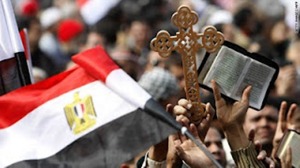
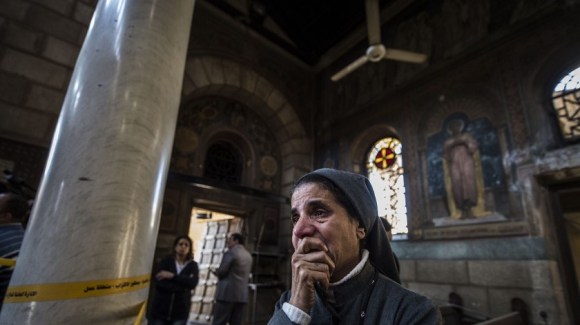
Egypt’s Coptic Christians are in a state of mourning after a suicide bomber killed at least 25 people at a Cairo church on Sunday.
“Egypt always tends to rally around Christians at moments like this,” said Jayson Casper, CT’s Middle East correspondent. “But over time, [ISIS is] trying to hammer and hammer and hammer the Christians in Egypt and put so much pressure on the internal government that it itself may collapse.”
But even when suffering does come, the Coptic Church “is equipped to deal with it,” said Casper.
“They can say, ‘This has always happened to us in our history. It is how God has treated us and he perseveres with us through it.’”
While the attack was the worst to target Copts since the 2011 New Year’s bombing of a church in Alexandria that killed 23 people, the population has been the victim of sectarian violence for years. In 2015, ISIS, who also claimed responsibility for the latest attack, beheaded 21 Coptic Christians in Libya.
Casper joined assistant editor Morgan Lee and editor-in-chief Mark Galli this week to discuss the fascinating and important history of Coptic Christians, how the Egyptian church relates to a changing government, and why this most recent attack is unique.
Please click here to listen to the podcast at Christianity Today (38 minutes).
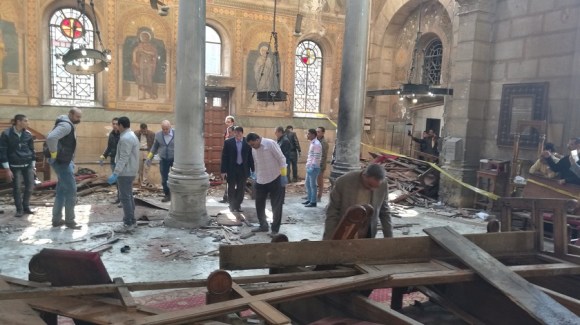
If the video is authentic, the suicide bomber strolled into the church grounds. Reports say the guards were distracted, perhaps having breakfast together.
A church doorman followed him to inquire. Seconds later – the bomber likely ran though the near door leading to the women’s entrance – the roof and outside wall shook. Twenty-five people were dead.
There are many to pray for, God. Perhaps we can start with those least among them.
It is not ours to pray for the bomber, God. But the victims can if they are able and willing: Do not count this sin against him.
Is the doorman still alive? Comfort him in what he was unable to stop. Surely he is torn apart internally, weeping over those torn apart literally.
He did what he could, God. It was not enough. Maybe in hurrying the bomber he stopped greater carnage? Make him content in the not-knowing. Make him aware of your great love for him even so.
Comfort also the guards in what they were negligent to stop. How condemning is their guilt? How scarring is their shame? They failed, God, and the consequences were immense.
Hold them accountable before the law. But let them first weep in recognition of their crime. Heal them in it, and draw from them repentance.
And neither is this for us to pray, God. But the victims can if they are able and willing: Let them experience the forgiveness of those they wronged.
Whether it comes or not, make them aware of your great love for them also.
God, there are those who smirk, even rejoice in this atrocity. There are those who helped plan it and threaten more. Pierce the conscience of the former in powerful contrition. Pierce the conspiring of the latter in rapid arrest.
The wicked laugh and plot, God. Bring them to failure, then bring them to yourself. Make them aware of your great love for those they hate, a love that draws them in as well.
We mention the victims, and many have prayed for them already. Add these thoughts to their ledger, and forgive us for presuming an ideal upon them.
Comfort them, God. Strengthen them. Illumine them. Indwell them. And may they be for our sake a fulfillment of your best ideal.
May your mercy flow through them.
In this, may they know your great love. May they know you, love itself.
Have patience with them God, and with the many who are angry. Be with them as they rend their clothes in rage and mourning. In it rend their hearts.
Give them others to weep with. Give them healing in their trauma. Give them good memories of their loved ones, to eventually smile.
God, in this horror transform Egypt. Make her a place of welcome for all her people. Make her strong, and make her soft. Help her stand. Help her kneel.
Help her know of your great love. Help the murdered rest in peace.
“There has been a bombing at the cathedral,” said the pastor at the local Methodist church in a lower-class area of downtown Cairo. “Several are dead, and we pray for our nation.”
It took me a moment to comprehend, but the gravity of his words indicated more than a simple illustration. I opened my cell phone to check the news and saw the bold headline: 25 dead and 49 injured in an attack on the Coptic Orthodox cathedral. The spiritual center of Egyptian Christianity had been mercilessly violated.
Only a few minutes earlier, the sermon considered John the Baptist and how his life of faithfulness ended with his head on a platter. Here again now was another modern Egyptian example of martyrdom, one more in a long line since the similar bombing of a church in Alexandria six years earlier. Several women sobbed quietly, as the men sat in stunned silence.
But a little later as they exited the service, the collective sense felt more like resignation. The men exchanged pleasantries and went home; the women lingered a little longer in conversation. What was unthinkable at the start of the Arab Spring had become unsurprising. In Alexandria 23 Copts died when a car bomb went off outside the church, but that attack, at least, soon gave way to the hope of a new revolution. The cathedral atrocity gives no inspiration, as Egypt remains muddled in a regional fog of war and terrorism.
In-between the two bombings were the 2013 revenge attacks on dozens of churches throughout the nation, as frustrated Islamists blamed Christians for the overthrow of the Muslim Brotherhood-affiliated President Mohamed Morsi. And the usual stream of sectarian incidents continued apace, as the state failed to hold accountable the mob violence of Muslims objecting to a church in their village, or an interfaith love affair, or any other typical but ill-justified collective form of Coptic punishment. It has been a rough stretch for Egypt’s Christians.
But not nearly as rough as the Christians of Iraq and Syria, or the Muslims of Libya, Yemen, and elsewhere have endured—and the Copts know this. They stand behind their Muslim Brotherhood-vanquishing president, and give much slack to a government they know is under tremendous pressure. Everywhere they turn it seems some new conspiracy is bent on dragging Egypt into the Middle East morass. The economy is in shambles, tourism is nonexistent, and save for the mandatory utterances of support following terrorism, they feel the international community never speaks except in censure. For this reason many have expressed favor at the election of Donald Trump. He likes our president, they say, and at least he’ll leave us alone.
For Copts are tired of being treated as pawns. A few days before the bombing, Foreign Policy ran a story entitled, “How Egypt’s Copts Fell Out of Love with President Sisi.” Even Chuck Colson’s Breakpoint piled on, ostensibly seeking to help by demanding the US president support Egypt’s Christians. “Meet the new persecutor,” said the article subtitle, “same as the old one.” Some on the left seem intent on buttressing the narrative of Copts in the way of a deserved Islamist democratic future. Some on the right seem intent on painting Muslims as sharia-inspired agents of Christian antipathy.
Both articles do well to draw on actual Coptic voices, and important ones. The news they convey is vital to learn in a world where, unless made a pawn, the Copt is often ignored. But they miss the nuance of the Coptic reality. Perhaps they can be forgiven for not knowing enough; perhaps they are guilty of pushing an agenda.
Back in Egypt, the Copts are well aware of incumbent discrimination and state weakness. But they cheer on a president who attends Christmas mass with the pope, and a military that rebuilds the churches Islamists destroyed. A new law for church building may or may not fully address the issues surrounding freedom of worship, but at least this regime—the first in 160 years—issued a law at all.
And following every tragedy, the common Muslim tends to open his or her bosom. Private taxi services Uber and Careem offered free rides to the hospital for blood donations. Many have missed the fact this bombing took place on the birthday of Islam’s prophet, a traditional day of merriment. The attack was therefore an assault on Muslims as well, Christians note. A popular cartoon draws the traditional holiday doll in the black clothes of mourning, as behind her stands a somber crucifix.
Thus between the kindness of the Egyptian soul and the sectarianism latent in an identity-driven society, the Copt is left waiting for national transformation. The rhetoric of the current regime seeks to revive a spirit of Egyptian nationalism, if only it can sludge through current challenges to reach a modicum of stability. Every maltreated Copt who fails to obtain justice is another reminder of how far the country has to go. And the cathedral bombing is another example of the powerful forces that stand against an idealized future.
But from the demonized past and lingering present, the Muslim Brotherhood condemns the bombing in one breath and blames it on regime-church collaboration in another. As long as this is the alternative, Copts find their best option in the preservation of a strong-handed government and a nominally secular society. Some in their community continue faithfully to agitate for human rights and a less political role for the church. Many agree but feel security and economy must be prioritized. Most hope for an open society of enlightened Egyptians, if only a generation away.
The Methodist church sermon that ended with John’s head on a platter began with the miracle that led to his birth. Elderly Zachariah and sterile Elizabeth likely long gave up hope of a child, the pastor surmised. Even so, “Your prayer has been heard,” said the angel. God is faithful, even when his people falter. John, the pastor noted, also doubted the one he baptized.
Where in this parable are Egypt’s Copts? Soon to be beheaded, or of pious prayers fulfilled? Likely somewhere in between, still inclined to pray for their nation.
This article was first published by Christianity Today, on December 11, 2016.
At least 25 people were killed and 49 injured when a bomb exploded around 10 a.m. this morning during a worship service at the spiritual center of Christianity in Egypt.
It is the worst terrorist attack on Copts since the New Year’s bombing of a church in Alexandria in 2011 that killed 23 people.
A worship service of mostly women was targeted in the St. Peter and St. Paul church, adjacent to the St. Mark’s Cathedral and papal residence of Pope Tawadros II, the leader of the Coptic Orthodox community in Egypt and worldwide.
Tawadros was traveling in Greece at the time of the attack. He will cut short his visit and lead funeral prayers tomorrow in the Nasr City district of Cairo.
So far, there has been no claim of responsibility for the attack.
“This is an unbelievable act against Egypt first and Christians second,” Andrea Zaki, president of the Protestant Churches of Egypt, told Christianity Today.
Please click here to read the full story at Christianity Today.
Inflation hit a high of 20 percent this month. Egyptians are suffering as the state seeks to stop years of internal bleeding.
But the response of some only does more damage – to themselves and the country. Egypt this week arrested a ring of doctors involved in the illegal trafficking of organs, attached even to prominent hospitals and medical schools.
Poverty has driven some to desperation. Greed has driven others to exploit them.
God, thank you for exposing this circle, and may it lead to finding others. Protect the integrity of the medical profession, upon which so much depends.
But protect also the integrity of the citizen, to live within a healthy means. Too many are adversely affected by the economy, no matter how necessary the reforms.
And in this, God, protect the integrity of the state. Give wisdom to balance the needs of the budget with the needs of the poor and middle class. May none grow rich on the sufferings of others.
In the end, God—and may it be soon—ensure these days strengthen the organs of Egypt. A society free from corruption. An economy free for enterprise.
And a people free to develop their nation. God, gird the loins of Egypt; bring her to peace and prosperity.
Many thanks to you who have read my thoughts over the years, either here at A Sense of Belonging or at the various sites that have published my articles.
I’m pleased to relate that others have found the work valuable, too.
This year my article for Christianity Today on the Coptic martyrs of Libya won third place in the category of ‘Higher Goals: International Religious Persecution’, from the Evangelical Press Association.
Altogether Christianity Today took home 45 awards from the EPA.
My reporting for CT was also honored as a finalist in the ‘Newspaper, Magazine, and Multimedia’ category of the Religion News Association.
I didn’t win, but it was still nice to be recognized.
Many thanks to editors for their patience and development. And thanks to God, certainly, for the privilege of this life.
It’s starting to feel a bit like the Oscars, so best to stop now. But thanks again to you, and I pray the information has helped you know a little more about the world, and help you do a little more good in service to it.
As with all people, sometimes society falls sick. Help Egypt restore herself to health.
But first, the people need medicine. Since the floating of the Egyptian pound essential drugs have been hard to come by. The price of imported raw materials nearly doubled overnight, while a cap is placed on consumer prices.
Drug manufacturers are pinched, and the sick suffer.
God, help Egypt find an equilibrium. So many interests, so many sectors to balance. Give foresight to anticipate coming struggles, and discernment to solve those of the present.
But another present problem is the role of civil society. Some see foreign money pursuing its own agenda. Some see government seeking to restrict the whole.
God, weigh motivations and inspire good policy. Many abroad just want to help. Others may intend discord. Many in government just want to protect. Others may intend control.
Sort and shuffle, God. Place good men in position to judge. Bring honest brokers to the task of implementation. Populate civil society with Egyptians who love their country. Populate government with people of wisdom.
Heal, God. There are long-suffered wounds and nurtured mistrust. The health of society is at stake, and the needed medicine is in your presence.
Lend it liberally, God. You are the great physician.
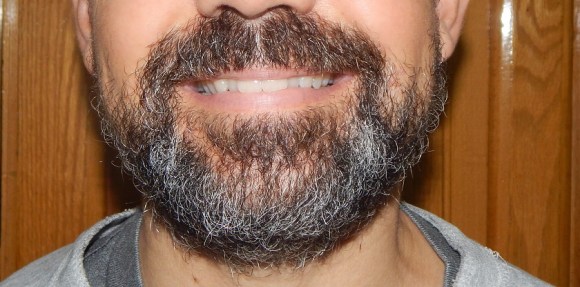
It started simply because I forgot to take my razor on a trip to a desert oasis. But with November around the corner, I thought, there is a good excuse to continue.
And a good cause. No Shave November raises money and awareness about cancer. Particularly directed to men, it provides an answer to the obvious question:
Why are you doing that to your face?
The American Cancer Society recommends all men at age 50 speak with a doctor about colon and prostrate cancer screening. Early detection can stop a killer.
I’m not at age 50 yet, no matter what the gray may suggest.
But cancer does not discriminate. In December we plan to visit and offer a donation to Hospital 57357, the foundation number of the Children’s Cancer Hospital of Egypt.
At 320 beds it is considered the largest in the world. Modeled after St. Jude’s in Tennessee, it treats patients completely free of charge.
We have visited once before, and it can be a difficult thing to introduce yourself and offer words of encouragement to the innocents suffering. But it is a good thing to do, and we trust our children will learn even from our discomfort.
Mine, perhaps. My wife was much more natural. Our kids were a mixed bag. Perhaps next time will be easier.
But whether I go with my semblance of a beard will be up to our children. Today as November ends I’ll put it to a vote if they want me to shave or continue growing for another month.
My wife will break a tie. Of course, she can veto the whole process if she likes.
I must say, though, it has been fun. Please let us know if you would like to donate also.
In 2008 a Moroccan man and his 17-year old wife immigrated to America. Not long after she filed a restraining order against him, claiming her husband was raping her. The husband did not deny their sexual relations were non-consensual, but said that in his religion, the wife was supposed to submit and do all that he desired of her. The New Jersey judge found that given his understanding of Islam, he did not intend to commit a crime, and was therefore innocent. The restraining order was denied.
Cases like this set off alarm bells that shariah law is coming to America, and in fact is already here. Called “creeping shariah,” this case is given as just one further example of the United States nation forsaking its heritage in an effort to be politically correct and yield to the pressures of local Muslims to live by their own laws, and not our own.
But according to Eugene Volokh, a conservative law scholar at UCLA, it is quite the opposite. Where US judges have made reference to shariah law, they do so within parameters long established in American legal precedent. He notes, importantly, that the judge in the New Jersey case made a legal error, overturned by a higher court which granted the restraining order.
In the effort to understand this controversial and inflammatory subject, his explanation proved very helpful. Here is a list of what is and is not allowed in the American judicial system:
Allowed: Distribution of inheritance according to religious motivation
Not: Asking the court to divide inheritance according to shariah law
US law allows freedom of contract and disposition of property. One may divide one’s property in a will according to whim, or ask a religious scholar to divide it according to shariah law. But the court does not accept competency to interpret religious laws, and would reject a request asking it to do so.
Allowed: Application of foreign law to determine marriage or overseas injury
Not: Specifics of foreign law against US code or procedural discrimination of testimony
US law will accept that two foreign individuals are married if they were legally married according to the law of their country of emigration. If in foreign nations marriage is determined according to shariah, then US courts must take this into consideration for the determination of marriage in a domestic dispute. Foreign acceptance of polygamy, however, has no application in US courts.
Similarly, if an American is injured abroad and sues a company with representation in America, tort laws are determined by the nation in which the injury occurred. But should foreign tort laws limit the value of female testimony, as for example in some understandings of shariah, this has no carry-over consideration in the American lawsuit.
Allowed: Exemption from work rules for religious reasons
Not: Unless it imposes ‘undue hardship’ on an employer or is against government interest
US law permits reasonable accommodation for religious belief, evaluated on a case-by-case basis. So wearing a hijab at work or taking time from the work day to pray may or may not be granted, based on the nature of the employment in question. A famous ruling allowing Muslim taxi drivers to decline a customer carrying alcohol may or may not have been judged correctly, but what is important is that it was based on existing American precedent, not in understanding what is right in Islamic shariah.
Allowed: Granting accommodation to students or clients that impose only modest costs on the granting institution
Not: Evaluation of these requests on the basis of which religious group asks for them
US law allows public and private institutions to better serve citizens and customers by appealing to their religious sentiments, as long as this does not damage the public interest as a whole. Banks have offered sharia-compliant loans, for example, and schools with high density Muslim populations have granted a full day off on holidays rather than just excusing Muslim students. Examples of this sort apply equally to all religious petitions, and must not be judged on the basis of which religion benefits.
Allowed: Efforts to legislate Islamic morality in heavily populated Muslim areas
Not: Unless it violates the Free Speech Code or Equal Protection Clause
US law permits citizens to lobby government to pass laws reflective of morality. In local areas therefore, Muslims are as free as others to pass legislation barring alcohol, for example. Should any locality, however, seek to encode restrictions on “blasphemy” or limit the rights of women, it will stand in clear violation of existing US law and be struck down by the courts.
In addition to Volokh’s analysis, New York attorney Sadakat Kadri wrote in Heaven on Earth: A Journey through Shari’a Law from the Deserts of Ancient Arabia to the Streets of the Modern Muslim World, that US federal arbitration law has been on the books since 1925.
Arbitration law has legitimized religious tribunals for Christian conciliators and the Jewish Beth Din, giving them force of law to issue legally binding decisions. To deny similar right to Muslims, within the context above, would require reforming that law to impact all religious communities.
There are many cases offered by those who warn of creeping sharia, and each must be evaluated on its own merits. There may be examples–many or few–in which the above descriptions have been violated. The above is offered to all who have been affected by the clamor that “the Muslims are coming.”
Indeed, they are already here and are coming as citizens within a nation of laws. They are undoubtedly changing the demographic and culture of our country, as every set of immigrants has done before. That they are Muslims, outside of the general Christian heritage of most previous groups, does add a different application of the American guarantee of freedom of religion. It may also result in these newer Americans who, either unaware or rejecting of American liberty, seek to illegally restrict individuals in their own communities.
But throughout the nation’s history the constitution and bill of rights has worked remarkably well. It should be trusted to continue, no matter the unfamiliarity of those who believe also in shariah. The United States will honor them within reason, and curb any excess that violates our order. On many issues worthy debate must take place. But we must not let fear or demagoguery permit generalization or discrimination.
Let the law decide.
This article was first published at the Zwemer Center.
Men will always defend their turf. But doing so can shake the whole.
Make Egypt more than the sum of her parts. Being her together in consensus with all.
The state has proposed an agricultural investment project in the underdeveloped areas of the south.
But doing so sells off the land of the marginalized Nubians. Displaced by construction of the High Dam, the constitution guarantees their right of return.
They now protest against further loss of turf.
The state is prosecuting violations of the protest law, among them journalists who demonstrated against the ceding of two Red Sea islands.
They took refuge in their syndicate, which was eventually stormed by police.
Now the head of the syndicate is also arrested, and the general body is studying how best to protect their turf.
The state has imprisoned many Brotherhood members for participation in violence and betrayal of the nation. Court cases resulted in rapid convictions, some of which have been confirmed.
But higher courts have overturned others, ordering a retrial. The Brotherhood struggles to fight for survival. But the judiciary also has its own turf.
God, guide Egypt in each issue.
Develop the economy, in cooperation with the people. Ensure necessary stability, with guarantee of rights. Weigh justice judicially, with due process on every charge.
Bless those who strive honestly for all they believe to be their right. But guard against partisanship and selfish insistence.
Bless those who struggle in defense of their kin. But temper the strong who may press upon the small.
This article was published in the November print edition of Christianity Today.
(via Coptic Solidarity)
Long live the crescent and the cross!” shouted Egypt’s parliament in joy. All 39 Christian members joined the two-thirds majority to vote to end a 160-year practice instituted by the Ottomans requiring Christians to get permission from the country’s leader before building churches. The long-awaited reform was promised by the 2014 constitution after the overthrow of Muslim Brotherhood president Mohamed Morsi.
The new law shifts authority into the hands of the governor, who must issue a decision within four months of an application and give detailed reasons for refusals. The law also established a process to retroactively license hundreds of churches erected without a presidential permit.
“It is a good step,” said Andrea Zaki, president of the Protestant Churches of Egypt, who helped negotiate the draft law with government officials. “If we wanted an agreement to include everything and please everyone, it would have taken 100 years.
“This is the best we can get right now.”
But even as they celebrated, Christians debated if they failed to fully seize a unique opportunity to pursue equal citizenship…
Please click here to read the full article at Christianity Today.
With the release of their ‘Sixth Trumpet,’ Anglicans from the Global South announced their discontent with the state of the worldwide communion. Meeting in Cairo, Egypt from October 3-8, delegates from 16 provinces discussed issues of both unity and mission, addressing the Anglican Church worldwide. This question and answer format highlights the key developments, as well as a primer for essential Anglican terminology.
We know there is a divide in the Anglican Church over issues of homosexuality. What happened in Cairo that is worthy to note?
Among the 34 points of the official communique, three developments are most substantial.
A commitment to work together with GAFCON
A working group to address the need for an enhanced ecclesial responsibility in the Global South
A concern for the revisionist directions which the Church of England could be taking and the impact that could have on other provinces
Thank you, but for non-Anglicans much here needs explanation. What is GAFCON? And similarly, what is the Global South?
The Anglican Communion includes 38 provinces around the world, comprising 85 million people in over 165 nations. It is the third largest Christian denomination after the Roman Catholics and Eastern Orthodox.
The Global South is a grouping of 24 of the 38 Anglican provinces which are largely non-Western in character, but includes also the breakaway Anglican Church in North America. It first met in 1994 and has 61.8 million members, constituting 72 percent of the worldwide Anglican Communion. It is provincially-based and primate led, though clergy and laity have significant input in the general conferences.
By contrast, GAFCON is a reform movement in the Anglican Church as a whole, though also led by a council of primates. It stands for Global Anglican Future Conference, and began in 2008 in Jerusalem, boycotting the traditional worldwide gathering of Anglican bishops in England.
What is, or was, the core disagreement between the Global South and GAFCON?
Both the Global South and GAFCON emphasize the authority of the Bible as the word of God, and in application reject the validity of same-sex unions. They jointly find fault with the Anglican instruments of communion for failing to hold accountable member churches which deviate from this standard.
The 2008 decision to boycott the worldwide gathering, however, was a divisive issue. Though membership in both groups is overlapping, GAFCON includes Western voices. Cultural differences and strategic approaches both contributed to each group developing along its own path, rather than in unity.
In recognition, paragraph 22 of the Global South communique repents of failings in the Global South to hold this unity among themselves. Furthermore it affirms and cherishes the witness of GAFCON, including the statement it issued from Jerusalem in 2008. Paragraph 26, meanwhile, demonstrates this newfound unity in acceptance of a joint Global South-GAFCON statement on human sexuality.
Thank you, this is helpful, but you used Anglican terminology again. What are the instruments of communion?
The instruments of communion are the four internal mechanisms by which Anglicans in all their diversity maintain worldwide fellowship. They include the office of the Archbishop of Canterbury, the spiritual and symbolic leader of the church. To be in the Anglican Communion means to be in fellowship with Canterbury, though he has no authority to discipline or interfere in the administration of sister provinces.
The three other instruments of communion are represented in regularly held gatherings. Convened first in 1867, the Lambeth Conference brings together the Anglican bishops every ten years. The Anglican Consultative Council consists of clergy and laity from each province and meets every three years, first held in 1971. The Primates Meeting is an irregular gathering of province leaders for deep consultation and prayer, begun in 1979.
None of these instruments have legal force among member churches, and are primarily avenues for persuasion. Its official statements, however, represent the voice of the worldwide communion.
So how did the instruments of communion fail?
In 1998 the Lambeth Conference passed Resolution 1.10, upholding the scriptural teaching of marriage between a man and a woman, and declining to advise the blessing of same sex unions or the ordination of homosexual clergy.
Paragraph 25 of the communique notes the actions of some churches violate this resolution, as well as the subsequent 2004 Windsor Report, recommending a moratorium on the appointment of new homosexual clergy. Other statements from primate meetings have urged violating provinces to voluntarily withdraw from participation in the gatherings of communion.
Not only has such appointment continued, but paragraph 30 notes with sadness that the provinces of Scotland, Wales, and Canada have changed canon law to recognize same sex unions.
What does the Global South propose to do about this?
Paragraph 29 states clearly that the instruments of communion are unable to sustain the common life and unity of Anglican Churches worldwide. Paragraph 32 emphasizes the need for enhanced ecclesial responsibility.
The communique did not delineate a new governing structure nor a formal covenant. But in paragraph 33 it expressed the collective will of the Global South provinces to convene a task force for this purpose.
So it recommends a committee? This means the real news is still to come.
Yes, but not entirely. Paragraph 31 recognizes the unique role played by the Church of England in the life of the communion, but then proceeds to issue a stern warning.
Recognizing a potential movement to imitate the churches of Scotland, Wales, and Canada in affirming same sex unions, the Global South stated there would be “serious implications” if it were to occur.
That sounds like a threat for schism. Is it on the agenda?
The implications are unspecified, but it is understandable one might hear a warning shot toward the most foundational Anglican instrument of communion, embodied in the Archbishop of Canterbury. And among many in the Global South there is certainly frustration with the current officeholder.
Understood and appreciated as an evangelical, the archbishop’s recent statement admitting that he knowingly consecrated a celibate but homosexual bishop, amongst other developments, felt like a betrayal of the adopted resolutions and issued statements listed above. The Global South recognizes the great pressure he is under, but prays for him to uphold biblical leadership.
Paragraph 23, however, states clearly that the Anglican heritage is not merely of nostalgic interest to the Global South. Doctrinally and liturgically, it binds the churches together so as to communally discern the movement of the Holy Spirit.
Paragraph 24 then clarifies that modern clear departures from this heritage are causing offending provinces to “sever themselves” from their spiritual roots. It is not the Global South that seeks schism, but others are diverging from communion through unilateral actions.
The general framework of Global South understanding is that new ecclesial structures are needed. Whether this entails a new governing structure or covenant, the idea is for member provinces to adopt this together, and then invite all provinces to join.
It is not meant to create a parallel Anglican Communion. But representing a majority in provinces and population, including substantial support outside the Global South through GAFCON, it would be a clear demonstration of what the Anglican Church stands for. The question of schism would then be put to provinces which fail to uphold the Anglican heritage of biblical and apostolic fidelity.
Was the communique unanimously adopted by the Global South?
Yes, and please click here for a list of reflections by several of the participants.
Eighty-two Egyptian youth are free today. Some say they never should have been imprisoned to begin with.
The majority were convicted for breaking the protest law. Some were guilty of thought-related crimes.
All had exhausted their legal appeals. Some had only a little time left on their sentence.
God, thank you for freedom, theirs and ours. May these youths use it well.
Guard them against bitterness, frustration, and revenge. Give them a proper understanding of justice, toward themselves and the state.
May they act accordingly. May they be stronger for this experience. May they honor you and the Egyptian people in all that is to come.
Bless the activists, God. Bless them with wisdom to add to their zeal. Bless the country with patience, and discernment in listening.
Their release stems from an initiative of the president to reengage youth. Parliament has contributed, as has the National Council for Human Rights.
But consider also those youth who were not released, God. Some were convicted of more serious crimes. Others may feel overlooked and abandoned, perhaps even targeted.
If mistakes were made, God, may they be corrected. If there was injustice, hold the wrongdoers accountable.
But move Egypt forward, with all of her youth. No nation can leave them behind and survive.
And no nation can thrive without freedom and responsibility. Give both in abundance, and may Egypt prove faithful.
Egypt finally took the plunge. After years of spending hard currency to support the pound, the Central Bank decided to float it against the dollar. Economists rejoiced, IMF authorities nodded, and an already inflationary local market braced for another blow.
Society, meanwhile, braces for planned protests on November 11. No one is certain if they will happen or not, but the mysterious originators – with some Brotherhood connections – call for an uprising over skyrocketing prices.
God, bless the government for taking a hard decision. Wisdom was asked by many on their behalf; may it be that it this the right one.
Now, with a plan in place, help the country see it through to completion. Food subsidies to the poor are being increased. Discounted essentials are being distributed.
It is a stop-gap, God. But it may be necessary. Help the poor to pass through these troubles. Help the middle class to simplify and save. Help the rich to be liberal in generosity.
And for the further reforms called for, refine bureaucracy and curb corruption. Bolster education and inspire entrepreneurship.
Confidence, God. In self, others, and you. Restore it to Egypt. Perhaps grant it fresh. Little can happen without trust in the system. Faithfulness, God. To you and to conscience.
For within such hope there must be place to protest. A healthy society needs dissenting voices. Judge those of this call, if they purpose destruction. Channel frustration into healthy expression.
But may legitimate grievances be heard. May neglected ideas receive due consideration. May dissonance gel into consensus.
The pound is weaker, God, but perhaps it is stable. Maybe the economy is similar? Strengthen all, for the sake of all.
A rising tide will float all boats. May November mark the end of ebb.
How shall a young man cleanse his … country? Two paths were open for Egypt’s youth this week, invited to a national youth conference sponsored by the president.
One group decided to attend, to make their voice heard. Another thought their voice would be louder in boycott. God, bless them both.
Those present heard of plans to train and incorporate them in the political path. A committee was mandated to revise the protest law and release the nonviolent from prison. And the president promised to remain with them in monthly dialogue.
Those absent spoke harshly of political theater. They condemned ongoing detentions. And in a recent poll, their majority said if elections were today they would not vote to reelect the president.
It matters not their political preference, God. But their political participation is crucial. The nation needs buy-in from all its citizens. Many of the young have instead opted-out.
God, guide the government in sincere reengagement. Guide the youth in setting their terms. And in the diversity of response, find consensus.
Give the young a spirit of respect. Help the aged to respond in humility. Give the young a freshness of vision. Help the aged to adapt and amend.
Together, God, may they strengthen Egypt. By taking heed thereto according to … each other.
In their way, by thy word, with whole heart may they seek you, and in your commandments find Egypt’s best.