Categories
Global South (Anglican) Middle East Published Articles

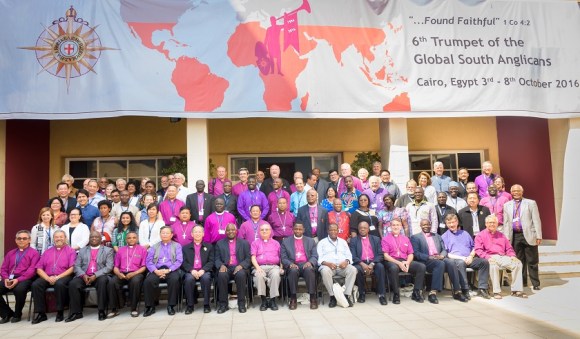
Reflections on the Sixth Trumpet of the Anglican Global South

global-south-anglican-conference
Credit: Michael Adel, Bridges Cultural Center

For the communique, please click here. For the Global South-GAFCON joint statement on human sexuality, please click here.

The following are statements collected from a selection of archbishops and bishops who participated in the conference.

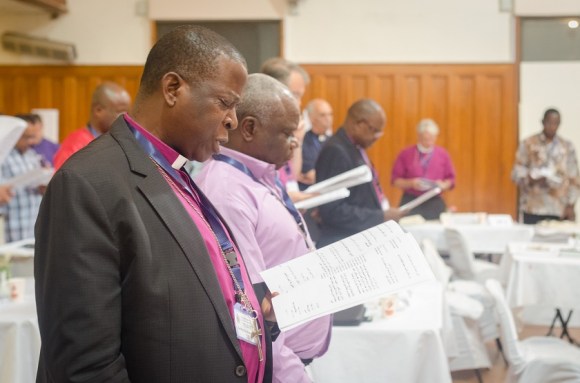
Several months ago we were praying that the Lord would guide us during the conference, specifically that it would not be political, but spiritual, seeking the guidance of the Holy Spirit. We did experience His movement among us, and the communique reflects the love of God, the grace of our Lord Jesus Christ, and the fellowship of the Holy Spirit.

It expressed very clearly where we stand, in a non-aggressive and non-divisive way. On the contrary, it shows how unity among the people of God brings blessing. (Psalm 133)

  • Archbishop Mouneer Hanna Anis, Province of Jerusalem and the Middle East

It expresses our collective frustration, hope, and counsel to the Anglican Communion leadership on the state of our communion. It shows our faith, determination, and effort to restore this communion to wholeness. And it shows we are getting ready for the possibility of further deterioration, that we should be able to speak and act decisively.

  • Archbishop Nicholas Okoh, Province of Nigeria

With the confusing messages from the centers of Anglicanism regarding Biblical morality, it clearly communicates our message, allowing us to focus on our mission to lead people to Jesus Christ.

  • Archbishop Foley Beach, Anglican Church in North America

When we see conflicts and suffering in the world, this communique tells us we have to work faster and more corporately to help. But it also expresses our dissatisfaction and disappointment over the inability of the communion to address fundamental issues which are distracting us from the mission of the church. The truth of the gospel will only have power if it is not compromised.

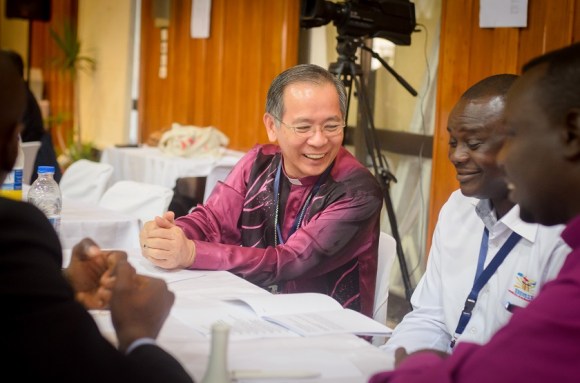
  • Archbishop Ng Moon Hing, Province of Southeast Asia

Matthew 5 says that no one lights a lamp and then covers it with a basket. But the Anglican Communion has been covered by darkness due to Satanic power exercised through the decisions of men. This communique has the force to uncover it again so as to be the light of the world, to shine openly for both the Anglican Communion and the world.

  • Archbishop Stephen Oo, Province of Myanmar

We are united, we are of one mind, and the communique was approved unanimously. One more time we clarified where we are in terms of doctrine and mission. But it also pushes us to keep moving ahead, as our duty is to go and spread the kingdom of God.

  • Archbishop Tito Zavala, Province of Chile

It captures a revitalized spirit among the Global South churches, with openness and inclusion to those likeminded in the North. I believe this is the first time the Global South and GAFCON have issued a common statement, speaking in one voice. There is a strong sense that God is the prime mover, calling the church to rise up together, as we balance between mission in service of the world, and the battle for truth within the church.

  • Bishop Rennis Ponniah, Diocese of Singapore

The communique is very touching, as it appeals to all of us to come together. But it also warns of what is happening in the northern churches. If you warn your brother but he continues, there must be a reaction. We are together, but we cannot walk together in this journey. It is very African for brothers to part if they don’t agree, but by the grace of God we will come back together.

  • Bishop Timothy Ranji, Diocese of Mt. Kenya South, Kenya

The Global South – GAFCON joint statement is outstanding, the most pastorally sensitive statement on human sexuality that I have ever read. It emphasizes the importance of family and marriage, while expressing a genuine love and concern for those who find themselves with homosexual orientation.

I am so appreciative that the Global South has recognized those of us in the Episcopal Church who uphold Holy Scripture and the traditional understanding of marriage, desiring to remain in relationship with us.

  • Bishop William Love, Diocese of Albany

It represents a very substantive healing of relationships that had previously been strained, mostly because of differences in strategy. I credit Bishop Mouneer, who reached out to everyone and said we must be unified.

The enhanced ecclesial responsibility is critically important because of the failures of the instruments of unity. Those who agree can now pursue mission without having to battle theologically.

  • Bishop Bill Atwood, International Diocese of the Anglican Church in North America

The communique raises hope for those we lead in Southern Africa, over the authority and authenticity of scripture and the lordship of Christ. For them we pledge to stand and fight, and may the Holy Spirit grant us power and humility to do so. May the church of Christ grow from strength to strength; praise be to his name for the communique.

  • Bishop Bethlehem Nopece, Diocese of Port Elizabeth, Southern Africa

The Global South and the church must live and apply this communique, so as to make clear the situation in the Anglican Communion. Now we must carry it to society so that it is seen in love as we serve the people living in poverty and amid many other troubles in this world.

  • Assistant Bishop Hassan Othman James, Diocese of Kadogli, Sudan

If you have not yet read the statements but the above piques your interest, here are the links again.

For the communique, please click here. For the Global South-GAFCON joint statement on human sexuality, please click here.

Categories
Global South (Anglican) Middle East Published Articles

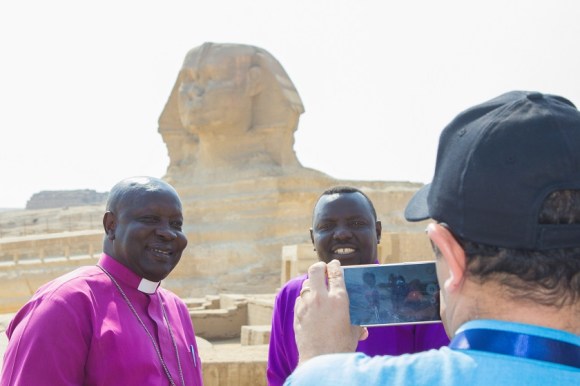
Global South Anglicans Tour the Egyptian Treasures

global-south-anglicans-sphinx
Credit: Andrew Gross

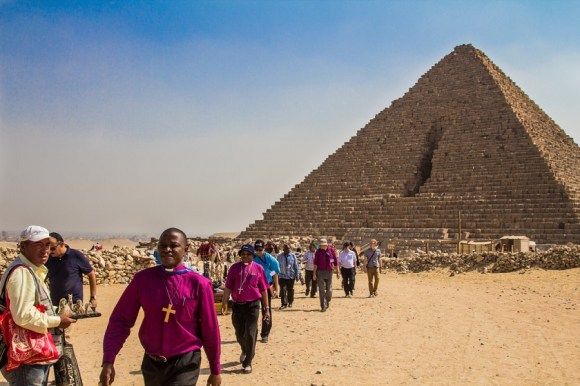
In cooperation with the Ministry of Tourism, the sixth Anglican Global South conference enjoyed a taste of Egyptian antiquities. Delegates toured the Giza pyramids, a papyrus gallery, and the Egyptian museum, closing the day with a dinner cruise on the Nile River.

“Egypt is safe,” said Archbishop Mouneer Hanna Anis of Egypt, chairman of the Global South Anglicans. “As an Egyptian I appeal to you, please come and visit.”

Anis emphasized to delegates that one-third of the Egyptian economy depends on tourism. Millions of lives are affected by the downturn, he said.

But both bishops and laity smiled as they interacted with local Egyptians, tasted local dishes, and took countless selfies.

Theirs was the absolute opposite attitude of Jonah, who ran from the place to which God called him. Johan was the subject of the morning’s Bible study led by Archbishop Tito Zavala of Chile, on the church and the challenge of world evangelization.

Zavala highlighted several applications from Jonah’s story. God is in control of everything, so no matter the hardship and rebellion, Christians should never give up in their missionary enterprise.

God’s unique character is full of compassion, so Christians also must love all the people of the world, even their enemies.

Some Christians suffer from Jonah Syndrome, getting angry at everything that conflicts with their biases. Zavala asked delegates if they view their cultures similarly. Do they have a missions mindset, or a maintenance mindset?

Instead of simply having the right theology of evangelism, churches must develop actual touchpoints with society. He highlighted the development of his own nation of Chile, where the Anglican work began in the 1820s with foreign expats only.

Today the Anglicans have 100 churches in the country, with 95 percent Chilean leadership funded by 95 percent local tithes. Zavala himself was the first Chilean to be appointed bishop, and now he is the first Latin American to become an Anglican primate.

Categories
Global South (Anglican) Middle East Published Articles

An African Anglican is an Anglican, Twice

african-anglican-anglican-twice
Credit: Michael Adel, Bridges Cultural Center

Many an African Anglican has been accused, and perhaps felt a pang of conscience, of belonging to the church of the colonizer. However much they are thankful for the Gospel, the church in popular understanding remains essentially English.

Little do they know the opposite is true. The Anglican Church is essentially African.

Delegates at the sixth Anglican Global South conference in Cairo heard new research from the foremost scholar of the formational Anglican, Thomas Cramner, the first Protestant Archbishop of Canterbury.

Dr. Ashley Null is an elected fellow of the Royal Historical Society and is currently compiling a five-volume study of Cramner’s private theological notebooks.

What these notebooks reveal is the reformer’s deep dependence on the writings of Augustine. Imagined today as a Latin scholarly giant, in his day Augustine was derided as the son of a Berber who spoke Latin with an African accent. Much like many see Africans today, he was considered an outsider with just enough education to exist on the margins of civilization.

Null encouraged the delegates that the scholarly comparisons continue today. The progressive wing of the Anglican Church believes that God will lead them into all truth, which the church today can perceive better for modern times than those from two thousand years ago.

Yet this was exactly the challenge Cramner faced in his day, taking on Medieval Catholicism. Equating tradition with scripture led the church into all sorts of error, which only a return to the Bible could correct. In many examples Null demonstrated how Cramner’s writings drew from Augustine, who himself distinguished between the holy texts and the illumined church fathers who applied them for their day.

Their interpretation, Cramner echoed Augustine, is to be done by scripture. Yet the flexibility of a changing medium for the gospel is built into the original 39 Articles. Article 34 declares it is not necessary for all ceremonies to be alike in all times, places, and manners, so long as they are not contrary to the word of God.

“An African Anglican is an Anglican, twice,” Null said. “It is not just a great line, it is the truth.” Africans need not replicate an English church. And why should they, when the Anglican Church was designed to be culturally adaptable from the beginning, patterned after the teachings of a Berber?

Null demonstrated this was not just a missiological principle, but the very DNA of Anglicanism. But in the day’s Bible study, an Asian walked delegates through the challenge of mission.

Bishop Rennis Ponniah of Singapore said this is mission wider than world evangelization. It is extending the Kingdom of God through the church to the whole created order, bringing it all under God’s rule of righteousness, justice, and compassion.

Ponniah focused on three primary dimensions of this mission. The first is to proclaim the gospel of Jesus Christ faithfully. The second is to overcome the hostility of evil boldly. And the third is to shine the light of God’s rule winsomely. And all of these should be practically achieved through vibrant local parishes, for this is where the people are.

And on this day the Anglican Global South received the greetings of many parishes around the world. Bishop Paul Butler of Durham, Bishop Tim Dakin of Winchester, and Archbishop Glenn Davies of Sydney all expressed appreciation for support received from their fellow orthodox Anglicans. Bishop Mark Lawrence of South Carolina and Archbishop Foley Beach of the Anglican Church in North America expressed similar sentiment.

But Bishop Bill Love of Albany was unique. A conservative American who has chosen to stay within the Episcopal Church, he described the ‘companion partners’ of the Global South within his province. There are six diocese including his own, Central Florida, Dallas, North Dakota, Springfield, Illinois, and Tennessee. Fifteen bishops identify also, representing 10 percent of the whole, a remnant, Love said, which has not bent the knee. One reason he remains within the Episcopal Church is to remain faithful to them.

Much like Cramner was faithful to Augustine, and Augustine faithful to scripture. Even an American Anglican is African at heart.

Categories
Books Global South (Anglican) Middle East Published Articles

Global South Anglicans Learn How Africa Shaped the Christian Mind

global-south-anglican-african-christianity
Credit: Michael Adel, Bridges Cultural Center

Many in the world view Christianity as a Western religion. But even as its center of gravity shifts to the African continent, few are aware the degree to which Africa shaped the Christian mind.

Even in Africa this lesson can be missed, but the Anglican Global South made sure its delegates return home to their provinces with a proper perspective.

“Our stories shape us and how we see the world,” said Dr. Michael Glerup of Yale University and executive director of the Center for Early African Christianity. “The Global South is not new, it was the first reality of the early church.”

Glerup opened with the emphasis Cardinal Schonborn of Vienna has been trying to drive home to Europe: Christianity provides the legacy of civilization to a Western culture that has largely forgotten its roots. But Glerup demonstrated to delegates that these roots stretch back even further to Africa.

There were five early centers of African Christianity, he said, in Egypt, Carthage, Libya, Ethiopia, and Nubia. And in three particular principles, he demonstrated their sons were the first to teach Europe its eventual values.

Maurice of Luxor served in the Roman Theban Legion, fighting near Geneva. Martyred for refusing to sacrifice to the gods, he and his Christian unit also defied the command to kill innocent civilians. “Our oath to you will be of no value, if we deny our first oath to God,” Maurice told his commander, and with his words and example he taught Europe the principle of moral integrity. It was not until the 16th century that his popular portraits were changed from dark to white skin.

St. Pachomius, also from Luxor, was a pagan when visited in prison by local Christians who came to his aid. Upon his release he became a Christian, and eventually founded community-based monasticism providing compassionate service to all. Cyprian of Carthage would further cement the principle of a universal human family, teaching Christians suffering plague to tend even to the sick of their former persecutors.

The Berber Tertullian is well known among theologians as the first to coin the term ‘Trinity’ and was ahead of his time in teaching what would eventually become formulated as Orthodox Christianity. Less known was his teaching, “It is not part of religion, to compel religion; it is an act of free will.” He and fellow Berber Lactantius, the tutor of Constantine’s children, helped teach Europe the oft-neglected but esteemed principle of freedom of conscience.

Glerup’s lectures were sandwiched between two Bible studies led by senior leaders in the Global South. Archbishop Ng Moon Hing of Southeast Asia spoke on the church and the challenge of unity, while Archbishop Stanley Ntagali of Uganda spoke on the church and the challenge of false teaching.

Disunity has been a hallmark of both human and church history, Hing said, and neither theocracy nor democracy has a good track record in overcoming it. Paul’s ethic in Ephesians 2, however, establishes a new pattern in which a Christian is to be simultaneously a responsible citizen of God’s kingdom, and a faithful member of God’s household.

“Pray we can still be a family,” Hing said, “even if a diseased member must be quarantined for a time.”

The disease is connected to false teaching, said Ntagali, but like the corruption rampant in many parts of the Global South, this is a symptom rather than the disease itself.

It is secularism that has become the dominant philosophy of the world, he said, with God no longer at the center. This allows some to claim the Christian name while not following Christ, while others claim the grace of God as a license to do what they want.

Unfortunately, those who follow such false teachings disconnect themselves from the will of God in heaven. What is necessary is discernment in the patterns of the world, being transformed by the renewing of the mind. In this, Ntagali urged delegates, the Global South must be united.

If it is, if the early African heritage is recovered, perhaps again they can help shape the Christian mind, worldwide.

Categories
Christianity Today Middle East Published Articles

Global South Anglicans ‘Visit’ Carthage and the Valley of Dry Bones

global-south-carthage-dry-bones
Credit: Michael Adel, Bridges Cultural Center

On the first full day of the sixth Anglican Global South conference, delegates met Egyptian President Abdel Fattah al-Sisi and began private deliberations for the eventual “trumpet”, the concluding communique.

But in preparation they were led in a Bible Study by former Bishop of Singapore John Chew, and given a lecture by former Bishop of North Africa Bill Musk. Each applied the topic at hand to contemporary issues in the Anglican Global South.

Chew began by emotionally recalling his participation in the initial Global South gathering in Nigeria in 1994, then called the South-South Encounter. It helped us get to know each other, he said, and whether the way we did it was right or wrong, it clearly led to what followed.

That meeting was followed up by the 1997 conference in Malaysia, which galvanized the conservative primates of the Global South to achieve Resolution 110 of the 1998 Lambeth Conference, rejecting homosexual practice as incompatible with scripture.

Building on this history, he asked the delegates to reflect with him on Ezekiel 37’s valley of dry bones. “Can these bones live?” asked God to the prophet, to which Ezekiel wisely responded, “Lord, you know.”

Chew suggested that similarly, in light of the crises in the Anglican Communion, a proper response is to be silent and wait on God. When division is deep-seated, action cannot overcome action, but only God’s transformation of hearts.

But God did not leave Ezekiel to be silent, said Chew. God told him to “join the stick of Judah with the stick of Israel, and I will make them one stick.” Chew noted that perhaps many in Judah were pleased to see the compromising Israelites scattered in exile, but the heart of God, indeed the vindication of his holiness, is in bringing them back together.

Chew left the implication of this teaching to weigh on the delegates without direct application, but asked them if this was their orientation: To let God achieve it, rather than their own activism.

Afterwards, Musk led the delegates in exploration of the history of the church in Carthage, Tunisia, guiding them through the Donatist controversy and the religio-political shifts in the Latin-Berber, Vandal, and Byzantine eras.

The early church was divided along cultural lines, he said, between a foreign Latin elite that favored a compassionate response to Christians who denied their faith under persecution. The indigenous Berbers, however, held to a standard of purity that insisted upon faithfulness until death.

Various church fathers responded in different ways under different circumstances, Musk explained. But he esteemed the Council of Carthage which affirmed the right of a diocese to regulate its own affairs, rejecting the right of one to discipline leaders in another.

Similarly, Musk asked delegates if they could also create a mutually supportive Global South despite differences of viewpoint, while at the same time speaking the truth as they understand it on the important issues of the day.

Like the Christians of North Africa then, Christians of North Africa and elsewhere are persecuted now. Musk urged the lesson be learned of the dangers of a divided Christian community. The Arab invasions eventually overwhelmed the church, but the seeds of its demise were sown long before. Alongside apostolic gifts, a patient, long-suffering pastoral ministry is also of vital importance.

Anglican delegates closed the day by self-selecting themselves into four taskforce groups on the topics of theological education and leadership development, economic empowerment, evangelism, discipleship, and missions, and ecumenical and interfaith relations. Their practical recommendations were forwarded to the primates for further deliberation and planning.

Categories
Global South (Anglican) Middle East Published Articles

President Sisi Welcomes the Anglican Global South to Cairo

anglican-global-south-with-president-sisi
Credit: Egyptian Presidential Office

President Abdel Fattah al-Sisi of Egypt welcomed yesterday a delegation of 16 archbishops from the Anglican Global South, led by Archbishop Mouneer Hanna Anis, chairman of the Global South Steering Committee.

In a discussion lasting 90 minutes, Sisi affirmed the important role religious leaders play in peacemaking, helping spread a culture of tolerance and accepting the ‘other’.

Unfortunately, he said, extremists in religion do not accept diversity, calling anyone who disagrees with them an ‘infidel’ worthy to be killed.

Sisi told the archbishops that Egypt is keen to guarantee freedom of belief and worship for all its citizens, stressing the need to reform religious discourse to confront such extremism.

The archbishops commended Sisi for visiting the Coptic Orthodox Cathedral in Cairo for Coptic Christmas on January 7, to which Sisi replied it was his joy to be able to bring such joy to others.

Archbishop Ezekiel Kondo of Sudan and South Sudan thanked Sisi for looking after the refugees in Egypt, the majority of whom are Sudanese.

At the end of the meeting Anis thanked Sisi for their warm reception, and spoke of the efforts of the Egyptian diocese to build bridges between the different faith communities.

The meeting was also attended by the British ambassador to Egypt John Casson, joining Bishop Paul Butler of Durham in the UK, a member of the House of Lords.

Categories
Global South (Anglican) Middle East Published Articles

World Religious Leaders Laud the Anglican Global South Conference in Egypt

global-south-azhar-welcome
Credit: Michael Adel, Bridges Cultural Center

Pope Francis, patriarch of the worldwide Roman Catholic Church, and Sheikh Ahmed al-Tayeb, Grand Imam of Al Azhar, the leading religious institution in the Sunni Muslim world, welcomed delegates at the October 3 opening of the sixth Anglican Global South Conference, esteeming the importance of their gathering.

Pope Francis expressed his “deepest appreciation” for his invitation to this “momentous event”, in remarks read by the Apostolic Nuncio in Egypt, Archbishop Bruno Musaro. Musaro assured delegates of Francis’ prayers as they discuss themes of “high significance” for both the Anglican Communion and the entire Christian community.

“Nothing is lost when we effectively enter into dialogue,” Musaro quoted from Francis’ encouragement to all people of goodwill, “Nothing is impossible if we turn to God in prayer.”

Sheikh Ahmed al-Tayeb’s remarks quoted from the Quran in his welcome to the Anglican delegates, noting how God created different peoples in the world so that they would know each other and build society.

Tayeb’s message was delivered by Sheikh Saeed Amer, chairman of the fatwa committee in Al Azhar. He esteemed the importance of the conference, hoping it would contribute to building increasingly positive Egyptian participation in the Global South.

Pope Tawadros II, patriarch of the Coptic Orthdox Church also extended his welcome to the delegates of the Anglican Global South. Through Metropolitan Bishoy he expressed his delight in the Christological agreement signed between the Anglican and Oriental Orthodox Churches in 2014, as well as the 2015 agreement on the procession of the Holy Spirit from the Father.

“[We] back you in your defense of the commandments of the Holy Scriptures,” said Tawadros to the Global South delegates, through Bishoy, while noting serious disagreements that exist between the Coptic Orthodox and the Anglican Church as a whole.

“Yet we carry on our dialogue with the Anglican Communion in order to encourage the Anglican conservatives to continue abiding to the true and genuine Biblical principles.”

Archbishop Mouneer Hanna Anis, bishop of Egypt and chairman of the Global South steering committee, welcomed the ecumenical and interfaith dignitaries, and thanked them for their participation in the conference opening session.

Categories
Global South (Anglican) Middle East Published Articles

Global South Anglicans Open 6th Conference with a Nod to Athanasius

anglican-global-south-day-one
Credit: Michael Adel

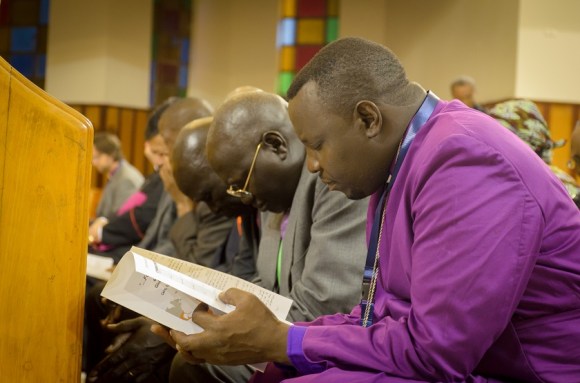
Anglicans of the Global South met today in All Saints Cathedral, Cairo, taking communion and opening their sixth conference. Archbishop Mouneer Hanna Anis of Egypt, chairman of the Global South Steering Committee, welcomed 12 primates and 90 delegates from 20 provinces of the Anglican Church.

In his opening address he gave a brief history lesson, recalling an earlier archbishop of Egypt, the 4th century Athanasius of Alexandria.

“He was known as ‘contra mundum’, ‘against the world’,” said Anis of the ancient champion against the heresy of Arianism. “He was opposed at that time even by the emperor, but eventually the false teaching disappeared, while orthodoxy flourished.”

Anis encouraged delegates to take two lessons from this history. First, drawing on the conference theme from I Corinthians 4:2, the church must be “found faithful” to the gospel received from the apostles. Second, the truth will prevail in the end.

Anis decried an “ideological slavery” in which some in the Western church use their money and influence to push their agenda on the Global South. They undermine the scripture and the traditions of the church in redefining the definition of marriage, he said, and their unilateral choices to ordain homosexual bishops is fraying the fabric of the worldwide Anglican Communion.

“I want to weep,” Anis said, “as Jesus did over Jerusalem.”

Anis also challenged delegates over the weaknesses of churches in the Global South. Corruption, tribalism, polygamy, poor treatment of women, and the prosperity gospel all show the need for greater theological education.

The church must also address the issues of poverty and economic migration, moving away from a dependency on Western aid into a more sustainable development. And as concerns terrorism and religious violence, Christians must again look to history, following the example of the martyrs, if necessary.

During the communion service, Archbishop Nicholas Okoh of Nigeria preached on the peace of Christ that is able to prevail in a crisis situation. The world has not achieved peace, citing examples in Syria, Yemen, Sudan, the Central African Republic, and his own homeland.

Christians, however, are called to be peacemakers focused on justice, fairness, and the love of God. This is also a call for world evangelization, he said, that the knowledge of the Lord may fill the earth as the waters cover the sea, quoting the prophecy of Isaiah 11.

Bishop Rennis Ponniah of Singapore prayed for the delegates, that God would melt their pride, free them from biases, and strip away all rivalries. He urged humility and submission to follow Jesus, that God would reveal what this means for them in the Global South.

“Let us weep over what breaks your heart,” Ponniah prayed. “May our faithfulness be the means by which you restore your church.”

Ecumenical and interfaith guests included representatives of Al Azhar, the Vatican, the Coptic Orthodox and Coptic Catholic Churches, and the Armenian Catholics. Political and diplomatic guests included representatives from the Egyptian Ministry of Foreign Affairs, and the embassies of the United States and Singapore.

The Anglican Church has 85 million members in 164 countries, the world’s third largest Christian denomination behind Roman Catholics and Eastern Orthodox. Anglicans in the 24 provinces of the Global South number 61.8 million, constituting 72 percent of the worldwide Anglican Communion.

Participants included archbishops from the provinces of Sudan, Nigeria, Uganda, Rwanda, Kenya, Burundi, Southern Africa, Western Africa, Indian Ocean, Myanmar, Sri Lanka, Bangladesh, Myanmar and South East Asia. Joining them from outside the Global South were archbishops from North America, Australia, and the United Kingdom.

Archbishop Anis urged them to adopt a joint statement of faith.

“Our unity in the Global South is very important,” said Anis as he closed the opening session. “We must face our many challenges together.”

Categories
Global South (Anglican) Middle East Published Articles

Global South Anglicans to Hold Sixth Conference in Cairo

global-south-anglicans

From October 3-8, All Saints Cathedral in Cairo, Egypt will host the sixth conference of the Anglican Global South. Over 100 delegates from 20 provinces will discuss the challenges facing the church in the world today.

Archbishop Mouneer Hanna Anis of Egypt is also chairman of the Global South steering committee. He stated the most critical of these challenges include poverty, illegal immigration, religious violence, and the false teachings about homosexual marriage prevalent in the West.

Delegates will also discuss the importance of ecumenical and interfaith dialogue. Invited guests to the opening session include the Grand Imam of Al Azhar, Ahmed El-Tayeb, and Coptic Orthodox Pope Tawadros II.

The Anglican Church has 85 million members in 164 countries, the world’s third largest Christian denomination behind Roman Catholics and Eastern Orthodox. Anglicans in the 24 provinces of the Global South number 61.8 million, constituting 72 percent of the worldwide Anglican Communion.

Expected participants include archbishops from the provinces of Sudan, Nigeria, Uganda, Rwanda, Kenya, Burundi, Southern Africa, Western Africa, Indian Ocean, Myanmar, Sri Lanka, Bangladesh, Myanmar and South East Asia. Joining them from outside the Global South will be archbishops from North America, Australia, and the United Kingdom.

The first plenary session will be led by recently retired Bishop Bill Musk of North Africa, on the historic church of Carthage in present day Tunisia. He will be followed by Dr. Michael Glerup of Yale University and executive director of the Center for Early African Christianity, speaking on how Africa shaped the Christian mind. The final seminar will feature Dr. Ashley Null, renowned scholar of Thomas Cramner, on how Africa shaped the Anglican faith.

The sixth Global South conference was originally scheduled for Tunis in 2015, cancelled on the advice of the Tunisian authorities due to terrorist threats. But this year delegates will spend half a day touring the Egyptian Museum and Giza Pyramids, and enjoy a dinner cruise on the Nile River.

Begun in 1994 in Kenya, each of the five previous Global South gatherings issued a “trumpet,” a declaration of principles and call to stand firm on the faith received from the Apostles. It is expected that many delegates will wish to challenge the current innovations happening within the traditional centers of Anglicanism in the United Kingdom and North America.

“This is a critical moment in the life of the Anglican Church,” said Bishop Mouneer. “We pray that as we strive for both truth and unity, our efforts will be ‘found faithful’ by God Almighty.”


Note: I will be assisting the diocese with its media coverage of the event, and will provide updates as possible.

Categories
Excerpts

Migrants vs. Immigrants

TOPSHOT-ITALY-REFUGEE-IMMIGRATION-SHIPWRECK-RESCUE
AFP PHOTO / MARINA MILITARE AND AFP PHOTO / STR / AFP PHOTO / MARINA MILITARE”

Salama Moussa provides a timely reminder of the difference:

Migrants are pushed by local disturbances to seek work and survival in other lands, regardless of the land, as long as it welcomes them. Immigrants have a fixed destination and while they seek a “better” life, the definition of “better” is often broader than mere survival.

He also mentions a request difference in orientation:

Immigration carries with it the hope of integration, assimilation and acculturation. This process is rarely painless but almost always beneficial, for the immigrants and the societies that receive them.

Migrants carry the hope of returning to their homelands once the emergencies subside or sufficient material wealth is accumulated. For them assimilation and acculturation are both highly undesirable, as they would render the migrants alien when they return to their homelands.

The categories can be fluid, depending on the reception and success of either group. But he warns of the loud megaphones that often accompany the pro- and con- on either extreme of the national debate:

Matters are made worse by leaders on all sides. Some package easy national solutions indistinguishable from simple bigotry. Others are unable to see that tolerance should not be extended to habits and ideas that burst the old lands into flames.

The answer, he says, is to encourage immigration and stem migration. The latter is to help strengthen the countries of origin, that there be no impetus to leave.

Of the former, [my comment] every nation must have a responsible immigration policy, which can legitimately wax or wane over time according to national circumstances. But Salama Moussa’s take is spot-on:

The second is done by adherence to the bedrock values that have made many countries, especially in the West, a haven to the beleaguered.

Chief among those values is tolerance. The root of that very word is Latin for “supporting” and “enduring”.

This means that while accepting new immigrants we must assert that the values that opened the doors for them can not be subverted by any beliefs they bring along, and that we will work to see our values endure.

As we transition back to Egypt following a period of time in the United States, my mind is still taken a bit my American issues. Hopefully Egyptian and Middle East commentary will return over time, but glad to share insight helpful to either context.

Like immigrants and migrants and many others, our ‘sense of belonging’ is also fluid.


Categories
Prayers

Friday Prayers for Egypt: Assassination, Funeral

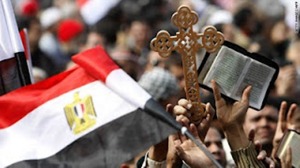
Flag Cross Quran

God,

Egypt witnessed a frightful return, disturbing a relative quiet. The pattern subsided but not that long ago was a viable threat. May it not be a portent of things to come.

A car bomb detonated in an upper class neighborhood, injuring one bystander but missing the deputy prosecutor-general. Fifteen months ago, his positional superior was assassinated by similar means.

God, thank you for the escape. But the signs that such men continue to nurse their grudges through violence is a disturbing development. After a year of many targeted killings, Egypt outside of Sinai has successfully enforced an extended period of calm.

May the culprits be caught, God. May those behind them be exposed and disabled. May any legitimate grievances find peaceful solution, and may justice be extended to all.

For grievances are also finding expression in the funeral of former Israeli president Shimon Peres. Egypt’s foreign minister will attend as a representative of the state. But others are critical of paying homage to a man they deemed oppressive of Palestinians.

God, give both peace and justice to the peoples of this world. In Egypt in particular, help leaders and citizens alike to find the proper balance. It is right to honor the dead. It is right to review a legacy.

May truth prevail among hearts unhardened to humbly receive and boldly respond. May they rightly impact others too possessed by the pain of past grudges, justly held or otherwise.

May the victims of all conflicts rest in peace. May the living rest the same. Heal Egypt and the region, and save her from further harm.

Amen.

Categories
Prayers

Friday Prayers for Egypt: Drowning

Flag Cross Quran

God,

Over 150 people are dead in a disaster off Egypt’s Mediterranean coast. An equal number of would-be migrants were rescued, but the majority remain unaccounted for.

Most on board the overloaded fishing boat were Egyptian, with a sizable segment of other nationalities. Turkey and Libya hold international focus as a launching pad of refugees to Europe, but Egypt has tended to stay out of the headlines.

The armed forces have intercepted many efforts, and tragedy has not been a media marker. Until now.

God, have mercy on the souls of those who perished. Put right the world of those who remain alive.

Put right the world.

Egypt is refining its legislative deterrent, upping the punishment for human trafficking. But the president also calls for greater investment in areas with people more likely to flee.

Help Egypt to right its own ship economically, even as she integrates refugees from elsewhere. Give wisdom to Europe in who she takes in. Give prosperity to her neighbors, that none need apply.

And give contentment to those dreaming of a better life elsewhere. May they know your peace, which can settle any soul. May they know your power, which seeks the good of all.

But for now, may those in transit know your comfort. May those who find them extend your grace.

Put right the world, God. Too many are drowning. Put right Egypt, may she rescue many.

Amen.

Categories
Christianity Today Middle East Published Articles

Pilgrims’ Process: Why Christians Closest to the Holy Land Visit the Least

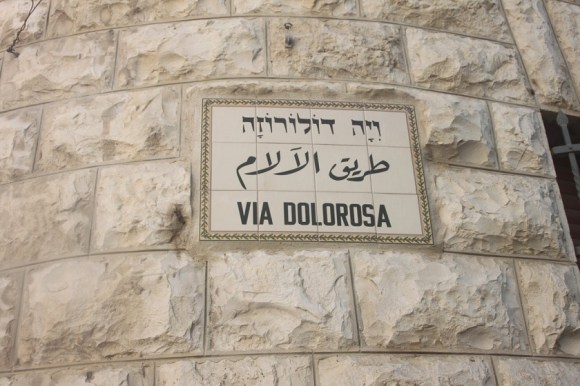
Via_dolorosa_Jerusalem

This article was first published at Christianity Today in the June print edition.

Walking down the Via Dolorosa, Nabil placed his hand on the wall where Jesus reportedly stumbled on his way to being crucified.

I am a lucky man, thought the 58-year-old. I can feel the Holy Spirit in my body.

This wasn’t how the Coptic Orthodox pilgrim had expected to feel in Jerusalem’s Old City. “Most Egyptian Christians want to visit as part of their faith,” he said, noting that he saw many elderly women dressed in black, weeping at each station of the cross. “Not me. I’m retired, I have nothing else to do, and I like to travel.”

Touring the Holy Land has been a transformational experience for Christians worldwide. In 2014, more than half of the 3.3 million tourists who visited Israel were Christians, according to the Israel Ministry of Foreign Affairs. Of these, one out of four was Protestant.

But among these tourism figures, the Arab Christian community is nearly a no-show. In 2014, Jordan sent only 17,400 tourists (which were not differentiated by religion). Egypt, only 5,200—all Copts. Lebanon forbids travel to Israel entirely.

So Close Yet So Far

There are many reasons Arab Christians don’t tour Israel. The ancient sites are right in their backyard, so familiarity breeds complacency. And economic and political conditions hamper travel.

“I grew up minutes from Mary’s Well in Nazareth, and walked to school daily past the Church of the Annunciation,” said Shadia Qubti, a Palestinian evangelical. “It’s where I met friends for coffee.”

Please click here to read the full article at Christianity Today.

Categories
Prayers

Friday Prayers for Egypt: Church and Loan

Flag Cross Quran

God,

Long awaited items seem almost there. But almost to arrival is still a distance. Give wisdom in the final days of discussion.

Egypt’s Christians have long complained of difficulty in securing authorization to build churches. The new constitution mandated a law be passed by parliament in its first term to govern a better process. Behind the scenes negotiations between church and state near completion, and elected representatives appear ready to receive the draft law.

What they do with it is up to them.

God, for some this is a non-issue, for others it equates religious identity. Give courage and tact. Give conviction and empathy. Give consensus in line with your good will.

Perhaps your good will is more flexible in monetary policy, God, but help Egypt to find it in reference to the IMF. Staff level agreements have been finalized on a $12 billion loan and reform package. But political push and social acceptance may be lacking.

And some breathe a sigh of relief, finding neoliberalism and austerity programs to be the problem, not the solution. Others view it as a mark of international confidence and economic recovery, while a third are torn but resigned in the face of fiscal necessity.

Sort between them, God, for the sake of the nation. Set right the ship, that all may prosper. If the loan goes through, disperse it well. If not, revive the economy through better means.

And in all things, bless Egypt. Give peace and due process in religion; give sense and stewardship in economy.

No matter the distance, help all arrive together.

Amen.


Categories
Excerpts

An Egyptian Human Rights Rebuke, to America

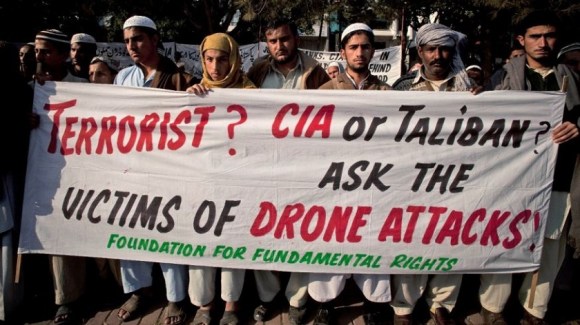
(via http://www.foxnews.com/world/2013/10/22/amnesty-us-must-investigate-alleged-civilian-drone-casualties-in-pakistan.html)

It is not unusual for American politicians and the State Department to call out other nations of the world for their violation of human rights.

But the past few weeks have given other nations an excuse to hit back. Laugh or cry, here is a selection of Egyptian statements about our racial issues and the UK Chilcot report on the Iraq War.

MP Margaret Azer, deputy ‎chairman of Egypt parliament’s human rights ‎committee, said in a statement that she was appalled by ‎the brutality of American police.

“I think that all ‎Egyptian MPs and defenders of human rights should ‎move to condemn the repeated brutal use of force ‎against black Americans and expose the bloody face of ‎the United States and its politicised use of the issue of ‎human rights to extort other nations,” said Azer.‎

Azer’s statement added that “the United States, which likes to ‎give lectures on human rights to other nations and issue ‎periodical reports on civil liberties in the world, was ‎caught red handed violating human rights and crushing ‎the peaceful protests of black Americans in the city of ‎Dallas and other US cities.”‎

Ilhami Agina, an independent MP and a member of ‎parliament’s human rights committee, also said in ‎a statement that “the excessive use of force ‎against black Americans in the US has exposed the ugly ‎face of Western regimes and that these ‎regimes are deeply involved in wide scale racial ‎discrimination.”

“[US President Barack] Obama, who came to Cairo in 2009 to ‎give us a long lecture on human rights, might have ‎forgotten that it is America that needs radical reform,” ‎said Agina.‎

Agina told reporters that he sent a letter to Egypt’s ‎foreign minister Sameh Shoukry asking him to summon ‎the US ambassador in Egypt – Stephen Beecroft – to ‎convey Egypt’s dissatisfaction with the excessive use of ‎force against blacks and urge the American ‎government to reform its record on human rights.

“Egypt is ‎now the head of the Arab summit and so it should give a ‎say on what happens in America, but if Shoukry does ‎not opt to do this, he should at least do as the US State ‎Department, which always grants itself the right to ‎comment on judicial and political issues in Egypt,” said ‎Agina.‎

Ayman Abu Ela, the parliamentary ‎spokesman of the Free Egyptians Party, told reporters ‎that he also hopes that Egypt’s parliament will hold a ‎session on America’s violations of human rights.

“The US ‎administration and media, which have always accused ‎Egypt of issuing a tough protest law have nothing to say ‎now about their police brutality against black protesters,” ‎said Abul Ela, also agreeing with other MPs that “the ‎recent incidents of excessive force and police ‎brutality in America have uncovered the falseness of ‎American democracy and its flawed reports about ‎human rights in the Arab world.”

Perhaps most US criticism of other nations means as little as these statements above in the practical rebuke and correction of abuses. Perhaps they reveal how indicative of the domestic political context each remark is made, rather than impact on international relations.

But sometimes, human rights abuses do result in international censure. Here is the Egyptian appeal:

The Egyptian parliament’s Committee on Foreign Affairs called on Friday for George W. Bush and Tony Blair to be tried as war criminals, saying the resounding report of a British committee investigating Britain’s participation in the war against Iraq clearly shows that there were no convincing reasons for the conflict.

“This British committee’s report – the Chilcot report – has exposed the false reasons which former US president George W. Bush and former UK prime minister Tony Blair had exploited to wage their illegitimate war against Iraq,” said the strongly-worded statement.

The parliament said that the American-led war in Iraq left more than one million Iraqis killed and millions more wounded, internally displaced or sent from their homes as refugees.

“There’s no question that George W. Bush and Tony Blair should be put on trial as war criminals not only because they are the ones who trumpeted the reasons for this war, but also because they should be held responsible for the deaths of millions of Iraqis since 2003,” the statement read.

Human rights – and their defense – are vitally important. Too important, in fact, to be left to politicians anywhere.

But without them, progress will always be limited. Empty rhetoric may be part of politics, but rhetoric sets a tone. The world is a better place even if politicians give only hypocritical lip service to human rights. Their conscience can always awaken. If so, laws and policies can change, however gradually.

Consider the alternative, if human rights are outright ignored or justified away. Sometimes, in many nations, this alternative is all too near.


Categories
Christianity Today Middle East Published Articles

Arab Christians and the Marrakesh Declaration

Marrakesh-Declaration

This article was first published at Christianity Today in the April print edition.

With the lilt characteristic of a Southern megachurch pastor, Bob Roberts Jr. introduced the most significant Muslim statement on religious freedom in 1,400 years.

“I am a Texan, an evangelical, and a Baptist,” the NorthWood Church leader told the crowd of more than 250 leading Muslim clerics from around the world. “You have made my job to build bridges so much easier. You have gathered to call people to change.” He drew hearty applause.

The Marrakesh Declaration, launched in Morocco this January, is a clear English-Arabic condemnation of terrorism and a pledge to better promote religious liberty.

“It is a very promising initiative. You could even say it is groundbreaking,” said Medhat Sabry, the Anglican Communion’s dean for Morocco and one of several non-Muslim observers (alongside Roberts) to the declaration’s signing. “But it is way too early to tell.”

This is because—from Cairo to Amman to Nazareth to Baghdad—the news caused barely a ripple in Christian communities in the Middle East and North Africa, whom the document is meant to comfort. Some Arab Christians saw a headline in the local news. Others didn’t hear of it at all.

Please click here to read the full article at Christianity Today.

Categories
Excerpts

Bishop Angaelos on the Recent Rise of Attacks on Copts

Bishop Angaelos

Bishop Angaelos of the Coptic Orthodox Church in the UK is a frequent go-to source for Western media seeking perspective on the Christians of Egypt and the Middle East.

As localized, sporadic attacks on this community have been on the rise in recent weeks, he released a statement that is quite wise and balanced. Before quoting it in its entirety, please feel free to click here for context, and here for video of what one of these attacks looks like first-hand. This article describes security facilitating a reconciliation.

You can also click here for a statement for the Egyptian president warning of efforts to drive a wedge between the two religious communities and vowing to hold accountable those responsible for the violence. After meeting with the president, Pope Tawadros of the Coptic Orthodox Church also urged people to not allow Egyptian national unity to be broken.

Here is the statement of Bishop Angaelos:

Egypt is undoubtedly going through a formative stage of its contemporary history. Having emerged from uprisings and changes in Government, dealing with resulting pressures on its economy and infrastructure, and with the loss of foreign investment and tourism, it has become more vulnerable to a disturbing wave of radicalism.

One of the manifestations of this radicalisation is that despite a short period of apparent reprieve, it is regrettable that the time has come yet again to speak of heightened, targeted attacks against Coptic Christians in Egypt. Tensions against Egypt’s indigenous Christian community have again escalated over the past few months, and will spiral even further if not immediately addressed.

The exponential rise in attacks against Christians and Christian property in recent months can largely be attributed to three main catalysts: inflammatory false rumours and accusations regarding alleged extra-marital relationships between Christians and Muslims, incendiary rumours relating to the building of new churches, and a growing trend towards the direct targeting of priests and their families. At their most brutal, these recent attacks have culminated in the burning of churches and places of worship, the stripping and public parading of 70-year-old Souad Thabet, and the senseless murder of Father Raphael Moussa.

What must be considered very clearly and with great concern however is that an attack on any individual member of a society is an attack on that same society and what it stands for, so our prayers are not only with those who have suffered these unspeakable and horrid violations, but for the society that is undermined and made more vulnerable with each and every one of these incidents. The system of law and order in Egypt is not one for Christians, Muslims or any other individual group of people, but it is for all Egyptians, and so when violated this violation is against all.

While there are clear efforts at the national level in Egypt to attempt to curb such acts of religiously-motivated violence and lawlessness, what we have repeatedly seen at the local level is, at best, carelessness and, at worst, criminal negligence in the reaction and lack of reaction of local security service officials. This gives a clear and direct message that certain crimes will go unchallenged and unchecked, especially when perpetrators are not brought to justice. The resulting sense of impunity not only means a lack of justice for crimes already perpetrated, but also gives greater encouragement to those who will seek to do even more, and more aggressively.

While there is a rejection of these attacks on Christians by the vast majority of Egypt’s 85% Muslim population, themselves often targeted by the same radical and intolerant elements, there is a need for a robust system of law and order that appropriately responds to crime, irrespective of who it is perpetrated by or against. If this does not happen, the concern is that hopes for a more cohesive nation will disappear, and that recent events will give way to a re-emerging religious divide.

In light of all this, it is of course difficult to have a sense of hope or promise in the current situation, but mine still remains rooted in the way Christians in Egypt and elsewhere have faced persecution for millennia. They continue to draw strength from their confidence and trust in an omnipotent God, and forgive through grace that only He can provide. In this, those suffering directly from this persecution provide a great example and inspiration for us not to be engulfed by anger or resentment but in calling for justice, remain forgiving, no matter how hard, and work towards a hopeful future, no matter how seemingly impossible.

The brutal and personal nature of many of the attacks against our brothers and sisters in Egypt warrants our prayers and support for them as they continue to endure heightened levels of persecution while refusing to lose their admirable and resilient spirit, and unyielding ability to forgive according to their Christian devotion and commitment.  We also pray for Egypt and its leadership, hoping that hearts and minds will be led to greater inclusiveness, justice, equality, and refuge for the oppressed, remembering that our Lord Himself once took refuge from persecution within its gracious and welcoming borders.


Categories
Excerpts

Trump, Clinton, and Egypt

Trump Egypt
(via http://www.businessinsider.com/donald-trump-ben-carson-pyramids-grain-2015-11)

We are often asked what Egyptians think about current American politics and the presidential race. Our answer tends to fall into these categories:

  • Many hate Hillary Clinton due to her support for the Brotherhood.
  • Many think it doesn’t matter because US foreign policy never changes.
  • Many see in Donald Trump an American version of Middle Eastern demagogues.

This al-Monitor article provides a nice first preview, focusing on the views of certain political and business elites. As such, our category three is missing. But it is often helpful, and at the least entertaining, to see how they see us.

Here are a few excerpts:

Trump’s position on the Brotherhood has led to some voicing their support for him in Egypt, most notably well-known billionaire businessman Naguib Sawiris. In June, Sawiris confirmed that he backs Trump because, in his view, Clinton supports the Brotherhood.

During an interview with Al-Monitor, former Egyptian Foreign Minister Nabil Fahmy responded to a question about which candidate would be better for achieving cooperation with Egypt by saying, “The rhetoric adopted by US presidential candidate Donald Trump vis-a-vis Islam and Muslims is unacceptable and greatly offensive. On the other hand, Hillary Clinton carefully chooses her words and is a ‘veteran politician,’ with all the positive and negative connotations associated with such a characterization.”

Former deputy Foreign Minister Gamal Bayoumi said, “In superpowers like the United States, the president operates according to general policies set by state institutions and forces that have influence in political life. While the president may play a role in changing the approach, the policies remain fixed.”

In statements to Egyptian daily El-Balad June 9, Cairo’s former Ambassador in Washington Abdel Raouf El Reedy said that, overall, Clinton would be the better president for Egypt, despite her having what he called some unfavorable positions on Egypt and the Arab world. He noted that Clinton’s policies on Egypt and the Arabs would be an extension of Obama’s current policies, while attempting to avoid a repeat of the current president’s mistakes.

More testimony is needed, but will any of these voices sway your vote?

Categories
Prayers

Friday Prayers for Egypt: Normalizing Ties?

Flag Cross Quran

God,

You desire good relations. But politics is often about particular interests, and sometimes relationships go sour. Sometimes they are damaged beyond repair. Perhaps in some cases, an outright break is necessary and best.

So with Israel, Turkey, and the Muslim Brotherhood, God, help Egypt arrange her affairs properly. Feelers have gone out that perhaps a thaw is in the offering.

Egypt has had longstanding peace with Israel, but it has usually been cold. Formal relations were handled by the intelligence and security sectors, but recently the foreign minister visited Tel Aviv.

Diplomatic relations carry more normalcy, which is controversial in Egypt. But use his effort to further peace between Israel and Palestine, God. And shape policies and attitudes among peoples, so that warm relations will be possible also with Cairo.

Turkey, also, has been mending fences with Israel, and Russia beside. Egyptian ties severed after Morsi was removed from power, and both sides continue to criticize each other.

But there are also hints that maybe things can change. Interests, justice, and legitimacies are sometimes hard to reconcile on the international stage, God. But Egypt and Turkey are regional powers; coordination is preferred to conflict.

God, may Egypt, Israel, and Turkey bless the region and the world. Much must change to experience your ideal. Forgive and be merciful when your ways are neglected.

At heart, this is a mark of the Egypt-Brotherhood relationship. Both sides accuse the other of bloody and traitorous conspiring. Though the Brotherhood is less than a nation, it is more than a person. And their members belong to Egypt, no matter the legitimacy or substance of mutual acrimony.

But does their ideology? God, give both sides great wisdom. Rule justly between them; may every crime find proper punishment.

Help member, group, government, and nation to come to terms. The issues are too disputed to pray simply for reconciliation, when some pray for retribution and others eradication. Many on both sides would see normalization as a terrible compromise, even a defeat.

Even so, it seems some are trying cautiously. If from good and righteous intention, God, bless them. Bless also those who from similar moral clarity are strident to apply justice.

Sideline those of selfish ambition, but for all others scrub away their every impurity. May good men lead the nation well.

Give Egypt discernment, God, at home and abroad. May all true ties be strengthened. May peace, in place of struggle, soon become normal.

Amen.

Categories
Excerpts

Egyptian Copts: Continuing Violence and Conditional Hope

Bishop-General Macarius, a Coptic Orthodox leader, walks around the burnt and damaged Evangelical Church in Minya governorate
(REUTERS/Louafi Larbi)

Egyptian Christians continue to offer overwhelming support to the current president. Following removal of the Muslim Brotherhood from power, Copts are inclined to overlook economic challenges and human rights infringements as they with many Egyptians appreciate Egypt’s relative regional stability. Public rhetoric esteems Christians as equal citizens as the president challenges Muslims to remove sectarianism and extremism from traditional Islamic discourse.

But this does not mean all is well. Inherited patterns continue, especially in rural and less developed areas. Middle East Concern chronicles the recent past:

On 20th May several Christian homes were attacked in al-Karam village in Minya province, as a result of a rumour about a relationship between a Muslim woman and a Christian man. During the attack the man’s mother was attacked and publicly stripped of her clothes. The woman is around 70 years old. Of the 16 people arrested for the assault, 11 were released on bail this week (three on 27th June and eight on 28th June).

On 9th June in Damshir village in Minya province four Muslims armed with knives attacked a Coptic man and his family. They alleged that construction work he was doing was intended to build a church and they threatened him and told him to leave the village. After he filed a complaint the four men were detained, but the authorities told him to stop the construction work.

On 10th June a man attacked a nun at a medical centre run by the Coptic Orthodox Church in the town of Biba in Beni Suef province. When a guard tried to help the nun he was also attacked. Later the same day the attacker returned, armed with a knife. The guard managed to lock the man out of the centre. A complaint was filed with the police, but no action has been taken so far.

On 17th June a mob of a few thousand people gathered at the house of a Copt in al-Bayda village near Alexandria, after prayers had been held at the mosque. They shouted that they would not allow a church in the village and accused him of turning the building which contains his apartment into a church. Several Coptic homes were attacked, two were seriously damaged and at least ten were looted.

On 29th June in Kom al-Loufy village in Minya province four houses belonging to Copts were set on fire after a rumour spread that two brothers were constructing a church. After the rumour started the police asked the brothers to sign a statement saying that the building they were constructing on their land was for residential purposes, however their homes and the homes of others were attacked nevertheless.

On 30th June Father Raphael Moussa was killed in Arish in Northern Sinai. Father Raphael was the parish priest of St George’s church. He was shot by several perpetrators on his way back from a church service. The Egyptian branch of the so-called “Islamic State” movement has claimed responsibility for the murder, and has threatened to carry out more killings.

But Middle East Concern also highlights possible measures that may move positive public rhetoric into written law:

In addition to these events there are currently four debates in the Egyptian parliament that could have an impact on Christian communities. These discussions include:

* possible amendments to legislation on blasphemy

* draft legislation to regulate personal status law for Christian communities

* draft legislation to regulate church construction

* two draft bills on equal citizenship for all and countering discrimination (including discrimination on the grounds of religion)

There is always work to be done. Right or wrong, Copts appreciate the trajectory of their nation but hope for better social and legal standing. This legislative term will be telling, ultimately judged over the current and coming generations.