Categories
Prayers

Friday Prayers for Egypt: How Many and Why

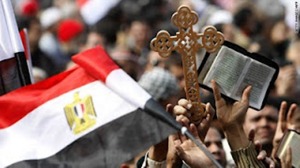
Flag Cross Quran

God,

In the coming days Egypt will vote. The question is not who, but how many.

The incumbent is expected to win in a landslide. Even his opponent supports him.

But with so little at stake, so much is at stake, God: Legitimacy, at home and abroad.

No doubt the president is still popular. In the eyes of many he saved a nation.

No doubt the economy is taking its toll. In the eyes of many his policies impoverish.

Egyptians can endure, God, and strengthen them in it. They can also vote, as they have demonstrated repeatedly.

Increase their agency. May they use their voice wisely.

So this week upcoming, God, take the pulse of the nation.

Are Egyptians enthused and eager to show it? Drive high the turnout.

Are Egyptians content and at peace with affairs? Let continue the mandate.

Are Egyptians accepting but with disappointment? Interpret well their absence.

Are Egyptians opposing but without like choice? Make positive their anger.

God, Egypt is at a critical moment. Elections communicate the will of the people.

May they speak, may they be heard, and may they be respected—at home and abroad.

Give Egypt four good years through the man of your choice.

You know the who and the many. Make clear the how. Bless fully the why.

Lead Egypt to peace and prosperity.

Amen.

Categories
Prayers

Friday Prayers for Egypt: Citizens, Foreign

Flag Cross Quran

God,

The citizen abroad is vulnerable. A foreign culture is hard to navigate with ways and threats uncertain.

The citizen at home is vulnerable. A foreign media is hard to navigate with news and biases uncertain.

So God, give discernment.

A number of recent cases emerged where Egyptians have been assaulted in other countries. One, a female teenage student, just died from injuries suffered in London.

Authorities are following up the incidents, by urging joint measures to monitor the legal process.

A number of recent articles emerged where Egyptians are accused of violations in their country. One, a British outlet, saw an alleged female torture subject deny their reporting about her.

Authorities are following up on the incidents, by urging citizen awareness to prompt a legal process.

God, give Egypt wisdom with the outside world.

A foreign culture sparks creative innovation. A foreign media offers alternate perspective. Both are healthy. Both are dangerous.

So help Egypt pursue justice for its citizens abroad. May they live in peace and mutual positive crosspollination.

And help Egypt promote truth for its citizens at home. May they live in peace with multiple accurate source-publication.

God, the world is uncertain; humanity, vulnerable.

Home or abroad, navigate the Egyptian. But may home, especially, be blessed.

Amen.

Categories
Christianity Today Middle East Published Articles

Is ISIS Really Muslim?

This article was first published in the March print edition of Christianity Today.

Is ISIS Really Muslim

For Egyptian Christians, 2017 was the deadliest modern year on record. At least 87 were killed by terrorists.

But despite being labeled by ISIS as its “favorite prey,” Copts were only 12 percent of such fatalities last year. Far more Muslims died in extremist violence at the hand of fellow believers.

Unless they aren’t believers at all.

If American Christians often don’t know how to understand Islam, they can take some comfort knowing that Egyptian Muslims struggle too.

A tragic case study occurred in December, when more than 300 people were killed at a Sinai mosque belonging to a Sufi order. Sufi Muslims are known for their mystical practices in search of spiritual communion with God. Many also seek intercession at the graves of Muslim saints.

In casual but solemn conversation at an upper-class organization in Cairo, one well-educated Egyptian woman reflected on the tragedy with colleagues. “Yes, but they are Sufis,” she said. “They’re not really Muslims.”

The woman was not making light of the massacre, nor justifying it. But she had internalized a message preached by another type of Muslim—Salafis—who judge Sufi practices to be outside the bounds of orthodox Islam. And when Salafis become jihadists, they may well kill Sufis as apostates.

In angry conversation with a middle-class taxi driver in Cairo, one typical Egyptian denounced ISIS for its crimes against both mosques and churches. “No, we can’t say that they aren’t Muslims,” he said. “Of course they are.”

What causes such confusion? Innocent victims, praying in a mosque, are placed outside of Islam while murderers, salivating at the entrance, remain in the faith?

At issue is a pernicious concept in the Muslim world called takfir in Arabic. It means the process of calling someone a kafir—an infidel…

Please click here to read the full article at Christianity Today.

Categories
Prayers

Friday Prayers for Egypt: Crown Prince Visit

Flag Cross Quran

God,

It was a high-profile visit, with high-profile rhetoric. The Saudi crown prince took his first foreign policy travels, spending several days in Egypt.

He spoke of economy. The joint megacity is a future boon.

He spoke of terrorism. Turkey and Qatar need isolation.

He spoke of religion. Copts are beloved and Azhar restored.

He spoke of culture. The opera was visited and is coming to Saudi.

God, these are words to consider. They are words many question. Guide Saudi Arabia between rhetoric and reality. Transform the kingdom to mirror your will.

But God, in this relationship, bless also Egypt.

May the projects respect sovereignty and prosper the nation.

May terrorism subside, no matter its source.

May the religious respect others and hearten the nation.

May culture inspire, no matter its form.

God, give peace between nations, both near and far. Raise the profile of Egypt; may her morals be high.

Amen.

Categories
Current Events

Friday Prayers for Egypt: BBC, Insurance

Flag Cross Quran

God,

Much of life depends on trust. Trust is based on credibility. Credibility comes from faithfulness.

Speaking truth or demonstrating care, guard this deposit in Egypt.

The BBC published a report on widespread torture and forced disappearances. The authorities balked, saying sources are biased – and perhaps the BBC itself.

Later, a ‘disappeared’ woman appeared on TV, denying BBC’s claims. Egypt demanded an apology, suspended cooperation, and threatened to prosecute.

God, you know. Good journalism is crucial, but it is based largely on trust.

Let not the news manipulate it. Let not the government discredit it.

Where trust is abused, expose. Where mistakes are made, correct.

Further transparency, strengthen accountability.

Judge, truthful God, in this world and the next.

The government launched a program offering social insurance to temporary workers. Without regular hire or injury compensation, the certificates give guaranteed payment in case of disruption.

It appears to be a boon to the poor, an additional benefit for employers to issue. But it is also a tool for financial inclusion, strengthening banking and market analysis.

God, you know. Good insurance is crucial, but it is based largely on trust.

Let not the poor be manipulated. Let not the elite be discredited.

Where there is genuine need, assist. Where there is worthy method, employ.

Further compassion, strengthen economy.

Bless, caring God, in this world and the next.

Too many trust too few. Too many are undeserving.

But God, make—or keep—faithful the many in Egypt. Keep—or make—credible her word.

In trusting you, may she prove trustworthy.

Amen.

Categories
Christianity Today Middle East Published Articles

Holy Sepulcher Will Reopen After Jerusalem Suspends Church Tax Grab

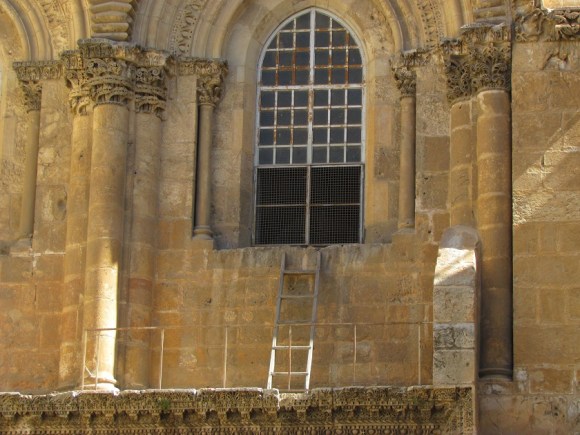
Immovable Ladder Holy Sepulcher

This article was originally published on February 27, at Christianity Today.

Israel suspended a controversial tax plan and property legislation today in response to the unprecedented Christian decision on Sunday to close the Church of the Holy Sepulchre in Jerusalem.

Prime Minister Benjamin Netanyahu and Jerusalem Mayor Nir Barkat agreed to form a government committee to “formulate a solution” and negotiate with church officials.

In response, the leaders of the Roman Catholic, Greek Orthodox, and Armenian clergy will reopen the church on Wednesday, reports the Associated Press.

Barkat had stated that Jerusalem’s churches owed more than $180 million in taxes on church-owned commercial properties, and the municipality had frozen church accounts.

Meanwhile, legislation advancing in the Knesset had threatened to complicate the churches’ ability to sell their properties.

Now suspended, these actions were contrary to the historic agreement between churches and the various civil authorities which ruled Jerusalem, said Bishop Sani Azar.

His Evangelical Lutheran Church in Jordan and the Holy Land closed its Church of the Redeemer for one day in solidarity, pending consultations with sister churches in Jerusalem.

“All the churches are united, so this shows something is very wrong,” said Salim Munayer, head of the Musalaha reconciliation ministry in Jerusalem.

“It is an unbelievable step, though Christians in the West have a hard time understanding.”

Please click here to read the full article at Christianity Today.

Categories
Prayers

Friday Prayers for Egypt: Energy Hub

Flag Cross Quran

God,

It has long been an ambition. Now it is becoming reality. But strange the one who makes it happen.

Egypt is an energy hub.

Not long ago she sold off share at cut rate prices. Not long after that she was begging fuel from international partners.

Then an enormous natural gas field was discovered, giving promise of self-sufficiency.

Came the bombshell: Importing more.

Came the explanation: To liquify, and then export.

Came the confusion: Israel.

As some gasped at the deal the government nodded. Private sector, but an awaited development.

Given infrastructure and a large consumer market, Egypt positioned herself to profit from regional exploration and extraction.

Israel is the first client, having discovered large fields shortly before. Others may emerge.

God, may they find a good partner.

Help shared economics promote common peace. Egypt has strengthened ties with Greece and Cyprus; now even Israel is drawn closer.

Keep contested economics from sparking further tensions. Turkey eyes developments warily; Sudan and Ethiopia jostle over Nile water.

God, there are details to confirm and obstacles to overcome.

But bless Egypt in the management of her resources. May she build a foundation, and distribute well.

Let not her ambition trump her reality. She is still a long way from prosperity.

But God, let it happen. Allow Egypt to rise.

Amen.


Categories
Prayers

Friday Prayers for Egypt: Documents, Deals

Flag Cross Quran

God,

The intrigue peaked as candidates emerged. It tempered as they fell.

But it continues still.

The running mate of a now detained general threatened release of secret documents that would embarrass the army.

The general disputed, as his partner joined in confinement.

And then a third, unrelated.

A former popular presidential candidate, not running now, boldly bashed the whole enterprise.

He is now in custody, accused of making deals with the Muslim Brotherhood, to which he once belonged.

God, reveal. Let Egypt have no secrets.

Where she has enemies, bring them to light. Where she has sinned, bring her to repentance.

Keep her accountable, and keep her safe.

In the days that followed several parties responded by pledging to bring out the vote. They asked for greater openness in the political system, but condemned destabilizing calls for boycott.

Bring the right balance, God, and bless those on both sides.

May it be that all seek Egypt’s best in sincerity, and find a way forward together.

But let the people deliver their message, and let it be heard and interpreted well.

Let it lead to transparent governance. Let it lead to prosperity and peace.

Let the documents be open. Let the deals be social contract.

Let the intrigue pass, and public policy prevail.

For the good of Egypt, God. Temper it not, nor let it fall.

Amen.

Categories
Prayers

Friday Prayers for Egypt: Operation Sinai

Flag Cross Quran

God,

There are three weeks left. Following a terrorist attack that killed 300 worshipers at a mosque in Sinai, the president gave a three-month ultimatum to the military and police to eliminate terrorism.

Today, Operation Sinai was launched. By land, air, and sea, in the desert and the Nile valley, a massive deployment seeks to fulfill the president’s call.

Parliament, al-Azhar, and the Orthodox church have all signaled their support. Perhaps the next few days will be telling.

But proof comes in the next few weeks. Terrorism hides easily. And surely many wish to disrupt the coming presidential elections.

God, protect.

Guide security to hideouts and depots.

Shield civilians from wayward fire.

Redeem terrorists from the judgment of Hell.

In the days to come, God, death counts will rise. Comfort the families, strengthen the nation.

Let the operation be decisive. Purge Egypt from the scourge that has plagued her.

May she seek peace, and pursue it.

Amen.


Categories
Christianity Today Middle East Published Articles

To Defend Mideast Christians, Can Advocates Critique Islam?

Advocates Critique Islam
Photo by Win McNamee/Getty Images

This article was first published in the January print edition of Christianity Today.

What’s the best way for Middle Eastern Christians in America to help fellow believers back home? A single misspelled email address inadvertently revealed the breadth of this dilemma for activists in the diaspora.

The mishap sparked a spat this summer between two prominent US Arab groups: the Arab American Institute (AAI), a polling and policy organization led by James Zogby, and Coptic Solidarity (CS), which champions the religious freedom of Egyptian Christians and other minorities.

Zogby, who has a Lebanese Maronite background, was a scheduled participant in CS’s annual Washington conference, which leaders often use to advise DC’s foreign policy establishment on Middle East issues.

But two days before the June 15 conference, Zogby unexpectedly withdrew.

Zogby explained in an article weeks later that he withdrew after receiving word that some controversial anti-Muslim “hate groups” would be at the conference and that the title of a panel in which he was participating had been revised to suggest that violence and impunity are endemic in Muslim and Egyptian culture.

“The best way to reinforce the message of the haters of Christians in Egypt is by giving them the ammunition that Copts in the US are working with Islamophobes in Washington,” Zogby told CT. “I felt it important to call out CS for what I strongly believe is a wrong-headed and potentially dangerous path.”

Stunned by Zogby’s withdrawal and his public criticism, CS wrote an angry response, accusing Zogby of a “dhimmi mentality,” a reference to the secondary status of non-Muslims in the historic caliphate.

“He intentionally tried to hijack our event and tarnish our reputation,” Lindsay Griffin, CS’s director of advocacy and development, told CT.

According to organizers, participants had received the revised speaker list and panel names a full month before the conference. But Zogby didn’t. His email address was misspelled, so he never received a May 9 message outlining the changes that later led him to withdraw.

But while the spark that ignited the conflict between the groups was an honest mistake, the issues at the center of the dilemma are real…

Please click here to read the full article at Christianity Today.

Categories
Prayers

Friday Prayers for Egypt: Candidates Set

Flag Cross Quran

God,

After much drama, the result may be straightforward. The presidential election will pit the incumbent against the head of one of Egypt’s smaller parties.

The candidate, who registered at the last minute, is also on record as one of the incumbent’s strongest supporters.

Some say he is there for show. He says he is there to win, but also in support of Egypt’s democratic development.

Without him, the election would be referendum.

So God, develop.

May these elections spur conversation on government policy.

May they spur growth of all allied parties.

May they give options to forces inclined toward a boycott.

May they give voice to the people in endorsement or change.

Some say the result has been predetermined. With you, God, it has, and make clear the path.

Allow these elections to move Egypt straightforward. Dramatic or not, guide her to peace.

Amen.

Categories
Prayers

Friday Prayers for Egypt: Settling the Field

Flag Cross Quran

God,

It is the highest post in the land, and therefore the most critical.

Fill it with the man of your choosing, but give the people a valid choice.

One once-popular candidate revised his desire to run.

One once-powerful general fudged his ability to run.

One once-marginal activist decried the procedures to run.

One still-notable politician tests the waters to run.

One still-controversial professor might be the first female to run.

One still-flamboyant chairman lingers, perhaps the only to run.

God, bring forward the right and true. Shield Egypt from ill agenda and lawless ambition. Give her candidates of judicious mind and servant heart.

And of them, of all them, give wisdom to the people.

Four years is a long time, God, and these four years are critical.

Settle the field, and settle the nation.

In her candidates, and of the one, lead her free to fields of peace.

Amen.

Categories
Americas Biola Published Articles

Good Mourning America

Good Mourning America

This article was originally published at The Table, of Biola University’s Center for Christian Thought.

In the days leading up to our presidential election, it seemed quite clear that Christians were not happy. But the ennui went beyond politics toward a greater sense that America was changing.

The unhappiness was rooted in good reason. Our principles were lambasted as backward, our policy stances were labeled as bigoted, personalities were labeled as bigots, and our politics were lowered into bouts of bravado. There seemed little for Christians to celebrate, save the requisite reference to our Lord and Savior Jesus Christ.

And then Trump won. Some rejoiced, while others cringed. But I suggest whether salve or acid, the underlying sentiment remains fundamentally unchanged.

With our eyes on the world and our changing national fortunes, we appear marked by vindication or frustration, tempted to pride or anger, either way ready to lash out ineffectively at our culture at large. Since apparently Jesus cannot keep us happy, perhaps with him we should try being sad?

But being sad is no cure all, either. Some of different temperament instead yield to depression, tempted to flagellation, ready to grumble unhelpfully at our Christian culture at large.

Being sad is an emotional response, much like being angry. Whether red, blue, or annoyed we are reacting to circumstances, and we should not be too harsh with ourselves. God has given us our emotions, and they are wonderful tools to tell us something is wrong, or at least, different.

For America is different, in her religious composition. Perhaps America is also wrong, in her moral choices. But God invites us first to examine ourselves, requiring of all a greater humility. But to get there, a step beyond sadness is needed, evoking a suffering we are conditioned to dread.

As American Christians, we must choose to mourn that which is different, and that which may also be wrong.

Mourning, unfortunately, carries with it the connotation of defeat, of finality. We know what it means to mourn over the death of a loved one, but here we must mourn over the death of an idea.

I posit that for so many Americans, our fundamental unhappiness stems from an inability to let go of our dream of a Christ-centered nation.

Nor should we. But to find peace we must understand what it means to mourn, to grieve. In the loss of a loved one, we recognize the fact that he or she is gone. The suffering comes not from the death primarily, but from every unfulfilled expectation, every lost hope, every dream for the future that will now never be. Mourning is the necessary surrender thereof.

America is changing, we Christians feel. But we have been reluctant to admit she has already changed. Denial is often the first resistance to grief, pushing off the uncomfortable mourning. Poll after poll bears out the fact, however, that Christianity is losing its national prominence.

Christianity Today recently ran a series analyzing the trends, and one of the most poignant is this: In a 1967 Gallop survey, two percent of Americans identified themselves with no religion; in 2015, a Pew survey finds the now-ascendant “nones” at 23 percent.

Nearly one-quarter of Americans have no religious affiliation. That is a fact very near to a flatline.

Proper mourning, however, must identify the body. Though we cannot be happy, Jesus is still Lord and Savior. It is not Christianity that has died, and neither the church. The polls bear out this fact as well.

A Gallop survey in 1940 found 37 percent of Americans saying “yes” when asked if they attend church weekly. In 2015, the number dropped all the way to an astounding, wait for it, 36 percent.

Church going Americans are as numerous now as they have long been. What has changed, then? Where have the nones come from? In 1972 a GSS survey found mainline Christians to be 28 percent of the population. By 2014, they were only 12 percent. And as the former standard bearers of Christian civil religion eroded, evangelical Christians have grown to 23 percent.

Nearly one-quarter of Americans are evangelical Christians. That too is a fact, but it is not a pulse. Christianity in America is not dead, but Christian America? Yes.

At this point, it must become personal. I have my story to tell, but that is not what I mean. Every death is mourned differently by every bereaved. Two sons of a deceased mother will each grieve uniquely, for they had different hopes, dreams, and expectations for the life they no longer share with her. One cannot say to the other, “I know how you feel,” no matter the similarity of experience, nor the true comfort they can exchange.

The author of the Christianity Today series reflects on these religious demographic changes and says it may not be a bad thing. As nominal Christian expression recedes it gives the church more opportunity to correctly present the gospel life of discipleship.

Perhaps he is right. Of the 70 percent (according to a 2014 Pew survey) of Americans who identify as Christian, he divides them into rough statistical thirds: Cultural, due to birth and inherited identity; Congregational, due to communal attachment; and Convictional, due to belief and practice.

I do not disagree with his assessment nor the necessity of distinction. An evangelical reading of the Bible emphasizes the eternal importance of personal faith and practice. But as one in his category of convictional Christians, I mourn over our separation from the whole.

Perhaps I am wrong to mourn. Many evangelicals of my youth warned instead to mourn over those who falsely understood themselves to be Christians just because they were born into a household that attends church that way. One must be “born again,” said Jesus. Perhaps those who emphasize this message find vindication they have fewer mainline Christians to mourn over?

Likely not. Their sentiment is genuine, and their concern is real. Their witness comes from the heart. They love their fellow man, and they love America beside. For many, transforming the former is a means to preserve the latter. Some need patience, to endure their zeal. Others give praise, as their lives have been changed.

I, however, rightly belong to all three of the author’s categories. I was born into a Christian home. I value belonging to a Christian people. I adhere to time-honored Christian convictions.

Evangelical faith cherishes and nurtures all three. But I find the statistics are ripping away two-thirds of those who might otherwise be counted with me. And with them is ripped away the Christian ethos of America.

This is the death that I mourn—the hollowed out corpse of a once Christian nation. With it dies the expectation of my country’s inherent goodness, the hope of nominals still near to the gospel, and the dream of enduring Christ-infused values.

But again, some might rejoice that true faith is made clear. “We should be less American, and more Christian,” is a statement increasingly heard from many in the pews. Once more, I do not disagree.

But another tool to postpone mourning is improper substitution. Less apt if comparing to the death of a loved one, consider the reaction if your dog dies, or your girlfriend breaks up with you. How many people offer false comfort with the well intentioned words, “Just get another one?” And perhaps you will, wanting the replacement to fit the hopes you had for the old. Rarely does it work.

The dream of a Christ-honoring culture cannot be replaced by substituting out America for a more singular Christian priority. Likely a needed corrective, but it does not address the pain.

Nor do the more common reactions of striving harder and fighting back. How many people have you met who numb the loss of a loved one by drowning themselves in activity? Even if done to honor the deceased, it leaves unaddressed the underlying grief.

Many evangelical thinkers have outlined their “what do we do now?” strategies. Some say we should embrace our role as a prophetic minority. Others suggest we must reclaim the institutions of cultural influence. Some recommend a renewal in the church. Others encourage a revived evangelism.

Each is likely a fine way forward. But not yet. Wait. Rest. Mourn. Identify the dream you had, cry, and humbly suffer. Then, let it go.

What Christians attained in America past may or may not have been God’s will. Undoubtedly it fell short of his ideal. In so many ways, it was good. And as long as we live here, we have obligations to seek her best.

But the fact at this moment is that America is moving on from her Christian heritage. Perhaps I am wrong, but it is sorrowful that something so precious is being lost, a glue that holds much together.

Yet a loss fully mourned brings healing. Healing brings wholeness. Christ brings completeness. From here, God can give us new hopes, dreams, and expectations for ourselves and our nation, fitting a new reality.

American Christians—triumphant or frustrated, depressed or angry, denying or striving, of any and all statistical categories—should dream with him. The nones are waiting, as is Jesus, our Lord and Savior.


Categories
Prayers

Friday Prayers for Egypt: Nation, City, River

Flag Cross Quran

God,

To present an idea, men come together. To discuss, they meet. Three conferences this week convened weighty issues.

Human contact helps relations. Human hubris may drive apart. But the ideas matter, and make a difference.

President Sisi presented the accomplishments of his four years in office. From national projects to economic reform, it may be the prelude to his reelection campaign.

God, give eyes to the people to see Egypt rightly. Where there is success, to celebrate. Where there is question, to examine. And whether or not he runs again, to vote.

The Azhar rallied for the sanctity of Jerusalem after US disruption of the status quo. Muslim and Christian, Palestinian and Arab, it aims to increase pressure from the international community.

God, give eyes to the world to see Israel rightly. Where there is negotiation, to encourage. Where there is posturing, to expose. And whether or not an embassy moves, to seek justice.

The Nile River commanded the attention of Egypt and Ethiopia. The two presidents met to revive deliberation on a steadily constructing dam.

God, give eyes to the nations to see water rightly. Where there is complication, to study. Where there is stalling, to speed. And whether or not consensus emerges, to drink.

Let the ideas settle. Let the conviction impact. Let the people reflect.

And in the end, God, reveal the right path forward. Let men meet and talk, but first pray. Be not absent, in any conference.

Amen.


Categories
Excerpts

How Many ISIS Jihadis in America?

ISIS Jihadis Returning
Photograph by Bram Janssen / AP, via the New Yorker

A recent edition of the New Yorker tackled the problem of ISIS fighters returning to their home countries. Given the controversies in the US about Muslim bans and extreme vetting, it is interesting to note other nations have it much worse:

A new report, to be released Tuesday by the Soufan Group and the Global Strategy Network, details some of the answers: At least fifty-six hundred people from thirty-three countries have already gone home—and most countries don’t yet have a head count.

On average, twenty to thirty per cent of the foreign fighters from Europe have already returned there—though it’s fifty per cent in Britain, Denmark, and Sweden. Thousands more who fought for ISIS are stuck near the borders of Turkey, Jordan, or Iraq, and are believed to be trying to get back to their home countries.

Dozens of governments face similar challenges. Earlier this year, President Vladimir Putin acknowledged that ten per cent of the more than nine thousand foreign fighters from Russia and the former Soviet republics who went to Syria or Iraq have come home. (In private, other Russians have given me higher numbers.)

The report, titled “Beyond the Caliphate: Foreign Fighters and the Threat of Returnees,” notes that countries in Southeast Asia, such as the Philippines, and in North Africa, such as Libya, are particularly vulnerable.

Here are some more numbers, concluding with America:

Over all, since 2011, more than forty thousand people, from more than a hundred and ten countries, travelled to join ISIS—in addition to the local Syrians and Iraqis who became fighters. Among these jihadis were seventy-four hundred from the West—five thousand of them from Europe.

So far, the numbers of ISIS fighters from the United States have been comparatively low.

More than two hundred and fifty Americans tried to leave the country to join the caliphate in Syria or Iraq.

About half—a hundred and twenty-nine—succeeded, the report says. Some were blocked.

Only seven of those who made it to the battlefield have returned. As of August, the United States has charged a hundred and thirty-five people for terrorism offenses linked to ISIS; seventy-seven have so far been convicted.

Of course, these are the numbers we know, and even small numbers are significant. Terrorists do not need major manpower to succeed.

Even so, allow statistics to guide conversation and the processing of spin. Ideology knows no borders, but two oceans provide valuable buffer.

So does an already robust processing system. Vigilance must never falter, but neither must we surrender to mischaracterization.

Those returning have rights. Muslims coming are human. Let us protect ourselves, but keep our soul.


Categories
Prayers

Friday Prayers for Egypt: Slow Boil

Flag Cross Quran

God,

The waters of Egypt are simmering. Lower the temperature.

The Nile is her lifeblood, and a dam in Ethiopia may impact historic share. But also threatened Sudan leans instead to Turkey, a Brotherhood-aligned adversary.

The Israelis are her neighbor, and a president in America complicates the status quo. But the New York Times published leaks that suggest a betrayal of Palestine.

The presidency is her backbone, and elections in March invite political review. But back-and-forth developments lend intrigue to potential candidacies.

God, give Egypt wisdom to navigate these challenges.

Provide water to all, and harness the river in widespread development. Keep the Red Sea from further militarization.

Provide transparency to all, and establish justice in fair negotiation. Keep the media from biased disinformation.

Provide agency to all, and validate a leader in contested consensus. Keep the politics from crass characterization.

God, give Egypt peace to impart in these challenges.

Christmas came, with a new cathedral named after the birth of such a prince.

May this spirit hover over the waters. Calm them, God. Peace, be still.

Amen.

Categories
Christianity Today Middle East Published Articles

Does One Huge New Church in Egypt Make Up for Troubles with 24 Small Ones?

Sisi New Coptic Cathedral
(via Ahram Online)

This article was first published at Christianity Today on January 10, 2018.

Celebrating Christmas with Egyptian Christians for the fourth consecutive year, President Abdel Fattah al-Sisi presented the largest gift under the tree: A new cathedral.

Sisi was the first president in Egypt’s history to even attend a Christmas mass. During last year’s celebration, he promised to build Egypt’s largest church and largest mosque in a yet-to-be-developed new administrative capital.

Three weeks earlier, 27 people had been killed in a suicide bombing in a chapel adjacent the old cathedral and papal residence, St. Mark’s in Cairo.

“Evil, destruction, and killing will never defeat goodness, peace, and love,” Sisi said at this month’s cathedral inauguration. “We are one, and you are our families. No one can ever divide us.”

Coptic Orthodox Pope Tawadros II called the new church, named The Nativity of Christ, a “divine arrangement.”

But also…


One week prior to the Helwan incident, a church in Atfih, 60 miles south of Cairo, was ransacked—not by terrorists, but by dozens of local Muslims offended by the rumor that a bell would be installed in the unlicensed village church.

In a recent report by EIPR, Egypt witnessed 20 similar sectarian incidents at churches over a 13-month period. Ibrahim said the total is now up to 24.

EIPR’s reporting timeframe began with the issuance of Egypt’s new church building law, meant to eliminate such problems…

Please click here to read the full article at Christianity Today.


Categories
Prayers

Friday Prayers for Egypt: Crimes and Executions

Flag Cross Quran

God,

When police do their job there is usually nothing remarkable to report. Society is protected, the blotter is filled.

Many thanks to you and them for Egypt’s low crime rate and day-to-day safety.

But recently three female singers have faced legal action over videos and public statements.

Seventy-five people and officials have been arrested for participation in a human trafficking ring.

And nineteen have been executed over terrorist violence.

These are not ordinary events, God, and the reporting reflects it.

The videos are said to promote debauchery. The ring was investigated for fourteen months. And the executions came after military court rulings.

There is little controversial over the human trafficking, except the exposure of official corruption. Weed it out, God, with full transparency.

But of the singers, some wish to protect the rights of speech, others the sensibility of society. Balance them, God, with no hypocrisy.

And of the executions, some criticize the trials as flawed while others praise the probity of the military. Exact justice, God, with all gravity.

Christmas is coming, with threats well known and procedures well studied. May the holiday pass with nothing remarkable.

Protect society, God, but leave blank the blotter. Help police stay alert. Help Egypt be righteous.

Amen.

Categories
Christianity Today Middle East Published Articles

Calvin of Arabia: Protestant Theology Translated into Arabic

John Calvin Arabic
Translation: Foundations of the Christian Religion, vol. 1, John Calvin. (via LSESD)

This article first appeared in the December edition of Christianity Today.

Most of the theological writings that shaped Western society over the last 500 years cannot be found on Middle Eastern bookshelves. Few Arabs have ever read anything from John Calvin, Jonathan Edwards, or Karl Barth.

The reason is simple: Almost none of the Protestant canon has been translated into Arabic.

The dearth of Christian religious texts in the world’s fourth-largest language is especially pronounced within Protestantism, which developed in European languages such as Latin, French, German, and English. The Reformation has barely broken into the Arabic-speaking world, dominated by Islam and where most local Christians—whose numbers are dwindling fast—are inheritors of Orthodox or Catholic theologies.

Nearly a decade ago, George Sabra, president of the Near East School of Theology (NEST) in Beirut, had the notion to translate perhaps the most influential writing of the Reformation, John Calvin’s Institutes of the Christian Religion, into Arabic for the first time.

Written by my colleague Griffin Paul Jackson, I contributed a section on Catholic efforts:

After years of checking thousands of footnotes, Sabra—who settled on a Baptist publisher based in Egypt for his 1,500-page tome—has realized the weight of clear, quality translation. But he’s not the only one counting the cost.

For Middle East Catholics, less than one percent of key texts are available in Arabic, said John Khalil, a priest who works at the Dominican Institute for Oriental Studies in Cairo. “Our bishops can access works in Italian or French,” he said. “But having nothing in Arabic results in fewer theologians. It is a problem.”

Khalil recently secured permission to publish translated and original Christian works, naming his imprint after Aquinas. He has begun revision of the Summa Theologica, translating volume two and hoping to complete the rest in the near future.

But the problem is not just with the classics. Few modern theological works have been translated into Arabic either. Only one book is available from the leading theologians behind the Second Vatican Council.

Khalil’s primary interest is social justice, and in May he published the first Arabic translation of Gustavo Gutiérrez’s benchmark A Theology of Liberation. A handful of books about liberation theology exist in Arabic, but until now, no original texts.

But even these pushed Christians toward participation in Tahrir Square demonstrations that led to the overthrow of Egypt’s government in 2011. One celebrated martyr of the revolution, Mina Daniel, was a leader in Khalil’s study group.

Since then, however, many Christians have soured on such theology. Khalil hopes translation can make a difference.

“I don’t imagine we will become like Latin America,” he said, “but I hope we will at least stop blaming our young people who are struggling for justice. Religion should criticize every political system, and the church must have a prophetic voice.”

Please click here to read the full article at Christianity Today.


Categories
Biola Middle East Published Articles

The Arrogance of Enemy Love: A Poem to ISIS

Arrogance of Enemy Love
An early 15th century Coptic prayer book from Ethiopia. View the full book at bit.ly/1XP8af8

This article was first published at The Table.

Many have been impressed by the forgiveness Coptic Christians have offered to their enemies. Beheaded, ambushed, churches bombed, shot in cold blood – they have not retaliated. Instead, though anger boils, they pray for their persecutors.

In the links above you can explore the opportunities I have had to write about this suffering community, and in one article I partially translated a poem circulated on social media that one Copt directed to ISIS. The Arabic original is here, and the full translation is below:

I will not speak (as some have done)

And curse your religion whatever its name.

I have come that it be known:

My fathers’ religion and what it proclaims.

My fathers’ religion has love at its heart,

The meaning of which will call you to peace.

My fathers’ religion, right from the start

Offers forbearance that conflict will cease.

Your hatred and killing in no way suffices

To stop us from loving and praying for you.

My father’s religion, oh dear Uncle ISIS,

Is not a weapon to pierce you straight through.

I wish that you could come to see

Or just one time the answer seek.

That while you bomb and murder, we

Stay strong as if a mountain peak.

My fathers’ religion of spirit consists.

It is not a body whose end is the dust.

And for the spirit—despite death persists—

Awaiting are loved ones residing in trust.

My fathers’ religion, if you could discern,

Offers each wounded the medic of life.

Tomorrow when you will repent and return,

You will come to know just who is the Christ.


It is a phenomenal sentiment. Which is why I was surprised – and then cut to the core – when my Egyptian friend helping me translate it called it: Haughty.

When I showed him my translation he said: Well done. It is even more arrogant than the original.

My friend is a Muslim, but non-practicing, with a respectful dismissal of religion in general. Perhaps one can say such a person of any background might be offended by strong claims of religious conviction. I have previously written critically when it is labeled bigotry.

I don’t think this is true of my friend. He has a generous heart and speaks tongue-in-cheek. But while I cannot judge the heart of the one who wrote the poem, I can discern the heart of the one who translated it.

And my friend is right.

It is my job to represent what I understand to be the reality of Egypt. This poem, I believe, is an authentic expression of the Coptic community.

But it is more than that. It is an expression of the way I would like the Coptic community to be. Many are not there. Many struggle. Yet many of them hold as an ideal that this is what their Christianity calls for.

So the poem represents also my conviction, but once again more. It represents my triumphalism, my sense of the moral superiority of Christianity. I have written about this before, and it is not necessarily damning. We all judge deficient that which we find to be false.

These days, much of the world says this should not be done with religion. Fair enough. It is hard to weigh between metaphysical matters. Even so, is it not right to let each religion be tested according to its merits, its morals, and its history? Few issues are as important, once one believes in an eternity.

But set all that aside. When I translated the poem I was rejoicing in more than my conviction, I was rejoicing in my identity. When I shared it in the article I was not just encouraging fellow Christian readers with the example of brothers-in-faith. I was encouraging also an us-versus-them mentality.

The ‘them’ is everyone else. There is nothing in it particularly against Islam, but Islam is the context. In Egypt, Christians are surrounded. In America, we are media saturated. I wish to be of generous heart toward Muslims and their faith. This too, with the yearning expressed in the poem, is part of what I understand to be Christianity.

But is that yearning for the glory of God, or the wholeness of my fellow man? Too often, it is the yearning for a pat on the back, the placement on a pedestal. And who better to offer, than a forgiving, grieving woman turned into an icon? Do I truly care for her in the loss of her son or husband? Or do I care for the message we can make out of her?

This is haughtiness. This is arrogance. My friend knows me well, and I’m afraid he exposed me. At the least, he helped God reveal.

Perhaps a bit of Arabic and Egyptian context is helpful. The opening line of the poem, my friend explained, recalls a verse from the popular poet Gamal Bakheet. “Their fathers’ religion, what is its name?” was written at the time of the 2011 revolution, and is a thinly veiled jibe at the Muslim Brotherhood. (See his Arabic recital here.)

The poem speaks of “our fathers’ religion” in the context of sublime values. It praises not only Islam, but also Christianity and Judaism – and even the non-monotheistic religions. And it criticizes those outsiders who want to bring something more defined, more exclusive, and more politically instrumental to Egypt.

My friend has no love for the Muslim Brotherhood, but his father – of whom he speaks respectfully – was a regional leader.

There is another context, even more illustrative. “Your fathers’ religion” is a common insult in Egypt. You can say it to anyone, regardless of their faith, to curse them and their whole ancestry.

In this light, the Coptic poem dips deep into Egyptian waters. It says it will not curse – but even in mentioning the phrase it practically does. It is a redirect, yes, to speak instead of “my fathers’ religion.” But it is soaked in the context from which it emerges. How many Copts have heard this expression hurled by wayward Muslims?

So let us salute them all the more, when they rise above and bless those who go far beyond insult. But remember, and be chastened by, the inherent temptation to pride.

The Bible tells a story of Abraham coming back from a battle, reclaiming his goods taken during a regional war. Upon meeting a friendly king he receives a blessing and yields a tenth of the spoils.

New Testament commentary establishes this king as a prefiguration of Jesus, establishing his covenant of grace as superior to the covenant of law that would be developed through Abraham’s descendants.

For the non-Christian reader, allow the logic to be complicated. But note the verse concerning Abraham and the king. “And without doubt, the lesser person is blessed by the greater.”

How easy it is, when we rightly note and idealistically contemplate the near-impossible calling to bless the enemy, to put ourselves in that superior posture. How easy it is to imagine ourselves in a greater community.

How easy it is to be haughty.

Is the poem a healthy encouragement and impassioned exhortation, or an arrogant celebration and smug self-validation? Only the poet knows.

The translator? The question hits too close to home. It is better to lean toward repentance.

How many of us should consider similarly?