The conflict has turned a corner as the Syrian government regained control of Damascus and begins pushing into rebel-held areas.
LobeLog interviewed Josh Landis of Syria Comment to ask him what happens next. The full interview is worth reading, but here are a few excerpts on competing regional policies.
Turkey:
Idlib was one of the poorer regions of Syria. It was a Muslim Brotherhood and rather Salafi place before the revolution. Now it’s become a dumping ground for all of the defeated rebel forces that have been pushed out of the various rebel pockets. They’ve all been pushed into Idlib, and it’s become this very unhappy collecting point.
Today we’re seeing lots of violence there internally, between militias that are vying for supremacy. But also, Turkey is protecting Idlib. Turkey does not want it to be conquered, because in doing so Assad would push tens of thousands of militia fighters into Turkey. That will make the refugee problem much more difficult for Turkey and saddle Turkey with up to 100,000 hardened rebel fighters, many of whom have links to al-Qaeda.
This gives Turkey a lot of incentive to take Idlib province and try to set up a satellite statelet that can act as a holding province for these rebels.
Israel:
Israel wants Syria to remain weak. The civil war has opened up a lot of potential for advances on Israel’s northern border. It’s destabilized that border, but at the same time it’s weakened Assad tremendously. He’s no longer a military threat to Israel, and the militias that are now along the border also don’t pose a threat.
Even if they have links to the Islamic State or al-Qaeda they’re small and have no missile capabilities or other advanced military technology. Israel would like to be able to preserve those gains and consolidate its control over the Golan. It’s now pressing the United States to follow up on its Jerusalem recognition by recognizing the Golan as Israeli territory.
United States:
The U.S. has closed off all of the major highways out of Syria to the east. International trade for Syria has been blocked off and sanctions tightened. The U.S. is dead set against international organizations playing any role in Syrian redevelopment so the U.S. can continue to strangle Syria and keep it extremely poor.
You might argue that this is bad from a counterterrorism perspective because it will create more instability, but I think the U.S. is willing to pay that price because it won’t hurt the U.S. directly.
…
We’re not sure exactly what the U.S. is promoting in Syria, but all the talk coming out of Washington reflects an effort to squeeze Syria politically, economically, diplomatically, and militarily in order to unseat Assad and replace him with a government that’s going to be pro-West and anti-Iran.
This article was first published in the July print edition of Christianity Today.
War was swirling in Syria. Rebels were pressing. And Maan Bitar was the only hope for American help.
“Because I am evangelical, everyone thinks I have channels of communication,” said the pastor of the Presbyterian Church in Mhardeh. “Syrians believe the United States has the power to stop the conflict—if it wants to.”
In the early years of the civil war, Bitar’s Orthodox neighbors were desperate to convince the US and its allies to end support of rebel forces. Mhardeh, a Christian city 165 miles north of Damascus, was being shelled regularly from across the Orontes River.
But salvation came from a different source. Russian airpower turned the tide, and Syrian government-aligned troops drove the rebels from the area.
Russian intervention on behalf of Mideast Christians has pricked the conscience of many American evangelicals. Long conditioned to Cold War enmity, the question is entertained: Are they the good guys in the cradle of Christianity? Or are persecuted Christians just a handy excuse for political interests?
“The news tells us Russian troops are bringing peace to the region, said Vitaly Vlasenko, ambassador-at-large for the Russian Evangelical Alliance. “Maybe this is propaganda, but we don’t hear anything else.”
Please click here to read the full article at Christianity Today.
But here also is testimony from Egypt, unfortunately cut due to word count:
“If Russia helps anyone to save them from death and danger [in Syria], we welcome this,” said Boules Halim, spokesman for the Coptic Orthodox Church. “Not just for Christians, but for humanity.”
Halim had no comment on Russian political developments with Egypt. But despite technically not being in communion over disagreements with the fifth-century Chalcedonian Creed, relations with the Russian Orthodox Church are growing increasingly strong.
Pope Tawadros has met Putin. Theological students are being exchanged. Russian monks are touring Egyptian monasteries.
“We are coming together in dialogue,” Halim said. “Better communication leads to better understanding.”
For his lifelong commitment to religious peace, King Abdullah II of Jordan recently became the second Muslim ever to win the prestigious, $1.4 million Templeton Prize. And Jordan’s Christian minority is celebrating with him.
“I believe in our king,” said Imad Shehadeh, president of the Jordan Evangelical Theological Seminary, following Wednesday’s announcement. “He is a kind, wise, loving, humble, and effective leader.”
Established in 1973, the Templeton Prize is awarded for exceptional contribution to “affirming life’s spiritual dimension.” First given to Mother Teresa, previous winners range from Billy Graham to the Dalai Lama. More recently, Christian philosopher Alvin Plantinga and Jean Vanier of L’Arche have won the prize.
But this year, Abdullah was honored as a ruler who has done more promote inter-Islamic and interfaith harmony than any other living political leader, Templeton said.
Islam is the official religion of Jordan, and the constitution guarantees freedom of religion for minorities such as the roughly 2 percent of the population that’s Christian (mostly Greek Orthodox). The Protestant community joins them in commending their king’s efforts for religious unity, though some wish his commitment went even further…
Please click here to read the full article at Christianity Today.
This article was first published in the June print edition of Christianity Today.
Three brief excerpts in the efforts to unite evangelicals and Orthodox believers.
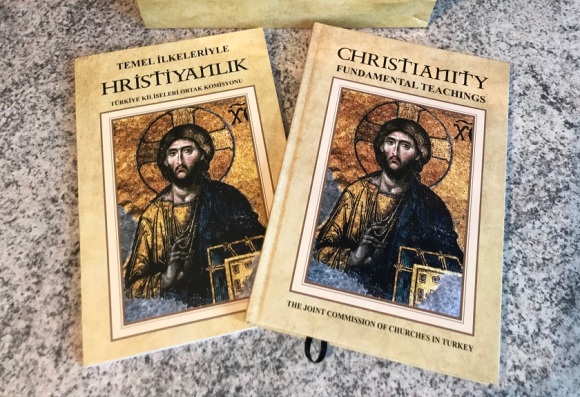
Four years ago in Istanbul, a humble Turkish book partially reversed the 11th century’s Great Schism. Catholics joined Eastern and Oriental Orthodox—alongside Protestants—to publish a slim, 12-chapter treatise on their common theological beliefs.
“You can’t find a page like this in all of church history,” said Sahak Mashalian, an Armenian Orthodox bishop and the principal scribe of Christianity: Basic Teachings. “It is akin to a miracle.”
If this is contemporary, here is history…
“The Copts largely resisted conversion,” Suriel wrote, “[but it] awakened in them a spirit of inquiry and an impulse to reform.”
Missionaries supplied Girgis [Orthodox founder of the Sunday School Movement] materials, and the Bible Society of Egypt gave him free or low-cost Bibles for his students, said Sinout Shenouda, the Orthodox vice-chair of its board. “The Americans initiated the idea, and the Orthodox came to imitate,” he said. “It was competition, but useful in that it profited from the missionaries rather than just attacking them.”
So what about the future?
Evangelical principles seep into traditional churches. Evangelicals do too—and the cross-pollination continues.
“I don’t think it is possible to overstate the influence of evangelical converts to Orthodoxy in terms of missions,” said Alex Goodwin, annual giving director for the Orthodox Christian Mission Center (OCMC). “It has been transformative for many of us who are ‘cradle Orthodox.’ ”
Please click here to read the full article at Christianity Today.
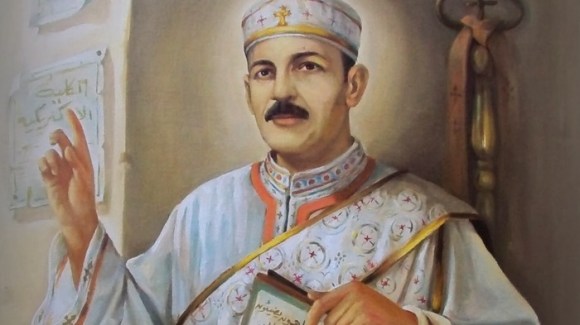
Habib Girgis, memorialized on the curtain separating the altar from the sanctuary of a Coptic Orthodox Church
This article was first published at Christianity Today on June 19, 2018.
My wife had just dropped off our kids at the local Coptic Orthodox Church we attend in Cairo and sat down with her Egyptian friend at the adjacent church-owned cafe. After initial pleasantries, she spoke of this current article I was then researching.
“Oh, do Americans have Sunday School also?” inquired the mother. “I never knew.”
My wife and I have lived in Egypt for nearly nine years and consider ourselves of evangelical faith. But we wish also to learn about ancient Christianity and, to the degree possible, worship within the Coptic Orthodox Church, which many Protestants here respectfully call “the mother church.”
We have been impressed by their biblical fluency. We have marveled at their forgiveness after martyrdom. But to entrust our own children to them?
We have been blown away by their care for the next generation. It takes two years of training to even teach a kindergartener.
It was not always so, and they have the Americans to thank—sort of.
This article is about Habib Girgis, the recently canonized Coptic saint who doubled as a humble educator. This past month the Coptic Orthodox Church celebrated the 100th anniversary of what he set in motion: the Sunday School Movement.
Girgis lamented the situation of his time, when Western missionaries were making inroads among the Copts.
But then again, they left fallow their own fields:
“Is there among us anyone who is capable of responding to those who ask him about his religion and why he is a Christian?” Girgis asked in a student lecture four years later.
“I am sure that most of us do not have an answer, except to say that we were born from Christian parents and hence we are Christians.”
Please read the article to see how Girgis sparked the solution, but spark it he did. Today the Coptic Church is among the most devout in the world. Here is testimony from one of Girgis’ disciples, who carried forward his teacher’s reforms once he reached the highest levels of the church:
Looking backward eight decades, the beloved Pope Shenouda III, known as “the teacher of generations,” described the solution with primordial imagery.
“Our teacher … started his life in an age that was almost void of religious education and knowledge,” said the patriarch, who died in 2012.
“Then, God said, ‘Let there be light,’ and there was light. And the light was Habib Girgis.”
Please click here to read the full article at Christianity Today.
And if you are interested in an earlier post, excerpting a book review on Habib Girgis, please click here.
Give Egyptians their right representation. May they bear well the concerns of their district.
But in whose name?
Many MPs have publicly signaled their intention to switch parties, and the Future of a Homeland is poised to receive them. Doing so would make them the largest party in parliament.
Some are current independents, leaving a coalition that recently hoped to become the majority party.
Some are rival partisans, leaving parties they deem to be failing and riven by internal disputes.
But all have prompted a legal question. The Constitution and parliament bylaws appear to bar any change in status while seated in office. The penalty is expulsion.
God, guide Egypt in this formative period.
Mergers are sensible. Attrition is natural. Institutions are rebuilding and like will find like.
But are you pleased?
The president has expressed hope that the political scene will coalesce.
Are these movements healthy, or manipulating? Do they serve the people? Do they serve the nation?
God, guide each politician’s heart and conscience. Guide the judges who may have to decide.
But not all representation is inside the parliament.
A number of activists were recently arrested, under a variety of charges. They vary in their opposition, but also aim to speak in the name of the people.
Give voice to that which is healthy. Where charges prove true, hold accountable the manipulative.
Guide each activist to serve the people. Guide each authority to serve the nation.
Guide also the judges who have to discern.
God, Egypt’s future is not yet determined. Choices and foundations lay a path forward.
But if the future is open, the homeland is ancient.
Give Egypt peace, you have preserved her before. Give Egypt hope, you have prospered her prior.
Give her good representation, to multiply both.
In whoever’s name they speak, may your will be done.
Fares Abraham grew up in the West Bank village of Beit Sahour, where tradition says the angels sang “Peace on Earth” to the startled shepherds. But his clearest memory is of his mother shot in the back by an Israeli soldier as she shuffled him and the neighborhood kids into her house during the first intifada.
Now in his mid-30s, the Liberty University graduate created Levant Ministries five years ago to mobilize Arab youth to fulfill the Great Commission.
And when he comes back home, he is at peace with his upbringing.
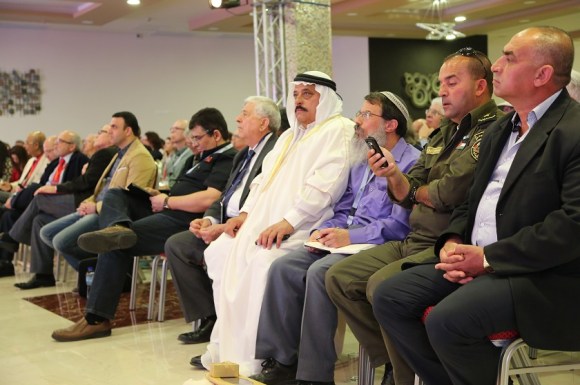
“When I was young, I asked myself if I should join the resistance or be a bystander,” he said to the 500 attendees—including 150 local Palestinian Christians—gathered in Bethlehem from 24 countries at the fourth biennial Christ at the Checkpoint (CATC) conference in 2016.
“But now I can go up to a checkpoint, look a soldier in the eye, and say, ‘I forgive you and love you in the name of Jesus.’”
Working also with global partners, Abraham believes the younger generations are pro-peace, becoming increasingly pro-justice the more their lives are transformed by the gospel.
It is a message communicated at CATC, though its anti-Christian Zionism is often criticized as anti-Israel…
Please click here to read the full article at Christianity Today.
Audience at CATC opening in 2016; credit: Andrew Larson
Ireland is in fierce debate over its future with abortion. Such high-stakes battles are often called a culture war.
Abortion, like war, is a terrible thing. Even if one believes it is necessary, it is still death. Defining it otherwise, depending on one’s convictions, makes it almost worse than war. It is the prevention of life.
From war, at least, can come great virtue. All too often, abortion comes because of convenience.
Except in Egypt. Even when a willful choice, it is anything but convenient.
The good journalists at Mada Masr wish Egypt could be otherwise. On Safe Abortion Day, September 28, they posted a heart-wrenching two-part article, telling three stories of women aborting.
So as background, here are the essential facts:
Egypt has one of the most restrictive abortion laws in the world. The law, which has remained largely unchanged since the 1930s, punishes women who intentionally abort a pregnancy with imprisonment. Abortion is not permitted on any grounds, including rape or incest.
The only exception is that a woman does not face punishment if she attempts to abort unsuccessfully. The Doctors Syndicate Code of Ethics also allows physicians to perform an abortion if the woman’s life or health is threatened, but this is a moral, not a legal, duty.
While there is a widespread assumption that this restrictive stance to abortion is rooted in religion, the origins of the law are colonial in nature. Articles that are still in force today were based on items in the French Penal Code.
The article does not tackle the controversy of whether abortion is legal in Islam. For those interested, here is how BBC and Wikipedia cover it. For many of our Muslim friends it is a non-issue.
But as will be seen, judicial rulings made little difference to the following three women.
Story one concerns a woman who had to hide away for her abortion, as she afterwards struggles with the morality of her choice.
Story two is of a woman in a forbidden relationship despite a knowing mother, which the abortion threatens if the wrong people find out.
Story three is of a married woman whose pregnancy puts her life in danger, only to be left unattended by doctors reluctant to get involved.
Please click here and here to read the article, but I’ve excerpted the most poignant sections below.
Story one
Had I been married, I would have had the abortion at home. There would have been no need to make up excuses to escape my family during that time. I would have been able to receive my friends at home, or at least I would have been able to use the bathroom freely without having to kneel whenever I passed in front of the window so the neighbors wouldn’t notice me.
Had I been married, I would have been able to go to any hospital as soon as the bleeding started. I would have been able to pretend that this was an accidental miscarriage and I would have received medical attention.
Had I been married, I would have received the news of my pregnancy differently, even if I decided to abort in the end.
Much of my resentment arose from the feeling that I was doing something illegal, even though it’s my own body. If I were in a different country, I might have been able to go to a hospital and request counseling. It’s disturbing not to be able to ask for help, to feel oppressed under a guardianship imposed by law and society.
…
Even though I had read over and over that a fertilized egg has no soul, I felt that I was killing my son or daughter. I felt the pain of loss and I was troubled by my questions:
Why did I have to do it this way? Perhaps I was worried more about the standard of living and the kind of life we had — if I didn’t have to struggle so much to eat and drink and do everything else, would I have opted to keep the baby?
Story two
I had always heard that male partners disappeared in these situations and that the whole relationship would end soon after. …
Every time I used the bathroom, he waited for me and took the sanitary pad to throw it away. This comforted me. I felt accepted. He wasn’t disgusted by my blood. I didn’t have to worry about the practicalities. I stayed focused on the pain I felt in my lower abdomen.
It’s such a false notion that only a husband will act responsibly and care for you — the notion that you should get married in order to have a man by you. No, the truth is that the man who took care of me during that period was one with whom I had what society sees as an illegitimate relationship.
…
Despite my persistent need to have a woman by my side at this time, I never imagined that my mother could be that woman. Our relationship wouldn’t allow it.
Everything I do goes against everything she believes in. I am in a relationship, which she knows about from Facebook. The idea of being in a relationship was itself too liberal for my conservative family.
The more important point was the future of my very small family, whose escape from my father was brought about by circumstances in which I played a key role.
Our separation from my father made my presence at home a source of strength to my mother. I was the eldest daughter and always supported her. I was the one who encouraged her to leave home when she was still with my father.
We were a family paying the price for choosing our own peace of mind. That price was living in a home beneath our social standing and having much less money to spend than we were previously accustomed.
So I faced a dilemma: If I left them, this might drive them back to my father. Also, if my father learned of this, he might force them to return, arguing that my pregnancy was proof that my mother was unable to handle us on her own.
Story three
I closed my eyes to the sight. My son was wrapped in a transparent plastic bag. His heart was beating slower and slower, until it came to a complete stop. I stopped screaming. My mother stopped crying. And I drifted out of consciousness.
I saw blood and wished I were asleep. I wished I hadn’t been awake for that experience, and that I didn’t relive it dozens of times in my nightmares.
I felt my soul escape my body to watch me from above. I was knocking my head against the wall. My sister’s skin was under my nails mixed with her blood. I grabbed at her with a strength I didn’t know I had.
She was crying, my mother screaming. My father was looking for the doctor who had already told us he wouldn’t help until he saw a head coming out of the womb.
“Haram [it’s wrong],” he said, very simply, judging me in my worst moment, as I both pitied and hated myself. From one in the afternoon until 11 at night, he left me to kill my son on my own.
…
The two doctors were in agreement, saying that the fetus would die. They provided the reports that they told me would allow me to have an abortion in any hospital.
I was allowed an abortion because I am a married woman and because the pregnancy was a risk to my health. They insisted, however, that neither would perform the abortion himself.
The first told me nicely that he doesn’t do abortions, and the second said that he wouldn’t do anything. I went to see a third doctor, but he was religious and said it was haram. His voice joined the first two: Even if I went through labor, I would still have a dead child. I surrendered.
…
I went home and listened to all the things I didn’t want to hear on that day. “You will be compensated. You will be rewarded. God’s will is never bad,” my family said.
…
Throughout, I felt my son resisting my body’s attempts to eject him. I was his home, but I was kicking him out. I was his safety, but I was expelling him. I felt him fight to stay alive, as I fought for him to die.
“Just open my stomach and get him out!” I screamed. I felt guiltiest at this point: He was still alive. His heart was still beating. My body wants to get rid of a living baby, a baby I claimed to love beyond belief, a baby whose ultrasound pictures I cherished, a baby whose every heartbeat was precious.
Every two weeks, I’d gone to the doctor just because I wanted to see this baby. But in that moment, I would have done anything just to get rid of him. I just wanted it to be over.
…
My father ran again through the corridors looking for someone to cut the cord, yelling like a man who was about to lose two lives, one of whom was struggling for his last breath.
Finally, the hospital manager intervened and severed the umbilical cord himself. He refused to give us any documentation of his involvement, or of any other doctor’s in my case, perhaps fearing legal ramifications. Before we left, and based on his request, a friend of my father’s, a gynecologist, came and cleaned my uterus in an operating room.
I walked to the room with blood dripping down my legs. My son was dead, and I was in a room lacking the most basic hygiene. I felt I was a woman having an abortion in a shady backroom clinic in Cairo.
…
I parted with my placenta and my faith. He departed to a new world, and I remained here for them to blame me for the loss. They forbade newlyweds from visiting me. “It’s a bad omen,” they said. I was faced with judgment from beginning to end. I was made to be guilty for a mistake I never made.
…
And then, a few months later I found out I was pregnant again and my first reaction was that I couldn’t deal with this.
I carried my pregnancy to term. I have a baby girl who is coping with a chronic disease for which there is no cure. I love her, and I accept her. My pregnancy and labor with her was very different. I continued to hear the same provocative consolations, however, things like, “You see, God rewarded you well.”
Story one struggled with guilt. Story two worried about shame. Story three was hit with religion.
Legal abortion in a culture of tolerance promises to do away with these pains. Pains they are, and they are not the only ones. The issues are real, and compassionate care is necessary.
There is forgiveness from guilt. There is freedom from shame. There is redemption in religion.
But I think that like war, abortion – legal or otherwise, necessary or convenient – would do well to keep its stigma. The barriers should be high, lest death, and life, lessen in sanctity. Like war, abortion should never become an easy option.
Like the reception of soldiers returning from war, however, all depends on a culture and community ready to embrace them.
Most pro-life people I am familiar with in the United States are like this. Media often depicts those angrily protesting in front of abortion clinics. I’m not sure who is more numerous, and there is no necessary distinction.
One can rail against cultural license one moment, and comfort a licentious teenager the next.
Listen to her stories. They may not be as frightful as the ones above. But they are all felt fully, in the moment, as a great war.
War is Hell? Yes. Abortion?
Whatever your answer, heaven is waiting. Consider both carefully in the ranking of priorities.
Hanna Maher’s wife is nine months pregnant, due any day now, with only four hours of daily electricity. Her two older boys scurry about in the dark, kept ignorant by parents about the dead at the border.
But it is hard to be ignorant in Gaza.
A Norwegian charity estimates 56 percent of children in the Palestinian territory suffer from traumatic nightmares. Suicide, rarely seen culturally, is a growing concern. Maher, an Egyptian-born Baptist pastor, says some at the border see death as the best option.
Two million people are squeezed into a coastal strip roughly the size of Philadelphia. Exit is severely restricted on one side by Israel. The waiting list into Egypt is 40,000 names long.
Unemployment is over 40 percent. Clean drinking water is hard to come by. And on May 14, as tens of thousands massed near a chain link fence demonstrating for their “Right to Return,” Israeli snipers picked off dozens.
“Monday was a hard day. But at least it is quiet now,” Maher said. “It has been bad for years. But conditions now are the worst I have seen.”
Maher went to Gaza in 2011, and married his local Palestinian wife a year later. His congregation is the strip’s only evangelical church, with about 60 regular members. Overall, Gaza’s Christian population is about 1,000, mostly Greek Orthodox; in the last 10 years, it has declined by a third.
Maher provides food aid to about 120 families. His marriage preparation classes are a crash course in how to nurture a family amid poverty.
And he says local Christians are critical of just about everyone…
Please click here to read the full article at Christianity Today.
By now, the tragedy is well known. Dozens of Palestinians in Gaza were killed by Israeli fire at the border separating the two territories.
Some were crossing illegally. Others were protesting.
Decide between the narratives, God. There is only one truth, however nuanced.
There may be guilt widely spread. There may be ample justification.
But there is blood. And the blood draws attention to another tragedy: the situation itself.
Gaza is suffering. God, give them hope.
But give them more. Give them consistent electricity. Give them clean water. Give them movement.
Egypt has opened its border with Gaza to allow some flow of people and goods, throughout Ramadan.
But afterwards, God? What future with Egypt? What future with Israel? What future with the West Bank?
What future at all?
Give wisdom to all. There are security threats. There are humanitarian concerns. There are issues of basic dignity.
It is likely the protests at the border will continue. It is likely that some will grow increasingly desperate. Some of these will give up. Some of these will act out.
Where there is power, let it serve humbly. Where there is need, answer it graciously.
God, Gaza is just part of a larger, intractable struggle. Unstuck it.
Bring peace to the people on all sides of divide. Help Egypt be a friend to many.
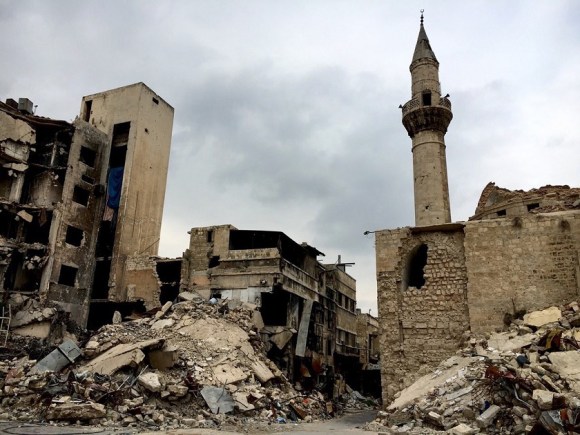
Children playing in Beit Sakhour, a neighbourhood in East Aleppo largely destroyed in Syria’s ongoing conflict (World Watch Monitor)
Following up on my recent article for World Watch Monitor, here is Part II of my interview with Miles Windsor, head of advocacy for Christian charity Middle East Concern.
These questions and answers were cut for length from the original, but I am pleased to share them here for the consideration of readers.
If you have your own viewpoint on who Syrian Christians support, even if in a personal capacity, please share.
It is important to recognize the extent to which situational dynamics influence statements of political allegiance, including by church leaders. Most Syrian Christians are in areas controlled by the Assad regime. The conflict situation also heightens the extent to which communities rely on patronage, a significant factor in Middle Eastern society even in peaceful times.
So we should not be surprised that church leaders readily voice support for President Assad. That is not to suggest that such articulations are empty, but rather that nuanced interpretation is usually necessary.
It can be simplistic to suggest ‘what the Bible says’ Syrian Christians should do. But are there Biblical principles you would counsel for them in the midst of a complicated state of difficulty? Might there be multiple options of God-honoring response?
We must guard against simplistic or overly prescriptive approaches. There is biblical basis and precedent for a range of responses to danger and persecution. The Apostle Paul who explained that ‘everyone who wants to live a godly life in Christ Jesus will be persecuted’ (2 Tim 3:11,12) is the same Apostle who fled from Damascus to escape murderous plots (Acts 9:23-25). Other times he challenged the injustice and brutality of an imminent public flogging based on his citizenship rights (Acts 22:25).
It can be tempting to offer reminders of basic principles such as “trust in God and his promises,” and “do not deny your faith.” Although well-intentioned, true, and important, such advice is usually obvious and can come across as crass over-spiritualization, especially if offered by outsiders.
Better is to defer to our Syrian and other Middle Eastern sisters and brothers who are ministering in the heat of conflict and refugee situations and whose profound theological reflection is now shaping their own ministry approaches.
For example, two themes that are regularly emphasized in relation to the Middle Eastern church are the importance of presence and the danger of victimhood. The importance of Christian presence in Syria is the prophetic role of the Church and the calling of Christ’s people as agents of reconciliation and transformation. The imperative of maintaining a witness to the love, hope, peace, and life of Christ in a context of hatred, hopelessness, conflict and death, helps to understand how vital it is for the salt and light of Christ’s people to permeate and help shape a post-conflict Syria.
To rise above the mentality of victimhood is to reject the vicious cycles of blame, demonization and revenge, to acknowledge the comparable suffering of many others, to build alliances with the majority which also strives for peaceful coexistence, and to reject the label of ‘minority,’ whether imposed by those seeking to control, or to protect.
These are rich seams to mine as Syrian Christians seek to respond in ways which honor God, but they should also be a challenge to the more comfortable and complacent parts of the global church!
Describe a little bit about how MEC can speak authoritatively on the subject.
An association of many Christians and Christian ministries in the Middle East and North Africa, Middle East Concern (MEC) supports those in the region who are marginalised, discriminated against or persecuted for being or becoming Christians. Through a wide network of church and ministry partnerships in the Middle East and North Africa (MENA) region, MEC seeks to provide support which is led by the priorities of MENA Christians. This support includes advocacy – challenging injustice and seeking to ensure that the voice of MENA Christians is heard and understood.
Please click here to read an excerpt of Part I, or here for the full article published at WWM.
Peace is pending in North Korea, while Iran is thrown in doubt.
Taxis fall out of favor, as private conveyance newly legalizes.
And metro prices have risen again.
Give guidance to Egypt in wading the waters.
The region has already been shaken. Will it shake further? Tehran and Tel Aviv. Damascus and Golan. A new embassy.
Let there be peace, God. Let there be justice. Right the past wrongs, without making new ones.
But change will always displace. Care well for taxis, even as new earnings—and costs—come to be. Does it make the world better? It does make it different.
Is Egypt prepared to change? Is she prepared to preserve? Discernment, God, and quickly.
May she know her friends. May she know her principles.
Remake her, God, in your image. Lest she be remade by others.
Egypt strives to be a good neighbor. She was once also a good host. What future does she desire?
What do you?
Over the past many months Egypt has cultivated its relationship with the Mediterranean nations of Greece and Cyprus. The have a sea to share, natural gas to protect, and economies to integrate.
They have similar vision for their region.
But this week they recalled their past. Egypt invited the two presidents to ‘Nostos,’ which in Greek means ‘return to roots.’ Thousands of Greeks and Cypriots used to live in Egypt, Alexandria in particular.
There are far fewer today. ‘Egypt for the Egyptians’ discouraged their welcome; over time, so did declining economy.
But Nostos celebrated their heritage, and invited their families back for a visit.
Their churches still function. The monastery at Mt. Sinai is theirs. Egypt is still much Mediterranean.
It is a beautiful neighborly gesture. But is it an openness for return?
God, bless Egypt in her hospitality. She is still a good host. African and Syrian refugees in the thousands call her home – at least temporarily. They live, work, and are part of society.
Guide her also in wisdom. Egypt is for the Egyptians. But Greeks and Cypriots – and Italians, and Armenians, and Turks – were also Egyptian. Many still are.
God, if you prosper Egypt, perhaps more will seek her. Wealth often extends welcome.
But the reverse is also often true. Welcome brings material reward.
God, what of the spiritual? Does multiculturalism dilute authenticity? Does a mix of religions tepid them all? Does culture thrive? Do values change?
Alexandria is now known as a city conservative in its Islam. Yet Christians have their historic see.
May all believers be faithful. May all neighbors be kind. May all nations be friendly.
You determine the exact times and places for all peoples to live.
Honor Egypt for celebrating her past. Direct Egypt in treading her present. Bless Egypt in shaping her future.
Many do well in returning to roots. But from where there is strength, spread wide the branches. Allow the birds of the air to rest in their shade.
As the conflict in Syria continues, Jayson Casper sat down with Miles Windsor, head of advocacy at Christian charity Middle East Concern, to discuss where Syrian Christians’ allegiance lies, whether those who fled the country may return, and how Christians in other countries can help.
Jayson Casper: There has been much reporting about how Syrian Christians supposedly support the regime, the opposition, or are neutral. There is also reporting about how their stance may have shifted over time. What is your perspective on how the hard-to-define majority of Syrian Christians should be described?
Miles Windsor: The first point to stress is that within Syria’s sizeable Christian communities, there are both supporters of the Assad regime and supporters of opposition groups, so it’s important to avoid blanket generalisations. And a second basic point is that for most Syrian Christians, and indeed most Syrians generally, political allegiance is usually nuanced or qualified.
“Improved security alone will not be sufficient to facilitate large-scale return of IDPs”
Although there are Syrian Christians who support, and are active within, opposition groups, most Syrian Christians tend to favour the Assad regime. This is certainly the public position articulated by most Syrian church leaders.
Such support has historical roots. The Assad regime has traditionally granted a significant degree of freedom to the diverse religious communities of Syria.
Please click here to read the full article at World Watch Monitor.
This article was first published in the May print edition of Christianity Today.
Two years ago, the heroic actions of some Kenyan Muslims brought their majority-Christian nation together. The Oscar-nominated film depiction of that heroism may do so again—if many people watch.
Watu Wote is a fictional retelling of real-life horror. In December 2015, al-Shabaab terrorists stormed a bus headed toward the border with Somalia and demanded Christian passengers separate for targeted execution.
Muslim passengers responded, “If you want to kill us, then kill us. There are no Christians here.” The Christian women were given hijabs to wear, while the Christian men were hidden behind bags.
They knew the danger. One year earlier in a similar bus attack, Muslim militants killed 28 Christians who failed to correctly say the Islamic creed.
Filmed on location in Swahili and Somali, the 22-minute film was nominated for the Live Action Short Film category at the 90th Academy Awards.
“The film captures an issue close to Kenyan hearts, that apart from religious differences, we are all Kenyan,” said Timothy Ranji, bishop of the Anglican diocese of Mt. Kenya South. “The downside is that it will be watched by very few Kenyans…”
Please click here to read the full article at Christianity Today.
It is hard to fix everything at once. Help Egypt prioritize well.
To boost the struggling economy, the government emphasized the importance of e-commerce.
Steps will be taken to promote the sector. A local company is poised to pioneer an Uber-like regional bus service. And Google offers free digital training in Arabic.
It is a wise move, God. But so few in Egypt are connected, and internet quality lags far behind world standards.
But honor the effort and multiply the gain. Spread it through society. Internet, and all.
Technology can rapidly transform an economy. It can also rapidly transmit vice. Give wisdom.
But if technology starts with the few, the rain is no respecter of persons.
It comes so infrequently sewers are left long-ignored. There is much else to do.
Yet after two days of downfall, the streets are aflood.
The government has by now cleared most. The president has pledged preventative action. Every few years, the problem repeats.
But even so, Egypt needs rain.
God, let it be your blessing. Pour out your mercy, soak deep your love.
Let not the promise of novelty distract firm foundations. From underneath, drain well the filth.
Cleanse Egypt, God, and fix right her flaws. Make repentance priority, that all may be well.
Egyptians have long lamented the state of their schools.
Often overcrowded with teachers poorly trained. Private lessons necessary for tests perhaps manipulated. Rote memorization required in subjects not fitting the needs of the nation.
The list is long. The school year is short.
But with the help of the World Bank and a minister formerly responsible for the American University in Cairo, Egypt will soon embark on an extensive reform.
Bless the intentions, God. Guide the outcomes.
More schools will be built. Teacher conditions will be improved. Curriculum will be revised. Tests will begin at an earlier age. Grading will be revamped. Comprehension will be emphasized.
Results will still determine the university future, so perhaps an educational reality will remain. 30 percent of high school students suffer depression; 20 percent contemplate suicide.
God, give the students a deeper understanding of their worth. Give them the motivation to succeed, and the means to do so.
The means require millions. The World Bank will provide some. Help Egypt find the rest.
Many say Egypt requires generational change. Let this be the one, raised properly at home and school. And, properly to fear you.
May such fear prompt duty, creativity, industriousness, and love.
But no more lamenting, God. May school success come.
For the first time in two years, Aeroflot returned to Cairo. Russia had suspended all air travel following a terrorist attack on a tourist carrier, and security precautions still prevent direct flights to the popular Red Sea resorts.
Let it not happen again, God.
But as Russian-Egyptian relations return to normal, give discernment in current affairs.
How should the government consider accusations of poison in the UK, and gas in Syria?
Let the truth be known, God, if only to the privy of world leaders. Let Egypt’s president act accordingly.
But give knowledge also to the world community.
Allow heads-of-state the discretion to maneuver. But disclose secret deeds done in darkness. Give no cover to illness in conduct.
None can stand on your holy hill, God. But the heart of a man may yet be made pure. May such men lead their nations well.
Help Egypt stand with many. As necessary, help Egypt stand alone.
In the waning years of the Ottoman Empire, a delegation of imams approached the sultan in complaint. Western pressure forced the state to allow Christian churches to ring their bells.
“Do they all ring at the same time?” the sultan asked. No, he was told. “Then don’t worry,” he replied, “until they can agree.”
Perhaps apocryphal, the story illustrates the long history of division plaguing Christianity around the world.
The Ottoman empire is gone, and Turkey is now a secular state with official freedom of religion. Bells are hardly heard these days at all, though in smaller numbers the ancient Christian communities remain.
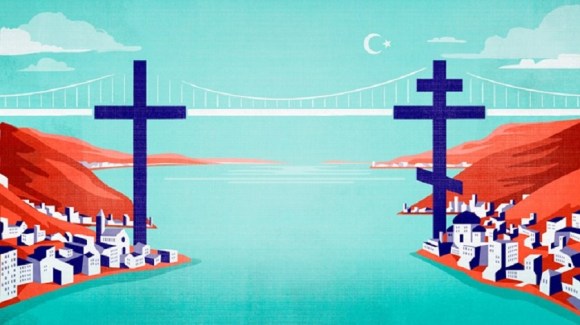
But from Istanbul – once Constantinople – where the “Great Schism” sundered Catholicism and Orthodoxy in 1054, a new book heralds a new beginning.
Christianity: Fundamental Teachings is a simple, 95-page presentation of the common beliefs of all Turkish churches. Its 12 chapters include descriptions of the nature of God, the salvation through Jesus, the work of the Holy Spirit, the inspiration of the Bible, and the role of the church.
But its most explosive page is the preface of endorsements.
The Orthodox Ecumenical Patriarch, The Armenian Patriarchate, the Syrian Orthodox Patriarchate, the Catholic Bishops Conference of Turkey, and the Associate of Protestant Churches all approve it, and recommend that it be widely read.
“You can’t find a page like this in all of church history,” said Armenian Bishop Sahak Mashalian, the principle scribe. “It is akin to a miracle.”
Please click here to read how it developed, at The Media Project.