Categories
Prayers

Lebanon Prayer: White Heart Leaders

God,

Mandate renewed. White votes aplenty.

Give him the white heart proclaiming.

And with him a deputy, narrowly won.

The same total elected odd partners.

Deal or no deal? God, only you know.

The voting is maintained clandestine.

Opposite camps, but yet status quo—

The devil you know bests the stranger.

Opinion of many: Devils them all.

Has anything changed since the polling?

A tighter result but no serious threat,

Unless in the laws—coalitions.

Prime minister soon. President maybe.

Will any foundations be shaken?

Industrious spirit, accountable charge.

Renewal within, from the margins.

We pray, God, for more. Renewal at the top.

A white heart to lead every leader.

Transform the whole, the new blood and old.

The nation to follow—then prosper.

Amen.


To receive Lebanon Prayer by WhatsApp, please click this link to join the closed comments group.

Lebanon Prayer places before God the major events of the previous week, asking his favor for the nation living through them.

It seeks for values common to all, however differently some might apply them. It honors all who strive on her behalf, however suspect some may find them.

It offers no solutions, but desires peace, justice, and reconciliation. It favors no party, but seeks transparency, consensus, and national sovereignty.

How God sorts these out is his business. Consider joining in prayer that God will bless the people and establish his principles, from which all our approximations derive.


Sometimes prayer can generate more prayer. While mine is for general principles, you may have very specific hopes for Lebanon. You are welcome to post these here as comments, that others might pray with you as you place your desires before God.

If you wish to share your own prayer, please adhere to the following guidelines:

1) The sincerest prayers are before God alone. Please consult with God before posting anything.

2) If a prayer of hope, strive to express a collective encouragement.

3) If a prayer of lament, strive to express a collective grief.

4) If a prayer of anger, refrain from criticizing specific people, parties, sects, or nations. While it may be appropriate, save these for your prayers alone before God.

5) In every prayer, do your best to include a blessing.

I will do my best to moderate accordingly. Thank you for praying for Lebanon and her people.
Categories
Christianity Today Europe Published Articles

‘Thou Shalt Not Kill’: Ukrainian Orthodox Church Ruptures Relations with Russia

Image: Artem Hvozdkov / Getty Images

After 93 days of war, the Ukrainian Orthodox Church-Moscow Patriarchate (UOC-MP) has definitively broken with Russia—maybe.

In a council decision taken May 27, the Russian Orthodox Church (ROC)–affiliated body declared its “full self-sufficiency and independence,” condemning the three-month conflict as “a violation of God’s commandment: Thou shalt not kill!

Such a condemnation was not new. The day the invasion began, UOC-MP Metropolitan Onufriy called it a “repetition of the sin of Cain.” But in dry ecclesial language, the statement dropped a bombshell.

It “adopted relevant amendments” and “considered … making Chrism.”

Chrism, the anointing oil of baptism and other liturgical rites, was last made in Ukraine in 1913. Its manufacture is a typical sign of autocephaly, the self-governing of an Orthodox church branch.

Continuing the tone, the UOC-MP reiterated its position.

“We express our disagreement with … Patriarch Kirill of Moscow and All Russia,” it stated of the ROC head, “regarding the war in Ukraine.”

Kirill has consistently supported Russia’s “special military operation.”

In 2018, the breakaway Orthodox Church of Ukraine (OCU) was granted autocephaly by the Ecumenical Patriarch of Constantinople, Bartholomew I. Rejected by Kirill and the UOC-MP, the act formalized the national schism. (A much smaller third Ukrainian Orthodox church joined the OCU.)

The UOC-MP council’s Friday statement continued to echo the ROC rejection. OCU bishops lack apostolic succession, it said, while overseeing the forcible seizure of churches to transfer jurisdiction. The UOC-MP stated a willingness to dialogue with the OCU if these dividing issues could be addressed.

And then, it symbolized division.

The next day during Holy Liturgy, Onufriy referred to Kirill as a fellow primate, not as his hierarch (superior). No mention was made of any connection to the ROC Moscow Patriarchate.

Andrey Shirin said these “unheard of” developments were “truly remarkable.”

“The ongoing war in Ukraine is a crisis on several levels—political, economic, humanitarian,” said the Russian associate professor of divinity at the John Leland Center, a Baptist seminary in Virginia. “This is another chapter in the theological crisis.” The consequences could…

This article was originally published by Christianity Today, on March 30, 2022. Please click here to read the full text.

Categories
Prayers

Lebanon Prayer: Shades of Stability

God,

Will stability help? Or stability drain? Does it depend on which kind?

The speaker of parliament wants four more years,

After thirty. His leadership known.

Could he be like the lira, stable two decades plus? Before its vociferous fall.

Up. Down. Intervening. Dollars disappear,

Like value. My bank account same.

And also, my wallet—as all prices rise. Inflation: It eats more than me.

Reviving a council to keep cost control,

Will president unleash the black?

His allies: Strong for sixteen years. Their weapons: Held for forty.

Postpone this discussion for only two more,

They say. For the nation needs rescue.

Your love, God, is stable. But so is our sin. Our lives between boring, chaotic.

Transformation. Disruption. Or comfort and peace?

My answer? Desire? Confusion.

And Lebanon, God, is a riddle alike. We need an uprising, but also

A school year consistent. A pharmacy stocked.

If torn down, will build up be certain?

Sometimes, holy God, you search out the lost. Sometimes: Silent and hidden.

I alternate aching with indifferent cold,

Wanting. Contented. Unstable.

Fix us afresh, God. My nation entire. We beg of you: Guide in this crisis.

We have new politicians along with the old.

We have me. Pitiful. Yet, your image.

Amen.


To receive Lebanon Prayer by WhatsApp, please click this link to join the closed comments group.

Lebanon Prayer places before God the major events of the previous week, asking his favor for the nation living through them.

It seeks for values common to all, however differently some might apply them. It honors all who strive on her behalf, however suspect some may find them.

It offers no solutions, but desires peace, justice, and reconciliation. It favors no party, but seeks transparency, consensus, and national sovereignty.

How God sorts these out is his business. Consider joining in prayer that God will bless the people and establish his principles, from which all our approximations derive.


Sometimes prayer can generate more prayer. While mine is for general principles, you may have very specific hopes for Lebanon. You are welcome to post these here as comments, that others might pray with you as you place your desires before God.

If you wish to share your own prayer, please adhere to the following guidelines:

1) The sincerest prayers are before God alone. Please consult with God before posting anything.

2) If a prayer of hope, strive to express a collective encouragement.

3) If a prayer of lament, strive to express a collective grief.

4) If a prayer of anger, refrain from criticizing specific people, parties, sects, or nations. While it may be appropriate, save these for your prayers alone before God.

5) In every prayer, do your best to include a blessing.

I will do my best to moderate accordingly. Thank you for praying for Lebanon and her people.
Categories
Africa Christianity Today Published Articles

Nigerian Christians Protest Deborah’s Death

Image: Courtesy of Gideon Para-Mallam

Thousands of churches across Nigeria demanded an end to sectarian killings on Sunday, horrified by the mob assault on a female university student accused of blasphemy. But fearful of more violence, their approach differed significantly—by geography.

“The overwhelming majority of our churches in the south participated, many going to the streets in peaceful protest,” said Testimony Onifade, senior special assistant to the president of the Christian Association of Nigeria (CAN). “Gathering together, we condemned this gruesome act and demanded the government identify, arrest, and prosecute the culprits.”

But in the north, where Muslims represent the majority of Nigerians, John Hayab described 20 minutes set aside to pray for divine intervention. The president of CAN’s Kaduna state chapter lauded the “solemn” ceremony observed by all northern denominations, amid a ban on protests by local authorities as some Muslims had threatened counterdemonstrations.

Instead, a select group of 120 Christian leaders gathered in a Kaduna city church, guarded by police and security agencies.

There was good reason for caution.

Two weeks ago, in Nigeria’s northwestern-most state of Sokoto, Deborah Samuel was beaten to death and set on fire by fellow students at Shehu Shagari College of Education. Officials and police intervened in vain.

Two students were arrested. Protesting for their release, Muslim supporters proceeded to destroy an additional 11 buildings, descended on Christian shops in the city, and besieged the palace of the sultan of Sokoto who had condemned the May 12 murder.

According to her friend Rakia, Samuel’s last words were, “What do you hope to achieve with this?”

After a colleague shared Islamic material on an exam-prep social media group, Samuel posted an audio recording asking him to remove it. Friends who overheard some Muslim students deeming her response to be blasphemous urged her to retract the statement. Instead, she responded…

This article was originally published at Christianity Today on May 25, 2022. Please click here to read the full text.

Categories
Prayers

Lebanon Prayer: Elected Names and Faces

God,

One hundred twenty-eight.

Some new, some old.

Some enrage. Some inspire.

Some with me and mine. Some with them—still us.

Help us to remember.

And each one has a name and face.

Remember all—I cannot.

And here: I dare not list each one.

Yes, they are yours. And yes, they are ours.

Yes, each one in need of prayer.

But a list will not help me.

I scroll past, skim through. Whisper generic good for all.

Maybe some are more righteous than me.

How do you keep track of eight billion?

But I can pray for trends:

Bless those who come with noble aims, for whom ‘kulun yani’ kul shi.*

Now among 128. Do they join in or holdout with nose up?

God, guide them well, for change must come. New blood renews the languid.

But guide them wise, their number weak, no matter how much rising.

Bless those who come with single mind, that weapons rig the system.

Their number up, the platform theirs. Discussion, tabled, threatening.

But is it time? And can they win? What consequences suffered?

To themselves? Or to the south? Or to nation collapsing?

Bless those who lost the upper hand, who still promote their project.

Calls for reform, resistance true, with forces piled against them.

But humbled, may they humble still. Others strong. All servants?

Bless those of old, the way things were. And likely still are, maybe.

They care for own, protect their flock. Distribute jobs and money.

Should it all be swept aside? Can they sustain the model?

With ever shrinking slice of pie, help them to help all others.

Renew, or rig?

Reform, or rile?

Among each group – dishonest.

We asked before: Remove such men.

But wheat and chaff still present.

Bless them also. Change their ways. And bind manipulation.

But now we have them. So change me too.

For each one, make us thankful.

They came from you. They came from us. They now are the solution.

Help me to pray—by name—for some.

The rest, God, shepherd. Lead them.

Amen.

*The popular chant of the 2019 uprising was: All of them means all of them. Here, the phrase is adjusted to: ‘All of them means’ everything.


To receive Lebanon Prayer by WhatsApp, please click this link to join the closed comments group.

Lebanon Prayer places before God the major events of the previous week, asking his favor for the nation living through them.

It seeks for values common to all, however differently some might apply them. It honors all who strive on her behalf, however suspect some may find them.

It offers no solutions, but desires peace, justice, and reconciliation. It favors no party, but seeks transparency, consensus, and national sovereignty.

How God sorts these out is his business. Consider joining in prayer that God will bless the people and establish his principles, from which all our approximations derive.


Sometimes prayer can generate more prayer. While mine is for general principles, you may have very specific hopes for Lebanon. You are welcome to post these here as comments, that others might pray with you as you place your desires before God.

If you wish to share your own prayer, please adhere to the following guidelines:

1) The sincerest prayers are before God alone. Please consult with God before posting anything.

2) If a prayer of hope, strive to express a collective encouragement.

3) If a prayer of lament, strive to express a collective grief.

4) If a prayer of anger, refrain from criticizing specific people, parties, sects, or nations. While it may be appropriate, save these for your prayers alone before God.

5) In every prayer, do your best to include a blessing.

I will do my best to moderate accordingly. Thank you for praying for Lebanon and her people.

Categories
Christianity Today Middle East Published Articles

Exodus, Judges, or Nehemiah: Lebanon’s Evangelicals Assess Surprising Election Victory

Image: Marwan Tahtah / Getty Images

On the eve of Lebanon’s parliamentary elections last weekend, Resurrection Church of Beirut (RCB) called for a prayer meeting. The short meditation focused on Psalm 147: heal the brokenhearted and sustain the humble—but cast the wicked to the ground.

Mired in economic crisis, many Lebanese blame a corrupt political class.

Three years ago, a massive popular uprising shouted “all of them means all of them” against the traditional sectarian parties. But within a few months, protests fizzled as COVID-19, the Beirut port explosion, and a World Bank-labeled “deliberate” financial depression drove many to despair.

For many, emigration seemed the only answer.

Hikmat Kashouh called out to God.

“Confuse many in the election booths, and encourage others,” prayed the RCB pastor. “Cause them to vote for those you desire.”

One of Lebanon’s largest evangelical churches, only 35 members from the main Baabda campus prayed along with him. The turnout mirrored that of the nation, which initially reported that participation dropped to 4 in 10 eligible voters. Very few expected significant movement in the political map.

“For three years we have cried out to God, reflecting his love as we ministered to everyone regardless of religion,” said Nabil Costa, executive director of the Lebanese Society for Educational and Social Development, also known as the Baptist Society. “And then at the fourth watch of the night, when everyone was losing hope, God said, ‘I am still here.’” Most evangelicals, he said, supported…

This article was originally published at Christianity Today, on May 19, 2022. Please click here to read the full text.

Categories
Christianity Today Europe Published Articles

What Is Antisemitism? Evangelicals Favor Different Definitions

Image: Yoni Reif / Courtesy of WEA

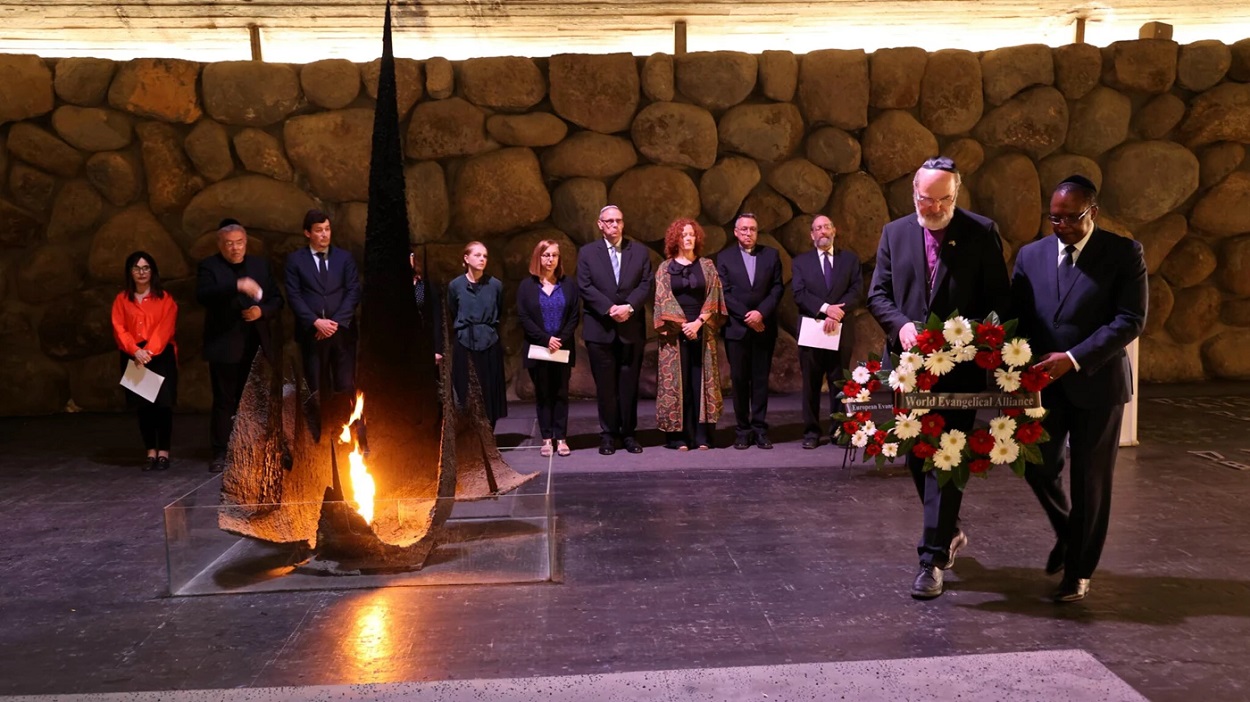
In a solemn ceremony last month at the World Holocaust Remembrance Center in Jerusalem, the European Evangelical Alliance (EEA) laid a wreath of remembrance.

It was also a pledge.

“In awe and profound shame,” the alliance wrote on its Yad Vashem laurel, “yet with the promise for future solidarity.”

Alongside dialogue partners from the International Jewish Committee for Interreligious Consultations (IJCIC), the EEA warned that antisemitism is rising around the world. Taking a concrete step April 26 in opposition, it announced its adoption of the International Holocaust Remembrance Alliance (IHRA) working definition of the issue.

With 37 member nations—including the United States, Germany, and Poland—the IHRA has been building a coalition around the following description:

Antisemitism is a certain perception of Jews, which may be expressed as hatred toward Jews. Rhetorical and physical manifestations of antisemitism are directed toward Jewish or non-Jewish individuals and/or their property, toward Jewish community institutions and religious facilities.

The EEA was joined in Jerusalem by Thomas Schirrmacher, secretary general of the World Evangelical Alliance (WEA), as well as Goodwill Shana, chairman of its international council. Though the two leaders also laid a wreath, the global organization did not sign onto the IHRA definition like its European affiliate.

The vast majority of evangelicals share the goal of combating antisemitism. But not all agree with IHRA’s usage.

“Though its specified aim is to provide a guide to help identify antisemitic statements or actions,” said Salim Munayer, regional coordinator of the WEA’s Peace and Reconciliation Network for the Middle East and North Africa, “it has been deployed to stifle discussions about whether the State of Israel should be defined in ethno-religious terms, and to delegitimize the fight against the oppression of Palestinians.”

The definition was first published in 2005 in order to evaluate and measure the growth of antisemitism in Europe. It was adopted officially by the IHRA in 2016. At issue is not its wording, but the 11 given examples that illustrate offense.

Some are clearly uncontroversial, such as calling for the killing of Jews, denying the scope of the Holocaust, or perpetuating conspiracy theories about Jewish world domination.

But of the 11, seven concern the State of Israel. Some of these examples of antisemitism are…

This article was first published at Christianity Today on May 16, 2022. Please click here to read the full text.

Categories
Prayers

Lebanon Prayer: Elections, Justice, Judgment, Blessing

God,

Keep today safe. Make today just.

But justice is a hard word:

It means so many things to so many people.

Make it what it means to you.

But then, God, is it judgment?

If so, it starts with us.

Remove the planks from our eyes. Try me and know my inmost thoughts.

David preferred your wrath to the nations’. Job repented, mute.

Your discipline comes with purpose.

Your mercy mixed with tears.

May we shed them also.

And spare us the blood.

It is a dreadful thing to fall into the hands of the living God.

So we humble ourselves, instead.

We fall on our knees.

We trust your hands to shake us.

We trust your hands to heal.

No matter the meaning, we all want a change.

And so we pray the principles:

Put your candidates in office. Hold accountable the frauds.

Expose manipulation. The common interest, first.

Take these prayers, from all of us. Will my plea cancel his?

No, each prayer folded over, pressed together, overflows.

The measure we pray – measure it true.

To us and to Lebanon.

For elections, for life.

Your will to be done. Your kingdom to come.

My vote makes a difference.

Your justice, how odd.

Amen.


To receive Lebanon Prayer by WhatsApp, please click this link to join the closed comments group.

Lebanon Prayer places before God the major events of the previous week, asking his favor for the nation living through them.

It seeks for values common to all, however differently some might apply them. It honors all who strive on her behalf, however suspect some may find them.

It offers no solutions, but desires peace, justice, and reconciliation. It favors no party, but seeks transparency, consensus, and national sovereignty.

How God sorts these out is his business. Consider joining in prayer that God will bless the people and establish his principles, from which all our approximations derive.


Sometimes prayer can generate more prayer. While mine is for general principles, you may have very specific hopes for Lebanon. You are welcome to post these here as comments, that others might pray with you as you place your desires before God.

If you wish to share your own prayer, please adhere to the following guidelines:

1) The sincerest prayers are before God alone. Please consult with God before posting anything.

2) If a prayer of hope, strive to express a collective encouragement.

3) If a prayer of lament, strive to express a collective grief.

4) If a prayer of anger, refrain from criticizing specific people, parties, sects, or nations. While it may be appropriate, save these for your prayers alone before God.

5) In every prayer, do your best to include a blessing.

I will do my best to moderate accordingly. Thank you for praying for Lebanon and her people.

Categories
Christianity Today Europe Published Articles

Photos Show Ukraine’s Bible Belt Struck Down But Not Destroyed

Image: Joel Carillet
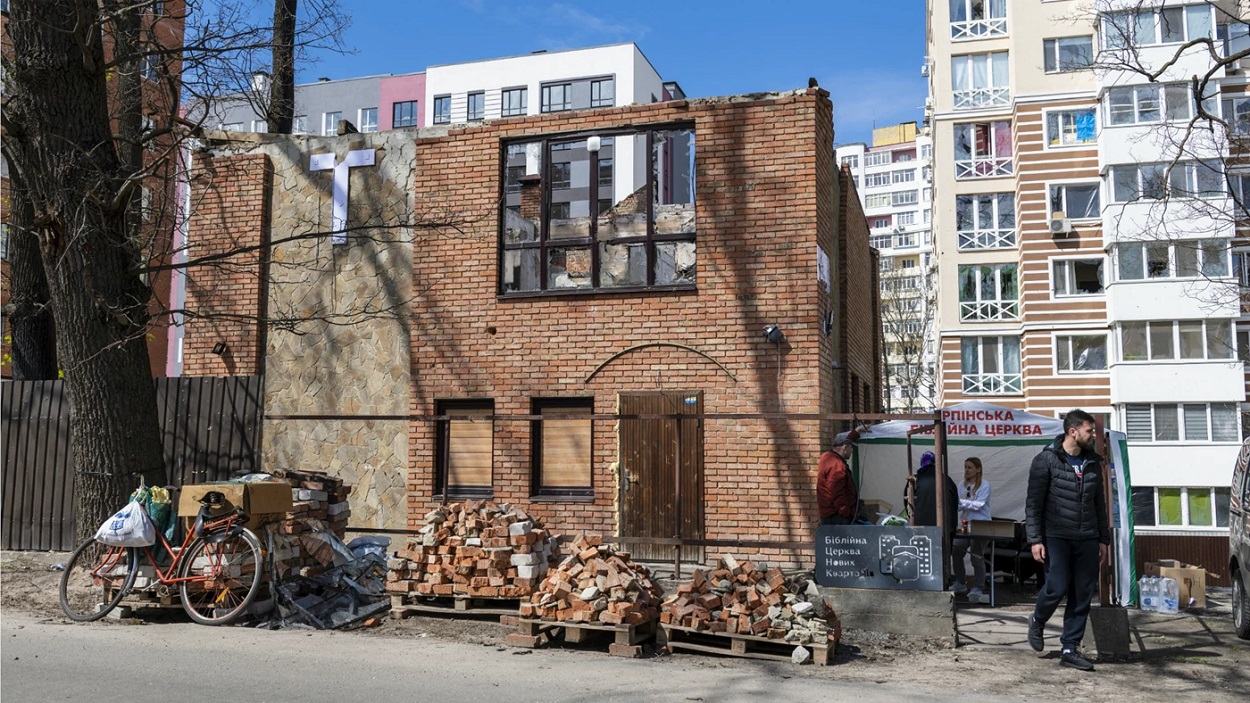
A Baptist church plant in Irpin, Ukraine, damaged during the Russian invasion

Ministry had been going so well in Irpin, Ukraine.

Over the past decade, the population of Kyiv’s northwest suburb swelled to 90,000, and Irpin Bible Church (IBC) grew with it. The Baptist congregation grew to include 700 adults, with an additional 300 children. And in 2019, 12 members launched a church plant in the “New Blocs” neighborhood, where 15,000 Ukrainians lived in multi-story apartment complexes with no church of any kind.

Meeting previously in a basement office, last December the church planters purchased a stand-alone building from a local bank, grateful to have their own location amid a shortage of rental space. With a ground-floor capacity of 200 people, the congregation’s 60 members anticipated additional growth.

Three months later, the Russians invaded.

Hostomel was the first suburb to fall, being home to the regional airport. The assault on Irpin and neighboring Bucha began February 27, attempting to encircle Kyiv.

IBC senior pastor Mykola Romanuk was in the US at the time, while his family relocated to western Ukraine. He returned on March 5, only to leave later that day when tanks first breached the suburb. The next day, a member of his congregation who had returned to Irpin to assist with evacuations was killed alongside a mother and her two young children—a tragedy witnessed and shared worldwide by The New York Times—as Russian forces shelled the humanitarian corridor.

By March 14, Russia occupied half the suburb, including the church plant’s quarter. IBC’s sanctuary remained secure, but 200 of its members fled to 20 nations across Europe, while another 500 scattered across western Ukraine. Romanuk was in Rivne, 200 miles west of Kyiv, with about 70 of his congregants. Services resumed online while the stalwart faithful tried to serve 4,000 mostly elderly residents left behind in Irpin.

Dozens were killed in Russian atrocities.

On March 16, Ukraine announced a counterattack. The army recaptured the suburb on March 28. But fighting continued in Bucha for another two days, during which time Russia increased its seemingly random barrage of missiles into Irpin. One hit the church plant, destroying its roof and the second floor Sunday school classrooms.

There were no military personnel in the area.

“Any building can be rebuilt,” said Romanuk. “Compared to the destruction of the city and the many who died, it is no big deal.”

While some Ukrainian Protestants see church buildings as holy, he added, the majority Orthodox Christians view sanctuaries as a sacred space to connect with God, imbued with divine aura. No food is allowed inside; certainly not a bathroom toilet.

This has impacted relief efforts. Of the eight Orthodox churches in Irpin, only two had service annexes. Though only one was damaged—and its priest killed in an airstrike—it was only the annexes that opened to shelter their neighborhood members, he said. One Orthodox priest tried to help more broadly.

“In our theology, the church is a place for service and worship,” said Romanuk. “Now it has become a home for the homeless, catering to the needs of all.” Leading IBC since 2009, he returned with his wife and daughter on April 3, living in the church basement with…

This article was originally published at Christianity Today on May 13, 2022. Please click here to read the full text.

Categories
Prayers

Lebanon Prayer: Electoral Change

God,

When all is bad, we still fear worse. But hope holds on that change will come.

Every billboard says so.

But what is the substance? What is the plan? This face or that one? My list, not his?

Beyond the names, what parties?

The red we know. The yellow-green. Who else is campaigning? The logos retreat.

One week remaining.

What of the rumors? Elections postponed? It seemed all in favor though no one would say.

Is a crisis coming?

God, spare us from violence. But spare us from doubt. A vote is a privilege that many don’t have.

The Arab world is arid.

Help us be faithful even if depressed. The barriers many: Cross-country, to drive.

Elite entrenchment.

But also infighting of everyone else. Media partisan. Confusing law. Regional meddling.

My ballot, to speak.

I cast it in hope that the message is heard. With enough of my comrades perhaps we can win.

Or voided, vote blank.

It too will say something, rejecting the whole. Fulfillment of duty, wash hands of results.

God, you know.

And God, you care. But towards what end? That this corrupt fall or to set back that sect?

You choose the king.

But so do I. Align my will. Dedicate me to the cause. Through me help bring the best of us.

And then, to rest.

Your favor does not come with prince, but faithfulness to prince of peace. Change itself

Can never change.

So while we work in vigilance, we ask you also change the heart. Bring repentance to our soul.

Love of neighbor. Also—them.

One week away, we ask your grace. Bring this nation toward the good; politicians, honest, pure.

But first, change me.

Amen.


To receive Lebanon Prayer by WhatsApp, please click this link to join the closed comments group.

Lebanon Prayer places before God the major events of the previous week, asking his favor for the nation living through them.

It seeks for values common to all, however differently some might apply them. It honors all who strive on her behalf, however suspect some may find them.

It offers no solutions, but desires peace, justice, and reconciliation. It favors no party, but seeks transparency, consensus, and national sovereignty.

How God sorts these out is his business. Consider joining in prayer that God will bless the people and establish his principles, from which all our approximations derive.


Sometimes prayer can generate more prayer. While mine is for general principles, you may have very specific hopes for Lebanon. You are welcome to post these here as comments, that others might pray with you as you place your desires before God.

If you wish to share your own prayer, please adhere to the following guidelines:

1) The sincerest prayers are before God alone. Please consult with God before posting anything.

2) If a prayer of hope, strive to express a collective encouragement.

3) If a prayer of lament, strive to express a collective grief.

4) If a prayer of anger, refrain from criticizing specific people, parties, sects, or nations. While it may be appropriate, save these for your prayers alone before God.

5) In every prayer, do your best to include a blessing.

I will do my best to moderate accordingly. Thank you for praying for Lebanon and her people.

Categories
Prayers

Lebanon Prayer: Campaign Clashes

God,

The vote is free. The people, too, or is there occupation?

Politics manipulates. Licit or illegal?

From north to south, and in Beirut, campaigning is disrupted.

But so are lives. The poster size offends the sinking lira.

Politicians show their plans—or at least their faces.

But some denied in neighborhoods where rivals show displeasure.

Provocation? Threatened quit. Rumors of postponement.

Who will win when many hate each color, list, and slogan?

Yet even those who herald change have failed to stay united.

They scratch and claw for every vote. One seat—or two—a triumph.

Division, God, is not of you. But nor is it unrighteous.

People differ, weigh their choice. And power is a blessing.

Used instead to silence voice, or raise a fear of ‘other,’

It weaponizes stewardship. It bludgeons trust and service.

Helpless, God, we but can pray? And vote in resignation?

Or will through prayer a miracle give mandate to my favored?

A miracle is needed, God.

But is it in elections?

Change the system. Change the heart.

Change the expectations.

But until then, let vote be free. The people, too, in conscience.

Their ballot cast by principle. On time, while safe and honest.

The king, you say, is in your hand—wicked, just, or tepid.

Guide voters, then, with virtue sure—conviction, courage, honor.

Many lack these marks of strength, the leading class deficient.

But all fall short of your demand to imitate our master.

Humble us, God.

Rebuild us right.

Let Lebanon freely prosper.

Amen.


To receive Lebanon Prayer by WhatsApp, please click this link to join the closed comments group.

Lebanon Prayer places before God the major events of the previous week, asking his favor for the nation living through them.

It seeks for values common to all, however differently some might apply them. It honors all who strive on her behalf, however suspect some may find them.

It offers no solutions, but desires peace, justice, and reconciliation. It favors no party, but seeks transparency, consensus, and national sovereignty.

How God sorts these out is his business. Consider joining in prayer that God will bless the people and establish his principles, from which all our approximations derive.


Sometimes prayer can generate more prayer. While mine is for general principles, you may have very specific hopes for Lebanon. You are welcome to post these here as comments, that others might pray with you as you place your desires before God.

If you wish to share your own prayer, please adhere to the following guidelines:

1) The sincerest prayers are before God alone. Please consult with God before posting anything.

2) If a prayer of hope, strive to express a collective encouragement.

3) If a prayer of lament, strive to express a collective grief.

4) If a prayer of anger, refrain from criticizing specific people, parties, sects, or nations. While it may be appropriate, save these for your prayers alone before God.

5) In every prayer, do your best to include a blessing.

I will do my best to moderate accordingly. Thank you for praying for Lebanon and her people.

Categories
Prayers

Lebanon Prayer: Death and Orthodox Easter

God,

I cannot say I know the cause, and many more are like me too.

But it does not look good.

Bankers reject the government plan.

Protestors rally where lawmakers meet.

But is business aligned with the people?

How to pray, except for good, when most of the small print escapes us?

And what of the pharmacist, killed in her store?

Or expat electors pulled in tug-of-war?

Better known yet is the poverty push

That dares some to risk life and limb to escape.

Some have drowned.

Some drown in blame.

Some—more than me—know the issues quite well.

Some are complicit in many a crime,

While some seek out facts keen to educate.

Give them ears, God. Too many are not listening.

We know why, and it is fair:

The hand has been nailed immobile.

So like your own, it sags inert,

Waiting for one to unpin it.

You rose from the dead by the power of God,

But came down from the cross with assistance.

Where now is Joseph, from Arimathea?

His humble act, far from the crowd—

But brave in approaching authority—

It set the stage for miracle,

Though he himself did little.

God, find these men, and amplify.

Bolster their spirits, in number.

And then, when few are watching, where only women linger:

Show yourself.

Birth new life.

Let Lebanon once again prosper.

Amen.


To receive Lebanon Prayer by WhatsApp, please click this link to join the closed comments group.

Lebanon Prayer places before God the major events of the previous week, asking his favor for the nation living through them.

It seeks for values common to all, however differently some might apply them. It honors all who strive on her behalf, however suspect some may find them.

It offers no solutions, but desires peace, justice, and reconciliation. It favors no party, but seeks transparency, consensus, and national sovereignty.

How God sorts these out is his business. Consider joining in prayer that God will bless the people and establish his principles, from which all our approximations derive.


Sometimes prayer can generate more prayer. While mine is for general principles, you may have very specific hopes for Lebanon. You are welcome to post these here as comments, that others might pray with you as you place your desires before God.

If you wish to share your own prayer, please adhere to the following guidelines:

1) The sincerest prayers are before God alone. Please consult with God before posting anything.

2) If a prayer of hope, strive to express a collective encouragement.

3) If a prayer of lament, strive to express a collective grief.

4) If a prayer of anger, refrain from criticizing specific people, parties, sects, or nations. While it may be appropriate, save these for your prayers alone before God.

5) In every prayer, do your best to include a blessing.

I will do my best to moderate accordingly. Thank you for praying for Lebanon and her people.
Categories
Christianity Today Europe Published Articles

How Russian Christians View the ‘Special Military Operation’ in Ukraine

Image: Kirill Kudryavtsev / Getty

Russian sermons—to the extent legally possible—reflect the national mood.

“Honor the tsar!” preached Alexey Novikov of Land of Freedom Pentecostal church in Moscow two days after the February 24 Russian invasion of Ukraine, quoting from 1 Peter 2:17. While not pro-war, it was certainly pro-Russia. Once a lawfully elected president commits troops, he said, it is a Christian’s duty to support them.

One month later, Mikhail Belyaev of Source of Living Water Baptist church in Voronezh, Russia, asked, “Why are the churches silent?”

Many Ukrainian evangelicals are fuming at their cross-border colleagues for failing to speak out against the war. They also cite the apostle Peter, placing priority on the same verse’s earlier command: “Love the family of believers.”

But Belyaev’s sermon was not pro-Ukraine. His congregation 320 miles south of Moscow provides a different answer.

The churches are not silent, he said. They are preaching the gospel and praying for peace.

“Russians take the Ukrainian complaint seriously,” said Andrey Shirin, associate professor of divinity at the John Leland Center for Theological Studies, a Baptist seminary in Virginia. “But they put God before the nation—and think many Ukrainians put too much stock in their nationality.”

Shirin left Russia 30 years ago and said that, then as now, most believers are wary of politics. And while some pastors have criticized the war, a pro-Ukraine sermon would be hard to find.

Throughout the war, polls have shown strong support for what Russia has legally mandated be called a “special military operation.” Between 65 percent and 89 percent have signaled approval; 71 percent said they feel “pride” and “joy.”

Some analysts have suggested propaganda is at play: Three in 4 Russians rely on television for the news, and 2 in 3 from state-run broadcasts. Only 5 percent have access to a VPN for outside reporting.

Others have suggested falsification: A “list experiment” in which Russians did not have to answer the war question directly resulted in an approval rating of 53 percent.

Specific polls do not exist for evangelicals. Shirin, noting the difficulty of precision, estimated pro-Russia sentiment like Novikov’s would register only 20 percent. But pro-Ukraine sentiment and a clear antiwar position would fare…

This article was originally published at Christianity Today, on April 22, 2022. Please click here to read the full text.

Categories
Christianity Today Europe Published Articles

Parsing Pacifism: Ukraine’s Mennonite Heritage Shapes Evangelical Responses to Russia

Image: Sergei Supinsky / Contributor / Getty

Ukrainian Baptists were once practical pacifists.

Now locked in a vicious war of survival with invading Russian forces, many are on the front lines of battle. Leading voices call for NATO to enforce a no-fly zone. Pastors pray for soldiers; churches offer bread.

What happened?

It is not as straightforward as simple self-defense. But neither was their nonviolence, practiced by most Slavic evangelicals, a clear convictional principle. Forged in the fires of the Soviet Union, the then-second-largest Baptist community in the world developed along a very different path from their denominational brethren in the United States.

Just ask Roman Rakhuba, who was raised Baptist.

“I never would have called myself a Mennonite,” said the head of the Association of Mennonite Brethren Churches of Ukraine (AMBCU). “Later I discovered I was following their principles all along.”

Known as the “Bible Belt” of Eastern Europe, Ukraine’s evangelical faith was greatly influenced by the Anabaptist tradition. Rakhuba grew up in Zaporizhzhia, 350 miles southeast of Kyiv, near the old oak tree associated with the Chortitza colony of Mennonites, founded in 1789.

His grandfather was saved through one of their preachers.

But as a Baptist child, Rakhuba was raised without toy guns, instructed to never return evil with evil. Forbidden from playing war, his relatives refused to fight in the Soviet army. He remembers Mennonites hosted at his grandfather’s home, learning of the 1763 decree by Catherine the Great to invite German settlers to develop the Russian hinterland.

They were joined by Lutherans and Catholics, dissidents and rebels, offered lands, self-governance, and—vital for the pacifists—exemption from military service. Over the next century, Mennonite communities thrived in Ukraine, developing infrastructure for agriculture and industry. But increasing prosperity challenged their social and spiritual life, and drunkenness and dancing became common.

Then came pietism.

In the mid-19th century, German missionaries, such as the Lutheran Edward Wuest, found a reception with the Mennonites. Their emphasis on a regenerated Christian life through personal conversion, prayer, and Bible study appealed to colonists dissatisfied with the traditional church. The community ruptured, and in 1860 a parallel Mennonite Brethren denomination was born, sending missionaries as far as Siberia and India.

The still-German speakers lived largely separate lives from their Slavic neighbors, until two events intervened to spark an evangelical revival. In 1858, Emperor Alexander II authorized the translation and printing of the Bible in Russian. Three years later, he abolished serfdom.

“For the first time, peasants were no longer tied to the land,” said Mary Raber, a church history instructor at Odessa Theological Seminary. “Where better to find a job than on the farm of a successful colony?”

Slavs, now with a New Testament to read, started joining their Bible studies.

Mennonites were not the only revivalist movement in the Russian empire. German Baptists planted churches in the Caucasus Mountains. An English missionary won converts among the St. Petersburg elite. Neither of these groups adopted pacifism as a rule, and even some Mennonites organized self-defense units to ward off bandits in the chaos of World War I. But none were prepared for…

This article was originally published at Christianity Today, on April 20, 2022. Please click here to read the full text.

Categories
Prayers

Lebanon Prayer: Easter Silos

God,

“Tear down these silos, and in three days I will build them up again.”

Some cheered. Some mourned.

Most went about their day.

The world moves on, and so must life.

That which is dead just crumbles.

“Keep it alive!” “Prop it up!” “We must preserve the memory!”

“At least, till justice comes.”

But where is justice, God?

Memory exchanged for glitz, throughout the civil war city.

Bullet holes here, a statue there.

Seventeen thousand still missing.

With erasure comes grievance, and grievance comes grudge.

The world moves on, and so must life.

But it does not.

Wounds run deep. Statues nurture.

The choice: Ignore, or sect.

There is nobility in both, God. But little of you.

In the silos you suffered.

Grain spoiled, poured out – for none.

The bread of life was wasted.

And now the poor go hungry.

Yet for some there is cake. Cookies abound.

Cast lots: Who has your favor?

One day they will be built again.

The world moves on, and so must life.

But will you be in it?

The new port? The next Beirut? Lebanon—if it continues?

Three days, God. We are waiting.

Millennia. We are waiting.

Come. You do not come.

But yes, you have. To me.

A day is as a thousand years, for world unperceiving.

My day is rich like a million.

My memory of sin is purged. The scars remain, but healed.

The silos—full—inside my heart.

Bread: Broken, eaten, grateful.

It is enough, God.

But it is not enough.

Too few have bread. Too few have life.

And silos: Ruined, standing.

Until they fall, or are brought down.

Erased. And justice with them.

We wait, God.

We work as we can.

Your life in us, for others.

Bless this nation. Raise afresh.

Three days.

The dawn emerges.

Amen.


To receive Lebanon Prayer by WhatsApp, please click this link to join the closed comments group.

Lebanon Prayer places before God the major events of the previous week, asking his favor for the nation living through them.

It seeks for values common to all, however differently some might apply them. It honors all who strive on her behalf, however suspect some may find them.

It offers no solutions, but desires peace, justice, and reconciliation. It favors no party, but seeks transparency, consensus, and national sovereignty.

How God sorts these out is his business. Consider joining in prayer that God will bless the people and establish his principles, from which all our approximations derive.


Sometimes prayer can generate more prayer. While mine is for general principles, you may have very specific hopes for Lebanon. You are welcome to post these here as comments, that others might pray with you as you place your desires before God.

If you wish to share your own prayer, please adhere to the following guidelines:

1) The sincerest prayers are before God alone. Please consult with God before posting anything.

2) If a prayer of hope, strive to express a collective encouragement.

3) If a prayer of lament, strive to express a collective grief.

4) If a prayer of anger, refrain from criticizing specific people, parties, sects, or nations. While it may be appropriate, save these for your prayers alone before God.

5) In every prayer, do your best to include a blessing.

I will do my best to moderate accordingly. Thank you for praying for Lebanon and her people.
Categories
Christianity Today Europe Published Articles

Who Is My Neighbor? For Christians in the Balkans, the Answer Might be Troll Farms.

Image: Illustration by Wenjia Tang

Twenty of the top 22 Christian pages on Facebook in 2021 were run from Europe’s southeast corner.

Nikola Galevski’s wasn’t one of them.

The pastor of Soulcraft Evangelical Church in Skopje, North Macedonia, actually prefers Twitter, which in the Balkans mostly attracts leftist and antireligious voices. He uses the handle “Protestant Imam,” which is a tongue-in-cheek gesture of openness to the Muslim population that makes up about a third of his country.

“The community teases me, and I tease them,” Galevski said, “but it helps develop their life with Christ.”

He has around 5,000 followers on Twitter, and some of his videos on YouTube went viral when his wife, Anet, was dying of cancer. Galevski shared about the struggle of her death in his weekly sermons, which were posted online. Orthodox Christians, nonbelievers, and Muslims joined him in his mourning, and when Anet died, views jumped into the tens of thousands.

But that pales in comparison to the top Christian Facebook page, “Be Happy Enjoy Life,” which reached 75 million users every month, according to an internal Facebook document obtained by MIT Technology Review. Ninety-five percent of viewers did not sign up to follow that page but instead had its content pushed into their news feeds by Facebook’s algorithms.

That page is one of 15,000 in the Balkans that is believed to be a “troll farm,” pumping out disinformation and figuring out new and better ways to command eyeballs—many of them belonging to Christians scrolling in America.

An internal Facebook document written by a senior-level data scientist said, “Our platform has given the largest voice in the Christian American community to a handful of bad actors who, based on their media production practices, have never been to church.”

They’re certainly not evangelicals. Galevski, who is also the coordinator of the Evangelical Protestant Initiative, would probably know them if they were. There are about…

This article was originally published in the April print edition of Christianity Today. Please click here to read the full text.

Categories
Prayers

Lebanon Prayer: Coming Loan, Returning Friend

God,

We thank you for agreement, though many say its false.

And naught but shame can come upon the architects of loss.

It is not wise to borrow. Worse: Surrender on a debt.

Rely on outside help to fix a problem of one’s own.

The terms of reference, strident. Reforms, we surely need.

But will these straighten Lebanon for finance or the poor?

At least there is consensus, for now, on what to do.

Conditional on follow-up; will implementing fail?

And what then of elections? Will mandate carry through?

And how long will it take until a government is formed?

Could help—now—come from elsewhere? A bailout before loan?

Will friends—again—from Saudi prove their friendship at the bank?

At least they have returned, God. An empty embassy

Is more than just a symbol of relations gone awry.

But this week things are better, and all across the board.

A glimpse of hope, ephemeral? Or first look at the roots?

Distrust appears endemic. Manipulation, fierce.

The sins of men run deep within the soil of ancient land.

God grant them all discernment, and courage to address

Corruption and entitlement distributed by sect.

Some must fall entire. Others to redeem.

Promote the honest faithful; may their influence expand.

No more ad hoc solutions, as each blame someone else.

Let justice paint with broadest brush. But mercy, beautify.

The landscape is angelic. Your praise, each day, it sings.

Draw people to the chorus from cacophony of angst.

From president to doorman, from cleric to the cook,

All are equal in your sight and each with vital role.

Perhaps a loan is coming. Renewed support from Gulf.

Be warned: No trust in princes. Wealth: Moth and rust destroy.

You, oh God, are holy. Yet you love us. You forgive.

Reveal it now in Lebanon. Humbled, prayerful—heal.

Amen.


To receive Lebanon Prayer by WhatsApp, please click this link to join the closed comments group.

Lebanon Prayer places before God the major events of the previous week, asking his favor for the nation living through them.

It seeks for values common to all, however differently some might apply them. It honors all who strive on her behalf, however suspect some may find them.

It offers no solutions, but desires peace, justice, and reconciliation. It favors no party, but seeks transparency, consensus, and national sovereignty.

How God sorts these out is his business. Consider joining in prayer that God will bless the people and establish his principles, from which all our approximations derive.


Sometimes prayer can generate more prayer. While mine is for general principles, you may have very specific hopes for Lebanon. You are welcome to post these here as comments, that others might pray with you as you place your desires before God.

If you wish to share your own prayer, please adhere to the following guidelines:

1) The sincerest prayers are before God alone. Please consult with God before posting anything.

2) If a prayer of hope, strive to express a collective encouragement.

3) If a prayer of lament, strive to express a collective grief.

4) If a prayer of anger, refrain from criticizing specific people, parties, sects, or nations. While it may be appropriate, save these for your prayers alone before God.

5) In every prayer, do your best to include a blessing.

I will do my best to moderate accordingly. Thank you for praying for Lebanon and her people.

Categories
Christianity Today Europe Published Articles

Bucha Evangelical Leader Sees Russian Atrocities, Looks for God’s Hand

Image: Chris McGrath / Staff / Getty

The atrocities are shocking. Ukrainian authorities have said 410 civilians were killed in the suburbs of Kyiv, discovered after the Russian army withdrew from its positions. At least two were found with their hands bound; several were shot in the head.

Many bodies were burned.

One resident said the occupiers were polite, and shared their meal rations. But others told of ransacked apartments; one was tied to a pole and beaten. Soldiers even shot a cyclist, who had dismounted and turned a corner on foot.

It could have been Ivan Rusyn.

President of Ukrainian Evangelical Theological Seminary (UETS), he had been coordinating aid from a safe house in Kyiv. But riding his bicycle into Russian-controlled Bucha to deliver medicine to a neighbor, he became an eyewitness to the atrocities.

Russia has called the images fake; satellite evidence contradicts. Christianity Today interviewed Rusyn to hear his firsthand report. He spoke about the spiritual impact, becoming a more authentic church, and how evangelicals have been helping the reclaimed suburbs—where he lived the past eight years:

Tell me about your neighborhood.

If you look at Bucha on Google Maps, I live in one of the five apartment blocs opposite Toscana Grill. It is an expensive restaurant, but sometimes I have eaten there. I run in the municipal park nearly every day, and with friends on Saturday. The seminary in Kyiv is six miles away, and it would take me 25 minutes to drive there, with traffic.

I noticed Google now says it will take an hour and a half.

The bridge was destroyed on the second day of the war. Russian helicopters and soldiers landed first at the Hostomel airport, three miles from our home. There was heavy combat, and I took shelter in my basement for the next five days. Then I left to the seminary, following that Google Maps route to skirt around Kyiv to the northeast. After two days we evacuated, and I found my way to a safe house in the city.

Now when we bring food and provisions into Bucha, Irpin, and Hostomel, we see many destroyed Russian tanks. The bridge is still out, but we can navigate it carefully with minibuses. It is dangerous, but if you go slow the journey now takes about one hour.

When did you return? Four days ago (April 3). We were escorted by police because…

This article was originally published by Christianity Today, on April 7, 2022. Please click here to read the full text.

Categories
Middle East

Despite Drop in Deportations, Turkey Still Troubles Christians

Image: Chris McGrath / Staff / Getty

Last year, Protestant Christians in Turkey suffered no physical attacks.

There were no reported violations of their freedom to share their faith.

And there was a sharp reduction in foreign missionaries denied residency.

But not all is well, according to the 2021 Human Rights Violation Report, issued March 18 by the nationally registered Association of Protestant Churches (APC).

Hate speech against Christians is increasing, fueled by social media.

Legal recognition as a church is limited to historic places of worship.

And missionaries are still needed, because it remains exceedingly difficult to formalize the training of Turkish pastors.

“Generally there is freedom of religion in our country,” stated the report. “But despite legal protections, there were still some basic problems.”

Efforts to unite Turkey’s evangelicals started in the mid-1990s, and the APC began publishing its yearly human rights reports in 2007. Today the association, officially registered in 2009, represents about 85 percent of Christians within Turkey’s 186 Protestant churches, according to general secretary Soner Tufan.

Only 119 are legal entities.

And of these, only 11 meet in historic church buildings. The great majority rent facilities following their establishment as a religious foundation or a church association. While generally left alone, they are not recognized by the state as formal places of worship and thus are denied free utilities and tax exemption.

And if they present themselves to the government in pursuit of such benefits, officials often warn they are not a church and threaten closure. Sometimes the authorities even try to recruit informants. And some Christians who have refused have lost their jobs.

Other Turkish Protestants are simply harassed. “Dead priest walking,” said residents of Arhavi to a local pastor as…

This article was originally published at Christianity Today on April 6, 2022. Please click here to read the full text.

Categories
Christianity Today Europe Published Articles

After War, Can Armenia’s Evangelicals and Orthodox Save Their Nation Together?

Image: Maja Hitij / Getty

Craig Simonian had a vision. It landed him in a war zone.

Raised in an Armenian-American Orthodox family, he came to know Jesus personally at university. He served as a Vineyard church pastor in New Jersey for nearly two decades but continued to embrace his Apostolic church heritage.

It laid the foundation of his faith—but also of his nation of origin.

“The reason Armenia still exists is because of the church,” he said. “It kept our shattered people together, especially in the diaspora.”

As a child, Simonian’s grandmother witnessed her father and mother murdered in the Armenian Genocide, killed by Turks in the waning days of the Ottoman Empire.

When she eventually arrived in America, it was the Apostolic church that embraced their family. Simonian recalled kindly visits by priests of their Oriental Orthodox tradition who—in the face of tragedy and devastation—gave him a deep appreciation of the sovereignty of God.

It was his evangelical awakening, however, that drew him back to Armenia—and in particular to its church. He relocated in 2018 to a nation locked in a cold war with neighboring Azerbaijan. A self-professed “oddball,” he longed for the Apostolic church to embrace fully the gospel he had discovered.

“If we are going to reach this generation, we can’t do it without them,” Simonian said. “I will call people to Jesus but never to leave their church.”

But two years later, the war turned hot.

Azerbaijan invaded the Armenian-controlled enclave of Nagorno-Karabakh in October 2020. The territory is recognized internationally as belonging to Azerbaijan, yet the residents of what Armenians call Artsakh voted for independence in 1991. For three decades Armenia held the upper hand but was routed in a 44-day war through superior drone technology that Turkey and Israel supplied to Azerbaijan.

Russian intervention enforced a ceasefire, with Nagorno-Karabakh demolished and Armenians holding a fraction of their previous territory. The nation felt numb after its defeat, and many found refuge in the Apostolic church.

Today, Simonian provides ad hoc spiritual care as he builds relationships with evangelicals and Orthodox alike.

His primary worship is through Yerevan International Church. But few in his personal circles have saluted his efforts to attend the Divine Liturgy and cultivate relationships with Orthodox clergy. Many evangelicals are soured by years of the older tradition labeling the newcomers a sect, or worse, a cult. But neither has Simonian yet found in the Apostolic church the fellowship that characterized his diaspora youth.

“The warm fuzzies I had growing up are completely void here,” he said. “The church is not so much a community.”

Simonian understands. Soviet communism purged the church, replacing clergy with compliant leadership. Following Armenia’s independence in 1991, this generation still exists but is giving way to a spiritual cadre that he says recognizes the church needs more than ancient traditions.

“We do not need to re-evangelize Armenia,” said Shahe Ananyan, dean of Gevorkian Theological Seminary in the Apostolic holy see of Etchmiadzin, 13 miles west of Yerevan. “Our main task is to wisely consider how to bring both Eastern and Western traditions together in synthesis.”

The church is still discussing application, he said. But he recognized that modern life for many has crowded out liturgical attendance and Bible reading. Forging forward anyway is…

This article was originally published by Christianity Today on April 1, 2022. Please click here to read the full text.