Russia is a strange ally. The week begins with the declaration her airliner was brought down by a bomb. It ends with agreement to build a nuclear reactor.
Help Egypt in the back and forth. Negotiate the give and take.
Egypt is maintaining caution in making any pronouncements on terrorism, waiting until the commission concludes. Russia had been with them, then with the UK stopped the tourist flow.
Is it pressure politics or necessary precaution? Rebuke Egypt if she is playing games. Protect Egypt if others are.
But rebuild the tourist sector, God, and with it Egypt’s professional reputation. Help her standardize operations and keep all safe. Thwart those intent on causing her harm.
And may building a reactor result only in good.
God, honor Egypt with the energy she needs. With nuclear comes risk, and maybe temptation. All assurances are given that intentions are peaceful. There is so much to gain, so much to go wrong.
Keep Egypt safe from error. Guard against negligence. Handle waste. Hinder sabotage.
Between now and completion, make Egypt ready.
In relationship with Russia, may Egypt both benefit and avoid entanglement. In all international affairs, help her stay sovereign. Help her do right.
May Egypt neither give nor take, God. May she bless. May she experience your example, and imitate.
Last week I highlighted a poor op-ed from the Washington Post. This article from the New York Times is better, but its headline is well, dubious.
Egyptians do thrive on conspiracy theory, though they should be accorded a degree of sympathy given the troubles and outside influences on their region.
Now, writing a headline is almost more art than journalism, sometimes crossing the line into marketing. The author is forgiven, and may not have had say in the final wording.
But the body of the article does not quote one single average citizen to make its point. It opens with President Sisi urging Egyptians to even go without food if necessary in the face of threats. Then the closest it comes to demonstrating popular rejection of the message is this:
After Mr. Sisi’s bellicose talk of going without food, “people are just making fun of him,” said Hisham Kassem, a veteran Egyptian journalist sympathetic to the president. “I am disappointed.”
Hisham Kassem is an important voice. As a journalist he should be expected to have his ear on the street. The author does well to quote him, and builds a case against the Egyptian habit of resorting to conspiracy.
Unfortunately, other voices quoted are from influential Egyptians outside of the country. They are critics of the regime, and some have fled for their safety. Their voices are also important, but they are not well placed to demonstrate the popular reception of government statements.
The article also quotes media figures in Egypt, and even an ordinary citizen, who express criticism of the regime:
During parliamentary elections, one pro-government talk show stunned viewers by broadcasting a call from a woman who said her disappointment with Mr. Sisi had kept her from the polls. She cited a much-hyped economic conference hosted by the president that failed to bolster growth, and an expansion project billed as a “new” Suez Canal, which had resulted in a decline in toll revenue. “I am sorry, but we are kidding ourselves,” she said. “I feel cheated.”
And it ends with a powerful statement from a prominent broadcaster who chastised the recourse to conspiracy and urged Egypt to take responsibility for itself:
Lamees el-Hadidi, one of the most popular pro-government talk show hosts, said in a broadcast that the government was compounding the economic pain from the plane crash by scaring away investors with the detentions of a prominent investigative journalist, Hossam Bahgat, and a newspaper owner, Salah Diab.
“If I am now in a very difficult situation with tourism and a foreign plot, do I need to make another problem with investments and another problem with freedoms?” she asked. “We don’t need a foreign conspiracy. We are the conspiracy itself. We conspire against ourselves!”
But these voices concern a popular discontent over the economy and to a lesser degree, over rights and freedoms. These are present, but they do not speak to a ‘dubious’ attitude towards either the state narrative or the conspiracies that swirl around.
I would say the great majority of Egyptians believe that outside forces are out to get them. And this attitude is shared equally by pro- and anti- regime.
And they have good reason. Right after the Russian airline crash, when early speculation imagined a terrorist missile, the UK’s Daily Mail published a story about a British tourist airliner having to take evasive maneuvers to avoid a similar fate.
Besides enraging the Egyptian public, this article was – to use a British expression – rubbished by the UK government:
UK’s Foreign Secretary Philip Hammond described on Sunday the Daily Mail’s allegations that a British passenger plane “had been seconds” from being struck by an Egyptian rocket last August as a “red herring.”
I have no explanation for the article, but it came amid a media frenzy that has now resulted in the restriction of UK and Russian flights to Egypt, crippling the tourist industry. Already struggling for foreign currency, this crisis is estimated to lose revenue of $280 million per month.
As Salama Moussa has repeatedlywritten, Egypt must face up to its self-inflicted wounds and take responsibility for itself. Foreign nations can help.
Foreign media has a role to play as well, and the power of shaming – though not appreciated in the Middle East – can be strong. The New York Times article describes well much of what is happening in Egypt.
But it would do better with a proper headline, especially one that is better documented. Perhaps nothing the author could have done would have made a difference, but the result among Egyptians is that this is just one more example of Western media misrepresenting it.
And sadly, they are not short of evidence that can be similarly construed.
Western press jumps on Egypt and local press scowls back.
A local anchor demands the president keep the state accountable gets herself suspended.
A local investigative journalist spends 48 hours in military detention.
A local media magnate has his assets frozen under a cocktail of unclear charges.
Western press paints a crisis and local press cries conspiracy.
Each case, God, deserves its own nuance. And each case reminds of the importance of journalism. Help Egypt, and the West, to get it right.
The press has power, let it be used for good. It shapes opinion, let it reveal reality. It shines a light, let it expose wrongdoing. It levels critique, let it hold all accountable.
It is part of society, let it be held accountable.
Cairoscene recently published a list of the seven most expensive schools in Egypt, with a picture of each. Here is the summary, with all figures in American dollars, per year:
Cairo American College – $22,900
American International School in Egypt – $10,300
British International School in Cairo – $9,285
Modern English School – $8,855
El Alsson – $7,900
The International Schools of Choueifat – $7,450
Canadian International School – $6,990
One of Egypt’s deepest problems is its education system. Schools are overcrowded; teachers are underpaid. Many parents will spend much of their income on tutors to make up for the deficiency and ensure their children can pass exams.
But wealthier Egyptians can sidestep the system entirely, opting for high priced foreign curriculum. Many of these schools also employ international teachers, and pay them accordingly. Expat families also populate these schools, and Egyptian parents are thankful for the all-English education and interaction with foreign speakers.
To avoid government education there are also less expensive options for Egyptians. There is a system of ‘languages’ schools, private institutions that use a government curriculum in Arabic for the humanities and English for the sciences. They can cost several hundred to a couple thousand dollars per year, and are generally all-Egyptian.
There is also a system of religious schools, mostly Catholic, open to all Egyptians and also using the national curriculum. They tend to have a strong reputation for education and discipline, teach French or English alongside Arabic, and can cost significantly less.
The new constitution mandates a percentage increase in overall budget expenditure for education. Hopefully in time it has an effect and gives a solid foundation to all Egyptians, not just those who can pay for it.
(from Egyptian Streets, sharing a screenshot from the Washington Post)
The downing of a Russian tourist plane over Egypt’s Sinai has stirred the emotions of many. An editorial is allowed greater range of expression than that expected of sober journalism, but this analysis by the Washington Post is not only frightfully early, but incredibly rude:
The state media controlled by Messrs. Putin and Sissi have a nasty habit of blaming all disasters on the United States, no matter how far-fetched the theory required. So we won’t be surprised if Russians and Egyptians are told the CIA is somehow responsible for the tragedy in the Sinai. Those seeking a more rational conclusion must consider this somber point: The Egyptian and Russian regimes are far less adept at fighting terrorism than they are at lying.
The above is their conclusion, even though the authors admitted neither Putin nor Sisi have ruled out terrorism. In fact the editorial earlier stated:
As U.S. officials underlined, there are strong indications but so far no conclusive evidence that the plane was bombed.
The Washington Post story caused the independent grassroots publication Egyptian Streets to publish its own editorial demanding an apology:
I find this editorial one of the most sickening pieces I’ve read in my life. The Post, walking the line of most of the western media, believes it has such a high moral stance that it can pass on judgements about a government that lost 224 of its citizens in a plane crash, and another that will suffer severe consequences in its tourism industry due to it. Instead of showing solidarity and support for a country that is struggling to get back on its feet, the western media seems almost cheerful that this accident took place. They are taking the opportunity to politicize the misery, in an attempt to undermine the Egyptian and Russian governments – falling so low as to accuse them of being liars.
The author is clear the Egyptian government has many failings, but that it has indeed made great gains against terrorism. And if the Post wishes to chastise a nation for falsehood in connection with terrorism, it has a far better target:
Under the pretext of the war on terror, the United States and the United Kingdom occupied Iraq with no international mandate, hung its president, dissolved its ruling party, fragmented its military and shed millions of innocent Iraqi lives. The United States government lied about Saddam Hussein having weapons of mass destruction – and no US or UK official has been held accountable for this lie until today. Besides the destruction of the Iraqi State and the killing of over a million innocent civilians, the invasion has also fueled the creation of the very terrorists Egypt is fighting today.
So are the ‘locals’ quick to scapegoat anyone but themselves?
Egyptians are not hysterical people who would continuously blame all of their problems on the United States or the CIA, as the Post alleges. Egyptians have legitimate reasons to be wary of American foreign policy in the region, as they are suffering its catastrophic repercussions today.
I don’t know what is taking place behind the scenes. But the Egyptian government has stated that Western governments have not shared the intelligence being mentioned in the press. Is this also Egyptian blustering? If not, then why is critical evidence being released to the public before going to the sovereign nations responsible to sort out this tragedy? The inquiry the Post labels as stonewalling also includes Irish and French experts. Are these in on it also? Why the rush to judgment?
Of course, about the only good reason would be that they did share it, and Egypt still obfuscates. If it was a bomb, and if the governments are more concerned about their shelf-life than their citizens, countless lives of foreign vacationers could still be at stake. If Egypt was to bury its head in the sand, the media slap in the face might be needed. After all, neither Egypt nor Russia have the best record of transparency.
But such rudeness from a respectable publication?
To start with, it is beyond doubt that the Egyptian government has its flaws in managing the economy, its overflowing and corrupt bureaucracy, and its lack of respect for human rights. But things have come to a point where the western media needs to be put in its proper place.
That place is to report, to investigate, and to hold accountable. That day may come for Sisi’s and Putin’s handling of this tragedy. But until then, take care before calling someone a liar. And show respect to a nation in crisis.
A week later, still not enough is known. What caused the Russian airliner to fall from the sky?
A joint Egyptian-Russian team has been studying debris and black boxes, but has yet to issue a final report.
But ISIS’s affiliate in the Sinai claimed – twice – that it brought down the plane, though it will withhold specifics until a time of its choosing.
And officials in the US and UK have stated that an onboard bomb is the most likely cause, garnished from intelligence gained in online chatter.
Since then tourists are being evacuated, airlines are changing flight paths, vacationers are being warned, and Egypt is growing angry. The damage to her tourist industry is immeasurable, already in a climate of economic stress.
God, make sense of it all soon.
May the truth be known. May precautions be taken. May all stay safe. May they vacation in peace.
But God, why are nations not cooperating? Are Egypt and Russia dragging their feet, afraid to confirm a terrorist act? Are the US and UK leaking suspicion for political pressure?
Comfort the families of those who have died. Facilitate the return of tourists who wish. Help experts share intel and information. Keep a bad situation from becoming worse.
God, responsible or not for this tragedy, root out the terrorism that claims and rejoices.
But God, settle everyone’s spirits. Let neither fear nor frustration influence sound judgment. Grant Egypt wisdom and leadership to guide through this crisis.
May all be known transparently. May all be safer in the end.
Writing for Carnegie, Mukhtar Awad writes a long but thorough history of Islamist radicalization since the movement to oust Morsi as president. Towards the end he issues a warning that might not be on everyone’s radar:
The eventual return of Egypt’s many itinerant jihadists—probably several thousand—is another factor that will likely increase jihadists’ recruitment of Islamist youth and the possibility that nonjihadi violent groups embedded in the Egyptian mainland will turn into active cells of the Islamic State and al-Qaeda. There is a precedent for this. When Egyptian fighters returned from jihad in Afghanistan in the 1980s and 1990s, their actions precipitated the bloodiest years of the previous insurgency.
The brutal and successful Islamic State has inspired many young Islamists to wage jihad, particularly after its conquests in Iraq and Syria and its infliction of significant casualties on the ranks of the Egyptian military. An increasing number of Islamists have joined its ranks, and others have fought under the banner of jihadi groups in Libya. Al-Qaeda also remains a popular touchstone among those who reject the Islamic State’s claim to the caliphate and its gross barbarity. Its branch in Syria, the Nusra Front, is another successful model in the view of young Islamists, and some Egyptians have traveled to join its ranks.
Many Egyptian jihadists who left in the 1980s stayed overseas to fight in regions like the Arab Maghreb—one estimate by a pro-government center run by a retired senior officer puts the number at anywhere between 8,000 and 10,000 Egyptians, though these numbers could not be independently verified.47 Egyptian authorities claim that at least 3,000 Egyptians have traveled to join the Syrian jihad since 2012, a number that peaked during Morsi’s presidency.48 This number is also impossible to verify, but an Egyptian Islamic State fighter based in Syria interviewed for this paper confirmed that the number is likely close to several thousand.
As escalating as Russia’s intervention in Syria has been, having them at the table could ironically serve as a basis for an eventual political solution. Far too much blood has been shed to offer even the faintest praise to anyone, but at least there is coordination among the major powers, including efforts to involve Turkey and Saudi Arabia as well.
If peace can eventually take hold, where will all the foreign fighters go? As Awad states, Egypt has dealt with this scenario already. But in the ongoing effort to regain stability, it would be the oddest of consequences that peace in Syria might throw Egypt off kilter again.
It is sad to pray that a tragedy will have resulted from negligence. It is sad to pray about negligence that helped produce a tragedy.
In the space of a week, God, Egypt witnessed both. May the former not have long term consequence. May the latter bring long term change.
A Russian tourist plane crashed in the Sinai on its return trip home. Scores are dead, including children, with rescue operations ongoing. Initial reports suggest technical problems with the airplane.
But the crash occurred near the focal point of Egypt’s terrorist activity. Soon it will be clear, but God, may all have been a tragic accident.
Either way, God, comfort the families. Rescue those still alive. And for the sake of Egypt and her economy, may vital Russian tourism not be scared away.
Only a few days earlier exceptional floods swept through the city of Alexandria. Torrential rainfall overwhelmed a drainage system ill equipped and unaccustomed. The governor resigned, though he had inquired about capabilities in advance. Several people died, damage is extensive.
God, comfort the families. But hold responsible the officials high and low who failed in due diligence. May this tragedy result in a city stronger in infrastructure. May it result in a nation unwilling to sweep problems under the rug.
And God, may it not take tragedy to spur Egypt to action. Grant Egypt stability, but lift her from lethargy.
As people fail to vote and candidates fail to inspire, instill in Egyptians a sense of deep personal responsibility. May they engender reform to hold the rest accountable.
And where there is only accident, God, help Egypt to rally. Spare her further suffering and may better days come.
Few words are needed to describe events of the week, God. As many return to a business-as-usual approach to politics, a crisis emerges in the currency of business.
So in short, give wisdom to the new central bank manager. He must manage depreciation to the dollar, prevent debilitating inflation, hold on to foreign reserves, stimulate international investment, and facilitate domestic imports.
Different sectors want different policies. Give him discernment for what is right, what will serve his nation.
And help voters do the same. After selecting candidates among dozens of names, most must return for a streamlined choice.
Inspire at least the same turnout, God. Perhaps more. Revive a sense of civic engagement. Renew a reality in its importance.
May the parliament to come build a sound foundation to represent the people. May the exchange rate to come settle at a level that provides stability and fairness.
Shadi Hamid of the Brookings Institute is an insightful analyst of Middle Eastern affairs. Of Islamists in particular, he notes they often moderate under moderate repression, as witnessed under Mubarak. But intrinsically he finds them to be ‘illiberal’ in terms of Western values, though there is a strong undercurrent in his writing that the values of democracy demand they must be allowed to govern anyway.
Writing in the Atlantic, he chides President Obama’s ‘do-nothing’ foreign policy for main of the region’s ills, including allowing Egypt’s military remove the Muslim Brotherhood’s Morsi in a coup d’etat that eventually resulted in hundreds dead during the bloody suppression of the sit-in protest at Rabaa.
America’s relative silence was no accident. To offer a strong, coherent response to the killings would have required a strategy, which would have required more, not less, involvement. This, however, would have been at cross-purposes with the entire thrust of the administration’s policy.
Obama was engaged in a concerted effort to reduce its footprint in the Middle East. The phrase “leading from behind” quickly became a pejorative for Obama’s foreign-policy doctrine, but it captured a very real shift in America’s posture.
It is a fine argument, though others have praised Obama for the wisdom of his foreign policy in a messy region. But beyond not criticizing the removal of Morsi, Hamid chides America for not holding Morsi himself accountable to a more liberal paradigm:
America’s unwillingness to play such a role increased the likelihood that the Muslim Brotherhood, empowered by its conservative base and pressured by its Salafi competitors, would veer rightward and overreach, alienating old and new allies in the process. As demonstrated in Egypt, the governance failures of Islamist parties can have devastating effects on the course of a country’s democratic transition.
Hamid appears to extend the ‘moderate repression’ argument to the realm of international politics. He highlights Turkey as an example:
After coming to power in 2002, the Islamist-rooted Justice and Development Party (AKP) passed a series of consequential democratic reforms. The prospect of membership in the European Union helped incentivize the AKP to revise the penal code, ease restrictions on freedom of expression, rein in the power of the military, and expand rights for the country’s Kurdish minority. But when the threat of a military coup receded, and negotiations with the EU faltered, the AKP government seemed to lose interest in democratization, increasingly adopting illiberal and undemocratic practices.
His essay highlights that what Islamist believe and what they can accommodate pragmatically are often in stark contrast:
In 2006, the Brotherhood’s general guide, Mahdi Akef, told me angrily that “of course” the Brotherhood would cancel Egypt’s peace treaty with Israel if it ever had the chance.
Of course, Morsi did not cancel the peace treaty, though Hamid notes he once called Jews ‘the descendants of apes and pigs’. The Muslim Brotherhood realized its red lines, and even played a functional role in helping broker peace between Israel and Hamas in Gaza, he says.
But I not sure what is his overall argument, or philosophy. He notes Obama’s hands-off strategy, but earlier in the article he criticizes the hands-on support given to the region’s dictators. There is no either-or, of course, and it appears his preference is for the democratizing pressure from the Bush administration circa 2005, that opened up political space in the region, including Egypt, and gave Islamist entities – among others – wider space to operate.
But concerning that ‘illiberal’ nature of Islamism, is his solution altogether continual moderate repression? Whether from domestic or international agents, that seems open to criticism as well. Hamid levels it himself at the Egyptian military [SCAF] after the revolution and through the beginnings of Morsi’s presidency.
SCAF, though, grew increasingly autocratic, culminating in one very bad week in June 2012 when the military and its allies dissolved parliament, reinstated martial law, and decreed a constitutional addendum stripping the presidency of many of its powers.
Hamid calls these ‘egregious violations of the democratic process’, and there is little argument. But it can also be said they were among the few means left of moderate repression to constrain Brotherhood illiberalism. As already noted above, without international pressure from the US the Brotherhood went headlong into the arms of Salafis.
Modern world peace is based strongly on the idea of national sovereignty. Domestic repression is not healthy, while all sorts of pressure exist legitimately in the realm of international relations. Hamid alludes to it as ‘dependency’.
As long as Arab countries are dependent on Western powers for economic and political survival, there will be limits to how far elected governments, Islamist or otherwise, can go.
(If that dependency were to weaken in the long run, Islamists would likely pursue a more ideological, assertive foreign policy. Ideology, to express itself, needs to be freed of its various constraints.)
But if this is his belief, given all that Islamists have said about both domestic and international ideology, should they be given an opening at all? Why risk their partial empowerment? If their moderation came only from modes of repression, will not a true nature reveal itself when no longer constrained?
These are not comfortable questions to ask, let alone answer. But I am curious about Hamid’s answer.
Very shortly Egypt will begin two long anticipated processes. She will vote to elect a parliament, and negotiate to secure a loan. The first aims to restore a democratic institution; the second a sound economy.
Bless both efforts, God. Whether virtue or vice brought Egypt to this stage, may wisdom lead her forward.
Seven electoral lists and hundreds of individuals will compete in polls that could stretch into December. They will be tasked first with review of all laws passed in parliament’s absence, and then work with the president and cabinet to supervise the nation’s agenda.
Candidates are diverse. Leftists, liberals, and a remnant of Islamists. Supporters of the old regime. Representatives of tribal and business interests. Some criticize the entire procedure as manufactured. Some celebrate it as the completion of a democratic path.
Some, it seems, view parliament as a burden. Some don’t seem to care at all.
God, whether flawed or noble, invest these elections with importance. Rally each citizen in support of civic duty. May they pursue their local interests. May they pursue their political principles. Inspire them to be involved in the right running of their nation.
May they choose able and honorable representatives.
And of the nation’s current representatives, give them discernment in economic policy.
Billion dollar loans have been mentioned by officials, sought through the World Bank and IMF. With low interest and long repayment, some see these as the solution to meet a budget deficit and win time for necessary reforms.
As the pound devalues and tourism and direct investment lag in adequate rebound, stability is needed. Such loans signal confidence from the international community, they also tie the nation to an economic agenda. Wise men debate these matters, and disagree.
Let the wisdom filter into public discourse, God. Let the people know the challenges before them. Let them work, save, and invest to win good life for their families. Let their collective efforts win good life for Egypt.
Let Egypt repay her debts and restore her economy.
God, may politicians owe their debt to the people. May they receive it in interest a hundred times over.
Help Egypt to honor her neighbors, near and far. Help her to satisfy commitments, repay debts, and work for peace.
Help her toward a wise and sovereign foreign policy.
Egypt is alive economically because of Saudi aid. Egypt supports their offensive in Yemen. Saudi Arabia desires the fall of Syria’s Assad. Egypt backs Russian strikes against Assad’s enemies.
Egypt appoints a culture minister who speaks against Wahhabism. Saudi welcomes a pro-Brotherhood luminary.
There are interests in international relations, God, but there are also principles. There is balance of power, but also use of power. Hard as it may be to determine, there is right and wrong.
Right is to honor neighbors. Right is to satisfy commitments. Right is to repay debts.
Right is to work for peace.
On Syria, Egypt has called for a political solution. Is this right, God? Has too much wrong been waged that might must impose from the outside?
God, find a peaceful solution. Too many have died. Too many have suffered. Too many are implicated.
There is compromise, God, but there is also hypocrisy. There is the lesser of evils, but also evil. Help Egypt, her neighbors, and the international community to conduct themselves rightly.
Bring balance to the region, God. Bring peace, justice, and stability. Bless Egypt with sovereignty. May she use it to bless others.
Is the Muslim Brotherhood really Qutbist? Are frustrated members inclined toward the Islamic State? In an interview with Ahram Online, political commentator Wahid Abdel Maguid both reconsiders assumptions and reminds of reality:
Abdel-Meguid, a member of the Constituency Assembly of Egypt since 2012, is reluctant to endorse alarm concerning a supposed nationwide infiltration of militant Islamist movements. Nor is he willing to corroborate “exaggerated accounts” suggesting militant Islamist groups like ISIS are finding ready recruits in the Brotherhood ranks.
“That is an overblown story. I don’t deny that there’s a sympathy there, or that some young and angry members have defected to ISIS. But their numbers are limited,” Abdel-Meguid says.
…
Abdel-Meguid says the Brotherhood has not been under the sway of Sayyid Qutb’s radical thinking. Qutb was an early Brotherhood leader with some violent ideas…
“That is security jargon – this Qutbi thinking. It’s popular in security circles and promoted by security-aligned media, in part to excuse the McCarthyism practiced against the Muslim Brotherhood,” Abdel-Meguid opines.
…
Under the three-decade rule of ousted president Hosni Mubarak, Abdel-Meguid says, the state continued the short-sighted and undemocratic scheme of using the Muslim Brotherhood to serve a political agenda.
Mubarak, however, did not aim to use Islamists groups to defeat other political movements, but rather to present moderate Islamist groups like the Brotherhood as an unsavory option – “the Islamist alternative” to his rule.
“The state allowed the Muslim Brotherhood to function across the social sphere. First within universities then within syndicates and then by establishing some 2000 NGOs – which are now being taken over by the state one-by-one in a McCarthyist campaign,” he says…
For the most part, Islamists tangoed. The Brotherhood continued to act across the social spectrum, contesting parliamentary elections and criticising the regime, “short of criticising Mubarak himself”.
“This was the situation when they started taking part in the slow surge of political activities that started around 2005, but once the demonstrators started to use slogans directly slamming Mubarak they [the Brotherhood] would step back. This was the case until the early hours of the 25 January Revolution,” says the long-time politcal commentator.
The landslide success of all kinds of Islamist candidates at the 2011 parliamentary elections tempted the Brotherhood to go back on that agreement and to fall prey to the “arrogance of power”, says Abdel-Meguid.
This arrogance set off a series of misguided political choices that eventually reminded society of its fear of “the Islamist alternative”, an alternative that had now become reality.
“This explains the attitude of those who were very supportive of the Islamists in 2011 and were subsequently very supportive of the military in 2013,” when elected president Mohamed Morsi, a Brotherhood member, was ousted.
The Islamists’ failure to grasp the political inclinations of society was highlighted when Morsi invited to 6 October celebrations one of the militants convicted of being involved in Sadat’s assassination at the same celebrations just 30 years before.
…
“What they did was suicidal and it will be a very long time before the damage is rectified, especially with the terrifying expansion of groups like ISIS scaring Egyptians and the wider world,” Abdel-Meguid concluded.
At the United Nations and in interviews with Western press, President Sisi issued many positive statements. Egypt is improving its economy. Parliamentary elections are coming. Freedoms are being protected. Terrorism is being fought.
May it all be true.
Moreover, God, may it set an agenda. May the president’s rhetoric signal initiative to make it fully true. May it speak to ministers, officials, police, activists, politicians, and ordinary citizens that the promises of revolution are priority.
For back in Egypt, there are areas where it is not yet true. Activists have disappeared. Judicial trials are disputed. Inflation strains the economy. Terrorism is a lingering threat.
God, help Egypt balance between encouraging word and wounding critique. Let the president’s rhetoric speak of hope that launches new momentum. Let his policy implement reform that creates new culture.
Give Sisi wisdom, God. Give him men of integrity and efficiency.
Give Egypt justice, God. Give her systems of transparency and accountability.
Preserve Egypt. Bless her president. Establish all that is right and true. May those abroad bear witness.
Everyday Egypt is a Facebook page featuring the images of photographers active in the country. Many thanks to Egyptian Streets for collecting these great photos showing the reality of daily transportation for millions of Egyptians. Please enjoy, and visit their pages also for regular updates that go beyond the sometimes distorting headlines.
1. The daily bus journey
2. Cycling the old streets of Cairo
3. Cairo’s vehicular lifeline
4. Party time? A ‘disco pick-up truck’
5. When there’s just not enough space
6. Candy Crush fever on the Cairo metro
7. Even livestock need to get around
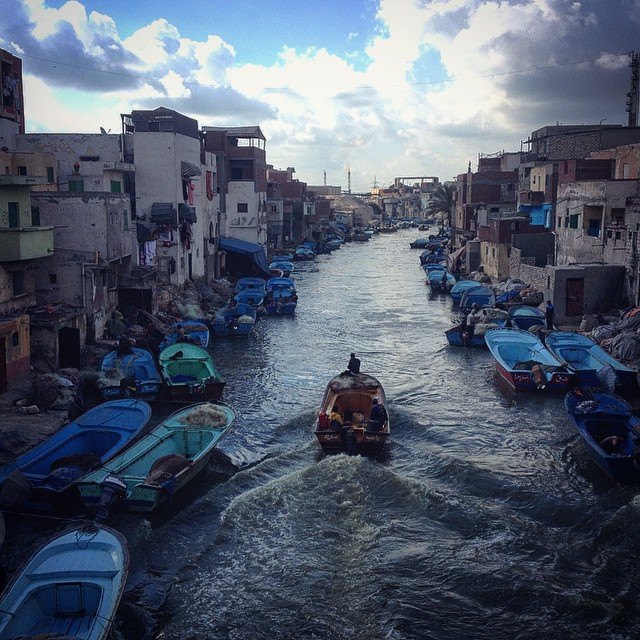
8. Is this Venice or Alexandria?
9. The everyday ferry commute
10. Four people and one motorbike
11. Watching the world pass by on a train
12. The subway journey
13. Hanging on to a microbus
14. Sometimes walking is just better
15. Even the ferries tend to be overcrowded
16. Tuk-tuk-ing through a sandstorm
17. Catching a microbus with civilization in the background
18. There’s no yellow school bus for these children
19. The metro ride home can often be long
20. Riding with style
21. The bus station
22. Horse carriages are still common in some areas
23. Going home after a long day of working in the fields
Have mercy on the more than 700 Hajj pilgrims trampled underfoot in Saudi Arabia. Have mercy on the two million still alive, witness to the disaster. May they reflect anew, and seek you with all their heart.
Eight of the dead are among the 62,000 Egyptians on the pilgrimage. For them and all nationalities beside, comfort their families and provide for their children. Many Muslims believe Mecca is the best of all places to die. Help them to balance their grief with acceptance of honor.
Help the Saudi authorities to review all procedures, God. May they do all in their power to ease and order the necessary rituals.
And apart from the Hajj, God, bless all Muslims as they celebrate their holiday. May they laugh, love, and long for you. Lighten their hearts from the troubles of the region; burden their souls to serve you and their peoples.
Have mercy, God. Forgive the dead and the living, and revive us all.
Amen.
Update: The Ministry of Endowments now lists 124 Egyptian casualties.
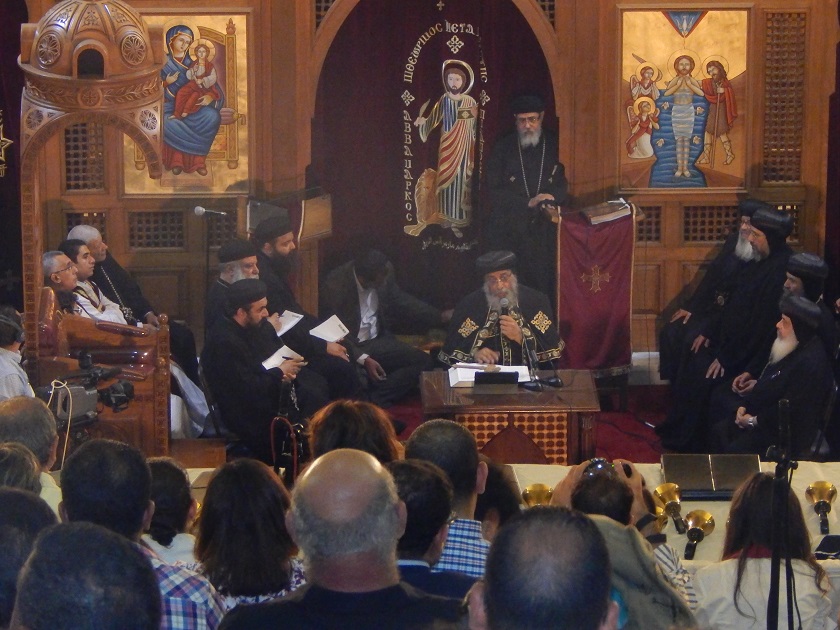
Pope Tawadros at St. Mark’s Church in Maadi, Cairo
Friends in Philadelphia will soon have the privilege of a papal visit. But will Pope Francis preach in your particular church?
His equal in the faith visited us in Maadi.
A Catholic might not consider it so. A Protestant might insist we are all equal. But for Orthodox Christians, Pope Tawadros is patriarch of one of the five ancient sees of the church, in which Rome and Alexandria are equals.
“To advance in the church,” he said, “is not done in the ways of the world. It is to lower yourself beneath the feet of others.”
By holding to equality with Rome, or in serving as a patriarch at all, does the head of the Coptic Orthodox violate his own teaching? His sermon on Wednesday was on the topic of humility. His visit on Wednesday—perhaps—is evidence of it.
Pope Tawadros’ predecessor Pope Shenouda was beloved of the people. Charismatic and witty, his Wednesday sermon at the papal cathedral characterized this bond. To a full house that treated him like a superstar, he took questions from the audience and left them laughing, rebuked, and inspired.
Pope Tawadros is respected as an organized administrator and heady thinker. He is young in his position, but does not seem to have the same level of charisma nor to have won the same level of enthusiasm. Few could.
He initially tried to follow in Shenouda’s footsteps, but when I attended a few weeks ago the hall was only half-full. Furthermore, he replaced the question-and-answer period with the traditional evening prayer. He does have a call-in show on Coptic satellite television, but I have heard Copts complain that this medium is out of reach to many simple believers. Rich and poor alike, all loved Pope Shenouda.
The Coptic Cathedral is now under repair, and Pope Tawadros suspended the Wednesday service. Before this, however, it was interrupted by petitioners seeking resolution for their divorce cases. Speculation wonders if the two are connected, or if the pope feels weighed down by the burden of comparison.
There is no answer that can weigh the motivations of his heart. But the visit to Maadi reflects a new evolution of the Wednesday tradition. Rather than sitting centrally in the cathedral, he will visit his flock.
“To be humble does not mean you are less than others or to deny your gifts, talents, or abilities,” Tawadros said. “It is liberation from the power of the self.”
In order to stay humble Tawadros recommended a checklist of characteristics the Christian should continually review. Never elevate your opinion of yourself, but lower it. Be thankful, and search for the good in all things. Remember the final judgment, and constantly repeat, “Have mercy on me, a sinner.”
Tawadros’ advice centered on the creation of a humble spirit, but two other attributes are necessary, he said. The Christian should also cultivate an open mind and a wide heart. Together these three make it possible to live well and navigate the challenges of life.
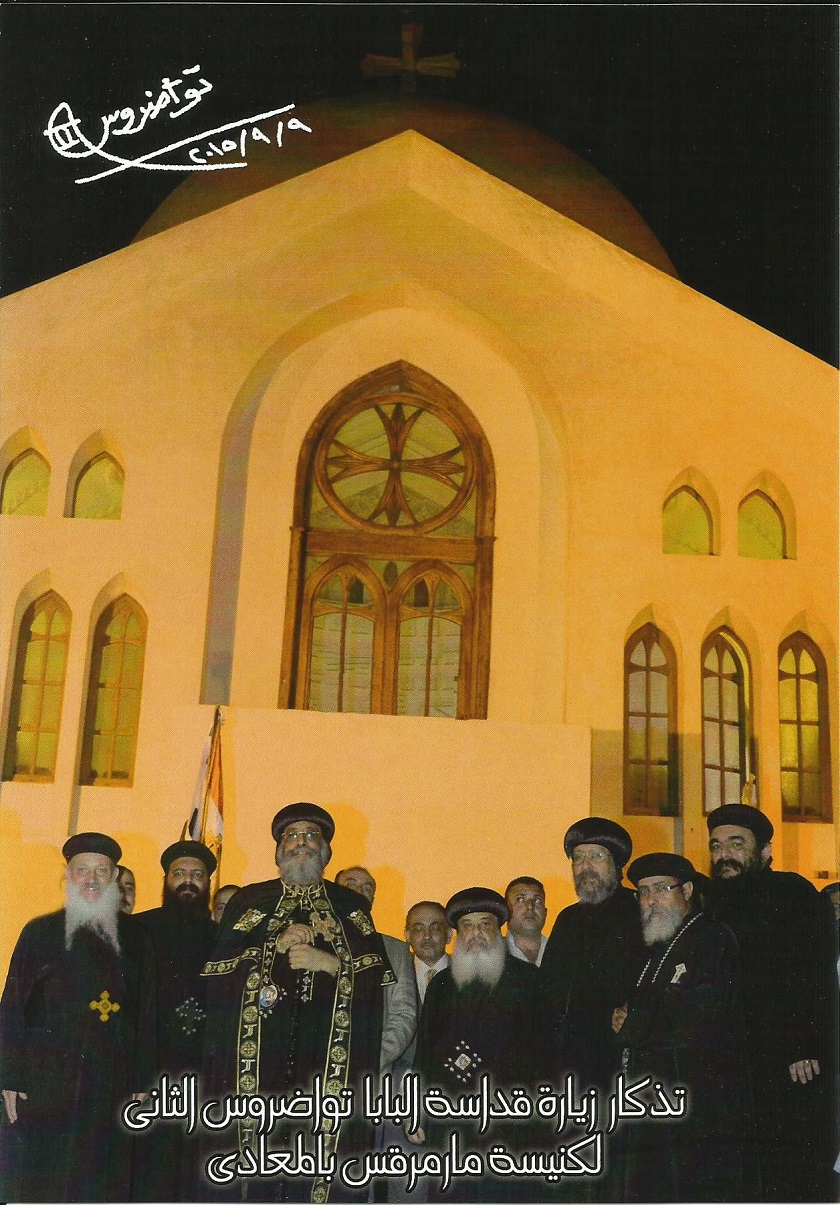
After the sermon St. Mark’s Church demonstrated fidelity to Tawadros’ predilection for organized administration, in the form of crowd control. Young people from the scouts program lined the aisles and hallways, channeling all in attendance into a single line to meet the pope. There, he further demonstrated humility as near an hour transpired for each one to receive from his hand a commemorative picture of the occasion.
Commemorative photo taken in front of St. Mark’s Church
Meanwhile, I chafed. My seat was in the very back row of the balcony. The best seats were already taken, so I judged the next best viewpoint would be to scan the whole assembly. Had I considered it, I might have believed myself humble for choosing so lowly a place.
I have had the opportunity to meet Pope Tawadros, briefly. But at the end of a long evening I just wanted to get home. I was quite happy to skip the line and again, had I considered it, I might have believed myself humble for my patience in waiting to leave and allowing others to go ahead.
But patience wears thin. I could see below that the pope was receiving the crowd. What I could not see was the organization. The scouts in the balcony were not letting us go anywhere, and I didn’t know why. Just let us exit, I thought, and as others get in line below, I’ll slip out a side door.
A few fought their way past the scouts, and the balcony crowd started getting restless. We were told many times to sit and wait, but no one was explaining anything.
That might be a mark of deficient organization, as communication is a must. But my entire perspective changed once allowed down the balcony steps. Very efficiently, at each turn in the path stood the scouts. Smoothly and quickly we were ushered to Pope Tawadros.
As it turns out there was no opportunity to leave by another path. I took the picture from the pope, then a mug from the bishop. Just like that, and I was outside. Five minutes later I was home.
It could be said the entire evening was public relations. Rather than continuing in the pattern set by his popular predecessor, Tawadros sets his own terms. He will visit the churches in carefully controlled settings. He will deliver a sermon and distribute memorabilia. Copts love their religious leaders. He will create a desire in each church to receive a future visit.
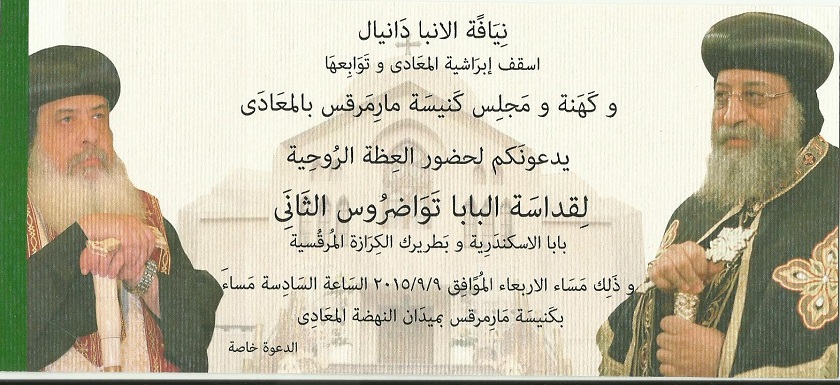
Invitation distributed to selected parishioners of St. Mark’s Church, following an open sign-up
If it is public relations, is it only PR? And is it wrong? Tawadros blessed the Copts of St. Mark. He both encouraged and demonstrated a humble spirit. He has the open mind to create a new pattern for Wednesday sermons, and the wide heart to check directly in on local congregations.
He has a hard job. If he lacks the charisma that is comfortable with the spotlight, he knows he cannot remove himself from it. Instead he will subject himself even to the scouts of the church.
Only God knows his heart, but God has so far chosen to elevate him to leadership of an ancient see. Many scoundrels have held similar posts in the past, so there is no guarantee. Let both Catholic and Protestant nod heads in sad memory of flawed saints and rank sinners.
Let them both also hold out hope and prayer for Pope Tawadros, to live and lead worthy of his calling.
“I must decrease, he must increase,” Tawadros quoted John the Baptist, speaking of Jesus. Standing long in the apostolic line of Alexandria, may the 118th successor of St. Mark do the same.
A recent Ahram Online article provides the reasons for negative economic growth assessments for Egypt, discussed at the 20th annual Euromoney conference in Cairo:
Only 6% of companies have a loan or line of credit
Necessary collateral 33% higher than world average
97% of businesses employ less than ten people
Informal sector represents 30% of economy and 40% of labor
Read the full article for explanations about why these statistics are disheartening. But on top of revolutionary and terrorist issues scaring away both tourism and foreign investment, the national base itself is not easily mobilized for growth. The conference’s opinion is that much internal reform and structural adjustment is necessary.
Forgive Egypt. Forgive her for the accidental killing of Mexican tourists. Forgive her for the haphazard way she handled the press. Forgive her for blaming the victims. Forgive her for false reporting in local media. Forgive her for awkward and self-referential condolences. Forgive her for the damage to tourism. Forgive her for the insufferable pain inflicted on the Mexican tourists and their families.
Forgive her, God. But may she also repent.
You have given government authority to protect citizens and society, God. Help Egypt to root out the terrorists the tourists were mistaken for. But you have given authority in trust. Help Egypt restore it.
Transparency and accountability have been promised by the authorities. May they fulfill their word, and extend it to governance in general.
Forgive Egypt, God. Save her from herself and her many entrenched sins. May this terrible accident be a rebuke that jolts her into reflection and change.
May it jolt her to repentance. May she weep over what she has done.
Comfort the victims, God. Give them strength to forgive.
From my article on Christianity Today, co-written with Tim Morgan, published September 18:
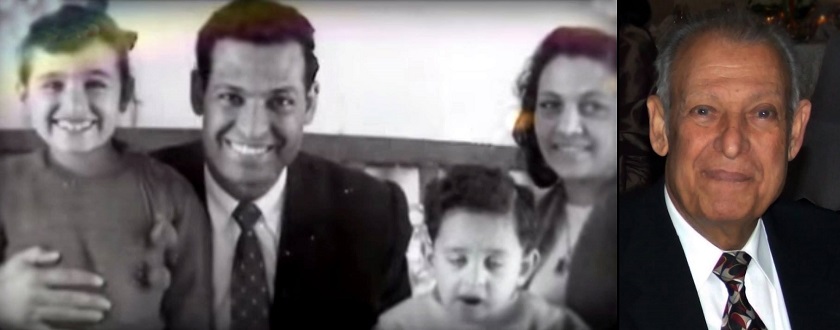
Menes Abdul Noor, who served as pastor of Kasr el-Dobara Evangelical Church in Cairo, Egypt, for over three decades, died on Monday, September 14, from Parkinson’s disease. He was 85.
Under his leadership, the 8,000-plus Presbyterian congregation became the largest Protestant church in the Middle East.
Abdul Noor authored and translated over 100 books, and taught at the Haggai Institute and Evangelical Theological Seminary in Cairo for more than 25 years. He is survived by his wife, Nadia, his son Farid, and his daughter Violet. He had six grandchildren and four great grandchildren.
His memorial service Wednesday was attended by officials of the Orthodox, Catholic, and Anglican churches, as well as a representative of Al-Azhar, the foremost Muslim institution in the Sunni world. It was also broadcast live on the SAT-7 Arabic satellite television network.
Please click here to read the full article at Christianity Today, including quotes and anecdotes from an unpublished CT interview with Abdul Noor in 2008.








 Jayson Casper