After 18 grueling months fighting desertification in Niger, Tony Rinaudo was near despair. As manager of a small reforestation project for SIM in 1983, he knew few of the 6,000 trees the missions agency had planted yearly since 1977 had survived the arid Sahel climate.
Locals called him the “crazy white farmer,” not wishing to waste valuable agricultural land on more failed efforts. But, trudging on, he loaded another batch of saplings into his pickup truck, struggling to fulfill his childhood prayer.
Years earlier in the threatened Ovens Valley of southeast Australia, Rinaudo lamented the bulldozing of hilly bushland and the killing of fish by drift from insecticides sprayed on tobacco plants—while children elsewhere went to bed hungry.
“God,” he cried out, “use me somehow, somewhere, to make a difference.”
Soon thereafter he stumbled upon I Planted Trees by Richard St. Barbe Baker. One line impressed itself upon Rinaudo, becoming his eventual life work.
“When the forests go, the waters go, the fish and game go, herds and flocks go, fertility departs,” he read from the 19th-century English botanist’s book. (The quote is attributed elsewhere to Scottish science journalist Robert Chambers). “Then the age-old phantoms appear stealthily, one after another—Flood, Drought, Fire, Famine, Pestilence.”
In 1981, Rinaudo settled in Maradi, 400 miles east of Niger’s capital, Niamey. The West African nation’s economic center, on its southern border with Nigeria, hosted SIM’s agricultural project, a hospital, and a local Bible school. Present since 1924, the mission—together with Catholics—established Niger’s largest concentration of Christians, though they numbered less than 1 percent of the population overall.
French colonialists and later international development projects contributed to environmental degradation through large-scale farming, clearing trees to maximize yield. Local farmers felled them further—out of poverty and hunger—to sell the wood, while women would walk miles to find kindling for their cooking fires.
As Rinaudo stopped to deflate his tires to traverse the sandy landscape for his delivery, he sighed and once again called out to God.
“Forgive us for destroying the gift of creation,” he prayed. “Show us what to do, open our eyes.”
Looking up, he spied a bush. On any other desert trek, Rinaudo recounted to CT, he would have passed by similar-looking shrubs soon to be consumed by wandering goats. But this time…
This article was originally published by Christianity Today, on November 10, 2022. Please click here to read the full text.
I recently was interviewed by Dr. Alfonse Javed, host of the podcast Our Urban Voices. We spoke about the necessity of religious literacy in reporting on this often-troubled region, and how I go about my job. It runs about 35 minutes, and the topics are listed by timestamp, below.
Additionally, Isabella Meibauer interviewed me (among others) on a similar topic for her article in IJNet, “Tips for Reporting Ethically and Accurately from Abroad.”
Please click here for the link to the podcast, and click here for the link to the article. It is our privilege as journalists to represent the perspectives of our sources. Thanks for your interest, from time to time, in what we think as well.
Timestamped Show Notes:
01:41 – Topic: The Importance of Representing all Views in Journalism
01:50 – Family, from America to Lebanon
03:39 – A Day in the Life of a Journalist
06:59 – Reporting Complexities Fairly
08:56 – Representing 2% of Population
10:04 – What is Sympathetic Reporting?
10:28 – Hope, Reflection and Prayer
13:28 – Handling an Accusation of Bias
16:22 – Religion Impacting News in the Middle East
18:05 – Religion a Factor in Community Relations
18:23 – Religion a Factor in Politics
20:37 – Christians in the Middle East and Diaspora
21:37 – Relations Between Christian and Muslim Communities in the Middle East
23:17 – Religious Identity and Neighborliness
24:02 – Surprised by Christians in the Middle East
25:26 – Christians in Egypt
27:10 – Learning about the Middle Eastern Culture
27:46 – Cheaper Way to ‘Travel’ to the Middle East
28:04 – Middle Eastern Hospitality
28:22 – Connecting Middle Eastern Christians to Americans
In the waning days of the Ottoman Empire, evangelicals laid down their lives for their Lord. Living in Nusaybin, once home to the ancient theological school of Nisibis, they were among the firstfruits of the Sayfo (“sword”) martyrs.
Overall, modern estimates posit half a million deaths of Syriac-Aramean Christians at the hands of Turkish and Kurdish soldiers, concurrent with the Armenian genocide that claimed 1.5 million lives. Today this Christian community, still speaking the language of Jesus, seeks its own recognition.
In June 1915, the Muslim-majority city—now located on Turkey’s southeastern border with Syria—had about 100 Syrian Orthodox families, and an equal number belonging to other Christian sects. The Protestants were rounded up with Armenians and Chaldeans, marched to the front of town, and shot dead.
The Orthodox families were promised peace by the local leader, but 30 men fled and sought refuge in the rugged mountains. A monk, trusting authorities, led soldiers to their hideout seeking to reassure the frightened band.
According to reports, along the way they turned on the monk, demanding he convert to Islam. Upon his refusal, they cut off his hands, then feet, then head. Returning to Nusaybin, the soldiers assembled the remaining Christians, leading them out of town. In joyful procession the believers sang hymns of encouragement: Soon we will be with our Lord Jesus Christ.
Refusing conversion, one by one they were shot, and then dumped in a well.
In 1919, then-Syrian Orthodox Archbishop Aphrem Barsaum filed a report to the prime minister of Britain, after the Allied powers displaced the Ottomans. Similar massacres had been repeated in 335 other villages in the archbishop’s jurisdiction, killing 90,313 Christians and destroying 162 churches. Collecting other reports, delegates to the Paris Peace Conference following World War II tallied 250,000 deaths.
“It is unjust when they speak only of the Armenian Genocide,” said Archbishop Joseph Bali, secretary to Syriac Orthodox patriarch Mor Ignatius Aphrem II. “We also need to be vocal about our people.” Fueled by a substantial diaspora, the Armenian tragedy has been recognized…
This article was first published at Christianity Today, on October 21, 2022. Please click here to read the full text.
If the world is at stake, stewardship of creation must be global. And with an evangelical passion akin to world missions, Ed Brown is preaching ecology to the nations.
One region at a time.
Following initial consultations in Jamaica in 2012, Brown became the Lausanne Movement’s catalyst for creation care and helped build out the Lausanne/World Evangelical Alliance Creation Care Network (LWCCN). The goal was to amplify a conviction forged two years earlier in Cape Town, South Africa, at the third Lausanne Congress: Creation care is a gospel issue within the Lordship of Christ.
Since then, LWCCN has conducted conferences in 12 regions drawing delegates from over 120 nations. Concluding earlier this month in Jordan for the Middle East and North Africa, Brown and his colleagues addressed local issues for a region experts warn is warming at twice the rate of the rest of the world.
And the UN is cued in. Its 27th climate change conference, COP27, begins November 6 in Sharm el-Sheikh, Egypt, with COP28 scheduled next year in the United Arab Emirates’s Abu Dhabi.
Brown served previously as chief operating officer for the evangelical Au Sable Institute of Environmental Studies, and today is a fellow at the Nelson Institute of Environmental Studies at the University of Wisconsin-Madison. He founded Care of Creation, Inc. in 2005, and is author of Our Father’s World: Mobilizing the Church to Care for Creation.
In Amman, he spoke with CT about the challenge of politics, the response of missionaries, and the drastic impact environmental changes will soon have on ministry to one’s neighbors.
Reflecting on your many meetings, did the message of creation care resonate with the international evangelical community?
Much more so than in the US. We found people hungry and eager to have us come. People in these countries live closer to nature, without the protections from nature that exist in the West. They are much more aware of climate change happening. You can’t hide from it.
We’ve seen this with the floods in Pakistan, and with Hurricane Ian it is coming home to America. But this has been true for people in the Philippines for decades. The weather is changing, and our message is that creation is groaning in a biblical sense.
What is it that they were hungry for, or lacking?
Everywhere we go, the Spirit has been speaking to people about caring for God’s creation. With a conference like this, people are discovering each other. I may be the only one in my church, they realize, but I’m not the only one in [my] country—and now we can communicate with each other.
There is also a thought that individuals and church leaders sensed that something wasn’t right, without knowing the biblical foundation about how the Bible speaks to the issue.
Can you give an example about how we have missed this message in Scripture? The central passage I use is…
This article was originally published at Christianity Today, on October 19, 2022. Please click here to read the full text.
When “God’s smuggler” came to the Middle East, he went through the front door. Once known for hiding Bibles in the back of his Volkswagen when crossing behind the Iron Curtain, Brother Andrew instead simply handed them to terrorists. Coupled with his devotion to the Palestinian church, the founder of Open Doors shook the Western Christian status quo.
Arab evangelicals loved him for it.
“He had a soft heart for those in pain, the persecuted, and those usually considered on the other side, the enemy,” said Jack Sara, general coordinator for the Middle East and North Africa Evangelical Alliance. “He was willing to step into a difficult place and talk with difficult people, but never compromise the message of the gospel.”
The news of Anne van der Bijl’s death Tuesday at age 94 shook participants during the second general assembly of the World Evangelical Alliance’s (WEA) Arab world region. David Rihani, president of the Jordan Evangelical Council, recalled the words of his father who received the Dutch evangelical frequently.
“This man is an example of a real Christian leader,” the first Jordanian evangelical pastor told his son. “He writes books, he shares knowledge, and he cares about everyone without discrimination.”
Rihani praised Brother Andrew’s ecumenical cooperation. Developing relationships with traditional Catholic and Orthodox leaders in the region, for decades Open Doors has chronicled persecution against all Christian denominations. And as the group’s advocacy across 60 countries grew to include the plight of believers in other religious traditions, the Bible smuggler won respect in the wider human rights community as well.
“He advocated tirelessly for religious freedom, a source of hope to persecuted Christian communities around the world,” tweeted US Ambassador-at-Large Rashad Hussain, a Muslim. “I’m grateful his legacy will live on in the work of @OpenDoors.”
But it was his literature that originally established Brother Andrew’s worldwide fame. God’s Smuggler, written in 1967, sold more than 10 million copies and was translated into 35 languages—including Arabic.
Maher Fouad, president of the General Society for Iraqi National Evangelical Churches, was touched most by And God Changed His Mind (1990). Calling Andrew a “blessed saint,” he recalled reading the book in 1991 when he headed the prayer ministry of the National Evangelical Church of Baghdad.
“It redirected me completely,” Maher said. “He knew how to slowly enter the presence of God, and only then find answers to prayer.”
The publication of Light Force in 2004 highlighted to the world Brother Andrew’s increased attention to the Muslim world. Acclaimed to be as captivating as Smuggler, his dependence on prayer was on display in practical concern for the Middle Eastern church.
“My purpose is to encourage and strengthen the local believers to be a Light Force,” he wrote, “an alternative to military might.”
But first he modeled it himself. In 1992, when 415 militants from Hamas were expelled by Israel to the side of a mountain in southern Lebanon’s Marj al-Zohour, Brother Andrew saw an opportunity to…
This article was originally published by Christianity Today on September 29, 2022. Please click here to read the full text.
Four years ago, Shenouda was an infant found at the door of a Coptic church. Today, renamed Yusuf, the boy is found in a state-run orphanage. In between lies the care of a priest, the devastation of a Christian family, and a sectarian bureaucracy undergoing partial reform.
Egypt is home to a Dickens-like tragedy.
“Adoption is not legal in Egypt,” said Nermien Riad, executive director of Coptic Orphans. “There is no possibility it will happen as known in the Western world.”
The boy’s family name and location have been kept anonymous as a cautionary measure, as reported by the Coptic publication Watani. Likely left by an unwed mother, the child was found by a Coptic priest who presented him to the couple, infertile for 29 years.
They took him into their home, obtained a birth certificate as if he was their own, and raised him with love and devotion. They gave him a Christian-signifying first name, honoring the prior Coptic Orthodox pope, and per Egyptian naming custom the four-generation quadrilateral was completed with the names of the doting father, grandfather, and great-grandfather.
All was idyllic, until a jealous niece realized the impact on her inheritance.
Egypt’s Islamic-based law, seeking to preserve lineage, prohibits taking another’s child as one’s own. The niece reported the couple to the police, who investigated. The prosecution determined there was no blood relation, but also no ill will.
The father signed a paper stating he found the child “on the street,” likely to shield the priest’s involvement. But though the case was dropped last February, the boy was taken to an orphanage. With no papers to prove his ancestry, he was assumed to be a Muslim—and thus forbidden to live with a Christian family—and given the religiously neutral name Yusuf, the Arabic equivalent of Joseph.
The desperate parents protested: What Muslim would leave their unwanted child at a church? Denied, they were even forbidden from visiting him in the orphanage. Their applications for employment at the facility were turned down. According to the Ministry of Social Solidarity, Egypt has…
This article was originally published at Christianity Today on September 27, 2022. Please click here to read the full text.
A new language law in Ukraine has complicated ministry to Russian-speaking citizens. Comparing restrictions to the Soviet era, one Christian broadcaster is relocating to Budapest, Hungary.
“I don’t want our staff busted on the air for reading the Bible in Russian,” said Dan Johnson, president of Christian Radio for Russia, which operates New Life Radio (NLR) from Odessa on Ukraine’s Black Sea coast. “We were expecting bombs to wreck our radio operations, but it turned out to be this law.”
Last month, Russian missiles landed one mile from their studio.
But earlier in July, President Volodymyr Zelensky signed into law a near-complete ban on Russian music on radio and television. Passed by parliament with a two-thirds majority, it exempts pre-independence classical artists like Tchaikovsky and Shostakovich as well as modern composers who have condemned the war.
About 65 percent of NLR airtime is music. Though local Christian anthems have inspired many during the war, Johnson said most contemporary worship songs are in Russian, even those originating from Ukraine.
A 2021 national survey identified 22 percent of the Ukrainian population as native Russian speakers, with 36 percent speaking the language primarily at home. Concentrated in the eastern Donbas and southern regions where Russian troops have prioritized attack, there are fears that Moscow is preparing to annex certain occupied areas.
Johnson has fled restrictions before. He moved to Russia in 1991 and by 1996 began radio ministry in Magadan, a featured city in Aleksandr Solzhenitsyn’s The Gulag Archipelago. Kicked out in 2006, he continued ongoing satellite-based radio work in Moscow, broadcasting throughout the former Soviet Union. But as the campaign against both free press and evangelical ministry tightened, in 2019 he relocated again.
Odessa promised an atmosphere of freedom—until now.
“There isn’t a government in the world that can stop the gospel,” Johnson said. “We will pivot and move on as always.”
NLR rents its studios and broadcasts by satellite and online, simplifying operations. Budapest was chosen because of its sizable Russian Christian population, Johnson said, which welcomed the ministry.
In the meanwhile, NLR continues to produce content in Russian, encrypting the signal to broadcast from outside the country. This should satisfy the law, he said, while also raising funds to build a Ukrainian language–only network in Odessa. In time, as a to-be Ukrainian broadcaster, he hopes to secure an FM license, alongside satellite and internet radio.
“I hope the authorities will leave us alone,” he said.
Sergey Rakhuba of Mission Eurasia called NLR collateral damage.
“I believe in freedom of speech,” he said, “but this is a state of war.” A native Russian speaker himself, an aspect of Rakhuba’s ministry has witnessed increased scrutiny…
This article was originally published at Christianity Today on August 30, 2022. Please click here to read the full text.
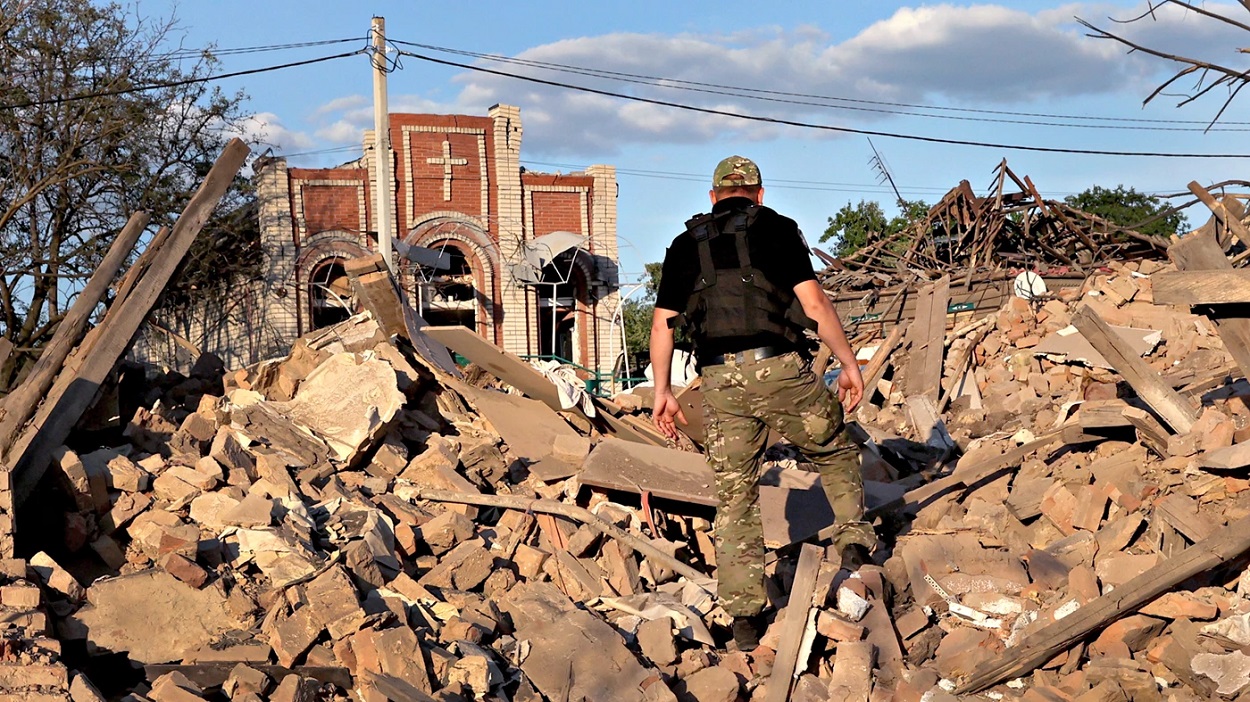
Image: Scott Olson / Getty Images Sukovska Baptist Church was heavily damaged by a nearby missile strike in June in Druzhkivka, Ukraine, and has since conducted its Sunday services in a tent.
The World Evangelical Alliance (WEA) called for prayer.
“On this day of independence, we want to declare our dependence on God,” it stated on behalf of Ukraine, “the One who can bring true peace to the hearts of each individual person, each family, and even entire peoples.”
Joined by the affiliated European Evangelical Alliance, the WEA petition specified prayers to end the suffering, to spare the world from further repercussions, to strengthen the church’s response, and to marshal peace not through weapons, but through prayer.
Ukraine must defend itself, the WEA clarified; but Christians have a deeper hope.
“Throughout history, God has changed hopeless and dire situations in surprising ways,” stated the petition. “Let us also pray for healing and for reconciliation, and that Russia and Ukraine could live in peace as independent, sovereign nations.”
An accompanying guide for parents offers similar prayers for children.
It will not be easy. An Orthodox priest who performed last rites for the 116 people found in a mass grave in Bucha reflected on his spiritual calling.
“Saying the word forgive isn’t difficult,” Father Andriy told The Associated Press. “But to say it from your heart—for now, that’s not possible.”
As a followup to its March survey of the wartime prayers of Ukraine’s evangelicals, Christianity Today asked a sampling of Christian leaders to explain how the ongoing war has changed how they pray and what they pray for, how they understand unanswered prayers in difficult times, and how fellow Christians around the world can best pray for them now:
Denys Kondyuk, head of the missiology department at Ukrainian Evangelical Theological Seminary, Kyiv:
My prayers were more scheduled and structured before the invasion. Now they are dominated by requests for health and life, for obvious reasons. And I have seen God answer through many stories of deliverance from very dangerous situations; but of course, there are still many that suffer and die.
The prayer for the war to end is still unanswered.
Ukrainians have focused on verses that emphasize God’s justice, especially those which emphasize there is not much we can expect from people. Others, meanwhile, have found hope in the scriptures that promise our suffering is temporal, awaiting the kingdom of God.
Please pray that God guides us to serve where it is needed, and to be bold in what we do. And ultimately, for the victory of Ukraine—bringing justice to those who suffered and died.
Yuriy Kulakevych, foreign affairs director of the Ukrainian Pentecostal Church, Kyiv: We are all called to grow in Christ, which includes our prayer life. As pastor of God’s Peace Pentecostal Church in Kyiv, I am encouraging our people to…
This article was originally published at Christianity Today on August 24, 2022. Please click here to read the full text.
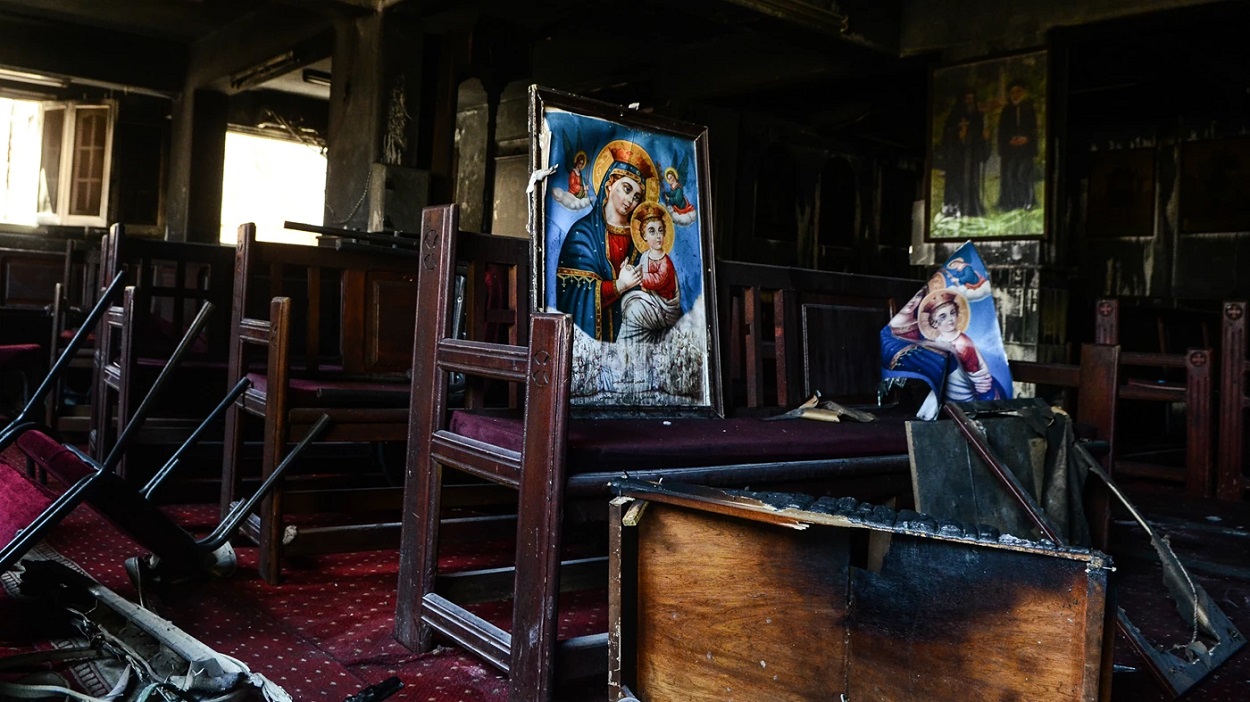
As Egypt reels from the tragic church fire that killed 41 worshipers on Sunday, many search for where to put the blame.
“God forgive the fire department,” said Ishak Henin, a deacon at Abu Seifein Coptic Orthodox Church in Imbaba, a dense urban neighborhood of Cairo. “If they had come earlier, they could have saved more people.”
Egyptian authorities stated they arrived almost immediately after the 9 a.m. fire was first reported. Eyewitness testimony varied; some stated 15 minutes, others over two hours.
Abu Seifein means “the father of two swords” and is the Arabic moniker for second-century martyr Saint Mercurius, whose icon reflects his military origins.
But the word church may give the wrong impression to overseas audiences, as the sanctuary was located between ground floor shops and towering residences. Illegally repurposed in 2007 from one of many tightly packed apartment complexes, the now-charred chapel traced back to an era when Egyptian Christians were unable to obtain permits to build new houses of worship.
The law was changed in 2016, and a Coptic legal expert stated Abu Seifein was officially licensed in 2019. Since the latest batch in April, the slow-moving process has now legalized 2,401 churches and affiliated service centers.
Yet many remain in their original condition, below safety codes, and according to the law full legality can only come once all regulations are satisfied.
Abu Seifein’s four-story building housed two daycare facilities, and 18 children died in the blaze. Around 100 people were present at worship that morning; authorities stated most deaths—which included the local priest—were caused by smoke inhalation and the resulting stampede.
One family lost a set of five-year-old triplets, their mother, and grandmother.
The head of Egypt’s evangelical community was “deeply pained,” and offered condolences to Pope Tawadros, patriarch of the Coptic Orthodox Church. “We pray that God will give comfort and patience to the people,” stated Andrea Zaki, “and…
This article was originally published at Christianity Today, on August 18, 2022. Please click here to read the full text.
Image: Mission Eurasia A Bible camp for displaced Ukrainian children
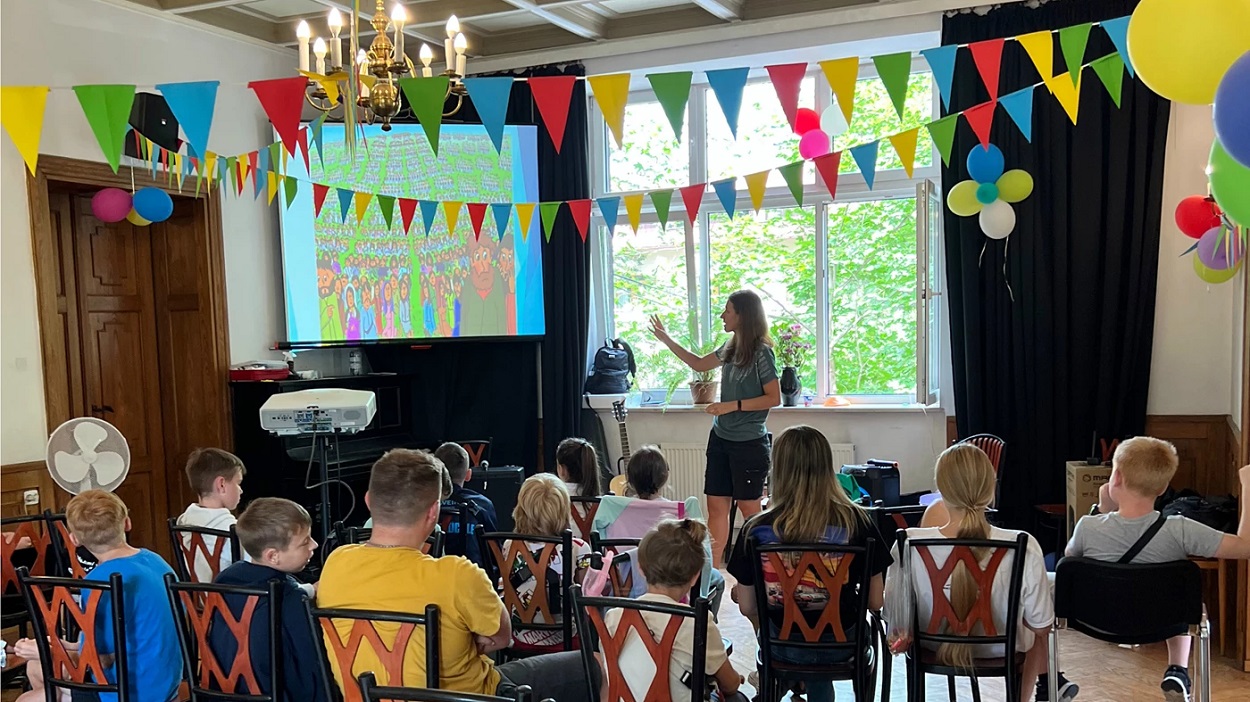
Her mother died of cancer. Her father was killed in the war. When her home in Donetsk was destroyed by a Russian missile, retreating Ukrainian troops brought the eight-year-old orphan and her grandparents and uncle to volunteers serving with the Chernivtsi Bible Seminary (CBS), 680 miles to the west.
Their only possessions were the clothes on their backs.
Resettled in temporary housing, last month the uncle was called back to the front lines. The girl has been sent to a Christian camp, and the seminary—serving as a ministry hub for the internally displaced—is doing what it can to assist.
“We did not think that serving a refugee is such a complicated process,” said Vasiliy Malyk, CBS president. “But no matter how difficult it may be, we can help them at least with some dignity.”
It is a team effort, and once tallied the numbers both stagger and pale in comparison to the need.
The Alliance for Ukraine Without Orphans (AUWO) has mobilized 3,000 volunteers to provide temporary housing for 6,000 people, mostly women and children. It has evacuated 38,000—more than two-thirds of which have been orphans. Nearly 59,000 people have received some sort of humanitarian aid.
“When the war started, everyone was focused on responding,” said Ruslan Maliuta, a former AUWO president and current network liaison for One Hope. “But then we realized the war is going to last, the crisis is huge, and the response will require us all to work together.”
To do so, in April the World Evangelical Alliance (WEA) launched The Response—Ukraine Special Taskforce (TRUST), with Maliuta as its leader. AUWO united with Ukraine’s Baptists, Pentecostals, and seven other national church and parachurch organizations to coordinate refugee relief efforts, alongside ten regional partners from Poland, Moldova, Slovakia, Hungary, and Romania.
“Having churches reach across denominational lines to work together has been one of the most encouraging things,” said Chris Guess, a Romanian pastor. “We have volunteers from across the globe, [as] God’s people have jumped in with us.” For example, volunteers from Argentina shipped 20,000 tons of rice.
Comparing notes from March onward, the evangelical network has mobilized 64,000 volunteers. Temporary housing has been offered to 271,000. Over 346,000 people have been evacuated, while nearly 600,000 have received humanitarian aid. Over $1.1 million has been distributed to partners.
“TRUST is coming alongside the admirable work of professional aid agencies with no intention of competing or creating a new relief organization,” said Thomas Schirrmacher, WEA secretary general. “TRUST offers a bridge that connects.”
Yet the United Nations underscores the grim reality: 6.2 million need shelter, 10.2 million need food, and 12.1 million need health assistance.
“People are on the edge of exhaustion,” said Rafal Piekarski, serving with Proem Ministries in Poland. “Our Polish resources are over. We don’t want to compete with each other, but be good stewards of what you can bring from your countries, your churches.” In May, Piekarski was one of…
This article was originally published at Christianity Today, on August 5, 2022. Please click here to read the full text.
The field is set for Nigeria’s 2023 presidential election, leaving its Christian citizens in a quandary.
In selecting candidates to replace the current head of state, Muhammadu Buhari, one dominant political party ignored customary protocols ensuring geographic rotation of power, while the other party—in the face of severe warnings—abandoned the customary commitment to religious representation.
Believers may desert them both.
Africa’s most-populous nation is roughly divided between a majority Muslim north and a majority Christian south. An unwritten agreement has rotated the presidency between the two regions. Buhari, a Muslim, hails from Borno State in the northeast.
The first transgression, by geography, happened in May when the opposition Peoples Democratic Party (PDP) nominated Atiku Abubakar from Adamawa State, also in Nigeria’s northeast. A Muslim, he chose as his vice-presidential running mate Ifeanyi Okowa, the Christian governor of Delta State in the south.
One month later, the incumbent All Progressives Congress (APC) nominated Bola Tinubu, the Muslim former governor of Lagos State in the south. But since he hails from a Christian region, fears were raised that his Muslim rival for president might sweep the north—viewed by many as a more reliable voting bloc. Speculation was rampant he would choose a Muslim vice-presidential candidate to compensate.
“We will consider such action as a declaration of war,” warned the Christian Association of Nigeria (CAN), which represents almost all the nation’s Protestants and Catholics. “We … will mobilize politically against any political party that sows the seed of religious conflict.” CAN also opposes any Christian-Christian political ticket as well.
Similar statements were issued by two of CAN’s five blocs: the Pentecostal Fellowship of Nigeria—“Meet us at the polls,” it said—and the Catholic Secretariat of Nigeria.
Opposition extended beyond religion.
The civil society Middle Belt Forum warned the APC against breaking Nigerian unity. And a leaked security report—denied by Buhari—said such a choice would destabilize the nation and risk Christian lives.
Tinubu defied them all.
“I believe this is the man who can help me bring the best governance to all Nigerians,” he said on July 10, defending his selection of the Muslim former governor of Borno, Kashim Shettima. “In this crucial moment, where so much is at stake, we must prioritize leadership, competence, and the ability to work as a team over other considerations.”
The vice president of Nigeria holds no formal power. But Christians were aghast at the affront.
“In a country with 100 million people in each religion, are you saying there is no competent Christian who can be your partner?” asked Samson Ayokunle, the outgoing president of CAN. “If you are picking a Muslim, it means you have an agenda.”
Ayokunle, a Baptist, assured that CAN, which this week will rotate to new leadership, has no preference in terms of political parties. Tinubu governed Lagos well, he said, and Abubakar has never picked a fight with Christians.
However, “CAN said loud and clear that we will teach a lesson to any party with a Muslim-Muslim ticket,” Ayokunle told CT. The only complication? “Christians have not been voting enough.”
It may be about to change. Denominations across Nigeria…
This article was originally published at Christianity Today on July 26, 2022. Please click here to read the full text.
The epicenter of advocacy for international religious freedom (IRF) has crossed the pond. Last week, the United Kingdom hosted the first in-person government ministerial on the issue to be held outside the United States.
Under the Trump administration, the US State Department inaugurated the Ministerial to Advance Religious Freedom in 2018. Reconvened in Washington in 2019, the following year the event moved to Poland which was forced to conduct proceedings online due to COVID-19. Pandemic distractions prevented Brazil from hosting the ministerial in 2021, but civil society and religious groups rallied to organize an IRF Summit in DC instead.
In 2020, 27 nations seized the ministerials’ momentum to create the International Religious Freedom or Belief Alliance (IRFBA), centered around Article 18 of the Universal Declaration of Human Rights (UDHR).
Declaring that “everyone has freedom to believe or not believe, to change faith, to meet alone for prayer or corporately for worship,” IRFBA has since grown to include 36 countries, an additional five national “friends,” and two observers—including the UN-designated special rapporteur on freedom of religion or belief (FoRB), the preferred terminology for IRF in Europe.
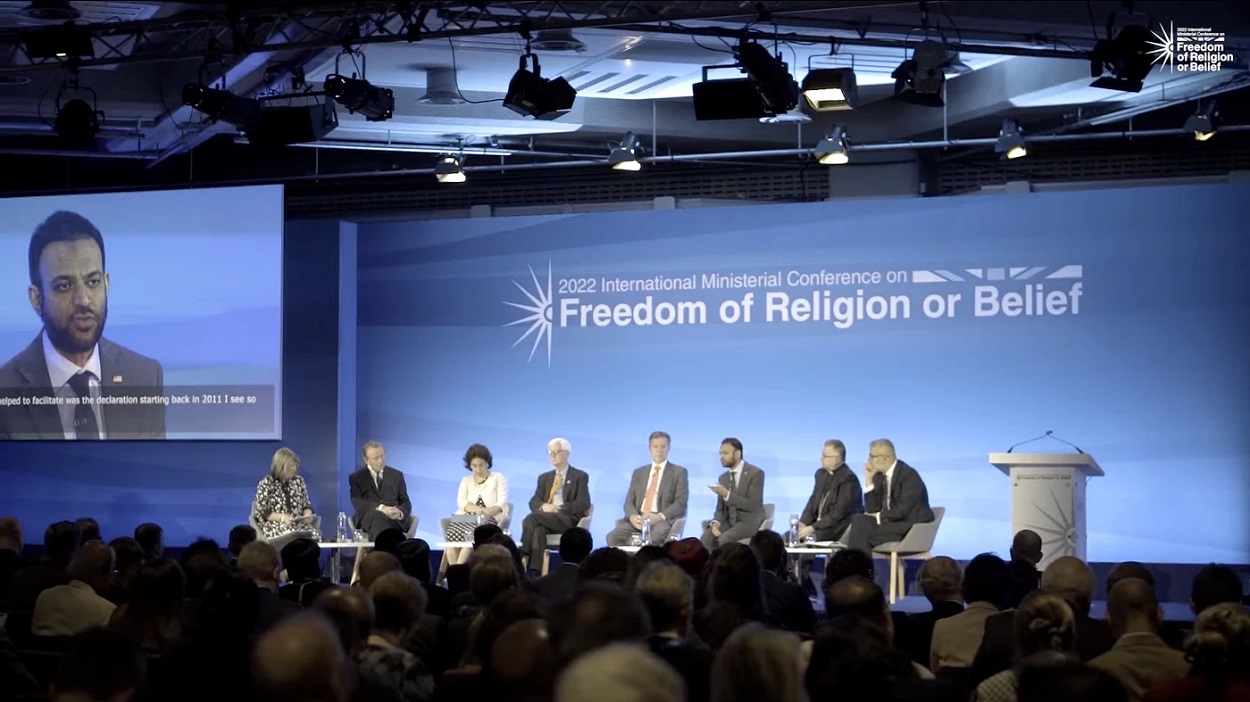
As IRFBA chair, the UK hosted the Ministerial Conference on Freedom of Religion or Belief on July 5–6 in London.
“Millions of people are being deprived an education or a job or a home or access to justice or liberty, even to life itself,” said Fiona Bruce, the UK prime minister’s special envoy for FoRB, “simply on account of what they believe.”
The UK demonstrated leadership on the issue in 2020, when as chair of the Group of Seven—a political forum of the world’s leading democratic economies—Britain secured the first-ever mention of FoRB as a priority within the G7 official communique.
“The ministerial helped create a heightened global consciousness on FoRB, a cornerstone of all human rights,” said Godfrey Yogarajah, ambassador for religious freedom for the World Evangelical Alliance (WEA). “Where FoRB is violated, all other human rights suffer.”
Hosted at the Queen Elizabeth II Center in Parliament Square, the 2022 ministerial’s remarks were delivered by Prince Charles of Wales and Archbishop of Canterbury Justin Welby. Chief rabbi Ephraim Mirvis spoke on behalf of Britain’s Jews.
Regional foreign minister Tarik Ahmed, a Muslim, delivered a statement welcoming to the ministerial 500 delegates from more than 100 countries. Sources told CT the UK did an exceptional job integrating the dozens of civil society and religious groups into the official proceedings.
With better coordination—and a wider berth from Americans’ July 4 observance of Independence Day—attendance might have been even larger. Only a few days before the UK ministerial…
This article was originally published at Christianity Today on July 13, 2022. Please click here to read the full text.
Bassem Ragy did not need a master’s of divinity degree in order to do math.
Seven years ago, when his church’s preschool children presented their paltry Sunday school offering of 7 Egyptian pounds (then equivalent to $2), he recalled the equation of five loaves plus two fishes.
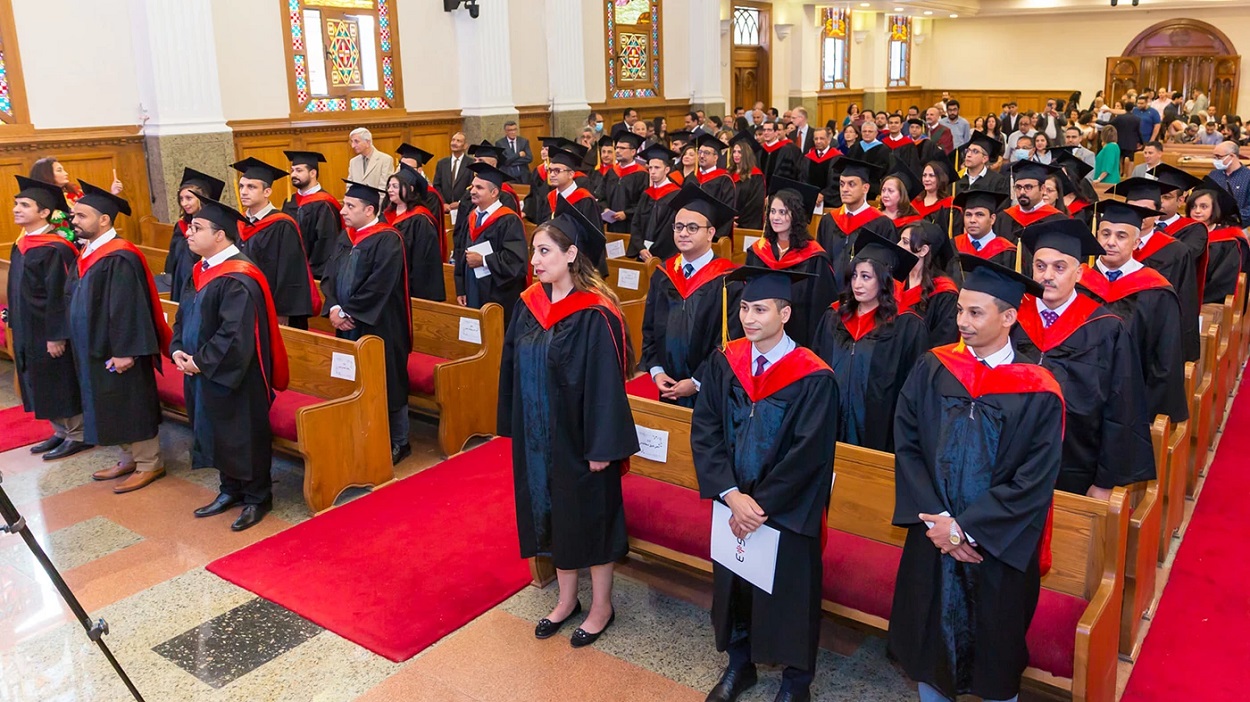
Now one of 69 members of the 2022 graduating class of Evangelical Theological Seminary in Cairo (ETSC), the newly-minted MDiv can preach Jesus’ miracle from the original Greek.
“When I see the work of our graduates, it gives me hope for the church’s future,” said Tharwat Wahba, ETSC vice president for church and society—and one of its many alumni. “We must keep up our momentum.”
The fishermen are multiplying.
In 1995, there were about 50 students at the Presbyterian institution. By 2005, seminary research had identified 311 affiliated churches, 127 of which lacked a full-time pastor.
By 2019, enrollment had grown to 300 students. Three years later, it reached 509. And now affiliated churches number 450, only 70 of which lack pastoral leadership.
Founded in 1863 aboard a felucca, a traditional Egyptian boat, in the Nile River, ETSC’s floating campus served mission stations and fledgling churches associated with the then-American Presbyterian movement. The seminary has steadily supplied synod pulpits ever since.
Wahba linked the explosive growth to a low point in modern Egyptian history.
While most Coptic Christians were cautious about the 2011 Arab Spring, many evangelicals seized the opportunity to minister to revolutionaries in Tahrir Square, hoping for the success of the democratic moment. But Islamist politicians quickly dominated the parliament, and in 2012 the Muslim Brotherhood captured the presidency.
Much of the Egyptian church felt under siege.
But the following year, ETSC—which had created a missions department back in 2002—made church planting and evangelism a required course for MDiv students. And in summer 2013, when a popularly backed coup removed Islamists from power, Egyptian evangelicals were already poised to serve society.
In 2015…
This article was originally published at Christianity Today on July 8, 2022. Please click here to read the full text.
Founding fathers are often sacred, but not sacrosanct.
In recent years, Americans have wrestled with the slave-owning legacies of George Washington and Thomas Jefferson. Confederate statues have been toppled, ideologically refighting for some the Civil War. Pilgrims have become pillagers; Plymouth Rock equated with imperialism.
Muslims are having a similar moment.
Their prophet is called a pedophile. Their miracles, a myth. Successors to Muhammad are compared to ISIS. And it is not just Islam’s historic men. Two current global controversies concern two of the faith’s celebrated founding females: Aisha and Fatimah.
The International Union for Muslim Scholars has renewed its call for an international ban on insulting religions. And from India to England, Muslims have poured into the streets this month in protest.
Christians—whether leading such polemics or suffering under blasphemy accusations—have often been embroiled in such Muslim controversies. These latest episodes, many are relieved, are centered elsewhere.
“But Christians in both India and Pakistan are quite frightened,” said Juliet Chowdhry, a trustee for the British Asian Christian Association. “It is inevitable that as a vulnerable religious minority that is incorrectly perceived to be in league with the West, Christians will find themselves caught up in the anger.”
Thus they are keeping silent, said a Christian leader in Pakistan who—illustrating the point—requested anonymity due to the sensitivity of the situation.
Last month [May 26], a spokesperson for the ruling Bharatiya Janata Party (BJP) in India cited Aisha, often considered the favorite wife of Muhammad. Appearing on a talk show with Muslims, the Hindu official responded passionately when chided about a disputed temple.
Her prime minister, Narendra Modi, has led India in the direction of Hindu nationalism, stoking tensions with its 15 percent Muslim community. Though always a minority religion there, Islam ruled the subcontinent for centuries, with some ancient temples turned into mosques.
In one location, shivling idols were allegedly discovered last month. The Muslim talk show guests said no, their shape—holy to Hindus in honor of Shiva—resembled instead a fountain. The panel then descended into a heated discussion over the mocking of gods and goddesses.
“Should I start mocking claims of flying horses … and having sex with [Aisha] when she turned nine?” exclaimed the official. “Should I start saying all these things that are mentioned in your scriptures?”
Buraq is the name of the winged animal mentioned in Islamic tradition as carrying Muhammad on a night journey from Mecca to Jerusalem. Similar traditions quote Aisha on her tender age at the time her marriage was consummated, while some more contemporary scholars cite evidence to argue she was in her teens.
At least 15 majority-Muslim nations—led by those in the Arabian Gulf—have condemned India, which in turn censured both the BJP spokesperson and another offending official. The grand mufti of Oman called the comments a “war on all Muslims,” while Egypt’s al-Azhar mosque described them as “real terrorism.”
Muhammad was 53 when he married Aisha, and Islamic sources indicate a happy existence together. Aisha grew up to become a scholar and a military leader, often honored by modern day Muslims as an example of feminist egalitarianism.
But she is also a center of controversy—resurrected in a recent British film.
After the death of Muhammad, a faction of Muslims believed leadership should remain in the bloodline of the prophet. Known as Shiites, this sect believes the caliphate was promised to Ali, the prophet’s nephew and husband to his daughter, Fatimah. About 10–15 percent of Muslims are Shiites, with the great majority residing in Iran, Iraq, India, and Pakistan.
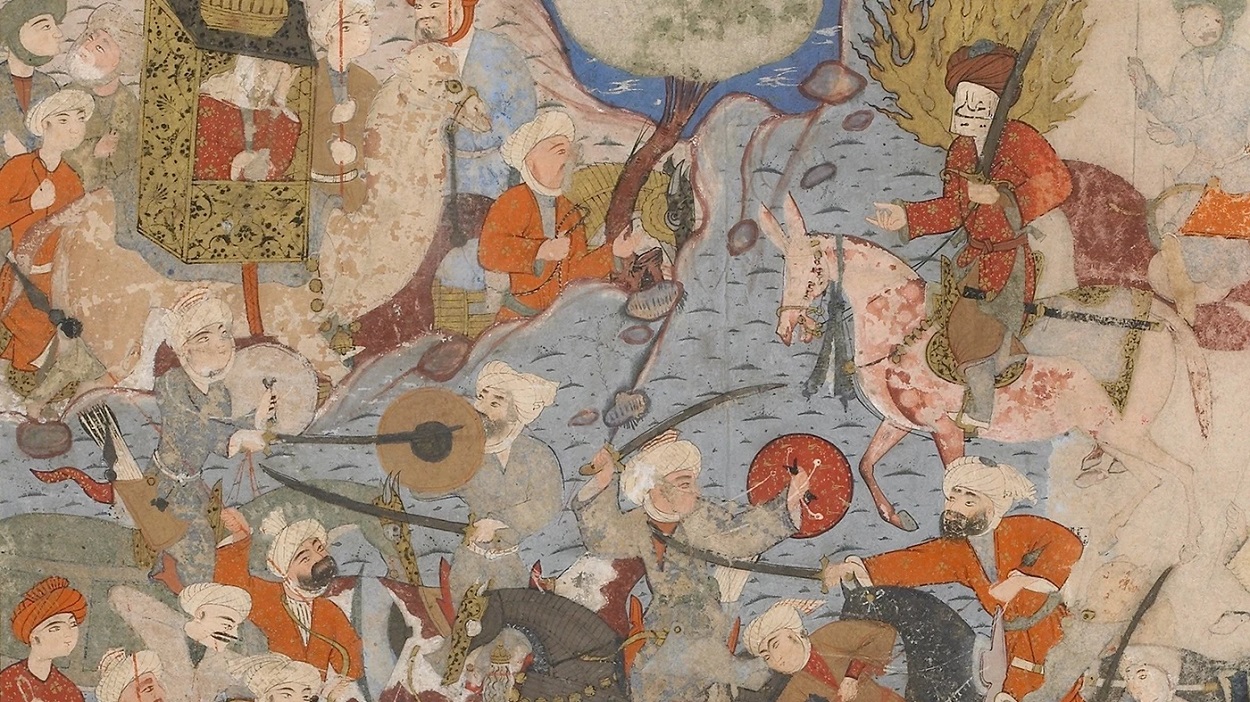
Sunnis, the majority sect, believe Muhammad did not designate a successor. The community then met to elect one, a caliph, and the first three were chosen from among Muhammad’s closest companions. Ali became the fourth caliph, but in a clash known as the Battle of the Camel, Aisha rode the Arabian dromedary in a rebellion against him.
The Lady of Heaven builds its story around Fatimah, who Muslims esteem as akin to Mary, the mother of Jesus.
In a poignant introductory scene, Fatimah is introduced as the first victim of terrorism, paralleled as an elderly woman comforts an Iraqi child whose mother was killed by ISIS. Winning awards for visual effects, the $15 million partisan film relates a Shiite perspective that the famed daughter of Muhammad died in childbirth—due to injuries suffered earlier in a raid ordered by his first successor.
Sunni orthodoxy honors the first four caliphs as “righteous.” Thereafter the community descended into civil war, with Ali and Fatimah’s children on the losing end. Hussain, the younger of two sons, was killed in battle, and his commemoration by Shiites is often accompanied by mourning and ritual self-flagellation.
Though Shiite-dominated, Iran banned the film as divisive to the Muslim community, while Pakistan, Egypt’s al-Azhar, and the Muslim Council of Britain all condemned it also. Following large-scale Sunni protests, most UK cinemas canceled upcoming screenings. According to Rotten Tomatoes, the film’s approval rating…
This article was originally published at Christianity Today on June 24, 2022. Please click here to read the full text.
And then there are three presidents, each with a share of a weakening state,
Taking on the behemoth.
But there is a fourth, God. Very well armed.
A factor in the equation.
We pray for resolution.
But not just finality – justice, and fair.
Preserve us our rights. But what are they?
Who says this angle? No, two degrees more. Stretch the line out for a thousand.
Bend it here for this field, then split it at that.
Can we speak of the moral in mathematics?
Power.
If your word is true, we are mighty.
Because we are weak. And in that, our strength.
Unpredictable. Wild. Unyielding.
We are masters in exploiting system.
There are few rules in power.
But there are morals.
They don’t keep them—but do we?
For your word to be true we must meet it.
Our weakness is strength, but is it of you?
Is it just? Is it fair? Is it righteous?
Is it humble?
We pray for resolution.
Not one that seeks a mealy peace—
Trades principle for interest.
We need the gas. So does the world.
In double want find outcome.
God, we desire real strength.
Unity. Consensus.
But to find them we must each bend low—
A power, made perfect, in weakness.
Bless it, God. We need the gas.
We need a resolution.
Amen.
To receive Lebanon Prayer by WhatsApp, please click this link to join the closed comments group.
Lebanon Prayer places before God the major events of the previous week, asking his favor for the nation living through them.
It seeks for values common to all, however differently some might apply them. It honors all who strive on her behalf, however suspect some may find them.
It offers no solutions, but desires peace, justice, and reconciliation. It favors no party, but seeks transparency, consensus, and national sovereignty.
How God sorts these out is his business. Consider joining in prayer that God will bless the people and establish his principles, from which all our approximations derive.
Sometimes prayer can generate more prayer. While mine is for general principles, you may have very specific hopes for Lebanon. You are welcome to post these here as comments, that others might pray with you as you place your desires before God.
If you wish to share your own prayer, please adhere to the following guidelines:
1) The sincerest prayers are before God alone. Please consult with God before posting anything.
2) If a prayer of hope, strive to express a collective encouragement.
3) If a prayer of lament, strive to express a collective grief.
4) If a prayer of anger, refrain from criticizing specific people, parties, sects, or nations. While it may be appropriate, save these for your prayers alone before God.
5) In every prayer, do your best to include a blessing.
I will do my best to moderate accordingly. Thank you for praying for Lebanon and her people.
Americans prefer a less polarized Holy Land. But they themselves are as polarized about it as ever.
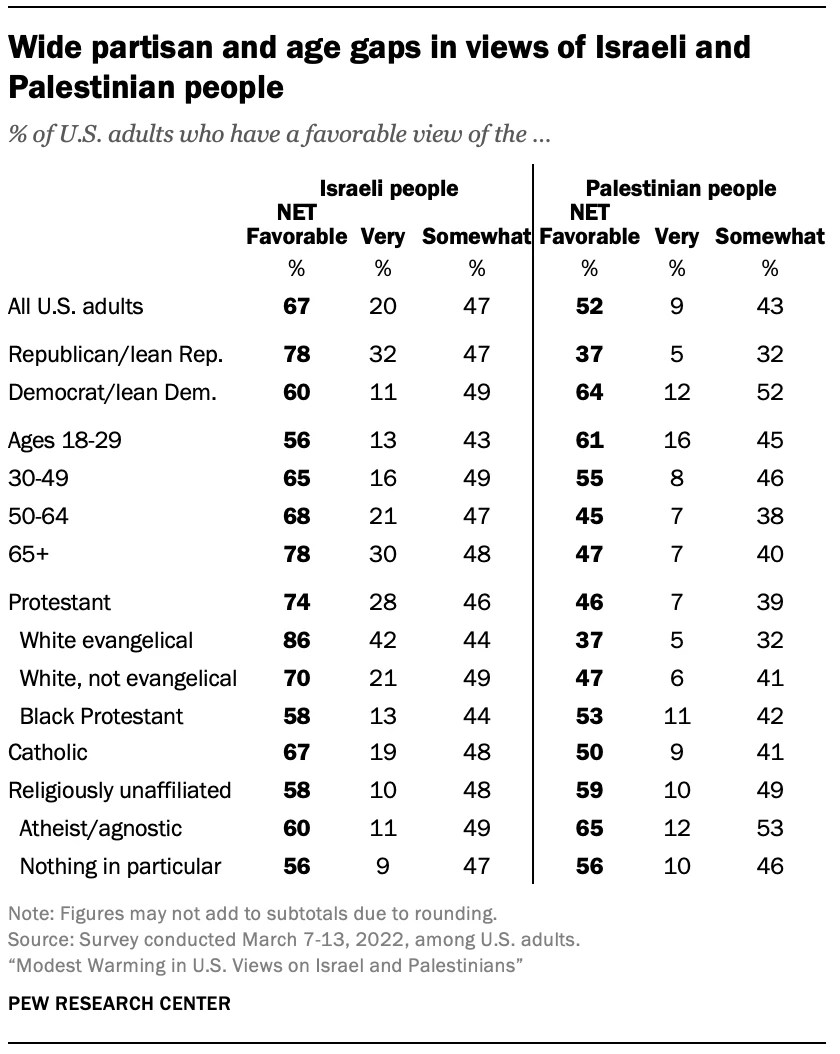
A new survey by the Pew Research Center—three years removed from when Donald Trump and Benjamin Netanyahu led the political scene—reveals rising favorability ratings for Israel and Palestine, across nearly every segment of Americans.
Most, however, still prefer Israel.
White evangelicals lead the way, with 86 percent viewing the Israeli people favorably and 68 percent viewing Israel’s government favorably, compared to 37 percent favorability for the Palestinian people and 14 percent favorability for their government.
Overall, 1 in 3 white evangelicals view both peoples favorably, but only 1 in 10 favor both governments.
These believers are out of step with the wider US, however.
Among Americans at large, the Israeli people have a 67 percent favorability rating, up from 64 percent. The Israeli government’s favorability rating increased from 41 to 48 percent. And a narrow majority of Americans now view Palestinians positively (52%, up from 46%), though less so their government (28%, up from 19%). Overall, 2 in 5 Americans view both peoples favorably (42%), but only 1 in 5 favor both governments.
“Americans naturally want to be favorable toward other peoples,” said Mark Tooley, president of the Institute on Religion and Democracy (IRD). “I’m surprised it is not higher.”
Theology may have something to do with the affinity. In a new question, Pew asked Americans if God gave the land that is now Israel to the Jews. White evangelicals agreed at a rate of…
This article was originally published at Christianity Today, on June 9, 2022. Please click here to read the full text.
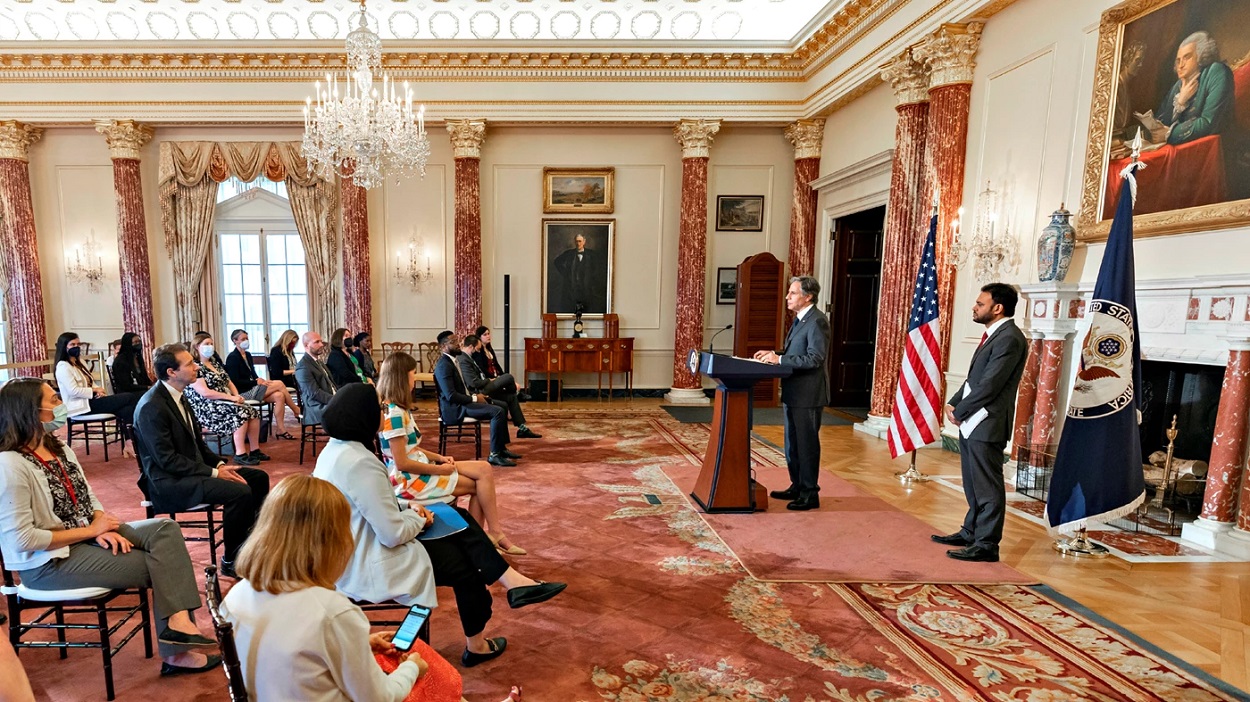
The US Department of State released its 2021 annual report on international religious freedom (IRF) last week, describing conditions in nearly 200 nations. Delivering remarks from the Benjamin Franklin room—where US ambassadors are sworn into service—Secretary of State Antony Blinken presented a litany of well-known offenders.
China, he said, continues its genocide against Uighur Muslims.
Saudi Arabia makes illegal the practice of any faith besides Islam.
Pakistan sentences people to death for blasphemy.
And Eritrea demands renunciation of faith to release the arrested members of religious minorities.
“Respect for religious freedom isn’t only one of the deepest held values and a fundamental right,” Blinken stated. “It’s also, from my perspective, a vital foreign policy priority.”
Last November, these four nations were among the 10 Blinken designated as countries of particular concern (CPC). A separate special watch list (SWL) listed four more: Algeria, Comoros, Cuba, and Nicaragua.
But three days after the IRF report release, a terrorist attack in Nigeria highlighted its omission. Dozens of Christians were gunned down in a Catholic church on Pentecost Sunday. And one month earlier, a Christian college student was murdered by a mob over her alleged blasphemy against Islam.
Back in April, the independent US Commission on International Religious Freedom (USCIRF) released its own list of nonbinding CPC recommendations, reminding Blinken it was “appalled” at the omission of Nigeria. After listing Africa’s most populous nation as a CPC for the first time in 2020, the State Department removed…
This article was originally published at Christianity Today, on June 6, 2022. Please click here to read the full text.
Terrorists launched a gun and bomb attack at the end of a Catholic Mass in southwest Nigeria on Sunday, killing an estimated 70 worshipers according to residents and church leaders.
The terrorists attacked the St. Francis Xavier Catholic Church in Owo, Ondo state, at about 9 a.m., church leaders and residents told Morning Star News (MSN) though text messages. The carnage could have been greater. The church, one of the largest in the area, can hold up to 1,200 people, and was full at the time of the attack.
A priest at the church, Andrew Abayomi, told MSN that as the worship service was coming to an end, the terrorists threw explosive devices and shot at worshipers.
“We were in worship Mass when the terrorists attacked us. They shot at the congregation while breaking into the church by throwing improvised explosive devices at the church building,” Abayomi said. “Some of us hid inside the church as they shot randomly at us. This lasted for about 20 minutes before they retreated.”
He said it was difficult to give details about the number killed and injured, as leaders were focusing on transferring the wounded to hospitals. Circulated videos showed bloody images of men, women, and children strewed among the pews. Among other Owo residents, Loye Owolemi said about 70 worshipers were shot dead and others abducted when terrorists…
This article was originally published at Christianity Today on June 5, 2022. Please click here to read the full text.
To receive Lebanon Prayer by WhatsApp, please click this link to join the closed comments group.
Lebanon Prayer places before God the major events of the previous week, asking his favor for the nation living through them.
It seeks for values common to all, however differently some might apply them. It honors all who strive on her behalf, however suspect some may find them.
It offers no solutions, but desires peace, justice, and reconciliation. It favors no party, but seeks transparency, consensus, and national sovereignty.
How God sorts these out is his business. Consider joining in prayer that God will bless the people and establish his principles, from which all our approximations derive.
Sometimes prayer can generate more prayer. While mine is for general principles, you may have very specific hopes for Lebanon. You are welcome to post these here as comments, that others might pray with you as you place your desires before God.
If you wish to share your own prayer, please adhere to the following guidelines:
1) The sincerest prayers are before God alone. Please consult with God before posting anything.
2) If a prayer of hope, strive to express a collective encouragement.
3) If a prayer of lament, strive to express a collective grief.
4) If a prayer of anger, refrain from criticizing specific people, parties, sects, or nations. While it may be appropriate, save these for your prayers alone before God.
5) In every prayer, do your best to include a blessing.
I will do my best to moderate accordingly. Thank you for praying for Lebanon and her people.
After 93 days of war, the Ukrainian Orthodox Church-Moscow Patriarchate (UOC-MP) has definitively broken with Russia—maybe.
In a council decision taken May 27, the Russian Orthodox Church (ROC)–affiliated body declared its “full self-sufficiency and independence,” condemning the three-month conflict as “a violation of God’s commandment: Thou shalt not kill!”
Such a condemnation was not new. The day the invasion began, UOC-MP Metropolitan Onufriy called it a “repetition of the sin of Cain.” But in dry ecclesial language, the statement dropped a bombshell.
It “adopted relevant amendments” and “considered … making Chrism.”
Chrism, the anointing oil of baptism and other liturgical rites, was last made in Ukraine in 1913. Its manufacture is a typical sign of autocephaly, the self-governing of an Orthodox church branch.
Continuing the tone, the UOC-MP reiterated its position.
“We express our disagreement with … Patriarch Kirill of Moscow and All Russia,” it stated of the ROC head, “regarding the war in Ukraine.”
Kirill has consistently supported Russia’s “special military operation.”
In 2018, the breakaway Orthodox Church of Ukraine (OCU) was granted autocephaly by the Ecumenical Patriarch of Constantinople, Bartholomew I. Rejected by Kirill and the UOC-MP, the act formalized the national schism. (A much smaller third Ukrainian Orthodox church joined the OCU.)
The UOC-MP council’s Friday statement continued to echo the ROC rejection. OCU bishops lack apostolic succession, it said, while overseeing the forcible seizure of churches to transfer jurisdiction. The UOC-MP stated a willingness to dialogue with the OCU if these dividing issues could be addressed.
And then, it symbolized division.
The next day during Holy Liturgy, Onufriy referred to Kirill as a fellow primate, not as his hierarch (superior). No mention was made of any connection to the ROC Moscow Patriarchate.
Andrey Shirin said these “unheard of” developments were “truly remarkable.”
“The ongoing war in Ukraine is a crisis on several levels—political, economic, humanitarian,” said the Russian associate professor of divinity at the John Leland Center, a Baptist seminary in Virginia. “This is another chapter in the theological crisis.” The consequences could…
This article was originally published by Christianity Today, on March 30, 2022. Please click here to read the full text.








 Jayson Casper