Categories
Excerpts

Can Muslims Reflect Critically on their History?

Artwork depicting the Bulgarian War of Independence, against the Turks

In advance of the Yom Kippour / Ashura holiday, CNN ran a very interesting op-ed written by Haroon Moghul about the links between Jewish and Muslim commemoration. But he drops a hint about history that can be very provocative among Muslims, though he develops it in a direction, that while essential, misses the bigger challenge.

But kudos to him for opening the door. Perhaps he has reflected more fully elsewhere.

He writes:

I know a lot of Muslims who demand the West own up to its sins. They expect Western schools, institutions and leaders to acknowledge the dark side of our history. The expansionism, imperialism, colonialism.

I wonder, though, if we could tolerate the same introspections in our mosques and madrasas. It’s easy to talk about being the victim. It’s a lot harder to talk about doing wrong. It’s easy to talk about what other people do to you. It’s hard to talk about what we do to others. Or what’s done in our name.

His very next paragraph, which I will quote below, provides the hint. But instead of pursuing it he goes on to make still worthy reflective criticism on the merging of Islam and ethno-nationalism and the political use of the religion. For example:

Today, Syrians die by the thousands, attacked by a Ba’athist regime uncritically supported by the Islamic Republic of Iran. A revolution that came to power calling the despotic shah a tyrant has now inaugurated a regime with a more murderous record. Iran, with its allies in Syrian President Bashar al-Assad and Hezbollah, have killed and tortured more than even ISIS has. Like ISIS, too, it happens in my religion’s name.

The author then asks the reader not to take his confession as an opportunity to ‘pile on the Muslim world’, and then offers criticism of American politics and culture, where we walk a similar path. It is good of him to find parallels and challenge toward the pursuit of justice, though readers will be divided if his examples hit the mark.

I beg his patience if the following is interpreted as piling on. But take note of the tense of the original hint: ‘It’s hard to talk about what we do to others,’ he writes. Not what we have done.

Here is the paragraph I delayed quoting:

When I was young, I was taught about Islam as a catalog of battles and conquests, rules and rituals. There was little serious ethical deliberation, not much in the way of cultural direction and precious little spiritual content.

Above, Moghul mentioned the Muslim tendency to ask the West to own up to its sins. Many have. Pope John Paul II, especially, offered apologies for the Christian share in the sins of our history. Perhaps today many conservative Christians must face the reality of how their support for a war in Iraq contributed to the emergence of ISIS. Not many are yet apologizing, but at least some, like Tony Blair, are beginning to reflect.

Let not Christians, or even America, be fully blamed for this tragedy. And similarly, though Moghul is right to ask Muslims to consider how they have permitted a world where Islam is so fully implicated in the most wretched of atrocities, neither Muslims nor Islam are guilty. Only those committing crimes.

But just like Christian history, Muslim history is also full of sin. At least, many Christians can look back and admit this. Are Muslims also able to do so?

Again, Moghul asks for consideration:

The first Caliph, Abu Bakr, died of natural causes. He lucked out: The second Caliph, Umar, was assassinated. The third, Uthman, was killed, too, except by his own troops. The fourth, Hussain’s father, Ali, was assassinated by radical Muslims — the Khawarij, the precursors of ISIS — while in prayer…

Who wants to focus on this history?

In fact, many Muslims near-mythologize their early history altogether. Salafis in particular look back at the first three generations of Muslims in the most uncritical terms. They wish to craft a present based on restoration of this enlightened past. Who has practiced Islam correctly, they ask? The answer is logical: Those who were closest in time to Muhammad.

But these closest in time were also those who launched Islam’s much celebrated wars of expansion. In Arabic they are called al-Futuhat al-Islamiya, the Islamic openings. They are heralded as the beginning of a golden age that saw Muslims reach the pinnacle of world civilization, as nations from Spain to India were enveloped in the fold.

It will be good to remember Moghul’s appeal not to pile on. Nearly every civilization was built upon military might. While the caliphate spread by the sword, most conversions happened voluntarily over time, though with many this-worldly inducements. Muslim history witnessed great examples of chivalry and compares favorably to some of the baser instincts of Christian expansion and crusade. And no matter the time, place, or people, war is hell.

But so was Muslim war and the ambition that fueled much of it, whether ethnic, nationalist, political, or religious. Can Muslims today look back on this period, and apologize? Even as the much needed nuance of justification is offered–and at times accepted–can this history be relegated to its ethnic, nationalist, or political causes, and Islam made innocent?

It seems Moghul’s essay points in this direction, and he knows well the firestorm he would light if the argument is pushed. These thoughts are mine, but does he share them? Can he help lead Muslims to greater critical reflection?

His hint is appreciated.

Categories
Prayers

Friday Prayers for Egypt: Election, Exchange

Flag Cross QuranGod,

Low turnout. Salafis lose. Runoffs pending.

Pound devalues. Banker resigns. Policy changing?

Few words are needed to describe events of the week, God. As many return to a business-as-usual approach to politics, a crisis emerges in the currency of business.

So in short, give wisdom to the new central bank manager. He must manage depreciation to the dollar, prevent debilitating inflation, hold on to foreign reserves, stimulate international investment, and facilitate domestic imports.

Different sectors want different policies. Give him discernment for what is right, what will serve his nation.

And help voters do the same. After selecting candidates among dozens of names, most must return for a streamlined choice.

Inspire at least the same turnout, God. Perhaps more. Revive a sense of civic engagement. Renew a reality in its importance.

May the parliament to come build a sound foundation to represent the people. May the exchange rate to come settle at a level that provides stability and fairness.

Develop economy.

Grant agency.

God, bless Egypt in all her choices.

Amen.

Categories
Excerpts

Concerning Islamism: Hands On or Off?

(from abc.net.au)
(from abc.net.au)

Shadi Hamid of the Brookings Institute is an insightful analyst of Middle Eastern affairs. Of Islamists in particular, he notes they often moderate under moderate repression, as witnessed under Mubarak. But intrinsically he finds them to be ‘illiberal’ in terms of Western values, though there is a strong undercurrent in his writing that the values of democracy demand they must be allowed to govern anyway.

Writing in the Atlantic, he chides President Obama’s ‘do-nothing’ foreign policy for main of the region’s ills, including allowing Egypt’s military remove the Muslim Brotherhood’s Morsi in a coup d’etat that eventually resulted in hundreds dead during the bloody suppression of the sit-in protest at Rabaa.

America’s relative silence was no accident. To offer a strong, coherent response to the killings would have required a strategy, which would have required more, not less, involvement. This, however, would have been at cross-purposes with the entire thrust of the administration’s policy.

Obama was engaged in a concerted effort to reduce its footprint in the Middle East. The phrase “leading from behind” quickly became a pejorative for Obama’s foreign-policy doctrine, but it captured a very real shift in America’s posture.

It is a fine argument, though others have praised Obama for the wisdom of his foreign policy in a messy region. But beyond not criticizing the removal of Morsi, Hamid chides America for not holding Morsi himself accountable to a more liberal paradigm:

America’s unwillingness to play such a role increased the likelihood that the Muslim Brotherhood, empowered by its conservative base and pressured by its Salafi competitors, would veer rightward and overreach, alienating old and new allies in the process. As demonstrated in Egypt, the governance failures of Islamist parties can have devastating effects on the course of a country’s democratic transition.

Hamid appears to extend the ‘moderate repression’ argument to the realm of international politics. He highlights Turkey as an example:

After coming to power in 2002, the Islamist-rooted Justice and Development Party (AKP) passed a series of consequential democratic reforms. The prospect of membership in the European Union helped incentivize the AKP to revise the penal code, ease restrictions on freedom of expression, rein in the power of the military, and expand rights for the country’s Kurdish minority. But when the threat of a military coup receded, and negotiations with the EU faltered, the AKP government seemed to lose interest in democratization, increasingly adopting illiberal and undemocratic practices.

His essay highlights that what Islamist believe and what they can accommodate pragmatically are often in stark contrast:

In 2006, the Brotherhood’s general guide, Mahdi Akef, told me angrily that “of course” the Brotherhood would cancel Egypt’s peace treaty with Israel if it ever had the chance.

Of course, Morsi did not cancel the peace treaty, though Hamid notes he once called Jews ‘the descendants of apes and pigs’. The Muslim Brotherhood realized its red lines, and even played a functional role in helping broker peace between Israel and Hamas in Gaza, he says.

But I not sure what is his overall argument, or philosophy. He notes Obama’s hands-off strategy, but earlier in the article he criticizes the hands-on support given to the region’s dictators. There is no either-or, of course, and it appears his preference is for the democratizing pressure from the Bush administration circa 2005, that opened up political space in the region, including Egypt, and gave Islamist entities – among others – wider space to operate.

But concerning that ‘illiberal’ nature of Islamism, is his solution altogether continual moderate repression? Whether from domestic or international agents, that seems open to criticism as well. Hamid levels it himself at the Egyptian military [SCAF] after the revolution and through the beginnings of Morsi’s presidency.

SCAF, though, grew increasingly autocratic, culminating in one very bad week in June 2012 when the military and its allies dissolved parliament, reinstated martial law, and decreed a constitutional addendum stripping the presidency of many of its powers.

Hamid calls these ‘egregious violations of the democratic process’, and there is little argument. But it can also be said they were among the few means left of moderate repression to constrain Brotherhood illiberalism. As already noted above, without international pressure from the US the Brotherhood went headlong into the arms of Salafis.

Modern world peace is based strongly on the idea of national sovereignty. Domestic repression is not healthy, while all sorts of pressure exist legitimately in the realm of international relations. Hamid alludes to it as ‘dependency’.

As long as Arab countries are dependent on Western powers for economic and political survival, there will be limits to how far elected governments, Islamist or otherwise, can go.

(If that dependency were to weaken in the long run, Islamists would likely pursue a more ideological, assertive foreign policy. Ideology, to express itself, needs to be freed of its various constraints.)

But if this is his belief, given all that Islamists have said about both domestic and international ideology, should they be given an opening at all? Why risk their partial empowerment? If their moderation came only from modes of repression, will not a true nature reveal itself when no longer constrained?

These are not comfortable questions to ask, let alone answer. But I am curious about Hamid’s answer.

(Note: Hamid’s book, Temptations of Power, likely addresses these issues.)

UPDATE: Hamid has been gracious to respond by Twitter. Below are his comments.

Categories
Prayers

Friday Prayers for Egypt: Election, Debt

Flag Cross QuranGod,

Very shortly Egypt will begin two long anticipated processes. She will vote to elect a parliament, and negotiate to secure a loan. The first aims to restore a democratic institution; the second a sound economy.

Bless both efforts, God. Whether virtue or vice brought Egypt to this stage, may wisdom lead her forward.

Seven electoral lists and hundreds of individuals will compete in polls that could stretch into December. They will be tasked first with review of all laws passed in parliament’s absence, and then work with the president and cabinet to supervise the nation’s agenda.

Candidates are diverse. Leftists, liberals, and a remnant of Islamists. Supporters of the old regime. Representatives of tribal and business interests. Some criticize the entire procedure as manufactured. Some celebrate it as the completion of a democratic path.

Some, it seems, view parliament as a burden. Some don’t seem to care at all.

God, whether flawed or noble, invest these elections with importance. Rally each citizen in support of civic duty. May they pursue their local interests. May they pursue their political principles. Inspire them to be involved in the right running of their nation.

May they choose able and honorable representatives.

And of the nation’s current representatives, give them discernment in economic policy.

Billion dollar loans have been mentioned by officials, sought through the World Bank and IMF. With low interest and long repayment, some see these as the solution to meet a budget deficit and win time for necessary reforms.

As the pound devalues and tourism and direct investment lag in adequate rebound, stability is needed. Such loans signal confidence from the international community, they also tie the nation to an economic agenda. Wise men debate these matters, and disagree.

Let the wisdom filter into public discourse, God. Let the people know the challenges before them. Let them work, save, and invest to win good life for their families. Let their collective efforts win good life for Egypt.

Let Egypt repay her debts and restore her economy.

God, may politicians owe their debt to the people. May they receive it in interest a hundred times over.

Amen.

Categories
Prayers

Friday Prayers for Egypt: Regional Balance

Flag Cross QuranGod,

Help Egypt to honor her neighbors, near and far. Help her to satisfy commitments, repay debts, and work for peace.

Help her toward a wise and sovereign foreign policy.

Egypt is alive economically because of Saudi aid. Egypt supports their offensive in Yemen. Saudi Arabia desires the fall of Syria’s Assad. Egypt backs Russian strikes against Assad’s enemies.

Egypt appoints a culture minister who speaks against Wahhabism. Saudi welcomes a pro-Brotherhood luminary.

There are interests in international relations, God, but there are also principles. There is balance of power, but also use of power. Hard as it may be to determine, there is right and wrong.

Right is to honor neighbors. Right is to satisfy commitments. Right is to repay debts.

Right is to work for peace.

On Syria, Egypt has called for a political solution. Is this right, God? Has too much wrong been waged that might must impose from the outside?

God, find a peaceful solution. Too many have died. Too many have suffered. Too many are implicated.

There is compromise, God, but there is also hypocrisy. There is the lesser of evils, but also evil. Help Egypt, her neighbors, and the international community to conduct themselves rightly.

Bring balance to the region, God. Bring peace, justice, and stability. Bless Egypt with sovereignty. May she use it to bless others.

Amen.

Categories
Excerpts

Fear and Islamism in Egypt

MB England EgyptIs the Muslim Brotherhood really Qutbist? Are frustrated members inclined toward the Islamic State? In an interview with Ahram Online, political commentator Wahid Abdel Maguid both reconsiders assumptions and reminds of reality:

Abdel-Meguid, a member of the Constituency Assembly of Egypt since 2012, is reluctant to endorse alarm concerning a supposed nationwide infiltration of militant Islamist movements. Nor is he willing to corroborate “exaggerated accounts” suggesting militant Islamist groups like ISIS are finding ready recruits in the Brotherhood ranks.

“That is an overblown story. I don’t deny that there’s a sympathy there, or that some young and angry members have defected to ISIS. But their numbers are limited,” Abdel-Meguid says.

Abdel-Meguid says the Brotherhood has not been under the sway of Sayyid Qutb’s radical thinking. Qutb was an early Brotherhood leader with some violent ideas…

“That is security jargon – this Qutbi thinking. It’s popular in security circles and promoted by security-aligned media, in part to excuse the McCarthyism practiced against the Muslim Brotherhood,” Abdel-Meguid opines.

Under the three-decade rule of ousted president Hosni Mubarak, Abdel-Meguid says, the state continued the short-sighted and undemocratic scheme of using the Muslim Brotherhood to serve a political agenda.

Mubarak, however, did not aim to use Islamists groups to defeat other political movements, but rather to present moderate Islamist groups like the Brotherhood as an unsavory option – “the Islamist alternative” to his rule.

“The state allowed the Muslim Brotherhood to function across the social sphere. First within universities then within syndicates and then by establishing some 2000 NGOs – which are now being taken over by the state one-by-one in a McCarthyist campaign,” he says…

For the most part, Islamists tangoed. The Brotherhood continued to act across the social spectrum, contesting parliamentary elections and criticising the regime, “short of criticising Mubarak himself”.

“This was the situation when they started taking part in the slow surge of political activities that started around 2005, but once the demonstrators started to use slogans directly slamming Mubarak they [the Brotherhood] would step back. This was the case until the early hours of the 25 January Revolution,” says the long-time politcal commentator.

The landslide success of all kinds of Islamist candidates at the 2011 parliamentary elections tempted the Brotherhood to go back on that agreement and to fall prey to the “arrogance of power”, says Abdel-Meguid.

This arrogance set off a series of misguided political choices that eventually reminded society of its fear of “the Islamist alternative”, an alternative that had now become reality.

“This explains the attitude of those who were very supportive of the Islamists in 2011 and were subsequently very supportive of the military in 2013,” when elected president Mohamed Morsi, a Brotherhood member, was ousted.

The Islamists’ failure to grasp the political inclinations of society was highlighted when Morsi invited to 6 October celebrations one of the militants convicted of being involved in Sadat’s assassination at the same celebrations just 30 years before.

“What they did was suicidal and it will be a very long time before the damage is rectified, especially with the terrifying expansion of groups like ISIS scaring Egyptians and the wider world,” Abdel-Meguid concluded.
Categories
Prayers

Friday Prayers for Egypt: Statements Abroad

Flag Cross QuranGod,

At the United Nations and in interviews with Western press, President Sisi issued many positive statements. Egypt is improving its economy. Parliamentary elections are coming. Freedoms are being protected. Terrorism is being fought.
May it all be true.

Moreover, God, may it set an agenda. May the president’s rhetoric signal initiative to make it fully true. May it speak to ministers, officials, police, activists, politicians, and ordinary citizens that the promises of revolution are priority.

For back in Egypt, there are areas where it is not yet true. Activists have disappeared. Judicial trials are disputed. Inflation strains the economy. Terrorism is a lingering threat.

God, help Egypt balance between encouraging word and wounding critique. Let the president’s rhetoric speak of hope that launches new momentum. Let his policy implement reform that creates new culture.

Give Sisi wisdom, God. Give him men of integrity and efficiency.

Give Egypt justice, God. Give her systems of transparency and accountability.

Preserve Egypt. Bless her president. Establish all that is right and true. May those abroad bear witness.

Amen.

Categories
Americas Published Articles Zwemer

Are Muslims Political Pawns?

Ben Carson (via the Chicago Tribune)

All press is good press. Perhaps not always true, it is often a maxim of politics. A day after the backlash over his ‘a Muslim should not be president’ comment, Ben Carson announced windfall fundraising of one million dollars.

But perhaps it is also a maxim of religion? With the name of Islam dragged through the mud of Republican politicking and right-wing punditry, the Council for American-Islamic Relations (CAIR) seized the media spotlight and announced a campaign to freely distribute the Quran to citizens and civic leaders alike.

Back in 2001, CAIR chairman Nihad Awad reported that 34,000 Americans converted to Islam after the attacks of September 11.

It is a very natural phenomena. Media loves a negative story, which draws attention to an otherwise obscure issue. People begin to investigate, and discover the issue is not as completely negative as first reported, or stems from an extreme fringe. Then the counter-narrative emerges, in which the issue is hailed as good, or at least complicated. Conflicted over the original outrage, a moderating tone enters the issue into the mainstream.

From here, the politicking – or proselytizing – continues with precious momentum.

If conservative American evangelicals are not already concerned about Ben Carson’s comments, perhaps they should consider another pillar of culture war outrage: gay marriage.

I was raised in the 1980s. My first memory of homosexuals was local news coverage of a gay pride parade in some northeastern city, as transvestites and drag queens shouted at the cameras in an otherworldly display of an underground subculture I could never have imagined. The TV announcer could barely contain his chuckle, if I remember correctly.

Sitcoms and movies were rife with mocking humor. The AIDS scare lent credence to cries of God’s judgment. But over time society discovered the human behind the identity. Media attitudes shifted, both shaping and reflecting public opinion. The louder the protest, the greater the spotlight. Today the Supreme Court declares marriage equality.

Consider the distance traveled in three short decades. Imagine Islam in America three decades to come.

Note that in the examples above no statement is offered on the merit of Carson’s comment nor the appropriateness of gay marriage. There is a place in America for worthy debate on the morality and policy of queer issues. There is a place to discuss the nature of Islam and its compatibility with American values.

At least there should be. The fact this space is shrinking is perhaps commensurate with the retributive empowerment of the previously marginalized. May the conservative American evangelical reflect, and where necessary, repent.

But consider also the sub-Christian flaw in my argument above, quite akin to much popular discourse about Islam. The motivation is fear. Perfect love will not permit this.

Punditry highlights the illiberal character of sharia law and links the savagery of ISIS to the Quran and Islamic history. But it equates this otherwise worthy research with Islam in its entirety. Worse, it suspects imitation within every Muslim. Beware, it cries, lest one day we see Syria in Springfield.

My argument risks being similar. Beware, I cry, lest the crassness of your rhetoric win ground for Islam.

There is a better way. The conservative American evangelical must win ground for Muslims.

Islam is a religion, an idea, a way of life. Let it be praised or criticized according to its merits. But the better way is to do so with respect, humility, and hope. Muslims around the world deserve honest assessment of their faith. Whether of its religious, social, or political aspects, Christians should speak.

But Muslims in America deserve much more from their Christian neighbors. The better way is to bless, rather than demonize. To secure rights, rather than restrict them. To speak up in their defense, rather than rally a political base.

Conservative American evangelicals should be the first to depoliticize this issue entirely.

What this argument lacks is sufficient consideration of the proper place of denunciation. There is truth that is opposed to error. There are valid interests opposed to vile manipulations. There are Muslims in America and the world with political agendas to match any lobby from the right or the left.

There is a place for religion in politics. But great care should be taken against the politicization of religion. America has navigated this minefield for centuries, and Islam provides a particular challenge.

“But no religious test shall ever be required as a qualification to any office or public trust under the United States,” says the constitution. Let American citizens vote as they wish, from any, all, or no religious motivation.

But let American Christians both engage and transcend the politics of the day to embrace a kingdom greater than the republic. Their obligation is to help all participate in both.

This article was first published at the Zwemer Center.

Categories
Excerpts

Getting Around in Egypt

Everyday Egypt is a Facebook page featuring the images of photographers active in the country. Many thanks to Egyptian Streets for collecting these great photos showing the reality of daily transportation for millions of Egyptians. Please enjoy, and visit their pages also for regular updates that go beyond the sometimes distorting headlines.

1. The daily bus journey

The daily struggle on a bus in Egypt. Photo by Ahmed Fouad

2. Cycling the old streets of Cairo

A man uses the bicycle to get around El Moez Street in Cairo. Photo by Pan Chaoyue

3. Cairo’s vehicular lifeline

Cairo's vehicle lifeline: the October 6 Bridge. Photo by Mahmoud Khaled

4. Party time? A ‘disco pick-up truck’

A 'disco pick-up truck' somewhere between Koul el Atroun and Toukh in the Nile Delta. Photo by Tinne Van Loon

5. When there’s just not enough space

Sometimes there just isn't enough space on the micro-bus. Photo by @kareem_1911

6. Candy Crush fever on the Cairo metro

Some things are universal. Photo by Nadia Mounier

7. Even livestock need to get around

Not as uncommon as you'd think. Photo by Tinne Van Loon

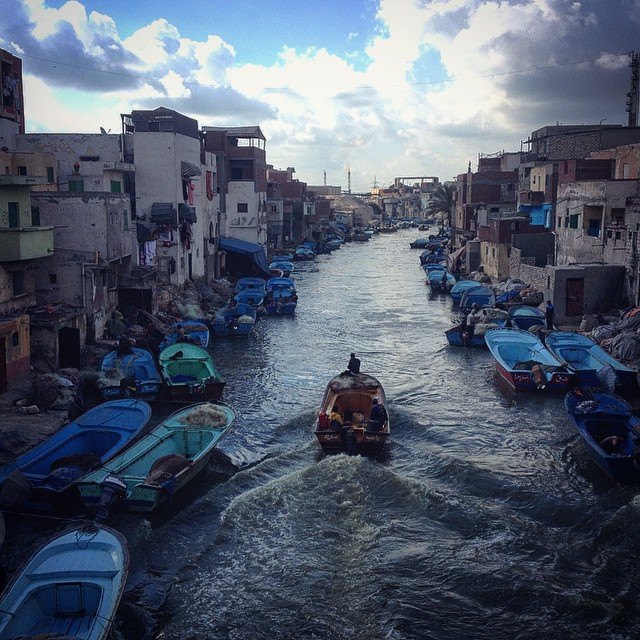
8. Is this Venice or Alexandria?

Al Max in Alexandria (Egypt's Venice). Photo by Ahmed Hayman

9. The everyday ferry commute

Crossing the Nile River on a ferry boat. Photo by Pan Chaoyue

10. Four people and one motorbike

Egyptian youth riding a 'vesba' in Cairo. Photo by Roger Anis

11. Watching the world pass by on a train

On the Cairo-Alexandria train. Photo by Sima Diab.

12. The subway journey

The everyday subway journey. Photo by Hadeer Mahmoud

13. Hanging on to a microbus

A child simply hanging off the back of a micro-bus in Giza. Photo by Roger Anis

14. Sometimes walking is just better

Often times, it makes more sense to just walk than to get stuck in one of Cairo's traffic jams. Photo by Tinne Van Loon

15. Even the ferries tend to be overcrowded

A ferry sails between Maghagha city and Sharona Island. Photo by Mohamed Ali Eddin

16. Tuk-tuk-ing through a sandstorm

A tuk-tuk riding through the haze o a sandstorm in October 6 City. Photo by Owise Abuzaid

17. Catching a microbus with civilization in the background

There's often no formal stops for micro-buses. Photo by Hadeer Mahmoud

18. There’s no yellow school bus for these children

Tens of children returning from school on a pick up truck at a remote village in Qantra Sharq, North Sinai. Photo by Mohamed Ali Eddin

19. The metro ride home can often be long

Sleeping by the window on the Metro in Cairo. Photo by Pan Chaoyue

20. Riding with style

A veiled woman driving a motorbike in Cairo. Photo by Roger Anis

21. The bus station

The bus station. Photo by Hadeer Mahmoud

22. Horse carriages are still common in some areas

Horse carts on the streets of Maghagha city in Minya. Photo by Mohamed Ali Eddin

23. Going home after a long day of working in the fields

Egyptian women laugh as they ride back home on a donkey cart after a hard days work in the fields in Giza. Photo by Tara Todras-Whitehill

Categories
Prayers

Friday Prayers for Egypt: Hajj Stampede

Flag Cross QuranGod,

Have mercy on the more than 700 Hajj pilgrims trampled underfoot in Saudi Arabia. Have mercy on the two million still alive, witness to the disaster. May they reflect anew, and seek you with all their heart.

Eight of the dead are among the 62,000 Egyptians on the pilgrimage. For them and all nationalities beside, comfort their families and provide for their children. Many Muslims believe Mecca is the best of all places to die. Help them to balance their grief with acceptance of honor.

Help the Saudi authorities to review all procedures, God. May they do all in their power to ease and order the necessary rituals.

And apart from the Hajj, God, bless all Muslims as they celebrate their holiday. May they laugh, love, and long for you. Lighten their hearts from the troubles of the region; burden their souls to serve you and their peoples.

Have mercy, God. Forgive the dead and the living, and revive us all.

Amen.

Update: The Ministry of Endowments now lists 124 Egyptian casualties.

Categories
Personal

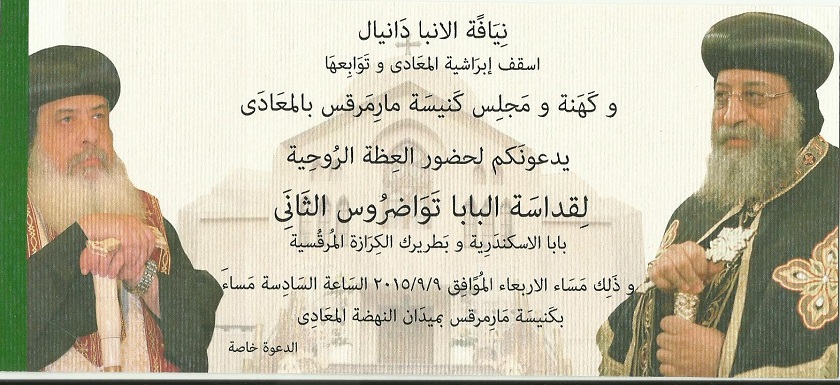
The Pope, in Maadi

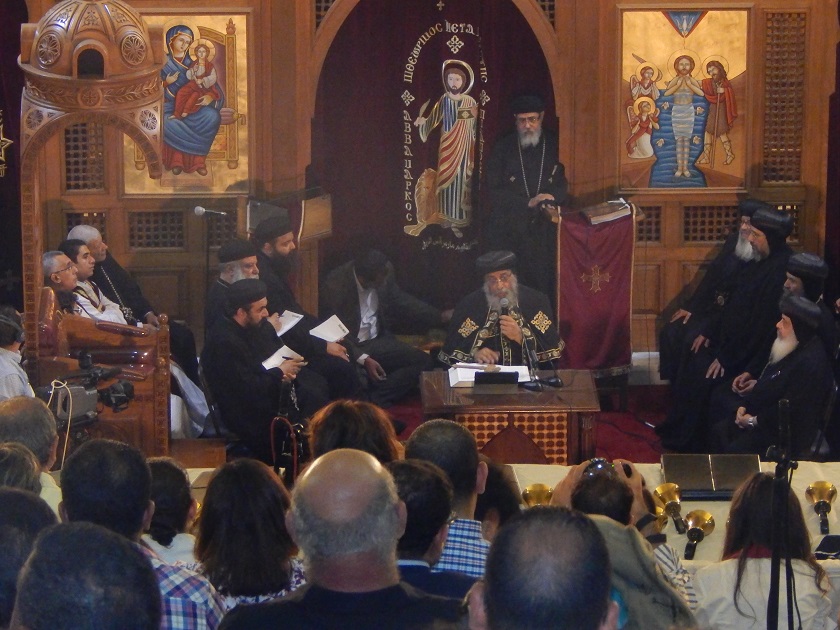
Pope Tawadros at St. Mark's Church in Maadi, Cairo
Pope Tawadros at St. Mark’s Church in Maadi, Cairo

Friends in Philadelphia will soon have the privilege of a papal visit. But will Pope Francis preach in your particular church?

His equal in the faith visited us in Maadi.

A Catholic might not consider it so. A Protestant might insist we are all equal. But for Orthodox Christians, Pope Tawadros is patriarch of one of the five ancient sees of the church, in which Rome and Alexandria are equals.

“To advance in the church,” he said, “is not done in the ways of the world. It is to lower yourself beneath the feet of others.”

By holding to equality with Rome, or in serving as a patriarch at all, does the head of the Coptic Orthodox violate his own teaching? His sermon on Wednesday was on the topic of humility. His visit on Wednesday—perhaps—is evidence of it.

Pope Tawadros’ predecessor Pope Shenouda was beloved of the people. Charismatic and witty, his Wednesday sermon at the papal cathedral characterized this bond. To a full house that treated him like a superstar, he took questions from the audience and left them laughing, rebuked, and inspired.

Pope Tawadros is respected as an organized administrator and heady thinker. He is young in his position, but does not seem to have the same level of charisma nor to have won the same level of enthusiasm. Few could.

He initially tried to follow in Shenouda’s footsteps, but when I attended a few weeks ago the hall was only half-full. Furthermore, he replaced the question-and-answer period with the traditional evening prayer. He does have a call-in show on Coptic satellite television, but I have heard Copts complain that this medium is out of reach to many simple believers. Rich and poor alike, all loved Pope Shenouda.

The Coptic Cathedral is now under repair, and Pope Tawadros suspended the Wednesday service. Before this, however, it was interrupted by petitioners seeking resolution for their divorce cases. Speculation wonders if the two are connected, or if the pope feels weighed down by the burden of comparison.

There is no answer that can weigh the motivations of his heart. But the visit to Maadi reflects a new evolution of the Wednesday tradition. Rather than sitting centrally in the cathedral, he will visit his flock.

A full church for the papal visit“To be humble does not mean you are less than others or to deny your gifts, talents, or abilities,” Tawadros said. “It is liberation from the power of the self.”

In order to stay humble Tawadros recommended a checklist of characteristics the Christian should continually review. Never elevate your opinion of yourself, but lower it. Be thankful, and search for the good in all things. Remember the final judgment, and constantly repeat, “Have mercy on me, a sinner.”

Tawadros’ advice centered on the creation of a humble spirit, but two other attributes are necessary, he said. The Christian should also cultivate an open mind and a wide heart. Together these three make it possible to live well and navigate the challenges of life.

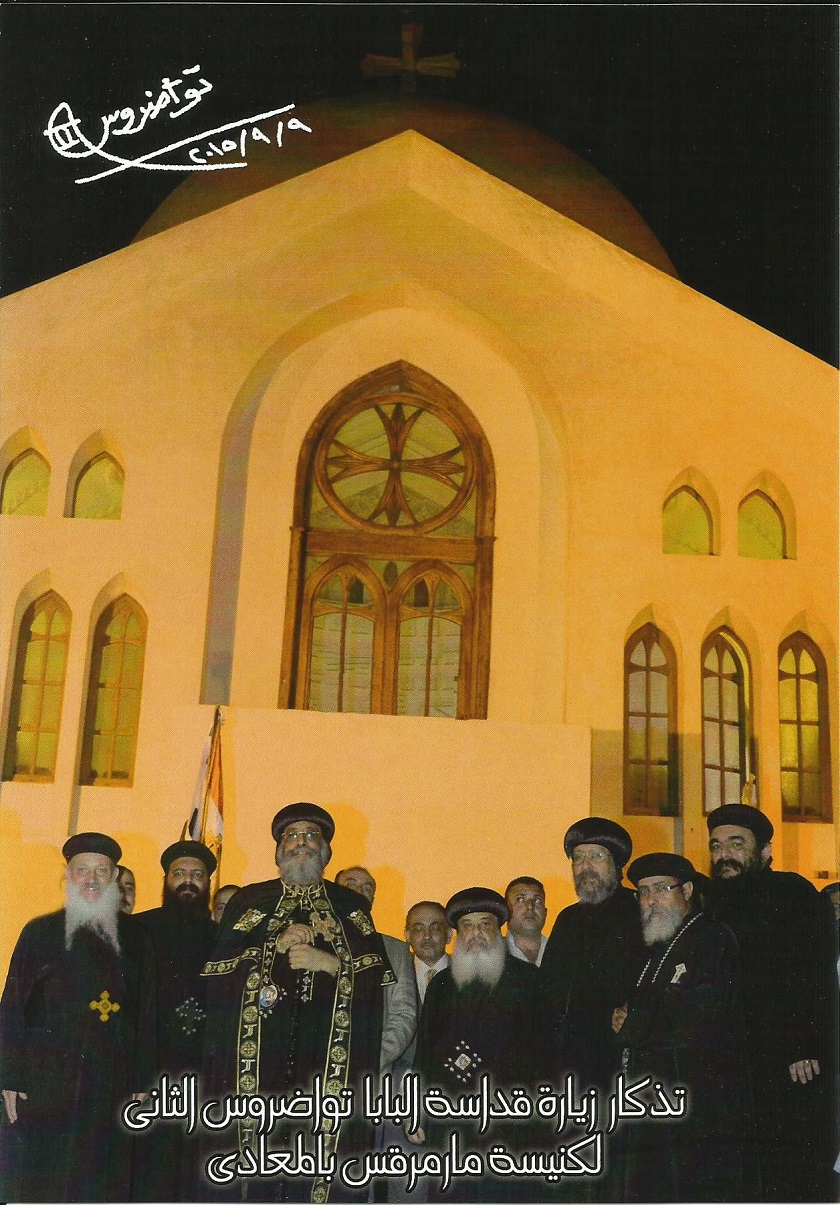
After the sermon St. Mark’s Church demonstrated fidelity to Tawadros’ predilection for organized administration, in the form of crowd control. Young people from the scouts program lined the aisles and hallways, channeling all in attendance into a single line to meet the pope. There, he further demonstrated humility as near an hour transpired for each one to receive from his hand a commemorative picture of the occasion.

Commemorative photo taken in front of St. Mark's Church
Commemorative photo taken in front of St. Mark’s Church

Meanwhile, I chafed. My seat was in the very back row of the balcony. The best seats were already taken, so I judged the next best viewpoint would be to scan the whole assembly. Had I considered it, I might have believed myself humble for choosing so lowly a place.

I have had the opportunity to meet Pope Tawadros, briefly. But at the end of a long evening I just wanted to get home. I was quite happy to skip the line and again, had I considered it, I might have believed myself humble for my patience in waiting to leave and allowing others to go ahead.

But patience wears thin. I could see below that the pope was receiving the crowd. What I could not see was the organization. The scouts in the balcony were not letting us go anywhere, and I didn’t know why. Just let us exit, I thought, and as others get in line below, I’ll slip out a side door.

A few fought their way past the scouts, and the balcony crowd started getting restless. We were told many times to sit and wait, but no one was explaining anything.

That might be a mark of deficient organization, as communication is a must. But my entire perspective changed once allowed down the balcony steps. Very efficiently, at each turn in the path stood the scouts. Smoothly and quickly we were ushered to Pope Tawadros.

As it turns out there was no opportunity to leave by another path. I took the picture from the pope, then a mug from the bishop. Just like that, and I was outside. Five minutes later I was home.

It could be said the entire evening was public relations. Rather than continuing in the pattern set by his popular predecessor, Tawadros sets his own terms. He will visit the churches in carefully controlled settings. He will deliver a sermon and distribute memorabilia. Copts love their religious leaders. He will create a desire in each church to receive a future visit.

Invitation distributed to selected parishioners of St. Mark's Church, following an open sign-up
Invitation distributed to selected parishioners of St. Mark’s Church, following an open sign-up

If it is public relations, is it only PR? And is it wrong? Tawadros blessed the Copts of St. Mark. He both encouraged and demonstrated a humble spirit. He has the open mind to create a new pattern for Wednesday sermons, and the wide heart to check directly in on local congregations.

He has a hard job. If he lacks the charisma that is comfortable with the spotlight, he knows he cannot remove himself from it. Instead he will subject himself even to the scouts of the church.

Only God knows his heart, but God has so far chosen to elevate him to leadership of an ancient see. Many scoundrels have held similar posts in the past, so there is no guarantee. Let both Catholic and Protestant nod heads in sad memory of flawed saints and rank sinners.

Let them both also hold out hope and prayer for Pope Tawadros, to live and lead worthy of his calling.

“I must decrease, he must increase,” Tawadros quoted John the Baptist, speaking of Jesus. Standing long in the apostolic line of Alexandria, may the 118th successor of St. Mark do the same.

Categories
Excerpts

Bad Signs for Business

Egyptian woman selling vegetables (from copticorphans.org)

A recent Ahram Online article provides the reasons for negative economic growth assessments for Egypt, discussed at the 20th annual Euromoney conference in Cairo:

  • Only 6% of companies have a loan or line of credit
  • Necessary collateral 33% higher than world average
  • 97% of businesses employ less than ten people
  • Informal sector represents 30% of economy and 40% of labor

Read the full article for explanations about why these statistics are disheartening. But on top of revolutionary and terrorist issues scaring away both tourism and foreign investment, the national base itself is not easily mobilized for growth. The conference’s opinion is that much internal reform and structural adjustment is necessary.

Categories
Prayers

Friday Prayers for Egypt: Dead Tourists

Flag Cross QuranGod,

Forgive Egypt. Forgive her for the accidental killing of Mexican tourists. Forgive her for the haphazard way she handled the press. Forgive her for blaming the victims. Forgive her for false reporting in local media. Forgive her for awkward and self-referential condolences. Forgive her for the damage to tourism. Forgive her for the insufferable pain inflicted on the Mexican tourists and their families.

Forgive her, God. But may she also repent.

You have given government authority to protect citizens and society, God. Help Egypt to root out the terrorists the tourists were mistaken for. But you have given authority in trust. Help Egypt restore it.

Transparency and accountability have been promised by the authorities. May they fulfill their word, and extend it to governance in general.

Forgive Egypt, God. Save her from herself and her many entrenched sins. May this terrible accident be a rebuke that jolts her into reflection and change.

May it jolt her to repentance. May she weep over what she has done.

Comfort the victims, God. Give them strength to forgive.

Amen.

Categories
Christianity Today Middle East Published Articles

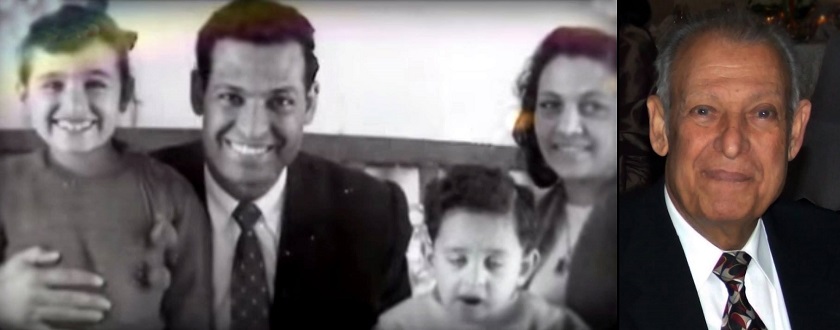
Died: Menes Abdul Noor, 85, Former Pastor of Middle East’s Largest Evangelical Church

(from KDEC)
(from KDEC)

From my article on Christianity Today, co-written with Tim Morgan, published September 18:

Menes Abdul Noor, who served as pastor of Kasr el-Dobara Evangelical Church in Cairo, Egypt, for over three decades, died on Monday, September 14, from Parkinson’s disease. He was 85.

Under his leadership, the 8,000-plus Presbyterian congregation became the largest Protestant church in the Middle East.

Abdul Noor authored and translated over 100 books, and taught at the Haggai Institute and Evangelical Theological Seminary in Cairo for more than 25 years. He is survived by his wife, Nadia, his son Farid, and his daughter Violet. He had six grandchildren and four great grandchildren.

His memorial service Wednesday was attended by officials of the Orthodox, Catholic, and Anglican churches, as well as a representative of Al-Azhar, the foremost Muslim institution in the Sunni world. It was also broadcast live on the SAT-7 Arabic satellite television network.

Please click here to read the full article at Christianity Today, including quotes and anecdotes from an unpublished CT interview with Abdul Noor in 2008.

Categories
Lapido Media Middle East Published Articles

Planting a Tree for Peace Means More than ‘Hugs and Kisses’

(from Michel George)

If the Islamic State is uprooting civilization, one response is to plant a tree.

At Palmyra in Syria, religious fanatics took an axe to the witness of generations past.

At Ismailia in Egypt, religious leaders take a shovel to secure a witness for generations future.

And by the banks of the Suez Canal, Egypt’s recently expanded national project, imams and priests both learn and demonstrate a lesson that transcends religion.

‘We want to open their eyes to see how great their country is,’ said Saleem Wassef, ‘not in terms of their Muslim or Christian heritage, but for all of us as citizens.’

Wassef is the coordinator of the ‘Imam-Priest Exchange’, a three year project run by the Egyptian Family House. Each year 35 pairs of Muslim and Christian leaders are brought together in friendship, trained to cooperate in practical expressions of national unity.

The ‘Exchange’ is supported strongly by Bishop Mouneer of the Anglican Church. Supervised by the head of the Islamic Research Council, Sheikh Muhi al-Din al-Afifi, and a leading figure in the Orthodox Church, Fr. Butros Bastorous, it urges participants to dialogue.

The Family House was created in partnership by the Azhar and Egypt’s Christian denominations shortly after the 2011 revolution, in an effort to preserve good religious relations.

Despite much trauma locally, as the whole region exploded in religious violence, Egypt stayed relatively stable.

Last month, to great celebration, Egypt opened a new waterway in the Suez Canal to permit two-way traffic, decreasing travel time and potentially doubling revenue. Funded entirely by the local investments of businessmen and farmers, Muslims and Christians, it was a moment of pride after four trying years.

(from Michel George)

 Consecrate

On 1 September the Imam-Priest Exchange followed behind to consecrate the effort.

At the oldest church in Ismailia the imams planted three olive trees. Then at the Young Men’s Muslim Association, priests did the same.

‘It is necessary to bring our people together,’ said Wassef. ‘Planting a tree means love and prosperity, and is sign for the future that you are working for the coming generations.’

In a previous generation under then-President Mubarak, Egypt would often make a great show of national unity. Religious leaders would come together at major events and exchange what became locally known as ‘hugs and kisses’.

But many felt they were only patching over religious tensions. ‘Hugs and kisses’ would often follow an episode of violence.

So the Family House mandate is to diffuse tension and preempt violence in practical projects of great symbolism. Branches have been created in Alexandria, Asyut, and other major cities throughout the country. One of the most active is in Ismailia.

Sheikh Abdel Rahman (R) and Fr. Suriyal

‘The Grand Imam of al-Azhar [Ahmed al-Tayyib] wants us to move from closed meetings out to the streets and the people, walking among them,’ said Sheikh Abdel Rahman Mahmoud, a leading figure in the local branch.

‘When they see so many imams and priests walking together they are amazed; they have not seen this in Egypt or elsewhere.’

Rehabilitation

Hundreds attended their public lecture. Dozens came up to them on the street, took pictures, and asked how they could participate.

Mahmoud and Fr. Surial Aziz coordinate with other imams and priests to visit up to four local schools a week, demonstrating religious unity. They are even working to open sub-branches in two of Ismailia’s larger neighborhoods.

Ismailia is a success story of the Family House vision, but for Wassef in the Imam-Priest Exchange, the visit is only one step of the process. The next day he took them to a drug rehabilitation center.

A patient gives his testimony of recovery. The director lectured on the spiritual role in healing. Wassef wants each participant to return home, find his religious opposite, and together meet the needs of their shared community.

And the Suez Canal is a reminder.

‘If imams and priests visit our national projects it will inspire their role in society as religious leaders in promoting citizenship,’ Wassef said.

‘They go back to their cities and villages and tell the story of pride in their country. Egypt is serving not only its own people, but the whole world.’

If religious unity holds in Egypt as Iraq and Syria burn, they just might.

This article was first published at Lapido Media.

Categories
Atlantic Council Middle East Published Articles

Where the Church Ends and the Citizen Begins

(from Coptic Media Center)

This article was first published at Egypt Source.

Accusations against the Coptic Orthodox Church are many. It is in bed with the regime. It desires a political role. It monopolizes the Coptic voice, keeping the faithful within its walls. It is not difficult to find evidence that can fit the accusations. But as the church talks to its own people, not only is it aware of these perceptions, it is actively working to dispel them.

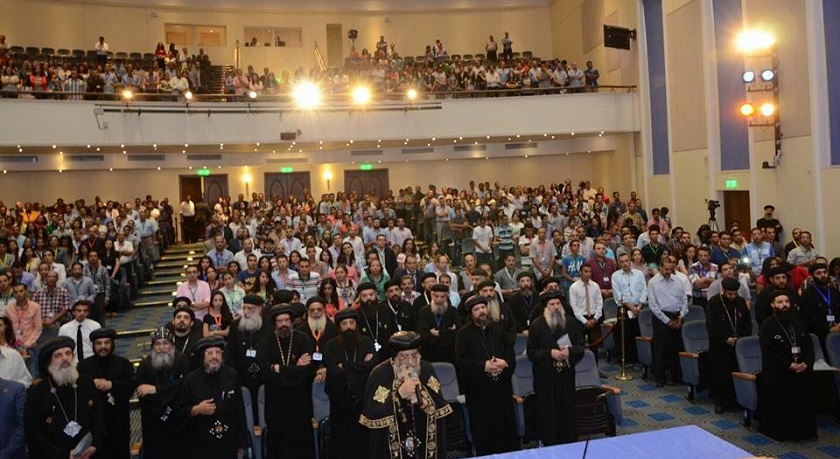
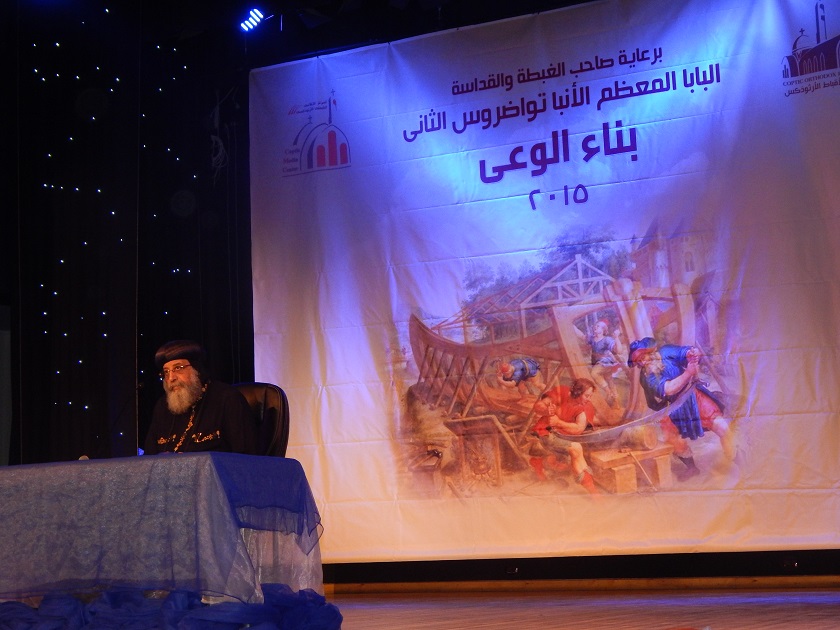
“The church is a pure spiritual institution,” Pope Tawadros said to the gathered crowd of 700 youth, emphasizing also a societal role. “It is the national church of Egypt, it is ancient. But we must not be closed upon ourselves.” Tawadros was speaking at a conference entitled “Building Consciousness,” organized by the Coptic Media Center (CMC), the media arm of the church. Hosted in Cairo, it followed two gatherings in Upper Egypt, with an upcoming meeting in Alexandria and the Delta. Participants are handpicked as active and influential leaders able to carry the message back to their churches.

Building Consciousness, according to CMC head and church spokesman Fr. Boules Halim, is a multi-year campaign designed to create educated, enlightened Orthodox Christians, able to think for themselves and engage with society. “They should vote and join political parties,” he said. “They should build their society and not be secluded. Connection to [the] church should not encompass their whole life.”

For many Copts this would be a radical departure. During the long era of now-ousted President Hosni Mubarak and the late Pope Shenouda, Egyptian citizens, including Copts, were depoliticized. As the state withdrew from social service provision, the church stepped in to fill the gap for its flock. Spiritual programs also multiplied, but as devotion increased so did the sense of the church as an alternate society, a place safe for Copts away from the trials of the world.

The state presented itself as a bastion of stability and semi-secularism against an Islamist threat. The church received the mantle of Coptic political leadership. The relationship had its ups and downs as it negotiated issues of sectarian violence, family status laws, and Coptic criticism from the diaspora.

The thrust now is to prepare Coptic citizens for leadership, but Building Consciousness is not a new emphasis of the church, according to Halim. It is the renewed application of Christian teaching to replace a reality that was forced upon them. “Society refused us,” he said, citing, for example, discrimination in state youth centers and sport programs. Speaking on the relationship between Mubarak and Shenouda, he said, “This is how the state wanted it, it was the nature of that stage.”

Egypt is now in a new stage, having passed through revolutionary tumult. While a large majority of Copts have strongly endorsed the regime of President Abdel Fattah al-Sisi, Halim is cautious, though encouraged. “Until now we still don’t have a convincing picture of citizenship, but there is hope,” he said. “The early signals say to us, ‘Come and participate,’ and the government is creating a conducive climate.”

Both Tawadros and Halim emphasized that the church will play a national role to encourage electoral participation. Attempting to allay concerns that this initiative opens up the church to similar criticisms made of Egypt’s short-lived Brotherhood government, they say it calls on all citizens to vote for the most qualified candidates and not on the basis of religion. It will use church networks to urge Copts to the polls, but will not endorse candidates, nor filter Coptic politicians through the political parties. This may happen at the local level, Halim conceded, but it is refused. There is no central electoral strategy in the church.

Besides politics, the Coptic citizen should be active also in the development of the country. But this area reveals potential contradictions in the message. The church has an organizing role, said Halim. He envisions a future in which every diocese has both a Coptic hospital and a Coptic school, open to all, without discrimination. As registered private schools, they will follow the national curriculum. The few schools currently operating have only a handful of Muslim students, as Copts have flocked to enroll. But once there is sufficient number, Halim hopes the student body will be distributed equally according to religion.

“If we can have a role in education, it will contribute greatly to better consciousness and open minds,” he said. “When enlightenment reaches the other it is more powerful. It produces coexistence, knowledge, love, and common cause.” During his presentation Tawadros advocated similarly. “We must serve society within the possibilities available,” he said, “completing the government in the provision of services.”

Such plans have provided fodder for Islamist critics accusing the church of proselytizing. While nothing in the conference suggested this aim, it is clear the church preaches a certain conception of society. One of the pillars of Building Consciousness is emphasis on the dual nature of Coptic and Egyptian identity. This, while at peace with Muslims, may be at odds with an Islamist agenda.

Viewed through the lens of the last four years of struggle and polarization, the issues are also quite political. The church insists it is not involved in the micro issues of elections and policies. But its vision is to shape society in the acceptance of macro issues of citizenship and national identity.

Here, the church wants Coptic citizens up to the task, even as it leads the effort. But in their eyes there is little contradiction, as the church with its members is the body of Christ. If it desires Coptic citizens to play an active role in society, it falls upon church leadership to teach them to do so. Where does the church stop, and the Christian begin?

According to Halim, the church as an institution desires strongly to leave these matters aside and return strictly to a spiritual, shepherding role. But too much is at stake in this transitional period. “If one calls for the church to have no role whatsoever, this will be when full citizenship becomes a reality,” he said. “But as long as citizenship is lacking, the country needs us.”

Pope Tawadros Building Consciousness

Categories
Current Events

Churches of the United Arab Emirates

Back in May I traveled to the Gulf – Persian or Arabian as per your geopolitical preference – to research the growth of Christianity among the extensive migrant population. What I learned became an article for Christianity Today: Why Christianity is Surging in the Heart of Islam.

The excerpt provided in my earlier post ended with a hook:

In Bahrain and Kuwait, Muslims can enter church compounds. In Qatar, guards allow only foreigners. Saudi Arabia’s Grand Mufti (the nation’s highest official of religious law) has called for all churches in the peninsula to be destroyed.

Surprising to many observers is how many of these churches there are.

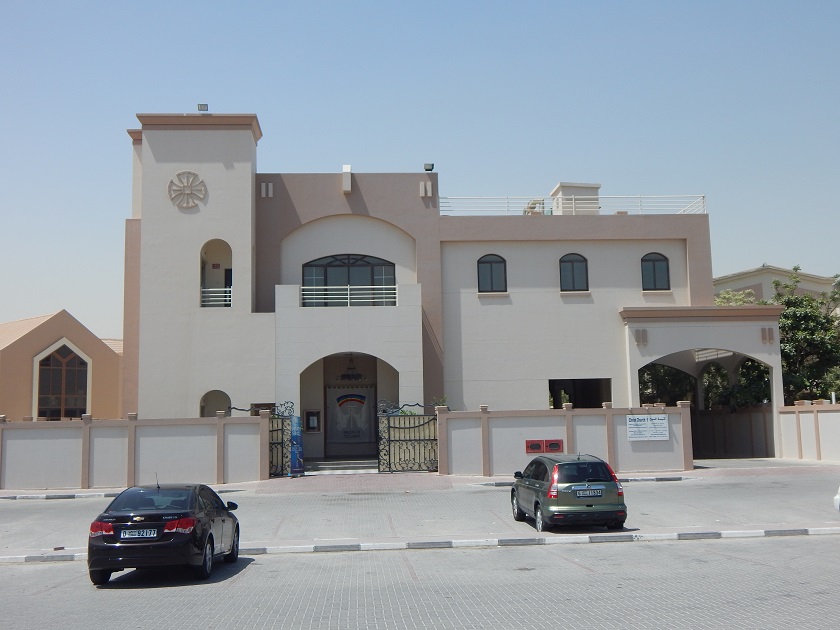
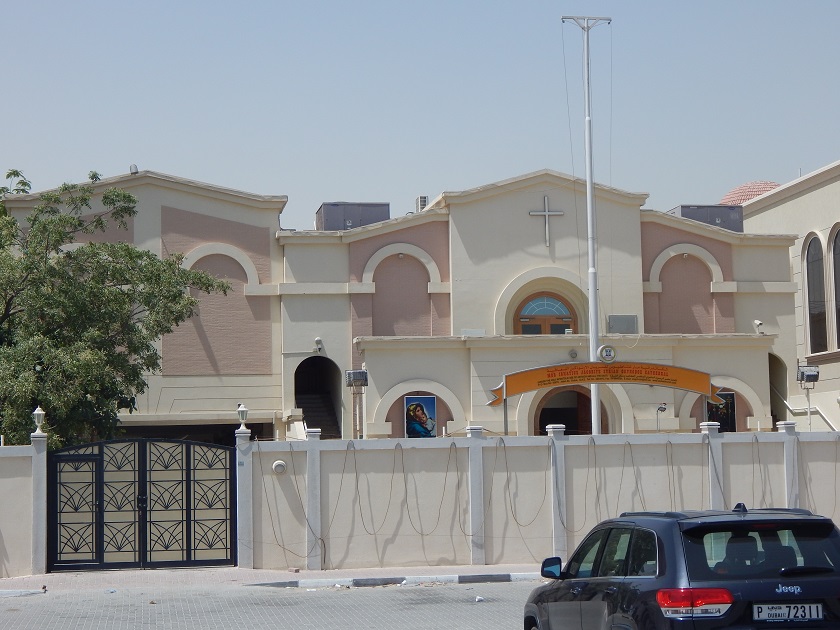
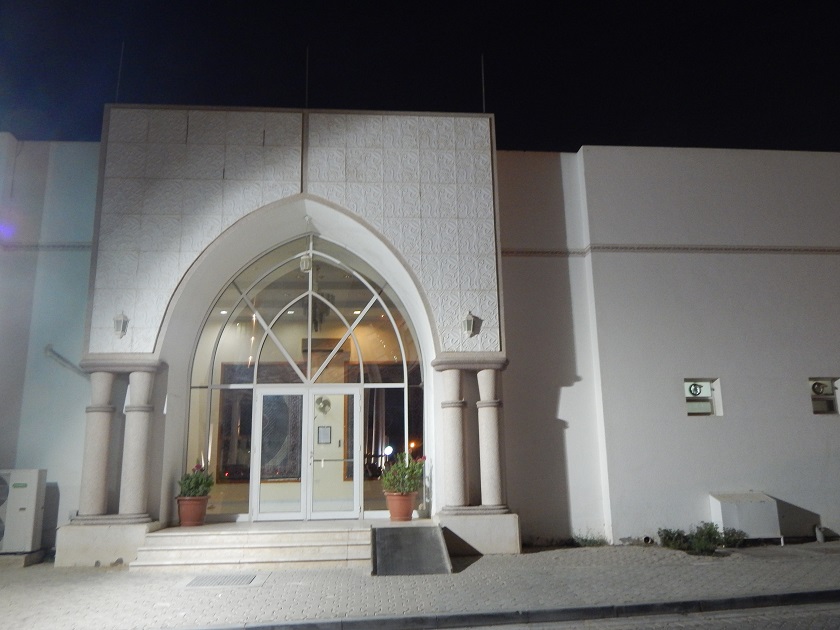
Hopefully you clicked to read on. If not, the answer is that the Gulf region hosts more than 40 physical church buildings in 17 cities. Many of these host multiple congregations. All operate publicly with permission of national governments.

Alongside them are house churches, most of which operate in a legal limbo outside of formal permission but generally with the awareness of authorities who watch everything closely.

My article makes clear that religious freedom in these nations is not complete, certainly not along Western conceptions. But the existence of these buildings is remarkable in its own right. They are a concession to foreign workers, certainly. One leading church leader told me that Islam, at best, only ‘tolerates’ non-Muslims.

But let us not dismiss tolerance. Many of these buildings are not tucked away into foreign-only enclaves, eyesores to be hidden from embarrassed Muslims. No, they are downtown, in residential neighborhoods, near commercial centers … and massive. At least they are in the United Arab Emirates.

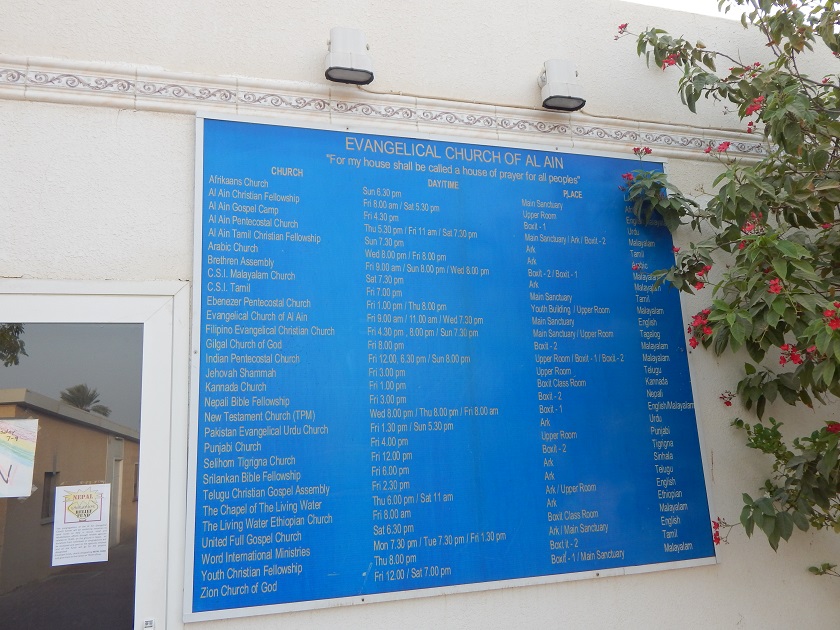
Please enjoy the pictures.

St. Andrew's Anglican Church, Abu Dhabi
St. Andrew’s Anglican Church, Abu Dhabi
St. Anthony's Coptic Orthodox Church, Abu Dhabi
St. Anthony’s Coptic Orthodox Church, Abu Dhabi
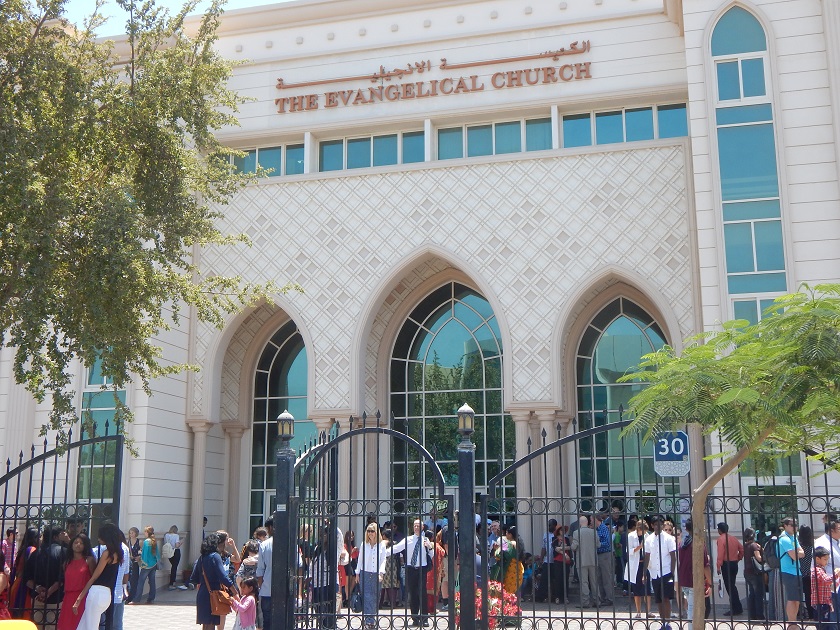
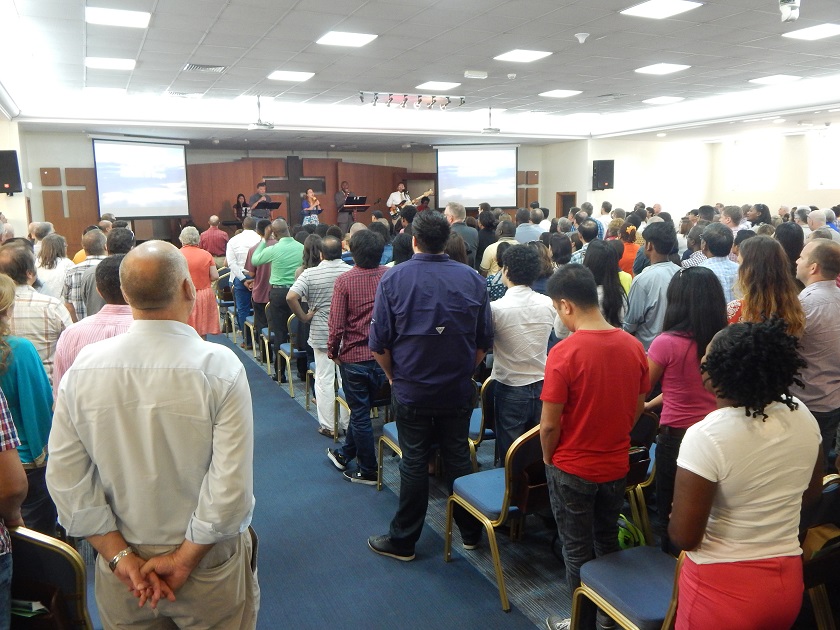
The Evangelical Church of Abu Dhabi
Service at the Evangelical Church of Abu Dhabi
List of Churches within the Evangelical Church of Abu Dhabi
Bibles for Sale at the Evangelical Church of Abu Dhabi
Anglican Christ Church, Dubai
Dubai Evangelical Church Centre
Worship Hall inside Dubai Evangelical Church Centre
Indian Mar Thoma Church, Dubai
Mar Ignatius Syrian Orthodox Church, Dubai
The Dubai churches pictured above are in compound just for foreign worship. But it is right down the street from the famed Ibn Battuta mall. In the distance you can see the Evangelical Church, in the foreground is a Sikh Temple.
Not all churches are in buildings. In the Gloria Hotel in Dubai is the Fellowship of the Emirates, featured in the article as an example of Christian worship that is welcome but exists in legal limbo.
Not all churches are in buildings. Inside the Gloria Hotel in Dubai is the Fellowship of the Emirates, featured in the article as an example of Christian gathering that is welcome but exists in legal limbo.
Jim Burgess, pastor of the Fellowship of the Emirates, inside the not-yet-set-up church hall.
The article describes how the presence of all these churches is connected to the medical missions of 100 years earlier. This is Oasis Hospital in al-Ain, the tribal home of the royal family. The modern building to the right is the new hospital the royal family paid for to expand Oasis' service.
The article describes how the presence of all these churches is connected to the medical missions of 100 years earlier. This is Oasis Hospital in al-Ain, the tribal home of the royal family. The modern building to the right is the new hospital the royal family paid for to expand Oasis’ service.
Upon entering the hospital, the visitor first sees the words of Jesus from John 4:13, in English and Arabic.
Also prominently available and in every patient room is a Gospel of Luke and a copy of the Jesus Film.
The Evangelical Church of al-Ain, hosted on hospital grounds.
Service at the Evangelical Church of al-Ain
List of Churches within the Evangelical Church of al-Ain
The Bible Society of the Gulf, in the Evangelical Church of al-Ain. The Bible Society legally distributes over 40,000 Bibles per year throughout the Gulf, whether in small depots like this or in centers within larger Protestant and Catholic churches.

If the images are striking, far from what you may have imagined about the Muslim lands of the Arabian Peninsula, click here to read the article again with new eyes.

One Christian leader compared the church in the Gulf to a potted plant that is being removed and planted in the ground.

Their consensus voice conveys two wishes: For the Christian, pray – and come – that it might flourish. For all, be thankful for regional leadership that is far more tolerant than you might think.

Categories
Christianity Today Middle East Published Articles

Why Christianity is Surging in the Heart of Islam

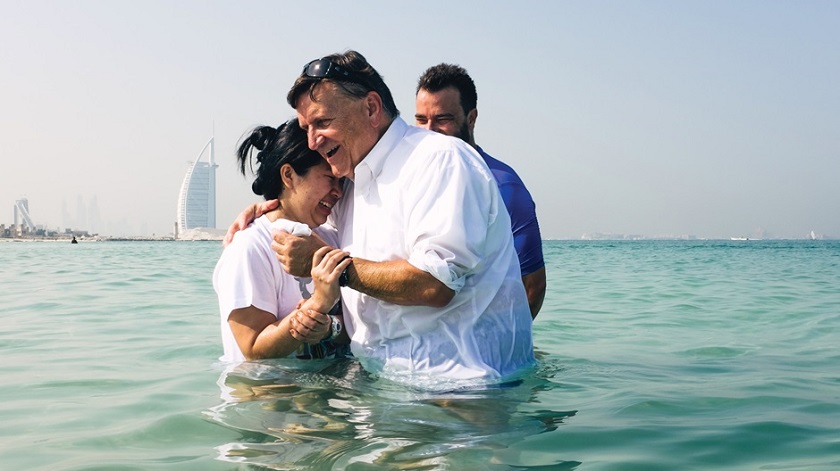
Public baptism service in the Gulf, in front of Dubai's Burj al-Arab. Photo courtesy of Fellowship of the Emirates.
Public baptism service in the Gulf, in front of Dubai’s Burj al-Arab. Photo courtesy of Fellowship of the Emirates.

My article for Christianity Today was published September 11, 2015. Here is an excerpt:

Espada, an architect, is one of the millions of foreign workers transforming the former desert oasis into a global center for business and travel. The UAE’s Dubai is the fifth-fastest-growing city in the world; its population is now more than 80 percent migrant.

The great majority of migrant workers in the region come from India and Southeast Asia, sometimes suffering exploitation in labor camps to send a collective $100 billion back home. As an American, Espada is unusual.

But as a Christian, he is not. Today the Pew Research Center numbers Christians in the Arabian Peninsula at 2.3 million—more Christians than nearly 100 countries can claim. The Gulf Christian Fellowship, an umbrella group, estimates 3.5 million.

These migrants bring the UAE’s Christian population to 13 percent, according to Pew. Among other Gulf states, Bahrain, Kuwait, and Qatar are each about 14 percent Christian, while Oman is about 6 percent. Even Saudi Arabia, home to Islam’s holiest cities (Mecca and Medina), is 4 percent Christian when migrants are counted.

Together, they represent the largest Christian community in the Middle East outside of Egypt. But their experiences vary considerably.

In Bahrain and Kuwait, Muslims can enter church compounds. In Qatar, guards allow only foreigners. Saudi Arabia’s Grand Mufti (the nation’s highest official of religious law) has called for all churches in the peninsula to be destroyed.

Surprising to many observers is how many of these churches there are.

Please click here to read the full article at Christianity Today. Next post I’ll share some photos of church buildings.

Categories
Current Events

Friday Prayers for Egypt: Corruption and Economy

Flag Cross QuranGod,

Will Egypt be serious? Can it be? Is tackling corruption really part of the agenda?

Cries of corruption are a time-tested way to taint an opponent. Given its assumed pervasiveness they may even be true. But as the minister of agriculture falls, as does – ironically – an anti-corruption activist, help the government tackle this issue at its roots, and not just trim the low-hanging branches.

Give them both a fair hearing, God. Them, and all others.

A former Mubarak-era businessman and politician, accused of widespread corruption, is trying to return to parliament. Subject to multiple trials and jail over the past four years, the legal tussle has been intense. Decide his case rightly, God, and all like him.

Give mercy to the repentant. Give candidacy to the legal. Above all, give discernment to the electorate. Keep corruption far from the coming parliament.

For beyond politics, corruption spoils the economy. The government is feverishly working to stimulate investment, cautiously working to enact reform.

The rich and powerful can tolerate corruption; perhaps they even benefit. But its costs are felt most harshly where economic revival is most needed. For the poor and middle class, it is hard to play on an uneven field.

But real growth is dependent upon them. Studies show the Egyptian economy is woefully top heavy. Corruption trickles down far more efficiently than capital.

God, how to even begin? Give officials wisdom and uprightness. Give functionaries a living wage and a tender conscience. Give the system transparency.

Give Egypt the people and will to make it happen. May it both accompany and spur a cultural change. And beyond accusation, may it bring healing. There are degrees of guilt, God. Let justice be blind, but also be nuanced.

Cleanse the nation, God. May prosperity come, to all.

Amen.

Categories
Christianity Today History Published Articles

Before We Conquer, Have We Tried Love and Tears?

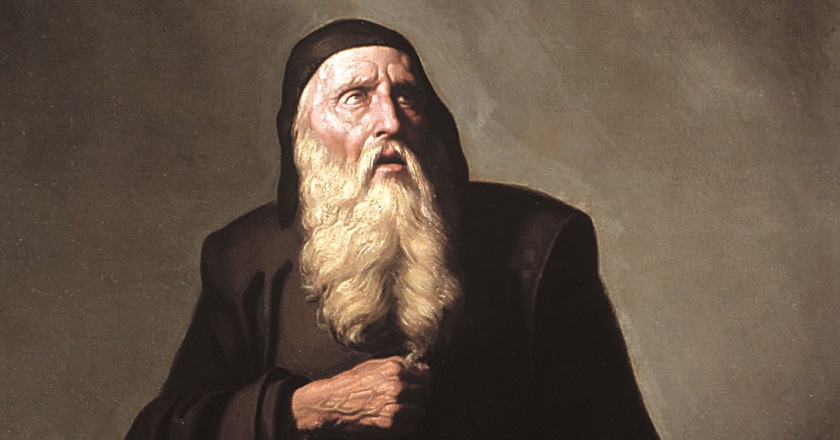
Ramon Llull (image frombalearidesdigital.com)
Ramon Llull (image from balearidesdigital.com)

From my article at The Behemoth on the 13th century Spanish missionary, Ramon Llull. This year marks the 700th anniversary of his death.

Most missionary careers are not launched by a suicide. Neither do most end with deliberate martyrdom. What Ramon Llull did in between rebuked a Christian Europe fighting jihad with its own crusades.

The Mediterranean world in the 13th century witnessed a conflict in transition. The 1212 Battle of Toloso signaled the decisive decline of Muslim civilization in Spain. But in 1291, the crusader city of Acre fell, the last major outpost of Christian power in the Holy Land. Merchants from Genoa and Venice established control of seafaring trade routes. But Arabic philosophy governed the discourse of European intellectual circles.

Born around 1235 in Majorca (a Spanish island near Barcelona his father helped to liberate), Llull was a product of this time. King James I of Aragon granted the family land, and Llull served in the court of his son. A troubadour in the classic sense, he was an accomplished musician and poet, also authoring treatises on horsemanship and warfare. Palma, the family home, was a center of shipbuilding. And Llull was a devotee of courtly love, a palace and literary tradition that germinated in Andalucía.

Here, arresting his licentiousness, God got his attention.

Deep in flirtation with a married woman of the court, Llull’s wooing poem was interrupted by a vision of the crucified Christ. Blood dripping from head and hands, Jesus looked at him reproachfully. Llull immediately retired to his chambers, but was not yet converted. The married father of two tried to resume his poem a week later.

God intervened again, later giving the vision a third time. Now around 30 years old, Llull surrendered to the compassion of Christ, abandoning the king’s court in Aragon.

Back in Majorca, …

The Behemoth is an ad-free, subscription-based sister publication of Christianity Today. The article is behind a paywall, but for those interested a free 30-day trial is available.