It was approved earlier, but implemented now. It was expected before, but now felt in pocket.
It was to come, and more is coming.
The fuel subsidy was slashed, with some products doubling in price.
It hits the middle class and their fleet of automobiles. It hits the lower class with microbuses and gas bottles. The rich can take it, but it hurts them too.
All for the sake of the state budget.
Surely it is necessary, some say. Deficits are a debilitating reality and the IMF urges reform.
Surely there are alternatives, others say. The people are already poor.
The government doubled the discounted allotment for essential goods on the ration cards, to help.
A functional, efficient economy would help even more.
God, whatever the wisdom in subsidy reduction, bring about the greater goal.
Help the poor to cope. Help the rich to share.
Help the nation right itself.
Give Egypt the advisors necessary to find the path forward. Give her the leadership necessary to do what must be done.
You have given new fields of natural gas. Speed the extraction. Refuel the nation.
Bring holistic recovery, God. From your grace, subsidize hope.
Today is the end of Ramadan, the month of fasting.
In order to help our Western friends understand this month, here are a few stories that reveal a wide scope of Ramadan diversity.
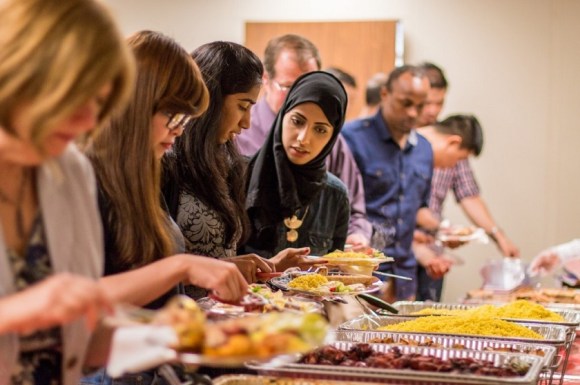
It may be surprising to some that in Egypt, many churches host iftar, the fast-breaking meal at sunset. I attended two, which I reported on for Christianity Today. It can be a great way to honor Muslims for their commitment, and to build bridges between the two communities.
Inspired by the practice, we looked to imitate.
Our daughter invited her school friends and mothers, which included a Christian family. She even encouraged us not to eat or drink – from noon until 7pm – to share the experience.
But this experience did not include any men, so I was banished to the back room. One of the mothers is more traditional and the company of women put all at ease.
Fortunately, they sent back some food.
On another occasion we went to a friend’s home to break fast with them. Our younger daughter asked if one of the ladies of the house was a Christian, as she didn’t cover her hair.
Needless to say, this group was comfortably mixed in gender.
We were not fasting with them on this occasion, and decided first to stop by the new mall opened in their neighborhood – which even has an indoor ski park!
The mall was pretty empty, as most people were at work or looking to get home on time to eat again. But Baskin Robbins was open and even offered their free samples. We all indulged.
As parents we were careful not to eat or drink in public throughout the day, but made an exception for the ice cream. When we got back to the car, our thermoses emptied.
Similar was an interview I did with a Muslim friend downtown. The temperature was 109 degrees, and to make my way there I walked to the metro, rode in the crowded un-air-conditioned car, then after a short walk outside stuffed myself into a microbus.
All the while there was a water bottle in my bag, unable to surface.
Yet when I arrived, my friend kindly offered me a cup of water.
What to do? Muslims know Christians are not fasting, and are generally not offended if a friend eats quietly in front of them. His was a kind gesture on a hot day.
But in Egypt Christians generally choose not to eat or drink in front of them from respect.
I can’t say if this was the right decision or not. But I took the cup, thanked him for his consideration, and placed it down on the table.
I assured him I would be willing to drink it later, but never did.
It was a long trek back home as well, but hopeful a genuine sentiment was communicated.
Later in the month, however, we invited another Muslim friend to break fast at our home. He was without his family for a while, so he could share with us.
But he is a non-practicing Muslim, and preferred to eat at our normal dinnertime of 6pm, an hour before sunset.
There is a good bit of diversity in Ramadan, but it doesn’t end there.
Unrelated to the month we invited a Christian family to join us for a meal. But surprised we were when they left half their plate untouched.
We failed to realize the Christian ‘Fast of the Apostles’ overlapped with Ramadan this year. Coptic Christians abstain from meat during their fasts, which last several days – like Lent – not just from sunrise to sunset.
If they are faithful, Coptic Christians can be fasting over half the year.
Unlike us, the local sweet shop is quite accustomed to Coptic fasts and always has a ready stash of Christian-fast-appropriate treats available.
Perhaps from habit in filling our order when we visit Christian families, the shopkeeper naturally doled out from that supply.
We didn’t realize it until he was done, but said no matter. We were off to visit Muslim friends but judged they taste similar enough.
Given the spirit of the season, we don’t think our friends minded – if they even noticed.
You may have an image in your mind of Muslims. There may be an associated thought about Ramadan. Most likely it is true, at least partially.
But realize there is much diversity in the Muslim world, and each deserves our understanding and honor.
Among some this is difficult (think of terrorists). Among others it is easy (think of our friends).
I suppose like humanity in general, most are in-between.
But however difficult to imagine, it becomes easier when you actually know them.
And like humanity in general, it can become more difficult when you actually know them well.
We all have warts. But we are all also made in the image of God.
Do your best to discover both among Muslims, as you can.
And congratulations to all our Muslim friends; enjoy your feast.
Since last week there has been much written but little resolved. Qatar and the Gulf allies have traded accusations and attempted mediation. But now a line in the sand has been drawn.
A list of demands has been issued.
Egypt, joining Saudi Arabia, the United Arab Emirates, Bahrain, and others, have given Qatar ten days to close al-Jazeera, reduce Iran ties, shutter a Turkey base, and end support for terrorist groups.
God, with many details behind closed doors, only you can sort out fully the right and the wrong. But amid charges of meddling over several years of frustration, this crisis may be approaching a critical moment.
Keep the peace. Promote consensus. Honor sovereignty. Reveal the truth.
The region needs good journalism, God. Provide for transparency and accountability in an independent media.
The region needs a spirit of unity, God. Help Arab brothers recognize joint challenges and cultivate wise policies.
The region needs respect for diversity, God. Allow conflicting interests and disparate peoples to find welcome.
The region needs less violence, God. End outside support for terrorist groups and reform poisonous ideology.
A line is in the sand, and you count every grain. Let wise heads prevail, and you know every hair.
The stars are in the sky, and you call them by name. Call also the faithful lights of regional politics, and bid them to peace.
This article was first published at Christianity Today, on June 22, 2017.
For most American Christians, Ramadan is a novelty; something heard of, but rarely seen. For Middle Eastern Christians, it is everywhere.
For some, it is an annoyance. The month-long fast from sunrise to sunset can make for a cranky Muslim neighbor. Productivity tends to slow. Religiosity tends to rise.
But for other believers, it is an opportunity.
“The Evangelical Church of Maadi wishes all Egyptians a generous Ramadan,” proclaimed the flowery banner hung in the southern Cairo suburb. Such signage is not uncommon (and Muslims also display Merry Christmas wishes for Christians). But saluting “all Egyptians” is a statement.
“I want our brother Muslims to feel that we are one [as Egyptians], and it will make him happy in his heart,” said pastor Naseem Fadi. “We both celebrate Ramadan.”
Beside the need to have good relations with Muslims, Fadi also emphasized his biblical obligations. “Our faith tells us to love everyone,” he said. “And when we reach out to others, we teach them about ourselves.”
Across the Middle East, Christians join in the festive spirit—often by hosting an iftar, the traditional fast-breaking dinner…
Please click here to continue reading at Christianity Today.
Perhaps the story is over, perhaps the judiciary will still have a role. But two contested islands in the Red Sea have been ceded by Egypt to Saudi Arabia, after parliament ratified the president’s decision.
It was an unpopular vote; proponents insist it was the right one.
At issue is original ownership. Egypt has long administered the islands, but were they originally Saudi? Both sides have produced maps, documents, and other evidence to support their case.
And in the background is the role of Saudi Arabia in supporting Egypt. The president first announced the deal in conjunction with a massive Saudi aid and investment program. Many felt he ‘sold’ Egyptian land.
The Administrative Court sought to block the transfer, but parliament acted on its believed constitutional prerogative. The Constitutional Court has not yet spoken—it may or may not. If originally Saudi only parliament is necessary to ratify a foreign agreement. If originally Egyptian a national referendum is necessary.
God, sort out the complications. The islands are unpopulated, but strategic. And little is more valuable in Egyptian imagination than land.
If the vote to cede was genuine, then bless the courageous lawmakers for standing against the popular will. It is right to give back what belongs to another.
But opponents say the vote was manipulated by government pressure. If so then bless the courageous lawmakers for calling it out. It is right to resist machinations of power.
But was the vote right, God? You know. Bless Egypt whether yes or no, but bless her differently. Through rebuke or commendation, guide her to the right and good.
All land is yours, God. All souls belong to you. All peoples reflect your handiwork.
Determine the exact lines of the places you would have them. Your greater story is not yet over. Within it is Egypt, and may all end well.
St. Peter and St. Paul Coptic Orthodox Church in Cairo, bombed December 2016 – Creative Commons on Wikipedia
This past Palm Sunday two suicide bombers killed over 45 people at two churches in northern Egypt. One made his way all the way to the altar at St. George’s Cathedral in the Nile Delta city of Tanta, while the other was stopped at the gate outside St. Mark’s Cathedral in Alexandria, where he detonated his explosives. These attacks—along with the December 2016 bombing of St. Peter’s and St. Paul’s Church at the cathedral compound in Cairo, the May massacre of 30 Copts in Minya, and ongoing violence in Arish and elsewhere—have raised questions about the Egyptian state’s ability to protect Christian citizens from the threat of terrorism. But amid the breakdowns, church leaders have developed routines and relationships with security authorities to provide a joint system of security.
On Easter Saturday evening, the chief Easter celebration in Egypt, I went to the midnight vigil at a Coptic Orthodox church in Cairo. The streets were cordoned off and a barrier channeled the throngs of worshippers through a tight security check. Police vans with heavily armed officers were everywhere. Yet as I approached behind several Egyptians getting their bags searched, a layman from the church caught my eye and motioned me forward. Nodding to the police, he allowed me to quickly pass through the metal detector and into the service.
One week later, it seemed Easter had been an aberration. The normal two to three policemen kept watch on the church from a distance. A couple church doormen glanced casually as I walked by them after passing through the metal detector. Yet in conversations with several church officials about internal security, they seemed satisfied that the apparently reduced police presence offered sufficient protection…
Please click here to read the full article at TIMEP.
The Gulf has had enough. So has Egypt. So have others. Some hedge their bets. Some play both sides.
But it is a crisis, God. The tiny nation has been called out for supporting terrorism, within a region that is full of it, but usually sticks to innuendo. It also happens to host the largest US military base in the Middle East.
And the damage is far beyond diplomacy. A blockade is established on all entry and exit. The only airspace is through Iran.
Qatar is rich, and can ride out the damage. But for how long, and at what cost? What can bring resolution, in a culture bound by honor? In the eyes of many, Qatar has forfeited it.
But you know, God. Dangerous and deadly games are played in the region, by someone. Even the public rivalries are contentious, in media.
You value unity, God. At some level it is right for the region to maintain it.
You value diversity, God. At some level each nation must find its own way.
But you deplore duplicity, God. Many accuse in mutual recrimination.
And you deplore savagery, God. Many suffer in targeted destabilization.
Settle the region and every nation. Preserve sovereignty and good will. Promote peace and economic balance.
Hold accountable. If some are guilty let your judgment be true.
But all are guilty. Let your justice redeem.
God, the people have had enough. Have you? Do we witness your retribution, or more manipulation?
Put things right, God, on all sides. Honor Qatar. Honor all.
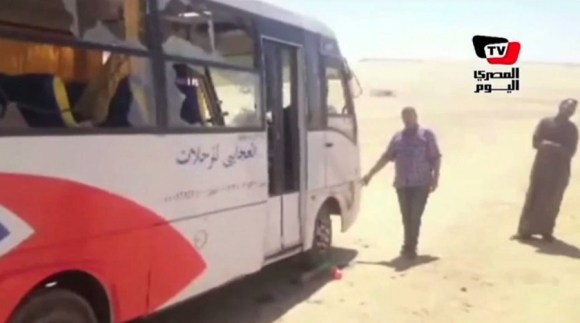
(Photo Credit: Screenshot of Associated Press raw footage of bus that was carrying Coptic Christians going to church retreat when they were ambushed in Egypt on May 26.)
As word spread that 28 Coptic Christians were killed by terrorists, ambushed on their way to a church retreat in Upper Egypt, it was a little while before the realization hit: I was on a church retreat in the Delta.
Being in the opposite direction offered no sense of safety. Only one month earlier the Islamic State sent two suicide bombers to spoil Palm Sunday in churches in the Delta cities of Tanta and Alexandria. But this attack seemed different, another escalation. Coptic outings like the fated one to St. Samuel the Confessor Monastery near Minya in Upper Egypt represent one of the favorite activities of Orthodox Christians throughout Egypt, a mixture of spirituality and social fun. This killing could be a message for Christians to stay in their homes. Whether at worship or leisure, they are ISIS’ favorite target.
But the mentality is worse. Before the Palm Sunday bombings, the Islamic State drove Christians from their homes in northern Sinai, forcing them to take refuge in the Suez Canal cities or Cairo. There is an element—very small but determined and dangerous—that wants Egypt rid of Christianity.
It will be a very difficult task. The roots of the faith go back two thousand years. Copts claim first-century St. Mark the gospel writer as the founder of their church, and third-century St. Anthony the hermit as the founder of monasticism. Gruesome death is no stranger to the Coptic Orthodox Church; its liturgical calendar begins at the era of Diocletian, the Roman emperor who set thousands of martyrs to the sword. It is not likely the church is going anywhere.
But will they think twice before going again to a monastery? St. Samuel is off in the desert, an ancient expression of the Christian impulse to simplify and flee the allurement of the world. Copts in Upper Egypt go to the monastery 120 miles south of Cairo on the Western Desert road to seek the saint’s blessing, and perhaps the spiritual guidance of a monk. But with little else in the way of area entertainment, they also go for a picnic and to have a good time.
So also do they go to Anafora, a modern expression of the Christian impulse to simplify and uplift the marginalized of the world. This is where I was, 90 miles north of Cairo on the Alexandria Desert road, when I heard the news of the savage attack on the bus to St. Samuel. The rest of the day the atmosphere was sullen. Founded only two decades ago and not a monastery but a place of lay retreat and development, Anafora is usually vibrant and bustling with activity. But what joy can there be in the face of such evil?
Yet there must be. That evening the staff at Anafora quietly celebrated the birthday of one of their sisters. The founding bishop urges Copts to not give into fear, but to insist on both love and justice. Is this not the message of Christianity, to resurrect life after suffering death? The Coptic Orthodox Church has incarnated this model for two thousand years, will they not continue?
Friday begins the weekend in Egypt in accordance with the Muslim day of communal prayer. Most churches make this their primary worship service as well, and many Christians take advantage of the quiet roads and time off to commune with fellow believers in their monastery of preference. There are dozens scattered throughout the country, and surely next Friday they will be full again. Copts have not stopped going to church after the suicide bombings. I suspect they will not stop celebrating their heritage of monasticism and martyrdom either.
But the question of continuance must be asked. Since the Arab Spring, emigration has dramatically increased in anecdote, though official figures cannot be verified. And for decades within Egypt, economic realities even more than sectarian tension have driven internal migration from villages to cities. Are there enough of strong faith and eternal Christian values to stay and persevere? Or is it those of strong means and international Christian connections who leave, regardless of faith? In any case, the less-well-off are left behind.
But poor, rich, and in-between, the Copts of Egypt still number in the millions. Now by far the largest Christian community in the Middle East, they also claim a Biblical promise. “Blessed be Egypt, my people,” God says through the prophet Isaiah, and with Muslims the Copts see God’s hand of preservation upon the land of the Nile. But Isaiah also listed Assyria, modern-day Iraq now bereft of Christians, as God’s handiwork. With Israel named as God’s inheritance, is the best the Copts can hope for a tenuous middle ground?
There may not be much sympathetic American Christians can do to help, but do try to understand. And as you enjoy your church outing in the weeks to come this summer, do so with remembrance and prayer. Think too of the allurements of the world, the blessings of simplicity, and the necessary uplift of the marginalized. Think of St. Samuel, and of Anafora, and of an ancient bond of faith.
If from there you can only grow frustrated, remember the importance of love, justice, and joy. Trust God will work out his purposes and join him along the way, even as ambushes await.
To some degree, dramatic events were more of the same. For good or for ill, some may well carry forward, some must irrevocably stop. Judge rightly, God, and guide Egypt to your judgment.
Coptic families were gunned down on an outing to a monastery.
Websites were blocked in a dispute over content and orientation.
An NGO law was ratified establishing greater government oversight.
Each is a continuation.
The massacre is the fourth in five months, forgetting not the 2013 church attacks following the Rabaa dispersal, the 2011 Maspero incident, and the 2010 New Year’s Eve bombing.
After Morsi’s removal a number of Islamist media networks were shut down.
After Mubarak’s resignation a number of NGOs were raided amid ongoing investigations.
The difference of opinion ranges from minimal to severe. God, fill in and close the gaps.
Only the most hardened justify the ambush in Minya. But some suggest Copts somehow are reaping the consequence of their political stances.
The websites in question were not shy to be critical. Some are said to be funded by Islamist-friendly nations, others are said to be independent.
Many Egyptians believe the upheavals of the past few years gestated through foreign NGOs. Some call the law draconian; some call it necessary.
How then to pray?
Sanctify life in the eyes of all. Make none a pawn in political games.
Foster free and responsible media. Let true information circulate widely.
Protect the people from/through NGOs. Help government partner with civil society.
God, Egypt is troubled and needs your support. For good or for ill, old patterns continue.
Carry forward your blessing. Stop irrevocably the plague.
Shrine to the martyrs of Tanta in St. George’s Church, killed by a suicide bomber on Palm Sunday.
They couldn’t even wash their dead.
Thirty Coptic Christians were gunned down by ISIS, ambushed in a church bus on a weekend outing to a popular monastery in the Egyptian desert. Their families gathered to receive their loved ones in a local hospital, but were met with a mixture of ill-equipped facilities and overwhelmed staff. They even had to fetch their own water.
As if another reason was necessary, Coptic anger turned the funeral march into a protest.
“With our souls and blood we will redeem you, oh Cross!” they shouted. Some seemed to take aim at Islam. “There is no god but God,” they chanted, before changing the second half of the Muslim creed, “and the Messiah, he is God.”
Other chants took no aim at all, thrashing wildly in anger. “We will avenge them, or die like them.”
Many observers say such anger plays right into the hands of ISIS, which is keen to turn Egypt against itself.
Six weeks earlier, after twin suicide bombings on Palm Sunday, Bishop Boula of the Coptic Orthodox diocese of Tanta found himself in a similar situation. Hospitals did not have enough refrigeration units to keep the 25 bodies of those martyred at St. George Church. Crowds were gathering, and anger was surging.
Quickly, he made the decision to bury them together in the church crypt reserved for bishops. Honoring the dead with their leaders of ages past, he then marshaled the youth to provide order and security for the semi-spontaneous funeral service.
“It cooled the fire of all the people,” he later recounted on satellite TV. St. George was renamed to include “the righteous martyrs of Tanta,” with a shrine erected outside the crypt.
It was perhaps the most practical of Coptic efforts to process their anger. Forgiveness is another, as Copts have moved Muslims and wowed the world with their example…
Please click here to read the full article at Christianity Today.
After the latest atrocity against the Copts perpetrated by the Islamic State – killing 30 in an ambush of a church outing to visit a monastery – the following poem was circulated on social media.
It is entitled ‘A Message to ISIS’, written by Kiro al-Masry. The translation is mine and the Arabic original is given at the bottom.
I will not speak (as some have done)
And curse your religion whatever its name.
I have come that it be known:
My fathers’ religion and what it proclaims.
My fathers’ religion has love at its heart,
The meaning of which will call you to peace.
My fathers’ religion, right from the start
Offers forbearance that conflict will cease.
Your hatred and killing in no way suffices
To stop us from loving and praying for you.
My father’s religion, oh dear Uncle ISIS,
Is not a weapon to pierce you straight through.
I wish that you could come to see
Or just one time the answer seek.
That while you bomb and murder, we
Stay strong as if a mountain peak.
My fathers’ religion of spirit consists.
It is not a body whose end is the dust.
And for the spirit—despite death persists—
Awaiting are loved ones residing in trust.
My fathers’ religion, if you could discern,
Offers each wounded the medic of life.
Tomorrow when you will repent and return,
You will come to know just who is the Christ.
رسالة لكل داعش
انا مش هقول زي اللي قالوا دين ابوكم اسمه ايه
انا جاي اقـــــول دين ابويا يعني ايه
دين ابويا يعني حب يعني دعوه للسلام
دين ابوايا من البدايه دين تسامح مش خصام
رغم كرهك رغم قتلك وصاني اصليلك واحبك
دين ابويا ياعم داعش مش سلاح يطعن ف جسمك
نفسي تفهم مره واحده او تساءل نفسك سؤال
ازاي وانتوا بتقتلـــونا بنبقي صخر من الجبال
دين ابويا اصله روح مش جسد اخره التراب
يعني لما الروح بتصعد بتتلاقي مع الاحباب
دين ابويا لو بتفهم دين بيداوي كل جريح
وبكره لما تتوب وترجع هتعرف مين هو ( المسيــــح )
بقلم الشاعر : كيرو المصري
In a future post I hope to offer some commentary and reflection. But for now, take note at one way Copts are encouraging themselves in the face of atrocity and evil. Pray for them, and for ISIS likewise.
This article was first published at Christianity Today, on May 26, 2017.
(via Reuters and Ahram Online)
Terrorists ambushed a Coptic church bus trip on Friday near Minya in Upper Egypt, killing at least 26 and injuring 25, including many children.
Egypt’s interior ministry reported that three 4×4 vehicles of 8 to 10 gunmen dressed in military uniforms opened fire on the vehicle, which was on its way to St. Samuel the Confessor Monastery in Samalout, 140 miles south of Cairo.
There was no immediate claim of responsibility, but the attack—which occurred on the eve of Ramadan—follows church bombings claimed by the Islamic State on Palm Sunday and in advance of Christmas.
Last week, Egyptian authorities arrested 48 individuals, securing confessions of belonging to a terrorist cell linked to the Islamic State.
“I am grieving. It is sad and shocking,” said Bishop Thomas of the Coptic Orthodox diocese of Qusia, 75 miles from the monastery. “But at the same time, I know this is not new. I was expecting things like this to happen. And it will not be the last.”
Two weeks after the Palm Sunday suicide bombing in Alexandria, security at the St. Mark’s Anglican Pro-Cathedral was tight. Police cordon, metal detector, bags checked – even eyeglasses needed to be removed.
But inside, tucked away behind the expectant bustle, volunteer leaders circled with hands together and let out a shout, as if to the whole world.
“Believe me, the solution is love!” they cried, raising their hands to heaven.
Ninety percent were Muslim.
Widely known in Egypt as an Islamist stronghold, for decades many Muslim youth in Alexandria had proclaimed the Muslim Brotherhood slogan: Islam is the solution.
And similar to churches throughout the country, St. Mark’s is couched behind thick, high walls. Save for official visits on Christian holidays, few Muslims would need to enter.
But society needed it, decided Nader Wanis. In 2012 in cooperation with church leaders, he opened the Corners for Creativity cultural center in the 150-year-old cathedral, seizing on an opening in the Arab Spring.
Despite the positive signs of youth engagement and interfaith cooperation during the Egyptian revolution, at the time there were also marks of tension. A year earlier conservative Salafis burned a church in Cairo believing a Muslim woman was kidnapped inside. Before that the Two Saints Church in Alexandria was bombed by unknown assailants on New Year’s Eve.
“The church has been misunderstood by the Egyptian street,” said Wanis. “There are rumors we have weapons, fornication, and sorcery inside.
“As long as the church stays closed, Muslims can think whatever they want. But the cultural center is a means to let people in.”
Welcome
Since then they have come in droves, and the community has welcomed it. Over one thousand each year have graduated from diverse training programs in singing, drawing, photography, acting, writing, fine arts, and graphic design. All are run by volunteer leaders.
On this occasion dozens of artists gathered for the monthly art exhibition and handicraft market. Paintings and sculptures lined the walls of the church in absolute reversal of their original purpose. Hijabed women offered their homemade crafts behind foldaway tables set up in front of the massive church door.
The volunteers’ pep talk met behind the welcoming ribbon soon to be cut by two deans from Alexandria University and a local businessman. And afterwards everyone gathered to honor participants in the sanctuary, where Muslims and Christians sang together about religious harmony and community service. “Believe me, love is the solution,” was one of their most enthusiastic.
But it almost didn’t happen.
The church attack ensured it did.
Nader was worshiping at St. Mark’s when the walls shook from the explosion at the Orthodox cathedral five minutes away, killing 17. Earlier the center had considered postponing the exhibition due to the university exam schedule. But after finishing communion he immediately called his team to determine the necessary response.
The 40 volunteer leaders gathered daily in discussion and decided to hold the exhibition and announce it as Masr al-Samida, Egypt the Resistant. Difficult to translate into English, it connotes the suffix ‘-proof’, as in ‘water-,’ or fittingly, ‘bomb-.’
“We insist on creating peace,” said Wanis. “As a church we will not be scared, we will not close in on ourselves again because of one or two incidents, we will not build more walls.
“Now, Muslims and Christians are together. If they explode us again we will die together.”
Message
Mohamed Moussa is one of the longest serving volunteers at the center. A fourth-year journalism student at Alexandria University, he is responsible to organize the exhibition.
“The message is that we are one people, persevering,” he said. “Every time something happens it only brings us closer.”
Moussa knew nothing of the center four years ago, but stumbled into a media course. Touched by the ethos he remains, now in charge of a medium far from his chosen education.
“When you are here you feel there is no difference between a Muslim and a Christian,” he said. “If anything they treat us better than them.
“We are one family, and we are getting bigger.”
Part of the allure of the center goes beyond interfaith unity. Volunteers are given additional training by Wanis and others in administration, marketing, and leadership. But this last word is anathema.
Volunteers are called khadim, the traditional word in the church that means “servant.”
“We are in a church, so they use our language,” Wanis said. “We reject the common terminology and its logic, because we do not lead, we serve.”
And the contrast could not be clearer for the newest volunteer.
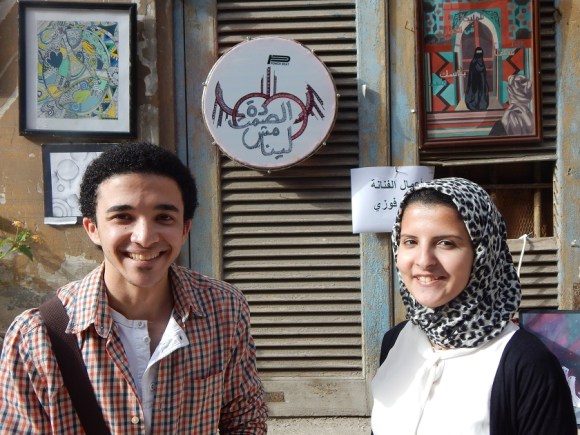
“There is no ‘I’ here, we are all together and work together,” said Bassant Fawzy, a 21-year-old art student at Alexandria University.
“People with knowledge and skills tend to keep them to themselves, but here we teach each other.”
Only one week a “servant”, she brought along her friend Ibrahim Mohamed, who was surprised and impressed to see Islamic-themed art in a church building. Without his knowing, Fawzy borrowed his traditional drum and decorated it with a phrase from the popular song The Nation’s Heart is Wounded, “It is not for us to be silent.”
“We need hope to overcome the crisis,” Mohamed said. “We want everyone to know we support our country in all it is going through. And with terrorism in the churches we must say it here, in the heart of a church.”
Response
When Wanis started Corners for Creativity he did not know how Muslims would respond. Four topics were expressly forbidden: Religion, politics, sex, and soccer – four topics that divide society. But still today nervousness abounds.
“Some Christians are afraid for me,” said Bassem Mounir, a fine arts student and four months a servant. “After the bombings they are worried about Muslims coming into a church.
“But this church opens its doors to everyone, as if we are all brothers.”
At the ceremony each participant received a certificate, honored by the university deans. On the screen above flashed a prayer: God, remember the terrorists who love you and will even give their lives for you, but who neither know you nor your love for all people.
“There is a virus spreading through society to divide it, working through religion,” said Mohamed Helal, dean of the faculty of fine arts. “Religion builds walls, but art transcends them – and this is what Nader is doing.”
The effect has been transformative for Christian and Muslim alike.
“It makes people in our church feel like they are part of the community,” said Bishop Samy Fawzy Shehata, head of the Anglican churches in Alexandria. “It is not healthy to have walls around you, it is a kind of sign that you are an exclusive group.”
Instead, he believes, the church must present an essential message, in light of extremism that pulls people apart.
“We’re trying to show the community that it is possible to live together in peace,” he said.
“It’s not that difficult, you just open the door.”
So much in Egypt is old. Some gets preserved. Some gets restored.
All is its heritage. Honor and judge appropriately.
Over the past few weeks many Pharaonic artefacts have been discovered. Mummies, statues, funerary cartouches.
Let Egypt celebrate, God, and the world with her. Some are inspiring, some are mishandled. Help archaeology support the understanding of history. Help tourism support the suffering economy.
Over the past several weeks many Mubarak-era figures have been highlighted. Businessmen, ministers, political operatives.
Let Egypt reflect, God, and the judiciary with her. Some have reconciled, some have fled. Help the people understand this era properly. Help justice come where it is due.
God, may Egypt honor her past and her elders. Yet at the same time you make all things new.
From generation to generation, from millennia to millennia, help her find her way.
Preserve her peace. Restore her faith. May she honor you.
Dr. Kamal Boraiqa is a lecturer at al-Azhar University and a member of al-Azhar Center for Dialogue, the al-Azhar Observer for Combating Extremism, and the Egyptian Family House. With a PhD from al-Azhar in Islamic Studies, he has served as an imam at the Santa Rosa Islamic Center in the United States and as a visiting scholar at the UK’s Birmingham University Center for the Study of Islam and Muslim-Christian Relations, and is a member of the African Union steering committee to link policy makers and religious leaders.
Dr. Kamal, as an al-Azhar scholar, what aspects of Pope Francis’ visit and speech resonated with you the most, especially in terms of your responsibilities in dialogue?
The meeting itself was a message to the whole world that the three heavenly religions – Islam, Christianity, and Judaism – are against violence, fanaticism, and radicalism. One who contemplates the speeches of Pope Francis and Sheikh Ahmed al-Tayyib will learn many lessons.
First, that faith is incompatible with violence, for violence is the negation of every authentic religious expression. Religious leaders are called, therefore, to unmask the violence that masquerades as purported sanctity and is based more on the “absolutizing” of selfishness than on authentic openness to the Absolute. We have an obligation to denounce violations of human dignity and human rights, to expose attempts to justify every form of hatred in the name of religion, and to condemn these attempts as idolatrous caricatures of God. Holy is his name, he is the God of peace.
Religion, however, is not meant only to unmask evil. It has an intrinsic vocation to promote peace, today perhaps more than ever. This is done through teaching the younger generations, because education becomes wisdom if it draws out of men and women the very best of themselves, in contact with the One who transcends them and with the world around them, fostering a sense of identity that is open and not self-enclosed.
Sincere dialogue is the only alternative to civilized encounter, lest we are left with the incivility of conflict. Wisdom seeks out the other, overcoming the temptation to rigidity and closed-mindedness. It is open and in motion, at once humble and inquisitive. It values the past and sets it in communication with the present, within suitable hermeneutics.
Pope Francis demonstrated this when opened his speech with “As-Salaam Alaikum.” This traditional Muslim greeting in Arabic means, “Peace be upon you,” and reflects his great respect and appreciation of the Muslim faith.
But he followed up also with a practical call. He said that in order to prevent conflicts and build peace, it is essential that we spare no effort in eliminating situations of poverty and exploitation where extremism more easily takes root. He also spoke forcefully about blocking the flow of money and weapons to those who provoke violence.
How does al-Azhar contribute to the fight against radicalism?
Al-Azhar’s strategy to combat radicalism is both local and international. Its system of education is built upon layers and layers of exchange through dialogue and the acceptance of difference of opinion and interpretation. Al-Azhar’s moderate curricula teaches and encourages the proper understanding of Islam that is far away from extremism. It reflects the true spirit of Islam and the essence of Islamic heritage in both rationality and rhetoric.
Spiritually, al-Azhar embodies Islamic moderation and tolerance, the two fundamental characters of the three monotheistic religions in general…
Please click here to read the full interview at Informed Comment.
I knew Hamilton existed, but very little beyond this. My editor’s linking to ‘unimaginable‘ may have helped the article go viral.
It was already a compelling story. Forgiveness offered by the widow of the Coptic doorman who save the lives of dozens, intervening against a suicide bomber.
It was a morbid type of fun to watch the article circulate online. I was very glad to tell the story. But so very sad there is a story to tell.
So it is a similar feeling being interviewed about it. Pilgrim Radio is a Christian network in the northwest United States, and they asked me to share with their listeners. If you like, here is the 27 minute program.
And here is the original article at Christianity Today, if you’d like to refresh your memory before listening.
I was interviewed by Pilgrim Radio once before, on the churches and Christians of the Arabian Peninsula.
Thanks for following along. Just remember to aim for more than appreciating the Coptic example. To the best of your ability, with God’s help, imitate. It can now be imagined.
A condensed version of this interview was first published at The Media Project on May 4, 2017.
Bishop Thomas
Coptic Christians, the Middle East’s largest Christian community, account for roughly ten percent of Egypt’s population and have endured generations of exclusion and restrictions. Their struggles for equality have been aggravated by a series of gruesome and deadly attacks carried out by ISIS criminals. The latest act was a pair of bombings on Palm Sunday targeting packed churches in Alexandria and Tanta, which took the lives of 45 Christians and wounded more than 100 others, according to Human Rights Watch. ISIS previously targeted Copts in Cairo in a December, 2016, bombing that killed 30 and in a January, 2017, attack in the Sinai peninsula that killed eight. ISIS has stated its intention to extirpate Christianity from the Middle East.
TMP Egypt contributor Jayson Casper spoke to Bishop Thomas, head of the Coptic Orthodox diocese of Qusia and Meir, 170 miles south of Cairo, to find out how Copts are reacting to the latest attacks and what they expect for the future. Born in 1957, Thomas became a monk in 1985 and bishop in 1988. In 1999 he founded Anafora, a retreat center along the Cairo-Alexandria desert road, which became a community dedicated to ecumenical welcome and human development. Fluent in English alongside his native Arabic, he is a key source of insight on the situation of Christians in Egypt.
The Easter holiday is a joyous occasion but Egypt and her Christians are going through a difficult time after the Palm Sunday bombings. How are Copts doing these days?
There was a blend of grief, shock, anger, and question marks about what’s happening. People recall similar incidents from the past – the December bombing at St. Peter and St. Paul Church in Cairo, the 2010 Alexandria bombing, and further back in history. There has been a development in the attacks against Christians, and people are comparing it to what is happening in Syria and wondering if this will come to Egypt.
But the church holds to Christian principles, giving the people a Christian message. Love, and conquer evil through good. If we believe in the forgiveness Christ gave to us, we have to give it to others. Think positively, and do not be afraid. Don’t generalize but be fair. We cannot put the work of Islamic extremists on normal Muslims who haven’t done anything.
And normal people from the families of the victims have made statements that are very powerful. The widow of the doorman at St. Mark’s Cathedral in Alexandria said she forgives them. There is the question: How can Copts forgive like this? We are trying to nurture a holistic faith in society. Believing our life is not limited to this world makes it becomes stronger.
It will be good to come back to the teachings of the church, but first I want to ask about what is seen in the media. Coptic reactions are portrayed as fear, anger, and disillusionment. Things aren’t getting better and the government isn’t taking care of us. Is this an accurate picture? How strong and widespread are these feelings?
The Copts have a clearer understanding because we know the growth of Islamic fundamentalism has to be dealt with in a deeper way than just police or military forces. Security measures are only a part. The foundation is the ideology, needing the reformation of education. Copts are angrier at the education system than the security situation.
We look at things realistically, even though we were hoping for a calmer, more peaceful situation with the new government after the Muslim Brotherhood regime. We hoped it would be more active in reform. Some Copts are disappointed, but we are aware it is a long-term change, needing the support of the private sector, NGOs, and the religious sector. The curriculum of al-Azhar has to be looked at, in how they portray Christians, as does the public school curriculum.
We see also two kinds of media. One is trying to understand the situation and sympathize in the tragedy. The other is condemning Christians and encouraging more of the same. This must be dealt with firmly. If someone encourages attacks on others this is a crime against humanity, and it must be declared as such.
These things are being discussed among the youth and on the Coptic street. Even still, we are saying we love and we forgive—Jesus told us to love our enemies and do good to them—so his love encompasses the whole world and our fight is not against flesh and blood. It is against evil principles and thoughts; it is a struggle of ideology. Humanity must be linked with religion, and not to a particular religious group. As Christians we view everyone within the circle of God’s love, so we must love everyone, even those who persecute and attack us. We are against evil, but not against human beings. Instead we pity them.
There are some voices in Egypt who are promote this idea, but will it always be within the elite? It has to be implemented at the grassroots through the educational system.
You mentioned the importance of ideology. The president has spoken many times about the importance of reforming religious rhetoric, it seems he is aware of the comprehensive nature of this issue, beyond a military solution. But we see crimes against Copts go unpunished and a failure to pursue educational reform. Do the Copts still have optimism the government will move in this direction so that it will reach the grassroots, over time? Or is their frustration it is either only talk and politics, or that the state is unable to address ideological reform?
There is a group of people who hope it will change, who say we should encourage the process of reformation. There is another who says it will not happen, it is too long-term and the ideology is fixed among too many scholars. Personally, I think those who are disappointed are thinking about emigration, and I think another wave will come very soon, which is very bad. Christians have to stay in Egypt and be empowered here.
The process of reformation goes beyond just a president. He is trying to do his best but the society has many layers, and the undercurrent is stronger than what the official government says. What we need is to focus more on the undercurrent, which requires lots of work.
This gives Christians the responsibility to build up society. We have to be more active in peacemaking. This is an art that needs training, and helps build trust in the community. But we must also address the power balance, which aids the stability of society. Christians abroad and the international community can help Copts achieve this. We must work on projects and fill professions that the society needs.
Such as?
In my area of Qusia we created a school that provides education in languages and an open, creative atmosphere, not dictation. Many Christians and Muslims started to come. It is run by the church, but society needs it, and it is unique in the area.
People meet and interact, but not in a religious framework. They come for the sake of their children, and discuss ethics and childrearing. We create many educational programs through this platform, and this gives us hope that these meeting points help give us status in society.
Similar things like hospitals and social events help society unite, and the church should take the lead. It presents us to society in a new way and counters disinformation against us.
But this problem is bigger than Egypt, and we have to look at it from a global perspective. Islamic fundamentalism and political Islam must be addressed. We have seen the results over several decades, in addition to the recent developments in Syria and Iraq and Lebanon and Palestine. The Middle East has been almost depopulated of its Christians, and in Egypt we are the largest community left. Will these conservative forces succeed in pushing our Christians to the West, or not?
Let’s return shortly to immigration, but first address some of the spiritual teachings you mentioned earlier. The wife of the doorman in Alexandria gave a phenomenal testimony of forgiveness, that came from her faith. But as we judge the Coptic mentality between anger and frustration and the church teachings to resist fear and hold on to joy, to what degree does the Christian message of hope truly permeate them as people?
One of the spontaneous reactions has been the full attendance of Sunday evening prayers, right after the Palm Sunday morning bombings. All during Holy Week our churches have been packed. People are praying with enthusiasm and demonstrating persistence that we are here, we’re staying here, and this is our faith. Through their actions they are demonstrating their hope.
No doubt there have been tears, but still they come. There is sadness in their hearts, but they still hold to the responsibility that God has given: We are not afraid, we love, and we ask for justice. These are the three folds the church has been teaching, and the people’s reaction has been a beautiful portrayal.
Many people see only the church teaching suffering and martyrdom, but within this there is justice, a very important aspect that balances with love. Love and forgiveness create peace and positive attitudes, but at the same time love is not weak, it is strong, that is why there is no fear. Love and justice must be intertwined. I love, but I ask for my rights. I’m a human being, and I must be dealt with in my home country like a citizen, with security and equal rights.
The heritage of martyrdom in the Coptic Church promotes acceptance and forgiveness. But what is its connection with justice?
There have been many saints who were martyred because they asked for their rights. St. George, St. Mina, St. Mercorious – they stood up for their faith, defending other people. This is why it was their fate to become martyrs. Martyrdom is not just someone putting a bomb in a church. It is mainly people declaring their faith, hold to their rights, asking for justice, but ending in death.
So I don’t see a contraction, and many in the Coptic community are asking what we must do to achieve justice. I don’t know how it will be implemented. Communication with scholars, writers, and journalists from the Muslim side, to empower the cause?
If I take an American example, in achieving justice for the black community there were three main aspects. The first is Rosa Parks, and how she was made able to ask for her rights. Our teachings can help prepare the individual and create many more.
The second is Martin Luther King, who was a man of faith, but also of truth. He was able to communicate love and Christian principles in a context of injustice. The church has to give the message.
The third, which is very much needed, is Elanor Roosevelt. She represents the political arena and media, which were not of the black community. If the Christians in Egypt make a better effort to reach out to the Muslim community, its intellectuals and scholars, and discuss with them in more openness to empower them to join in the faithful fight for justice, it will be a great help.
But it is also needs an international effort, for the ideology is global. If conservatism is strong in the world there must be collaboration in the reformation of thought and the interpretation of texts in light of citizenship and humanity. There is much work ahead of us, and if it is not undertaken we may end up in a worse situation.
Is there something that makes the Copts of Egypt different from the Christians of the rest of the region, something that has enabled them to survive and resist the temptation to violence?
We don’t want to blame the victims, which is important to state clearly. We stand in sympathy and solidarity with the people of Syria, Iraq, and the region. We have seen what happened in Sinai, when the Christians evacuated from the area. We don’t know if this will continue.
A faithful attitude of ‘love your enemies’ and forgiveness gives a positive message to the other side, but we don’t know what will happen. It is a big question mark. Allow me to be spiritual and say it is the hand of God that is protecting this people here for a reason. I don’t know why, but keeping the Christian community in stability in Egypt may give a message of stability to the whole Middle East.
Yet over the past few decades, as you mentioned, Coptic immigration to the West has increased dramatically.
And it will continue to increase, no one can say it will stop. This makes us weaker, because who emigrates? Those who are able – the rich, the educated, those able to make a living outside. But they leave behind the weaker ones. If someone wants to care for their family we cannot tell them stop, to stay. We can encourage them it will get better, but if they have decided to go, they will.
But we recognize the negative impact. Still, Copts in the diaspora help with financial support, educational programs, and are a voice in the international community. This is very much appreciated. The presence of Christians in the Middle East remains a big question mark these days. If things continue, I don’t know how long we can last.
Yet in Egypt we have a very strong belief in the promise found in Isaiah 19, that there will be an altar in the land of Egypt. This gives the Christians a very strong hope that we will always be here and nothing can break us. This belief gives us power and helps explain why the church is flourishing despite difficulties, attacks, and persecutions. The church is strong, and people are determined to stay and stand firm in their faith.
Two feuds escalated this week. One reached a preliminary conclusion, the other a concerning jolt. It may not be proper to pray mend the fences, but rather in wisdom to put all things right.
After months of debate and clear judicial opposition, the president signed a parliament-ratified bill to select the chief judge of major courts from three nominations. Viewed as anti-constitutional interference and a blow to seniority, it is nonetheless law, pending further developments.
After months of tense but nonmilitant local opposition, the Islamic State struck against a major tribe in Sinai. Recriminations followed, and the fight is threatening to move beyond the licensed violence of army and police and involve the well-armed Bedouins.
God, politics is often contentious. Ensure efficiency in policy. Define limitations of power. Where there is manipulation, cause it to cease. Where there is exaggeration, cause it to settle.
In the effort to strengthen both state and society, give wisdom. Give humility.
God, violence is often compounding. Empty the Sinai of terrorism. Rebuild the region in hope. Where there is insult, curb retribution. Where there is injury, increase resolve.
In the effort to defeat the Islamic State, give wisdom. Give clarity.
All men are brothers, God, and it is not right to feud. But perhaps a fight is sometimes necessary. Settle scores quickly, and justly. Limit escalation, mend fences.
If the Egyptian government wants to combat the spread of radical religious ideology, it would do well to return to its Muslim roots. At a conference held at the headquarters of the Azamiyah Order in Cairo on April 21, which Al-Monitor attended, presenters argued that Sufi Islam is the authentic expression of Egypt’s Muslims.
The conference emphasized the brotherly bond between Muslims and Christians, following the Palm Sunday bombings on April 9. But Sufis are singled out as infidels by the Islamic State (IS), too.
“I have told President [Abdel Fattah] al-Sisi to take care of the Sufi leaders,” Sheikh Alaa Abu al-Azayem told Al-Monitor. “We are the ones who stand against terrorism, fighting not with weapons but ideas.”
Sufism is widely considered the default setting for Egypt’s Muslim community, and tombs of popular Sufi saints dot the landscape up and down the Nile…





 Jayson Casper