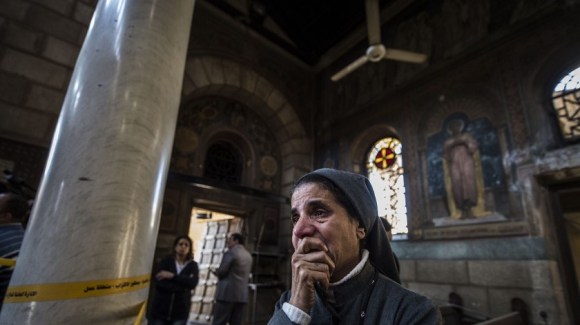
Shrine to the martyrs of Tanta in St. George’s Church, killed by a suicide bomber on Palm Sunday.
They couldn’t even wash their dead.
Thirty Coptic Christians were gunned down by ISIS, ambushed in a church bus on a weekend outing to a popular monastery in the Egyptian desert. Their families gathered to receive their loved ones in a local hospital, but were met with a mixture of ill-equipped facilities and overwhelmed staff. They even had to fetch their own water.
As if another reason was necessary, Coptic anger turned the funeral march into a protest.
“With our souls and blood we will redeem you, oh Cross!” they shouted. Some seemed to take aim at Islam. “There is no god but God,” they chanted, before changing the second half of the Muslim creed, “and the Messiah, he is God.”
Other chants took no aim at all, thrashing wildly in anger. “We will avenge them, or die like them.”
Many observers say such anger plays right into the hands of ISIS, which is keen to turn Egypt against itself.
Six weeks earlier, after twin suicide bombings on Palm Sunday, Bishop Boula of the Coptic Orthodox diocese of Tanta found himself in a similar situation. Hospitals did not have enough refrigeration units to keep the 25 bodies of those martyred at St. George Church. Crowds were gathering, and anger was surging.
Quickly, he made the decision to bury them together in the church crypt reserved for bishops. Honoring the dead with their leaders of ages past, he then marshaled the youth to provide order and security for the semi-spontaneous funeral service.
“It cooled the fire of all the people,” he later recounted on satellite TV. St. George was renamed to include “the righteous martyrs of Tanta,” with a shrine erected outside the crypt.
It was perhaps the most practical of Coptic efforts to process their anger. Forgiveness is another, as Copts have moved Muslims and wowed the world with their example…
Please click here to read the full article at Christianity Today.
This article was first published at Christianity Today, on May 26, 2017.
(via Reuters and Ahram Online)
Terrorists ambushed a Coptic church bus trip on Friday near Minya in Upper Egypt, killing at least 26 and injuring 25, including many children.
Egypt’s interior ministry reported that three 4×4 vehicles of 8 to 10 gunmen dressed in military uniforms opened fire on the vehicle, which was on its way to St. Samuel the Confessor Monastery in Samalout, 140 miles south of Cairo.
There was no immediate claim of responsibility, but the attack—which occurred on the eve of Ramadan—follows church bombings claimed by the Islamic State on Palm Sunday and in advance of Christmas.
Last week, Egyptian authorities arrested 48 individuals, securing confessions of belonging to a terrorist cell linked to the Islamic State.
“I am grieving. It is sad and shocking,” said Bishop Thomas of the Coptic Orthodox diocese of Qusia, 75 miles from the monastery. “But at the same time, I know this is not new. I was expecting things like this to happen. And it will not be the last.”
Two feuds escalated this week. One reached a preliminary conclusion, the other a concerning jolt. It may not be proper to pray mend the fences, but rather in wisdom to put all things right.
After months of debate and clear judicial opposition, the president signed a parliament-ratified bill to select the chief judge of major courts from three nominations. Viewed as anti-constitutional interference and a blow to seniority, it is nonetheless law, pending further developments.
After months of tense but nonmilitant local opposition, the Islamic State struck against a major tribe in Sinai. Recriminations followed, and the fight is threatening to move beyond the licensed violence of army and police and involve the well-armed Bedouins.
God, politics is often contentious. Ensure efficiency in policy. Define limitations of power. Where there is manipulation, cause it to cease. Where there is exaggeration, cause it to settle.
In the effort to strengthen both state and society, give wisdom. Give humility.
God, violence is often compounding. Empty the Sinai of terrorism. Rebuild the region in hope. Where there is insult, curb retribution. Where there is injury, increase resolve.
In the effort to defeat the Islamic State, give wisdom. Give clarity.
All men are brothers, God, and it is not right to feud. But perhaps a fight is sometimes necessary. Settle scores quickly, and justly. Limit escalation, mend fences.
Easter passed peacefully, but not Egypt. Though there were no troubles on the holiday, others sandwiched.
A few days earlier Copts praying in a village were pelted with stones, as police looked on. A few days later terrorism struck at St. Catherine’s Monastery in the southern Sinai, as police responded.
One officer died, a few others were injured.
God, protect the nation. Protect her churches. Protect her people. Protect her police.
The disturbing fact in the latest incident was the reach of ISIS to the south. Cells have perpetrated terrorism in various places on the mainland, but it was believed the group had no presence save northern Sinai.
So hem them in, God, and squeeze. Aid the security forces. Grant bravery, justice, and fidelity to law.
It was law also that settled justice for Aya Hegazi, a dual Egyptian-American citizen. After three brave years in pretrial detention, the court ruled against charges filed. She and her husbanded had opened a children’s center, and were accused of exploitation.
President Trump claimed intervention, and flew her home before meeting at the White House.
God, protect the judiciary. Protect its independence. Protect civil society. Protect its people.
If Aya was innocent, how many others? In a congested legal system give all their day in court, in fidelity to the constitution. As Egypt responds to the pressures against her, help her hold to the right and the true.
So steady her institutions, God, and strengthen. Aid the social entrepreneurs. Grant creativity, license, and fidelity to law.
Whether religion, state, or society, give stability and peace. Too many make trouble. Root out, vindicate.
Easter is coming. May it be safe for Egyptian Christians.
Sunday is coming, and Monday after that, and Tuesday… May it be safe for Egyptians.
Forty-five people are dead after twin suicide bombings at churches on the start of Holy Week. Among them are Muslims, though only one faith was targeted.
This time. Some attacks have targeted Muslims of particular ilk. Many have targeted police, army, and other men of state.
But the nation responded as if it was an attack on national unity, and so should the prayer follow.
Bless the Christian martyrs, God, yes. Bless the Egyptian dead.
And may this prayer be echoed in the hearts of Egyptians nationwide.
It is too little to pray hold the nation together, for it does not show signs of being torn asunder.
But national unity is a slogan that is neither empty nor full. It is a reality, yet still an aspiration.
So bring together Muslim and Christian in the aftermath, and help them to know each other. Let this be a mark that undoes terrorist intention.
Yet what is the fullness of the aspiration? Citizenship? Protection? Accommodation? God, there are differing visions among different Egyptians.
Let them come together, and let them discuss. Let them bare their hearts and find your way.
Respect. Honor. Justice. Peace. Love.
There are those who actively work against these, God. Silence them. Redeem them. But put their ideas to rest. Too much exists even on the margins, seeping ever closer to the mainstream.
Until then, defend.
Equip the government to ensure both security and rights. Alert the people to threats both tangible and notional. Uplift society to immunize with both economy and education.
And above all, through the fear of God and the bond of humanity.
On the day of the bombs your Messiah was lauded. If Egypt must follow him in suffering provide also his triumph.
Fayed El-Geziry/NurPhoto / Sipa USA via AP A Christian who fled ISIS brings belongings into the Evangelical Church in Ismailia.
This article was first published at Christianity Today on February 27, 2017.
As Coptic Christians flee Egypt’s Sinai Peninsula in unprecedented numbers, a Protestant church is there to receive them.
“We were the first to respond,” said Atef Samy, associate pastor at Kasr el-Dobara Evangelical Church in Cairo. “Two of those killed were very dear to our church.”
In the last few days, more than 100 families have left their homes in Sinai for the Suez Canal city of Ismailia, 125 miles west.
On February 19, the Egypt chapter of ISIS released a video calling Copts “our priority and our preferred prey.” Three days later, one man was shot and his adult son burned alive.
“This is sheer terrorism,” Samy said. “They want to embarrass the government and claim they can cleanse the Christian presence.”
In recent weeks, seven Copts have been killed. Witnesses say they were murdered in cold blood, with no negotiation, theft, or attempts to convert to Islam.
Hit lists are also reportedly being circulated, warning Christians to leave or die.
“I am not going to wait for death,” Rami Mina, who left Arish on Friday morning, told Reuters. “I shut down my restaurant and got out of there. These people are ruthless.”
Samy declined to name those killed, but identified them as born-again Christians active in ministry. His church quickly mobilized to help others leave, and provided support to the Ismailia church that has assisted dozens. Mattresses, blankets, food, and medical supplies are the most pressing needs.
Adel Shukrallah, responsible for youth ministry in the Evangelical Church of Ismailia, is heading the Protestant relief effort locally.
Please click here to read the full article at Christianity Today.
THREE years after the car bomb that devastated world-famous Museum of Islamic Art, in Cairo, Egyptian culture is thumbing its nose at Islamic terror.
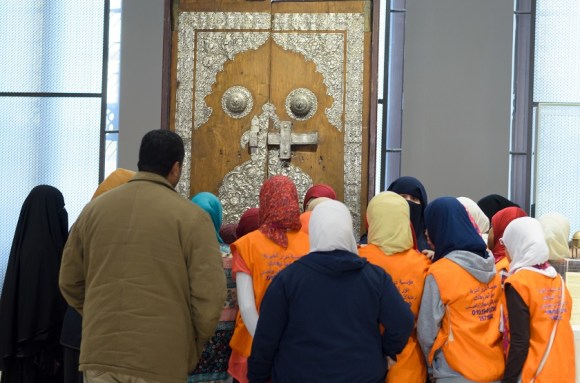
And in pride of place in the central rotunda is a nineteenth-century mosque door carved by Yehuda Aslan, a Jewish craftsman.
On 24 January, 2014 the Museum of Islamic Art (MIA) in Cairo was the secondary casualty of the bomb that killed six, and injured dozens in a blast targeting the Cairo Security Directorate across the street. The attack was claimed by the Sinai Province of the Islamic State.
It also smashed the façade of the historic museum built in 1903, damaging 179 pieces, ten beyond repair.
Two weeks ago the museum reopened in grand ceremony.
‘This is our heritage, not only for Egypt or Muslims, but for humanity,’ said Ahmad al-Shoky, the museum director.
‘If you destroy it, we will rebuild it, and make it better than before.’
Considered the largest museum of Islamic art and artifacts in the world, the MIA holds more than one hundred thousand pieces from throughout the Muslim world.
The earliest dates back to 652AD, a tombstone from year 31 of the Muslim era that bears signs of the Umayyad regime. It is the oldest mark of Islam in Egypt.
Al-Shoky presided over the opening of sixteen additional exhibits, tripling the items on show to the public. The richness of Islamic history, he believes, blunts the appeal of terrorism.
‘The museum is not only about good art, but a good message,’ al-Shoky told Lapido. ‘We have reworked our displays to show how Islamic art contributes to world civilization.’
Tolerance
And a central part of this civilization, he says, is religious and cultural tolerance. The door to the as-Sayyida Zaynab Mosque by Yehudah Aslan is just one example.
Zaynab whose shrine is at the mosque named after her in Old Cairo, was the prophet Muhammad’s granddaughter, and ‘patron saint’ of Cairo.
‘We are not against any religion, and welcome anyone who can produce something for the world,’ said al-Shoky. ‘This message is short, but powerful, and you can find it in many of our halls.’
Umayyad era art (661-750 AD) is introduced with a note of influence from Byzantine, Coptic, and other civilizational sources.
The medicine and science exhibits highlight the contributions of the Christian Bakhtishu family doctors, and the Muslim, Mary the Astrolabe, from the Abbasid era (750-1253 AD).
And the Fatimid era (909-1171 AD) speaks of joint celebrations with ‘Christian fellow citizens’ for the holidays of Epiphany and Maundy Thursday.
Renovations were supported by a £2.1 million equivalent grant from the United Arab Emirates. Additional donations and expertise were shared by the United States, Italy, Germany, Austria, Switzerland, and UNESCO.
Before the explosion, if two hundred visitors came, it would be terrific, al-Shoky said. Since the reopening, the MIA has averaged more than two thousand.
Children
And not only adults. The redesign includes an educational wing for children. Around 150 have come every day.
‘Art teaches children that Islam is not a terrorist religion,’ said Yumna Khalid, a 20-year-old volunteer guide studying Islamic archaeology at Egypt’s Ain Shams University.
‘It is not like what people say now about Islam. No, we have had brilliant artists and scientists.’
Maher Daniel agrees. He is an award-winning cartoonist and animation director for Egyptian state television – and a Christian.
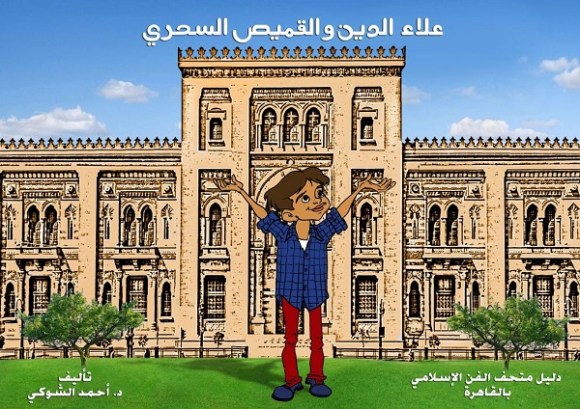
He contributed the illustrations to the children’s guidebook free of charge. Aladdin and the Magic Shirt spins a fantasy tale introducing the reader to the main pieces of each exhibit.
‘Egypt has passed through several crises, and children have not received enough attention,’ says Daniel. ‘The museum strives to address [the child’s] mind, promoting our shared heritage, for both Muslims and Christians.’
This does not mean he whitewashes the past, or the present. But Daniel says the space for extremism in Egypt is shrinking, and if there is an opportunity to help, you must help.
‘Our hope is in the enlightened Muslims, who are seeking reform and trying to shake the dirt from Egypt,’ he said.
‘But God only knows, in history these things ebb and flow.’
Manal Salah brought her twelve-year-old son to see the museum. He particularly liked the hall of weapons, marveling at the ninth-century Ottoman sword bearing the name of Mohamed the Conqueror.
‘The reopening of the museum is a positive sign,’ she said. ‘And we are optimistic for the future. If God wills, all will be well.’
Here is a sobering stat related by the Economist. Interpret it as you will:
Horrifyingly, although home to only 5% of the world’s population, in 2014 the Arab world accounted for 45% of the world’s terrorism, 68% of its battle-related deaths, 47% of its internally displaced and 58% of its refugees.
Surely there is no clear cut answer to the question in the title. But allow the raw numbers to sink in.
When a bomb ripped through the women and children praying together at the St. Peter and St. Paul Church in Cairo on Dec. 11, the nation’s grief was expressed through a Muslim doll.
The suicide attack claimed by the Islamic State – Sinai Province took place on the national holiday of moulid al-nabi, the Prophet Muhammad’s birthday. The larger Islamic State has since called for bombings of Christian churches in the USA, with the aim of creating “bloody celebrations” there, as well.
Egyptians have begun trying to make sense of this latest wave of violence in Cairo, and the arousa doll has propelled expressions of grief. A popular cartoon depicted the arousa, traditionally given to Muslim girls, weeping in the black clothes of mourning. Behind her stood a somber crucifix.
Twenty-seven people died in the bombing, and their families have been changed forever. The Coptic community is approaching the Christmas season with fear wondering if another church will be targeted.
But does the timing of the attack suggest Muslims also have reason to be afraid?
The moulid, popular with most Egyptians and in particular the mystical Sufi trend, is rejected by many Salafi interpretations of Islam to which the Islamic State belongs.
It is a day for sweets, visiting family, and giving gifts. It is also a day Christian religious leaders congratulate their Muslim counterparts, reciprocated on Christmas.
But celebration of the moulid is condemned by Salafis as a religious innovation.
Coincidence or not, their extremists chose this day to escalate their insurrection and signal their willingness to inflict mass casualties.
“The message could be, ‘You love the moulid, and you like the Christians?’” said Sheikh Alaa al-Din Abul Azayim, head of the Azamiya Sufi order. “’Then on this day we’ll kill your friends – and you are next.’”
Please click here to read the full article at The Media Project.
This article was first published by Christianity Today, on December 11, 2016.
At least 25 people were killed and 49 injured when a bomb exploded around 10 a.m. this morning during a worship service at the spiritual center of Christianity in Egypt.
It is the worst terrorist attack on Copts since the New Year’s bombing of a church in Alexandria in 2011 that killed 23 people.
A worship service of mostly women was targeted in the St. Peter and St. Paul church, adjacent to the St. Mark’s Cathedral and papal residence of Pope Tawadros II, the leader of the Coptic Orthodox community in Egypt and worldwide.
Tawadros was traveling in Greece at the time of the attack. He will cut short his visit and lead funeral prayers tomorrow in the Nasr City district of Cairo.
So far, there has been no claim of responsibility for the attack.
“This is an unbelievable act against Egypt first and Christians second,” Andrea Zaki, president of the Protestant Churches of Egypt, told Christianity Today.
Please click here to read the full story at Christianity Today.
Egypt witnessed a frightful return, disturbing a relative quiet. The pattern subsided but not that long ago was a viable threat. May it not be a portent of things to come.
A car bomb detonated in an upper class neighborhood, injuring one bystander but missing the deputy prosecutor-general. Fifteen months ago, his positional superior was assassinated by similar means.
God, thank you for the escape. But the signs that such men continue to nurse their grudges through violence is a disturbing development. After a year of many targeted killings, Egypt outside of Sinai has successfully enforced an extended period of calm.
May the culprits be caught, God. May those behind them be exposed and disabled. May any legitimate grievances find peaceful solution, and may justice be extended to all.
For grievances are also finding expression in the funeral of former Israeli president Shimon Peres. Egypt’s foreign minister will attend as a representative of the state. But others are critical of paying homage to a man they deemed oppressive of Palestinians.
God, give both peace and justice to the peoples of this world. In Egypt in particular, help leaders and citizens alike to find the proper balance. It is right to honor the dead. It is right to review a legacy.
May truth prevail among hearts unhardened to humbly receive and boldly respond. May they rightly impact others too possessed by the pain of past grudges, justly held or otherwise.
May the victims of all conflicts rest in peace. May the living rest the same. Heal Egypt and the region, and save her from further harm.
This article was first published at Christianity Today in the April print edition.
With the lilt characteristic of a Southern megachurch pastor, Bob Roberts Jr. introduced the most significant Muslim statement on religious freedom in 1,400 years.
“I am a Texan, an evangelical, and a Baptist,” the NorthWood Church leader told the crowd of more than 250 leading Muslim clerics from around the world. “You have made my job to build bridges so much easier. You have gathered to call people to change.” He drew hearty applause.
“It is a very promising initiative. You could even say it is groundbreaking,” said Medhat Sabry, the Anglican Communion’s dean for Morocco and one of several non-Muslim observers (alongside Roberts) to the declaration’s signing. “But it is way too early to tell.”
This is because—from Cairo to Amman to Nazareth to Baghdad—the news caused barely a ripple in Christian communities in the Middle East and North Africa, whom the document is meant to comfort. Some Arab Christians saw a headline in the local news. Others didn’t hear of it at all.
Please click here to read the full article at Christianity Today.
Photo Credit: Wing of EgyptAir plane in November 2008. By captain.orange via Flickr.
6am in Cairo, May 19, I woke to the news of another disaster. EgyptAir flight 804 fell out of the sky en route from Paris, France. The world wondered terrorism. Egypt pondered the same, but the cause almost didn’t matter. With many Egyptians I exhaled deeply, sighing in familiar resignation, “Oh no, not again.”
Writing about Egypt these past seven years, I have shed many a tear over local developments. Most have come observing the nation’s self-inflicted wounds, as young men are anointed ‘martyrs’ after near-pointless street clashes. Others have come as once hopeful faces harden into determined grimace against either the regime or its opponents, if not altogether into despondent passivity.
But that morning there was no time for tears, and one reason was personal. The next morning I would fly with my family the same route to Paris, transferring onward back to America.
For us the inconvenience was a delayed flight, a missed connection, and acute exhaustion after a very long day. But back in the United States I could soak in the green grass, breathe the fresh air of freedom, and lament a polarized political discourse that seems offensive given our comparable blessings.
But in Egypt flight 804 is far more than an inconvenience. It is hard to weep when suffering becomes endemic, when a country steels itself against the inevitable next blow. Tears were a natural response for the families who lost loved ones. The rest of the nation simply feels under siege.
“Oh no.”
When Metrojet flight 9286 crashed into Sinai October of last year, Egypt hoped beyond hope that it was not terrorism. As ISIS claimed responsibility and Russia and the UK suspended their flights, many interpreted the hemorrhaging of nearly $250 million per month in lost tourism revenue as a targeted strike at the nation’s economy.
Fortunately the hijacked EgyptAir flight 181 in March ended safely as the result of a lovestruck looney. But for flight 804 a terrorism component would almost perversely be welcome, though no claim of responsibility has yet been issued. If Paris authorities failed at least Cairo has the misery of good company. Should EgyptAir equipment or crew prove to be at fault, another mental log gets marked against a would-be pyramids vacation.
Already it is too late. Who wants to come to a nation beset by five years of upheaval? Who wants to invest when governments are shuffled like a used deck of cards? The Egyptian pound devalues as foreign reserves evaporate. The regime desperately attempts to balance between necessary economic reforms and protection of the poor. But all the while prices are rising and only Gulf largesse buys time in hope that Egypt can get its house in order.
Set aside domestic political reform, for most Egyptians have. A dedicated few strive after the liberal reforms promised early in Tahrir Square, while the Muslim Brotherhood nurses their grudge against the many enemies they feel cheated them from power. The Western press rightfully rails against the human rights failings the government admits are a necessary compromise in search of stability. But the outcome is political stagnation as leaders ask for trust, but without the reserve of transparency on which it can be built.
The resulting gap is filled in with conspiracy, on all sides. The Muslim Brotherhood blamed the regime for the crash and warned more disasters would follow unless Egyptians unite against the alleged coup. Some regime supporters suggested Israeli involvement, and many saw evidence of a Western media campaign against Egypt. No matter what the failing, they say, Egypt is made to be at fault.
Pummeled from the right and left by events not always of their own making, it is hard to determine if conspiracies are spun just to distract the populace or if they are actually believed in full. But for want of a fully developed and accountable democratic political system, someone somewhere is always conspiring behind the scenes. It is just impossible to pin down who.
“Not again.”
In the aftermath another familiar cycle begins. Anonymously sourced quotes from foreign or Egyptian figures reveal information or posit interpretation. Egyptian authorities follow behind to deny, that no official findings have been concluded. Perhaps all is true and legitimate in the moment. But the world waits and eventually loses interest; Egyptians simply add to the list of yet unaccountable deaths, stretching back to the first days of the revolution. Still unknown is who killed the protestors.
The difficulty comes in policy recommendation, especially in an atmosphere filled with punditry. Hardheaded analysis is necessary, and God bless the diplomats who must make decisions. The Christian in us wants to help, but how to advise? In the contested arena sincere critique is taken as interference, for the Arab world has suffered at the hands of our moralizing endeavors. Foreign policy is about national self-interest; they are quite used to our situational application of principle. They are also quite used to seeking someone else to blame.
What does this imply for Egypt and terrorism, Egypt and good governance, Egypt and struggling political economy? Listen to Egypt’s groan, and sigh in return. Each disaster is felt personally, every loss a tragedy. Rather than seek strategic distance, embrace a sympathetic analysis. Mourn with those who mourn. Love mercy, act justly, and walk humbly. Suffer with them, but stay true to principle. Wounds—if from a friend—can be trusted.
Now is the time for comfort and prayer. Unfortunately, it is also the time for transparent investigation. In all her calamities, Egypt alone is ultimately responsible for the latter. The West can encourage, and demand fidelity. But without the former, we are no help at all.
Once before, Cairo burned. With fire true and abstract, she is threatened again.
The incidents are curious, God, and in the sequential diversity conspiracy spins. Familiar foes blame each other, while official authorities blame faulty wiring.
Settle the cause of every and all, holding accountable for each liability. Connect the dots or prove them random, but put the mind of the nation at ease.
For there is little shame in assuming the worst, God. A new tragedy springs every week, compounding problems as if under siege.
After a lengthy lull, unknown assailants gunned down officers in Giza. Sinai has been long troubled, but for many months the capital has been calm. The Islamic State has amped up its rhetoric against Egypt. Does this attack portend more ill?
Keep Egypt safe, God, from enemies far and near. That they exist is obvious. Identify them properly.
Concurrently investigated is a youthful online street comedy group. Much popularity has followed their satire of state, interpreted by others as incitement and insult.
God, the semi-strong can punish offense. The truly strong can bear with patience. Guide the youth from youthful indiscretion, judge them for any sinister plotting. Bless their creativity and channel it properly.
But restore to Egypt the confidence of upright conviction. Help society establish freedom, discern deviation, and reinforce responsibility. It is a hard balance, God, in the best of times. Give Egypt the strength to find it.
Which is near impossible when constantly putting out fires. Arson, accident, or negligence, God, install better detectors and sprinklers. Rid her of traditional asbestos, and cleanse her with holy rain.
As Egypt receives echoes of both hope and horror, make true the promise and put down the threat. Help the people live in peace.
The president once again visited the papal cathedral for Christmas mass. He esteemed the unity of the nation and assured all destroyed churches would be repaired this year.
But terrorists once again killed policemen, destroyed pipelines, and targeted tourists—this time at a popular beach resort. It is a reminding blow to the notion that Egypt is secure.
So God, help Egypt remember correctly.
May she recall neighborly relations between religions. May she resolve through pain of innocents lost.
Let churches be rebuilt and Muslims also celebrate. Let grief heal wounds and reach out in forgiveness.
Otherwise echoes risk ringing empty. Hearts will be hardened and divisive lines reinforced.
God, amplify the sounds of hope. Revive the pulse of justice. Erase the marks of hostility.
Egypt has a long way to go. Echoes alone are monotonous. Strike forth a symphony, and bid her rejoice.
Abu Osama al-Masry, blurred in a Wilayat Sinai propaganda video; from SITE Intel Group
Who downed Russian airline flight 9286 as it left tourist resort Sharm el-Sheikh in October, killing all 224 on board?
Russian officials have confirmed a bomb brought down the plane, while Whitehall has labelled shadowy leader of the new ISIS affiliate Wilayat Sinai – Abu Osama al-Masry – ‘a person of interest’ in on-going investigations. Egypt has yet to release details from their investigation.
‘Foreign tourists, workers, and troops in Egypt are at greater risk than ever’, wrote Zach Gold in Egypt Source.
‘Whether [WS] was responsible or made an opportunistic claim, the group’s willingness to even rhetorically target foreign interests in Egypt is another dangerous marker in a pattern of threats’, he added.
A former Azhar student and clothing importer Abu Osama al-Masry claimed responsibility on behalf of Wilayat Sinai. ‘They were shocked by a people who sought the hereafter, loved death, and had a thirst for blood’, he said.
‘We will inherit your soil, homes, wealth, and capture your women! This is Allah’s promise’.
Jurisprudence
‘Eloquent in quoting the Qur’an’: Abu Osama al-Masry, blurred in propaganda video. Photo: SITE Intel Group
Al-Masry, a nom-de-guerre indicating he is Egyptian, is said to have been born in northern Sinai but grew up in Sharqiya in the eastern Nile Delta.
The 42-year-old former student at the Muslim world’s most prestigious seat of learning, al-Azhar in Cairo, al-Masry is said to be ‘well versed in Islamic jurisprudence’ and ‘eloquent in quoting the Quran’.
Wilayat Sinai, meaning ‘the province of Sinai’, pledged allegiance to the Islamic State on 10 November, 2014.
It was previously known as Ansar Beit al-Maqdis (ABM), translated roughly as ‘Supporters of Jerusalem’ – implying the same apocalyptic zeal as IS.
Lapido Media nailed this affiliation a year ago – and the fact of the reluctance of the West to believe it amid the complexity of Egyptian culture and the prevalence of ‘conspiracy theories’.
On 5 November 2014, we wrote: ‘Ali expects the “Supporters of Jerusalem” – a home-grown terrorist outfit operating out of Sinai – to soon announce their allegiance to ISIS. Abu Hamza al-Muhajir, he said, was an associate of Abu Musad al-Zarqawi in the Islamic State of Iraq and believed to be killed by US forces in 2010.
‘But some evidence suggests he is still alive and operating out of the Sinai with the Supporters of Jerusalem,’ Ali said.
Shifting
If the Russian airline attack is confirmed, it will not have been the first time Wilayat Sinai has targeted foreigners.
Strategy, however, is shifting from attacking tourism in Egypt as part of an economic war, to attacking tourists in retaliation for their nation’s policies.
In February 2014 the group killed two South Koreans and an Egyptian driver in a bus traveling from St Catherine’s Monastery in the Sinai.
They also claimed responsibility for the hideous executions of American oil worker William Henderson in August 2014, and the Croatian Tomislav Salopek in August 2015.
Wilayat Sinai’s fighting force is estimated between a low of one to two thousand militants, and as high as five to twelve thousand.
The sparse population of North Sinai is approximately 435,000, or forty per square mile.
Unlike the Islamic State, WS’s composition is mostly local, consisting of veteran jihadists, disaffected Bedouin, and disillusioned youth. Some foreign fighters come from Palestine, Saudi Arabia, and Syria, and WS have issued a call for more.
Egypt has accused Turkey of providing support for Wilayat Sinai, posting names and pictures of alleged operatives they have captured.
Wilayat Sinai also benefits from members who previously served in the Egyptian military, before defecting or being expelled.
Walid Badr, a former major in the army, was the suicide bomber in the September 2013 assassination attempt on the interior minister. One month later former officers Emad Abdel Halim and Hisham Ashmawi led an assault on a checkpoint in Sinai killing 31 people.
History
WS, under its original guise of Ansar Beit al-Maqdis was formed sometime in 2011 in response to the Egyptian revolution of 25 January.
Egyptian security says ABM breathed new life into existing bands of militants such as al-Tawhid wa al-Jihad, which had conducted operations against tourism hotels in Sinai in 2004, 2005, and 2006.
After formally merging, ABM originally targeted Israel, launching a few cross-border attacks and several acts of sabotage against the Egypt-Israeli gas pipeline.
President Mohamed Morsi authorised military action against ABM after it killed 16 border guards in August 2012. But he is also understood to have preferred negotiation and tried to limit their influence through dialogue with other Sinai parties.
After Morsi’s removal from office on 3 July, 2013, ABM shifted focus and deliberately targeted Egyptian security forces.
Abu Osama al-Masry deemed Morsi an apostate and equated democracy with atheism – a typical militant Islamist trope.
But ABM sought to take advantage of the military-versus-Muslim Brotherhood conflict to paint itself as the defender of Muslims.
Al-Qa’eda
A leaked Egyptian security document from February 2015 accused the Muslim Brotherhood of working with Al-Qa’eda to send three thousand fighters to the Sinai.
Morsi, like the transitional military council before him, released jihadis from prison.
But an Egyptian researcher says that while he permitted militants a degree of operation, he did not nurture them as a ‘last resort’ to protect his office.
In addition to the acts of terrorism listed above, ABM has been a leading force in a long list of attacks in Sinai and the Egyptian mainland.
The small Christian population of roughly 650 families in the Sinai have also suffered at their hands. Many have relocated, though local Muslims have promised to protect them.
Logo of Wilayat Sinai
Imitating
Four hundred attacks killing seven hundred soldiers: Wilayat Sinai. Photo: SITE Intel Group
Targeting Christians is only one of the ways Wilayat Sinai is imitating the Islamic State.
Mixing terror and piety, they have beheaded opponents and moved against drug trafficking. They have appealed to the sympathy of Bedouin tribes and distributed money to those whose homes have been destroyed in the conflict.
But Wilayat Sinai has so far failed to reproduce the primary marker of the Islamic State – territorial acquisition. They hide out in the desert, mix with the people, plant roadside bombs, and adopt guerilla tactics, but have failed to claim and hold land.
It has not been for want of trying.
Wilayat Sinai has led over four hundred attacks on security forces between 2012 and 2015, killing an estimated seven hundred soldiers.
On 1 July, 2015 militants led a full-day assault on the city of Sheikh Zuweid, following multiple coordinated attacks on surrounding checkpoints. The effort failed when the military employed F-16s in the city’s defense.
Reporting on Sinai is difficult as the government has criminalised publication of information that contradicts official statements.
One month ago on 22 October, an army spokesman declared ‘full control’ over the Sinai, but terror attacks continue.
An anonymous officer said failings stemmed from unfamiliar terrain and a scorched-earth policy that alienated the population. There are alsoconflictingreports as to whether local tribes are joining the fight or just watching idly by.
But an anonymous militant admitted the military have severely restricted their operations, and the closing of tunnels on the Gaza border has dried up the weapon supply.
Europe
Human Rights Watch has criticised the government over the creation of a buffer zone meant to destroy the network of tunnels long exploited by traffickers and terrorists alike. Between July 2013 and August 2015 HRW reported the destruction of at least 3,255 homes and properties.
Israel claims that Hamas is aiding Wilayat Sinai, though leaders deny any connection to this ‘black extremism’.
But on Egypt’s Western border the Islamic State has been more successful in setting up a franchise. They call Libya ‘the strategic gateway’, noting its proximity to Egypt, Tunisia, African nations of the Sahel, and Europe.
In spring 2014 Libyans in Syria returned to Derna near Benghazi and pledged allegiance to the Islamic State. Fledgling states have been created for each of Libya’s three traditional regions: Cyrenaica, Tripoli, and the Fezzan.
This has sparked terrorist activity in Egypt’s Western Desert as well. In July 2014 ABM claimed responsibility for an attack in Farafra that killed 22 soldiers. Last month in pursuit of terrorist targets, the military accidentally killed eight Mexican tourists in the Bahariya oasis.
Splits
The terrorism network in Egypt is fluid. Abu Osama al-Masry indicated his support for the Islamic State as early as 30 June, 2014, praying for them to conquer Baghdad. By September reports of co-operation and training emerged.
But by November the eventual pledge of allegiance was disputed, with veterans said to support Al-Qa’eda, yet with the youth vote winning out.
Since then splinter groups have formed, though there is no evidence of direct conflict. Jihadi Ribat was created in December 2014, eschewing support for Islamic State claims to the caliphate. The aforementioned former military officer Ashmawi split with others in July 2015 to formal-Murabitoon.
Ajnad Misr declared its intention to focus on attacks against security personnel in Cairo, in January 2014. It has been implicated in over 25 attacks, but focuses on Egypt rather than a global cause.
There even appears to be diversity within the Islamic State network. Recent attacks on the Italian Consulate in Cairo and on a security directorate in Shubra el-Kheima were claimed by Islamic State in Egypt, not Wilayat Sinai.
The Egyptian government claims progress in the fight against terrorism, and last week killed Ashraf el-Gharably, reportedly a top commander in Wilayat Sinai. The UK has offered the support of special forces to help kill or capture Abu Osama al-Masry.
The British government declared Wilayat Sinai, then ABM, a terrorist entity in April 2014.
‘Egypt deserves support, not punishment,’ Anglican Bishop of Egypt Mouneer Hanna Anis told Lapido Media, critical of Russian and British decisions to restrict air travel to Egypt estimated to cost the nation nearly £185 million per month.
‘My prayer is to see the international community working together to fight terrorism.’
Russia is a strange ally. The week begins with the declaration her airliner was brought down by a bomb. It ends with agreement to build a nuclear reactor.
Help Egypt in the back and forth. Negotiate the give and take.
Egypt is maintaining caution in making any pronouncements on terrorism, waiting until the commission concludes. Russia had been with them, then with the UK stopped the tourist flow.
Is it pressure politics or necessary precaution? Rebuke Egypt if she is playing games. Protect Egypt if others are.
But rebuild the tourist sector, God, and with it Egypt’s professional reputation. Help her standardize operations and keep all safe. Thwart those intent on causing her harm.
And may building a reactor result only in good.
God, honor Egypt with the energy she needs. With nuclear comes risk, and maybe temptation. All assurances are given that intentions are peaceful. There is so much to gain, so much to go wrong.
Keep Egypt safe from error. Guard against negligence. Handle waste. Hinder sabotage.
Between now and completion, make Egypt ready.
In relationship with Russia, may Egypt both benefit and avoid entanglement. In all international affairs, help her stay sovereign. Help her do right.
May Egypt neither give nor take, God. May she bless. May she experience your example, and imitate.
During the 2013 terror attack at the Westgate Mall in Nairobi, Kenya, al Shabaab gunmen paused for a moment and made an announcement in Swahili: All Muslims could come forward and leave.
Among those trying to escape was Joshua Hakim, who covered up the Christian name on his ID as he showed it to the gunmen.
“They told me to go,” Hakim later told The Guardian. “Then an Indian man came forward, and they said, ‘What is the name of Muhammad’s mother?’ When he couldn’t answer, they just shot him.”
Other terror attacks by al Shabaab, a Somali terrorist group with ties to al Qaeda, have followed a similar pattern. Those who could prove they were Muslim—by reciting a prayer in Arabic or answering questions about Islam—were allowed to go free. Those who couldn’t were killed.
As a result, some Kenyans have begun to share tips online about how to pretend to be Muslim, just in case. This includes learning to recite the shahada—Islam’s main creed—in Arabic.
This pragmatic response to terror attacks is understandable. But is it biblically sound? Kenyan Christian leaders are divided on the issue.
No, says David Oginde, head of Christ is the Answer Ministries, one of Kenya’s largest parachurch organizations with 45,000 members. “A true Christian must be ready to live and to die for the faith,” he said.
But two professors at St. Paul’s University, a conservative Anglican institution in Nairobi, say the answer isn’t that clear-cut. Reciting the shahada doesn’t amount to denying Christ, says Samuel Githinji, a theology lecturer.
The article also included Arab theologians, who mostly responded that pretending to be a Muslim is not acceptable, but forgiveness should be offered to those who succumb. It also touched on similar themes in Christian history, during the Roman era.
Here is the conclusion:
The persecutions of old backfired, bringing many into the Christian fold. It is too early to write of the impact today. But Ajaj is hopeful, and counsels faithfulness when called upon.
“I hope they give a good testimony, and glory to God’s name.”
Of course nothing is certain. Martyrdom may not change a hardhearted terrorist. Pretending may not save your life either.
But for the record, the mother of Muhammad is Aminah bint Wahb.
Please click here to read the full article at Christianity Today.
Terrorism in Egypt has been connected to franchises, but not faces. Whether driven by political frustration or extremist ideology, the forces causing havoc have earned infamy as a whole and not as a part.
But this week there is a name. It is an old name for those who know, but Hisham al-Ashmawi, a former military officer, has seized a new limelight for himself.
God, may he fail. But may you not fail with him. Redeem him. With his colleagues, may peace come to both soul and land.
Authorities have linked him to various recent terrorist acts, but his release of an audio call for jihad against Sisi resulted in media attention. His background, his al-Qaeda (rather than ISIS) allegiance, and his announcement of a new cell all contribute.
Sin is destructive, God. If there is division in the ranks of terrorism, God, then allow conflict. If there is ambition, let jealousy stir. Save many from self-combustion; save all from collateral damage. May this cancer eat itself.
But God, cancer kills unless treated. Even then it can be too late. Whatever surgical steps are needed, may they be administered with professionalism, in accordance with all medical standards.
Help Egypt to recover, whole. Turn frustration into participation. Turn ideology into righteousness. Forgive. Reconcile. Heal.
All with justice, God. Hold Egyptians accountable for their sins, but do not burden the nation. Many are tempted to employ evil in their quest for the good they imagine. Rebuke them. Transform them.
But may they see you honor those who hold to the good, risking failure. Provide Egypt examples of good issuing from good, untainted with even a hint of wrongdoing.
Make their faces shine forth, God, like glory unveiled. May all darkness recoil in terror, and Egypt praise your name.
Give Egyptians a happy holiday at the end of Ramadan. Honor their fasting, hear their prayers. And above all, keep them safe.
The week began with a huge explosion at the Italian consulate. It ended with the claim of a terrorist attack on a naval vessel in the Mediterranean.
There have been warnings of more attacks over the multi-day Eid. Perhaps they are not aimed primarily at civilians, but people can be nervous all the same.
Calm them, God, with proper vigilance. Secure them, with proper faith.
The Cairo police chief was recently relieved of his duties. Establish a system of accountability that puts the most able in the top posts. Their assignment is challenging; give wisdom, supply intelligence.
With stability, in peace, help all enjoy this time with family. Strengthen bonds and renew religion. As Egyptians look to you, give them eyes to see correctly.
Let love drive out fear. Let security drive out terrorism. Let the Eid go back to normal.








 Jayson Casper