At head of table: Rev. Bayadi (L) and Dr. Badie (R)
This text is transcribed from documents received from the Coptic Evangelical Organization for Social Services, headed by Dr. Andrea Zaki, a chief participant in this meeting.
The text reads:
Based on a welcoming letter from Dr. Rev. Safwat al-Bayadi, President of the Protestant Community of Egypt and Dr. Rev. Andrea Zaki, Vice-President, sent to the General Guide of the Muslim Brotherhood, which addressed some public opinion issues at this critical stage in Egyptian history after the January 25th Revolution and gained the attention of the Guidance Office of the Muslim Brotherhood, and based on the two parties’ communication, the General Guide called for a meeting to gather the leaders of the evangelical church and the leaders of the Muslim Brotherhood. The meeting took place on February 28, 2012, at the headquarters of the Muslim Brotherhood. The General Guide has agreed to visit the headquarters of the evangelical church upon invitation.
The participants consented on the importance of the current historical moment Egypt is going through after the revolution, which requires everyone to take social and historical responsibility to advance the country. The participants emphasized that Egypt’s future depends on community cohesion and unity, and stressed on the basic values of the Egyptian society that represent its social and cultural identity and brings its citizens together.
The participants agreed on the following:
The sons of the country are all partners in one destiny and one future.
The joint struggle of all Egyptians of all segments of society, that was manifest in the January Revolution, represents the cornerstone of societal unity; the struggle reflects that full citizenship, based on equality, is the foundation of this society.
All sons of the country have the same rights and responsibilities as the constitution states. Equality among all citizens constructs societal unity; efficiency is the only criterion to hold a public position; and equality of economic opportunities is the basis of justice.
The Egyptian society is based on solidarity, interdependence and compassion among all people, which represents the bond that includes all citizens without discrimination. Therefore, education should promote the values of tolerance, solidarity and pluralism.
Respect for beliefs and sanctities is obligatory. Prevention of any contempt of others’ beliefs and the incitement of hatred is a compulsory social responsibility of loyal citizens.
Freedom of belief and religious practices as well as freedom to build or renovate religious houses – in light of the law and the right for citizens to resort to their own religious laws concerning their personal affairs along with other rights mentioned in the Islamic Sharia’ – are all considered part of the values of the Egyptian society and a base for its cultural authenticity.
The participation of all citizens in defending the country is the responsibility of all, and it is the crucible where all segments of society are melted and form national unity. This national unity is crucial to fighting all internal and external enemies of Egypt who want to drive a wedge between its societal segments.
The religious values are the motives of the renaissance. Therefore, everyone must mobilize these values to achieve a better future for Egypt.
Societal responsibility obliges all leaders, institutions and religious movements to fight against all types of strife, intolerance and discrimination, and consolidate the unity of society.
The Egyptian society’s identity represents the frame for all its people. All people have made contributions to this identity and deserve its legacy. Protection of societal values is considered the basis of cultural uniqueness and the responsibility of all citizens who contributed to building Egypt’s civilization together over time.
All participants of this meeting made emphasis on the importance of communication between the two parties to promote joint activities, especially among the youth, such as encouraging active participation, advocating for values and religious morals, and carrying the social responsibility of fighting the illness that affected the Egyptian society under the previous regime. This will guarantee everyone the right to participate in building a new Egypt that achieves the demands and dreams of the revolution.
Attendees from the Muslim Brotherhood:
Dr. Mohamed Badie (General Guide, Head of the Executive Office)
Mr. Mohamed Mahdy Akef (former General Guide)
Dr. Rashad Mohamed Bayoumy (Vice-General Guide)
Dr. Hosam Abo Bakr al-Seddik (Member of the Guidance Office)
Mr. Walid Shalaby (Media Counselor to the General Guide)
Attendees from The Evangelical Church in Egypt:
Dr. Rev. Safwat al-Bayadi (President of the Protestant Churches in Egypt)
Dr. Rev. Andrea Zaki (Vice-President of the Protestant Churches in Egypt)
Rev. George Shaker (Secretariat of the Protestant Churches in Egypt)
Rev. Soliman Sadek (Pastor of the Evangelical Church in Fagala)
Dr. Rev. Makram Naguib (Pastor of the Evangelical Church in Heliopolis)
Dr. Rev. Atef Mehanny (President of the Evangelical Seminary)
Dr. Helmy Samuel (Member of the Parliament)
Dr. Rafik Habib (Coptic Evangelical Organization for Social Services)
Rev. Refaat Fathy (Secretariat of the Evangelical Synod)
Dr. Rev. Sarwat Kades (Chairman of the Board of Dialogue of the Evangelical Synod)
Dr. Emad Ramzy (Secretariat of the Board of Directors of CEOSS)
Rev. Daoud Ebrahim (Member of the Council of the Presbyterian Church in Egypt)
Rev. Eid Salah (Member of the Council of the Presbyterian Church in Egypt)
Mr. Farouk al-Zabet (Head of the Congregation of the Evangelical Brethren Church)
Dr. Fready al-Bayadi (Member of the Council of the Presbyterian Church in Egypt)
Rev. Nady Labib (Head of Cairo Presbyterian Council)
Rev. Refaat Fekry (Pastor of the Evangelical Church in Ard Sherif)
Give Egypt a good government; give Egypt a good president.
For now there are many choices: At the least, four figures from the former regime, four Islamists, two leftists, and two old school opposition figures. Candidacy has opened, but not yet closed. How many will remain until election day?
Unfortunately, that is part of the drama. Speculation is rife that some candidates only run to drop out later to aid another or secure a deal of some form or another. Then, accusation is rife that certain candidates are ineligible for one reason or another.
The major development is that the Muslim Brotherhood entered the race, despite giving assurances early they would refrain from seeking the presidency. On their heels Mubarak’s spy chief then committed, widely understood as their chief adversary in the former regime.
But God, so much is ‘widely understood’ in different directions. So few seem pleased with their choices save for the dedicated partisans. So many seem afraid these are less elections than national theater. Yet a recent poll suggests 95% of the electorate plans to vote.
Bless the Egyptian people, God. May this exercise represent true democracy. Judge back to the revolution itself – were you pleased? Preserve all that was good; sideline all that was suspect. Build institutions and processes; allow candidates only a secondary importance.
Weigh the motivations of all, God, and humble or elevate accordingly.
In the end, God, give Egypt the one most fitting to your good and righteous aims. You install kings, and take them down. Merge your will with the people’s empowerment. Honor Egypt with her leader.
Yesterday I had the unique opportunity to visit the headquarters of the Muslim Brotherhood in the Muqattam area of Cairo. I interviewed their official spokesman, Mahmoud Ghozlan about a recent document of principles agreed upon by the Brotherhood and the leadership of the Evangelical Churches of Egypt.
It is a very interesting document, and I hope to share a full article about it shortly. For now, I simply wanted to share some pictures of the building as well as brief reflections from the visit.
The MB HQ, labeled in both Arabic and EnglishFrom afar; translation: Headquarters of the Muslim BrotherhoodThe entryway; translation: The Muslim Brotherhood Welcomes its Guests; We Bring Good to All People (slogan of the MB's Freedom and Justice Party)
This final picture is from the reception area, displaying the nine ‘General Guides’ in Muslim Brotherhood history. Though each of these figures deserves further research, here simply I present their names, from left to right in the picture:
Hassan al-Banna (1928-1949)
Hassan al-Hudaybi (1949-1972)
Omar al-Tilmisani (1972-1986)
Muhammad Hamed Abu al-Nasr (1986-1996)
Mustafa al-Mashour (1996-2002)
Muhammad al-Ma’moun al-Hudaybi (2002-2004)
Muhammad Hilal (uncertain)
Muhammad Mehdi Akef (2004-2010)
Muhammad Badie (2010-present)
Our discussion centered on the document of principles establishing citizenship and religious freedom as common values. Still, I also gained some insight into the current political crisis between the Brotherhood, the military council, and liberal parties. Most interesting was the change in demeanor as we navigated certain topics.
It is not useful to read too much into the following, but when Ghozlan justified the Brotherhood for going back on an earlier pledge not to field a presidential candidate, his manner was humble and seeking an audience. He expressed that the media was engaged in deliberate mischaracterization of the group and its intentions, and appeared hopeful his story would be carried faithfully.
In another setting, I hope to, but while I find his explanations reasonable, I stated that for this article in particular I was not seeking political justification, but religious. If Egyptian Christians wish to have hope in the words of this document, how should they respond now that the Brotherhood has gone back on its word not to field a presidential candidate?
I was keen to not be accusatory, but to seek their mindset.
Strangely, his attitude changed. He immediately straightened and delivered justification from the life of Muhammad. It was no longer an invitation to see their political condition sympathetically, but a pronouncement of their non-culpability in terms of religion. I felt, hopefully wrongly, that he instinctively needed to assert/defend the moral high ground of Islam, or at least of their political Islam.
I had the distinct impression the group feels vulnerable and defensive. Indeed, it appears all are against them these days. Could it also be their conscience is pricked, underneath a Machiavellian exterior?
In the media, at least, it seems this is true of many in the organization, despite the official choice of the majority to go against their pledge.
It may be politically expedient and even necessary for the good of all Egypt. But as Muslims, is it right?
Ghozlan gave justification, even if the Christian or merely moral person might cringe – to be written about shortly. I think the pulse of general Egyptian morality will not permit it, though, no matter what presidential choice they make in the end.
Update: The article is still in process, but here is the full text and list of signatories to the agreement. Please click here.
Egypt is currently undergoing a major political stir concerning the formation of the constitution. The referendum in March 2011 assigned parliament the right to elect a 100 member constituent assembly to draft the constitution, which would be put to a popular referendum after fifteen days. Very little instructions were provided on how this should be done, resulting in the current crisis.
Consistent with their powerful parliament majority, Islamist forces have approved an Islamist-dominated assembly. First they apportioned one-half of the membership to be drawn from parliament, which was distributed roughly according to party percentage. As Islamists represent 70% of this body, they immediately commanded a dominating percentage of the assembly as well.
The remaining half of the assembly was to be drawn from civil society, but the Islamist parliamentary majority submitted the final candidate list only one hour prior to voting, and then pushed through their desired candidates. This list includes several prominent non-Islamist figures, but most of these have since resigned in protest over Islamist dominance of the assembly.
The crisis is ongoing, with reformist Islamists seeking to reach out to the disgruntled liberals, while the Muslim Brotherhood engages in an ongoing war of words with the government and military council over the cabinet – which they want dismissed so as to form one themselves (in coalition, they insist, with all political currents) – as well as the presidency. The next few days in Egypt may be very politically telling.
In the meanwhile, this article purposes also to provide brief background on some of them selected members of the constituent assembly I have interacted with or written about in the past.
Only six Coptic members were elected to the body, but one of them is Rafik Habib. He is noteworthy as being a vice-president in the Freedom and Justice Party, the political arm of the Muslim Brotherhood. A Protestant, he cares deeply for the issues of Copts, but wraps their best future in an Islamic vision.
A more traditional Islamist is Nadia Mostafa, who is one of only six women in the 100 member assembly. She is a professor at Cairo University and discussed with me the relationship between Islam and civil society, especially how the promotion of civil society is often to the exclusion of the Muslim religion.
The final figure I have profiled was former Grand Mufti of Egypt, Nasr Farid Wassel. In a short interview I highlighted his statement honoring Osama bin Laden, but then spoke with an official member of the Azhar to dispute his interpretation.
It is certainly a unique body of Egyptians. Will they be able to draft a constitution acceptable to the Egyptian consensus? While already in question, the outcome is still to be decided.
It is not an Arab Spring, says Ben Wedeman, CNN’s Senior Correspondent in Cairo, as it has lasted through several seasons, and is likely to continue several more. He prefers the term Arab Revolt, and believes there is no going back.
Wedeman spoke at the Abraham Forum hosted by St. John the Baptist Episcopal Church in Maadi, Egypt on March 22. The forum is directed by church rector Rev. Paul-Gordon Chandler, and aims to promote dialogue between religions and cultures for the sake of peace and better understanding. The title of Wedeman’s lecture was ‘Reflections on the Current Middle East’.
Wedeman began with a question he is often asked: Did you see it coming? While he said the conventional wisdom on Egypt was that with Mubarak’s looming death a power struggle would soon emerge, no one anticipated Tunisia. Yet with the level of education and demographics of youth, the gains of the Arab Revolt are here to stay, even as the struggle will likely continue for a while to come.
Wedeman’s lecture walked the audience through the harbingers of the revolt in Egypt, stating why there was some evidence discontent was in the air. In 2000 several thousand Cairo University students protested Israeli policy in Palestine and Egyptian complicity. In 2003 there were clashes between police and protestors in Tahrir Square over the US invasion of Iraq.
Shortly thereafter the nation went temporarily silent as Mubarak collapsed while addressing parliament on State TV. Finally, in 2008 the protests at Mahalla al-Kubra in the Nile Delta witnessed significant anger against Mubarak himself, with demonstrators smashing his picture and stomping upon it.
Still, the January 25 protests caught everyone by surprise. Whereas during even the sizeable protests of the past there were at least five policemen per demonstrator, on this occasion the security forces were overwhelmed. Being on the street, Wedeman noticed as well they were largely new, young conscripts, whose fear was palpable in their visage.
Among the noteworthy anecdotes Wedeman shared was his comment to a fellow journalist following an ‘alternate reality’ speech given by then-speaker of Egypt’s upper house, Safwat el-Sharif at the headquarters of Mubarak’s National Democratic Party, given on January 28.
Wedeman told his colleague to take a picture of this building, as he wasn’t sure it would last much longer. That evening, on the Day of Rage, it burned.
The evening grew even more interesting as Rev. Chandler opened the floor for questions and answers. The following is a capsule of the different topics:
SCAF?
I think the military council will hand over power as they have promised, as they do not want the responsibility of running the country. What they want is to keep their significant perks, as they control between 30-40% of the economy. SCAF will go back to their barracks while they maintain an influence, but their fate will be decided by their coming interactions with the elected parties.
Syria?
I can’t predict anything, but unlike Egypt there is a significant percentage of the population which is truly afraid of what will happen if the regime falls. The consequences could get very nasty. I recently spoke with activists in Jordan and asked if they were planning to push forward. No, they replied, we have been watching Syria and we think it is best to give reform a chance first.
Iran in Syria?
Certainly Iran has a lot at stake in Syria, as it is their main connection to the Arab World. Yet the news that their Quds forces have been operating is not sure, as it is mainly reported by Washington and Tel Aviv, where news should always be taken with a grain of salt. Iran’s interest is comparable to that of the Sunni Gulf states, which are heavily calling for the fall of Assad. It underscores a Sunni-Shia split in which the Gulf States are now retaliating against the interference of the Iranian regime in their region following the Khomeini revolution.
Egypt becoming Pakistan?
This is not a realistic scenario, because the Egyptian character will push back against the extremism which is seen in Pakistan. Yes, Egyptians are very religious, but they have a long history of welcoming foreigners and do not have a deep hatred of the ‘other’. Having a significant percentage of the population as Christians also works against a Pakistan outcome, as seen in the example of the historic Wafd Party.
Saudi Arabia?
Ah, they are the elephant in the room. Even President George Bush’s democracy promotion agenda left Saudi Arabia off the table. Their influence through oil is simply too large to ignore. There have been demonstrations there, which have been met with violence. Yet here we see how the interests of the West trump their principles – and then some. But yes, they definitely need change, especially in the area of women’s rights.
Muslim Brotherhood?
I see the Brotherhood as pragmatic businessmen who know they must compromise to get and stay in power. I’m not worried about them in the short term, as opposed to the Salafis, who are more hardline and seem to have come out of nowhere. But it is always a concern when a political group puts religion as a central focus. Religion is a least common denominator which serves to divide. Take Hizbollah, for example. It means ‘Party of God’. If you are against the party of God, you are against God, and if against God, you are an infidel. Still, many in the Brotherhood refer to the example of Turkey, which is not that bad a model, actually.
Democracy with Islamists?
It seems clear that the Salafis are not converts to democracy as an end but as a means to power. The Brotherhood is different, as they have struggled for decades to get into politics, even being persecuted. They talk the talk of democracy, but now they will be put to the test. The reality of governance will probably not allow them to descend into extremism.
Salafis?
Salafi success in the elections was surprising, but they out-Brotherhood-ed the Brotherhood. They engaged in social service work both traditionally and with the elections, and pulled on the power of religious allegiance. Yet it should be noted the Salafis have a long relationship with Egyptian intelligence, which sees them as a counter-weight to their ‘archenemy’ the Muslim Brotherhood. For instance the head of the Salafi Asala Party used to be the head of the Mugamma, the central administrative building in Cairo – just without a beard. Many parts of the regime fell with the revolution, but others remained, chief among them the intelligence services.
Ben Wedeman has won numerous awards in his journalism career and speaks many languages, even dabbling in classical Mongolian. He is married with three children.
Give comfort to the Copts in the loss of their pope. Pope Shenouda was a father figure and the only spiritual patriarch many Copts have ever known. May his death remind them that all die, but their confidence rests in the one of whom their faith claims resurrected the Messiah.
As they find this confidence, God, nurture it through provision of the next suitable pope. Many in the church are divided: Some desire another champion, others wish for a church of spiritual leadership leaving politics to the people. You know what is best, God. Provide the man who will strengthen the church and further your kingdom principles. May he have the Copts be a blessing to all, no matter the manner he interprets your will.
God, may the process of his selection be transparent. In the vagaries of post-revolutionary Egypt, help the church to honor its ancient traditions, while honoring also the public eye. In the end, may the choice be yours, but may the people find consensus with their leaders. Heal division, curb ambition. Preserve the unity of all.
Thank you, God, for the outpouring of condolence offered by Egypt. May it unite also Egypt’s Muslims and Christians, and give them common cause in rebuilding their nation.
Yet there is fear, and the coincidence of history is concerning. During the interim between Pope Kyrollos and Pope Shenouda the state placed Article Two into the Constitution. Young Pope Shenouda railed against it, for it established the principles of sharia law to be the basis of all legislation.
Old Pope Shenouda, however, relied on sharia law to secure what he believed to be Biblical interpretation in divorce and family matters. It is likely the new constitution will be formed in the interim between two popes. Meanwhile, as Egypt prepares, almost no Copts ask for the removal of Article Two.
Yet almost all Christians – and many Muslims – have at least slight concern Article Two will be amplified Islamically. According to the rules of the game as received so far, very little can be done to prevent the Muslim Brotherhood and Salafis from crafting a fully Islamic constitution, if they so wish.
God, give wisdom to the Copts in these major issues. Should they labor and protest for a liberal constitution seemingly against the wishes of the majority? Should they embrace an Islamic vision and within it trust the protection offered? Or should they fully partner with Islamists to grant a religious charter that guarantees citizenship and full political and religious freedom?
The choice is no longer in the hands of Pope Shenouda, God. Raise up leaders who can guide the Copts in the way of wisdom.
Yet bless the process, God. May the constitution be a document to unite Egyptians, not divide them. May Copts share liberally in the process, while humbly recognizing their minority voice. May Muslims be generous and inclusive. May they hold to the truth nobly as their wisdom suggests. Honor all as they honor the other. May each hold the interests of Egypt above their own. From this, God, grant the interests of all.
Give Copts a good pope, God; give Egypt a good constitution.
The atmosphere at Pope Shenouda’s funeral today was not what I expected. At first it was dull, and then sympathetically chaotic.
Entrance to the church itself could only be secured with a personal invitation, so I made my way early to the courtyard of the Coptic Orthodox Cathedral to witness the swelling throngs. Over the past few days since his death thousands upon thousands of Copts gathered to collectively mourn both outside and inside the church, where Shenouda’s body was sitting-in-rest, perched upon his papal throne.
The only issue: The crowds did not come.
The inside of the church was packed with dignitaries, as was visible from the giant movie screen set up both in the courtyard and in the garden below. I maneuvered to a platform by the side of the stairs, to try to capture a picture of when the whole area would lurch with mourners.
As the sun beat down and I tired from standing as the funeral service proceeded, it became apparent the crowds were not coming. The upper level of the courtyard at the entrance to the church was packed, but with hundreds, not thousands. This entryway was shut to seal off the proceedings, while dignitaries entered from a smaller door to the side.
I walked around wondering. The entrance I came through amid tight security had now been shut, as had the other gates to the cathedral. Temporary cloth walls cordoned off other areas.
Apparently, authorities wanted to keep the official funeral as peaceful and ordered as possible. The day before three Copts died and dozens were injured as a semi-stampede erupted among those trying to pay their last respects.
At this point I wondered what would happen if all the doors remained closed. Despite the fewer numbers there were still over a thousand people outside the church, not including the several thousand inside. Might there be another stampede when the service ended?
Yes, but in the other direction.
Near the close of service the funeral leader read off the list of names present. These included top military brass, major presidential candidates, senior figures from the Muslim Brotherhood and other parties, and ambassadors from around the world. Nearly all major religious denominations were also present. It was an impressive list.
But not to the crowd waiting outside. They listlessly attended to the names, and awaited the final farewell video of Pope Shenouda.
When it came, they raised their hands and tearfully waved him goodbye.
Then when they were bid farewell in peace, the crowd rushed across the entranceway courtyard to the balcony for one last glimpse of his physical body. He was taken from his throne and escorted outside to the street, where he would be flown for burial at St. Bishoy Monastery in Wadi Natroun.
When this scene ended, as most were unable to see, a small contingent started to physically break down the cathedral door to enter inside. Only the rapid reaction of the church’s scouts prevented this from happening.
I did not quite notice how it happened next, only that a few minutes later another door was forced open. It may have been aided by those inside seeking a more rapid exit, but before long the crowd was jamming itself through the narrow entrance, past the cries of those inside forbidding the action.
The object was Pope Shenouda’s throne. Before too long scores of Copts had surrounded it, trying to get close enough to touch. These were seeking blessing, as the pope had only minutes early been occupying the seat. Most would never get that close to either a pope or his chair again.
Many Copts believe in the physicality of blessing, and they have scriptural warrant to do so. It says in Acts 19:11-12,
God did extraordinary miracles through Paul, so that even handkerchiefs and aprons that had touched him were taken to the sick, and their illnesses were cured and the evil spirits left them.
The Coptic Orthodox Church believes itself to be an extension of the original apostolic authority. As Peter became pope in Rome, so did Mark the gospel writer in Alexandria. Their power given to work miracles continues today.
I cannot say whether the following is official doctrine or not, but one mourner told me that no injections had been given the corpse of Pope Shenouda. He died three days ago but his body has not yet begun the process of decay. He has sat-in-state since then, for public display and affection, as a mark of God’s approval.
I found the example of the priest in the video to be inspiring. His spiritual leader had just died, all order was breaking down inside the cathedral, and he sat patiently in the papal chair serving the crowd. Instead of rebuking them, he assisted the gathering of tissues from those who were too far away, touched the chair, and gave them back. May God bless him.
Today was a sad day, and I wish I was not so occupied with gathering pictures so as to more fully join in. The Bible commends us to mourn with those who mourn. At times I did, especially when witnessing others shed tears. But for the most part I was too distracted with the surroundings.
May God bless the Copts, give them space to mourn and sympathy from their neighbors, and an eventual next good pope to come.
Mahmoud Ghozlan, official spokesman for the Muslim Brotherhood
In recent weeks the Muslim Brotherhood has been engaged in public squabbles with the military council over formation of the government. According to most interpretations of the constitutional declaration which guides the transition in Egypt, the presidency – here the military council – has the right to appoint members of the administrative cabinet.
At first the Muslim Brotherhood requested to form a new government, but the military council refused. More recently they are stating they will field a vote of no confidence in the parliament against the Ganzouri government. Though it does not appear this will lead to its fall constitutionally, it may put pressure on the military council to sack it. The Brotherhood may then be poised to inherit this mantle given the legitimacy of its electoral gains.
A major question to be put to the Brotherhood is this: Why now? Ever since the Ganzouri government was appointed in November revolutionary forces have rejected it. The Brotherhood line has been one of patient support, fueling suspicion of a ‘deal’ between them and the military council. Yet their logic was sound; the government is only transitional.
Would their logic be even more true now, with three months remaining until a new president takes office, and with it the right of appointing a cabinet. That is, if such a right remains after drafting a new constitution.
Mahmoud Ghozlan, official spokesman for the Muslim Brotherhood, put it this way in a statement to Ahram Online:
We initially accepted this government as a replacement for the [previous] cabinet of Essam Sharaf, believing that Ganzouri had considerable experience, especially given that the most pressing issues were security and the economy. Today, however, we realize that the incumbent government is no different from its predecessor. No one was arrested for the massacres at Maspero, Mohamed Mahmoud Street, and Qasr Al-Aini under the Sharaf government, which insisted on blaming all the problems on a ‘third party’.
His mention of Maspero, however, brought back to mind previous statements of the Brotherhood at the time of the massacre, when 28 people were killed during a mostly Coptic demonstration.
At the time, Brotherhood Supreme Guide Mohamed Badie told al-Masry al-Youm he suspected former members of Mubarak’s National Democratic Party were behind the massacre. Furthermore, he rejected the widespread calls for the resignation of the government, saying, ‘Sharaf’s cabinet is a transitional one.’
In addition, ‘We must be a little patient and when there is an elected parliament that monitors the ministers and cabinet elected by the people, it will certainly set in place a long-term plan to solve all problems.’
Why is there no longer any patience? There is an elected parliament, and it is monitoring the ministers and cabinet. Speculation is possible: Was the Brotherhood confident it would capture the legislature but is less sure about the executive branch?
A more revealing memory comes from the official website of the Muslim Brotherhood, IkhwanWeb. Their statement following Maspero also urged patience for the current Sharaf government, but then ended in this manner:
Finally, we remind those who have already forgotten what General Amos Yadlin, former Director of Israeli Military Intelligence, said and published in newspapers on 2/November/2010, before the revolution:
“Egypt represents the biggest playing field for Israeli military intelligence activity. This activity has developed according to plan since 1979. We have penetrated Egypt in many areas, including the political, security, economic, and military spheres. We have succeeded in promoting sectarian and social tension there so as to create a permanent atmosphere of turmoil, in order to deepen the discord between Egyptian society and the government and make it difficult for any regime following that of Hosni Mubarak to alleviate this discord”.
Is it time to wake up?
So while Ghozlan criticizes the Sharaf and Ganzouri governments for blaming a ‘third party’, this was exactly what the Muslim Brotherhood did at the time. Who is a better third party than Israel?
Essentially, the Muslim Brotherhood is correct. No one has yet been held accountable for the massacre at Maspero, though three security personnel are currently submitted to prosecution. Certainly the Ganzouri government, as Sharaf before him, are to be held accountable for this and other as yet prosecuted offenses.
Mahmoud Ghozlan explained the perspective of the Brotherhood in a telephone interview.
The third party in these cases is still unknown, and we are unable to say who it is. It could be remnants of the NDP, corrupt businessmen who have lost their access to power, former regime members now in Tora Prison, or foreign powers.
But the role of the government is to find the culprit and keep security, and they have not done so.
In the days of Sharaf we gave him lots of opportunity, but he failed. This is the same of Ganzouri, who had much more experience for the job. But he has made the same mistakes as Sharaf, especially in terms of the Port Said massacre and the economic situation. Additionally his statement before parliament failed to impress many members, not just from the Brotherhood.
As for the difference between patience with Sharaf and eagerness now to form a government, Ghozlan clarified,
With Sharaf there was no evidence as to the political balance of power. But now after elections we see it distributed in parliament. Therefore, it is logical that these powers be left to represent the people.
Concerning the right of parliament to form a government according to the constitutional declaration, which most experts deny, Ghozlan explained,
The constitutional declaration was only temporary. In fact, the military council stated in the beginning they would only govern for six months and then return to their barracks.
It is known that any parliament in the world is responsible for oversight over the executive branch. Furthermore, we are like any other parliament with the right of legislation. Therefore, it is necessary we exercise these rights and hold them accountable.
Ghozlan was unaware if a date for a vote of no confidence has yet been set by the parliament. This is a matter in the hands of the speaker, Saad al-Katatni.
With these additional comments Ghozlan makes clearer the case of Brotherhood legitimacy. Yet however legitimate the complaint, are they operating under false pretenses? Observers must answer this for themselves, for who can know the heart of those involved. The only evidence available is their words and deeds, past and present.
Egypt is gearing up for a push, though it is impossible to say in which direction. Presidential candidates continue to jockey for position, but the uncertainty will not last much longer. Candidacies open officially tomorrow. Meanwhile, the Brotherhood hints and searches and denies – all over who their candidate will be. Are they unsure, or just posturing?
Make Egypt real, God. There is so much doubt over what truly takes place and what is engineered. It is not fair to the people, to those who labor for justice and right. Remove the intrigue and opaqueness and conspiracy from the routine of life. Egypt needs faith its government will represent the interests of the people. This faith must be founded on reality.
Perhaps a greater wrangling is taking place in parliament over the constituent assembly to draft the constitution. The law is vague, so each party contests its interpretation of who must fill the 100 seats. From parliament, or outside? Reflective of the elected majority, or equal representation of all sectors of society? Parliament does have the final say, and the Brotherhood promises it will select members from across the national spectrum.
Give Egypt a worthy constitution, God. It means so much, or at least it should. Choose good men of pure heart and clean conscience. Choose men who will listen to the voice of all and find consensus. Choose men of courage and conviction. Give Egypt a document to be proud of.
There is wrangling over the governing cabinet as well. The current administration has not succeeded in bringing stability. While many revolutionaries have called for its dismissal from the beginning, the Brotherhood is gearing to dismiss it now, if it can. It does not seem a vote of no confidence will result in replacement, but they want to govern now, and appear poised to try.
God, why now, when the president will be seated in three months, and choose his own cabinet? Why does their ambition surface so close to the close, when they have backed the military’s choices until now? Is their ambition healthy and laudable, or selfish? Try them, God, and know their hearts. Promote them, and any, of whom you would call a good and faithful servant. Give Egypt a good government, both now and in the days to come.
And lastly, there is wrangling on the street. A small demonstration met with clashes at the US Embassy. While it meant to protest over the NGO crisis, the location can greatly exaggerate its importance. Furthermore, it holds potential to become worse.
Too much fighting, and too many deaths, God, in the past several months. May this forgettable episode not be a sign of more to come – at the embassy, or anywhere. There is pressure building on all the fronts mentioned; the street is often the place of release.
Give peace, God, to weary Egyptians. It is wrong, even so, that they are weary. By all rights they should be overjoyed at the transformations before them. A parliament has been elected, and a president is to come, along with a constitution. These should be good days, God. Please make them so.
Egypt’s first free elections in over thirty years did not err on the side of simplicity. Even so, this did not deter massive national participation and excitement, as 54% of the nation lined up for hours on the street to cast their ballot. Many, however, admitted to having little knowledge about the political process, enabling accusations of fraud and voter manipulation. In this they mirrored many casual Western observers who valued the accomplishment of the elections, but were confused by the mind-boggling complications.
The results were simple: Islamists won a major victory, securing around 70% of the seats. The tale of this victory, and what it means for Egypt, is the subject of this recap.
The Set-Up
Egyptian elections for the People’s Assembly were conducted in three stages over a period of nearly two months. Each of Egypt’s 27 governorates was then subdivided into electoral districts, according to population. Two-thirds of the seats were awarded by proportional representation according to votes cast for their party. The remaining third was chosen by individual ballot for the candidate alone. Of the total representatives chosen, fully one-half were required to be workers or farmers. Together, the People’s Assembly consists of 508 seats, 10 of which were appointed by the military council.
Confused? Naturally. The process did not result from consensus planning or a democratic heritage. Instead it was cut and pasted from a mishmash of Egyptian history through pressure and compromise between political parties and the military council.
The 50-50 division between workers/farmers and professional seats is a holdover from President Nasser. He stipulated a place for the common man in the People’s Assembly in accordance with his Arab nationalist and socialist policies, but in reality the designation was little more than an administrative token. The military council represents a continuation of his legacy, and insisted on keeping the division. Political parties did not raise significant objection.
There was loud protest, however, over the electoral system. The party list format groups candidates together under broad alliances. Citizens then cast one vote for their party of preference, which is awarded seats per district according to the total percentage won. If a district, for example, represents ten seats, every party must field ten candidates. Should the party capture 60% of the vote, its top six candidates would claim seats.
This was the system Egypt utilized for elections in the 1980s, before switching to an individual candidacy format more akin to politics in the United States. The winner was the first to capture 50%+1 of the ballots cast, requiring a run-off for the top two candidates, if necessary. Intentional or not, this allowed for simpler vote-rigging and intimidation of voters, allowing the National Democratic Party to win a sweeping (fraudulent) victory in 2010.
Fearful the remnants of the NDP would claim victory after the revolution through similar methods, political parties argued to return to a party list system. Through subsequent pressure on the military council the percentage of such party list candidates moved from one-third, to one-half, and finally to two-thirds. The military council refused to abandon individual candidacy altogether, leading to fears it would promote old regime fortunes in the election process.
These fears were also buttressed by their refusal to allow international observation of the elections. Instead the military council decreed the nation’s judges would supervise legitimacy, but this created a problem of logistics. In order to guarantee a judge at every ballot box, the elections were divided into three stages. Stage one took place in the governorates of Cairo, Alexandria, and others, while stages two and three mixed between the governorates of the Delta and Upper Egypt.
In the end, the military council did allow limited international observation. Former US President Jimmy Carter was prominently involved through his Carter Center, with its longstanding work in democracy promotion. While noting irregularities, he ultimately judged the elections ‘acceptable’.
The Parties
The military council further placated popular demand and issued a law to bar former members of the NDP from participating in elections. Though this law was struck down by the court, it proved to be unnecessary. A number of old regime parties acquired legal registration and ran in elections, but altogether secured only 3.5% of the seats.
The true competition centered on five parties/alliances, though initial efforts sought to maintain one national effort to unite all political forces. This hope quickly degenerated into a liberal-Islamist divide, as fears rose some wished to craft Egypt into a religious state.
Soon greater divisions emerged on both sides. The broad Democratic Alliance was led by the Freedom and Justice Party of the Muslim Brotherhood. It tried to position itself a religious but centrist force, keeping an alliance with the historically liberal Wafd Party. It faltered, however, as conservative Salafi Muslims split to form their own alliance, under the banner of the newly created Nour Party. Eventually, the Wafd also decided it could not align with the Muslim Brotherhood in good faith, and decided to go it alone.
On the liberal side, political parties from both the right and left of the economic spectrum formed the Egyptian Bloc, dedicated to the civil state. Yet the young revolutionaries felt marginalized, and split to form a left-leaning activist alliance named The Revolution Continues. A major factor in the dissolution of all alliances was the placement of candidates on the party list and assignment to favorable individual districts. The interests of party outweighed formation of a common front.
The Results
In the end this hurt the liberal far more than the Islamists, if indeed it was a factor at all. The Democratic Alliance headed by the FJP did slightly better than anticipated, winning 45% of the seats. The surprise of elections was the showing of the Islamist Bloc headed by the Salafi Nour Party. Assumed to be marginal and full of political novices, they captured a solid 25% of the People’s Assembly.
The liberal Egyptian Bloc fared decently in the first stage of elections due to concentrations of upper class and intellectual pockets in the big cities. Their appeal failed to materialize in the rest of the country, however, in the end receiving only 7% of the seats. The Wafd Party captured a slightly higher number, as their name recognition echoed through the rest of the nation winning the allegiance of most non-Islamist-inclined voters. Despite the popular appeal of the revolution, however, the Revolution Continues Alliance faltered miserably, winning only 2% of parliamentary representation.
The Stakes
Though the powers of the People’s Assembly remain undetermined, the military council has bequeathed it full legislative authority. This raises significant questions for the coming period. Will the Islamist forces align to move Egypt in the direction of a religious state? Will liberal forces find common ground with the Muslim Brotherhood’s FJP to marginalize the Salafis? Will the FJP evolve into a new NDP with the blessing of the military council, to revive the former regime? Or, will they gradually continue the revolution in effort to send the military council back to their barracks?
Not much is clear except the existence of a popularly elected legislative body. This in itself is an achievement of the revolution.
note: This article is a bit dated but has been held until publication in the Maadi Messenger, a monthly magazine for the expatriate community in Cairo.
Essam el-Erian, a senior leader in the Egyptian Muslim Brotherhood, called into question the Brotherhood’s commitment to the peace treaty with Israel.
Essam el-Erian
He commented on the ongoing NGO crisis embroiling the United States and Egypt. American and local NGO personnel in Egypt stand accused of fermenting chaos under the guise of democracy promotion.
The US has warned $1.3 billion in annual aid is in jeopardy if the charges, denied as frivolous, are not dismissed.
Erian told Lapido Media, ‘If the US withdraws its aid it gives us the right to review our side of the agreement as well. Aid is a part of the Camp David Accords, or why else would the US be giving this money to Egypt?’
There is only one problem. Former US president Jimmy Carter, who orchestrated the accords in 1978, stated, ‘There was no commitment of any finances going to Egypt as the result of the Camp David Accords.’
Is Erian ignorant of the text of these accords, or is something else in play? According to Raymond Ibrahim of Jihad Watch, Erian’s words fit into a larger context of Islamic behavior based on ‘circumstance’.
‘All Islamists understand that the treaty with Israel is a matter of necessity (i.e., Egypt cannot at the moment defeat Israel, therefore it is in its own interest to agree to peace). Might as well get money out of it.’
Ibrahim recently highlighted a video of Yasser al-Burhami, a prominent sheikh with the Salafi Call, an ultraconservative Muslim association. Burhami comments on how Mohamed at times made peace with the Jews, and at other times, subdued them through force and imposed jizia, a payment by non-Muslims in return for protection within the Muslim community.
Burhami then generalizes, ‘The prophet’s methods of dealing with infidels are available for Muslims to replicate depending on their situation and their capabilities.’
Speaking to Lapido Media, Ibrahim gave application. ‘Islamist politics and worldview are quite clear that once capability allows, Islam must go on the offensive.’
Gamal Nassar, a leader in the Muslim Brotherhood from Giza, Cairo, reinforces the notion of circumstance while commenting on Erian’s statement. ‘Things have changed since the revolution, and the US must realize it is not the same as before.’
Sheikh Osama al-Qusi is an independent Salafi scholar often criticized in his community for distinguishing between the affairs of religion and the affairs of the world.
Osama al-Qusi
Qusi notes that Burhami is correct in terms of Mohamed adapting to his circumstances, but notes many Islamists take this as license to be Machiavellian. Even so, ‘Just because Mohamed did something politically does not mean it applies to us. No, we must leave politics to the politicians.’
Furthermore, circumstance does not change the Islamic attitude toward other communities. ‘We are peaceful with those who are peaceful with us, and we fight against those who fight against us.’
Yet for many Islamists, ‘us’ applies to all Muslims. Essam al-Sharif is a leader for the Salafi-based Authenticity Party in Warraq, a district of Cairo. ‘According to sharia law, I have the obligation to defend Muslims.
Essam al-Sharif
‘If the Camp David Accords do not allow us to help the Palestinians in Gaza it is invalid and we must fight Israel. In sharia we respect the borders of this world administratively to honor our agreements, but they do not override our duty to support Muslims.’
Sharif believes Muslims must treat non-Muslims well whether they are strong or weak regardless of their circumstances. Yet this does not preclude jizia, and Muslims must be honest about it.
‘If we say we will not collect jizia, this is hypocrisy. No, non-Muslims must pay it, even if we are too weak to collect it now.’
Sheikh Abdel Muti Bayyoumi is a member of the Azhar’s Islamic Research Academy, a pillar of the Islamic establishment in Egypt. He dismisses Burhami completely, saying he is not specialized in jurisprudence, and is not fit to issue religious rulings.
Bayyoumi agrees the Quran allows Muslims only to fight those who fight against them. Where there is a pact of peace, however, Muslims must work with non-Muslims for justice.
As this concerns Israel and the opinion of Erian, ‘There is no relation between US aid and the Camp David accords. Thus, we are still bound to the treaty so long as Israel also keeps to it and does not review it first.’
Interestingly, Carter suggests issues of justice have been neglected in the treaty.
‘There is one element of the Camp David accords that has been abandoned in the past, even in Egypt, and that is the protection of the Palestinian rights.’
Interpretations of Islam are part and parcel of post-revolutionary Egyptian attitudes toward peace with Israel. Some reflect Burhami’s attitude about ‘circumstance’, and others Bayyoumi’s attitude about justice.
It seems things can never be simple in Egypt. While the official registration period for presidential candidacy does not open for a few weeks, Egypt already has multiple self-professed seekers, as well as one to drop out already. Some have been bold and outspoken, others lie quietly and wait. And for the Muslim Brotherhood, there is a candidate they will support who they claim will be a surprise to everyone.
For all these individuals, God, give them a sense of purpose and national pride. Keep the scent of power from corrupting their morals, and may they engage the political process with dignity and honor, as indeed most are doing. Many seem to be leaders of good character; bless them and Egypt as competition nears.
Nevertheless, rumors have been rampant there will be a consensus president before the competition even begins. On the one hand, this can be seen to find a candidate acceptable to all, to smooth the transition. On the other, it is accused of being a back door deal, to find consensus between the military council and the Muslim Brotherhood.
Man has schemed for ages on end, God, and there is little expectation it will stop soon. Is it best to avoid a contentious campaign? Does the transition to democracy find support if one candidate can be agreed upon across the political spectrum? Or does this short-circuit democracy itself? Honor the people, God, and give them true agency. May their choice be real, and may they believe it is real. Build confidence in their role in society, that the nation is theirs to govern. May several candidates emerge to represent them, may the victor be best for Egypt, and win the respect of all.
Keep the candidates safe, God, as one was attacked just this morning. Preside as well over the former president, whose trial decision will be released soon. You know the truth of his guilt or innocence, God – may justice be done. May the decision be transparent so that all may accept; keep men from violence if they are disappointed. Bind the hands of potential sabotage.
God, protect Egypt. As the transition to full democratic rule approaches, the stakes grow higher and higher. May agreement and consensus be found. May the institutions of state be strengthened and reformed. May security reverse the gains of crime. May Egyptians hope once again in their nation.
Give Egypt a good government, God; give her a good president.
Who are the Muslim Brotherhood, and what do they represent? Having thousands of members means that many people are able to speak as representatives, whether they are qualified or designated to do so or not. Yet if one relies only on an official spokesman, it is difficult to know if the comments are sanitized for public consumption, especially if directed towards a Western audience. A useful remedy can come through personal interviews, though one must still be wary of a politician’s skill in PR.
Cornelis Hulsman, editor-in-chief of Arab West Report, secured such an interview in June 2011 with Osama Farid, the son of Dr. Farid (94), secretary-general of the Muslim Brotherhood, several decades ago and until today highly revered in the Muslim Brotherhood.
Based on his notes I prepared this report.
Osama Farid echoed the caution needed in applying any and every statement a Muslim Brother makes as the heartbeat of the group, saying care should distinguish between the organization and the community. As an example he spoke of Subhi Saleh, who in the past several months has made outspoken comments on how the Muslim Brotherhood will apply Sharia law if elected, and that Muslim sisters should take care to only marry within the group. Salah had been a high profile Muslim Brother in the aftermath of the revolution, having served on the legal committee to propose constitutional amendments submitted for the March 19 referendum. Osama Farid, however, states categorically that he does not represent Muslim Brotherhood thinking, though he gets frequent attention in the press.
The press has been equally misleading, states Osama Farid, by characterizing the Muslim Brotherhood as beset by internal splits. Yes, he says, there is a difference of opinion on several issues, and there are different attitudes in how to deal with change. This is normal in an organization of its size, but reflects only the biased press the Brotherhood has dealt with for years.
Is, then, Osama Farid a capable source of information for the group? As a the son of a Guidance Bureau member he speaks from authority, and in this interview provides insightful comments on his personal history with the Brotherhood, the current relationship between the Brotherhood and its political arm, the Freedom and Justice Party, the relationship with Hamas and attitudes toward Israel, as well as other comments on Salafis and other Islamists in the contemporary arena. Osama Farid is an accomplished businessman; his investments once included a fleet of private airplanes for charter.
Members
Osama Farid described several periods of the Muslim Brotherhood. In the 1970s many members of the al-Gama’a al-Islamiyya joined the group. Osama Farid states that al-Gama’a was internally divided, however, over the question of violence. The members opposing violence broke away and enrolled into the more established Muslim Brotherhood, which had committed itself to a nonviolent methodology. The large influx represented a sort of second founding for the historic organization, which began in 1928 founded by Hasan al-Banna.
Osama Farid expresses admiration for the thought of Sayyid Qutb, a Muslim Brotherhood ideologue executed in 1966. Osama Farid described his execution as a tragedy, and celebrated him as a great thinker whose philosophy was on par with Georg Friedrich Hegel. Though many believe Qutb was a primary factor in the radicalization of the Muslim Brotherhood, Osama Farid countered that Qutb’s view of hakimiyya (God’s sovereignty) has been mistranslated and misunderstood by the majority of media and critics.
The Brotherhood, Osama Farid says, looks to select members who enjoy a good reputation in society, and who demonstrate leadership in morals, athletics, and intellect. If agreeable, candidates are given a syllabus to progress through. Yet regardless of entry, many Muslim Brothers have wound up imprisoned for their association and/or activities – over 30,000 in the group’s history, according to Osama Farid. His own uncle, Saleh, spent twenty-five years in prison.
Relationship with the Freedom and Justice Party and current politics
As an organization, the Muslim Brotherhood seeks to engage Egyptians to build a good culture of citizenship. Historically, though always having a political component, this has meant the provision of social services, engagement in society, helping the jobless (with priority to members but including all). They have also supported the families of imprisoned members, and provided legal services to those run afoul of the government. Only following the revolution, however, has the Muslim Brotherhood been able to channel their social gains into a legal political party.
The Muslim Brotherhood believes the primary purpose of government is to cultivate the good life for the people, so they can be happy. Yes, the government should be concerned with matters of Sharia, but it also needs to promote a culture of tolerance. The Freedom and Justice Party, Osama Farid believes, is working towards this end.
For example, the Muslim Brotherhood, through their party, will seek neither the majority of seats in parliament nor the presidency. Yet he also believes that the ruling military council should fulfill its vow to the people and turn over soon the matter of governance to the people. The military council made agreement to do so in six months, providing elections first for the parliament, then the Shura Council (upper house), then the presidency, and culminate in the drafting of a new constitution. They should not deviate from this, though some decry liberal parties and others have not yet had time to develop their constituencies. Farid, though, believes this to be their own problem, and of more serious concern is the return to civilian rule.
The Freedom and Justice Party (FJP) has faced criticism within Egypt on several fronts, and Osama Farid provided perspective on certain issues pertaining. Political parties must be independent, and in the case of the FJP not be based on the organization of the Muslim Brotherhood. The Freedom and Justice Party is believed by many to simply be an extension of the Muslim Brotherhood. Osama Farid said the current leadership of the party was proposed by the broad Shura Council of the Brotherhood, and chosen by the Guidance Bureau. Yet he confirmed that this was only for the creation of the party, and that after their initial term expired all positions would be determined by internal party elections.
Yet Osama Farid also provided some statistics that suggest an ongoing strong linkage between the party and the Brotherhood. 40% of the party membership originated in active, working members of the Muslim Brotherhood, all of whom had 10-15 years of experience in the group. Though not a majority, there is the potential for significant overlap between the agendas of the two entities.
In another controversial accusation, some believe there to be a secret pact between the Muslim Brotherhood and the military council. Osama Farid finds it normal that there is a direct line of communication between the two since the Brotherhood has a large following, but the military council also has established links with other political forces.
Osama Farid also gave historical perspective to suggest that the Muslim Brotherhood has not been averse to making such deals. In 2005 many Muslim Brotherhood members ran as independents for parliament, as the group at that time was banned from official participation. Eight-five of these members won a seat, and Osama Farid believed it could have been much more had the elections not been rigged. Yet he stated that within the context of political corruption, the Muslim Brotherhood cooperated with the authorities to determine which Brotherhood candidate would be victorious in which district. That was politics at the time, and the Muslim Brotherhood played along.
Relationship with Hamas and Israel
Another fear expressed about the Muslim Brotherhood in Egypt concerns their relationships with Hamas and their Israel policy in general. Osama Farid stated that Hamas are our brothers, but that while there is coordination between the two groups, the level of coordination is low. Personally, Osama Farid hopes this coordination will increase, but he recognizes the sensitivity of the issue keeping the groups largely separate.
Osama Farid also stated that each group secures its own financing. While there is no money that moves from the Muslim Brotherhood in Egypt to Hamas (though there has been sharing of medical supplies during Israeli operations), the Brotherhood does provide consultative services if needed, though Hamas takes its own decisions. As an example Osama Farid revealed that the Brotherhood intervened to secure the release of the Israeli soldier Gilad Shalit, but their advice was not heeded.
Concerning Israel, Osama Farid stated the Muslim Brotherhood believes that all international resolutions directed at Israel (such as UN #242) should be implemented. While he does not want normal relations with Israel, he also stated the Muslim Brotherhood does not want war. He stated they know the line between the ideal and the possible, and that the Brotherhood is realistic. Any war with Israel would be suicide. In this matter and in political matters of all sorts, he believes the Brotherhood to be a wise and moderate organization, aiming for stability both domestically and internationally.
Salafis and Other Islamists
In presenting the Brotherhood as a moderate organization, he contrasted it starkly with another Islamist group emerging in Egyptian politics, the Salafis. Having never been in political life previously, Osama Farid explained, the Salafis were taken advantage of by Mubarak since many opposed participation in politics. For many Salafis, the God-appointed leader should be obeyed without question. These believe democracy to be akin to kufr (unbelief), and though they may enter into upcoming democratic elections, they are not democratic. Osama Farid believed they needed to be monitored due to the danger they posed; it is quite possible they could win a large percentage of parliament.
The Salafi role in society, by contrast, is quite positive, Osama Farid explained. They help families and widows, provide finances for the poor to go on pilgrimage to Mecca, as well as for needed school supplies and fees. Yet they have an aggressive social agenda, focusing on gaining control of the larger and more influential mosques where they are strong in number. Small mosques, Osama Farid elaborated, are not as influential, and will often follow the ideological trend of the largest mosque of the area.
Osama Farid also provided a description of Salafi organization in Alexandria, considered a stronghold of the movement. There are three main Salafi trends, the largest of which is led by Sheikh Hasan Yaqub, drawing support from the slum areas of the city. These three trends have organized a Shura Council for each of Alexandria’s fifteen districts, and each trend supplies five members so that each council has fifteen members. As such they have established themselves in the city, and their influence is strong.
Osama Farid recommended contacting Salafi sheikh Safwat Hejazi for more information. Though he is not their official coordinator he unofficially links between the Salafis and the Muslim Brotherhood.
Osama Farid made briefly a few closing comments about al-Gama’a al-Islamiyya. These also are participating in politics since the revolution, and the group has sought to make revisions to its former methodology, especially in forswearing the use of violence. Mitwali al-Sharawi is in the lead of the revision group, but not all members accept the changes. Without placing him in either category, Osama Farid commented on al-Gama’a al-Islamiyya leading figure Abbud al-Zumur, who is unapologetic over his involvement in the assassination of President Anwar Sadat. Osama Farid believed al-Zumur to be deficient in Islamic jurisprudence.
The essential question posed concerning the Muslim Brotherhood remains: Do their public statements reflect internal policy, or, especially when speaking to the West do they put on a moderate face? It is never possible to know a man’s heart or to discern fully his true intentions. Yet the information provided by Osama Farid displays a level of openness suggesting his words to be both transparent and authoritative. Certainly he has commented on matters often not addressed in Brotherhood public discourse.
As such, this interview is offered for public consumption, so that interested parties might hear from the Muslim Brotherhood through an Egyptian who knows them well. In the controversial and confusing public square of Egypt, it is necessary to filter the news from the din. Much more is necessary, but it is hoped this contribution may help shape English language readership in their understanding and opinion of the Muslim Brotherhood.
A small collection of jokes in Egypt celebrating February 14 (I find the last one the most humorous):
Our romantic date was spent protesting
I love you as much as the Muslim Brotherhood loves parliament
I would catch a tear gas canister for you
He finally said the three words I have been waiting for: Yusqut Hukm al-‘Askar (Down with Military Rule)
Collected from Paul Attallah, who sends out a daily collection of links to Egypt news articles. Contact me if you would like to be added to his list. Some of his digital artwork can be found here.
While we’re on the subject, here is my favorite pre-revolution Mubarak joke:
During an international summit between George Bush, Vladimir Putin, and Hosni Mubarak, God appeared and announced the end of the world in two days. He instructed the leaders to return to their countries and warn the people.
George Bush announced, ‘I have met God and have good news and bad news. The good news is our religion is true. The bad news is the world will end in two days. Prepare to meet your maker.’
Vladimir Putin announced, ‘I have met God and have bad news. First, our atheism is false. Second, the world will end in two days. Everyone go get drunk.’
Hosni Mubarak announced, ‘I have met God and have good news. First, our religion is true. Second, I will be your president until the end of time. Everything is fine.’
Dr. Abdel Munim Abul Futuh is a frontrunning candidate in the Egyptian presidential elections. He has been a member of the Muslim Brotherhood’s Guidance Council for twenty-five years, but now finds himself officially outside the organization as a result of his desire to run for the presidency. The Brotherhood has stated it will not field a candidate for this post, and thus expelled him from the group. Nonetheless, his stature as a liberal-leaning Islamist positions him well among current declared candidates, and there is a better-than-fair chance he may be Egypt’s next president.
Arab West Report was able to secure an interview with him; questions were posed by Editor-in-Chief Cornelis Hulsman, and composed under his supervision by Yousef Habib, Jenna Ferrecchia, and myself. Prior to the full transcript and analysis thereof I will place now a brief preview. The final transcript will be posted with a link to the video of this interview in a few days.
The interview was conducted in Arabic, so the nuances of his answers must wait until the proper and precise translation is finished.
How do you plan to unite Egypt as president, given her current divisions?
Egypt has diversity, not division. In order to unite Egyptians the president must have four characteristics:
He must work for Egypt’s independence and national benefit
He must be religious to fit with the population
He must deepen the reality of citizenship
He must render justice according to the law
Are you truly independent from the Muslim Brotherhood?
I take pride in the Muslim Brotherhood and in its moderate Islamist ideology. But my separation now is not a tactic. I do not represent the Brotherhood and am completely independent in terms of organization.
What is your opinion about the caliphate?
This is not an Islamic religious term. It represents simply the idea of international cooperation but is misused by many. In any event it does not concern me. I am interested in building Egypt. Besides, as we are now, who can we unite with?
What is your opinion of the Hassan al-Banna quote: ‘The Qur’an has made Muslims to be the guardians for an incapable humanity, giving them the right of superintendence and sovereignty over the world.’
If Banna or anyone else said this, it is an incorrect idea. No person may claim guardianship over any other person, and Islam does not support this. If someone claims to be on better standing with God than someone else, fine, but let him take this up with God. Between men, anyone who sets himself up as better than another, even religiously, damages the essential dignity of humanity.
Note: al-Banna is the founder of the Muslim Brotherhood. Click here for a summary translation of a compilation of his writings, here for an analysis thereof, and here for the response of a regional leader of the Brotherhood to some of its quotes.
Earlier your said creating the Freedom and Justice Party was ‘a risky gamble’ in the likelihood it would mix proselytizing and politics. What do you think now after their electoral success?
Now as before I do not support the Muslim Brotherhood in creating a political party, as there is an obvious mixture between the two. Every day you get some Muslim Brother – non-affiliated with the Freedom and Justice Party – speaking about politics. It is not good.
How do you see the proper role of Egypt’s president and parliament?
The president should have strong powers but these should be shared with parliament, which maintains both a legislative role and one of oversight on the executive branch.
How do you view the process of reform at the Ministry of Interior?
It is not simply a matter of firing officers, but engineering a change in culture so the police become in service to the people. But this must be done with respect to the preservation of stability.
What are you views about the coming constitutional assembly?
This must be representative of all sectors of society, some of which may come from parliament, but not most. It must produce a national dialogue in order to create consensus, even if this takes time. But out of respect to the March referendum, the writing of the constitution should take place after presidential elections, not before.
What is your view about Article Two of the old constitution, making Islam the religion of the state and the principles of Islamic sharia to be the source of legislation?
It was part of the 1971 constitution and was approved widely by the people. Today, everyone supports it, including Christians.
How many Christians do you think are in Egypt, and should their official number be made public?
I do not have an estimate on their number, but the fact of their number should be part of public information. What is done about this number is another matter, but as a statistic it should be released.
You stated previously there should be no barriers to religious conversion in any direction. What is your view?
Freedom of doctrine is a basic human right and enshrined in the recent Azhar document. But neither the Azhar nor the church should have any role in conversions, as if they must give their approval. It is the state alone which must guarantee this freedom.
What do you think about the unified law for building houses of worship?
This is an invented issue. There is no need for a law but only for administrative permits where there is a need. But really, Egypt does not need more mosques or churches; it needs farms and factories.
How do you view issues of marriage and divorce?
In Islam, marriage is a civil matter, not a religious issue. But if a Christian wishes to have a religious marriage, this is a matter for his community. But in terms of the state marriage and divorce should be civil matters. The problem some Christians have in getting divorces is simply a matter between him and the church; the state is not involved.
What are your ideas on economic policy and Islamic banks?
Time does not permit a full answer, but the gap between the rich and the poor is largely an issue of corruption and poor administration. As for Islamic banks, they exist now everywhere in the world. People should have the freedom to choose the bank they wish to use, with all options available.
Thank you very much for your time, Dr. Abul Futuh.
Update: The interview has now been transcribed. Please click here for the post.
In Tahrir and in squares throughout the nation, Egyptians once again filled public space. In fact, by appearances they did so in greater numbers than at the height of the January 25 revolution which deposed President Mubarak. What is not clear altogether is why they were there, or who they represent.
Tomorrow may tell.
Some Egyptians, the revolutionaries, are very clear. They demand the fall of the regime, just as they did a year ago. Mubarak, they say, was only the public face of a military regime that still stands. For Egypt to be truly free, the army must return to its barracks, guard the borders, and yield to a civilian president.
There are different variations on this theme. Some want power immediately transferred to the parliament, with its speaker as head of government as an interim measure. Others desire the formation of a civilian presidential council to guide through the writing of a constitution and election of a president proper. Nearly all, however, find the military council to be leading the counter-revolution seeking to preserve the status quo under a new guise, and many find the Muslim Brotherhood to be complicit in a power sharing agreement.
The Muslim Brotherhood is also in the square. Their presence is less clear. They have taken the lion’s share of responsibility to secure entrances to Tahrir, to prevent unruly factions or clandestine weapons to enter. They stop short of proclaiming today as a day of celebration, but they are pleased. One of their leading figures declared revolutionary legitimacy is in the hands of parliament, and no longer in Tahrir. Yet they still speak of an unfinished revolution, though they rarely speak ill of the military council. Another leader has proposed the idea of a ‘safe exit’ for the military, implying they have committed crimes while in power. Yet they firmly stick to the announced military timetable to hand over power, after presidential elections in June.
Salafis are also in the square, but their voices are diverse. Some are very anti-military council, others less so, equally pleased with their gains in parliament. Yet Salafism is not a united movement, even having banded together under a political party. While committed throughout their ranks to a state which enforces sharia law – however gradually – some see military rule as an obstacle while others see it as a fight not worth waging, as long as they have room to transform Egypt socially. Salafi presence is not a dominant makeup of today’s protest, but they are there.
Then there is the average citizen, who is impossible to qualify. The military council has been heavily lauding the January 25 revolution, billing today’s anniversary as a great celebration. They praise the heroism and bravery of the youth. They also praise the armed forces, as guardians of the revolution. Revolutionaries claim they have brainwashed the people through state media; equally likely is that the average citizen has always trusted the army, as most men have served within its ranks. Is the average citizen there to celebrate with them?
Or has the average citizen, at least in Tahrir, come to see the military council as the problem? Following the most recent clashes on Qasr al-Aini Street outside the Cabinet building, a female volunteer at a field hospital in Tahrir was beaten by military personnel and in the attack stripped of her full length niqab, revealing a provocative blue bra. This image was widely circulated, and a newspaper the next day posted it on its front page, with the title – Kazeboon (Liars). The military denied using force to dismiss the sit-in, and this paper was outraged.
In the weeks following this incident activists have created a Kazeboon movement, taking a projector through the lower class streets of Cairo and showing footage of the clashes in public spaces. They have often been resisted forcefully by military sympathetic residents, or, according to some accusations, paid thugs.
Has this campaign affected the average citizen? Is this why the numbers in Tahrir have swelled?
What is clear is that the numbers came from everywhere. Previous demonstrations used Tahrir as a gathering point; this effort recalled January 28, 2011 when marches set off from around the city to converge there. Most of these marches today appear to have been of revolutionary sentiment, and found Tahrir Square filled before they even arrived. As such they encamped in the side streets and on bridges crossing the Nile, while the mixed groups described above gathered around their various stages – Islamist, liberal, socialist, and families of the martyrs.
The differences are immense, one year to the next. In 2011 the demonstrators were met by security forces who confronted them with batons, water cannons, and tear gas. From a different angle, once the demonstrators secured the square after the withdrawal of security, there were no stages in Tahrir; all the people were one. Now, the paths to Tahrir were open to all, but divided once they arrived.
This description illustrates why tomorrow may be indicative. Revolutionary groups have announced efforts to conduct an open sit-in. Meanwhile, the Muslim Brotherhood has announced they are leaving the square. The average citizen will go back to his home and sleep. What will he do tomorrow? Today, the numbers were immense; what will they look like tomorrow?
Perhaps tomorrow will not be deciding, in the same manner January 26 meant little last year. Yet still, the script is flipped. On January 25 the demonstrations were led by activists, with the Muslim Brotherhood wavering on the sidelines, and the Salafis largely maintaining political quietism. The 26th and 27th were met with smaller confrontations, but momentum was building in anticipation of Friday, the 28th, the Day of Rage. On the weekend, following Friday prayers, the nation was asked to validate the revolution. They, including the Muslim Brotherhood, did.
This time, religious groups have begun in participation, but at least in the case of the Brotherhood, now withdraw. Tomorrow, the 26th, will see a sit-in, but what will be of Friday, a day earlier this calendar year, on the 27th? Tomorrow and continuing there will be no conflation of Tahrir revolutionary celebrants; all who continue will be revolutionaries.
Without the Brotherhood and their vast skills of mobilization, can they succeed?
The question may not be that simple, as we still have a day in-between to change the equation. Since the fall of Mubarak sit-ins have ended violently. Often there has been an attempt at escalation, which eventually was met by force. Some say the escalators are infiltrators seeking conflict so as to mar the public opinion of continued revolution. Others say the escalations have been peaceful, and met with a security response that has been unwarranted and reminiscent of the Mubarak regime, or worse. What will happen with tonight’s sit-in, if anything?
Already some of the revolutionaries have moved the place of protest from Tahrir Square about three blocks to the north to the Maspero Radio and TV Building – the seat of state media. In occupying this site they wish to highlight what they believe to be media distortions, but they do so at a point of great state sensitivity. Will they be allowed to stay? Or, do some wish to storm it altogether? If so, are they infiltrators looking to spark a fight?
Also in the air are rumors the demonstration will move to the military hospital where Mubarak is residing, so as to bring him to the square for trial. Additionally a procession is foretold that will move to Tora Prison to bring his sons and other remnants of the regime yet to receive full trials. If these are more than rumor, they will certainly merit resistance. But who issues the rumor/plan – revolutionaries or infiltrators?
Engineered or otherwise, the spark that may change the equation is violence. A simple attempt by police to violently clear a small sit-in in November made immediate waves on Twitter. Within hours it brought a deluge of support, leading to five days of street fighting on Mohamed Mahmoud Street outside Tahrir. The square itself filled once more, leading to the sacking of the government when all was said and done.
Surely the military council will not use violence tomorrow, but who knows? Or, will someone use violence in effort to pin blame on them, or their supposed plain clothed thugs? If violence occurs, will it keep people away, or attract them in numbers? So much is unknown.
Equally unknown is the reaction if no violence occurs. How big will the sit-in be? Will it grow on Friday? Can it maintain itself until forcing the military council to hand over power somewhere? Will it maintain its presence until June, waiting for presidential elections? So much is unknown.
And, equally unknown is where the Muslim Brotherhood will be. By siding against Tahrir now do they reveal an understanding with the military council? Or, are they the best revolutionaries of all, seeking to undo the military state via an elected parliament with widely accepted legitimacy? Do they risk losing their own popular legitimacy among the people? Or, are they waiting in the wings – perhaps as before – to see where the winds blow? The Brotherhood has consistently denied any interest in securing the presidency since the first days of the revolution. Yet if the military council were to fall, might they claim this prize as well, maintaining public posture that they never sought it?
Of course, the next few days may pass entirely without incident. If it is true the majority sentiment from January 25 is against military rule, perhaps today is only a preview of June, in case of delayed presidential elections or the ascension of a military candidate. The Brotherhood, and the people, may not wish confrontation now – might the numbers padded through their mobilization have been a warning shot?
Such is Egypt during revolution, one year on. It is nearly impossible to read the tea leaves, as conventional wisdom is consistently turned on its head, and surprises await around every corner. Even today, no one expected these numbers.
While noting irregularities, former US president Jimmy Carter, through his Carter Center for promoting democracy, has judged the elections to be “acceptable.” When the first post-Mubarak parliament opens session today (January 23) its composition will be 72 percent Islamist.
The celebrated chant of Tahrir Square – “Muslims and Christians are one hand” – has given way to sectarian politics in which liberal parties, favored by the great majority of Copts, received a crushing defeat.
The Democratic Alliance, dominated by the Freedom and Justice Party (FJP) of the Muslim Brotherhood, has won 46 percent of the seats. The more conservative Salafi Nour Party has captured 24 percent. A handful of smaller Islamist parties add another 2 percent. Liberal politicians, who were once hopeful, are reeling from their losses. Coptic Christians are left pondering their murky future.
Today, The Wall Street Journal published an op-ed article about risks to freedom that observed, “Especially critical is protection for Copts, the canaries in Egypt’s coal mine. The fate of Egypt’s democracy—and the chances for the emergence of non-Islamist options—will rest on whether this millennia-old community, as well as an array of other groups, feels comfortable in the new Egypt.”
Amin Makram Ebeid, a Coptic intellectual and author, summarizes four primary Coptic responses:
A minority, though sizeable, is planning to emigrate.
The largest group is looking for spiritual, perhaps even mystical solutions.
A smaller party is dedicated to stay and fight for their rights, especially in securing a non-Islamist constitution, which according to the national referendum in March is the provenance of parliament.
Finally, there is a group that is looking to cooperate with Islamists, provided Copts do not lose their identity in the process.
Paula Magdy, a 24-year-old volunteer librarian in a Coptic Orthodox Church in Cairo, illustrates the group seeking spiritual solutions. “We pray to God to save us, but I am not afraid. Up until now we have not been sure about anything. Maybe they have won elections, but we will win the war?”
Fawzi Khalil, a pastor at Kasr el-Dobara Church also estimates most Christians fall into the spiritual solution category, with only about 10 percent actively participating in shaping the political outcome for Copts.
Standing their Ground
Emad Gad is one of the 10 percent, representing the group wishing to stay and fight. He is a Coptic leader in the liberal Egyptian Social Democratic Party, winning a parliament seat in the north Cairo district. Naturally, he offers political perspective.
“We don’t fear the result of elections because there were many violations that skewed results. In any case, parliament will not form the government, the president will, and the military council also maintains its influence.”
For him, the constitution is the largest battleground, but liberals are working on an agreement with Islamists for each party to nominate a limited number of members to the committee which will draft it.
Nevertheless, “If Islamists reach toward a Saudi-style government we have many means to resist. Certainly the new generation is able to go once again to the streets. I expect Egypt will remain a civil state.”
Fr. Philopater
Father Philopater will also stay and fight, but his is a religious perspective. A controversial priest in the Coptic Orthodox Church who has repeatedly clashed with the hierarchy, Philopater expects a continuation of the suffering of Copts.
“The one benefit is that persecution will now be obvious, as under Mubarak it was always assigned to hidden hands or deviant people.”
Furthermore, Copts should not cooperate with Islamists. ‘It is true some speak of protecting Copts, but others speak about jizia, call us infidels, or instruct Muslims not to greet us in the street.’
Ebeid agrees with non-cooperation. “Christians should not support them in their quest for power. If we sell ourselves, why should liberal Muslims continue to fight?”
Cooperating with Islamists
Then there is the group which promotes cooperation. Rafik Habib, son of a now-deceased prominent Protestant pastor, represents a tiny Coptic constituency that actually favors Islamist rule. He is among roughly one hundred Copts who are founding members of the Brotherhood’s FJP, and serves as one of its vice-presidents.
He believes Egypt must accept the essential religious basis of society, not deny it.
“Secularism surrounds Christianity and the church and weakens its role in society. Under an Islamic state it can be completely different because the main function of the Islamic state is to protect religion, not to restrict it.”
Youssef Sidhom
More typical are Copts who wish to cooperate with Islamists but due to necessity. Among these is Youssef Sidhom, editor-in-chief of the Coptic newspaper Watani.
“In order to keep any vicious Islamist appetite at bay we must stay at the table with them and remind them they promised not to hijack Egypt.”
Unlike Philopater, Sidhom has a degree of trust in the leaders of the Muslim Brotherhood, who through his interactions with them finds them to be decent people.
“I believe the Brotherhood wants to prove they can create a form of democracy that respects the rights of all Egyptians.”
Similar to Social Democrat Gad, however, Sidhom is prepared.
“Our Plan B if Islamist groups seek an Islamic state is to oppose their constitution in a referendum, but if it is accepted, Copts and liberal Muslims – 40 percent of the population – will take again to the streets.”
All Politics is Local
While these responses are varied, it is “the street” that decides. This is not the street of Tahrir Square, but the poor, crowded neighborhoods in every city of Egypt.
In Warrak, a suburb of Cairo, Shadia Bushra, a 45 year old Coptic widow, cast her vote for the Freedom and Justice Party.
“I don’t know much about politics, but I followed the general view of the neighborhood.”
Essam Sharif
It did not hurt that when her local church failed to intervene to defend her rights in a property dispute, Essam Sharif, her Salafi neighbor and a leader in the Nour Party stood by her side, retained a lawyer, and helped win the judgment against wealthier Christian neighbors.
“I told her I would have done the same if she was opposed by Muslims,” stated Sharif.
Stated Islamist commitment to the rights of all has also won support from Copts in Maghagha, a small city in Upper Egypt. Sheikh Hamdi Abdel Fattah is a candidate for the Nour Party.
“I will consider myself the candidate of Christians ahead of Muslims, even if they do not vote for me. As such, I have to demand their rights. This is both democracy and Shari’ah law.”
Sheikh Hamdi and Fr. Yu’annis
Father Yu’annis is a Coptic Orthodox priest in Maghagha and has campaigned openly for Abdel Fattah.
“I don’t support him as a Salafi or as a Muslim, but as a person. He is from our village and I hope all Salafis will be like him.”
Yet he is pragmatic as well. “If we see more than two-thirds of the people are for an Islamic state we cannot stop them from having it, so as the Egyptian proverb says, ’With him who wins, play with him’. I must do my village duty to stand by him, so he won’t say I caused him to lose, and if he wins, he will be thankful.”
Perplexing Questions
The seismic politic changes in Egypt during the past 12 months are still underway. Copts and others fill this resulting uncertainty with fears and expectations in wildly different directions.
Essam Thabit, a Coptic school teacher in Maghagha, believes all will be well. “Whoever comes to power will make sure they treat Christians better than the old regime, even though they know Christians won’t vote for them. I expect many churches to be built.”
His Coptic colleague Yasser Tekla from the neighboring city of Beni Mazar expects, and oddly welcomes, the worst. “I will vote for the Salafis now so they will come to power and people will see them truly, and then reject them afterwards.”
Many Copts hesitated during the revolution, while others joined wholeheartedly. The initial celebrations of Tahrir – where Muslims and Christians alternated protecting each other at prayer – have been followed by multiple instances of bloody sectarian conflict.
This has prompted Copts to ask themselves hard questions: Should Copts take refuge in the military council against Islamists, or with Islamists against the military-as-old-regime? Should they enter the political arena and trust its processes, or enter their churches and trust in God?
So far, clear answers to these questions seem beyond the reach of Egypt’s Christian minority.
Many Christians in America are keen on emphasizing that the ‘separation of church and state’ is found nowhere in the constitution. Rather, they state, it was from the personal letters of Thomas Jefferson – his guiding opinion, of course, but never adopted in America’s founding documents.
This is true. The constitution guarantees freedom of religion for the individual, while also keeping government from imposing a religious test for any public office. Many Christians, however, find that the modern interpretation of these clauses – read through Jefferson – squeeze religion from public life.
They don’t know how good they have it.
Coptic Christians in Egypt are currently caught between two relatively good systems. The modern secular state, as in America, allows personal freedoms and independence of religious institutions. This was somewhat the promise of Mubarak, but never really arrived. Especially in light of the Arab Spring, many Copts look to the west and hope for the implementation of such enlightened policy.
Yet on the other hand, also driven by the Arab Spring, is the understanding that Islam-as-state protects a subservient church. This also is enlightened, and for many centuries Christians lived comfortably under the caliphate, participating in society, economy, and government. There were abuses in history, and it is not the equivalent of modern citizenship. Yet many Copts are fearful of such a return, while Islamist groups like the Muslim Brotherhood and the Salafis are head-over-heels trying to assure them their fears are baseless.
Unfortunately, Mubarak muddled between the two.
While the church was officially independent, it was not free. Relations between the president and the pope were conducted along the lines of the old caliphal system. No jizia was paid, but in exchange for guaranteeing the subservience of the Christian community, the pope received a direct line to the leader and relative freedom of internal rule. If Christians got out of line, though, or if it was necessary to hold them in line, a measure of sectarian strife was allowed. Some say it was even encouraged, if not promoted.
A few days ago I posted about a controversy in the church, which erupted during Christmas celebrations. With the massacre at Maspero in the background, Pope Shenouda welcomed the military council, as well as the Muslim Brotherhood. The church has regularly welcomed representatives of the state, which in the past have been members of Mubarak’s National Democratic Party.
This year, it is members of the military council, and of the triumphant Islamist powers. Though the faces have changed, the pope was following a protocol long established.
Revolutions, however, disrupt protocol. Many young Copts invested themselves heavily in the revolution, seeking greater freedom for society at large. Instead, at Christmas, they find the pope continuing the same pattern. The military, they believe, killed demonstrating Copts at Maspero, and no one has been held accountable. The Muslim Brotherhood is an open question; will they simply continue politics-as-usual, with a democratic face?
If these young Copts desire freedom throughout the society, they desire it on the part of the church as well. It was humiliating, or else cowardly and insulting, to see the pope receive those who shed Coptic blood, as well as Islamists who seem very comfortable with the military.
They want the pope to be revolutionary. They want him to refuse greetings until justice is met. To a large degree, they want a western version of freedom of religion.
They are not alone. Many Egyptians desire this, including many Muslims. The question is: Is it best for the church?
The pope is a man of tradition, and old men are set in their ways. He is also a fountain of wisdom, and he knows his society. He believes the church is safest under the protection of the state.
Is he wrong? Maybe. Jesus was a revolutionary, though of a different kind. But he was willing to sacrifice himself for what was right. If the church challenges the state – currently constituted as the military council – it might rally both Christians and Muslims to continue the revolution until military rule is abolished. Then, with governance in the hands of civilians, even an Islamist parliament would be free to … well, what would it do?
Or, if the church challenged the state, the state might hit back. Would Muslims rally behind it? If so, would they be strong enough? Or would this only push them deeper into Islamism, seeing Coptic comeuppance, ‘those ungrateful Christians’?
One might pragmatically say the church should stay by the side of the military against the Islamists, as under Mubarak. Activists, and most Copts, would now say that Mubarak did not work out so well for them. They were certainly very critical of him before the revolution. But will Islamists be worse?
Pope Shenouda is probably not making bets for one side or the other. In all likelihood, he is simply following protocol. He is not promoting the military council or the Muslim Brotherhood. He is acknowledging their place in the governance of Egypt.
History is riddled with examples of minorities who backed the wrong side. If Pope Shenouda is licking the boots of the powers-that-be, this is beneath the dignity of his position – indeed of any Christian, or of any individual human being. But if he were to thumb his nose, this also is a threat to dignity, and more.
Perhaps unfortunately, revolutions demand one choose a side. This puts Christians in a very difficult position. On the one hand, their religion encourages them to sacrifice themselves for others, for truth, and for the cause of justice. On the other, it encourages fealty to the ruling powers, with prayers offered on their behalf. How, then, should a first loyalty to God drive a Christian in Egypt today? How should it drive the pope?
Perhaps Pope Shenouda leans a bit too much in deference to the state. This is certainly the activists’ charge. Yet it must also be noted this criticism is leveled from the perspective of a western system of religious freedom, or at least from the longing thereof.
It may well be Egypt is moving back to an official caliphal system, where the pope represents his community. Or perhaps the mixed-Mubarak system will stay in place. The future could be very bad, or it might not be bad at all. Activists must continue to labor for what they believe in, and convince others of the same. The pope must be given room to do the same. Indeed, his conduct now may be guaranteeing activists their relative freedom of operation.
Americans, imagining themselves in the middle of all of it, might wish for a little more Jefferson.
Following two years of bloody winter holidays, and following also resounding Islamic success in elections, the Muslim Brotherhood coordinated with security forces – and probably Orthodox Church leadership – to stand watch outside church buildings throughout Egypt.
I was able to visit one installation in Helwan, to the south of Cairo. After moving from church to church in the district of Maadi, finding no Brothers present, I happened upon a Christian taxi driver who told me they were at his church, to which he subsequently brought me. It would have been difficult to find on my own.
I wrote about this story for Lapido Media, a British website focusing on telling religious aspects of the news which might be overlooked by other outlets. That the Brotherhood would come and spend Christmas with Copts is a fairly big deal, but many Western news agencies missed it. Not only is the event newsworthy, but so is its undercurrent. Please click here to read the story.
The basic question is this: Is the Brotherhood coming to Christmas celebrations because they love Copts as fellow citizens and Egyptian brothers? If so, this is wonderful.
Or, does their effort to ‘defend’ Christians issue from a place of Islamic superiority which offers protection to religious minorities in exchange for their acceptance of an Islamic system of government? If so, this is concerning.
Read the story for several wonderful quotes which insist upon the former. Yet upon pushing them for their eventual goal – after reestablishing security, economy, and demonstrating the virtues of Islamic government – they deftly skirted the issue. They insisted it was not proper to speak about Christians under dhimmi protection ‘now’.
I don’t necessarily doubt their sincerity. I believe that most Brothers, being Egyptians, have a love of their fellow Copts. It is a laudable feature of Islam that it urges Muslims to defend the rights of (at least Abrahamic) religious minorities.
Every religion has a natural chauvinism with which it imbues believers concerning their own faith. One of the prominent interpretations of Islam insists it has the right to rule – and rule justly – but to accord non-Muslims a special place in subservience to an Islamic order. Even if the Muslim Brotherhood does not have a ‘strategy’ to turn Copts into dhimmis, this aspect of their faith may be bubbling to the surface, no matter their simultaneous sincere expressions of love and equality.
Being a dhimmi may not even be a horrible thing, but neither is it liberal democracy. Currently the Muslim Brotherhood straddles the fence, insisting both on a civil state with equality of citizenship and an Islamic reference to guide legislation. Can they pull it off? Time will tell.
Yet despite the desires of many Muslim Brothers to postpone this question, it is essential it be answered now. Otherwise, the system may take root and produce effects from sources far more deeply rooted than assertions of national unity. These assertions are true, they are even sharia. Yet historically, sharia also often included dhimnitude.
Muslim Brotherhood overtures at Christmas hint in both directions. As one Brother states in the article, he wants Christians to know what is in their heart. This is good, but Copts also deserve to know what is in their vision.
The title of this post requires far more than this excerpt, but Project Syndicate gives a very useful article on Egyptian Salafism:
Al-Nour is one of two Egyptian Salafi groups that were organized and centralized decades ago, the other being the relatively apolitical Ansar al-Sunnah (Supporters of the Sunnah). The roots of the organization go back to 1977, when the Muslim Brothers dominated the Islamic Group at Alexandria University. In reaction, students with Salafi convictions, mainly studying in the faculty of medicine, formed the “Salafi School,” arguing against the Muslim Brotherhood’s ideology and domination of Islamist activism.
By mid-1985, the Salafi School was calling itself the “Salafi Call Society.” It had its own educational institution, the al-Furqan Institute, a magazine entitled Sawt al-Da‘wa (the Voice of the Call), and a complex social-services network. The Zakat Committee (Islamic tithe) was in charge of funding and administering orphanages, support of widows, relief work, and free health clinics and other community facilities.
To manage its operations in Alexandria and elsewhere, the SCS leadership established an executive committee, a governorates committee, a youth committee, a social committee, and a general assembly. All of this was accomplished under the hazardous conditions of Mubarak’s rule, which banned the movement’s leaders from leaving Alexandria without travel permits from the State Security Investigations Service. The regime regularly closed their institute, banned their publications, and arrested their leaders.
This oppression perhaps explains the SCS leadership’s initial reaction to last January’s revolution. “They would have bombed us from the air if they saw our beards in Tahrir!” said one of the SCS leaders. Indeed, the SCS leadership did not officially back the revolution until the final days before Mubarak’s fall, although their mid-ranks and grassroots activists did join the protests. This includes Emad Abdel Ghafour, the head of al-Nour Party.
The article goes on to describe possibilities following elections, including whether or not the Salafis will align or collide with the Muslim Brotherhood. It is an informative discussion; read the rest here.
I hope to continue to study this topic, not in the least because it is easy to label Salafis as ‘ultra-conservative’, and have already become a prop in the propaganda of ‘support us (the old regime/Muslim Brotherhood/military council) or face the Salafis’. They may well be ultraconservative, they may well be a worse political outcome than any of the above. At this point, however, I can state that among those I have spoken with, they are all nice people. Nice does not mean politically capable or desirable, but it is more than they are often given credit for.
In the days to come I hope to share some of my findings.


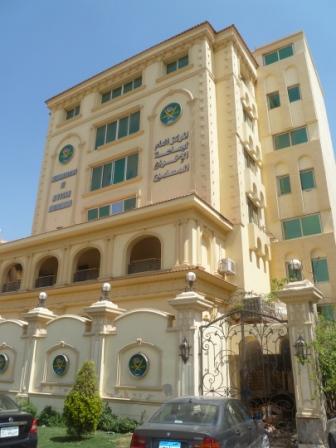

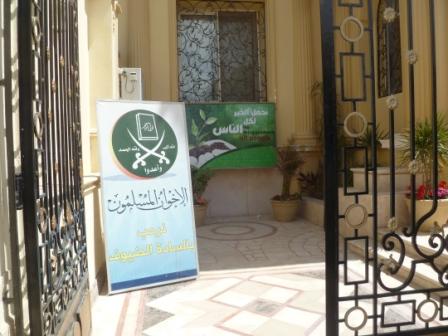


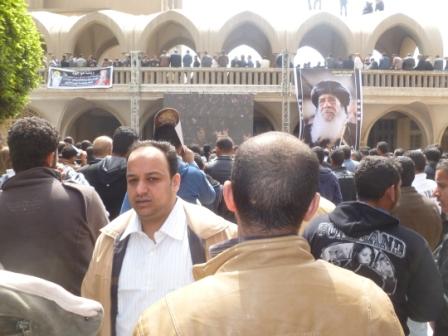
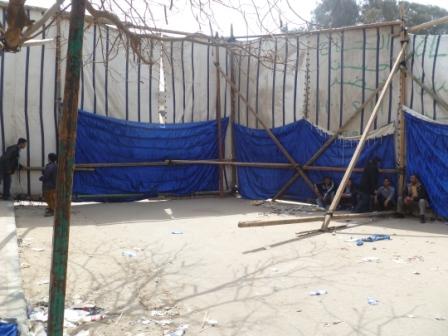
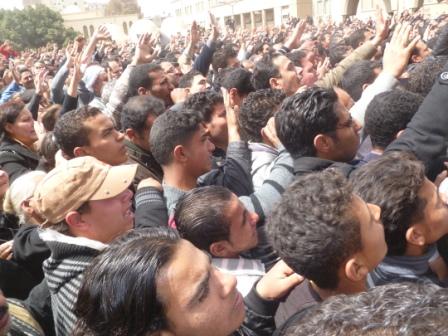
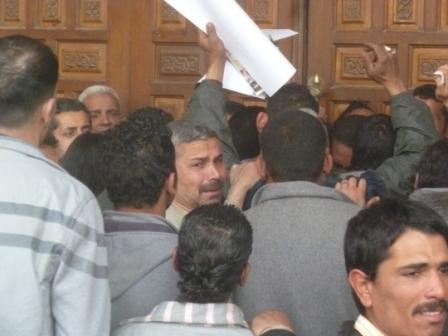
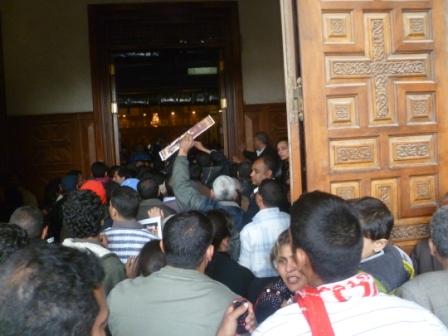
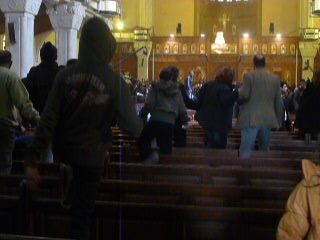
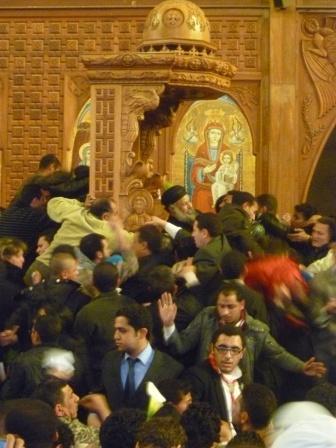


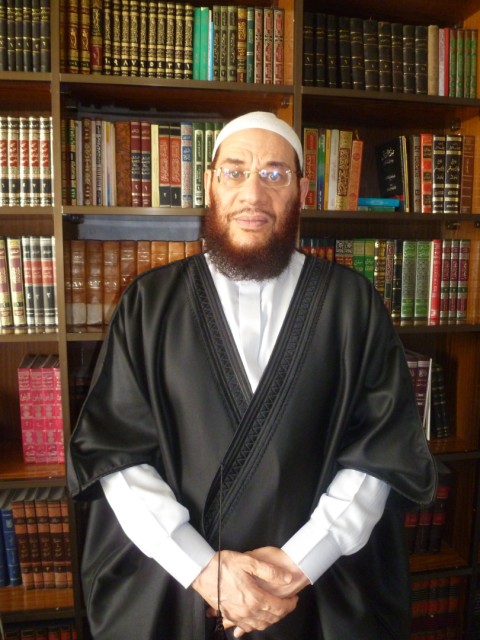
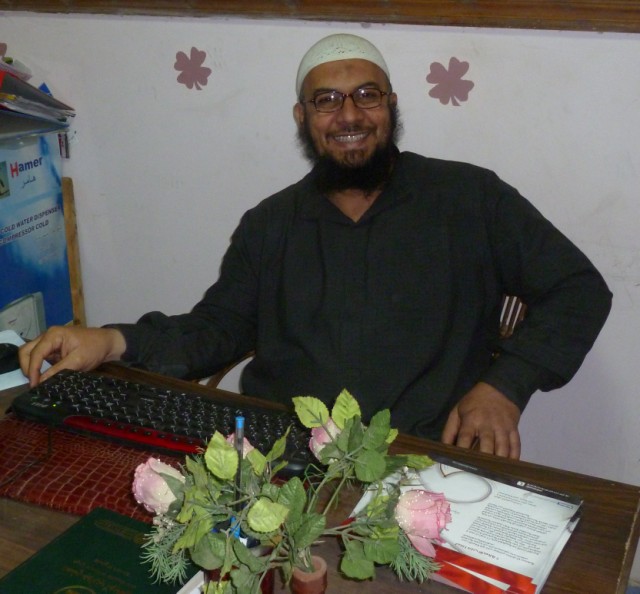
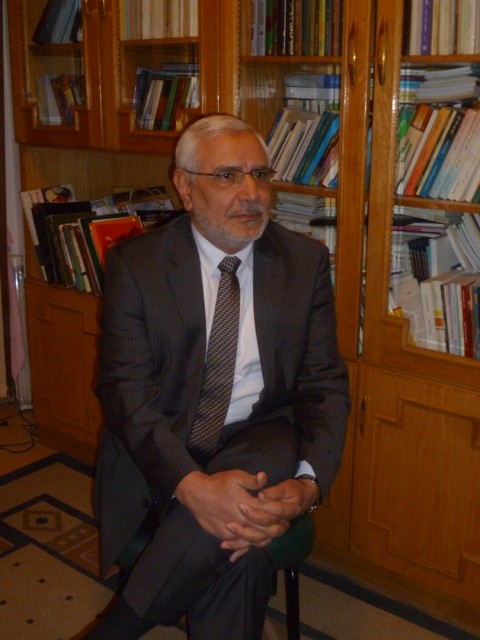


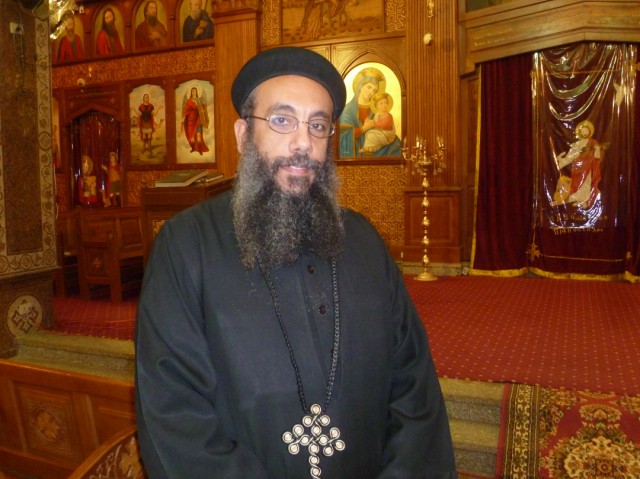
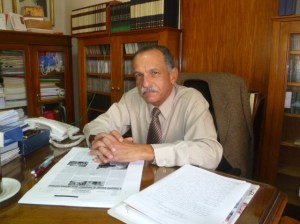

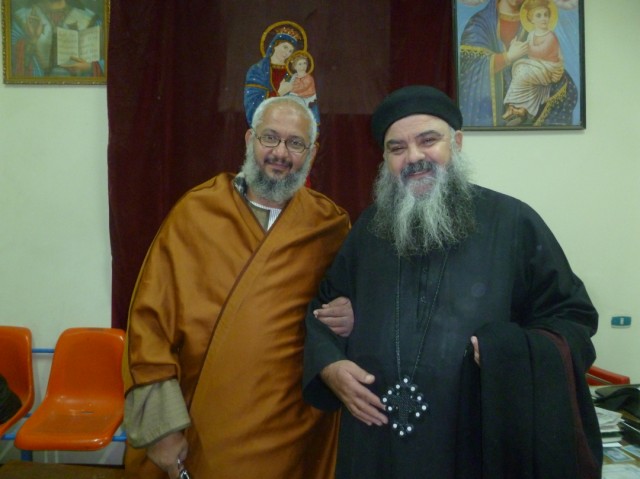

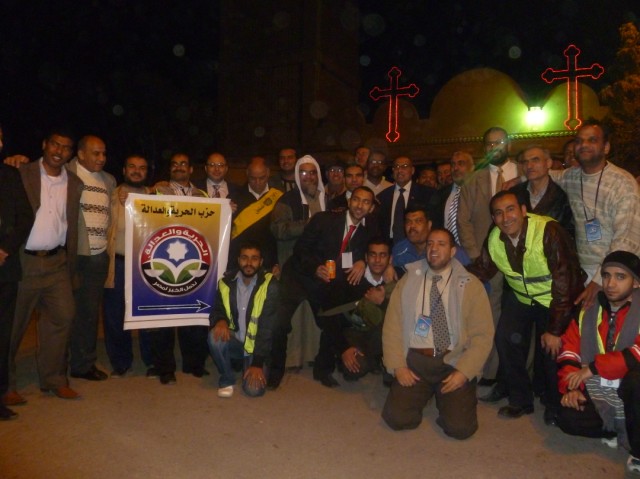
 Jayson Casper