This article was published in the November print edition of Christianity Today.
(via Coptic Solidarity)
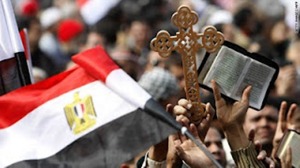
Long live the crescent and the cross!” shouted Egypt’s parliament in joy. All 39 Christian members joined the two-thirds majority to vote to end a 160-year practice instituted by the Ottomans requiring Christians to get permission from the country’s leader before building churches. The long-awaited reform was promised by the 2014 constitution after the overthrow of Muslim Brotherhood president Mohamed Morsi.
The new law shifts authority into the hands of the governor, who must issue a decision within four months of an application and give detailed reasons for refusals. The law also established a process to retroactively license hundreds of churches erected without a presidential permit.
“It is a good step,” said Andrea Zaki, president of the Protestant Churches of Egypt, who helped negotiate the draft law with government officials. “If we wanted an agreement to include everything and please everyone, it would have taken 100 years.
“This is the best we can get right now.”
But even as they celebrated, Christians debated if they failed to fully seize a unique opportunity to pursue equal citizenship…
Please click here to read the full article at Christianity Today.
With the release of their ‘Sixth Trumpet,’ Anglicans from the Global South announced their discontent with the state of the worldwide communion. Meeting in Cairo, Egypt from October 3-8, delegates from 16 provinces discussed issues of both unity and mission, addressing the Anglican Church worldwide. This question and answer format highlights the key developments, as well as a primer for essential Anglican terminology.
We know there is a divide in the Anglican Church over issues of homosexuality. What happened in Cairo that is worthy to note?
Among the 34 points of the official communique, three developments are most substantial.
A commitment to work together with GAFCON
A working group to address the need for an enhanced ecclesial responsibility in the Global South
A concern for the revisionist directions which the Church of England could be taking and the impact that could have on other provinces
Thank you, but for non-Anglicans much here needs explanation. What is GAFCON? And similarly, what is the Global South?
The Anglican Communion includes 38 provinces around the world, comprising 85 million people in over 165 nations. It is the third largest Christian denomination after the Roman Catholics and Eastern Orthodox.
The Global South is a grouping of 24 of the 38 Anglican provinces which are largely non-Western in character, but includes also the breakaway Anglican Church in North America. It first met in 1994 and has 61.8 million members, constituting 72 percent of the worldwide Anglican Communion. It is provincially-based and primate led, though clergy and laity have significant input in the general conferences.
By contrast, GAFCON is a reform movement in the Anglican Church as a whole, though also led by a council of primates. It stands for Global Anglican Future Conference, and began in 2008 in Jerusalem, boycotting the traditional worldwide gathering of Anglican bishops in England.
What is, or was, the core disagreement between the Global South and GAFCON?
Both the Global South and GAFCON emphasize the authority of the Bible as the word of God, and in application reject the validity of same-sex unions. They jointly find fault with the Anglican instruments of communion for failing to hold accountable member churches which deviate from this standard.
The 2008 decision to boycott the worldwide gathering, however, was a divisive issue. Though membership in both groups is overlapping, GAFCON includes Western voices. Cultural differences and strategic approaches both contributed to each group developing along its own path, rather than in unity.
In recognition, paragraph 22 of the Global South communique repents of failings in the Global South to hold this unity among themselves. Furthermore it affirms and cherishes the witness of GAFCON, including the statement it issued from Jerusalem in 2008. Paragraph 26, meanwhile, demonstrates this newfound unity in acceptance of a joint Global South-GAFCON statement on human sexuality.
Thank you, this is helpful, but you used Anglican terminology again. What are the instruments of communion?
The instruments of communion are the four internal mechanisms by which Anglicans in all their diversity maintain worldwide fellowship. They include the office of the Archbishop of Canterbury, the spiritual and symbolic leader of the church. To be in the Anglican Communion means to be in fellowship with Canterbury, though he has no authority to discipline or interfere in the administration of sister provinces.
The three other instruments of communion are represented in regularly held gatherings. Convened first in 1867, the Lambeth Conference brings together the Anglican bishops every ten years. The Anglican Consultative Council consists of clergy and laity from each province and meets every three years, first held in 1971. The Primates Meeting is an irregular gathering of province leaders for deep consultation and prayer, begun in 1979.
None of these instruments have legal force among member churches, and are primarily avenues for persuasion. Its official statements, however, represent the voice of the worldwide communion.
So how did the instruments of communion fail?
In 1998 the Lambeth Conference passed Resolution 1.10, upholding the scriptural teaching of marriage between a man and a woman, and declining to advise the blessing of same sex unions or the ordination of homosexual clergy.
Paragraph 25 of the communique notes the actions of some churches violate this resolution, as well as the subsequent 2004 Windsor Report, recommending a moratorium on the appointment of new homosexual clergy. Other statements from primate meetings have urged violating provinces to voluntarily withdraw from participation in the gatherings of communion.
Not only has such appointment continued, but paragraph 30 notes with sadness that the provinces of Scotland, Wales, and Canada have changed canon law to recognize same sex unions.
What does the Global South propose to do about this?
Paragraph 29 states clearly that the instruments of communion are unable to sustain the common life and unity of Anglican Churches worldwide. Paragraph 32 emphasizes the need for enhanced ecclesial responsibility.
The communique did not delineate a new governing structure nor a formal covenant. But in paragraph 33 it expressed the collective will of the Global South provinces to convene a task force for this purpose.
So it recommends a committee? This means the real news is still to come.
Yes, but not entirely. Paragraph 31 recognizes the unique role played by the Church of England in the life of the communion, but then proceeds to issue a stern warning.
Recognizing a potential movement to imitate the churches of Scotland, Wales, and Canada in affirming same sex unions, the Global South stated there would be “serious implications” if it were to occur.
That sounds like a threat for schism. Is it on the agenda?
The implications are unspecified, but it is understandable one might hear a warning shot toward the most foundational Anglican instrument of communion, embodied in the Archbishop of Canterbury. And among many in the Global South there is certainly frustration with the current officeholder.
Understood and appreciated as an evangelical, the archbishop’s recent statement admitting that he knowingly consecrated a celibate but homosexual bishop, amongst other developments, felt like a betrayal of the adopted resolutions and issued statements listed above. The Global South recognizes the great pressure he is under, but prays for him to uphold biblical leadership.
Paragraph 23, however, states clearly that the Anglican heritage is not merely of nostalgic interest to the Global South. Doctrinally and liturgically, it binds the churches together so as to communally discern the movement of the Holy Spirit.
Paragraph 24 then clarifies that modern clear departures from this heritage are causing offending provinces to “sever themselves” from their spiritual roots. It is not the Global South that seeks schism, but others are diverging from communion through unilateral actions.
The general framework of Global South understanding is that new ecclesial structures are needed. Whether this entails a new governing structure or covenant, the idea is for member provinces to adopt this together, and then invite all provinces to join.
It is not meant to create a parallel Anglican Communion. But representing a majority in provinces and population, including substantial support outside the Global South through GAFCON, it would be a clear demonstration of what the Anglican Church stands for. The question of schism would then be put to provinces which fail to uphold the Anglican heritage of biblical and apostolic fidelity.
Was the communique unanimously adopted by the Global South?
Yes, and please click here for a list of reflections by several of the participants.
Eighty-two Egyptian youth are free today. Some say they never should have been imprisoned to begin with.
The majority were convicted for breaking the protest law. Some were guilty of thought-related crimes.
All had exhausted their legal appeals. Some had only a little time left on their sentence.
God, thank you for freedom, theirs and ours. May these youths use it well.
Guard them against bitterness, frustration, and revenge. Give them a proper understanding of justice, toward themselves and the state.
May they act accordingly. May they be stronger for this experience. May they honor you and the Egyptian people in all that is to come.
Bless the activists, God. Bless them with wisdom to add to their zeal. Bless the country with patience, and discernment in listening.
Their release stems from an initiative of the president to reengage youth. Parliament has contributed, as has the National Council for Human Rights.
But consider also those youth who were not released, God. Some were convicted of more serious crimes. Others may feel overlooked and abandoned, perhaps even targeted.
If mistakes were made, God, may they be corrected. If there was injustice, hold the wrongdoers accountable.
But move Egypt forward, with all of her youth. No nation can leave them behind and survive.
And no nation can thrive without freedom and responsibility. Give both in abundance, and may Egypt prove faithful.
Egypt finally took the plunge. After years of spending hard currency to support the pound, the Central Bank decided to float it against the dollar. Economists rejoiced, IMF authorities nodded, and an already inflationary local market braced for another blow.
Society, meanwhile, braces for planned protests on November 11. No one is certain if they will happen or not, but the mysterious originators – with some Brotherhood connections – call for an uprising over skyrocketing prices.
God, bless the government for taking a hard decision. Wisdom was asked by many on their behalf; may it be that it this the right one.
Now, with a plan in place, help the country see it through to completion. Food subsidies to the poor are being increased. Discounted essentials are being distributed.
It is a stop-gap, God. But it may be necessary. Help the poor to pass through these troubles. Help the middle class to simplify and save. Help the rich to be liberal in generosity.
And for the further reforms called for, refine bureaucracy and curb corruption. Bolster education and inspire entrepreneurship.
Confidence, God. In self, others, and you. Restore it to Egypt. Perhaps grant it fresh. Little can happen without trust in the system. Faithfulness, God. To you and to conscience.
For within such hope there must be place to protest. A healthy society needs dissenting voices. Judge those of this call, if they purpose destruction. Channel frustration into healthy expression.
But may legitimate grievances be heard. May neglected ideas receive due consideration. May dissonance gel into consensus.
The pound is weaker, God, but perhaps it is stable. Maybe the economy is similar? Strengthen all, for the sake of all.
A rising tide will float all boats. May November mark the end of ebb.
How shall a young man cleanse his … country? Two paths were open for Egypt’s youth this week, invited to a national youth conference sponsored by the president.
One group decided to attend, to make their voice heard. Another thought their voice would be louder in boycott. God, bless them both.
Those present heard of plans to train and incorporate them in the political path. A committee was mandated to revise the protest law and release the nonviolent from prison. And the president promised to remain with them in monthly dialogue.
Those absent spoke harshly of political theater. They condemned ongoing detentions. And in a recent poll, their majority said if elections were today they would not vote to reelect the president.
It matters not their political preference, God. But their political participation is crucial. The nation needs buy-in from all its citizens. Many of the young have instead opted-out.
God, guide the government in sincere reengagement. Guide the youth in setting their terms. And in the diversity of response, find consensus.
Give the young a spirit of respect. Help the aged to respond in humility. Give the young a freshness of vision. Help the aged to adapt and amend.
Together, God, may they strengthen Egypt. By taking heed thereto according to … each other.
In their way, by thy word, with whole heart may they seek you, and in your commandments find Egypt’s best.
Father Rafic Greiche, a Catholic priest; Father Bishoy Helmy, an Orthodox priest; and Reverend Rifaat Fikry, a Protestant pastor speak at a meeting of Egypt Council of Churches.
Egypt’s recent church building law was largely negotiated behind the scenes between the government and the three largest Christian denominations: the Orthodox, Catholic, and Protestant churches. Despite concerns over insufficient public dialogue and loopholes which may hinder implementation, many Christians celebrate a formal legal process over the ad hoc nature of security intervention and presidential permits.
And among those who hope to gain are the smaller Christian denominations of Egypt. Largely overlooked in the national discussion, they also have a right to freedom of religion and worship.
Christians are generally estimated to be 10 percent of the population, the vast majority belonging to the Coptic Orthodox Church. But in 2006, the Ministry of the Interior published its most recent major clarification of Christian denominations, recognizing also the Coptic Catholic Church and the National Evangelical Church as “Egyptian” churches. Eighteen others are approved but designated as “foreign,” An additional 17 Protestant denominations are not mentioned specifically in the 2006 statement, but are recognized under the umbrella of the Evangelical Church.
Please click here to read the full article at TIMEP.
For many in Egypt these are difficult days. Taxes are increasing, subsidies are reducing, the pound is depreciating, and prices are rising.
And as many fear worse is to come, people are hoarding. Basic commodities are disappearing. Some are smuggling, others siphoning.
The government is reacting. The military is supplying. The economy is sliding. Many are worrying.
God, your wisdom is needed. Help the ministers set proper policy. Help the international community know how to assist. Help the consumers distinguish their wants from their needs.
Help the people budget. Help their budgets stretch.
Help the police weed out corruption. Help the nation eliminate waste. Help tourists return. Help investment simplify.
There are many things wrong that need fixing, God. Lend your aid, and may Egypt listen. The root cause, the surface trouble, and everything in between—set things right.
Bless Egypt, God. May prices hold, and her people rise.
Speaking to house mothers at one of the more unique boarding schools in Egypt, Saleem Wassef challenged them to maintain hope with difficult children.
“Repeat yourself over and over again, because it is a long journey to raise a child,” said the administrative director. “Keep teaching them, even though they don’t listen.”
As every father, mother, and teacher knows, this is wise advice. What prompts the added italics is the setting. Technically speaking, the house mothers were not listening either.
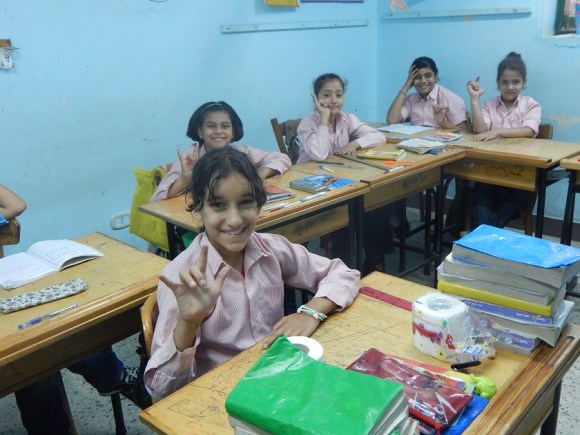
Suzanne, Maryam, and Marina are deaf, graduates of the school in question. They live full time with 45 students at the Deaf Unit, a ministry of the Anglican Church of Egypt located in Old Cairo. One-third are from Upper Egypt, the rest from poor areas of Greater Cairo. Ten others commute from nearby.
Founded in 1982, the Deaf Unit provides essential education to a segment of the population that is often seen as a source of shame. “To have a disability or a disabled child is sometimes seen as punishment from God for the sins of the family,” states the school’s website. “But one of our key objectives is to change these cultural attitudes by working with families and communities to educate them and build relationships.”
According to a 2007 study by the World Health Organization, 16 percent of Egyptians suffer from some degree of hearing loss. The Deaf Unit estimates two million are hard of hearing. The government provides deaf schools, but Wassef, a former director-general in the Ministry of Education, says these are overcrowded and not up to a satisfactory standard.
Marina goes further. Twenty-years-old, she is currently completing her high school degree in the government system. The Deaf Unit offers classes only through elementary, defined in the deaf curriculum as kindergarten through 8th grade.
“Government schools do not work hard enough, with insufficient focus on education,” an annoyed Marina gestured with her hands. “Some of the teachers don’t even know sign language.” She skips classes altogether, learning material through a private tutor while Deaf Unit students are in sessions. The rest of the day she mothers them, finding the sixteen teenagers especially challenging.
At the end of each school year Marina takes her tests in the government system, which for the first time provided a high school equivalency exam for the deaf. Egypt is making progress in attending to the needs of this neglected population, and Cairo University is opening its doors to graduates.
Though the Deaf Unit is not permitted to administer examinations, the government greatly appreciates their service, said Wassef. There is now one Muslim student enrolled after authorities encouraged the diocese to open classes to all. Wassef is currently seeking state authorization to extend classes through the preparatory level, in deaf terms from 9th through 11th grade.
“We have to be a model in front of the children, because they will follow someone and right now the morals of many are low,” Wassef told the three house mothers. “And in the end you will be able to say, ‘We developed these leaders.’”
Serving the whole society is part of the ethos of the Anglican Church, Wassef explained, and special attention is given to employ their students. Suzanne, Maryam, and Marina are examples, but several others work outside of Cairo, where community-based rehabilitation groups operate in Luxor, Minya, and Menouf. An audiology clinic operates at the Deaf Unit, which in two years plans to employ four deaf to administer hearing tests and produce ear molds. In 6 October City the diocese runs a full-scale Vocational Training Center.
Setting their sights at a young age, the Deaf Unit takes a field trip to KFC in Dokki, where a socially-conscious hearing manager has employed several deaf behind the counter. Most customers can only confusedly point to their food selections, but by placing the deaf in the public eye the culture slowly changes.
The Deaf Unit does what it can to speed up the process. Sign language classes are offered once a week to parents, relatives, and the general public, said Ramez, the financial manager, with an intensive course each summer. A native of Old Cairo attending the historic Jesus, Light of the World Church, he was intrigued by the fifty-plus member deaf congregation that also meets at the facility. He studied sign language, and has watched others learn. “Before too long,” he said, “anyone can sign professionally.”
Thirty to fifty Egyptians are trained each year, with special instruction available for non-Arabic speaking foreigners. Courses are offered at minimal charge, but the Deaf Unit stands in need of donations. None of the 55 students pay more than 200 LE ($22 US) per year. Wassef says the per-student yearly cost is 17,000 LE ($2,000 US).
But beyond donations, the Deaf Unit appreciates even non-signing volunteers to help with physical education, computers, and vocational training. And for the truly dedicated, teachers and room mothers are welcome. Suzanne, who has 18 years of experience, recalls with a smile her school days when foreign mothers helped raise them.
None have been on staff since the 2011 revolution, but neither can any replace the authentic model. “Our children like foreigners because they look different and are fun,” she said. “It is like what they see on TV.
“But they prefer the house mothers to be deaf, because we are like them and can understand.”
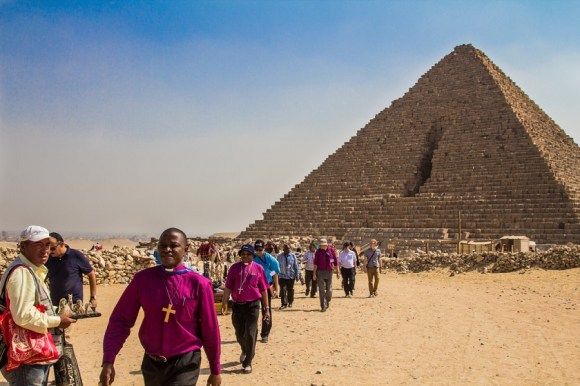
In a defiant gesture of faith from beneath the Pyramids, Anglican bishops sent a message to the world this week: Egypt is safe.
And this on a weekend the UK embassy warned against visiting public places.
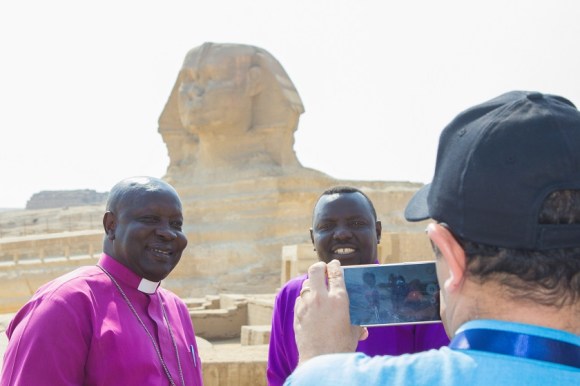
Representing twenty of the more conservative provinces of the worldwide Anglican Communion, delegates to the Sixth Global South conference in Cairo visited the Giza pyramids and dined on the Nile in a show of solidarity.
‘I appeal to you as an Egyptian, please return and visit Egypt,’ Bishop Mouneer Hanna Anis, chairman of the Global South, told delegates.
‘Our economy depends on tourism, and when it is down, thousands of Egyptians cannot earn a living.’
The tourism sector employs roughly four million Egyptians, representing 12.6 percent of the work force. But according to the Central Bank of Egypt, tourism revenue declined by nearly a half – 48.9 percent – year-on-year to September 2016.
The 31 October, 2015 crash of Russian Metrojet Flight 9268 over the Egyptian Sinai desert, claimed by the Islamic State, had a disastrous impact.
Russia, who represented 35 per cent of arrivals, has since barred all flights to Egypt, and the UK at 12 per cent have canceled flights to resort areas in the Sinai.
Ghostlike
Photo: Darren Haley
In Cairo the pyramids stood empty. In Luxor there was just one family at their hotel, where staff threw a party for their one-year-old’s birthday, to show their appreciation.
American Darren Haley said: ‘It was sad to see just how much Egypt has to offer and how few are willing to take the journey. Egypt is history just waiting to be explored.’
Egypt is struggling to promote tourism with an ongoing Islamist insurgency.
The Ministry of Foreign Affairs reacted furiously to UK and other embassy warnings that they said could ‘harm the country’s economy.’
Without identifying the threat, the UK embassy issued a warning 7 October to avoid ‘large gatherings and public spaces,’ specifically mentioning museums.
‘Most terrorist attacks target the security forces,’ reports the embassy website,‘but it’s likely that foreigners, including tourists, will also be targeted.’
So the bishops’ stance is all the more remarkable. ‘I wanted the Anglican delegates to see a different picture of Egypt than what they see in the media,’ Bishop Anis told Lapido.
‘It is unfair to call Egypt unsafe, as we have seen there is no place in the world safe from terrorism.’
Before the Russian airline crash tourism was showing signs of recovery. Revenues had increased 45.3 percent compared to a year earlier.
Rebound
Egypt hopes a second rebound is coming.
Officials are finalizing negotiations with the Russian authorities to restore flights. Egypt Air resumed London-Luxor travel on 3 October.
On 10 October Egypt completed restoration work at the shrine of King Tuthmosis III in Karnak Temple.
Last month the ransacked Mallawi Museum in Upper Egypt was reopened for the first time since pro-Morsi rioting in August 2013.
But even throughout this tumultuous period, tourists have come.
‘We have never had a bad experience, even during the uprisings of the last five years,’ Bishop Timothy Ranji of Kenya told Lapido. Every year since 2004 he has brought thirty clergy to Egypt for religious pilgrimage.
‘Egypt is secure, full of lovely people, and I invite everyone to come,’ said Archbishop Tito Zavala of Chile.
‘I am an ordinary person here. There is no need for bodyguards.’
For the communique, please click here. For the Global South-GAFCON joint statement on human sexuality, please click here.
The following are statements collected from a selection of archbishops and bishops who participated in the conference.
Several months ago we were praying that the Lord would guide us during the conference, specifically that it would not be political, but spiritual, seeking the guidance of the Holy Spirit. We did experience His movement among us, and the communique reflects the love of God, the grace of our Lord Jesus Christ, and the fellowship of the Holy Spirit.
It expressed very clearly where we stand, in a non-aggressive and non-divisive way. On the contrary, it shows how unity among the people of God brings blessing. (Psalm 133)
Archbishop Mouneer Hanna Anis, Province of Jerusalem and the Middle East
It expresses our collective frustration, hope, and counsel to the Anglican Communion leadership on the state of our communion. It shows our faith, determination, and effort to restore this communion to wholeness. And it shows we are getting ready for the possibility of further deterioration, that we should be able to speak and act decisively.
Archbishop Nicholas Okoh, Province of Nigeria
With the confusing messages from the centers of Anglicanism regarding Biblical morality, it clearly communicates our message, allowing us to focus on our mission to lead people to Jesus Christ.
Archbishop Foley Beach, Anglican Church in North America
When we see conflicts and suffering in the world, this communique tells us we have to work faster and more corporately to help. But it also expresses our dissatisfaction and disappointment over the inability of the communion to address fundamental issues which are distracting us from the mission of the church. The truth of the gospel will only have power if it is not compromised.
Archbishop Ng Moon Hing, Province of Southeast Asia
Matthew 5 says that no one lights a lamp and then covers it with a basket. But the Anglican Communion has been covered by darkness due to Satanic power exercised through the decisions of men. This communique has the force to uncover it again so as to be the light of the world, to shine openly for both the Anglican Communion and the world.
Archbishop Stephen Oo, Province of Myanmar
We are united, we are of one mind, and the communique was approved unanimously. One more time we clarified where we are in terms of doctrine and mission. But it also pushes us to keep moving ahead, as our duty is to go and spread the kingdom of God.
Archbishop Tito Zavala, Province of Chile
It captures a revitalized spirit among the Global South churches, with openness and inclusion to those likeminded in the North. I believe this is the first time the Global South and GAFCON have issued a common statement, speaking in one voice. There is a strong sense that God is the prime mover, calling the church to rise up together, as we balance between mission in service of the world, and the battle for truth within the church.
Bishop Rennis Ponniah, Diocese of Singapore
The communique is very touching, as it appeals to all of us to come together. But it also warns of what is happening in the northern churches. If you warn your brother but he continues, there must be a reaction. We are together, but we cannot walk together in this journey. It is very African for brothers to part if they don’t agree, but by the grace of God we will come back together.
Bishop Timothy Ranji, Diocese of Mt. Kenya South, Kenya
The Global South – GAFCON joint statement is outstanding, the most pastorally sensitive statement on human sexuality that I have ever read. It emphasizes the importance of family and marriage, while expressing a genuine love and concern for those who find themselves with homosexual orientation.
I am so appreciative that the Global South has recognized those of us in the Episcopal Church who uphold Holy Scripture and the traditional understanding of marriage, desiring to remain in relationship with us.
Bishop William Love, Diocese of Albany
It represents a very substantive healing of relationships that had previously been strained, mostly because of differences in strategy. I credit Bishop Mouneer, who reached out to everyone and said we must be unified.
The enhanced ecclesial responsibility is critically important because of the failures of the instruments of unity. Those who agree can now pursue mission without having to battle theologically.
Bishop Bill Atwood, International Diocese of the Anglican Church in North America
The communique raises hope for those we lead in Southern Africa, over the authority and authenticity of scripture and the lordship of Christ. For them we pledge to stand and fight, and may the Holy Spirit grant us power and humility to do so. May the church of Christ grow from strength to strength; praise be to his name for the communique.
Bishop Bethlehem Nopece, Diocese of Port Elizabeth, Southern Africa
The Global South and the church must live and apply this communique, so as to make clear the situation in the Anglican Communion. Now we must carry it to society so that it is seen in love as we serve the people living in poverty and amid many other troubles in this world.
Assistant Bishop Hassan Othman James, Diocese of Kadogli, Sudan
If you have not yet read the statements but the above piques your interest, here are the links again.
For the communique, please click here. For the Global South-GAFCON joint statement on human sexuality, please click here.
In cooperation with the Ministry of Tourism, the sixth Anglican Global South conference enjoyed a taste of Egyptian antiquities. Delegates toured the Giza pyramids, a papyrus gallery, and the Egyptian museum, closing the day with a dinner cruise on the Nile River.
“Egypt is safe,” said Archbishop Mouneer Hanna Anis of Egypt, chairman of the Global South Anglicans. “As an Egyptian I appeal to you, please come and visit.”
Anis emphasized to delegates that one-third of the Egyptian economy depends on tourism. Millions of lives are affected by the downturn, he said.
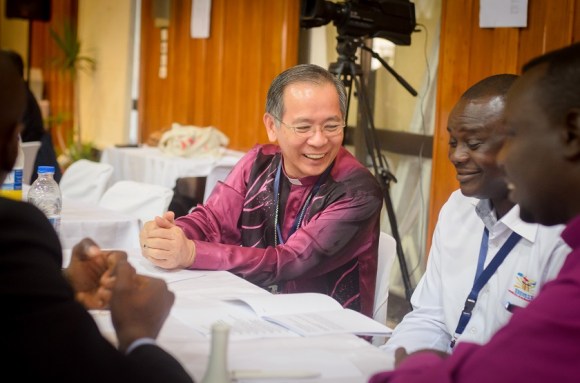
But both bishops and laity smiled as they interacted with local Egyptians, tasted local dishes, and took countless selfies.
Theirs was the absolute opposite attitude of Jonah, who ran from the place to which God called him. Johan was the subject of the morning’s Bible study led by Archbishop Tito Zavala of Chile, on the church and the challenge of world evangelization.
Zavala highlighted several applications from Jonah’s story. God is in control of everything, so no matter the hardship and rebellion, Christians should never give up in their missionary enterprise.
God’s unique character is full of compassion, so Christians also must love all the people of the world, even their enemies.
Some Christians suffer from Jonah Syndrome, getting angry at everything that conflicts with their biases. Zavala asked delegates if they view their cultures similarly. Do they have a missions mindset, or a maintenance mindset?
Instead of simply having the right theology of evangelism, churches must develop actual touchpoints with society. He highlighted the development of his own nation of Chile, where the Anglican work began in the 1820s with foreign expats only.
Today the Anglicans have 100 churches in the country, with 95 percent Chilean leadership funded by 95 percent local tithes. Zavala himself was the first Chilean to be appointed bishop, and now he is the first Latin American to become an Anglican primate.
Many an African Anglican has been accused, and perhaps felt a pang of conscience, of belonging to the church of the colonizer. However much they are thankful for the Gospel, the church in popular understanding remains essentially English.
Little do they know the opposite is true. The Anglican Church is essentially African.
Delegates at the sixth Anglican Global South conference in Cairo heard new research from the foremost scholar of the formational Anglican, Thomas Cramner, the first Protestant Archbishop of Canterbury.
Dr. Ashley Null is an elected fellow of the Royal Historical Society and is currently compiling a five-volume study of Cramner’s private theological notebooks.
What these notebooks reveal is the reformer’s deep dependence on the writings of Augustine. Imagined today as a Latin scholarly giant, in his day Augustine was derided as the son of a Berber who spoke Latin with an African accent. Much like many see Africans today, he was considered an outsider with just enough education to exist on the margins of civilization.
Null encouraged the delegates that the scholarly comparisons continue today. The progressive wing of the Anglican Church believes that God will lead them into all truth, which the church today can perceive better for modern times than those from two thousand years ago.
Yet this was exactly the challenge Cramner faced in his day, taking on Medieval Catholicism. Equating tradition with scripture led the church into all sorts of error, which only a return to the Bible could correct. In many examples Null demonstrated how Cramner’s writings drew from Augustine, who himself distinguished between the holy texts and the illumined church fathers who applied them for their day.
Their interpretation, Cramner echoed Augustine, is to be done by scripture. Yet the flexibility of a changing medium for the gospel is built into the original 39 Articles. Article 34 declares it is not necessary for all ceremonies to be alike in all times, places, and manners, so long as they are not contrary to the word of God.
“An African Anglican is an Anglican, twice,” Null said. “It is not just a great line, it is the truth.” Africans need not replicate an English church. And why should they, when the Anglican Church was designed to be culturally adaptable from the beginning, patterned after the teachings of a Berber?
Null demonstrated this was not just a missiological principle, but the very DNA of Anglicanism. But in the day’s Bible study, an Asian walked delegates through the challenge of mission.
Bishop Rennis Ponniah of Singapore said this is mission wider than world evangelization. It is extending the Kingdom of God through the church to the whole created order, bringing it all under God’s rule of righteousness, justice, and compassion.
Ponniah focused on three primary dimensions of this mission. The first is to proclaim the gospel of Jesus Christ faithfully. The second is to overcome the hostility of evil boldly. And the third is to shine the light of God’s rule winsomely. And all of these should be practically achieved through vibrant local parishes, for this is where the people are.
And on this day the Anglican Global South received the greetings of many parishes around the world. Bishop Paul Butler of Durham, Bishop Tim Dakin of Winchester, and Archbishop Glenn Davies of Sydney all expressed appreciation for support received from their fellow orthodox Anglicans. Bishop Mark Lawrence of South Carolina and Archbishop Foley Beach of the Anglican Church in North America expressed similar sentiment.
But Bishop Bill Love of Albany was unique. A conservative American who has chosen to stay within the Episcopal Church, he described the ‘companion partners’ of the Global South within his province. There are six diocese including his own, Central Florida, Dallas, North Dakota, Springfield, Illinois, and Tennessee. Fifteen bishops identify also, representing 10 percent of the whole, a remnant, Love said, which has not bent the knee. One reason he remains within the Episcopal Church is to remain faithful to them.
Much like Cramner was faithful to Augustine, and Augustine faithful to scripture. Even an American Anglican is African at heart.
Many in the world view Christianity as a Western religion. But even as its center of gravity shifts to the African continent, few are aware the degree to which Africa shaped the Christian mind.
Even in Africa this lesson can be missed, but the Anglican Global South made sure its delegates return home to their provinces with a proper perspective.
“Our stories shape us and how we see the world,” said Dr. Michael Glerup of Yale University and executive director of the Center for Early African Christianity. “The Global South is not new, it was the first reality of the early church.”
Glerup opened with the emphasis Cardinal Schonborn of Vienna has been trying to drive home to Europe: Christianity provides the legacy of civilization to a Western culture that has largely forgotten its roots. But Glerup demonstrated to delegates that these roots stretch back even further to Africa.
There were five early centers of African Christianity, he said, in Egypt, Carthage, Libya, Ethiopia, and Nubia. And in three particular principles, he demonstrated their sons were the first to teach Europe its eventual values.
Maurice of Luxor served in the Roman Theban Legion, fighting near Geneva. Martyred for refusing to sacrifice to the gods, he and his Christian unit also defied the command to kill innocent civilians. “Our oath to you will be of no value, if we deny our first oath to God,” Maurice told his commander, and with his words and example he taught Europe the principle of moral integrity. It was not until the 16th century that his popular portraits were changed from dark to white skin.
St. Pachomius, also from Luxor, was a pagan when visited in prison by local Christians who came to his aid. Upon his release he became a Christian, and eventually founded community-based monasticism providing compassionate service to all. Cyprian of Carthage would further cement the principle of a universal human family, teaching Christians suffering plague to tend even to the sick of their former persecutors.
The Berber Tertullian is well known among theologians as the first to coin the term ‘Trinity’ and was ahead of his time in teaching what would eventually become formulated as Orthodox Christianity. Less known was his teaching, “It is not part of religion, to compel religion; it is an act of free will.” He and fellow Berber Lactantius, the tutor of Constantine’s children, helped teach Europe the oft-neglected but esteemed principle of freedom of conscience.
Glerup’s lectures were sandwiched between two Bible studies led by senior leaders in the Global South. Archbishop Ng Moon Hing of Southeast Asia spoke on the church and the challenge of unity, while Archbishop Stanley Ntagali of Uganda spoke on the church and the challenge of false teaching.
Disunity has been a hallmark of both human and church history, Hing said, and neither theocracy nor democracy has a good track record in overcoming it. Paul’s ethic in Ephesians 2, however, establishes a new pattern in which a Christian is to be simultaneously a responsible citizen of God’s kingdom, and a faithful member of God’s household.
“Pray we can still be a family,” Hing said, “even if a diseased member must be quarantined for a time.”
The disease is connected to false teaching, said Ntagali, but like the corruption rampant in many parts of the Global South, this is a symptom rather than the disease itself.
It is secularism that has become the dominant philosophy of the world, he said, with God no longer at the center. This allows some to claim the Christian name while not following Christ, while others claim the grace of God as a license to do what they want.
Unfortunately, those who follow such false teachings disconnect themselves from the will of God in heaven. What is necessary is discernment in the patterns of the world, being transformed by the renewing of the mind. In this, Ntagali urged delegates, the Global South must be united.
If it is, if the early African heritage is recovered, perhaps again they can help shape the Christian mind, worldwide.
On the first full day of the sixth Anglican Global South conference, delegates met Egyptian President Abdel Fattah al-Sisi and began private deliberations for the eventual “trumpet”, the concluding communique.
But in preparation they were led in a Bible Study by former Bishop of Singapore John Chew, and given a lecture by former Bishop of North Africa Bill Musk. Each applied the topic at hand to contemporary issues in the Anglican Global South.
Chew began by emotionally recalling his participation in the initial Global South gathering in Nigeria in 1994, then called the South-South Encounter. It helped us get to know each other, he said, and whether the way we did it was right or wrong, it clearly led to what followed.
That meeting was followed up by the 1997 conference in Malaysia, which galvanized the conservative primates of the Global South to achieve Resolution 110 of the 1998 Lambeth Conference, rejecting homosexual practice as incompatible with scripture.
Building on this history, he asked the delegates to reflect with him on Ezekiel 37’s valley of dry bones. “Can these bones live?” asked God to the prophet, to which Ezekiel wisely responded, “Lord, you know.”
Chew suggested that similarly, in light of the crises in the Anglican Communion, a proper response is to be silent and wait on God. When division is deep-seated, action cannot overcome action, but only God’s transformation of hearts.
But God did not leave Ezekiel to be silent, said Chew. God told him to “join the stick of Judah with the stick of Israel, and I will make them one stick.” Chew noted that perhaps many in Judah were pleased to see the compromising Israelites scattered in exile, but the heart of God, indeed the vindication of his holiness, is in bringing them back together.
Chew left the implication of this teaching to weigh on the delegates without direct application, but asked them if this was their orientation: To let God achieve it, rather than their own activism.
Afterwards, Musk led the delegates in exploration of the history of the church in Carthage, Tunisia, guiding them through the Donatist controversy and the religio-political shifts in the Latin-Berber, Vandal, and Byzantine eras.
The early church was divided along cultural lines, he said, between a foreign Latin elite that favored a compassionate response to Christians who denied their faith under persecution. The indigenous Berbers, however, held to a standard of purity that insisted upon faithfulness until death.
Various church fathers responded in different ways under different circumstances, Musk explained. But he esteemed the Council of Carthage which affirmed the right of a diocese to regulate its own affairs, rejecting the right of one to discipline leaders in another.
Similarly, Musk asked delegates if they could also create a mutually supportive Global South despite differences of viewpoint, while at the same time speaking the truth as they understand it on the important issues of the day.
Like the Christians of North Africa then, Christians of North Africa and elsewhere are persecuted now. Musk urged the lesson be learned of the dangers of a divided Christian community. The Arab invasions eventually overwhelmed the church, but the seeds of its demise were sown long before. Alongside apostolic gifts, a patient, long-suffering pastoral ministry is also of vital importance.
Anglican delegates closed the day by self-selecting themselves into four taskforce groups on the topics of theological education and leadership development, economic empowerment, evangelism, discipleship, and missions, and ecumenical and interfaith relations. Their practical recommendations were forwarded to the primates for further deliberation and planning.
President Abdel Fattah al-Sisi of Egypt welcomed yesterday a delegation of 16 archbishops from the Anglican Global South, led by Archbishop Mouneer Hanna Anis, chairman of the Global South Steering Committee.
In a discussion lasting 90 minutes, Sisi affirmed the important role religious leaders play in peacemaking, helping spread a culture of tolerance and accepting the ‘other’.
Unfortunately, he said, extremists in religion do not accept diversity, calling anyone who disagrees with them an ‘infidel’ worthy to be killed.
Sisi told the archbishops that Egypt is keen to guarantee freedom of belief and worship for all its citizens, stressing the need to reform religious discourse to confront such extremism.
The archbishops commended Sisi for visiting the Coptic Orthodox Cathedral in Cairo for Coptic Christmas on January 7, to which Sisi replied it was his joy to be able to bring such joy to others.
Archbishop Ezekiel Kondo of Sudan and South Sudan thanked Sisi for looking after the refugees in Egypt, the majority of whom are Sudanese.
At the end of the meeting Anis thanked Sisi for their warm reception, and spoke of the efforts of the Egyptian diocese to build bridges between the different faith communities.
The meeting was also attended by the British ambassador to Egypt John Casson, joining Bishop Paul Butler of Durham in the UK, a member of the House of Lords.
Pope Francis, patriarch of the worldwide Roman Catholic Church, and Sheikh Ahmed al-Tayeb, Grand Imam of Al Azhar, the leading religious institution in the Sunni Muslim world, welcomed delegates at the October 3 opening of the sixth Anglican Global South Conference, esteeming the importance of their gathering.
Pope Francis expressed his “deepest appreciation” for his invitation to this “momentous event”, in remarks read by the Apostolic Nuncio in Egypt, Archbishop Bruno Musaro. Musaro assured delegates of Francis’ prayers as they discuss themes of “high significance” for both the Anglican Communion and the entire Christian community.
“Nothing is lost when we effectively enter into dialogue,” Musaro quoted from Francis’ encouragement to all people of goodwill, “Nothing is impossible if we turn to God in prayer.”
Sheikh Ahmed al-Tayeb’s remarks quoted from the Quran in his welcome to the Anglican delegates, noting how God created different peoples in the world so that they would know each other and build society.
Tayeb’s message was delivered by Sheikh Saeed Amer, chairman of the fatwa committee in Al Azhar. He esteemed the importance of the conference, hoping it would contribute to building increasingly positive Egyptian participation in the Global South.
Pope Tawadros II, patriarch of the Coptic Orthdox Church also extended his welcome to the delegates of the Anglican Global South. Through Metropolitan Bishoy he expressed his delight in the Christological agreement signed between the Anglican and Oriental Orthodox Churches in 2014, as well as the 2015 agreement on the procession of the Holy Spirit from the Father.
“[We] back you in your defense of the commandments of the Holy Scriptures,” said Tawadros to the Global South delegates, through Bishoy, while noting serious disagreements that exist between the Coptic Orthodox and the Anglican Church as a whole.
“Yet we carry on our dialogue with the Anglican Communion in order to encourage the Anglican conservatives to continue abiding to the true and genuine Biblical principles.”
Archbishop Mouneer Hanna Anis, bishop of Egypt and chairman of the Global South steering committee, welcomed the ecumenical and interfaith dignitaries, and thanked them for their participation in the conference opening session.
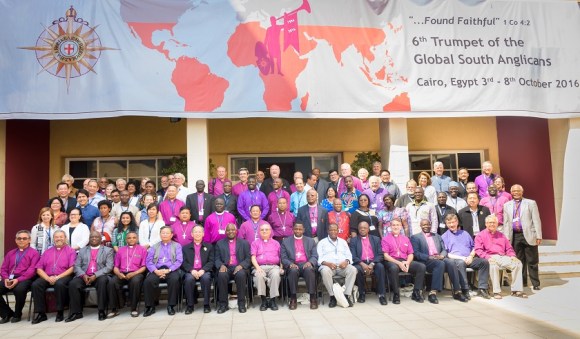
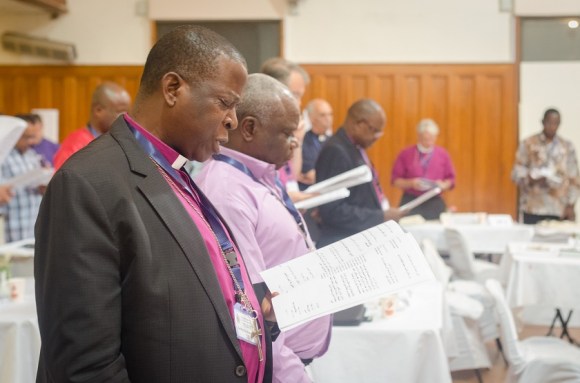
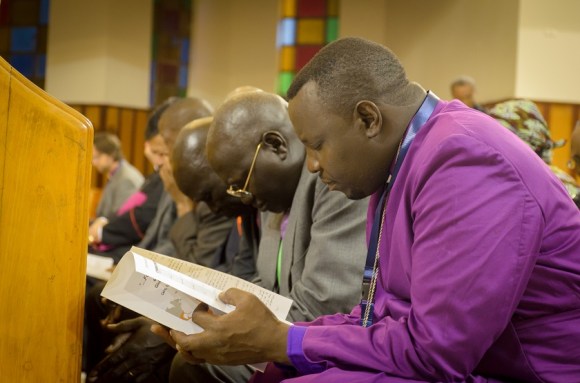
Anglicans of the Global South met today in All Saints Cathedral, Cairo, taking communion and opening their sixth conference. Archbishop Mouneer Hanna Anis of Egypt, chairman of the Global South Steering Committee, welcomed 12 primates and 90 delegates from 20 provinces of the Anglican Church.
In his opening address he gave a brief history lesson, recalling an earlier archbishop of Egypt, the 4th century Athanasius of Alexandria.
“He was known as ‘contra mundum’, ‘against the world’,” said Anis of the ancient champion against the heresy of Arianism. “He was opposed at that time even by the emperor, but eventually the false teaching disappeared, while orthodoxy flourished.”
Anis encouraged delegates to take two lessons from this history. First, drawing on the conference theme from I Corinthians 4:2, the church must be “found faithful” to the gospel received from the apostles. Second, the truth will prevail in the end.
Anis decried an “ideological slavery” in which some in the Western church use their money and influence to push their agenda on the Global South. They undermine the scripture and the traditions of the church in redefining the definition of marriage, he said, and their unilateral choices to ordain homosexual bishops is fraying the fabric of the worldwide Anglican Communion.
“I want to weep,” Anis said, “as Jesus did over Jerusalem.”
Anis also challenged delegates over the weaknesses of churches in the Global South. Corruption, tribalism, polygamy, poor treatment of women, and the prosperity gospel all show the need for greater theological education.
The church must also address the issues of poverty and economic migration, moving away from a dependency on Western aid into a more sustainable development. And as concerns terrorism and religious violence, Christians must again look to history, following the example of the martyrs, if necessary.
During the communion service, Archbishop Nicholas Okoh of Nigeria preached on the peace of Christ that is able to prevail in a crisis situation. The world has not achieved peace, citing examples in Syria, Yemen, Sudan, the Central African Republic, and his own homeland.
Christians, however, are called to be peacemakers focused on justice, fairness, and the love of God. This is also a call for world evangelization, he said, that the knowledge of the Lord may fill the earth as the waters cover the sea, quoting the prophecy of Isaiah 11.
Bishop Rennis Ponniah of Singapore prayed for the delegates, that God would melt their pride, free them from biases, and strip away all rivalries. He urged humility and submission to follow Jesus, that God would reveal what this means for them in the Global South.
“Let us weep over what breaks your heart,” Ponniah prayed. “May our faithfulness be the means by which you restore your church.”
Ecumenical and interfaith guests included representatives of Al Azhar, the Vatican, the Coptic Orthodox and Coptic Catholic Churches, and the Armenian Catholics. Political and diplomatic guests included representatives from the Egyptian Ministry of Foreign Affairs, and the embassies of the United States and Singapore.
The Anglican Church has 85 million members in 164 countries, the world’s third largest Christian denomination behind Roman Catholics and Eastern Orthodox. Anglicans in the 24 provinces of the Global South number 61.8 million, constituting 72 percent of the worldwide Anglican Communion.
Participants included archbishops from the provinces of Sudan, Nigeria, Uganda, Rwanda, Kenya, Burundi, Southern Africa, Western Africa, Indian Ocean, Myanmar, Sri Lanka, Bangladesh, Myanmar and South East Asia. Joining them from outside the Global South were archbishops from North America, Australia, and the United Kingdom.
Archbishop Anis urged them to adopt a joint statement of faith.
“Our unity in the Global South is very important,” said Anis as he closed the opening session. “We must face our many challenges together.”
From October 3-8, All Saints Cathedral in Cairo, Egypt will host the sixth conference of the Anglican Global South. Over 100 delegates from 20 provinces will discuss the challenges facing the church in the world today.
Archbishop Mouneer Hanna Anis of Egypt is also chairman of the Global South steering committee. He stated the most critical of these challenges include poverty, illegal immigration, religious violence, and the false teachings about homosexual marriage prevalent in the West.
Delegates will also discuss the importance of ecumenical and interfaith dialogue. Invited guests to the opening session include the Grand Imam of Al Azhar, Ahmed El-Tayeb, and Coptic Orthodox Pope Tawadros II.
The Anglican Church has 85 million members in 164 countries, the world’s third largest Christian denomination behind Roman Catholics and Eastern Orthodox. Anglicans in the 24 provinces of the Global South number 61.8 million, constituting 72 percent of the worldwide Anglican Communion.
Expected participants include archbishops from the provinces of Sudan, Nigeria, Uganda, Rwanda, Kenya, Burundi, Southern Africa, Western Africa, Indian Ocean, Myanmar, Sri Lanka, Bangladesh, Myanmar and South East Asia. Joining them from outside the Global South will be archbishops from North America, Australia, and the United Kingdom.
The first plenary session will be led by recently retired Bishop Bill Musk of North Africa, on the historic church of Carthage in present day Tunisia. He will be followed by Dr. Michael Glerup of Yale University and executive director of the Center for Early African Christianity, speaking on how Africa shaped the Christian mind. The final seminar will feature Dr. Ashley Null, renowned scholar of Thomas Cramner, on how Africa shaped the Anglican faith.
The sixth Global South conference was originally scheduled for Tunis in 2015, cancelled on the advice of the Tunisian authorities due to terrorist threats. But this year delegates will spend half a day touring the Egyptian Museum and Giza Pyramids, and enjoy a dinner cruise on the Nile River.
Begun in 1994 in Kenya, each of the five previous Global South gatherings issued a “trumpet,” a declaration of principles and call to stand firm on the faith received from the Apostles. It is expected that many delegates will wish to challenge the current innovations happening within the traditional centers of Anglicanism in the United Kingdom and North America.
“This is a critical moment in the life of the Anglican Church,” said Bishop Mouneer. “We pray that as we strive for both truth and unity, our efforts will be ‘found faithful’ by God Almighty.”
Note: I will be assisting the diocese with its media coverage of the event, and will provide updates as possible.
Egypt witnessed a frightful return, disturbing a relative quiet. The pattern subsided but not that long ago was a viable threat. May it not be a portent of things to come.
A car bomb detonated in an upper class neighborhood, injuring one bystander but missing the deputy prosecutor-general. Fifteen months ago, his positional superior was assassinated by similar means.
God, thank you for the escape. But the signs that such men continue to nurse their grudges through violence is a disturbing development. After a year of many targeted killings, Egypt outside of Sinai has successfully enforced an extended period of calm.
May the culprits be caught, God. May those behind them be exposed and disabled. May any legitimate grievances find peaceful solution, and may justice be extended to all.
For grievances are also finding expression in the funeral of former Israeli president Shimon Peres. Egypt’s foreign minister will attend as a representative of the state. But others are critical of paying homage to a man they deemed oppressive of Palestinians.
God, give both peace and justice to the peoples of this world. In Egypt in particular, help leaders and citizens alike to find the proper balance. It is right to honor the dead. It is right to review a legacy.
May truth prevail among hearts unhardened to humbly receive and boldly respond. May they rightly impact others too possessed by the pain of past grudges, justly held or otherwise.
May the victims of all conflicts rest in peace. May the living rest the same. Heal Egypt and the region, and save her from further harm.








 Jayson Casper