Categories
Personal

Other Stories from Kurdistan

The situation for refugees in Erbil, Kurdistan, Iraq is dire. I was pleased to be able to convey this perspective in a recent article for Lapido Media, highlighting the relief efforts of a local Cairo church, Kasr el-Dobara.

But there are other interesting stories to be told, more than could be honored in a reasonable word limit. Here then are a few other anecdotes that had to be cut in the editing:

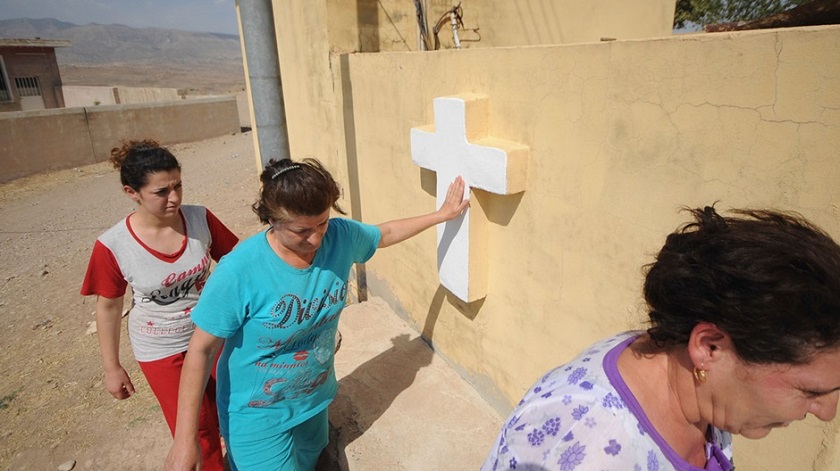
KD Christian refugee

Coordinated with US airstrikes, Kurdish Peshmerga forces have begun to reclaim villages overrun by ISIS. But many displaced Christians in Erbil, the Kurdish Iraqi city which has received hundreds of thousands of refugees, have little confidence to return.

‘I don’t want to go back to the same neighbors who betrayed me,’ a roughly 60 year old blind man from Nineveh told Revd. Fawzi Khalil. ‘They surrendered me to the terrorists.’

Khalil is the director of relief ministries at Kasr el-Dobara Church in Cairo, Egypt, and is part of the church’s efforts to deliver much needed aid. He has spoken to dozens of individuals with similar stories; names and faces begin to blend together.

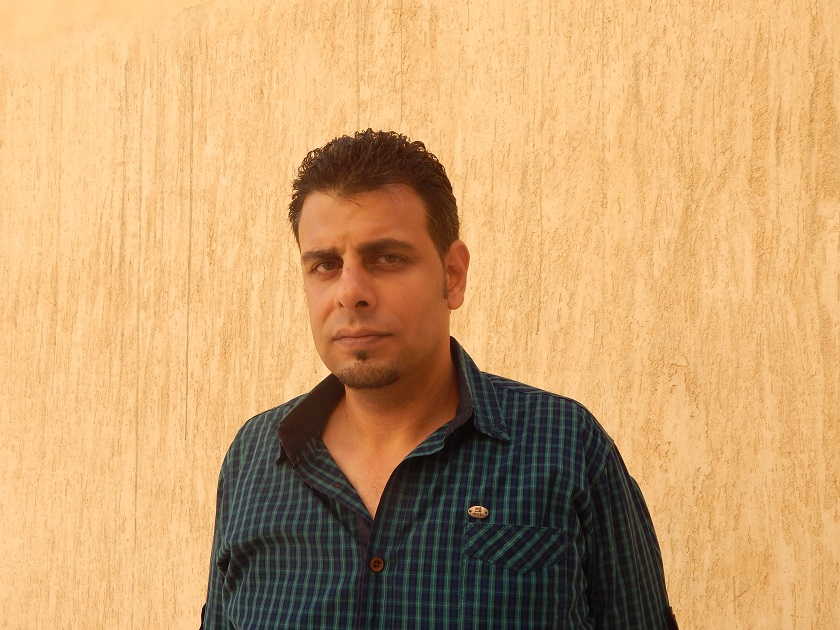
The man in the photo above is the blind man, supplied by Rev. Khalil. It is amazing to have met so many with such terrible stories.
KD Erbil refugees

Khalil explained that the majority Chaldean Catholic Church of Ankawa has done an excellent job of caring for Christian refugees. Erbil’s population includes roughly 160,000 Christians, and many have taken in their religious brethren.

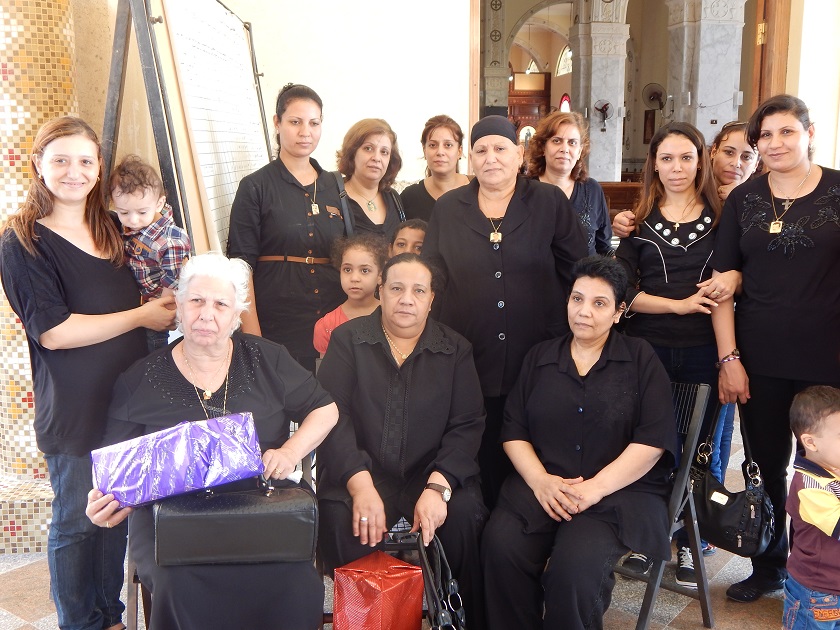
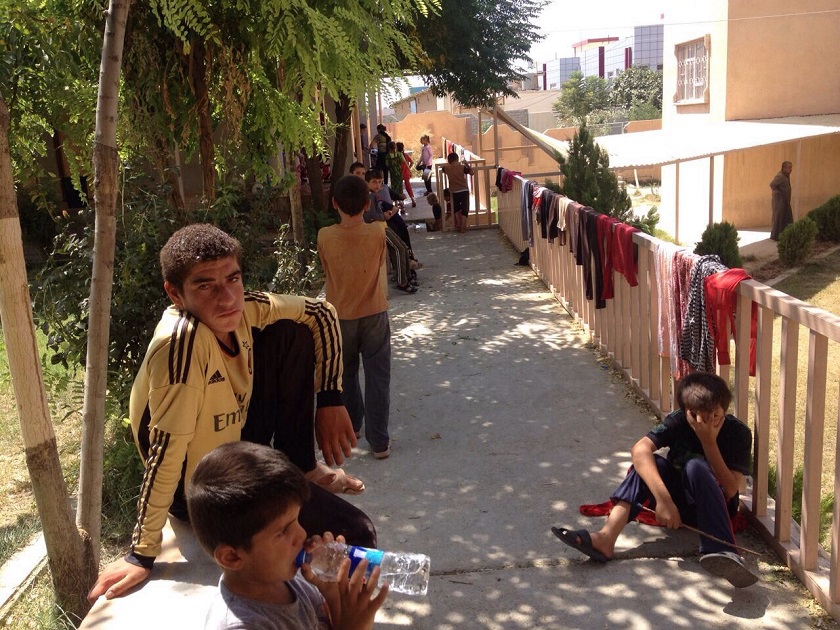
As a consequence Erbil’s churches are packed, and the Mar Eliya refugee camp is located on the grounds of the church-run school. Nearby Mar Yousef camp is in a church itself, and hosts mostly Muslims and Yazidis.

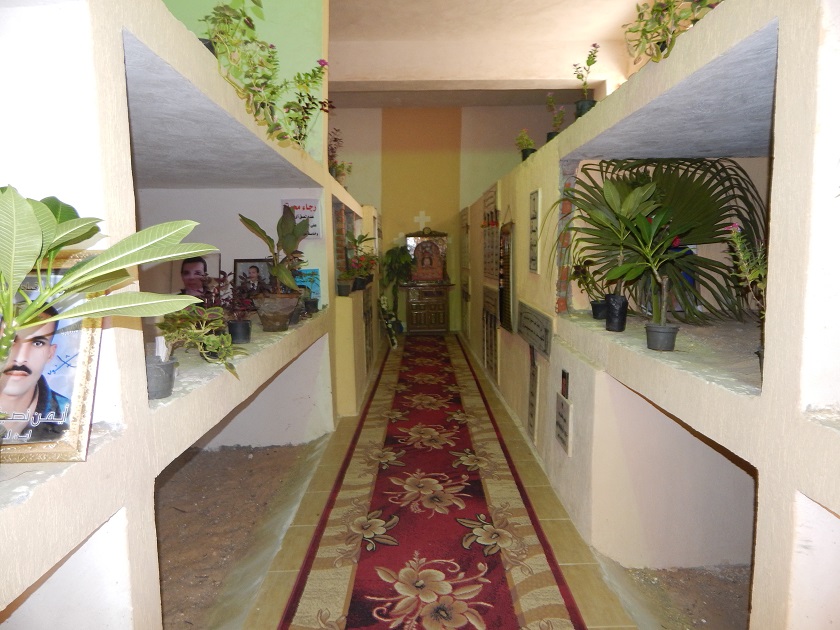
The photo above, also from Khalil, pictures what these campgrounds are like. People and their scant belongings sit around idly. I was surprised by how green the area is. But from another photo, not all refugees are so fortunate:

SAT7 refugee camp

This photo is from SAT-7, whose Ehab el-Kharrat was quoted extensively in the original article. Many campgrounds are located in the desert, and according to Eva Boutros, who was also interviewed, many have inadequate water supplies. Dozens of children gathered around a sole faucet, she witnessed, trying to get clean.

But Boutros also told a story of other children, who enjoyed with her relief team a special break from the agony of refugee life:

One of the Christian refugees is named Soha. Age 22, she graduated from university and was looking forward to her new job in Mosul before the ISIS onslaught. Now she must care for her brother’s three children who have been separated from their mother.

‘Now, all I have is a mattress, a donated plate of food, and two pairs of clothing,’ she told Eva Boutros. ‘This is the end of my youth.’

Boutros is the director of volunteer ministry for Kasr el-Dobara, but accompanied a joint Orthodox-Catholic-Protestant team organized by the Chaldean Church in Heliopolis, Cairo.

This team brought tents, medical supplies, blankets, and children’s underwear, all donated by Egyptian companies.

But Boutros recognized many of the refugees needed something more, and took 280 young women, including Soha, shopping at the local mall.

‘It was fun for us, and fun for them,’ she said, describing a moment of happiness amid a desperate situation.

Perhaps her woman’s touch gives her greater memory for personal detail, as opposed to Khalil. But she praises a different source.

‘I remember each person, their face and their story,’ she said. ‘The Lord sent us to tell them, we are suffering with you.

‘They need you to hug them, stay with them, and listen, listen, listen.’ Kasr el-Dobara’s team included a professional psychiatrist, who spent hours counseling women and children in their trauma. Childcare specialists did their best to entertain the kids each evening.

Finally, here is an amateur video made by the Kasr el-Dobara team, showing their team in action and giving thanks to those who have donated.

Categories
Arab West Report Middle East Published Articles

Musad Abul Fagr: The Bedouin in Egypt’s Constitutional Committee

Musad Abu Fagr

From my recent article at Arab West Report, continuing a series on the formation of Egypt’s constitution:

By self-description, Mus’ad Abū al-Fajr really wasn’t that important. In almost every categorization he was in the minority. But he also counts himself a ‘son of the revolution’ and fully worthy. And as a Bedouin, his participation in Egypt’s constitutional Committee of Fifty was itself one of its greatest accomplishments.

Selected as a ‘general personality’ independent of any institution, Abū al-Fajr isn’t sure why he was chosen. But he is confident it is linked to his status as a revolutionary from Sinai, active in protest in public squares since 2004. From 2007-2010 he was jailed on charges of ‘inciting riots’, and was released only a few months before the January 25 revolution. He immediately joined in on the National Movement for Change, found himself active in Tahrir Square, eventually became part of the National Salvation Front, and then worked on behalf of Tamarod to depose Muhammad Mursī.

But there were many revolutionary candidates to choose from for inclusion in the Committee of Fifty, so it was his status as a Bedouin that stood out. Therefore from the moment of his inclusion Abū al-Fajr considered that the region of Sinai was going to win at least a minimum of its rights. He knew that if he would withdraw from the committee – along with Hajāj Udūl of Nubia, with whom he cooperated extensively – it would cost the project much credibility and the symbolic vote of their regions. The task, then, was to achieve more, not just for the Sinai but for the people, for whom Abū Fajr described himself as continually defending.

Here is the gain:

His primary achievement, Article 236, represented the minimum. Treating Sinai along with the underdeveloped border areas of Nubia, Matrouh, and Upper Egypt, it promises a ‘comprehensive economic and urban development’ with ‘participation of the residents’. These are promised the ‘priority in benefiting from them’ in a manner that takes into account ‘the cultural and environmental patterns’ of each area. Ten years is given as the limit, with the law to spell out the particulars.

And here is why it wasn’t more:

But in fact, Sinai was to be mentioned more frequently. It was to be in the preamble, in the articles on cultural diversity, and those preventing discrimination based on geography. It was not the writing committee that played the chief role in removing it, he says, but direct pressure from the military seeking support for its own controversial article.

Abū al-Fajr described this as Article 204 on the military trial of civilians. He says he could have achieved more for Sinai had he simply agreed to it. He judges this from his experience in the work and discussions of the committee, but stood against it nonetheless. Besides himself, only five others voted to reject the article in the end.

Most of those interviewed described a few setbacks here and there, but were very positive about the document as a whole. Abul Fagr’s reaction is unique:

And the end result is a constitution he is happy with, recognizes a few flaws, but yet does not consider a revolutionary document, and is ultimately not worthy of Egypt. He does not even believe it will last.

Please click here to read the full article at Arab West Report.

Categories
Current Events

Do Egyptians Support ISIS? How about the Brotherhood?

Estimates say the number of Egyptian recruits in ISIS equal 8,000, perhaps 20-30 percent of their fighting force. A report indicates ISIS is in direct communication with Sinai-based terrorist groups to train in creating cells to attack security personnel.

But while some say the ISIS mentality is present among Egyptians, especially in Upper Egypt, there has been little quantifiable data to go by.

A recent poll published by the New Republic, relying on surveying efforts by the Fikra Forum, finds only three percent of Egyptians have a favorable opinion of ISIS. By contrast, and also noteworthy, 35 percent support the Muslim Brotherhood.

A few observations: First, three percent of 90 million people is still a very large number. How might you feel if your neighbor was one of the 2.7 million?

Second, the Egyptian government purports a link between groups like ISIS and the Muslim Brotherhood. Whether or not this is true operationally, on the ground there is a huge contrast. The great majority of Brotherhood supporters do not find common cause with the jihadis of Syria and Iraq.

Third, the common Western assertion is that Egypt following the coup is a polarized society divided against itself, while the common Egyptian assertion is that the country is united against the Muslim Brotherhood. This finding, if correct, undermines both claims.

If a full one-third of society rejects the political system, the claimed unity is an illusion that ignores or purposefully downplays a palpable frustration. On the other hand, if only one-third of an electorate opposes the majority political view, evidence is lent to the argument that Egypt was and still is greatly behind the June 30 revolution and the danger posed by Brotherhood leadership.

Of course, even here caution is needed. Some may have supported the removal of Morsi but still see the Muslim Brotherhood as an essentially good organization, serving society. And others may hold strong objections to the ideology of the Brotherhood yet believe they are still treated unfairly. The polling data released is not specific enough to nuance beyond the larger percentages.

But the percentages are significant even so. Egypt is mostly against the Brotherhood, and almost entirely against ISIS. The troubles lie in the many real people covered over by a minority statistic.

Important note: H.A. Hellyer, who has extensive experience in following Egyptian survey organizations and urges caution about their general reliability, does not recognize the Fikra Forum as a polling center.

Categories
Prayers

Friday Prayers for Egypt: Open, Closed, and Outlawed

Flag Cross Quran

God,

After a long delay, Egypt’s universities opened again, and with it a renewal of student protests.

After a long tenure, the Carter Center closed its Egypt operations, claiming the nation was unlikely to move toward democratic governance.

And after a long tolerance, the government formally outlawed the National Alliance to Support Legitimacy, the mostly Islamist effort to return President Morsi to power.

Weigh each step, God, and judge accordingly. The general rhetoric is well known and oft-repeated, but help each measure to be understood in turn.

Provide for students a good education, inclusive of political consciousness. But may the antics of some not disturb the studies of all.

Honor the Carter Center for their work these past three years in critiquing Egypt’s political state. But raise up others who can provide respected assessment of coming parliamentary elections.

And with the NASL, all that exists is the general rhetoric: Establish the truth within competing narratives.

God, give wisdom to the leaders, discernment to the people, and resolute integrity to all.

Egypt has long awaited good, efficient, and honest operation, God. In school, in elections, and in opposition, may all three be witnessed soon.

Amen.


Categories
Personal

More from the Maspero Memorial: Video, Pictures, and Anecdotes

On October 10, it was quite an adventure simply to get to the memorial service for the martyrs of Maspero. ‘The church in 6 October City,’ is what both people and press related, and Google Maps said there is only one, downtown. 6 October City is also one of Cairo’s satellite cities, and thus not very easy to access.

But the name of the church – St. Michael’s – did not match the name of the church on Google. I was faced with the choice of having to taxi out and hope it was correct, which would be quite expensive, or discover the routes of public transportation, which would take me downtown and then leave me there. In either case I was not confident the only church in town was the right one.

Wael Saber
Wael Saber

In the end I contacted Wael Saber, described in my earlier article as one of the spokesmen for the Union of the Families of Maspero Martyrs (UFMM), to try and double-check the location of the memorial service. He proposed a solution without which I would have been completely lost. I could meet him at 7:30am in downtown Cairo, where he was arranging a bus to transport dozens of relatives.

Within the controversy described in the article, this bus was good evidence that Saber is indeed appreciated by at least many relatives as the spokesman of the group. More below will contest that claim, but as we weaved out of Cairo and through the expanse of land on the way to 6 October City, we did not quite reach it. Instead the bus veered to the left, out into the desert.

I had no idea where we were headed, but I’m glad I searched Google thoroughly looking for a second church. I did not find one, but on the outskirts of town was a new cemetery, and it quickly became clear we were now driving through it.

The sign reads: Cemeteries of St. Michael, 6 October City. The vast gray expanse behind are the Muslim graves.

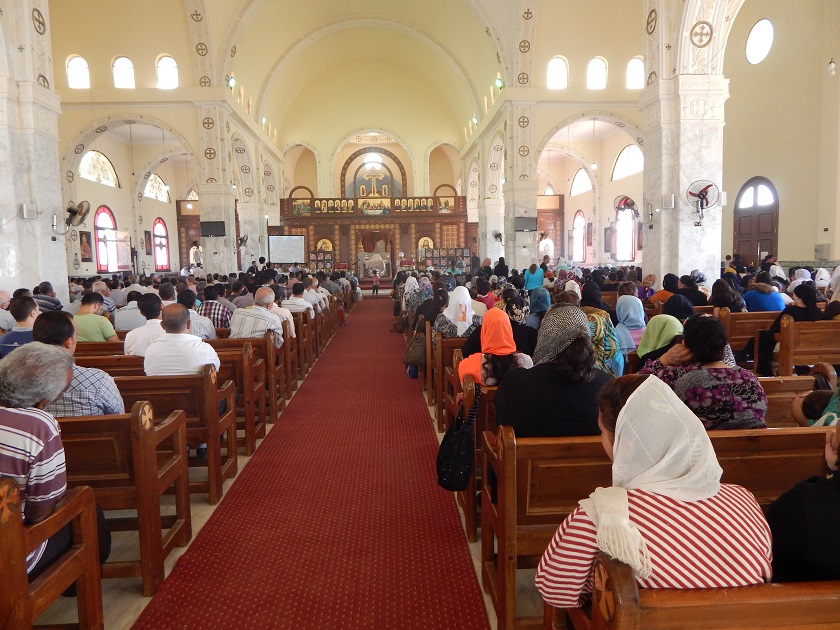
The majority of the mausoleum structures were clearly for Muslims, but as we drove through to the back of the cemetery a huge church rose up above the whole area. It was odd to see the massive structure with no comparable mosque nearby. Later, a church employee told me the size was necessary to hold mourners for the funerals held here, especially given that the remains of the martyrs of Maspero often attract a crowd. The church does hold regular mass, he also said, but busses in the worshipers from surrounding areas.

St. Michael's Church. The sign to the bottom left says 'Come to me', with Jesus speaking to Maspero martyrs.
St. Michael’s Church. The sign to the bottom left says ‘Come to me’, with Jesus speaking to Maspero martyrs.

I spoke with him outside the crypt holding the remains not only of the Maspero dead, but also those killed in an earlier attack on a church in Imbaba, Cairo, as well as those killed in a later drive-by shooting during a wedding in the Cairo neighborhood of Warraq. The church was built in 2011, and Saber told me he has papers stating church leadership will rename it to the Church of St. Michael and the Maspero Martyrs.

Inside the crypt of the Maspero martyrs. One must remove shoes before entering.
The plaque reads: The Martyrs of Maspero, with a date of October 10, 2011. One relative explained it is the 10th because that is when the autopsies were finalized, though the massacre took place on the 9th. The phrase above says: Their bodies are buried in peace, and their names live throughout the generations.
The plaque reads: The Martyrs of Maspero, with a date of October 10, 2011. One relative explained it is the 10th because that is when the autopsies were finalized, though the massacre took place on the 9th. The phrase above says: Their bodies are buried in peace, and their names live throughout the generations. Honored below are Nassif Ragi, Michael, Musad, and Wael Mikha’il.

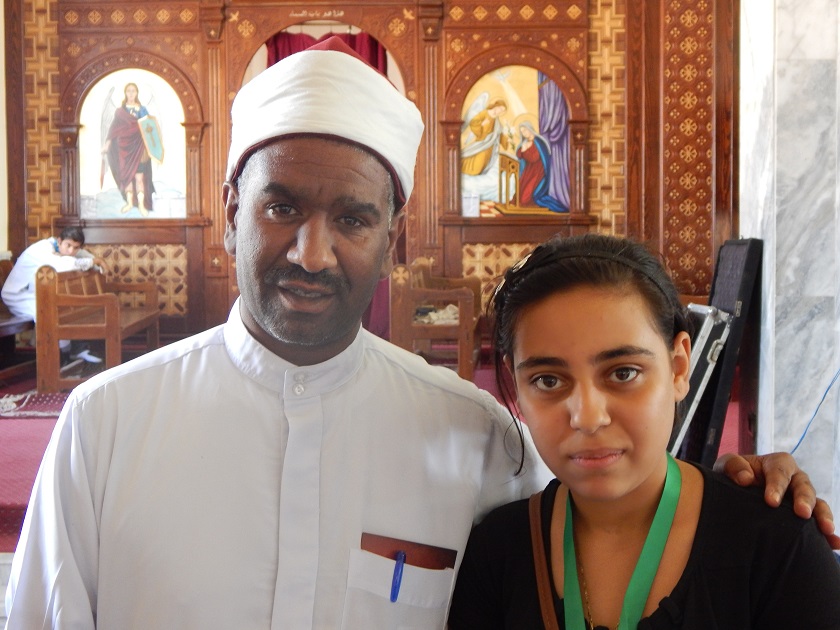
It has been a difficult three years for Egypt’s Christians, but also for her Muslims. At the end of the mass I spoke with Sheikh Ahmed Saber, who is the imam of a mosque near the Maspero Radio and Television building, the epicenter of the Coptic protests and the site of the eventual massacre. Over the course of time he has become a friend – first to the activists, later to the families – and was keen to be present at the memorial service.

Ahmed Saber, with one of the younger relatives of the deceased.

Unfortunately, he did not have much to say about the course of justice, preferring to make non-politicized statements. Perhaps this was wise – it just wasn’t useful for my article. But he also stated he was there in a personal capacity, not representing the Azhar institution despite his clerical garb. But it was acceptable the Azhar was not there, he said, for the church and Azhar agree upon 99 percent – which is citizenship, human rights, and social justice – and disagree about only 1 percent – doctrine.

Therefore, he said, having official church representatives was the same as having Azhar representatives.

Except, the official church representatives did not come either. Earlier it had been stated that the influential bishops of Central Cairo and Giza would be in attendance, but at the last moment they excused themselves due to travel necessities. This seemed odd to me, but none of the Copts I spoke with were troubled by it, stating both were present at the 2nd memorial service a year earlier. Having now lived long in Egypt my mind flirted with the conspiratorial, but there was nothing to latch on to, so it also escaped my article.

Another interesting comment from the sheikh was in relating an earlier conversation between St. Anthony and St. Boula, two of Egypt’s earliest monks. St. Anthony instructed him that Copts should pray first for the Nile, then for the ruler, and then for the patriarch. Sheikh Saber found this to be an example of wisdom, and elaborated upon it while quoting several Bible verses. He was certainly a unique individual. Muslims often attend special services in the church as welcome visiting dignitaries, but are invited or allowed to leave midway through before the serving of communion. Sheikh Saber remained politely the entire time.

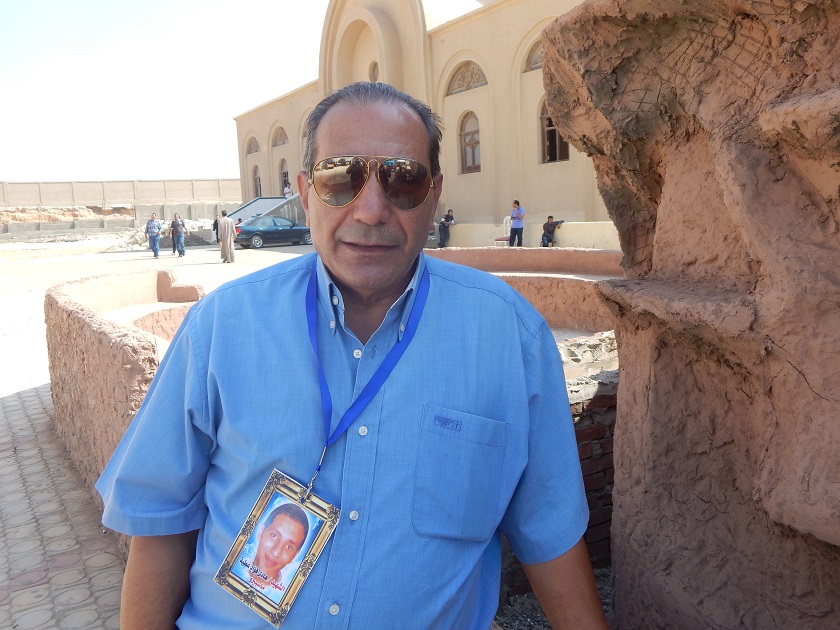
Fuad Attiya
Fuad Attiya

Afterwards I did my best to interview as many family members as I could. Wael Saber’s contact was given to me by one side of the activist division, Fuad Attiya by the other. The activist told me Attiya represented 14 of the martyr families, and that Saber was supported by only three or four. The following needed to be cut from my article due to word limit, and I didn’t mind as I felt the back-and-forth exchange of accusations was becoming petty. But it is nonetheless insightful:

The three UFMM spokesmen were appointed by the families as they were the most active relatives working on their behalf, Saber said. This testimony was confirmed with others at the memorial service and was evidenced by a busload of relatives for whom he arranged transportation.

But not by all. Fuad Attiya is the 69 year old father of Hady, his 22 year old son killed by gunshot in the demonstration. He invited the MYU to attend the church memorial service.

‘There is no Union [speaking of the UFMM],’ he told Lapido Media. ‘No one speaks on behalf of the Maspero martyrs. This is a lie.’

Another relative told me Attiya provided for the light snacks shared by the martyrs’ families after the service. Perhaps this is not as strong an indication of support as the bus provided by Saber, but he did appear a respected senior figure to those I spoke with, including Saber. Attiya, however, did not confirm the ‘14 families’ idea spoken of by the activist, but he clearly was not happy with Saber’s assumption of leadership.

But following the commemorative funeral procession shown above, quarrels broke out here and there between the various parties. It was not long thereafter the MYU activists decided to leave. I wondered if they had been asked to. Here is another segment of the article that needed to be cut:

Mina Magdy, general coordinator of the MYU agreed with Gaziri it was a day for the martyrs. They attended the memorial mass to express condolences, and left shortly after it ended. He is saddened by the accusations against the group and explained they have spent countless hours with Saber and the families to demonstrate their innocence.

He believes lies have been told by the media to harm their organization, and many of the families have been taken in. He also thinks Saber is jealous of the MYU’s political influence, something he wants for himself.

Saber admits he will represent the UFMM not just in matters pertaining to the justice of their case, but also as citizens about the affairs of the nation. He announced their participation in the June 30 protests that led to the military-backed overthrow of former President Mohamed Morsi, for example.

Magdy made it clear to me they were not attending the mass to attract attention to themselves as an organization, but to participate in an event that devastated them as well. They left of their own decision, he said, so as to leave the focus of the day for the families, even though both Attiya and the priests conducting the service asked them to stay.

Relatives of the martyrs, dressed in black.
Attendance at the memorial mass

I have known the activists of the Maspero Youth Union for a long time, and it is difficult for me to believe they have profited off the names of the martyrs. In human nature, however, anything is possible, and Magdy spoke of the privacy of the organization when I asked if I could review their financial records. He assured me, though, that they have shown bank reports and other evidence to the families. He will accompany them to court if any produce evidence of wrongdoing by any in the MYU, but so far no one has.

Youssef Sidhom, quoted in the article, also stated that when his newspaper collects donations it makes them public and details the expenditures, so that all is done in full transparency. Unfortunately, many in Egypt’s activist spectrum – from the Muslim Brotherhood at one end to the Maspero Youth Union on the other – operate outside the structures of oversight and keep all their financial dealings in-house. Mina Thabet told me the donations the MYU helped solicit were processed through a certain priest, so there is a channel to follow up with these investigations.

Wael Saber also stated that in order to cut out the ‘middle man’ of the MYU and others he printed with permission the phone numbers of every activist family, so anyone who wanted to help could do so directly. Here also is a channel to follow up on the counter-accusations that he is an opportunist. The families can be asked about him directly, which he invited me to do.

But the whole matter is sad. Certainly if there is fraud, this is sadder still. And if Saber and others are deliberately marring the reputation of the MYU then this also deserves condemnation.

There is that within me that wants to get at the truth of the story, motivated by a desire that a better understanding might overcome this animosity – or perhaps prove the worthiness thereof. But even the telling of the divisions I hope has a small impact on showing this ugly face to the activists and families themselves. The death of these 27 individuals was a tragedy; it deepens in sorrow with the witness of infighting.

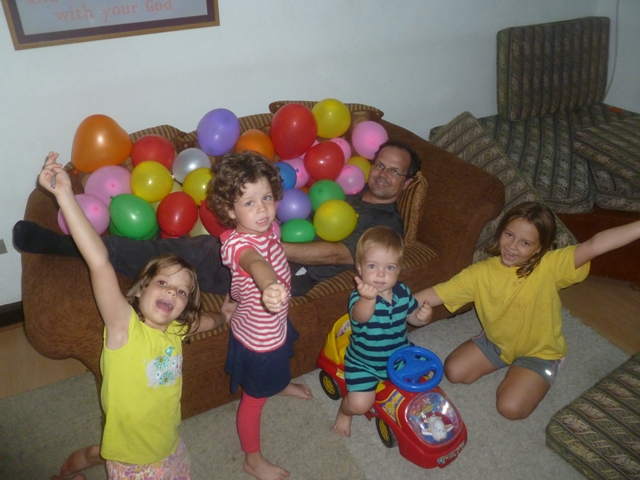
October 10 was also my birthday. After the melancholy experience I returned home and was received by my own family which does not suffer from so much division. Of course in comparison we have hardly suffered at all.

40 Balloons

But as my children covered me with 40 balloons, I was reminded of the good gift of unity in a community of love. The bulk of my day was unsettling; the ending repaired all harm. I pray Egypt might receive a similar experience soon.

Categories
Lapido Media Middle East Published Articles

Infighting Between Coptic Groups Not Helping Maspero Justice Campaign

Regla Gamal
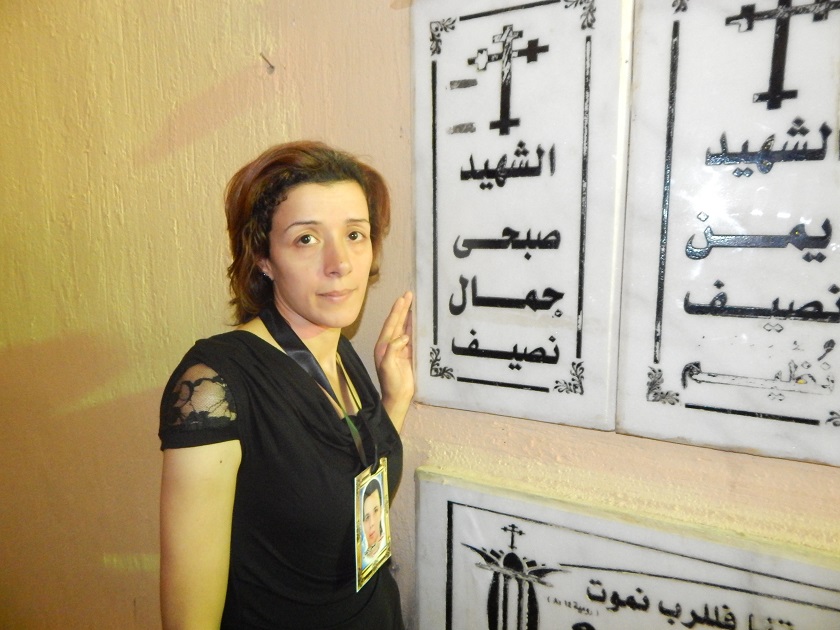
Regla Gamal, standing next to her brother’s memorial plaque, translated: The martyr, Subhi Gamal Nassif

Three years after Maspero and Regla Gamal is still wearing black.

On 9 October 2011 her 26-year-old brother, Subhi, was shot dead during a mostly Coptic demonstration in what became known as the Maspero massacre.

Twenty seven Egyptian Christians were killed by the army as thousands protested against attacks on their churches, the majority crushed under the wheels of swerving military vehicles.

To date only three lower ranking soldiers have been convicted, each being sentenced to between two to three years in prison. Despite the best efforts at justice by Coptic activists and relatives of the victims, their differences have led to infighting that is hindering their cause.

‘These are clothes of mourning,’ Gamal, 39, told Lapido Media. ‘I will not stop wearing black until justice comes and those responsible are judged.’

Egyptian tradition dictates female relatives of the deceased wear black for a period of 40 days, up to a maximum of one year. But at the memorial service held in the Cairo church where their remains are interred, most of the women among those now known as ‘the families of the martyrs’ were similarly dressed.

The night of the massacre Wael Saber, one of three official spokespeople for the Union of the Families of Maspero Martyrs (UFMM), watched horrified as his brother Ayman was hit by an army personnel carrier.

‘The state has dragged its feet,’ he told Lapido Media. ‘We demand transparency and justice, and will not be silent in front of their blood.’

Purposefully silent, however, were the mostly Coptic activists of the Maspero Youth Union (MYU). Formed in solidarity with Egypt’s revolution, they called for the march that ended in tragedy. To mark the anniversary the MYU braved Egypt’s current security crackdown with a candlelight vigil.

Sympathisers

Dozens of sympathisers gathered, but included only two relatives of those slain.

This is because the UFMM was formed in response to the MYU and other activists speaking in the name of the victims’ families and soliciting donations on their behalf, Saber explained.

Fady Yousef, president of the Coalition of Egypt’s Copts called the MYU a ‘corrupt entity’.

‘They are not loved because they have made profit off their blood,’ he said, referring to money raised by MYU that didn’t reach families of the victims.

Mina Magdy, a spokesman for MYU, denied any wrongdoing, stating they have spent countless hours with Saber and the families to demonstrate their innocence.

One of the founding members of MYU, Mina Thabet, attributes the discord to the corrupt media. ‘The regime depends on people repeating the same accusations [against activists] over and over until they believe it, and this is what is happening,’ he said.

Bickering

But the bickering between activists and families carried over into the memorial service, attended by busloads of relatives. The hubbub and media show offended many.

‘Ninety per cent of those here today have come to be seen and to have their picture taken,’ complained Wagdi Gamal, Regla’s brother.

Veteran Coptic activist Hany el-Gezery was there and also criticized the MYU. ‘They want to be a hero and to show they exist,’ he said. ‘But in this case the only voice that counts is of the families of the martyrs.’

Political father to many of the activists, Gezery recently dissolved his own Coptic movement to merge more fully into the national effort to support the current president, Abdel Fattah al-Sisi. But he wants the former top brass held accountable.

‘I saw General Hamdy Badeen [Egypt’s former head of military police] with my own eyes, standing there as it began,’ he told Lapido Media. ‘I accuse him directly.’

During the candlelight vigil, some protestors held a banner with Badeen’s picture, along with former leaders of the military council Generals Hussein Tantawi and Sami Anan, quietly calling for justice. President Sisi, though director of military intelligence at the time, was not mentioned.

That is, until unaffiliated youth arrived and began chanting against him, calling for the end of military rule. The MYU got them to quickly quiet down and shortly afterwards ended the protest.

Saber, Gezery, and Magdy are all critical of the government for delaying attention to Coptic issues, but so far do not hold Sisi personally responsible.

‘Sentimental’

Youssef Sidhom, editor-in-chief of the leading Coptic newspaper Watani, notes that most Copts are still being patient with the new president, and believes it is a ‘sentimental’ accusation that activists accuse the former top officials without sufficient evidence.

The MYU did solicit donations, he recognizes, but knows of no lawsuit leveled against them for fraud.

Similar to both activists and families, however, he wants the Maspero case to reopen.

Until then, Regla Gamal will continue to wear black.

‘We have no hostility toward the army, but we want the case to reopen and if the military leaders are guilty they must be judged,’ she said.

‘Why this hasn’t happened yet we don’t know.’


This article was originally published at Lapido Media on October 15, 2014.

Categories
Christianity Today Middle East Published Articles

Facing ISIS, Middle Eastern Evangelicals Exchange Strategies

Christian refugees from Mosul find a home in Merga Souva Iraq. -- Gail Orenstein / AP Images
Christian refugees from Mosul find a home in Merga Souva Iraq. — Gail Orenstein / AP Images

From my article at Christianity Today, published October 14, 2014:

“God is allowing ISIS to expose Islam,” said Khalil’s fellow pastor, Atef Samy. “They are its true face, showing what Islam is like whenever it comes to power.”

But the savagery of ISIS, which has overwhelmed Kurdistan with more than 850,000 refugees, has prompted other Middle Eastern Christians to embrace their Muslim neighbors. This theme was heard often from members of the Fellowship of Middle Eastern Evangelical Churches (FMEEC), who met in Cairo last month for a conference on the dwindling Christian presence in the region.

“We must be a voice for Islam,” said Munib Younan, bishop of the Evangelical Lutheran Church in Jordan and the Holy Land. “We must not allow the West to see ISIS, the Muslim Brotherhood, or others like them as the face of Islam.”

Others were more reflective of the diversity among both Muslims and non-Muslims.

The article opens with a brief description of an evangelical relief trip to help refugees in Kurdistan, which I also wrote about here. It also describes cooperation attempts in the Egyptian Family House, uniting Muslims and Christians, which I hope to profile in a few days. There are other strategies described by those who attended a recent conference in Cairo, whose opinions on US-led military action I wrote about here.

But please click here to read the full article at Christianity Today.


Categories
Excerpts

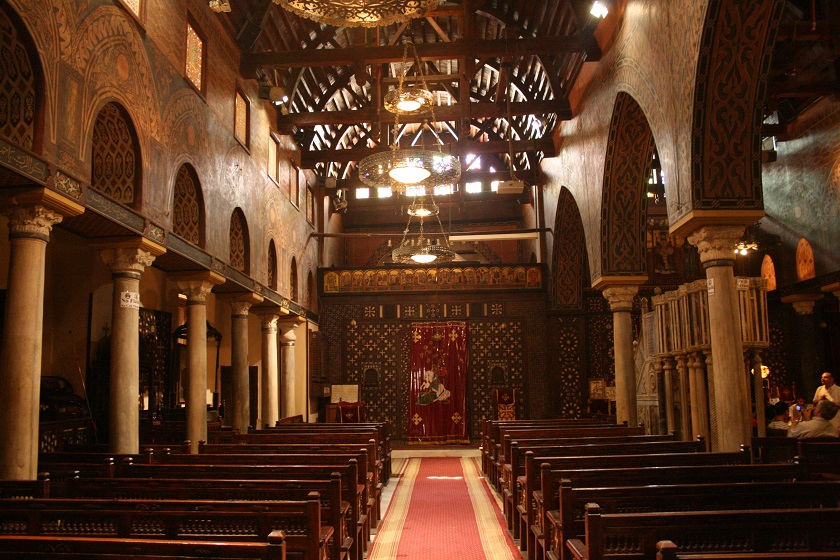
Ancient Egyptian Church Renovated

Hanging Church

It is often said of Egypt that it is impossible to build or repair a church without presidential permission, even simply to fix a toilet or change a light bulb. There are historical reasons for this statement and contemporary examples of the difficulty.

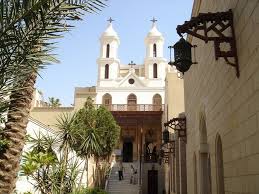
But this article in Ahram Online celebrates the full reopening of the 4th Century ‘Hanging Church’, following sixteen years of renovation.

Work was carried out under the supervision of the Ministry of Antiquities with a $14 million budget.

He explained that the restoration work was carried out in three phases to reduce water leakage and strengthen the church’s foundations and the Babylon fortress located beneath it, to protect them from potential future damage. The walls were reinforced, missing and decayed stones were replaced and masonry cleaned and desalinated. The decorations and icons of the church were also subject to fine restoration in collaboration with Russian experts. New lighting and ventilation systems have also been installed.

Located in a heavily populated area, says Wadallah Mohamed, assistant of the head of the projects section at the ministry, the Hanging Church was suffering from environmental hazards including air pollution, a high subsoil water level, a high rate of humidity, and leakage of water from the outdated and a decayed 100-year-old sewage system. Other damage included decorations of the church’s wooden ceiling being stained with smoke and the impact of the 1992 earthquake, which resulted in cracks in the church’s walls and foundations.

“The church is now safe and sound and its restoration was carried out according to the latest technology,” asserted Mohamed.

The church was beautiful before the renovation, I look forward to visiting it now. It is located next to the Coptic Museum, which also has opened recently after a long period of repair.

This news should not let Egypt off the hook for its record in facilitating church construction. A high profile worship site and tourist attraction is far different from some church in an obscure village. It should be said, however, that obscure village churches are often built in a style far more grandiose than local need might warrant. It should also be said, further, that once a church is built, a mosque springs up next to it, so that local Christians will call it ‘the church’s mosque’. There is often a competition over height; both religious adherents often prize the building for its social statement over its functional purpose.

But this requires a full and separate analysis. For now, simply celebrate that Egypt has cooperated to repair a grand church together – toilet, light bulb, and all.

Hanging Church Outside

Here is the message given on the occasion by church and government official figures, as related by Paul Attallah:

Pope Tawadros II gave three messages on this occasion:

First message: A message of gratitude towards our ancestors who built this church on the Roman Babylon Fortress ruins.

The second message is a “promise” to all Egyptians: Egypt is a museum of civilization and history. Each archeological spot is a jewel. We need to be aware about this richness to rejoice and to preserve our monuments.

The third message is a peace message given from this place thanks to the State efforts to deliver a message of peace to the whole world that everyone can coexists in peace. In fact, Egypt is carrying a part of all religions.

The religions don’t exist for rivalry but for peace, and when we begin our celebration with the national anthem it gives a model to the whole world that we can live in peace in the middle of an region full of conflicts and violence. But in Egypt we provide a model and example of religions coexistence.

The Egyptian Prime Minister gave a speech: I remember Pope Shenouda III saying: Egypt our homeland lives in us. It gathers people and don’t divide them. It’s a country which knows love and peace and never give up. Look to the whole region: as long as we are united we will not be scared and we will build our country.


Categories
Prayers

Friday Prayers for Egypt: Remembering Maspero

Flag Cross Quran

God,

It is hard to judge the weight of Maspero on the conscience of the nation. Three years ago 27 Copts were killed while demonstrating, some by gunshot, some by the weight of military vehicles which plowed through the crowd.

This week the anniversary was commemorated by a small protest in downtown Cairo, and a small memorial at the church which houses their remains. The families of those killed call for justice, unsatisfied with the minor sentences given to three lower ranking soldiers.

Maspero marked the first blood shed by the army; whether by army or police much more has followed. To date, few have been held accountable, by any of Egypt’s successive regimes.

God, comfort the families of all who lost loved ones, but especially those on this anniversary. Comfort soon those others on the many anniversaries to come.

But comfort is cold without justice, God. You know those guilty, as well as their degree of guilt. Share this information with the people, to balance appropriately between mercy and judgment, between forgiveness and retribution.

For much of the nation has reconciled already with the military, relegating the sins of the past to the past. Others find aplenty the sins of the present.

Will the sins of the future come through ignoring this blood? Without proper rendering, will more blood flow?

Touch the conscience of the nation, God, that all might remember. Touch the conscience of the leaders, that investigations would be transparent. Touch the conscience of the guilty, that they might confess.

And with a healthy conscience, God, may Egypt heal. May Maspero – with all other blood – leave no permanent stain.

Amen.


Categories
Personal

Poverty and Politics in Ezbat al-Haggana

As Egypt considers its coming parliament, discussed among pundits and politicians alike, actual voting power lies far off the beaten track in slums such as Ezbat al-Haggana. Nagwa Raouf, founder of the House of Blessing local charity, says two million people live there.

“We have told the people, ‘Do not sell your vote, it is your dignity’,” she stated, but the call goes on deaf ears. During the 2012 presidential campaign, Ahmad Shafiq and Amr Moussa offered the equivalent of US $0.83 to cast a ballot on their behalf.

Islamist groups which had been active in Ezbat al-Haggana did not sell their vote, Raouf explained, though she was not happy with them either.

“The Muslim Brotherhood has worked with the people for eighty years, giving them money, clothes, and meals for Ramadan,” she stated. “But what have they done to uplift the people?

“Salafis are the same but worse, as they are close minded.”

In an area where the majority live below the poverty line, Raouf sought out a neighborhood Muslim imam to sanction a unique, if cynical, solution.

“With the sheikh we agreed to tell them to take the money, but then go and vote for someone else,” she said.

Ezbat al-Haggana is located in northeast Cairo, off the ring road, not far from high class developments built away from the downtown. With no housing provided, Upper Egyptians looking for work erected a shanty town not far from construction.

According to Raouf, thirty years ago Egypt’s Border Guard sold the Haggana land to its officers, who in turn sold it to local residents. It took twenty years for the government to provide local sewage and electrical service.

Despite the evident poverty, construction is booming, especially after the revolution. Local regulations forbid apartments from going over four floors, but this is widely disregarded. Contractors from outside the area make a partnership with land owners, offering to build additional apartments upon their one floor home. Contractor and owner split the floors, which in turn are sold or rented to others.

Or, perhaps, they are kept in family. It is common for 15-20 people to live in a single home, as migration trends from Upper Egypt dictate families live together, and near to neighbors of the same region. Though Haggana divides informally its sub-districts by native origin – Asyut, Minya, Sohag, etc – Muslims and Christians are intermingled along the same pattern.

Likewise, religious relations follow the Egyptian pattern. Raouf states that Muslims and Christians are fine neighbors, but the problem of church building traveled with the migrants.

There is one official, licensed church in Ezbat al-Haggana, but several unofficial meetings in family homes. Next to one of these someone recently erected an unlicensed mosque.

Local Muslims, Raouf explains, welcome Christian worship – but to a point. They know full well that services are conducted by their neighbors and have no objection. Problems begin when Copts seek to transform the exterior of their building to reflect formal church architecture. Muslims feel their allowance has been betrayed, while Christians feel their identity is denied by the refusal of official permissions. Fortunately, Haggana’s community leaders have had the wisdom to avoid stoking tensions in this area.

It is these community leaders who guard its people against outsiders, which can make even charity work difficult.

“First you have to love,” said Raouf. “Then you have to get to know them, then trust them, then win their confidence, and then finally you can help.”

Raouf’s House of Blessing succeeded by first working through an already established NGO, The Mountain of Mercy. She asked workers there to recommend ten families who stood in dire need of improved housing. Interviewing them one by one, she looked for who could help themselves.

She settled on a family originally from Aswan who settled in Haggana thirty years earlier. Raouf noticed the woman of the household kept her children in school and carried potable water to her home each day. She was industrious and principled.

The House of Blessing collected money from the Islamic zakat giving of family and friends. They demolished the woman’s home entirely and built for her and her family a two story dwelling, with a small shop attached to the outside. Half of the nearly US $6,000 project is paid by the charity, with the other paid by the family in the form of a no interest loan.

Raouf and the woman exchanged the warmest of greetings.

This type of fundraising is difficult in Egypt, however. To transform a nearby alleyway Raouf caught the attention of a Saudi Arabian television show, whose producer funded and filmed the construction of two complete buildings. Eight whole families were outfitted, benefitting over sixty people. Whereas many alleys in Haggana are stained by garbage or general disrepair, this one sported a dignified cement floor. Many months later, it was still in pristine condition.

“To change people you must change their home,” believes Raouf. “Before, people would look at this alley and say, ‘We are satisfied, should we go against what God has given us?’

“But God wants us to live well.”

Raouf believes residents should also live well politically. As she first benefitted from the reputation of others, she now lends her own to those who believe similarly. Before the fall of Morsi she assisted contact for the Muslim Brotherhood’s Freedom and Justice Party, the moderate Islamist Wasat Party, and the liberal Egyptian Social Democratic Party.

“I work with different political parties so that people can experience them and compare between them,” she stated.

On the occasion of the Muslim Eid al-Adha holiday, the Social Democrats were in town. They hosted a party and community dialogue on the process of writing a constitution. Held at a park outside of town, attendance was small.

“It is not a long term battle,” said Nancy Muneer, deputy director for the party in East Cairo, “but a very long term battle.”

No natural politician, Muneer has been working in areas like Ezbat al-Haggana since the 2011 revolution – but never before.

“My son joined the revolution, before which he had zero hope,” she said. “I am upper middle class but I can’t stand to see people eating garbage off the street. We have everything we need to live in a better way, we just need a system.”

Muneer is in charge of women and youth affairs in the party, and she has been transformed by the experience.

“I am involved because I love people and love Egypt. Many of us are like this,” she said. “It is very addictive, because you fall in love with these people. They are so simple, genuine, and humble.”

There are also so foreign to her world. Muneer’s experience underscores why liberals may have such difficulty in mobilizing the people. It is not necessarily that the poor of Ezbat al-Haggana are Islamist, ignorant, or easily swayed by religion. They are simply not known.

“We go to Gazira Club and City Stars,” she said, “but Ezbat al-Haggana is what real Egypt is like, and we don’t know it.”


Note: This article was originally written in 2012, but not published. I reviewing some of my older work I believe it is still very relevant to the Egyptian scene, even with the removal of many Islamist parties. The same political dynamics exist. Finally, at last contact, Mouneer is no longer working with the Social Democratic Party, having opted out of politics.

Categories
Excerpts

Why Does Egypt Suffer Power Cuts?

Power plant

Even into late September Cairo temperatures reached 100 degrees. Statistics show that 40 percent of energy demand comes from home consumption, and increased air conditioner use contributed to overloading the system.

The one complaint about a recent article at the Middle East Institute on the energy crisis is that it does not describe the ‘how’ of this overloading. That is, why does the power grid shut down in certain neighborhoods, at certain times, and for certain durations? Cairo residents complained of several outages a day over the summer, often lasting an hour at a time.

Were these planned and distributed? Was suffering experienced equally by neighborhood? These are fascinating questions for which I have not yet heard an answer.

But the article does a good job at giving the background to the energy crisis. If one is to be inconvenienced, it helps at the very least to understand why. Here is a brief summary of the main points:

1. From long before the revolution, the government estimated yearly increases at 10 percent, but the actual increases averaged 12 percent.

2. The government did increase its power generation capacity in response, so that by the end of 2013 it equaled 30,000 megawatts. But for near 90 million people this is still inadequate, especially when compared to the near 50 million populations of South Africa and South Korea, which produce 44,000 mw and 80,000 mw respectively.

3. The government anticipated energy growth would coincide with increased production of natural gas. Contracts were signed with international companies, but the 2011 revolution interrupted the ability to pay. Work stopped and production lagged.

4. The existing power grid was forced to work at full capacity to meet local demand, canceling scheduled periods of shutdown for regular maintenance. This contributed to a loss of efficiency and times of irregular shutdown.

5. The Ministry of Electricity has counted 300 acts of terrorism against electricity towers since the June 30, 2013 deposing of President Morsi. Similar accusations of sabotage were issued by the Morsi administration during its year in office.

The end result is that by the summer of 2014, Egypt’s power generation industry is operating at only 70 percent of capacity.

This information will help no one feel cooler in Egypt. Nor will it help anyone feel better about Egypt. The article also described current steps the Sisi government is taking to relieve the crisis; depending on your point of view this information may or may not be helpful either.

But at the least, we can be thankful it is now October.

Categories
Prayers

Friday Prayers for Egypt: Eid Threats

Flag Cross Quran

God,

The streets are quiet as Egyptian Muslims remember the sacrifice of Abraham. They slaughter a sheep, celebrate with family, and have three or four days to relax and enjoy.

Throughout the country there is calm, though some are trying to disrupt it.

Ansar Bait al-Maqdis, the foremost terrorist group operating out of the Sinai, has threatened to kill the interior minister during the eid holiday as part of its ongoing campaign against security forces.

The prayer is obvious, God. Foil their plans and avert their schemes. Bring to justice all who threaten the security of the nation.

But there are other threats as well, God. Eid congratulation banners have been hung outside mosques in Alexandria, giving good wishes from the Muslim Brotherhood.

It is just a banner, but it signals more. The Brotherhood has been outlawed and the state has sought to keep places of worship politics-free. The sign bears the phrase – ‘Come, let us truly love each other’ – but it is placed in the face of the regime.

God, let these words ring true. Acrimony has characterized many Egyptians this past year, as the political mixes with the religious. The Brotherhood calls for love, but they have demonized many. They in turn are now an object of scorn for millions beside.

Judge the politics, God, and hold accountable all who have poisoned it. Judge the religion, and honor those who honor you correctly.

But let the people love each other. Eid is a good reminder and practical example. Abraham and his son were nearly separated in pursuit of your will, but you intervened. A sacrifice preserved their family.

As the people slaughter their sheep, help them contemplate their own sacrifice, offered to you to preserve their nation. Much has been given, much more may still be required.

Give them a few days of quiet, God. But give them peace to celebrate, relax, and enjoy for much longer.

Amen.

Categories
Excerpts

The Case against Qatar

Qatar

A recent Foreign Policy investigative report details Qatari foreign policy. It describes a strategy of intervention-by-proxy, which keeps its hands clean officially while funneling money to groups it deems ideologically similar, that is, those they can trust.

Primarily, this has been the Muslim Brotherhood and various activist Salafi factions.

The article is long but worthy, and one interesting section describes how Qatar has helped the US disengage from the region. This was evident in Libya, when Qatar not only provided crucial Arab support for the operation, but also took the lead in sponsoring militia groups against Gaddafi.

But now that the US is reengaging the region, this time against the Islamic State (ISIS), officials are examining anew the sponsorship by Qatari individuals and charities which have gone to the al-Qaeda affiliated al-Nusra Front. Following three years or more of looking the other way, the dispute has become public:

In Syria, meanwhile, it wasn’t until the Islamic State gained prominence that Washington sat up and took notice. In March, David S. Cohen, the Treasury Department’s undersecretary for terrorism and financial intelligence, took the unprecedented step of calling out the Qataris in public for a “permissive terrorist financing environment.” Such stark criticism, counterterrorism experts say, is usually left for closed-door conversations. A public airing likely indicated Doha wasn’t responsive to Washington’s private requests.

But if initial requests were private, that means the US – for a long while, at least – tolerated and possibly approved of the general strokes of Qatari foreign policy. Two key aspects of Qatar’s leverage over the United States include its hosting of the US Central Command air base, as well as the usefulness of its network to liaison with otherwise disreputable characters. Discussions with the Taliban in particular have often flowed through Qatar. Without them, back-door channels would not be possible; hostages released might still be held.

Has the US, therefore, been a partner in the wanton destruction of Syria? President Obama has forcefully spoken against Assad, but has never decisively moved against him. The article deems the chaos there less to be a result of coordinated conspiracy, than uncoordinated incompetence:

In other words, there was no one winner. Qatar and other international powers haphazardly backed dozens of different brigades and let them fight it out for who could secure a greater share of the funding. They had few incentives to cooperate on operations, let alone strategy. Nor did their various backers have any incentive to push them together, since this might erode their own influence over the rebels.

Says one analyst:

“One of the things about Qatar’s foreign policy is the extent to which it has been a complete and total failure, almost an uninterrupted series of disasters,” says Hussein Ibish, a senior fellow at the American Task Force on Palestine. “Except it’s all by proxy, so nothing bad ever happens to Qatar.”

Except its reputation in much of the Arab world. Egyptians in particular have been furious at Qatar over its support for the Muslim Brotherhood. Saudi Arabia and the United Arab Emirates have signaled displeasure in manners unusual among Gulf monarchies.

Long ago Qatar made a bet on the Islamist factions becoming the prominent power players in the region. For a while they seemed vindicated; now they appear in retreat. Qatar has been publicly acquiescing to the criticism, sending away top Brotherhood figures it has long hosted, for example, but it is unclear if its long term strategies have changed.

Were Qatar and its allies-by-proxy simply outmaneuvered? How much of the Arab Spring was manipulated by the regional and international power struggles? What role did America have is a key question. Most Arabs view Washington as the chief puppet master, allowing its public allies – the Saudis, Turks, UAE, Qatar, and Israel, of course – to mess around with local sovereignty.

Or, did the US just pull back, and allow others to run the show? Either way, the result is a disaster, however many parties share in the blame.

One other controversial point converges with this article. Many Egyptians see the Muslim Brotherhood as one aspect of an Islamist agenda that includes and coordinates with groups like ISIS, on the far end of the spectrum. The point is not necessarily that the MB keeps its hands clean while sending out clandestine orders to others to ferment chaos – though this is certainly believed locally.

But if the Brotherhood is one part, and a key part, of Qatar’s proxy network, a linkage does seem to exist. This article does not make the accusation, and I do not wish to lend it weight in the mentioning. But it bears consideration.

Of course, Brotherhood sympathizers simply turn the equation on its head. They see Qatar as the good guy, standing with the people and the forces of democracy, against fearful Gulf monarchies, their own proxies, and the US.

God bless this part of the world. Maybe one day the oil will run out and they can all be left alone again.

Categories
Arab West Report Middle East Published Articles

Sayyid Hegab: Writing the Preamble to Egypt’s Constitution

Sayyid Hegab

From my recent article at Arab West Report, continuing a series on the committee which rewrote Egypt’s constitution:

The quip often attributed to Otto van Bismarck may apply to Egypt’s constitution: Laws are like sausages, it is better not to see them made. Recent articles in this series attempt to do just that; peel back the layers to watch how certain articles came to be.

But the quip does not apply as well to the preamble of the constitution, for this was largely the work of one man. Sayyid Hijāb, the esteemed Egyptian poet and winner of the 2013 State Appreciation Award in Literature, described the process.

Hegab describes his oppositional past as a possible reason he was chosen for membership in the Committee of Fifty, and then how he came to be given the preamble:

Eventually the committee agreed to authorize Hijāb and Fadl to write alternate preambles, though Hijāb consulted also with Salmāwi and Bishop Antonius, who represented the Coptic Catholic Church. After about a month both submitted their drafts, and Fadl’s was roundly dismissed. It read too much like an employee report, Hijāb described, while he purposed his to carry the vision of the revolution.

But tinkering with his draft went on throughout, up until the last minute. Hijāb faithfully continued in his subcommittee responsibilities, he said, working on the preamble from home. But while the end product differed from his original text due to negotiating the concerns of some—and the manipulation of others—he is pleased it carries forward the vision.

These concerns and manipulations were largely over religious matters of varying importance:

Most of this description was easily accepted, however. He modified language about ancient Egypt and its early discovery of monotheism, as his original text violated the sensibilities of some religious members. There was some objection to describing the early Christians as ‘martyrs’, he said, but this passed when they witnessed his suitable description of Islam. No Christians complained about describing the ‘light’ of Islam, but non-Orthodox questioned his initial description of the Christian martyrs defending the ‘true doctrine’ of the church of the Messiah. Seeking consensus, he pulled the phrase.

All Christians were pleased, though, by his unsourced reference to Pope Shenouda about Egypt being a homeland that lives in us. No one objected to this phrase either; perhaps some did not know where it came from, he surmised.

But the modern era ruffled some feathers, as he described it as a time of ‘enlightenment’ in which ‘humanity became mature’. Once again, the religiously conservative objected, seeing maturity in the message of the prophets. Hijāb had one conversation in particular with the Grand Mufti, in which he assured him the terms were common in the social sciences as descriptions of the developing world. The mufti was satisfied enough in the end, and the language stayed.

Hijāb proved flexible when he originally intended to describe the ‘sharī‘ahs’ of human rights documents, amending this only to state the constitution was consistent with UN Declaration of Human Rights. But he held ground over the objections of Salafis toward language describing the Egyptian people as ‘the sole source of authority’. These references came in Hijāb’s second section of the preamble in which he described the principles of the revolution and the basics of political vision.

Salafis view God alone as possessing authority, but they received a different goal in the end. After long discussions about defining the role of sharī‘ah within the body of the constitution, they won its mention in the preamble, defining interpretation according to the collected rulings of the Supreme Constitutional Court. Here the poetic vision of Hijāb’s text is broken, for this reference even contains a footnote, saying these rulings are to be deposited in the official minutes. Hijāb did not intend for sharī‘ah to be mentioned in the preamble at all, finding its place in Article 2 to be sufficient.

But perhaps the Salafis received a bit more, though for whose benefit cannot be said securely. The reference to sharī‘ah was won through negotiation, but Hijāb believes a second late change came through manipulation. Salafis were strong, though not alone, in arguing against reference of Egypt as a civil state. In the end a compromise was won to declare Egypt had civil governance, and this is reflected in the official draft Hijāb submitted for the final vote. But at its reading, ‘Amr Mūsa spoke ‘civil government’ in its place, and Hijāb believes it was deliberate. In any case, though he and Bishop Antonius objected, it entered the record as the preamble was voted on and approved unanimously.

Please click here to read the preamble (and constitution) in its entirety, and here to read the full article at Arab West Report.


Categories
Excerpts

They Really Do Hate Us … at Least on Twitter

From AhramOnline, on research analyzing Twitter:

In the case of Egypt, the researchers analyzed more than 2.2 million Arabic tweets that mentioned the United States and found just three percent could be termed pro-American, with 23 percent neutral and the majority critical of the United States.

Ok, so they hate our foreign policy – no big news there. But the following is more disturbing:

By contrast, about 30 percent of those tweeting in Arabic about Hurricane Sandy expressed concern about Americans or defended Americans.

Only 30 percent? Ugh. I hope there is some confusion in reporting or answering, between ‘concern’ and ‘defended’. But this doesn’t reflect well, I’m afraid.

So how to interpret the general conclusion:

“Reactions to cases where the US is influencing Middle Eastern affairs are 95 percent to 99 percent negative,” Keohane said.

Is our foreign policy just really bad? Or are we inept at PR, at least in comparison to local outfits? The research showed these numbers hold no matter what side of the domestic divide these tweets support.

I generally think that ‘winning hearts and minds’ is an overblown concept. But in as much as it is a policy goal, the US is failing miserably … at least on Twitter.

Categories
Personal

Striking ISIS: Egyptian Participation and Christian Angst


bombing-isis

Many Christian religious leaders in the Middle East expressed great reserve against the US plan to strike at ISIS in Syria. But one particular Egyptian politician, a Christian, argues forcefully for it—including Egyptian participation. Now that the bombs have begun to fall, his words are also worthy of consideration.

“We should go, if only symbolically with a few planes,” said Ehab el-Kharrat, a founding member of the Egyptian Social Democratic Party. “We must not give a message to our local terrorists that we are backing off.”

Egyptian President Sisi has promised coordination with the US-led coalition, but has not contributed any forces. He recently stated Egypt is neither for Assad nor the opposition, though it does maintain membership in the Friends of Syria group organized early against the regime. Sisi has, however, compared the Islamist forces fighting in Syria to the Muslim Brotherhood, accused of coordinating ongoing attacks in Egypt.

Kharrat believes Egypt, and the international community in particular, should have been much more forceful, from an earlier date, but narrowly focused. He says many in his party agree, though it has taken no official stand.

“The decision not to arm the Free Syrian Army was a serious mistake and we must do so now as soon as possible,” he said. “Assad is not the answer, he is a cruel dictator, worse than Mubarak, similar to Saddam.”

Kharrat criticized the Muslim Brotherhood and Salafis for understanding the procedures of democracy, but not its philosophy – unless they reject it to begin with. But leaning on Assad, like some Christians are at least reluctantly willing to do, does not work either. It has produced the ills Christians are currently suffering.

“Autocratic regimes give ground to breed Muslim extremists like bacteria,” he said.

Bishop Muhib Younan of the Evangelical Lutheran Church in Jordan and the Holy Land agrees. “We have relied on secular autocrats who oppress others,” he said, “but must recognize also that democracy is a damaged concept.”

The trouble is that many Middle Eastern Christians, and certainly Egyptian Copts, feel trapped. Their experience with Islamists leads them to mistrust open democratic procedures that may bring them to power. But the secular states they have relied upon do not necessarily protect them beyond rhetoric.

Some in Egypt, such as Mina Fayek, a Cairo based blogger and activist, complain the Egyptian state has not yet rebuilt the churches attacked by Islamist mobs following the dispersal of the pro-Morsi Rabaa sit-in. The army promised it would be done; over a year later little work has progressed.

Others, such as Rami Kamel, a veteran Coptic activist, see both state and church inaction over the recent Gabl al-Tayr incident, where 22 Copts and three policemen were injured dispersing a sit-in protest over a missing woman believed to be kidnapped. “Sisi and the state will never go to the church,” he said, “because the church’s role has ended.”

But to imagine these sentiments as indicative of Coptic opinion would be greatly misconstrued. Christians are among Sisi’s greatest supporters.

If he follows through with his rhetoric, perhaps they should be. Commenting on the airstrikes in Iraq and Syria to the AP, Sisi said much more was necessary.

“The comprehensive strategy we’re talking about — part of it would be the security and military confrontation, correct, but it would also include fighting poverty,” he said. “We are also talking about improving education, which is important, as well as changes in the Islamic religious discourse.”

This coincides exactly with Kharrat’s opinion, though the second part awaits a demonstration of Sisi’s commitment.

“In Tunisia, Libya, Egypt, Syria, and all our states, the question of religion and politics must be resolved,” he said. “The only solution is a democratic and liberal system.”

As for Syria, Kharrat believes the practical only solution is to strike a deal with Assad to remove him from power, but assure him of non-prosecution, and the Allawites of non-persecution. Both Allawites and Christians must be incorporated into the new government, but only from outside the Baathist regime.

But the immediate task is to fight the Islamist rebels: ISIS, Nusra, and whoever else. Whether or not anyone else is left standing to take on Assad is a fair question, but not a few Christians, at least for now and however much they distrust America, are glad that ISIS is being hit.

Categories
Prayers

Friday Prayers for Egypt: Narratives

Flag Cross Quran

God,

In all that happened this week in Egypt, the impression is not nearly as strong as that received from summer catch-up. First I read the news, largely from Egyptian sources. One could not be happier for the progress in the country.

But then I read the analysis, largely from Western sources. One could not be more depressed over the regression in the country.

Revolution. Coup. Hero. Autocrat. Strong state. Deep state. Terrorists. Detainees.

Some coverage was balanced; some was not. But reviewing the news of the summer felt like whiplash. I am still dizzy.

Egyptian media seems to have stabilized its perspective, as has the world’s. God, may they not remain in different places.

Even within all the necessary nuance, there is truth to the matter. May it be found, and be universally recognized. May it trump opinion. May it dismiss conspiracy.

May it be transparent.

God, censure those who spin the news to their own favor. Rebuke those who push an agenda. Events will always have interpretation; newsmen can never be fully objective.

But multiply, God, both evidence and fidelity. Release the information necessary; enable journalists to tell the story rightly.

And then may it be heard, by ears willing to hear.

Help all to live in the light, God. Shine in Egypt, and abroad.

Amen.

Categories
Lapido Media Middle East Published Articles

Church Relief Effort Highlights ‘1000s Left on Streets’ ahead of Iraqi Winter

Published September 23rd at Lapido Media:

Ehab el-Kharrat visiting refugee children in Erbil, Iraq (credit: SAT-7)
Ehab el-Kharrat visiting refugee children in Erbil, Iraq       (credit: SAT-7)

A former Egyptian member of parliament whose church is distributing aid to Iraqi refugees has spoken out about the gaps in humanitarian provision as the country heads into winter.

He expressed concern about underfunded UN campsites and thousands living on the streets.

Ehab el-Kharrat visited Erbil, a city in the Kurdistan region of Iraq that has attracted thousands of people fleeing conflict in the region.

His church, Kasr el-Dobara church in Cairo, works among relief heavyweights such as the UNHCR, Caritas, and Samaritan’s Purse.

It has sent a delegation to Iraq every ten days for the past two months, trying to stem the humanitarian tide. The congregation, which is made up of the middle and upper classes, has donated $180,000 to the relief effort with a further $120,000 from a fundraising trip to the United States.

So far it has distributed 2,500 mattresses with pillows and blankets, and it supports a network of 2,200 families that receive a food basket every two weeks.

This network is run in coordination with churches of Ankawa, a Christian neighborhood in Erbil. Ninety per cent of recipients are non-Christian – either Sunni Muslims also fleeing Islamic State, or else from the Yazidi minority.

Revd Fawzi Khalil is director of relief ministries at Kasr el-Dobara church.

He explained that the Chaldean Catholic Church of Ankawa has done an excellent job of caring for Christian refugees. Erbil’s population includes 160,000 Christians, and many have taken in fellow Christians.

As a consequence Erbil’s church grouds are packed. The Mar Eliya refugee camp is located on the grounds of the church-run school. Nearby Mar Yousef camp is in the church itself and hosts mostly Muslims and Yazidis.

Kharrat, a founding member of the Egyptian Social Democratic Party, described a pecking order of beneficiaries. After refugees living in camps in church grounds, the next most fortunate group is those taken in by Kurdish families, he said, followed by those in unfinished buildings but under the sponsorship of church groups. Kasr el-Dobara’s efforts are toward this group, primarily.

Underfunded

But thousands of Iraqis remain on the streets and in underfunded UN campsites in the desert. Kharrat noticed most tents were recycled from an earlier Syrian refugee camp, and are of deteriorating quality.

Erbil has a permanent population of 1.5m people, and UN figures show there are 1.8m displaced Iraqis. But according to UN-Iraq, the three established UN camps can host only eight per cent of the refugees.

Local families and churches take in the rest, but thousands sleep on the streets, under bridges, or in partially completed buildings, said Khalil.

In speaking to Kurdish officials, he related their complaint that under the Maliki government, Baghdad ‘failed’ to send Erbil its constitutionally guaranteed share of the budget. The new government, formed on 8 September, has promised to do so ‘but not yet delivered’, he said.

This has left the Kurdish regional government in a bind, as the UNHCR is a refugee agency, but those fleeing are technically considered internally displaced persons. With no agency possessing a clear mandate, the UN looks toward the government to lead.

Even so, UN documents detail over 346,000 people who have been reached to some degree, with Saudi Arabia touted as a particularly generous donor.

Grateful

But this effort has not impressed the Kurds, says Kharrat.

‘Kurds are grateful to the US in particular and the West in general,’ he said, ‘but are wondering why the Arabs are so slow – in both humanitarian and military aid.’

Khalil and Kharrat stated they were busy with their own work in the area but neither recalled seeing any Muslim groups among the refugees.

Islamic Relief, however, has been working in the Anbar province to the west of Baghdad. It also distributed food parcels to 1,500 Christian families displaced in Nineveh.

According to Eva Boutros, director of volunteer ministry for Kasr el-Dobara, the fact that Egyptian Christians have been present has made an impression on many.

‘Muslims and Yazidis appreciate very much that they are cared for,’ she said. ‘They know it is the church that is doing this in Iraq.’

But whether Christians, Muslims, or the UN, no one is doing enough. By December if no solution is found, the already tragic situation will turn catastrophic.

‘Hundreds of thousands are unprepared for winter,’ Kharrat said, anticipating average lows of three degrees Celsius.

‘Conditions are horrible. They survived the summer – the heat did not kill, but the freezing snow might.’


Categories
Atlantic Council Middle East Published Articles

Christians Question Obama’s ISIS Strategy

Participants in the FMEEC conference in Cairo

From my recent article in MENA Source:

In his efforts to build a coalition to strike militarily Islamic State in Iraq and al-Sham (ISIS) targets in Iraq and Syria, President Barack Obama has been careful to avoid an overly religious discourse. Part of his appeal, however, is for the protection of Christians and other religious minorities. In his speech on September 10, Obama promised “humanitarian assistance to innocent civilians who have been displaced,” mentioning specifically tens of thousands of Christians. But his concern pushed far beyond relief: “We cannot allow these communities to be driven from their ancient homelands.” It is a noble sentiment. Obama would do well to consider, however, the many Middle Eastern Christian voices who see beyond these words something ignoble.

“In the American culture you need an evil, to fight an evil,” said Fr. Michel Jalakh, the newly appointed Lebanese Catholic general secretary of the Middle East Council of Churches. “ISIS did not come from nothing, they have lots of money and a large army, who is giving this to them? How did they emerge in one year?” If there must be a military response, Jalakh desires it come from within the Muslim world itself. Still, he sees a much simpler solution. “It is enough to shut off the water faucet,” he said. “Many of America’s allies are helping ISIS.”

Jalakh was a participant in the September 8-10 conference of the Fellowship of Middle East Evangelical Churches (FMEEC), held in Cairo. FMEEC president Reverend Andrea Zaki, also general director of the Coptic Evangelical Organization for Social Services, did not express conspiratorial origins to ISIS, but feared a similar practical outcome. “Who will define the moderate groups?” he stated in response to arming Syria’s rebels. “I’m afraid that any militarization will go again to the radicals.”

Please click here to read the full article at MENA Source, including more quotes, both con- and somewhat pro-, sprinkled with a brief analysis.

Categories
Personal

An Apology to Egypt

I’m sorry, Egypt, and please accept my apology. Perhaps you will view this as only a half-apology, so allow me to give my excuses first.

We were not here this summer, spending two months in the United States. It was a very nice time, but full of travel, conferences, and professional development. My computer crashed in the middle of it. And yes, there was vacation also. It was very refreshing.

You see, Egypt, you can be quite demanding. I guess I’m moving from excuses to pent-up frustration – but I’ll assure you, this is still excuse. The past three years I have rejoiced with you, wept with you, and at times felt like cursing you.

You have had a habit of moving from one crisis to the next. As soon as one horror passes, another surfaces. It has been exhausting.

But I have always prayed with you.

That is, I trust you are praying also. I have tried to find the prayers of all people in your society, and honor them in navigating the complicated pathways of politics, religion, and culture. It has not been easy; you are deeply at odds with yourself.

But this summer you gave a respite. Things calmed down. You stayed out of the news. I know not everything is right with you, but you could take a perverse comfort that others were much worse. Maybe I took that comfort with you.

So while I was away, it was easier to trust that things were ok. And maybe they were, though I knew also that not everyone agrees. But I could go on with my business and keep a bit of emotional detachment.

This isn’t the sort of thing that is good to admit, I know.

Believe me, I didn’t forget you. Every day I checked the news, though truth be told it was often just the headlines.

And every day I prayed for you. Well, most every day. But I failed to write them down and share with others. This is what I apologize for. I didn’t know the details well enough – I wasn’t connected enough – to publicly pray beyond the generalities.

Maybe that is an excuse as well. If so, it was also the reality. I hope the important thing is a restoration going forward.

I am back, and back to work, but still catching up. I will aim to restart Friday Prayers next week. Please pray them with me again. I hope others will as well. I seek your good, even if I don’t always know what it entails.

Please forgive me. Are we ok?