Categories
Lapido Media Middle East Published Articles

Planting a Tree for Peace Means More than ‘Hugs and Kisses’

(from Michel George)

If the Islamic State is uprooting civilization, one response is to plant a tree.

At Palmyra in Syria, religious fanatics took an axe to the witness of generations past.

At Ismailia in Egypt, religious leaders take a shovel to secure a witness for generations future.

And by the banks of the Suez Canal, Egypt’s recently expanded national project, imams and priests both learn and demonstrate a lesson that transcends religion.

‘We want to open their eyes to see how great their country is,’ said Saleem Wassef, ‘not in terms of their Muslim or Christian heritage, but for all of us as citizens.’

Wassef is the coordinator of the ‘Imam-Priest Exchange’, a three year project run by the Egyptian Family House. Each year 35 pairs of Muslim and Christian leaders are brought together in friendship, trained to cooperate in practical expressions of national unity.

The ‘Exchange’ is supported strongly by Bishop Mouneer of the Anglican Church. Supervised by the head of the Islamic Research Council, Sheikh Muhi al-Din al-Afifi, and a leading figure in the Orthodox Church, Fr. Butros Bastorous, it urges participants to dialogue.

The Family House was created in partnership by the Azhar and Egypt’s Christian denominations shortly after the 2011 revolution, in an effort to preserve good religious relations.

Despite much trauma locally, as the whole region exploded in religious violence, Egypt stayed relatively stable.

Last month, to great celebration, Egypt opened a new waterway in the Suez Canal to permit two-way traffic, decreasing travel time and potentially doubling revenue. Funded entirely by the local investments of businessmen and farmers, Muslims and Christians, it was a moment of pride after four trying years.

(from Michel George)

 Consecrate

On 1 September the Imam-Priest Exchange followed behind to consecrate the effort.

At the oldest church in Ismailia the imams planted three olive trees. Then at the Young Men’s Muslim Association, priests did the same.

‘It is necessary to bring our people together,’ said Wassef. ‘Planting a tree means love and prosperity, and is sign for the future that you are working for the coming generations.’

In a previous generation under then-President Mubarak, Egypt would often make a great show of national unity. Religious leaders would come together at major events and exchange what became locally known as ‘hugs and kisses’.

But many felt they were only patching over religious tensions. ‘Hugs and kisses’ would often follow an episode of violence.

So the Family House mandate is to diffuse tension and preempt violence in practical projects of great symbolism. Branches have been created in Alexandria, Asyut, and other major cities throughout the country. One of the most active is in Ismailia.

Sheikh Abdel Rahman (R) and Fr. Suriyal

‘The Grand Imam of al-Azhar [Ahmed al-Tayyib] wants us to move from closed meetings out to the streets and the people, walking among them,’ said Sheikh Abdel Rahman Mahmoud, a leading figure in the local branch.

‘When they see so many imams and priests walking together they are amazed; they have not seen this in Egypt or elsewhere.’

Rehabilitation

Hundreds attended their public lecture. Dozens came up to them on the street, took pictures, and asked how they could participate.

Mahmoud and Fr. Surial Aziz coordinate with other imams and priests to visit up to four local schools a week, demonstrating religious unity. They are even working to open sub-branches in two of Ismailia’s larger neighborhoods.

Ismailia is a success story of the Family House vision, but for Wassef in the Imam-Priest Exchange, the visit is only one step of the process. The next day he took them to a drug rehabilitation center.

A patient gives his testimony of recovery. The director lectured on the spiritual role in healing. Wassef wants each participant to return home, find his religious opposite, and together meet the needs of their shared community.

And the Suez Canal is a reminder.

‘If imams and priests visit our national projects it will inspire their role in society as religious leaders in promoting citizenship,’ Wassef said.

‘They go back to their cities and villages and tell the story of pride in their country. Egypt is serving not only its own people, but the whole world.’

If religious unity holds in Egypt as Iraq and Syria burn, they just might.

This article was first published at Lapido Media.
Categories
Atlantic Council Middle East Published Articles

Where the Church Ends and the Citizen Begins

(from Coptic Media Center)

This article was first published at Egypt Source.

Accusations against the Coptic Orthodox Church are many. It is in bed with the regime. It desires a political role. It monopolizes the Coptic voice, keeping the faithful within its walls. It is not difficult to find evidence that can fit the accusations. But as the church talks to its own people, not only is it aware of these perceptions, it is actively working to dispel them.

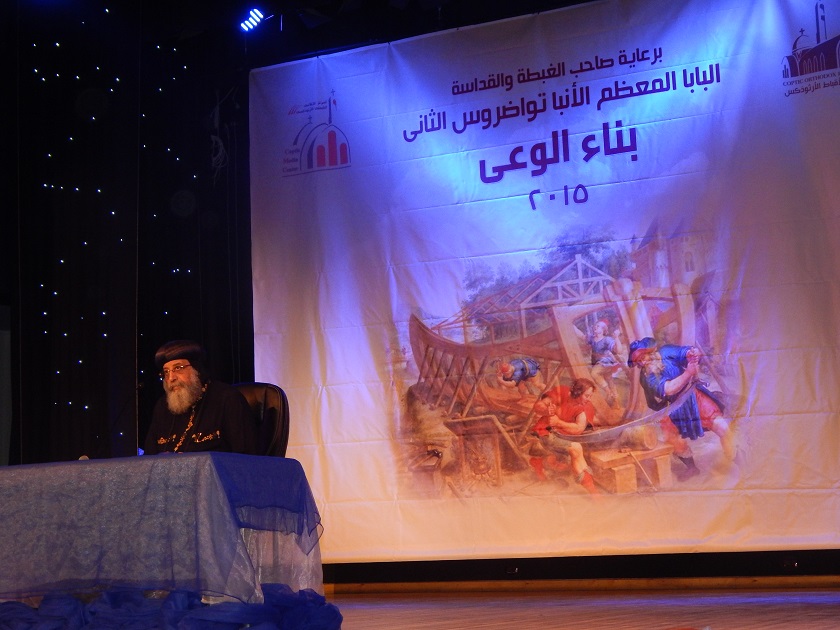
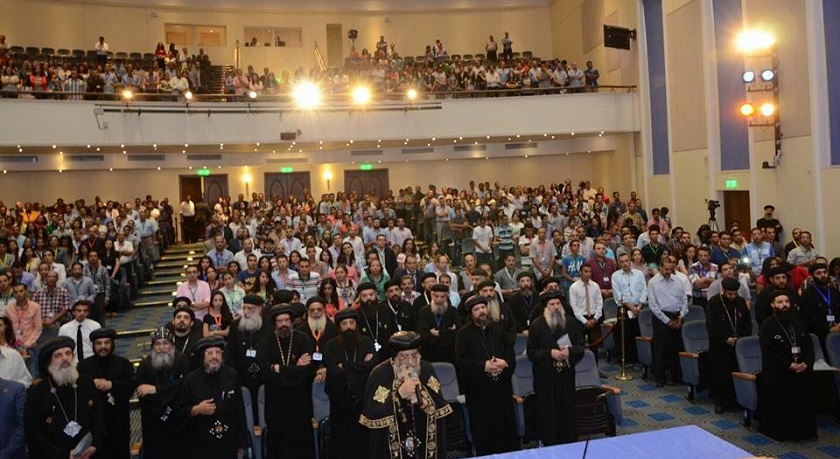
“The church is a pure spiritual institution,” Pope Tawadros said to the gathered crowd of 700 youth, emphasizing also a societal role. “It is the national church of Egypt, it is ancient. But we must not be closed upon ourselves.” Tawadros was speaking at a conference entitled “Building Consciousness,” organized by the Coptic Media Center (CMC), the media arm of the church. Hosted in Cairo, it followed two gatherings in Upper Egypt, with an upcoming meeting in Alexandria and the Delta. Participants are handpicked as active and influential leaders able to carry the message back to their churches.

Building Consciousness, according to CMC head and church spokesman Fr. Boules Halim, is a multi-year campaign designed to create educated, enlightened Orthodox Christians, able to think for themselves and engage with society. “They should vote and join political parties,” he said. “They should build their society and not be secluded. Connection to [the] church should not encompass their whole life.”

For many Copts this would be a radical departure. During the long era of now-ousted President Hosni Mubarak and the late Pope Shenouda, Egyptian citizens, including Copts, were depoliticized. As the state withdrew from social service provision, the church stepped in to fill the gap for its flock. Spiritual programs also multiplied, but as devotion increased so did the sense of the church as an alternate society, a place safe for Copts away from the trials of the world.

The state presented itself as a bastion of stability and semi-secularism against an Islamist threat. The church received the mantle of Coptic political leadership. The relationship had its ups and downs as it negotiated issues of sectarian violence, family status laws, and Coptic criticism from the diaspora.

The thrust now is to prepare Coptic citizens for leadership, but Building Consciousness is not a new emphasis of the church, according to Halim. It is the renewed application of Christian teaching to replace a reality that was forced upon them. “Society refused us,” he said, citing, for example, discrimination in state youth centers and sport programs. Speaking on the relationship between Mubarak and Shenouda, he said, “This is how the state wanted it, it was the nature of that stage.”

Egypt is now in a new stage, having passed through revolutionary tumult. While a large majority of Copts have strongly endorsed the regime of President Abdel Fattah al-Sisi, Halim is cautious, though encouraged. “Until now we still don’t have a convincing picture of citizenship, but there is hope,” he said. “The early signals say to us, ‘Come and participate,’ and the government is creating a conducive climate.”

Both Tawadros and Halim emphasized that the church will play a national role to encourage electoral participation. Attempting to allay concerns that this initiative opens up the church to similar criticisms made of Egypt’s short-lived Brotherhood government, they say it calls on all citizens to vote for the most qualified candidates and not on the basis of religion. It will use church networks to urge Copts to the polls, but will not endorse candidates, nor filter Coptic politicians through the political parties. This may happen at the local level, Halim conceded, but it is refused. There is no central electoral strategy in the church.

Besides politics, the Coptic citizen should be active also in the development of the country. But this area reveals potential contradictions in the message. The church has an organizing role, said Halim. He envisions a future in which every diocese has both a Coptic hospital and a Coptic school, open to all, without discrimination. As registered private schools, they will follow the national curriculum. The few schools currently operating have only a handful of Muslim students, as Copts have flocked to enroll. But once there is sufficient number, Halim hopes the student body will be distributed equally according to religion.

“If we can have a role in education, it will contribute greatly to better consciousness and open minds,” he said. “When enlightenment reaches the other it is more powerful. It produces coexistence, knowledge, love, and common cause.” During his presentation Tawadros advocated similarly. “We must serve society within the possibilities available,” he said, “completing the government in the provision of services.”

Such plans have provided fodder for Islamist critics accusing the church of proselytizing. While nothing in the conference suggested this aim, it is clear the church preaches a certain conception of society. One of the pillars of Building Consciousness is emphasis on the dual nature of Coptic and Egyptian identity. This, while at peace with Muslims, may be at odds with an Islamist agenda.

Viewed through the lens of the last four years of struggle and polarization, the issues are also quite political. The church insists it is not involved in the micro issues of elections and policies. But its vision is to shape society in the acceptance of macro issues of citizenship and national identity.

Here, the church wants Coptic citizens up to the task, even as it leads the effort. But in their eyes there is little contradiction, as the church with its members is the body of Christ. If it desires Coptic citizens to play an active role in society, it falls upon church leadership to teach them to do so. Where does the church stop, and the Christian begin?

According to Halim, the church as an institution desires strongly to leave these matters aside and return strictly to a spiritual, shepherding role. But too much is at stake in this transitional period. “If one calls for the church to have no role whatsoever, this will be when full citizenship becomes a reality,” he said. “But as long as citizenship is lacking, the country needs us.”

Pope Tawadros Building Consciousness

Categories
Current Events

Friday Prayers for Egypt: Corruption and Economy

Flag Cross QuranGod,

Will Egypt be serious? Can it be? Is tackling corruption really part of the agenda?

Cries of corruption are a time-tested way to taint an opponent. Given its assumed pervasiveness they may even be true. But as the minister of agriculture falls, as does – ironically – an anti-corruption activist, help the government tackle this issue at its roots, and not just trim the low-hanging branches.

Give them both a fair hearing, God. Them, and all others.

A former Mubarak-era businessman and politician, accused of widespread corruption, is trying to return to parliament. Subject to multiple trials and jail over the past four years, the legal tussle has been intense. Decide his case rightly, God, and all like him.

Give mercy to the repentant. Give candidacy to the legal. Above all, give discernment to the electorate. Keep corruption far from the coming parliament.

For beyond politics, corruption spoils the economy. The government is feverishly working to stimulate investment, cautiously working to enact reform.

The rich and powerful can tolerate corruption; perhaps they even benefit. But its costs are felt most harshly where economic revival is most needed. For the poor and middle class, it is hard to play on an uneven field.

But real growth is dependent upon them. Studies show the Egyptian economy is woefully top heavy. Corruption trickles down far more efficiently than capital.

God, how to even begin? Give officials wisdom and uprightness. Give functionaries a living wage and a tender conscience. Give the system transparency.

Give Egypt the people and will to make it happen. May it both accompany and spur a cultural change. And beyond accusation, may it bring healing. There are degrees of guilt, God. Let justice be blind, but also be nuanced.

Cleanse the nation, God. May prosperity come, to all.

Amen.

Categories
Prayers

Friday Prayers for Egypt: Natural Gas

Flag Cross QuranGod,

Thank you for good news for Egypt. Please prepare her to use it well, three-to-five years from now.

A massive offshore pool of natural gas was found this week in Egypt’s Mediterranean waters. Estimates say it increases her reserves by third. Long suffering an energy crunch, within a few years Egypt will be self-sufficient.

Therefore, God, may good trump greed. Help Egypt make necessary structural adjustments with minimal impact on labor. Help Egypt prepare industries with great impact on labor. And let all contracts be awarded transparently, that capital be rewarded for efficiency over proximity.

Clear Egypt of corruption, God. May the people see fruit from your good gift.

Amen.

Categories
Personal

Convergence

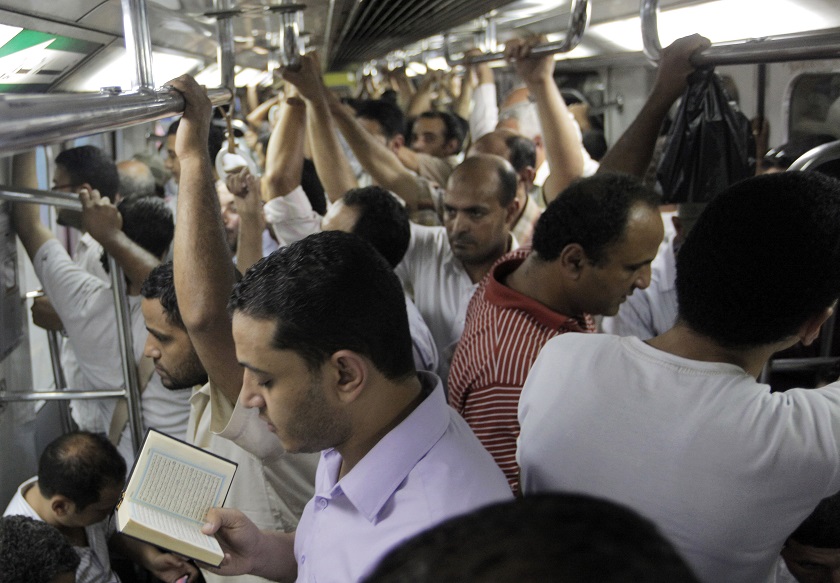
An Egyptian man reads the Quran while riding the metro (AP Photo/Amr Nabil)

A few days ago I stood in the center of a crowded metro car. It was around 95 degrees, hotter inside. Strangely enough with the open windows and rotating ceiling fans, the temperature was tolerable.

Sometimes it can be preferable in the aisle, rather than squeezed five across a four person bench. But generally it is better to sit, relax, and open a book. Otherwise I stand, keep balance, and open a book.

Save for the few with a Quran, I am often the only one reading.

Sometimes I am sheepish about the content, worried it might offend any one of the strongly held political opinions of the day. On this occasion, sadly somewhat paranoid, I pull it carefully from my bag, turn the cover inward against my body, and then open to read.

There are many Egyptians proficient in English, but generally speaking everyone on the metro minds their own business. Still, who knows if a troublemaker with wandering eyes wants to take issue with a foreigner? Especially when not reading, my eyes often wander as well, curious how others pass the time.

The best way to get a seat in a crowded metro is to move to the center and hope those in front of you get out at a nearby stop. It makes for a fun guessing game. Should I choose the family with small kids, or the young university students? Will it be the old man, or the fully covered lady?

This time I had no choice, and just filed into my spot. In front of me was a Quran reader intoning quietly, sitting next to a similarly aged young man playing Candy Crush on his smartphone.

At that moment a familiar sound emerged from the far left end of the car. “By God, please help me,” called out a medium-sized woman dressed completely in black. “God reward you for your kindness, I need food for my children.”

As she worked her way through the crowded car a few people slipped her a coin. But upon completion of her plea another familiar sound came from the far right. “Four pens for five pounds, and get the fifth one free,” the middle aged, somewhat shabbily dressed salesman belted. “Check them out, the best pens in Cairo.”

One or two people handed him the requested bill, but as they did with the covered lady, most ignored him. The two alternated cries as they moved down the aisle.

In the middle, all converged. The Quran and Candy Crush. Begging and enterprise. Middle class youth, lower class poverty, and foreign wealth.

Each was seeking something: a small profit, a trip downtown. For me the metro is the fastest way from here to there. At thirteen cents, it is also the cheapest.

But it is also a chance to learn in transit. Not just the book. The metro is a microcosm of society, a dose of reality piercing the bubble of a more insular Maadi.

Most travel in silence. But whether in hope or complaint, the face of the nation is witnessed clearly. Within it is a valuable lesson to Egyptian and foreigner alike.

The Cairo metro is home to all.

Categories
Lapido Media Middle East Published Articles

The Egyptian Street is Still Alive…

Nahda Group
Credit: Kyrellos Atef

Thousands are in jail for breaking the protest law. Revolutionary hope takes a backseat to stability and security.

Yet, despite the crackdown on opposition politics, an unlikely source of protest is taking back the streets.

‘Even now, I am calling for the revolution to continue and the rejection of dictatorial paths,’ Fr William Sidhom told Lapido. ‘But I have no weapons except my words.’

The motivation is liberation theology. The medium is street theatre.

The 68-year-old Jesuit is one of the few Egyptian Christians influenced by the Latin American movement. He has written fourteen books, five on the subject.

In the 1960s and 1970s, activist Catholics pushed the church not just to care for the poor, but to liberate them from political and economic structures that held them in place.

Pope Francis has warmed to this heritage, designating the murdered Salvadorian bishop Oscar Romero a saint. But in Egypt, Sidhom said, the church is afraid.

Fr. William Sidhom
Fr. William Sidhom

‘There is no faith without justice,’ he said, ‘but the understanding in the Arab world is to stay far away from politics or you will go to prison.’

So instead, Sidhom, the self-proclaimed Christian Marxist, has surrounded himself with Muslim activists.

From 2011 onward they were at the forefront of the Egyptian revolution. Youssef Ramez, the youthful Coptic general-coordinator of Sidhom’s Nahda Association, said the NGO was a centre for much of the early artistic graffiti in and around Tahrir.

Nahda is located in the working-class neighborhood of Faggala, only a thirty-minute walk from the iconic square. For the past fourteen years Sidhom has sponsored acting, painting, music and literacy for residents and artisans alike.

In 2005 he partnered with Mostafa Wafi’s ‘Popular Imagination’ street theatre troupe, placing the Muslim leftist and human rights activist in charge of art and cultural activity.

In 2012 they created the Nahda Art School, whose acronym deliberately forms the Arabic word for ‘people’.

Saturday before sunset prayers, the people hit the street.

‘What are their demands?’ asked an intrigued resident playfully as the group of twenty moved from the centre to an open sidewalk in front of the local chemist.

With five Sudanese refugees at the head of the procession, the students chanted an African tune before launching into a fifteen-minute sketch.

Then they marched back to the centre, again in song. Several peered from their balconies. Traffic along the narrow side street came to a halt.

‘This is new,’ laughed a driver as his four-year-old daughter gaped from the passenger seat on her mother’s lap. ‘We haven’t seen this in Egypt before, but it is good.’

Nahda DriverThe Nahda effort to share culture with local residents is rare but not quite unique. ‘Our Street Cinema’, funded partially by the British Council, shows current and vintage films in the streets of Salam district in Cairo.

‘Mahatat for Contemporary Art’ stages opera presentations in residential balconies in the Delta cities of Port Said, Damietta and Mansoura.

But ‘Art is a Square’ grew too popular—and perhaps too provocative—for its own good. Despite receiving on-and-off funding from the Ministry of Culture, security forces shut down its monthly offerings of art and music.

The Nahda sketch had an ‘indirect’ political message, said Italian-trained acting coach Hamdy el-Tounsy.

His students designed content under his supervision, consisting of several short scenes from everyday life. Issues included racism, sexual harassment and drug use. But nestled in was also a reference to an opposition newspaper, doubling as a pun about absent human dignity.

‘There are many messages that can be received,’ said Tounsy, ‘but it is up to each person what impacts him.’

Wafi’s ‘Popular Imagination’ troupe has produced street theatre performances about public space, freedom for women, and emigration. But it was The Colours’ Revolution that carried a direct political message.

‘Dictatorship destroys diversity,’ he told Lapido. But Wafi’s greater concern is ‘daily politics’, the kind that organizes neighborhoods and clears garbage from the streets.

Last year, as Islamist protests were squashed under President Sisi, Colours was performed over 150 times throughout Egypt.

Each performance is cleared first with local neighborhood leaders—café and chemist owners in the most recent example. Should the police show concern they assure all is OK.

Even so, Wafi considered and then declined a revision of Colours. ‘The atmosphere is not right,’ he said. Currently in production is a play about water pollution.

Wafi considers himself a non-practicing Muslim, but is positive about Sidhom’s liberation theology. Copts’ strong attachment to the church, he believes, hurts the concept of citizenship. But Christians in Sidhom’s circles are driven to help the poor and marginalized.

The sponsorship of the church also gives cover to Nahda’s work, he said. Independent activists have much less space to operate.

Catholic Church spokesman Fr. Rafic Greiche said that Egyptian church hierarchy distances itself from liberation theology because of Latin American associations with communism and violence.

Ramez said that apart from Christian activists, almost no Copts have even heard of it.

But for Sidhom, the believer must ‘defend justice, build society, and secure the interests of the poor’. There are many methods, some revolutionary.

His path is development through the sharing of culture.

‘Revolution is not to change ten officers with ten others, but to change society,’ he said. ‘This requires great patience.

‘So rather than people going to the theatre, we take the theatre to the people.’

Nahda Audience

This article was originally published at Lapido Media.
Categories
Prayers

Friday Prayers for Egypt: Police vs State

Flag Cross QuranGod,

The police have a hard job. They are targets for terrorism, accused of corruption, and scapegoats of a revolution. Their moral authority has been compromised, yet they are on the front lines of state sovereignty.

How much compensation do they deserve?

The lowest of them, the most numerous, and perhaps those most exposed, think it is not enough. In one location they protested to make their case known. Their colleagues were called in to disperse, with tear gas and resulting clashes.

For now the issue is at rest. The government has promised to study demands and meet some by early next month. September 5, the low ranking officers union will convene to discuss response.

God, give them wisdom, both now and then. God, give the state wisdom, in how to treat them right.

If they are placated, it could enflame other institutions of the state. Civil servants have slated a protest date a week later.

If they are rejected, it could enflame a vital institution of the state. A house divided against itself cannot stand.

At the same time, many call for the overall reform of the institution. Whether targets, accused, or scapegoats, the house is not in order.

God, find the right solution.

Inspire the police in the sacredness of their duty. Hold the police to the accountability of their charge. Empower the police for the fight against chaos. Imbue the police with ethics of service.

And for those they serve, may they return all proper respect. May they honor authority and obey the law. Rebuild the police reputation, God. May they be a pillar in a state that is just.

Amen.

Categories
Prayers

Friday Prayers for Egypt: Borders, Bombs

Flag Cross Quran

God,

The bombs continue, this time striking a security directorate in the early morning hours with a blast that rattled all Cairo. Several injuries, none killed – it is a marker of taunting more than a message of death.

But from where?

There are problems at the borders, God. To the west, Libyan officials have abandoned a desert crossing. To the east, militants seized Palestinians returning to Gaza, taking four from a bus. And long a guarantor of peace, the United States is considering pulling out peacekeeping forces on the Sinai border with Israel.

How much of Egypt’s trouble is imported, God? Most of the Gaza tunnels have been destroyed. But instability still reigns in Libya, as the Arab League debates arming the internationally recognized government. Will more war bring peace, or more weapons to smuggle?

Secure the borders, God, though with Egypt’s deserts the task is formidable. Ideas have wings, but keep out the men and means of violence.

Of those already here, may they be found, disarmed, and prosecuted.

But most belong here. Egypt has long been an exporter of violent ideology. Give winning flight to better ideas.

Help men of religion to lead the charge. Help them also to stay out of the way. Religion can inspire, it can also impose.

Help Egypt find the balance. Help her craft a society of welcome and tolerance, humanity and peace.

For those tempted to radicalize where these are absent, God, give them a stronger inner core of righteousness. May they fight for justice, but transgress not.

May humility rattle the region, and decency taunt the darkness. May the borders be secure because the center is whole. A marker of encouragement, a message of life.

Amen.

Categories
Excerpts

Two Wings of the Brotherhood

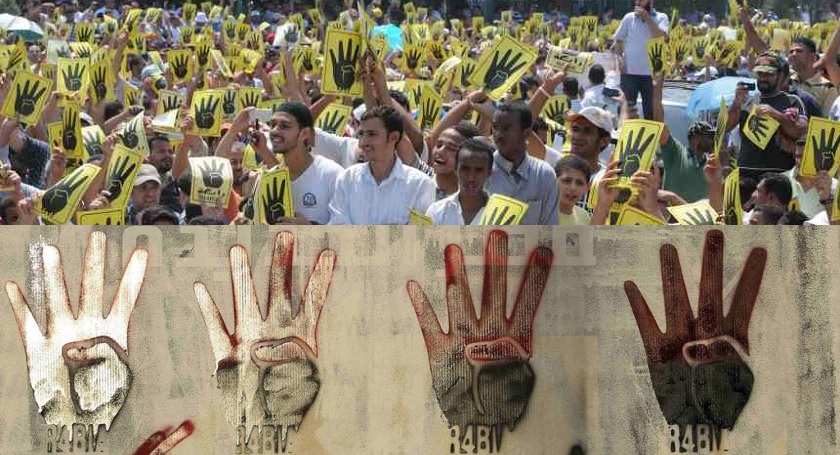
Rabaa Red and YellowThe text has 75 footnotes. Samuel Tadros of the Hudson Institute has dutifully followed the internal power struggle consuming the Muslim Brotherhood since the fall of Morsi. It is a long read, but he ties the strands together in a compelling narrative.

The thrust is that there are two competing wings, an old guard that wants to protect the principle of peacefulness — if only to maintain a longstanding international reputation. Beneath their leadership are the youth bent on revenge for the sufferings of Rabaa and continued demonstrations.

The latter, he writes, have been imbued with a heavy dose of ‘revolutionary Salafism’, pushing conflict with the regime. And with so many leaders imprisoned, it is very difficult to maintain the traditional system of cohesiveness and obedience. The split has not taken place, but it is brewing.

So here is Tadros’ summary of the two sides. It very important to keep in mind when listening to these talking points repeated in media discourse about Egypt:

At the heart of the Brotherhood crisis sit two competing visions. Neither side can claim a coherent strategy. The old guard believes that the Egyptian regime should be given a chance to implode on its own.

In this view, a combination of economic decline, security failure, and growing discontent will lead either to self-destruction, an internal coup, or Western intervention by pressuring for reconciliation.58 To maintain momentum, demonstrations need to continue even if they do not produce immediate results.

Simultaneously, the Brotherhood needs to keep the pressure on the West by warning that the fate of Iraq and Syria awaits Egypt if they don’t move. By maintaining a semblance of non-violence, the Brotherhood can continue to claim that it is the moderate alternative to the Islamic State. It is betting on time and changing regional dynamics, especially a rapprochement between Turkey and Saudi Arabia under King Salman.59

On the opposite side, the new leadership, and behind it the Brotherhood’s rank and file, believes that only by bleeding the regime can it be brought to its knees. 

A regional deal is precisely what they fear as it would mean that all their sacrifices would have been in vain and their tormentors would not be punished. Their war with the regime is no longer about Morsi and the coup; in fact, Sisi’s removal would solve nothing for them. Instead, the struggle is an ideological one between Islam and apostasy, between right and wrong, between them and the “Army of Camp David” and its “Zionist masters.” Such a struggle stems from a worldview that allows no compromise.

From well informed research, Tadros puts forward speculation that is well fitting within the reputation of the Brotherhood. Perhaps the leadership is ok with this division.

Earlier in his text he wrote of the discourse during the sit-in at Rabaa:

The mixing of Islamists had an effect on the speeches. Speakers, in English, portrayed the struggle as one of democracy against a coup while others, in Arabic, cast the struggle in the language of jihad. This was not merely the Brotherhood’s famous two discourses in two languages, but the result of genuine confusion and disorientation.

In order to maintain the organization of the Brotherhood, but perhaps also in strategy, they tried to hold the two wings together:

Besides, the leadership could have it both ways. Officially, the Brotherhood would not claim violent acts and maintain its pledge to nonviolence; in reality, the special units would bleed the regime to death. The new slogan, “All that is below bullets is peacefulness,” replaced the old slogan, “Our peacefulness is stronger than bullets.”

After all, as a Brotherhood member lamented, “our peacefulness is not stronger than bullets.”38 Allowing the special units to conduct these attacks would hurt the regime without committing the whole group to the path of violence. 39 The calculation would prove mistaken as violence spiraled out of control.

But does he know this was a calculation? It is fitting and logical, but toward the conclusion where he speculates, ‘The Brotherhood may still hope to have it both ways,’ he provides evidence that seems more like an organization in confusion:

Before the clash, the Brotherhood’s statement endorsing jihad in Arabic on January 27 was removed from its website; and the group issued a statement three days later, in English, denouncing violence.63

On May 17, Mohamed Montaser called for a revolution to cut heads. Following his statement committing to the revolutionary path on May 28, he seemed to backtrack on June 25 by calling on the Brotherhood youth to be careful not to slip into a cycle of violence.64

His shift was in response to the horror of the Revolutionary Punishment’s assassination of a civilian which it accused of cooperating with the regime,65 and a realization that such acts would tie the Brotherhood to violence and end any prospect of the Brotherhood regaining public support.

The shift was short-lived, however. Following the regime’s liquidation of nine Brotherhood leaders on July 1, Montaser released a statement that declared “the Muslim Brotherhood affirms that the assassination of its leaders is a turning point that has ramifications and by which the criminal, Abdel Fattah al-Sisi, founded a new phase in which there cannot be control on the anger of the oppressed segments that will not accept to die in their homes and between their families.”66

An organization in confusion also fits with Tadros’ thesis. But to what degree is Brotherhood leadership — to the extent it exists — engaging in conscious Machiavellian politics?

Other analysts follow the same footnoted evidence and conclude that the youth can no longer be controlled by a leadership that remains peaceful and moderate. Tadros also writes that the Brotherhood pyramid has been inverted, with the base dragging leaders along. But advocates of ‘reconciliation’ who believe that inclusion of Brotherhood-style political Islam is necessary for the stability of Egypt seem to grab this fact in hope that the situation can be redeemed. They lament the ‘coup’ and the failure not only of the Arab Spring, but also of their analysis of integration. Consider this section of a long essay by Marc Lynch, compellingly defending the foreign policy of President Obama:

Obama came to office intending to defeat al Qaeda with a lighter footprint, through drone strikes, partnerships with local allies, and the cultivation of more moderate Islamist groups. He understood the nuances of intra-Islamist politics and seized the opportunity to divide the mainstream of Islamism from al Qaeda and stop the spiral toward a clash of civilizations.

Obama’s willingness to work with the Muslim Brotherhood following Mubarak’s fall was a departure from decades of U.S. policy and the strongest signal Obama ever sent that the United States believes in democracy regardless of who wins. By early 2012, Obama’s policies on Islamism were proving successful.

Lynch then blames the coup and anti-Brotherhood Gulf propaganda as being the primary catalysts of current Islamist violence. Surely there is a contributing effect.

But Brotherhood literature has long imbued adherents with the worldview of ‘a clash of civilizations’ — just not now. And as Tadros’ essay details, even in 2012 the Brotherhood’s primary allies were Salafis, whose strident ideology is now convincing the ideologically vacuous Brotherhood that the priority of pragmatism — and with it the adoption of peacefulness — was a wrongheaded betrayal of the principle of jihad, to which they paid only lip service.

Lynch’s analysis is astute, but does he understand the nature of the Brotherhood? Or only of part of it, the part he hopes can be peacefully integrated into the world system providing an escape from instability, autocracy, and the ever present call for the US to re-intervene militarily. Who would not want such an outcome, and the Brotherhood seemed to promise it.

Only as time is now telling, as Tadros seems to suggest, that only part of the Brotherhood promised it. Let there be all sympathy for the Brotherhood in their trial. They are under tremendous pressure. It is amazing how their organization is still holding together, and a testament to their belief and commitment.

But it is only when a man is tested that his true colors show. And for a very large section of the Brotherhood, they witness that peacefulness was a means to an end. Under pressure, they strike back. Very natural, of course. But also very ugly. Just watch their satellite programming.

Have they suffered human rights abuses? Most certainly. Have they been cheated? Of course. At the least they were outmaneuvered.

But all their appeals in English lose sympathy when the Arabic is read. But is this their internal decision and strategy, or the flailings of an organization in chaos? Even after reading Tadros, I’m not sure. Even he is cautious between deductions and assertions.

Do the talking points meet in a coherent conspiracy-theory whole? As one wing warns of state collapse and a Syria scenario, is the other wing working to make the threat real?

You be the judge, but let 75 footnotes guide you along the way.

Categories
Excerpts

The Duel of Drawing Egypt’s Future

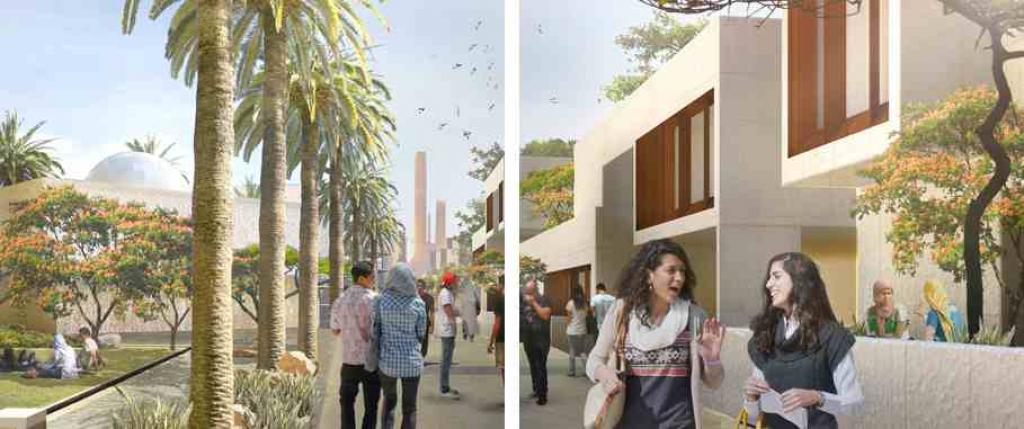
What will Egypt one day look like? Declaring this future, and drawing it visually, is one way to secure authority. This is a view put forward by Mada Masr, discussing the plans for the new Egyptian capital to replace Cairo.

via Mada Masr
via Mada Masr
via Mada Masr
via Mada Masr
via Mada Masr
via Mada Masr

The presentation thus stands not only for a city, but for a whole world — and  not merely a better or a greener world, but also a world that is ultra-organized, a world where everything on both the macro- and micro-scale follows a single abstract plan that blatantly encompasses everything.

During the presentation, however, very little was said about the viability of this world. Questions of whether it’s financially feasible, or whether it’s actually going to be functional, or even liked by those who are going to inhabit it, were not addressed. There were only speculative abstract graphics, but they were enough to convince the audience of the achievability of this imaginary world, give it a material existence, and make it somehow immediately graspable.

The maps and images had such a potent make-believe effect that the value of properties located within several dozen kilometers of the proposed city spiked out of proportion just a few minutes after the press release was issued.

The article goes on to show a similar promotional effort in the 1970s to create Sadat City. Between Cairo and Alexandria, at the time it was also designed to be a new administrative capital. Sadat City exists, but in pale reality to the original promise.

Mada Masr is worried the new capital city project is more of the same.

The government’s growing interest photoshopped maps, architectural visualizations, video promos and professional presentations might simply be good PR campaigning, but it’s also part of a ruling paradigm. These plans, drawings, maps, images, videos, presentations and other visual media about grand schemes for a new Egypt are in fact some of the ways in which the authority produces itself, rather than being a mere product of the regime.

If so, the same effort to inspire and hold morale is witnessed in the Muslim Brotherhood. Here, the visual future is in the form of a grand museum to honor the hundreds killed while dispersing the pro-Morsi sit-in at Rabaa al-Adawiya mosque in Cairo.

Also from Mada Masr:

The Rabaa Story website is sleek and glossy, with infographics detailing the number of people who died during the dispersal (though without clearly identifying sources), pictures of victims, videos promoting the second year anniversary and blurbs telling people to mobilize “on the street” and make videos promoting awareness of the anniversary, and even plans for a museum.

But both the website and the Ikhwanweb twitter account appear to be reaching out and appealing to an international audience. Almost all the promotional material is in English, even the hashtag representing the campaign, and none of the promotional material is religious in nature — instead, it focuses on human rights violations.

When it comes to how the public side of the Muslim Brotherhood remembers Rabaa, the focus appears to be on getting the notice of the international English-speaking community — a community which, as shown by recent condemnatory statements from foreign rights groups, has already proven sympathetic to their narrative.

Image projection is powerful. Mada Masr finds that both sides in the standoff realize this, and are — in these examples — appealing to the hopes of a core constituency.

fd

Categories
Prayers

Friday Prayers for Egypt: Remembering Rabaa

Flag Cross Quran

God,

Two years are past, hundreds are dead. Help Egypt to remember correctly.

In response to massive protests against then-President Morsi, his supporters rallied in protests of their own. They continued several weeks after he was removed by the army. After several warnings to disband, the camp was cleared forcibly. Some policemen were killed, but so many more protesters.

God, give justice for every innocent life. Hold accountable every unjustified killing. Help Egypt recover and heal from a terrible wound.

But the call to remember Rabaa implicitly ignores other troublesome events. A second campsite also witnessed much loss of life, as did demonstrations before and after. Retaliatory attacks struck at police stations and churches throughout the country. Dehumanizing and sectarian rhetoric was hurled in multiple directions.

God, it was ugly.

Two years later much of the country has moved on. A new constitution was written and ratified. The military hero who overthrew Morsi was overwhelmingly elected president. Pro-Morsi demonstrations long continued, clashes ensued, and arrests multiplied. Things are much quieter now, but a terrorist insurgency feeds off the memory.

Some memories are selective, others choose to forget. But two responses are necessary, and seem purposefully ignored: Accountability and forgiveness.

In their place a sole word reigns: Retribution. One side enacts, the other calls.

Justice, God, could take its place, if agreement could settle on a definition. Mutual acrimony and mutual culpability sideline the possibility.

So what can be done, God?

For those aggrieved, touch their hearts. Direct their ire and guide their response, but let not their souls be poisoned. May they overcome hatred, and transform anger. For their own sake, Egypt’s, and the path of righteousness, help them forgive and respond in blessing.

For those aggressing, touch their conscience. Honor their duty and gird their devotion, but let not transgression be swept under the rug. May they be stricken in soul, and find restoration. Give all authorities wisdom, mercy, and firm commitment to rule of law.

But all this may not be enough, God. Behind Rabaa is also a clash of ideologies. Help Egypt to remember, but also to know herself. Guide all in creating the proper society, inclusive of as many as possible.

There, and in getting there, may Egypt heal.

Amen.

Categories
Prayers

Friday Prayers for Egypt: New Suez Canal

Flag Cross QuranGod,

The Suez Canal is now longer, and wider, and deeper. It can accommodate ships in both directions. It was funded by the people; may they quickly recoup their investment.

Much, of course, is out of Egypt’s control. Revenue from the canal rises and falls from global shipping patterns. The new project keeps the watercourse competitive. Extra capacity and decreased wait signal growth opportunity.

But nothing beats location. God, this comes from you, so help Egypt be thankful.

Help her also to celebrate. It is a national achievement, a political success, and an economic potential. The nation needs good news.

But she also needs sober judgment. Many voices have lavished praise, many voices have decried waste. Many voices have agendas.

God, give the president faithful counsel. Guide him both to inspire, and to plan. Let all proceed from firm foundation.

Where there are cracks, God, fill them in. But let nothing be papered over. And where some chip away, prevent further erosion.

The Suez Canal is a symbol of Egypt, a national resource and a source of pride. Amid rumblings of terrorism, thank you for keeping the day safe.

But now move Egypt forward from this day. May the Canal Zone develop, may people flock there and find work. May politics and economy accommodate them all.

Your love has poured into Egypt for millennia, God. May it flow in both directions. Long, wide, and deep – may Egyptians respond to your investment.

Amen.

Categories
Personal

The Virgin’s Fast and Intercession

Virgin Mary 2

In the Coptic Orthodox tradition, today begins two weeks of fasting from animal products in honor of the Virgin Mary.

During our six years in Egypt we have attended the Orthodox Church regularly, appreciating without fully accepting many of their traditions. But today a small part of the mass, seemingly special for this fasting period, unnerved me.

It was not this part, repeated each week:

With the intercession of the Mother of God, Saint Mary:

Oh Lord, grant us the forgiveness of our sins.

We prostrate before you, oh Christ,

With your good Father and the Holy Spirit,

Because you have come and saved us.

A mercy of peace, a sacrifice of praise.

I was raised a good Protestant, and imagine I still am. Our attendance at the Orthodox Church is to learn, and to the degree possible, serve – seeking to honor the body of Christ in the widest possible ecumenical spirit. Our priests share this spirit and welcome us, but are bound by the teachings of their church that bars communion to all who are not baptized Orthodox.

They would be happy to re-baptize us, but to us this does not seem right. ‘There is one faith, one hope, one baptism,’ it is written, and we do not share their understanding of history lending them status as the one church which has carried Jesus’ teachings correctly.

But we do share, we believe, membership in the universal church of those who trust in Christ for their salvation. Though our fellowship with the Orthodox is not complete, we trust it is real.

This puts us in the position of engaging their traditions. One of the more Protestant-offending is the intercession of the saints; chief among them, the Virgin Mary.

The hymn above, so beautifully chanted each week, is perfectly Protestant in every line but the first.

But there is a logic behind the concept of intercession that I find able to accept, if not practice. It is a logic most practicing Protestants frequently assume.

That is: In times of need, I am very eager to ask my friends to pray for me. If I believe that the prayers of a living Christian can make a difference with God, why should I not also seek the prayers of still-living Christians in heaven?

Fair enough, but the Orthodox extend the logic further along family lines. Would not Jesus be even more inclined to answer the request of his mother? After all, they say, at the wedding feast in Cana of Galilee, Jesus was approached, by Mary among others, to tend to the embarrassment of running out of wine.

‘My time has not yet come,’ said Jesus, seemingly rebuffing the request. But it made no difference to her. ‘Do whatever he tells you,’ his mother told the servants. And thus, Jesus’ first miracle – perhaps against his inclinations – turned water into wine.

Why should the Christian not continue to seek such obvious intercessory power?

But the Protestant has a trump card to play, while highlighting the example in Cana as before Jesus’ death and resurrection. But now it is written, ‘Let us then approach the throne of grace with confidence, so that we may receive mercy and find grace to help us in our time of need.’

My conclusion has been: Intercession is not necessary, though it may be benign. Perhaps it even helps, if only in strengthening bonds with the church both here and hereafter.

But if I seek intercession doubting that God cares enough to hear me on my own, it may become dangerous. This is not the Orthodox understanding, but I have seen this spirit in many otherwise faithful, believing friends.

It is dangerous also as a manipulative technique, very akin to the Middle Eastern mindset – not far from any human – that seeks to get around the system through ‘wasta’, a powerfully placed ally who can bend rules or gain a hearing on my behalf.

But if intercession seeks to engage the ‘great cloud of witnesses’, and still ‘fix our eyes on Jesus’, why not?

After around six years of fellowship, this is where I have more or less comfortably settled with the Orthodox.

Until today.

Perhaps this was the first time we were in church on the actual first day of the Virgin’s Fast. But this part of the liturgy took my attention:

We have no [dalla] with our Lord Jesus Christ

Except in your requests and intercession,

Oh Lady of us all,

Our Lady, the Mother of God.

I wasn’t sure what dalla meant, but it didn’t sound good. The dictionary gives these options, among others: audacity, boldness.

In the teachings above, Christians are told to approach the throne in this manner.

But the dictionary also offered these options: familiarity, chumminess.

This is the sense my friends offered after mass. They described dalla as something like ‘warm, friendly feelings’, and who could have more of this with God than the Virgin Mary?

They used justification similar to that offered above, which seems perfectly logical. But that is not what the hymn is saying. It is that our dalla with God comes only through her intercession. This is making it a necessity.

And it runs up against another teaching of Jesus, where God welcomes our requests through our relationship with him. ‘I tell you the truth, my Father will give you whatever you ask in my name,’ he said, but even here it is not intercession exactly. ‘I am not saying that I will ask the Father on your behalf. No, the Father himself loves you because you have loved me.’

Perhaps we do not perfectly love him, an Orthodox might argue, whereas his mother does. But elsewhere it is written, ‘We love him because he first loved us,’ and this, ‘while we were yet sinners.’

My friends assured me this also is Orthodox teaching. The church, they said, wants to impress upon the faithful the need for humility, while lifting up those whose previous testimonies – the saints – have stood the test of time. But yes, they assured, it is only Christ that gives us access to God. We can go to him on our own.

But of Mary they may have a leg up on Protestants. ‘All generations will call me blessed,’ she said. Invoking her intercession is not necessarily fulfillment, but remembering and praising her certainly is.

The Catholic Church, they said, can sometimes go too far on Mary. But the Orthodox try to keep a middle way, a balance.

Today for dinner we ate rice, peas, and zucchini. Visiting Orthodox friends later on, we had cake specially made without eggs and butter. We are not fasting, but our fare was suitable for the day.

I am glad it was so. Hail Mary, full of grace … with reticence still for the ending.

Virgin Mary 1Orthodox readers are invited to answer more fully than my laymen friends. Protestants, too.

Categories
Prayers

Friday Prayers for Egypt: Health, Meds, and Water

Flag Cross Quran

God,

Keep Egypt healthy. She does too much harm to herself, but aid also where she is trying.

Cancer statistics were released this week, and a national database will finally be developed. Hepatitis C has declined 30 percent over the past few years, and cheaper drugs are coming to the market.

But a different pharmaceutical firm was shut down after children died in Beni Suef. And many locations throughout the country receive water only sporadically. Other neighborhoods have lush, green grass, while over a third of residential water is lost through leakages in the pipes.

The problems are many: poor planning, poor maintenance, poor infrastructure, poor quality, poor habits.

Some are related to budget, some to culture. Inspire Egypt to fix them all.

The constitution mandates the increase of medical spending over time. Help education to spread awareness. Help the government to do its job.

Remove from influence the criminally negligent in both the public and private sector. But remove also the negligence of personal care. So much of good health lies only in attention to creation.

You have made all things wonderful, God. The land and waters and people of Egypt. Heal them. Preserve them. With sound body, mind, and spirit, may all thrive in harmony.

Amen.

Categories
Excerpts

The Brotherhood Admits Mistakes?

One mistake, some say now, was in allying with Egyptians like these. Photo: Getty Images

Writing in Carnegie, Nathan Brown and Michelle Dunne say that the Muslim Brotherhood has survived the crackdown and reconstituted itself both inside and outside of Egypt.

Though severely weakened, opportunity has emerged for a new, more youthful generation of leadership that has conducted an internal review of policies during the revolutionary period.

Both before but especially after Morsi’s fall, Brotherhood leaders would admit ‘mistakes’, but not say what they were specifically. Now, there appears to be a list. It surfaces from private conversations the authors have had, so perhaps it is not yet official. But it mirrors the critique consistently directed to the Brotherhood by their one-time non-Islamist partners in revolution:

The substance of the self-critique within the Brotherhood, put forward assertively by younger members, is simply this: the leadership failed to recognize that 2011 was a real revolution in Egyptian society and to act accordingly.

Brotherhood leaders did not make common cause with those who wanted real change, and instead they opted to gain entry to the Egyptian state through rapid elections (agreed upon with the Supreme Council of the Armed Forces that held control after Mubarak) and then tried to bring about modest reforms—a plan that failed abysmally. “We failed to build on the profound values that emerged during the revolution,” said one young Islamist, “Instead of taking needed time with the transition, we went for superficial political solutions.”

Another added, “It was a problem to move toward elections so quickly, as many parts of the revolution were not represented in the political process.” Youth leaders spoke with regret of compatriots from other parts of the ideological spectrum who were left in the dust as the Brotherhood rushed to reap the reward of elections, only to come up against the immoveable object of the Egyptian state.

The revolution was “not Islamic” and “nonideological,” older and younger interlocutors agreed. One senior Brotherhood member noted with regret that “the Brotherhood had a certain project for a century and tried to implement it after 2011, failing to realize that it was no longer suitable for a nation in revolution.”

The Brotherhood was unable to adapt quickly enough to this need for “broad platforms based on values,” said the senior member, which would have required abandoning a long-standing dogma that the movement was responsible for “carrying the load on behalf of the nation.”

Brotherhood leaders look back at their decision, when Morsi faced increasing, vociferous secular challenges, to tack right and ally with Salafists against secular forces in the parliament elected in early 2012 as a disaster; “This was not what the revolution wanted,” said one. The more revolutionary path would have taken on serious restructuring of powerful institutions—for example, reforming the security sector and civilian bureaucracy—but the Brotherhood opted to placate them.

The Carnegie article is long but worth reading — a walk-through of the last few years. At times it seems overly charitable to the Brotherhood, downplaying Beltagi’s comment about terrorist violence in Sinai, and treating as somewhat marginal the violent rhetoric on Turkey-based satellite channels connected to or sympathetic with the Brotherhood.

But it is an analysis that is well-informed from authors who do their homework. As to what to make of the Brotherhood’s self-critique, and what it means for the movement’s, and Egypt’s, future:

As one of the oldest and most influential Islamist groups in the world, the Muslim Brotherhood bears close watching as it, and Egypt, hurtle toward an uncertain future whose shock waves will be felt throughout the Middle East, Africa, and the Islamic world.

That is, unless, things stay calm. The shock waves then might be in the world of Islamism, but the authors seem to assume there are greater surprises to come.

Update: It is obvious the authors have spoken with many sources in the Brotherhood, and the reputation of the authors gives credibility that, though not mentioned by name or position, these sources are indicative of the group’s main streams.

But is it really true the Brotherhood now sees it as a mistake to have allied with the Salafis at the expense of original liberal revolutionary leaders? If they see the revolution as non-Islamic and nonideological, why do so many of their voices clamor for jihad and paint retribution in Islamic terms? Why did they bring in Wagdy Ghoneim, of all people, to support their Egypt Call project?

Brown and Dunne are established scholars. Brown in particular has tracked the Brotherhood incendiary discourse. Why do they believe these voices over the others?

The Brotherhood needs allies. Whatever self-critique it is engaging in, I suspect it is substantial. But I do not imagine they call a mistake their use of targeted language to targeted audiences. It continues all the same.

Categories
Personal

The Family House at the Ministry of Youth

Pope Tawadros presenting Minister of Youth Khalid Abdel Aziz with a commemorative gift, quoting Isaiah 19:25 in Coptic, Arabic, and English.

In a sign of cooperation between the government and Egypt’s religious institutions, the Ministry of Youth and Sports hosted Pope Tawadros of the Coptic Orthodox Church, representing the Egyptian Family House.

The Family House is a partnership institution between the Azhar and Egypt’s Christian denominations. It is tasked to promote and preserve national unity, at both the governmental and grassroots levels.

On July 27 Minister of Youth Khalid Abdel Aziz welcomed Tawadros in an event organized by the youth committee of the Family House. The title of the conference was The Role of Youth in Building Egypt’s Future.

Central to Tawadros’ message was that education is the key to change in society.

Participating also in panel discussion were Gamal al-Shaer, head of the Radio and Television Institute, Gamal Shaqara, professor of modern history and the head of the Middle East Research Center, Musad Aweis, head of the youth committee of the Egyptian Family House, and Aida Nassif, professor of philosophy at Cairo University and Aweis’ assistant leader in the youth committee.

They discussed the economy, confronting terrorism with culture and thought, as well as social and spiritual development.

Minister Abdel Aziz referred to Tawadros’ statement from August 2013 that a nation without churches is better than churches without a nation. This put an end, he said, to the sectarian problem Egypt was suffering at the time.

Dozens of churches throughout Egypt were burned following the removal of President Morsi and the dispersal of pro-Morsi protest sites. Some were trying to sow the seeds of division, the minister said, but to their surprise the opposite was proven.

Tawadros was asked how the church overcame the divisions of 2013. He said the one who knows love, understands life. So the one who knows the love of Egypt understands Egypt, and the church has been a national institution since the first century, which always puts the interests of the nation as first priority.

He praised the 14 centuries of relationship between Muslims and Christians in Egypt, saying it could not be described on paper but is tasted in everyday life.

Muslims and Christians together are responsible for the protection of the nation, Tawadros emphasized. The fingers of a hand differ in shape and size, but they work together for the good of the person. This is a lesson, he said, in accepting differences and pluralism.

The event at the ministry was part of stage two of a Family House program to prepare youth leaders from the different governorates who can spread the ideas of national unity, building bridges of communication and dialogue between the sons of the nation.

Five regional meetings to be held in Alexandria, North Sinai, Luxor, Fayoum, and Cairo will contribute to this effort.

Tawadros Youth Lecture Hall

Information and pictures courtesy of the Facebook page of the Coptic Orthodox Church Spokesman.

Categories
Excerpts

How Morsi Could Still be President

Catherine Ashton meets with President Morsi © EU

This article from Reuters details a deal that was in place, brokered by the EU with the opposition, that was spurned by Morsi and the Muslim Brotherhood, two months before he was pushed from power:

Under a compromise crafted in months of shuttle diplomacy by EU envoy Bernardino Leon, six secular opposition parties would have recognized Mursi’s legitimacy and agreed to participate in parliamentary elections they had threatened to boycott.

In return, Mursi would have agreed to replace Prime Minister Hisham Kandil and five key ministers to form a technocratic national unity cabinet, sack a disputed prosecutor general and amend the election law to satisfy Egypt’s constitutional court.

The article does not mention the ‘five key ministers’, but the guess is that they were the Brotherhood appointees in charge of influential posts in education, information, supply, and the like. The former prosecutor general was fired and the new one appointed in a process contrary to the constitution Morsi swore to uphold.

But the negotiations didn’t work:

People familiar with the talks said Saad el-Katatni, leader of the Brotherhood’s political wing, helped negotiate the deal but could not sell it to Mursi and key Brotherhood leaders.

A very important caveat:

Mursi, Katatni and senior aides are detained by the army at unknown locations and cannot tell their side of the story.

However, right until the moment the military toppled him on July 3, the president went on proclaiming his electoral legitimacy and showed no signs of willingness to share power.

Of course by right he did not need to. But this report indicates opposition efforts to work with Morsi were not just cover for an eventual ‘coup’:

On that trip, Ashton also met armed forces commander General Abdel Fattah al-Sisi, the man who led the military intervention to oust Mursi. Participants said Sisi had also supported the EU initiative, saying the army did not want to intervene in politics and would welcome a broader national consensus.

“Contrary to what the Brotherhood is saying now, the army did its best to keep Mursi in office,” one participant said.

The full story is yet to be written, but if accurate this report provides important details from behind the scenes.

Categories
Prayers

Friday Prayers for Egypt: New Face in Terrorism

Flag Cross QuranGod,

Terrorism in Egypt has been connected to franchises, but not faces. Whether driven by political frustration or extremist ideology, the forces causing havoc have earned infamy as a whole and not as a part.

But this week there is a name. It is an old name for those who know, but Hisham al-Ashmawi, a former military officer, has seized a new limelight for himself.

God, may he fail. But may you not fail with him. Redeem him. With his colleagues, may peace come to both soul and land.

Authorities have linked him to various recent terrorist acts, but his release of an audio call for jihad against Sisi resulted in media attention. His background, his al-Qaeda (rather than ISIS) allegiance, and his announcement of a new cell all contribute.

Sin is destructive, God. If there is division in the ranks of terrorism, God, then allow conflict. If there is ambition, let jealousy stir. Save many from self-combustion; save all from collateral damage. May this cancer eat itself.

But God, cancer kills unless treated. Even then it can be too late. Whatever surgical steps are needed, may they be administered with professionalism, in accordance with all medical standards.

Help Egypt to recover, whole. Turn frustration into participation. Turn ideology into righteousness. Forgive. Reconcile. Heal.

All with justice, God. Hold Egyptians accountable for their sins, but do not burden the nation. Many are tempted to employ evil in their quest for the good they imagine. Rebuke them. Transform them.

But may they see you honor those who hold to the good, risking failure. Provide Egypt examples of good issuing from good, untainted with even a hint of wrongdoing.

Make their faces shine forth, God, like glory unveiled. May all darkness recoil in terror, and Egypt praise your name.

Amen.

Categories
Excerpts

Brotherhood: Avoid the Mistakes of Syria – But How?

A fighter from the Nureddine al-Zinki unit, a moderate Syrian opposition faction affiliated with the Muslim Brotherhood and made up of former Syrian Free Army fighters at odds with the radical Islamic State jihadists, checks a WWII soviet-era Mosin Nagant sniper rifle at the Sakhur frontline, near the northern Syrian city of Aleppo on 11 September 2014 (AFP) - See more at: http://www.middleeasteye.net/news/syrias-muslim-brotherhood-appoints-new-leader-1320475160#sthash.GICBoIS1.dpuf
A fighter from the Nureddine al-Zinki unit, a moderate Syrian opposition faction affiliated with the Muslim Brotherhood and made up of former Syrian Free Army fighters, 11 September 2014 (AFP) – See more at: http://www.middleeasteye.net/news/syrias-muslim-brotherhood-appoints-new-leader-1320475160#sthash.GICBoIS1.dpuf

If you read this headline you might hope they intend it to lead in one of two directions. First, as a call to the government to stop persecuting peaceful movements. Second, as a call to their own violent wing, to keep Egypt from such a scenario.

Unfortunately, you would be wrong, according to this voice – unnamed – in a recent analysis by Sada on the post-pacifist Brotherhood.

The way many Brotherhood leaders are framing this is that if there is a war between society and the state, and if the society has taken a stance, the Muslim Brotherhood should not hinder society’s fight for freedom.

“We should not stand silent in this battle,” said an Istanbul-based consultant for the newly-elected executive bureau. “The vacuum should be filled by a powerful organization, and we will not repeat the mistakes of the Syrian Muslim Brotherhood (SMB),” he added.

The consultant was referring to the fact that the SMB lost their support in Syria because they distanced themselves from the chaos during the early stages of the revolution.

Whoever this voice is, he appears well-placed and influential. And potentially, a menace.

In 2012 the Syrian Muslim Brotherhood issued a covenant and charter in which they laid out their post-Assad vision. Early on they were politically influential.

But they also joined in the violence. Apparently, they weren’t good enough at it. After suffering considerable losses they now appear to be a negligible force on the ground.

The Egyptian Brotherhood, according to this consultant, might be seeking to get ahead in the game. That is, it seems, to become influential in insurrection.

The Muslim Brotherhood appears to be an organization in flux and much internal dissent. The unnamed consultant’s open-ended phrasing should not be taken as definitive. But it is terribly disconcerting. For the record, Yehia Hamed, former investment minister under Morsi, denies there is a trend within the Brotherhood that wishes to arm the revolution.

But according to this article in Carnegie, there is indeed a trend though in substantial minority status:

In addition, the proportion of members within the Brotherhood who want to bear arms appears to be relatively small. In a survey held at a meeting of the Brotherhood’s youth cadres in one of the Egyptian governorates, less than 30 out of 300 members who attended the meeting were in favor of armed action. The others preferred to continue their work on the ground using nonviolent means.

Egypt’s current difficulties are the fault of many. But until now Egypt has avoided the fate of its neighbors in Syria, Libya, and Iraq. The Brotherhood, even here, does not seem to be wishing to turn Egypt into a quagmire. Their argued justification might be that if it can be in the forefront of a militant rebellion, it can keep it from transforming into an Islamic State nightmare.

But that they would even take a step in this direction betrays all the rhetoric of ‘peacefulness’ issued from the start of the revolution. It shows it as a tactic, not a conviction. It wants to lead, and at least as this consultant is concerned, it is willing to lead in violence if necessary.

Many Egyptian anti-Islamists have long argued this is the nature of the Muslim Brotherhood. But their pacifistic political participation has been the norm for decades. I don’t think the West and the academic community was wrong to discount it out of hand.

But perhaps their behavior in Syria spoke otherwise, and no one was listening.

Categories
Diocese of Egypt (Anglican) Middle East Published Articles

Alexandria School of Theology Confers First MA Degrees

AST Graduation

Ten years after its founding, the Anglican Alexandria School of Theology (AST) celebrated its first graduating class to receive the degree of Masters of Arts in Theology. The four students joined the July 18th commencement exercises with 27 others who received a Bachelors in Theology, plus one who completed a two-year diploma program.

Rev. Samy Fawzy, principal of AST, congratulated the graduates for their efforts over the past four years, despite the difficulties Egypt has experienced. Rev. Atif Mehany, dean of the Evangelical Theological Seminary in Cairo, urged them further in his commencement address to overcome the challenges following the Arab Spring and fulfill their responsibilities to serve both church and society.

Rev. Fawzy conferred the degrees with Bishop Grant LeMarqand, vice-chairman of the board of AST, and Rev. Mouneer Hanna Anis, chairman of the board of AST, bishop of Egypt, North Africa, and the Horn of Africa, and president bishop of Jerusalem and the Middle East. They were joined by Bishop Peter Tasker, representing the archbishop of Sydney and AST partner institution Moore College in Australia.

Class representative Philip Bishay offered thanks to the staff and professors of AST on behalf of a diverse body of many denominations, who through dialogue and unity completed each other, he said. He encouraged all in attendance to let the light of God fill their hearts, which will then shine no matter the darkness around them.

AST MA Graduates

This article was first published at the Anglican Diocese webpage.