As America under Trump re-determines its policies in the Middle East, the feelings of the region’s people matter very little. ‘Hearts and minds,’ sure, but cold-calculating interests generally rule geopolitical considerations.
All the same, I can imagine the Egyptian angst in reading this recommendation by the Hoover Institute for Washington to re-up its cooperation with Cairo. Most of the article is an essay in explanation of why Egypt no longer matters, at least in the manner it once did.
Does Egypt today still matter? Some in Washington have been arguing otherwise.
True, rights of passage through the Suez Canal are helpful and so are flights over Egyptian airspace, but the United States can survive without both. Egypt’s control of the Arab League is no longer as strong as in the past and in all cases the Arab League is irrelevant anyway.
Maintaining the peace treaty with Israel is in Egypt’s own interests and not dependent on U.S. support. Al Azhar holds no sway over the world’s Muslim population, and Egypt’s cultural decline leaves it with limited soft power capabilities over Arabic speaking peoples.
From Syria to Yemen and even in neighboring Libya, Egypt has lost its ability to impact its surroundings. Even regional allies are growing frustrated with Egypt and its president. Those in the Gulf dreaming of Egypt becoming a counterbalance to Iran are realizing the futility of their investments.
In all cases Egypt is increasingly deteriorating under the weight of its own troubles and Washington has no ability to change that.
So cut the cord? Absolutely not.
Is it time then for the United States to abandon Egypt? The answer is a resounding no.
It is precisely because of Egypt’s movement towards the regional abyss that the United States needs to reinvest in the American-Egyptian relationship. Egypt is no longer a regional player but rather a playing field where local, regional and international powers are in competition over the country’s future.
The country may no longer be a contestant for regional hegemony, but it is today the primary contested prize in a struggle over the region’s future. If the Westphalian order is to be defended in the Middle East amidst state collapse and the rise of Caliphate revivalist movements, this defense has to start with the most natural of the Arabic speaking states. With ninety two million people, a state collapse in Egypt would lead to a refugee crisis of historical proportions.
No one wants a Somalia on the Nile, a Libya on Israel’s borders, or a Syria in control of the Suez Canal, the United States least of all.
This would require a policy shift, oddly enough, away from the traditional cold-calculating interests of Camp David and the Suez Canal. Instead, the US must strengthen (read: prop up?) the state.
U.S. interests in Egypt are [in] … strengthening state institutions to make sure a regime collapse does not lead to a state collapse.
Instead of focusing on military cooperation, the United States needs to develop a new partnership with Egypt that addresses the growing terrorist threat in the country, the collapse of the rule of law, the failed economic policies, the educational vacuum, and the growing sectarian hatreds that threatens the fate of the Middle East’s largest Christian community.
If US banks can stomach a ‘too large to fail’ bailout strategy, why can’t Egypt? This is easy enough to imagine from an ocean away, but locally many liberal-leaning Egyptians feel US ‘assistance’ (read: interference) has been too much, not too little.
But at the same time, this type of Egyptian assesses the problem similarly. The state is weak, they say, the economy is faltering, and education is low on the totem pole of priorities. They imagine, perhaps rightly, that sectarian issues will dry up if these failings are addressed.
So calling it a ‘bailout’ likely isn’t right. It is a call to strengthen a weakened longstanding partner, in a manner that moves beyond one or two points of American national interest.
So how to cooperate? The article referenced is meant to persuade Americans, not Egyptians. But in Cairo the tone taken risks being tone-deaf to local pride, let alone a legacy of bilateral mistrust.
Perhaps Trump, with his shock-value strategy of resetting all relations, can change that. And as stated earlier ‘feelings’ don’t matter. That’s good, because Trump puts little stock in the value of tactful rhetoric.
Just don’t imagine Egypt will be happy about it. ‘You matter because you’re a headache’ is an insult not an encouragement. The author, who identifies himself as a ‘native son of the land’, can swallow it.
I suspect few other Egyptians can do so readily. If America wishes to pursue this policy, it calls for a task even greater than the discredited ‘nation-building’ efforts seen elsewhere.
It calls for culture-influencing. And that requires real mutuality and engagement, much of it without control. Culture requires freedom, and freedom requires trust.
Whether or not Egypt warrants these in US policy eyes is one thing. Whether or not Trump’s ‘America first’ can prioritize it is another.
Egypt matters. So does every other nation and people. How any state relates to another is an indication of national character. Whatever policy chosen — and diplomats must be nimble — may both America and Egypt prove worthy.
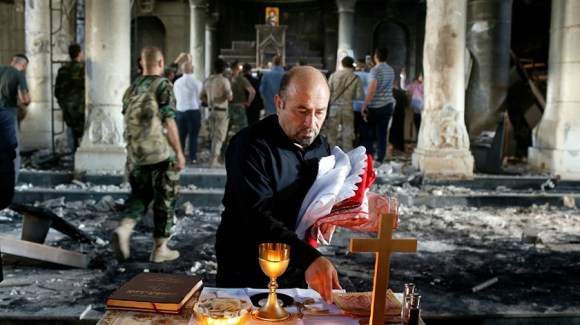
Ahmed Jadallah / Reuters Preparation for Qaraqosh’s first Sunday mass since the Iraqi Christian town was recaptured from ISIS (October 30, 2016).
This article was first published at Christianity Today on January 30, 2017.
Married in December to a Syrian woman with American citizenship, Fadi Hallisso went to Beirut to apply for a green card.
A Syrian Christian, Hallisso has worked with refugees in Lebanon since 2012. Funded by different American agencies, he was no stranger to the US government. He even testified about the situation in Syria to the US State Department and to Harvard Divinity School.
But this week, Hallisso was told he was no longer welcome to apply. The new US administration said so.
“It is very humiliating to be put in the category of potential terrorist,” said Hallisso. “Just because I carry a certain passport.”
As more details of President Donald Trump’s new security policies emerge—including a promise to prioritize Christian refugees for resettlement in America—much appears lost in translation.
“This executive order has created a new atmosphere very hostile to people in the region,” said Chawkat Moucarry, World Vision’s director for interfaith relations—and Hallisso’s uncle. “Unwritten rules seem to be implemented as a result.”
Is Trump’s executive order on refugees a de facto “Muslim ban”? Is it not? Is it prudent? Is it overdue? As American Christians debate these questions from the small towns of Middle America to the nation’s major airports, so also Arab Christians are trying to figure out what is going on.
“I read the executive order,” said Adeeb Awad, chief editor of al-Nashra, the monthly magazine of the Presbyterian Synod of Syria and Lebanon. He remarked…
Please click here to read the full article at Christianity Today.
Living in the Middle East one drinks deeply from the well of conspiracy thinking. It pollutes the mind, but also trains it.
So while Americans mused over the merits and demerits of Trump and Clinton, I feared the patterns I was watching develop.
To describe would require a full listing of faults, but I mean this post to be more humorous than serious. It excerpts from an article by Karl ReMarks, a noted Middle Eastern satirist.
In it he compares the United States with Arab nations. It is funny while being unnerving. Enjoy, so to speak.
On the secret services:
Let’s start at the beginning. During the campaign we were surprised to learn of the influence that the head of the American mukhabarat (state security, i.e. your FBI) can wield over the election process, simply by choosing to pursue a certain line of investigation. As you may know, this has been a constant feature of our politics since independence. Our surprise turned to astonishment when we started to witness the blossoming feud between the then-president-elect and the American mukhabarat, another important feature of Arab politics.
On top of that, we started to hear reports of foreign meddling in your elections, which some say may have influenced the result. Of course, we are quite familiar with that situation, too, not least because of the efforts of your own administrations over the decades. Yet it came as a surprise to hear talk of “foreign hands” and “secret agendas” in a country like America. We sympathize.
On the bright side, this was also the moment that the conspiracy theories started to spread. You know us; we’re quite fond of conspiracy theories—particularly when they involve plots by external powers—and consider ourselves connoisseurs of the genre. Your plots are a bit rough around the edges, we have to admit, but top marks for creativity. Was the election of Trump a Russian conspiracy? Was talk of the Russian conspiracy a liberal conspiracy to undermine Trump? Did the mukhabarat leak information to help Trump? Did the mukhabarat leak information to hurt Trump? Was media coverage of Trump’s mukhabarat conspiracy theories part of a liberal conspiracy theory to bring him down? They’re all so deliciously complex and open-ended, much like our own.
On the media:
Of course, another crucial aspect to this transformation is the president’s contemptuous attitude towards the media. My, the delightful similarities. From blaming the press for engaging in secret conspiracies to undermine him to threatening their access to his White House palace to refusing to take questions from certain reporters, President Trump reminds us of several of our own leaders. In fact, an Arab leader complaining about CNN coverage is pretty much a staple of our political life.
This took an interesting turn on Saturday when the president accused the media of manufacturing his feud with the mukhabarat and his Minister of Information Mr. Sean Spicer castigated the media for reporting the size of Trump’s inauguration crowd. The not-so-veiled threats by the president and Mr. Spicer to the media are very much in the spirit of Arab governance.
On protests:
And then there’s the unrest. In the lead up to the inauguration, we started to hear about youth protests against the new regime. Come on! This is bordering on plagiarism now. Please write your own plots and stop borrowing ours. Although, we usually wait for leaders to take power before we start protesting; we like your preemptive revolution approach.
…
A word of warning though, before embarking on this path. We tried the revolution thing ourselves, and it didn’t work out so well. Maybe you should just adapt to living in the new regime. We were always told that having a strongman in charge is the best solution for Arab countries, otherwise there would be chaos. Perhaps the American people are not ready for democracy after all. Let’s face it America, you look like an Arab country now.
In 2008 a Moroccan man and his 17-year old wife immigrated to America. Not long after she filed a restraining order against him, claiming her husband was raping her. The husband did not deny their sexual relations were non-consensual, but said that in his religion, the wife was supposed to submit and do all that he desired of her. The New Jersey judge found that given his understanding of Islam, he did not intend to commit a crime, and was therefore innocent. The restraining order was denied.
Cases like this set off alarm bells that shariah law is coming to America, and in fact is already here. Called “creeping shariah,” this case is given as just one further example of the United States nation forsaking its heritage in an effort to be politically correct and yield to the pressures of local Muslims to live by their own laws, and not our own.
But according to Eugene Volokh, a conservative law scholar at UCLA, it is quite the opposite. Where US judges have made reference to shariah law, they do so within parameters long established in American legal precedent. He notes, importantly, that the judge in the New Jersey case made a legal error, overturned by a higher court which granted the restraining order.
In the effort to understand this controversial and inflammatory subject, his explanation proved very helpful. Here is a list of what is and is not allowed in the American judicial system:
Allowed: Distribution of inheritance according to religious motivation
Not: Asking the court to divide inheritance according to shariah law
US law allows freedom of contract and disposition of property. One may divide one’s property in a will according to whim, or ask a religious scholar to divide it according to shariah law. But the court does not accept competency to interpret religious laws, and would reject a request asking it to do so.
Allowed: Application of foreign law to determine marriage or overseas injury
Not: Specifics of foreign law against US code or procedural discrimination of testimony
US law will accept that two foreign individuals are married if they were legally married according to the law of their country of emigration. If in foreign nations marriage is determined according to shariah, then US courts must take this into consideration for the determination of marriage in a domestic dispute. Foreign acceptance of polygamy, however, has no application in US courts.
Similarly, if an American is injured abroad and sues a company with representation in America, tort laws are determined by the nation in which the injury occurred. But should foreign tort laws limit the value of female testimony, as for example in some understandings of shariah, this has no carry-over consideration in the American lawsuit.
Allowed: Exemption from work rules for religious reasons
Not: Unless it imposes ‘undue hardship’ on an employer or is against government interest
US law permits reasonable accommodation for religious belief, evaluated on a case-by-case basis. So wearing a hijab at work or taking time from the work day to pray may or may not be granted, based on the nature of the employment in question. A famous ruling allowing Muslim taxi drivers to decline a customer carrying alcohol may or may not have been judged correctly, but what is important is that it was based on existing American precedent, not in understanding what is right in Islamic shariah.
Allowed: Granting accommodation to students or clients that impose only modest costs on the granting institution
Not: Evaluation of these requests on the basis of which religious group asks for them
US law allows public and private institutions to better serve citizens and customers by appealing to their religious sentiments, as long as this does not damage the public interest as a whole. Banks have offered sharia-compliant loans, for example, and schools with high density Muslim populations have granted a full day off on holidays rather than just excusing Muslim students. Examples of this sort apply equally to all religious petitions, and must not be judged on the basis of which religion benefits.
Allowed: Efforts to legislate Islamic morality in heavily populated Muslim areas
Not: Unless it violates the Free Speech Code or Equal Protection Clause
US law permits citizens to lobby government to pass laws reflective of morality. In local areas therefore, Muslims are as free as others to pass legislation barring alcohol, for example. Should any locality, however, seek to encode restrictions on “blasphemy” or limit the rights of women, it will stand in clear violation of existing US law and be struck down by the courts.
In addition to Volokh’s analysis, New York attorney Sadakat Kadri wrote in Heaven on Earth: A Journey through Shari’a Law from the Deserts of Ancient Arabia to the Streets of the Modern Muslim World, that US federal arbitration law has been on the books since 1925.
Arbitration law has legitimized religious tribunals for Christian conciliators and the Jewish Beth Din, giving them force of law to issue legally binding decisions. To deny similar right to Muslims, within the context above, would require reforming that law to impact all religious communities.
There are many cases offered by those who warn of creeping sharia, and each must be evaluated on its own merits. There may be examples–many or few–in which the above descriptions have been violated. The above is offered to all who have been affected by the clamor that “the Muslims are coming.”
Indeed, they are already here and are coming as citizens within a nation of laws. They are undoubtedly changing the demographic and culture of our country, as every set of immigrants has done before. That they are Muslims, outside of the general Christian heritage of most previous groups, does add a different application of the American guarantee of freedom of religion. It may also result in these newer Americans who, either unaware or rejecting of American liberty, seek to illegally restrict individuals in their own communities.
But throughout the nation’s history the constitution and bill of rights has worked remarkably well. It should be trusted to continue, no matter the unfamiliarity of those who believe also in shariah. The United States will honor them within reason, and curb any excess that violates our order. On many issues worthy debate must take place. But we must not let fear or demagoguery permit generalization or discrimination.
Let the law decide.
This article was first published at the Zwemer Center.
It is not unusual for American politicians and the State Department to call out other nations of the world for their violation of human rights.
But the past few weeks have given other nations an excuse to hit back. Laugh or cry, here is a selection of Egyptian statements about our racial issues and the UK Chilcot report on the Iraq War.
MP Margaret Azer, deputy chairman of Egypt parliament’s human rights committee, said in a statement that she was appalled by the brutality of American police.
“I think that all Egyptian MPs and defenders of human rights should move to condemn the repeated brutal use of force against black Americans and expose the bloody face of the United States and its politicised use of the issue of human rights to extort other nations,” said Azer.
Azer’s statement added that “the United States, which likes to give lectures on human rights to other nations and issue periodical reports on civil liberties in the world, was caught red handed violating human rights and crushing the peaceful protests of black Americans in the city of Dallas and other US cities.”
Ilhami Agina, an independent MP and a member of parliament’s human rights committee, also said in a statement that “the excessive use of force against black Americans in the US has exposed the ugly face of Western regimes and that these regimes are deeply involved in wide scale racial discrimination.”
“[US President Barack] Obama, who came to Cairo in 2009 to give us a long lecture on human rights, might have forgotten that it is America that needs radical reform,” said Agina.
Agina told reporters that he sent a letter to Egypt’s foreign minister Sameh Shoukry asking him to summon the US ambassador in Egypt – Stephen Beecroft – to convey Egypt’s dissatisfaction with the excessive use of force against blacks and urge the American government to reform its record on human rights.
“Egypt is now the head of the Arab summit and so it should give a say on what happens in America, but if Shoukry does not opt to do this, he should at least do as the US State Department, which always grants itself the right to comment on judicial and political issues in Egypt,” said Agina.
Ayman Abu Ela, the parliamentary spokesman of the Free Egyptians Party, told reporters that he also hopes that Egypt’s parliament will hold a session on America’s violations of human rights.
“The US administration and media, which have always accused Egypt of issuing a tough protest law have nothing to say now about their police brutality against black protesters,” said Abul Ela, also agreeing with other MPs that “the recent incidents of excessive force and police brutality in America have uncovered the falseness of American democracy and its flawed reports about human rights in the Arab world.”
Perhaps most US criticism of other nations means as little as these statements above in the practical rebuke and correction of abuses. Perhaps they reveal how indicative of the domestic political context each remark is made, rather than impact on international relations.
But sometimes, human rights abuses do result in international censure. Here is the Egyptian appeal:
The Egyptian parliament’s Committee on Foreign Affairs called on Friday for George W. Bush and Tony Blair to be tried as war criminals, saying the resounding report of a British committee investigating Britain’s participation in the war against Iraq clearly shows that there were no convincing reasons for the conflict.
“This British committee’s report – the Chilcot report – has exposed the false reasons which former US president George W. Bush and former UK prime minister Tony Blair had exploited to wage their illegitimate war against Iraq,” said the strongly-worded statement.
The parliament said that the American-led war in Iraq left more than one million Iraqis killed and millions more wounded, internally displaced or sent from their homes as refugees.
“There’s no question that George W. Bush and Tony Blair should be put on trial as war criminals not only because they are the ones who trumpeted the reasons for this war, but also because they should be held responsible for the deaths of millions of Iraqis since 2003,” the statement read.
Human rights – and their defense – are vitally important. Too important, in fact, to be left to politicians anywhere.
But without them, progress will always be limited. Empty rhetoric may be part of politics, but rhetoric sets a tone. The world is a better place even if politicians give only hypocritical lip service to human rights. Their conscience can always awaken. If so, laws and policies can change, however gradually.
Consider the alternative, if human rights are outright ignored or justified away. Sometimes, in many nations, this alternative is all too near.
As Christians involve themselves – for good and for bad – in the divisive politics and cultural struggles of our nation, it is assumed they do so to preserve and advance a moral ethic consistent with Scripture.
Unfortunately, it can be easy to forget one of the central marks of this morality: ‘Do unto others, as you would have others do unto you.’
This command, and it is necessary to remember it is an active imperative, concerns many issues of the day. I would submit that current Muslim-Christian relations illustrate this selective memory, and the Middle East provides a useful mirror.
In the Arab world it is Christians who are the great minority. How do they describe their situation? Much like in America, there is considerable nuance.
It must be said at the outset that the comparison will not be exact. The US enshrines religious freedom for the individual and forbids a religious test for public office. While these concepts are not absent from the Arab world, they are mixed in with many constitutions that enshrine Islam as the religion of the state and sharia law as the basis of legislation. At the official level these articles can complicate matters considerably.
But what about the popular level?
To be certain there is a spirit that, while tolerating Christianity, strives to preserve and advance the Islamization of society. Some conservative Muslims argue that Christians should not be greeted on their holidays, lest it imply endorsement of false theology. Others warn their children against playing with Christians at school. And many Christians complain of discrimination that is mixed in with a general culture of nepotism.
But Christians the region over also speak of neighborly relations with normal people who happen to be Muslims. Post-Arab spring, many Arab governments are going out of their way to combat extremism that has crept into society. And as reflected in my recent article in Christianity Today, many Arab Christians are comfortable saying they and their fellow Muslim citizens worship the same God.
Yet the article also described an undercurrent of frustration, that Christians feel internally compelled to seek common theological ground in order to secure common societal acceptance. The more some push the distinctiveness of Christianity, the more they fear either government or popular response.
Within the diversity of these Arab responses there is also advice for America and the West: Limit the presence of Muslims in your midst.
The complaint is not so much against Muslims as a people, but of Islam as a religion. The more devout the practice, they say, the greater the enthusiasm to enact its superiority – not just in the afterlife, but to bring this world into conformity as well. As evidence, they simply point to their own societies.
Whatever is made of the ‘same God’ debate, Islam and Christianity are different religions. But different also is the historical fusion between these religions and their respective societies. It is good to learn from our Arab brothers and sisters in Christ about their experience with Islam where they are the minority. But the point here is not so much to arm with argument but to invite readers to flip the script and see within it a mirror to their own society.
How might American Muslims feel about our current social and political climate? Would they say most neighbors treat them well? Would they complain they have to accommodate their faith to a dominant culture? Would they state a concern over discrimination or a fear of rejection?
Many Arab Christians have responded to their challenges by withdrawing into their own communities. Are American Muslims tempted to do the same?
And what of the warning some Arab Christians issue about Islam? How similar is it to some Muslim warnings about decadent Western society and the Christianity that is powerless to arrest it? Or, others argue, the Christianity that is in league with colonialism or Zionism or consumer capitalism to radically alter the fabric of Muslim society?
Let every charge be answered, and every religious ideology be examined. But let every American Christian return to the imperative of Christ:
“Do unto others as you would have others do unto you.“
Consider the situation in which Middle Eastern Christians live and ask, how would you like this ‘you’ to be treated?
It is not argued that treating American Muslims well will necessarily make any difference to the Egyptian Copt, the Lebanese Maronite, or the Iraqi Assyrian. But any mistreatment of Western Muslims is often reported in the regional press, and gives fuel to those with an axe to grind.
The Golden Rule is not about quid pro quo. It is fulfillment of the law of Christ, who served those who loved him not. Please be mindful, for concerning Muslims it is often we who so rarely love.
Many have praised President Obama’s recent visit to a Baltimore mosque and affiliated school. Others have been critical, but it is important to counter a rhetoric that is increasingly casting shadows upon fellow American citizens.
But here are two Western Arab voices that express a little concern. The first is a UK-based Muslim, Nervana Mahmoud. She cites official White House photos that present a ‘cropped’ picture of American Islam.
(Official White House Photo by Pete Souza)
The leader of the West’s strongest nation has opted to strip Islam from its centuries-old, colorful diversities and frame it within a monochromatic conservative style—a self-defeating approach from a man who advocated for diversity among weary Americans who wish to shelter their country from the turbulence of the Middle East. … The lack of non-Hijabi women among the attendees, even among the children, is striking.
Nervana counts herself a liberal Muslim, and wishes this sector had been highlighted. She is confused why a progressive American politician would choose such a mosque for the spotlight.
Non-Islamist Muslims exist in America as well as in their native countries. Iranian Americans, for example, will undoubtedly tell the president tales about oppression, dress code, and the Islamic Republic of Iran. Other liberal Muslims fight against segregation, enforcing Hijab upon children.
Almost all mainstream Muslim scholars agree that Hijab for pre-puberty children is not obligatory. The American leadership that fights the Islamic State’s oppression, however, seems tolerant of such indoctrination of children.
Coptic-American Maged Atiya suggests that no matter the mosque the venue would have been criticized as unrepresentative. But he is disappointed that such a cerebral president offered such an empty speech.
It is heavy on optimism, on declarations of belief in liberal values and tolerance, and on deep faith that fundamental forces will force a happy outcome. In short, that we are destined by the arc of history to a fair, just and tolerant outcome in any struggle.
The trouble with that view is that it offers no guidance to short-term policy that will actually lead to such outcomes in the long run.
… The Baltimore speech does American Muslims injustice by lack of acknowledgement of real barriers that stand between their desire to conform to a conservative version of their faith and yet integrate effectively into American society.
He laments Obama’s missed opportunity to really tackle this issue with substance. If so, he could have addressed the core competing values.
There are major differences between the ethos of conservative Islam with its backward glances and emphasis on community sovereignty and the liberalizing trend of American society with its emphasis on the liberation and autonomy of the individual.
Glossing over these differences leaves all exposed when the conflicts inevitably come to the surface. Bigots among American non-Muslims will insist that Muslims can never be “full Americans”, while bigots among American Muslims will insist that such differences are merely manifestations of irrational hatred of Islam. This is a disservice to any effective understanding and outreach between faiths.
I am sympathetic to both viewpoints, but also willing to propose an explanation.
Whether the choice to not wear hijab or sport a long beard and traditional clothing comes from conviction, compromise, or apathy, many of these Muslims mix easily into Western life. They may or may not believe fully the tenets of Islam, may or may not pray at home or the mosque. But in the panoply of American diversity they look more or less like everyone else, and thus, I imagine, draw neither the ire nor support of culture warriors.
Perhaps Obama chose to highlight such a mosque precisely because it draws such a visual image. You, too, are welcome in America. The vitriol of much political discourse targets you, and must be spoken against. Your clothing choices reflect your faith, and for this there is freedom. We must defend it vigilantly, and publicly.
If this is a sentiment behind Obama’s choice, it may also illumine his speech. The presidency is often more a bully pulpit than a university lectern. As hard as some are hitting Muslims these days, the force of rhetoric must be returned. Where fear and suspicion are preached, let principles and idealism respond.
But the criticism of both authors is fair. The complexity of this issue must be honored, and Muslims come in a million stripes.
But they also come as individual citizens. All but the tiniest minority deserve the full scope of American freedoms. American political leadership should do justice to both these realities.
Here in Egypt the conspiracy thinking is strong that the United States, or at least her allies in the region, are a force behind the emergence of the so-called Islamic State.
From the London Review of Books, here is some of the evidence. Fortunately, the author also deals with it along the conspiracy spectrum:
His book went to press before he could take account of the extraordinary revelation that US intelligence had anticipated the rise of Islamic State nearly two years before it happened.
On 18 May, a document from the US Defense Intelligence Agency dated 12 August 2012 was published by a conservative watchdog organisation called Judicial Watch, which had managed to obtain this and other formerly classified documents through a federal lawsuit.
The document not only anticipates the rise of IS but seems to suggest it would be a desirable development from the point of view of the international ‘coalition’ seeking regime change in Damascus. Here are the key passages:
7b. Development of the current events into proxy war … Opposition forces are trying to control the eastern areas (Hasaka and Der Zor), adjacent to the western Iraqi provinces (Mosul and Anbar), in addition to neighbouring Turkish borders. Western countries, the Gulf states and Turkey are supporting these efforts. This hypothesis is most likely in accordance with the data from recent events, which will help prepare safe havens under international sheltering, similar to what transpired in Libya when Benghazi was chosen as the command centre of the temporary government …
8c. If the situation unravels there is the possibility of establishing a declared or undeclared Salafist principality in eastern Syria (Hasaka and Der Zor), and this is exactly what the supporting powers to the opposition want, in order to isolate the Syrian regime.
So American intelligence saw IS coming and was not only relaxed about the prospect but, it appears, positively interested in it. The precise formula used in paragraph 8c is intriguing. It doesn’t talk of ‘the possibility that Isis might establish a Salafist principality’ but of ‘the possibility of establishing’ a Salafist principality. So who was to be the prime mover in this process? Did IS have a state backing it after all?
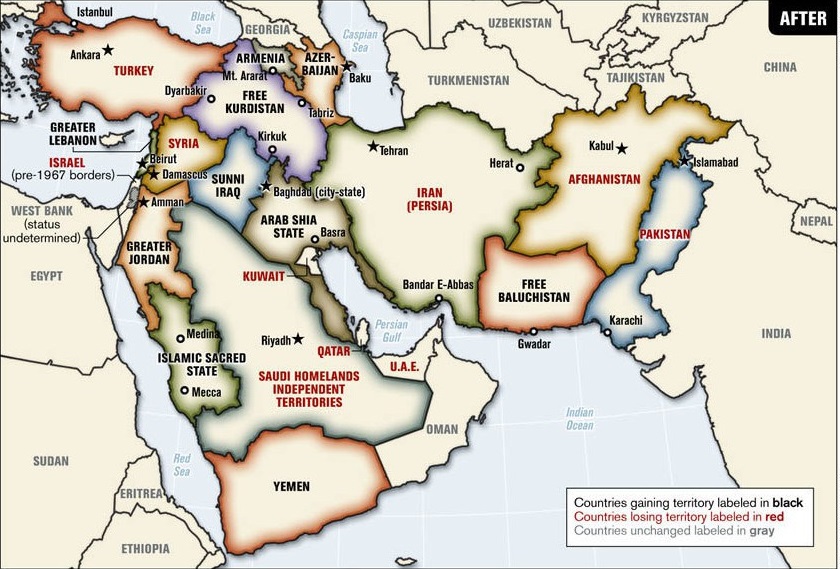
The second piece of evidence is less direct, but comes from a 2006 map of the ‘New Middle East’ published in the Armed Forces Journal. It draws boundaries for an Arab Shia state, an Arab Sunni state, Syria, and Kurdistan.
Here is the author’s interpretation:
What we can make of this is, of course, unclear. At one extreme, conspiracy theorists will argue that it supports their claim that the Western powers have been deliberately creating chaos for unavowable reasons of their own.
At the other end of the spectrum, one could hypothesise that the DIA document may have been read by four unimportant people in Washington and ignored by everyone else.
In the middle, showing more respect for the DIA, we could imagine something else: the possibility that, in 2012, American and other Western intelligence services saw Isis much as they saw Jabhat al-Nusra and other jihadi groups, as useful auxiliaries in the anti-Assad drive, and could envisage its takeover of north-eastern Syria as a helpful development with no worrying implications.
If Islamic State escaped whatever influence Western intelligence services may initially have sought to have on it and went its own way, this means that people have been playing with fire.
I don’t pretend to know what the truth is. But there is no need to prove malign intent on the part of the Western powers. The most charitable theory available, ‘the eternally recurring colossal cock-up’ theory of history, will do well enough.
It is a very long but thorough article, stretching from the Mamluke era to Sykes-Picot through last century’s cycle of Arab revolutions and coup d’etats, up to the current day. His conclusion is that if the Western world wants to defeat the Islamic State, it must do so through the Syrian army, at least temporarily with Assad at the helm.
It makes for a good read, and also drives you crazy. Just realize that Arab conspiracy theorists are right there with you, and have suffered far more than we who can read the London Review of Books.
From Global Post, two articles which detail the contracts given out the past two years, and which companies receive them:
Until recently, the United States and Egypt shared a very special arrangement.
Here’s how it went: the US government would collect taxes from the American people. It would give a portion of the proceeds — about $1.3 billion a year — to help Egypt’s military. Egypt’s military would then give that money back to the United States, or at least to the country’s major defense corporations, in return for goods and services.
Would you like to round your budget figures as precisely as the following:
Contract details cited here were compiled from the US Defense Department database, where contracts over $6.5 million are published each business day. Dollar amounts are rounded to the nearest tenth of a million.
And here, without ado, is the beginning of the list:
See the table at the bottom of the page for full details of the contracts.
1. Lockheed Martin
Amount: $259 million
Boeing (5th) and Raytheon (6th) were the only other names I recognized. It is not that US military spending is improper, it is that US aid must be recognized also for this reality: It is a subsidy to the defense industry.
If we define our terms properly we can have better debate on policy.
A recent Foreign Policy investigative report details Qatari foreign policy. It describes a strategy of intervention-by-proxy, which keeps its hands clean officially while funneling money to groups it deems ideologically similar, that is, those they can trust.
Primarily, this has been the Muslim Brotherhood and various activist Salafi factions.
The article is long but worthy, and one interesting section describes how Qatar has helped the US disengage from the region. This was evident in Libya, when Qatar not only provided crucial Arab support for the operation, but also took the lead in sponsoring militia groups against Gaddafi.
But now that the US is reengaging the region, this time against the Islamic State (ISIS), officials are examining anew the sponsorship by Qatari individuals and charities which have gone to the al-Qaeda affiliated al-Nusra Front. Following three years or more of looking the other way, the dispute has become public:
In Syria, meanwhile, it wasn’t until the Islamic State gained prominence that Washington sat up and took notice. In March, David S. Cohen, the Treasury Department’s undersecretary for terrorism and financial intelligence, took the unprecedented step of calling out the Qataris in public for a “permissive terrorist financing environment.” Such stark criticism, counterterrorism experts say, is usually left for closed-door conversations. A public airing likely indicated Doha wasn’t responsive to Washington’s private requests.
But if initial requests were private, that means the US – for a long while, at least – tolerated and possibly approved of the general strokes of Qatari foreign policy. Two key aspects of Qatar’s leverage over the United States include its hosting of the US Central Command air base, as well as the usefulness of its network to liaison with otherwise disreputable characters. Discussions with the Taliban in particular have often flowed through Qatar. Without them, back-door channels would not be possible; hostages released might still be held.
Has the US, therefore, been a partner in the wanton destruction of Syria? President Obama has forcefully spoken against Assad, but has never decisively moved against him. The article deems the chaos there less to be a result of coordinated conspiracy, than uncoordinated incompetence:
In other words, there was no one winner. Qatar and other international powers haphazardly backed dozens of different brigades and let them fight it out for who could secure a greater share of the funding. They had few incentives to cooperate on operations, let alone strategy. Nor did their various backers have any incentive to push them together, since this might erode their own influence over the rebels.
Says one analyst:
“One of the things about Qatar’s foreign policy is the extent to which it has been a complete and total failure, almost an uninterrupted series of disasters,” says Hussein Ibish, a senior fellow at the American Task Force on Palestine. “Except it’s all by proxy, so nothing bad ever happens to Qatar.”
Except its reputation in much of the Arab world. Egyptians in particular have been furious at Qatar over its support for the Muslim Brotherhood. Saudi Arabia and the United Arab Emirates have signaled displeasure in manners unusual among Gulf monarchies.
Long ago Qatar made a bet on the Islamist factions becoming the prominent power players in the region. For a while they seemed vindicated; now they appear in retreat. Qatar has been publicly acquiescing to the criticism, sending away top Brotherhood figures it has long hosted, for example, but it is unclear if its long term strategies have changed.
Were Qatar and its allies-by-proxy simply outmaneuvered? How much of the Arab Spring was manipulated by the regional and international power struggles? What role did America have is a key question. Most Arabs view Washington as the chief puppet master, allowing its public allies – the Saudis, Turks, UAE, Qatar, and Israel, of course – to mess around with local sovereignty.
Or, did the US just pull back, and allow others to run the show? Either way, the result is a disaster, however many parties share in the blame.
One other controversial point converges with this article. Many Egyptians see the Muslim Brotherhood as one aspect of an Islamist agenda that includes and coordinates with groups like ISIS, on the far end of the spectrum. The point is not necessarily that the MB keeps its hands clean while sending out clandestine orders to others to ferment chaos – though this is certainly believed locally.
But if the Brotherhood is one part, and a key part, of Qatar’s proxy network, a linkage does seem to exist. This article does not make the accusation, and I do not wish to lend it weight in the mentioning. But it bears consideration.
Of course, Brotherhood sympathizers simply turn the equation on its head. They see Qatar as the good guy, standing with the people and the forces of democracy, against fearful Gulf monarchies, their own proxies, and the US.
God bless this part of the world. Maybe one day the oil will run out and they can all be left alone again.
In the case of Egypt, the researchers analyzed more than 2.2 million Arabic tweets that mentioned the United States and found just three percent could be termed pro-American, with 23 percent neutral and the majority critical of the United States.
Ok, so they hate our foreign policy – no big news there. But the following is more disturbing:
By contrast, about 30 percent of those tweeting in Arabic about Hurricane Sandy expressed concern about Americans or defended Americans.
Only 30 percent? Ugh. I hope there is some confusion in reporting or answering, between ‘concern’ and ‘defended’. But this doesn’t reflect well, I’m afraid.
So how to interpret the general conclusion:
“Reactions to cases where the US is influencing Middle Eastern affairs are 95 percent to 99 percent negative,” Keohane said.
Is our foreign policy just really bad? Or are we inept at PR, at least in comparison to local outfits? The research showed these numbers hold no matter what side of the domestic divide these tweets support.
I generally think that ‘winning hearts and minds’ is an overblown concept. But in as much as it is a policy goal, the US is failing miserably … at least on Twitter.
Egypt’s presidential race is shaping up, and its arms race as well. The relevance of each is to be determined.
Hamdeen Sabbahi, who finished third in the presidential race of 2012, declared his candidacy, claiming to represent both the January 25 and June 30 revolutions. Many then saw him as the best alternative between the old regime and Muslim Brotherhood candidates, but many wonder now if his popularity remains.
God, give him clarity and courage. May his campaign highlight issues between which the people must debate and choose. Strengthen and equip him to bear this challenge.
Abdel Munim Abul Futouh, meanwhile, who finished fourth in the previous race, declined to run. He lamented the unjust state of the nation and said he would not lend credence to a foregone conclusion. He had some support then as a revolutionary, independent Islamist, but some wonder now if he has any support at all.
God, give him wisdom and prudence. May his campaign of a sort rebuke any foul play by the current authorities. Convict him to be upright and influential now, even if he is saving himself for a later challenge.
And subsequently, the Rebellion Campaign, or Tamarod, splits. They brought the possibility of a presidential election to the people through a massive signature campaign and protest to remove Morsi, but with a choice upon them they begin infighting. Some back Sabbahi, others back the yet to declare army general Abdel Fattah al-Sisi. Millions backed Tamarod eight months ago, but having accomplished their goal, does anyone back them now?
God, give them perspective and chivalry. May their choice reflect the will of the organization, to the degree the organization exists. They have borne their challenge, shall they have another one?
Sisi, however, campaigned in Russia. He returned with the endorsement of the Russian president, but also with strengthened ties and negotiations for arms sales and military cooperation. This is seen as a counterbalance to the longstanding support given by the United States, implicitly protesting the widespread suspicion America is interfering in local developments.
God, give them leverage and diplomacy. May Egypt conduct its foreign policy with independence and find friends with mutual interests for the common good. This challenge is ongoing, and may not end soon.
Nearly everything in Egypt feels weighty, God, but does reality match? Is Sabbahi a real candidate or a willing foil to Sisi? Does Abul Futouh matter? Is Tamarod a discarded shell? Is Russia a replacement for America? Or is the status quo more or less immovable, with developments meant to dodge, distract, and squabble over scraps of relevance?
May it not be so. The heart is divided between selfishness and altruism; politics allows for both and no man is an angel. But may public leaders emerge having been proved as public servants. Satisfy the need for meaning and purify the desire for power.
Above all, God, make Egypt relevant, but only for good. Challenge her, and curb her rebellion. May she find the freedom that comes from doing right.
I have lived overseas now for about eight years. We have lived in three different countries, but even so, I feel quite at home here in Egypt, where we have been for four years. We have lots of friends and my life is busy with four young kids. For me, living overseas is the norm. While I love so many things about America, and I would love to live in the same state, or even town, as my family, I am perfectly content living as an expat.
But there are times when homesickness strikes. Times when you just wish you could be two places at once, or that you could travel over the ocean as easily, and cheaply, as driving from New Jersey to Pennsylvania. And one of those times is the holidays. Particularly Christmas.
The family I grew up in still gets together on Christmas despite growing from the original 7 to now 29 people. And if I sit and think about that too long, especially at the time they are actually gathering, which is usually when I am sleeping here, that can make me sad. I would love to be with my family on Christmas. But of course, I am with my family on Christmas as I celebrate with my husband and kids. What is the difference?
The last few years I have felt that Christmas has snuck up on me. We celebrate American Thanksgiving, and before I can think about it, I have to have the Christmas Advent calendar up in order to count down to the 25th. Meanwhile, here in Egypt, the official holiday of Christmas isn’t until January 7, according to the Coptic calendar. And while you can see lots of Christmas trees and wrapping paper on display at local shops, there isn’t exactly the festive atmosphere that you would find in the States. One of the biggest reasons the 25th almost comes without notice is that my girls have a regular school day and are either studying for or taking their mid-term exams. The church where we worship has begun Christmas choir practice for the girls, but their program will be on New Year’s Eve.
And so I am learning what I need to do personally to make Christmas special for me and my family in our home here in Egypt. I need people and special celebrations. If we aren’t invited to others’ celebrations, then I need to host celebrations for us (or maybe for me!) I need to bake and enjoy the time spent in the kitchen with my kids, as that is one of my favorite memories from Christmases in Pennsylvania… all the kitchen preparation beforehand. I need to listen to Christmas music and make an effort to teach my kids the carols they should know. We need to attend Christmas productions and concerts at local churches. And we need to set new traditions that make our Christmases ones that our children will one day miss.
This year I am hoping to host three Christmas teas. What is easier, and tastier, than making a bunch of Christmas sweets, and inviting others to join and indulge? One group will be teachers from my daughter’s Egyptian school, where I have begun teaching on a very part-time basis. This is an experiment and something totally new for them. Another group will be of Egyptian Christian friends. Again, a bit of an experiment, but we can celebrate the holiday together, perhaps for some of them in a new way. And the last group will be of other foreign moms like me. This will be the most naturally comfortable and possibly the tastiest as they provide some of their favorite traditional sweets.
No matter where we are, if with my husband and our children gathered together, we are home. And this home is now Egypt. It requires some adjustments and creativity, and perhaps some courage to step out and try new things. One of our Egyptian traditions is sailing on a felucca on the Nile River on Christmas morning. It is very different from the craziness that ensues when 17 grandchildren descend on my parents’ house on Christmas day. But these are special times and new memories that we make ourselves. Perhaps one day our own children will have a longing for Egypt. But we pray they will be able to celebrate wherever they are, even if not quite home.
US Secretary of State John Kerry met with top Egypt officials to convey Washington’s “deep concern” about the transitional period and to offer the US’s goodwill should developments move “on the right track,” according to Western diplomats.
But on CNN, the focus brushes over any difficulties at all:
U.S. ties with Egypt go deeper than aid, America’s top diplomat said Sunday.
“Let me make it clear here today: President Obama and the American people support the people of Egypt,” U.S. Secretary of State John Kerry said. “We believe this is a vital relationship.”
Both articles report the general thrust of the speech, but their opening leads are indicative. The US wants to avoid a crisis while Egypt wants to project one.
I cannot speak very well about the messaging coming from Washington, but Egypt is currently filled with belief that the US backed the Muslim Brotherhood and is even now working behind the scenes against the popularly backed military move to depose President Morsi.
After all, for many here, the timing of Kerry’s visit is auspicious. He arrives one day before Morsi’s trial is to begin.
Perhaps the United States felt she needed to take a stand. Perhaps this is a new wrinkle in an old story of feigned antagonism. Perhaps she backs the Muslim Brotherhood. Perhaps she backs democracy.
Perhaps she is against the killing of protestors. Perhaps she is muddled and has little idea of how to engage Egypt.
Whatever the reality, God, she has suspended aid.
Not all, of course, and not permanently. But it is a significant step of disengagement from a nation with which she has an entrenched political and military partnership. What will come of it?
Make Egypt, God, a country that needs no aid. Help her to stand on her feet, supply her own needs, and craft her own policies. May these be wise and righteous; may she be generous and able to aid others instead.
Make Egypt, God, a country free from external leverage. Help her to defend her nation as necessary, stand tall in balance of power, and speak into issues of regional justice. May she be strong and welcoming; may she love peace and pursue it.
But these are ideals, God. And even if achieved, Egypt will remain part of the global community in which none are independent. Within this web, she is more often a fly than a spider; give her reprieve.
US aid is the reality in which she lives. Help Egypt’s leaders to respond correctly. May good relations with America persist, even as they evolve. But may all stipulations be negotiated fairly, from strength to strength, on what is right and proper rather than from interest and pressure.
For Egypt can certainly pressure back. Perhaps you deem America immoral, God, as many Egyptians do. But there are certainly other immoralities to flirt with; may Egypt not run from one lover to the next.
There is a certain stability in the world, filled with injustices but facilitating peace as the absence of war. Egypt, if she wishes, can undo some of this. Suez, Sinai, Israel – her contribution to the web is substantial. Make right the injustices, God, but preserve and enhance any peace that exists.
And God, if American aid and leverage has positive ideals behind it, may a principled stand produce principled results. Domestically, hold leadership accountable to the demands of the people. Grant Egypt consensus and a governmental system that represents it.
The United States may be acting from any number of motivations, so give Egypt discernment. But whether aid is restored, lessened, made conditional, or eliminated, help Egypt also to take a stand.
For Egypt, may there be no wrinkles. May there be no antagonism. May there be no backed political entity. May there be no engineered democracy. May there be no killing. May there be no need for protests.
May there be no muddle. God, engage Egypt, and do not suspend your aid.
As the US administration has decided to suspend some foreign military assistance to Egypt, consider this article from Reuters, carried by Ahram Online, from a few weeks previous:
Richard Genaille, deputy director of the Pentagon’s Defense Security Cooperation Agency, said he hoped the Obama administration reached a decision soon on whether to continue $1.23 billion in U.S. military assistance to Egypt, given the large number of weapons shipments in the pipeline.
“We’re kind of antsy about that,” Genaille said after a speech at the ComDef industry conference in Washington. “There’s a whole bunch of contracts out there. The bills keep coming in and we’ve got to be able to pay them somehow otherwise we go in default.”
….
Funding for the weapons sales must be finalized or “obligated” by September 30, when the U.S. government’s 2013 fiscal year ends, or the funds will revert to the U.S. Treasury, officials say.
“We’re kind of hoping that sometime pretty soon they’ll make a decision one way or another – either we terminate or they actually give us some more of the Egyptian (foreign military funding) so we can pay the bills,” Genaille said.
He said the administration was trying to sort through the potential costs associated with terminating contracts, but the amount would be “substantial – in the billions.”
US ‘aid’ to Egypt is a useful foreign policy tool, worthy to be debated as a legitimate budget expenditure. But it is important to remember this aid is essentially a subsidy to the defense industry. It’s just nice to hear the Pentagon brass say so.
Many Egyptians believe the United States is deeply involved in their nation’s affairs. Some believe because of strong military ties, President Obama was behind the removal of President Morsi. Others believe because of a State Department search for a new reliable partner to do their bidding, President Obama was behind the ascent of the Muslim Brotherhood and is still working to hoist them upon a wary public.
Paul Atallah is among the latter. He frequently distributes a newsletter summing up Egyptian developments in local media and provides his own commentary. If you would like to receive it, his email address is: paul_attallah@hotmail.com
He has given me permission to share his latest take on the ‘weird speech’ President Obama offered at the United Nations.
Point 1: Mohammed Morsi was democratically elected, but proved unwilling or unable to govern in a way that was fully inclusive.
Point 2: The interim government that replaced him responded to the desires of millions of Egyptians who believed the revolution had taken a wrong turn,
Point 3: but it too has made decisions inconsistent with inclusive democracy – through an emergency law, and restrictions on the press, civil society, and opposition parties.
Comment: At this point, Obama did not mention anything about MB and Islamist terrorist actions committed during the last three months which had been the cause of this emergency law, etc. and this makes the whole difference.
Point 4: Of course, America has been attacked by all sides of this internal conflict, simultaneously accused of supporting the Muslim Brotherhood, and engineering their removal from power. In fact, the United States has purposely avoided choosing sides.
Comment:Liar!
Point 5: The United States will maintain a constructive relationship with the interim government.
Point 6: We will continue support in areas like education that benefit the Egyptian people.
Comment: This argument is normally used to say: We are against the regime but we cannot harm the people!
Point 7: Our approach to Egypt reflects a larger point: the United States will at times work with governments that do not meet the highest international expectations, but who work with us on our core interests.
Comment: So we have to deal with a dirty military dictatorship against our will!
Point 8: But we will not stop asserting principles that are consistent with our ideals, whether that means opposing the use of violence as a means of suppressing dissent, or supporting the principles embodied in the Universal Declaration of Human Rights.
We will reject the notion that these principles are simply Western exports, incompatible with Islam or the Arab World – they are the birthright of every person.
Comment: Condemning the Egyptian regime and nothing about MB monstrosities. I feel that he is speaking about Syria and not about Egypt.
Point 9: And while we recognize that our influence will at times be limited; although we will be wary of efforts to impose democracy through military force, and will at times be accused of hypocrisy or inconsistency – we will be engaged in the region for the long haul. For the hard work of forging freedom and democracy is the task of a generation.
Comment: I am not quite sure of what Obama meant by this statement? Does he mean that US at a certain moment would interfere to impose democracy by military force or is he talking of the military coup that happened in order to impose democracy?
If he meant the first one so it is a warning: At a certain point we will be obliged to impose democracy through military force. But I am not sure of this translation.
If the meant the second: How was it possible to get rid of a paramilitary/religious regime?
As an example of his newsletter, here are a few other links he provides about local analysis in the Egyptian press:
It is always fun to be an American in Egypt! In our experience, Egyptians, no matter which side of this divide they occupy, have always treated us kindly and with respect.
I confess to not following every detail that emerges about the crisis in Syria, and ask patience from those who have who can bring more to bear in this brief post. Please comment freely.
But in searching briefly for a presentation of the evidence tying the recent chemical weapons attack to the Syrian government, I was disappointed by this article on CNN:
A declassified report by the White House does not divulge all details of the evidence the United States is looking at. And it remains unclear what the “streams of intelligence” cited in the report may be and how they were collected.
It goes on to summarize the result of the evidence, presented by Secretary of State Kerry:
“We have declassified unprecedented amounts of information, and we ask the American people and the rest of the world to judge that information,” Kerry told lawmakers Tuesday.
It “proves the Assad regime prepared for this attack, issued instruction to prepare for this attack, warned its own forces to use gas masks.”
Physical, “concrete” evidence shows where the rockets came from, when they were fired, and that not one landed in regime-controlled territory, Kerry said.
“Multiple streams of intelligence indicate that the regime executed a rocket and artillery attack against the Damascus suburbs in the early hours of August 21,” the White House says in the declassified report.
“Satellite detections corroborate that attacks from a regime-controlled area struck neighborhoods where the chemical attacks reportedly occurred. … The lack of flight activity or missile launches also leads us to conclude that the regime used rockets in the attack.”
Here is an analysis of the evidence from Reuters, carried by Ahram Online:
No direct link to President Bashar al-Assad or his inner circle has been publicly demonstrated, and some US sources say intelligence experts are not sure whether the Syrian leader knew of the attack before it was launched or was only informed about it afterward.
While US officials say Assad is responsible for the chemical weapons strike even if he did not directly order it, they have not been able to fully describe a chain of command for the 21 August attack in the Ghouta area east of the Syrian capital.
It is one of the biggest gaps in US understanding of the incident, even as Congress debates whether to launch limited strikes on Assad’s forces in retaliation.
The strongest evidence, they say, comes from a link between Assad’s presidential circle and the scientific center responsible for chemical weapons:
Personnel associated with the Syrian Scientific Studies and Research Council (SSRC), which has direct ties to Assad’s entourage, were likely involved in preparing munitions in the days before the attack, they say.
A declassified French intelligence report describes a unit of the SSRC, known by the code name “Branch 450”, which it says is in charge of filling rockets or shells with chemical munitions in general.
US and European security sources say this unit was likely involved in mixing chemicals for the 21 August attack and also may have played a more extensive role in preparing for it and carrying it out.
But…
Much of the US claim that Assad is responsible was initially based on reports from witnesses, non-governmental groups and hours of YouTube videos.
Perhaps my disappointment is conditioned by the long wars in Afghanistan and especially Iraq, the case for which was built on faulty or misrepresented ‘streams of intelligence’. I understand that this work cannot be made public fully. I have a basic trust in the US government, but I also fear the behind-the-scenes maneuvering among world and regional powers, masquerading as concern over chemical weapons.
Here is an alternate explanation along with direct testimony, from Mint Press:
However, from numerous interviews with doctors, Ghouta residents, rebel fighters and their families, a different picture emerges. Many believe that certain rebels received chemical weapons via the Saudi intelligence chief, Prince Bandar bin Sultan, and were responsible for carrying out the dealing gas attack.
“My son came to me two weeks ago asking what I thought the weapons were that he had been asked to carry,” said Abu Abdel-Moneim, the father of a rebel fighting to unseat Assad, who lives in Ghouta.
Abdel-Moneim said his son and 12 other rebels were killed inside of a tunnel used to store weapons provided by a Saudi militant, known as Abu Ayesha, who was leading a fighting battalion. The father described the weapons as having a “tube-like structure” while others were like a “huge gas bottle.”
…
“They didn’t tell us what these arms were or how to use them,” complained a female fighter named ‘K.’ “We didn’t know they were chemical weapons. We never imagined they were chemical weapons.”
As stated above, this article places primary blame on Saudi Arabia, while reporting how different nations seek to influence events:
More than a dozen rebels interviewed reported that their salaries came from the Saudi government.
…
Ingersoll referred to an article in the U.K.’s Daily Telegraph about secret Russian-Saudi talks alleging that Bandar offered Russian President Vladimir Putin cheap oil in exchange for dumping Assad.
“Prince Bandar pledged to safeguard Russia’s naval base in Syria if the Assad regime is toppled, but he also hinted at Chechen terrorist attacks on Russia’s Winter Olympics in Sochi if there is no accord,” Ingersoll wrote.
“I can give you a guarantee to protect the Winter Olympics next year. The Chechen groups that threaten the security of the games are controlled by us,” Bandar allegedly told the Russians.
But it is not just Russia:
“They believed that Prince Bandar, a veteran of the diplomatic intrigues of Washington and the Arab world, could deliver what the CIA couldn’t: planeloads of money and arms, and, as one U.S. diplomat put it, wasta, Arabic for under-the-table clout,” it said.
Bandar has been advancing Saudi Arabia’s top foreign policy goal, WSJ reported, of defeating Assad and his Iranian and Hezbollah allies.
…
Although Saudi Arabia has officially maintained that it supported more moderate rebels, the newspaper reported that “funds and arms were being funneled to radicals on the side, simply to counter the influence of rival Islamists backed by Qatar.”
But rebels interviewed said Prince Bandar is referred to as “al-Habib” or ‘the lover’ by al-Qaida militants fighting in Syria.
Certainly there can be misinformation and invented testimony on all sides, but the reporter for Mint Press, Dale Gavlak, writes consistently for the AP and has contributed often to Christianity Today. I have met her once and appreciate her journalism. She states, however, she did not investigate personally in Syria, but relied on a local journalist.
In the end, is this much different than ‘streams of intelligence’? Yes, at least in part, for the journalist is named. Unfortunately, as seen above, not all of his sources are. But the two accounts are almost comically different. The first builds its case on the complexity of the attack, the second on the incompetence of the delivery.
So what should America do? Here I will pause, for I realize that geopolitical realities are messy and our ideals, perhaps, can rarely be realized. In fact, perhaps, they must often be compromised. Among the regional powers listed above, are there any with which our ideals can rest comfortably?
So shall we choose between the least bad options, using language with which President Obama has described the recommended missile strike? Or should we just stay out of someone else’s fight? If so, it is not as simple as saying we will stay out of a civil war, since so many other regional agendas are in play. Should we let them decide matters, and keep our ideals from having any influence at all?
Goodness. I hope we have moral men and women in our administration making these decisions. But I fear that as long as our intervention is portrayed in ‘humanitarian’ terms, we compromise these ideals by not being fully honest.
I fear a situation as in Libya, where a mandate was given to protect the people of Benghazi from Gaddafi’s anticipated assault. Not long afterwards US-supported NATO forces went far beyond their mandate to aid the rebels and facilitate the overthrow of the government, even though, reportedly, there were no ‘boots on the ground’.
But tough decisions must fall to someone, and I am glad the president has involved Congress. Our intervention must now be the choice of the American people, for good or for ill.
Syrian church leaders have welcomed and endorsed the call of Pope Francis for a day of prayer and fasting for Syria on Saturday, 7th September. The Pope condemned the use of chemical weapons, along with all other forms of violence, and renewed his appeal for urgent effort towards a negotiated settlement rather than military escalation. The Pope’s call has also been welcomed by other religious leaders, including the Grand Mufti of Syria.
The Syrian crisis is increasingly complex, with the chemical weapons attack of 21st August a particularly heinous example of the numerous atrocities perpetrated by a range of parties. Widespread violence between Government and various opposition groups continues, including in the major cities of Damascus, Aleppo and Homs. There are also conflicts between Kurdish groups and opposition groups as well as intra-opposition clashes.
The death toll continues to rise and the number of displaced people grows ever larger. The most reliable estimates suggest that at least four million are displaced within the country and that more than two million are officially registered as refugees in neighbouring countries (many more have not officially registered).
Syrian Christian leaders are appalled by the continuing violence and violations of human rights. Their consistent message is that a solution can only come through political dialogue and that all parties must prioritise the needs of the Syrian people.
Syrian Christians urge that we join in prayer for Syria at this time. They request our prayers that:
a. Peace, justice, and reconciliation will be established in Syria
b. Calls for renewed effort to find a political solution will be heeded by all those in authority and with influence
c. There will be effective provision for those internally displaced and for refugees
d. The international community will cease using Syria as a place to pursue their own agendas and act only in the best interests of the Syrian people.
But simply praying is not enough for everyone. Robert Miner is a friend of ours who lived for 26 years in Jordan, working extensively with the Program for Theological Education by Extension. With a small number of like-minded friends, he protested the possible strike at the American Embassy in Amman.
Robert Miner, in the middle
His petition declares:
Please take note that we strongly disapprove of the proposed US attack on Syria, which is soon to be discussed in the US Congress.
The cause of peace in Syria, as well as in the entire region, will in no way be furthered by an attack by the US and its allies on Syria, but will lead to further death, destruction, and the prolonged suffering of the Syrian people.
We demand the US withdraw its military and denounce these threats against Syria.
He also provides links to the White House, Congress, and in particular for Christians, a message of faith programed for delivery to your appropriate representatives.
May God give wisdom to all in determining the right course of action, and bring peace, justice, stability, and consensus to the Syrian people.
Trouble is brewing in the region. While Syria grabs the headlines due to the threat of an American strike, the impasse in Egypt has ratcheted up as well. She has experienced her first clear attempt at assassination since the revolution, directed at the minister of the interior, who heads the police.
Islamist groups have denied any involvement, condemning the act while redirecting blame to the security apparatus itself. Miraculously, only one bystander was killed, while several were injured along with others in the minister’s motorcade.
Nonsense, God. No matter the culprit this event turns a page in Egypt’s transition. The nation has been surprisingly free of targeted killings, given all that was at stake. Draw her back, God. May the perpetrators be found quickly and transparently.
But what can be said compared to the violence in Syria? Amid countless victims in a civil war doubling as a regional proxy battleground, scores more are added to the ledger via chemical attack. Meanwhile, the world cannot even agree on who did it.
But some are certain and ready to punish. Among them, God, some have deliberated and stayed their hand. Give wisdom to the elected representatives of the citizens of the United States of America, to decide the necessity of bombing Syria.
There is a world order, God, but few means of righteous enforcement. Plus, the order is rife with examples of manipulation that put the question to foreign interventions for justice or human rights.
God, will an American strike prevent or provoke more violence? Syria has suffered enough, and if America moves, by definition she will suffer more. Yet whatever the decision, be merciful to the Syrian people. However little faith they still hold in humanity, do not betray their faith in you. Save and rescue them from their oppressors, foreign and domestic.
It has been too long, God. Do you want an outsider to jolt this struggle to conclusion? God, if America intervenes, may it only be for good intention, even if she only paves the road to further hell. Hold her accountable otherwise; hold her accountable still.
But bring peace and justice from somewhere, God. First and last, may it be from the Syrians. Bless them, but ugh, how hollow these words. Bless them, and lift this curse.
And bless Egypt. Keep her from descending into a deeper pit. Save both nations from assassination.










 Jayson Casper