Categories
Americas Christianity Today Published Articles

Bearing False Witness

Eid and Taqiyya
An Afghan refugee vendor waits for customers to sell his sheep at cattle market set up for the upcoming Muslim festival Eid al-Adha in Karachi, Pakistan, Thursday, Aug. 16, 2018. / AP

This excerpt was first published at Christianity Today on August 24.

So what if a Muslim invites you to a celebration? The lamb might be tasty, but should Christians be wary?

Statistics show they already are.

The 2018 American Muslim Poll from the Institute for Social Policy and Understanding (ISPU) found only 36 percent of white evangelicals believe Muslims are committed to the well-being of America.

And according to the Pew Research Center, 50 percent of self-identified white evangelicals believe there is a “great deal” or “fair amount” of support for extremism among Muslims living in America. This is often connected to a fear of Shari’ah law.

Yet according to the 2017l ISPU poll, only 10 percent said Shari’ah should play a legal role in their community.

Are the rest lying? Or are evangelicals predisposed to assume they are?

Taqiyya is an Arabic word that has come to mean “dissimulation,” said Martin Accad, chief academic officer of Arab Baptist Theological Seminary in Lebanon and associate professor of Islamic Studies at Fuller Theological Seminary. It is a contested allowance in Islam to conceal your true faith if under personal duress.

But in much anti-Muslim discourse, taqiyya has been redefined into a religious obligation for Muslims to lie to non-Muslims not simply for survival, Accad said, but to serve the expansionist agenda of their religious community.

Without knowing the term, the concept is creeping into Christian consciousness.

And Accad wants to nip it in the bud…

Please click here to read the full article at Christianity Today.

Categories
Africa Christianity Today Published Articles

Sectarian Cinema: Oscars Highlight Muslim Defense of Persecuted Christians

Watu Wote
(Image: Hamburg Media School)

This article was first published in the May print edition of Christianity Today.

Two years ago, the heroic actions of some Kenyan Muslims brought their majority-Christian nation together. The Oscar-nominated film depiction of that heroism may do so again—if many people watch.

Watu Wote is a fictional retelling of real-life horror. In December 2015, al-Shabaab terrorists stormed a bus headed toward the border with Somalia and demanded Christian passengers separate for targeted execution.

Muslim passengers responded, “If you want to kill us, then kill us. There are no Christians here.” The Christian women were given hijabs to wear, while the Christian men were hidden behind bags.

They knew the danger. One year earlier in a similar bus attack, Muslim militants killed 28 Christians who failed to correctly say the Islamic creed.

Filmed on location in Swahili and Somali, the 22-minute film was nominated for the Live Action Short Film category at the 90th Academy Awards.

“The film captures an issue close to Kenyan hearts, that apart from religious differences, we are all Kenyan,” said Timothy Ranji, bishop of the Anglican diocese of Mt. Kenya South. “The downside is that it will be watched by very few Kenyans…”

Please click here to read the full article at Christianity Today.


Categories
Christianity Today Middle East Published Articles

Is ISIS Really Muslim?

This article was first published in the March print edition of Christianity Today.

Is ISIS Really Muslim

For Egyptian Christians, 2017 was the deadliest modern year on record. At least 87 were killed by terrorists.

But despite being labeled by ISIS as its “favorite prey,” Copts were only 12 percent of such fatalities last year. Far more Muslims died in extremist violence at the hand of fellow believers.

Unless they aren’t believers at all.

If American Christians often don’t know how to understand Islam, they can take some comfort knowing that Egyptian Muslims struggle too.

A tragic case study occurred in December, when more than 300 people were killed at a Sinai mosque belonging to a Sufi order. Sufi Muslims are known for their mystical practices in search of spiritual communion with God. Many also seek intercession at the graves of Muslim saints.

In casual but solemn conversation at an upper-class organization in Cairo, one well-educated Egyptian woman reflected on the tragedy with colleagues. “Yes, but they are Sufis,” she said. “They’re not really Muslims.”

The woman was not making light of the massacre, nor justifying it. But she had internalized a message preached by another type of Muslim—Salafis—who judge Sufi practices to be outside the bounds of orthodox Islam. And when Salafis become jihadists, they may well kill Sufis as apostates.

In angry conversation with a middle-class taxi driver in Cairo, one typical Egyptian denounced ISIS for its crimes against both mosques and churches. “No, we can’t say that they aren’t Muslims,” he said. “Of course they are.”

What causes such confusion? Innocent victims, praying in a mosque, are placed outside of Islam while murderers, salivating at the entrance, remain in the faith?

At issue is a pernicious concept in the Muslim world called takfir in Arabic. It means the process of calling someone a kafir—an infidel…

Please click here to read the full article at Christianity Today.

Categories
Christianity Today Middle East Published Articles

To Defend Mideast Christians, Can Advocates Critique Islam?

Advocates Critique Islam
Photo by Win McNamee/Getty Images

This article was first published in the January print edition of Christianity Today.

What’s the best way for Middle Eastern Christians in America to help fellow believers back home? A single misspelled email address inadvertently revealed the breadth of this dilemma for activists in the diaspora.

The mishap sparked a spat this summer between two prominent US Arab groups: the Arab American Institute (AAI), a polling and policy organization led by James Zogby, and Coptic Solidarity (CS), which champions the religious freedom of Egyptian Christians and other minorities.

Zogby, who has a Lebanese Maronite background, was a scheduled participant in CS’s annual Washington conference, which leaders often use to advise DC’s foreign policy establishment on Middle East issues.

But two days before the June 15 conference, Zogby unexpectedly withdrew.

Zogby explained in an article weeks later that he withdrew after receiving word that some controversial anti-Muslim “hate groups” would be at the conference and that the title of a panel in which he was participating had been revised to suggest that violence and impunity are endemic in Muslim and Egyptian culture.

“The best way to reinforce the message of the haters of Christians in Egypt is by giving them the ammunition that Copts in the US are working with Islamophobes in Washington,” Zogby told CT. “I felt it important to call out CS for what I strongly believe is a wrong-headed and potentially dangerous path.”

Stunned by Zogby’s withdrawal and his public criticism, CS wrote an angry response, accusing Zogby of a “dhimmi mentality,” a reference to the secondary status of non-Muslims in the historic caliphate.

“He intentionally tried to hijack our event and tarnish our reputation,” Lindsay Griffin, CS’s director of advocacy and development, told CT.

According to organizers, participants had received the revised speaker list and panel names a full month before the conference. But Zogby didn’t. His email address was misspelled, so he never received a May 9 message outlining the changes that later led him to withdraw.

But while the spark that ignited the conflict between the groups was an honest mistake, the issues at the center of the dilemma are real…

Please click here to read the full article at Christianity Today.

Categories
Excerpts

Must the Muslima Wear a Headscarf?

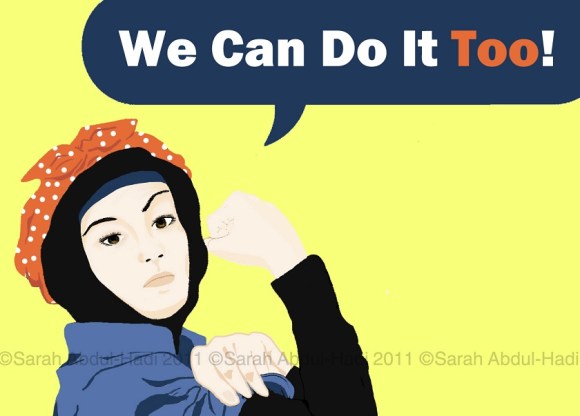
Hijab Identity Politics

Identity politics are dangerous. Unfortunately Muslims have long been swept up into the fray. Sometimes willingly.

In many traditional and conservative societies, women have covered their heads. This is not exclusive to Islam, whatever the Quran says about it.

But a time came also when Muslims were mobilizing on the basis of faith, using it as a rallying cry. It roughly corresponded with an ascendant European colonialism that weakened the political power Muslims once possessed. It revived in the 1970s, with the surge in popularity of political Islamism.

And one symbol of resistance was the woman. The headscarf became a statement.

It is far more than that, of course. It is a symbol of piety, of faith. It is an act of modesty in an immodest world. Perhaps it is an act of acquiescence to culture, or obedience to husband.

In the end it is a piece of cloth, and from an American perspective we believe a woman should be (mostly) free to wear what she wants.

But to be a good Muslima, must the woman wear a scarf?

I will not delve into the perspectives that say yes, or the traditional interpretations that seem to govern much of the Muslim world. They may well be right.

But in a recent article, the Huffington Post highlighted five scholars who say no. I know some of the names. One is famous and generally well celebrated. Another was marginal and called an apostate.

Here are their arguments.

Khaled Abou el-Fadl

El-Fadl mentions that the illa (operative cause) for the injunction to cover was to protect women from harm and to avoid undue attention from mischief mongers.

He also states that the ma’ruf (generally accepted as good) and the munkar (socially recognized as unacceptable) are based on pragmatic and practical experience.

Therefore, he argues that if the headscarf itself causes women to stand out and put them in the way of harm, and if uncovering the head is not considered socially immodest or licentious, then it would be permissible for Muslim women to not wear the headscarf.

One would hope a well functioning society would not harass women who cover their heads. Does his reasoning then suggest that the headscarf is otherwise an obligation? Should the power of decision be yielded to the mischief mongers?

Javed Ahmad Ghamidi

Like El-Fadl, Ghamidi opines there were injunctions exclusive for the wives of the Prophet. He argues that there are only four instructions that pertain to Muslim women.

These include lowering the gaze, wearing modest clothing, covering the bosom with a piece of cloth, and not displaying ornamental embellishments before unrelated men.

No other injunction other than these has been imposed on Muslim women.

This seems straightforward enough. A general command for modesty may require a headscarf in some cultures, but not in others. But who is to decide? The individual woman? Islam teaches that God judges the individual, so she alone bears the consequences. But who protects society?

Abdullah bin Bayyah

Bin Bayyah adopts an approach based on necessity.

He argues that hardships allow for uncovering of body parts and mentioned how the shins of two of the Prophet’s wives, Aishah and Umm Salamah, were uncovered when they were giving water to wounded soldiers on the battlefield. He also mentions the minority position of Ibn Ashur that women may uncover their hair in public.

Bin Bayyah’s student Hamza Yusuf even asserts that:

“The laws are there to serve human beings; we are not there to serve the law. We are there to serve Allah, and that is why whenever the law does not serve you, you are permitted to abandon it, and that is actually following the law. …

The law is for our benefit, not for our harm. Therefore, if the law harms us, we no longer have to abide by it.”

If uncovering hair is admitted to be a minority position, bin Bayyah’s does not seem a very strong argument. A pillar of sharia law is the consensus of community.

His student Yusuf pulls a principle of Jesus, but the Huffington Post excerpt does not go far enough to demonstrate the validity of the principle in Islam. For now it must be enough that some scholars argue so.

Ahmad Ghabel

The late Shia cleric, who had the prominent title of Hojjat el-Islam (authority on Islam), offered ten arguments in support of the viewpoint that covering the head was not obligatory but recommended.

He opined that there was no consensus amongst jurists as to whether hair constituted the awrah (intimate parts) that must be covered.

For the reader desiring demonstrations of validity, the link will offer an academic treatise. But even if something is only recommended, should it not be done? Perhaps it cannot be enforced, but does the woman risk her standing with little recourse?

But as above, the second claim is more powerful. If there is no consensus on what must be covered, then again we come back to modesty, not compulsion.

Nasr Abu Zayd

According to the late Abu Zayd, both the awrah (intimate parts) and the hijab (veil) are subject to socio-cultural norms and therefore are changeable and not fixed. He opined that both are not legislated by Islam but are rather specific to the Arab culture.

Fair enough, but again, on what basis? Not enough here to tell.

For what it is worth, this is the scholar labeled an infidel by an Egyptian court, and forcibly divorced from his wife. I don’t know his story well enough to say which of his opinions most offended the judge.

All religions impose obligations; all societies have their norms. The former is of individual faith; however related, the latter is not wise to transgress.

But some always will, and society needs their creativity. Just not too much of it. It is difficult to know where the line must be drawn.

If this was the only matter, we would probably work it out. Not to justify any particular outcome, but traditional societies seemed to do so, with diverse application.

Some highlight the hijab as a symbol of oppression. Others compel it as a means of control. Some thrust it in your face demanding respect. Others find ways to seduce men all the same.

Too much of this issue is wrapped in identity politics. Let’s just leave each other alone.

Mostly. Unfortunately, the headscarf at this time hits at a collective world conscience on how to balance rights with freedoms, the individual with society.

Maybe we can’t just leave each other alone, but we can be charitable. How wonderful if this was our collective identity.

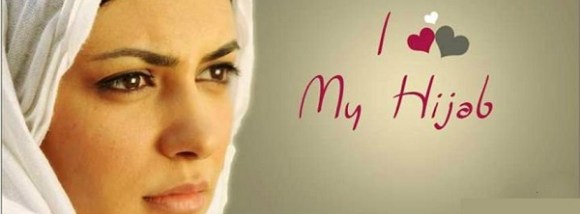
I Love My Hijab

Categories
Middle East Patheos Published Articles

Secondary Separation, in Islam

Secondary Separation Islam

In fundamentalist Christian circles there is an approach to the world known as ‘secondary separation’. While the Bible notes Christians are not of this world, there is tension when Jesus says they are also in this world, and should not expect to be removed.

Fundamentalism is one expression of this tension, that leans in the direction of withdrawal. A key verse is II Corinthians 6:17, “Come out from them and be separate,” quoting an Old Testament passage focusing on holiness.

Separation from the world is therefore a necessary Christian posture, though defining ‘them’ and ‘separate’ can be difficult. Fundamentalists take it a step further, saying that ‘them’ includes also those Christians who do not separate sufficiently.

This is secondary separation, and it has been most famously applied against Billy Graham. The renowned evangelist has been celebrated by most Christians for his gospel fidelity and salvation message.

But it that ‘most’ that offends this fundamentalist spirit. His crusades have cooperated with too many insufficiently fundamentalist churches, which they believe compromises the call to be separate.

In partnering with those who are not theologically pure, he risks endorsing their relative liberalism.

It is interesting to note a similar approach exists in Islam.

The posture of takfir is the process of declaring someone a kafir, an infidel. Longstanding Islamic jurisprudence says this should almost never be done to a Muslim, unless he or she openly renounces their faith.

But there is a verse in the Quran that provides Muslim fundamentalists, if the term is appropriate, a powerful retort. Sura 5:44 says, “And whoever does not judge by what Allah has revealed, then it is those who are the disbelievers,” using the plural of the Arabic word kafir at the end.

This verse has been applied by Muslim insurrectionists throughout the ages against their Muslim rulers who they accuse of not properly implementing sharia.

Certainly Muslims also struggle with the tension of their texts, and they are invited to provide proper interpretation.

But leave it to ISIS, the so-called Islamic State, to take it a step further.

Should it be necessary: There is little similarity between Christian fundamentalists and Islamic terrorists. But a devotion to God and a commitment to his way may sometimes prompt an antagonistic stance not only to the world, but also to fellow believers.

And from an article in Jihadica, “The Caliphate in Disarray,” there is also a similarity in secondary takfir.

Turki al-Bin’ali, the self-proclaimed ‘Grand Mufti,’ or chief cleric, of ISIS, was killed several months ago in a US airstrike. His death set off a wave of eulogies, but also counter-eulogies and accusations. Some even speculated his location was tipped off to the enemy that he be eliminated as leader.

Takfir is one of the issues that divides ISIS and al-Qaeda, with the latter being slightly more reticent to call non-affiliated Muslims non-believers. It is a sensible position if you are trying to recruit, not to limit your pool of applicants.

Then again, the number willing to die in their cause is considerably limited by their viciousness. Perhaps then it is best to recruit only the purest of the pure. But as seen with Christian fundamentalists, purity is easily nitpicked.

As a result: theological division among those who believe they have already most dedicated to God’s path through jihad.

Al-Bin’ali’s nemesis on this issue, the Meccan-born Ahmad ibn ‘Umar al-Hazimi, preached a rigorous approach to takfir. The following excerpt may be challenging in its Arabic references, but careful reading will establish a clear similarity with secondary separation:

In his lectures, he [al-Hazimi] espoused a controversial doctrine known as takfir al-‘adhir, or “the excommunication of the excuser.”

The notion of takfir al-‘adhir is derived from two concepts in Wahhabi theology. The first is the requirement of takfir; the second is the inadmissibility of al-‘udhr bi’l-jahl, or “excusing on the basis of ignorance.”

According to the founder of Wahhabism, Muhammad ibn ‘Abd al-Wahhab (d. 1792), it is incumbent upon all true believers to excommunicate—that is, to make takfir of—those deemed unbelievers, as well as to excommunicate those who fail to excommunicate them.

As Ibn ‘Abd al-Wahhab stated—and this is the line around which the Hazimi-Bin‘ali debate revolves—“Whoso fails to make takfir of the polytheists, or has doubts concerning their unbelief, or deems their doctrine to be sound, has [himself] disbelieved.”

The duty of takfir is generally accepted in Jihadi Salafism, but there is some debate over al-‘udhr bi’l-jahl, that is, over whether ignorance may serve as a legitimate excuse for holding errant beliefs, and so shield one from the charge of takfir.

For al-Hazimi, who follows the traditional Wahhabi view, al-‘udhr bi’l-jahl is categorically invalid, meaning that the ignorant heretic is to be declared an unbeliever.

Moreover, as he says, anyone who regards ignorance as an excuse for the heretic’s unbelief is also to be declared an unbeliever. Hence the idea of “the excommunication of the excuser.”

Perhaps in truth this is a tertiary takfir, with standard Wahhabism being the secondary. But herein is the problem: Once you start judging a fellow believer’s faith, where does the cycle stop?

Fortunately for Christian fundamentalists, it does not continue to the bombing of a Billy Graham crusade. But there is many a former fundamentalist who has become jaded when he or those he respected found themselves on the wrong side of a Christian fatwa. Sometimes it moves them to a more nebulous evangelicalism; sometimes they leave the faith entirely.

But they are not killed. ISIS, while flip-flopping repeatedly on the issue, did not hesitate to execute proponents of the at-the-time-minority outlook. Others died in airstrikes under what is described as ‘murky circumstances’. The article features more of the back-and-forth diatribe, which revealed also a discontent in ISIS over corruption, dishonesty, unfulfilled prophecies, and the loss of territory.

All the above is a reminder that the tension in religious faith is not only maddening for the sincere believer, but necessary. If God said both this and that, both are true no matter the apparent inconsistency or challenge of application.

It is easy to side with that (or this) most congenial to personal temperament, but mature faith must grapple with both and live accordingly.

In the world, but not of it. Judge by God’s sharia, but don’t judge. The challenge applies to more than we might at first imagine.

My article was first published at Patheos.

Categories
Excerpts

Can Polygamy be Curbed in Islam?

Islam Polygamy

Islam grants a man the right to take up to four wives, as long as he can provide for and treat them equitably.

As it has been explained to me, the original allowance came early in Muslim history when the male population was greatly reduced by warfare.

Some Muslims argue the original reason for revelation indicates the provision was temporary. Others argue the high standard of practice is nearly impossible, rendering the provision irrelevant.

But many others see it as God’s eternal permission. Only Turkey and Tunisia have outlawed polygamy, though restrictions exist in many nations.

Egypt, apparently, may enter this minefield.

According to al-Monitor, a draft law has been proposed to require the permission of a first wife before her husband can legally marry a second. The marriage would become null and void unless he can submit to the court her written agreement.

The article does not delve into the details of Islamic jurisprudence, and I am in no position to judge. But it does provide several reactions that illustrate how modern Muslims in Egypt regard the practice.

Here are a few excerpts:

Asserting that the draft law is compatible with Islamic Sharia, he [the draft law author] indicated that the Islamic Research Academy would approve it because Islamic Sharia allowed both spouses to add conditions to protect their rights, to preserve their interests and to have guarantees.

One traditional Salafi parliament member deferred to the Azhar to decide if the law is compatible with Islamic sharia. But he had an objection of relevance, akin to the original Muslim situation:

Khalil added, “What second marriage are we talking about at a time when the number of spinsters in Egypt stands at more than 11 million? Egyptian young men are barely capable of getting married once, let alone a second marriage.”

The head of Azhar University’s fatwa committee did not object:

“This is a permissible condition that has a sound purpose, which is to prevent the harm that may be caused to the first wife in case her husband decided to marry a second woman without her consent.

If a man has the right to marry more than one and consents to waive this right, then the condition [of the first wife’s prior approval] would therefore be valid.

A man can still be capable of having another wife without harming his first wife, since in Islam doing justice between wives is a prerequisite for polygamy.”

The female head of the Arab League’s Women Department disagreed:

“At the beginning of their marriage, both spouses would have strong emotional feelings and would rule out the idea of a second marriage. But as life goes on, a man could consider a second marriage.

I think that the husband should submit to the court the reasons for which he wants a second marriage, and it would be up to the judge to decide whether to allow him or not to do so. The first wife is not a neutral party, and certainly she would not want her husband to take on a second wife.”

A member of Egypt’s National Council for Women said the stipulation is already in personal status law, though not in the marriage contract. But she supports the amendment because there is a one year statute of limitations for divorce, from the time the wife becomes aware of the second marriage. Lawyers (and husbands) have exploited this loophole and kept women in the dark.

But she also finds a supporting rationale:

She further pointed that Muhammad did not allow Ali bin Abi Talib to take on another wife besides Muhammad’s daughter Fatima Zahra because this would hurt her, which confirms that the marriage contract condition of the first wife’s approval on the second marriage is in accordance with Islamic Sharia.

But a Salafi leader dismissed this reasoning:

“Prophet Muhammad and his companions were married to several women, and no one reported that they ever waited for their first wife’s permission.”

He explained that Muhammad’s rejection of Ali bin Abi Talib is a special case related exclusively to Fatima because the second wife was the daughter of Abu Jahl, an infidel.

Hawari added, “Moreover, the prophet did not forbid Ali from getting another wife, but he asked him to divorce Fatima if he insisted on marrying the daughter of Abu Jahl.

After Fatima’s death, Ali married eight women. Therefore, this example cannot be cited when talking about polygamy.”

We had one friend who kept giving birth to girls. She was constantly afraid her husband would take a second wife.

We have another friend whose father’s second marriage proved a source of tension with his children.

A third friend invited us to the marriage of his first wife’s son. We had previously only met his second, but at the door he told us not to mention her name. The first wife didn’t know about it. We had the impression the children did, though, and didn’t object.

Polygamy is complicating, certainly.

Instead of parliamentarians, it would be better to probe instead the Muslim sources and what their commentators have ruled throughout history. It would be better to explore the process by which Turkey and Tunisia outlawed the practice, and see if it had socially acceptable legal justification.

Sometimes bypassed in interpretation of law – divine or otherwise – are the personal stories of those involved.

But in lieu of further study, please make do with the examples above. What do you think?

Here, I only advise to speak with graciousness and humility, holding whatever convictions you deem appropriate.


Categories
Middle East Published Articles Religion Unplugged

Religious Freedom for the Muslim World: The Unlikely Activism of Kamal Fahmi

Kamal Fahmi

A few excerpts from my article for The Media Project.

Kamal Fahmi sat with Mazen, a Yemeni teenager at a community center in Taiz, Yemen’s third-largest city and cultural capital. Mazen’s father was there, who arranged the meeting.

Impressed with the boy’s intelligence and demeanor, Fahmi learned of their troubling problem.

Mazen didn’t want to study Islam in school.

Fahmi had heard this story before. Visiting Yemen as he had in nations across the region, converts were considered Muslim by birth and in all official paperwork. And for those underage, Islamic education came as part of the package, even if they didn’t believe in it.

Fahmi was sympathetic, but tried to downplay the problem. After all, born into a Christian family in Sudan, he had studied Islam in school also. Hold to your faith, he counseled, but pass the tests.

Yet something in the boy stirred him, as well as the nature of his family. Mazen was not a convert, and neither was his father. His grandfather was, decades earlier. Three generations of Christians, yet still considered Muslims. The injustice gnawed at him.

“They love their country, they are not criminals, they are not spies,” Fahmi said. “If anything, they have become better citizens.

“They should be free to follow what they believe.”

It is not only an issue in the Muslim world, of course:

Worldwide, 26 percent of nations criminalize blasphemy, including Russia, Italy, Myanmar, and the Bahamas. But apostasy law is more characteristically Islamic, with only India and Nigeria as non-Muslim-majority countries.

Please click here to read the full article at The Media Project.

Categories
Books

Wisdom and Foolishness in Abrahamic Faith

Wisdom Abraham

“Knowledge is power,” is an oft-repeated saying. In an information economy this makes perfect sense, and our educational system is geared to develop know-how.

Wisdom, on the other hand, sometimes seems a neglected virtue. It is the realm of philosophers, maybe, who have little to do with practical life. Or religion, often considered a private domain.

The Abrahamic religions, however, esteem the cultivation of wisdom over and above simple knowledge. Baghdad built the famed “House of Wisdom” when Islam represented the pinnacle of human civilization, translating classical texts that eventually reached the West.

Jewish writings nearly deified “Sophia” as a personification of wisdom. Along with Christianity, these traditions have produced philosophical minds among the greatest the world has ever known.

Which may make it surprising to hear St. Paul esteem being a fool for Christ. In view of the Greek tradition of his day, he said, Christianity is foolishness.

Paul is not subverting this tradition by any means, only highlighting how the wisdom of God in Christ is nonsense in the estimation of the world. Not non-rational, it simply reflects how God’s thoughts are higher than man’s.

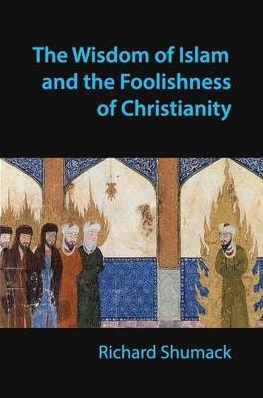
Nonetheless, one of the tasks of faith is demonstrating its plausibility to the world. The effort is nobly undertaken by Richard Shumack, in one of the most contested of fields. His book, The Wisdom of Islam and the Foolishness of Christianity, was shortlisted as the Australian Christian book of the year in 2014.

A philosopher by training, Shumack is a professor at Melbourne School of Theology and part of the Ravi Zacharias International Ministry team. It can be said at the outset: he finds Christianity superior to Islam. Not surprising – he is a Christian.

Two things are noteworthy about his book, however. First, the absolute respect his gives the Islamic tradition, interacting in friendship with men he considers to be among the Muslim world’s top philosophical minds. There is great wisdom in their faith, he agrees.

And second, the difference in paradigm that makes all the difference. Islam conceives a legislative model between God and man; Christianity, a relational. Wisdom follows from both, he says, but the latter is preferable and better accords with the world.

Shumack does not presume to prove the truth of Christianity’s claims. Similar to Islam, the challenge of monotheism is dealt with elsewhere. But finding his Muslim scholar friends assert the philosophical superiority of Islam over an incoherent Christianity, Shumack was compelled to pick up the gauntlet. He fully admits, of course, that key Christian concepts appear to place Muslims at an advantage.

But in each chapter he builds his case sequentially. Certainty. God’s Hiddenness. Sin. Trinity. Incarnation. Cross. Revelation. Divine Ethics. Politics. Each is a problem to tackle in the Muslim-Christian conversation. On some points monotheists share similar challenges. On others, the Christian is on the defensive.

With deference and respect, at times Shumack tries to turn the tables. But for the most part he simply returns to his central thesis:

Islam makes sense if one sees God as creator, legislator, and master. But Christianity makes sense if God is in addition, father.

To many Muslims this is foolishness. God has no son; he is utterly different from his creation. But it is the central point of Christianity: God’s word made flesh, crucified, and resurrected.

Perhaps both are fools to the atheist or modern secularist, so let Muslims and Christians be friends. Shumack’s book is polemical but warm, inviting response from his Muslim philosopher-friend.

There is no reason religious debate cannot be so. The world is much in need of wisdom, and the Abrahamic faiths possess it in abundance.

Unfortunately, their mutual conversation often demonstrates the opposite, showing that living out wisdom is another question entirely.

If we be fools, let it be for the right reason, in the right spirit. Abraham left the security of his land and family, and nearly sacrificed his son. Today he is honored by over half of humanity, a blessing to the whole world.

May this be true of his descendants, Muslims, Christians, and Jews altogether.

Wisdom of Islam Foolishness of Christianity

Categories
Excerpts

Copts in Egypt’s Textbooks


Copts Egypt Textbooks
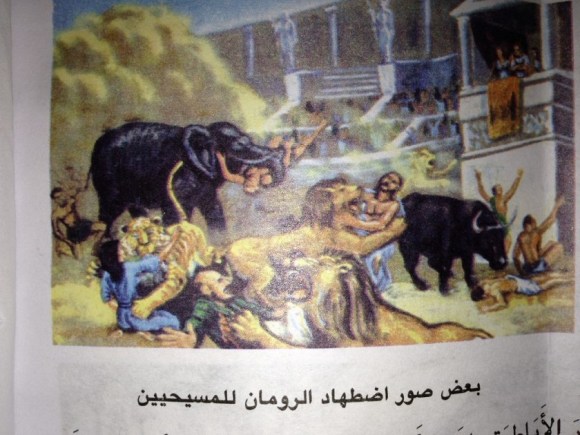
Translation: Some pictures of the Roman persecution of Christians. Via Mada Masr.

There is a general understanding that Egypt’s Christians are marginalized in the educational curriculum.

An additional idea is that this came during an Islamization period in the 1970s, or perhaps during Nasser’s presidency.

A researcher examined this question and described them on Mada Masr. Here is his evaluation:

Based on an analysis of Egyptian history textbooks from 1890 until the academic year 2016/2017, it is clear that Egyptian history is narrated from a perspective that values an Arab Muslim identity over other perspectives and voices.

While the tone generally revers and paints Christianity in a positive light, the narrative as a whole is exclusionary in both explicit and subtle ways.

The article as a whole is insightful, and here is an example — of how textbooks changed:

Current history textbooks do not include explicit derogatory references to Christianity or Christians — as some of the earlier textbooks did. In fact, they include extremely positive mentions, albeit concise.

For instance, in explaining why ancient Egyptians embraced Christianity, a 2016 textbook explains that they were attracted by its values of justice, equality, mercy, empathy, tolerance, renouncement of worldly pleasures, and valuing of the afterlife.[11]

However, we need to also be cognizant of more subtle ways that might give value to one identity while diminishing or silencing others. In addition to continuing to use explicit and extensive Muslim referents as highlighted above, more subtle exclusions can also be found in current textbooks.

For instance, they use the word “Arab” to characterize countries such as Egypt and Lebanon even before they had been taken over by Arab Muslim armies. Such references give the historically inaccurate and false impression that these countries have always embraced an Arab identity, eclipsing the richness of their pre-existing civilizations and cultures.[12]

Additionally, several of these history textbooks have continued to address students as if they are all Muslim. For instance, an 1893 history textbook explains that the religious story of David and his son Solomon “must be learned by all Muslims.”[13]

Similarly, a 1988 history textbook encourages students to learn about the annual Muslim pilgrimage to Mecca by asking their relatives who might have performed it.[14]

In discussing civic engagement, current textbooks encourage students to be proud of our Islamic principles and values that encourage us to volunteer in the community and peacefully co-exist with others different from ourselves.[15]

In Egypt it is sometimes necessary to ask the religion of the researcher, often indicated by name. Ehaab Abdou — I believe these names are shared by Muslims and Christians alike.

What is important, however, is quality. The article is too brief to fully evaluate, but he claims a comprehensive scope of research. I don’t have the background in the subject to know if he left out damning specifics; other Egyptians, please weigh in.

The one thing I noticed is that he did not specifically state he evaluated textbooks in the Azhar educational curriculum. Copts sometimes claim this is a source of bias against them.

But on the whole, the article appears to be an evenhanded treatment of a controversial subject.

Few things are as important as the education of our children — and ourselves.

Categories
Personal

Muslims Work for Religious Freedom, in Italy

MWL1
(via the Muslim World League)

Some of the articles I’ve written concern interfaith efforts to secure religious freedom, particularly in Muslim nations.

Two days ago, the Saudi-based Muslim World League met with the Italian Minister of the Interior to best secure Muslim rights in the traditionally Catholic nation.

In a helpful explanation from the 2016 US Report on International Religious Freedom, Italy has a series of “accords” with recognized religious groups in the nation.

The Catholic Church is separate from the government but does have a unique accord privileging it somewhat above the 12 other Christian denominations and religious groups. Accords are signed through the Ministry of the Interior, and grant tax-deductible status, state financial support, property rights, clergy recognition, and religious holiday waivers for students and employees. Non-accord groups can apply for these benefits on a case-by-case basis.

Muslims do not have an accord with the government.

Part of the issue may be that Muslims have no administrative entity governing their affairs. Among the topics discussed with the minister is the role of the Muslim World League to help unify the local Muslim community, and secure Islam as a recognized religion.

Italy lauded the MWL for its role in spreading the values of tolerance and coexistence.

A few days earlier the secretary-general of the MWL met Pope Francis, and agreed to set up a joint committee to pursue the values issued in their statement:

  • Religion and violence are incompatible
  • Religions have moral resources capable of contributing to fraternity and peace
  • The phenomenon of fundamentalism, in particular when violent, is troubling and joint efforts are required to counter it
  • Situations exist where freedom of conscience and of religion are not entirely respected and protected
  • There is an urgent need to remedy this, renewing religious discourse and reviewing school books

This is a worthy statement, though the urgent need would seem to require more than the suggested remedies. Yes, these would help change a culture over the long term. But laws guaranteeing freedom of conscience and religion are currently lacking in several countries within the Muslim World League.

Perhaps the statement is a polite and friendly way to begin to address this, without the shame associated with naming names – as does the US Report on International Religious Freedom.

The statement of religion and violence being incompatible is also curious. Islam has a well-defined tradition of religiously sanctioned jihad. It need not be equated with terrorism, but neither is it exactly equivalent to Christian just war theory. I find it strange the Muslim World League could sign on to such a clause, without further delineation.

But they are discussing the right things. The common criticism of interfaith statements of toleration is that Muslims do not practice what they preach in their own countries.

It remains to be seen if the Muslim World League will act on these principles, but it is encouraging that the Vatican has a joint committee to hold them responsible.

And, to be held responsible. In coordination with the MWL, Italy has taken steps to better ensure the religious freedom of minority faiths.

Do note when Muslim nations do the same.


Categories
Excerpts

Did the Muslims Conquer Jerusalem?

Syriac Conquest History
A Syriac hymn, manuscript dated to the 14th century.

Did the Muslims conquer the Middle East? History says they did, from both the Western and Islamic perspectives. Much of the self-understanding of modern civilization has been built upon this premise, the resulting Crusades, and eventual colonization by European powers.

Some fear there are signs of a renewed animosity between the Western and Muslim worlds, a quasi-religious competition, even as Christianity has lost much of its ethos and Islam has lost much of its power.

But new research into a third resource questions the history. Scholars and historians know Latin and Greek. Arabic is also readily translated and studied.

But not Syriac, the neglected lingua franca of 7th century life in the Levant, and the language of its native, non-imperial peoples.

The Institute of Advanced Studies recently published one scholar’s research:

Syriac literature was produced by—and conversely sheds light on—communities living on the borders of the Near Eastern polities, considered as a religious minority in the Zoroastrian Empire of the Sasanians, as heretics in the eyes of the Byzantine Orthodox (since the “universal” councils of Ephesus in 421 and Chalcedon in 531 that they refused), and as one of the religions of the book under Islamic powers.

Syriac thus offers a crucial “internal” source for the history of the Mesopotamian region reaching as far as South Arabia and the Far East from the late antique to the medieval era.

Shortly before the rise of Arab/Islamic empire, the Byzantine and Persian Sassanid empires were at war, taking and then losing Jerusalem and possession of Jesus’ True Cross.

The literature produced by Syriac Christian communities did not celebrate the triumph of the Byzantine empire, the author described, nor mourn the victory of the Zoroastrian Persians who briefly held the Holy City. They were rather nonplussed by regional politics, and awaited God’s ultimate redemption through one of their own anticipated champions.

So when the Arabs came:

It is striking to see that the second capture of Jerusalem in 636 by the Arabs, only a few years after its retaking by Heraclius, is hardly mentioned in the Syriac chronicles where it is a non-event.

Since the siege ended peacefully, after a negotiation between the Byzantine patriarch of Jerusalem and the caliph, and the city was not stormed by the Arab troops, the capture of the city is not mentioned in the most ancient Syriac sources.

Produced by the communities who were at the heart of the events, Syriac sources compel us to reconsider what “conquests” means.

Modern historians talk about the Sasanian and then Arab-Muslim conquests, but Syriac sources never use the word or concept. There were sieges, battles, military operations that could be catastrophic and dramatic for the local populations, but there were also negotiations and cities taken by treaty.

Contrary to Arab-Muslim sources that would subsequently create the genre of “futuh,” or “conquest” literature, in order to celebrate those who took part in the campaigns and the distribution of the booty, Syriac sources present a situation of occupation and change of rulership more than a conquest as such.

They invite us thus to reconsider the categories, and the agendas, that we have inherited from later Arab-Muslim sources.

There is also an interesting sub-discussion on how intra-Christian debate on the nature of Jesus’ crucifixion mirror some of the issues mentioned in the Quran.

I am wading into deep historical waters, and I am not the scholar to do so. New research often threatens to upend the academy, only to be counter-argued and put in its place. Perhaps the same will happen here.

But the language of local people is a useful counter-balance to official histories, written by either the winners or losers. In this case, both had a vested interest in labeling the actions a ‘conquest’.

Certainly the Muslims would go on to conquer further, only to be conquered later in turn. Such is the history of the world.

But lest it repeat itself unwarrantedly, both sides might do well to revisit their language and understanding of history.

For once again, the Syriac heritage stands in the middle. An ancient faith, outside of power. We have much to learn, and consider.

Image via https://hmmlorientalia.wordpress.com/2013/02/08/a-short-hymn-in-syriac-attributed-to-severos/


Categories
Christianity Today Middle East Published Articles

Saudi Arabia’s Neighbor Defends Religious Freedom of Individuals

This article was originally published by Christianity Today, on September 13.

Bahrain Declaration 2
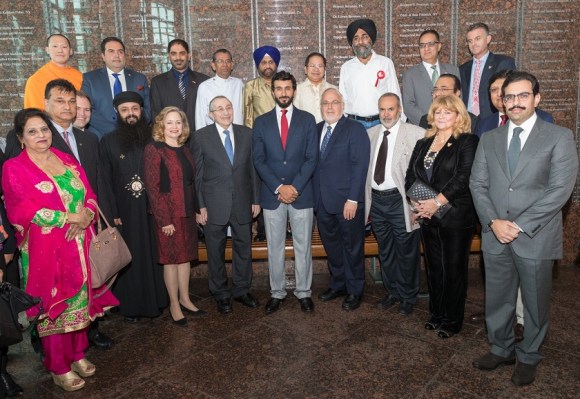
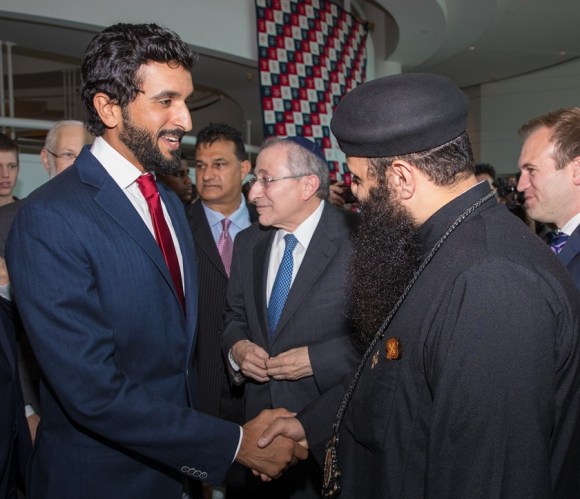
Prince Nasser bin Hamad al Khalifa (center), with Bahrain Declaration attendees. Credit: Simon Wiesenthal Center.

The cause of religious freedom received a significant boost from the Muslim world today. The island Kingdom of Bahrain—connected by bridge to Saudi Arabia—has declared “freedom of choice” to be a “divine gift.”

“We unequivocally reject compelled observance,” states the Bahrain Declaration for Religious Tolerance, released September 13 in Los Angeles with Muslim, Christian, and Jewish leaders in attendance. “Every individual has the freedom to practice their religion, providing they do no harm to others, respect the laws of the land, and accept responsibility, spiritually and materially, for their choices.”

Prince Nasser bin Hamad al Khalifa of Bahrain signed as an official envoy of the Gulf nation’s king. Johnnie Moore, a board member of the National Association of Evangelicals, and Rabbi Marvin Heir of the Simon Wiesenthal Center also participated, joining ambassadors from Saudi Arabia, the United Arab Emirates, Egypt, and Israel.

“The King is acting decisively, courageously, and seriously,” said Moore, noting also Bahrani sponsorship of a religious tolerance center in the capital city of Manama, as well as the sponsorship of a chair in religious coexistence at La Sapienza University in Rome.

“The declaration goes farther than any similar document that I’m aware of.” …

Please click here to read the full article at Christianity Today.

Bahrain Declaration
Prince Nasser bin Hamad al Khalifa, with a Coptic priest. Credit: Simon Wiesenthal Center.
Categories
Personal

Is Sex Slavery Legal in Islam?

Yazidi Sex Slaves
(via REUTERS/Ari Jala)

In my recent post about al-Azhar and the doctrine they spread around the world, one reader offered this question in the comments:

Someone I know wrote an article about Islam recently and made the statement that, according to his knowledge, official Islam has never condemned the action of ISIS soldiers in raping Yazidi women. He made several other statements I didn’t particularly like, but on this point, he is saying they cannot condemn such treatment because Muhammad did this sort of thing and even gave his troops permission to do the same. Have you ever come across any statement that al-Azhar believes such action is wrong?

First of all, a little context, excerpted from an article in the National Catholic Register on the same topic:

In the Quran, slave girls are referred to as “those whom your right hand possess,” … Verse 4:3 allows a man to have up to four wives but advises that if he can’t deal fairly with all of them, he should marry only one, or else resort to “those whom your right hand possess.” Verse 4:2 says that men are forbidden to have sex with married women “except those whom your right hand possess. It is a decree of Allah for you.”

The article also draws from traditions about Muhammad. These have varying degrees of reliability but are regarded as an authentic source in principle. I cannot comment on these specific traditions mentioned, but they are provided in well-attributed collections.

After the assault on the Jews of Khaybar, Muhammad ordered that a leader of the tribe, Kinana bin al-Rabi, be tortured until he disclosed the location of the group’s treasure. A fire was lit on Kinana’s chest but, as he still refused to reveal the secret, Muhammad had him beheaded. Muhammad had promised Kinana’s young wife, Safiya, to another Muslim, but, after hearing of her beauty, he went back on his word and took her in “marriage” for himself. By some accounts, this occurred only hours after he dispatched her husband. (Ishaq, p. 515; Bukhari, 1. 8. 367).

The issue of sex slaves in Muslim history and interpretation is of course contested, but what do Muslim authorities do with it today?

Egypt’s highest Islamic authority, al-Azhar, has strongly denounced the Takfiri Daesh [ISIS] terrorists’ newly-released rules for sex slavery, stressing that they have nothing to do with Islam.

“This organization is a criminal and terrorist organization, and one of the goals of terrorism is the spread of its ideologies and the spread of its propaganda that will attract people’s attention,” Mohamed Mehna, a member of al-Azhar’s Grand Sheikh’s Technical office, said on Wednesday. (from Press TV)

This alone should satisfy the question from the original comment, asking only if official Islam condemned the action.

But maybe something in ISIS’ rationale was deficient, it could be asked. That is, while their specific action is condemned, does the practice still has an Islamic basis?

Consider then this document, called A Letter to Baghdadi, the self-appointed caliph of the Islamic State. The list of signatories includes representatives of official Islam from around the world, including Egypt.

It criticizes the Islamic State on several points, and this is from the executive summary:

10. It is forbidden in Islam to harm or mistreat—in any way—Christians or any ‘People of the Scripture’.

11. It is obligatory to consider Yazidis as People of the Scripture.

12. The re-introduction of slavery is forbidden in Islam. It was abolished by universal consensus.

‘Consensus’ is an important word here. While it does imply anti-slavery developments around the world, in which Muslim nations share, it also is a term of Islamic jurisprudence.

Sharia is developed from different sources, but ijma’, or consensus of the scholars, is one of the essentials. Here is how point 12 is developed in the letter:

No scholar of Islam disputes that one of Islam’s aims is to abolish slavery …

For over a century, Muslims, and indeed the entire world, have been united in the prohibition and criminalization of slavery, which was a milestone in human history when it was finally achieved …

After a century of Muslim consensus on the prohibition of slavery, you have violated this; you have taken women as concubines and thus revived strife and sedition (fitnah), and corruption and lewdness on the earth.

You have resuscitated something that the Shari’ah has worked tirelessly to undo and has been considered forbidden by consensus for over a century. Indeed all the Muslim countries in the world are signatories of anti-slavery conventions.

Where I have placed three dots it represents the letter quoting from the Quran to establish its points. I admit I followed some of the logic, but not all of it. But I am hardly a scholar. Read yourself to review.

But the fact is that these are the words of many of the highest Islamic authorities around the world. It is a shame this fact is not more widely known.

Still, though I know the basics of the principle of ijma’, I am still curious about the question posed in the comment and cemented in the Catholic journal. If something was permitted by Islam at Muhammad’s time, can it really be condemned absolutely?

One scholar I asked told me that in the story above, Muhammad married Safiya in order to end the practice of sex slavery. When their prophet set her free and married her, his companions could do no less with those they captured. He tells me this related in the literature.

Getting into the details of this question requires far more study than I have yet done and this post allows. Here are two links to competing sides. But here are a few principles as it is considered.

One, there are many Muslims whose interpretive system requires near-absolute fidelity to the earliest practices of the Islamic community. Through them we are often convinced this is normative Islam. It makes sense, but is it necessary? Islam has a long history and an interpretive framework that has adjusted to time and place. Shall Muslims not be given the freedom of development, if they work to claim it in fidelity with their sources?

Two, there are many commands and practices in the Bible that Christians today consider obsolete, though they came through God’s command. There is not absolute symmetry here with Islam; the religions are different and have different interpretive systems. But give pause before declaring offensive an attribute of Islam, lest the accusation be returned. For those who reject all religion in general, of course, this is less applicable.

Three, for everyone, find a balance in critical charity and charitable criticism. Islam, like all religions and worldviews, deserves its hard questions given its universal claims. But Muslims are individual human beings . Like many others, many Muslims cherish their faith without delving into all the details. Take care before bludgeoning anyone with details we also know little about.

Islam may be true or erroneous, it may engender virtue or vice. But of Muslims, honor them to the degree they seek to honor both God and humanity. Where they are deficient, remember, we all are too.


Categories
Prayers

Friday Prayers for Egypt: New Proposals

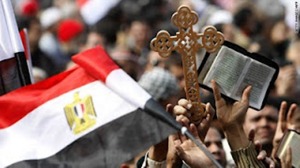
Flag Cross Quran

God,

Egypt is debating significant changes. Give her the wisdom to walk the right path.

Some have proposed the constitution be amended to allow the president a six-year term. Others say leave the constitution alone, and implement it.

Some have proposed the marriage age be lowered to 16 to legalize longstanding practice. Others say there are too many Egyptians already, and it is backwards.

Some (in Tunisia) have proposed inheritance be divided equally between the sexes, and marriage made open to non-Muslim men. The Azhar says it is against Islamic sharia, and condemns it.

Some have proposed the train system be mechanized. No one opposes, but who will fund it?

God, your discernment is needed.

Grant the president wisdom to achieve agenda, and the people a choice in approving their leader.

Grant Egypt wisdom in population control, and women a choice in the details of marriage.

Grant the Azhar wisdom in Islamic interpretation, and Tunisia a choice in religion and state.

Grant the ministry wisdom with limited resources, and funders the choice of both safety and gain.

God, develop Egypt to function well – government, institutions, and citizens.

In all the above, lead her. Changes must come, may they be the right ones.

Amen.


Categories
Excerpts

A Primer on Salafism III

Salafis Studying
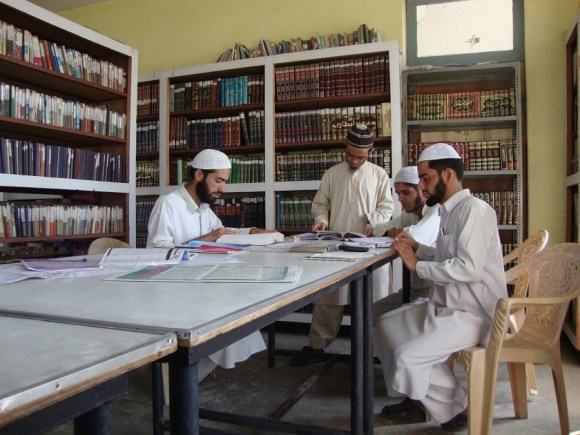
(Image by Tariq Mir. Kashmir, 2011.)

Salafism is often wrongly criticized. But it can be rightly criticized also. The first post in this series emphasized how it is often a popular (meaning of the people) expression of Islam. The first essay here shows how this happens, though I think it errs in conclusion.

The second doesn’t even err, because it doesn’t even say anything. It just is hell-bent on Salafism winning in one particular corner of the world.

Salafism and the Politics of Free Market Religion’ takes an economic approach to the question.

Like economic forces, some ideologies may be best explained as different approaches to the marketplace of religion. In applying this idea to Salafism, we see that it promotes a free market “faith economy.” Salafism seeks to break the monopoly of state religion over Muslim identity, analysis of texts, and daily religious life.

Ok… benefit of the doubt so far. It is an interesting premise.

Salafism, until very recently, was not formally invested in politics. It was, as such, largely distinct from larger Islamist organizations, like the Muslim Brotherhood, Hizbul Tahrir, and others. Salafism is not, however, agnostic to the societies in which it operates; many Salafis engage in social education and proselytization programs.

Yes, largely true. He goes on to make the point that most governments in the Middle East have a particular brand of sponsored religion – often not Salafi.

Because the state enjoys a monopoly, it does not need to ensure that its product, state religion, is adequate or appealing to this audience. This usually means the quality of that product suffers, which is why most monopolized religious economies have low levels of popular participation.

While the people yearn for more direct religious participation, the ulema [religious scholars]—at the behest of governments—often support the status quo. This has caused popular resentment toward the scholarly class, which is viewed as backward and obscurant.

‘Yearning’ seems a word too close in sympathy with its analysis. But ok. I’ve often heard this criticism.

Salafism focuses more on an individual’s principles and ethics. It is not enough for the state and scholars to protect the faith. The individual must also “establish the state of Islam in his heart,” which will result in “the state of Islam being established in the land.”

According to Salafism, the individual is elevated above more imperial notions of allegiance and dedication to state. The focus is on individual dedication to a broader set of values, including duty to self, family, and neighbors. In short, Salafism is about a kind of personal transformation.

Much like the Protestant Reformation, Salafism has been able to personalize religion for the masses.

A bit too harsh on state-sponsored religion, perhaps, sometimes. But it is an interesting window into how Salafis see themselves.

But here is the author’s conclusion and recommendation:

In a “faith economy” free from state regulation, greater levels of religious participation, and possibly even civic duty, become possible. By heeding Salafism’s call to deregulate religious identity, authority, and interpretation, greater religious freedoms can be enjoyed by all.

This seems an idea to celebrate – but do you dare? Does Salafism really believe in the deregulation of religion and the state? Does Islam? People should be free to choose what religion to follow? This is the heritage of Ibn Taymiyya and Abdel Wahhab?

Salafis believe in religious freedom? What if they win? It’s a horrible question, but one so many Muslims are afraid of. That’s one reason why there is state-sponsored religion in the first place. And for 1400 years, it’s almost always been that way.

Perhaps in conversation some Salafis might surprise me. In many other ways, several have. But this is not the discourse I’m used to.

The following, though, is rampant in some sections of the Muslim word. It just doesn’t belong as academic analysis.

Syria, the War on Terror, and the Left’s Salafiphobia’ is an impassioned plea to get rid of Assad and call out the hypocrisy of the American left. I get it, Assad’s a bad guy. And I get that that there is likely a whole lot of misinformation about ‘moderate rebels’, ‘extremists’, ‘secular government’, and the like.

I don’t understand Syria, but if you want to pick a side, go for it.

But why here? It’s not really worth excerpting anything except the opening and concluding paragraphs:

The spontaneous, massive protests against President Donald Trump’s Muslim ban were an inspiring display of solidarity between non-Muslim and Muslim Americans. As encouraging as public backlash against this draconian policy has been, however, it strongly contrasts with the lack of public support Muslims have received during the past fifteen years of the so-called “War on Terror.”

We cannot truly defeat destructive far right policies and structural Islamophobia if we tolerate these same positions among individuals and groups that label themselves as progressive. Now is the time to make clear that the left will not tolerate anti-Muslim bigotry even within its own ranks.

I’m quite sympathetic to parts of what the author is arguing. Does the war on terror mean perpetual militarism? And there is a great danger. Given that much of this war is being fought against Muslims, it risks ramping up the rhetoric against Muslims in general.

As we have seen in part one, that can be directed against Salafis in particular, even by other Muslims.

But why is this essay even here? The last of six in a series on Salafism, it teaches nothing about its subject. Has Muftah inserted an endorsing editorial?

It was a disappointing ending to a very helpful series. I hope you have benefited from their scholarship, and my piddling comments here and there.

Salafis are human beings. Tear apart or adopt their ideas as you will. But treat them with the honor given them by their Creator, and recognize the fidelity they wish to give back. Just remember, as Paul wrote, “My conscience is clear, but that does not make me innocent.”

Please click here to review part one and part two of this primer on Salafism.

Categories
Excerpts

A Primer on Salafism II


Abdel Wahhab Ibn Taymiyya
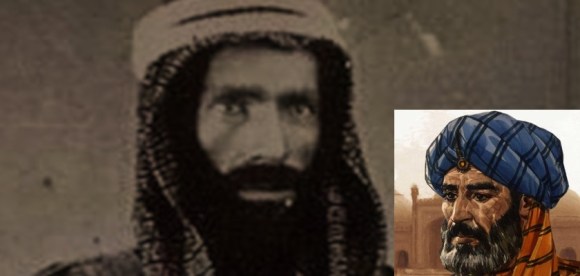
Mohamed ibn Abdel Wahhab (L) and Ibn Taymiyya (R)

If you have been introduced to Salafism in the news or in often critical analysis, two figures are generally named. The first is Ibn Taymiyya, who you won’t likely know much about but may understand he is the source of all Muslim things violent.

The second is Mohamed ibn Abdel Wahhab, and you may well have heard that his ‘Wahhabism’ is the state interpretation of Saudi Arabia, which funds conservative and perhaps violent Islam around the world.

We would do well to know a bit more about individuals often pilloried, and ‘Understanding Ibn Taymiyya as a Man of His Time’ is a good starting place.

Born in the city of Harran (then Upper Mesopotamia, now modern Turkey) in 1263, Ibn Taymiyyah was already a refugee in Damascus by the age of seven. His family had been forced to flee from their home, in order to avoid the encroaching Mongol invasion, which had overtaken Baghdad in 1258.

The common theme of much of Ibn Taymiyyah’s work was relatively straightforward: the desire to achieve freedom for Muslims, both physically and metaphysically. For example, he famously lamented over the manner in which Muslims were enamored and distracted by Greek philosophy.

Ibn Taymiyyah was acutely disturbed by the Mongolian invaders, whom he believed were physically and intellectually colonizing Muslims. The underlying message and purpose of Ibn Taymiyyah’s work was, therefore, to free the Muslim community from its foreign conquerors. In order to accomplish this, he argued, it was critical to first free the Muslim mind from the distractions of non-Muslim philosophy.

This is precisely why Ibn Taymiyyah dedicated significant portions of his work to opposing the use of external sources (i.e. sources outside the Quran and Hadith) in theology and law.

To Ibn Taymiyyah, the Quran and Hadith alone effectively addressed issues previous Muslim scholars (and many of his contemporaries) were attempting, but ultimately failing, to resolve through Greek philosophy. In a way, then, Ibn Taymiyyah was engaged in a momentous project of rebuilding Muslim intellectual independence.

As posted yesterday, much of Salafism is about rejection. But perhaps Christians can sympathize – there have been many a ‘Back to the Bible’ with some similarity.

But in his rejection of the Mongols he took a step that has plagued Muslims ever since, though in ways the author thinks he likely didn’t intend:

Unlike many other scholars, he not only saw the Mongols as hostile invaders, but also refused to accept them as legitimate rulers, even after they converted to Islam. He went as far as to issue a fatwa mandating that Muslims fight them.

Much of the Islamic heritage was dedicated to keeping popular obedience to rulers who may not have been upright, but at least were Muslims. And once you start calling some Muslims ‘non-Muslims’, it opens up all sorts of doors.

Extremist groups to distort Ibn Taymiyyah’s views, for their own benefit. For example, ISIS commonly cites the scholar to justify its sectarian crimes. Its members claim that his diatribes against the Shia, Sufis, and Druze clearly sanction their murder.

Ibn Taymiyyah was, however, both sharply aware of this and vehemently against sectarian splits, as evidenced by one of his fatwas: It is not permissible for teachers to sectarianize people and sow enmity and hatred between them. Rather, they must be like brethren supporting each other in goodness and piety.

Certainly we see many Muslims today not ‘like brethren’. In fact we find two actual brethren not like brethren in the story of Abna (the sons of) Abdel Wahhab.

From ‘Ibn Taymiyya and the ibn Abdel Wahhab Brothers’:

Sulayman Ibn Abdul Wahhab—Muhammad Ibn Abdul Wahhab’s lesser-known older brother [was a] major critic of the early Wahhabi movement. Sulayman wrote a significant refutation of his brother’s work, called The Divine Lightning in Refutation of the Wahhabis (al-Sawa‘iq al-Uluhiyya fi-l-Radd ‘ala al-Wahabiyya).

I left the Arabic there for those who like that sort of thing (like me). But here’s the historical context:

Wahhabism first emerged in Arabia, as a localized reform movement aimed at correcting the deviances and errors that Muhammad ibn Abdul Wahhab perceived to be widespread in the Muslim community.

For Abdul Wahhab, many of the popular religious practices of the day—such as the veneration of saints’ graves, pilgrimage to their shrines, pleading for intercession with God from holy figures, or attachment to relics—smacked of a blatant idolatry (shirk) that reflected an excessive attachment to fellow men, rather than God.

His writings consistently stressed the absolute sovereignty of God, and emphasized the need to perform all acts of worship (ibada), broadly conceived, toward God alone.

At issue between the brothers was a divergent reading of Ibn Taymiyya. But on the following point all three agreed:

Ibn Taymiyyah’s legal rulings never tired of condemning the rampant shirk being practiced by many Muslims of the time, particularly their excessive devotion toward saints and Sufi-oriented mystics.

But remember what he did to the Mongols? Abdel Wahhab the younger took it a step further:

This strict emphasis on shirk is not the most controversial aspect of Ibn Abdul Wahhab’s writings, however. That is reserved for his takfīr (excommunication) of those Muslims engaging in acts of idolatry.

Throughout his writings, Ibn Abdul Wahhab declared that Muslims who engage in such idolatrous practices are no longer Muslim—despite their testimony of the shahada (the Muslim declaration of faith).

Abdel Wahhab the senior quoted Ibn Taymiyya to show he wouldn’t approve:

It is not permissible to call a Muslim an “unbeliever,” neither for a sin which he has committed nor for anything about which he was in error, such as questions about which the People of the Qiblah (i.e Muslims) dispute.

The following could get a little complex again, like that section yesterday. Skip over briefly, or follow along if you want to see an example of how Muslims dispute among themselves:

A key pillar of Sulayman’s argument against his brother rested on the important distinction between greater and lesser idolatry. This distinction was not found in the Quran, but rather was alluded to in the Hadith traditions, and became a key construct in later Islamic thought.

An act of “greater idolatry” (shirk al-akbar) is typically viewed as something so manifestly idolatrous as to directly contradict Islamic monotheism, taking the person outside of Islam. An example of this would be praying to a stone or wooden idol; one cannot seriously claim to be Muslim and perform this act. An act of “lesser idolatry” (shirk al-asghar) would be an act that is disapproved of, but considerably less serious.

According to Sulayman, the popular violations his brother railed against were shirk al-asghar—crucially falling short of apostasy.

Fascinating. Here’s how it was resolved, as you could likely guess:

As history tells us, however, this debate between the brothers would not be settled by strength of argument, but rather by force of arms, as the early Wahhabi movement gradually spread its influence through conquest across the Arabian Peninsula in the late 18th century.

Two very good essays, showing how Salafism is often mischaracterized and its originators distorted.

But don’t let that get too far. I said in the introduction yesterday that there is still quite enough room for judgment. Sulayman channels Ibn Taymiyya:

From where did you get that a Muslim…if he calls out to a living or dead (saint), or makes vows to him or sacrifices to him or touches his tomb… that all this is greater idolatry (constituting apostasy) … and that he who commits it may have his good deeds wasted, wealth plundered and blood spilt (as an apostate)?

Good. An erring Muslim should not be killed as an apostate. But an apostate can be killed as an apostate.

It is important to nuance and sympathize. But it is more important to stand on principles and not the proper desire to prevent demonization result in unwarranted approbation.

I think the final two essays in the series cross that line, the final one horribly. See you tomorrow.

Please click here to review part one of this primer on Salafism, and here for part three.


Categories
Excerpts

A Primer on Salafism

Salafi Women
(Photo: Marwan Tahtah, via Al Akhbar English)

Muftah recently published a special collection of essays on Salafism, under the premise that the popular, conservative, and terrorism-linked interpretation of Islam is often misunderstood and unfairly judged.

I agree, though there are certainly aspects to judge thoroughly.

Six essays were provided –  most helpful, some mixed, and one awful.

I’ll provide excerpts to save you the trouble of reading all of them, with a few comments along the way.

But first, what is Salafism?

From ‘Why are Muslim’s Scapegoating Salafism for ISIS’ Crimes?’:

Salafism, broadly speaking, is an Islamic movement that focuses on teaching tawhid (Oneness of God), emulating the sunna (customs and teachings) of the Prophet Muhammad and his earliest followers, and eliminating bid’a (heterodox innovations) from the religion.

That’s a good starting point, but let’s get to the crux of the issue:

ISIS’s theological justifications for terrorism are hardly related to the fundamental principles of Salafism (i.e. tawhid, the sunna, and eliminating bid’a). Rather, the beliefs of ISIS and other such groups have everything to do with the corrupted, misread, and decontextualized doctrines of takfir (excommunication) and jihad (struggle).

In terms of takfir, this entails enforcing “zero-sum,” maximalist boundaries around who is considered a Muslim, and who is a kafir [infidel]. With regard to jihad, it becomes a justification to sanction the wanton killing of any and all individuals who fall “outside Islam”—even if they identify as Muslim.

That’s how many people view Salafism in general. Not that some Salafis aren’t guilty, but why are they wrong?

Consider, for example, the following verse from the Quran: “Whoever does not rule by what Allah has revealed; they are the disbelievers” (5:44 al-Ma’ida). ISIS and its many followers regularly recite this passage to justify their murderous actions against anyone who is a “disbeliever” as “coinciding with the true way of Islam.” Some argue that ISIS’s approach toward the verse is a “Salafi reading” of the Quran, but this is simply inaccurate.

Both the most knowledgeable of the Prophet’s companions in tafsir (exegesis), Ibn Abbas, and the most cited and revered resource for modern Salafis, Ibn Taymiyyah, read this passage entirely differently from ISIS’s interpretation.

They note that the same sura [chapter of the Quran] offers two other denunciations for those who legislate by something other than the Sacred Law. Those who reject the very source of the Sacred Law, as the Jews did, are the non-believers (kuffar, the plural of kafir), while those who believe in the Prophet (i.e. Muslims) but turn away from the Sacred Law out of laziness, selfish interests, belief that it is outdated, or that there is something superior to it, are oppressors (zalimin) or heretics (fasiqin). In other words, those who disregard God’s law are not all kuffars, as ISIS claims.

As this example demonstrates, there is a substantial difference between a “Salafi” reading of scripture, and a straightforwardly bogus reading of scripture. ISIS is involved in the latter, not the former.

Interesting. It is a helpful article, but it would have done well to give a few more examples. But that would be research, not an essay.

Strangely, the essay entitled ‘What is Salafism?’ does a poor job of answering its own question.

What is it exactly that unites Salafism transhistorically? Here, Haykel offers some common but not entirely accurate generalizations. These are, (i) a return to the authentic practices and beliefs of the pious predecessors, the salaf;

(ii) monotheism (tawhīd); (iii) actively fighting unbelief; (iv) the Qur’an and Sunna as the only valid sources of religious authority,

(v) ridding Islam of heretical innovations, and (vi) a belief that specific answers to all questions are found in the Qur’an and the Sunnah.

That’s not bad, and following the simpler description above is helps reinforce the idea. Unfortunately the author spends most of his time showing how the above don’t quite work. Oh well. Academics.

What he does do, though, is give a very good (ok, and academic) summary of where Salafism came from:

Salafism, simply put, is a form of Sunni Islam that aspires to the model of the earliest Muslims (“the salaf”). Literally, the “salaf” means the forebears, and refers to the companions of the Prophet and the succeeding two to three generations.

The Quran, along with the literature of Muhammad’s traditions produced by these early generations, became the main sources for Salafi interpretation.

But now here comes the jargon. If your eyes glaze over, please come back in a couple paragraphs:

The primordial manifestation of this scripturalist tendency in Islam was the rise or consolidation in the 3rd AH/9th CE century of traditionalism against the rationalist syncretism of the intellectual elite that came to be known as kalam (lit., speech or discourse).

Kalam had its origins in Christological debates [that is, debates about the nature of Christ] and was then absorbed into Muslim practice through the mediation of the Arab Christian milieu in Syria and Iraq.

The salaf, including the eponymic founders of the four Sunni legal schools rejected kalam and condemned its practitioners as those given to whim and desire.

Ok, one more migraine-susceptible excerpt. But if you have a developing interest in Islamic history, this part is really good:

Perhaps the best contemporary description of this nascent movement (that was to become known as “Ahl al-Sunnah wa al-Jama`a”) comes from the matchless prose of their arch-enemy, the Muʿtazili essayist, al-Jāhiz (d. 255 AH/869 CE), who labeled them al-Nābita, literally, the “nobodies,” the rootless leaders of the masses, the demagogues.

He describes the Sunni movement as a consolidation of various groups aligned against the Muʿtazila and their rational discourse on theology (kalam). The followers and supporters of their new movement, he writes, included “worshippers (ʿubbād), jurists (fuqahā’), hadith people (ahl al-hadīth), and ascetics.”

There’s more here I could copy, including more info about the Ashari interpretation of Islam, described in my recent Azhar post, if you liked that.

But just to sum up the nature of academia that leaves one more confused through knowing more:

All of these traits have been widely shared by a variety of movements from all different theological backgrounds in Sunni Islam.

Finally, what further complicates the challenge of defining Salafism through self-identification is that there is no unified “Salafi” movement today.

Oh well. Thanks for coming along for the ride.

It is important to note, though, that two important characteristics of Salafism are the rejection of foreign ways of thought and its popular, pietistic appeal.

The first will be emphasized tomorrow in considering two key pillars of Salafism, Ibn Taymiyya and Mohamed Abdel Wahhab.

The second will come the next day treating marketplace religion – and the aforementioned ‘awful’ essay. Stay tuned.

 Please click here for part two of the series, and here for part three.

Categories
Christianity Today Middle East Published Articles

Art after Terror: Meet the Egyptian Church that Welcomes Muslims

This article was first published at The Media Project.
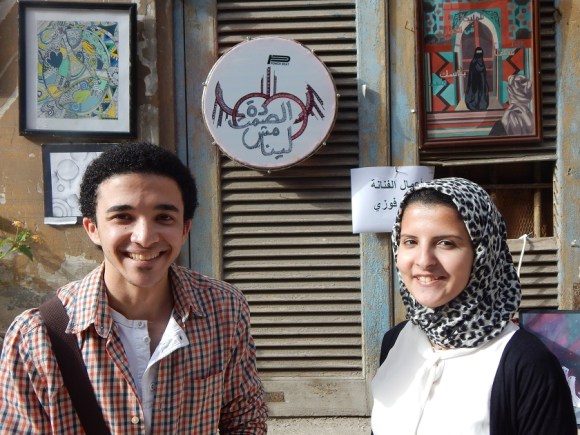
Art after Terror Alexandria

Two weeks after the Palm Sunday suicide bombing in Alexandria, security at the St. Mark’s Anglican Pro-Cathedral was tight. Police cordon, metal detector, bags checked – even eyeglasses needed to be removed.

But inside, tucked away behind the expectant bustle, volunteer leaders circled with hands together and let out a shout, as if to the whole world.

“Believe me, the solution is love!” they cried, raising their hands to heaven.

Ninety percent were Muslim.

Widely known in Egypt as an Islamist stronghold, for decades many Muslim youth in Alexandria had proclaimed the Muslim Brotherhood slogan: Islam is the solution.

And similar to churches throughout the country, St. Mark’s is couched behind thick, high walls. Save for official visits on Christian holidays, few Muslims would need to enter.

But society needed it, decided Nader Wanis. In 2012 in cooperation with church leaders, he opened the Corners for Creativity cultural center in the 150-year-old cathedral, seizing on an opening in the Arab Spring.

Despite the positive signs of youth engagement and interfaith cooperation during the Egyptian revolution, at the time there were also marks of tension. A year earlier conservative Salafis burned a church in Cairo believing a Muslim woman was kidnapped inside. Before that the Two Saints Church in Alexandria was bombed by unknown assailants on New Year’s Eve.

“The church has been misunderstood by the Egyptian street,” said Wanis. “There are rumors we have weapons, fornication, and sorcery inside.

“As long as the church stays closed, Muslims can think whatever they want. But the cultural center is a means to let people in.”

Welcome

Since then they have come in droves, and the community has welcomed it. Over one thousand each year have graduated from diverse training programs in singing, drawing, photography, acting, writing, fine arts, and graphic design. All are run by volunteer leaders.

On this occasion dozens of artists gathered for the monthly art exhibition and handicraft market. Paintings and sculptures lined the walls of the church in absolute reversal of their original purpose. Hijabed women offered their homemade crafts behind foldaway tables set up in front of the massive church door.

The volunteers’ pep talk met behind the welcoming ribbon soon to be cut by two deans from Alexandria University and a local businessman. And afterwards everyone gathered to honor participants in the sanctuary, where Muslims and Christians sang together about religious harmony and community service. “Believe me, love is the solution,” was one of their most enthusiastic.

But it almost didn’t happen.

The church attack ensured it did.

Nader was worshiping at St. Mark’s when the walls shook from the explosion at the Orthodox cathedral five minutes away, killing 17. Earlier the center had considered postponing the exhibition due to the university exam schedule. But after finishing communion he immediately called his team to determine the necessary response.

The 40 volunteer leaders gathered daily in discussion and decided to hold the exhibition and announce it as Masr al-Samida, Egypt the Resistant. Difficult to translate into English, it connotes the suffix ‘-proof’, as in ‘water-,’ or fittingly, ‘bomb-.’

“We insist on creating peace,” said Wanis. “As a church we will not be scared, we will not close in on ourselves again because of one or two incidents, we will not build more walls.

“Now, Muslims and Christians are together. If they explode us again we will die together.”

Message

Mohamed Moussa is one of the longest serving volunteers at the center. A fourth-year journalism student at Alexandria University, he is responsible to organize the exhibition.

“The message is that we are one people, persevering,” he said. “Every time something happens it only brings us closer.”

Moussa knew nothing of the center four years ago, but stumbled into a media course. Touched by the ethos he remains, now in charge of a medium far from his chosen education.

“When you are here you feel there is no difference between a Muslim and a Christian,” he said. “If anything they treat us better than them.

“We are one family, and we are getting bigger.”

Part of the allure of the center goes beyond interfaith unity. Volunteers are given additional training by Wanis and others in administration, marketing, and leadership. But this last word is anathema.

Volunteers are called khadim, the traditional word in the church that means “servant.”

“We are in a church, so they use our language,” Wanis said. “We reject the common terminology and its logic, because we do not lead, we serve.”

And the contrast could not be clearer for the newest volunteer.

“There is no ‘I’ here, we are all together and work together,” said Bassant Fawzy, a 21-year-old art student at Alexandria University.

“People with knowledge and skills tend to keep them to themselves, but here we teach each other.”

Only one week a “servant”, she brought along her friend Ibrahim Mohamed, who was surprised and impressed to see Islamic-themed art in a church building. Without his knowing, Fawzy borrowed his traditional drum and decorated it with a phrase from the popular song The Nation’s Heart is Wounded, “It is not for us to be silent.”

“We need hope to overcome the crisis,” Mohamed said. “We want everyone to know we support our country in all it is going through. And with terrorism in the churches we must say it here, in the heart of a church.”

Response

When Wanis started Corners for Creativity he did not know how Muslims would respond. Four topics were expressly forbidden: Religion, politics, sex, and soccer – four topics that divide society. But still today nervousness abounds.

“Some Christians are afraid for me,” said Bassem Mounir, a fine arts student and four months a servant. “After the bombings they are worried about Muslims coming into a church.

“But this church opens its doors to everyone, as if we are all brothers.”

At the ceremony each participant received a certificate, honored by the university deans. On the screen above flashed a prayer: God, remember the terrorists who love you and will even give their lives for you, but who neither know you nor your love for all people.

“There is a virus spreading through society to divide it, working through religion,” said Mohamed Helal, dean of the faculty of fine arts. “Religion builds walls, but art transcends them – and this is what Nader is doing.”

The effect has been transformative for Christian and Muslim alike.

“It makes people in our church feel like they are part of the community,” said Bishop Samy Fawzy Shehata, head of the Anglican churches in Alexandria. “It is not healthy to have walls around you, it is a kind of sign that you are an exclusive group.”

Instead, he believes, the church must present an essential message, in light of extremism that pulls people apart.

“We’re trying to show the community that it is possible to live together in peace,” he said.

“It’s not that difficult, you just open the door.”
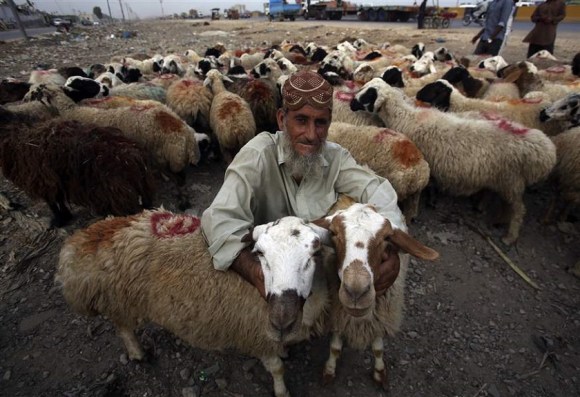
 

Categories
Middle East Published Articles Zwemer

Islam and the Bigotry of Conviction

the-muslim-world

The Muslim World (TMW) is one of the leading academic journals covering Islam worldwide. Strange it would call its own history “bigoted”.

It was founded in 1911 by Samuel Zwemer, a founding father of Protestant missions in engagement with the oft-rival monotheistic faith. Now published by Hartford Seminary, like much of the Protestant mainline its original evangelistic fervor has faded.

Still I was startled to read the concluding sentence of an informative historical biography TMW published in commemoration of their 100th edition:

A century later, TMW has successfully broken ranks with religious provincialism and bigotry, and lives up to the present motto of the Seminary “exploring differences and deepening faith.”

Is this a fair account of all but TMW’s most recent scholarship?

The article notes the academic rigor exhibited from its beginnings to the present day, and despite this conclusion is charitable towards its earliest pioneers and the belief system that propelled them. But it chronicles the development of TMW from a Protestant missionary endeavor to a nonsectarian survey of Muslim-Christian relations. Begun by “the apostle to the Muslim world,” it is now edited by a Muslim.

Editors had to choose between faithfulness to its evangelizing mission to the Muslim world, and thus remain a primary resource for missionary activities, or tilt toward an academic oriented journal concerned with dialogue with Islam. …

To be sure, the journal might have faltered and disappointed many in its hundred years of existence; however, its faithfulness as a forum for academic articles on Islam (both current and past) and Christian-Muslim relations has survived.

Zwemer is called a “pioneering scholar of Arabic” and noted as a professor at Princeton Theological Seminary. He is said to have had “a keen knowledge and understanding of Islam and Muslims,” who included contributions from the “best minds of its times.”

But at the same time it appears to reduce his era of TMW to a historical record of peculiar mentality:

For posterity, the journal represents an invaluable source of missionary activities and scholarly papers on Protestant theologians’ and missionaries’ perception of and thought about the Arab and Muslim world. In that sense, TMW is a priceless wealth of information thanks to Zwemer.

A shift took place under the subsequent editor, one the author approves of. Edwin Calverley (1948-1953) did not necessarily break with the missionary heritage, but wished to reorient presentation:

Associate editor under Zwemer, his first editorial promised “nothing inaccurate, unfair or ill-mannered about Islam.” Calverley’s meticulous academic mind and concern for truth and his determination impressed his contemporaries. He sought to enable readers (missionaries and theologians) to discover what Muslims thought of themselves.

But the editor the article seems to respect most is Kenneth Cragg (1953-1960), the Anglican Arabist:

He led the journal toward a professional and academic authorship. There is no doubt that Cragg’s command of the issues at hand and his own expertise allowed him to make bold changes in the direction of the journal. He took seriously the conscience of Islam and Muslims’ sincere and deeply held set of convictions about the one and only God.

Unlike Macdonald, he did not see Islam as a Christian heresy or as a symbol of man’s perversity as Zwemer, or another way of salvation as liberal theologians. He saw Islam as a theological problem and not as a religious problem or a socio-cultural one.

Cragg asked both Christians and Muslims to show hospitality of mind and a proper attention to the religious other. He invited them to “enlarge [their] hospitality of heart and thought.” His bold and creative writing allows for Islam to speak for itself.

William Bijlefeld (1968-1992), however, followed with a definitive focus on Muslim-Christian relations as the journal’s reason for existence. The author notes his contributions dispassionately but provides a telling quote:

We may be liberated of much confusion and frustration if we interpret the concept of mission not in the sense of an attempt to ‘impose truth’ on others, but as an honest effort to reflect and realize in our time the Compassion of God who IS the truth.

This is still a Christian sentiment, but is it a proper understanding of the heritage of Zwemer and others? Did they see their efforts as imposing truth, as described? Would it not rather be one of deciphering and demonstrating, however polemic in orientation?

Here the stage is set for the author’s joltling conclusion, following two cursory paragraphs about most recent developments. The journal now accords with this long range plan:

Strong academic programs, creative scholarship in the study of Islam and Christian-Muslim relations; local, national and international initiatives in Christian-Muslim relations; and leadership to religious communities and congregations in interfaith and ecumenical relations.

For this let TMW be saluted. And in the drift away from Zwemer’s heritage no critique is needed. This is the development of much Protestant theology over the past 100 years.

It is worthwhile to review this history through the lens of a publication. And as mentioned, the author is by no means disrespectful. All of which makes his concluding sentence so surprising.

“Religious provincialism.” Very well, that can be seen as a fair enough term for Christian exclusivity. Such a belief may indeed influence one to interpret only through the light of one’s own faith.

But is this “bigotry”? Such a term suggests instead its application on the speaker. Christian exclusivity is a belief, as is the accompanying missionary mandate. That one imagines God will ultimately condemn the religious other has no necessary bearing on one’s treatment of that other in this world.

Zwemer and his colleagues confidently critiqued Islam and found it lacking. Perhaps they also devalued the Muslim mind for holding to it so tenaciously. But as best I know, they studied conscientiously and argued respectfully.

The author does not bring out anything otherwise. And if Zwemer bears even a tinge of bigoted guilt for his attitudes, the author commends later editors of similar Christian belief for their academic care and faithfulness in representing Islam.

Where then is the bigotry? Is it in this quote from Zwemer?

We hope to interpret Islam as a world-wide religion in all its varied aspects and its deep needs, ethical and spiritual, to Christians; to point out and press home the true solution of the Moslems; namely, the evangelization of Moslems; to be of practical help to all who toil for this end.

These words are taken from TMW’s first editorial. But Zwemer repeated them again in his final editorial in 1947. His call for mission held steady from first to last, and in yielding editorship it was stipulated the journal continue upon the same philosophy.

Did it continue with Cragg? The author quotes him from shortly before he became editor, writing in TMW:

Our readiness to make Christ known and loved is the direct measure and consequence of what, so known and loved, He means to us. An apology to Christian mission is no more, no less, than an apology for the Christian faith.

And Cragg was even clearer in his own book, The Call of the Minaret:

If Christ is what Christ is, He must be uttered.  If Islam is what Islam is, that “must” be irresistibly. Wherefore there is misconception, witness must penetrate: wherever there is the obscuring of the beauty of the Cross it must be unveiled: wherever men have missed God in Christ He must be brought to them again.

The language of Cragg reflects a different age than of Zwemer; does it reflect a different conviction? Either way, if either is bigotry then most Muslims must also be damned. So must everyone who holds to a conviction and wishes others to discover its value. In his labeling of the now-rejected heritage of TMW surely the author is calling the reader to the truth-as-he-understands-it. And should he not be praised for so doing?

Whatever your conviction, study well the convictions of others. Report them accurately. If you are motivated to do so to disprove and dispel, so be it. The effort is worthy, and closer will all parties come to the truth.

But let your motivation move deeper, and do so in respect, honor, and love for the one who holds opposite conviction. You are equals. You are human.

At core, I suspect both Zwemer and the author of this article to be of this character. That either one may betray the principle is understandable; conviction of truth can make blind to malpractice.

But it need not, and should not. Right conviction of truth not only commands the mind but also orders the heart. Love is the protective virtue. Christian faith is a primary source for both, though too many fail to draw them in balance. Perhaps other faiths share similar struggle.

The Muslim World was, and is, a chronicle of this struggle. Let all embrace it, read, and learn. Listen well, and speak freely.

This article was first published at the Zwemer Center.