As Muslims celebrate, keep their joy. As Egyptians observe, keep them safe.
In Egypt and around the region, security is stepped up in prevention of extremist attacks. The pilgrimage, a time of piety for many, is a time of advertising for others.
May the eid pass peacefully, God. May peace come in their supplication.
There may be three million Christians in Japan, one percent of the population. They now have a Coptic Orthodox Church among their options.
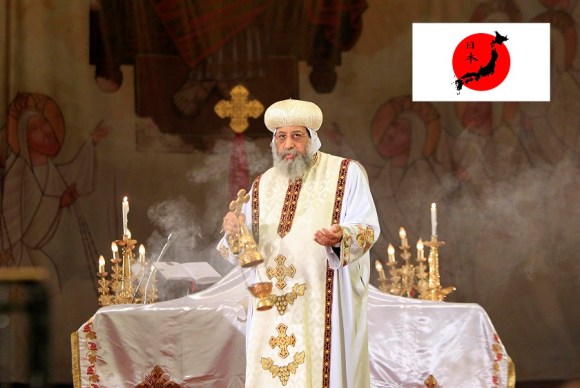
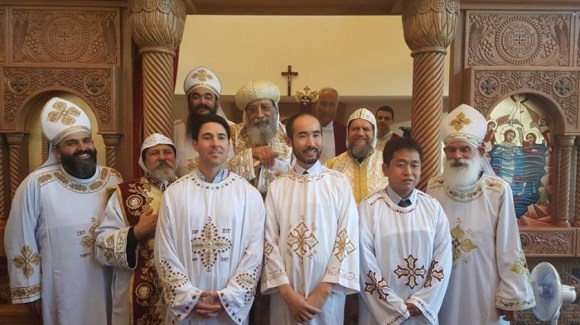
Egypt’s Pope Tawadros arrived on August 26 to consecrate Japan’s first Coptic Orthodox congregation, the Church of St. Mary and St. Mark.
Tawadros hailed the cooperation between Japan and Egypt, especially the new initiative to establish Japanese schools to better the education system. He praised the Japanese people for their renaissance following nuclear disaster, and their ongoing commitment to peace.
The church, he said, preaches love in every place. The church is a mother, who searches for her children wherever they are.
And the church does not stay still. As St. Mark traveled the ancient world to come to Egypt, so the church today comes to Japan.
The church was first built one year ago in Kyoto, on July 16. Around 100 people attended in the opening, including many nationalities of Eastern Orthodox rite. There are around 20 member families, though the church welcomes all and seeks to serve Japanese society. Language lessons in Arabic and Japanese are one expression of this desire.
The first mass, however, was held in 2004 by Bishop Daniel of the Sydney Diocese of Australia, to which the Japanese church belongs. St. Mary and St. Mark Church has also joined the Japanese Confederation of Christian Churches.
Nestorian Christianity was the first to reach Japan, perhaps as early as the 5th century. St. Francis Xavier is credited as the first modern missionary, in 1549. His efforts faced severe persecution, chronicled in the book Silence, by Shusaku Endo, and now made into a feature film starring Liam Neeson.
Protestants and Orthodox came in the 19th century. Interestingly, eight Japanese prime ministers have been Christians.
“God loves the world and everyone in it,” said Tawadros. “The church knows no geography.”
(via the Coptic Media Center)
UPDATED:
Perhaps the best evidence is the Japanese character of the church. In addition to a Japanese language mass, two of the three deacons consecrated by Pope Tawadros were Japanese.
(via Coptic Media Center)
Even so, they were identified by their Coptic/Christian names: Tawadros, Makarios, and Athanasius.
“We hope that God will bless them and they will become great servants of this church,” said Tawadros, interviewed in Japan by CTV.
“The church has a spiritual role to present salvation and encourage repentance, but it must also have a role in society according to the local needs,” he continued.
“This is the idea of St. Mark himself.”
Pope Tawadros was received in Japan by the Egyptian ambassador, toured the Tokyo Museum, and met the mayor of Tokyo.
His visit also attracted the attention of the Japanese media, with this clip presented by NHK, Japan’s national public broadcasting organization.
The Coptic Media Center provided translation:
Title: People: Egyptian Christian Church- First visit to Japan for the Pope of the Coptic church
Picture: Pope Francis & H.H. Pope Tawadros II
Reporter: The person here standing next to Pope Francis is the Coptic Orthodox pope, His Holiness Pope Tawadros II. The first Coptic Orthodox church was established in Japan and H.H. came to Japan for the first time. Yesterday, he conducted a holy liturgy.
What kind of holy liturgy was it, I wonder?
Beyond the doors, you can hear a unique sound of prayers. Last year in October, a Coptic church was established in Japan. H.H. Pope Tawadros II conducted a holy liturgy there. At the holy liturgy, there were 100 church members gathered from around Japan.
Mr. Michel Youssef (church member): This is the first Coptic church in Japan and we are very happy that H.H. Pope Tawadros from Egypt had come today.
Reporter: The Coptic holy liturgy style had been continuing from ancient times. Icons of saints are on the wall and that had been brought from Egypt. The ladies cover their heads with scarves and (the Copts) respect and follow the traditions. But on the other hand, Japanese is used in the holy liturgy, and the clergy use PC tablets in their holy liturgy and it shows that they are keeping up with the modern technology.
The Coptic Orthodox church was founded around the 1st century, it is said that 10% of the Egyptian population are Coptic Christians. The Copts (Coptic community) have spread overseas to other countries such as Japan and Canada. One of the background reason for this is the presence of a group of Muslims (in Egypt) that considers Copts like enemies.
Rosemary: I think when they hear hate speeches like “kill people from other religions” that turns into persecution (against Copts).
Reporter: Continuously churches have been attacked because I.S. terrorists’ main aim is to attack churches. Regarding this issue, H.H. Pope Tawadros II commented on this:
H.H. Pope Tawadros II (Japanese subtitle): Terrorism divides the Egyptian people but Egypt is a strong country. (Addressing to Japanese people): let’s meet in Egypt.
Tomorrow night we will broadcast a Coptic studies researcher from Göttingen university (Mr. So Miyagawa) who will talk about how the Coptic clergy gives out information for Copts around the world. Please look forward to it tomorrow night.
I will update this post further if the follow-up video becomes available.
They started out friendly. Probably they still are. But the American president played an unexpected wild card, with developments still uncertain.
The US cut its military aid.
Trump has repeatedly praised Sisi, who has returned the admiration. But even so his administration followed an Obama pattern in holding back some aid pending better progress in human rights and democracy.
One reason: The controversial NGO law. Sources said they were told by Egypt it would not pass.
God, international relations are built on interests, but also through relationship. Strengthen communication between the two leaders.
Did Egypt promise and not deliver? Did she deceive to begin with? Or is it an erroneous report?
Let there be clarity in the relationship, God. Let Egypt know exactly what the US requires, and act accordingly.
No games. No guessing.
But also no free ride. Help Egypt judge the demands of her sovereignty. If accepting aid, in exchange for what? Is it a price worth paying?
Help her reach a place no aid is needed.
Develop Egypt in human rights and democracy, God. Develop also the American understanding.
Where there is a gap, narrow it.
Preserve friendly relations, God. In international relations, wild is risky. Put cards on the table, and play them well.
All is uncertain, but you know the way. Lead Egypt to the right and good.
In his recent article for Foreign Affairs, Eric Trager says the Brotherhood miscalculated at Rabaa, and in post-Morsi policy in general.
It certainly hasn’t worked out well for them, but I have one small quibble, perhaps:
Indeed, from the moment of Morsi’s July 3 overthrow, the Brotherhood’s leaders understood that they were in a kill-or-be-killed struggle with the new military-backed government.
A ‘be-killed’ moment, maybe. There were extensive negotiations going on at the time, between both international and domestic forces. The official discourse held that there was a way for continued Brotherhood political participation.
Trager outlines the pre-Rabaa violence against Brotherhood protests, though. Many, perhaps including the Brotherhood, didn’t really believe the official discourse.
But the possible quibble is with ‘kill’. Did the Brotherhood realize success depended on their violence? That was not part of their official discourse, nor did it seem an underlying reality, as Trager notes:
Although the Brotherhood mobilized violence against its opponents multiple times during Morsi’s presidency, its leaders called for nonviolence following Morsi’s overthrow, with Supreme Guide Mohamed Badie infamously proclaiming, “Our peacefulness is stronger than bullets.”
The article is full of great quotes, with links. But why is this ‘infamous’? It seems honorable. The Brotherhood was certainly willing to ‘be-killed’:
“If they want to disperse the [Cairo] sit-in, they’ll have to kill 100,000 protesters,” Brotherhood spokesman Gehad el-Haddad told journalist Maged Atef two weeks before the massacre. “And they can’t do it [because] we’re willing to offer one hundred thousand martyrs.”
If honorable, it was still tragic, and tragically wrong. Several hundred died, thousands more jailed. But tens of thousands were not willing to pay the price boldly promised.
And it is honorable to risk so much blood? Maybe. Many senior leaders are in prison, but others fled to safety abroad. A good number had family members killed. They bet their organization, and perhaps the prize was worth it.
But Trager shows some were willing to bet more, perhaps undoing my quibble:
From the younger Brothers’ perspective, this was a dangerously naïve strategy, leaving them and their comrades defenseless during the assault that followed.
“Our dear brothers were saying, ‘we are peaceful,’” Amr Farrag, a prominent Brotherhood youth based in Istanbul, later lamented in a Facebook post. “‘Our peacefulness is stronger than bullets.’ Fine, so we got smacked on our necks.”
Another prominent Brotherhood youth, Ahmed El Moghir, later revealed that the Cairo demonstration site was “sufficiently armed to repel the Interior Ministry and possibly the army as well,” but that most of these arms were removed only days before the massacre due to senior Brotherhood leaders’ “betrayal.”
So maybe the ‘kill’ is appropriate to go with ‘be-killed’. Take all testimony with a grain of salt.
A good number of policemen died clearing the square. The great majority of protestors were not armed. When the Interior Ministry displayed weapons captured after the operation, they were not that many.
But is that because they were removed? Why? Cold feet? Conscience? Facilitation of martyrdom and political sympathy?
Much more is needed to understand, but the quote is clear.
The Brotherhood is complicated. But they also miscalculated. What next?
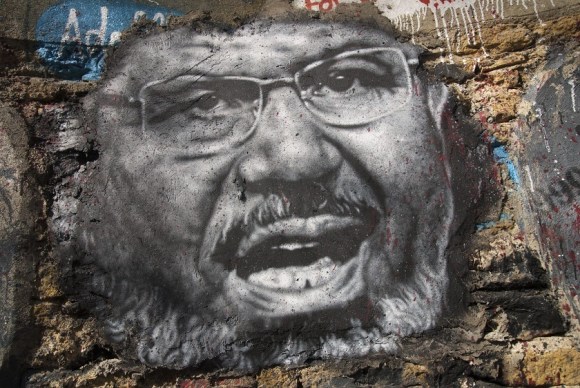
(Image: A painting of Mohamed Morsi in France. Flickr/ThieryEhrmann, via The Islamic Monthly.)
The first part of the title is the name of a very good explanatory piece in The Islamic Monthly. It also is the name of a new book by Shadi Hamid and Will McCants, collecting analysis from Islamists published individually at Brookings.
The trouble is, this article leaves me with more questions.
First the good stuff:
In the early 1990s, a new debate around the role of Islam and politics — and more specifically “Islamist” movements — emerged. In an alternate universe, if certain things at that moment had turned out differently, the Middle East’s path might have diverged considerably.
In the first round of Algeria’s elections in 1991, the Islamic Salvation Front, or FIS, won 47.5% of the vote and 188 of 231 seats. For the first time, an Islamist party was on the verge of coming to power, not through revolution (as had happened in the case of Iran) but through democratic elections. The country’s staunchly secular military quickly stepped in and aborted the elections, plunging Algeria into a civil war from which it has yet to recover.
And so the debate erupted over the “Islamist dilemma” — would Islamists who came to power through elections cede power if they were voted out of office? Or, as U.S. Assistant Secretary of State Edward Djerejian famously put it, would it be “one man, one vote, one time”?
Two opposing camps formed: those who believed these groups could be incorporated within the democratic process, as long as they played by the rules, and those who thought their ideology rendered them irreconcilable.
It’s been more than 25 years, and the debate is more or less where it started. In some ways, it’s worse.
The article describes it as worse in the Trump desire to criminalize the Muslim Brotherhood, and I largely agree. There is a significant risk:
Even more worrying [is that] it would affect not just U.S. foreign policy, but American politics and the safety and security of American Muslims.
The camp of Trump chief strategist Steve Bannon sees designation of the Brotherhood as an opening salvo against U.S. Muslim organizations and Muslims more broadly, blurring the lines between extremists, Islamists, and ordinary American Muslims.
As The Atlantic’s Peter Beinart has argued, the Bannon camp “uses the specter of the Muslim Brotherhood and Sharia law to depict American Muslim political participation, and even religious expression, as a security threat.”
Whatever real challenges there are from Islamism, they must not be manipulated to demonize Muslims. This is happening all too frequently these days.
But there is a historical insight Bannon-types latch onto:
Some of the most prominent American Muslim organizations today were started by members or supporters of the Muslim Brotherhood decades ago.
Although most of these organizations were never formally linked to the Brotherhood and the influence of their Brotherhood founders has since evaporated, the Trump administration could argue that they should be subject to legal sanction once the Brotherhood is criminalized as a terrorist organization.
Yes, again, the criminalization aspects are very worrisome. But I am curious: Has the Brotherhood influence really faded? The authors know better than I do, for I do not know the American Muslim scene well. But I would be interested to know more about that assertion.
In any case, there are certainly challenges from Islamism, which the authors put forward well:
The illiberal policies pursued by many Brotherhood or Brotherhood-like organizations would harm the cause of human rights in Muslim-majority countries.
Therefore:
On the one hand, the Brotherhood’s many illiberal branches could set back the cause of human rights should they come to power in Muslim-majority countries. On the other, denying them the opportunity to come to power denies another fundamental human right — the freedom to participate in elections — and sets back the cause of democracy.
This is a dilemma. But I’m afraid the concluding advice raises more questions:
The U.S. should chart a middle way.
It should not help illiberal Brotherhood groups win democratic elections but neither should it prevent them. It should not cheer the electoral success of Brotherhood groups but neither should it refuse to work with them once in power if it serves other important U.S. interests.
In other words, it should treat the Brotherhood like any other illiberal political movement.
That seems like sound advice, but one – is it ‘rethinking’? It sounds like what we have always done, at least officially.
And two – is it sound?
On the first count, if our official policies have not been actual reality, we must delve into competing quasi-conspiracy theories. Some say the US has indeed backed the Brotherhood in Egypt, pushing for the ouster of Mubarak knowing full well the Brotherhood was the primary organized political force, perhaps wishing to entrust a new Middle East to Islamists rather than autocrats. Some versions of the conspiracy say we even went further, and funded and nurtured them.
Or alternately, some say we prevented their continuing in power by not adequately opposing the overthrow of Morsi and designating it a coup. Some versions of the conspiracy say we quietly cheered on as his administration was undermined, and are glad for a return of a military backbone status quo.
So which is it? The official reading of US policy is that we accepted the election results that brought Morsi to power, worked with him once there, and then worked with the administration that removed him and subsequently won a popular election. That sounds exactly like the article’s advice.
Except that the publication of the article was timed to correspond with the fourth anniversary of the clearing of the pro-Morsi protest camp, when hundreds of his supporters were killed. It is a news hook, yes. Is it also political sympathy?
If so, why not? They won the elections, though they thereafter lost much of the population. But American policy? Under the advice of the article, should we have stepped in against Morsi’s removal, or let it be?
On the second count, could it not be argued that the US should work to deny illiberal parties from coming to power, of any stripe? Right-wing neo-Nazis in Europe, for example? There are many strands of American politics that wish to isolate and limit their influence in the US. That seems quite right.
So without crossing the line into undermining democracy, if the Brotherhood-type groups are as illiberal as the author’s suggest, would it not be reasonable for the US to seek to prevent their ascendance – openly and publicly?
Perhaps there are wise reasons not to – non-interference in other nations’ internal affairs being a primary one. But I have never liked the one they propose, even if it has logical merit:
On national security grounds, criminalizing non-violent Islamists risks pushing them into the arms of violent groups targeting the U.S., increasing the risk to American lives.
Again, the criminalizing argument is necessary. Human rights extend to those you disagree with. But if a group can be so easily pushed to violence because it doesn’t get its way – that is not a good indication they should be given their way. Quite the opposite, in fact.
The Brotherhood proudly proclaims that jihad is its way and martyrdom is its highest aspiration. Islam allows for non-militant explanations of these terms, but Brotherhood groups in Gaza and Syria and Libya have all embraced militancy. The Egypt branch is torn, but even then, its prior choice of peacefulness was tactical.
Would it not be reasonable to work to prevent them from achieving the power necessary for implementation? Reasonable, that is, without undermining democracy and national sovereignty?
But there again is the dilemma, and perhaps the gap between official and unofficial policy.
The article did a very good job setting the scene. I only wish they wouldn’t have cut off the depth of their analysis right when it started to get interesting.
Then again, the authors are prolific on this topic. Surely their answer is found in other texts. Explorefreely.
And please read for yourself, and comment with your thoughts. It is a fairly crucial part of American debate these days.
Egypt is debating significant changes. Give her the wisdom to walk the right path.
Some have proposed the constitution be amended to allow the president a six-year term. Others say leave the constitution alone, and implement it.
Some have proposed the marriage age be lowered to 16 to legalize longstanding practice. Others say there are too many Egyptians already, and it is backwards.
Some (in Tunisia) have proposed inheritance be divided equally between the sexes, and marriage made open to non-Muslim men. The Azhar says it is against Islamic sharia, and condemns it.
Some have proposed the train system be mechanized. No one opposes, but who will fund it?
God, your discernment is needed.
Grant the president wisdom to achieve agenda, and the people a choice in approving their leader.
Grant Egypt wisdom in population control, and women a choice in the details of marriage.
Grant the Azhar wisdom in Islamic interpretation, and Tunisia a choice in religion and state.
Grant the ministry wisdom with limited resources, and funders the choice of both safety and gain.
God, develop Egypt to function well – government, institutions, and citizens.
In all the above, lead her. Changes must come, may they be the right ones.
For the first time in my life, I locked the keys in the car. Worse, it was borrowed. All the movie tricks with wire hangers came into my mind, but none seemed like they’d work. I was stuck.
Stuck an hour away from home. With two of my kids, picking them up from camp. One eager dorm leader suggested we break the back window. It would be cheap and easy to fix, he said. He’d do it right now with his fist. Seemed like the only way out at the time.
But then one after another, God brought solutions.
There was a spare key back in Cairo, but in the apartment of our friends who let us borrow the car. I called my wife, who was at Bible study in the international church offices.
She quick asked a friend, who coincidentally was right then going to that apartment to take the house sitter to the beach for the weekend.
My wife got a ride over, and got the key. Fifteen minutes later and we would have been lost.
Back at the campsite, another father overheard the dilemma and offered us a ride home.
Once there, spare key in hand, our whole family piled into the Uber. I had planned to take the two girls to the near-to-camp expansive mall to hear about their experience. Now, we could all go, and experience their joy all at once.
And this week, Uber even offered a 30 percent discount.
An hour later we unlocked the car. Several hours later, we came home exhausted.
It could have been a disaster. But one small coincidence after the other had the handprint of God, making the day even better than we expected.
It also came with a valuable lesson to discuss with the kids: All things work together for good, to those who love God. Let’s not complain, but wait expectantly.
I believe this.
But don’t you think it is also a little crass and self-serving? One day later marked the four-year anniversary of several hundred protestors killed, as their sit-in camp was cleared by authorities.
Our nation borders a territory that is hemmed in on all sides, an open-air prison. One nation over is torn by civil war and terrorism.
Yet God arranged quick access to a spare key, so I could get home more conveniently. So I could take my whole family to a food court.
That’s a different lesson to share with the kids, isn’t it? Believe me, I tried. Their eager celebration of God’s goodness shifted into sullen confusion. Death and destruction can do that to a dinner conversation.
We talked through the possibilities. A Syrian refugee opened our favorite ice cream shop across the street, and is doing great business. God did well to work that out for good, right?
Our good, absolutely. Best and cheapest ice cream in town. But I’m sure he’d rather be back home.
The Syrians are Muslims, was one possibility. Maybe God worked things out for us because we’re Christians?
Perhaps there is some fidelity there to the verse above. But a good number of those Syrians are Christians, too. One kid shot it down more broadly. God would want to do good to everyone.
Maybe that’s it? There are bad people in the world, destroying God’s good? Certainly, but is God’s good coming? It’s hard to see, and a long time in coming.
One child recalled the Israelites in the wilderness. Already in a tough situation, God sent snakes to kill many when they grumbled. Sometimes disaster is discipline, even punishment.
True, but hardly satisfying when we consider the tragedies of another.
Sullen, and glum. There are no easy answers.
There are things we don’t understand, I told them. Even more so, Jesus foretold difficulties for those who follow him. He was not saved from the cross, and this should not be forgotten in the hope of ‘all things good’.
God has given different promises to those who suffer. He is with them in the middle of it. Many have said their fellowship with him has been closest during the harshest times of trial.
And we must not forget, in heaven, one day, all will be good. The resolution is coming.
Until then, we have a choice.
Was the car key episode simply a series of well-timed coincidences? Yeah, maybe.
Or was it the loving hand of a personal God upon his wayward creation and adopted son?
Which would you rather?
We do not need to extrapolate the universe to find his favor in the little things. But neither should we believe the universe revolves around us.
There is blessing, and there is suffering. In faith we hold that both work out for good, even when we cannot see it.
It is not my place to find the good in Syria. That is up to the Syrians. It is up to God. I can help as I am able, but I dare not interpret.
Sometimes lessons are simpler for children than adults; I don’t think this is one of them. But best they hear them now, I think, than struggle with them later. There is mystery in our faith, and it cannot be avoided forever.
But likely, a child will take it to heart much more readily than we will.
If this is the good from a neglected car key, it is sufficient. Far better than a ride home and a family night out.
But thank you, God, for those little things also. For us.
Habib Girgis, memorialized on the curtain separating the altar from the sanctuary of a Coptic Orthodox Church
Perhaps it is likely you find one word in this title a bit odd? We’ve had Sunday School in American churches long before I can remember – could it really have been an Egyptian immigrant?
That would be a tale, but the idea traveled in the other direction. Sunday Schools in Egypt are thriving, and America had a role.
But it is largely due to the tireless work of a Coptic Christian few have heard of.
Habib Girgis is the subject of a new biography published by St. Vladimir’s Seminary Press, written by Bishop Suriel of the Melbourne, Australia diocese of the Coptic Orthodox Church.
Here is a review, provided by the Center for Law and Religion. Afterwards I’ll continue the story of cross-pollination.
By the mid-nineteenth century, the Coptic Orthodox Church was in a state of deep vulnerability that tore at the very fabric of Coptic identity. In response, Girgis dedicated his life to advancing religious and theological education.
This book follows Girgis’ six-decade-long career as an educator, reformer, dean of a theological college, and pioneer of the Sunday School Movement in Egypt—including his publications and a cache of newly discovered texts from the Coptic Orthodox Archives in Cairo. It traces his agenda for educational reform in the Coptic Church from youth to old age, as well as his work among the villagers of Upper Egypt. It details his struggle to implement his vision of a Coptic identity forged through education, and in the face of a hostile milieu.
The pain and strength of Girgis are seen most clearly near the end of his career, when he said, “Despite efforts that sapped my health and crushed my strength, I did not surrender for one day to anyone who resisted or envied me…. Birds peck only at ripe fruits. I thank God Almighty that, through his grace, despair never penetrated my soul for even one day, but in fact I constantly smile at the resistances…. It is imperative that we do not fail in doing good, for we shall reap the harvest in due time, if we do not weary.”
Habib Girgis remains a pioneer of Coptic religious and theological education—a Copt whose vision and legacy continue to shape his community to this very day.
I must read the book to know the details and his particular impetus. But as I understand the greater trends, the American Presbyterian missionary efforts in Egypt put the Coptic Orthodox Church under great stress. The church, as mentioned in the excerpt, was vulnerable due to a state of internal decay as simony and Biblical illiteracy plagued the faithful. The church kept to its ancient rituals, but little more.
The Presbyterians, following a general failure to work successfully among the Muslims, began converting Copts to the evangelical faith and starting new churches.
Habib Girgis worked tirelessly to renew the Orthodox Church, as described above. His activity furthered the reforms began in the papacy of Cyril IV (1854-61), and continued with Pope Cyril V (1874-1927), the longest serving patriarch in Egypt’s history, who supported it.
The Sunday School Movement that was launched would eventually animate to-be Pope Shenouda III and other eventual bishops. The monastic heritage of the church found new life with an emphasis on education, and Bible reading was encouraged among the young, old, clergy, and laity.
Girgis was declared a saint by the Holy Synod of the Coptic Orthodox Church in 2013.
Today the Presbyterian Church in Egypt is also thriving, but the Coptic Orthodox Church are the revived mother church respected by most. Habib Girgis is largely to thank, and now he can be.
Perhaps also Christians worldwide might realize – oh, Copts have Sunday School, too?
From Open Democracy, a translation of local sheikhs in Upper Egypt who led a campaign against the construction of a church in their village.
In late February 2017, a major international conference hosted by Al-Azhar concluded with the issuance of an important declaration affirming Muslim and Christian religious institutions’ commitment to the principle of equal citizenship.
Yet on the ground, in the village of Kom Al Lofi, in the Upper Egyptian governorate of El Minya, the practices of two Al-Azhar sheikhs – Sheikh Ahmed Mohamed, an employee of the local mosque, and Sheikh Abdel Gawad, the Imam – suggest a very different take on citizenship than that espoused by Al-Azhar.
In an interview with the official mouthpiece Al-Ahram newspaper, both sheikhs categorically opposed the right of 500 Christian inhabitants to have a church in their village, suggesting that the route to social harmony is for the Christians residents to forgo the idea altogether.
Sheikh Ahmed said that as Copts comprise 7.3% of the village, “their numbers do not allow for the construction of a church.” When the journalist asked if 500 people do not have a right to their own place of worship he responded: “We are a Muslim state (Dawla muslimah) and if there was a pre-existing church we would not object to prayers taking place, but why call for having a church now when we need to unite, not cause the occurrence of strife and this is strife caused by the media!”
He suggested that groups outside the village must be inciting this call for a church because the Christian residents are too poor to contemplate constructing one themselves.
When the journalist questioned how the Muslim majority would be harmed by a church being constructed in the village, given that there are ten mosques, Sheikh Ahmed said: “It is not right and it is not conceivable because our religion is against the construction [of the church]. This is a Muslim state and it has been unacceptable from a security point of view since a long time ago.”
Christians in Kom Al Lofi used to worship in a building that they used as a church but they were prohibited from doing so by the security forces several years ago in response to opposition from local residents and members of religious movements. Since then, families have travelled for miles to worship at churches in other villages.
In recent months, religious hardliners in these other villages have also objected to visitors worshipping in their local churches. In August 2016, security forces promised to reopen the building in Kom Al Lofi to allow Christians to worship there but they have sought the approval of the inhabitants and religious hardliners in the village – which has been repeatedly denied.
Copts have not been silent spectators to the escalating sectarian situation.
On 11 April 2017 – two days after suicide bombers attacked churches in Alexandria and Tanta – local authorities allowed Christians to worship in the building in Kom Al Lofi, but they were met by other residents who threw stones at them. Security forces intervened and arrested the perpetrators, but two days later, on 13 April 2017, the houses of three Christian residents were torched by people in the village in retaliation for their worship in the local building.
(The local sheikhs told the Al Ahram newspaper that the Copts had burnt the houses themselves to attract attention).
Copts in Kom Al Lofi have not been silent spectators to the escalating sectarian situation. Rather, last week they issued a widely-publicised declaration calling on the state to protect their constitutional right to worship and rejecting any informal mediation by so-called local leaders or any deal that would treat them like second-class citizens.
While they held puritanical Salafi hardliners and the Muslim Brotherhood responsible for fomenting anti-Christian sentiment, they also rejected on this occasion the authority of local sheikhs to determine what, when, where and how they should worship.
It is a tricky and persistent problem. Before condemning too quickly please recall the concerns of some in the United States when a mosque is purposed to be built in their community.
I would like to better understand the pro- and con- concerning church building in Islamic law. Certainly the top scholars in Egypt have given fatwas of permission.
It is very important to hear the opposition of voices like these, and learn. The rule of law is necessary, but so is the engagement of neighbor.
Egypt used to be a breadbasket. Now she imports her food. But vegetables are still desired abroad, if only they would accept them.
Several nations have put a ban on Egyptian agriculture, wary of pesticides. Egypt had been hoping for boom harvest sales, having recently devalued the currency. Now they may face a domestic glut.
Fix what needs fixing, God. Help Egypt better care for her resources, and better market her goods. Balance crop with environment, profit with health.
However impossible, restore self-sufficiency.
Wherever necessary, reinforce human rights.
The president signed a law strengthening the national council devoted to the cause. Guaranteed is its access to prisons and hospitals, as well as its access to cabinet and parliament.
It has the mandate to hold government accountable. God, give it the wisdom and courage.
Appoint the right men and women. May they find listening ears and responsive hands. May individual and society equally be honored.
Dignity, God, and food. Provide both, from within Egypt.
Two more price categories are now set for increase: Water, by up to 50%, and bus tickets, the same. Subsidies are being slashed across the board, and inflation is rising.
The government has implemented procedures to help the poor, who are many. The economy is struggling, and has been imbalanced for a long time.
At least the reforms are doing something, God, but are they the right thing?
They are not the only reforms, though. The education minister revamped the elementary system and promises the same for high school.
Most agree education needs drastic improvement, God, but will it work? Will anything?
The people can only wait and see, and hope. Good news is that two new oil fields are producing at ‘unprecedented’ levels. New natural gas fields are near to extraction.
The requests are simple, God. Give wisdom to the ministers. Give support to the poor. Give patience to the rest.
But with patience, transparency and accountability. If the economy is put straight, put it straight for all. If it collapses… God, spare Egypt the tragedy. Spare the world.
Increase production, and slash corruption. Do what you wish with subsidies, but inflate the sense of national responsibility.
And reform, God. Reform well. The human heart and all beside.
I recently attended a gathering at al-Azhar University, where the World Organization of Azhar Graduates presented with Egyptian Radio about the work and need to spread “Ashari, Wasati” Islam, and define the parameters of true religion. This is done, they said, to help combat terrorism and extremist interpretations of Islam.
That is all well and good, perhaps, provided we know what Ashari and Wasati mean.
The World Association has over 131,000 members – within Egypt but also throughout Asia, Africa, and the West. Formally an independent organization, it is headed by the Grand Imam of al-Azhar, the foremost spokesman for Sunni Islam in the world.
There is much debate these days, even within Egypt, about whether or not al-Azhar is part of the problem. Some say its reliance on ancient interpretations pulls from the same ground as al-Qaeda and the Islamic State. It is noteworthy, they say, that al-Azhar has not declared these groups non-Muslims.
The particulars of this debate are beyond this small posting, and unfortunately still beyond my expertise. But here are the basics about Ashari and Wasati.
Abu al-Hasan Ashari died in the first-half of the third century of Islam, in 935 AD.
Early Islam was wracked by internal conflicts and philosophical debates, with the two chief sparring partners the Ahl al-Hadith, the family of tradition, and the Mu’tazila, the translation of which is not especially important here, but represented what they called a rational understanding of Islam.
Ahl al-Hadith relied on literal readings of the Quran with strong dependence on the many traditions and sayings of Muhammad that circulated widely. Among their important beliefs was the uncreated nature of the Quran and the absolute sovereignty of God in the details of man’s destiny.
The Mu’tazila gave metaphorical meanings to much of the Quran, believed it was delivered in time to Muhammad and was not eternal, and that man possessed free will or else God would be unjust in populating Heaven and Hell.
Depending on the caliph, either Ahl al-Hadith or the Mu’tazila would have the upper hand and persecute their opponents. For the record, Ahl al-Hadith bear some resemblance to today’s Salafi/Wahhabi Muslims, while the Mu’tazila no longer exist.
Abu al-Hasan Ashari was raised in Ahl al-Hadith but studied and eventually joined the Mu’tazila. But he repented of this viewpoint in a famous speech at the mosque in Basra, Iraq, and eventually forged his own school.
Concerning the Quran, it was God’s eternal, uncreated word but delivered at a certain point in time. Concerning destiny, God determined certain aspects of a man’s life but did allow him free will. The Ashari position sought to moderate between the two trends at the time, and eventually became the official position of al-Azhar.
But among the most important principles promulgated was the idea that all are Muslims, no matter their philosophy or sins. Al-Azhar today accepts equally the four primary schools of jurisprudence in Sunni Islam, and will call no Muslim an infidel.
Here then is the context for why they do not excommunicate, so to speak, the Islamic State. They are great sinners, al-Azhar repeats continually. But their belief in Islam’s essentials is correct, so they may not be put outside the faith. It is a position that has since saved the Muslim world from much of its early discord. Terrorists like the Islamic State as well as other non-violent but still extreme groups, label most everyone an infidel.
Wasati, meanwhile, simply means “of the middle.” You might think this is related to the story above, but it is of relatively modern coinage. The Quran speaks of Muslims being “the middle nation,” but in early commentary this tended to be interpreted as a people of justice and a religion that is meant to ease the life of mankind.
Wasati is often paired with another term – moderate – to basically say Islam is not a violent, extreme religion. Fair enough, as it often faces the accusation among some who view it through the terrorist lens.
If this is how Azhar graduates and Egyptian Radio are defining Islam to Muslims worldwide, that seems an encouraging matter.
Of course, the issues run deeper, but this post is long enough. I will thus close in imitation of how traditional Muslims ended their commentaries: Any mistakes are mine, and God knows best.
Those with knowledge are invited to provide a better, broader explanation of the above.
Terrorism is defeated neither by force nor ideology. Yet they dare not be neglected.
Egypt took a step in both directions this week. God, give her success.
A military base was inaugurated toward the Libyan border. And the president formalized an anti-extremism council, with representatives also from the Azhar and Orthodox church.
May the day come when no base is necessary. May men know you themselves with no need of clerics.
But until then, God, and in these days especially, raise every encumbrance against terrorism.
Raise the capacity of the military. Raise the morality of the people.
But mostly, redeem the conscience of the extremists. Win them to yourself.
There are always ways to do evil. Its final defeat is only in you.
A woman wears a Burkini in the south of France Credit: PA (via ITV)
A quick word to not judge by appearances, or to make assumptions about religious values.
Our family took a vacation to the Red Sea recently, at a hotel with a healthy mix of European speedos and Egyptian burkinis. It was quite the contrast.
From what we could tell, everyone behaved respectfully and enjoyed themselves.
While nowhere as revealing as a traditional bikini, the burkini is quite shapely. One night at dinner two Egyptians rose to dance to the folk band that came through. One was bareheaded, the other wore a hijab. Both knew well the techniques of belly dancing, and took no mind of the onlookers.
Was one a Christian, the other Muslim? If hijabed, why would she dance so? And while the burkini is an innovative development to help conservative Muslims enjoy the beach, is it conservative enough?
Within this discussion a recent article at CairoScene took my attention. A popular Egyptian comedienne decided to take off her hijab:
Mostafa stated through her official Facebook page that she had been wearing the hijab since she was in primary school up until high school, and she believes that, in the beginning, it was internalised by her as ‘normal’ because it was just part of the way you’d look in the society and community she grew up in. However, when she really started asking herself if she was wearing it for herself, God, or people, she realised she was doing it out of pure conforming to society – “The concept of God wasn’t there,” she stated.
Mostafa started wearing it in different ways, like the fashionable turban-style hijab that has been more prevalent lately in Egypt and around the world for hijabis. But, that did not go well because she was once again attacked for wearing hijab “the wrong way,” though she asserts is something a lot of girls do in terms of their choice in clothing that is only coupled with a scarf over the head.
Her decision to take off the hijab came to her when she refused contradicting herself. She states that once she takes it off, which is what she is comfortable doing now, perhaps she will become convinced of the concept of the hijab on a personal level, and if that happens, it’ll be the right decision because it’ll come from within.
[Read on to discover the largely negative reactions to her post.]
As you encounter Muslim women in your everyday life, be careful not to make assumptions. Some wear the hijab because of their culture. Some wear it because of their husband or father. Some wear it because of piety. Some wear it as a political statement.
What they actually believe, and their personal character, may bear no relation whatsoever. Or maybe it does.
We were in church the other day and a hijabed lady came in with an uncovered friend. This is unusual in Egypt, but it doesn’t have to be a scandal.
My daughter asked, surprised, “Daddy, is she a Muslim?”
“I don’t know,” I told her. “Some Christians cover their heads in church.”
My daughter protested. It was clearly a Muslim hijab.
“You’ll have to ask her,” I said, smiling wryly.
My daughter didn’t like that answer either. It is sort of an awkward question, both in Egypt and America.
Unfortunately, it is much easier to make assumptions. What we need is conversation. When you next encounter that hijabed woman going about your daily life – yes, it is awkward – do your best to say hi.
This quote is taken from an Iranian, but I think the sentiment — and language — would be the same for many Arabs:
On July 4, Mahmoud Esmaeili, a 33-year-old software engineer, became an American citizen. Here’s why: “I like the system here. I like the rule of law. You know what to expect and what to not expect, so you can plan. That was the major part of why I wanted to be part of America.” — from the Washington Post.
In Arabic the word for ‘system’ is ‘nizam’. On one level it refers to the governing apparatus, as heard during the Arab revolts, “al-shaab yurid isqat al-nizam,” or “the people want the downfall of the regime.” Mubarak had his nizam, so did Morsi, and now Sisi bears the weight of the term.
But the term implies more. It is the way society operates. On this level Mubarak, Morsi, and Sisi are much the same. Regardless of their political orientation, most people I meet complain equally about the Egyptian nizam.
And they are equally jealous of the American nizam.
The Post article relates a fascinating survey that shows 93% of Americans believe that respecting American institutions and laws are very important to being American.
Read the article to discover other criteria that polled high or low, but take a minute to be thankful for the American nizam — regardless of who hold office.
And take a moment of reflection also about the foolishness of certain political trends that seek to undermine it.
We must jealously guard our constitution, laws, separation of powers, electoral system, and essential rights. The human tendency to power must be tamed by a social contract that agrees to play by the rules.
This contract, says the survey, suggests Americans are far more united than commonly thought. Both parties would do well to better esteem this consensus.
One Iranian, I trust, would heartily agree.
Can any Farsi speakers verify if ‘nizam’ would have been his word of choice?
Five more policemen were killed today. Several high-profile militants were killed this week. And to avoid adding their number to the roll, Egypt’s churches canceled summer activities for the next three weeks.
The intelligence services are finding material – warning the Christians and raiding the hideouts.
Yet extremist elements are finding recruits – threatening Christians and targeting checkpoints.
God, the cycle must end somewhere. May it be with the least blood.
Criminals must be found, God. But give them justice greater than death. To the degree possible, help raids end in capture.
Peace must be established, God. But give Egypt justice greater than security. To the degree possible, help rights end in responsibility.
Death comes for all, God, when you will it. But in Egypt the past several years, it has come too soon for too many.
In eternity you cancel death. May Egypt live as if you canceled it now.
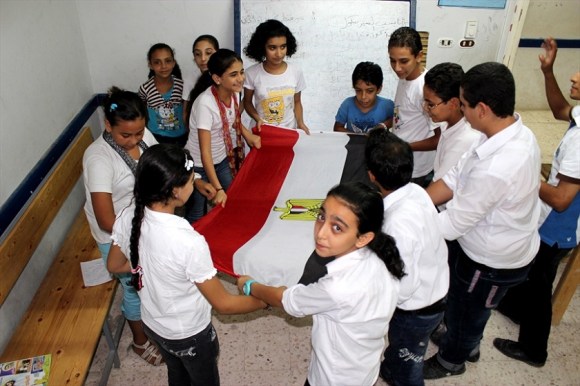
Egyptian Christian children gather round the country’s flag in a group activity, Aug 2012
The churches of Egypt are temporarily shutting down their summer activities.
“I asked all our churches and conference centres to cancel their trips and events for the next three weeks,” Dr. Andrea Zaki, president of the Protestant Churches of Egypt, told World Watch Monitor. “There is news they could be targeted by radicals.”
An unofficial translation of his official statement reads: “Warm greetings in the name of Jesus. In light of recent developments, please stop all church trips and conferences [for] the next three weeks of July 2017. This is a serious matter. Any trip or conference [that continues] will be the personal responsibility of the organiser.”
Zaki confirmed the information came directly from the security agencies. Fr Boules Halim, official spokesman for the Coptic Orthodox Church, told World Watch Monitor his denomination issued similar instructions, asking churches to wait for further information once the three-week moratorium expires.
Please click here to read the full article at World Watch Monitor.
It is too early to work out the details, but the plan is set in motion.
By 2024 Egypt will surrender full judicial supervision of elections.
In their place will be an election commission. The change accords with the constitution, and on paper all should be fine.
But God, Egyptian paper is not a strong papyrus.
Past elections have been manipulated. Some say these days are over. Others fear they may return, without the oversight of a generally respected judiciary. Some don’t trust the judiciary either.
So in the coming seven years, God, establish credibility. Grant sequential elections that reflect the people’s will.
The same in all institutions, God. The same in all bureaucracy. Honest conduct and honest outcome.
Establish the supervision necessary to keep wayward ambition in line.
Prepare the hearts proper to make it all superfluous.
It is never too early, God, but it needs a plan. May this one work.
Amen.
Addendum: 26 soldiers were killed in an attack on a checkpoint in Rafah, northern Sinai. God, have mercy on their souls, and eliminate terror. Give the nation a healthy resolve.
This article first appeared in the July print edition of Christianity Today.
(Credit: robertharding / Alamy)
Call Ann Fink crazy, but the intrepid grandmother has a tradition to uphold. She’s toured Israel, Jordan, and Egypt with 8 of her 13 granddaughters. Victoria, a preteen, is number 9.
“Her parents are not afraid,” said Fink, a Pennsylvania native, while visiting Egypt with Victoria. “We believe we can die at any time. Only God knows when and where.”
Neither tourist knew just how much visits like theirs support the region’s beleaguered Christians.
From a high-water mark of $7.2 billion in 2010, tourism revenue in Egypt has fallen by 76 percent following the unrest of the Arab Spring. The decline has devastated the economy and, with it, Egypt’s Christians.
Copts, an estimated 10 percent of the population, make up more than half of tour operators and more than a quarter of the tourism workforce, according to Adel el-Gendy, a general manager in the Tourism Development Authority. Christians have better connections to the West, he said, and are often more skilled with languages.
Gendy, a Muslim, has been assigned development of the Holy Family route—25 locations that, according to tradition, were visited by Jesus, Joseph, and Mary as they fled Herod’s wrath. Relaunched with government and church fanfare in 2014, the route is close to being designated as a World Heritage site by UNESCO, he said. But the project has struggled as tourists stay away.
The route runs through Old Cairo, which boasts churches dating back to the fourth century but feels like a ghost town. Souvenir shops are open, but their lights dim. “Our income has dropped by 90 percent,” said Angelos Gergis, the Coptic Orthodox priest at St. Sergius Church, built above a cave where tradition says the Holy Family stayed three months. “We are assigned to assist 100 poor families in the area, but we used to help so many more.”
There are no tourist fees at Christian religious sites, but many visitors leave donations. “You can see things in Egypt you won’t see anywhere else,” he said. “And if you have any sympathy for us, please come. Your visit does help…
Please click here to read the rest of the article at Christianity Today.
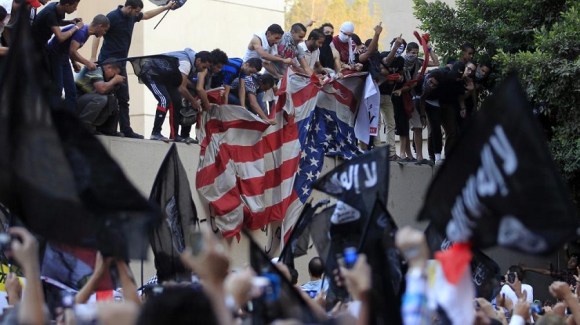
Protesters destroy an American flag pulled down from the U.S. embassy in Cairo, September 11, 2012. Mohamed Abd El Ghany / Reuters
Many Egyptians believe the United States is out to get them. Yet at the same time, the United States is the primary supplier of the Egyptian military, and ties between the two armed forces are strong.
Samuel Tadros wrote an engaging history of post-Arab Spring Egypt for the Hoover Institute, entitled “The Follies of Democracy Promotion.”
In it he brings to task the sentiment of past administrations — Bush and Obama included — who sought to pressure Egypt to open up democratically.
Some critics might say it is the underlying relation with the military and the failure to push harder for democracy that makes the United States a popular target. Tadros is cynical.
Regardless, in his conclusion he hits at a very important but often overlooked feature of the bilateral relationship:
Beyond any specific policy disagreements between the two countries throughout the years, the weakness of the alliance stems from the failure of Washington to build a constituency for the United States in Egypt.
As anti-Americanism and conspiracy theories overtook the country, no one in Egypt was willing to stand for the United States, defending the importance of the alliance.
Engagement with Egyptian society should not be limited to Cairo or to the business community, but the United States should make an effort to reach wider spectrums of Egyptian society.
And he offers several rather practical steps:
The US embassy should offer a correction to every anti-American story appearing in the Egyptian media, and those who actively spread such stories and refuse to correct them should pay a price.
A journalist consistently spreading conspiracy theories about the United States should not get invited to the US embassy Fourth of July party and he should not receive a visa to go shopping in America.
Alhurra, the US-based satellite TV channel, should be revitalized to provide fact-based news for Egypt and the region as a whole.
Above all, President el-Sisi should give a major speech making the case for the US-Egyptian alliance, detailing what America has done to help Egypt and refuting anti-American conspiracy theories. If he is committed to the alliance and wants US economic and military aid, he should be required to make the case for America to his people.
America has been content to look the other way as its reputation is trashed, assured vital interests will be [and have been] protected. And Egypt is free to pursue its favored foreign policy, independent of the United States, if it chooses.
‘Hearts and minds’ only go so far in a climate of disinformation. And America must step up to the plate and deserve the good reputation it desires.
But Tadros’ suggestions are sensible. It is strange they have not been widely discussed before.






 Jayson Casper