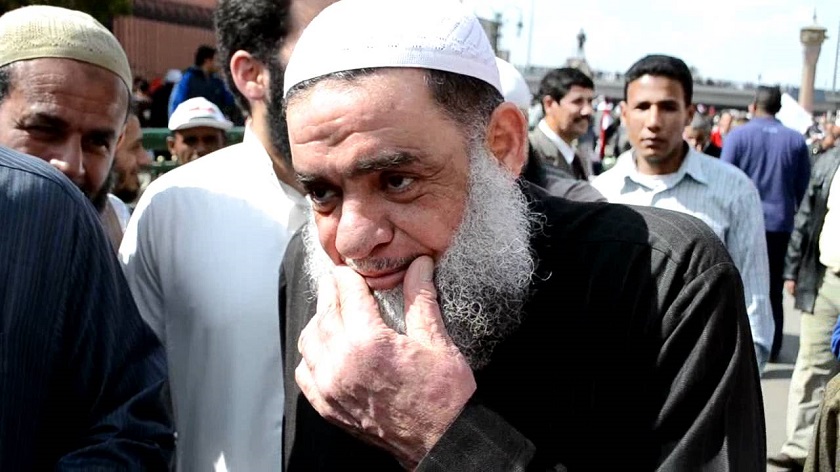
Sheikh Saeed Ibrahim was very keen to see my parents. He canceled an appointment to meet them, making sure the opportunity was not missed before they returned to America.
He wanted this picture taken, and he wants you to see it. He would be very pleased if you share.
“I want the world to see that normal Americans can meet a Muslim leader, and be friends,” he said. “Too many are equating Islam with what they see in ISIS and other extremist groups.
“We have to change this picture.”
I met Ibrahim during training sessions for the Egyptian Family House. He was one of 70 religious leaders – half Muslim, half Christian – learning to be friends with one another and then partner together in their local area to preserve and promote national religious unity.
Ibrahim mentioned it is slow going, and that due to various reasons his overtures to area priests have not yet succeeded.
So he was especially interested to go international.
Not that he has not been active at home. The Azhar is Egypt’s central Muslim institution, perhaps the most influential in the wider Sunni world. Its graduates lead the great majority of the nation’s mosques, and generally control the national religious discourse.
Ibrahim is a supervisor of Azhar preachers in Giza. In addition to this task he delivers a sermon each Friday, offers daily religious lessons, and gives a weekly lecture to police, youth, and women.
In recent months he has been especially active. Following the election of President Sisi the Azhar launched a campaign called Love of Country. Following an international Azhar conference last December to condemn ISIS, it launched Eliminating Violence and Terrorism.
Since then he has spoken in at least an additional 100 area schools, with a three-fold message:
First, Islam does not know terrorism nor call for it because it is a religion of peace and security.
Second, Islam in its doctrine accepts the religious other no matter the religion.
Third, Islam treats all people well and with proper morality.
So while Ibrahim and his colleagues work to spread this message to Egyptians young and old, he holds a special burden to communicate with foreigners.
He wants tourism to return to the country, and he wants the image of Islam to improve. He hopes that as they take pictures together, the world will become more aware.
If any in Egypt read this and take note, I would be happy to introduce you. It would be good to draw in also a Coptic priest, and encourage the Family House in working together.
“We are doing this because of the circumstances our country is going through,” Ibrahim said, “but the reward we receive is from God.”
The police stand in service to the people. They stand also in service to the law. At times there is heroism, at times there is error. But at all times there must be accountability.
This week there was.
An officer was sentenced 15 years in prison for the killing of an unarmed protestor. The case of Shaima al-Sabagh, carrying flowers to lay at Tahrir Square for the revolutionary anniversary, took both media and presidential attention. Perhaps he did not mean to kill. Perhaps there are others needing accountability beside. Perhaps this ruling is an exception. Perhaps it is a precedent.
A human rights organization released a report implicating police in implicitly endorsing the forced displacement of Copts from their homes. The case of Copts in Beni Suef, where a Facebook post by a relative in Jordan resulted in 18 forced from their home, took both media and presidential attention. They have returned home, but so far none have been held accountable, either in the mob or the police.
Perhaps it is an exception, but perhaps media accountability can also set a precedent.
But in Luxor, the police foiled the plans of a suicide bomber to kill visiting tourists. Intercepted beforehand, he blew himself up but few suffered injuries. Positive accountability is in order.
God, honor the police. Equip them to do their job faithfully. Give them the support necessary, both popular and legal.
Deal justly with things go awry. Deal justly with superiors. Deal justly with the system. Preserve the faith of the people and the rule of the law.
Comfort the family and colleagues of Shaima in this verdict. Reconcile the Copts of Beni Suef to their neighbors. Let freedom of expression be received without bullets. Let community justice be issued without exile.
And amid all the controversies, help the police in the hard job against terrorism. Spare Egypt further tragedy. Stabilize the nation, bring back tourism and investment, and help Egyptians to live in peace.
May the police enable as they serve the people. But hold them—and all—accountable, in service to the law.
It is Egyptians who must determine their leadership. Bless her with enduring independence and government of the people.
But Europe has a significant influence in legitimizing. President Sisi visited Germany and Hungary to strengthen ties and secure trade. Meanwhile a group of international Islamic scholars gathered in Turkey to give religious justification to resist and take retribution.
Egypt barred a human rights activist from a conference in Berlin. Meanwhile the world awaits the judgment of London if the Brotherhood has terrorist links.
God, make clear in Egypt both reality and righteousness. Let there be transparency over every crime and allegation. Let there be accountability for every failure and offense.
And in Europe, where transparency and accountability are presumably stronger, let there be more than interests and leverage. May they respect both rights and sovereignty.
Balancing both, may peace – with all legitimate pressure – prevail.
Preserve good relations, God. Preserve good government.
Mohamed Abdel Maksoud, a Salafi signatory of Egypt Call.
A leading American academic has denounced the latest Muslim declaration against elected Egyptian President Abdel Fattah al-Sisi as a call for ‘religious violence’.
Samuel Tadros of Hudson Institute in Washington DC told Lapido that ‘Egypt Call’, a 13-point document published last week by 159 Muslim scholars from 35 nations, and endorsed by the Brotherhood, provided ‘Islamic justification’ for the fight against Sisi.
‘This document is as direct a call for violence as you may ever get,’ Tadros said. ‘This is a religious verdict on the regime as unbelievers.’
As President Sisi visited Germany and secured an eight-billion-Euro energy deal, two policemen were shot dead near the Giza pyramids.
Meanwhile, the Muslim Brotherhood sponsored protests in Berlin. ‘Tell Merkel to stand up for democracy and human rights in Egypt,’ tweeted Ikhwanweb, their official English account.
Both activities find justification in the new document which reinforces already grave questions about whether the Muslim Brotherhood is behind violence in Egypt.
Question
The text of Egypt Call declares, ‘It is a religious obligation to resist the regime, working to finish it off through all legitimate means.’
Points 11 and 12 recognize the international struggle, condemning nations that have stood with Sisi, while praising governments, politicians, human rights organizations, and others who have criticized him. Point 13 specifically mentions civil disobedience.
But point 4 makes it personal. Mentioning specifically rulers, judges, policemen, soldiers, muftis, media, and politicians, it says: ‘Retribution against them is necessary.’
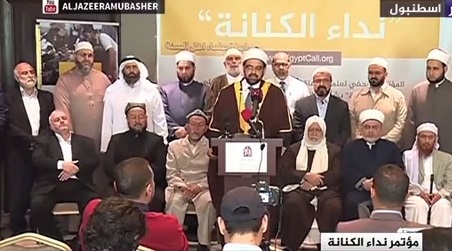
Press conference in Istanbul for Egypt Call. Ghoneim (mentioned below) is back row, 5th from left.
The sharia views them as killers, it says, and they deserve the judgment of those who kill. But the text also insists – without specificity – that this must be according to legitimate methods.
So: What is legitimate?
Ambiguity
Jihad as a concept can be viewed along a spectrum from the struggle to submit to God, to the fight to submit the world to him.
The Brotherhood has long perfected the art of ambiguity. In January, it called on followers to prepare for a ‘relentless jihad.’
It has issued statements that condemn ongoing violence, but also praised previous Brotherhood militancy.
For Tadros, the ambiguity is now gone.
He sees in Egypt Call the concept of ‘loyalty and disavowal’, often interpreted in the modern world by jihadis as the rejection of all who do not fit their definitions of sharia.
The doctrine requires viewing those disavowed as non-Muslims, or unbelievers.
Tadros recognizes, however, that the word ‘unbeliever’ is not found in Egypt Call. Rather, in detailing how the Sisi regime has fought against Islam, allied with enemy Zionism, and killed and imprisoned thousands of innocents, it lets readers make this judgment for themselves.
Over 500,000 have indicated their support on the official website.
According to Joas Wagemakers, a prolific writer on political Islam and lecturer at Radboud University in the Netherlands, ‘loyalty and disavowal’ has some Quranic inference.
But it was developed by the early Kharijite movement that rebelled against the caliphate.
Wagemakers, in his chapter in editor Roel Maijer’s Global Salafism, says Sunni Islam rejected the concept until ibn Taymiyya resurrected it in the fourteenth century. Modern-day extremists use it to justify rebellion against a Muslim ruler.
Point 2 of Egypt Call references one of the principle Quranic verses underpinning the doctrine.
But it does not specifically use the terminology, nor label the regime as non-Muslim.
Tadros attributes this to internal philosophical disputes on technical points about legitimate rebellion. But these religious scholars, he says, do not see themselves as offering points on strategy.
According to the research of Michael Cook, a professor at Princeton University and author of Forbidding Wrong in Islam, majority scholarly Sunni opinion is against the idea of opposing even an oppressive ruler.
Most say it will result in more harm than good, even if legitimate.
But the heritage of sharia includes voices which advocate a quiet rebuke, and others who advocate outright militancy. Where does the Brotherhood fall?
Some ask whether retribution is to come from formal judicial tribunals after they restore Morsi. A recent report from the semi-governmental National Council for Human Rights said 1,250 Muslim Brotherhood members had been killed in the eighteen months after Morsi’s overthrow.
Others question whether they have advocated the kind of assassinations seen at Giza. The same report said seven hundred security forces had been killed during the same time period.
Perspective
Egypt Call does not provide details, but a brief look at the signatories offers perspective. Tadros has identified several of them from previous research he did into Egyptian Islamism.
While in Germany the Brotherhood tweeted about democracy and human rights, one of the signatories Said Abdel Azeem, an Egyptian Salafi leader denounced democracy on YouTube as ‘an idol that people worship apart from God,’ and said that it permits all sorts of excess in personal freedoms. The film has received more than 28,000 views.
Azeem has taken a stand against jihadis who kill Muslims they deem apostates, but another signatory, Atiya Adlan, adheres to the Sorouri strand of Salafism that adopts the concept of ‘loyalty and disavowal’, declaring the ruler who does not govern by sharia to be an unbeliever.
And signatory Mohamed Abdel Maksoud, a pro-Brotherhood Salafi leader, has previously hailed the jihad of Osama bin Laden.
More acutely applicable to the Egyptian struggle, he called for the killing of Syrian President Bashar al-Assad, and praised the vengeance taken against Egyptian police.
Though not a signatory, Wagdy Ghoneim spoke at the press conference in Turkey that introduced Egypt Call.
‘The military regime headed by the infidel and apostate Abdel Fattah al-Sisi is fighting Islam and religion,’ he said. ‘He led a coup against Morsi because Morsi desired to bring back the Islamic caliphate.’
Ghoneim has called for the killing of pro-Sisi journalists. When the Islamic State beheaded Copts in Libya, whom he called ‘Crusaders’, Ghoneim had no condemnation but launched a diatribe against the Coptic Church.
At a popular level, the official Facebook page of the Brotherhood’s political party in Maadi, Cairo, shared video of ‘revolutionaries’ firebombing an empty train.
None of this is proof that the Brotherhood is behind the violence in Egypt. But it chips further away at the veneer of ambiguity, even as they cling to it.
The editor-in-chief of the Muslim Brotherhood’s official English website did not respond to a request for clarification.
This article was originally published at Lapido Media.
From Bishop Mouneer in his diocesan newsletter, on the recent visit of the Archbishop of Canterbury, Justin Welby:
In the Middle East, Africa, and much of the non-Western world, extending honour is among the chief virtues. Our Anglican Communion is blessed to have a leader who embodies not only this cultural value, but also its Biblical roots.
“Without doubt, the lesser person is blessed by the greater,” writes the author of Hebrews. “Honour one another above yourselves,” writes Paul in Romans. On April 20, our diocese of Egypt was blessed by the visit of Justin Welby, the Archbishop of Canterbury. He came to offer condolences over the martyrdom of 21 Christians killed by ISIS in Libya. But in humility, as a man of the West visiting the East, he proved the reality of these verses in his life and leadership.
In attendance were Coptic Orthodox Bishop Angaelos and Coptic Catholic Bishop Antonius Aziz, themselves men of humble service there to honour his visit. Aware the representatives of these churches could not share in an Anglican Eucharist, the archbishop desired to demonstrate his appreciation for their churches in a land whose children produced such a testimony of faith.
Archbishop Welby left the communion table, knelt before the two bishops, and asked them to pray a blessing for him. Immediately moved in spirit, they knelt as well, and asked the same of him. He then returned and offered body and blood to God’s holy church. Both privately expressed how they were touched by his gesture.
“Whoever wants to become great among you must be your servant,” said Jesus to his disciples. “Those who honour me,” said God in I Samuel, “I will honour.” Following communion, Archbishop Welby joined me in demonstrating this call and promise of God.
For the past seven years, Rev. Drew Schmotzer has worked tirelessly not only as my personal assistant, but also in assuming vacant pastoral positions in Maadi, Menouf, and at All Saints Cathedral. He is now leaving the diocese to return to the United States. Archbishop Welby’s visit was Rev. Drew’s last day in Egypt. During the service, we were able to honour Rev. Drew’s humble service to the Diocese of Egypt. I presented him with the shield of the diocese in gratitude for his ministry.
“God is not unjust,” it is written in Hebrews, “he will not forget your work and the love you have shown him as you have helped his people.” The virtue of honour is one the Eastern Church can share with the Western. Our Anglican Communion is blessed to have so many from all cultures who, in humility, exhibit it already.
Two Egyptian granddaddies are going through growing pains. Both predate the modern state, and are striving to remain relevant.
The Muslim Brotherhood is taken over by its youth, who are forcing a revolutionary path. A new statement says resistance is an Islamic obligation, with all means possible to undue the fall of Morsi. There is no mention of peacefulness. A bid by the historic leadership to reassert itself appears to have failed.
The Egyptian Wafd, meanwhile, is also in crisis. Despite the intervention of President Sisi, agreements to reconcile two conflicting factions have fallen apart again. The wing which advocates reform is connected to historical families, while the current president is a prominent businessman – who has won elections. Though the party has a venerable name, its general support on the street is unclear.
God, forgive tepid prayers in others’ business. Where there is virtue, unity is paramount. Where there is discord, sin eats itself. Where there is partisanship, these distinctions are charged. Prayer can offer discernment, but it is dangerous to take sides.
So God, resolve these crises toward the good of Egypt, as you interpret best. Sideline those who prevent positions of virtue. Allow the mutual failures of those who compete in partnership with vice. In both, protect the innocent from all collateral harm.
And protect Egypt, God. Protect her from the spirit of retribution. Protect her from the spirit of subservience. Honor zeal. Reform society. Establish justice. Develop polity. Give stability.
The Brotherhood and Wafd have a long history of rhetoric toward these principles. May the principles outlive the parties.
And may the parties continue only as long as they are faithful stewards of this trust. They are both grandfathers; may their children act with the wisdom of the aged.
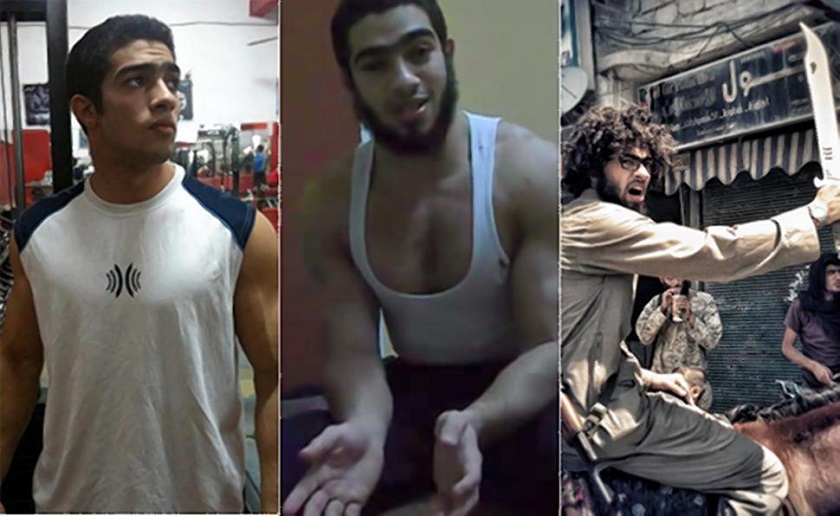
Islam Yakan, an Egyptian jihadi, not the character described in this story.
Powerful testimony from Rana Allam, about her former work colleague and fellow Tahrir demonstrator, in Daily News Egypt.
The difference between us, and it was quite minor back then, that he came from a family that believed in the Muslim Brotherhood and he was a religious young man, while I believed in a secular civil state. We never had a problem discussing such matters, and just as he was neither a hardliner nor ultra conservative, we agreed on the basis of democracy.
But then Rabaa happened.
Eventually he found his young brother, after weeks of torture at some detention facility. He could tell the torture was brutal by the marks on his brother’s face and body. They were then informed that the student was facing charges of terrorism and that his trial was due in a few days. By then, and because of the extended absence from work along with his psychological status, our friend was out of a job. He did not appear to mind the unemployment much, being too busy with his mother and sister who lost a husband/father and his tortured brother in detention facing terrorism charges.
Other troubles followed, and eventually he fled the country with his family. He is not described as in Syria, as I was expecting. But the attitude is similar.
My genius sweet colleague has become a bloody, vengeful, bitter man. He has joined the flock of those who rejoice at the murder of police officers, judges and soldiers. He is hailing the Almighty every time a death toll is announced. He is praying for God’s strength to be given to those “martyrs” dying for the cause. He goes on and on about jihad in Islam against those infidel murderers. He also calls for the heads of their supporters, from government officials to idiotic pro-army demonstrators. Right now, I do not think he minds killing his neighbour if he was a mere verbal supporter of the regime.
Early on after the fall of Morsi, many Islamists and others warned that in keeping the Brotherhood from democratic gains it would push them into violent efforts for power. I recognize the power of the logic, but have argued against it, though with troubled reservation of spirit. It is too akin to blackmail, even as many principles are violated.
But to the extent this account is an accurate description of the post-Morsi environment, the logic is different, and more unassailable. It is not the whole story of extremism, but Allam sums it up, in rhetoric surprising to appear in Egyptian media, even if in English.
Our rulers still deny this fact and continue to breed violence completely oblivious or uncaring of what that leads to. There are almost five million Brotherhood sympathisers in Egypt, given the parliamentary and presidential elections figures. The number might have decreased after the Brotherhood’s rule indeed, but how much? A few hundred thousands are enough to turn this country upside down. We should also count those who are not Brotherhood sympathisers but had their loved ones go through the same suffering. The families and friends of the tortured, murdered, unjustly imprisoned will be bitter enough to hate everyone else, and hatred is the root of evil. Does no one in this regime see that?
Life can sometimes be much less expensive in Cairo than in other cities of the world, and what better test can demonstrate this than the Oreo cookie?
Or rather, the Borio.
I am not sure about any of the legalities in this locally produced knockoff of the popular Nabisco product, but it is ubiquitous in Egypt. Many restaurants, especially those that cater to foreigners, will also offer a Borio Madness ice cream treat, or a Borio smoothie, or varieties of this sort.
But as my wife was shopping the other day she saw the Borio and the Oreo side-by-side.
The foreign Oreo costs 1.5 LE for a pack of three – the equivalent of 22 US cents.
The local Boreo costs 1 LE for a pack of six – the equivalent of 14 US cents.
By contrast, a quick internet search revealed that Walmart in the US is offering a variety 12 pack of Oreos, each containing four cookies, for $18.72, or, $1.56 each.
Anyone with a sweet tooth care to join us?
Sure, the wrapper will probably be thrown on the garbage littered streets, and there is the pesky problem of riots and occasional explosions and all, but think of it differently…
Who can turn down a Borio, especially at these prices?
Do you remember what the Egyptian revolution was like? In an op-ed on Ahram Online, Hani Shukrallah gives these poignant paragraphs in a long essay considering if Egypt is now less ‘Islamic’.
For background context, he considers the recent call to remove the veil, the emergence of television programs questioning traditional Islamic interpretation, and the renewed effort of the Azhar to assert its prerogative in all such matters. These are reactions to an old paradigm, he believes, that was dealt a blow by the revolution in a peculiar way:
The Egyptian Revolution was profoundly secular, if not secularist. After more than nearly four decades of the inexorable rise of Islamism came a popular revolution of millions that conspicuously made a point of putting religion (with all its uncomfortable impedimenta) on the backburner. Similarly to all the Arab Spring uprisings, Egyptians in motion spoke not of Sharia, rule by what God ordained or the restoration of the Caliphate. As the whole world came to know, the banner of Tahrir was freedom, democracy and social justice. They did not speak of an Islamic nation, but rather reclaimed the flag, redefining Egyptian nationhood as one arising from the fundamental human dignity of its citizens.
It went even further. As if picking up from where the previous popular revolution in their history (the revolution of 1919) had left off, the young men and women of Tahrir and elsewhere around the country took the hitherto stunted notions of citizenship and equality to new and unprecedented heights. Women, veiled or unveiled, were now fully equal to men — their bodies, which for decades had been put at the very heart of the symbolic battle over the nation’s identity, its political, social and cultural makeup, its present and future, were rendered a non-issue. The Egyptian Revolution did not debate the hijab; it ignored it — and in doing so dismantled its very basis, symbolically and practically.
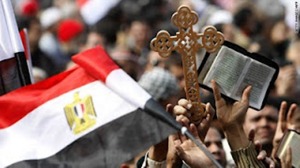
Similarly, Coptic/Muslim Brotherhood was an overriding theme of the Egyptian Revolution. Previously inconceivable images of demonstrators holding aloft the Quran and the Cross, Coptic human shields around Muslims performing their prayers, seemed to roll back, within weeks, decades of effective disenfranchisement of Egypt’s Christian minority, holding Copts hostage to the Islamist/police state contestation, with each side taking a swipe at what had become the country’s preferred whipping boy.
And herein lay a fundamental feature of the Egyptian Revolution (indeed, the whole Arab Spring), which many commentators have failed to grasp. And this is that in neither targeting nor deploying religion, it sidelined it, pushed it out of the political realm, and rendered it politically, ideologically and culturally neutral. It was not anti-Islamic or pro-Islamic; it simply was non-Islamic. Not anti-religious but non-religious.
This is the very definition of secular.
The Egyptian revolution was many things, fueled by many parties with diverse goals. But fundamentally he is right, at least in presentation. All these groups, including the religious ones, largely put forward a secular image if only for pragmatic reasons. It was not named ‘secular’, but acted so.
His is an astute observation in retrospect, however much he longs for it to have been true, or at least, to have continued truly.
Solidarity of group is good. But there are many groups in the world. Who stands with whom?
Give wisdom to the Tarabin of Sinai, who pledge to support the government in the fight against ISIS.
Give wisdom to the government, to know if and how to accept.
Give wisdom to the other tribes, to navigate this minefield.
ISIS holds no territory in Sinai, but they appear to have some freedom of movement. The role of the tribes is key, but uncertain. Do they protect or simply tolerate, or are they themselves intimidated?
The Tarabin have suffered losses at their hands, having cooperated with the state. ISIS, meanwhile, is doing what it can to exploit tribal fault lines to win support and create division.
Their solidarity seems right, but should it be armed? Theirs is a separate group, no matter how loyal.
The loyalty of other groups is being tested. The stakes are high.
Defeat the menace, God, with the support of all. As for the solidarity of government and tribes, show Egypt the best polity. Make a state of citizenship; honor an ancient code.
But there is another ‘tribe’ that operates within the field of citizenship, within the fold of the state. The Brotherhood has suffered losses, having antagonized the state.
One leader died in prison from a stroke. They accuse of lack of timely medical intervention.
A popular soccer star has assets confiscated from a business began with their partnership. He says he is independent, but where does his loyalty lie? Should the question even be asked?
The solidarity of the Brotherhood gives them great strength; it also creates networks that can be pursued. After a year in power, and a year without, many are vulnerable.
So bless them God. Reveal the innocent, convict the guilty. But help their solidarity find right relation to the state.
In Sinai or in cities, in secret cells or prison cells, give wisdom. Honor the solidarity that serves a higher cause. But meld each solidarity with the competing others, and make the state an effective, arbitrating servant.
That each one, in solidarity with all, might serve you. Make this the largest tribe.
A view shows a damaged police station burnt in a blaze by supporters of former president Mohamed Mursi in Kerdasa, a town 14 km (9 miles) from Cairo in this September 19, 2013 file photograph. REUTERS/Mohamed Abd El Ghany
Here is a recent report from Reuters, showing the difficulty in covering Egypt well. Kudos for going there, but we can only trust the journalist for his/her impressions.
The pronoun is not specified, as he/she requested anonymity. The fear, likely, is of covering anti-regime sentiment. The question is if he/she covered it well.
The brief story is that Kerdasa, Giza was the site of an Islamist take-over following the dispersal of the pro-Morsi sit-ins at Rabaa and Nahda. That day locals stormed the police station with rocket-propelled grenades, killing 12 officers. Authority was not reestablished until a month later. Since then, 185 Brotherhood supporters have been sentenced to death for their role in the violence.
The headline states: Sisi’s Crackdown on Islamists Yet to Win Over Egyptian Village.
Fair enough, as Kerdasa would be a difficult village to win over. The article reports that night raids on suspected Brotherhood members continue, and the police man checkpoints into and out of the village.
But the following first-hand anecdotal description could be found almost anywhere in Egypt:
A look around Kerdasa offers plenty of reminders that arrests and intimidation have never succeeded in silencing enemies of the state.
Idle teenagers who can be easy recruits for jihadists. Women covered from head to toe in black. Profanities scribbled on a burned-out police station insulting President Abdel Fattah al-Sisi and calling for Mursi’s return.
This is one of the troubles in reporting about Egypt — those reading don’t know the commonality of everyday life. Teenagers are idle in every city. Many women wear the full niqab. And anti-Sisi graffiti from the past year and a half has rarely been scrubbed from the walls.
None of this necessarily suggests a dissatisfaction with him, nor ongoing support for Morsi.
Good reporting gets local opinion, on the record. But still the journalist must be trusted in selection of sources. Some quotes against the current atmosphere were given anonymity, but the following are bold in their public criticism:
Ayman al-Qahawi works at Al Azhar, a center of Islamic learning seen by Sisi as an ally in the fight against extremism.
“Kerdasa has become a black spot in our lives even though there are only a small number of criminals. They treat all of us as if we are terrorists,” said the professor, adding that a colleague was not allowed to leave Egypt because his identification card showed he lives in Kerdasa.
Bus driver Sayed Hassan, 31, says that when he went to renew his vehicle license, police stopped him at a checkpoint.
“Pull over you terrorist. You are from Kerdasa. You will spend a lot of time with us,” he quoted an officer as saying.
What should be inferred from these voices? Is Kerdasa so Islamist they don’t fear to give their names, safe in the protection of village solidarity? Or that Kerdasa is in the process of being restored, and thus there is no fear to voice complaint?
Probably no inference is best, but the willingness to go on the record is a positive development.
Of course, the fear of the correspondent is still telling.
Even so, he/she did a good job of balancing opinion:
“We are sure that Mursi is oppressed and his case is political,” said student Abdel Rahman Mohamed, 22.
“The country will not calm down. The only solution is Mursi’s release and the release of the 40,000 people detained since the military coup.”
A pharmacist blamed both sides for the deterioration in Kerdasa and in his finances.
“Please don’t mention my name,” he told a Reuters reporter. “The Brotherhood are already boycotting my pharmacy because I don’t agree with their viewpoint. I don’t want to anger them even more. They are still around.”
Fear, apparently, is shared by many. It makes reporting difficult.
The police usually do not belong in the papers. The criminal should take the headlines, with the officer behind the scenes. In Egypt, sadly, this has not been true. The pendulum, hopefully, might yet reach balance.
Police abuse and corruption was a prime catalyst of the revolution. Demonized, the papers scrutinized every fault. Later, the police stood with the army and multitudes of demonstrators against Morsi. Lionized, the papers rehabilitated their reputation.
But once again the police are back in the papers. Carefully, cautiously, reports of abuse and corruption hit the front page.
Some say it is sanctioned directly from the top. To reform an institution requires public will; shaping public will requires media dissemination.
Sisi may be saying: Get your house in order.
The police chief has also been vocal: We will treat citizens humanely, we will train in human rights.
And a few police have been arrested, accused in the deaths of detainees.
God, you know the realities of how Egypt works. You know the practices inside police stations. You know the relationship between government and press. And you know the sincerity of each man’s heart.
May good laws be enforced by good men in good institutions. Reform all to the extent necessary.
Let public rhetoric shape public behavior, and curb private but official violations. Let media shaming evolve into legal accountability. Let police take pride in their performance. Let justice and rule of law characterize the social order.
And give wisdom to Egypt to know how to get there.
‘Be sure your sins will find you out,’ says the ancient wisdom. Perhaps this is the longest application on record.
But it is still incomplete, as the culprit remains hidden by the obscurity of history. Surely he is mentioned in the hieroglyphic records somewhere, but as the all-thumbs sloppy apprentice to the famed embalmer of Thebes.
From The Guardian, describing the CT scan results on a number of ancient mummies, on display in London.
There will be eight mummies in the show. Details of two were revealed yesterday. The unknown Thebes man, mummified around 600BC, is particularly interesting because of the bits of tool that were left in the poor man’s skull.
Daniel Antoine, who is responsible for the museum’s human remains collection, said embalmers had “great skill and knowledge of human anatomy”, managing to extract a brain through a hole no bigger than 2cm by 2cm.
In this case, something went wrong. The embalmer would probably have used a metal rod to break the bones at the top of the nose to then extract the brain with a wooden or perhaps reedy spatula – it is this that somehow broke and remains in the man’s skull.
So what happened? Was this poor man, who was also suffering from severely painful dental abscesses, thrown to the young student for his training? When he made his error, did he just cover it up and trust no one would notice? Did he show such contempt for the afterlife that this poor worker would live his next life with tool bits in his head?
Or does the scandal go deeper? The chief embalmer was a man of great skill, working on the finest of corpses:
Tamut lived in Thebes around 900BC and had a top job as a temple singer, or chantress, of the god Amun. Because of her high status she was given the best possible mummification. Researchers have scanned and made 3D copies of amulets that adorned her body.
They have also detected a pair of small metal plates which cover the incision that the embalmer would have made in her left abdomen to drain out her internal organs. They have on them carvings of a protective eye, presumably to help heal the wound magically.
Would such shoddy student mummification have escaped the notice of this renowned embalmer? It seems more likely there was a love triangle between Tamut, the surgical chief, and the worker with dental issues. The high executive in the mummy office maintained an affair with her, one of the notoriously loose temple singers. As one last expression of high class snobbery, he botched the operation of her jilted working-class husband and left him brain-dead in the afterlife.
Tamut, he planned, would be preserved for him forever.
That is, until his modern-day equivalent in London discovered the scandal. Ancient wisdom proves true after all.
Former president Morsi received his first prison sentence this week: Twenty years for inciting violence against protestors while in office. Afterwards his supporters took to protesting, but far fewer than once before. Even so, again, there was violence.
But by the end of the week the Brotherhood abroad reconstituted itself. And the first public statement included a seeming admission they were wrong to pursue a revolutionary path.
God, with passions divided let each pray their own way.
Further confuse the Brotherhood as it disintegrates, suffering the consequence of sins sowed over many years.
Further consolidate the Brotherhood as it reflects, recovering from sins suffered over many years.
Either way, may both pray to bless Egypt.
Either way, the Brotherhood is twisting. Twisting in the wind as prison sentences hit closer and closer to home, threatening death. Twisting in contortion to stay alive and stay united, as pressure pushes harder and harder from within and without.
And let each interpret again in turn.
Twisting the truth to fit the need. Reacting nimbly to those twisting the plot.
Either way, may all pray to bless the Brotherhood.
Bless them with wisdom, God, to reflect rightly. Bless them with courage, to act upon the truth.
Blessing friend or enemy, God, grant Egypt a righteous outcome.
Archbishop of Canterbury Rev. Justin Welby visited the Anglican All Saints Cathedral in Cairo and opened his sermon with a surprising comparison. Earlier he visited Egyptian President Abdel Fattah al-Sisi, Grand Sheikh of al-Azhar Ahmad al-Tayyeb, and Coptic Orthodox Pope Tawadros II.
“It has been an interesting and useful day,” the archbishop told the packed cathedral of his high profile itinerary, “but worshipping with you is the most important part.
“Here we meet with Jesus Christ and become his witnesses.”
Welby’s visit was to offer condolences for Egypt’s most recent witnesses, the twenty Coptic Christians and one Ghanaian martyred in Libya in February. The word ‘martyr’ is derived from a Greek word meaning ‘witness.’
Symbolically, Welby delivered to Pope Tawadros twenty-one letters written by grieving British families. One is believed to have been related to David Haines, the aid worker captured in Syria and beheaded last year.
“Why have the martyrs of Libya spoken so powerfully to the world?” Welby asked. “The way these brothers lived and died communicated that their testimony is trustworthy.”
The Most Rev. Dr. Mouneer Hanna Anis, archbishop of the Anglican diocese of Egypt, North Africa, and the Horn of Africa, hosted Welby and welcomed him warmly.
But an unfortunate symbolism coincided his visit with the release of another video from the Islamic State in Libya, this time of Ethiopian Christians. Two groups totaling twenty-eight people were martyred, one beheaded and the other shot in the head.
Welby paid tribute to them, along with others killed for their faith in Kenya and Nigeria.
He noted the certainty of their resurrection, but stated, “We must grieve for them, support their families, and seek to change the circumstances that lead to their deaths.”
Welby’s sermon did not go into specifics, but he has earlier defended military strikes against the Islamic State in Syria and Iraq, while urging local governments to exercise their mandated use of force to restore order.
And concerning the flood of refugees to the region, “Europe as a whole must stand up and do what is right,” he told the BBC, and share the burden of accepting them.
According to the UN High Commission for Refugees, over 125,000 Syrians have fled to Egypt. Refuge Egypt, a social service arm of the Anglican Church in Egypt, extends food and medical care to those the UNHCR designates as of particular concern.
Welby praised the Christians of the Middle East for their trustworthy witness. But in order to be communicated, it must be acted out.
“If the church hears the world’s cries for help, but turns its back,” he said, “they will not believe in the love of Christ.”
Visiting with President Sisi, the archbishop heard him emphasize that Egyptian Christians are not a minority, but enjoy their full rights as all other Egyptian citizens.
Visiting with Grand Sheikh Ahmed al-Tayyib, he heard that love and mercy are the two elements that must characterize both international and human relations, and that the true picture of Islam and Christianity must be presented to the world.
“When a community is full of light,” Welby said in his sermon, “people will see through it and perceive God, and know they are loved by Christ.”
During communion, he sought to demonstrate this. Aware the Coptic Orthodox and Catholic bishops present could not share in full fellowship, Welby went to them and knelt down, asking for a blessing. In response, the two reciprocated and each prayed for the other in turn.
So many are having hard times in this region, Welby said, he wanted to come and offer condolences. Finishing his sermon, hepromised the audience that he was praying for them in the Middle East, but closed with a request of his own, for the West.
“Please pray for us, that in our comfort we do not forget to be faithful witnesses.”
Too much should not be made of these markers, but they may reveal a mindset of some. Long on the defensive, Egypt’s non-Islamists feel empowered.
Among the results are a book burning at a school, seized from the Brotherhood. And a call for women to remove their head coverings, at a summer rally in Tahrir.
Give wisdom, God, for both substance and form.
The Azhar as an institution is non-Islamist, but it is also conservative, and pushing back. Subject to attacks in the media, it defends itself and traditional Islamic belief.
Egypt is still in flux, and the push and pull from various visions will take time to settle. In the meanwhile, each advocates its cause.
So how to pray? May all who invoke you in their vision pray from a pure heart. However different, may they seek the good of society. However conflicting, may liberal and conservative virtues all be honored, neither accused nor corrupting into vice.
Let books be written, and critiqued. Let heads be covered, if from faith. Let religion speak, with humility.
Let society find a way to incorporate all, amid respect. Let those who push find freedom, but failure – if they push too far.
Sort them out, God, and define the limits. Help Egypt arrive at the optimal place, with each in a mindset of peace.
IN IRAQ, ISIS zealots smash centuries-old artifacts and blow up churches. In Yemen, Shia militias plough through cities as Sunni neighbour Saudi Arabia rains down missiles.
Egypt is not without its own religious tension, but a timely interfaith art exhibition in Cairo intersects with perhaps the only potentially good news coming out of the region.
Iran may be rejoining the international community, and Iranian-born Azadeh Ghotbi is coming to London.
Born a Muslim, educated in a Catholic school and married to an atheist beside a Jewish bridesmaid, Ghotbi has lived in five countries across three continents.
Her parents fled the Islamic Revolution when she was a child.
Today,Ghotbi is one of 47 premier and emerging artists featured at the CARAVAN visual arts exhibition. Founded in Cairo in 2009, its yearly offerings travel the world, dedicated to the message of interreligious peace and cultural understanding between East and West.
‘I jumped at the opportunity to participate in this noble mission,’ Ghotbi told Lapido Media. ‘I highlight in my art that strength and beauty come through openness to the “other” and the cross-fertilisation of differences.’
Soar
[Change your viewpoint. Photo: Sixpillars.org]
Her piece is entitled Crossroads, and her message fits perfectly with the theme of the exhibition, The Bridge.
‘I have suffered the consequences of religious obtuseness,’ she wrote in her artist’s statement, ‘but have benefitted immensely among open-minded souls from diverse religious backgrounds.’
Ghotbi’s art has been exhibited in top galleries in Europe, the United Statesand Iran. The last of these has informed several pieces.
Faced straight on, the black letters of peace are hard to read behind the iron bars of a cage. But the inset of the letters is radiant turquoise, a colour she associates with the beauty of Iran, and only visible if you changeyour viewpoint.
‘As for the small fragile turquoise bird that represents hope, peace and freedom for us all,’ she explains,‘I left the cage door ajar for it!’
Ghotbi crafted Peace in 2013, eager for change.
Savvy
Two years later, Ghotbi is enthusiastic about the framework agreement signed by Iran and Western nations. As Tehran reduces its nuclear capabilities and allows comprehensive inspections, international sanctions will be gradually eliminated.
Sanctions have disproportionately hurt the poor and middle class, she said, while strengthening the political hand of the hardliners. The US Congressional Research Service reported a five percent contraction of the Iranian economy in 2013 along with a 56 percent currency devaluation and a 45 percent rise in the rate of inflation.
‘What Iran needs eventually is political change from within,’ said Ghotbi. ‘It’s youthful and highly educated population is quite savvy, but desperate for more freedom and better economic opportunities.’
‘I am very pleased about the deal going ahead,’ he told Lapido Media. ‘We have to work toward peoples coming together.
‘Opening up Iran, which it will do, allows more people to experience the “other”, on both sides.’
Indirect
An American, Chandler grew up as a minority Christian in mostly Muslim Senegal. He was deeply influenced by the local arts scene, but also disturbed by the tensions between the two faiths.
It was not until his ten years as an Episcopal priest in Cairo’s historic St. John’s Church that a vision began to form. Initially, CARAVAN was held only in Egypt, but over the past two years more than 300,000 have viewed the traveling exhibition in London, New York, and Washington, DC.
This year, The Bridge opened at the oldest church in Paris, the Eglise Saint Germain-Des-Pres, during the United Nations week for interfaith harmony. Following its current station in Cairo it will move to St Martin-in-the-Fields, Trafalgar Square from June 1 – July 31.
But CARAVAN is not intended only for the Western elite, as important as it is for them to see this example of cooperation between Arabs, Persians, Muslims, Christians, and Jews. The exhibition will travel also to rural areas in the United States, where misunderstanding of the Middle East is prevalent.
‘Art provides a context to address issues indirectly,’ Chandler told Lapido Media. ‘ It provides an atmosphere of contemplation and discussion that is neutral, when being direct causes tensions to rise.’
And in the Middle East, where spin-off projects are in development in Jordan, Tunisia, and Malta, the indirect approach of art can make all the difference.
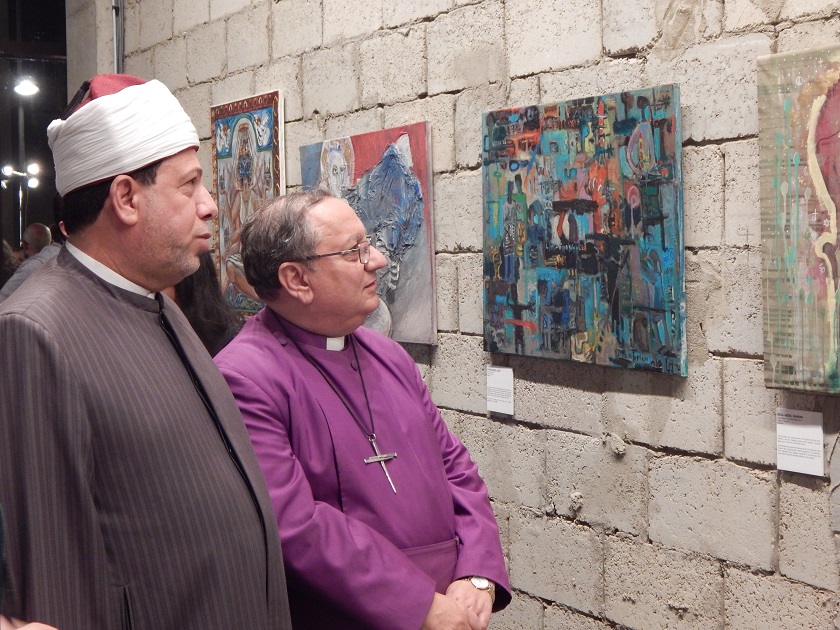
Sheikh Abdel Aziz of the Azhar and Bishop Mouneer of the Anglican Church, observing the CARAVAN artwork.
According to Bishop Mouneer Hanna Anis, archbishop of the Anglican diocese of Egypt, structured efforts at dialogue between religious professionals have not impacted reality.
‘We have to be creative so that dialogue reaches the people,’ he said at the exhibition opening in Cairo. ‘Paul-Gordon has done this through art, to help build harmony between cultures, and to bring people together.’
The Middle East needs CARAVAN, Ghotbi believes, but art is not enough.
Education, jobs, and women’s rights are necessary to ease religious clashes between groups that used to coexist peacefully.
Chandler agrees, noting that transformation through art is a long term process.
‘Art doesn’t stop conflict, but that is not its function,’ he said. ‘It can’t change events but it can change people.’
However much the Middle East needs this message, it can also export the example. 47 artists are living testimony.
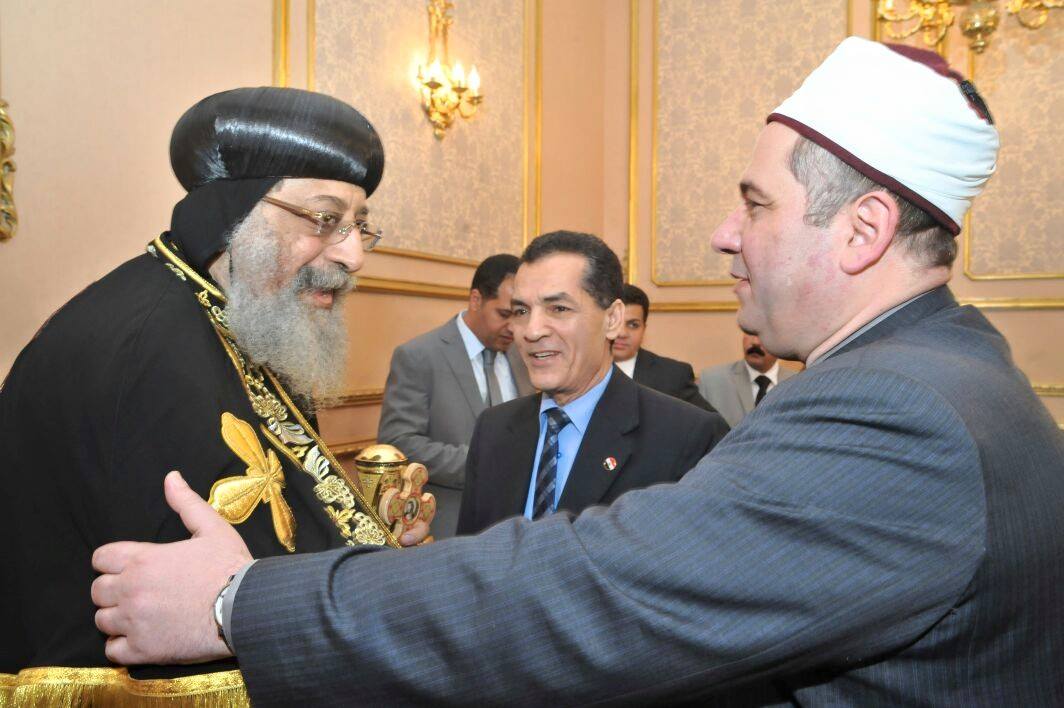
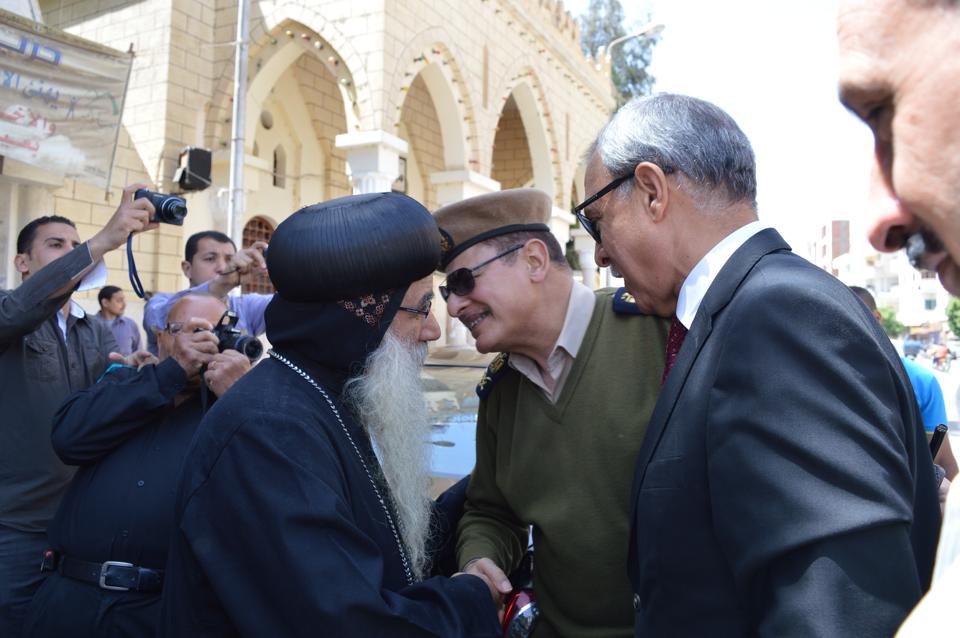
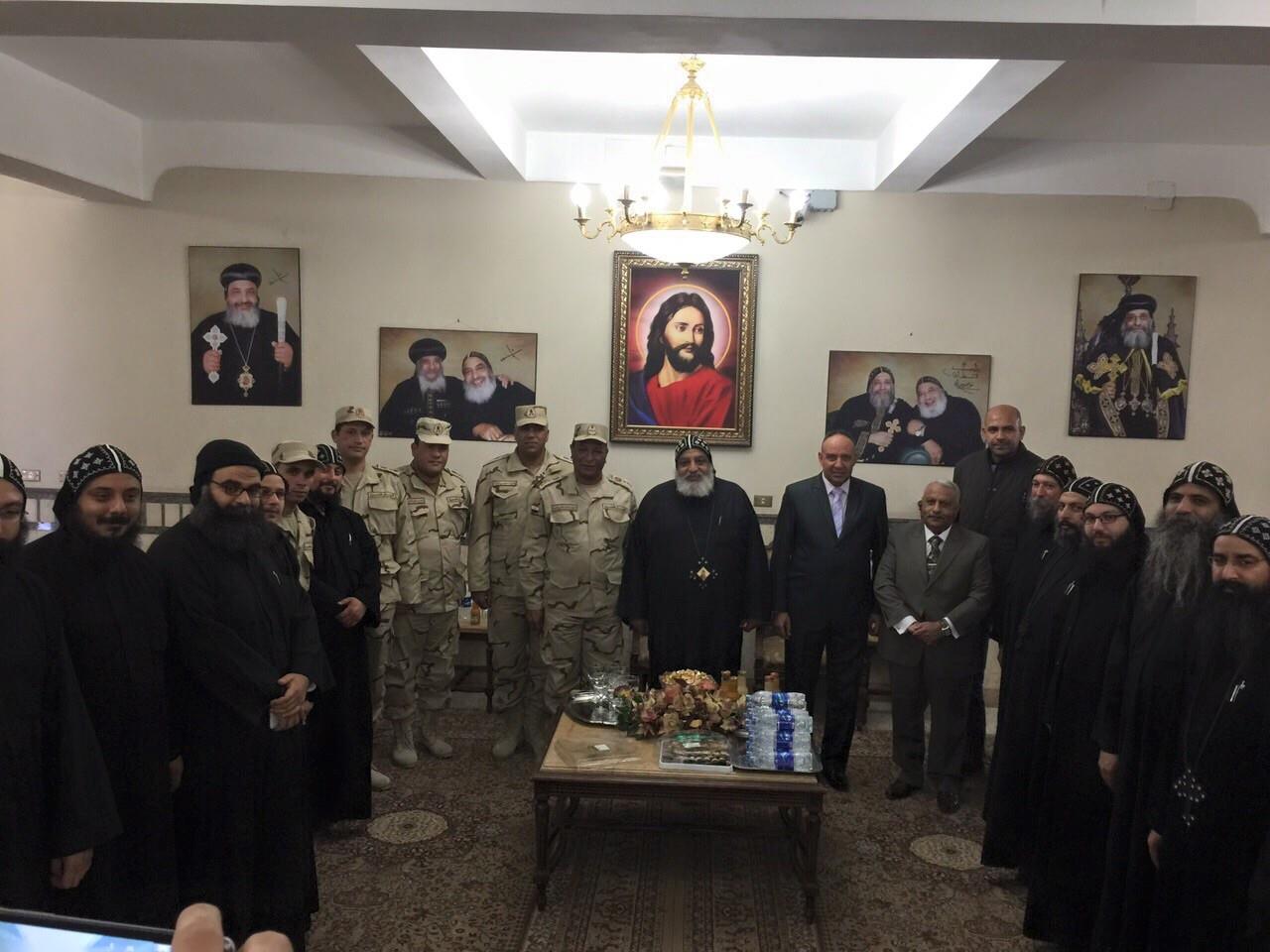
The following pictures show a lot of handshakes, but the message should not be lost in the repetition. Government officials, most of them Muslim, congratulate Copts for their holiday celebrating the resurrection of Jesus.
Similar pictures could be seen on Christmas, but Easter is a far bigger deal. In Egypt, Christmas is an official holiday, and there is no Muslim religious objection to the birth of the Messiah. Muslims agree with Christians that Jesus was born of the Virgin Mary, and though they object to the interpretation of incarnation, there are few reasons not to celebrate a common prophet.
Easter is different. In Islam, Jesus die not die on the cross so therefore he cannot have been raised again. There are real theological barriers, and less if any common ground. Some conservative Muslims are vocal about the inadmissibility of congratulating Christians on their holidays, but especially Easter.
The Muslim governmental and religious officials of the current Egyptian regime do not agree. Certainly they would not share the spiritual meaning of Easter, but they are keen to demonstrate congratulations to Copts in recognition of the importance of their holiday.
In these contested times in the Middle East, a handshake communicates much.
(More reflection to follow after the pictures)
Prime Minister Ibrahim MehlabShiekh Mohamed Abu Hashim, representing the AzharSheikh Mohamed Gamia, representing the Egyptian Family HouseAmr Moussa, head of the constitutional committee and former head of the Arab LeagueNabil al-Arabi, head of the Arab LeagueLabor Minister Nahed al-AshariPlanning Minister Ashraf al-ArabiCulture Minister Abd al-Wahid al-Nabawi
Easter greetings were also extended in the governorates.
Bishop Thomas of Qusia received Asyut governor Yassir al-DesoukiBishop Kyrillos of Nag Hamadi received Sohag governor Gen. Abd al-Hamid al-HeganBishop Bisada of Akhmim received Sohag governor Ayman Abd al-MunamBishop Maqar of Sharqia received Sharqia governor Rida Abd al-SalamA military designation visited the St. Mina Monastery outside Alexandria
Just as at Christmas great importance was given to the visit of President Sisi to the papal mass, the first ever honor bestowed by an Egyptian president, perhaps meaning should also be taken from his absence at Easter services.
Religious relations remain tricky in Egypt, and the president may not have wanted to alienate conservative Muslims with such a symbolic endorsement. But his government was not shy to risk it.
America is a secular state; Egypt is less so. When President Obama frequents a Muslim Iftar, it is an honorable recognition of the place of Islam within a nation that constitutionally guarantees the non-establishment of a religion and the freedom of all.
In Egypt it is a bit different, for Islam is the state religion and its law is the source of legislation. While the constitution guarantees freedom of religion, Islam retains a priority of place in interpretation.
The gesture in Cairo, then, is weightier than that offered in Washington. It is greater still in the more conservative governorates. It is not just that Copts have freedom, it is that as a government we honor even their Islam-challenging Easter holiday.
Of course the reality is not yet complete, and a cynic is excused if he accuses the government of insincerity. It is the practical demonstration of executive enforcement of law that speaks far louder than a handshake, and in this many parts of Egypt are still lacking.
But a handshake still speaks, and it speaks in relationship. Far more handshakes are needed, but let the message resonate.
Last summer the body of Hisham Rizk turned up in a Cairo morgue. The 19 year old graffiti activist had been missing for a week, and the official autopsy labeled him as having drowned in the Nile River.
No further information was given on the English language Ahram Online. But withholding comment only fuels speculation – rampant among many revolutionary activists – that the security apparatus is coming after them. Orchestrated to begin on Police Day, the January 25 revolution humiliated them but now is the time for payback. So goes the theory.
Rizk was a member of the Mohamed Mahmoud Street Graffiti Union, whose images are among the few to remain prominently displayed in Cairo. They are at the site of terribleclashes in November 2011, between protestors and police on a side-street off Tahrir. They contributed also to the rift between revolutionaries and the Muslim Brotherhood, who did not participate in defense of the square.
The Brotherhood has since suffered its own terrible losses at the hand of police. Though these groups share a common enemy, there is little sympathy offered. During their year in power the Brotherhood marred revolutionary icons and dismissed the ongoing struggle with the military and security apparatus, with whom these activists say they readily accommodated.
News of Rizk’s death reminded me of my last visit to Mohamed Mahmoud Street, several weeks earlier. President Sisi was not yet elected, though his victory seemed inevitable. An interview subject postponed our meeting two hours, so I had lunch in McDonalds facing the ubiquitous graffiti.
To pass the time I alternated between reflecting on the images and reading ‘A Theology of Liberation,’ tucked away in by bag to read on the metro. It was written by Gustavo Gutiérrez, the Latin American priest who demanded that Christianity pursue justice for the poor, as reflected in the character of God. For Gutiérrez, the cross of Christ represented the total involvement of God in the suffering of mankind. As such, Jesus identified with all victims, and his resurrection presages their own, toward which his followers must strive.
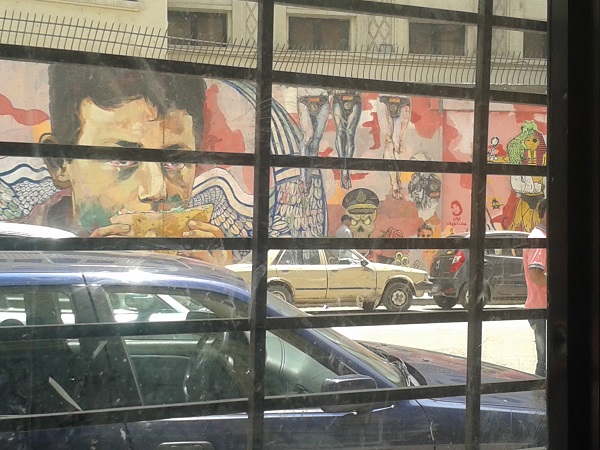
Consider then the following picture, as seen behind the bars of McDonalds, while eating French fries and a cheeseburger from the Egyptian equivalent of the dollar menu:
Here is the image in question:
The three crucified pairs of legs are covered by a belt bearing the name ‘Central Security,’ the revolutionary activists’ archenemy. What is not clear to me is what the symbolism means. Are these the victims of police, mocked and tagged with state insignia? Or have the police themselves been stripped, hung, and crucified? Does the image commemorate, or anticipate?
If the former, it is a remarkable statement of the power of Christian imagery within a revolutionary struggle of Muslim majority. Islam rejects the cross of Christ, believing instead God saved Jesus from the humiliation of crucifixion at the hands of his enemies. But the clashes and aftermath of Mohamed Mahmoud represent a losing moment for these activists. To depict their suffering they drew a cross.
To my knowledge there is no revolutionary graffiti of an empty tomb. They can hardly be blamed; they have had no victory. Initially pleased with the military removal of the Muslim Brotherhood, many now see in President Sisi the restoration of the security state. But some Christian revolutionaries have spoken of how they comforted their Muslim colleagues with tales of Jesus. Struggle involves suffering, they said, and perhaps even death. But victory comes as God resurrects.
This is how most non-revolutionary Egyptian Christians view the emergence of President Sisi. They, with millions of Muslims beside, project upon him the image of savior. He is the answer to their prayers, the remover of the Muslim Brotherhood.
And now it is the Brotherhood which is now being crucified, though this particular image is not found on Mohamed Mahmoud Street. Their opponents might cite a different Biblical parallel in the story of Esther. Following the failure of his plot to exterminate the Jews, Haman was hanged on the gallows he prepared for Mordecai.
Instead, the graffiti interpretation is possible that it is security which receives its comeuppance. A triumphant revolutionary movement finally secures the reins of power and holds the police accountable for its crimes. Their execution is in order. Perhaps the picture draws on Islamic imagery: Crucifixion is among the punishments commanded for those who sow discord in the land.
Liberation theology anticipates such a grand reversal. Salvation is not simply from personal sin, but from the corruption of society which binds the poor in their place. Certain strands of this theology call for participation in the necessarily violent struggle to overthrow the powers-that-be.
Certainly those who fear God should be involved in the pursuit of justice. The question is how best to interpret justice, and where on the spectrum of participation a red line should be drawn.
But the alternate interpretations of the graffiti – whether identifying the Brotherhood or the security on the cross – should not be tolerated. Neither is consistent with the Jesus who cried out, ‘Father forgive them,’ according to the Biblical account. Jesus intended his crucifiers also to be beneficiaries of the liberation he offered.
For according to Christian theology, his crucifixion was the wisdom of God to put right the universe. This is not the case for Hisham Rizk, even if he drowned a martyr. It is not the case for any of the revolutionaries who have died for their cause. They represent a tragedy, a reminder of a world not yet put right. Whether one fights nobly, foolishly, or not at all, death is still the reality for everyone amid extensive injustice.
But to put it right, God expects his followers to work for justice in the face of death, unafraid. Such is the glory of a martyr, who will receive God’s compensation in reward of uncompromising faith. Many revolutionaries have been motivated by this promise.
The hope of liberation theology is that the promise is greater still. It is that through crucifixion resurrection comes. This is certainly true of personal Christian theology. It is only through death to self and identification with Christ on the cross that God’s life can inhabit an individual, in this world and the next. But is it true for society as well?
Here, liberation theology appears to be of two minds. For one, the answer is yes: We struggle on behalf of the poor and oppressed and whether or not we die, we await God who will put right all things through our sacrifices.
For another, the answer is no: It is obvious our idealistic struggles fail, so we must in a sense crucify the other and wrest power from him. Then we can put right all things in view of what God has commanded.
The first is of faith, perhaps naïve. The second is of pragmatism, perhaps ungodly. Where in this analysis is Egypt?
Perhaps Sisi has put all things right. Perhaps he is struggling to do so. Perhaps he only pretends, putting all things wrong.
Let each Egyptian judge, mindful of the following: Faith must be lived in the world, but the ways of the world must not sideline the convictions of faith. Countenance no manipulation, and avoid no crucifixion.
Securing the first assures God’s blessing; enduring the second enables God’s liberation. Such is the hope of faith.
Even as I type I am filled with dread should such hope prove empty. If Hisham Rizk died an inopportune death, where is the liberation to follow? Is it found in his enduring images on Mohamed Mahmoud Street? Is there some collective cosmic tally to which he contributes?
Perhaps. Paul wrote that his sufferings filled up what was lacking in the suffering of Christ. Jesus said his followers would do even greater works than himself. An earlier prophet summed up all requirements: Do justly, love mercy, walk humbly.
The world will not be put right until God puts it right. But God desires us to put it right in the meanwhile, flawed and incomplete our efforts will inevitably be.
Wherever Egypt is along the path of progress, she has not yet arrived. Blessings to all Egyptians who seek to move her forward.
The public statements coming out of Egypt are positive. Help the public reform to follow.
You know what is needed, God, but officials surely have an idea as well. The housing minister announced efforts to eliminate slums within a year. The interior minister called on citizens to report police abuse. And following visits by the National Council of Human Rights, the prison system will be subject to random and ongoing investigations.
Words are good, though deeds are better. Similar words have been spoken before. That they are spoken again puts confidence on hold.
So let confidence be earned, God. Place Egyptians in solid dwellings. Hold police to the highest standard. Respect criminals despite their crimes. And honor officials who honor your will.
Apply this will to the nation at large, God. In Upper Egypt the law is weak. In Alexandria the buildings collapse. Everywhere the poor exist.
And as Egypt follows up on its economic conference, create a context to facilitate investment, curb corruption, and distribute wealth.
Hope is high, God, and words are many. But reform is always difficult. Humans flee accountability and hide their faults.
Be gentle, but shine your light. Be merciful, but root out the wrong.
Stand with those who have declared reform, God. Strengthen their hand and firm their resolve. May they work with integrity to fight the status quo.
Make the benefit public, for all to enjoy. Bless Egypt and help her prosper.
 Sheikh Saeed Ibrahim was very keen to see my parents. He canceled an appointment to meet them, making sure the opportunity was not missed before they returned to America.










 Jayson Casper