Evangelicals in Jordan have a new leader. They just don’t have anything official for him to lead yet.
Five denominations, including Baptists, Assemblies of God, Evangelical Free, Nazarene, and Christian and Missionary Alliance (CMA) churches, met a month ago to elect Habes Nimat as president of the Jordanian Evangelical Council. They comprise 57 churches total.
“I would like to believe that they chose me because I am a team player,” said Nimat, who has led a CMA congregation in the capital city of Amman since 2017. “I have good relations with the evangelical society, the local society, and they know my work with Christians of all denominations.”
Established in 2006, the council is the fruit of nearly 100 years of evangelical outreach in Jordan. Numbering roughly 10,000 individuals, evangelicals remain a small minority among the 2.2 percent of Christians in Jordan’s overall population of 10 million, almost exclusively Sunni Muslims.
Nimat will need to rely on these good relations to achieve the most pressing evangelical concern—legal recognition of the council as an official Christian denomination.
Jordan currently recognizes 11 Christian denominations: Greek Orthodox, Roman Catholic, Armenian Orthodox, Melkite Catholic, Anglican, Maronite Catholic, Lutheran, Syrian Orthodox, Seventh-day Adventist, United Pentecostal, and Coptic.
They are organized into the official Council of Church Leaders (CCL), which functions as a government advisory body. The prime minister will confer with the CCL on whether or not to admit new representation.
“We have been working on registration for many years as one body,” said Nimat, “but so far, we have not heard an answer from them, neither positive nor negative.”
Representation on the CCL entitles the denomination to…
Please click here to read the full article at Christianity Today.
Smoke rises over the Syrian town of Tel Abyad, as seen from the Turkish border town of Akcakale in Sanliurfa province, Turkey, October 10, 2019. REUTERS/Murad Sezer
Three Christians have been killed in Turkey’s assault on Kurdish-held areas in northeast Syria, reported In Defense of Christians (IDC), citing their sources on the ground.
In Qamishli, a Syriac Christian and his wife died, while in Ras al-Ain an additional Syriac Christian civilian was killed. Ten civilians were injured in the attacks.
“People were so scared, they were telling me, ‘They are bombing us right now!’” Bassam Ishak, president of the Syriac National Council of Syria, told NPR. “We think this is a message to the Kurds and Christians there to leave, so Turkey can move refugees there. We think it’s a form of ethnic cleansing.”
The Turkish operation focused initially on a 60-mile stretch of land between the two Arab-majority cities of Ras al-Ain and Tel Abyad, a sparsely populated area known as Syria’s breadbasket, reported BBC. IDC, which advocates for Christians and other religious minorities in the Middle East, said that this area has large concentrations of Christians.
In total seven civilians were killed, including two children, reported Channel 4. Retaliatory Kurdish mortar fire into Turkey killed…
Please click here to read the full article at Christianity Today.
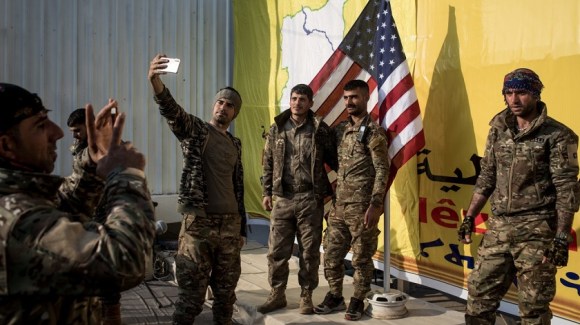
Image: Chris McGrath / Getty Images; The Kurdish-led and American-backed Syrian Defense Forces (SDF) announced the defeat of the Islamic State in at a ceremony in Baghouz in March.
Not long after the defeat of the Islamic State in the area, Syrian Christians warn that US military withdrawal from the Kurdish-controlled region, announced yesterday by President Donald Trump, will expose them to danger.
“The expected military invasion [by Turkey] and the possible confrontation with the Kurds might oblige Christians of the region to leave,” said Joseph Kassab, president of the Supreme Council of the Evangelical Community in Syria and Lebanon. “This means one more tragedy to the Christian presence in Syria.”
Seeking to honor his campaign promises to extract America from “endless war,” Trump yielded to Turkey’s demand to establish a “safe zone” along its southern border with Syria. Since August, the United States and Turkey administered a joint buffer zone patrol in the Kurdish-majority area.
Turkey’s objectives are two-fold. First, to resettle up to 2 million Syrian refugees currently residing in Turkey. Second, to clear the border of Kurdish fighters linked to the Kurdistan Workers Party (PKK), deemed a terrorist entity by both Ankara and Washington. Turkey’s President Recep Tayyip Erdogan had threatened to establish a 20-mile corridor unilaterally, frustrated by US cooperation with Kurdish fighters belonging to the PKK.
The Kurdish-controlled area of northeast Syria stretches 300 miles from the Euphrates River to the Iraqi border. Approximately 750,000 people live there, including estimates of between 40,000 and 100,000 Christians.
Over 700,000 Christians have fled Syria since 2011. And while some warn of further displacement, others fear a greater threat.
“Turkey aims to kill and destroy us and to finish the genocide against our people,” said a statement issued by…
Please click here to read the full article at Christianity Today.
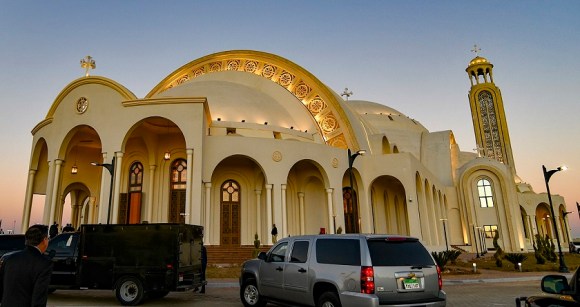
U.S. Secretary of State Michael R. Pompeo visits the Cathedral of the Nativity in Cairo, Egypt, on January 10, 2019. [State Department photo/Public Domain]This article was first published in the Summer 2019 print edition of Light magazine, produced by the Ethics and Religious Liberty Commission.
In January, President Abdel Fattah al-Sisi of Egypt stood side-by-side with Pope Tawadros II, patriarch of the Coptic Orthodox Church. Inaugurating the Cathedral of Nativity, the largest church in the Middle East, he uttered two remarkable words that reverberated through the national broadcast to Muslim homes throughout the nation.
“Merry Christmas.”
If some Christians find this phrase under siege in America, they have no idea the power unleashed by the president’s words. Eight years earlier, emboldened by the Arab Spring and empowered by the Muslim Brotherhood presidency of Mohamed Morsi, ultra-conservative Salafi Muslims sparked nationwide controversy by declaring no pious Muslim could utter the words.
Their point was theological—Christmas celebrates God becoming man in Jesus, and a Muslim cannot congratulate a Christian neighbor for such blasphemy. But the impact was social. Easygoing Egyptians had long wished each other good greetings on respective religious feasts. Salafis are better practicing Muslims than we are, many would admit, and a chill began to spread in community relations.
When then-defense minister Sisi overthrew Morsi following widespread protests against his rule, he did so with Pope Tawadros—and the head of al-Azhar, the leading Islamic institution in Egypt—standing nearby in support. As president he became the first to attend a Christmas mass, a practice he has continued. He speaks strongly about the rights of Christians and their place in the nation. And in building a new capital city he made sure the centerpiece landmarks would be the region’s largest mosque and church, built side-by-side. There is no Merry Christmas controversy today.
But do Sisi’s words fall on deaf ears? Are the arms of the state too weak? Or might he be of double mind, grandiloquent in gesture, apathetic in implementation? Two other church examples counterbalance the cathedral…
Please click here to download the print edition; my article is on page 54.
Annunciation, from Chronology of Ancient Nations by Al-Biruni, 1307.
This article was published in the July/August print edition of Christianity Today.
Mohammed, a pious PhD student from Egypt, sat guardedly in the “Community of Reconciliation.” Invited by David Vidmar, director of coaching for Peace Catalysts International, the middle-aged Muslim seemed soured on the idea of interfaith exchange at his northern California university.
Vidmar suspected Mohammed came to the jointly led Muslim-Christian dinners because he felt obligated to do da’wah, the Arabic word for spreading Islam. But over a shared meal and discussion about Mary, the Egyptian’s attitude shifted. “The deeper we got into the life of Mary and how Christians understand the virgin birth of Jesus, he became very enthused,” Vidmar said. “There are so many misunderstandings . . . it was wonderful to observe him see the similarities and be able to relax.”
Peace Catalysts is a Jesus-centered peacemaking effort, focused primarily on Christians and Muslims. Vidmar and his family worked for eight years with Uighurs in Kazakhstan and still wish Muslims would experience the love and forgiveness God reveals through Jesus. But now he works to help both sides experience heart transformation through deep and genuine friendship—and Mary proved a fruitful bridge.
“Since so many Muslims use the term ‘Jesus, Son of Mary,’ it would be helpful for evangelicals to think more deeply about this,” Vidmar said. “Muslims often excitedly tell me their favorite chapter in the Qur’an is Maryam, and women especially express appreciation for it.”
Mary is mentioned 34 times in the Qur’an—more than in the New Testament—and its only named woman. Islam upholds the virgin birth, the annunciation by Gabriel, and—mirroring the Ave Maria in Luke’s gospel—declares Mary to be “exalted above all women.”
Yet even Catholics have been slow to recognize the similarities…
Please click here to read the full article at Christianity Today.
This article was first published in the May print edition of Christianity Today.
Among Christians in America, Israel can be viewed as a fulfillment of prophecy, a democratic ally in a region of chaos, or an occupier oppressing stateless Palestinians. How to choose?
Given that 2 out of 3 US evangelicals have a positive perception of Israel, according to LifeWay Research, perhaps a better question is: How should evangelicals identify with the issues Israel faces?
Fortunately, there is a useful interpreter. “If the Christian community wants to understand Israel from a believing perspective,” said Jamie Cowen, an Israeli lawyer and a believer in Jesus, “going through Messianic Jews is best.”
However, the complexity of Israel divides even Messianic Jews in attitude toward Palestine, as illustrated by debate this year over an interview provocatively summarized as supporting ethnic cleansing.
“The only rights the Palestinians have are squatter’s rights,” Paul Liberman, executive director of the Alliance for Israel Advocacy (AIA), told The Intercept.
He described how the lobbying arm of the Messianic Jewish Alliance of America (MJAA) was pushing for a shift of US funding from UN–administered Palestinian aid ($364 million in 2017) to an Israeli-led effort offering money to relocate from the West Bank. The goal: eventual annexation of the territory in a one-state solution with fewer Palestinian citizens, maintaining Israel as a Jewish state.
First adopted by the MJAA in 2015, the idea reverberated within Messianic Jewish circles once TheIntercept highlighted efforts to harness evangelical influence in Congress and the White House.
“It is not a removal. It is an opportunity for a much better life,” said Joel Chernoff, CEO of the MJAA. “But the demographic issue is real.”
About 700,000 Jews and 1.5 million Arabs live in Judea and Samaria—the favored name in Israel for the West Bank. Chernoff desires more Jewish settlements there. And he believes many Palestinians already want to escape the territory’s corrupt Palestinian Authority. (A 2017 MJAA poll found half of residents were discussing a move abroad and were open to resettlement in exchange for about $5,000.)
The “ethnic cleansing” headline was a smear tactic by liberal and anti-Israel media, Chernoff said. The issue is not controversial among the MJAA’s 3,000 dues-paying members, 12,000 supporters, or 155 affiliated synagogues. But it is controversial to other Messianic Jews.
“There is not a consensus this is a good proposal,” said Monique Brumbach, executive director of the 75-member Union of Messianic Jewish Congregations (UMJC). “The Scriptures promised the land to the Jewish people. But there will always be other people within it.”
Nearly all Messianic Jews believe modern-day Israel is the fulfillment of biblical promises…
Please click here to read the full article at Christianity Today.
This article was first published in the April print edition of Christianity Today.
The students at Wheaton College were surprised: Wait, Saint Augustine was African?
Shown the international award-winning Augustine: Son of Her Tears for a freshman seminar that reads his Confessions, they witnessed history brought to life beyond the text, said Sarah Miglio, dean of curriculum.
So did the Muslim actors who depicted the story of the Christian theologian. The cast and creators now want to remind the world—and especially their own people in North Africa—that the church father properly belongs to their heritage.
“The West is more acquainted with Augustine than we are in North Africa,” said Aicha Ben Ahmed, the Tunisian actress who played Monica, Augustine’s long-suffering mother. “We have a wine named after him here, and it is better known than the saint.”
The leading actor, Ahmed Amin Ben Saad, was similarly affected. “Saint Augustine is…
Please click here to read the full article at Christianity Today.
This article was originally published at Christianity Today, on April 18.
…early signs are promising. On April 10, one day before Bashir’s arrest, the Sudanese Professionals Association (SPA) leading protests put out a call for Christian participation, acknowledging “you have suffered sectarian and psychological restrictions for years … [which have left you] without the right to worship freely.”
Shortly thereafter the SPA declared “Christ is the heart of the revolution,” and cited “blessed are the peacemakers.”
On April 14, Sudanese Christians responded.
Leaders from the Evangelical Presbyterian, Baptist, and Church of Christ denominations in Sudan appeared at a sit-in at military headquarters, offering hymns sung by both Christians and Muslims.
“This is a time to move away from the trenches of religious and ethnic discrimination and head towards an inclusive and unifying Sudanese national identity for all of us,” said Rafaat Masaad, head of the Evangelical Synods in Sudan.
“We must make a covenant that we will not withdraw or accept anything less than a new Sudan ruled by humanity and citizenship.”
Sudan, however, is not the only version of Arab Spring, Part Two. The military in Algeria removed their aged president on April 2 following widespread protests that began in February. The wheel-chair bound 82-year-old President Abdelaziz Bouteflika was attempting to secure his fifth term in office.
Unlike Bashir, Bouteflika was a beloved figure. A popular politician in his youth, he fell out of favor but returned in 1999 to put an end to the decade-long civil war that began when the military nixed an Islamist election victory that eventually killed up to 200,000 people.
A secularist of sorts, Bouteflika was an autocrat who allowed limited Islamist space of action. An Algerian Muslim Brotherhood figure was among the tentative opposition candidates against Bouteflika’s fifth-term ambitions. But al-Qaeda called from the outside for protests to impose an Islamic state, declaring Bouteflika was a friend of Christians and Jews.
The World Christian Database counts Christians as only 0.3 percent of the population, while Open Doors ranks Algeria No. 22 in its watch list, though one year earlier it ranked No. 42.
The Algerian Protestant Church, consisting mainly of former Muslims, and known by its French acronym EPA, was registered officially in 2011. But in practice it faces many restrictions, with houses of worship liable to be shut down.
“Since the beginning of the year, all the churches have begun to pray and fast for the elections,” said an unidentified Algerian Open Doors source, knowing the results are “unpredictable” but aiming for better legal standing.
“We hope that the Lord intervenes in our country.”
But on March 22, with the protests fully engaged, the EPA put out an official statement.
“We Algerian Christians, as equal Algerian citizens, fully share the aspirations and the legitimate demands of the Algerian people in their peaceful fight for a modern and democratic Republic,” it declared, “where the fundamental rights of the citizen will be respected and protected, no matter what their political and religious convictions may be.”
Will they receive their wish? Will Sudan? …
Please click here to read the full article at Christianity Today, with links to the supporting publications.
This article was first published at Christianity Today on April 11, 2019.
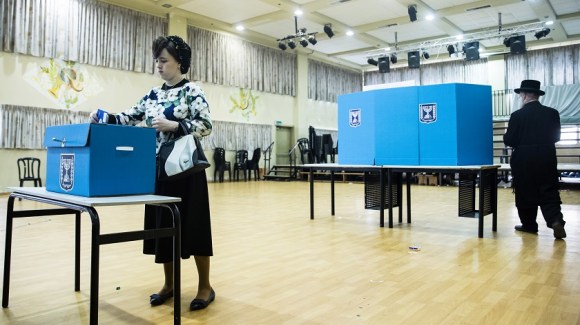
In one of the most tightly contested Israeli elections in years, Benjamin Netanyahu appears poised to remain prime minister.
His Likud party is projected to win 35 seats in the 120-member parliament, the Knesset, tied with challenger Benny Gantz’s Blue and White party; but coalition partners will likely boost the incumbent Bibi to a governing majority of 65.
But for Christians in Israel, could the most significant electoral development have come from a new party that won a total of zero seats?
“We are the only party to give Christian and Messianic candidates parity in the candidates’ list,” said Avi Lipkin, the Orthodox Jewish head of the Bible Bloc Party, known as Gush Hatankhi in Hebrew.
“For the first time in 2,000 years, Jews and Christians are … brethren and allies.”
In Israel’s proportional system, a party must claim at least 3.25 percent of the nearly 6.4 million eligible voters—so roughly 200,000 votes total—in order to enter parliament.
The Bible Bloc only won 367.
The significance lies in their getting started. As a new party, Lipkin explains they had limited time to build a base. To legalize a party, 100 members are needed. The Bible Bloc recruited 150: roughly half Jewish and half Christian, as reflected in their candidate list.
Heading the list was…
Please click here to read the full article at Christianity Today.
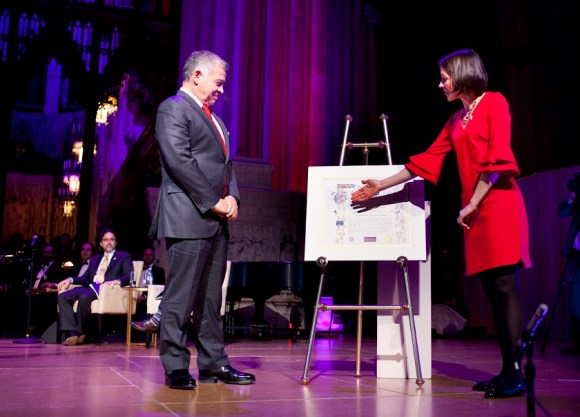
Heather Templeton Dill, president of the John Templeton Foundation, presents the Templeton Prize “Tree of Life” medallion to His Majesty King Abdullah II of Jordan, at the Templeton Prize Ceremony, Washington National Cathedral, November 13, 2018. (Photo credit: Templeton Prize-Clifford Shirley)
The pastor of the Amman International Church in Jordan had a problem.
Suspected intelligence agents were coming to church, asking questions, and attending Bible studies. His youth pastor was detained at the Israeli-Jordan border and denied reentry. Members of his church, some who had lived for years in Jordan, were suddenly denied visas.
“Politically speaking, we were the best protected church—half of our congregation were military or foreign service,” said Greg Griesemer, pastor since 2012.
“But after testing the waters with us, the government went more aggressively against the Jordanian evangelical churches.”
Griesemer eventually had to leave the country also, informed that the government had an alleged file accusing him of proselytizing Muslims. But he believed the government was checking to see if anyone would stand up for evangelicals in general, as the Vatican would do for Catholics. Unlike the historic churches of Jordan, evangelicals are not represented in the official national council of churches.
Despite a congregation filled with American citizens, appeals to the US embassy went nowhere, he said. And then quite unexpectedly, in came the cavalry.
Completely unrelated to local developments in Jordan, popular Christian author Joel Rosenberg had been developing a warm relationship with Jordan’s King Abdullah. An evangelical of Jewish background, Rosenberg writes political thrillers about the end times, weaving current events into a Biblical narrative of apocalyptic prophecy.
In one bestseller, the king and the Hashemite Kingdom were targets of a series of ISIS terrorist attacks. After reading the novel, Abdullah invited Rosenberg and his wife to Jordan for a five-day visit, and a friendship emerged. Later and at the king’s invitation, in November 2017 Rosenberg led a delegation of American evangelical leaders to see Jordan firsthand.
But not just any leaders. They included several who were politically connected, including close advisors to President Donald Trump. The group featured Tony Perkins, president of the Family Research Council, Jim Garlow, former senior pastor of Skyline Church in San Diego, who moved to Washington to minister to politicians, and Michele Bachmann, a former congresswoman from Minnesota, in addition to others.
Jordan was not their only priority. In the past 18 months Rosenberg also led the group to visit Egypt, the United Arab Emirates, and Saudi Arabia. Coming again with official invitations, he wished to forge better ties between evangelical Christians and Middle East governments and peoples. A key priority has been to support Christian minorities, who often feel under pressure in society, if not persecuted by Muslims of extremist ideology.
Also invited to participate was Mike Evans, leader of the Jerusalem Prayer Team and founder of the Friends of Zion Heritage Center, in Israel. A self-proclaimed Christian Zionist, he and several members of the delegation were well-known for their strong support of Israel.
Their reputation preceded them in Jordan, and some local evangelical leaders turned down invitations to meet. Though Jordan maintains a peace treaty with Israel, popular sentiment is strongly in favor of the Palestinians. They did not want to be associated with an ideology that would strain relations not only with Muslims, but also traditional Christian church leaders.
But Rosenberg’s delegation did come at the invitation of King Abdullah, and they had already met with several senior government officials, including the foreign minister and the chairman of Jordan’s joint chiefs of staff. Nearly 40 evangelical leaders and pastors did agree to sit down, representing many of the major denominations and ministries in Jordan. They included Emad Maayah, president of the Jordan Evangelical Council, and Imad Shehadeh, president of the Jordan Evangelical Theological Seminary, and they shared their perspectives and prayer requests in an off-the-record dialogue.
The pastors conveyed a deep sense of respect toward the king and appreciation for the freedom Jordan gives them and all Christians in the country. Some spoke reluctantly of issues they were facing, and Griesemer was also present to share his story. Notes were taken, discussed, and agreed to be shared tactfully with King Abdullah.
Mike Evans, a journalist by profession, took particular interest. During the delegation’s working lunch at the palace with the king later that day to conclude their visit, he spoke up first to relay the issues discussed. Others followed.
Photos were agreed upon, and a simple press release was issued by both palace and delegation.
In later, follow-up discussions with the palace Evans would mention a Jordanian pastor who was having his ministries shut down by the government, and how evangelical churches were losing the ability to offer volunteer visas to foreign staff.
Abdullah expressed surprise, that he had never heard of these troubles, and in front of the group assigned one of his closest advisors to look into it.
“Everyone was very encouraged,” Evans said. “I went back to the Jordanian believers, and told them I have good news.”
Such a response was fitting with the reputation of the king. Last year in November he was awarded the prestigious, $1.4 million Templeton Prize, celebrating exceptional contributions to “affirming life’s spiritual dimension.” First given to Mother Teresa, previous winners range from Billy Graham to the Dalai Lama. Abdullah was cited for his efforts to foster better inter-Islamic unity in rejection of terrorism, as well as leadership in fostering Muslim-Christian dialogue and peace.
Six weeks later came the salvo.
“For King Abdullah to receive the Templeton Prize for religious tolerance in view of this situation in Jordan is an absolute travesty,” wrote Evans in the Jerusalem Post. “It is the Templeton Prize for bigotry.”
What changed? Evans wrote that he worked with the king’s advisor for over a year, but things only got worse. The Jordanian pastor’s ministry was dismantled. Churches were being asked to submit membership lists to the government. It seemed fitting with a media campaign launched against evangelicals, as interpreted by some. A year earlier the Jordan Times published an article in which an Arab Christian leader called them “outlaws,” using an Arabic word frequently describing ISIS.
Frustrated, Evans went public, and Griesemer was pleased. He had pushed Evans to engage the press earlier.
“I value trying to work quietly through individuals and groups, but with the issue of Christian persecution the Jordanian government doesn’t care enough to deal with it until there is public pressure,” Griesemer said.
“It is clear the government was committed to its hypocrisy of waving the flag of religious freedom, but in the background persecute Christians.”
He cited a similar situation a decade earlier. Christian expats were being expelled from Jordan, some under accusations of proselytizing. In many cases no reason was given, though the government stated they were violating the terms of their residency visas. But once the press got involved, Griesemer said, international attention caused Jordan to backtrack and the wave of expulsions ceased, with some reversed.
Evans hopes a media strategy will be successful again, describing his obligation as the one who addressed these issues with King Abdullah, personally.
“I believe it can help the situation, because nothing else has,” he said. “I will speak up for them, no matter the cost.”
But who will pay it?
Imad Shehadeh, the seminary president, had to answer nonstop phone calls and messages about his role in the article. Evans did not check with us, he told them, and circulated published quotes in which he praised the king for winning the Templeton Prize.
“We are praying for protection and no further escalation,” said Shehadeh.
Evans believed he was doing Jordanian evangelicals a favor. In his article the only cases attached to names were ones where he had specific personal permission. But for everyone else, he anticipated their reaction.
“I don’t think they’ll be happy, and they are the ones who live there,” he said. “But they can always say, ‘We didn’t talk to him.’”
But Evans’ article also caught other members of the delegation by surprise. Joel Rosenberg said all conversations with the Jordanian Christians and palace were explicitly off the record. (Evans disputed this.)
“I was disappointed to see a friend of mine break our ground rules of confidentiality with both His Majesty and our Jordanian Christian brothers and sisters, and then publicly accuse King Abdullah of being a bigot,” Rosenberg said. “Nothing could be further from the truth, and it does not reflect the reality.”
After reading Evans’ article against the king, Rosenberg immediately reached out to the Royal Court as well as to Jordanian Evangelical leaders in an effort to limit the damage, even sending a personal note of apology to the king for the unfair attack by one of his delegation members.
In an interview with TMP, Rosenberg praised Abdullah as “far and away the leader of the pack” among other Middle East leaders working to protect Christians, allowing churches to operate openly, and promoting peaceful relations between Muslims and Christians.
“There is no question Jordanian Christians, like all Middle Eastern Christians, have challenges and problems, that is the reality of the region,” he said. “But my direct understanding from evangelical leaders throughout the Hashemite Kingdom is how much they appreciate the king and the freedom they have.
“Any argument by a few frustrated individuals has to be seen in the context of the respect Jordanian society has for Christians.”
Shehadeh spoke similarly, defending King Abdullah.
“Jordan is not a perfect country. No country is,” he said, describing Abdullah’s past interventions to solve Christian issues.
“But the king is in a very difficult position trying to work with people of opposing positions and has consistently done a remarkable job to bring sides together. Political leaders in other countries can learn a lot from him.”
The furor has now died down, Shehadeh described, thanks to Rosenberg’s response.
Award-winning journalist Daoud Kuttab, a committed Christian who lives in Jordan, also downplayed the long-term implications. Evans published in an Israeli newspaper, in English, so most of society was likely ignorant. But he published a response in the Jerusalem Post nonetheless, and called out Evans for shoddy journalism.
“It was a hit job,” he said. “Evans used partial information from renegade and non-mainstream people, without talking to all sides.”
Kuttab quoted the president of the Jordan Baptist Convention stating that only one evangelical church was closed down, but due to the attitude of the pastor Evans cited. (The pastor disputed this.)
“Sure there are problems,” Kuttab said, “but for Evans to call the king a bigot? He made evangelicals look like the reason.”
Evans, however, warned about becoming blind to the abuses of power, just to retain access. Why are Muslim leaders reaching out to them to begin with? Because of their connections to Trump.
“They want things from America, but I don’t think this can be one-sided,” he said. “We’re not official, and we don’t speak for the president.
“But we have influence, and we have to live with our own consciences. It is a matter of integrity and the word of God.”
Perhaps. But it is his call to make? Griesemer, the international church pastor, believes it is worth it, and that he himself paid a high price in having to leave his job, home, and community.
“Either be moderately persecuted in the dark, or speak out and maybe it gets better—or worse. Let God work out the details,” he said.
“I lived there for a decade. I had similar risks, though not the same.”
Azadi Tower in Tehran (image courtesy of Article18)
This article was originally published at Christianity Today, on February 14.
Hundreds of thousands of Iranians flooded streets nationwide on Monday, in celebration of the 40th anniversary of the Islamic Revolution.
Not present were dozens of Christians with no freedom of movement.
“For 40 years, the Iranian government has harbored an intolerant view towards Christianity,” said Mansour Borji, advocacy director at Article18, a Christian human rights organization focused on Iran.
“Administrations have changed and the methods have varied, but the objective remains the same: to restrict Christians’ influence on all spheres of Iranian life.”
An in-depth report on violations against Iranian Christians in 2018 was jointly released last month by Open Doors, Middle East Concern, Christian Solidarity Worldwide, and Article18. It was a first-time collaboration for the groups—in order to amplify their voice, Borji said.
The report stated that according to public records, 29 Christians were held in detention in 2018 for terms of 6 months to 10 years (if formally sentenced at all). Eight were released.
The report emphasized that many more detentions of Christians remained undocumented.
Article 18 of the International Covenant on Civil and Political Rights (ICCPR) guarantees the freedom of religion, including the right to adopt a faith of one’s choice and to publicly practice and teach it.
Iran ratified the ICCPR in 1975, prior to the 1979 revolution which ended 2,500 years of monarchy.
But Christians are not the only victims…
Please click here to read the full article at Christianity Today.
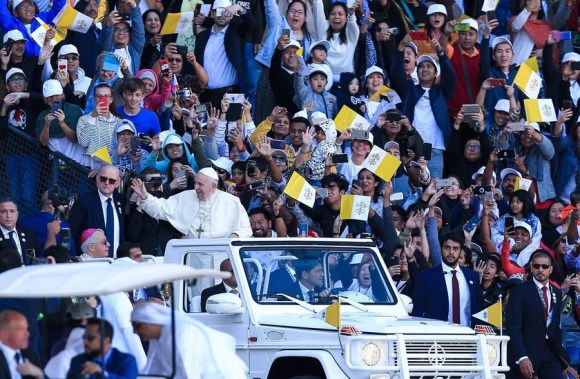
(Pope Francis arrives at the Zayed Sports City in Abu Dhabi for Mass. Victor Besa / The National)
This article was first published at Christianity Today, on Feb. 6, 2019.
Pope Francis must love creating cognitive dissonance.
This week, he became the first Catholic pontiff to ever visit the Arabian Peninsula, the heart of Islam, where conversion to Christianity is illegal. Francis lauded his hosts in the United Arab Emirates (UAE), saying they “strive to be a model for coexistence.”
The Gulf nation’s crown prince received him with a 21-gun salute. Francis then railed against the “miserable crudeness” of war.
Human rights groups pressed him to address migrant worker issues. Francis rejoiced in “a diversity that the Holy Spirit loves and wants to harmonize ever more, in order to make a symphony.”
The mere existence of a Christian community to visit in the Gulf states may surprise many. In 2015, CT visited the Emirates and reported on its “thriving” church, populated by more than a million Christians—primarily economic migrants from Asian nations such as Indonesia and the Philippines.
The Pew Research Center counts them as 13 percent of the population. They worship in over 40 churches, served by over 700 Christian ministries.
And in a region where the Vatican cited a decline of Christians from 20 percent to 4 percent of the Middle East population in the last 100 years, the Emirati government provided a day off and 1,000 buses to bring Catholics to mass.
Attendance reached 135,000, billed as the largest Christian gathering ever held in the Arabian Peninsula.
If the pope does enjoy sparking controversy, he succeeded also among local evangelical leaders…
Please click here to read the full article at Christianity Today.
Palestinian Christian couple from the Gaza Strip leaves through the Israeli Erez crossing, Thursday, Dec. 24, 2009 (photo credit: Tsafrir Abayov/Flash90)
Bethlehem’s Church of the Nativity has restored its sparkling mosaics and marble columns to their original glory for the first time in 600 years.
“It has become such a beautiful church,” Ziad al-Bandak, head of the local project committee of Christian leaders, told the AP. “Every Christian in the world would love to see it now.”
Palestinian Mayor Anton Salman expects 1.2 million tourists will make their way to Christ’s birthplace this year. Among them, following an Israeli reversal, will be those who most long to visit for Christmas—the Christians of the Gaza Strip.
“In Gaza, they talk about the West Bank as if it is heaven,” said Hanna Maher, Egyptian pastor of the Gaza Baptist Church. “People love to go for Christmas; there are so many churches.”
In Gaza, there are three. According to the 2017 census, 47,000 Christians live in the Palestinian territories (1% of the population), but only about 1,000 live in Gaza.
Last week the Christian advocacy group Middle East Concern (MEC) reported that nearly all who applied to enter Israel to visit the West Bank for Christmas failed to receive permits, except for those older than 55.
Applicants younger than 16 were also approved, consistent with restrictions instituted last Christmas and maintained through Easter. A previous policy limited travel to those between ages 16 and 35.
The MEC report was confirmed by Maher, who stated that initially just 200 travel permits had been granted, and Christians, sharing stories of the delayed permit applications, began to assume those outside the age limit would not be allowed to travel.
But their prayers were answered this week…
Please click here to read the full story at Christianity Today.
This article was originally published at Christianity Today on December 19.
For fifty years, John baptized Jesus in private.
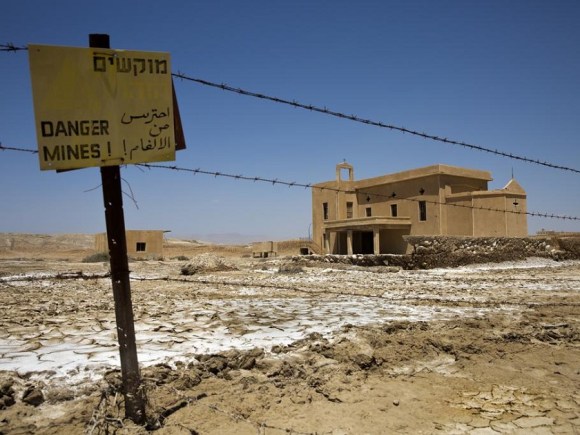
But last week on the western bank of the Jordan River, landmines were cleared to allow visitors a first look at a faded fresco of the baptism in a crumbling Ethiopian monastery.
Trudging through mud while avoiding well-marked areas warning of live charges remaining from the Six-Day War, intrepid pilgrims once again received iconic witness of the beloved Son.
“Israel placed the mines between 1967 and 1971 because there was a war,” Marcel Aviv, head of the Israel National Mine Action of Authority, a branch of the Defense Ministry, told the Times of Israel, standing a few hundred yards from Jordan.
“But now it’s empty because it’s a border of peace.”
Israel partially reopened the Qasr al-Yahud baptismal site in 2011. But visitors…
Please click here to read the full story at Christianity Today.
Egyptian Christians now have an additional 168 legal church buildings.
On November 30, a cabinet committee approved the requests of Egypt’s Coptic Orthodox, Protestant, and Catholic churches to formally register facilities long functioning as centers of worship.
Prior to a new law passed in August 2016, churches faced an arduous task to secure recognition by the government. Local authorities could delay or deny paperwork, often on security grounds placating neighborhood Muslim refusal.
CT previously reported how this new law was not without controversy, but that it designed to streamline the process, allow judicial review, and transfer final approval from Egypt’s president to the local governor.
The law also established a committee to review church requests to license existing church facilities. Consisting of the prime minister, ministers of justice, housing, antiquities, and others, it officially convened in January 2017.
A total of 3,730 requests were submitted for approval, pending review of structural soundness and compliance with local regulations. The first batch of 53 church buildings was approved in February of this year.
According to the government statement, the current decree brings the total number of approvals to 508.
“I am pleased,” said Andrea Zaki, president of the Protestant Churches of Egypt. “The process has been slow in the beginning, but I think going forward it will be better.”
Zaki is optimistic…
Please click here to read the full article at Christianity Today.
This article was originally published on September 20, 2018, and in the October issue of Christianity Today.
Image: Jonathan Bartlett, via CT.
This article expands my previous coverage of Andrew Brunson and the US-Turkish crisis to include also issues related to advocacy for Christians in Iran.
Why did advocacy succeed for the drug dealers but not the pastor? And what should be made of Youcef Nadarkhani, the Iranian house church leader released in 2013 after much international advocacy—only to be arrested and beaten this past July?
“Christians engaged in this part of the world always walk a knife edge regarding how to respond to unjust imprisonment,” said Mark Bradley, an author of three books on Iran and Christianity.
“Some prefer to remain under the radar. Others prefer to get as much support from politicians and journalists as possible. It is impossible to know which is more effective.”
Todd Nettleton, chief of media relations for Voice of the Martyrs, said some persecuted Christians hope for sanctions that will either push politicians to reform or the people to revolt.
But with the experience of working in 68 countries, he described others who believe a society unfettered by sanctions leads to openness to the gospel and a demand for rights and freedoms.
“In our work, we encounter Christians living in hostile and restricted nations who fall on both sides of this debate,” he said. “We stand with them regardless of the action or inaction of earthly governments.”
Please click here to read the full article at Christianity Today.
This article excerpt was originally published at Christianity Today, on August 16.
Photo Illustration by Sarah Rogers/The Daily Beast
… But some analysts say high-level pressure may do more harm than good, for both Brunson and Turkey (and Europe). And Americans who serve the gospel overseas often have dual sympathies, pained by the resultant suffering of the local citizens they serve.
“I would love to have US advocacy for my release,” said one American who previously worked in Turkey, “even though as a Christian I could stay [in jail] as long as I needed to.”
But wishing to stay anonymous so that he can return to Turkey, his reasoning is almost the reverse of expectations.
“Politically, being detained creates a negative image of Turkey in the US,” he said. “I would want to get out as quickly as possible to continue to advocate for that part of the world, helping them see the Turkey I love.”
And this Turkey is suffering, said a Turkish evangelical involved in ministry for over a decade, who also requested anonymity to discuss politics.
“Economic disaster!” he said of the currency devaluation. “Our people are already poor, but now the crisis deepens.”
Erdoğan has engaged President Trump’s rhetoric tit-for-tat, accusing him of an “evangelical, Zionist” mentality. But worries over Erdoğan’s economic policies and his control over Turkey’s central bank have resulted in a near 50-percent decline in the lira this year, as inflation has soared.
As Trump celebrated, Erdogan cried conspiracy.
And Turkey’s minorities unexpectedly asserted they were just fine.
“Statements alleging and/or alluding to oppression are completely untrue,” stated 18 Christian and Jewish leaders, headlined by Greek Orthodox Ecumenical Patriarch Bartholomew I of Constantinople. “Many grievances experienced in the past have been resolved.”
Many religious freedom analysts view the statement as evidence of the opposite: that minorities in Turkey are manipulated by the government in order to counter American claims of persecution. Many grievances continue.
And the above-mentioned Turkish ministry leader fears the worst.
“The response of the US is putting Turkish Christians in danger. People take it as a reason to attack us, and Christophobia is growing,” he said.
“Probably Brother Andrew will be released. But we’ll stay here and face all the effects after him…”
Please click here to read the full article at Christianity Today.
Judaism and Christianity symbols on the Jerusalem old city gate – MyHolyShop
This article was first published at Christianity Today, on July 31, 2018.
In a legislative act both obvious and inflammatory, this month Israel cemented its nature as a Jewish state.
By a narrow vote in the Knesset, Israel’s legislature, the law entitled “Basic Law: Israel as the Nation-State of the Jewish People” was adopted to serve alongside over a dozen other “basic laws” that serve as Israel’s de facto constitution.
A key clause states that national self-determination is “unique” to Jews. Other provisions formally establish the nation’s flag, emblem, and anthem. Jerusalem is confirmed as the complete and united capital. The Sabbath and Jewish festivals are declared official days of rest.
But two other clauses have raised considerable concern. Jewish settlement is a “national value” to be promoted. And Arabic is downgraded from an official language to one with “special status.”
“This law outlines that Israel’s democratic values are secondary for non-Jews,” said Shadia Qubti, a Palestinian evangelical living in Nazareth. “It sends a clear message that my language is not welcome and consequently, neither is my cultural and ethnic identity.”
Her fears are echoed by an Israeli lawyer.
“While the idea of the law is straightforward—it’s hard to argue that Israel isn’t a Jewish state—the actual provisions are controversial, discriminatory, and possibly racist,” said Jaime Cowen, former president of the Union of Messianic Jewish Congregations…
Please click here to read the full article at Christianity Today.
This article was first published in the July print edition of Christianity Today.
War was swirling in Syria. Rebels were pressing. And Maan Bitar was the only hope for American help.
“Because I am evangelical, everyone thinks I have channels of communication,” said the pastor of the Presbyterian Church in Mhardeh. “Syrians believe the United States has the power to stop the conflict—if it wants to.”
In the early years of the civil war, Bitar’s Orthodox neighbors were desperate to convince the US and its allies to end support of rebel forces. Mhardeh, a Christian city 165 miles north of Damascus, was being shelled regularly from across the Orontes River.
But salvation came from a different source. Russian airpower turned the tide, and Syrian government-aligned troops drove the rebels from the area.
Russian intervention on behalf of Mideast Christians has pricked the conscience of many American evangelicals. Long conditioned to Cold War enmity, the question is entertained: Are they the good guys in the cradle of Christianity? Or are persecuted Christians just a handy excuse for political interests?
“The news tells us Russian troops are bringing peace to the region, said Vitaly Vlasenko, ambassador-at-large for the Russian Evangelical Alliance. “Maybe this is propaganda, but we don’t hear anything else.”
Please click here to read the full article at Christianity Today.
But here also is testimony from Egypt, unfortunately cut due to word count:
“If Russia helps anyone to save them from death and danger [in Syria], we welcome this,” said Boules Halim, spokesman for the Coptic Orthodox Church. “Not just for Christians, but for humanity.”
Halim had no comment on Russian political developments with Egypt. But despite technically not being in communion over disagreements with the fifth-century Chalcedonian Creed, relations with the Russian Orthodox Church are growing increasingly strong.
Pope Tawadros has met Putin. Theological students are being exchanged. Russian monks are touring Egyptian monasteries.
“We are coming together in dialogue,” Halim said. “Better communication leads to better understanding.”
For his lifelong commitment to religious peace, King Abdullah II of Jordan recently became the second Muslim ever to win the prestigious, $1.4 million Templeton Prize. And Jordan’s Christian minority is celebrating with him.
“I believe in our king,” said Imad Shehadeh, president of the Jordan Evangelical Theological Seminary, following Wednesday’s announcement. “He is a kind, wise, loving, humble, and effective leader.”
Established in 1973, the Templeton Prize is awarded for exceptional contribution to “affirming life’s spiritual dimension.” First given to Mother Teresa, previous winners range from Billy Graham to the Dalai Lama. More recently, Christian philosopher Alvin Plantinga and Jean Vanier of L’Arche have won the prize.
But this year, Abdullah was honored as a ruler who has done more promote inter-Islamic and interfaith harmony than any other living political leader, Templeton said.
Islam is the official religion of Jordan, and the constitution guarantees freedom of religion for minorities such as the roughly 2 percent of the population that’s Christian (mostly Greek Orthodox). The Protestant community joins them in commending their king’s efforts for religious unity, though some wish his commitment went even further…
Please click here to read the full article at Christianity Today.








 Jayson Casper