I cannot say I know the cause, and many more are like me too.
But it does not look good.
Bankers reject the government plan.
Protestors rally where lawmakers meet.
But is business aligned with the people?
How to pray, except for good, when most of the small print escapes us?
And what of the pharmacist, killed in her store?
Or expat electors pulled in tug-of-war?
Better known yet is the poverty push
That dares some to risk life and limb to escape.
Some have drowned.
Some drown in blame.
Some—more than me—know the issues quite well.
Some are complicit in many a crime,
While some seek out facts keen to educate.
Give them ears, God. Too many are not listening.
We know why, and it is fair:
The hand has been nailed immobile.
So like your own, it sags inert,
Waiting for one to unpin it.
You rose from the dead by the power of God,
But came down from the cross with assistance.
Where now is Joseph, from Arimathea?
His humble act, far from the crowd—
But brave in approaching authority—
It set the stage for miracle,
Though he himself did little.
God, find these men, and amplify.
Bolster their spirits, in number.
And then, when few are watching, where only women linger:
Show yourself.
Birth new life.
Let Lebanon once again prosper.
Amen.
To receive Lebanon Prayer by WhatsApp, please click this link to join the closed comments group.
Lebanon Prayer places before God the major events of the previous week, asking his favor for the nation living through them.
It seeks for values common to all, however differently some might apply them. It honors all who strive on her behalf, however suspect some may find them.
It offers no solutions, but desires peace, justice, and reconciliation. It favors no party, but seeks transparency, consensus, and national sovereignty.
How God sorts these out is his business. Consider joining in prayer that God will bless the people and establish his principles, from which all our approximations derive.
Sometimes prayer can generate more prayer. While mine is for general principles, you may have very specific hopes for Lebanon. You are welcome to post these here as comments, that others might pray with you as you place your desires before God.
If you wish to share your own prayer, please adhere to the following guidelines:
1) The sincerest prayers are before God alone. Please consult with God before posting anything.
2) If a prayer of hope, strive to express a collective encouragement.
3) If a prayer of lament, strive to express a collective grief.
4) If a prayer of anger, refrain from criticizing specific people, parties, sects, or nations. While it may be appropriate, save these for your prayers alone before God.
5) In every prayer, do your best to include a blessing.
I will do my best to moderate accordingly. Thank you for praying for Lebanon and her people.
Russian sermons—to the extent legally possible—reflect the national mood.
“Honor the tsar!” preached Alexey Novikov of Land of Freedom Pentecostal church in Moscow two days after the February 24 Russian invasion of Ukraine, quoting from 1 Peter 2:17. While not pro-war, it was certainly pro-Russia. Once a lawfully elected president commits troops, he said, it is a Christian’s duty to support them.
One month later, Mikhail Belyaev of Source of Living Water Baptist church in Voronezh, Russia, asked, “Why are the churches silent?”
Many Ukrainian evangelicals are fuming at their cross-border colleagues for failing to speak out against the war. They also cite the apostle Peter, placing priority on the same verse’s earlier command: “Love the family of believers.”
But Belyaev’s sermon was not pro-Ukraine. His congregation 320 miles south of Moscow provides a different answer.
The churches are not silent, he said. They are preaching the gospel and praying for peace.
“Russians take the Ukrainian complaint seriously,” said Andrey Shirin, associate professor of divinity at the John Leland Center for Theological Studies, a Baptist seminary in Virginia. “But they put God before the nation—and think many Ukrainians put too much stock in their nationality.”
Shirin left Russia 30 years ago and said that, then as now, most believers are wary of politics. And while some pastors have criticized the war, a pro-Ukraine sermon would be hard to find.
Throughout the war, polls have shown strong support for what Russia has legally mandated be called a “special military operation.” Between 65 percent and 89 percent have signaled approval; 71 percent said they feel “pride” and “joy.”
Some analysts have suggested propaganda is at play: Three in 4 Russians rely on television for the news, and 2 in 3 from state-run broadcasts. Only 5 percent have access to a VPN for outside reporting.
Others have suggested falsification: A “list experiment” in which Russians did not have to answer the war question directly resulted in an approval rating of 53 percent.
Specific polls do not exist for evangelicals. Shirin, noting the difficulty of precision, estimated pro-Russia sentiment like Novikov’s would register only 20 percent. But pro-Ukraine sentiment and a clear antiwar position would fare…
This article was originally published at Christianity Today, on April 22, 2022. Please click here to read the full text.
Now locked in a vicious war of survival with invading Russian forces, many are on the front lines of battle. Leading voices call for NATO to enforce a no-fly zone. Pastors pray for soldiers; churches offer bread.
What happened?
It is not as straightforward as simple self-defense. But neither was their nonviolence, practiced by most Slavic evangelicals, a clear convictional principle. Forged in the fires of the Soviet Union, the then-second-largest Baptist community in the world developed along a very different path from their denominational brethren in the United States.
Just ask Roman Rakhuba, who was raised Baptist.
“I never would have called myself a Mennonite,” said the head of the Association of Mennonite Brethren Churches of Ukraine (AMBCU). “Later I discovered I was following their principles all along.”
Known as the “Bible Belt” of Eastern Europe, Ukraine’s evangelical faith was greatly influenced by the Anabaptist tradition. Rakhuba grew up in Zaporizhzhia, 350 miles southeast of Kyiv, near the old oak tree associated with the Chortitza colony of Mennonites, founded in 1789.
His grandfather was saved through one of their preachers.
But as a Baptist child, Rakhuba was raised without toy guns, instructed to never return evil with evil. Forbidden from playing war, his relatives refused to fight in the Soviet army. He remembers Mennonites hosted at his grandfather’s home, learning of the 1763 decree by Catherine the Great to invite German settlers to develop the Russian hinterland.
They were joined by Lutherans and Catholics, dissidents and rebels, offered lands, self-governance, and—vital for the pacifists—exemption from military service. Over the next century, Mennonite communities thrived in Ukraine, developing infrastructure for agriculture and industry. But increasing prosperity challenged their social and spiritual life, and drunkenness and dancing became common.
Then came pietism.
In the mid-19th century, German missionaries, such as the Lutheran Edward Wuest, found a reception with the Mennonites. Their emphasis on a regenerated Christian life through personal conversion, prayer, and Bible study appealed to colonists dissatisfied with the traditional church. The community ruptured, and in 1860 a parallel Mennonite Brethren denomination was born, sending missionaries as far as Siberia and India.
The still-German speakers lived largely separate lives from their Slavic neighbors, until two events intervened to spark an evangelical revival. In 1858, Emperor Alexander II authorized the translation and printing of the Bible in Russian. Three years later, he abolished serfdom.
“For the first time, peasants were no longer tied to the land,” said Mary Raber, a church history instructor at Odessa Theological Seminary. “Where better to find a job than on the farm of a successful colony?”
Slavs, now with a New Testament to read, started joining their Bible studies.
Mennonites were not the only revivalist movement in the Russian empire. German Baptists planted churches in the Caucasus Mountains. An English missionary won converts among the St. Petersburg elite. Neither of these groups adopted pacifism as a rule, and even some Mennonites organized self-defense units to ward off bandits in the chaos of World War I. But none were prepared for…
This article was originally published at Christianity Today, on April 20, 2022. Please click here to read the full text.
“Tear down these silos, and in three days I will build them up again.”
Some cheered. Some mourned.
Most went about their day.
The world moves on, and so must life.
That which is dead just crumbles.
“Keep it alive!” “Prop it up!” “We must preserve the memory!”
“At least, till justice comes.”
But where is justice, God?
Memory exchanged for glitz, throughout the civil war city.
Bullet holes here, a statue there.
Seventeen thousand still missing.
With erasure comes grievance, and grievance comes grudge.
The world moves on, and so must life.
But it does not.
Wounds run deep. Statues nurture.
The choice: Ignore, or sect.
There is nobility in both, God. But little of you.
In the silos you suffered.
Grain spoiled, poured out – for none.
The bread of life was wasted.
And now the poor go hungry.
Yet for some there is cake. Cookies abound.
Cast lots: Who has your favor?
One day they will be built again.
The world moves on, and so must life.
But will you be in it?
The new port? The next Beirut? Lebanon—if it continues?
Three days, God. We are waiting.
Millennia. We are waiting.
Come. You do not come.
But yes, you have. To me.
A day is as a thousand years, for world unperceiving.
My day is rich like a million.
My memory of sin is purged. The scars remain, but healed.
The silos—full—inside my heart.
Bread: Broken, eaten, grateful.
It is enough, God.
But it is not enough.
Too few have bread. Too few have life.
And silos: Ruined, standing.
Until they fall, or are brought down.
Erased. And justice with them.
We wait, God.
We work as we can.
Your life in us, for others.
Bless this nation. Raise afresh.
Three days.
The dawn emerges.
Amen.
To receive Lebanon Prayer by WhatsApp, please click this link to join the closed comments group.
Lebanon Prayer places before God the major events of the previous week, asking his favor for the nation living through them.
It seeks for values common to all, however differently some might apply them. It honors all who strive on her behalf, however suspect some may find them.
It offers no solutions, but desires peace, justice, and reconciliation. It favors no party, but seeks transparency, consensus, and national sovereignty.
How God sorts these out is his business. Consider joining in prayer that God will bless the people and establish his principles, from which all our approximations derive.
Sometimes prayer can generate more prayer. While mine is for general principles, you may have very specific hopes for Lebanon. You are welcome to post these here as comments, that others might pray with you as you place your desires before God.
If you wish to share your own prayer, please adhere to the following guidelines:
1) The sincerest prayers are before God alone. Please consult with God before posting anything.
2) If a prayer of hope, strive to express a collective encouragement.
3) If a prayer of lament, strive to express a collective grief.
4) If a prayer of anger, refrain from criticizing specific people, parties, sects, or nations. While it may be appropriate, save these for your prayers alone before God.
5) In every prayer, do your best to include a blessing.
I will do my best to moderate accordingly. Thank you for praying for Lebanon and her people.
Twenty of the top 22 Christian pages on Facebook in 2021 were run from Europe’s southeast corner.
Nikola Galevski’s wasn’t one of them.
The pastor of Soulcraft Evangelical Church in Skopje, North Macedonia, actually prefers Twitter, which in the Balkans mostly attracts leftist and antireligious voices. He uses the handle “Protestant Imam,” which is a tongue-in-cheek gesture of openness to the Muslim population that makes up about a third of his country.
“The community teases me, and I tease them,” Galevski said, “but it helps develop their life with Christ.”
He has around 5,000 followers on Twitter, and some of his videos on YouTube went viral when his wife, Anet, was dying of cancer. Galevski shared about the struggle of her death in his weekly sermons, which were posted online. Orthodox Christians, nonbelievers, and Muslims joined him in his mourning, and when Anet died, views jumped into the tens of thousands.
But that pales in comparison to the top Christian Facebook page, “Be Happy Enjoy Life,” which reached 75 million users every month, according to an internal Facebook document obtained by MIT Technology Review. Ninety-five percent of viewers did not sign up to follow that page but instead had its content pushed into their news feeds by Facebook’s algorithms.
That page is one of 15,000 in the Balkans that is believed to be a “troll farm,” pumping out disinformation and figuring out new and better ways to command eyeballs—many of them belonging to Christians scrolling in America.
An internal Facebook document written by a senior-level data scientist said, “Our platform has given the largest voice in the Christian American community to a handful of bad actors who, based on their media production practices, have never been to church.”
They’re certainly not evangelicals. Galevski, who is also the coordinator of the Evangelical Protestant Initiative, would probably know them if they were. There are about…
This article was originally published in the April print edition of Christianity Today. Please click here to read the full text.
We thank you for agreement, though many say its false.
And naught but shame can come upon the architects of loss.
It is not wise to borrow. Worse: Surrender on a debt.
Rely on outside help to fix a problem of one’s own.
The terms of reference, strident. Reforms, we surely need.
But will these straighten Lebanon for finance or the poor?
At least there is consensus, for now, on what to do.
Conditional on follow-up; will implementing fail?
And what then of elections? Will mandate carry through?
And how long will it take until a government is formed?
Could help—now—come from elsewhere? A bailout before loan?
Will friends—again—from Saudi prove their friendship at the bank?
At least they have returned, God. An empty embassy
Is more than just a symbol of relations gone awry.
But this week things are better, and all across the board.
A glimpse of hope, ephemeral? Or first look at the roots?
Distrust appears endemic. Manipulation, fierce.
The sins of men run deep within the soil of ancient land.
God grant them all discernment, and courage to address
Corruption and entitlement distributed by sect.
Some must fall entire. Others to redeem.
Promote the honest faithful; may their influence expand.
No more ad hoc solutions, as each blame someone else.
Let justice paint with broadest brush. But mercy, beautify.
The landscape is angelic. Your praise, each day, it sings.
Draw people to the chorus from cacophony of angst.
From president to doorman, from cleric to the cook,
All are equal in your sight and each with vital role.
Perhaps a loan is coming. Renewed support from Gulf.
Be warned: No trust in princes. Wealth: Moth and rust destroy.
You, oh God, are holy. Yet you love us. You forgive.
Reveal it now in Lebanon. Humbled, prayerful—heal.
Amen.
To receive Lebanon Prayer by WhatsApp, please click this link to join the closed comments group.
Lebanon Prayer places before God the major events of the previous week, asking his favor for the nation living through them.
It seeks for values common to all, however differently some might apply them. It honors all who strive on her behalf, however suspect some may find them.
It offers no solutions, but desires peace, justice, and reconciliation. It favors no party, but seeks transparency, consensus, and national sovereignty.
How God sorts these out is his business. Consider joining in prayer that God will bless the people and establish his principles, from which all our approximations derive.
Sometimes prayer can generate more prayer. While mine is for general principles, you may have very specific hopes for Lebanon. You are welcome to post these here as comments, that others might pray with you as you place your desires before God.
If you wish to share your own prayer, please adhere to the following guidelines:
1) The sincerest prayers are before God alone. Please consult with God before posting anything.
2) If a prayer of hope, strive to express a collective encouragement.
3) If a prayer of lament, strive to express a collective grief.
4) If a prayer of anger, refrain from criticizing specific people, parties, sects, or nations. While it may be appropriate, save these for your prayers alone before God.
5) In every prayer, do your best to include a blessing.
I will do my best to moderate accordingly. Thank you for praying for Lebanon and her people.
The atrocities are shocking. Ukrainian authorities have said 410 civilians were killed in the suburbs of Kyiv, discovered after the Russian army withdrew from its positions. At least two were found with their hands bound; several were shot in the head.
Many bodies were burned.
One resident said the occupiers were polite, and shared their meal rations. But others told of ransacked apartments; one was tied to a pole and beaten. Soldiers even shot a cyclist, who had dismounted and turned a corner on foot.
It could have been Ivan Rusyn.
President of Ukrainian Evangelical Theological Seminary (UETS), he had been coordinating aid from a safe house in Kyiv. But riding his bicycle into Russian-controlled Bucha to deliver medicine to a neighbor, he became an eyewitness to the atrocities.
Russia has called the images fake; satellite evidence contradicts. Christianity Today interviewed Rusyn to hear his firsthand report. He spoke about the spiritual impact, becoming a more authentic church, and how evangelicals have been helping the reclaimed suburbs—where he lived the past eight years:
Tell me about your neighborhood.
If you look at Bucha on Google Maps, I live in one of the five apartment blocs opposite Toscana Grill. It is an expensive restaurant, but sometimes I have eaten there. I run in the municipal park nearly every day, and with friends on Saturday. The seminary in Kyiv is six miles away, and it would take me 25 minutes to drive there, with traffic.
I noticed Google now says it will take an hour and a half.
The bridge was destroyed on the second day of the war. Russian helicopters and soldiers landed first at the Hostomel airport, three miles from our home. There was heavy combat, and I took shelter in my basement for the next five days. Then I left to the seminary, following that Google Maps route to skirt around Kyiv to the northeast. After two days we evacuated, and I found my way to a safe house in the city.
Now when we bring food and provisions into Bucha, Irpin, and Hostomel, we see many destroyed Russian tanks. The bridge is still out, but we can navigate it carefully with minibuses. It is dangerous, but if you go slow the journey now takes about one hour.
When did you return? Four days ago (April 3). We were escorted by police because…
This article was originally published by Christianity Today, on April 7, 2022. Please click here to read the full text.
Last year, Protestant Christians in Turkey suffered no physical attacks.
There were no reported violations of their freedom to share their faith.
And there was a sharp reduction in foreign missionaries denied residency.
But not all is well, according to the 2021 Human Rights Violation Report, issued March 18 by the nationally registered Association of Protestant Churches (APC).
Hate speech against Christians is increasing, fueled by social media.
Legal recognition as a church is limited to historic places of worship.
And missionaries are still needed, because it remains exceedingly difficult to formalize the training of Turkish pastors.
“Generally there is freedom of religion in our country,” stated the report. “But despite legal protections, there were still some basic problems.”
Efforts to unite Turkey’s evangelicals started in the mid-1990s, and the APC began publishing its yearly human rights reports in 2007. Today the association, officially registered in 2009, represents about 85 percent of Christians within Turkey’s 186 Protestant churches, according to general secretary Soner Tufan.
Only 119 are legal entities.
And of these, only 11 meet in historic church buildings. The great majority rent facilities following their establishment as a religious foundation or a church association. While generally left alone, they are not recognized by the state as formal places of worship and thus are denied free utilities and tax exemption.
And if they present themselves to the government in pursuit of such benefits, officials often warn they are not a church and threaten closure. Sometimes the authorities even try to recruit informants. And some Christians who have refused have lost their jobs.
Other Turkish Protestants are simply harassed. “Dead priest walking,” said residents of Arhavi to a local pastor as…
This article was originally published at Christianity Today on April 6, 2022. Please click here to read the full text.
Craig Simonian had a vision. It landed him in a war zone.
Raised in an Armenian-American Orthodox family, he came to know Jesus personally at university. He served as a Vineyard church pastor in New Jersey for nearly two decades but continued to embrace his Apostolic church heritage.
It laid the foundation of his faith—but also of his nation of origin.
“The reason Armenia still exists is because of the church,” he said. “It kept our shattered people together, especially in the diaspora.”
As a child, Simonian’s grandmother witnessed her father and mother murdered in the Armenian Genocide, killed by Turks in the waning days of the Ottoman Empire.
When she eventually arrived in America, it was the Apostolic church that embraced their family. Simonian recalled kindly visits by priests of their Oriental Orthodox tradition who—in the face of tragedy and devastation—gave him a deep appreciation of the sovereignty of God.
It was his evangelical awakening, however, that drew him back to Armenia—and in particular to its church. He relocated in 2018 to a nation locked in a cold war with neighboring Azerbaijan. A self-professed “oddball,” he longed for the Apostolic church to embrace fully the gospel he had discovered.
“If we are going to reach this generation, we can’t do it without them,” Simonian said. “I will call people to Jesus but never to leave their church.”
But two years later, the war turned hot.
Azerbaijan invaded the Armenian-controlled enclave of Nagorno-Karabakh in October 2020. The territory is recognized internationally as belonging to Azerbaijan, yet the residents of what Armenians call Artsakh voted for independence in 1991. For three decades Armenia held the upper hand but was routed in a 44-day war through superior drone technology that Turkey and Israel supplied to Azerbaijan.
Russian intervention enforced a ceasefire, with Nagorno-Karabakh demolished and Armenians holding a fraction of their previous territory. The nation felt numb after its defeat, and many found refuge in the Apostolic church.
Today, Simonian provides ad hoc spiritual care as he builds relationships with evangelicals and Orthodox alike.
His primary worship is through Yerevan International Church. But few in his personal circles have saluted his efforts to attend the Divine Liturgy and cultivate relationships with Orthodox clergy. Many evangelicals are soured by years of the older tradition labeling the newcomers a sect, or worse, a cult. But neither has Simonian yet found in the Apostolic church the fellowship that characterized his diaspora youth.
“The warm fuzzies I had growing up are completely void here,” he said. “The church is not so much a community.”
Simonian understands. Soviet communism purged the church, replacing clergy with compliant leadership. Following Armenia’s independence in 1991, this generation still exists but is giving way to a spiritual cadre that he says recognizes the church needs more than ancient traditions.
“We do not need to re-evangelize Armenia,” said Shahe Ananyan, dean of Gevorkian Theological Seminary in the Apostolic holy see of Etchmiadzin, 13 miles west of Yerevan. “Our main task is to wisely consider how to bring both Eastern and Western traditions together in synthesis.”
The church is still discussing application, he said. But he recognized that modern life for many has crowded out liturgical attendance and Bible reading. Forging forward anyway is…
This article was originally published by Christianity Today on April 1, 2022. Please click here to read the full text.
“I want to see 96 percent of Azerbaijanis confess their faith in Christ, and revival often began when the king became a believer,” he said. “But our God is the president of presidents, so the government does not rule over me.”
He has a long way to go.
Panahov, founder of the Vineyard church in Muslim-majority Azerbaijan, arrives at his target by inverting his homeland’s estimated proportion of Christians: 4 percent. Most of these are Russian Orthodox, holdovers from when the Caucasus nation of 10 million was part of the Soviet Union.
But the Azerbaijan Bible Society estimates that 20,000 Azeris have become evangelicals, most within the past two decades. And the government—despite being panned for widespread human rights violations in politics—has earned local plaudits for its level of religious freedom, especially toward Christians and Jews.
Panahov’s own story supports his optimism. But is it wise? Orthodox, Catholic, and Presbyterian leaders offer a word of caution.
From an Azeri Muslim family with a communist father, in 1989 Panahov came to faith at the age of 12 through a local Russian Baptist church. But as he grew interested in the arts and dancing, the conservative Christian community could not accept such worldly activity.
Panahov fell away from the faith as he performed professionally around the world—until in 2007 he tore his meniscus. Doctors in Turkey, where he lived at the time, told him he would never dance again.
It was then he recalled Jesus—whom he said spoke a word of healing to him. But through his Turkish pastor, God also gave him a commission: Return to Azerbaijan, and share what God has done for you.
Panahov was reluctant, knowing his artistic passion was a spiritual offense. But trusting God, he went back and eventually found a new church home. Over the next seven years he worshiped comfortably, started a family, and even found work as a dance instructor. But then he heard again the voice that healed him: Go out and start a house church.
He left his fellowship with tears but knew to obey. In the beginning he met mostly with believing relatives, but four years later their number grew to the 50 required by the authorities for registration. Similar miracles have marked many in the movement, which according to Panahov counts 350 believers in 16 cell groups, spread throughout his Caspian Sea country.
And God has used his artistic talent. His team has drawn hundreds to gospel-themed performances in downtown Baku, the nation’s capital. Media and filmmaking have put the message on the internet. The Vineyard church baptized 64 new Christians during the pandemic, he said, and 36 during Azerbaijan’s victorious war with neighboring Armenia.
“Two years ago, the churches did not believe opportunities for evangelism could reach such a level,” Panahov said. “But I know it is from God, because I don’t have the brains for it.”
It is also from the government, which following many years of suppression now works with church leaders to legalize their fellowships. While noting a positive trend, the US Commission on International Religious Freedom still recommends Azerbaijan for inclusion on the State Department’s Special Watch List for religious freedom violators.
Of concern is the legislation that requires 50 people before legal registration. Many evangelicals celebrate the freedom they do have—and the movement of the Holy Spirit to far surpass this number. But some notice…
This article was originally published by Christianity Today on April 1, 2022. Please click here to read the full text.
Image: Edits by Christianity Today / Source Images: NurPhoto / Jeff J Mitchell / Getty
Of Ukraine’s more than 4 million refugees, 90 percent are women and children. Of the 6.5 million internally displaced Ukrainians, 54 percent of adults are women. Men ages 18-60 are required to stay and resist the Russian invasion. And thus it is men who usually tell the public tales of war.
Women are often kept to private forums, such as their journals. Including:
32 days of war.
Fall asleep while checking the news on your phone.
See nightmares about concentration camps, bombing, dead people.
Wake up from a nightmare and remember it is not just a bad dream.
Check your phone with the thought: I hope everyone I love is alive.
Kiss a sleeping husband thinking about the fragility of life.
Wash your face. Put your clothes on.
Go to work. Wear a smile as a mask. Distance your emotions from pain. Physically hear pain turn into white noise in your head.
Check on your family during a 15-minute break at work. Cry on your break.
Six seconds: breathe in. Eight seconds: breathe out.
Feel grateful for being away from your phone eight hours a day at work. Feel helpless about being away from your phone eight hours a day at work.
So began the March 27 entry of Tetiana Dyatlik Dalrymple, suffering vicariously from afar in Washington, DC. Her father, Taras, sensed that such female perspectives have been missing from coverage of the war.
As regional director for Eastern Europe and Central Asia for Overseas Council, he recruited six Ukrainian women leaders who could tell their story. In partnership with the Eastern European Institute of Theology, ScholarLeaders International, and four affiliated seminaries, they sought to correct the critical observation of Svitlana Alexievich, a Belarussian novelist who won the Nobel Prize for literature in 2015.
“All that we know of war,” she said, “is told by men’s voices.”
Too few international supporters care to notice. The theological educators’ second webinar, The Russia-Ukraine War: Women Voices, drew only about 200 registrations yesterday, less than half of the first by male seminary leaders.
Marina Ashikhmina, vice rector for educational work at Tavriski Christian Institute, said the distinction is patently unfair. Women in war have a “double responsibility.” Underappreciated in society is…
This article was originally published by Christianity Today, on April 1, 2022. Please click here to read the full text.
More than three years later, there is an almost-law.
Cabinet to parliament, likely to approve?
The IMF is visiting, they need to see it real.
But is there full agreement on the bailout to come?
Election cries uniting: Depositors protect.
Confront corrupt officials, root out in every sect.
But which ones? Few will specify.
Vote here: Our resolved list.
A law is surely needed, with money trapped in banks,
Exchange rate fluctuations, and the lira in collapse.
The answer: A committee, with power to decide.
Composed of adept figures chosen later. But by whom?
God, is this a solution? The first step in a plan?
Or simple obfuscation and delay until no end?
Or worse—is that the plan?
And of some, or of all?
Are they united, though separate in list?
Some say.
Three years ago, the people, in thousands, with their feet,
Descended on the central squares with a resounding ‘yes’.
Those days have passed: Corona. Depression. Winter rain.
All of these conspired and deflated common cause.
There are lists independent. A vote to throw away?
Or embers of intensity that could—and must—revive?
God, you know.
Sift wheat from chaff.
Give light to eyes.
Discernment, come.
Give people back their money. But so much more beside.
Free them from enslavement to consumeristic trends.
The lust of eyes, seductive. The pride of life, a snare.
Blessed are the poor trumps all, when poor is all we have.
Blessed are the poor, in spirit: Help this to remain.
Let sect embody service. Politics—ideas.
God, bless all of Lebanon.
Free it for your cause.
Make of her a beacon.
A message. Beauty. Love.
Amen.
To receive Lebanon Prayer by WhatsApp, please click this link to join the closed comments group.
Lebanon Prayer places before God the major events of the previous week, asking his favor for the nation living through them.
It seeks for values common to all, however differently some might apply them. It honors all who strive on her behalf, however suspect some may find them.
It offers no solutions, but desires peace, justice, and reconciliation. It favors no party, but seeks transparency, consensus, and national sovereignty.
How God sorts these out is his business. Consider joining in prayer that God will bless the people and establish his principles, from which all our approximations derive.
Sometimes prayer can generate more prayer. While mine is for general principles, you may have very specific hopes for Lebanon. You are welcome to post these here as comments, that others might pray with you as you place your desires before God.
If you wish to share your own prayer, please adhere to the following guidelines:
1) The sincerest prayers are before God alone. Please consult with God before posting anything.
2) If a prayer of hope, strive to express a collective encouragement.
3) If a prayer of lament, strive to express a collective grief.
4) If a prayer of anger, refrain from criticizing specific people, parties, sects, or nations. While it may be appropriate, save these for your prayers alone before God.
5) In every prayer, do your best to include a blessing.
I will do my best to moderate accordingly. Thank you for praying for Lebanon and her people.
Suffering freezing temperatures during the long winter cold in the Caucasus Mountains, this month Armenians in Nagorno-Karabakh had no heating for three weeks. The natural gas “malfunction,” stated Azerbaijan’s state-run energy distribution company, has now been repaired.
It is not often that pipeline maintenance draws international concern.
The European Union and Freedom House bothcalled for quick resumption of the supply in order to avert a humanitarian crisis. Over 100,000 residents in the contested enclave rely on Armenian natural gas that passes through Azerbaijani territory.
Nagorno-Karabakh, which Armenians call Artsakh, lies within the internationally recognized territory of Azerbaijan. Armenians accused Azerbaijan of deliberate disruption, prevention of repair, and installation of a new valve with which they can shut off gas flow at will.
Secured by Armenians backed by Armenia’s military following the fall of the Soviet Union, Artsakh sought independence for three decades while controlling six buffer zones in depopulated Azerbaijani lands. Negotiations failed to resolve the dispute, until Azerbaijan launched a 44-day war in 2020 that recovered significant territory.
A Russian-brokered ceasefire ended active hostilities.
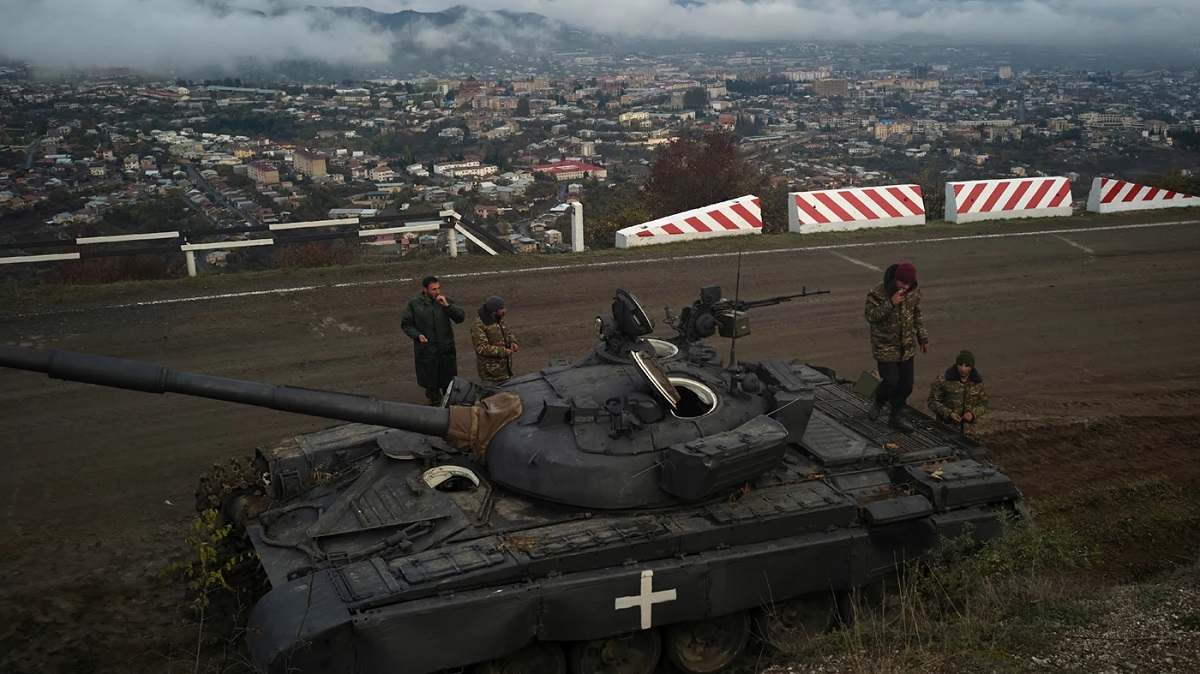
Yet skirmishes continue, and Azerbaijan accuses Armenia of instigation. Last November, Armenia stated an Azerbaijani incursion occupied 15 square miles of sovereign territory. Christianity Today was reporting from one of the liberated buffer territories at the time.
And in the month prior to the pipeline issue—with the world’s attention focused on Ukraine—Russia officially accused Azerbaijan of breaking the terms of the ceasefire. Monitors recorded at least four incidents of firing toward Armenian villages. Three soldiers were reportedly killed by an Azerbaijani drone; another was shot by a soldier across the border.
After years of holding the upper hand in Nagorno-Karabakh, the reversal suffered in the war has Armenians fearful of genocide. Now victorious, Azerbaijan President Ilham Aliyev has pledged to develop the area economically and to treat Armenians as equal citizens.
The recent conduct makes many doubt these promises.
“They openly can’t go for a full-blown war today since Russian peacekeepers are deployed here,” stated an Armenian journalist. “So they do everything to disrupt normal life and make people leave their homeland.”
But it goes beyond “Artsakh.” To emphasize its sovereignty over the region, Azerbaijan has…
This article was originally published at Christianity Today on March 31, 2022. Please click here to read the full text.
Ibrahim Baghirov died as an infant. His mother, Mary, had read in the Gospels about Jesus and Lazarus, so she prayed for God to raise her child from the dead. He did, she says. Doctors in Baku, the capital of Azerbaijan, confirmed the miracle to her, which also confirmed her fledgling faith as a Muslim-background Christian.
Two decades later, Baghirov is an emerging preacher in the church that meets in the family’s home.
But in September 2020, as Azerbaijan launched what would become a 44-day war against neighboring Armenia, Mary’s faith faltered. Having once trusted God where medicine failed, she hastily made her son an appointment for an unnecessary surgery in hopes of keeping him from conscription. He gently rebuked her.
“I will go wherever God takes me,” said Baghirov, now 26 years old. “There are ways to keep me here, but there will be no blessing in that.”
He deployed within weeks to the front lines in the snowcapped peaks of Nagorno-Karabakh, a swath of land about the size of Delaware that is encircled by present-day Azerbaijan and has been contested for centuries.
Along the way, Baghirov said he received a word from God: None of his fellow soldiers would die, and he would be their minister. His country is predominantly Muslim, and several of his comrades shunned him after his pocket New Testament fell from his backpack. Others asked questions, though, and became friends.
Azerbaijan, with a reputation as one of the most secular countries in the Muslim world, is tolerant of its long-established Christian minority community. But its long-standing animosities toward Christian Armenia are a different story.
The two countries’ generations-old dispute over Nagorno-Karabakh—a majority-Armenian territory whose modern borders were established in 1923 when Joseph Stalin made it part of Azerbaijan—has been fierce. The worst atrocities of the early 20th century killed thousands, leveling villages and leaving blood on both Armenian and Azeri hands. Relations were more neighborly for several decades, until the Soviet Union disintegrated and triggered a new round of massacres beginning in the late 1980s. Thousands were displaced from their homes as each nation purged its opposing ethnic minority, while Armenia depopulated a buffer zone around the territory to protect it from attacks.
In 1991, Nagorno-Karabakh voted for independence, and Armenia-backed forces eventually secured control of the region, dubbing it the Republic of Artsakh. (Neither Azerbaijan nor the international community has recognized Artsakh’s sovereignty.) Skirmishes between the countries smoldered for decades during a languishing peace process led by the US, France, and Russia.
But in 2020, Azerbaijan conscripted soldiers and advanced on the territory in yet another conflict. Baghirov was assigned to an artillery unit, a post that spared his tender pastoral heart from one adversity, at least: He would not engage in direct combat against the fellow Christians he and his military were slowly overtaking.
But Baghirov said he heard another word from God, another promise: Not one Armenian would die from his hand.
On the other side of the lines, shivering in the snow, fighters in an Armenian unit were also talking to God. An embedded priest from the Apostolic Church, the national church of Armenians, carried a relic of the holy cross and encouraged them as they knelt. They beseeched God for their fellow soldiers, surrounded by Azerbaijani forces and pounded by missiles and suicide drones.
“Don’t lose hope,” said Menuk Zeynalyan. “Our struggle is for our holy church and holy land.”
A married father of four, Zeynalyan left a comfortable parish among the Armenian minority in the neighboring nation of Georgia and signed up for military chaplaincy in 2019. Before the war, he led soldiers in three weekly Bible lessons. Many came from irreligious homes, raised by parents under the banner of Soviet atheism. But within two months, he said, everyone knew the catechism.
His highlight was the prayer of dedication prior to the soldier’s oath. Before swearing the secular pledge to defend the nation, Zeynalyan tied their patriotism to the Lord. After all, tradition had it that Thaddeus and Bartholomew preached the gospel in Armenia. And their country had become the world’s first officially Christian nation in the year 301, long before the Roman Empire followed suit.
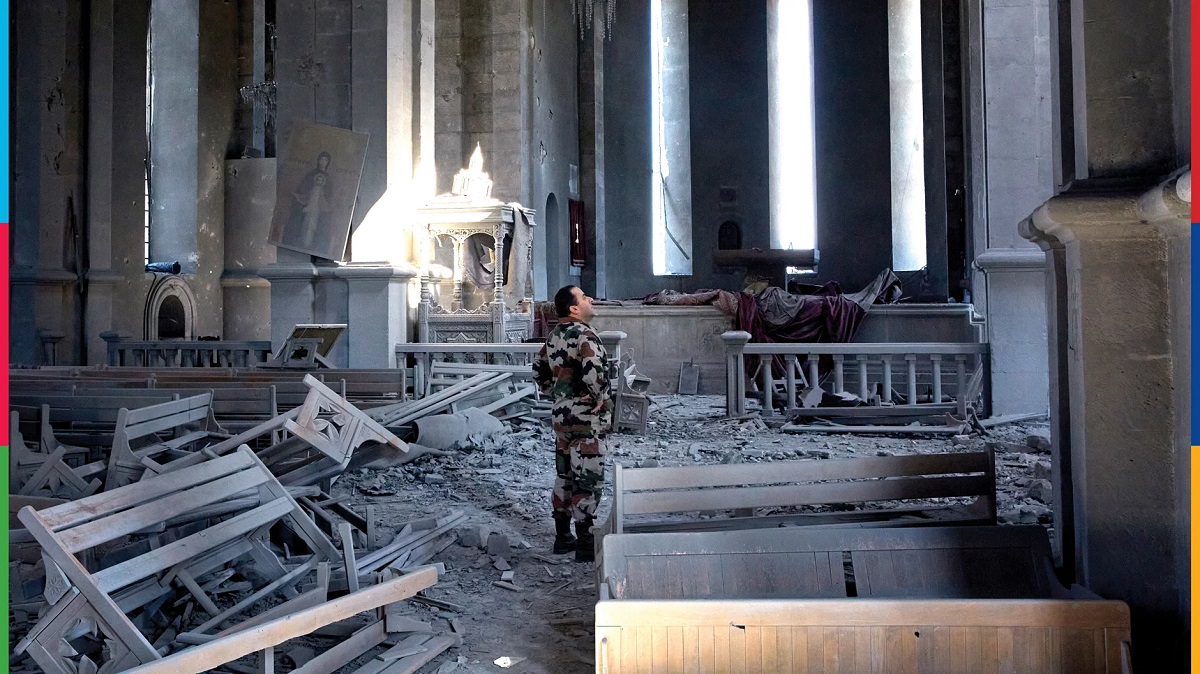
Miraculously, Zeynalyan’s prayers were answered, and his beleaguered colleagues emerged from the battle unscathed. Zeynalyan said he witnessed many examples of divine intervention in 2020. He was at the Ghazanchetsots Cathedral in the city of Shusha—known to Armenians as Shushi—on October 8, when two missiles struck within five hours in an attack Human Rights Watch deemed a possible war crime.
In early December 2020—with the Armenian lines broken and at least 6,000 soldiers confirmed killed—a Russia-brokered ceasefire ended hostilities. Shusha, the crown jewel of Nagorno-Karabakh, was back under Azerbaijani control, and their military was poised to seize the regional capital of Khankendi, known to Armenians as Stepanakert.
“It was pure joy to recapture our land,” Baghirov said. “For three decades, it was a heavy burden in our hearts, and finally our people can return to their homes.”
Officially, however, it is a ceasefire and not a capitulation. Armenia maintains control over Stepanakert and about a third of the disputed territory, protected by Russian peacekeepers. And while the mood is somber in the Armenian capital of Yerevan, about five hours away, Zeynalyan keeps his faith.
“No matter how much land we lose,” the chaplain said, “we are God’s people and will remain here until the second coming of Christ.”
Christianity Today spoke with more than two dozen sources during a visit to both nations one year after the war. It’s an open question how, if at all, they will reconcile their intense differences.
But for a few Christians in Armenia and Azerbaijan, a more personal question nags. Isn’t there a unity in Christ that transcends geopolitical grievances?
And if there is, should Christians wait for their governments to make peace? Or should they start themselves, by making peace with fellow believers behind enemy lines? For hundreds of years, the Caucasus region has been…
This article was originally published in the March print edition of Christianity Today. Please click here to read the full text.




 Jayson Casper