Categories
Asia Christianity Today Published Articles

Pakistani Christian Praised for Documenting Blasphemy Victims. Most Are Muslims.

Image: Daniel Berehulak / Staff / Getty

Last month, mob violence took the life of Lazar Masih of Pakistan. Hundreds of Muslims responded with brutality to accusations that the 74-year-old Christian had desecrated a Quran—even before he could be tried under the nation’s blasphemy law.

A year earlier, in a similar blasphemy accusation, thousands of rioters burned hundreds of 400 homes and 26 churches, sending Christian villagers fleeing for safety. The US Commission on International Religious Freedom (USCIRF) has consistently condemned this hostile climate as unjust, including in a special update issued last December.

“The brutal killing of Lazar Masih is an alarming reminder of the dangers of merely being suspected or accused of blasphemy in Pakistan,” stated USCIRF chair Stephen Schneck. “The country’s draconian blasphemy law signals to society that alleged blasphemers deserve severe punishment, which emboldens private individuals and groups to take matters into their own hands. Pakistani authorities must hold those responsible for his death accountable.”

Accountability is rare.

In 2011, Pakistan executed the assassin of Salman Taseer, a former governor outspoken in his criticism of such laws. But from 1994 to 2023, 95 individuals were killed in blasphemy-related extrajudicial attacks, according to data compiled by the Lahore-based Centre for Social Justice (CSJ). Stretching back to 1987, at least 2,449 people have faced legal accusations.

USCIRF has recommended Pakistan be classified as a Country of Particular Concern (CPC) since 2002 for its violations of religious freedom. Created by the 1998 International Religious Freedom Act (IRFA), the independent bipartisan watchdog lobbies US policy to press reform on egregious offenders.

In January, Rashad Hussein, the US ambassador-at-large for international religious freedom, commemorated the 25th anniversary of IRFA by honoring CSJ executive director Peter Jacob as one of nine award recipients for his dedication to the cause.

In particular, he praised CSJ for compiling Pakistan’s only comprehensive database of blasphemy-related arrests, prosecutions, and killings. Last year, 329 suffered under the law, and 7 people were killed before ever reaching the court.

But of the accused, only 11 were Christians. High-profile cases such as Masih’s tend to reach Western and persecution-monitoring media, overlooking the 247 Muslims who were overwhelmingly targeted in a nation that is 97 percent Muslim.

Christians still suffer disproportionately, but Jacob works in defense of all. Since CSJ has started tracking data, 52 percent of accusations have been lodged against Muslims, 32 percent against Ahmadis (a heterodox Islamic offshoot founded by a messiah-like figure), 12 percent against Christians, 2 percent against Hindus, and 2 percent are of unconfirmed identity. Nearly 600 people are currently detained in prison.

With such data, Jacob lobbies the government. In advance of last February’s elections, he won concrete pledges to address minority rights issues in the platforms of three major political parties, who went on to win over half of Pakistan’s legislative seats.

Obtaining reform is more difficult.

Last year, parliament voted to increase the punishment for blasphemy offenses from three to ten years’ imprisonment. It also added language to forbid insults against the companions of Muhammad, which can implicitly target minority Shiites.

The US State Department has adopted USCIRF’s CPC recommendation since 2018. Open Doors ranks Pakistan No. 7 on its World Watch List of countries where it is hardest to be a Christian.

Jacob founded CSJ in 2014 and has spent 35 years in human rights work. He obtained a master of laws degree from Notre Dame University and served 18 years as executive director of the National Commission for Peace and Justice, established by the Catholic Bishops’ Conference on Pakistan.

CT asked Jacob about hate speech protections for Christians, why Muslims accuse each other of blasphemy, and how faith sustains him in an uphill battle:

Why are Christians disproportionally accused of blasphemy?

Christians take pride in the fact that their leadership supported the creation of Pakistan, and remain politically and socially active in the country while contributing to its welfare and defense.

But this sentiment is in a direct clash with the monolithic view of Pakistan championed by sectarian parties and extremist groups. Persecuting minorities became politically advantageous in the pursuit of religious nationalism, and as Christians resisted the human rights violations against them, their victimization only increased in scope.

Today, it is the Shiite Muslim sect that is predominantly persecuted. But as blasphemy laws were introduced by the military government in the early 1980s, and especially since 1992 when they were fully activated, Christians have been among the foremost victims.

Are the accusations based on fact?

Given the harsh punishments in the law and an environment of hostile social behavior, it is safe to say that blasphemy, in the real sense, is almost nonexistent. The entire range of cases is either totally or partially fabricated.

Experts widely believe…

This article was originally published at Christianity Today, on June 20, 2024. Please click here to read the full text.

Categories
Asia Christianity Today Europe Middle East Published Articles

Quran Burning in Sweden Singes Muslim-World Christians

Image: Hadi Mizban / AP Images

Following the burning of the Quran in Sweden last month, Christians in the Muslim world have been vocal in their condemnation.

But some expressions of disapproval may have been forced upon them.

“Christian religious figures … [must] state their positions regarding this explicit crime,” stated the Association of Muslim Scholars in Iraq. “Their silence puts them in a position of refraining from criminalizing and condemning it.”

The Sunni-based group had plenty of reasons to be offended. The stunt occurred in front of the Grand Mosque of Stockholm on the first day of Eid al-Adha, one of two primary Muslim holidays. And prior to being lit on fire, the Quran was kicked about and stuffed with bacon—provocation against Islam’s prohibition of pork.

But the greatest Iraqi ire may have been that the culprit was one of their own—and a Christian. Salwan Momika, a 37-year-old father of two, sought refuge in Sweden sometime after 2017. But his checkered history had many Middle East Christians criticizing him as well.

In fact, he is an atheist.

His Instagram post announcing his act declared his lack of faith in anything save secular liberalism. Citing the protest as an act of democracy in defense of freedom of speech, he also asked for financial support. And it is reported that upon arrival in Sweden, he volunteered for a far-right party known for its opposition to Muslim migrants.

But earlier, he worked for Shiites.

Momika professed admiration for Abu Mahdi al-Muhandis, the deputy commander of Iraq’s Popular Mobilization Forces (PMF), who was killed with Iran’s Qasem Soleimani in a US drone strike in 2020. Under the PMF’s command he enrolled with Christian compatriots in “The Spirit of Jesus Brigades” in the common fight against ISIS.

He also tried founding his own political party in Iraq, the Syriac Democratic Union. The established, similarly named Christian party in Syria denied any connection to him.

“He is a showoff who wants the spotlight,” said Habib Ephrem, president of the Lebanon-based Syriac League. “He has no specific ideology and stirred up controversy in the Muslim world—for nothing.”

Some observers speculated that Momika’s aim was to create conditions in which it would be impossible to deny his citizenship request and send him back to Iraq.

At least it has given Christians an opportunity for witness.

“What happened in Sweden was an unwholesome use of the concept of personal freedom,” said Ara Badalian, senior pastor of Baptist Church in Baghdad. “True Christianity is characterized by love, tolerance, and rejection of violence and hatred.”

The patriarch of the Assyrian Church of the East spoke similarly. “We call upon the governments of all countries, particularly the Swedish government, not to allow these actions perpetrated in the name of ‘personal freedom,’” stated Mar Awa Royel, who quoted Ephesians 4:32. “This is what the Bible teaches us…

This article was originally published at Christianity Today, on July 11, 2023. Please click here to read the full text.
Categories
Asia Christianity Today Europe Published Articles

Christians Fret as Muhammad’s Family Comes Under Fire

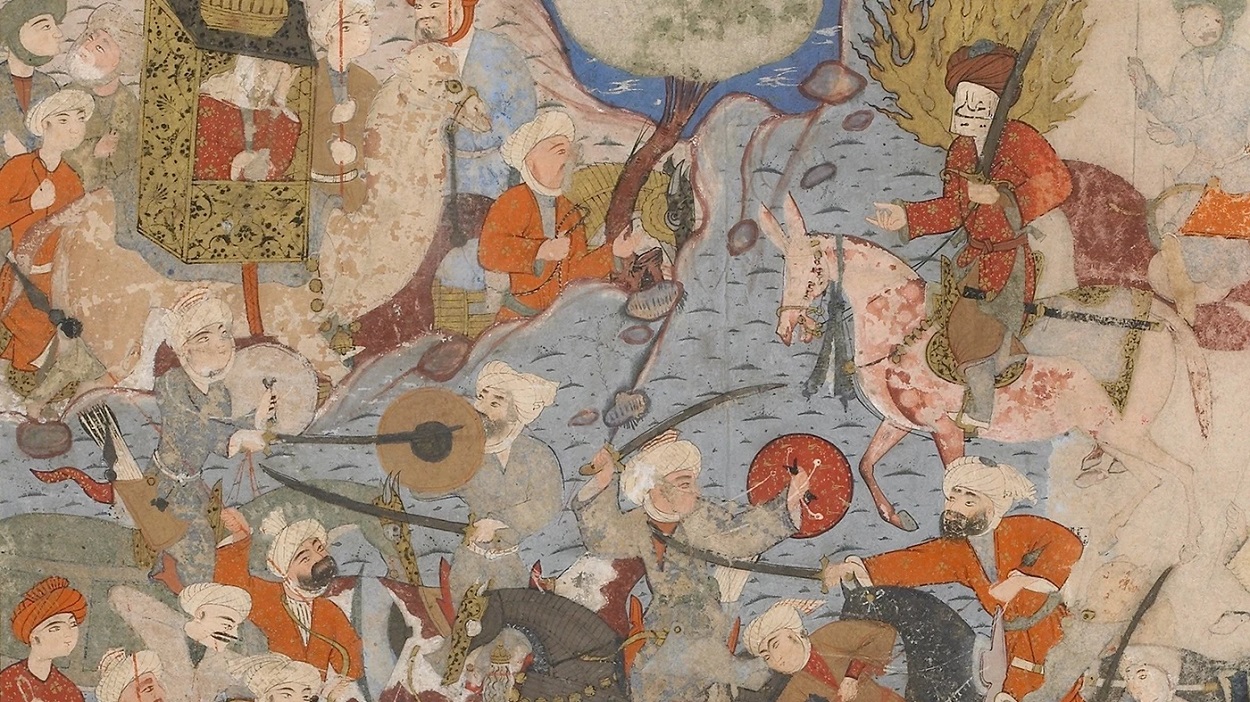
Aisha (L), at the Battle of the Camel

Founding fathers are often sacred, but not sacrosanct.

In recent years, Americans have wrestled with the slave-owning legacies of George Washington and Thomas Jefferson. Confederate statues have been toppled, ideologically refighting for some the Civil War. Pilgrims have become pillagers; Plymouth Rock equated with imperialism.

Muslims are having a similar moment.

Their prophet is called a pedophile. Their miracles, a myth. Successors to Muhammad are compared to ISIS. And it is not just Islam’s historic men. Two current global controversies concern two of the faith’s celebrated founding females: Aisha and Fatimah.

The International Union for Muslim Scholars has renewed its call for an international ban on insulting religions. And from India to England, Muslims have poured into the streets this month in protest.

Christians—whether leading such polemics or suffering under blasphemy accusations—have often been embroiled in such Muslim controversies. These latest episodes, many are relieved, are centered elsewhere.

“But Christians in both India and Pakistan are quite frightened,” said Juliet Chowdhry, a trustee for the British Asian Christian Association. “It is inevitable that as a vulnerable religious minority that is incorrectly perceived to be in league with the West, Christians will find themselves caught up in the anger.”

Thus they are keeping silent, said a Christian leader in Pakistan who—illustrating the point—requested anonymity due to the sensitivity of the situation.

Last month [May 26], a spokesperson for the ruling Bharatiya Janata Party (BJP) in India cited Aisha, often considered the favorite wife of Muhammad. Appearing on a talk show with Muslims, the Hindu official responded passionately when chided about a disputed temple.

Her prime minister, Narendra Modi, has led India in the direction of Hindu nationalism, stoking tensions with its 15 percent Muslim community. Though always a minority religion there, Islam ruled the subcontinent for centuries, with some ancient temples turned into mosques.

In one location, shivling idols were allegedly discovered last month. The Muslim talk show guests said no, their shape—holy to Hindus in honor of Shiva—resembled instead a fountain. The panel then descended into a heated discussion over the mocking of gods and goddesses.

“Should I start mocking claims of flying horses … and having sex with [Aisha] when she turned nine?” exclaimed the official. “Should I start saying all these things that are mentioned in your scriptures?”

Buraq is the name of the winged animal mentioned in Islamic tradition as carrying Muhammad on a night journey from Mecca to Jerusalem. Similar traditions quote Aisha on her tender age at the time her marriage was consummated, while some more contemporary scholars cite evidence to argue she was in her teens.

At least 15 majority-Muslim nations—led by those in the Arabian Gulf—have condemned India, which in turn censured both the BJP spokesperson and another offending official. The grand mufti of Oman called the comments a “war on all Muslims,” while Egypt’s al-Azhar mosque described them as “real terrorism.”

Muhammad was 53 when he married Aisha, and Islamic sources indicate a happy existence together. Aisha grew up to become a scholar and a military leader, often honored by modern day Muslims as an example of feminist egalitarianism.

But she is also a center of controversy—resurrected in a recent British film.

After the death of Muhammad, a faction of Muslims believed leadership should remain in the bloodline of the prophet. Known as Shiites, this sect believes the caliphate was promised to Ali, the prophet’s nephew and husband to his daughter, Fatimah. About 10–15 percent of Muslims are Shiites, with the great majority residing in Iran, Iraq, India, and Pakistan.

Sunnis, the majority sect, believe Muhammad did not designate a successor. The community then met to elect one, a caliph, and the first three were chosen from among Muhammad’s closest companions. Ali became the fourth caliph, but in a clash known as the Battle of the Camel, Aisha rode the Arabian dromedary in a rebellion against him.

The Lady of Heaven builds its story around Fatimah, who Muslims esteem as akin to Mary, the mother of Jesus.

In a poignant introductory scene, Fatimah is introduced as the first victim of terrorism, paralleled as an elderly woman comforts an Iraqi child whose mother was killed by ISIS. Winning awards for visual effects, the $15 million partisan film relates a Shiite perspective that the famed daughter of Muhammad died in childbirth—due to injuries suffered earlier in a raid ordered by his first successor.

Sunni orthodoxy honors the first four caliphs as “righteous.” Thereafter the community descended into civil war, with Ali and Fatimah’s children on the losing end. Hussain, the younger of two sons, was killed in battle, and his commemoration by Shiites is often accompanied by mourning and ritual self-flagellation.

Though Shiite-dominated, Iran banned the film as divisive to the Muslim community, while Pakistan, Egypt’s al-Azhar, and the Muslim Council of Britain all condemned it also. Following large-scale Sunni protests, most UK cinemas canceled upcoming screenings. According to Rotten Tomatoes, the film’s approval rating…

This article was originally published at Christianity Today on June 24, 2022. Please click here to read the full text.

Categories
Americas Christianity Today Published Articles

Should Christians Quote Muhammad?

This article was first published in the January print edition of Christianity Today.

Christians Quote Muhammad

Christians breathed a sigh of relief last October when Pakistan’s Supreme Court acquitted Asia Bibi, a Christian mother of five on death row, of blasphemy charges against Islam. What many might not have noticed was the Islamic rationale.

Whether or not she spoke against Muhammad, Bibi was insulted first as a Christian, wrote the judge. And on this, the Qur‘an is clear: Do not insult those that invoke other than Allah, lest they insult Allah in enmity without knowledge.

The verdict also quoted Islam’s prophet himself: “Whoever is cruel and hard on a non-Muslim minority, or curtails their rights … I will complain against the person on the Day of Judgment.”

And finally, it referenced an ancient treaty that Muhammad signed with the monks of Mount Sinai: “Christians are my citizens, and by God, I hold out against anything that displeases them.… No one of the Muslims is to disobey this covenant till the Last Day.”

Today it can seem like Muslims violate this covenant the world over. But does the Bibi decision validate those who insist that Islam rightly practiced is a religion of peace? And should Christians join Muslims to share verses that comprise the Islamic case for religious freedom?

CT surveyed more than a dozen evangelical experts engaged with Muslims or scholarship on Islam who reflected on three key questions when considering interpretations of Islam that favor religious freedom.

[These questions are: Is it true? Is it helpful? Is it enough?]

Please click here to read the full article at Christianity Today.

Also: click here to read my related Christianity Today article about The Covenants of the Prophet Muhammad with the Christians of the World, the book which describes the Sinai treaty mentioned above, and others.

Finally, here is a sidebar from the Should Christians Quote Muhammad article, identifying sources in the Islamic tradition on which the evangelical scholars reflected.

Quranic verses regarding Christians:

• Q5:82 – You will find the nearest of them in affection to the believers those who say, “We are Christians.” That is because among them are priests and monks and because they are not arrogant.

• Q2:62 – Indeed, those who believed and those who were Jews or Christians or Sabeans those who believed in Allah and the Last Day and did righteousness—will have their reward with their Lord, and no fear will there be concerning them, nor will they grieve.

• Q22:40 – And were it not that Allah checks the people, some by means of others, there would have been demolished monasteries, churches, synagogues, and mosques in which the name of Allah is much mentioned.

• Q29:46 – And do not argue with the People of the Scripture except in a way that is best.

• Q2:256 – There shall be no compulsion in religion. The right course has become clear from the wrong.

Texts used in Supreme Court of Pakistan acquittal of Asia Bibi:

• Christians are my citizens, and by God, I hold out against anything that displeases them. No compulsion is to be on them … The Muslims are to fight for them … Their churches are to be respected. No one of the Muslims is to disobey this covenant till the Last Day (Covenant with the Monks of Mount Sinai)

• “Beware! Whoever is cruel and hard on a non-Muslim minority, or curtails their rights, or burdens them with more than they can bear, or takes anything from them against their free will; I [Prophet Muhammad] will complain against the person on the Day of Judgment.” (Abu Dawud)

• Q6:108 – “And do not insult those they invoke other than Allah, lest they insult Allah in enmity without knowledge. Thus We have made pleasing to every community their deeds. Then to their Lord is their return, and He will inform them about what they used to do.”


Categories
Asia Christianity Today Published Articles

Covenantal Theology: Can Muhammad’s Ancient Promise Inspire Muslim-Christian Peace Today?

Supreme Court of Pakistan
(Reuters)

This article was first published at Christianity Today, on December 21.

Christians esteem the biblical progression of covenants—Abrahamic, Mosaic, Davidic—finalized by Jesus as he ushered in the New.

But for the sake of religious freedom in the Muslim world, should they embrace a further covenant: Muhammadian?

Recent scholarship suggests the potential promise, newly fulfilled in Pakistan.

After eight long years on death row, Asia Bibi was acquitted of blasphemy by the Muslim nation’s Supreme Court in late October. The Christian mother of five had been sentenced for uttering contempt for Muhammad, the prophet of Islam, while attempting to drink water from a well.

The three-judge panel ruled that contradictions in accuser testimony and Bibi’s forced confession by a local cleric rendered the charges invalid. But in the official court document, one justice went as far as to partially base his judgement on how Bibi’s accusers violated an ancient covenant of Muhammad to the Christian monks of Mount Sinai—“eternal and universal … not limited to [them] alone.”

“Blasphemy is a serious offense,” wrote judge Asif Khosa, “but the insult of the appellant’s religion … was also not short of being blasphemous.”

He referenced a 2013 book by John Morrow, a Canadian convert to Islam. The Covenants of the Prophet Muhammad with the Christians of the World is an academic study of six treaties commanding the kind treatment of Christians, reportedly dated to the seventh century.

Each similar in scope, they command Muslims not to attack peaceful Christian communities, to aid in the construction and repair of churches, and even to allow self-regulation of tax payments.

It is “nothing short of providential,” Morrow wrote, that they have been “rediscovered” at a time of widespread Islamist violence against the Christians of the Middle East.

“For Muslims, it means a wake-up call, an awareness that they have deviated from the Islamic tradition,” Morrow told Patheos, a popular religion and spirituality website.

“[It] requires that Muslims not only tolerate Christians, but love them as their brothers and sisters.”

This resonates with…

Please click here to read the full article at Christianity Today.

Categories
Excerpts

Islamists Elsewhere

Islamism Asia

The Atlantic has an insightful piece on the history of American engagement with political Islam. It is written by authors previously recommended as scholars of the movement.

The whole is worth reading, but here is an excerpt describing non-Arab Islamist success — outside of the political process.

It is often assumed politics and governance is the standard of judgment. But is that the case?

Pakistan’s Islamists provide an intriguing counterpoint to the Moroccan “model.” Yet it is a counterpoint that very few Moroccans—or Arab Islamists anywhere—seem much interested in.

Jamaat e-Islami, Pakistan’s Muslim Brotherhood analog, usually wins only a handful of parliamentary seats, yet, as Spiegel points out, the movement may very well be more influential than its Moroccan counterpart, in terms of “influencing judicial appointments, religious tradition, educational mores, and societal norms writ large.” There are other ways of winning besides, well, winning.

In Southeast Asia, Islamist parties, while gaining a significant share of the vote, have not been able to win outright on the national level.

They have, however, helped “Islamism” spread throughout society and become normalized, with even ostensibly secular parties embracing the idea that Islam—and even explicit sharia ordinances—have an important role to play in public life. The lesson here may appear counterintuitive.

The worse Islamists do in elections, the less of a threat they pose to their non-Islamist competitors, who, in turn, seem to have less of a problem appropriating Islamist styles for their own electoral purposes.

Of course, the causal relationships become complicated: One of the reasons that Islamists don’t do as well in South and Southeast Asia is because they’re less distinctive, since these societies seem to have coalesced around a relatively uncontroversial conservative “middle.”

Democracy empowers and encourages all parties, Islamist or otherwise, to seek the center, wherever that may be. As the center shifts rightward, Islamist groups are further emboldened, particularly in polarized societies where candidates pay little price for their radicalism.

It is little surprise, then, that Indonesia, the largest Muslim democracy in the world, has seen a sectarian upsurge. (In May 2017, a Muslim candidate who had developed a reputation as a young “moderate” played on hardline conservative sentiment to unseat the governor of Jakarta, a Christian, who was subsequently imprisoned for blasphemy.)

People often say that Islamism has already conquered Egypt, even if the Brotherhood lost. There is a conservatism to society that wasn’t always here, at least as judged by photos of teachers and students from the 1950s and earlier.

Cairo University Islamism
Cairo University, 1959.

There is also this interesting nugget on Islamists at home:

By the time the Arab uprisings toppled regimes in Tunisia, Egypt, and Libya in 2011, the United States had already begun thinking about a new approach toward Islamists.

In 2010, the National Security Council began work on a Presidential Study Directive focused on the question of what a push for genuine political reform in the Middle East would look like—including the normalization of Islamists as political actors.

The immediate challenge after the revolutions of 2011 was therefore not one of deciding whether to increase engagement with Islamists—the Obama administration had already come around on that issue—but rather the question of how and to what extent to undertake such a shift.

I either didn’t know or had forgotten this data point. With all the Egyptian accusations that the US was plotting the Muslim Brotherhood takeover of the nation, it would have been poignant consideration at the time — and now.

Categories
Asia Christianity Today Published Articles

They Will Know We are Christians by Our Drinks

This article was first published in the April print edition of Christianity Today.

Muslim World Alcohol

The deadliest incident faced by the persecuted church last Christmas wasn’t radical Islamists. It was alcohol.

Liquor mixed with aftershave killed about 50 people at Christmas parties in a Pakistani village, and sickened about 100 more.

In Pakistan, as in many Muslim-majority nations where Shari‘ah law forbids drinking, alcohol is closely identified with Christianity. The nation’s primary alcohol producer, for example, riffs on the Bible in advertisements. Founded in 1860 by the British, Murree Brewery’s slogan, “Eat, drink, and be Murree,” echoes the repeated biblical idiom for short-term pleasures.

Perhaps as surprising as the existence of a Pakistani brewery is the fact that 12 Muslims were among the victims of the fatal Christmas parties. But in 2007, then–Murree CEO Minnoo Bhandara told The Telegraph that 99 percent of his customers are Muslims. And in the Middle East, alcohol sales increased 72 percent from 2001 to 2011, according to market research.

Still, in most Muslim countries only Christians may buy or consume alcohol. But not all do. Wilson Chowdhry, chairman of the British Pakistani Christian Association, estimates that about half of Pakistani Christian men drink. Roman Catholics are slightly more inclined; Protestants less so. But the women of both branches of Christianity, he says, are fully opposed.

Chowdhry, an evangelical, believes alcohol is licit for the Christian; but in deference to his wife, he does not drink. Common arguments in Pakistan will feel familiar to Americans…

Please click here to read the full article at Christianity Today.

Categories
Excerpts

Why the Carnage in Pakistan?

Pakistan Lahore Easter
(via pakistantoday.com)

At least 69 people are dead in the Pakistani city of Lahore, many of them from Christian families celebrating Easter in a public park.

The Pakistani Taliban has claimed responsibility, stating it directly targeted Christians and promises further attacks in the future.

From Lapido Media, an anonymous British NGO worker provides a first-hand account:

A crowd of some 25,000 protesters had gathered in Rawalpindi, Islamabad’s twin city, and after prayers, started marching towards the capital. As night fell they arrived in front of the National Assembly building and fighting broke out.  Tear gas was fired, and the rioters smashed Islamabad’s new metro bus stations, assembled at great expense only a year earlier.

As we drove home from Easter Sunday celebrations we could hear the chanting: thousands of people in the heart of Pakistan’s capital city demanding that the government institute a policy of ethnic cleansing.

A challenging question is why such brutality exists, coupled with hardcore support for a blasphemy law that further targets religious minorities.

The author takes note of many signs of tolerance emerging after the tragedy in Lahore, and finds hope:

While there are Muslims who pray for the rights of Pakistani minorities; while there are Muslims who text me condolences on the Christian lives lost in Lahore; while there are Muslims who risk their lives to demand government action against radical clerics who openly declare their support for Islamic State –while such people exist, there is hope for Pakistan.

But he also lays blame on one man in particular who set it all in motion:

It is not easy to step back from three decades of officially-sanctioned Islamism; the retrogressive reforms of General Zia, who strengthened the blasphemy law and degraded the rights of Pakistani women, cannot be undone without a fight.

At such analysis Countercurrents balks:

There is a tendency among historians and analysts to place most if not all of the blame for the current state of affairs on the shoulders of the US-sponsored dictator General Zia-ul-Haq.

Instead, the author faults the very movement that created Pakistan in the first place:

In the late 1930s, elements within the Muslim elite, motivated by narrow and selfish interests, began to aggressively pursue an agenda involving the creation of a separate state for India’s Muslim population.

The oft-repeated phrase “Jinnah’s Pakistan” should be familiar to even the most casual observers. Those who conjure up this tired slogan whenever minorities are targeted must come to terms with the fact that it was the “Quaid” himself who set the dangerous precedent of using communalist rhetoric for political ends.

Jinnah, a westernized, non-practicing Muslim, cynically raised the cry of “Islam in Danger” as part of his campaign to drive a wedge between Muslims and Hindus and gain support for the partition of the Indian subcontinent among the sections of the Islamic clergy.

Based on the bogus claim that Muslims and Hindus constituted two distinct nations, the partition that gave birth to the “Land of the Pure” was a tragedy of immense proportions, resulting in an orgy of violence and untold suffering for millions of people on both sides of the artificial border.

What is happening is simply the inevitable result of official policy…

… rooted in Pakistan’s creation through the partition, that encourages the identification of Islam with the state, consequently diminishing non-Muslims to second-class status while also fanning the flames of religious fundamentalism and strengthening the power of the clerics.

Quartz, however, wants to absolve Jinnah, quoting:

His speech advanced the case for a secular, albeit Muslim-majority, Pakistan: ‘I cannot emphasize it too much. We should begin to work in that spirit and in course of time all these angularities of the majority and minority communities, the Hindu community and the Muslim community … will vanish.’

And again:

You are free; you are free to go to your temples, you are free to go to your mosques or to any other place of worship in this State of Pakistan. You may belong to any religion or caste or creed—that has nothing to do with the business of the State …

Now I think we should keep that in front of us as our ideal and you will find that in course of time Hindus would cease to be Hindus and Muslims would cease to be Muslims, not in the religious sense, because that is the personal faith of each individual, but in the political sense as citizens of the State.

That this has not happened is a fault that rests in the decline of the state itself:

Pakistan’s most prominent human rights activist, Asma Jahangir, warns that the worst is yet to come. ‘Past experience has shown that the Islamists gain space when civilian authority weakens,’ she pointed out in an article a few years ago.

‘The proliferation of arms and official sanction for jihad have made militant groups a frightening challenge for the government. Pakistan’s future remains uncertain and its will to fight against rising religious intolerance is waning.’

I am no expert in Pakistan, but right or wrong, this is analysis. The greater question is what can be done about it.