The last three years in Egypt have been troublesome. Find a culprit, and force your way.
An early culprit was Mubarak. Today he faces a verdict that may exonerate him.
The current culprit is the Muslim Brotherhood, according to a national fact-finding investigation into the post-June 30 violence. They initiated the violence in the dispersal of their pro-Morsi sit-in, and followed it up against Christians across the nation.
An ongoing culprit is also named. The security services exercised an inordinate and random response, resulting in hundreds of deaths. They have the ire of Islamists who called for nationwide protests this weekend, but did not galvanize.
God, of course there are many to blame. Find them and transparently hold them to account. But blame deflects from one’s own culpability.
Give Egypt humility, and help her hold herself to account.
For it far easier to impose. The state has the strength and is asserting its right. Thousands have been arrested and dissenters marginalized.
But even weakness seeks to impose. A Salafi group, backed by the Brotherhood, called on the masses to impose sharia law and Islamic identity.
Each is trying to fix what went wrong.
The state does not wield the sword in vain, God, you have asked it to maintain justice and order. But the human impulse to blame and impose contradicts other principles you demand. Mercy, patience, confession, and other-centeredness – these are absent among too many.
Preserve goodness in Egypt, God. Protect her against those who wish her ill, but may she not respond in kind. Generate a wide consensus, so that no force is necessary.
Issue no blame, God, and impose no wrath. Forgive, and rebuild Egypt.
Translation: We are those who pledge allegiance to Muhammad. The Battle for Identity, November 28. On the flag is the Muslim creed, there is no god but God, and Muhammad is his messenger.
Happy Thanksgiving to American friends and family, but as you are thankful today be aware about tomorrow, at least as concerns your interest in Egypt. Friday may be black here as well.
There are two reasons this could be true.
First, the Salafi Front has called for nationwide demonstrations, seeking a ‘Muslim Youth Uprising’. They announce their intention to ‘impose Islamic identity’, feeling it weakened by secular efforts against sharia. Within their propaganda are pictures of the black flag of Islam, used by the Islamic State in Syria and Iraq. This connection does not come through in their rhetoric (that I have seen), and the flag has a place in Islamic history beyond current use by jihadis. They do, however, support a caliphate in principle and have criticized the government for calling it terrorism.
Second, this same government has promised to meet the protests firmly, threatening live ammunition if they turn violent or destructive. If Egypt has another round of deaths the day will surely be black.
It is difficult to say if the turnout will be simple or substantial. Egypt’s largest Salafi party has condemned the protests, as have the official religious establishments. But noteworthy is that the Muslim Brotherhood has announced its support, though it has not publicly indicated if it will participate.
The Brotherhood statement indicates a desire to ‘preserve’ Islamic identity, avoiding the Salafi Front’s use of ‘impose’.
It would be good if they were able to be contacted within Egypt, to further explore their meaning. Certainly the Brotherhood needs others to protest with them, as they are in a very poor situation currently. If the regime is to fall, they need allies.
But here, it is the Brotherhood supporting others. And what does it mean that they have chosen these allies?
In the West there is understanding that the Muslim Brotherhood is a moderate Islamist organization. Indeed, since the fall of Morsi they have been consistent in their public posture not to employ violence. Whether or not this is truly the case is contested, but they present themselves as a democratic organization that can be trusted to govern well within the norms of the international system. If political change comes to the region, so goes the argument, better the Muslim Brotherhood through the ballot box than the jihadis through the sword.
In Egypt people have been aware of Muslim Brotherhood double-speak for some time. But in announcing their support for a rally to ‘impose Islamic identity’, could their intentions be clearer? Some room should be given for nuance, of course, and desperate people do desperate things. The enemy of my enemy is my friend, it could be argued.
Please monitor the news tomorrow, and see how events are reported. Will the demonstrators be labeled as Salafi crazies, akin to the Islamic State? Or will it be a ‘revolutionary’ action, against the ‘coup’?
And be thankful for your identity, whatever it is. In Egypt as in America there is much to be thankful for, no matter the current unrest. Many, of course, are disagreeing to the point of protest. Be thankful for this right as well, if you have it, but be wary about imposing.
Does an Islamic identity demand its imposing? This Thanksgiving, the Muslim world is being forced to confront the question. For the good of the world, be thankful the conversation is happening, and may all decide rightly.
When all is not well the wounds can go deep. Continued health demands paying attention.
The Muslim Brotherhood has stumbled badly. Tripped deliberately or drunk with power, their wound still feels fresh to many. And the United Arab Emirates throws salt on it by designating them – and allegedly connected organizations – as terrorist entities.
But the wound in the Gulf is treated carefully. Qatar, isolated politically from her neighbors, is restored into fellowship with Saudi Arabia and the Emirates. Agreeing to tone down her rhetoric against Egypt, they tone down support as well for the Brotherhood.
The wounds of many have been left to fester. The anniversary of the Mohamed Mahmoud clashes passed with little remembrance, as revolutionary activists lament missing justice. One former Brotherhood member beloved of most activists had long withdrawn from many in depression. She committed suicide only a few days earlier.
God, the Brotherhood is mentioned in all the above, but there are many wounded beside. Indeed, they caused much of the wounding. But whether activists or old guard, Islamists or Christians, Bedouins or police, tour guides or the average Egyptian, many are nursing their lingering bruise.
Having a wound implies neither innocence nor guilt. All it implies is the need for healing.
Some wounds demand amputation. God, help Egypt, the region, and the world judge the Brotherhood correctly.
But deal mercifully with all taken in by the promise of the Brotherhood, who currently at least have had their dreams derailed. Deal mercifully as well with those enamored of the revolution, who find their sacrifices have been in vain.
Guide them, God, so that they may reflect correctly. But heal them and restore them to wholeness.
But even treated wounds can leave a scar. And a scar can boost pride and intimidate others.
For those wounded early in the revolutionary period, many have rebounded. They were trampled on by the dreams of others, and many were enamored with their fall. May they now deal mercifully.
Guide them, God, so that they may reflect correctly. But heal them and restore them to wholeness.
But after their individual healing, God, judge righteously between them. Hold accountable all who have erred. Deal mercifully, but restore society to wholeness.
And if Egypt heals, may the Gulf as well. Not just politically, but in full conformity with your will. Bless the region, God, and all its people.
Her wounds are deep and stretch back decades, even centuries. May all pay attention, and in good health, continue.
A desperate Egypt reaches out to the West, trying to communicate the dire threat of terrorism.
A celebrity researcher ties this terrorism to the Muslim Brotherhood, and the West yawns.
But 33 soldiers died last Friday in separate brazen attacks on security personnel in Sinai, and now Egypt’s Christian leaders have picked up the mantle to call for help.
‘Egypt now needs the support of its friends,’ wrote Revd Mouneer Hanna, Anglican Bishop of the Diocese of Egypt, in an open letter on the diocesan website. ‘This support involves understanding of the real situation.’
One week earlier Revd Andrea Zaki, general director of the Coptic Evangelical Organization for Social Services, joined a semi-official Egyptian delegation to the United States. It was made up of diplomats, journalists, civil society members, and men of religion, who were eager to present Egypt’s perspective to a sceptical West.
On many issues Zaki found an agreeable reception. But their counterparts in Washington DC bluntly told the group that the Egyptian government has not provided ‘clear evidence’ linking the Muslim Brotherhood to the ongoing terrorism campaign.
Due process
Perhaps this is because Egypt appears to be giving this ‘evidence’ first to the people, and only later through judicial channels. This reversal of due process causes Western observers to be dismissive.
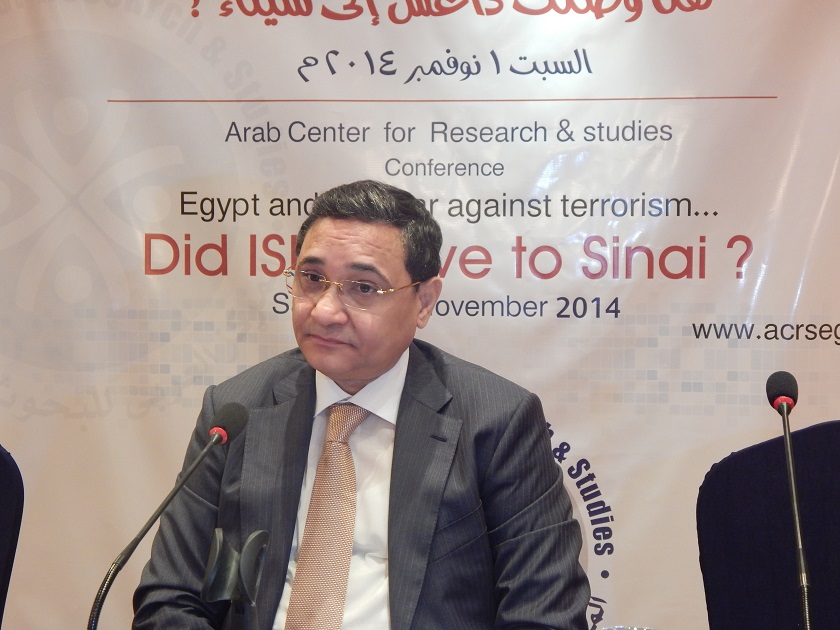
‘Isn’t he that guy on television with the crazy theories?’ remarked a European journalist as Abdel Rahim Ali walked into the room to hold a press conference on 1 November on the possible emergence of ISIS in Sinai. The mixed crowd of Egyptians and Westerners awaited his evidence.
Ali expects the ‘Supporters of Jerusalem’ – a home-grown terrorist outfit operating out of Sinai – to soon announce their allegiance to ISIS. Abu Hamza al-Muhajir, he said, was an associate of Abu Musad al-Zarqawi in the Islamic State of Iraq and believed to be killed by US forces in 2010.
But some evidence suggests he is still alive and operating out of the Sinai with the Supporters of Jerusalem, Ali said.
On 4 November, without mentioning al-Muhajir, Reutersconfirmed Ali’s prediction of the merger with ISIS. But Egyptian state-run Ahram Onlinedenied the news, quoting from what is alleged to be the Supporters of Jerusalem’s official Twitter account, @3Ansar_B_Almqds.
Leaked conversations
In Ali’s presentation, however, the source of his evidence was not provided, fitting with his general modus operandi. Host of the popular television show, ‘The Black Box’, and editor-in-chief of al-Bawaba newspaper, Ali regularly releases leaked conversations of revolutionary and Islamist figures.
Despite their illegal nature, Ali operates freely. And he freely admits his sources are connected to the security apparatus.
One of the most damning allegations concern leaked recordings of phone calls between President Morsi and Ayman al-Zawahiri, leader of al-Qaeda. In them an agreement is made to cease operations against Egypt while allowing jihadist groups to exist on Egyptian soil.
In this context, reference in Bishop Mouneer’s open letter about the Brotherhood finds verification. He spoke of the Muslim Brotherhood leader Mohamed el-Beltagi’s statement from the pro-Morsi sit-in at Rabaa in Cairo, prior to its bloody dispersal.
‘We do not control the situation on the ground,’ Beltagi said in a July 2013 video on YouTube. ‘But what is happening in Sinai …will stop the moment …the president [Morsi] returns to power.’
Bishop Mouneer told Lapido Media that, like many others, he is not happy that thousands of people are currently in prison without judicial rulings. He understands this makes the West feel Egypt is being very harsh with the Muslim Brotherhood.
But after listing a long litany of Brotherhood offenses – attacks on protestors, churches, and calls for jihad in Syria – he provides Egyptian perspective on this reversal of due process.
The courts are slow, he said, and Egypt is in a state of war against terrorism: ‘In times of war countries sometimes take extraordinary measures, such as America with Guantanamo Bay.
‘In order to educate the people and influence public opinion, [security] leaks some of these things.’
But of these recordings and allegations, Bishop Mouneer cannot say what is true and what is not, as long as Ali does not release his sources.
Similarly, Zaki does not feel compelled to make the case against the Muslim Brotherhood for the sake of his American audience. ‘This is the responsibility of the government,’ he told Lapido Media.
But he does want to convey Egypt’s general satisfaction with the situation following the post-30 June deposing of Morsi. The military answered the call of millions, he said, and the people ratified this action in subsequent elections.
Acceptance
This message is beginning to be heard. Zaki said the Americans expressed their acceptance of President Abdel Fattah al-Sisi’s government, as well as the necessary role of Egypt’s military in fighting terrorism.
Economic support will also be forthcoming at the expected 21 February economic summit in the resort city of Sharm el-Sheikh, the Americans told him. Egypt will present investment opportunities in fifteen projects worth $100 billion.
But the message of Egypt’s popular belief in Muslim Brotherhood culpability in terrorism is still awaiting judgment in the West. The Whitehall report authorised by the British government remains delayed.
‘I have no idea about the link between the Muslim Brotherhood and al-Qaeda,’ said Bishop Mouneer, expressing more caution than many Egyptians.
‘But I know one thing, we were going backwards during the time of Morsi.’
This article was originally published on Lapido Media.
Estimates say the number of Egyptian recruits in ISIS equal 8,000, perhaps 20-30 percent of their fighting force. A report indicates ISIS is in direct communication with Sinai-based terrorist groups to train in creating cells to attack security personnel.
But while some say the ISIS mentality is present among Egyptians, especially in Upper Egypt, there has been little quantifiable data to go by.
A recent poll published by the New Republic, relying on surveying efforts by the Fikra Forum, finds only three percent of Egyptians have a favorable opinion of ISIS. By contrast, and also noteworthy, 35 percent support the Muslim Brotherhood.
A few observations: First, three percent of 90 million people is still a very large number. How might you feel if your neighbor was one of the 2.7 million?
Second, the Egyptian government purports a link between groups like ISIS and the Muslim Brotherhood. Whether or not this is true operationally, on the ground there is a huge contrast. The great majority of Brotherhood supporters do not find common cause with the jihadis of Syria and Iraq.
Third, the common Western assertion is that Egypt following the coup is a polarized society divided against itself, while the common Egyptian assertion is that the country is united against the Muslim Brotherhood. This finding, if correct, undermines both claims.
If a full one-third of society rejects the political system, the claimed unity is an illusion that ignores or purposefully downplays a palpable frustration. On the other hand, if only one-third of an electorate opposes the majority political view, evidence is lent to the argument that Egypt was and still is greatly behind the June 30 revolution and the danger posed by Brotherhood leadership.
Of course, even here caution is needed. Some may have supported the removal of Morsi but still see the Muslim Brotherhood as an essentially good organization, serving society. And others may hold strong objections to the ideology of the Brotherhood yet believe they are still treated unfairly. The polling data released is not specific enough to nuance beyond the larger percentages.
But the percentages are significant even so. Egypt is mostly against the Brotherhood, and almost entirely against ISIS. The troubles lie in the many real people covered over by a minority statistic.
Important note: H.A. Hellyer, who has extensive experience in following Egyptian survey organizations and urges caution about their general reliability, does not recognize the Fikra Forum as a polling center.
A recent Foreign Policy investigative report details Qatari foreign policy. It describes a strategy of intervention-by-proxy, which keeps its hands clean officially while funneling money to groups it deems ideologically similar, that is, those they can trust.
Primarily, this has been the Muslim Brotherhood and various activist Salafi factions.
The article is long but worthy, and one interesting section describes how Qatar has helped the US disengage from the region. This was evident in Libya, when Qatar not only provided crucial Arab support for the operation, but also took the lead in sponsoring militia groups against Gaddafi.
But now that the US is reengaging the region, this time against the Islamic State (ISIS), officials are examining anew the sponsorship by Qatari individuals and charities which have gone to the al-Qaeda affiliated al-Nusra Front. Following three years or more of looking the other way, the dispute has become public:
In Syria, meanwhile, it wasn’t until the Islamic State gained prominence that Washington sat up and took notice. In March, David S. Cohen, the Treasury Department’s undersecretary for terrorism and financial intelligence, took the unprecedented step of calling out the Qataris in public for a “permissive terrorist financing environment.” Such stark criticism, counterterrorism experts say, is usually left for closed-door conversations. A public airing likely indicated Doha wasn’t responsive to Washington’s private requests.
But if initial requests were private, that means the US – for a long while, at least – tolerated and possibly approved of the general strokes of Qatari foreign policy. Two key aspects of Qatar’s leverage over the United States include its hosting of the US Central Command air base, as well as the usefulness of its network to liaison with otherwise disreputable characters. Discussions with the Taliban in particular have often flowed through Qatar. Without them, back-door channels would not be possible; hostages released might still be held.
Has the US, therefore, been a partner in the wanton destruction of Syria? President Obama has forcefully spoken against Assad, but has never decisively moved against him. The article deems the chaos there less to be a result of coordinated conspiracy, than uncoordinated incompetence:
In other words, there was no one winner. Qatar and other international powers haphazardly backed dozens of different brigades and let them fight it out for who could secure a greater share of the funding. They had few incentives to cooperate on operations, let alone strategy. Nor did their various backers have any incentive to push them together, since this might erode their own influence over the rebels.
Says one analyst:
“One of the things about Qatar’s foreign policy is the extent to which it has been a complete and total failure, almost an uninterrupted series of disasters,” says Hussein Ibish, a senior fellow at the American Task Force on Palestine. “Except it’s all by proxy, so nothing bad ever happens to Qatar.”
Except its reputation in much of the Arab world. Egyptians in particular have been furious at Qatar over its support for the Muslim Brotherhood. Saudi Arabia and the United Arab Emirates have signaled displeasure in manners unusual among Gulf monarchies.
Long ago Qatar made a bet on the Islamist factions becoming the prominent power players in the region. For a while they seemed vindicated; now they appear in retreat. Qatar has been publicly acquiescing to the criticism, sending away top Brotherhood figures it has long hosted, for example, but it is unclear if its long term strategies have changed.
Were Qatar and its allies-by-proxy simply outmaneuvered? How much of the Arab Spring was manipulated by the regional and international power struggles? What role did America have is a key question. Most Arabs view Washington as the chief puppet master, allowing its public allies – the Saudis, Turks, UAE, Qatar, and Israel, of course – to mess around with local sovereignty.
Or, did the US just pull back, and allow others to run the show? Either way, the result is a disaster, however many parties share in the blame.
One other controversial point converges with this article. Many Egyptians see the Muslim Brotherhood as one aspect of an Islamist agenda that includes and coordinates with groups like ISIS, on the far end of the spectrum. The point is not necessarily that the MB keeps its hands clean while sending out clandestine orders to others to ferment chaos – though this is certainly believed locally.
But if the Brotherhood is one part, and a key part, of Qatar’s proxy network, a linkage does seem to exist. This article does not make the accusation, and I do not wish to lend it weight in the mentioning. But it bears consideration.
Of course, Brotherhood sympathizers simply turn the equation on its head. They see Qatar as the good guy, standing with the people and the forces of democracy, against fearful Gulf monarchies, their own proxies, and the US.
God bless this part of the world. Maybe one day the oil will run out and they can all be left alone again.
It is not as if this is the first time. Mutual acrimony between Israel and Hamas leads to the exchange of rockets, with deeply disproportional suffering. Now a land invasion is poised to begin.
Egypt has been the historic mediator, but this time – so far – unsuccessfully. Two years ago President Morsi, whose Muslim Brotherhood has ties with Hamas, brokered a ceasefire and relative lull in hostilities. This time the violence continues despite Egypt’s efforts, and peace is as far away as ever.
Meanwhile Egyptian society is torn. The people of Gaza lack their standard sympathy due to widespread sentiment Hamas has been destabilizing Egypt through the Sinai. But an anti-Zionism is always present, and as the Palestinian casualties mount the Egyptian frustration mounts with it.
God, is there an answer? Must Hamas be destroyed? Must so many people of Gaza die? Must rockets rain down on Israel? Must the Zionists be driven back to where they came from?
God, there must be a better answer. Help Egypt have a share in finding it. Help world sympathy for all not falter. But help Palestinians and Israelis to reconcile. Help justice to be done.
For justice is a sticking point. The terms are not equal. Palestine is under occupation. Stand with all who suffer, give them relief, and help them to honor moral convictions and call out to you.
Feeling triumphant, too many rejoice in the suffering of others. Feeling aggrieved, too many strike out at innocents. Feeling in need of world opinion, too many manufacture propaganda. Feeling in need of domestic support, too many dehumanize their enemy.
But if they call out, God, answer them and give repentance and forgiveness. Answer them and give initiative and creativity. Answer them and give a just political solution. Answer them and give social peace and mutuality.
Help them find the way, God, first through their own hearts, and then through the hearts of their enemy.
This is not the first time these prayers have been necessary; in man’s estimation it is unlikely to be the last. Remove acrimony and exchange love, God, however impossible it may seem. The sins of all are infinitely disproportionate to your grace, so have mercy.
President Sisi has been elected, and everyone wonders what will be next. Will he continue the crackdown on the Muslim Brotherhood, as indicated? What does it mean that the Salafi Nour Party is backing him? Is Sisi an Islamist-of-sorts himself? Is he a dictator in the making? Does his presidency herald a coming liberal era?
For these answers one must wait and see. But beyond the obvious divide that exists in Egypt lies one reality: The constitution obliges parliament to issue a law on transitional justice in its first session. Having suffered – or celebrated – the fall of two presidents in three years, political frustrations exist among many. Far beyond frustrations, many are dead due to political violence. Few have been held accountable.
Transitional justice promises much; in theory and often in international practice it leads to national reconciliation. Will it in Egypt?
Again, one must wait and see. But ‘Adil Mājid, vice-president of the Egyptian Court of Cassation and an honorary professor of law at the UK’s Durham University, is one with a vision. In July 2013 he wrote an article putting forward the requirements of national reconciliation at a time the concept was first discussed after the fall of Mursī.
I have translated his article here, published at Arab West Report.
A year later, Mājid is very critical of early efforts, but is hopeful that with a new president and coming parliament, the groundwork is better laid. Though obstacles remain, in an interview he described his hope for transitional justice given current realities, in the framework of his earlier article.
This vision is given here, also at Arab West Report.
Of course, even worthy endeavors like transitional justice and national reconciliation can be employed for less than worthy ends. Mājid is well aware of this possibility. But in answering the questions posed above about the Muslim Brotherhood, Islamism, dictatorship, and a liberal era, a key indicator to watch will be how it is used, worthily or otherwise. Will it heal the nation, or hurt it further?
Please read the linked reports for indications from a respected expert. Then watch carefully, and judge accordingly. Justice and reconciliation are concepts to be respected, necessary for the well-being of any nation. May they be pursued with truth and transparency.
Algeria celebrates its World Cup victory over Russia.
It has been a rather subdued World Cup so far in Maadi, Cairo. The cafes are full but by no means crowded. This World Cup has been a gem of a tournament, with average goals scored hovering around three per game.
But it is not attracting local attention in our neighborhood. Most space is empty when the matches begin. Throughout shisha smoking and backgammon hold more interest. Only a few hard core supporters cry out for a goal.
The television announcers are animated, however. A few days ago as the Russia-Algeria match crept to a close, with a 1-1 draw securing advancement for the North Africans, the Arabic boomed with each crucial clearance:
Allahu Akbar! Allahu Akbar!
But the final whistle prompted nary a cheer from the audience. There was no visible support for Russia, but little excitement for Algeria, either. While BeIn Sports, recently re-branded away from similarity to the al-Jazeera chain of stations, urged on their Arab (Muslim?) brethren, Egyptians present chattered, smoked, threw dice, or otherwise walked away at the completion of the match, as they have done for all others I have watched so far.
Egypt is not exactly a bastion for Arab nationalism, and the two national teams have a history of dislike, filled with riots and bus stonings. Algeria booted Egypt from qualification in the 2010 World Cup.
But Egypt perhaps should be such a bastion, for Nasser was the revered leader of Arab nationalism, and current president Sisi has been cast in his image. But Sisi has also fostered an Egypt-centricity against the alleged global machinations of the Muslim Brotherhood and world community. Right now, Egyptians just hope the wars engulfing their neighbors do not cross over their borders. There is a general pox on the Arab Spring in general and what it has wrought.
Algeria bears no crime in this analysis, but local Maadi residents have lent them little love.
It is still interesting to watch the ex-Jazeera broadcast celebrate. Americans are used to a local broadcast openly rooting for the home team, but would see as improper for an American announcer to openly cheer on England, say, against an African squad.
BeIn Sports is a creation of the Qatar media conglomeration, which apparently does not share the same sense of neutrality, or political correctness, or whatever this should be called. They also stand accused of overt support for the Muslim Brotherhood, earning them the animosity of millions of Egyptians. The recent sentencing of al-Jazeera journalists has been widely condemned internationally, but in local perspective the channel actively fabricated events.
Local residents highlight this video from an area near the bloody dispersal of the Rabaa sit-in, in which Islamist youth activist Abdel Rahman Ezz describes airplanes shooting live ammunition on the protestors. It is shown on the Rassd network, accused of being a Muslim Brotherhood arm, but whether or not such videos are tied to Jazeera journalists in question is a matter of contention. Certainly the judge believed so, or made it out to be, amid the hours of other completely non-related footage in their possession.
Whether or not al-Jazeera distaste plays into local soccer sensibilities is questionable, but as they have the rights to the Arabic broadcast of the World Cup, there is little other choice. Besides Algeria there is no other Arab team, and fellow Muslim Iran is also seen as Brotherhood-sympathetic, Shia in faith, and a poor team regardless. If anything, neighborhood Egyptians have been rooting for the Africans. Ghana in particular has won their favor, perhaps in direct competition to the United States with whom they were grouped.
Earlier that evening they were disappointed, as Ghana bowed out humbly while America advanced. But the reaction was still the same. Shisha, backgammon, and nonchalant departure. Maybe in the later knockout rounds, when powerhouse teams are likely to meet, local excitement will increase.
Perhaps. But even then, no matter how much God’s power is invoked by BeIn announcers in favor of Algeria versus Germany in their Round of 16 match today, Egyptians appear happy just for the distraction. Life has been hard, grand hopes have been crushed or exposed, and all they have left is Egypt.
And Egypt is not in the World Cup. Allahu Akbar, anyway.
Many Egyptians these days shed no tears over the demise of the Muslim Brotherhood, seeing in them an unhealthy and manipulative merging of religion and politics. But religion, politics, and manipulation are known the world over. First take a look at this excerpt from Christianity Today, describing two evangelical leaders during the Jimmy Carter presidency:
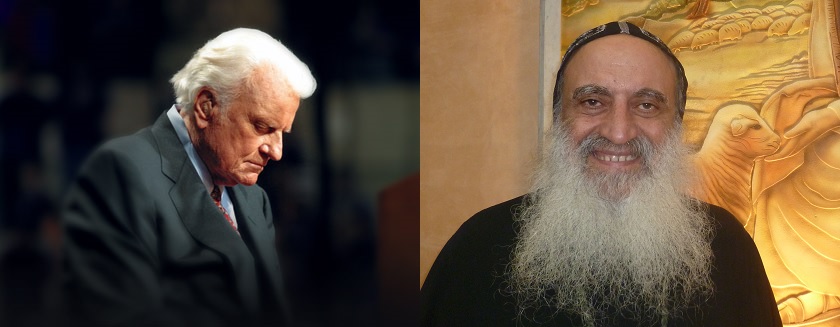
Balmer also describes Jerry Falwell’s mendacity and Billy Graham’s duplicity as they worked to bring Carter’s presidency to an end. Falwell brazenly lied in his report that Carter had told a group of evangelical leaders he supported gay rights. Eleven days after telling the Reagan campaign that he wanted to “help short of [a] public endorsement,” Graham reassured a Carter liaison that he was “staying out of it.”
I hate to think these descriptions are true, but perhaps this only shows we are quick to believe the worst of the other while doubting it for our own kind. The anecdotes are from a new biography of Carter, so I can only assume, perhaps wrongly, it was well researched.
But no research is needed to see the all-but manipulations of Bishop Boula of the Orthodox Church. Even here my ‘all-but’ exposes my will to disbelieve, but how can you doubt when his efforts are admitted? Here is a translation of his recent comments on Egyptian television, translated by Middle East Monitor (video included):
Bishop Paula (Boula): How do I estimate it? Let me tell you what I would do for instance in Tanta. I come to each one of the churches. Let’s assume that in this particular church there are six priests. We divide it into six squares and each priest is put in charge of one square and that would be the region he is responsible for. We tell the priest: father, you are in charge of this region. How many homes are there within it? I want to appoint one young man for each group of thirty homes to prompt them and make sure to bring out those who have not yet come out. The young man who is in charge of the thirty houses would submit a report about each of these houses, one by one. In this way, we would know who went out and who did not. We call the father in charge by phone and he goes and knocks on the door. So, we have extremely accurate information about the ratio of those who went out and those who did not.
Presenter: I am saying this to you but it might be possible that those who hear us might take to mean something else. Was the Church playing politics?
Bishop Paula: No, no. Look. The Church is playing patriotism.
Presenter: It plays patriotism?
Bishop Paula: It has a patriotic role. The Church has always been a patriotic church. And in this particular time it should have a strong patriotic role. The patriotic role is the prompting role. And to be telling the truth, it includes, if possible, unifying opinions through persuasion as to who is the best (candidate).
If not for that last statement, the ‘all-but’ could remain. It is, perhaps, patriotic to stimulate and even ensure the voting of the flock. Christians should be good citizens; the church should help them know how to engage their civic responsibility.
But could he not help himself? Did the Christian in him demand he reveal the full truth? Did his pro-Sisi/anti-Muslim Brotherhood giddiness expose it? Is he just proud of himself and the monumental task he organized? Bishop Boula invited me into a meeting once during parliamentary elections in 2011. I saw his efforts then, but did not notice any ‘persuasion’. Of course, that was just one session.
But, oh, this is fuel for the Egyptian political fire, and it is well deserved. Pope Tawadros, do you have a comment given your insistence of church neutrality? I wrote you an ‘all-but’ interpretation in that article. Has Bishop Boula made me a liar?
A worthy question also for the Muslim Brotherhood, for Jerry Falwell, and for Billy Graham. May God honor you all for the good you sought within your best interpretations. May he hold you all accountable for the means by which you pursued it.
And may be be merciful to us all for our many manipulations, both great and small. We self-justify far too easily.
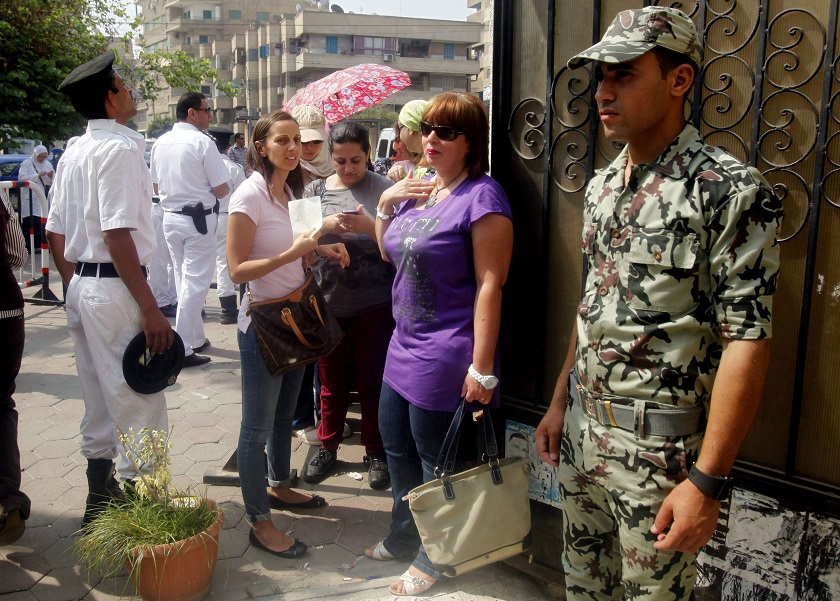
Uncovered, presumably Coptic women stand in line to vote
From my latest article at Egypt Source, exploring the controversial presidential election turnout:
One day before the beginning of presidential elections, the Egyptian Center for Media Studies and Public Opinion (ECMSPO) published the results of a counterintuitive poll. Based on personal interviews with 10,524 citizens throughout Egypt’s governorates, they predicted a turnout of only 10 percent.
More shocking, and controversial, was their estimate that 48 percent of presumed winner Abdel Fattah al-Sisi’s votes would come from Christians.
On the first day of voting the webpage of the Freedom and Justice Party (FJP), the political arm of the Muslim Brotherhood, seized on this survey. Publishing pictures of old men, smiling ladies, and assortments of priests and nuns, they featured the sectarian-laden headline: “Elderly, Women, Christians … the Trinity of Election Theater Today.”
But as reports streamed in of otherwise empty polling stations, this headline gained credibility. As the Presidential Elections Commission (PEC) decided to make the second day a public holiday, and then extend voting to a third, it cemented the impression even more.
The article takes a closer look at the polling organization, which doesn’t seem quite right. But the official totals of 47 percent turnout don’t quite seem right either. A closer look is given to the size of the Coptic electorate, but also, like Saturday’s post on Pope Tawadros, wonders about their behavior too. From the conclusion:
But cynical also is Muslim Brotherhood use of this demographic reality. To call the elderly, women, and Christians part of a ‘Trinity’ is to use theological language instinctively repulsive to Muslim sensibilities. That they call elections a ‘theater’ is reasonable given their organizational viewpoint; that they play games with religious minorities, gender, and age – as if these did not have the rights of citizenship to choose freely – is not.
Of course, the Muslim Brotherhood is not the only group making sectarian usage of the Copts. Lamis al-Hadidi, a pro-government media personality on the private CBC channel, urged them to vote reminding of their sixty churches burnt by terrorists. She, like the FJP, has crossed a line.
Perhaps individuals within the church are privately backing Sisi behind the scenes, and directing Copts to vote for him through internal discourse. If so, they too are crossing a line. But the church has had good sense to avoid this distinction publicly, officially instructing priests not to directly support a candidate.
Whether turnout is high or low, it may well prove that together, this Trinity elected Sisi. The Brotherhood may be right to fume, but they are wrong to do so with such sectarian language. Unfortunately, it is only one more example of the morass into which Egyptian politics has descended, and the mud slung by many.
But mud is slung in advanced democracies as well, and generally speaking it does not hinder straightforward readings of electoral results. The election of Sisi was supposed to be simple, though Egypt’s democracy is far from mature. Contested turnout figures are just one more bump in a very long road.
Please click here to read the full article at Egypt Source.
From my recent article at Arab West Report, continuing a series of interviews with members of the Committee of Fifty which wrote the constitution:
Seeking to represent all sectors of Egyptian society, the Egyptian Committee of Fifty to amend the constitution of 2012 was light on political parties. Only four seats were assigned, two for liberals and two for Islamists. This was in contrast to the Committee of One Hundred that wrote the 2012 constitution, which was heavily populated by political figures from the Islamist Freedom and Justice and Nour Parties.
After the fall of Morsi, however, few Islamists remained on the formal political scene. The Nour Party was the most prominent, representing the Salafi trend. One seat went to them, but who could represent the Brotherhood trend, with the Brotherhood boycotting the process? Announced as a representative of the Islamist trend was Kamal Hilbāwī, a former Brotherhood member who resigned in 2012 in protest of the group’s decision to field a candidate for president.
Helbawi was a member of the drafting subcommittee which was responsible to merge all articles into one contiguous text. To do so they changed articles according to language and syntax, but did not hesitate to also adapt the meanings.
But one of the most interesting points of his testimony concerns the negotiations with the Nour Party that resulted in the former Article 219, defining the principles of the sharia, moved in essence into the preamble and made subject to the Supreme Constitutional Court:
But in a compromise agreement the definition of the principles of sharī‘ah was moved to the preamble, with the term of reference being the collected rulings of the Supreme Constitutional Court. These are about 4-5 cases, he estimated, involving sharī‘ah interpretation issued by the highest court in the land since 1985. Having a definition makes sense, Hilbāwī believed, for someone might want to know what the principles of sharī‘ah are. These cases were entered into the official transcript of the constitutional proceedings, and the preamble of the constitution has equal weight with its articles, according to Article 227.
But reference to the rulings of the SCC raised the issue of why Article 219 was necessary in the first place, if the court already defined the principles of sharī‘ah. Perhaps the legislature did not adhere adequately to these rulings, but if the legal basis was there, what was the big deal? And in any case, if the language of 219 was in the SCC rulings, does this explain why the Nour Party was satisfied?
Hilbāwī dismissed the criticism by liberals of Article 219 that it would have opened up the entire corpus of sharī‘ah legal history to implementation in legislation or in court rulings. But in referring to the charge of Safwat al-Bayādī, confirmed in his testimony of the response of Sa’d al-Dīn al-Hilālī, that the testimony of Christians might not be given equal weight to Muslims, as was once in Islamic history, Hilbāwī said ‘perhaps’, in recognition of Hilālī’s rejection of 219 and his status as a very good scholar. There are still shaykhs in Egypt, mentioning Abū Islām and Mahmūd Shabān in particular, who advocate very retrograde rulings. But given the firm guarantees on equality present throughout the constitution, Hilbāwī does not expect any sharī‘ah-based impingement on general freedom.
The article also contains a first effort to understand what the religious language of sharia interpretation means. Please click here to read this and the whole article at Arab West Report.
Sixteen thousand Muslim Brotherhood prisoners launched a mass hunger strike yesterday, protesting against torture and other human rights abuses, according to local sources. Haitham Abu Khalil, the movement spokesman, says many more individuals are unlawfully detained.
The same day a lone Coptic hunger striker, unaffiliated and unsympathetic to the Brotherhood, ended his own hunger strike after twenty two days.
Unlike the others, he did so as a free man.
‘People are dying, hatred is increasing, justice is absent, and prices are rising,’ said Dr Hanny Hanna, an archaeologist and general director in the Egyptian Ministry of Antiquities. ‘We have had no revolutionary government, the same regime is with us until now.’
Three years ago Hanna had more hope. As the world celebrated images of Christians protecting Muslims at prayer in Tahrir Square, less known was the reverse. One of the first Copts to join the revolution of 25 January, Hanna became known as ‘the preacher of the revolution’ for leading protestors in Christian prayers and songs.
Polarized
But these days of unity are long gone. ‘Everyone is tearing down the other no matter what side you are on,’ Hanna told Lapido Media. ‘The polarisation has become so high.’
And with it the body count.
According to figures reported by the Carnegie Endowment for International Peace last month, over three thousand Egyptians have been killed in political violence since 3 July, the day former president Mohamed Morsi was deposed.
Over 2500 of these deaths have been the result of protests and clashes, while over 500 have died from terrorism and other militant actions, according to government statements.
Seventeen thousand have been injured in these events, and nearly 19,000 have been arrested. Of these, several hundred have already been on hunger strike to protest their ill treatment in prison.
Hanna, during a brief hospitalization
Hanna, who while drinking only water continued his normal responsibilities, criticized the violence of many protestors which has landed them in detention. But he also condemned the government and its protest law which has imprisoned many innocents beside them.
As the revolution appeared to be slipping away with resurgent autocracy first under the Brotherhood and now more severely against them, the preacher in him grappled with a response.
‘Should I go to the media and just say, “Love each other?” he asked. ‘It is easy to talk but it is stronger to take an action.’
Hunger strikes have largely been an individual action in Egypt since the 1970s, said Osama el-Ghazoly, a senior Egyptian journalist. The mass prison protest is a more recent development, but few have done so outside of jail.
Unlike most, Hanna’s hunger strike had no demands. Instead, it was his chosen action to communicate a message that all is not well and the revolution has not succeeded.
He even takes aim at Egyptian icon General Abdel Fattah al-Sisi, the front running presidential candidate. Hanna resurrects the memory of the Maspero massacre when 28 Coptic protestors were killed, either shot or crushed under military vehicles in October 2011. Sisi was the director of military intelligence at the time.
‘If Sisi wants my support he should make it clear what was his role in these events,’ said Hanna. ‘If he is clean, then fine. If not, he can go to hell.’
Critisism
But these messages do not sit well with his fellow Copts. Most are overjoyed at Sisi’s popularly endorsed removal of Morsi’s Muslim Brotherhood government, and anticipate the new constitution will usher in a democratic order.
Even Hanna’s personal Facebook page, filled with good wishes about his intentions, drew criticism. Comments lamenting the timing, method, and relevance of his protest mirrored the responses of political, religious, and revolutionary Coptic leaders.
‘I wish he would be more patient,’ said Naguib Abadir, a Coptic founding member of the Free Egyptians Party, one of the leading liberal flag bearers. ‘We are in a very difficult period with people trying to hijack our roadmap before it can be achieved.’
‘The body is not our own, it is the temple of God and we are responsible to protect it,’ said Revd Fawzi Khalil of Kasr el-Dobara Church, located just behind Tahrir Square, who demonstrated with Hanna from the early days of the revolution.
‘We are able to express our views in ways that do not threaten our life.’
Abadir and Khalil both told Lapido Media that Hanna should save his strength and take up politics, criticising him for picturing everything as negative. But even revolutionary colleagues see him as an idealist, who is harming himself in vain.
Mina Magdy
‘He is a good person working for peace,’ said Mina Magdy, general coordinator of the mostly Coptic Maspero Youth Union, which suffered heavily in the massacre. ‘But he is giving slogans and this does not work, we need specific demands.
‘Hanna’s message will reach neither the regime nor the people,’ he said. ‘No one cares about him.’
But this unhappy critique is categorically untrue. His wife and three daughters have stood by his side, and over ten friends have promised to join him on a future hunger strike, if necessary, in exchange for stopping now.
Hanna believes most of his critics misunderstand him and have succumbed to a culture that neither values the individual nor believes one person can make a difference.
‘In the beginning no one listens,’ he said. ‘But as you continue more people start to pay attention.
‘The fruit is seen as they change toward the good.’
Still a preacher, but now with his body, this is Hanna’s contribution to continue the revolution.
This article was originally published at Lapido Media.
A friend of mine, a politically liberal Muslim with little attachment to religion, has often accused the Muslim Brotherhood of seeking to create a Protestant type of Islam. It is a little difficult to catch the connections, as well as to tell if he believes such a transformation would be good or bad for Egypt. He certainly thinks Brotherhood control of this situation would be bad, but I’m less sure as concerns the greater idea.
This article in The Immanent Frame helps explain what might have been happening along these lines, before the overthrow of Morsi.
First, the context of Islam in Egypt:
In this respect, the law and court rulings do not recognize the existence of a congregation of Muslims who can worship—that is, engage in formal rites—outside the bounds of the state. This legal status seems to be a vestige of the Islamic caliphate (دولة المسلمين, “state of Muslims”), where the congregation of Muslims was conceived as a politico-religious entity, as it first took shape under the leadership of the Prophet Muhammad. While this conception often accrues to the power and advantage of Muslims in the aggregate, it restricts the religious freedom of Muslim groups or individuals who do not wish to align themselves to the political or religious orientation of the political authority.
Post-Morsi, the state has been working diligently to reassert control over the system of mosques, seeking to eliminate divergent Muslim Brotherhood voices. Incidentally, the article states Morsi’s government treated unorthodox voices similarly, continuing the policy of preventing Shi’ite or some extreme Sufi trends from operating local mosques.
But the Muslim Brotherhood also wanted to cement its control over mosques already within its influence, and gain control over mosques that were not. To do so it revived an old government practice of establishing boards to administer mosque affairs, appointed by the state, but with no influence on its religious discourse or choice of imam. The government started this program in the 1980s for the practical reason of its limited resources for direct control, but abandoned it altogether a decade later due to arising conflicts and competition.
When the Brotherhood government assumed control of the Ministry of Endowments, reviving the role of the mosque boards was on the agenda of the Freedom and Justice Party (FJP), the Brotherhood’s political arm. Minister Talaat Afifi issued a decree reconstituting the boards under the name “mosque development boards,” giving them prerogatives similar to those of the old boards. The boards still had no influence over religious and preaching activity, which remained the exclusive purview of the ministry, but, controversially, the boards were to be elected.
In doing so, the Brotherhood established a system in which they could not be accused of appointing their cronies to administer mosques, but instead take advantage of their powerful network through which ‘the people’ would exercise control. But, who are the constituent ‘people’?
But how to determine which Muslims possessed the right to vote in elections for this or that board? The official decree stipulated that “a general assembly of mosque patrons” be created from among registered residents of the neighborhood in which the mosque was located, as well as those who applied to the ministry-appointed imam to affirm that they were regular attendees and registered as members of the general assembly.
Of course this move created a great deal of controversy and opposition, notably from the existing system of imams who saw the risk of their power diminishing. But there was a great religious objection as well, not tied to politics:
The decree also raised the hackles of imams and scholars who believed that it would give rise to local “churches” in Islam; churches have a discrete membership and members have certain prerogatives.
The decision to elect mosque development boards did not resolve the problem or mitigate conflicts, but only inflamed them further, partly because the idea was grafted on to a centralized administrative order and partly because it ran up against the idea of “every mosque for every Muslim”—a central tenet of Islam—making it “every mosque for every Muslim in this neighborhood.”
Morsi’s government suspended the decision to elect boards, and after his overthrow even the appointed boards were dissolved and reconstituted with traditional Azhar scholars and local patrons opposed to the Brotherhood. Politics is a determining factor, certainly, but the philosophical decision seems to have been correct, or at least consistent with traditional reasoning:
There is a traditional Islamic discourse that takes pride in the fact that there is no central religious authority in Islam—no church, no priesthood, no clerical class to govern the religious (and certainly not political) lives of Muslims. This discourse is well grounded in doctrine and Islamic jurisprudence, which indeed contain no reference to the specific shape of Muslims’ religious communities or clerical prerogatives. Historical practice also holds no precedents.
But to return to the central question about whether or not such a Protestantizing of Islam would be ‘good’ for Egypt:
The problem is that Islamic doctrine, jurisprudence, and historical practice do, in fact, both assume and fundamentally rely on the existence of a single Muslim polity with authority over Muslims’ religious affairs and the religious scholar class. The alternative is to abandon the Muslim state for a modern nation-state that fully embraces the concept of citizenship, which would entail the disappearance of political authority over religious affairs and open the door to religious freedom. Otherwise, the modern state will continue to draw on this legacy of religious authority inherited from the caliphate.
…
In engineering its policies for managing Islam, the state proceeds from the belief that Muslims’ religious unity is part and parcel of preserving political unity and the patriotic line, and it legally suppresses any activity or attempt on the part of Muslim groups or individuals to freely worship outside the bounds of the centralized state administration or beyond the scope of a centralized, religious orthodoxy described as “proper religion.”
Here in Egypt the Coptic Orthodox Church behaves similarly. A Christian is at home, theoretically, in one church building as he is in another. A man appointed deacon may show up in any church, don his robe, and join in serving communion. There is the thought in Christianity that the priest should only serve this communion to one who is in good standing – requiring local relationships to know – but this does not seem to be practiced. Instead, the confessional relationship may occur with a priest from any church, diocese, or monastery. The judgment of receiving communion is usually left to the conscience of the believer.
In majority Christian lands where the Protestant Church is established in relationship with the government, perhaps there is a parallel as well. But in America as well as Egypt the pattern is toward local independence with varying levels of denominational cooperation. The multitude of Protestant denominations certainly contributes, which is a phenomena not generally mirrored in Islam.
But Islam exhibits great diversity, certainly cultural diversity in its many international expressions. What it does not generally do is sanction this diversity as an option for local communities of Muslims. Outside the Muslim world it certainly exists, as mosques are established for minorities along lines of freedom given to churches, and generally funded by the community or by donations from abroad. Such freedom, however, is not extended by many Muslim states to their majority Muslim populations. In this, it seems, they follow not necessarily the rule of Muhammad, but the ideal practice of the faith current during his time.
And perhaps they dare not do otherwise, for equally historical reasons. After Muhammad the early caliphal period and afterwards witnessed an explosion of Muslim diversity that nearly tore the nascent state apart. Many of these movements were political in orientation, no matter how much religious piety and practice played a role. It took all the skill of ‘the rightly guided caliphs’ to hold things together, and the task fell to later jurists to shape sharia so as to allow a degree of diversity to law schools while maintaining the overall unity of the faith. It also fell to later caliphs to secure the support of scholars to maintain legitimacy for their rule. These processes evidence elements of manipulation and duplicity alongside sincere devotion to faith, a legacy that continues in the mosque-state relationship to this day.
Can it be developed differently along Protestant lines? Should it be? Perhaps the Muslim Brotherhood tried, and as in many of their efforts, failed. In a neutral environment, if such freedom existed, Muslim Brotherhood groups would gain control over certain mosques in certain neighborhoods – maybe many. But would the success of allowing full local control of mosques contribute to a greater climate of freedom, or simply initiate a religio-political anarchy that would tear government and society apart?
As with most experiments, all that awaits is the trying. Will Egypt, or similar nations succeeding the caliphal system, dare take the risk? Or is the very idea inimical to Islam altogether?
Please feel free to weigh in with your own ideas and experiences.
From my recent article at Arab West Report, continuing a series on the composition of Egypt’s constitution. Nadia Mostafa is the former director of the Program for Dialogue and Civilizational Studies at Cairo University. She is also an Islamist, though not a formal supporter of the Muslim Brotherhood. But she is a severe critic of the events which removed him from power.
She did not want to even discuss the content of the constitution, unfortunately, deeming it illegal. But she was very willing to express her displeasure with several contributing forces:
Chief among them are the very Salafis the Brotherhood cooperated with, in error. In supporting their demand for Article 4, giving the Azhar a role in legislation, and Article 219, defining the principles of sharī‘ah, the Brotherhood gave into unnecessary, non-historical, and ultimately fear-inducing intimations of a religious state. But when the Salafis sided with the coup leaders, Mustafá notes, look how quickly they dropped these two articles. All the Nour Party desired, it seems, is to take the place of the Brotherhood in the political spectrum.
Next she takes aim at the liberals:
Early in the transitional period these same liberals bemoaned the extremism of the Salafis and the interference of their Saudi Arabian backers. Now, they speak of the Salafis as possessing political acumen and of the Saudis as important financial backers for Egypt.
Similarly, liberals rejected the constitution of 2012 because it was an unrepresentative document crafted by an Islamist majority. But this did not prevent them from orchestrating an unrepresentative majority of their own, which all but excludes political Islamists, except for those who play by the measure of the coup. And as for their rhetoric saying the Muslim Brotherhood was invited but refused, what sort of invitation can be accepted when the president and his aides are held incommunicado, and the organization brandished as terrorists? Their goal, Mustafá believes, is to eliminate political Islam, or at the least any political Islam that has leverage.
Finally, she criticizes the church:
Excited by the possibility of gains in the constitution, some Coptic groups threatened to boycott or urge a ‘no’ vote if they did not win a special parliamentary quota. But when this failed to materialize, Pope Tawadros stepped in to support a ‘yes’ vote in the referendum. Christians, Mustafá believes, are not seeking their rights but to limit the rights of political Islamists, allied with seculars against the Islamic identity of the country.
But she also has critical words for the Brotherhood:
She and others of similar mind advised the presidency that Mursī was leaning too heavily on the support of Salafis rather than maintaining unity with liberals and other moderates. She believes there should be a separation between the preaching of a religious organization and the rhetoric of its political spinoff. A civil system must allow for religion in the public square, but politicians should not play with religion for political gain. When many call for the leadership of the Brotherhood to leave, she agrees, provided the same be true for current leadership across the board. The old guard, everywhere, must yield to the youth.
Please click here to read the full article at Arab West Report.
Accusations circulate, trials continue, but the question remains: What is the relationship of the Muslim Brotherhood to violence?
In response to the ongoing climate of terrorism, vandalism, and demonstrations-cum-clashes, the group put out a long statement asserting their ‘absolute peacefulness’. They have no relation to recent attacks, they said, and none of their members resort to violence even in defense.
Numerous anecdotes refute this statement, God, so what should be understood from it? Thank you that it is made, at least. May it serve to combat a culture of violence that is spreading among many in their attitude of resistance.
And protect the Brotherhood and its members from any undue maligning. Egypt is still in a crisis period, where recourse to propaganda is an easy temptation for all. Place men of conscience in the courtrooms, in the police stations, and in the media, to deal justly with each Brother who comes their way.
But God, if this is their own propaganda, make known the reality. The Syrian Brotherhood is engaged in civil war, Hamas in armed resistance. However just their causes may be in your sight, they are violent. Does this Egyptian statement reveal a commitment, a tactic, or an outright lie?
Outsiders have not been reticent to give their opinion, God. Turkey and Qatar assert the group’s legitimacy; Saudi Arabia and the Emirates call them terrorists. Now England is to take up the challenge. Having now and long given refuge to Brotherhood dissidents, they will investigate any illegal activities or relationships with those who commit them.
Transparency, God, and all due process. If the aforementioned nations do not have the best reputation in terms of freedom and human rights, allow England to live up to its reputation. But inasmuch as that reputation is trashed by others who see espionage in the heart of London, make clear all evidence against the Brotherhood, if any.
Forgive our world, God, where truth is contested and interests trump justice. And even where values are held and defended, many will do evil that good may prevail. Where in this the Brotherhood falls, God, make known to everyone. May the moral high ground truly be moral.
And in this also, forgive the revolutionaries who have succumbed to the same. Whether against Mubarak, the army, Morsi, the army, or against the state and security in general, many have lashed out within their peacefulness. With some it is provoked, for others it is cover. But where there is a struggle for true freedom and justice, cause these ideals to prevail.
And implement them, within a state licensed to employ violence legally, though judiciously. Hold authorities accountable for all excesses, but give them firmness also to enforce the right.
Teach Egypt, God, the meaning of absolute peacefulness. The ongoing climate presents many challenges, but honor those only who stand firm to the end.
From The Immanent Frame, an article describing where democracy went wrong in Egypt, and doesn’t blame the Islamists. The author draws on James Madison’s assertion that factionalism cannot be destroyed without destroying freedom, and that the only path is to create democratic governmental mechanisms that prevent a certain faction from taking over the state.
This, unfortunately, never took place in Egypt. Non-Islamist political forces, for one reason or another, were never able to develop the kind of broad and cohesive coalitions that could have effectively represented them. After the constitutional crisis of the fall of 2012, moreover, they effectively threw in the towel, and formed the National Salvation Front.
The article states the NSF sought to undermine the government rather than seek to compete with it.
Even if it is true that the Muslim Brotherhood is essentially an anti-democratic movement, it could not have threatened an Egyptian democracy, at least as long as other Egyptian political movements played their role in such a democracy by organizing their supporters into cohesive parties that could effectively compete at the ballot box. Even if it took a couple of rounds of electoral losses before they successfully organized themselves, it would have been worth it to build a genuine democratic coalition.
The question the opposition might give in response is that the Brotherhood showed inclination not to reform the state and open up a democratic polity, but to inherit the Mubarak state and maintain its relative authoritarianism. The author admits the Brotherhood’s illiberal leanings, but finds it would not ultimately have mattered.
In short, so long as there is at least the credible prospect of a politically competitive system, there is no reason to believe that the principles underlying the median voter theorem would not have applied to restrain the Muslim Brotherhood until such time as the non-Islamist opposition could have organized itself more effectively. Ironically, then, it may very well be the case that the biggest problem facing Egyptian democracy is not that the Egyptian Muslim Brotherhood is too committed to its own organization, as many Egyptian commentators have suggested, but rather that other Egyptian groups lack the internal discipline necessary to form an effective nationwide coalition.
This seems too rosy an application of Madison, but spot on concerning the fault of the opposition. But there is more strong critique to come.
Success at the ballot box is not mere “ballotocracy,” to be casually dismissed, as many Egyptian liberals have claimed. An inability to form an electoral majority signifies an inability to govern—at least in the absence of overwhelming force.
So what then? Here is the author’s hindsight analysis:
The fact that there is no credible liberal democratic political party does not mean, however, that Omar Suleiman was right. It only means that Egypt has not yet produced such a party. The existence of such a party is not, however, a precondition for a functioning electoral democracy; it is the product of the practice of democracy over multiple rounds and iterations.
It is too late now, unless it isn’t too late. This would be the claim of the liberals, that the democratic order is now coming under a strong and guiding hand. The author disagrees, and thinks they took the easy way out.
As a result of their short-sighted strategies, Egypt faces at least several years of renewed authoritarianism. Instead of attempting to exclude their competitors from politics, Egyptians need to embrace competitive politics and accept the substantial costs of building a competitive electoral system from the ground up, even if that requires letting your opponents win from time to time.
Ironically, his advice may have been heeded by an unintended audience. The Salafi Nour Party may have sensed what was coming, took their licks, and ensured their coming place in the order – democratic or otherwise.
If not democratic, Muslim governments have long had their ‘sultan’s sheikhs’, as the Nour Party is now derogatorily called by pro-Morsi Islamists. But if democratic, they stand ready to inherit the Islamist mantle. Perhaps they will lose elections to come, but by building up the polity, their bet is for the long haul.
Who knows the developing political orientation of the people, but if Gulf funding is any indicator, these Salafis may be the best students of Madison.
Not one conviction was levied against those who killed protestors during the January 25 revolution. This fact is still not yet fully explained, but raised questions of whether or not Egypt’s judicial system functions independently of the powers-that-be.
These questions continue today. But this week a few Muslim Brotherhood members were found innocent of certain minor charges. More significantly, an officer was given a ten year sentence when 37 detainees from the pro-Morsi sit-ins were killed inside a police van. It may be that the law is blind.
The coming months will demonstrate. The president referred the fact-finding report from the sit-in dispersal to the judiciary, with its accusations of ‘excess force’. More serious trials against Muslim Brotherhood members continue. Will they judge impartially?
God, you know where justice lies; men make at best approximations. But may those of the judiciary be men of conscience. May they weigh the evidence and act accordingly. May they remember they hold the life of fellow human beings in their hands.
For the weight of accusation is against them, no matter how many are upright. The Judge’s Club has been called financially corrupt by the nation’s top auditor. The onus of revolutionary killings lingers. And while some detained sit in prison for months without trial, others are convicted straightaway. Many view judges as politicized, at the least.
What can be prayed for, God, but the above? The judiciary is but one of many state institutions that is still in flux since the revolution. Purge it from all impropriety. Make transparent its proceedings. Let the people trust its arbitration.
Through them or otherwise, God, bring justice to Egypt. Justice for victims of these transitional years. Justice for victims of the old regime. Justice against all who have manipulated the system for their own benefit.
Through them or otherwise, God, but may it be through them. May Egypt, and its judiciary, be fully independent.
This post recalls twoarticles published last year at Arab West Report but not referenced on the blog, on the Salafi–Jihadis. The testimony is poignant based on current developments:
“We are distinguished from other Islamic trends by not accepting partial solutions,” he said. “The Brotherhood has understandings with the Americans, and they are not working on behalf of the shar’īah but to keep power for themselves.” As for the Salafīs, “They were a pure religious movement, far from politics, but when we see how the Nour Party has behaved after the revolution we see a great similarity to the state security apparatus, finding consensus with the military and even with the liberals.”
This jihad, however, does not target the West directly, though he lauds al-Qā’idah, justifies the Benghazi operation, and warns Americans their blood is not safe in Muslim lands. In fact, though his rhetoric is violent – “We have come to smash the pillars which the people have gotten used to” – the Salafī-Jihadi effort consists entirely of preaching, however much the State Department says otherwise.
“We do not carry weapons in Egypt,” he said. “We are engaged only in an intellectual battle. The security wants to charge us with being armed, but we reject this completely.”
The above quotes from Ahmed Ashoush, a colleague of Mohamed al-Zawahiri. They are accused of links with the Muslim Brotherhood and of fueling Sinai-based terrorism to protest his removal from power.
The second article reflects an email exchange with two experts on Islamist movements, Khalil al-Anani and Ahmed Zaghloul. Here is an excerpt from the latter, on the propensity of different groups toward violence:
Do you believe they are engaged in or preparing for an armed struggle and/or terrorist activity in Egypt or the region?
A large number of the remaining Jihad Organization has renounced violence; so has Jamā’at al-Islāmīyah following their ‘Revisions’ and created a political party with members in the Egyptian parliament. These are the classic organizations associated with violence.
But the idea of using violence is still present and will never disappear. There are a number of vine-like organizations in the Sinai which have conducted violent operations recently. There are others who have adopted the ideas of al-Qā’idah in Egypt.
But the source of danger is not the known groups but the sleeping cells who maintain the idea of jihad. Some of these have traveled to Iraq, Libya, or Syria for the jihad there. As long as there are places subject to aggression there will be suitable areas for these cells to be active.
Reality changes frequently, as does the ability to accept comments at face value. But these testimonies are offered in the ongoing effort to determine what is happening in Egypt, for the good of the country. Please clickhere to read the full articles at Arab West Report.
From McClatchy, an article full of interesting anecdotes on the Islamist youth committing violence in the Nile Delta:
In Sharqia province, which sits just between Cairo and the restive Sinai, eight police officers have been killed in just three weeks, each by a motorcyclist who pulled up to them in traffic and shot them, usually in the head, according to Mohammed el Khatib, the general coordinator of the police union.
This is what makes the news, but testimonies of the youth reveal something a little different:
In December, they tried to set a police officer’s car on fire but were so inexperienced they failed. Then last month, they decided to launch three attacks on the same day, to distract the police from their protests. In addition to setting the police officer’s home ablaze, they planned to bomb a train. But they couldn’t trigger the explosion, so they settled for setting it on fire.
The third attack came when Saleh pointed a gun at nearby residents while his friends set a stationary shop belonging to Mohsen Said Mtwaly, 65, a retired general who’s a supporter of Field Marshall Abdel Fatah el-Sissi, the minister of defense who engineered Morsi’s ouster and now is the presumed front-runner for still-to-be-set presidential elections. A photo of Sissi sits in the store’s display window.
The interviewed youth say they have no share in the killing of officers, and this is what proves their methods as ‘peaceful’.
Interesting also is why they supported the presidency of Morsi, quite opposite from the international rhetoric of the Brotherhood:
The three young men said they first organized during Morsi’s presidency when he called for projects to renew Egypt. They hoped to create an Islamic caliphate, they said. They felt that if Egypt could be ruled by Islamists, then other countries would follow and soon the region would become one big caliphate. But they never got a chance to start their movement.
Debutantes in violence may become more professional, as many of the terrorist attacks in Egypt have proven. More disturbing is this account of local police efforts to stop it:
As he cleaned up the debris three weeks after the attack, Mtwaly was unapologetic about urging residents to reject Morsi’s administration.
“I know the Muslim Brotherhood very well and they have no national agenda,” Mtwaly said. “I used to tell people they are not good for you. They want to steal the country.”
Mtwaly said he backs the police and is confident they will find the men who set fire to his shop, unaware that McClatchy already had tracked them down.








 Jayson Casper