Categories
Excerpts

The Brotherhood as the Jihadi Source

Former President Mohamed Morsi, wearing the red uniform of a prisoner sentenced to death

Egyptian Foreign Minister Sameh Shoukry recently called the Muslim Brotherhood the source of all extremist ideology. The article does not give a detailed rationale, though the accusation is repeated often by many anti-Islamists in Egypt.

This article in al-Monitor, however, explains how it works:

The Islamists see a wide systematic conflict between the Brotherhood and Salafist jihadist groups, from which IS defected. However, one of the defectors from a Salafist jihadist group in Sinai (which the sheikh did not name) believes that the Brotherhood is the main generator of organizations fighting in the name of religion.

The jihadist — who defected from Salafist jihadism but still believes in the jihadist ideology — told Al-Monitor on condition of anonymity, “Jihadist groups classify the Brotherhood as democratic, whose way of ruling is no different than that of political regimes.

There are fundamental differences, on both the systematic and doctrinal levels between the Brotherhood and the jihadists. It is a political group with an Islamic cover that aims at political reform, and does not mind the idea of ​​jihad, but under terms that are subject to political calculations and interests. The jihadists, however, believe that this [ideology] is a blasphemy and that those who follow politics and leave jihad are secular infidels, even if they constantly repeat Islamic slogans.”

So the two entities are against each other in tactics, but the Brotherhood is an incubator for later jihadi action:

The jihadist said, “The Brotherhood is the oldest organization that has the most experience in lobbying human resources. It educates its cadres from childhood, teaching them jihadist slogans and explaining to them the [importance] of establishing an Islamic caliphate and applying Sharia. [They say], ‘Allah is our objective, the prophet is our idol and the Quran is our constitution; jihad is our fate, and death for the sake of Allah is our highest aspiration.’”

He added, “This is how the Brotherhood is the main generator of jihadist groups, as I previously mentioned. Complicated political differences often emerge between the Brotherhood and its political opponents, such as the harsh violence [campaign] launched by the Egyptian army against the Brotherhood. These political differences reached their peak following the bloody Rabia al-Adawiya massacre.

When such incidents occur, the Brotherhood youths rush to come up with mobilizing jihadist slogans and deviate from the Muslim Brotherhood’s path. They either turn to extremist [organizations], such as IS, or they turn to the radical right or convert to atheism when they realize that the jihadist and religious group [they belong to] cannot protect them from death.”

The Brotherhood is clear it is in support of jihad as a core and central concept of Islam. In other documents aligned ideologues declare they seek a caliphate. Brotherhood supporters have many answers to smooth the jagged edges of these religious terms, and alternate interpretations are possible.

But if the accusative warning of the foreign minister is heeded, the choice is between a slow ascent into a jihadist caliphate, or a bloody effort to birth one.

The international system has rules of governance, and respect for democratic choice is one of its pillars. While open jihadist groups like ISIS reject the system altogether, the Brotherhood seeks to work within it. But as this anonymous sheikh explains, the line between them is fluid.

So what is the answer? Hope that inclusion moderates core Brotherhood conviction? Or stamp out a confessedly democratic movement? Apply international pressure against the illiberal and jihadist impulses of popularly-chosen sharia? Or put out the fires of violence-bent radicals around the world?

Tough choices. Suggestions?

Categories
Prayers

Friday Prayers for Egypt: Europe

Flag Cross QuranGod,

It is Egyptians who must determine their leadership. Bless her with enduring independence and government of the people.

But Europe has a significant influence in legitimizing. President Sisi visited Germany and Hungary to strengthen ties and secure trade. Meanwhile a group of international Islamic scholars gathered in Turkey to give religious justification to resist and take retribution.

Egypt barred a human rights activist from a conference in Berlin. Meanwhile the world awaits the judgment of London if the Brotherhood has terrorist links.

God, make clear in Egypt both reality and righteousness. Let there be transparency over every crime and allegation. Let there be accountability for every failure and offense.

And in Europe, where transparency and accountability are presumably stronger, let there be more than interests and leverage. May they respect both rights and sovereignty.

Balancing both, may peace – with all legitimate pressure – prevail.

Preserve good relations, God. Preserve good government.

And may both ultimately be by and for the people.

Amen.

Categories
Lapido Media Middle East Published Articles

Brotherhood’s Call for Retribution is ‘Religious Violence’

Mohamed Abdel Maksoud, a Salafi signatory of Egypt Call.

A leading American academic has denounced the latest Muslim declaration against elected Egyptian President Abdel Fattah al-Sisi as a call for ‘religious violence’.

Samuel Tadros of Hudson Institute in Washington DC told Lapido that ‘Egypt Call’, a 13-point document published last week by 159 Muslim scholars from 35 nations, and endorsed by the Brotherhood, provided ‘Islamic justification’ for the fight against Sisi.

‘This document is as direct a call for violence as you may ever get,’ Tadros said. ‘This is a religious verdict on the regime as unbelievers.’

As President Sisi visited Germany and secured an eight-billion-Euro energy deal, two policemen were shot dead near the Giza pyramids.

Meanwhile, the Muslim Brotherhood sponsored protests in Berlin. ‘Tell Merkel to stand up for democracy and human rights in Egypt,’ tweeted Ikhwanweb, their official English account.

Both activities find justification in the new document which reinforces already grave questions about whether the Muslim Brotherhood is behind violence in Egypt.

Question

The text of Egypt Call declares, ‘It is a religious obligation to resist the regime, working to finish it off through all legitimate means.’

Points 11 and 12 recognize the international struggle, condemning nations that have stood with Sisi, while praising governments, politicians, human rights organizations, and others who have criticized him. Point 13 specifically mentions civil disobedience.

But point 4 makes it personal. Mentioning specifically rulers, judges, policemen, soldiers, muftis, media, and politicians, it says: ‘Retribution against them is necessary.’

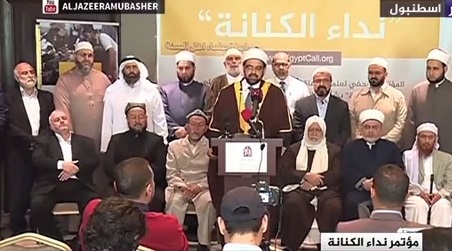
Press conference in Istanbul for Egypt Call. Ghoneim is back row, 5th from left.
Press conference in Istanbul for Egypt Call. Ghoneim (mentioned below) is back row, 5th from left.

The sharia views them as killers, it says, and they deserve the judgment of those who kill. But the text also insists – without specificity – that this must be according to legitimate methods.

So: What is legitimate?

Ambiguity

Jihad as a concept can be viewed along a spectrum from the struggle to submit to God, to the fight to submit the world to him.

The Brotherhood has long perfected the art of ambiguity. In January, it called on followers to prepare for a ‘relentless jihad.’

It has issued statements that condemn ongoing violence, but also praised previous Brotherhood militancy.

For Tadros, the ambiguity is now gone.

He sees in Egypt Call the concept of ‘loyalty and disavowal’, often interpreted in the modern world by jihadis as the rejection of all who do not fit their definitions of sharia.

The doctrine requires viewing those disavowed as non-Muslims, or unbelievers.

Tadros recognizes, however, that the word ‘unbeliever’ is not found in Egypt Call. Rather, in detailing how the Sisi regime has fought against Islam, allied with enemy Zionism, and killed and imprisoned thousands of innocents, it lets readers make this judgment for themselves.

Over 500,000 have indicated their support on the official website.

According to Joas Wagemakers, a prolific writer on political Islam and lecturer at Radboud University in the Netherlands, ‘loyalty and disavowal’ has some Quranic inference.

But it was developed by the early Kharijite movement that rebelled against the caliphate.

Wagemakers, in his chapter in editor Roel Maijer’s Global Salafism, says Sunni Islam rejected the concept until ibn Taymiyya resurrected it in the fourteenth century. Modern-day extremists use it to justify rebellion against a Muslim ruler.

Point 2 of Egypt Call references one of the principle Quranic verses underpinning the doctrine.

But it does not specifically use the terminology, nor label the regime as non-Muslim.

Tadros attributes this to internal philosophical disputes on technical points about legitimate rebellion. But these religious scholars, he says, do not see themselves as offering points on strategy.

According to the research of Michael Cook, a professor at Princeton University and author of Forbidding Wrong in Islam, majority scholarly Sunni opinion is against the idea of opposing even an oppressive ruler.

Most say it will result in more harm than good, even if legitimate.

But the heritage of sharia includes voices which advocate a quiet rebuke, and others who advocate outright militancy. Where does the Brotherhood fall?

Some ask whether retribution is to come from formal judicial tribunals after they restore Morsi. A recent report from the semi-governmental National Council for Human Rights said 1,250 Muslim Brotherhood members had been killed in the eighteen months after Morsi’s overthrow.

Others question whether they have advocated the kind of assassinations seen at Giza. The same report said seven hundred security forces had been killed during the same time period.

Perspective

Egypt Call does not provide details, but a brief look at the signatories offers perspective. Tadros has identified several of them from previous research he did into Egyptian Islamism.

While in Germany the Brotherhood tweeted about democracy and human rights, one of the signatories Said Abdel Azeem, an Egyptian Salafi leader denounced democracy on YouTube as ‘an idol that people worship apart from God,’ and said that it permits all sorts of excess in personal freedoms. The film has received more than 28,000 views.

Azeem has taken a stand against jihadis who kill Muslims they deem apostates, but another signatory, Atiya Adlan, adheres to the Sorouri strand of Salafism that adopts the concept of ‘loyalty and disavowal’, declaring the ruler who does not govern by sharia to be an unbeliever.

And signatory Mohamed Abdel Maksoud, a pro-Brotherhood Salafi leader, has previously hailed the jihad of Osama bin Laden.

More acutely applicable to the Egyptian struggle, he called for the killing of Syrian President Bashar al-Assad, and praised the vengeance taken against Egyptian police.

Though not a signatory, Wagdy Ghoneim spoke at the press conference in Turkey that introduced Egypt Call.

‘The military regime headed by the infidel and apostate Abdel Fattah al-Sisi is fighting Islam and religion,’ he said. ‘He led a coup against Morsi because Morsi desired to bring back the Islamic caliphate.’

Ghoneim has called for the killing of pro-Sisi journalists. When the Islamic State beheaded Copts in Libya, whom he called ‘Crusaders’, Ghoneim had no condemnation but launched a diatribe against the Coptic Church.

At a popular level, the official Facebook page of the Brotherhood’s political party in Maadi, Cairo, shared video of ‘revolutionaries’ firebombing an empty train.

None of this is proof that the Brotherhood is behind the violence in Egypt. But it chips further away at the veneer of ambiguity, even as they cling to it.

The editor-in-chief of the Muslim Brotherhood’s official English website did not respond to a request for clarification.

This article was originally published at Lapido Media.

Categories
Prayers

Friday Prayers for Egypt: Party Dynamics

Flag Cross Quran

God,

Two Egyptian granddaddies are going through growing pains. Both predate the modern state, and are striving to remain relevant.

The Muslim Brotherhood is taken over by its youth, who are forcing a revolutionary path. A new statement says resistance is an Islamic obligation, with all means possible to undue the fall of Morsi. There is no mention of peacefulness. A bid by the historic leadership to reassert itself appears to have failed.

The Egyptian Wafd, meanwhile, is also in crisis. Despite the intervention of President Sisi, agreements to reconcile two conflicting factions have fallen apart again. The wing which advocates reform is connected to historical families, while the current president is a prominent businessman – who has won elections. Though the party has a venerable name, its general support on the street is unclear.

God, forgive tepid prayers in others’ business. Where there is virtue, unity is paramount. Where there is discord, sin eats itself. Where there is partisanship, these distinctions are charged. Prayer can offer discernment, but it is dangerous to take sides.

So God, resolve these crises toward the good of Egypt, as you interpret best. Sideline those who prevent positions of virtue. Allow the mutual failures of those who compete in partnership with vice. In both, protect the innocent from all collateral harm.

And protect Egypt, God. Protect her from the spirit of retribution. Protect her from the spirit of subservience. Honor zeal. Reform society. Establish justice. Develop polity. Give stability.

The Brotherhood and Wafd have a long history of rhetoric toward these principles. May the principles outlive the parties.

And may the parties continue only as long as they are faithful stewards of this trust. They are both grandfathers; may their children act with the wisdom of the aged.

Amen.

Categories
Prayers

Friday Prayers for Egypt: Tribe

Flag Cross Quran

God,

Solidarity of group is good. But there are many groups in the world. Who stands with whom?

Give wisdom to the Tarabin of Sinai, who pledge to support the government in the fight against ISIS.

Give wisdom to the government, to know if and how to accept.

Give wisdom to the other tribes, to navigate this minefield.

ISIS holds no territory in Sinai, but they appear to have some freedom of movement. The role of the tribes is key, but uncertain. Do they protect or simply tolerate, or are they themselves intimidated?

The Tarabin have suffered losses at their hands, having cooperated with the state. ISIS, meanwhile, is doing what it can to exploit tribal fault lines to win support and create division.

Their solidarity seems right, but should it be armed? Theirs is a separate group, no matter how loyal.

The loyalty of other groups is being tested. The stakes are high.

Defeat the menace, God, with the support of all. As for the solidarity of government and tribes, show Egypt the best polity. Make a state of citizenship; honor an ancient code.

But there is another ‘tribe’ that operates within the field of citizenship, within the fold of the state. The Brotherhood has suffered losses, having antagonized the state.

One leader died in prison from a stroke. They accuse of lack of timely medical intervention.

A popular soccer star has assets confiscated from a business began with their partnership. He says he is independent, but where does his loyalty lie? Should the question even be asked?

The solidarity of the Brotherhood gives them great strength; it also creates networks that can be pursued. After a year in power, and a year without, many are vulnerable.

So bless them God. Reveal the innocent, convict the guilty. But help their solidarity find right relation to the state.

In Sinai or in cities, in secret cells or prison cells, give wisdom. Honor the solidarity that serves a higher cause. But meld each solidarity with the competing others, and make the state an effective, arbitrating servant.

That each one, in solidarity with all, might serve you. Make this the largest tribe.

Amen.

Categories
Excerpts

Reporting on Kerdasa

A view shows a damaged police station burnt in a blaze by supporters of former president Mohamed Mursi in Kerdasa, a town 14 km (9 miles) from Cairo in this September 19, 2013 file photograph. REUTERS/Mohamed Abd El Ghany

Here is a recent report from Reuters, showing the difficulty in covering Egypt well. Kudos for going there, but we can only trust the journalist for his/her impressions.

The pronoun is not specified, as he/she requested anonymity. The fear, likely, is of covering anti-regime sentiment. The question is if he/she covered it well.

The brief story is that Kerdasa, Giza was the site of an Islamist take-over following the dispersal of the pro-Morsi sit-ins at Rabaa and Nahda. That day locals stormed the police station with rocket-propelled grenades, killing 12 officers. Authority was not reestablished until a month later. Since then, 185 Brotherhood supporters have been sentenced to death for their role in the violence.

The headline states: Sisi’s Crackdown on Islamists Yet to Win Over Egyptian Village.

Fair enough, as Kerdasa would be a difficult village to win over. The article reports that night raids on suspected Brotherhood members continue, and the police man checkpoints into and out of the village.

But the following first-hand anecdotal description could be found almost anywhere in Egypt:

A look around Kerdasa offers plenty of reminders that arrests and intimidation have never succeeded in silencing enemies of the state.

Idle teenagers who can be easy recruits for jihadists. Women covered from head to toe in black. Profanities scribbled on a burned-out police station insulting President Abdel Fattah al-Sisi and calling for Mursi’s return.

This is one of the troubles in reporting about Egypt — those reading don’t know the commonality of everyday life. Teenagers are idle in every city. Many women wear the full niqab. And anti-Sisi graffiti from the past year and a half has rarely been scrubbed from the walls.

None of this necessarily suggests a dissatisfaction with him, nor ongoing support for Morsi.

Good reporting gets local opinion, on the record. But still the journalist must be trusted in selection of sources. Some quotes against the current atmosphere were given anonymity, but the following are bold in their public criticism:

Ayman al-Qahawi works at Al Azhar, a center of Islamic learning seen by Sisi as an ally in the fight against extremism.

“Kerdasa has become a black spot in our lives even though there are only a small number of criminals. They treat all of us as if we are terrorists,” said the professor, adding that a colleague was not allowed to leave Egypt because his identification card showed he lives in Kerdasa.

Bus driver Sayed Hassan, 31, says that when he went to renew his vehicle license, police stopped him at a checkpoint.

“Pull over you terrorist. You are from Kerdasa. You will spend a lot of time with us,” he quoted an officer as saying.

What should be inferred from these voices? Is Kerdasa so Islamist they don’t fear to give their names, safe in the protection of village solidarity? Or that Kerdasa is in the process of being restored, and thus there is no fear to voice complaint?

Probably no inference is best, but the willingness to go on the record is a positive development.

Of course, the fear of the correspondent is still telling.

Even so, he/she did a good job of balancing opinion:

“We are sure that Mursi is oppressed and his case is political,” said student Abdel Rahman Mohamed, 22.

“The country will not calm down. The only solution is Mursi’s release and the release of the 40,000 people detained since the military coup.”

A pharmacist blamed both sides for the deterioration in Kerdasa and in his finances.

“Please don’t mention my name,” he told a Reuters reporter. “The Brotherhood are already boycotting my pharmacy because I don’t agree with their viewpoint. I don’t want to anger them even more. They are still around.”

Fear, apparently, is shared by many. It makes reporting difficult.

Categories
Lapido Media Middle East Published Articles

There is no ‘Nation of the Cross’

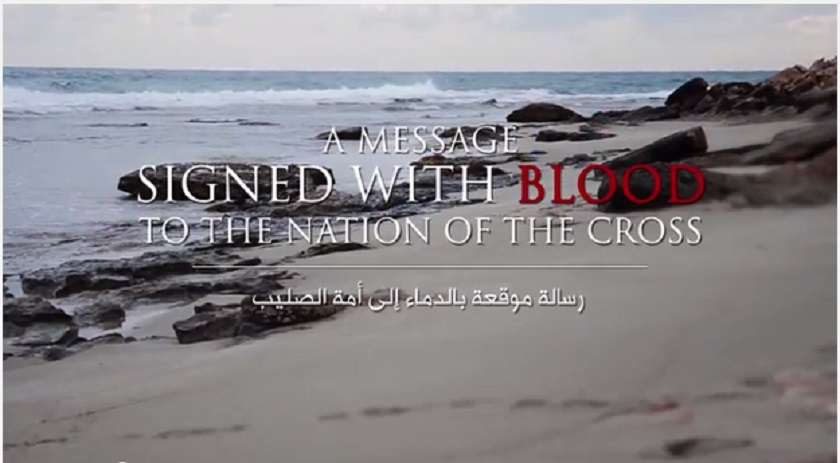
Message Signed Blood ‘To the nation of the cross, we are back again.’

So boasted the black-clad narrator of the latest ISIS video, this time chronicling their slaughter of 30 Ethiopian Christians captured in Libya. Two months earlier, the victims were Coptic Christians, whose beheadings came entitled: A message signed with blood to the nation of the cross.

But what is the ‘nation of the cross’?

Some have embraced the terminology. The Christ Church United Methodist of the Woodlands, Texas, posted a Je Suis Charlie inspired message of support: ‘Here am I, I too, am a member of the nation of the cross.’

But Bishop Angaelos of the Coptic Orthodox Church in the UK thinks they are making a grave mistake.

‘This divisive terminology implies that we as a “nation” of Christians are at war with the “nation of Islam”,’ he wrote to the youth of his church.‘Of course this is not the case, and we must not be coerced into a state of enmity.’

ISIS labeled the ancient Ethiopian Orthodox Church an ‘enemy’, likely for the ongoing Ethiopian military response against the Islamist terrorist group al-Shabab in Somalia. Likewise, the Coptic Orthodox Church is targeted to a great degree for the Egyptian government’s crackdown on the Muslim Brotherhood.

But ISIS is not just after these churches. ‘Our battle is between faith and blasphemy,’ the narrator declared. ‘We swear to Allah: You will not have safety, even in your dreams, until you embrace Islam.’

In seeing itself as a caliphate, Angaelos told Lapido Media, ISIS wants to put itself at war with Christianity.

Alarmed

‘Because there is a Muslim ummah, there must be in their eyes a Christian ummah, the nation of the cross,’ he said, using the Arabic word that can be translated as ‘nation’.

‘This is why I am very alarmed when people use it naively, because they are buying into a rhetoric that is not ours.’

And according to Muslim scholars, ‘nation of the cross’ is not part of Islamic rhetoric either.

The word ummah is used 62 times in the Qur’an, sometimes referring to ‘peoples’ in general. But over time it becomes more specific to the Muslim community, according to Frederick Denny’s chapter, ‘The meaning of ‘ummah’ in the Qur’an’, in The History of Religions.

Christians and Jews are viewed as an ummah as recipients of divine revelation, but Christians are labeled ahl al-kitab, or ‘people of the book’.

‘This phrase [nation of the cross] is unknown, ISIS has invented it to divide people,’ Muhga Ghalib, dean of Islamic Studies at al-Azhar University told Lapido Media. ‘We have the three religions: Islam, Christianity, and Judaism, and we are brothers in humanity.’

The editor-in-chief of the Muslim Brotherhood’s official English website agreed. ‘I cannot really make any reference of “nation of cross” to Islamic heritage, or history, and I’m not sure what the origin is,’ Hazem Malky told Lapido. ‘It looks like something they use in their own literature to serve their needs and ideology.’

But even where the rhetoric turns negative in Islamic history, terms like ahl al-dhimmah or kuffar are employed, to refer either to a protected community paying jizya tax, or to infidels.

ISIS’ video also highlights the fact that Syria’s Christians admit paying the tax, having been brought to the point of submission. Rejecting the nation-state system, ISIS sees the caliphate at war with distinct religious communities with the aim of subjugating them.

Obscure

Its extremist scholars have made a science out of reviving obscure concepts in Islamic history, like the selling of sex slaves and the burning of captives. These are rejected by the vast majority of Muslims today.

But even a group with traditional animosity against Christians finds the term ‘nation of the cross’ unfamiliar. Hany Nour Eddin, a member of Egypt’s dissolved parliament with the formerly militant al-Gama’a al-Islamiya, told Lapido Media ISIS tries to invoke the Crusades in its effort to pit East against West.

‘ISIS uses the logic of power and jihad in order to create conflict,’ he said. ‘They are trying specifically to recruit the Islamist current to their side, telling them the democratic experiment has failed.’

Bishop Angaelos, on the other hand, interprets it as the recruitment of an enemy.

He says ISIS wants a military response motivated by Christian sentiment. ‘The West must not give in. This ideology must fall, otherwise those killed will be replaced by others,’ he says.

Instead, those motivated by Christian sentiment have a responsibility to exhibit their faith.

After the beheading of the Copts by ISIS, Angelos tweeted #fatherforgive, and it quickly went viral. When BBC and CNN reported it, the popular discourse shifted.

Angaelos is calling for his own redefinition of terms to be taken up more broadly, to prevent the world being sucked into a false dichotomy.

‘When we disengage from this language, we move away from the simplicity of Christian West versus Muslim East, because it’s wrong,’ he said. ‘I find this concept of the Muslim world quite offensive. Do I not have a place? For millions of Christians, this is our world also, plus Baha’is and non-believers beside.’

He adds that ‘the nation of the cross’ does not fit the West in its religious diversity. Coining a phrase foreign to Islam, Christianity, and modern civilization, ISIS is threatening to set the terms.

‘They are killing Muslims not just Christians’ says Angaelos. ‘This ideology considers everything unlike itself an enemy.’

This article was first published at Lapido Media.

Categories
Prayers

Friday Prayers for Egypt: Brotherhood Twisting

Flag Cross Quran

God,

Former president Morsi received his first prison sentence this week: Twenty years for inciting violence against protestors while in office. Afterwards his supporters took to protesting, but far fewer than once before. Even so, again, there was violence.

But by the end of the week the Brotherhood abroad reconstituted itself. And the first public statement included a seeming admission they were wrong to pursue a revolutionary path.

God, with passions divided let each pray their own way.

Further confuse the Brotherhood as it disintegrates, suffering the consequence of sins sowed over many years.

Further consolidate the Brotherhood as it reflects, recovering from sins suffered over many years.

Either way, may both pray to bless Egypt.

Either way, the Brotherhood is twisting. Twisting in the wind as prison sentences hit closer and closer to home, threatening death. Twisting in contortion to stay alive and stay united, as pressure pushes harder and harder from within and without.

And let each interpret again in turn.

Twisting the truth to fit the need. Reacting nimbly to those twisting the plot.

Either way, may all pray to bless the Brotherhood.

Bless them with wisdom, God, to reflect rightly. Bless them with courage, to act upon the truth.

Blessing friend or enemy, God, grant Egypt a righteous outcome.

Grant Egypt peace. Make her straight.

Amen.

Categories
Personal

Crucifixion and Liberation in Cairo

Hisham Rizk
Hisham Rizk

Last summer the body of Hisham Rizk turned up in a Cairo morgue. The 19 year old graffiti activist had been missing for a week, and the official autopsy labeled him as having drowned in the Nile River.

No further information was given on the English language Ahram Online. But withholding comment only fuels speculation – rampant among many revolutionary activists – that the security apparatus is coming after them. Orchestrated to begin on Police Day, the January 25 revolution humiliated them but now is the time for payback. So goes the theory.

Rizk was a member of the Mohamed Mahmoud Street Graffiti Union, whose images are among the few to remain prominently displayed in Cairo. They are at the site of terrible clashes in November 2011, between protestors and police on a side-street off Tahrir. They contributed also to the rift between revolutionaries and the Muslim Brotherhood, who did not participate in defense of the square.

The Brotherhood has since suffered its own terrible losses at the hand of police. Though these groups share a common enemy, there is little sympathy offered. During their year in power the Brotherhood marred revolutionary icons and dismissed the ongoing struggle with the military and security apparatus, with whom these activists say they readily accommodated.

News of Rizk’s death reminded me of my last visit to Mohamed Mahmoud Street, several weeks earlier. President Sisi was not yet elected, though his victory seemed inevitable. An interview subject postponed our meeting two hours, so I had lunch in McDonalds facing the ubiquitous graffiti.

To pass the time I alternated between reflecting on the images and reading ‘A Theology of Liberation,’ tucked away in by bag to read on the metro. It was written by Gustavo Gutiérrez, the Latin American priest who demanded that Christianity pursue justice for the poor, as reflected in the character of God. For Gutiérrez, the cross of Christ represented the total involvement of God in the suffering of mankind. As such, Jesus identified with all victims, and his resurrection presages their own, toward which his followers must strive.

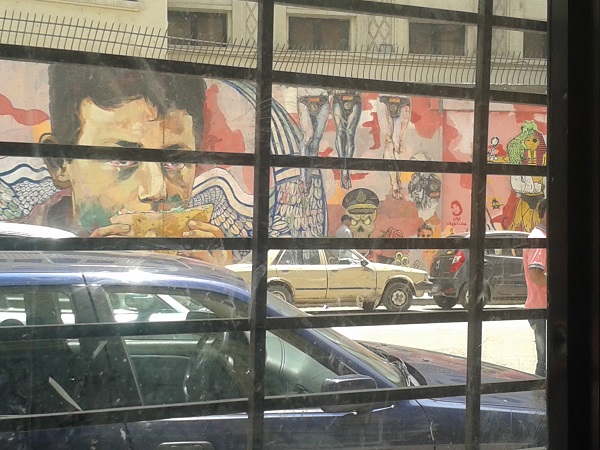
Consider then the following picture, as seen behind the bars of McDonalds, while eating French fries and a cheeseburger from the Egyptian equivalent of the dollar menu:

Here is the image in question:

McDonalds GraffitiThe three crucified pairs of legs are covered by a belt bearing the name ‘Central Security,’ the revolutionary activists’ archenemy. What is not clear to me is what the symbolism means. Are these the victims of police, mocked and tagged with state insignia? Or have the police themselves been stripped, hung, and crucified? Does the image commemorate, or anticipate?

If the former, it is a remarkable statement of the power of Christian imagery within a revolutionary struggle of Muslim majority. Islam rejects the cross of Christ, believing instead God saved Jesus from the humiliation of crucifixion at the hands of his enemies. But the clashes and aftermath of Mohamed Mahmoud represent a losing moment for these activists. To depict their suffering they drew a cross.

To my knowledge there is no revolutionary graffiti of an empty tomb. They can hardly be blamed; they have had no victory. Initially pleased with the military removal of the Muslim Brotherhood, many now see in President Sisi the restoration of the security state. But some Christian revolutionaries have spoken of how they comforted their Muslim colleagues with tales of Jesus. Struggle involves suffering, they said, and perhaps even death. But victory comes as God resurrects.

This is how most non-revolutionary Egyptian Christians view the emergence of President Sisi. They, with millions of Muslims beside, project upon him the image of savior. He is the answer to their prayers, the remover of the Muslim Brotherhood.

And now it is the Brotherhood which is now being crucified, though this particular image is not found on Mohamed Mahmoud Street. Their opponents might cite a different Biblical parallel in the story of Esther. Following the failure of his plot to exterminate the Jews, Haman was hanged on the gallows he prepared for Mordecai.

Crucifixion GraffitiInstead, the graffiti interpretation is possible that it is security which receives its comeuppance. A triumphant revolutionary movement finally secures the reins of power and holds the police accountable for its crimes. Their execution is in order. Perhaps the picture draws on Islamic imagery: Crucifixion is among the punishments commanded for those who sow discord in the land.

Liberation theology anticipates such a grand reversal. Salvation is not simply from personal sin, but from the corruption of society which binds the poor in their place. Certain strands of this theology call for participation in the necessarily violent struggle to overthrow the powers-that-be.

Certainly those who fear God should be involved in the pursuit of justice. The question is how best to interpret justice, and where on the spectrum of participation a red line should be drawn.

But the alternate interpretations of the graffiti – whether identifying the Brotherhood or the security on the cross – should not be tolerated. Neither is consistent with the Jesus who cried out, ‘Father forgive them,’ according to the Biblical account. Jesus intended his crucifiers also to be beneficiaries of the liberation he offered.

For according to Christian theology, his crucifixion was the wisdom of God to put right the universe. This is not the case for Hisham Rizk, even if he drowned a martyr. It is not the case for any of the revolutionaries who have died for their cause. They represent a tragedy, a reminder of a world not yet put right. Whether one fights nobly, foolishly, or not at all, death is still the reality for everyone amid extensive injustice.

But to put it right, God expects his followers to work for justice in the face of death, unafraid. Such is the glory of a martyr, who will receive God’s compensation in reward of uncompromising faith. Many revolutionaries have been motivated by this promise.

The hope of liberation theology is that the promise is greater still. It is that through crucifixion resurrection comes. This is certainly true of personal Christian theology. It is only through death to self and identification with Christ on the cross that God’s life can inhabit an individual, in this world and the next. But is it true for society as well?

Here, liberation theology appears to be of two minds. For one, the answer is yes: We struggle on behalf of the poor and oppressed and whether or not we die, we await God who will put right all things through our sacrifices.

For another, the answer is no: It is obvious our idealistic struggles fail, so we must in a sense crucify the other and wrest power from him. Then we can put right all things in view of what God has commanded.

The first is of faith, perhaps naïve. The second is of pragmatism, perhaps ungodly. Where in this analysis is Egypt?

Perhaps Sisi has put all things right. Perhaps he is struggling to do so. Perhaps he only pretends, putting all things wrong.

Let each Egyptian judge, mindful of the following: Faith must be lived in the world, but the ways of the world must not sideline the convictions of faith. Countenance no manipulation, and avoid no crucifixion.

Securing the first assures God’s blessing; enduring the second enables God’s liberation. Such is the hope of faith.

Even as I type I am filled with dread should such hope prove empty. If Hisham Rizk died an inopportune death, where is the liberation to follow? Is it found in his enduring images on Mohamed Mahmoud Street? Is there some collective cosmic tally to which he contributes?

Perhaps. Paul wrote that his sufferings filled up what was lacking in the suffering of Christ. Jesus said his followers would do even greater works than himself. An earlier prophet summed up all requirements: Do justly, love mercy, walk humbly.

The world will not be put right until God puts it right. But God desires us to put it right in the meanwhile, flawed and incomplete our efforts will inevitably be.

Wherever Egypt is along the path of progress, she has not yet arrived. Blessings to all Egyptians who seek to move her forward.

Categories
Excerpts

Defending Rabaa

Defending Rabaa

Omar Ashour is an academic at the Brookings Institute who recently published a paper entitled, ‘From Collusion to Crackdown: Islamist-Military Relations in Egypt.’

It is an insightful retelling of two epochal moments in history, the 1952 Free Officers revolution and the 2011 Arab Spring. In both, he details how the military establishment and the Muslim Brotherhood cooperated, maneuvered, and eventually clashed.

History is contested, so those who either lived through or studied carefully these events are invited to weigh in on the anecdote that follows. But in understanding Brotherhood resistance following the June 30, 2013 protests against Morsi, this detail risks being overlooked. I, at least, had missed it.

According to Ashour, the Muslim Brotherhood was an intimate partner with the Free Officers, but then tried to resist Gamal Abdel Nasser as he consolidated power outside of democratic procedures.

At one crucial moment the Brotherhood helped organize a demonstration against him, calling for (among other things) the army to return to its barracks.

Nasser asked Abdul Qadir Audeh, the Secretary-General of the MB, to dismiss the protesters. Audeh complied, hoping to reach a compromise, but was arrested that same night by Nasser’s loyalists in the military police and was executed a year later.

Sound familiar? In 2013 the Muslim Brotherhood did not accept the ouster of Mohamed Morsi on July 3 despite the massive protests against him. Right or wrong in this decision, this is an important distinction between 2013 and 1954. The sit-in in support of Morsi had formed to counter these protests, and continued into mid-August. During this time there were intense negotiations between the two sides, with active participation of foreign diplomats.

During negotiations the Brotherhood was urging on participants to stand firm, even to the point of martyrdom. This is well known. But in connection with the anecdote above, this detail escaped me.

On July 17, 2013, Audeh’s son Khaled, a university professor, reminded the hundreds of thousands of protesters in Rab‘a Square of that mistake. “Our stance here is our way to success. I swear I will never dismiss you like my father, the martyr Abdel-Qadr Audeh, dismissed the protesters on 28 February 1954…. They tricked him and told him to dismiss the protestors and that the army would go back to its barracks and democracy would be resumed. He believed them. And then he was arrested at night and executed afterwards.”

It helps put in perspective the psychology of the Brotherhood.

Ashour’s paper considers the removal of Morsi to be a coup, for those who take offense at this designation. But it also demonstrates the Brotherhood’s claim to be a martyr of democracy is overly simplistic. For example:

By December 1952, Nasser made it clear to the MB that there would be neither free elections nor a re-installation of civilian leadership. In January 1953, the RCC dissolved and banned all political parties in Egypt. The MB did not oppose this decision because it did not affect them (they were not a political party) and also to avoid a costly clash with Nasser’s powerful faction in the RCC and the army, an opportunistic stance that would prove costly in the future.

There is another important difference between the two episodes, as the Brotherhood did not initiate the protests of 2011, joining later. But they soon demonstrated a spirit of collusion with the military, ranging from cooperation to non-confrontation. Different examples are given, but here is one sometimes forgotten.

In June 2012, a SCAF decision dissolved the lower house following a constitutional court ruling that part of the electoral law was “unconstitutional.” This decision vested all legislative powers in the SCAF only days before Egypt’s first civilian president was scheduled to take office on June 30, 2012. It was, in effect, a bloodless coup, one that passed without any international condemnation and limited domestic criticism. Because the winner in the parliamentary elections, the MB, had also won the presidency, it did not mobilize its supporters and coalition partners [against the decision].

The Brotherhood may argue it was trying to be pragmatic, accepting defeat against a stronger foe in hopes of fighting another day with a stronger hand. Perhaps. But the details Ashour provides help recount a history that is not clean and principled. This is important to remember given the righteous garb the Brotherhood now seeks to don.

In the struggle for power in Egypt, democracy is a tool. But it is only one among many. That it is the preferred tool of the Brotherhood should not lend them greater favor. It is a bare-knuckled fight, and right now they are losing badly. But they chose to step into the ring, and have grappled along with the rest.

Without granting good intentions to either the military or the Brotherhood (which may be there), let there be some sympathy. Every fight has its principles. Every struggle for what is right is met with temptation to embrace some wrong.

The Brotherhood sees the military leadership as a dictatorial junta. The military sees the Brotherhood as a radical transnational force. Both see each other as a rival.

Be careful, oh outsider, about taking sides. For Egyptians of course it is a different matter entirely.

Categories
Excerpts

The Muslim Brotherhood in Transition

Muslim Brotherhood in TransitionNeither description is right, says Ibrahim al-Hudaybi. The former Brotherhood member says the organization is not al-Qaeda, but neither is it committed to non-violence. The better reality is that it is in transition, and the future is still uncertain.

His article is translated at Mada Masr, and here is why a non-violent ethic evolved in the years before the revolution:

Socially speaking, the organization mainly includes middle class professionals, and they are conservative by definition and not willing — due to their professional positions — to make choices that might alienate them from society (or justify such an alienation) and lead to grave social consequences.

Furthermore, the organization’s leadership has been — throughout the past decade at least — chiefly composed of businessmen, with economic interests that require protection by preserving a connection with the regime, to a certain extent. This initially led the organization to adopt an extremely conservative stance towards the revolution, reducing it to a limited reformative process, without pushing for any significant changes in economic and social structures.

In addition, the Brotherhood’s social investments, in terms of schools, medical clinics, mosques, and associations, also required maintaining a certain relationship with the government, in order to preserve those investments, eventually eliminating the prospect of violence.

Hudaybi argues that Rabaa radicalized many, and as the state arrested leadership the Brotherhood was increasingly unable to hold to its traditionally tight organizational structure and discipline.

Leaders, however, and especially outside the organization want to preserve the Brotherhood brand of non-violence so as to maintain support from international human rights organizations. But at the same time, they face internal pressure:

Such conflicting motives, combined with weak organization making them unable to control the movement as a whole, some leaders have become aware that pacifism won’t be an option for long. They have tried to prevent the full engagement of members in violent acts by redefining violence, using the now famous slogan: “Anything short of bullets is peaceful.”

And this article from Foreign Policy describes the Ultras Nahdawi, which have taken up the protesting mantle. Its youth say they are not the Brotherhood, though Hudaybi (without mentioning Ultras) describes many of these similar protesting and violent groups have emerged from the younger Brotherhood ranks. But if this connection is somewhat nebulous, here is how it describes the Nahdawi association with violence:

When the police do inevitably attack one of their demonstrations, however, the Nahdawy can rely on a subset of their members to spring into action and engage with police forces: the Maghouleen, or Unknowns.

“The Maghouleen are the ones who meet the police head-on,” Faisal said, lowering his voice. “They’re an anonymous group of front-line fighters. No one knows who they are, but they are armed and will be violent if they need to be.”

So what is the attitude of the Brotherhood leadership? The article quotes a respected analyst:

Political researcher and Brookings fellow H. A. Hellyer said this sort of rhetoric has been at the center of the Brotherhood’s PR strategy since the military takeover: championing dissent but refusing to take ownership of it.

“The reality is that the Muslim Brotherhood has lost tremendously in the last year and a half and everything they’re doing right now is about maintaining a semblance of brand,” Hellyer said. This “brand” is pro-democracy, anti-violence, anti-extremism — and the Ultras don’t quite fit the bill. So even though their ideologies and goals align, the Brotherhood isn’t about to wave the Nahdawy banner.

“It’s also all about redirecting: putting a message out there but not taking responsibility for it,” Hellyer said.

The outcome, according to Hudaybi:

This violent tendency represents the Brotherhood’s “organization” only as much as “their determination to remain peaceful” does. The organization is going through a transitional phase, in which both views of violence and non-violence are being adopted, sometimes by different people, sometimes in different statements (in different languages and on different sites), and at other times by the same people in different situations.

Under this organizational disintegration, there is currently no way to determine who will prevail eventually.

And his somber prognosis:

The more we fail to handle this situation — on the social and ideological level, the first being more important — the more likely it is for the discourse which claims that there is no difference between the Muslim Brotherhood, Al-Qaeda and the Islamic State to become a self-fulfilling prophecy.

Categories
Excerpts

A Regime-Islamist Reconciliation?

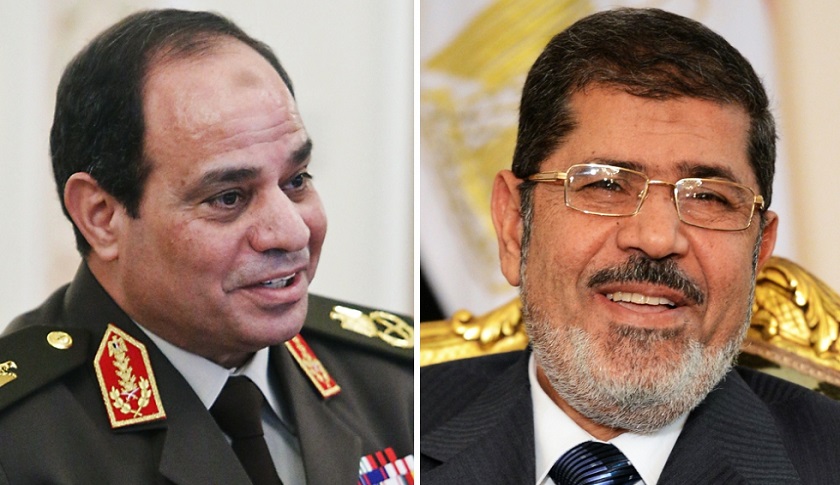
morsi-sisiVery important but under-reported news in this article from al-Ahram Weekly:

Recent developments suggest the possibility of a thaw in relations between the state and political Islam. President Abdel-Fattah Al-Sisi recently met with three members of the Dissident Muslim Brothers, a breakaway group from the Muslim Brotherhood.

There is also a reconciliation initiative, proposed by Tarek Al-Bishri, between the government and the Muslim Brotherhood. The legal scholar, known to be close to the Islamist trend, hopes the initiatives will attract Saudi backing.

After describing recent incidents of terrorism, the article provides perspective from the former Brothers:

Speaking to the press following the meeting between Al-Sisi and Dissident Muslim Brothers, Tharwat Al-Kharbawi said those attending agreed that a reconciliation with the Muslim Brotherhood is unrealistic.

Al-Kharbawi described the three-hour meeting as “an extraordinary meeting with an extraordinary man …You can rest assured that Egypt is in good hands. But we all have to work together to ensure he is not left alone.”

In the background are discussions with Brotherhood members in detention:

Al-Zafrani (ex-MB) told the press that the statements of repentance issued by some detainees was discussed. He said Al-Sisi welcomed the recantations. He quoted the president as saying that the principle of revision, admission of mistakes and repentance is acceptable as long as those issuing the declarations have not committed criminal acts.

Security sources report a growing number of imprisoned Muslim Brotherhood members are renouncing their membership of the group. Muslim Brotherhood leaders deny there is any such trend.

As for the reconciliation initiative, Bishry revealed it to a Turkish newspaper:

He also spoke of the January revolution, parliamentary elections and the importance of safeguarding the Egyptian state. “The continued existence of the state in Egypt is vital … we must preserve and perpetuate it through the participation of the people,” he said.

Al-Bishri argued that the ongoing conflict in Egypt is between three forces: the state and its backbone the army; Islamists and their grassroots organisations; and liberal elites who control the media. “The state, which is the strongest, should reach out to all,” he said.

Brotherhood dissidents dismiss Al-Bishry, finding him inclined to the Brotherhood above all.

After describing the long prison sentences given to many Brotherhood leaders, the article concludes with its analysis. The two sides are simply positioning:

In the confrontation between the state and political Islam, pressure is being sustained, on the one side, by long prison terms for Muslim Brotherhood leaders. On the other, there are bombings and violence being carried out by anti-state, pro-Islamist forces, considered by the state to be linked to the now-banned Muslim Brotherhood.

It is a game of nerves in which each side is seeking to strengthen its hand for whatever negotiations eventually ensue.

Certainly, Al-Sisi’s meetings with leaders from breakaway Muslim Brothers and reports that the new Saudi monarch is eager to settle the situation in Egypt suggest some form of social, if not political, reconciliation is increasingly likely.

Right or wrong in this conclusion, the article is worthy of consideration.

Categories
Europe Lapido Media Published Articles

The Muslim Brotherhood in England and Egypt

MB England EgyptLondon and Istanbul have become the new base of operations for the Islamist Muslim Brotherhood.

Following the ouster of Brotherhood President Mohamed Morsi in 2011 and their subsequent banning in Egypt in December last year, the organization is recalibrating abroad.

An early base of operations was Qatar, where the al-Jazeera network was widely perceived, even by its own staff, as being biased toward the Brotherhood.

But the United Arab Emirates and Saudi Arabia joined Egypt in labelling the MB a terrorist organization, and their pressure on Qatar resulted in the expulsion of some leaders.

Now several office blocks on London’s A406 North Circular Road comprise one of the two main centres of operation, the other being Turkey.

An investigation into MB links to terrorism was completed by former Ambassador to Saudi Arabia, Sir John Jenkins in July 2014, but its results have not yet been made public.

And bar a few lone journalists keeping tabs on the story, there is little public accountability about the presence and growth of such a controversial movement in Britain.

The MB is accused of burning up to 50 churches and Coptic businesses following the violent dispersal of pro-Morsi sit-ins on August 14, 2013. In December, in an Asyut court 40 Morsi supporters were found guilty, while 61 others were acquitted.

Ian Black of the Guardian has followed the story, implying the inquiry is being leaned on by Gulf nations who have banned the MB.

Delay in its publication is attributed to their displeasure that the report clears the MB of terrorism.

Black quotes MB apologist Anas al-Tikriti, founder Director of the Cordoba Institute, who says Islamists like the MB must be seen as a middle ground in the fight against extremism. If allowed to govern, he says, they would liberalize and sideline their hardliners.

Shadi Hamid of the Brookings Institute debunks this theory, saying Islamists only ever moderate their behaviour under duress. Once enjoying democratic freedoms, they tend to revert to their original illiberal religious conservatism.

Tikriti, whose father was in the Iraqi Brotherhood, recently denied on Twitter being a member or lobbyist of the MB.

Al-Jazeera however describe the Cordoba Foundation as a Brotherhood front. And the Hudson Institute, in a study of UK-based Islamism, calls him one of their shrewdest activists.

But Ibrahim Mouneer, an MB senior leader in London, told the Times that if the group were banned it would result in increased terrorism at home, with moderate Muslims concluding that an irenic approach didn’t work.

Lapido Media has argued this purported dichotomy between Islamism and jihadism is a false choice, and the government should not be gulled.

According to Andrew Gilligan of the Telegraph, the UK inquiry will confirm that the MB is not a terrorist group and should not therefore be banned.

And a British security source told Lapido they prefer to turn a more or less blind eye within the law, believing this offers opportunities for ‘influence’.

But Gilligan provides extensive evidence the group is linked – directly and indirectly – with terrorist groups, in particular with Hamas, and is at least potentially outside the law.

Cordoba Foundation is named by Gilligan as one of 25 groups with Muslim Brotherhood links. The Muslim Charities Forum is mentioned also.

A June report by the UAE based The National linked Takriti, his family, and associates also to the Middle East Eye and Middle East Monitor.

The Egyptian foreign ministry has asked in vain that London shut down UK based pro-MB satellite channels and newspapers like Alarabi, al-Hewar, and al-Araby al-Jadeed, saying they incite terrorist activity in Egypt.

The BBC has examined this growing media outreach that fails to promote impartial journalism, and is said to be funded by Qatar.

According to the Washington Post, this incitement is clear in the MB’s other haven abroad, Turkey. It says the Masr al-An channel, funded and managed by the MB, warned that the families of Egyptian police officers would be ‘widowed and orphaned’.

Other Turkey-based pro-MB channels like al-Sharq, Mukammilin and Rabaa employ similar rhetoric, and even allowed one MB supporter to issue a fatwa during a live interview to assassinate Egyptian President Abdel Fattah al-Sisi. Others advocate the killing of media figures and warn foreigners to leave Egypt lest they become legitimate targets.

The fatwa caused uproar, leading the Brotherhood on its English language Twitter feed @IkhwanWeb to condemn it and deny endorsing the channel.

The call to kill Sisi was made to audible applause by grinning Egyptian cleric Salama Abd Al-Qawi who said: ‘Doing this would be a good deed that would bring (the killer) closer to Allah.’

Although Al-Qawi was official spokesman for the Endowments Ministry during the presidency of Morsi, it is hard to pin down his ‘membership’ in the Muslim Brotherhood.

The MB is a hierarchical organization with strict guidelines for who is in and who simply is like-minded. Those who are members follow policy. Others aid and cooperate. The MB does not publish its membership list.

Many MB self-identify. And the period in power gave the opportunity to see new faces emerge. But without an admissions policy, it is very difficult to identify ‘members’.

MB-watchers have not seen the sheikh identified either way. But clearly he is at least a supporter and often featured in their broadcasts.

On January 25 this year a delegation of the Egyptian Revolutionary Council and the so-called Parliament in Exile, including leading MB figures, visited Washington and met State Department and White House officials.

They asserted that the revolution was non-violent and the only way to undo the coup. The State Department had previously said Egypt had given it no evidence of MB links to terrorism.

Just two days later the MB released a statement urging its supporters to prepare for a long and uncompromising jihad, stopping just short of an outright call for violence.

Charl Fouad El-Masri, editor-in-chief of Egyptian daily al-Masry al-Youm said: ‘Egypt’s Copts suffered during the Muslim Brotherhood rule greatly.’

Anglican Bishop of Egypt Rt Revd Mouneer Hanna Anis had his Suez church attacked by pro-Morsi supporters following the dispersal of the Rabaa and Nahda sit-ins in August 2013. He strongly suspects the MB to be behind Egyptian violence and terrorism.

‘They may not be directly involved in terrorist attacks,’ he told Lapido Media, ‘but they encouraged the flourishing of terrorist groups in Egypt.’

This article was originally published at Lapido Media, as a press briefing service.

Categories
Christianity Today Middle East Published Articles

Libya’s 21 Christian Martyrs: ‘With their Blood, They are Unifying Egypt’

(credit Mohsen Nabil / AP Images, via CT)

From my new article in Christianity Today:

Late Sunday night at an otherwise quiet curbside café in Cairo, customers put down their tea and backgammon. They sat riveted, watching Egypt’s president pledge retaliation against the Islamic State in Libya.

Earlier in the day, jihadists released a video of the beheading of 21 Coptic Christians. Following President Abdel Fattah al-Sisi’s declaration of a week of mourning, the channel switched to images of the orange-clad victims, walking to their death on the shores of Tripoli.

“Do you see that?” one customer exclaimed, rising to point out the scene to his friend. “They dressed the Copts like in Guantanamo. This is horrible!”

The remark demonstrates the gut-level reaction of Egyptian Muslims, contrary to the desires of the Islamic State.

“There has been a very strong response of unity and sympathy,” said Andrea Zaki, vice president of the Protestant Churches of Egypt. “People are describing Copts as Egyptians, first and foremost, and with their blood they are unifying Egypt.”

The article then provides commentary from other Christian leaders, and ends with a very direct message:

This thought is the central feature of nearly all Coptic advice to Christians in the West: Support Egypt.

Sidhom speaks openly of his “grudge” against the US administration, and no longer holds hope that American organizations can help. Zaki asks Western citizens to pressure their governments to see the “reality” and designate the Brotherhood as a terrorist entity. Kharrat asks for tourism and investment, especially in Upper Egypt.

But all ask for prayer.

“We are praying for God to change the hearts of those who have been raised on extremist thoughts,” said Anton, “and that this generation of Sisi will be different.”

Please click here to read the full article at Christianity Today, published February 18, 2015.

Categories
Atlantic Council Middle East Published Articles

Strong Egypt: A Party in the Middle

As party president Abdel Moneim Aboul-Fotouh speaks (2nd from L), the children of Mahmoud Shalan plead for his release from prison.

On an uncontested electoral list at the Strong Egypt Party’s first general conference on February 13, Abdel Moneim Aboul-Fotouh was confirmed as president along with his running mate for general-secretary, Ahmed Fawzi.

But this was the least remarkable event of the day. Their acceptance speeches set the tone for the controversy to follow.

“I have a dream,” said Fawzi, purposefully echoing Martin Luther King, “that Egypt will be a modern nation with a strong economy that exports ideas to the world.”

But no one was paying attention. As he spoke family members gathered in the aisle and silently held up posters of party members still in jail.

When Aboul Fotouh invited them to the front, activists seized the moment.“Yuskut, yuskut, hukm al-‘askar,” they chanted angrily: Down with military rule. Aboul Fotouh stood quietly, allowing the zeal of younger members to buttress his earlier remarks. “This regime is more oppressive than Mubarak’s,” he thundered. “How can we participate in parliamentary elections when people are killed in soccer games and in the streets?”

Strong Egypt had announced its boycott nine days earlier, but the rhetoric at the conference was far stronger than the official statement, which cited “a “lack of adequate democratic standards,” as the reason for the party’s decision.

The chants against the military prompted Zamil Saleh, a photographer for Sawt al-Umma newspaper, to rush forward in criticism, shouting at the offense. Other Strong Egypt members contained him, holding him back and ushering him out the hall. The process was calm, but al-Bawaba News quickly published he was beaten and his equipment smashed.

Shortly after the incident, party spokesman Ahmed Emam noticed the headline, published online before the conference had ended, and told the audience it was just one more piece of evidence of official state and media bias against the party. Twenty-seven locations had declined to host the conference, he said, many citing concern about security displeasure.

The Strong Egypt Party was licensed officially on November 12, 2012, and has roughly 400 voting members in its general conference, around 250 of whom were present for the election. In addition to the confirmation of the president, 87 candidates ran for 49 seats in the high committee, which in one month will vote on the ten-member political office.

A more contentious referendum item concerned integrating leadership with the Egyptian Current, formed in June 2011 by revolutionaries expelled from the Muslim Brotherhood. Their merger was announced October 1, and at the conference a roughly two-thirds majority approved the agreement to add two Egyptian Current members to the political office, and fifteen to the high committee.

Following the conference, former parliamentarian Mustafa Bakry called for the High Committee of Political Parties to ‘erase’ Strong Egypt as a legal entity, accusing Aboul Fotouh of attacking the Egyptian government. Mohamed Moussa of the Conference Party, founded by Amr Moussa, accused Aboul Fotouh of carrying out the instructions of the Muslim Brotherhood.

Conspiracy aside, Strong Egypt does support the return of the Brotherhood’s Freedom and Justice Party (FJP) to political life. Mamdouh al-Shaib, a member of the political office, told EgyptSource that the FJP should be allowed back into the political playing field, as long as it operates separately and independently of the Brotherhood itself.

Shaib believes social reconciliation must precede political, and be followed by transitional justice and a return of the army to its barracks. “Sisi is the ambassador of the army in the presidential palace, just as Morsi was the ambassador of the Brotherhood,” he said.

Fekry Nabil, also of the political committee, distinguished between legality and legitimacy. Morsi was the legal president, Nabil explained to EgyptSource, but through his performance in office he lost his legitimacy. Strong Egypt called for new presidential elections as early as March 2013, and was part of the June 30 demonstrations to remove him from office.

“But no one has the legality to call for the army to remove him,” Nabil added.

From the beginning, Strong Egypt suspected the July 3 removal of Morsi was a coup d’état, but were quiet about it until their transitional suggestions were ignored. Nabil described how in early negotiations after Morsi’s removal, Aboul Fotouh demanded the FJP not be eliminated from the political scene, and a referendum be submitted to the people to legalize the proposed roadmap. If agreed, Strong Egypt offered to mobilize for a ‘yes’ vote.

But subsequent killings at the Republican Guard and in the dispersal of pro-Morsi sit-ins confirmed their suspicion, and since then they have tried to balance between support for June 30, and rejection of July 3.

For Strong Egypt, an essential part of this balance is demanding the right to demonstrate, as in the licit protests of June 30, while not calling for them now, in light of the crackdown against them. They would prefer dialogue to resolve the ongoing crisis and return Egypt to democracy, for current protests carry too high a price in incarceration and blood. But Shaib anticipates another revolutionary wave is probably necessary.

So despite Sisi’s overwhelming victory in presidential elections, which Strong Egypt boycotted, the party considers his conduct in office and suppression of the political scene as confirming his lack of legitimacy following the coup. As to the legality of this election and his right to four years in office, it doesn’t much matter to Strong Egypt.

“Sisi was ruling the country after July 3 in actuality,” said Shaib. “We don’t accept his legitimacy, we recognize his reality.”

This article was originally published at Egypt Source on February 17, 2015.

Categories
Personal

Egypt’s Struggle to Return to Normal

Four years have passed since Egypt’s revolution began in 2011. They have been inspiring years; they have been difficult years. Some say they have resulted in much good; some say they have resulted in a restoration of the bad.

But millions of Egyptians simply a desire a restoration of the normal. The state is striving to deliver, as stability will cement the current political reality. Those opposed are trying to disrupt it, and herein lies the clash.

The news is full of evidence on both sides. Jihadist groups are waging a war against the state, killing policemen and soldiers with unfortunate regularity. And a day before the revolution anniversary a peaceful leftist march to Tahrir square was met with the violence of the state, in which one female activist died.

Between these two is the Muslim Brotherhood and its sympathizers. They claim no relation to violence, but are actively seeking to prevent stability. Their principle tool is demonstration.

The state has left them to conduct small demonstrations in local neighborhoods. But whenever they seek a sizable gathering they are met with the resistance of the police, often with arrest, and sometimes with casualties. It is worthy to note their marches are illegal, as a law exists to regulate them which requires prior announcement to the authorities. Many across the Egyptian political spectrum find this law to be repressive, but it is the law all the same. Brotherhood protests ignore it, not wishing to acknowledge the authority of the state after the removal of President Morsi. Even if they did, would they receive a permit?

But it is in this context that the quiet struggle to return to normal is being waged.

In our local neighborhood of Maadi there is a foot bridge over the Metro tracks. One one side it is located between upper- and lower-class areas, and on the other is a relatively middle-class area stretching to the Nile River. Ever since the revolution began and police enforcement deteriorated, small tuk-tuks have traversed all economic sectors, and barely squeeze into the foot bridge as they complicate passage for all pedestrians.

A tuk-tuk is a three wheel vehicle like a rickshaw. It is very useful in poorer neighborhoods where taxis cannot navigate the narrow streets. But drivers are often underage, reckless, and a hazard for driving everywhere else. The state has not yet shut them down in our neighborhood, though there have been some threats to do so.

In recent days the local government has repaired the foot bridge, and placed a large cement block at the entrance. Pedestrians can easily pass by, but tuk-tuks are barred. Motorcycles can still make it, but at least it is an improvement.

So far, this discussion has nothing to do with national politics. But the effort of the state to bring the neighborhood back to normal, however slowly, is clear. They even covered the foot bridge with a fresh coat of paint.

Maadi Foot Bridge Graffiti

But not a few days later was it covered with graffiti. ‘Man up and hit the streets on January 25,’ it urges. ‘Sisi is a pimp,’ is written in blue. It is ugly, crass, and defaces public property. It is also one of the few methods they have to get their message out.

This is the quiet struggle, not covered in the news. It shows why so many people dislike the Brotherhood and revolutionaries in general these days. They want life to go back to normal, they want stability for their country, and they want to walk over a nice bridge.

Of course, in its efforts, the local government didn’t even do that great a job. A few baseboards are not laid quite right, threatening to trip the pedestrian if his foot lands falsely. It is this lack of commitment to quality that contributed to revolutionary conditions in the first place, and may lend some sympathy to the protesters. In recent days it appears the bridge is under repair again.

As the outside world watches the larger struggle, sympathy is asked for the normal citizen. If in the end this revolution yields a transparent and accountable system of liberty and democracy, they stand as the passive beneficiaries. But in the process of getting there, excuse them for saying a pox on all your houses.

Categories
Excerpts

Talk Peace, Broadcast Violence

Mekameleen TV, a pro-Brotherhood satellite channel broadcast from Turkey

The Washington Post recently published an excellent article detailing the escalation of violent rhetoric between the Muslim Brotherhood and Egyptian state. Language is shocking on both sides, but the government crackdown on the Brotherhood is well-known and admitted, even as accusations of terrorism in the Sinai remain unproven in the eyes of many.

But the Brotherhood actively presents itself in English as committed to a path of non-violent resistance. Consider then this extended excerpt:

In a broadcast from Istanbul, for example, a slick haired television presenter on the Muslim Brotherhood funded and managed Masr al-An (Egypt Now) channel recently delivered an ominous message, “I say to the wife of every officer…your husband will die, your children will be orphaned…these kids [“revolutionaries”] will kill the officers in Egypt.”

This was not an isolated incident of open incitement on Masr al-An. Three other Turkey-based pro-Brotherhood channels (al-Sharq, Mukammilin and Rabaa) echo similar incendiary rhetoric and cheer on the “popular resistance,” hunkering down for confrontation with the regime.

Meanwhile, in Cairo, there is a similar level of vitriol, with the regime-driven media linking the Muslim Brotherhood with the Sinai-based Ansar Bayt al-Maqdis – which refers to itself as the Sinai Province of the Islamic State. The regime has labeled the Brotherhood as an enemy of the Egyptian state, which must be combated, and blames it for various plots against Egyptian interests.

The Islamist and Brotherhood embrace of confrontational rhetoric was evident in a recent “Message to the Ranks of Revolutionaries: ‘and Prepare’” uploaded to an official Web site of the Brotherhood. After a helpful reminder that the group’s logo of two swords and “Prepare” are all “synonyms of strength,” the message continued to remind, “Imam [Hasan] al-Banna [Brotherhood founder] equipped jihad brigades he sent to Palestine to fight the Zionist usurpers. And the second Guide, Hasan al-Hudaybi, restored the ‘secret apparatus’ [paramilitary] formations to attrit the British occupiers.”

It concluded, “We are at the beginning of a new phase where we summon our strength and evoke the meaning of jihad, and prepare ourselves, our wives, our sons and daughters and whoever follows our path for relentless jihad where we ask for martyrdom.” While this controversial essay did not directly call for violence, many Egyptians interpreted it as a departure.

This is exacerbated in that the Brotherhood, in its bid to make its cause a pan-Islamist one, has allowed radical former Brothers and other Islamists to join it on the platform. Inflammatory preachers like Wagdy Ghoneim – who virtually beat everyone else to the punch by deeming Sissi an apostate even before the Rabaa massacre – are hosted on the new pro-Brotherhood channels.

Following Sissi’s January speech on revolutionizing Islam, charges of apostasy are now standard fare on pro-Brotherhood channels. A Brotherhood-tied cleric who served in the Ministry of Religious Endowments under Morsi, Sheikh Salamah Abd al-Qawi, even gave a fatwa that Sissi’s death is permissible and that whoever kills him and dies in the act is a martyr; he received applause from the studio audience.

In another segment, viewers were urged to come out to protest for the “sake of their religion,” a not too surprising refrain after the Brotherhood’s endorsement of the radical call for a “Muslim Youth Intifada” in November 2014. The attempt to make the current conflict one about Islam was casually explained only months following the coup as part of a strategy to rile up quietist Salafis.

Pro-Brotherhood channels also help increase the profile of radical conspiracy theorists like journalist Sabir Mashhur who labels the army as “occupiers” and “crusaders” fighting the “Egyptian Muslims.” He offers such violent advice to the “revolutionaries” that if they hit the first and last tank in the column with rocket propelled grenades (RPGs) the division will melt away. Furthermore, he echoes other increasing calls to follow the path of the Iranian revolution.

Over the past year groups calling themselves “Popular Resistance,” “Execution Movement,” and recently a group called “Revolutionary Punishment,” have carried out everything from drive-by shootings of police officers, sabotage of public utilities and private businesses, to planting small improvised explosive devices (IEDs) that are increasingly deadlier and more sophisticated.

In the weeks leading up to January 25, the fourth anniversary of the Egyptian revolution, the pro-Brotherhood channels fully embraced these groups and even called on them to execute pro-regime media figures.

The article goes to great lengths to show the context of this escalation, as each side blames the other. It also suggests the Brotherhood is trying to straddle the fence between a long-standing policy of de-emphasizing their violent source material, while giving space to enraged youth bent on revenge for slain colleagues.

Perhaps. But as the excerpt above indicates, the Brotherhood is licensing far more than space for troubled youth. It is filling the space with incitement, at least by proxy. They must clearly condemn, and quickly.

Categories
Lapido Media Middle East Published Articles

Islamism or Jihadism: A False Choice

Fadel Soliman
Fadel Soliman

In the year 1321 Muslim mobs, with tacit allowance from the Mamluk Sultan, destroyed 60 churches in Egypt and openly attacked Copts on the roads and in their homes. Incitement included accusations Christians supported the invading Mongols in their ‘coup’ attempt against the state.

According to UK-based Fadel Soliman, these days may soon return. Coptic support for President Sisi and his coup against the democratically elected Islamist presidency of Mohamed Morsi has resulted in a ‘poisoned atmosphere’ between religious adherents.

‘I am so worried about the future of Egypt,’ said Soliman, ‘especially about the reactions of Muslims toward you.’

Soliman issued this comparison in the context of a larger argument about restoring hope to Muslim youth who own the dream of ruling by sharia. Too many, he laments, are attracted by the success of the so-called Islamic State following the ‘betrayal’ of the democratic dawn.

‘Either give the way to Muslim youth to try to reach their dreams through peaceful means,’ he told Lapido Media, ‘or they will definitely seek violent means. This is normal, this was expected to happen.’

Soliman is the Egyptian founder and director of Bridges Foundation, a UK-based NGO that aims to overcome misconceptions about Islam. His work has been praised by diverse figures such as Representative Michael Doyle of Pennsylvania and the liberal satirist Bassem Youssef of Egypt. He has consistently condemned terrorism and appealed to the Islamic State for the return of Alan Henning, later beheaded.

He is also an Islamist, arguing sharia law supports and enhances the principles contained in the Universal Declaration of Human Rights. He wishes justice for Egypt, to which he has not returned since the dispersal of the pro-Morsi sit-in at Rabaa where he witnessed sixteen of his students killed.

Correct?

But the crucial question is – if his argument is correct will frustrated Islamists flock to a jihadist vision? And similarly, should policymakers encourage ‘moderate’ Islamists as a counterweight to al-Qaeda and the Islamic State?

The argument is very popular in academic circles, informing much of the enthusiasm of the initial Arab Spring. Khalil al-Anani of Georgetown University in Washington DC, writing in Foreign Affairs, speaks for many in his worry about a return to authoritarianism in Egypt.

‘Through its clampdown on political dissent, Cairo has created a fertile ground for ISIS and groups like it,’ he wrote,‘with the potential to recruit young people, Islamists, and moderates alike.’

Indeed, most Muslims in Egypt are religiously conservative. The 2013 Pew survey showed 74% want sharia to be the law of the land, with 56% believing Egypt’s current legal system is deficient. The Muslim Brotherhood and Salafi parties captured nearly three-quarters of the parliament in the 2012 elections. It would appear these numbers represent those are ripe for radicalisation.

But Soliman’s appraisal of Egyptian politics fails to account for the millions of Muslims and Christians who rejected the presidency of Morsi. Coup or not, the subsequent ‘yes’ votes for the constitution and Sisi’s presidency each exceeded the 13 million Morsi won in 2012.

These numbers do not negate the conviction of Islamists that they have been cheated out of gains fairly won. Their grievances have been buttressed by the 632 people killed at Rabaa, according to Egypt’s semi-governmental National Council for Human Rights. A minimum of 6,400 people have been detained for ‘rioting’, according to the Ministry of the Interior.

Bigotry

But the assumption these frustrations will drive Islamists to violence is simply a form of bigotry, according to Samuel Tadros of the Hudson Institute in Washington DC.

‘I disagree with this line of argument,’ he said. ‘It is shallow and insulting to Muslims. It is the bigotry of low expectations.’

Where Soliman sees the path to violence as normal—despite his firm rejection—Tadros sees responsibility.

‘Violence is a choice,’ he said. ‘It is not an inevitable one. Just as some have chosen the path of terrorism, there are millions of men and women who have chosen not to become terrorists, not to kill their enemies.’

Estimates of Egyptians fighting in Syria and Iraq range between 5,000 and 8,000. Islamist movement expert Ahmed Ban of the Nile Center for Strategic Studies believes this makes up 20-30% of their fighting force.

These are significant numbers. But according to two recent polls, only three to four percent of Egyptians view the Islamic State in positive terms. Viewed in light of a population of 90 million, small percentages cause considerable worry. But Egyptians, including the mass of Islamists, are not rushing headlong into jihadism.

Soliman says that every time he criticizes the Islamic State his Facebook and Twitter feeds light up in protest.

But Khaled Dawoud of Egypt’s Constitution Party, writing for the Atlantic Council, says the majority of Egyptians in Syria and Iraq travelled there during the presidency of Morsi. It was not the failure of Islamism that boosted jihadism, but its success.

Egypt has instituted travel restrictions to Turkey to prevent the further flow of citizens to the Islamic State. Terrorism continues in the restless Sinai where the Islamic State has formed a local chapter. The threat is real.

Prioritising values

But even peaceful Islamists have a distinct illiberal agenda, writes Shadi Hamid of the Brookings Institution in his acclaimed book Temptations of Power. The premise that democracy would moderate them did not prove true in Egypt. In an excerpt from the Atlantic he describes the conflict this makes for observers, but Egyptians bear the greater struggle.

‘The ensuing—and increasingly charged—debate over the role of religion in public life put Western analysts and policymakers in the uncomfortable position of having to prioritise some values they hold dear over others,’ he wrote.

In the ongoing debate about how to include Islamists in the political order, foreign governments and Egyptians will set their agenda according to particular interests and principles.

But the implicit threat of jihadism should not be given a place of priority. It is neither sufficiently true nor morally honorable.

This article was originally published at Lapido Media.

Categories
Excerpts

Sisi, ISIS, Tunisia, and Arab Spring Values

Sisi - ISIS

In a recent article at Foreign Policy, Iyad el-Baghdadi described the near-eternal and present dichotomy hoisted upon the Middle East: Support a dictator, or his overthrow via violent Islamism. He finds an ironic symbolism in that the names of Sisi and ISIS are spelled backwards, and describes their evils as parallel.

Near the end of the article he reasserts the hope that motivated many in early 2011:

The Arab Spring is about believing that we don’t have to eternally choose between these two evils, and that we can present a real alternative. Arab Spring activists come from across the political spectrum, but they share a belief in fundamental individual rights, coexistence within one political system, and an open marketplace for ideas. These are the people who represent me — and whom I hope to have successfully, if briefly, represented in a public forum.

These are worthy values, and the author was briefly critical of others beside Sisi and ISIS in his critique:

Both extremes are born out of the same twentieth-century political culture that gave us authoritarian interpretations of just about every ideology: authoritarian Islamism, authoritarian nationalism, authoritarian socialism, and even, yes, authoritarian liberalism. Both view human rights not as inviolable or inherent, but as granted by the state, which can then reduce or suspend them at will. And both envision a state in which some people have less rights than others.

…..

Both sides have a deeply exclusionary, “with us or against us” worldview that manifests itself in a profound refusal to coexist with others. In the run-up to the 2012 elections, we saw the Mubarak-associated figure Shafik hint at banning Islamist parties should he get elected; during Morsi’s term we then watched Islamist discourse squeeze the space for civil society.

It would be worthy to dialogue with Baghdadi (the author, not the caliph!) about his opinion of the Muslim Brotherhood, for his criticism of them is far less severe, at least in this article. Indeed, he has tweeted and written prolifically, so his analysis is available.

But within the opening quote and listing of values comes a very poignant highlight: the open marketplace of ideas. Egypt did experience this open marketplace during its revolutionary period. With full respect to the diverse forces influencing public opinion, Egyptians overwhelmingly chose the Brotherhood and Salafis over the vision Baghdadi presents. Then, perhaps over and against his vision again, they overwhelming rejected Morsi.

The system that could tolerate this pendulum was never established, and perhaps this is Baghdadi’s lament. If left alone, would the Brotherhood have helped its establishment? Or are they just a milder version of ISIS, focused on a long term Islamization inconsistent with Baghdadi’s vision?

One problem is that the system the Brotherhood helped establish through their 2012 constitution enshrined an illiberalism antithetical to this vision. Shadi Hamid has explored this theme in his writing. Islamist organizations tend to moderate while in opposition, but then revert to their extremes when in power. But if such an illiberalism is what people vote for, if it wins the marketplace of ideas, how does it square with Baghdadi’s desire for fundamental individual rights?

He does not want to be forced back into a dichotomy, and this is noble. But would his vision have been able to triumph over time, allowing the people to reject Morsi four years later? Or eight? Or…

Perhaps, though the argument of urgency on the part of anti-Islamists is well known. To summarize, the Brotherhood would do all it could to sink its teeth into the existing system, to gain control of its levers and use it to their own advantage.

Fair or unfair, there is a distinction between the two current camps in the Egyptian struggle. The ideology of the Brotherhood — at its end goal, not necessarily through its stages or current rhetoric — does not support Baghdadi’s vision.

  • Fundamental individual rights: These are curbed by sharia, however variously defined.
  • Open marketplace of ideas: There are religious norms not allowed to be touched.
  • Coexistence within one political system: …

Here is the rub, and am I trying to find a comparison. A socialist versus capitalist vision of the economy can be very divergent. But European nations have navigated a path that has allowed various governments to traverse the path in different directions.

But how much allowance can there be for a democratic versus communistic approach to the state? Should the open marketplace of ideas, ostensibly welcomed in a democracy, allow momentum to build that would overthrow the system that enshrines it?

This later comparison seems closer to the struggle in Egypt. Liberal forces in Egypt have enshrined liberal values (to a degree) in the constitution, however much they recognize the violations used in putting down pro-Morsi protests, understanding also the violations on the part of certain protestors.

The question for this camp is if it will tolerate, or be able to resist, the continual violation. That is, will they accept reversion to Baghdadi’s dichotomy? The Mubarak regime held forward liberal values for thirty years — and all the while implemented a state of emergency that made it easy to circumvent them.

In all this, perhaps Baghdadi, like many, will find hope in Tunisia. The United States, two centuries ago, began a political experiment that removed religion from the sphere of the state, setting up a system meant to guard liberty and freedom. It has endured numerous contradictions along the years, but has been largely successful.

Now, Tunisia is beginning a political experiment that is seeking to integrate a religious, Islamist element. Will it be successful? Many Tunisians are worried, for in creating a system that allowed coexistence they had to beat back Islamist efforts to encode religion into the constitution. Efforts to do so in 2012 with the Brotherhood were not successful – the Brotherhood chose even more conservative Salafis as their partner. But the Brotherhood and the Tunisian Nahda come from the same family tree.

Is Nahda simply postponing a greater Islamizing goal? But more to the point, perhaps, of Baghdadi’s hope: Will the system created allow for the emergence and entrenchment of his Arab Spring values?

Consider the recent anti-liberal political moves of Turkey’s Islamist Erdogan, after an extended period of winning democratic elections. Will Tunisian Islamists consistently nudge and needle against values they have temporarily accepted? Will fear of a similar Islamist agenda lead to preemptive crackdown against them? Time will tell.

But the experiment is on, and perhaps Baghdadi and other activists frustrated with the dichotomy have a fledgling example of a third way.

Categories
Prayers

Friday Prayers for Egypt: Tidying House

Flag Cross Quran

God,

Egypt is trying to redecorate. But beware the house swept clean if it is left unoccupied.

The police force had long been closed to the Muslim Brotherhood, but the revolution opened the door. This week forty students were expelled, for family ties to Brotherhood members. The state had always been wary of infiltration; after a year in public power, it is now easier to find them.

The Azhar was harder to close off to Islamists; conservative Islam can be similar but is not the same. This week 71 students were expelled, for participation in campus protests. The state is seeking calm and a reformed religious discourse; many in disagreement have self-identified.

Downtown Cairo reflected the ethos of the country. Unregulated but entrepreneurial, numerous street cafés catered to fun loving Egyptian. This week many were shut down, pursuant to the law but surely jeopardizing to livelihoods. One café in particular was targeted for its congregating atheists.

And the undercurrent of society had long been left there, undisturbed. But this week the Azhar conducted a ‘count’ of Egypt’s atheists, while the police raided a bathhouse and arrested alleged homosexuals. Politically, commercially, and morally, the nation is housecleaning.

Perhaps. Some say the problems are so entrenched these are only a minor dusting. Others say it misses structural problems altogether.

But even opponents of the state are looking to tidy. Rumors say the Brotherhood is trying to restructure, while Sinai jihadists split over Islamic State affiliation.

God, wash Egypt of all its stains. Repair what is necessary. Gut what is rotten.

Help the police to be of one vision, to serve the law while serving the people. Protect the expelled from unjust accusation, but uncover also if their intentions were ill.

Help the Azhar to be of pure vision, to serve you while serving society. May it navigate well between justice and peace.

Help the economy to stimulate growth, to serve the investor while serving the client. Protect the tax base, but also those of lesser means.

Help the society to stimulate freedom, to serve human rights while it serves cultural norms. May it navigate well between liberty and taboo.

And help state opponents to weigh well their struggle. May they submit to you while submitting to authority, knowing the sometimes difficult balance.

God, you warn when an evil spirit leaves a dwelling, it can come back with seven far worse than itself. No amount of tidying will do, if you do not inhabit it.

Dwell in Egypt, God, and in her people. Dwell in her government, laws, and institutions. Dwell in her culture and commerce. Dwell in her marginalized, and her opponents.

And transform them all. Redeem them. Make Egypt clean.

Amen.