Categories
Prayers

Friday Prayers for Egypt: Running in Place with One Shoe

God,

Egypt seems to be both moving and waiting at the same time. It is as if everyone is waiting for the other shoe to drop.

If the first shoe was Morsy’s election, the second is where he will take Egypt. He gave a preview trying to restore parliament, but there has been only static since then. Three weeks and he still does not have a government in place. In fact, Brotherhood outrage over his now ‘interim’ cabinet is what caused them to field a presidential candidate in the first place.

Much of the reason for the waiting is that key issues are now in the hands of the judiciary – a notoriously slow entity in Egypt that has proved its ability to be ‘timely’ several times during the transition. Will parliament be reinstated? Will the military’s constitutional declaration be overturned? Will the Shura Council fall? Will the constituent assembly to write the new constitution survive?

No one knows, and the judgment on all was postponed again. More waiting. Where is the shoe?

The last judgment on the constitution illustrates this period best. Unsure of its ultimate existence, the committee frantically rushes to complete its work. If it can put forward a document it will create a reality less easily dismissed, even if ruled illegal. The military is then likely to form a new committee that will produce the constitution. Egypt may well face a future in which it has two. Will the people accept either?

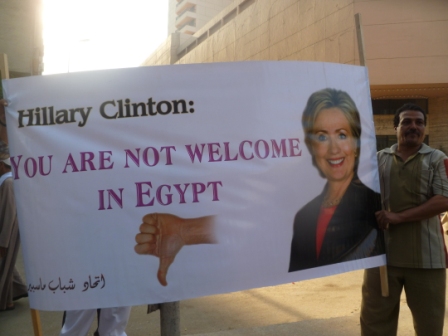
In the middle of all the activity, US Secretary of State Hillary Clinton arrived to greet President Morsy, other political forces, and the military. It provided enough of a distraction for each side to accuse the other of being behest to American patronage.

God, may this be a breather. Give every player to reflect on where Egypt stands. Turn them from their plans and strategies, if only for a moment, to wonder if their personal conduct blesses the nation; if it blesses the other.

How hard it is to do this, God, and maintain any level of integrity. This week Egypt’s long time spy chief died. He was accused of countless tales of torture, with his eye aimed especially at curbing the Muslim Brotherhood.

President Morsy will give him in a military funeral; his colleagues, meanwhile, can hardly suppress articulating he is now accountable to you.

Is Morsy a hypocrite? Are his colleagues judicious to hold back their loathing? Or is Morsy extending honor even to an enemy? Are his colleagues lacking in similar grace?

God, renew their strength. No one stands righteous before you, but give wisdom to Morsy and his advisors to run Egypt well. Do the same for those who oppose them. And in your greater wisdom and will, produce a future for the best of Egypt.

In fact, God, may all shoes fall before you in humility and awe. May Egypt be holy ground and all go barefoot in your presence.

Amen.

Categories
Christianity Today Middle East Published Articles

Muslim Creativity Comes to Church in Alexandria

One of over 40 award winning pictures taken by Muslim photographers at a recent exhibition at an Alexandria cultural center. All photos were of some aspect of the historic church which hosts the center.

This article was first posted on Christianity Today on July 19, 2012.

Alexandria, Egypt, was once a lighthouse for Christianity, emanating from the southern shore of the Mediterranean Sea. Now it is a stronghold of the Muslim Brotherhood and the even more conservative Salafi Muslims.

So a Christian opening a cultural center for Muslim and Christian artists in Alexandria—within the walls of an Anglican church—demonstrates a stroke of boldness in a city where some 23 Coptic Christians were killed in a church bombing on New Year’s Day 2011.

“For many Muslims,” says Nader Wanis, founder of the Corners for Creativity cultural center, “it was the first time in their life they [had] entered a church. They were astounded we let them in; then they go and invite others.”

Please click here to continue reading at Christianity Today.


This article was very fun to research and write; it was a nice break from politics and the challenge of understanding what is happening in Egypt.

This is Our City’ is a new feature of Christianity Today, highlighting Christians who are working not just for the good of their church or the good of their faith, but the good of the whole city. It focuses on six American locales – Portland, Richmond, Detroit, New York, Phoenix, and Palo Alto – and then a ‘7th City’ which can draw on good examples from anywhere.

So when I heard about this particular cultural center in Alexandria, I inquired if Christianity Today was interested in highlighting an international effort.

They were. Bangkok, Thailand was first to the pole, but I am glad to help Egypt get the silver medal.


Related Posts:

Categories
Christian Century Middle East Published Articles

Wary of Morsy

This article was originally published in the Christian Century on July 17, 2012.

President Mohamed Morsy’s decision to reinstate the dissolved parliament has set off a firestorm of debate in Egypt. Is Morsy fighting for full democracy against a military regime? Or is he trying to institute a full Islamist takeover of government? Christians worry about the second possibility.

“There are attempts to take control of all state institutions,” said Karam Ghobrial, an activist with the Coalition of Egypt’s Copts, “and the biggest proof is Morsy’s decision to bring back parliament.” Ghobrial is one of many lawyers who filed an injunction against the president’s ruling. Ghobrial’s comments reveal a deep-seated Coptic distrust of Islamists. “There should be international attention from the United Nations to protect minorities,” he said, “because Morsy broke his oath to respect and uphold the law.”

Morsy’s presidency did not start off this way. “We as Egyptians, Muslims and Christians,” he proclaimed in his victory speech…

Please click here to continue reading at the Christian Century.

Categories
Arab West Report Middle East Published Articles

Clinton Visits Morsy amid Coptic Protests

Outside the US Embassy in Cairo

Traditionally, it is the Copts who look to America for support of their minority rights. With the Muslim Brotherhood now in the presidency, though not in full power, some Copts wonder if the United States is switching sides.

The statement of ‘looking to America’ should not be taken as normative. The Orthodox Church and most leaders of influence insist on Egyptian solutions to Egyptian problems. They believe an appeal to the West would brand Copts as traitors in their own land. Average Copts, however, often state a sentiment of longing for America – either for pressure on Cairo or as an escape through emigration.

Amid frequent meetings between Islamists and members of the US administration, however, some Copts believe Washington’s interests are beginning to trump its commitment to human rights.

Bishoy Tamry

‘We believe there is an alliance between the Obama administration and the Muslim Brotherhood,’ stated Bishoy Tamry, a member of the political bureau of the Maspero Youth Union, a mostly Coptic revolutionary group formed after attacks on Egyptian churches. ‘This alliance is to support fascism in the Middle East.

‘The US thinks the Muslim Brotherhood will protect their interests in the region, but this will be over our bodies as minorities.’

The revolutionary character of the Maspero Youth Union plays a role in seeing the United States making a deal with the devil.

‘We knew the next president must have US support,’ Tamry continued, ‘because the military council rules Egypt and the US pays the military council.’

Most of the United State’s foreign aid to Egypt is in the form of military support, with smaller percentages given to economic and civil society development.

A few hundred people gathered at the US Embassy in Cairo to protest the visit of Hillary Clinton, the US Secretary of State. Early chants at the demonstration included, ‘The people and the army are one hand’, but these were silenced by Maspero Youth Union leaders. Tamry explained their group called for an open protest, and some attendees see the military council as the best means to limit or even depose Islamist rule.

One such group is the supporters of Egyptian television presenter Tawfiq Okasha, somewhat comparable to America’s Glenn Beck. These are strong supporters of the military council and clashed briefly with assembled protestors when they arrived, according to Ramy Kamel, an independent Coptic activist helping organize the demonstration. This drove the protest ten minutes south to the Four Seasons Hotel.

According to Nader Shukry, the media spokesman for the Maspero Youth Union, the United States is looking to preserve its interests after the Arab Spring shook their control of local governments. Yet their eye is not on the region’s good, but on its destruction.

‘[The US] knows Islamist rule will bring ruin to these countries, and the best evidence of this is their previous experience.’

As for proof of this alliance, it is found in their frequent meetings.

‘We see evidence in the pre-election visits of US representatives to the Muslim Brotherhood headquarters,’ said Tamry. ‘If the US was looking simply to political representatives it would have visited their Freedom and Justice Party.’

Others see this reasoning as absurd.

‘The United States has relations with every nation in the world,’ said Raed Sharqawi, an investigative journalist present at the demonstration.

‘The United States is also the shield for the Copts, and always will be. This protest is foolish.’

During Clinton’s visit she asked President Morsy to ‘assert the full authority of his position’. The president is currently engaged in a struggle with the military council over the dissolution of parliament. His party, the FJP is also pushing him to confront the military over its supplementary constitutional declaration to preserve some of its powers until a new constitution is written. Clinton did state the details of the transition should be left to the Egyptian people to determine, but urged the military return to its role of protecting the borders.

It is an open and contested question if the military is seeking to preserve its power and resist the revolution, or if it is defending democracy against a premature Islamist takeover of all institutions of government.

Nevertheless, whether the demonstrations against Clinton are foolish or astute, it is a dramatic step for a segment of the Coptic community to turn against the United States so publicly.

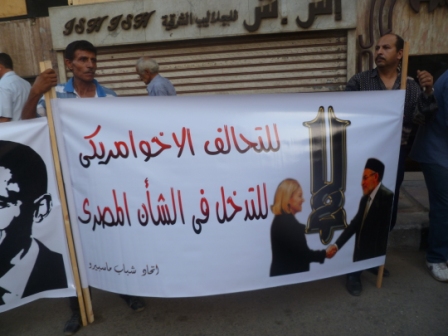
Translation: No to the Brotherhood-American Alliance to Interfere in Egyptian Issues. (Pictured: Hillary Clinton and MB General Guide Mohamed Badie)

Related Posts:

Categories
Arab West Report Middle East Published Articles

Taming the Islamists

A friend of mine asked me the other day what I think of this quote from the Economist:

‘The best way to tame the Islamists, as Turkey’s experience shows, is to deny them the moral high ground to which repression elevates them, and condemn them instead to the responsibilities and compromises of day-to-day government.’

For a while now, even reflecting on the situation in Palestine where the West helped overturn election results bringing Hamas to power, I have had sympathy with this viewpoint. But there are a few other nuances to highlight.

As concerns ‘condemned to rule’, we should not start by saying that governance is a curse. On the contrary, it is a privilege, a trust. That Islamists have this now is their opportunity, even if the thrust of the quote is true.

As concerns ‘tame’, it must be distinguished from another sentiment often lying underneath such analysis. Many would substitute subconsciously the word ‘defeat’.

The capriciousness of government will keep Islamists from extremism – this is how they are tamed. But it has also lessened their popularity, as they do lose the moral high ground. Many find the military has yielded power to Islamists first in parliament to give them opportunity to discredit themselves. That they now have the presidency is only further rope with which to hang themselves.

So if the author of the quote is quietly hoping for such an outcome, there is another sense in which being in power is not ‘condemnation’ – it is their opportunity to cement themselves in the system.

While on the one hand it is fine and good for Islamists to gain credibility as a political player, it is also widely suspected the Brotherhood will use its opportunity to infiltrate the system and get their people in every nook and cranny.

Then, even if ‘defeated’ at some stage in the political process, having been yielded governance even for a spell, it will have advanced their overall cause. I have no evidence other than anti-Brotherhood testimony this is their plan, but the testimony is ample and often specific.

Finally, taking Turkey as an example – the Islamists might just do well in terms of governance, and then they win.

This is a good outcome for Egypt, of course, as Turkey is an example of improved economy and civil society. But Turkey is also not the best example. From what I understand, Turkey is among the worst nations in terms of freedom of the press.

While Islamists might keep winning free elections there, and by extension in Egypt, questions exist as to how they may be softly manipulating society. This is very different from the hard corruption of a dictator, but is less than free and open democracy in a transparent system.

Finally, it should be stated that Islamism is different from the Muslim Brotherhood. Islamism in general simply represents the idea that religion should play a definitive role in shaping the political system. The Brotherhood is an organization dedicated to this goal, which may or may not be acting honestly for the good of society independent of itself. It is quite possible to be an Islamist outside the structure of the Brotherhood.

In any case, these are more questions to explore than convictions I possess. As to the overall aptness of the quote above, if these points are taken into consideration, I think it is on the whole correct.

Related Posts:

Categories
Aslan Media Middle East Published Articles

Morsy Reinstates Egypt’s Parliament

Military Council head Tantawi (L) and President Morsy

That was fast.

After only one week in office, President Morsy has picked his first fight – he issued a decree to reinstate the dissolved parliament.

Shortly before the run-off election the Supreme Constitutional Court ruled parliament to be unconstitutional based on procedural grounds, and the military council issued a decree to dissolve it.

Morsy, now with the executive power of the presidency, has undone the decree of the council.

Moreover, he threatens the legislative power the military council afforded itself in the interim period between the dissolution of parliament and the writing of the constitution after which new elections will be held.

Morsy promised the return of parliament from his victory speech in Tahrir Square. He used language, however, which left him wiggle room to fulfill this promise simply with new, eventual elections.

When he took his oath of office in front of the constitutional court, however, it seemed he was accepting the court decision and military prerogative to set the path of transition until a new constitution was written.

When he was seen repeated hobnobbing with the generals, it gave the impression a deal, or at least an understanding, had been reached. That is, Morsy made his ‘revolutionary’ speech, but now was getting down to business in cooperation with the military.

He is certainly getting down to business now.

The ruling to dissolve parliament was questionable, but it was issued by the ‘independent’ court. Whether or not it is, of course, is also questionable, but Morsy pledged to uphold the law and respect the judiciary.

On the other hand, many observers see the court ruling and subsequent constitutional declarations by the military as a power grab, or at the least as an effort to balance the power of the president and an Islamist parliament. Yet both president and parliament were elected democratically – though perhaps this is also among the questionable issues of Egypt’s transition.

This statement is not necessarily to cast doubts on the results, only to reflect the common perception that Egyptian’s votes are only an aspect of the power struggles underway in the country.

Morsy’s move comes one day before the High Administrative Court was set to issue a ruling on the legality of parliament’s dissolution. It is unclear if this case will docket as scheduled. The military council is holding an emergency meeting at present.

Two items to cast shades of conspiracy. One, some suspect this is a continuation of play acting between the Brotherhood and military council. A few months ago they railed against the performance of the government and threatened to withdraw confidence. They never did, but used the episode to justify going back on their promise not to field a presidential candidate. Under this theory, the crisis was engineered then, and is engineered now to present the Brotherhood as a revolutionary force deserving of popular and international support. The military, it is posited, is simply being a foil for the emerging power, with which they are fully in cahoots.

Two, it is noteworthy that in the last day or two President Morsy received a letter specially delivered by the undersecretary of state, William Burns. Its contents were not made public, but the timing is suspicious. The released text, incidentally, narrates the parliament before the constitution.

‘It will be critical to see a democratically elected parliament in place, and an inclusive process to draft a new constitution that upholds universal rights.’

According to conspiracy, however, ‘secret’ instructions could either supplement the theory above, or, more deviously, could be telling the Brotherhood the US has your back in a move against the military.

Away from conspiracy, the next moves may be telling. Morsy’s move is a definitive challenge to the military’s authority. If there was a deal, it seems clear he is violating it.

The military’s position is difficult. It will be hard pressed to go against the executive authority of a popularly elected leader. Indeed, it is the right of the executive to implement – or ignore – administrative aspects of the state.

It was assumed, if there was a deal, that the military possessed a number of cards which could be played against Morsy, with which to hold him in check. There is a court case pending, for example, to dissolve the Muslim Brotherhood as an organization. There may also be challenges to the legality of his campaign. He, like all other candidates, violated rules. He may also – though this is speculated popularly – have received foreign funding.

After all that has transpired, it would be difficult to imagine any of these legal measures unseating a president, but Egypt has had surprise rulings before.

And at the end of the day, a coup d’etat is ever on the table.

It was not imagined Morsy would move against the military so quickly. The expected path was to accommodate and slowly squeeze them from power, as in Turkey, and to a degree, in Latin America.

It seems Morsy will play his cards now, however. Coming days will reveal either his flush or his bluff.

Related Posts:

Categories
Prayers

Friday Prayers for Egypt: Reconciliation?

God,

As President Morsy settles into office, he is striking a conciliatory tone. He has announced he will appoint both a Copt and a woman to vice presidential posts. Furthermore, he is filmed frequently with the military, offering praises for the stewardship of the transition.

Many scoff, God. Perhaps they have good reason. These are not messages of substance, at least not yet. But they may be indications.

As for Copts and women, may they be indications of encouragement. Help Morsy to reach out and demonstrate with good will. May he honor this promise with a Copt embraced by their community. May he treat all Coptic issues with justice and equity. May they find in Morsy a man who fears you and honors humanity, without distinction. May there be real reconciliation between all.

As for the military, the scoffing is louder. Revolutionaries vary as to accepting these actions as a necessary part of the game to unseat the military eventually, or finding in them a complete betrayal of Tahrir and an embrace of power now that he has it.

Or, perhaps it is a reconciliation in fact. Perhaps the military has been guiding to democracy all along, and perhaps the Brotherhood sees itself as the conduit to a diverse future of competitive power sharing. May Egypt hope and pray for the best.

But there is a fine line between reconciliation and a deal. God, like all fields of human activity, politics belongs to you. May those who choose to navigate it do so with integrity and transparency. May the people of Egypt be honored with real choices, not backroom negotiations. If politics cannot be purified, keep pure those brave souls within it.

Not much has happened yet, God. A government must be appointed. Solution must be found for parliament and constitution. Guide these decisions and present Egypt representatives who will serve the national good.

You have given Egypt a president, God, help him to be a good one.

Amen.

Categories
Lapido Media Middle East Published Articles

As President Morsy Preaches Peace, Muslim Brotherhood Sanctions Jihad

Morsy hailed at Tahrir Square

In both his presidential campaign and inaugural addresses, President Mohamed Morsy has assured the world of Egypt’s commitment to peace. Yet in the run-up to the final election on June 14, the Muslim Brotherhood published an Arabic article calling this commitment into question.

‘How happy would Muslims be if the leaders of the Muslims … would make recovery of al-Aqsa Mosque [in Jerusalem] their central issue – to cleanse it from the filth of the Zionists and impose Islamic sovereignty over all quarters of Palestine,’ wrote General Guide Mohamed Badie, the group’s top leader.

Furthermore, he referenced a fatwa given by ‘Muslim scholars’ without further designation, ‘Jihad with life and money for the recovery of al-Aqsa Mosque is an individual duty incumbent on every Muslim.’ The article was published on IkhwanOnline, the official website of the Muslim Brotherhood.

This message is very different from the public statements of Morsy, who emerged from the Brotherhood to win Egypt’s first free democratic presidential election.

‘We will preserve all international treaties and charters,’ said Morsy. ‘We come in peace.’

Though Israel was never mentioned by name, the inference was obvious.

The international community is watching closely as importance lies in what Morsy does, not in what he says. Still, his assurance is understood as one of the necessary guarantees to the Egyptian military as well as the United States to not stand in the way of a Brotherhood presidency.

Yet the principle of action over rhetoric is necessary also concerning domestic Brotherhood politics. As US-MB delegations were in continual contact, Badie’s article sanctioning jihad betrays little intention to honor a peace treaty. On the other hand, at this point, they are just words, not actions.

Which words should be believed?

According to Sheikh Osama al-Qusi, an Egyptian Salafi scholar with no love for the Brotherhood, the word jihad does not necessarily imply fighting. ‘The term with life designates that one must be ready to give his life for the cause of Islam. It may include engaging in battle, but this is not demanded.’

Even so, al-Qusi links ‘jihad with life and money’ to its Qur’anic source, where God instructs the Muslims, ‘Allah has purchased from the believers their lives and their properties [in exchange] for that they will have Paradise. They fight in the cause of Allah, so they kill and are killed.’

Speaking with Lapido Media, Muslim Brotherhood spokesman Mahmoud Ghozlan makes a different distinction. ‘As a citizen I am different from the state or the presidency,’ he says.

‘Just because we have gained the presidency should we give up on our principles concerning Palestine, including that Jerusalem is for us?’

Ghozlan then reiterated Morsy’s assurances that Egypt would respect all international treaties. Indeed, the rest of Badie’s article references non-violent methods to expose Israeli occupation of Palestine, such as the ‘Miles of Smiles’ aid convoys from March 2012 to break the blockade of Gaza.

Dr. Nadia Mostafa, professor of international relations at Cairo University, agrees with this non-violent interpretation. ‘We can make jihad,’ she told Lapido Media, ‘in a different way.

‘It does not mean to make a suicide bomb. Jihad with life means we must offer everything in our life for the just cause, even to the last extent in which I die.’

Badie’s article, indeed, does not call specifically for jihad. It urges patience on the Palestinian people and a focus on reconciliation between Fatah and Hamas.

Yet it also urges persistence, that they should make their ‘motto and starting point the confrontation of the Zionists’. That is, perhaps, it is a Palestinian struggle, even if they should be encouraged that ‘every sincere Muslim mujahid in every nation of the world stands with you’.

For Mostafa, Palestine is the issue which will decide the presidency of Morsy. But it must not be allowed to distract from critical domestic issues, including overcoming the secular-Islamist divide. She expects, however, a firm rejection of the Gaza blockade.

‘The Brotherhood will say what they have to say, but we must separate between them and the presidency, and I believe Morsy understands this well.’

Mohamed Morsy formally ended his membership in the Muslim Brotherhood following his official declaration as president.

As president, however, he is not expected to have much love for Israel, no matter his international obligations. Political analyst Sameh Fawzy expects a zero-tolerance strategy towards Israel.

‘Egyptians have had a very limited margin of normalization with Israel over the last decades,’ Fawzy told Lapido Media. ‘This margin is expected to be even narrower than before.’

Therefore, while the Muslim Brotherhood may well continue its strident rhetoric, Fawzy believes the Israel file will remain in the hands of the foreign ministry and security apparatus.

While these cabinet positions are still being negotiated, many analysts believe these ministries will remain firmly under military supervision, if not direct control.

This combination is not predisposed to result in war, but the consequence may well be a continuation of the status quo. For Fawzy, the bilateral outlook is bleak.

‘Cold peace is the expected option.’


Published first at Lapido Media.


Related Posts:

Categories
Personal

The Muslim Brotherhood in Syria: Covenant and Charter

Translation: The Muslim Brotherhood, Syria

Egypt’s revolution, however noble and good, has been fraught with propaganda, manipulation, and conspiracy. Deciphering truth from falsehood is a near impossible task; distinguishing the ‘good guys’ from the ‘bad guys’ is a landscape of shifting sand.

At least Egypt is not Syria. There as well these complications exist, but with new reports of killing every day. If I were there I’d be pulling my hair out. On the other hand, if I were there it might be easier to identify ‘bad guys’, at the least.

I will not attempt to sort through Syria’s issues here, but I discovered an interesting document issued by the Syrian Muslim Brotherhood. As they compose a substantial part of the opposition to the Assad regime, it is useful to see their vision for a free Syria, here translated into English by the group on Facebook.

Whether it is true or simply further propaganda is anyone’s guess, however worthy of analysis. If I ever have clarity I’ll be sure to share.

—————

In the name of God the Merciful

Covenant and charter

For a free country, free life for every citizen. In this crucial stage of the history of Syria, where the dawn is born from the womb of suffering and pain, on the hands of the Syrian heroes, men and women, children, youth and old men, in a national overwhelming revolution, with the participation of all components of the Syrian people, for all the Syrians.

We, the Muslim Brotherhood in Syria – from Islam’s religion true principles, based on freedom, justice, tolerance and openness – we present this covenant and charter, to all of our people, committed to it in the letter and spirit, a covenant which safeguards rights, and a charter which dispels fears as a source of reassurance and satisfaction.

This covenant and charter represents a national vision, common denominators, adopted by the Muslim Brotherhood in Syria, and introduced as a new social contract, establishing a modern and safe national relationship, among the Syrian society components, with its all religious and ethnic factions, and all current intellectual and political currents.

The Muslim Brotherhood in Syria is committed to Syria in the future to be:

1- A civil modern state with a civil constitution, coming from the will of the Syrian people, based on national harmony, written by a freely and impartially elected constituent assembly, protecting the fundamental rights of individuals and groups from any abuse or override, ensuring an equitable representation to all components of society.

2- A democratic pluralistic deliberative country according to the finest modern thoughts of humanity; a representative republic, in which people choose those who govern and represent through the ballot box, in an impartial free transparent election.

3- A state of citizenship and equality, in which all people are equal, regardless of their ethnicity, religion, ideology, or orientation, going by citizenship principles which are the basis of rights and duties, in which all citizens are allowed to reach the highest positions, based on the rule of elections and efficiency.

4- A country that respects human rights – as approved by God’s laws and international charters – of dignity and equality, freedom of thought and expression, of belief and worship, of media, political participation, equality of opportunities, social justice and providing the basis needed for a decent living. In which no citizen is oppressed in his belief or worship, or restricted in a private or general matter. A country that refuses discrimination, prevents torture, and criminalizes it.

5- A country based on dialogue and participation, not on exclusivity, exclusion, or transcendence, all its people participate equally, in building and protecting it, enjoying its wealth and goods, committing to respecting all its ethnic, religious, and sectarian component, and the privacy of those components, with all their civilizational, cultural, and social dimensions, and the expression of these components, considering this diversity an enriching factor, an extension to a long history of co-existence, in a generous frame of human tolerance.

6- A state in which people govern themselves, choose their way, determine their future, with no guardianship of any autocratic ruler or one party system, and be their own decision makers.

7- A country with respect for institutions, based on the separation of the executive, legislative, and judicial powers, where the officials are in the service of people, and their permissions and following mechanisms are specified in the constitution, and the military and security departments responsibility is protecting homeland and people not protecting authority and regime, and do not interfere in the political competition between parties and national groups.

8- A country that renounces terrorism and fights it, and respects international covenants, charters, treaties and conventions, as a factor of security and stability in its regional and international perimeter. Establishes the best equal relations with its friends, in the forefront its neighbor Lebanon, for its people suffered – as the Syrian people – from the scourge of the system of corruption and tyranny, and works on achieving its people’s strategic interest and restoring its occupied land in all legal means, and supporting the legal demands of the Palestinian brotherly people.

9- A state of justice and law, where there is no room for hatred, revenge, or retaliation. Even those whose hands are contaminated with people’s blood, of any part, it is their right to have a fair trial, before an impartial and independent tribunal.

10- A country of intimacy and love, between the sons of the big Syrian family, in the light of a massive reconciliation, [forsaking] all false pretexts adopted by the system of corruption and tyranny, to intimidate the citizens of one nation of each, to prolong his rule and to sustain its control on everyone.

This is our vision and aspiration for our desired future, our covenant in front of God, and our people, and in front of all people. A vision that we assure today, after a history full of national working for decades, since the founding of the brotherhood, by the hands of Dr. Mustafa Assiba’ey, God’s mercy be upon him, in 1945.

We presented its features clearly and ambiguously, in the National Honor Charter in 2001, and in our political project in 2004, and in the official papers approved by the Brotherhood, on various social and national issues. And these are our hearts opened, our hands outstretched to all our brothers and partners in our beloved homeland, for it to take its decent position between the civilized human societies.

“Help one another in virtue, righteousness and piety, and do not sin or commit aggression.”


Muslim Brotherhood Movement in Syria

25-03-2012

(I edited here and there for clarity, but left the structure of the document as is.)


Related Posts:

Categories
Personal

Morsy at Tahrir

Addressing the crowd

Amid the celebrations, and worry, over Egypt’s new president, there has been a small crisis over where President-elect Morsy will swear his oath of office.

The military’s supplemental constitutional declaration says that in lieu of parliament, he must swear in at the Supreme Constitutional Court.

Many Islamists, however, fail to recognize this declaration and the dissolution of parliament, and insist he swear his oath in front of the chosen delegates of the people.

Revolutionaries, on the other hand, demand he swear his oath in front of them at Tahrir Square.

Mosry has chosen the balancing act, honoring two of three.

Seemingly submitting to the military dictate, Morsy is due to take his oath of office tomorrow. Many interpret this as a tacit acknowledgement of recent military decisions, or worse, indicative of a ‘deal’ or power-sharing arrangement.

Others say Morsy is simply playing along by the rules of the military in order to obtain the presidential office, at which point he will slowly, but surely, work to reverse their accumulated power. Under this scenario, he is currently cementing his revolutionary and centrist credentials so as to keep a popular mandate to resist, and then press against, the military.

Along this path, today Morsy pledged his allegiance to the Egyptian people at Tahrir.

During his 45 minute speech, he gave a little bit to everyone.

To the establishment he said he comes with a message of peace and Egypt will not attack anyone. Israel was not mentioned specifically but the intention was clear enough.

To the centrists he mentioned he would be the president of all Egyptians. He placed Muslim next to Christian, specified tourism workers, and included those who opposed him, and still do.

To liberals he pledged Egypt would be a civil, national, constitutional, and modern state.

But for the revolutionaries he saved his theatrics, worthy of Mario Balotelli’s pose. In the middle of his speech, Morsy left the podium and addressed the crowd directly. He then opened his jacket to reveal a plain blue shirt, and more importantly, no bulletproof vest. He trusted in God, and in the Egyptian people.

The triumphant pose against Germany
The dramatic pose at Tahrir

Morsy led chants honoring the ‘free revolutionaries who will continue the path’. He vowed not to accept any limitation on the powers of the president, implied in the supplementary constitutional declaration.

More poignantly, he pledged retribution for the martyrs and injured of the revolution. He did not specify, but most revolutionaries finger the military.

And when he finished his address, the official chanter boomed, ‘Field Marshal [Tantawi], tell the truth. Is Morsy your president or not?’ It was a direct challenge.

The only group left out of the above was the Islamists. There were no calls for sharia.

But he did tack them on at the end, almost as an afterthought. After referencing the large banner near the stage, he took up the cause of Sheikh Omar Abdel Rahman. Known as the Blind Sheikh, he sits in an American prison for conspiring in the 1993 World Trade Center bombing. From here he promised to work for the release of all prisoners incarcerated during the revolution, and included the Blind Sheikh in their number.

And finally, he called the people to unite in their love for Egypt. Yet to this he added such unity and love would ‘promote the cause of the umma’. Umma is an Arabic term generally taken to denote the Muslim nation as a whole. He did not elaborate, but perhaps hinted at, or subconsciously expressed, the greater aims of the Muslim Brotherhood project.

Reviewing Twitter later in the day, it was clear many Egyptians, even those opposed to the Brotherhood, were impressed. Perhaps not being raised in the arts of Arabic rhetoric I could not appreciate it, but I found the speech a bit rambling and repetitive. At the same time, however, it was a stark departure from the autocrat norm. Morsy was comfortable, engaged, and theatric. He reveled in his moment.

As for the content, a politician is often judged successful by how many constituencies he can please. In this case, he hit the mark. Morsy had to shy away from his base, but even the Omar Abdel Rahman reference can possibly be understood as one of justice, as I have written here, here, and here. At the least, a nation should be expected to lobby on behalf of its citizens jailed abroad, even its guilty ones. Still, the reference will give fodder for analysts to focus on Morsy’s extremist agenda, as well it possibly might suggest.

More likely it was a bone thrown to the Salafis and al-Jama’a al-Islamiyya, but who knows?

Another bone might concern the wrangling over the powers of the president. It is a key revolutionary demand, and of the Brotherhood as well. But largely it is nonsensical. Without a constitution, the powers of the presidency are undefined, yet to be determined by the people. That Egypt has reached this point is the fault and possible manipulation of many; but here, it is a rallying cry more than an issue of substance. That is, unless the charge is true the Brotherhood wish to gain control of everything.

In the end the largest question remains unanswered: Is their conflict or cooperation between the military and the Brotherhood? At Tahrir, did Morsy throw down the gauntlet, or simply pose for dramatic effect? Or, somewhat in between, was he establishing a bargaining chip? It is hard to tell. One’s answer here depends on the reading given to the revolution as a whole, not just on today’s speech.

A speech, which was on the whole successful. Is it his high-water mark, or is the best yet to come? Stay tuned, as the revolution continues. (Or not, depending on your interpretation…)

Post-script: After Morsy’s speech, Tunisian Prime Minister Rashed Ghannouchi addressed the crowd.[Ed. note: Ghannouchi leads al-Nahda Party, but is not prime minister.]Among other remarks he praised the martyrs of both the Tunisian and Egyptian revolutions. To their number he added Hassan al-Banna, the founder of the Muslim Brotherhood, who was assassinated, allegedly on orders of the government.

He then added Sayyid Qutb, who was hung following trial Nasser. While perhaps a victim of military rule, Qutb represent a strand of strident Islamism that employed violence and questioned the faith of Muslims who differed from his vision. Ghannouchi’s mention thereof, like Morsy’s reference to the umma, may reveal more beneath his public agenda. Or not; perhaps he just knew his audience.

Categories
Christianity Today Middle East Published Articles

What Egyptian Christians Think about their New Islamist President

Morsy celebrating victory

My article on Morsy’s victory was originally published at Christianity Today on June 25, 2012.

In the most democratic elections since 1952, the people of Egypt have freely chosen their leader. And for the first time in history, that leader is a native-born Islamist.

Mohamed Morsy of the Muslim Brotherhood captured 51 percent of the vote, narrowly defeating his rival Ahmed Shafik (widely perceived as the candidate of the former regime) who gathered 48 percent. Jubilant crowds in Tahrir Square celebrated into the night, though for diverse reasons.

Many rejoiced at the triumph of the candidate of Islam, one who had pledged to implement Shari’ah law. Others, nervous at the prospect of Muslim Brotherhood rule, nevertheless exulted in the triumph of the revolution, first deposing Mubarak and then defeating his former minister.

Some, though not likely in Tahrir, quietly exhaled at a democratic election and rotation of power, hopeful these gains will not be reversed.

Meanwhile, at a Christian retreat center outside of Cairo, a number of Coptic women shed tears of despair over their community’s future, as they huddled around a television and watched Morsy be proclaimed the winner.

Some of the men tried to find the positive…

Please click here to continue reading at Christianity Today


Related Posts:

Categories
Prayers

Friday Prayers for Egypt: Counting Votes

God,

It should be such an easy matter. Collect the ballots and count them. Unfortunately, it has become more complicated.

One complication is the accusation of fraud. This is requiring more time to investigate the circumstances of each polling station, and in one case, of the printing house which made the ballots.

The other, and more serious, complication is the prevalence of politics. This has put the whole counting operation in question. Islamists have already done their vote count, declaring their candidate the winner. They say if the final result is not so, it is clear evidence of fraud.

God, give officials the blinders necessary to simply count the total. Give investigators the insight to tell who, if any, are cheating.

Give the military council – the ultimate arbiter – the discipline to work by principle, for the good of Egypt. May they surrender power to the choice of the people, no matter how easy, or difficult, that is to ascertain.

And God, give peace to Egypt after the announcement of a winner. There is much talk of ensuing violence, as well as much denial. May there be no sore losers; may there be no manipulated chaos.

God, give wisdom to the Brotherhood. If they win, may they govern justly. If they lose, may they accept graciously. If they are cheated, may they find recourse. If they are cheating, may they be humbled, held accountable, and come to repentance.

God, give wisdom to their opponent and those who stand behind him. If they win, may they conciliate between all parties. If they lose, may they not sabotage. If they are cheated, may they unearth the truth. If they are cheating, may they suffer the exposure of truth, be judged, and come to repentance.

In all cases, God, bring reconciliation to Egypt.

God, give wisdom to the Copts. As the country suffers – or even is blessed by – political division and disagreement, help them to stand firm. May they not be drawn into conflict; may they not suffer as scapegoats. May they as individuals act as you lead each one; may they as a community be salt and light to all. May they find guidance from you alone, much deeper than elections.

God, give wisdom to the Muslims. Give them discernment to know if those who speak in the name of Islam and politics represent an honest voice for faith. Do they deserve support, or abandonment? Do they call to a proper implementation of Islam, or misrepresent it. The votes are cast but the challenge is open. May they find guidance from you alone, much deeper than elections.

In all cases, God, bring love to Egypt. May no party be abandoned; may no party be scapegoated. May each embrace the other, with all warts and with all beauty.

God, give Egypt a good president, but give her a foundation much deeper than the leader. Give her a confident people who will not accept falsehood. Give her a culture that celebrates creativity, responsibility, and servanthood. Give her a government accountable to just law.

Give Egypt your best, God. Keep her from harm and cause her to thrive. May she be blessed.

Amen.


Categories
Personal

Egypt’s Military: Seizing Power or Extending Transition?

MB’s Badie vs. SCAF’s Tantawi

Recent moves by the military council have put in question their commitment to democracy and the democratic transition. The popularly elected parliament has been dissolved, policing powers have been extended to the army, and an addendum to the constitutional declaration has afforded the council legislative powers, independence from the president, and a substantial role in overseeing the constitution.

These steps have been called by many a ‘soft coup’, and they may well be. It may represent the army’s effort to protect its influence in Egypt no matter the coming president, but especially if it yields to Mohamed Morsy of the Muslim Brotherhood.

There is another way to view these maneuvers, however, which posits the army as the guardian of democracy and the democratic transition.

Due to failures of the political powers, Egypt has not yet formed a constitution. For all those clamoring for the army to yield power, should it put the president – whoever he may be – in charge without defined responsibilities? Should the president have the chief role in shaping the ongoing democratic transition? Were not Mubarak’s nearly unchecked powers a chief cause of the revolution to begin with?

In this manner, the army has positioned itself as the balance of power for the coming president. Asserting its neutrality, the army will give responsibility to running the internal affairs of the nation to the president, but will act as the legislature until a new body is elected. Along with the president, prime minister, and the constitutional court, the military will also hold veto power over the coming constitution, to assure it is written according to consensus.

The addendum to the constitutional declaration states the military will retain this power until the new constitution is formed and approved by the people. At that time the transition will be complete and the military will abide by the new charter.

Understood in this explanation, the military’s moves are much more reasonable.

Not that they are immune from doubt, not in the least. Many argue the chief reason the political process has been muddled has been the military playing one party off against another. The extended transition envisioned by the military allows ample room for this policy to continue. The transition may be extended, and extended, and extended…

Additionally, even under this military-favored explanation, there seems little reason for the army to re-assume policing powers, as if it were a state of emergency. In advance of announcing the election results, the army has deployed throughout the country.

Meanwhile, the explosion of rumors has made everyone suspect. Conspiracies abound, and the military is not exempt, nor should it be.

Yet it should not be declared that the military has ‘seized power’. It may, but it has not done so yet.

It, like everyone else in the political scene, does appear to be maneuvering and manipulating. Surely there is much back-room discussion and public venting of rhetoric, sincere or otherwise. The Brotherhood has set up a confrontation scenario, while it pledges not to use violence under any circumstances. Even though other Brotherhood statements predict a violent backlash if their candidate does not assume office.

Their vote count appears legitimate and has been verified by independent sources. Yet their proclamation of victory, before consideration of electoral appeals, is a political move to establish the status quo viewpoint on their behalf. It is shrewd, but also suspect.

As is the military. Observers should be careful not to take sides as both have opened themselves to accusation. Instead, the facts must be presented as best determination allows, even in the midst of deep confusion.

Such is the apt description of all Egypt. May confusion pass and all judgments be established on solid evidence. Such indeed would be a revolution.

Related Posts:

Categories
Personal

The MB’s Organizational Structure: Any Christian Similarity?

Today the court postponed ruling on a case calling for the dissolution of the Muslim Brotherhood as an entity. It will be reviewed again on September 4, at which point the group may be declared illegal and forced to disband.

The following is an effort to understand the structure of the Muslim Brotherhood, as well as an effort to compare it to a more familiar Western expression of religion: The small group Bible study. Too often the Brotherhood is only seen from its top administrative levels, which fill the headlines of newspapers and command cries of conspiracy and caliphate. It is hoped a greater understanding of its organizational reach can provide perspective about the group as a whole, through which the current legal questions are being asked.

Please feel free to skip a few paragraphs if the following details become tedious.

The lowest level of organization in the Muslim Brotherhood is called the ‘family’. This consists of between 5-9 people who meet regularly, led by an established member. It focuses on general education into the Brotherhood ‘way’, so to speak. Membership in a family is not permanent; people are shuffled so as to build better and wider community. But every Muslim Brother, no matter how lofty his title, is constituted into a regular family meeting somewhere.

The family, however, is not an administrative structure. Instead, members of families in a particular neighborhood or district comprise a ‘branch’, which numbers no more than 90 people. Once it expands beyond this number the district is divided into two branches.

The up-to-90 members of a branch then elect 40 of their number to serve on the Branch Consultative (Shura) Council. In turn, the council elects 7-9 members for the Branch Administrative Council. See this geographically, for example, as the Maadi neighborhood of Cairo.

This pattern will repeat itself as the organization moves upward in hierarchy. The basic idea is that the Administrative Council runs and supervises the activities of the Brotherhood within its geographical scope. These activities include preaching, youth, politics, religion, students, service, etc. The Consultative Council is the group with its ear to the ground, running the different programs, so that the Administrative Council can make decisions and filter information upwards in the chain of command.

Every 3-4 branches then constitute a Region. Members of the Consultative Council in each branch elect 40 members to serve on the Region Consultative Council. These 40 then elect between 9-11 individuals to be on the Region Administrative Council. Geographically, this could represent South Cairo, for example.

Next, between 8-12 regions are grouped together, and the respective Consultative Councils elect 80-90 members for Administrative Office’s Consultative Council. This group proceeds to elect 13-15 members of the Administrative Office, which runs the affairs of the Brotherhood on roughly the governorate level. At this point the geographical scope might include all of Cairo.

At the highest level of the Muslim Brotherhood, The Administrative Office’s Consultative Council elects around 100 members to the General Consultative Council. This body elects and advises the Guidance Bureau, which currently has 18 members. Finally, the Guidance Bureau elects the General Guide, sometimes called the Supreme Guide. This is the position currently occupied by Dr. Mohamed Badie. For past leaders of the Brotherhood, click here.

Those who skipped ahead can pick up reading again now.

The important consideration now is to find an understandable parallel to the Muslim Brotherhood from Western culture. Along these lines it may be easier to consider whether or not the group should be dissolved on legal grounds.

From the lowest ends of Brotherhood bureaucracy, their ‘family’ appears to be akin to the concept of a small group Bible study. For those unfamiliar with American evangelical Christian culture, these Bible studies usually comprise up to ten individuals who meet weekly to monthly to study and discuss a predetermined passage of the Bible, often with the aim of finding application in one’s life. Yet within the religious discipline is the development of fellowship, knitting the group together in mutual and oftentimes local service.

These Bible studies are often but not always connected to a local church, but have no obligation to register with the authorities in any formal way. In fact, such oversight would be interpreted immediately as a curb on religious freedom and an invasion of privacy, representing ‘Big Brother’ government at its worst.

Now, it is not uncommon for these independent small group Bible studies to use pre-developed study guides or curriculums. There are numbers of options to choose from – Beth Moore, John Piper, Wild at Heart. Sometimes there can even be leadership training options offered to small groups, sponsored by these larger organizations. Sometimes there are regional conferences which celebrate unity and build fellowship among a larger constituency.

Moreover, many churches, especially larger ones, work to create extensive networks of these small group Bible studies. Inasmuch as the pre-developed study guides offer their resources for cost, however minimal, they are registered with the government as a business or a charity. These churches also are registered with the government. The network of Bible studies, however, is not. These are simply composed of ordinary citizens who open their homes to friends and neighbors.

But what would happen if these small group networks began to informally advocate for a particular presidential candidate? Or, along other lines, what if they collected donations to organize clothing drives for poor neighborhoods in their communities? Or, what is the situation if these networks spill over national borders into Mexico or Canada?

The situation is not exactly parallel, but at increasing levels of organization and complexity the question is fair: At what point should government regulation begin?

When the Muslim Brotherhood began, Hassan al-Banna utilized this ‘small group Bible study’ methodology to spread the message of Islamic renewal throughout Egypt. He wished to see the individual, family, society, and eventually state return to the principles advocated in the Quran and prophetic traditions. It was, first and foremost, a preaching organization, composed of small groups linked together creating common identity and purpose.

At different times in its history, the Muslim Brotherhood has moved away from its roots in preaching to consider politics, or even violence. Following the January 2011 revolution the group’s leadership was faced with a choice – to remain primarily a preaching and service organization or to enter full force into the political struggle.

There were voices on each side, but the majority opinion was to create a political arm – the Freedom and Justice Party. This party pushed against the limits of Egyptian law which stated no political party may be based on religion. But the final government ruling was that the party’s ‘Islamic reference’ was sufficient distance from Islam to allow its formation. This ruling is being challenged in court, also postponed to September. Nevertheless, the political party is fully registered and accountable to government oversight.

The Muslim Brotherhood is not. It never has been.

What is the Muslim Brotherhood, then? Is it simply a collection of ‘small group Bible studies’ with a developed administrative network? No members of the bureaucracy described above receive any salary for their leadership and administration. They collect dues and use these to finance programs and activities, but individuals do not profit financially from their association; they are volunteers.

As such, it is more fitting to call the Brotherhood a non-governmental organization, perhaps along the lines of the Rotary Club. Yet given the level of financial arrangement (with international donations circulating as rumors) along with the Brotherhood’s influence on the ground, government oversight would seem necessary and acceptable.

The Brotherhood has stated it will register under the NGO law, once a new government is formed and the restrictive, perhaps oppressive laws of the past are annulled. It also states that it could never file in the past due to the efforts of the Mubarak regime to discriminate against them.

Yet one reason for such discrimination is because, ultimately, the Brotherhood does not believe in the concept of the modern nation-state. While working for the good of Egypt, the group clearly advocates for some conception of a revival of the caliphate. Not only did they consider the rule of Mubarak illegitimate, they also worked toward a future in which such national boundaries become irrelevant.

Here, we move beyond the small group Bible study model. Even if such networks were to advocate for a certain presidential candidate or the reform of certain laws, none to my knowledge are calling for a return to Christendom.

This is not to argue in favor of a court ruling against the Muslim Brotherhood come September. In the middle of revolutionary struggles over legitimacy, it is quite possible the verdict could be a political move to silence opposition. Or, it could be a threat to hang over the group’s head in effort to control their actions, if not their rhetoric. Too much is going on between all parties to draw strict lines of black and white.

Yet it is not unreasonable to ask the Muslim Brotherhood to behave transparently. To a great degree, they do. The information above was supplied freely by Islam al-Bishlawi, Central Cairo Secretary for Youth in the Freedom and Justice Party, to whom thanks is offered. Yet to my knowledge, their finances are not open for public view. Billing themselves a ‘Muslim’ organization, does such secretiveness befit Islam or run counter to its sense of ethics or morality?

In September, perhaps, the court will decide.


Related Posts:

Categories
Personal

Confrontrations Brewing between Brotherhood and Military

Saad al-Katatny, speaker of parliament

Early results of the presidential elections show Morsy the likely victor, with a small 51% to 48% margin. Official results will not be issued until Thursday, though Morsy has declared victory. Shafik is mostly silent, though he protests Morsy’s declaration.

As news of Morsy’s victory was emerging, the military council issued a supplementary constitutional declaration. It gives them the rights of the legislature following the dissolution of parliament, as well as near veto power over the coming constitution. It isolates the military from the command of the president, and establishes martial law powers for the military police.

The presidential elections settle very little.

Tomorrow is a very key day in the continuing struggle. First of all, the Muslim Brotherhood is challenging the right of the military leadership to execute the decision of the court to dissolve parliament. It claims, following past precedent but iffy legal standing, that the people must ratify this decision through a referendum.

If it was just legal challenges all would be back page news. Tomorrow, however, represents a normal working day for parliament. The Brotherhood – it is unclear though unlikely other parties would follow – is threatening to march its elected representatives to the building, so as to enter. Meanwhile, police have barricaded the entrance, fitting with the official dissolution.

What sort of protest will this become?

Even more far reaching could be a legal decision expected to be issued on the same day. A court will rule if the Muslim Brotherhood itself must be dissolved.

The Brotherhood had long been dubbed a ‘banned’ organization under Mubarak, but was allowed freedom of operation since the revolution. Yet it never registered. It is a non-state entity operating independently of all government oversight and regulation.

This was the same situation of the US and other NGOs shut down several months ago. They were allowed to operate in a quasi-legal arrangement in which registration was never granted. However much their closure represented a crackdown on pro-democracy activity, it was in accordance – somewhat – with the law.

Such is the situation of the Brotherhood now, only that unlike the Western NGOs, the MB never sought registration to begin with. It is hard to know if this is just a threat raised against the group or a card to pressure them with. But if there is a true and absolute struggle between the military council and the Muslim Brotherhood, this court decision could be a critical blow.

It is not certain what a ruling against the Brotherhood would do to a Morsy presidency, but it appears the political arm of the group would be allowed to stay. The Freedom and Justice Party did register successfully following the revolution, as did every other political party. Of course, few consider the FJP to be independent of the Brotherhood, so the separation between the two is sure to be murky.

Egypt never ceases to be interesting.

Related Posts:

Categories
Personal

My Egyptian Run-Off Election Prediction

To open, and to be clear, I have no idea who will win this election. Both Ahmed Shafik and Mohamed Morsy took about equal shares in the first round, the revolutionaries are divided between them and many are boycotting, and who knows what the average Egyptian wants, or if he chooses to vote at all.

Of course, this is simply the difficulty from the polling perspective. Things are equally unclear about the suspicions of manipulation. The status quo opinion, especially after the dissolution of parliament, is that that state is working on behalf of Ahmed Shafik. This is reasonable, but it is also open to other conspiracies.

So amidst this mass of confusion I will wade: Mohamed Morsy will be Egypt’s next president.

First, from simple vote analysis: Both Shafik and Morsy captured about 25% of the electorate. Running amidst many other candidates, it is fair to say this represents the natural constituency of both.

In third place was Hamdeen Sabbahi, who represented the non-regime, non-MB vote. A great proportion of his supporters will boycott, and the rest will likely be split equally between the two as their conscience settles on the lesser of two evils.

In fourth place was Abdel Munim Abul Futuh, and somewhat significantly behind him was Amr Moussa. Abul Futuh’s votes will likely go to a fellow Islamist, while Moussa’s will shift to the civil state advocate. It’s probable most of these voters also are not thrilled about their final choice, but there are more of Islamist ilk, so Morsy gets the edge.

That leaves the undecided. Actually, these might not matter at all. Turnout for the first round of elections was only 46%; it is expected to be lower for the run-off. Both Shafik and Morsy have powerful political machines, so these will probably cancel each other out.

But if the non-committed voter chooses, I think he will have more inclination to lean toward Morsy. Shafik does not have a project; his campaign is based on the promise of a return to stability with a heavy dose of accusation against the Muslim Brotherhood.

The Brotherhood has lost a significant portion of its popularity since their triumph in parliamentary elections, but this sentiment is probably weakest (or least recognized) among the non-politicized voter. For these, Morsy represents either 1) the choice of a ‘Muslim’ president, or 2) the choice of change.

I think these factors will push the edge to Morsy in the end.

Second, no prediction is worth its weight unless it deals also with the underlying issues of interest and possible manipulation. Again, though murky, here is my best shot.

The first issue concerns outright vote fraud. In all that follows, I have no evidence to present, but only a reading of the tea leaves. I do not expect state sponsored cheating.

The reason is legitimacy. The military council won legitimacy by protecting the revolutionaries during the initial eighteen days of protest against Mubarak. They have since lost most of this legitimacy as they have navigated the transition, but their promise was to deliver civilian rule through a democratic process.

The only way for the military to salvage legitimacy is to fulfill their promise. Fraud would evaporate it. So would brute force or coup d’etat. The military likely desires to continue playing a role in Egypt’s politics behind the scenes. The only way for this to occur is to preside over legitimate elections, no matter the outcome.

Have they steered the outcome, through the apparatus of the state? Perhaps. The question is toward whom.

It is easier to guess at whom they have steered it away from. The first elimination was of strong, independent candidates. Omar Suleiman (of the intelligence services), Khairat al-Shater (of the Muslim Brotherhood), and Hazem Abu Ismail (of the Salafis) were all disqualified on procedural grounds – all with legitimate, explainable, though somewhat tenuous reasoning.

The second elimination was the most challenging. This was the electoral contest which promoted the strident partisan candidates over revolutionary centrists. It is far too uncertain to assert the military ‘arranged’ or even ‘steered’ this outcome. Yet it is reasonable they were not displeased by the winning candidacies of Shafik and Morsy, both of whom represented the major players of the old regime.

For the second issue, it is in this context the recent dissolution of parliament and likely assumption of constitution writing can be understood.

If Shafik wins, the constitution will be written under friendly circumstances, while the election of a new parliament would likely see a less dominant Islamist presence.

If Morsy wins, the constitution still stays out of the hands of Islamists, while the absence of a parliament denies the Brotherhood a second source of legitimacy. In this scenario, Islamists are even less likely to win parliament, as the people – already wary of the MB – will keep them from having a strong mandate.

A Morsy victory will set off alarm bells among many, and for those unfavorable toward the Brotherhood there is reason for concern. The presidency will allow gradual Islamist population of the general bureaucracy. A Brotherhood triumph could set a pattern for other nations, and their success could transform the map of the Middle East. The alarm for many will be that geopolitics has shifted, and the powers-that-be (i.e., the US) now favor Islamist rule.

While shifting alliances are possible, even on a legitimate basis of popular rule, my gut still imagines it not to be the case. I think the US and the Egyptian military are fundamentally averse to the Brotherhood.

This blog has done a good job at making the case why the military might not mind, or even favor, a Morsy victory. Chief among them is that it gives the military a cover for a civilian – and in particular an Islamist – to take the fall for all coming problems, natural or instigated.

A popular theory in Egypt claims that the military yielded parliament to the Brotherhood to give it just enough rope to hang itself. Indeed, their popularity has suffered as observers discovered them as a manipulating faction dedicated to the preservation and increase of its own power.

This theory can be extended to give them the presidency in order to complete the job. Losing parliament and the constitution divests them of the tools necessary to cement their control, and leaves the president to flail in the wind.

If indeed the powers-that-be want to rid the region of the specter – and promise – of the Brotherhood, this may be a far better strategy than repression.

Unfortunately, it is a dangerous and illegitimate game – if it is being played at all. The point here is to examine why a Morsy victory may be allowed, or may be accepted, or may even be encouraged.

Of course, Shafik could win, either along the lines of status quo conspiracy, or along the lines of popular legitimacy.

Parliament may have been dissolved because it violated the law. The constitution may revert to the military because political parties could not agree on the writing committee. One should never dismiss the simple and obvious explanations.

Yet even these, I venture to guess, will lead to a Morsy presidency.

Unfortunately, too often in Egypt, there is an angle behind every obvious. This will continue until Morsy, or Shafik, or the continuation of the revolution is able to install transparency as a hallmark of government.

May this day come, through the rule of whomever.

Related Posts:

Categories
Christian Century Christianity Today Middle East Published Articles

Write-Ups in the Run-Up to the Run-Off

Egyptians vote today, but I am having trouble deciding if I wish or am able to make a prediction (especially after the last disaster). I think probably I will, but my mind is still spinning from recent events, so in all likelihood I’ll wait until tomorrow and gauge the mood after day one.

In the meanwhile I can share with you some articles published elsewhere in advance of the run-off elections.

From Christianity Today: A primer explaining who the Copts are.

This weekend, Egypt will choose as its president either Mohamed Morsy of the Muslim Brotherhood or Ahmed Shafik of the former Hosni Mubarak regime. (That is, unless fallout from a high court’s invalidation yesterday of the nation’s parliament cancels the election.) Few Egyptians are excited about these choices—including many of the nation’s Copts.

But who are the Copts? Generally understood as “the Christians of Egypt,” Copts comprise Orthodox, evangelicals, and Catholics who total 10 percent of Egypt’s 80 million people. (Egypt also has a sizeable population of Christian refugees from Sudan.) Both the euphoria and disappointment of the Arab Spring have brought these branches of Christianity in Egypt closer together as a community.

However, defining the Copts concretely is more difficult, explains Mark Nygard, director of graduate studies at the Evangelical Theological Seminary in Cairo (founded in 1863 by American Presbyterian missionaries).

“Copts are the historical Orthodox Church of Egypt. It is a fuzzy term, but strictly speaking it refers to those under the pope’s authority,” he said.

Click here to continue reading at Christianity Today.

From Christian Century: Asking if Copts did, and now will, vote for the old regime candidate.

Coptic Christians, who constitute about 10 percent of Egypt’s population, were in a unique position to influence the first round of the presidential elections on May 23–24, the first election ever in Egypt without a predetermined outcome. It appears that they sided primarily with a representative of the old regime.

The top two vote-getters were Ahmed Shafik, who was appointed prime minister by Hosni Mubarak in a last-ditch effort to save his position, and Mohamed Morsi, the candidate of the Muslim Brotherhood. With Morsi and Shafik set to compete in a runoff election June 16–17, the election seems drawn as a competition between the old regime and the Muslim Brotherhood.

Morsi and Shafik each advanced with about 24 percent of the total, edging out Hamdeen Sabahi, who finished third. Sabahi is a long-standing opposition figure and a moderate socialist and Egyptian nationalist. As the centrist candidacies of Abdel Moneim Aboul Fotouh and Amr Moussa waned, Sabahi’s popularity exploded, especially among the youth, including many Copts. Fotouh is a former Brotherhood member who sought to be a bridge between Islamists and liberals. He attracted some Copts until receiving the endorsement of ultra-conservative Salafi groups, which scared many away. Moussa is a former foreign minister who fell out of favor with Mubarak, which increased his credibility. He attracted Copts who were sympathetic to the revolution but wary of drastic changes.

Youssef Sidhom, editor-in-chief of the Coptic newspaper Watani, estimated that about 60 percent of Christians voted for Shafik, 30 percent for Sabahi, and 10 percent for Moussa. As the votes were counted, one Sabahi campaign activist lashed out at Christians, claiming that they killed the revolution. He was quickly quieted down.

Yet is the charge true? Did Copts vote solidly for the most counterrevolutionary candidate? One must also ask: Did they feel the threat of the Brotherhood compelled them to make this decision?

For Sidhom, the choice has become clear. “The revolution is now in the hands of political Islam, and Copts must make a bitter choice to support the civil state. I expect Moussa’s supporters will easily shift to Shafik, but how will we be able to convince the youth, who were so dedicated to the revolution, to do so as well?”

Click here to continue reading at Christian Century.

Finally, for any Spanish speaking readers of this blog, please click here to access the Deia newspaper from Spain which is following the Coptic perspective on elections, and interviewed me in the process.

Best wishes and success to all Egyptians.

Related Posts:

Categories
Prayers

Friday Prayers for Egypt: Parliament Dissolution and Presidential Run-Off

God,

Tomorrow Egyptians go to the polls to elect their first freely chosen chief executive. Yet they go under a cloud of uncertainty. A judicial decision rendered their chief democratic achievement obsolete: Parliament is dissolved.

The ruling found its composition unconstitutional, following a precedent which dissolved parliaments before. Yet its timing – days before the election – was odd, prompting accusations of a democratic rollback on the part of the military.

Yet the accusations were rather muted. That is, many didn’t mind seeing the parliament go. The biggest victim – the Islamist majority – failed to protest significantly either. On the contrary, they urged people to head to the polls, to continue the revolution with the ballot.

Once there, people face three choices: The candidate of the old regime, the candidate of the Muslim Brotherhood, and the choice of spoiling the ballot. The third choice will have no impact on elections, but will provide a tally of every voter choosing none of the above.

God, give wisdom to Egypt’s people. First and foremost, should they even go to vote? Many say their participation is an endorsement of the flawed, and perhaps manipulated, process. Yet if your endowed responsibility to support one’s nation demands a vote, guide those who seek your will. Which president will serve Egypt best?

But God, the sad reality is that some might prefer the other candidate to win, only to see him fail before Egypt’s many challenges. Sadder still is that this could be your will as well.

Too much is obscure, God. Did the court rule against parliament on pure legal reasoning or on political considerations? If political, in favor of whom? Does dropping an assembly of Islamists allow a representative committee to draft the constitution? Or does it compromise the concept of representative government no matter which result is actualized?

Are Islamists the best path toward open and civil government, or the embodiment of its opposite?

Is the old regime properly reformed after the revolution to rule justly, or itching for an opportunity to settle scores?

God, how can Egyptians choose? It is not an election about higher vs. lower taxes or the proper scope of guaranteed health care. It is in essence a choice of direction for a nation – but without much certainty over the reality of either candidate. It is not a decision between shades of spin, but between truth and lies – but without much evidence in either direction.

And all the above presupposes there is not a deal between the old regime and the Islamists to divide power regardless.

God, lift Egypt. May these elections be a cause of celebration over the event, if not the outcome. But may the hope be greater: Give cause also to celebrate the outcome, if only months and years later.

Steady Egypt, God. The decisive moment has arrived and signs are not encouraging. From here events may either stabilize or begin to spiral out of control. There is the chance as well the status quo of confusion carries on. Keep Egypt from harm, God. Protect her people. May none choose violence to protest their loss.

But where loss is unjust, God, give ways to continue the struggle. Set right all wrongs. Elevate righteousness and curb manipulation. Create of Egypt a place where your values incarnate. Bless this land and its people.

Prepare them for whatever comes next.

Amen.

Categories
Aslan Media Middle East Published Articles

The Goal of the Muslim Brotherhood

The Muslim Brotherhood is a difficult subject to tackle. Some of this is the fault of others – there appears to be significant bias against them in many quarters. Some of this is their own fault – they are a closed organization accountable to no government oversight.

Some of it is due to the nature of their task. Their goal – to be examined below – is currently being pursued in the arena of politics. It is the nature of politics to appeal to as many as possible, presenting one’s ideas in as amenable a form as possible. The general public is left wondering what is real and what is spin, though usually most politicians can be pegged somewhere along a definitive spectrum.

This is true of the Brotherhood as well, which has fully embraced the vagaries, if not the hypocrisy, of the political game. After the revolution they appeared as centrists, seeking to unite all political powers in cooperation with the military’s transition plan. Though unity broke down, their strategy was successful as they won the lion’s share of seats in the parliament.

As the first round of presidential elections approached, they turned to their base. They gathered conservative Salafi scholars around them and spoke of sharia law, while their handlers rallied the crowds with chants against Israel and the establishment of the caliphate. Again, they were successful, as a splintered electoral field yielded just enough votes to advance to the run-off elections.

Now, with the final round of elections only days away, the Brotherhood positions itself as a revolutionary force. Running against the ‘old regime’ candidate of Ahmed Shafik, they are mostly assuming the support of conservative, non-political Muslims while trying to assuage the substantial non-regime, non-MB electorate they will be inclusive in government and faithful to the nation. Time will soon tell if they will be successful again.

Yet despite these changing postures and the confusion it engenders, almost everyone understands the Muslim Brotherhood to be a conservative, religious entity seeking greater integration of Islam into the fabric of society and government.

The difficulty is in establishing what this means. Detractors make them out to be fascists, while promoters paint them as democrats. Brotherhood rhetoric – tailored to the audience – can lend credence to either extreme.

Therefore, the best solution is to examine what the Brotherhood says to itself. Earlier I partially translated and analyzed a book distributed by the Brotherhood which assembles excerpts from the speeches of Hassan al-Banna, the group’s founder. More recently I came across the transcript of an address given by Khairat al-Shater, the MB’s chief financier and one-time presidential candidate. The video and translation are available online.

This speech was delivered in Alexandria on April 21, 2011, significantly before current political machinations yet after revolutionary euphoria had settled. Much of the speech concerns issues of internal organization and the importance of unity and obedience. It describes a group battered by security during the previous decades, which now has finally been able to rebuild itself. Now that the democratic moment has arrived, the group must double its effort to maintain cohesion and discipline, so as to accomplish the goal of Nahda – renaissance.

This is now the Brotherhood’s presidential slogan: Renaissance… the Will of the People.

Before exploring this goal in more detail it is useful to examine why this internal cohesion is so necessary. On the one hand, Shater compares it to party discipline found in every political movement:

‘[Political] parties always talk about partisan commitment, which is synonymous with obedience; meaning that people hear and execute the party’s policy and commit to its instructions, so the analogous term we have for partisan commitment is obedience.’

Yet it is clear that Shater does not see the political arm of the Brotherhood – the Freedom and Justice Party – as an end in itself:

‘The party is a vessel born of the Western idea which has a particular nature within particular limitations; it is designed and conceived, as manifested by everything from its philosophy to its methods, for the political process which is only one part of the greater Nahda project in politics, economy, society, education, morals, values, behavior, children, women, the elderly, the young.’

Stated even more clearly:

‘It is an instrument or a vessel for the deliberation of power in the political space, an instrument for [engaging in] the conflict for the sake of obtaining power.’

Yet obtaining political power is not necessarily the end goal:

‘Our one and only concern is for there to be a government that is faithful to the method of our Lord Almighty, a government keen on establishing the lives of people on the basis of Islamic reference, whether it be us or someone else. We are different from other parties; the issue is not that we ourselves need to govern as some think.’

So while the party is only an instrument, the group – the Brotherhood itself – is the focus. Interestingly, though, it also is only an instrument:

‘The Gama’a [group – the Muslim Brotherhood] is thus an instrument and not a long-term goal. It is an instrument or means to Islamize life in its entirety and institute religion.’

In this line of thought the Brotherhood is conceived as a vanguard, but Shater is clear the responsibility for renaissance is not theirs alone, it is upon all:

‘When we talk about developing the Ummah’s [nation, in collectivity of Muslims] Nahda on the basis of Islamic Reference, we don’t mean that the Muslim Brothers are the Ummah’s representatives in developing the Nahda, but rather that they think, plan, spread awareness, and market the idea. The entire Ummah participates in developing its Nahda because the responsibility falls on the shoulder of the Ummah as a whole.’

Therefore, while the Muslim Brotherhood seeks power in order to implement this renaissance, it does not imply the monopolization of power. Current political events may or may not argue otherwise, but establishment of a dictatorship is not part of the essential Brotherhood program:

‘[We desire the revolution] to guarantee that the current government or any future government commits to the interests of the people, to building a stable political life including peaceful rotation of power, independence of the judiciary, rule of law, security, and attempts to develop the country and people and fix [their] problems.’

Yet while these aims are democratic and for the good of the nation, the group as an instrument is clearly a vanguard, derived not from useful political philosophy but from God’s method in establishing Islam, exclusively along this vision:

‘The Muslim Brotherhood’s method is that of the Prophet’s, and thus we say that the Muslim who is connected to the Gama’a and the method must believe and realize that he is on the right path and that he must not be on a path other than this one. One of the fundamental prerequisites to develop the Brother within the Gama’a is to realize that you are on the right path and that you must not be on a path other than this one.’

This vision is also necessary:

‘We say Islam disappeared from life, thus preachers of the Ikhwan [Brotherhood] undertook the work of restoring Islam in its all-encompassing conception to the lives of people, and they believed that this would only come by way of the strong Gama’a … Whoever studies the jurisprudence of instituting religion as established by our master the prophet will find that the instrument which our he used was the Gama’a.’

The stakes are high, for without this group religion itself cannot exist:

‘Omar Bin Al-Khattab [the second caliph in Islam], which some scholars attribute to the prophet himself, stated, “There is no religion without a Gama’a, no Gama’a without an Imam [leader], and no Imam without obedience.”’

Therefore, as seen above, the goal of the Muslim Brotherhood is to ‘restore Islam’. Here is how Shater states it clearly, at the opening of his address:

‘You all know that our main and overall mission as Muslim Brothers is to empower God’s religion on Earth, to organize our life and the lives of people on the basis of Islam, to establish the Nahda of the Ummah and its civilization on the basis of Islam, and to subjugate the people to God on Earth.’

The word ‘subjugate’ should not imply compulsion, for Shater says at the end of his speech:

‘Every human is free in his choice because a Gama’a is based on voluntary commitment. We chose this path; no one forced it upon us, and if our Lord Almighty said, “No compulsion is there in religion,” then definitely there is no compulsion in the Muslim Brotherhood’s method.’

But subjugation does have a clear worldwide connotation. It is achieved through the concept of Ustathia, best translated as ‘professorship’.

‘Therefore, the path was clear, thus the Rashidun [rightly-guided] Caliphs continued the stage of the Global State of Islam, and so its domain expanded, and the Persian and Roman (Byzantine) States fell as the new state of Islam emerged on the global level. This state arrived after some time to the point where it became the strongest state in existence, and therefore Ustathia was actualized in reality.’

The crisis for Muslims came centuries later:

‘The last form of the Islamic Caliphate was the Ottoman government, but last century, it first lost the state of Ustathia which had been present but in a weak form. Hence we lost Ustathia and then after this the caliphate itself collapsed.’

The Muslim Brotherhood is a patient organization, and it recognizes that preparatory work must be done in stages. Yet the end goal is clear:

‘As Ikhwan we have spent a long time working on the individual, walking along this line, working on the household, working on society. So we are now developing the Muslim individual and God willing we will continue. We are developing the Muslim household and God willing we will continue. We are developing the Muslim society and God willing we will continue. We are preparing for the stage of Islamic government after this because it is what follows the stage of society.’

While nothing Shater mentions in his speech demands the use of military force, his analogy to the Prophet allows it, seeking application of Ustathia outside the realm of the peoples of Islam:

‘We have reviewed the stages from the Individual to Ustathiya, but where are we now along these stages? I mean are we now at the stage of the Individual, Household, Society, Government, Global Islamic State or Ustathiya? To answer this question we look at our situation and our history. His Eminence the Prophet, before he met his creator, had already made headway for the Muslim Gama’a under his leadership, regarding the household, individual, and society stages, and he established the Islamic state in Medina. He then began to expand this state to cover the Arabian Peninsula, and then began the launch of the Global State of Islam; and the evidence is that Ghzawat [raid] Mo’tah took place in his time, and we all know that Mo’tah is in Jordan and not in the Arabian Peninsula.’

Shater does not speak in detail of what Ustathia would imply if realized. It seems fair, however, to translate the concept as ‘leadership of the world’. A few final comments are necessary in conclusion, therefore.

It must be remembered that while this speech was given to Brotherhood members, these ideas are discussed publically. As seen in the video above, popular preacher Safwat Hegazi interpreted this vision as anticipating a march of millions of martyrs to Jerusalem to establish the United Arab States.

Yet when asked about the idea of caliphate by Western audiences, the Brotherhood refers to ideas like the European Union or the gradual economic integration of Islamic nations. Asked specifically about Hegazi, they emphasize he is not a Brother, does not speak for the group, is not based in reality, and in any case they have enough to worry about in Egypt.

But there is no denial; the dream is simply pushed back a hundred years or more.

It is not a matter of timing since God is on their side. Long or short, they follow the path of the Prophet and will in the end be victorious.

For non-Muslims, then, or non-Brotherhood Muslims, what should the response be? It is hard to gauge.

There is no reason a nation should be prevented from integrating their religion into the fabric of society if this is the will of their people.

Furthermore, there is no reason sovereign states should be prevented from consolidation if this is the will of their people.

Then, when a civilization establishes itself it is fully natural for it to seek a place of primacy in leadership and the promotion of principle consistent with its interests.

In each of these aspects Western nations, indeed Western civilization, can see itself reflected. If it criticizes the Brotherhood, does the pot call the kettle black?

Recognizing this reality, there are three areas worthy of discussion in which to take caution concerning the Brotherhood.

First, though a sensitive topic, Islam itself must be considered – at least in the sense the Brotherhood interprets it. Do the values of Islam in their entirety, since the Brotherhood calls for full implementation, befit the world and the principles of human rights?

Second, this consideration begs the following. Is the Brotherhood a worthy vanguard? By embracing the duplicity of politics do they show themselves as true Muslims or as frauds and manipulators? This is essentially a question for Muslims within their lands of influence.

Third, whether or not Islam is a power for good in this world, the discourse of the Brotherhood reinforces the narrative of a clash of civilizations. They are clearly engaged in a civilizational struggle in which Islam must obtain worldwide leadership. Many in the West are very guilty of the same; the question is if all must desist.

The above is rendered in hopeful education about the Muslim Brotherhood’s purpose. Loud cries from many are issued with little consideration to be fair toward their intentions. Others fail to consider these matters at all, either from ignorance, complicity, or dismissal.

Neither attitude serves the public. I am hopeful this article honors their words and contributes to the better discussion of proper domestic and international response.


Related Posts:

Categories
Personal

Missing Prayers for Egypt

Apologies to all for not getting up a Friday Prayers for Egypt this past weekend. On one count I was traveling in Upper Egypt, and when I returned home I was quite fatigued and fell ill.

But on another count I hardly knew what to pray for.

Faithful readers of this theme will notice that the prayers are often similar, no matter how current political events shape them. I pray for what is right and just to triumph. I pray for those men of ill intent or selfish ambition to be exposed. I pray for the Egyptian people to live in freedom and sovereignty. I pray for peace and honor to be exchanged by all.

I try not to let my own interpretations of these matters enter the prayers, for these are only seen through a glass darkly. I thank you for praying along with me, and adding the details as you see fit.

But last Friday – albeit hampered by sickness – I had nothing.

We should be able to pray in all circumstances, of course, and to a degree I did. But finding the words to help shape your prayers for Egypt was too tricky.

Why? One, the repetition of the themes of these prayers seemed empty, for whatever reason. Two, the reason could be that so much is now out of the hands of the people and main players, and in the hands of the law.

It is harder to pray for the law.

Presidential run-off elections between the candidate of the old regime and the candidate of the Muslim Brotherhood are scheduled for June 16-17. Since I am not praying at this moment, I can be candid in stating neither one of these choices is especially appealing – a fact recognized by about half of Egyptians as well. So asking prayer for the right choice – and either candidate may the choice of God’s best – while necessary, is difficult and somewhat depressing.

But that is not what killed the prayer. On June 14 there are two court cases due which may dramatically alter the Egyptian landscape.

One concerns the constitutionality of parliament. If the technicality is applied, which has precedent in Egyptian law, parliament could be dissolved. This may throw Islamists, perhaps revolutionaries, and some liberals into a fit.

The other concerns the constitutionality of the candidate of the old regime. Parliament quickly issued a law – targeting him – to bar high placed figures from Mubarak’s government. On June 14 the court will rule if the law is applied. If so, it eliminates him as a candidate, but no one knows exactly what would happen next.

So back to the prayer – how do you offer prayer for an event that may not even take place?

With a few more days of reflection I can say we can pray for these decisions; perhaps one or the other is best for Egypt’s transition. We can certainly pray for the heart of the judges who must navigate the corridor of what the law says, what is best given the revolutionary situation, and whatever pressures are put to them, if any. There situation is not enviable.

But even here, from my vantage point the legal pretexts seem flimsy, and the question of the independence and integrity of the judiciary is under heavy suspicion. Like much in Egypt, few if any know the full truth amidst propaganda, manipulation, and lies. And in the end, all conspiracies may well be empty.

But these circumstances are poison for event-specific prayer life.

Which returns the prayers, if offered, back to the repetition of general themes:

I pray for what is right and just to triumph. I pray for those men of ill intent or selfish ambition to be exposed. I pray for the Egyptian people to live in freedom and sovereignty. I pray for peace and honor to be exchanged by all.

God intends us not only to pray without ceasing, but also to make our prayers like the incessant cries of a widow demanding her rights from an unjust judge.

I will leave the formulation to you this week, but thank you for carrying this baton, if not this cross. Egypt is certainly in need in these coming days.

Even then, if all is normal, they then have a presidential election two days later.

God, be merciful.

Amen.