The previous article in this series highlighted the impact of USAID cuts on the vulnerable Yazidi community in Iraq. ISIS displaced Yazidis from their historic home of Sinjar in northern Iraq in 2014, killing and enslaving thousands. The jihadist group claimed that the Yazidis, whose religion has roots in ancient Mesopotamia, worshiped Satan. (The nature of the Yazidi religion will be discussed in the final article of this series.)
After US coalition forces drove back ISIS, most Yazidis remained in United Nations camps for the internally displaced. USAID was a key aid provider, facilitating access to essential services for more than 30,000 people in Sinjar. The cuts have prevented vulnerable groups like the Yazidis from accessing food and health care they need to survive, wrote Amy Hawthorne, a former Obama-era State Department official.
Top of Form
Yet the legacy of USAID in the Middle East is mixed.
American foreign policy is “deeply unpopular” in the region, Hawthorne continued, while tens of billions of dollars in assistance have failed to create stability, prosperity, or democracy.
If USAID has its critics in the region, so too does faith-based aid.
“Some [Iraqis and secular expats] are very critical of Christians,” said one aid worker serving Yazidis. CT granted him anonymity due to the sensitivity of the issue. “They accuse us of mixing help with the gospel.”
Humanitarian organizations of many varieties rushed to help the Yazidis in 2014 during their displacement. Yet large agencies like World Vision, Medair, and Doctors Without Borders began leaving in 2019 as the situation stabilized and crises multiplied around the world. Among the international groups remaining, the aid worker said, many are small and motivated by a long-term commitment to serve the Yazidi people.
For instance, the Kurdistan-based Zalal Life (highlighted in part 1) provides food distribution, vocational training, and medical services to three Yazidi camps and dozens of villages in the northern Iraqi governorate of Duhok. Other Yazidis are displaced to Iraq’s Nineveh valley, bordering Syria.
Ashty Bahro, who founded the Christian group in 2007, has never received USAID or UN funding. But this would not be a problem in Kurdistan, he explained, because unlike many Arabs in the Middle East, most Kurds love America.
Christian foundations and church support fund Zalal Life operations, he said, which recently included the repair of 100 tents left leaking in the wake of Trump’s budget cuts. And his two medical clinics are now serving twice as many patients as before, with three times the demand.
Bahro said the aid work is separate from his church ministry. He is also…
This article was originally published at Christianity Today on July 2, 2025. Please click here to read the full text.
When Hadi Maao was five years old, his mud-brick home collapsed on him after Muslim extremists detonated car bombs in his northern Iraqi village. Seven years later, in 2014, ISIS jihadists forced his community in the district of Sinjar to flee to the mountains. Now 22, he is an asylum seeker in the Netherlands and sends a quarter of his meager earnings as a grocery shelf stocker to his family still sheltering in a United Nations camp for internally displaced Yazidis.
“Sinjar is not a place to live,” he said. “I’m afraid people are forgetting us.”
US Agency for International Development (USAID) cuts have made things worse, pausing the reconstruction of Yazidi villages and overwhelming medical centers. An evangelical organization is trying to fill the gap, while a new generation of Yazidis living aboard are seeking ways to help. In this three-part series, we will also cover the complications of Christian aid in Sinjar and explain the basics of the Yazidi religion that Maao and his people follow.
Top of Form
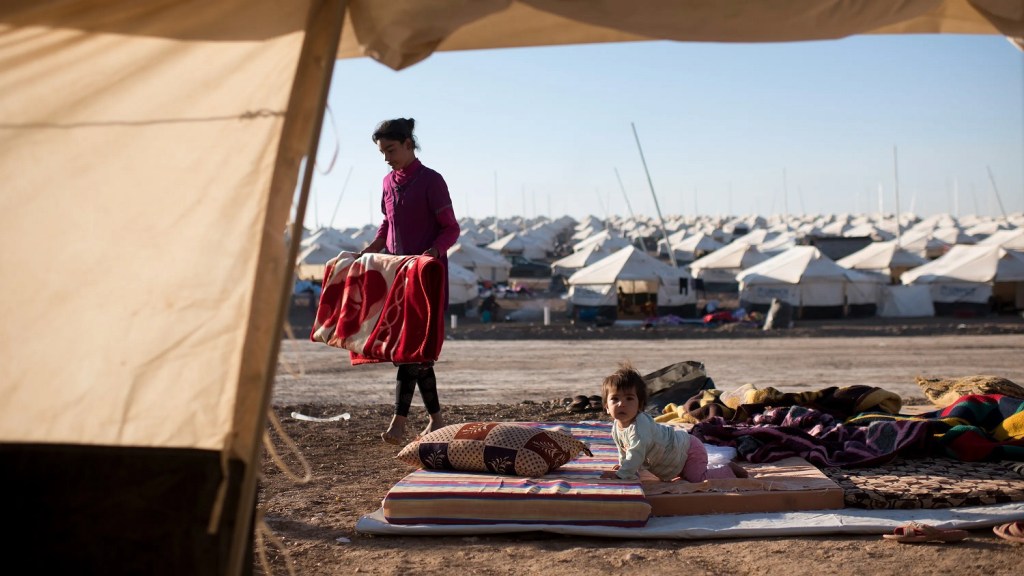
Maao is the youngest of four brothers and three sisters. All of his siblings currently live in Sardashti Camp in the Nineveh Valley, 12 miles east of the Syrian border. The money Maao sends home contributes to building a concrete house for his aging mother and father. They currently reside with his cousin’s family in the UN’s standard canvas tent.
At the International Religious Freedom Summit in February, Vice President JD Vance praised the first Trump administration’s action to bring aid to Yazidis and Christians “facing genocidal terror from ISIS.” Yet President Donald Trump’s executive order to freeze foreign funding and the subsequent dismantling of USAID has had a disastrous effect on the camps where Yazidis still live.
The camp is full of tattered tents that allow rain leakage, unhygienic bathroom facilities, and the threat of fire from spark-prone electricity cables, according to on-the-ground sources that CT spoke with. Cuts have halted the building of schools, community centers, and water purification units. An unused transformer, delivered prior to the stop-work order, was placed in storage.
Maao is from the village of Tel Ezer, also known as…
This article was originally published at Christianity Today on July 1, 2025. Please click here to read the full text.
Russian evangelicals used Sunday sermons to condemn a terrorist attack that killed more than 130 people at a Moscow concert hall.
As Russia’s Baptist union prayed for “God’s mercy and protection,” its Pentecostal union conveyed its “bitterness and sorrow.” Vitaly Vlasenko, general secretary of the Russian Evangelical Alliance, called it a “painful shock” that could unleash “unbridled revenge” against terrorism.
But many in Russia are wondering: Who are the terrorists?
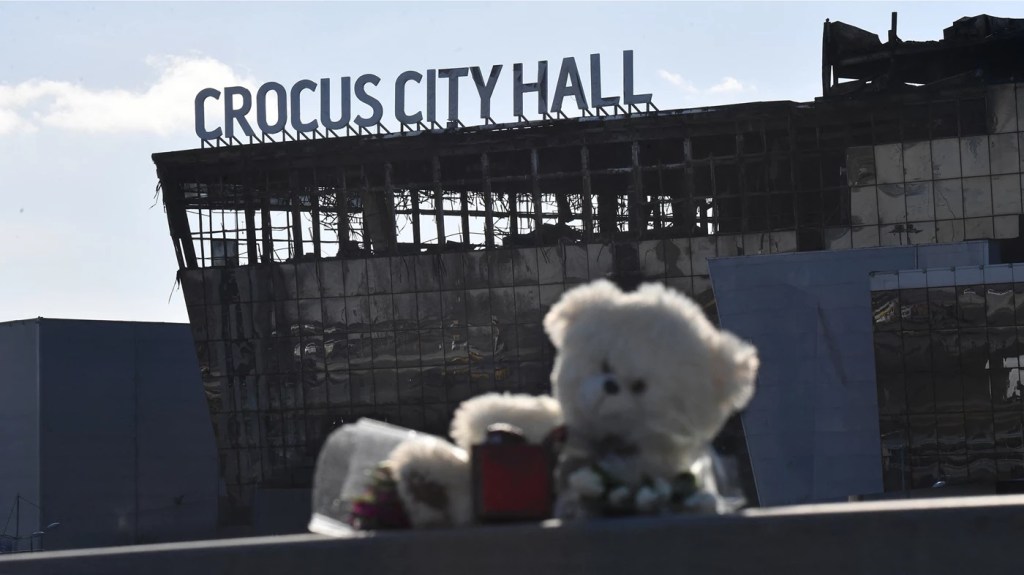
The attack on Friday that killed at least 137 people at the 6,200-seat Crocus City Hall was claimed by the ISIS affiliate in Afghanistan’s Khorasan Province (ISIS-K), which seeks an Islamic caliphate in Central Asia. Its statement emphasized it was targeting Christians and came in the “natural framework” of its war against the enemies of Islam.
Earlier this month, the US embassy in Moscow had issued a warning to avoid large gatherings. American officials stated they shared their intelligence with Russia. On March 7, Russia said it thwarted an attack on a synagogue, and a few days prior, security services killed six ISIS-K terrorists during a shootout in the nation’s Muslim Caucasus region.
The group was also linked to the 2017 St. Petersburg metro bombing that killed 15.
ISIS-K was formed by extremists seeking a more violent path than the Pakistani Taliban in 2015, the same year Russia formally intervened in Syria to support President Bashar al-Assad. A Sunni group, ISIS and its affiliates oppose Assad’s Alawite faith as heretical and considers Shiite Muslims as apostate.
In January, ISIS-K killed 95 Iranians in Kerman at a memorial service for Qasem Soleimani, leader of the Islamic Revolutionary Guard Corps who was assassinated by the US in 2020. And as American forces withdrew from Afghanistan in 2021, an ISIS-K attack on the Kabul airport killed 13 US soldiers and 170 civilians.
Analysts stated, however, that ISIS-K was increasingly targeting Russia.
Russia has arrested 11 suspects, with four alleged gunmen from Tajikistan now on trial.
But President Vladimir Putin, reelected March 17 with 88 percent of a vote Western observers declared was neither free nor fair, did not mention Islamic terrorism when he declared a national day of mourning. Official statements of blame have been vague, while the deputy head of Russia’s security council openly speculated that if Ukraine was involved, its leaders “must be tracked down and killed without mercy.”
“Are you sure it’s ISIS?” asked Russia’s foreign ministry spokesperson, suggesting the group was being used as a “bogeyman.” The Russian ambassador to the US denied receiving any advance information from the US. And a nationalist media outlet urged the Kremlin to give Ukrainians 48 hours to evacuate major cities.
Just a few hours prior to the concert hall massacre, in a wide barrage against Ukraine’s civilian infrastructure, Russia had targeted its largest hydroelectric dam, leaving more than one million people without electricity.
Ukraine has denied any involvement in the terrorist attack.
Its military intelligence spokesperson, however, suggested instead that it was a “deliberate act of provocation” by Putin, while President Volodymyr Zelensky stated it was typical of such “thugs” to divert blame. He also alluded to unproven accusations that terrorist attacks in 1999 were a false flag operation, and that Putin considered his own citizens to be “expendables.”
The US stated that ISIS-K alone carried out the attack, with Ukraine uninvolved.
Russian evangelical sources did not comment on the mutual accusations. They emphasized the outpouring of prayer, sympathy for victims, and the need to trust God and resist any urge for revenge.
“Evil is spreading across the earth,” said Alexey Markevich, vice rector for academic affairs for Moscow Theological Seminary, who has criticized the war in Ukraine. “Lord, give us peace, and prevent any of us from being consumed by evil.”
Christians4Peace, an anonymous…
This article was originally published at Christianity Today, on March 25, 2024. Please click here to read the full text.
Image: Wilayat Sinai / Telegram screenshot Nabil Habashi Salama, a Coptic Christian kidnapped from Bir al-Abd in North Sinai, speaks before his execution in the propaganda video of an Egyptian ISIS affiliate.
The Islamic State has claimed another Christian victim.
And Egypt’s Coptic Orthodox Church has won another martyr.
“We are telling our kids that their grandfather is now a saint in the highest places of heaven,” stated Peter Salama of his 62-year-old father, Nabil Habashi Salama, executed by the ISIS affiliate in north Sinai.
“We are so joyful for him.”
The Salamas are known as one of the oldest Coptic families in Bir al-Abd on the Mediterranean coast of the Sinai Peninsula. Nabil was a jeweler, owning also mobile phone and clothing shops in the area.
Peter said ISIS targeted his father for his share in building the city’s St. Mary Church.
In a newly released 13-minute propaganda video entitled The Makers of Slaughter [or Epic Battles], a militant quotes the Quran to demand the humiliation of Christians and their willing payment of jizya—a tax to ensure their protection.
Nabil was kidnapped five months ago in front of his home. Eyewitnesses said during his resistance he was beaten badly, before being thrown into a stolen car. It may be that these were kidnappers, because in the video that shows Nabil’s execution, he said he was held captive by ISIS for 3 months and 11 days.
On April 18, he was shot in the back of the head, kneeling.
“As you kill, you will be killed,” states the video, directed to “all the crusaders in the world.”
It addresses all of Egypt’s Christians, warning them to put no faith in the army. And Muslims which support the Egyptian state are called “apostates.” Two other Sinai residents—tribesmen who cooperated with the military—are also executed in the video.
Peter said that in the effort to drive Nabil from his faith, his teeth were broken.
His daughter Marina joined in the tribute. “I will miss you, my father,” she wrote on Facebook. “You made us proud…
This article was originally published at Christianity Today on April 19, 2021. Please click here to read the full text.
I contributed additional reporting to this AP article, including its conclusion below:
At Qaraqosh, Francis urged its residents to continue to dream, and forgive.
“Forgiveness is necessary to remain in love, to remain Christian,” he said.
One resident, Doha Sabah Abdallah, told him how her son and two other young people were killed in a mortar strike August 6, 2014, as ISIS neared the town. “The martyrdom of these three angels” alerted the other residents to flee, she said. “The deaths of three saved the entire city.”
She said now it was for the survivors to “try to forgive the aggressor.”
Francis wrapped up the day—and his visit—with a Mass at the stadium in Irbil, in the semi-autonomous northern Kurdish region. An estimated 10,000 people erupted in ululating cheers when he arrived and did a lap around the track in his open-sided popemobile, the first and only time he has used it on this trip due to security concerns.
On the makeshift altar for the Mass was a statue of the Virgin Mary from the Mar Adday Church in the town of Keramlis, which was restored after ISIS militants chopped off its head and hands.
“Religion is love, grace, forgiveness,” said Louis Sako, patriarch of the Chaldean Catholic Church, in advance of the visit. “Religion is a message, and humanity is its core.
“[And] as for us, we are staying until the end.”
But perhaps some Iraq Christians have a vision for even more.
“This is a time of healing for our country,” Farouk Hammo, pastor of Baghdad Presbyterian Church, told CT.
“But we are still praying for a visitation by the Lord Jesus—a revival—and it will happen.”
This article was originally published at Christianity Today on March 11, 2021. Please click here to read the full text.
For 25 years, Stephen Rasche was a “bare knuckles” international lawyer. But in 2010, he offered his services to the Chaldean Catholic Church of Erbil in Iraqi Kurdistan and has increasingly dedicated his life to the preservation of this ancient community.
Under the leadership of Archbishop Bashar Matti Warda, in 2015 Rasche helped found the Catholic University of Erbil, where he serves as vice chancellor. Also the director of its Institute for Ancient and Threatened Christianity, Rasche lived this title as ISIS ravaged Iraq’s Christian homelands in the Nineveh Plains and many believers fled to Erbil.
After testifying on their behalf before the United Nations and the US Congress, Rasche allows them to represent themselves in his recent book, The Disappearing People: The Tragic Fate of Christians in the Middle East. The book has won a diverse range of endorsements, from leaders such as Matthew Hassan Kukah, bishop of the Catholic Diocese of Sokoto, Nigeria; Yahya Cholil Staquf, general secretary of Nahdlatul Ulama, the largest Muslim organization in the world; and Thomas Farr, president of the Religious Freedom Institute.
The US State Department’s Office of International Religious Freedom reports that less than 250,000 Christians are living in Iraq, most in Kurdistan or on the Nineveh Plains. Two-thirds belong to the Chaldean Catholic Church.
CT interviewed Rasche about the logic of establishing a university during a genocide, how its Catholic identity functions in a Muslim society, and his enduring optimism for Christianity in Iraq.
What led you personally to invest your life in this endeavor?
In 2010, Bishop Warda had just been made archbishop, and I went to pay him a visit of respect, asking if there was anything I could do to help. “Yes, in fact,” he said. “You Americans have made a big mess here, and you could stay and help me. I have 3,000 displaced families here from the south, they need help, and no one is helping us with them. We don’t have jobs for them, and there’s a whole range of things I would like to do.”
I assisted on and off on a pro-bono basis for the next four years, but by 2014 the situation looked really desperate. ISIS was maybe 30 miles away from Erbil. But in a visit just after Christmas, I sat down with the bishop and the priests who told me, “We are going to stay. Will you be with us here, and help us?”
Honestly, I was skeptical. But after some deep thinking, I tried to determine the right thing to do and if there was a calling in this for me.
Tell us more about that calling.
Being an international transactions lawyer involved a fair amount of bare knuckles litigation. And not a lot of it, quite frankly, was fulfilling…
Please click here to read the full article at Christianity Today.
This article was first published by Christianity Today on December 28, 2019.
In another filmed massacre, 11 Nigerian Christians were executed by the Islamic State West African Province (ISWAP) over the Christmas holiday.
Wearing the orange jumpsuits made familiar by similar executions of Egyptian and Ethiopian Christians in Libya, the first Nigerian victim was shot in the head by the black-clad terrorists who then slit the throats of the remaining ten. It is understood to be the largest group killed by ISWAP, a Boko Haram splinter group, so far.
“This message is to the Christians in the world,” stated the 56-second propaganda video, released December 26, in both Arabic and Hausa, according to The New York Times.
“Those who you see in front of us are Christians, and we will shed their blood as revenge for the two dignified sheikhs.”
The reference is to Abu Bakr al-Baghdadi, the former ISIS caliph killed by US troops in an October raid in Syria, and Abu al-Hassan al-Muhajir, his purported successor, who was killed the next day.
The video offered no information about the victims, other than that they were recently seized in Nigeria’s northwest Borno state. But an earlier video was released by ISWAP in which captured aid workers appealed to Nigerian President Muhammadu Buhari, as well as to the Christian Association of Nigeria (CAN).
Four aid workers were killed by ISWAP earlier this month. Dozens of others are believed to still be in captivity, including Leah Sharibu, a teenage girl kidnapped almost two years ago whose perseverance under pressure has inspired Nigerian Christians.
The International Crisis Group estimates the jihadist group consists of between 3,500 and 5,000 fighters.
“These agents of darkness are enemies of our common humanity, and they don’t spare any victim, whether they are Muslims or Christians,” stated Buhari, according to al-Jazeera.
Nigeria’s population of 200 million is evenly divided between Muslims and Christians.
Muslim victims have been many, agreed CAN in an earlier statement. But it stated the widespread killing in Nigeria’s north has predominately targeted Christians, who make up 95 percent of those currently detained by jihadists.
“The government has been paying lip service towards securing their freedom,” stated CAN, mentioning in particular…
Please click here to read this article at Christianity Today.
This article was originally published at Christianity Today, on April 25, 2019.
In most Sunday schools, the question is an academic exercise.
“How many of you are willing to die for Christ?” asked the teacher on Easter morning. Every one of the children dutifully raised their hands.
A few minutes later, the Sri Lankan class descended to Zion Church’s main service, passing through an outside courtyard where a stranger was speaking with church leaders. He had discovered there was no Easter morning Mass at the nearby Catholic church in Batticaloa, and was wondering when the service would begin here. He asked about the healing service.
Observers report he was sweating profusely. A pastor invited him to take off his backpack. Then, an explosion—many inside thought it was the generator.
Half the children died on the spot.
“All the children had responded [to their teacher’s question] by putting their hands up, and signaled their fresh dedication to Jesus by lighting a symbolic candle,” recounts a seminary leader [full testimony in sidebar below]. “For so many of those children, it would be their final act of worship.”
In total, at least 26 worshipers—including 16 children—were killed and 100 injured at Zion, a charismatic congregation in the Fellowship of Free Churches in Sri Lanka. Two Catholic churches in and near Colombo on the island nation’s opposite coast were also attacked by suicide bombers that morning, along with three hotels. The death toll currently stands at 253, revised down from 359.
But this is not the only Christian tragedy.
Sri Lankan authorities have now arrested 76 local Muslim extremists and one Syrian, placing the blame on the National Thowheeth Jama’ath (NTJ) movement. ISIS has claimed responsibility, calling it revenge for the massacre at a New Zealand mosque last month.
In response, gangs of young Christian men are now marauding Muslim neighborhoods. People have been assaulted. Shops have been destroyed. Hundreds of Pakistani refugees—mostly Ahmadis, a persecuted minority themselves—have fled the area around St. Sebastian’s, the Catholic church in Negombo where more than 100 worshipers perished.
“How we process this new reality and respond will determine the character and the witness of the Church of Jesus Christ in Sri Lanka,” Ivor Poobalan, principal of evangelical Colombo Theological Seminary, told CT…
Please click here to read the full article at Christianity Today.
This article was first published in the March print edition of Christianity Today.
For Egyptian Christians, 2017 was the deadliest modern year on record. At least 87 were killed by terrorists.
But despite being labeled by ISIS as its “favorite prey,” Copts were only 12 percent of such fatalities last year. Far more Muslims died in extremist violence at the hand of fellow believers.
Unless they aren’t believers at all.
If American Christians often don’t know how to understand Islam, they can take some comfort knowing that Egyptian Muslims struggle too.
A tragic case study occurred in December, when more than 300 people were killed at a Sinai mosque belonging to a Sufi order. Sufi Muslims are known for their mystical practices in search of spiritual communion with God. Many also seek intercession at the graves of Muslim saints.
In casual but solemn conversation at an upper-class organization in Cairo, one well-educated Egyptian woman reflected on the tragedy with colleagues. “Yes, but they are Sufis,” she said. “They’re not really Muslims.”
The woman was not making light of the massacre, nor justifying it. But she had internalized a message preached by another type of Muslim—Salafis—who judge Sufi practices to be outside the bounds of orthodox Islam. And when Salafis become jihadists, they may well kill Sufis as apostates.
In angry conversation with a middle-class taxi driver in Cairo, one typical Egyptian denounced ISIS for its crimes against both mosques and churches. “No, we can’t say that they aren’t Muslims,” he said. “Of course they are.”
What causes such confusion? Innocent victims, praying in a mosque, are placed outside of Islam while murderers, salivating at the entrance, remain in the faith?
At issue is a pernicious concept in the Muslim world called takfir in Arabic. It means the process of calling someone a kafir—an infidel…
Please click here to read the full article at Christianity Today.
Photograph by Bram Janssen / AP, via the New Yorker
A recent edition of the New Yorker tackled the problem of ISIS fighters returning to their home countries. Given the controversies in the US about Muslim bans and extreme vetting, it is interesting to note other nations have it much worse:
A new report, to be released Tuesday by the Soufan Group and the Global Strategy Network, details some of the answers: At least fifty-six hundred people from thirty-three countries have already gone home—and most countries don’t yet have a head count.
On average, twenty to thirty per cent of the foreign fighters from Europe have already returned there—though it’s fifty per cent in Britain, Denmark, and Sweden. Thousands more who fought for ISIS are stuck near the borders of Turkey, Jordan, or Iraq, and are believed to be trying to get back to their home countries.
Dozens of governments face similar challenges. Earlier this year, President Vladimir Putin acknowledged that ten per cent of the more than nine thousand foreign fighters from Russia and the former Soviet republics who went to Syria or Iraq have come home. (In private, other Russians have given me higher numbers.)
The report, titled “Beyond the Caliphate: Foreign Fighters and the Threat of Returnees,” notes that countries in Southeast Asia, such as the Philippines, and in North Africa, such as Libya, are particularly vulnerable.
Here are some more numbers, concluding with America:
Over all, since 2011, more than forty thousand people, from more than a hundred and ten countries, travelled to join ISIS—in addition to the local Syrians and Iraqis who became fighters. Among these jihadis were seventy-four hundred from the West—five thousand of them from Europe.
So far, the numbers of ISIS fighters from the United States have been comparatively low.
More than two hundred and fifty Americans tried to leave the country to join the caliphate in Syria or Iraq.
About half—a hundred and twenty-nine—succeeded, the report says. Some were blocked.
Only seven of those who made it to the battlefield have returned. As of August, the United States has charged a hundred and thirty-five people for terrorism offenses linked to ISIS; seventy-seven have so far been convicted.
Of course, these are the numbers we know, and even small numbers are significant. Terrorists do not need major manpower to succeed.
Even so, allow statistics to guide conversation and the processing of spin. Ideology knows no borders, but two oceans provide valuable buffer.
So does an already robust processing system. Vigilance must never falter, but neither must we surrender to mischaracterization.
Those returning have rights. Muslims coming are human. Let us protect ourselves, but keep our soul.
Many have been impressed by the forgiveness Coptic Christians have offered to their enemies. Beheaded, ambushed, churches bombed, shot in cold blood – they have not retaliated. Instead, though anger boils, they pray for their persecutors.
In the links above you can explore the opportunities I have had to write about this suffering community, and in one article I partially translated a poem circulated on social media that one Copt directed to ISIS. The Arabic original is here, and the full translation is below:
I will not speak (as some have done)
And curse your religion whatever its name.
I have come that it be known:
My fathers’ religion and what it proclaims.
My fathers’ religion has love at its heart,
The meaning of which will call you to peace.
My fathers’ religion, right from the start
Offers forbearance that conflict will cease.
Your hatred and killing in no way suffices
To stop us from loving and praying for you.
My father’s religion, oh dear Uncle ISIS,
Is not a weapon to pierce you straight through.
I wish that you could come to see
Or just one time the answer seek.
That while you bomb and murder, we
Stay strong as if a mountain peak.
My fathers’ religion of spirit consists.
It is not a body whose end is the dust.
And for the spirit—despite death persists—
Awaiting are loved ones residing in trust.
My fathers’ religion, if you could discern,
Offers each wounded the medic of life.
Tomorrow when you will repent and return,
You will come to know just who is the Christ.
It is a phenomenal sentiment. Which is why I was surprised – and then cut to the core – when my Egyptian friend helping me translate it called it: Haughty.
When I showed him my translation he said: Well done. It is even more arrogant than the original.
My friend is a Muslim, but non-practicing, with a respectful dismissal of religion in general. Perhaps one can say such a person of any background might be offended by strong claims of religious conviction. I have previously written critically when it is labeled bigotry.
I don’t think this is true of my friend. He has a generous heart and speaks tongue-in-cheek. But while I cannot judge the heart of the one who wrote the poem, I can discern the heart of the one who translated it.
And my friend is right.
It is my job to represent what I understand to be the reality of Egypt. This poem, I believe, is an authentic expression of the Coptic community.
But it is more than that. It is an expression of the way I would like the Coptic community to be. Many are not there. Many struggle. Yet many of them hold as an ideal that this is what their Christianity calls for.
So the poem represents also my conviction, but once again more. It represents my triumphalism, my sense of the moral superiority of Christianity. I have written about this before, and it is not necessarily damning. We all judge deficient that which we find to be false.
These days, much of the world says this should not be done with religion. Fair enough. It is hard to weigh between metaphysical matters. Even so, is it not right to let each religion be tested according to its merits, its morals, and its history? Few issues are as important, once one believes in an eternity.
But set all that aside. When I translated the poem I was rejoicing in more than my conviction, I was rejoicing in my identity. When I shared it in the article I was not just encouraging fellow Christian readers with the example of brothers-in-faith. I was encouraging also an us-versus-them mentality.
The ‘them’ is everyone else. There is nothing in it particularly against Islam, but Islam is the context. In Egypt, Christians are surrounded. In America, we are media saturated. I wish to be of generous heart toward Muslims and their faith. This too, with the yearning expressed in the poem, is part of what I understand to be Christianity.
But is that yearning for the glory of God, or the wholeness of my fellow man? Too often, it is the yearning for a pat on the back, the placement on a pedestal. And who better to offer, than a forgiving, grieving woman turned into an icon? Do I truly care for her in the loss of her son or husband? Or do I care for the message we can make out of her?
This is haughtiness. This is arrogance. My friend knows me well, and I’m afraid he exposed me. At the least, he helped God reveal.
Perhaps a bit of Arabic and Egyptian context is helpful. The opening line of the poem, my friend explained, recalls a verse from the popular poet Gamal Bakheet. “Their fathers’ religion, what is its name?” was written at the time of the 2011 revolution, and is a thinly veiled jibe at the Muslim Brotherhood. (See his Arabic recital here.)
The poem speaks of “our fathers’ religion” in the context of sublime values. It praises not only Islam, but also Christianity and Judaism – and even the non-monotheistic religions. And it criticizes those outsiders who want to bring something more defined, more exclusive, and more politically instrumental to Egypt.
My friend has no love for the Muslim Brotherhood, but his father – of whom he speaks respectfully – was a regional leader.
There is another context, even more illustrative. “Your fathers’ religion” is a common insult in Egypt. You can say it to anyone, regardless of their faith, to curse them and their whole ancestry.
In this light, the Coptic poem dips deep into Egyptian waters. It says it will not curse – but even in mentioning the phrase it practically does. It is a redirect, yes, to speak instead of “my fathers’ religion.” But it is soaked in the context from which it emerges. How many Copts have heard this expression hurled by wayward Muslims?
So let us salute them all the more, when they rise above and bless those who go far beyond insult. But remember, and be chastened by, the inherent temptation to pride.
The Bible tells a story of Abraham coming back from a battle, reclaiming his goods taken during a regional war. Upon meeting a friendly king he receives a blessing and yields a tenth of the spoils.
New Testament commentary establishes this king as a prefiguration of Jesus, establishing his covenant of grace as superior to the covenant of law that would be developed through Abraham’s descendants.
For the non-Christian reader, allow the logic to be complicated. But note the verse concerning Abraham and the king. “And without doubt, the lesser person is blessed by the greater.”
How easy it is, when we rightly note and idealistically contemplate the near-impossible calling to bless the enemy, to put ourselves in that superior posture. How easy it is to imagine ourselves in a greater community.
How easy it is to be haughty.
Is the poem a healthy encouragement and impassioned exhortation, or an arrogant celebration and smug self-validation? Only the poet knows.
The translator? The question hits too close to home. It is better to lean toward repentance.
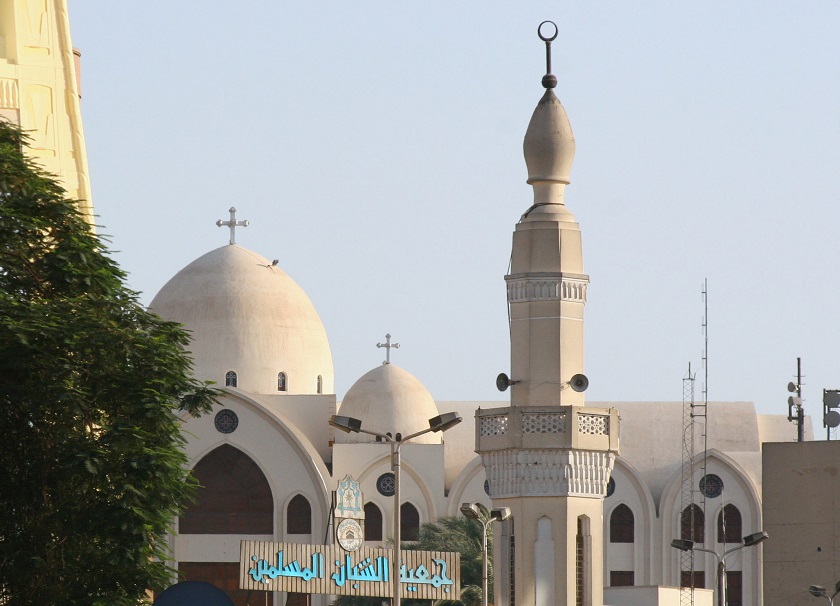
Photo Credit: Church and mosque in Egypt. By kmf164, via Flickr.
In what is being called the largest terrorist attack in modern Egyptian history, over 235 people were killed at a village mosque. Militants detonated explosives as worshipers exited the Rawda Mosque in Bir al-Abd, 25 miles west of the North Sinai capital of Arish. Several then fired upon the fleeing masses.
There has been no immediate claim of responsibility, but suspicion falls upon the Islamic State. The Rawda mosque is affiliated with the Gaririya Sufi order, and ISIS has previously vowed to attack what it deems to be heterodox Muslims, warning them to stop their distinctive rituals. ISIS represents an extreme Wahhabi interpretation of Islam, and is offended by Sufi practices that seek a mystical connection with God through chants and visits to the shrines of Muslim saints.
In 2013, a Sufi shrine was bombed with no casualties. But in 2016 two prominent Sufi sheikhs were kidnapped and decapitated.
Coptic Christians, who have seen over 100 people killed under an ISIS vow, responded with condemnation and sympathy. The next day, Saturday the 25th, the Coptic Orthodox Church spokesman announced all churches in Egypt would ring their bells in solidarity at noon.
“We pray to God that Egypt is preserved from such unprecedented brutal terrorism,” the church announced in its first statement, released shortly after the bombing. “We offer our sincere condolences to the families of the martyrs, praying for the healing of all who are injured,” stated the second announcement about the bells.
Such a public display of Christianity will only further infuriate ISIS…
Please click here to read the full article at Providence Magazine.
In fundamentalist Christian circles there is an approach to the world known as ‘secondary separation’. While the Bible notes Christians are not of this world, there is tension when Jesus says they are also in this world, and should not expect to be removed.
Fundamentalism is one expression of this tension, that leans in the direction of withdrawal. A key verse is II Corinthians 6:17, “Come out from them and be separate,” quoting an Old Testament passage focusing on holiness.
Separation from the world is therefore a necessary Christian posture, though defining ‘them’ and ‘separate’ can be difficult. Fundamentalists take it a step further, saying that ‘them’ includes also those Christians who do not separate sufficiently.
This is secondary separation, and it has been most famously applied against Billy Graham. The renowned evangelist has been celebrated by most Christians for his gospel fidelity and salvation message.
But it that ‘most’ that offends this fundamentalist spirit. His crusades have cooperated with too many insufficiently fundamentalist churches, which they believe compromises the call to be separate.
In partnering with those who are not theologically pure, he risks endorsing their relative liberalism.
It is interesting to note a similar approach exists in Islam.
The posture of takfir is the process of declaring someone a kafir, an infidel. Longstanding Islamic jurisprudence says this should almost never be done to a Muslim, unless he or she openly renounces their faith.
But there is a verse in the Quran that provides Muslim fundamentalists, if the term is appropriate, a powerful retort. Sura 5:44 says, “And whoever does not judge by what Allah has revealed, then it is those who are the disbelievers,” using the plural of the Arabic word kafir at the end.
This verse has been applied by Muslim insurrectionists throughout the ages against their Muslim rulers who they accuse of not properly implementing sharia.
Certainly Muslims also struggle with the tension of their texts, and they are invited to provide proper interpretation.
But leave it to ISIS, the so-called Islamic State, to take it a step further.
Should it be necessary: There is little similarity between Christian fundamentalists and Islamic terrorists. But a devotion to God and a commitment to his way may sometimes prompt an antagonistic stance not only to the world, but also to fellow believers.
And from an article in Jihadica, “The Caliphate in Disarray,” there is also a similarity in secondary takfir.
Turki al-Bin’ali, the self-proclaimed ‘Grand Mufti,’ or chief cleric, of ISIS, was killed several months ago in a US airstrike. His death set off a wave of eulogies, but also counter-eulogies and accusations. Some even speculated his location was tipped off to the enemy that he be eliminated as leader.
Takfir is one of the issues that divides ISIS and al-Qaeda, with the latter being slightly more reticent to call non-affiliated Muslims non-believers. It is a sensible position if you are trying to recruit, not to limit your pool of applicants.
Then again, the number willing to die in their cause is considerably limited by their viciousness. Perhaps then it is best to recruit only the purest of the pure. But as seen with Christian fundamentalists, purity is easily nitpicked.
As a result: theological division among those who believe they have already most dedicated to God’s path through jihad.
Al-Bin’ali’s nemesis on this issue, the Meccan-born Ahmad ibn ‘Umar al-Hazimi, preached a rigorous approach to takfir. The following excerpt may be challenging in its Arabic references, but careful reading will establish a clear similarity with secondary separation:
In his lectures, he [al-Hazimi] espoused a controversial doctrine known as takfir al-‘adhir, or “the excommunication of the excuser.”
The notion of takfir al-‘adhir is derived from two concepts in Wahhabi theology. The first is the requirement of takfir; the second is the inadmissibility of al-‘udhr bi’l-jahl, or “excusing on the basis of ignorance.”
According to the founder of Wahhabism, Muhammad ibn ‘Abd al-Wahhab (d. 1792), it is incumbent upon all true believers to excommunicate—that is, to make takfir of—those deemed unbelievers, as well as to excommunicate those who fail to excommunicate them.
As Ibn ‘Abd al-Wahhab stated—and this is the line around which the Hazimi-Bin‘ali debate revolves—“Whoso fails to make takfir of the polytheists, or has doubts concerning their unbelief, or deems their doctrine to be sound, has [himself] disbelieved.”
The duty of takfir is generally accepted in Jihadi Salafism, but there is some debate over al-‘udhr bi’l-jahl, that is, over whether ignorance may serve as a legitimate excuse for holding errant beliefs, and so shield one from the charge of takfir.
For al-Hazimi, who follows the traditional Wahhabi view, al-‘udhr bi’l-jahl is categorically invalid, meaning that the ignorant heretic is to be declared an unbeliever.
Moreover, as he says, anyone who regards ignorance as an excuse for the heretic’s unbelief is also to be declared an unbeliever. Hence the idea of “the excommunication of the excuser.”
Perhaps in truth this is a tertiary takfir, with standard Wahhabism being the secondary. But herein is the problem: Once you start judging a fellow believer’s faith, where does the cycle stop?
Fortunately for Christian fundamentalists, it does not continue to the bombing of a Billy Graham crusade. But there is many a former fundamentalist who has become jaded when he or those he respected found themselves on the wrong side of a Christian fatwa. Sometimes it moves them to a more nebulous evangelicalism; sometimes they leave the faith entirely.
But they are not killed. ISIS, while flip-flopping repeatedly on the issue, did not hesitate to execute proponents of the at-the-time-minority outlook. Others died in airstrikes under what is described as ‘murky circumstances’. The article features more of the back-and-forth diatribe, which revealed also a discontent in ISIS over corruption, dishonesty, unfulfilled prophecies, and the loss of territory.
All the above is a reminder that the tension in religious faith is not only maddening for the sincere believer, but necessary. If God said both this and that, both are true no matter the apparent inconsistency or challenge of application.
It is easy to side with that (or this) most congenial to personal temperament, but mature faith must grapple with both and live accordingly.
In the world, but not of it. Judge by God’s sharia, but don’t judge. The challenge applies to more than we might at first imagine.
In my recent post about al-Azhar and the doctrine they spread around the world, one reader offered this question in the comments:
Someone I know wrote an article about Islam recently and made the statement that, according to his knowledge, official Islam has never condemned the action of ISIS soldiers in raping Yazidi women. He made several other statements I didn’t particularly like, but on this point, he is saying they cannot condemn such treatment because Muhammad did this sort of thing and even gave his troops permission to do the same. Have you ever come across any statement that al-Azhar believes such action is wrong?
First of all, a little context, excerpted from an article in the National Catholic Register on the same topic:
In the Quran, slave girls are referred to as “those whom your right hand possess,” … Verse 4:3 allows a man to have up to four wives but advises that if he can’t deal fairly with all of them, he should marry only one, or else resort to “those whom your right hand possess.” Verse 4:2 says that men are forbidden to have sex with married women “except those whom your right hand possess. It is a decree of Allah for you.”
The article also draws from traditions about Muhammad. These have varying degrees of reliability but are regarded as an authentic source in principle. I cannot comment on these specific traditions mentioned, but they are provided in well-attributed collections.
After the assault on the Jews of Khaybar, Muhammad ordered that a leader of the tribe, Kinana bin al-Rabi, be tortured until he disclosed the location of the group’s treasure. A fire was lit on Kinana’s chest but, as he still refused to reveal the secret, Muhammad had him beheaded. Muhammad had promised Kinana’s young wife, Safiya, to another Muslim, but, after hearing of her beauty, he went back on his word and took her in “marriage” for himself. By some accounts, this occurred only hours after he dispatched her husband. (Ishaq, p. 515; Bukhari, 1. 8. 367).
The issue of sex slaves in Muslim history and interpretation is of course contested, but what do Muslim authorities do with it today?
Egypt’s highest Islamic authority, al-Azhar, has strongly denounced the Takfiri Daesh [ISIS] terrorists’ newly-released rules for sex slavery, stressing that they have nothing to do with Islam.
“This organization is a criminal and terrorist organization, and one of the goals of terrorism is the spread of its ideologies and the spread of its propaganda that will attract people’s attention,” Mohamed Mehna, a member of al-Azhar’s Grand Sheikh’s Technical office, said on Wednesday. (from Press TV)
This alone should satisfy the question from the original comment, asking only if official Islam condemned the action.
But maybe something in ISIS’ rationale was deficient, it could be asked. That is, while their specific action is condemned, does the practice still has an Islamic basis?
Consider then this document, called A Letter to Baghdadi, the self-appointed caliph of the Islamic State. The list of signatories includes representatives of official Islam from around the world, including Egypt.
It criticizes the Islamic State on several points, and this is from the executive summary:
10. It is forbidden in Islam to harm or mistreat—in any way—Christians or any ‘People of the Scripture’.
11. It is obligatory to consider Yazidis as People of the Scripture.
12. The re-introduction of slavery is forbidden in Islam. It was abolished by universal consensus.
‘Consensus’ is an important word here. While it does imply anti-slavery developments around the world, in which Muslim nations share, it also is a term of Islamic jurisprudence.
Sharia is developed from different sources, but ijma’, or consensus of the scholars, is one of the essentials. Here is how point 12 is developed in the letter:
No scholar of Islam disputes that one of Islam’s aims is to abolish slavery …
For over a century, Muslims, and indeed the entire world, have been united in the prohibition and criminalization of slavery, which was a milestone in human history when it was finally achieved …
After a century of Muslim consensus on the prohibition of slavery, you have violated this; you have taken women as concubines and thus revived strife and sedition (fitnah), and corruption and lewdness on the earth.
You have resuscitated something that the Shari’ah has worked tirelessly to undo and has been considered forbidden by consensus for over a century. Indeed all the Muslim countries in the world are signatories of anti-slavery conventions.
Where I have placed three dots it represents the letter quoting from the Quran to establish its points. I admit I followed some of the logic, but not all of it. But I am hardly a scholar. Read yourself to review.
But the fact is that these are the words of many of the highest Islamic authorities around the world. It is a shame this fact is not more widely known.
Still, though I know the basics of the principle of ijma’, I am still curious about the question posed in the comment and cemented in the Catholic journal. If something was permitted by Islam at Muhammad’s time, can it really be condemned absolutely?
One scholar I asked told me that in the story above, Muhammad married Safiya in order to end the practice of sex slavery. When their prophet set her free and married her, his companions could do no less with those they captured. He tells me this related in the literature.
Getting into the details of this question requires far more study than I have yet done and this post allows. Here are two links to competing sides. But here are a few principles as it is considered.
One, there are many Muslims whose interpretive system requires near-absolute fidelity to the earliest practices of the Islamic community. Through them we are often convinced this is normative Islam. It makes sense, but is it necessary? Islam has a long history and an interpretive framework that has adjusted to time and place. Shall Muslims not be given the freedom of development, if they work to claim it in fidelity with their sources?
Two, there are many commands and practices in the Bible that Christians today consider obsolete, though they came through God’s command. There is not absolute symmetry here with Islam; the religions are different and have different interpretive systems. But give pause before declaring offensive an attribute of Islam, lest the accusation be returned. For those who reject all religion in general, of course, this is less applicable.
Three, for everyone, find a balance in critical charity and charitable criticism. Islam, like all religions and worldviews, deserves its hard questions given its universal claims. But Muslims are individual human beings . Like many others, many Muslims cherish their faith without delving into all the details. Take care before bludgeoning anyone with details we also know little about.
Islam may be true or erroneous, it may engender virtue or vice. But of Muslims, honor them to the degree they seek to honor both God and humanity. Where they are deficient, remember, we all are too.
Egyptian Christian children gather round the country’s flag in a group activity, Aug 2012
The churches of Egypt are temporarily shutting down their summer activities.
“I asked all our churches and conference centres to cancel their trips and events for the next three weeks,” Dr. Andrea Zaki, president of the Protestant Churches of Egypt, told World Watch Monitor. “There is news they could be targeted by radicals.”
An unofficial translation of his official statement reads: “Warm greetings in the name of Jesus. In light of recent developments, please stop all church trips and conferences [for] the next three weeks of July 2017. This is a serious matter. Any trip or conference [that continues] will be the personal responsibility of the organiser.”
Zaki confirmed the information came directly from the security agencies. Fr Boules Halim, official spokesman for the Coptic Orthodox Church, told World Watch Monitor his denomination issued similar instructions, asking churches to wait for further information once the three-week moratorium expires.
Please click here to read the full article at World Watch Monitor.
Shrine to the martyrs of Tanta in St. George’s Church, killed by a suicide bomber on Palm Sunday.
They couldn’t even wash their dead.
Thirty Coptic Christians were gunned down by ISIS, ambushed in a church bus on a weekend outing to a popular monastery in the Egyptian desert. Their families gathered to receive their loved ones in a local hospital, but were met with a mixture of ill-equipped facilities and overwhelmed staff. They even had to fetch their own water.
As if another reason was necessary, Coptic anger turned the funeral march into a protest.
“With our souls and blood we will redeem you, oh Cross!” they shouted. Some seemed to take aim at Islam. “There is no god but God,” they chanted, before changing the second half of the Muslim creed, “and the Messiah, he is God.”
Other chants took no aim at all, thrashing wildly in anger. “We will avenge them, or die like them.”
Many observers say such anger plays right into the hands of ISIS, which is keen to turn Egypt against itself.
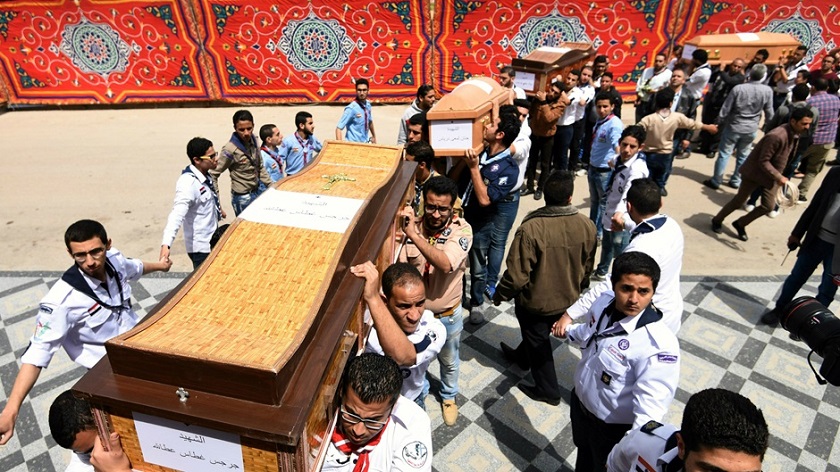
Six weeks earlier, after twin suicide bombings on Palm Sunday, Bishop Boula of the Coptic Orthodox diocese of Tanta found himself in a similar situation. Hospitals did not have enough refrigeration units to keep the 25 bodies of those martyred at St. George Church. Crowds were gathering, and anger was surging.
Quickly, he made the decision to bury them together in the church crypt reserved for bishops. Honoring the dead with their leaders of ages past, he then marshaled the youth to provide order and security for the semi-spontaneous funeral service.
“It cooled the fire of all the people,” he later recounted on satellite TV. St. George was renamed to include “the righteous martyrs of Tanta,” with a shrine erected outside the crypt.
It was perhaps the most practical of Coptic efforts to process their anger. Forgiveness is another, as Copts have moved Muslims and wowed the world with their example…
Please click here to read the full article at Christianity Today.
After the latest atrocity against the Copts perpetrated by the Islamic State – killing 30 in an ambush of a church outing to visit a monastery – the following poem was circulated on social media.
It is entitled ‘A Message to ISIS’, written by Kiro al-Masry. The translation is mine and the Arabic original is given at the bottom.
I will not speak (as some have done)
And curse your religion whatever its name.
I have come that it be known:
My fathers’ religion and what it proclaims.
My fathers’ religion has love at its heart,
The meaning of which will call you to peace.
My fathers’ religion, right from the start
Offers forbearance that conflict will cease.
Your hatred and killing in no way suffices
To stop us from loving and praying for you.
My father’s religion, oh dear Uncle ISIS,
Is not a weapon to pierce you straight through.
I wish that you could come to see
Or just one time the answer seek.
That while you bomb and murder, we
Stay strong as if a mountain peak.
My fathers’ religion of spirit consists.
It is not a body whose end is the dust.
And for the spirit—despite death persists—
Awaiting are loved ones residing in trust.
My fathers’ religion, if you could discern,
Offers each wounded the medic of life.
Tomorrow when you will repent and return,
You will come to know just who is the Christ.
رسالة لكل داعش
انا مش هقول زي اللي قالوا دين ابوكم اسمه ايه
انا جاي اقـــــول دين ابويا يعني ايه
دين ابويا يعني حب يعني دعوه للسلام
دين ابوايا من البدايه دين تسامح مش خصام
رغم كرهك رغم قتلك وصاني اصليلك واحبك
دين ابويا ياعم داعش مش سلاح يطعن ف جسمك
نفسي تفهم مره واحده او تساءل نفسك سؤال
ازاي وانتوا بتقتلـــونا بنبقي صخر من الجبال
دين ابويا اصله روح مش جسد اخره التراب
يعني لما الروح بتصعد بتتلاقي مع الاحباب
دين ابويا لو بتفهم دين بيداوي كل جريح
وبكره لما تتوب وترجع هتعرف مين هو ( المسيــــح )
بقلم الشاعر : كيرو المصري
In a future post I hope to offer some commentary and reflection. But for now, take note at one way Copts are encouraging themselves in the face of atrocity and evil. Pray for them, and for ISIS likewise.
Easter passed peacefully, but not Egypt. Though there were no troubles on the holiday, others sandwiched.
A few days earlier Copts praying in a village were pelted with stones, as police looked on. A few days later terrorism struck at St. Catherine’s Monastery in the southern Sinai, as police responded.
One officer died, a few others were injured.
God, protect the nation. Protect her churches. Protect her people. Protect her police.
The disturbing fact in the latest incident was the reach of ISIS to the south. Cells have perpetrated terrorism in various places on the mainland, but it was believed the group had no presence save northern Sinai.
So hem them in, God, and squeeze. Aid the security forces. Grant bravery, justice, and fidelity to law.
It was law also that settled justice for Aya Hegazi, a dual Egyptian-American citizen. After three brave years in pretrial detention, the court ruled against charges filed. She and her husbanded had opened a children’s center, and were accused of exploitation.
President Trump claimed intervention, and flew her home before meeting at the White House.
God, protect the judiciary. Protect its independence. Protect civil society. Protect its people.
If Aya was innocent, how many others? In a congested legal system give all their day in court, in fidelity to the constitution. As Egypt responds to the pressures against her, help her hold to the right and the true.
So steady her institutions, God, and strengthen. Aid the social entrepreneurs. Grant creativity, license, and fidelity to law.
Whether religion, state, or society, give stability and peace. Too many make trouble. Root out, vindicate.
This article was first published by Christianity Today on April 20, 2017.
Image: MOHAMED EL-SHAHED / AFP Coffins are carried to funeral of Egyptian Christians killed in Palm Sunday bombings.
Twelve seconds of silence is an awkward eternity on television. Amr Adeeb, perhaps the most prominent talk show host in Egypt, leaned forward as he searched for a response.
“The Copts of Egypt … are made of … steel!” he finally uttered.
Moments earlier, Adeeb was watching a colleague in a simple home in Alexandria speak with the widow of Naseem Faheem, the guard at St. Mark’s Cathedral in the seaside Mediterranean city.
On Palm Sunday, the guard had redirected a suicide bomber through the perimeter metal detector, where the terrorist detonated. Likely the first to die in the blast, Faheem saved the lives of dozens inside the church.
“I’m not angry at the one who did this,” said his wife, children by her side. “I’m telling him, ‘May God forgive you, and we also forgive you. Believe me, we forgive you.’
“‘You put my husband in a place I couldn’t have dreamed of.’”
Stunned, Adeeb stammered about Copts bearing atrocities over hundreds of years, but couldn’t escape the central scandal.
“How great is this forgiveness you have!” his voice cracked. “If it were my father, I could never say this. But this is their faith and religious conviction.”
Millions marveled with him across the airwaves of Egypt.
So also did millions of Copts, recently rediscovering their ancient heritage, according to Ramez Atallah, president of the Bible Society of Egypt which subtitled and recirculated the satellite TV clip.
“In the history and culture of the Copts, there is much taught about martyrdom,” he told CT. “But until Libya, it was only in the textbooks—though deeply ingrained.”
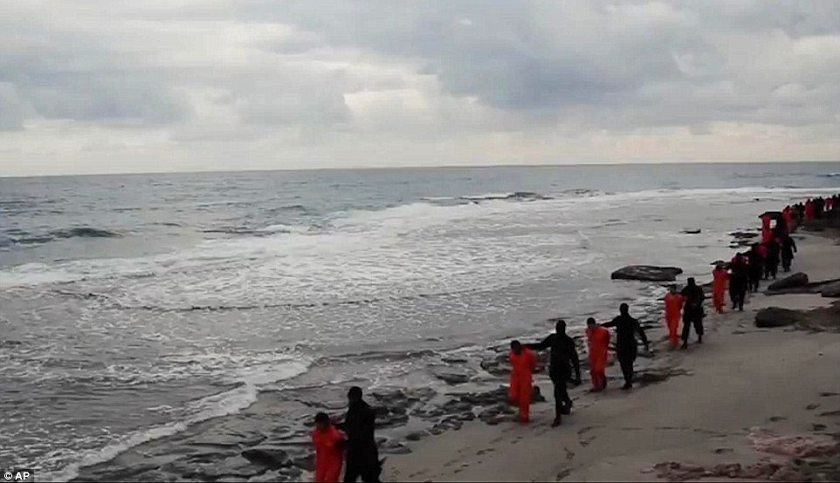
The Islamic State in Libya kidnapped and beheaded 21 mostly Coptic Christians in February 2015. CT previouslyreported the message of forgiveness issued by their families and the witness it provided.
“Since then, there has been a paradigm shift,” said Atallah. “Our ancestors lived and believed this message, but we never had to.”
Please click here to read the full article at Christianity Today.
This article was first published by Christianity Today on April 19, 2017.
Two weeks after killing 47 Egyptians in twin church bombings on Palm Sunday, the Islamic State claimed a fresh attack on the ancient monastery of St. Catherine on the southern Sinai peninsula.
One policeman was killed and four injured during an exchange of gunfire at a checkpoint about half a mile from the monastery entrance. Police were eventually able to gain control and force the militants to flee, according to the Ministry of Interior as reported by Ahram Online.
ISIS claimed responsibility in a terse statement via their official news agency, Amaq. However, local speculation suggested it may have been a result of skirmishes between disgruntled tribes and the government.
St. Catherine’s is named after the fourth-century martyr from Alexandria, and was built in the sixth century by the Byzantine Emperor Justinian. The monastery belongs to the Greek Orthodox Church, and was declared a UNESCO world heritage site in 2003.
In the mid-19th century, the fourth-century Codex Sinaiticus was discovered in St. Catherine’s ancient library, at the time the oldest near-complete text of the Bible. The library boasts more than 8,000 early printed books, and is considered second only to the Vatican in collection of early biblical manuscripts.
“We admire the monastery for digitizing its collection for research,” said…
Please click here to read the full article at Christianity Today.








 Jayson Casper