Dr. Abdel Munim Abul Futuh is a frontrunning candidate in the Egyptian presidential elections. He has been a member of the Muslim Brotherhood’s Guidance Council for twenty-five years, but now finds himself officially outside the organization as a result of his desire to run for the presidency. The Brotherhood has stated it will not field a candidate for this post, and thus expelled him from the group. Nonetheless, his stature as a liberal-leaning Islamist positions him well among current declared candidates, and there is a better-than-fair chance he may be Egypt’s next president.
Arab West Report was able to secure an interview with him; questions were posed by Editor-in-Chief Cornelis Hulsman, and composed under his supervision by Yousef Habib, Jenna Ferrecchia, and myself. Prior to the full transcript and analysis thereof I will place now a brief preview. The final transcript will be posted with a link to the video of this interview in a few days.
The interview was conducted in Arabic, so the nuances of his answers must wait until the proper and precise translation is finished.
How do you plan to unite Egypt as president, given her current divisions?
Egypt has diversity, not division. In order to unite Egyptians the president must have four characteristics:
He must work for Egypt’s independence and national benefit
He must be religious to fit with the population
He must deepen the reality of citizenship
He must render justice according to the law
Are you truly independent from the Muslim Brotherhood?
I take pride in the Muslim Brotherhood and in its moderate Islamist ideology. But my separation now is not a tactic. I do not represent the Brotherhood and am completely independent in terms of organization.
What is your opinion about the caliphate?
This is not an Islamic religious term. It represents simply the idea of international cooperation but is misused by many. In any event it does not concern me. I am interested in building Egypt. Besides, as we are now, who can we unite with?
What is your opinion of the Hassan al-Banna quote: ‘The Qur’an has made Muslims to be the guardians for an incapable humanity, giving them the right of superintendence and sovereignty over the world.’
If Banna or anyone else said this, it is an incorrect idea. No person may claim guardianship over any other person, and Islam does not support this. If someone claims to be on better standing with God than someone else, fine, but let him take this up with God. Between men, anyone who sets himself up as better than another, even religiously, damages the essential dignity of humanity.
Note: al-Banna is the founder of the Muslim Brotherhood. Click here for a summary translation of a compilation of his writings, here for an analysis thereof, and here for the response of a regional leader of the Brotherhood to some of its quotes.
Earlier your said creating the Freedom and Justice Party was ‘a risky gamble’ in the likelihood it would mix proselytizing and politics. What do you think now after their electoral success?
Now as before I do not support the Muslim Brotherhood in creating a political party, as there is an obvious mixture between the two. Every day you get some Muslim Brother – non-affiliated with the Freedom and Justice Party – speaking about politics. It is not good.
How do you see the proper role of Egypt’s president and parliament?
The president should have strong powers but these should be shared with parliament, which maintains both a legislative role and one of oversight on the executive branch.
How do you view the process of reform at the Ministry of Interior?
It is not simply a matter of firing officers, but engineering a change in culture so the police become in service to the people. But this must be done with respect to the preservation of stability.
What are you views about the coming constitutional assembly?
This must be representative of all sectors of society, some of which may come from parliament, but not most. It must produce a national dialogue in order to create consensus, even if this takes time. But out of respect to the March referendum, the writing of the constitution should take place after presidential elections, not before.
What is your view about Article Two of the old constitution, making Islam the religion of the state and the principles of Islamic sharia to be the source of legislation?
It was part of the 1971 constitution and was approved widely by the people. Today, everyone supports it, including Christians.
How many Christians do you think are in Egypt, and should their official number be made public?
I do not have an estimate on their number, but the fact of their number should be part of public information. What is done about this number is another matter, but as a statistic it should be released.
You stated previously there should be no barriers to religious conversion in any direction. What is your view?
Freedom of doctrine is a basic human right and enshrined in the recent Azhar document. But neither the Azhar nor the church should have any role in conversions, as if they must give their approval. It is the state alone which must guarantee this freedom.
What do you think about the unified law for building houses of worship?
This is an invented issue. There is no need for a law but only for administrative permits where there is a need. But really, Egypt does not need more mosques or churches; it needs farms and factories.
How do you view issues of marriage and divorce?
In Islam, marriage is a civil matter, not a religious issue. But if a Christian wishes to have a religious marriage, this is a matter for his community. But in terms of the state marriage and divorce should be civil matters. The problem some Christians have in getting divorces is simply a matter between him and the church; the state is not involved.
What are your ideas on economic policy and Islamic banks?
Time does not permit a full answer, but the gap between the rich and the poor is largely an issue of corruption and poor administration. As for Islamic banks, they exist now everywhere in the world. People should have the freedom to choose the bank they wish to use, with all options available.
Thank you very much for your time, Dr. Abul Futuh.
Update: The interview has now been transcribed. Please click here for the post.
A year ago today the revolution emerged successful. Mubarak stepped down, and the military council began leading the transition to democracy. One year later, few are actively celebrating the anniversary. There is substantial distraction from a call to escalate the revolution against the military itself.
Thank you, God, that yesterday’s protests – for the first time reaching military headquarters – ended without violence. Yet today an unknown chapter opens calling for civil disobedience. Most religious groups and standard political parties condemn it outright, or at least stay at arm’s length. Criticism reigns that it will bring chaos and demolish the nation. Yet what happens exactly, no one knows.
Some call for the non-payment of taxes. Others seek a general strike. Will the day pass quietly? Will a prolonged test of legitimacy emerge? Will either revolutionaries or infiltrators conduct sabotage?
Both the Orthodox Church and the Azhar have stated that civil disobedience violates their respective scriptures. They call on the nation instead to work even more diligently to support national recovery.
Do these groups represent you, God? The scriptures they point to seem clear enough.
Or is the effort any different from the revolution last year, which these and all institutions now celebrate wholeheartedly?
Speak to the heart of each Egyptian, God. Even if you guide them differently, guide them according to service, sacrifice, honor, and integrity.
Guide them also away from a spirit of disobedience. Even if their cause is fair, steer them to terms which rally around truth, justice, and righteousness.
Grant wisdom to the nation’s leadership. Help the military to pass this challenge while honoring their promises, honoring the people, and honoring Egypt’s sovereignty. Help clerics to study their scriptures while seeking your guidance, that they may encourage the people to do what is right. Help politicians to follow their convictions while representing the will of their constituency. Help revolutionaries to strategize astutely, to hold to account all who are in power.
Give Egypt discernment in these days, God. May she see herself truly, finding and removing her faults. May she double her virtues and all which pleases you. Keep her from passing blame on others, while rightly discovering all machinations against her.
May she celebrate all that has been accomplished this year, God. May she keep at work until the task is accomplished.
The disturbances in and around Tahrir Square in recent weeks have resulted in the erection of several walls cutting across downtown streets. These were built at the time to separate demonstrators from security forces as they battled in the streets. Additionally, some were built to provide additional protection from sensitive government facilities, especially the Ministry of the Interior, which runs the police. Some of these walls – namely near the Parliament building – are barbed wire allowing for foot traffic to flow while preventing mass demonstrations. The majority, however, are massive cement blocks which make Cairo begin to resemble an apocalyptic scene.
Julie’s parents have been visiting us, and the other day I accompanied them downtown to the Egyptian Museum, in the heart of Tahrir Square. I took advantage of the time to check out the scene. Many areas are too sensitive to photograph, but in and around the places of confrontation there were dozens of cameras – mainly for demonstrators seeking documentation – so I was more comfortable.
Fortunately I made my tour during a comparative lull in the conflict, but not without a reminder of how terrible tear gas is.
The most recent clashes occurred when angry protestors gathered near the Ministry of the Interior following the deaths of near eighty soccer fans in Port Said. While this may have been the result of hooliganism gone amuck, many people feel the tensions were deliberately stoked and facilitated by the security forces. The hardcore soccer fans then took to the streets, joined by other hardcore protestors who believe the police – the target of widespread anger in the January revolution – still reflects and works on behalf of the former regime.
In these street battles there is often little fighting. Usually a handful of protestors advances to the front lines, and will often throw rocks or Molotov cocktails. The police respond with tear gas, and there is a no man’s land in between the two sides. In addition, the police stand accused of using shotguns which fire pellets that scatter, resulting in small, but multiple wounds on a body. At times these have been fatal, or caused protestors to lose their eyes.
These clashes appear to have been different, though it is hard to verify. With all the walls downtown the Ministry of the Interior is effectively sealed off. Police could simply remain behind the walls, but some reports claim they have driven around the streets in their vehicles chasing after protestors. Whether or not this is true, other reports suggest the police have been the ones under pressure. One of the stone barriers has been destroyed as demonstrators filled the streets en masse. It also appears some demonstrators have fired similar shotgun pellets at police, resulting in many injuries. Whoever the aggressor is, to date around fifteen people have died in clashes over the past few days.
This picture is of a historic French research center housing many old documents. It was the scene of earlier clashes, in which an errant (or intentional) Molotov cocktail landed inside and destroyed the building with much of its content. Following the street to the right will lead to the largest Protestant Church in the Middle East, which has doubled in function as a field hospital during clashes over the past few months.
The next picture shows the street – Mohamed Mahmoud – which was also a scene of earlier clashes, described here and here. Not much was happening but many were gathered, and I wandered down to get a feel for the atmosphere. About halfway in the crowd turned and ran in my direction, but many at my level were calm and stationary. I turned to walk out with them, and soon knew why. The police had launched another round of tear gas.
I neither heard nor saw anything, but on the way out it became more and more difficult to breathe. My eyes watered and I was grateful to soon be back out in the open air of Tahrir Square. I stayed put for a little while just watching from a distance, but again, little was happening. The tear gas was meant simply to drive people back, keeping the sanctity of no man’s land.
I walked around town a bit to see where other clashes had taken place, as well as the barriers erected here and there. Near the Parliament I passed by about two hundred women who were leading a march to deliver demands to their representatives. They shouted against the military regime, and were viewed by many curious onlookers. Earlier in the day there was news of a larger ‘mother’s march’ which went to the site of the clashes to demand their sons stop being killed. This group, though, was much younger in appearance.
I kept moving and after taking several city blocks to maneuver around the barricades wound up on the other side of the clashes. The police line by this point was very calm, with many pedestrians milling about. This was the site of a great battle the night before, and many shops were damaged and the pavement scarred. All felt well, but it did not seem like the place for pictures.
Continuing the circuit, I wound up parallel to Mohamed Mahmoud looking in at the action from side streets. At the entrance were large crowds, appearing to regulate traffic in and out. It was not quite a human wall, but there were several arguments between people about joining the demonstrations or accusing them of ‘burning Egypt’. After several minutes of just watching, I meant to move through, but one of the group whistled and told me to come back. It was an easy decision to comply.
The next side street down had a similar scene. Again I waited within the crowd to get a sense of the situation. After a while I moved again to go to the main street and this time just sauntered by. It was eerie, as the street was deserted save for the handful of people moving either direction. Once I got back to Mohamed Mahmoud, though, I was back among the demonstrators and the several onlookers, as well as the multiple cameras, and all was well.
There was no conflict, except a philosophical one among those present. Several people rallied in the middle of the street and shouted, ‘To the Square, to the Square, he who goes is not a coward.’ Others adjusted their chant against the military council, shouting against this effort, ‘Down, down with the (Muslim) Brothers.’
There was nothing distinguishing about the effort to lead people away from the areas of conflict, but in the news were the efforts of different parliamentarians, among them the Muslim Brothers, who tried to mediate to end the clashes. The Muslim Brotherhood has positioned itself as the party of stability in the past several months. While this has played well among the electorate at large, it has infuriated the protestors who feel the Brotherhood is betraying the revolution now that they have won their legislative majority. Whether or not this effort was Brotherhood, it brought the anger of several. Most did not leave, even as the group clasped arms across the street and tried to sweep everyone away as they left.
Shortly after this I noticed a large contingent of Azhar sheikhs milling among the people as well. The Azhar has scholars of different persuasions, but is generally understood to be non-Brotherhood though socially conservative. Whoever these sheikhs represented, they were seeking a similar result, urging people to go back to the square.
Azhar Sheikh Holding a Megaphone
At one point a sheikh mounted a wall with a megaphone, but was drowned out by protestors shouting against him. His non-sheikh colleague took the megaphone and tried to gain an audience, beginning with ‘Down, down with military government.’ At this everyone cheered, and at least listened somewhat as they tried to argue the merits of protesting in Tahrir rather than in the streets leading to the Ministry of the Interior. They convinced no one, and after a bit the soccer fan among the protestors grouped together and raised their own cheers, dancing around and waiving their hands. All the while the police looked on from their line right even with the wall on which the Azhar sheikh stood.
By now several hours had passed and I started back to the museum to receive my in-laws. The following pictures show scenes from the center of conflict back out toward Tahrir Square.
A Wall Demolished by Protestors, between Tahrir and the Site of ClashesThe Size of a Single Boulder in the WallA Wall on a Side Street from Mohamed Mahmoud; Translation: Down with the Field Marshal, Down with Military Rule
At the end, I offered in-laws a chance to see the action and smell the lingering tear gas. All was calm, and they agreed, coming to the entrance to Mohamed Mahmoud before we found the nearest metro to return home. The following picture shows them in front of a sign accusing the military council figures of being oppressors, condemning them through a quote from the Qur’an.
Translation: And those who have wronged are going to know to what kind of return they will be returned.
There is a much different feel about the protests compared to that experienced last January. While the initial revolution was met with violence, there was a sense of hope and purpose, buttressed by the sheer number of people and the diversity of their backgrounds.
This time there is much revolutionary fatigue, and the revolutionaries are largely on their own. The anniversary of the 25th brought the masses, renewing their vitality, and every bloody incident serves to rally more troops. But for the most part those there now are troublemakers, curious onlookers, hardcore activists, street children, or some combination of the sort. Without commenting on the rightness or wrongness of their continuing struggle against military rule, the hope of earlier days has been replaced by the reality of death and struggle.
The following picture is a beautiful graffiti rendering of a few recent ‘martyrs’ who have perished on this street. Yet above them is written a curious phrase, seen elsewhere on city walls. It translates, ‘Peaceful is completely dead.’ In another place it continued, ‘Now we will take our rights by our own hands.’
In January every time the protestors were met with violence on the part of the police they called out ‘Peaceful, peaceful’. Now, though many still cling to this commitment, others have been induced to let it go. They feel that since Mubarak stepped down they have been increasingly killed during their protests, and must now change tactics. By no means is the situation as in Syria, where armed groups have formed among military defections, but this is a strong indication of the loss of hopeful idealism.
The latest change in tactics serves to take advantage of the final anniversary from the earlier revolution. Last year on February 11 Mubarak stepped down from power as the people celebrated. This year, a broad revolutionary alliance is calling for nationwide civil disobedience and a general labor strike, in addition to a boycott of all consumer products manufactured by the military.
It is unclear how much support this initiative has. The Muslim Brotherhood has condemned it, while several university student groups have indicated their participation. It is not a turn toward violence, but rather an effort to find another avenue toward hope (or chaos) – forcing the military to surrender power to civilians. The demand is that power be given to the Parliament with presidential elections to follow at the earliest moment possible.
The military council is currently weighing its options, and a prominent general has promised ‘good news’ will shortly be issued. What this entails is anyone’s guess.
Ever since the revolution Egypt has suffered / benefited from waves of popular protest. The expressions in Tahrir Square were largely political, yet included a significant expression of social and economic discontent. The original chant which rang through the streets demanded, ‘Bread, Freedom, and Social Justice.’
Most focus since the revolution has been on political matters, and these have yet only partially been achieved. The achievement is significant, as Egypt now has a parliament freely elected by its people. Yet the primary lesson learned by the population is that if you have a grievance, fill the streets.
‘One Hand’ on the Railroad
A few weeks ago I was assisting American documentary filmmakers obtain an interview with a Coptic priest and a Salafi sheikh, the latter of which was running for parliament with the former’s support. The couple is producing a film entitled ‘One Hand’, which focuses on youthful and unique expressions of national unity. They had other business in Asyut, and I was to meet them with the priest in Maghagha.
My train arrived as usual from Cairo, but coming from Asyut was another story. With the priest I waited at the station, and waited, and waited. Finally we learned that nearby villagers decided to escalate their protest against the local government for failing to deliver the normal supply of gas bottles needed for cooking. The shortage prompted a huge increase in price on the black market, so they decided to block the railroad tracks.
At this news we knew it could be hours, though probably not days, until the track was opened again. The priest and I drove an hour south to collect them on the side of the tracks. For whatever reason, the task was complicated by the fact there was very poor cell phone coverage, but we managed to speak with their neighbor who assisted them in their disembarkation. The filmmakers spoke very little Arabic.
Eventually they made it over to us, surrounded by a group of young men who were offering to ‘help’. They may or may not have been, but once we got them in the car one of them asked where we were from. Oddly, I felt a bit unnerved out of concern for the (young) couple, answered ‘America’ with a smile, and received a reply suggesting his ‘help’ may have been variable. ‘F*** America,’ he said, ‘We hate America.’
‘I know,’ I replied smiling still. We got in the car quickly and drove away, with both exhaustion and a sigh of relief. The long delay made little impact on their work, as the sheikh was not free until near midnight to begin a very friendly and welcoming interview.
Lock the Lock
The next two examples come from a Nile cruise on the occasion of Julie’s parents visit to Egypt. We boarded the sleeper car from Cairo and unloaded in Luxor, very pleased there was no railway protest to extend the journey.
Yet after the first few local sightseeing locations we noticed something strange. We got on a bus and drove over an hour away to board our cruise and spend the night. The next day we repeated the same ritual, only delayed an additional two hours. There are many ancient Pharaonic sites to see in Luxor, and both the delay and the absurd driving distance played havoc with our scheduled itinerary.
Mother and Daughter Exhausted from Extra Travel
The normal agenda is to get off the train, see the sites, and then board the boat right there in Luxor, stopping at all the tombs and temples along the way.
Unfortunately, we learned the workers at the canal lock in Isna were on protest, refusing to let any boats past. They began their sit-in on the 25th of January, to commemorate the revolution.
This left the boats in Luxor stranded, but fortunately our boat was trapped on the other side. This explains the hour plus bus ride after we finished sightseeing. We had to drive south to Isna in order to spend the night in our cabin, and then return the next day for Luxor sites, day two.
Only the next morning we encountered another post-revolutionary difficulty. The nation as a whole, but Upper Egypt especially, has suffered periodic gasoline shortages. The bus, we learned, was desperately searching for an open tap.
After several hours delay, a different bus met us at the dock and filled up from the boat’s supply of gasoline. I’m not sure there weren’t other shenanigans we weren’t being told, but we did see long lines of vehicles at the gas stations we passed on our way back to Luxor. I’m also not sure who’s bottom line must accommodate the extra costs of bus and gasoline – travel agent, cruise, tour guide – but the blow to tourism is substantial.
Other tours which knew of the lock strike at Isna cancelled their trips altogether.
A Free Pass at Edfu
The Massive Temple at Edfu
Later on in our tour we had a pleasant outcome from local instability. Our boat docked in Edfu, but the captain told everyone the tourism workers at the temple were all on strike. The rumor circulated but before it had time to settle in the guide rounded everyone up and we went ashore. From there, we rode horse drawn carriages to the site of the temple.
What we didn’t realize until later is that our carriages stopped at the back side of the temple. We passed along an open area along the wall of the massive complex, circled to the temple gate, and moved through en masse.
At the entrance of nearly every tourist location there is a small area to mill about where the grandeur is open to all onlookers. Then there is a welcome center where a ticket is purchased and then a souvenir section where tourists – foreigners especially – are all but assaulted by desperate sellers.
We skipped all this. By coming in the back we avoided whatever protest prevented entry from the front. At the temple gate some semblance of guard took money from every tour guide, but then allowed the group in without tickets, no questions asked. Ticket prices for Egyptians range from 1-5 LE ($0.18-0.80 US), but foreigners must fork over between 35-80 LE ($6-13 US) depending on location. It is still minimal, but it was a nice surprise – pleasant also, as we avoided the souvenir gauntlet.
Groups Moving Past the Entrance as Tour Guides Give a Little Baksheesh (Tips)
The Big Picture
It is difficult to know what to make of these protests. On the one hand, they are at the least annoying and disruptive, and perhaps even damaging to the local economy. Several people, especially in Cairo, criticize such strikes. They say people should be patient: ‘We waited thirty years to get rid of Mubarak, we should not expect things to get better immediately. In fact, such continuing ‘special interest’ protests are only making things worse.’
Fair enough, but how can this point be enforced when there is a window of opportunity now? Forty percent of Egyptians live on under two dollars a day, wages are low even in the middle class, and few people have benefits of any kind. The revolution has changed political leadership, but not so much at the regional level. Protests have proved effective for many in getting what they want – which could be as basic as a living wage. Who knows but if they wait longer the system will reset itself and local leaders will pay as little concern to their needs as before?
In many ways, the problem is one of trust. President Mubarak allowed the failure of the social contract which ensures domestic stability. Open political participation was minimal, but so was food on the table. As Egyptian institutions eroded from the inside, it will take a long time to rebuild following the revolutionary collapse. Unless such a contract is widely renegotiated, small and localized strikes will – and perhaps reasonably – continue.
Who pays the bill? Is it reasonable for the average working Egyptian to wait until the Muslim Brotherhood, elite liberals, and the armed forces get around to a new economic policy? If so few cared for their needs then, should they trust anyone will care now?
Perhaps they will. The only one of the three to demonstrate practical concern for the poor were the Islamists, who have now been widely elected to parliament. It is fair to ask if Islamist concern is opportunistic or transformative, but many have worked sincerely. Will they follow through? Will they be allowed to? Will the people wait? If so, for how long?
Revolutions are not easy, and the pain can linger even after resolution. Egyptians are among the most patient people on earth; they are now being put further to the test.
Postscript
On the sleeper train ride home I woke at about 2am from a lack of movement. It is difficult to catch shut-eye while the car lurches back and forth, but I was able. After about 45 minutes of standstill, however, I inquired. A baggage handler told me there was a train driver strike over assignments on the newer cars, which also came with a higher compensation.
Our car was newer, and despite my complaints above was much smoother than the older model we semi-suffered on the way south.
The handler assured me things would be settled soon, so I used the calm to get back to sleep. It worked, as I was unaware of another long delay that woke my wife around 4am.
In the morning I asked the porter about the delays. He replied there was just a normal backup of several trains at a particular station. Asking more specifically about a strike, he denied anything of the sort. I think I ran directly into the noble Egyptian quality of saving face.
In the end our scheduled twelve hour trip took sixteen. I don’t know if the drivers got what they wanted, or how it came about we did not spend an additional evening or two in the sleeper car. I just hope Egyptians remain patient as their lives accommodate such disturbances at an increasing frequency.
I suppose if everyone is doing it, it is easier to forgive.
Fortunately, They Slept Through the Night
Final Postscript
Today the media carried the news that a Luxor-Cairo train the day after our travels was attacked by thugs who tried to steal luggage from car number five. The passengers successfully beat them off.
It seems every month more people die. This month is the most inexplicable. Around eighty people were killed at a soccer match in Port Said, when partisans of one team set upon the other. Whether or not this was senseless violence complicates matters all the more. Some say there were signs of a planned attack, with gates strategically locked and opened.
But who can know, God? Almost immediately after the tragedy calls were renewed for the fall of the government, the withdrawal of the military council to their barracks, and the advance of presidential elections. Did some plan the tragedy for some political end? How horrible and evil. Or are some using the tragedy for some political end? How horrible still. The great stakes in the game make determination of the facts almost impossible. Or, are things so clear as to be obvious? God give mercy.
As a response the bereaved soccer fans – always belligerent but never fatal – have gathered at the Ministry of the Interior, their sworn enemy which oversees the police. Both they and security forces have fallen injured, and perhaps they seek to storm the building itself.
Remove all thoughts of revenge from their hearts, God. Give them to mourn, give them to protest, but keep them from returning evil for their hurt. Their nature helped advance the revolution; keep their nature from spoiling it. Perhaps it must also be asked to redeem their nature, God. In many ways their solidarity and fervor are beautiful, but sin crouches at the door, seeking to master. Protect them from themselves, that they might better protect each other, and Egypt.
But what is behind it, God? Who is behind it? Expose them. If it was simply soccer violence then hold all accountable. If there is more, may the culprits be found. Why are some not content with a good life rightly lived? Why must power be so seductive? Month after month people are dying; are these the price of crafting a just order? Or are the players involved in this struggle, if only one of them, rotten to the core?
Give wisdom to the military which governs Egypt, God. Bring justice to the nation and reconciliation among all who have been abused. Rebuke those who do evil, and empower those who do right in honor of your principles. Give repentance and forgiveness; bring transformation beyond punishment. Unite Egypt for the prosperity and freedom of her people.
Today I had a nice long visit with a fairly new Egyptian friend. Her name is Suzi and she is the mom of one of Emma’s classmates at school. This was our third visit together, once at our house and twice at hers. The kids all have fun playing together – Emma and her school friend, along with my Hannah and Layla, and the friend’s little brother who is the same age as Hannah. While they played, we mostly chatted about life. I thought I’d record some of the things I heard today as they provide an interesting insight into culture here.
Marriage Differences
One of the topics we spoke about was marriage. It is common here for a man to come to a woman’s house to inquire about marrying her. He may have known of her for a long time, or perhaps a friend mentioned her or he saw her in some spot and asked others about her. There are a variety of ways that this meeting can come about, but it is still a norm for marriages to be “arranged” this way. In most cases, it seems that the woman has full rights to say yes or no, but it is often the way a relationship begins.
That’s not to say there aren’t many, many relationships that start because people work together or go to school together or whatever, but this man coming to ask for a woman’s hand, while basically absent from the American culture, is still very present here. Suzi was asking if it was harder or easier to get married in America and I said that it was harder because of the absence of the arranged marriage. She seemed somewhat surprised to know that it doesn’t happen in the states. I couldn’t just wait at my parent’s house for possible suitors to come calling; I had to meet people and take initiative without being too forward. I told her it was tricky as it is a bit of a game to let someone know of your interest without being aggressive (as the woman). And meeting potential spouses in general can be challenging. While I appreciate the American dating system as a whole, I thought it might be a bit easier to find a husband in this culture.
That being said, she asked if the man must have a house or apartment already purchased and furnished before proposing to someone. He sometimes must have a car and enough money for a good amount of gold jewelry as well, that will be shown off at the engagement ceremony. In this way, I said, things might be easier in America. Many couples will start off living in an apartment and work together to afford a house after getting married. Whatever the particular timetable, it is not expected that a man have all the material goods before he can even look to get married. This is one reason that Egyptian men are getting married later in life as it is getting harder and harder to earn enough money to buy a flat and furnish it before proposing to a future bride.
Suzi’s story itself was quite interesting to me, and perhaps bizarre from the Western perspective. She is married to her first cousin. Her mom and his dad are sister and brother. We talked about this a bit as I told her it is illegal in the states to marry your cousin. (I guess I don’t really know if it’s illegal, but I think it is.) I tried to explain that one reason is the possible genetic problems with the offspring, but she said they just trust God for the health of their children.
I have encountered this frequently in this part of the world—the idea of marrying within the same family. Suzi said it makes sense as you know where the spouse comes from if they are from your family. It is a risk to marry an outsider. Her sister also married a cousin, and they have already, somewhat jokingly, arranged for Suzi’s daughter to marry the sister’s son, which is many years down the road considering they are both five now.
Even though Suzi married her cousin, she had never actually seen him until the wedding day! His family has lived in Cairo his whole life and she grew up about 8 hours south and at one point when they were very young they saw each other, but not another time until the day of the wedding. They got engaged over the phone and spent the following year planning things, and getting to know one another over the phone, before Suzi came to Cairo to get married to her cousin whom she had seen once in her life! They have been married 7 years now and seem to be happy with the arrangement.
Children Sleeping
Another topic we covered was children sleeping. We’ve talked about this each time we were together as Suzi cannot get over the fact that my girls go to bed at 7pm. In Arabic there is a word specifically for “staying up late,” and Egyptians, in particular, are known for their love of the late night. Especially in summer when kids are off school and the weather is so hot during the day, the streets will be busier at night with people enjoying a walk downtown or the view of the Nile. As such we have to miss out on some of these late-night activities if we want to hold to the regular bedtime.
Today Suzi was trying to figure out how she could get her kids to sleep earlier. As of now, her six-year old daughter sleeps at 2 or 3am, maybe midnight on an early night. Apparently, she doesn’t struggle with being tired during the day, and is not too difficult to wake in the morning, but Suzi complained that sometimes she, as the mom, would like to go to bed earlier but can’t since her kids won’t.
How the kids fall asleep is another factor. Suzi couldn’t get over the fact that I put Layla in her crib awake and she would just fall asleep. She mentioned that they would rock their kids until they fell asleep and then lay them down. I assured her that even in America, moms do different things with their kids, but I followed others who had success with this method and I really appreciated being able to not take the extra time to put the kids to sleep.
There are some downfalls to this, however, as my babies have always been used to sleeping in a crib. The few times I have wanted them to fall asleep on me or in another bed often didn’t work. One nice thing about the sleeping habits of babies around here is that they can sleep anywhere! Sometimes that could come in handy.
Besides the time factor, they have been working on getting the kids to sleep in their room without the parents. Emma’s friend is scared to sleep without her mom and so Suzi will begin the night in the kids’ room before moving to her own room. They have begun rewarding the kids for sleeping on their own. The parents are ready to sleep and stay in their own room and let the kids be in theirs! I suggested using a similar reward system to slowly move up the bedtime to a more reasonable hour. I can’t imagine how the kids function going to bed so late, but besides that, I cherish those hours in the evening when the kids are in bed and I am still awake. Somehow Suzi is cheerful and full of energy even though it seems she doesn’t get much time to herself.
Potty Training
Once we exhausted the sleeping topic, I thought I would ask about her method of potty training since I have heard very different ideas in the Middle East than I have in the states. I asked her when she began potty training with her children and her answer was when they were about eight months old! I guess when she noticed them going to the bathroom, she would quickly strip them and put them on a small child’s potty so they got used to the idea. At night, of course, they would wear diapers as they had no control over nighttime toilet needs, but during the day, slowly, slowly, they would get used to the idea of using the potty. It seems it may have been a long process but by the age of 1 ½, the children would be fully potty trained.
I asked why she did it this way, was it because diapers are expensive? This is one of the reasons I heard in Jordan when I asked a friend who said she begins as soon as the child can walk. Suzi said this is the way her mom did it except that she would begin as early as five months! I shared with her that in the states, people may begin the process at 2 for girls, and 3 for boys (as a general figure). She pointed out that kids will do what they learn and get used to. This is what I had told her about sleeping: my girls are used to falling asleep on their own and sleeping early. Her kids got used to using the potty at an earlier age and needed no daytime diapers by age 1 ½.
Two different cultures; two different ways of doing things. We share so many things in common such as marriage and child rearing, but our methods vary greatly. Who has it better? Who does it better? What can we learn from each other?
Prayers are one day late this week, but maybe it is for the better. One year ago today the nation descended in numbers, overwhelming police, and reached Tahrir Square. Remembering this day brings joy and sorrow, pride and remorse, hope and frustration. It was a day of courage, a day of conviction, a day of confusion, a day of crime. It changed so much, yet not all has changed. It was a privilege to be here. It is a privilege to continue.
Comfort Egypt, God, over those who died that day, and in subsequent protests. Bring justice to those responsible; issue forgiveness from bitter hearts. Convict those who transgressed and sought violence and chaos; rebuke those who took justice into their own hands. Honor the memory of this day, God, but allow no myths to obscure. The people made a mighty movement, but not all was right or good.
Yet so much was, God. And much of what was right or good is under question today. Unity has been replaced by suspicion; commonality with peculiarity of interest. Some groups took the day to celebrate, others to deny a reason for it. By the end these were at each others’ throats.
One year has passed, God. Are you pleased? Have the people reaped the reward of their sins, or the fruit of their virtues? Is it mixed? Is more struggle necessary, or more patience? Is one party in the right, deserving support? Have all compromised and manipulated, deserving judgment? Give grace to each and every individual, God, to find his or her way. Group these together, God, to form a path. Multiply them, to draw a map, even as its routes diverge.
Yet let this map be Egypt; its backbone the Nile. Grant wisdom to the military; may they govern justly and honor their promises. Grant consensus to the parliament; may they honor the people and fulfill their trust. Grant tenacity to the protestors; may they hold all accountable yet not neglect love and mercy.
God, honor the revolution. Protect Egypt in difficult times. Purify the hearts of its leaders at all levels; purify those who follow them. Give the nation humility and introspection; test her and reveal any wickedness. Restore the joy of her accomplishments; lead her in your way of righteousness. Make Egypt a beacon, God; her people an example. May they love each other. May they rejoice and be glad.
In Tahrir and in squares throughout the nation, Egyptians once again filled public space. In fact, by appearances they did so in greater numbers than at the height of the January 25 revolution which deposed President Mubarak. What is not clear altogether is why they were there, or who they represent.
Tomorrow may tell.
Some Egyptians, the revolutionaries, are very clear. They demand the fall of the regime, just as they did a year ago. Mubarak, they say, was only the public face of a military regime that still stands. For Egypt to be truly free, the army must return to its barracks, guard the borders, and yield to a civilian president.
There are different variations on this theme. Some want power immediately transferred to the parliament, with its speaker as head of government as an interim measure. Others desire the formation of a civilian presidential council to guide through the writing of a constitution and election of a president proper. Nearly all, however, find the military council to be leading the counter-revolution seeking to preserve the status quo under a new guise, and many find the Muslim Brotherhood to be complicit in a power sharing agreement.
The Muslim Brotherhood is also in the square. Their presence is less clear. They have taken the lion’s share of responsibility to secure entrances to Tahrir, to prevent unruly factions or clandestine weapons to enter. They stop short of proclaiming today as a day of celebration, but they are pleased. One of their leading figures declared revolutionary legitimacy is in the hands of parliament, and no longer in Tahrir. Yet they still speak of an unfinished revolution, though they rarely speak ill of the military council. Another leader has proposed the idea of a ‘safe exit’ for the military, implying they have committed crimes while in power. Yet they firmly stick to the announced military timetable to hand over power, after presidential elections in June.
Salafis are also in the square, but their voices are diverse. Some are very anti-military council, others less so, equally pleased with their gains in parliament. Yet Salafism is not a united movement, even having banded together under a political party. While committed throughout their ranks to a state which enforces sharia law – however gradually – some see military rule as an obstacle while others see it as a fight not worth waging, as long as they have room to transform Egypt socially. Salafi presence is not a dominant makeup of today’s protest, but they are there.
Then there is the average citizen, who is impossible to qualify. The military council has been heavily lauding the January 25 revolution, billing today’s anniversary as a great celebration. They praise the heroism and bravery of the youth. They also praise the armed forces, as guardians of the revolution. Revolutionaries claim they have brainwashed the people through state media; equally likely is that the average citizen has always trusted the army, as most men have served within its ranks. Is the average citizen there to celebrate with them?
Or has the average citizen, at least in Tahrir, come to see the military council as the problem? Following the most recent clashes on Qasr al-Aini Street outside the Cabinet building, a female volunteer at a field hospital in Tahrir was beaten by military personnel and in the attack stripped of her full length niqab, revealing a provocative blue bra. This image was widely circulated, and a newspaper the next day posted it on its front page, with the title – Kazeboon (Liars). The military denied using force to dismiss the sit-in, and this paper was outraged.
In the weeks following this incident activists have created a Kazeboon movement, taking a projector through the lower class streets of Cairo and showing footage of the clashes in public spaces. They have often been resisted forcefully by military sympathetic residents, or, according to some accusations, paid thugs.
Has this campaign affected the average citizen? Is this why the numbers in Tahrir have swelled?
What is clear is that the numbers came from everywhere. Previous demonstrations used Tahrir as a gathering point; this effort recalled January 28, 2011 when marches set off from around the city to converge there. Most of these marches today appear to have been of revolutionary sentiment, and found Tahrir Square filled before they even arrived. As such they encamped in the side streets and on bridges crossing the Nile, while the mixed groups described above gathered around their various stages – Islamist, liberal, socialist, and families of the martyrs.
The differences are immense, one year to the next. In 2011 the demonstrators were met by security forces who confronted them with batons, water cannons, and tear gas. From a different angle, once the demonstrators secured the square after the withdrawal of security, there were no stages in Tahrir; all the people were one. Now, the paths to Tahrir were open to all, but divided once they arrived.
This description illustrates why tomorrow may be indicative. Revolutionary groups have announced efforts to conduct an open sit-in. Meanwhile, the Muslim Brotherhood has announced they are leaving the square. The average citizen will go back to his home and sleep. What will he do tomorrow? Today, the numbers were immense; what will they look like tomorrow?
Perhaps tomorrow will not be deciding, in the same manner January 26 meant little last year. Yet still, the script is flipped. On January 25 the demonstrations were led by activists, with the Muslim Brotherhood wavering on the sidelines, and the Salafis largely maintaining political quietism. The 26th and 27th were met with smaller confrontations, but momentum was building in anticipation of Friday, the 28th, the Day of Rage. On the weekend, following Friday prayers, the nation was asked to validate the revolution. They, including the Muslim Brotherhood, did.
This time, religious groups have begun in participation, but at least in the case of the Brotherhood, now withdraw. Tomorrow, the 26th, will see a sit-in, but what will be of Friday, a day earlier this calendar year, on the 27th? Tomorrow and continuing there will be no conflation of Tahrir revolutionary celebrants; all who continue will be revolutionaries.
Without the Brotherhood and their vast skills of mobilization, can they succeed?
The question may not be that simple, as we still have a day in-between to change the equation. Since the fall of Mubarak sit-ins have ended violently. Often there has been an attempt at escalation, which eventually was met by force. Some say the escalators are infiltrators seeking conflict so as to mar the public opinion of continued revolution. Others say the escalations have been peaceful, and met with a security response that has been unwarranted and reminiscent of the Mubarak regime, or worse. What will happen with tonight’s sit-in, if anything?
Already some of the revolutionaries have moved the place of protest from Tahrir Square about three blocks to the north to the Maspero Radio and TV Building – the seat of state media. In occupying this site they wish to highlight what they believe to be media distortions, but they do so at a point of great state sensitivity. Will they be allowed to stay? Or, do some wish to storm it altogether? If so, are they infiltrators looking to spark a fight?
Also in the air are rumors the demonstration will move to the military hospital where Mubarak is residing, so as to bring him to the square for trial. Additionally a procession is foretold that will move to Tora Prison to bring his sons and other remnants of the regime yet to receive full trials. If these are more than rumor, they will certainly merit resistance. But who issues the rumor/plan – revolutionaries or infiltrators?
Engineered or otherwise, the spark that may change the equation is violence. A simple attempt by police to violently clear a small sit-in in November made immediate waves on Twitter. Within hours it brought a deluge of support, leading to five days of street fighting on Mohamed Mahmoud Street outside Tahrir. The square itself filled once more, leading to the sacking of the government when all was said and done.
Surely the military council will not use violence tomorrow, but who knows? Or, will someone use violence in effort to pin blame on them, or their supposed plain clothed thugs? If violence occurs, will it keep people away, or attract them in numbers? So much is unknown.
Equally unknown is the reaction if no violence occurs. How big will the sit-in be? Will it grow on Friday? Can it maintain itself until forcing the military council to hand over power somewhere? Will it maintain its presence until June, waiting for presidential elections? So much is unknown.
And, equally unknown is where the Muslim Brotherhood will be. By siding against Tahrir now do they reveal an understanding with the military council? Or, are they the best revolutionaries of all, seeking to undo the military state via an elected parliament with widely accepted legitimacy? Do they risk losing their own popular legitimacy among the people? Or, are they waiting in the wings – perhaps as before – to see where the winds blow? The Brotherhood has consistently denied any interest in securing the presidency since the first days of the revolution. Yet if the military council were to fall, might they claim this prize as well, maintaining public posture that they never sought it?
Of course, the next few days may pass entirely without incident. If it is true the majority sentiment from January 25 is against military rule, perhaps today is only a preview of June, in case of delayed presidential elections or the ascension of a military candidate. The Brotherhood, and the people, may not wish confrontation now – might the numbers padded through their mobilization have been a warning shot?
Such is Egypt during revolution, one year on. It is nearly impossible to read the tea leaves, as conventional wisdom is consistently turned on its head, and surprises await around every corner. Even today, no one expected these numbers.
While noting irregularities, former US president Jimmy Carter, through his Carter Center for promoting democracy, has judged the elections to be “acceptable.” When the first post-Mubarak parliament opens session today (January 23) its composition will be 72 percent Islamist.
The celebrated chant of Tahrir Square – “Muslims and Christians are one hand” – has given way to sectarian politics in which liberal parties, favored by the great majority of Copts, received a crushing defeat.
The Democratic Alliance, dominated by the Freedom and Justice Party (FJP) of the Muslim Brotherhood, has won 46 percent of the seats. The more conservative Salafi Nour Party has captured 24 percent. A handful of smaller Islamist parties add another 2 percent. Liberal politicians, who were once hopeful, are reeling from their losses. Coptic Christians are left pondering their murky future.
Today, The Wall Street Journal published an op-ed article about risks to freedom that observed, “Especially critical is protection for Copts, the canaries in Egypt’s coal mine. The fate of Egypt’s democracy—and the chances for the emergence of non-Islamist options—will rest on whether this millennia-old community, as well as an array of other groups, feels comfortable in the new Egypt.”
Amin Makram Ebeid, a Coptic intellectual and author, summarizes four primary Coptic responses:
A minority, though sizeable, is planning to emigrate.
The largest group is looking for spiritual, perhaps even mystical solutions.
A smaller party is dedicated to stay and fight for their rights, especially in securing a non-Islamist constitution, which according to the national referendum in March is the provenance of parliament.
Finally, there is a group that is looking to cooperate with Islamists, provided Copts do not lose their identity in the process.
Paula Magdy, a 24-year-old volunteer librarian in a Coptic Orthodox Church in Cairo, illustrates the group seeking spiritual solutions. “We pray to God to save us, but I am not afraid. Up until now we have not been sure about anything. Maybe they have won elections, but we will win the war?”
Fawzi Khalil, a pastor at Kasr el-Dobara Church also estimates most Christians fall into the spiritual solution category, with only about 10 percent actively participating in shaping the political outcome for Copts.
Standing their Ground
Emad Gad is one of the 10 percent, representing the group wishing to stay and fight. He is a Coptic leader in the liberal Egyptian Social Democratic Party, winning a parliament seat in the north Cairo district. Naturally, he offers political perspective.
“We don’t fear the result of elections because there were many violations that skewed results. In any case, parliament will not form the government, the president will, and the military council also maintains its influence.”
For him, the constitution is the largest battleground, but liberals are working on an agreement with Islamists for each party to nominate a limited number of members to the committee which will draft it.
Nevertheless, “If Islamists reach toward a Saudi-style government we have many means to resist. Certainly the new generation is able to go once again to the streets. I expect Egypt will remain a civil state.”
Fr. Philopater
Father Philopater will also stay and fight, but his is a religious perspective. A controversial priest in the Coptic Orthodox Church who has repeatedly clashed with the hierarchy, Philopater expects a continuation of the suffering of Copts.
“The one benefit is that persecution will now be obvious, as under Mubarak it was always assigned to hidden hands or deviant people.”
Furthermore, Copts should not cooperate with Islamists. ‘It is true some speak of protecting Copts, but others speak about jizia, call us infidels, or instruct Muslims not to greet us in the street.’
Ebeid agrees with non-cooperation. “Christians should not support them in their quest for power. If we sell ourselves, why should liberal Muslims continue to fight?”
Cooperating with Islamists
Then there is the group which promotes cooperation. Rafik Habib, son of a now-deceased prominent Protestant pastor, represents a tiny Coptic constituency that actually favors Islamist rule. He is among roughly one hundred Copts who are founding members of the Brotherhood’s FJP, and serves as one of its vice-presidents.
He believes Egypt must accept the essential religious basis of society, not deny it.
“Secularism surrounds Christianity and the church and weakens its role in society. Under an Islamic state it can be completely different because the main function of the Islamic state is to protect religion, not to restrict it.”
Youssef Sidhom
More typical are Copts who wish to cooperate with Islamists but due to necessity. Among these is Youssef Sidhom, editor-in-chief of the Coptic newspaper Watani.
“In order to keep any vicious Islamist appetite at bay we must stay at the table with them and remind them they promised not to hijack Egypt.”
Unlike Philopater, Sidhom has a degree of trust in the leaders of the Muslim Brotherhood, who through his interactions with them finds them to be decent people.
“I believe the Brotherhood wants to prove they can create a form of democracy that respects the rights of all Egyptians.”
Similar to Social Democrat Gad, however, Sidhom is prepared.
“Our Plan B if Islamist groups seek an Islamic state is to oppose their constitution in a referendum, but if it is accepted, Copts and liberal Muslims – 40 percent of the population – will take again to the streets.”
All Politics is Local
While these responses are varied, it is “the street” that decides. This is not the street of Tahrir Square, but the poor, crowded neighborhoods in every city of Egypt.
In Warrak, a suburb of Cairo, Shadia Bushra, a 45 year old Coptic widow, cast her vote for the Freedom and Justice Party.
“I don’t know much about politics, but I followed the general view of the neighborhood.”
Essam Sharif
It did not hurt that when her local church failed to intervene to defend her rights in a property dispute, Essam Sharif, her Salafi neighbor and a leader in the Nour Party stood by her side, retained a lawyer, and helped win the judgment against wealthier Christian neighbors.
“I told her I would have done the same if she was opposed by Muslims,” stated Sharif.
Stated Islamist commitment to the rights of all has also won support from Copts in Maghagha, a small city in Upper Egypt. Sheikh Hamdi Abdel Fattah is a candidate for the Nour Party.
“I will consider myself the candidate of Christians ahead of Muslims, even if they do not vote for me. As such, I have to demand their rights. This is both democracy and Shari’ah law.”
Sheikh Hamdi and Fr. Yu’annis
Father Yu’annis is a Coptic Orthodox priest in Maghagha and has campaigned openly for Abdel Fattah.
“I don’t support him as a Salafi or as a Muslim, but as a person. He is from our village and I hope all Salafis will be like him.”
Yet he is pragmatic as well. “If we see more than two-thirds of the people are for an Islamic state we cannot stop them from having it, so as the Egyptian proverb says, ’With him who wins, play with him’. I must do my village duty to stand by him, so he won’t say I caused him to lose, and if he wins, he will be thankful.”
Perplexing Questions
The seismic politic changes in Egypt during the past 12 months are still underway. Copts and others fill this resulting uncertainty with fears and expectations in wildly different directions.
Essam Thabit, a Coptic school teacher in Maghagha, believes all will be well. “Whoever comes to power will make sure they treat Christians better than the old regime, even though they know Christians won’t vote for them. I expect many churches to be built.”
His Coptic colleague Yasser Tekla from the neighboring city of Beni Mazar expects, and oddly welcomes, the worst. “I will vote for the Salafis now so they will come to power and people will see them truly, and then reject them afterwards.”
Many Copts hesitated during the revolution, while others joined wholeheartedly. The initial celebrations of Tahrir – where Muslims and Christians alternated protecting each other at prayer – have been followed by multiple instances of bloody sectarian conflict.
This has prompted Copts to ask themselves hard questions: Should Copts take refuge in the military council against Islamists, or with Islamists against the military-as-old-regime? Should they enter the political arena and trust its processes, or enter their churches and trust in God?
So far, clear answers to these questions seem beyond the reach of Egypt’s Christian minority.
Many Christians in America are keen on emphasizing that the ‘separation of church and state’ is found nowhere in the constitution. Rather, they state, it was from the personal letters of Thomas Jefferson – his guiding opinion, of course, but never adopted in America’s founding documents.
This is true. The constitution guarantees freedom of religion for the individual, while also keeping government from imposing a religious test for any public office. Many Christians, however, find that the modern interpretation of these clauses – read through Jefferson – squeeze religion from public life.
They don’t know how good they have it.
Coptic Christians in Egypt are currently caught between two relatively good systems. The modern secular state, as in America, allows personal freedoms and independence of religious institutions. This was somewhat the promise of Mubarak, but never really arrived. Especially in light of the Arab Spring, many Copts look to the west and hope for the implementation of such enlightened policy.
Yet on the other hand, also driven by the Arab Spring, is the understanding that Islam-as-state protects a subservient church. This also is enlightened, and for many centuries Christians lived comfortably under the caliphate, participating in society, economy, and government. There were abuses in history, and it is not the equivalent of modern citizenship. Yet many Copts are fearful of such a return, while Islamist groups like the Muslim Brotherhood and the Salafis are head-over-heels trying to assure them their fears are baseless.
Unfortunately, Mubarak muddled between the two.
While the church was officially independent, it was not free. Relations between the president and the pope were conducted along the lines of the old caliphal system. No jizia was paid, but in exchange for guaranteeing the subservience of the Christian community, the pope received a direct line to the leader and relative freedom of internal rule. If Christians got out of line, though, or if it was necessary to hold them in line, a measure of sectarian strife was allowed. Some say it was even encouraged, if not promoted.
A few days ago I posted about a controversy in the church, which erupted during Christmas celebrations. With the massacre at Maspero in the background, Pope Shenouda welcomed the military council, as well as the Muslim Brotherhood. The church has regularly welcomed representatives of the state, which in the past have been members of Mubarak’s National Democratic Party.
This year, it is members of the military council, and of the triumphant Islamist powers. Though the faces have changed, the pope was following a protocol long established.
Revolutions, however, disrupt protocol. Many young Copts invested themselves heavily in the revolution, seeking greater freedom for society at large. Instead, at Christmas, they find the pope continuing the same pattern. The military, they believe, killed demonstrating Copts at Maspero, and no one has been held accountable. The Muslim Brotherhood is an open question; will they simply continue politics-as-usual, with a democratic face?
If these young Copts desire freedom throughout the society, they desire it on the part of the church as well. It was humiliating, or else cowardly and insulting, to see the pope receive those who shed Coptic blood, as well as Islamists who seem very comfortable with the military.
They want the pope to be revolutionary. They want him to refuse greetings until justice is met. To a large degree, they want a western version of freedom of religion.
They are not alone. Many Egyptians desire this, including many Muslims. The question is: Is it best for the church?
The pope is a man of tradition, and old men are set in their ways. He is also a fountain of wisdom, and he knows his society. He believes the church is safest under the protection of the state.
Is he wrong? Maybe. Jesus was a revolutionary, though of a different kind. But he was willing to sacrifice himself for what was right. If the church challenges the state – currently constituted as the military council – it might rally both Christians and Muslims to continue the revolution until military rule is abolished. Then, with governance in the hands of civilians, even an Islamist parliament would be free to … well, what would it do?
Or, if the church challenged the state, the state might hit back. Would Muslims rally behind it? If so, would they be strong enough? Or would this only push them deeper into Islamism, seeing Coptic comeuppance, ‘those ungrateful Christians’?
One might pragmatically say the church should stay by the side of the military against the Islamists, as under Mubarak. Activists, and most Copts, would now say that Mubarak did not work out so well for them. They were certainly very critical of him before the revolution. But will Islamists be worse?
Pope Shenouda is probably not making bets for one side or the other. In all likelihood, he is simply following protocol. He is not promoting the military council or the Muslim Brotherhood. He is acknowledging their place in the governance of Egypt.
History is riddled with examples of minorities who backed the wrong side. If Pope Shenouda is licking the boots of the powers-that-be, this is beneath the dignity of his position – indeed of any Christian, or of any individual human being. But if he were to thumb his nose, this also is a threat to dignity, and more.
Perhaps unfortunately, revolutions demand one choose a side. This puts Christians in a very difficult position. On the one hand, their religion encourages them to sacrifice themselves for others, for truth, and for the cause of justice. On the other, it encourages fealty to the ruling powers, with prayers offered on their behalf. How, then, should a first loyalty to God drive a Christian in Egypt today? How should it drive the pope?
Perhaps Pope Shenouda leans a bit too much in deference to the state. This is certainly the activists’ charge. Yet it must also be noted this criticism is leveled from the perspective of a western system of religious freedom, or at least from the longing thereof.
It may well be Egypt is moving back to an official caliphal system, where the pope represents his community. Or perhaps the mixed-Mubarak system will stay in place. The future could be very bad, or it might not be bad at all. Activists must continue to labor for what they believe in, and convince others of the same. The pope must be given room to do the same. Indeed, his conduct now may be guaranteeing activists their relative freedom of operation.
Americans, imagining themselves in the middle of all of it, might wish for a little more Jefferson.
There is calm before a potential storm. Unlike the situation of many previous weeks, there is clear picture of the status quo. What is not clear is if it will be upset once more, as January 25 approaches. Will people celebrate their revolution, or renew it?
What is known can be understood, for the most part. Islamists have convincingly won the parliament, which will sit officially on January 23. Its legitimacy is widely acknowledged, setting up a parallel legitimacy with the army, which still occupies the role of presidency. There are unknowns: Will the Muslim Brotherhood ally with the Salafis for full Islamist control? Will parliament confront the legitimacy of the army? These are unknowns, but they are politics. Politics confuses, but it is not revolution. To a large degree, the scene it set. To a large degree, it is an acceptable scene.
God, give wisdom to those who play this game. Moreover, make it not a game, but a trust, especially as it pertains to writing the constitution. Help the game to be civil. Give trust to the participants; give insight to know whom not to trust, and when. Make bedfellows, God, and undo them. But may all bedfellows value fidelity and transparency, as contradictory as this hope may be.
So far, there is one fellow who refuses to bed. Mohamed el-Baradei has left the arena, decrying the lack of fidelity and transparency. Soon, presidential candidates will declare; he will not be among them. Is his judgment sound? Is his politics sounder? Does he lack fidelity and transparency himself?
These are the questions, God, that resound on January 25, engulfing all those who still consider themselves revolutionaries. Has the democratic process been botched, hijacked, or rightfully transformed into politics?
Those who urge further demonstrations, are they simply sore losers, or defrauded pioneers? Is their vision clearer than those who settle, or does ambition prevent their perception of success?
Regardless, God, protect Egypt on January 25. Most revolutionaries do not promote violence. Do some? Will some use the peaceful cover to ferment mischief? Or will others seek to defame them by doing mischief in their name?
So much can be volatile, God. The government is orchestrating celebrations in Tahrir; the revolutionaries are calling for demonstrations in Tahrir. Little organization is advertised; how can confrontations be avoided?
God, preserve Egypt. Sort through the politics in your wisdom, but keep peace between the people. Let not the gains of the revolution be spoiled – especially what was crafted in unity, creativity, and healthy pride. Honor Egypt, God. Honor her people.
note: This article was published on Lapido Media. The version below contains a few more quotes which did not make the final edit.
Young Coptic activists disrupted Christmas mass in St. Mark’s Cathedral in Cairo on January 7, shouting slogans against the military council.
Around ten individuals coordinated to erupt the moment Pope Shenouda, head of the Coptic Orthodox Church, extended Christmas greetings to military members, as captured on YouTube.
Among these was Gen. Hamdy Badeen, head of the military police. Many activists hold him responsible for the deaths of 27 people during a mostly Coptic protest at Maspero in October.
The pope has faced challenges leading the church during the revolution. Even so, he welcomed those whom many activists consider at odds with the Copts. This represents not only the military council, but also the Muslim Brotherhood, reported previously by Lapido Media.
Ramy Kamel
Ramy Kamel organized the Christmas protest in the cathedral – a rarity in the hierarchical church where the holiness of the pope is widely respected.
‘It has not yet been three months since Maspero and they invite the military council?’ Kamel stated.
Sameh Saad of the Maspero Youth Union echoed this dismay.
‘We are very angry because the Pope invited them. Nothing has happened to hold anyone in the military accountable since Maspero, and we do not want to greet them.’
‘Still, we will be silent because we love the pope.’
Kamel had been a leading member of the Maspero Youth Union, but resigned due to silence like this.
‘The organization was becoming content simply to issue statements, but people need to be awoken into action.’
Nevertheless, if not for his mother, Kamel would have passed the holiday at home. He states church security threatened him with attack dogs if he led a demonstration inside the cathedral.
Ramy Kamel's Mother, with grandson
Karima Salama is Kamel’s mother. ‘I pushed him to go. The common Copts here in our neighborhood are outraged, so how could my son sit at home doing nothing?
‘We must not say the pope makes mistakes but here he did.
‘The church should welcome all but the pope should not have invited them.’
Bishop Bisenti emphasizes such open reception in defense of the pope.
‘The pope expresses his love to welcome all, and if they want to come they are invited as brothers.
‘Those who reject this are looking from the point of view of punishment for what happened in Maspero, but we look from the point of view of love.
‘The question of punishment is left to the judge and we will accept this.’
The military council has stated lower ranking officers are being investigated concerning the tragedy at Maspero. Official charges, however, have only been leveled against activists.
A week before Christmas, Coptic confusion increased over the church’s reluctance to demand military accountability. Pope Shenouda stated peace and security prevailed in Egypt due to the military council, as reported in the local press.
Amir Bushra, another member of the Maspero Youth Union, was among those affected by Kamel’s protest.
‘I personally apologize to Ramy Kamel because I was opposed to doing anything in the cathedral, but realized I was mistaken when I saw Pope Shenouda with Gen. Hamdy Badeen.
‘The church should take pride in her sons, because their chants are the chants of all who lost loved ones at Maspero.’
A subsequent blow of protest was issued a week later at mass by Fr Yuhanna Fuad, priest of the Virgin Mary Church in Old Cairo, and presented on YouTube. He was present at the cathedral on Christmas.
‘Hamdy Badeen greeted me. I apologize I kissed him and shook his hand and was pictured with him. He arranged this to improve his image.
‘You have to know that your priest is honest and has to say the truth. These people are unjust. They are liars and thieves, holding on to power.’
Samir Morcos is a respected writer and researcher in Coptic Church affairs. He states, ‘This is a new dynamic we must accept after January 25, especially among the young people.
So it must be noted that while Bishop Musa [bishop of youth affairs] justified the presence of the military council, he did not condemn the youth.’
Samir Zaki, who works under Bishop Musa as the general secretary for encouraging civic participation, makes clear this perspective.
‘The system works that security and VIPs always come to Christmas, and we issue invitations to allow them through the doors of the cathedral. The military council stated they are coming to wish Christmas greetings. Should we not say thank you?’
As concerns the demonstrating youth, Zaki states, ‘The pope put forward the official church position, but they were representing their personal opinion. No one has done anything to them.’
Samir Morcos believes no one knows exactly the extent of Coptic frustration with the church, in its accommodation to the military council.
It is clear, however, there is an undercurrent of revolutionary sympathy. Ramy Kamel wants it to transform the church.
‘No one should be able to represent the position of the church absolutely, no matter who he is.’
For many, this itself is a revolutionary idea.
Please read the published article on Lapido Media.
The Coptic Orthodox Church is filled with the stories of saints, so much that the production of their movies has become a cottage industry. They are not always the best acted or of the highest Hollywood production value, but they open a window into the worldview of Egyptian Christians.
I first heard of St. John the Short when I visited the Monastery of St. Makarious, located in the Wadi Natrun Desert between Cairo and Alexandria. It is there I saw his relics; the monastery also houses those of John the Baptist, Elisha, and the Three Makarii, after one of whom the monastery is named.
The Relics of John the Baptist and Elisha the ProphetThe Sign above the Previous PhotoRelics of the Three Makarii
St. John the Short’s relics came to settle here as it was his abode for most of his monastic life, indeed, his life entire. John left Bahnasa near Minya in Upper Egypt at the age of 18. He was raised by Christian, God-fearing parents, though his mother was distraught he fully followed his spiritual commitment into monasticism. His father was more accepting, as was his older brother who bore family responsibilities preventing his own monastic choice until after his parents passed away.
John’s path to monasticism led him to a company of hermits who abused him incessantly in tests to decipher his commitment. In general a monk is by nature an individualistic solitary; the film presents them with few social skills. Yet for the most part it was a ruse, and John proved faithful. Eventually an angel appeared to the abbot and commanded him to accept John into their band.
Even so, the testing continued, leading to the event for which John is best known. The abbot instructed John to find deadwood in the desert, plant it, and then water it every day from a river twelve miles away. Faithfully, John did so, as obedience is a mark of Christian character. The abbot was astonished, for John kept at his work, never complaining a word.
This was only the beginning of the astonishment. After a long duration (stated in Coptic records as three years), the deadwood sprouted leaves, produced fruit, and became a full-grown plant. In popular Coptic lore it is known as the Tree of Obedience.
The Tree of Obedience, in Wadi Natrun
Years later John would give example to the fact that however monks desired independence and were often caustic with each other, beneath it all was a foundation of love. The abbot who abused John for so many years grew to love him like a son, and John cared for him in his debilitating illness over twelve years.
John’s miracles were many. The film displays him driving out a demon from a woman who aimed to kill him. He gave sight to the child of a woman to whom he was led from charity to give bread. He healed the stuttering of a man for whom he also cured his withered hand.
Yet despite his miracles he cared most for the cure of souls. A wealthy woman in the nearby village discovered the joy of the Lord when she gave away her possessions to the poor. Yet upon their exhaustion, none cared for her in return, and she slipped gradually into a life of ill repute. John went to her and rebuked her, but with the love of one who cried over a broken masterpiece.
The woman repented and followed John through the desert to take residence in a nunnery. John pushed her, urging her on as penance for her descent into sin. When she could go no further John allowed the opportunity for both to sleep, yet awoke in the morning to find her dead. He wept at his error, cursing himself that he allowed her to die before her sins could be expunged. Yet an angel appeared to him to lift his sorrow. God had forgiven her sins at the moment of repentance, and had now accepted her into paradise.
Eventually John moved from Wadi Natrun to the present day area of Suez. The film does not give the reason, but Coptic records state it was in response to Bedouin raids on area monasteries. Yet in Suez he faced another danger; the Roman prelate Clopas demanded to see who was giving comfort to the tortured village Christians.
He did not have opportunity to torture John himself. God struck Clopas with a painful disease, semi-comically labeled in the film as ‘chicken pox’. It drove him blind and gave him unbearable shivers. A palace servant instructed Clopas to beg healing from John, as he had healed others. When all other options failed, he humbled himself to do so.
In what struck me as odd, John refused. He sent message to Clopas he would not come unless he renounced his gods and worshipped Jesus, the Son of God. Encouraged to come, John heard his confession, and restored Clopas to full health.
John came to Suez in 395 AD, and died in his nearby isolated cave in 409 AD. An angel visited him the day of his death to declare his acceptance before God, that he had finished the course. Coptic records state he led the majority of Suez’s inhabitants to Christianity.
In an earlier post I wrote about Coptic miracle stories and the pervasive acceptance of these throughout the community. I also wrote once about the value of monasticism, though I don’t wish to rehash either of these reflections here.
Perhaps the only remark is the didactic simplicity of these films, seeking to bring the life of the saints into greater focus for the modern world. The cheesiness factor relates mostly to them being dated, but didactic films are often not that entertaining anyway.
Pope Shenouda opens each of these films with footage from one of his weekly meetings forbidding the improper copying and distribution of these films. He states that those who made them have a right to their intellectual property. In Hollywood, the FBI issues such a warning, threatening imprisonment or fine. In Egypt, it is the head of the church, threatening nothing in particular, but you know where this can go…
I mostly jest. I do enjoy the films, though their re-watch-ability is nil. But as I opened, they are a wonderful window into popular Coptic spirituality. The question is if I profit spiritually myself, or only as a sociological student. The former is far better, and St. John the Short offers lessons, to be sure.
Yet I am far too Western to give too much credence to the details of the story. Perhaps here there is a spiritual lesson to come, when I receive my comeuppance.
There is another question: Tonight, should we watch the more modern tales of Sister Irini, or Pope Kyrillos? Any suggestions?
Egypt now is waiting. Waiting for the 25th. In many cases, preparing for the 25th.
The ruling military council has declared the day a national holiday, and is preparing grand celebrations. Meanwhile the revolutionaries scurry around street corners showing films meant to discredit the military council and gain support for continuing the revolution.
Both will be present, presumably in the same places, on the 25th.
There are still Fridays between now and then to pray for this date, but it is good to ask for your providence now, God. Make this a day of safety, celebration, and continued commitment.
Until then, guide those who are preparing. Weigh their motivations and sift the wheat from the chaff. Do you approve that mass mobilization gives way to politics? Or are the politicians conniving benefactors of others’ work? When one appeals to the ‘martyrs’ is it from grief and desire for redemption, or lip service in the quest for legitimacy?
God you know the answers to the questions of men’s hearts. Whereas much of Egypt is confused, give insight for where to put their confidence and support. Direct men to the proper consensus; that which yields what is right and best. Give humility to the vanguard, give reflection to the masses. Give wisdom to the nation’s leaders. Take away fear; replace it with power, courage, and love.
God, the 25th may be huge, or it may come and go as one more day on the path of transition to somewhere. Regardless, may the outcome be towards a system that honors people, respects their dignity, and protects their sovereignty. Bless Egypt, God. Make her whole.
Following two years of bloody winter holidays, and following also resounding Islamic success in elections, the Muslim Brotherhood coordinated with security forces – and probably Orthodox Church leadership – to stand watch outside church buildings throughout Egypt.
I was able to visit one installation in Helwan, to the south of Cairo. After moving from church to church in the district of Maadi, finding no Brothers present, I happened upon a Christian taxi driver who told me they were at his church, to which he subsequently brought me. It would have been difficult to find on my own.
I wrote about this story for Lapido Media, a British website focusing on telling religious aspects of the news which might be overlooked by other outlets. That the Brotherhood would come and spend Christmas with Copts is a fairly big deal, but many Western news agencies missed it. Not only is the event newsworthy, but so is its undercurrent. Please click here to read the story.
The basic question is this: Is the Brotherhood coming to Christmas celebrations because they love Copts as fellow citizens and Egyptian brothers? If so, this is wonderful.
Or, does their effort to ‘defend’ Christians issue from a place of Islamic superiority which offers protection to religious minorities in exchange for their acceptance of an Islamic system of government? If so, this is concerning.
Read the story for several wonderful quotes which insist upon the former. Yet upon pushing them for their eventual goal – after reestablishing security, economy, and demonstrating the virtues of Islamic government – they deftly skirted the issue. They insisted it was not proper to speak about Christians under dhimmi protection ‘now’.
I don’t necessarily doubt their sincerity. I believe that most Brothers, being Egyptians, have a love of their fellow Copts. It is a laudable feature of Islam that it urges Muslims to defend the rights of (at least Abrahamic) religious minorities.
Every religion has a natural chauvinism with which it imbues believers concerning their own faith. One of the prominent interpretations of Islam insists it has the right to rule – and rule justly – but to accord non-Muslims a special place in subservience to an Islamic order. Even if the Muslim Brotherhood does not have a ‘strategy’ to turn Copts into dhimmis, this aspect of their faith may be bubbling to the surface, no matter their simultaneous sincere expressions of love and equality.
Being a dhimmi may not even be a horrible thing, but neither is it liberal democracy. Currently the Muslim Brotherhood straddles the fence, insisting both on a civil state with equality of citizenship and an Islamic reference to guide legislation. Can they pull it off? Time will tell.
Yet despite the desires of many Muslim Brothers to postpone this question, it is essential it be answered now. Otherwise, the system may take root and produce effects from sources far more deeply rooted than assertions of national unity. These assertions are true, they are even sharia. Yet historically, sharia also often included dhimnitude.
Muslim Brotherhood overtures at Christmas hint in both directions. As one Brother states in the article, he wants Christians to know what is in their heart. This is good, but Copts also deserve to know what is in their vision.
Following the revolution the status of Article Two in the Egyptian constitution has been a subject of great debate, as it serves to great degree to define the identity of the state. It reads: Islam is the religion of the state, Arabic is its official language, and the principles of Islamic law are the chief source of legislation.
Hani Labib, managing director of the Center for Intercultural Dialogue and Translation, moderated the discussions, which were held at the Association for Upper Egypt in downtown Cairo.
Labib provided an identical introduction to each of the three groups. He stated clearly that CIDT does not take an official position on Article Two. Yet given that this article has become a point of contention between groups who wish it to remain as it is, to be amended, or to be removed altogether, Labib asked each participant to provide answers to three questions:
Do you wish the article to remain in the constitution?
Do you believe the article is in need of amendment?
What is the proper formulation for Egyptian society?
Not all participants answered these questions clearly, yet most provided insights to illuminate the discussion and did not shy away from controversy. Summaries of their responses are below.
The Clerics’ Roundtable
Fr. Rufaeel Tharwat, a Coptic Orthodox priest, opened the discussion by stating that Article Two provided peace and security to Egypt. Nevertheless, he recognized that the 40% of the population which is illiterate demand that clerics from both religions interpret it correctly for the people. This would help assure that the government is for the nation and not for any particular part of it. In accordance with this, he wishes assurances that judges would not be able to use Article Two so as to change the law as they see fit. One particular area of concern – worthy of amending the article – is that non-Muslims be guaranteed to be ruled by their own religious laws. This would help ensure the principles of citizenship and prevent any possible loss of rights on the basis of Article Two.
Fr. Philopater Gameel, a Coptic Orthodox priest and leader in the Maspero Youth Union, followed by stating the worthiness of some of these points, but found that the emergence of more radical Islamic groups necessitated the cancellation of Article Two, keeping the constitution from any religious reference. He stated he had proof, for example, that judges have used Article Two to protect Muslims following crimes against Copts, as sharia, he maintained, does not allow execution of a Muslim for the killing of a non-Muslim. He fears also the article could be used to impose jizia (a tax on non-Muslims), as well as support accusations of takfir (calling someone an infidel). Article Two would be improved if it contained a clause to allow non-Muslims recourse to their own religious law, but this would only solve some of the issues, so it is best to remove the article altogether.
Abd al-Fattah Asakar, an Islamic writer and apologist, offered a completely different understanding of the Egyptian religious scene. He said there is only one religious community – Muslims and Christians together – for they are all monotheists and Egyptians. Anyone who harms a Copt harms God himself, for in his eyes the value of a Copt is more than the value of, say, a Pakistani Muslim. The Islamic liberal system is the best the world has ever known for protecting human freedom – even that of an atheist – but some have corrupted it by following men, such as the un-Islamic Salafis. There is no problem with Article Two, for a Muslim is a Christian and a Christian is a Muslim, but there are problems with the people and cultured Egyptians must educate better about true religion. All the same, he favors the amendment of the article to include a clause mentioning also the Gospel and the Torah.
Muhammad Muhammad Abdo is a professor of sharia and law from the Azhar University, and finds that Article Two is a guarantee for Copts as it is for Muslims, and should stay as it is. He agrees that Copts and Muslims have always lived closely together in one country, and that problems lie with the people, not the article itself. As for those who fear the article, he says it refers only to the broad principles of the law, protects diversity, and cannot be applied on laws in particular. Keeping a religious reference, on the other hand, prevents Egypt from going the way of Europe in adopting secularism with the resulting change in society; people must always be religious to something.
Fr. Antonious Aziz is a Coptic Catholic priest who is against any reference to religion in the constitution, even in personal status laws. He stated that Spain is assumed to be a Catholic nation, but it allows homosexuality, and the church takes no role in legislation, but rather supports human freedom. Consider the Bahai or atheist, he said. Shall a religion legislate against even these? No, religion should not have a dominating role in any state; it is not needed, for everyone has a conscience.
Muhammad Hajaj, a lawyer, like others looked to history and proclaimed that Muslims and Copts have cooperated in order to secure a state of justice. Problems that have existed recently, he claimed, were sown by the former regime. The constitution is meant to speak to broad principles, not details; as a sequential document he wondered why there was a problem. Article One establishes Egypt first and foremost as a democratic republic built on citizenship, and only then does Article Two build on this foundation. Further articles also establish equality between citizens and protect the right of religious practice. If anything, the article should be amended to remove the word ‘principles’, since such a word is dependent upon interpretation.
Osama al-Qusi is a doctor and Salafi preacher of Islam, and also believed the former regime’s corruption, oppression, and lack of transparency hurt the national fabric. Ibn Taymiyya for one praised the just government, even if it was not Muslim. Furthermore, if we say there is no compulsion in religion, how can we judge someone by a religion not their own? As such, this is present in Article Two, which would not differ if we amended it to say ‘all heavenly religions’, for example. Each religious community should be able to govern itself by its own laws, under the system of a general law for the nation.
Rev. Rifaat Fikry is an evangelical pastor in Shubra, who finds no civilized country in the world which puts religion in the forefront of its constitution. Secularism is needed, which is not that people leave God but that all are treated equally regardless of religion. In 1923 the constitution did establish Islam as the state religion, but it made no mention of sharia until the ‘believer president’ Sadat inserted it, and people have been playing with sectarian conflict since then. He agrees that Egyptian society is not ready to cancel Article Two, but it should be amended to say: “Islam is the religion of the majority of the population. Arabic is the official language of the country. Principles of all religions’ shari’ahs and international treaties for human rights are the principal sources for legislation.”
The Media Roundtable
Said Shuaib, a journalist, stated he was against Article Two, since the constitution does not represent the majority but the entire country. Sanctity of belief must be protected, and as such the constitution should be free of religious bias. For those who believe the article protects the Islamic identity of the state, he recommended the identity of Egypt is more properly grounded in that it protects the rights of all people equally.
Alaa Azmy, a journalist, is also for cancelling Article Two from the constitution, since he recognized a large part of the problem lies in that the general population does not understand the terms of debate. Therefore, the article should be dropped, an education campaign launched, and then a general societal debate should take place without calling one group religious and the other infidels. Currently, Article Two not only harms Copts, but Copts and Muslims together.
Wafaa Wasfy, a journalist, is against Article Two since in effect it cancels the state in favor of religion. Noting that Egypt is a religious society, she finds its people can sometimes run behind ideas rashly without sufficient thought. As such, society should move gradually in accord with what people can accept. This way, decisions made now might also be acceptable fifty years from now.
Bashir Abd al-Raziq, an editor, believes that Article Two is acceptable, but not in the way it currently is used by different groups for different interpretations. It must either evolve into something that all – Muslims, Christians, and Jews – can agree on together, or else it should be dropped entirely.
Robair al-Faris, a journalist, is against the merger of religion and state, but finds that as the majority of the population is illiterate, this means democracy will be the rule of them over the rest, which is dangerous. As such, he is not against cancelling Article Two, but it must be done the right way. First steps include removing the religious reference from the ID card, and then from education, so students do not receive religious orientations. Only then will society be prepared to accept cancellation of this article.
Said Tawfiq, a journalist, is in favor of keeping Article Two, since the problem is not in the text but in its application. Nevertheless, it should be amended to better guarantee the rights of Copts. A major problem lies in the fact that the governments of the region have always played with religion, but politics is a part of Islam, and who can reject Islam? Many people have reservations against the article, he believes, but will be afraid to speak up out of deference to the will of the majority.
Remon Edwards, a journalist, supports cancelling the second article, but believes reform in education and the media is necessary first. There should be no religious reference in the constitution, but the liberal parties who espouse such a position generally do not conduct activities in the street, so the message does not reach the majority poor.
Hassan Yahya, a journalist, finds that there is no value in Article Two, since every group interprets it according to their own understanding. Religious questions, he finds, have only mattered in the last several decades, forced upon the region by Israel as a Jewish state. Currently, it is Salafi groups causing problems, especially as they circulate a treatise called ‘The Curse of the Groups of the Coptic Nation’, which accuses Pope Shenouda of seeking to create an independent Coptic state.
Finally, Ibtisam al-Gindy and Shaimaa al-Shawarbi, both journalists, are in favor of amending Article Two. Al-Gindy believes it is biased against the Copts but if it is amended to include a guarantee for Coptic rights then it can remain. Al-Shawarbi meanwhile thinks it should be amended to make sharia ‘a’ source of legislation only, and not the primary one. She adds that if this article were to assist the ascent of the Muslim Brotherhood to power, she would be in favor of its cancelation.
The Civil Society Roundtable
Nabil Ahmed Helmi, professor of international law, believes that Egypt has always had a civil government, but that following the revolution Islamist and extremist voices emerged to frame the discussion that liberals are trying to turn Egypt into a civil government. A state does not have a religion, though a majority may. For this latter reason, even though he wants to keep religion from the state, it will be impossible to remove the article; the best that can be done is to amend it.
Imad Felix, a lawyer, weighed in saying that it is not improper to have the principles of Islamic sharia as a source of legislation. The difficulty comes in making sure these principles do not harm the members of other religious communities. It is essential in the coming period to make sure the religion of the majority does not control or influence the minority populations.
Samia Arisha, a writer, stated she was afraid of the future in what might be done through Article Two, agreeing that it would be difficult to remove, and harder still to speak about this with the groups that play with religion. The question is how to amend it. Can it respect the confession of Islam as the religion of the minority while protecting individual freedom? Can each religious community be given to rule by its own sharia? Regardless, anyone who threatens a person outside of his own group’s sharia must be tried in a civil court.
Irini Thabit, professor of languages at Ain Shams Univeristy, for example, questioned if the discussion concerning principles of sharia was in terms of popular understanding, or legal. She asked furthermore if Islamic sharia addressed both Muslim and Christian concerns. Helmi, acting as a moderator, answered yes to the latter question, saying there is no compulsion in religion and Christians are free to govern themselves in religious matters. He added as well he was upset the Jews left Egypt, for then the nation would have even more diversity.
Mahmoud Khayyal, a doctor, also was not sure of the parameters of the discussion, asking if interest was in the opinions about Article Two, or what was best to do with it in the future. He stated though born a Muslim he is an agnostic, and is against Article Two, even if amended to let other groups work according to their religious laws. What would be the outcome, he wondered – 4,000 religions needing to be written into the constitution? Furthermore, resting on the ‘principles’ of sharia does not help either, for principles can change also – look at Afghanistan. No, the article should be cancelled altogether.
Munir Mogahed, an engineer, agreed that Article Two should be cancelled, since the constitution is a proscriptive document, not a descriptive one. Therefore, if remaining, it allows a judge to rule not just based on the law and constitution, but also on his particular interpretation of sharia. Besides the law, the article will also lead to making education religious as well. These factors will push Egypt in the direction of becoming a sectarian country, which is a shame, since Article Two was scripted in bad form, for worldly reasons based on politics.
Tharwat Kharbali, a lawyer, spoke from an Islamist perspective, having been a Muslim Brother and active in the Wasat Party. He agreed there was a danger from extremist religious perspectives, saying there was no place for Wahabism in Egypt. Salafism does not help either, since during the era of the Prophet and Companions, whom they imitate, there were liberals and extremists also. The constitutional court must prevent such developments. He found Erdogan of Turkey to be an example, for during a conference he attended he addressed the concerns of his city (Istanbul), while others pontificated about Islam. Article Two is important, and should remain in the constitution, but it should be amended to define Egypt as a secular state with an Eastern understanding.
Medhat Bishay, a writer, agreed about the power of the Islamist trends, who speak loudly against liberals making the country secular to the level of rhetoric that they will die as martyrs to prevent this. Given the backwardness that exists in Egypt, great care must be taken. This is in light of the desire to bequeath a good nation to our children, requiring wisdom for the moment.
Felix spoke again, wondering if the solution would be to amend the article so as to include respect for international agreements. But he also believed the media would not be helpful, as so many people would require knowledge and definition of what these agreements are. Helmy closed believing the fear expressed was not completely necessary, for the military will never allow extremist trends to rule Egypt. The army, he stated, wishes to rule in accord with Egypt’s nature as a country, but unfortunately, 99% of the population is not able or engaged to have a discussion on the topic as we are doing today.
As Christmas comes to Egypt, Islamists rise to power. The military council stands prominently in the background of both.
What do you wish for Egyptian Christians, God? They are no mere minority, but have little independent power. They are dissolved into every community as part and parcel of the Egyptian fabric. Yet they are different, and sometimes subject to the approbation of ‘other’.
They all will say their security resides in you. As such, God, honor them in this. May their faith be rewarded as political winds vacillate.
But where should their earthly security reside? Is it with the ruling power? Is it with the Islamists? Is it with a democratic system? Is it aloof from all of these? Give Christians wisdom, God, to choose friends wisely during these tumultuous days. Yet beyond gaining friends, cause them to be servants to all, yet servile to none. Give them a sense of purpose to utilize the fruits of their faith on behalf of the nation, bringing to bear what might be missed by others. May their salt savor and their light shine.
Give such wisdom and purpose to Islamists as well, God. You have blessed them with favor from the majority of the people; may they be grateful and humble. Their challenges are many. Help them to draft a constitution of consensus. Help them to navigate relations with the military. Give them the skill of governance, God, for the good of the nation.
Meanwhile, God, the pope has invited both to Christmas. Many Copts are angry, finding both army and Islamists to be against their community. If true, do Jesus’ words demand he invite them? Do Jesus’ words allow for church-state politics? Are Jesus’ words simple rhetoric?
Bless Pope Shenouda, God. Help him to care for his flock, and care for his nation. Sanctify his prayers for the rulers of state, and help him to lead all Christians in this. Guide the church through these days, both the institution and the people, the body of Jesus.
May they find peace and kinship with the community of Muhammad. May all submit to one another in love and trust. Grant both a government in which they take rest, and take part.
The title of this post requires far more than this excerpt, but Project Syndicate gives a very useful article on Egyptian Salafism:
Al-Nour is one of two Egyptian Salafi groups that were organized and centralized decades ago, the other being the relatively apolitical Ansar al-Sunnah (Supporters of the Sunnah). The roots of the organization go back to 1977, when the Muslim Brothers dominated the Islamic Group at Alexandria University. In reaction, students with Salafi convictions, mainly studying in the faculty of medicine, formed the “Salafi School,” arguing against the Muslim Brotherhood’s ideology and domination of Islamist activism.
By mid-1985, the Salafi School was calling itself the “Salafi Call Society.” It had its own educational institution, the al-Furqan Institute, a magazine entitled Sawt al-Da‘wa (the Voice of the Call), and a complex social-services network. The Zakat Committee (Islamic tithe) was in charge of funding and administering orphanages, support of widows, relief work, and free health clinics and other community facilities.
To manage its operations in Alexandria and elsewhere, the SCS leadership established an executive committee, a governorates committee, a youth committee, a social committee, and a general assembly. All of this was accomplished under the hazardous conditions of Mubarak’s rule, which banned the movement’s leaders from leaving Alexandria without travel permits from the State Security Investigations Service. The regime regularly closed their institute, banned their publications, and arrested their leaders.
This oppression perhaps explains the SCS leadership’s initial reaction to last January’s revolution. “They would have bombed us from the air if they saw our beards in Tahrir!” said one of the SCS leaders. Indeed, the SCS leadership did not officially back the revolution until the final days before Mubarak’s fall, although their mid-ranks and grassroots activists did join the protests. This includes Emad Abdel Ghafour, the head of al-Nour Party.
The article goes on to describe possibilities following elections, including whether or not the Salafis will align or collide with the Muslim Brotherhood. It is an informative discussion; read the rest here.
I hope to continue to study this topic, not in the least because it is easy to label Salafis as ‘ultra-conservative’, and have already become a prop in the propaganda of ‘support us (the old regime/Muslim Brotherhood/military council) or face the Salafis’. They may well be ultraconservative, they may well be a worse political outcome than any of the above. At this point, however, I can state that among those I have spoken with, they are all nice people. Nice does not mean politically capable or desirable, but it is more than they are often given credit for.
In the days to come I hope to share some of my findings.
Bishop Cosman is the presiding bishop of the Coptic Orthodox Church in the diocese of North Sinai, consisting of an area 200km long and 127km deep. This roughly stretches from Port Said to Suez along the west (though these cities do not belong his bishopric).
Bishop Cosman states that the population of his bishopric is roughly 400,000-500,000 people, of whom about 3,000 are Christians, represented by 740 families. By contrast, over 2,000 Christian families live in the urban Cairo district of Hadayak al-Maadi. The bishop relates that the low population density makes for a quiet life, and that Christians have good relations, by and large, with their neighbors.
There are two principle cities in North Sinai, Rafah and Arish, each of which has been in the news recently with regularity. Rafah is the site of the crossing into Gaza, which was reopened following the reconciliation of rival Palestinian factions Fatah and Hamas. As the reconciliation has sputtered, however, so has the crossing of goods through the border, as many restrictions remain. Illegal tunnels in the area compensate in black market trade, and near here Gaza Palestinians stand accused of crossing the border to infiltrate through Sinai to Eliat, where several Israelis were murdered in a terrorist attack.
Arish, meanwhile, has been the site of internal Egyptian unrest. On Jan. 29 following a massive, peaceful Muslim Brotherhood and Salafi demonstration in Tahrir Square and elsewhere, including Arish, masked gunmen attacked the city police station in a shootout lasting several hours. Flyers were distributed calling for an Islamic emirate in the Sinai, linked to a supposed local al-Qaeda branch. This event that prompted the entry of the Egyptian military, though special agreement had to be secured first with Israel, as much of the area is demilitarized as mandated by the Camp David Accords.
Each of these two cities hosts a Coptic Orthodox Church. Arish is the seat of the bishopric, which was built in 1939 in the neighborhood of Dahya. Rafah, however, hosts the only licensed church, which was built in 1996. This church, however, was destroyed during the lawless initial days of the Egyptian revolution, and has not yet been rebuilt despite promises by the state, according to Bishop Cosman. He states the Christians are waiting patiently to take their rights to pray in Rafah Church. He does not know who committed this crime, as the sixty-plus attackers covered their faces while wielding automatic weapons.
In addition to the two churches the diocese owns three additional ‘service buildings’ that resemble ordinary structures but host regular masses and provide social outlets for the Christian community. Two of these buildings are in Arish itself, with the other in Masa’id, a smaller town roughly 12km to the east. A community of five priests, in addition to Bishop Cosman, serves the Christians of the area.
Only two of these priests, however, stem originally from the diocese of North Sinai. Neither does Bishop Cosman, who hails from Beheira in the Delta region, and was appointed ten years ago from the St. Mina Monastery to the west of Alexandria. That even two priests are local is quite an accomplishment, however, as nearly all of the area Christians originally emigrated from other quarters.
The original inhabitants of the territory of the diocese are native Arishis, some Palestinians, and large Bedouin families which historically roamed the desert. To this number came significant Nile Valley transplants seeking work, beginning in the 19th Century. The Christians of North Sinai belong to this last group, and live mainly in the cities of Arish and Rafah, though some are in the smaller, inland villages of Hassana and Nikhl, and some in temporary worker outposts connected to projects. Like the inhabitants of the area, Christians tend to be poor. They are employed primarily as teachers, employees of government ministries, or in construction.
As stated earlier, Bishop Cosman emphasized the Christians of North Sinai enjoy good relations with all their neighbors, as well as the Bedouins, which is one reason he does not suspect them of involvement in the Rafah church attack. These relations are cemented through mutual visits during holidays and funerals, though the small number of Christians stipulates their reach in the community is not that far.
Yet the real danger in the area comes neither from the Salafis nor the Bedouin, but the lawless and criminal elements hiding in the desert. Even so, the bishop seemed mostly unconcerned. “We trust in God,” was his simple reply.
The region of Sinai is mysterious, beyond the experience of either urban or rural Egyptians. It exists in the nexus of struggle between Egypt and Israel, state and Bedouin, and civilization and tribe. Within this flashpoint is a small community of Christians, mostly imperceptible in each of these conflicts. Yet their faith maintains they are salt and light nonetheless. Further research, including hopeful visits to the area, is necessary to determine if it is true.
At the end of the calendar year WordPress provides its users with a helpful summary sheet on statistics concerning the blog. Please accept this semi-self-congratulatory post with thanks to everyone who has enjoyed our reflections. It is a pleasure to share our lives and thoughts with you; we hope it has been helpful.
The blog received about 22,000 views in 2011 to equal 64 views per day. I’m not sure if that is a lot in the larger scheme of things, but it is nice to see the increase from 34 in 2010 and 19 in our abbreviated 2009 beginning.
Most viewers came from the United States, followed by Egypt, and then Australia. Thanks to you all. Topping the list from the other continents were the United Kingdom, Brazil, and Jordan. Unfortunately WordPress did not provide percentages.
Outside of Facebook and Twitter, the top referring site to our blog was from Milo Flamingo, who also writes about experiences in Egypt. Please click on her link as an expression of our thanks to her readers. Our Twitter account if you wish to follow is @jnjcasper, and we have started a new Facebook page for the blog, which you can ‘like’ by clicking here.
If you would like to review, or catch some posts you may have missed, these were our five most read articles from 2011:
Attack on St. Mina Church in Imbaba, Cairo – March 8, 2011. Following a disputed story over a Coptic woman who converted to Islam and was kidnapped and held in this church, it was attacked and a neighboring church was burned.
Emma’s Saliib – February 26, 2010. ‘Saliib’ is the Arabic word for ‘cross’. Our daughter Emma, now in kindergarten, was attending preschool at a Coptic Orthodox Church, and drew a cross on her hand like many Egyptian Christians do. This article gets many references from Google Search looking for ‘Coptic cross on hand’ or the like.
Rafik Habib: On Sharia, State, and Christianity – April 14, 2011. This article is also fueled by Google, as people search for more information about the son of an Egyptian Protestant pastor who has become the vice president in the Muslim Brotherhood’s Freedom and Justice Party. Many Copts consider the MB a political enemy, and I had the privilege of interviewing him.
Egyptian Protests, Day Two – January 26, 2011. If you would like to recap our perspective from the first days of the Egyptian revolution, you can read also thoughts from the 25thand 27th, before the internet was cut and our contact with the world ended. Surely the readership of these articles increased as people checked in out of concern for our wellbeing. For all good wishes and prayers, we thank you.
Just as a possible preview, we may be looking to change the template of the blog, and perhaps remove the ‘wordpress’ part of its address in the days to come. Despite any modifications, we hope to keep sharing what we learn of Egypt, issuing from a sense of belonging that we hope will continue to mark all we write, think, and do. Thanks once more for following along.
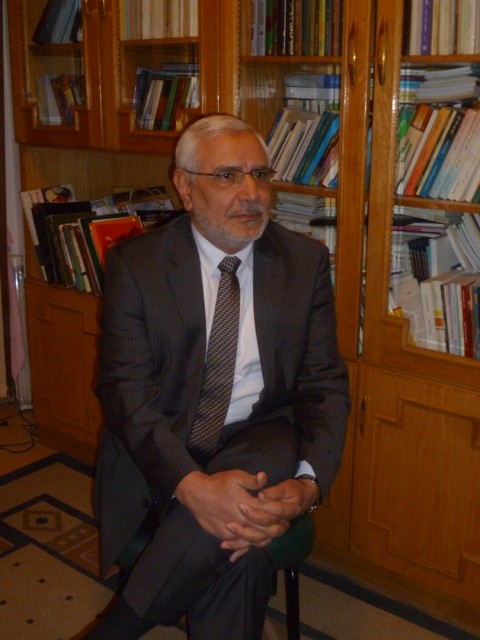

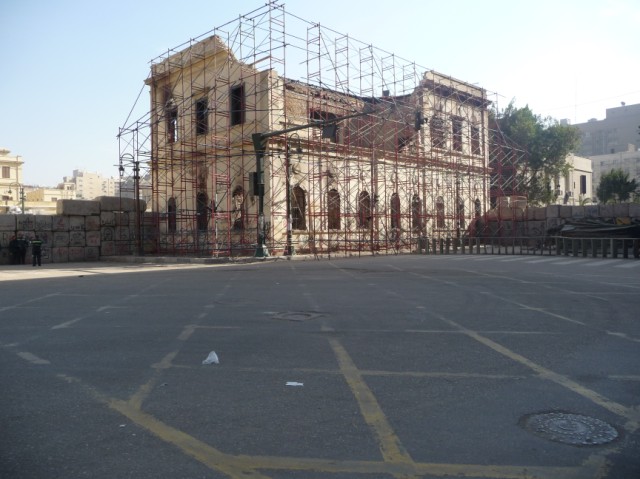
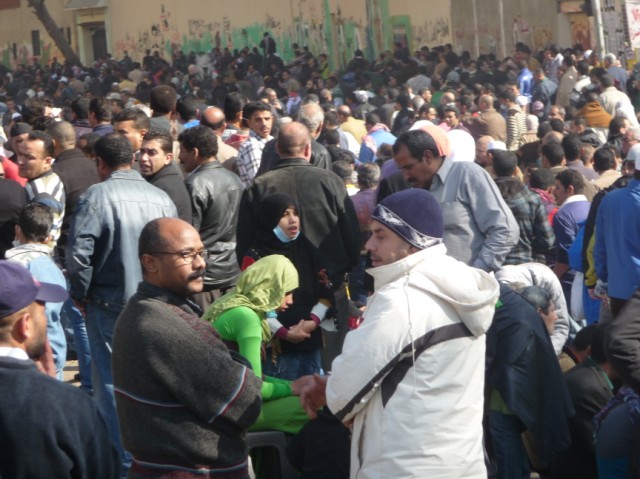
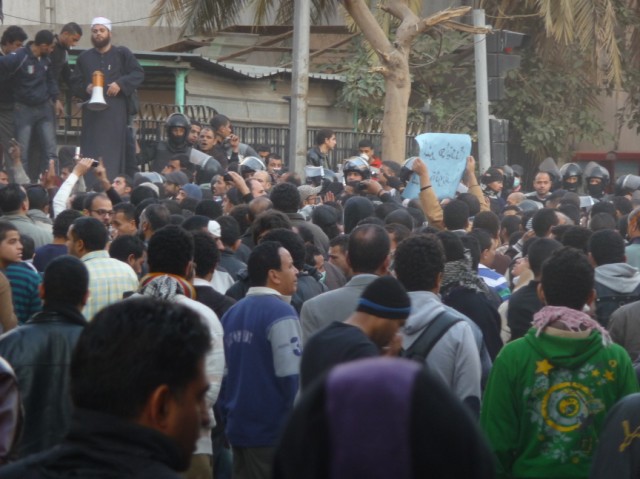
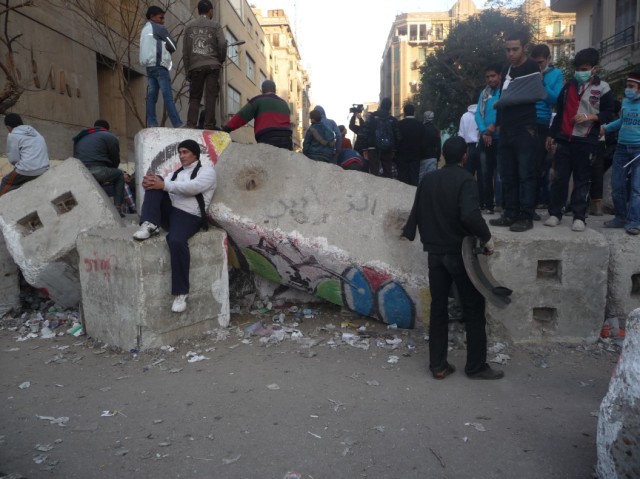


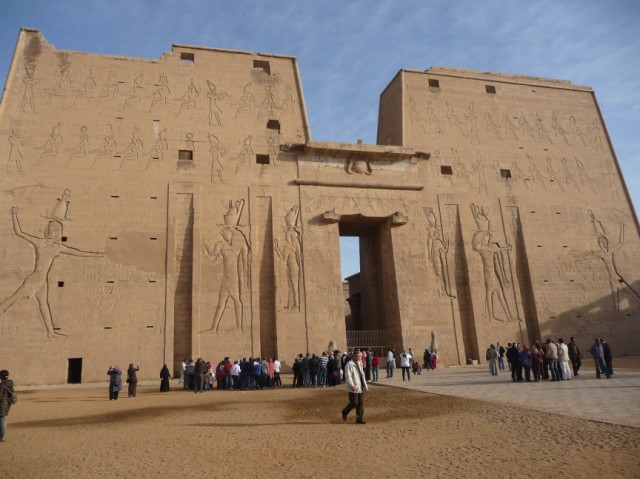
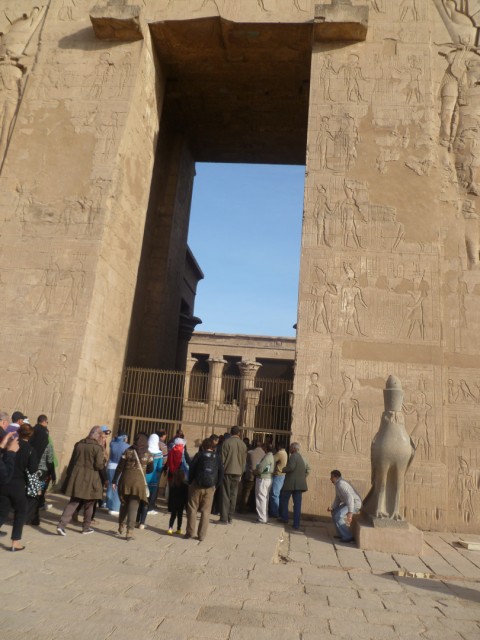


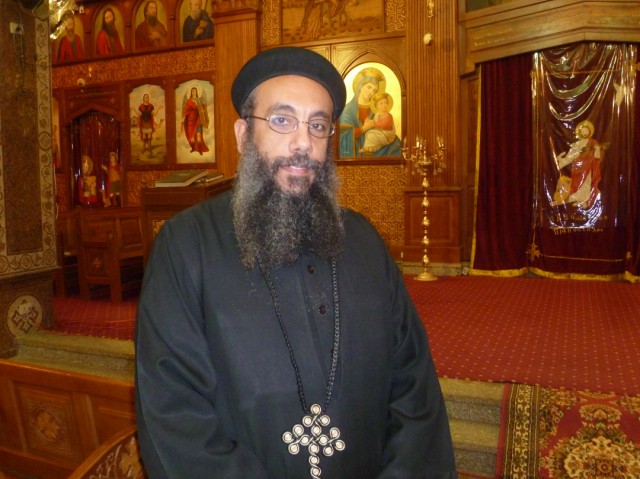
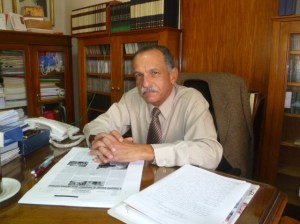

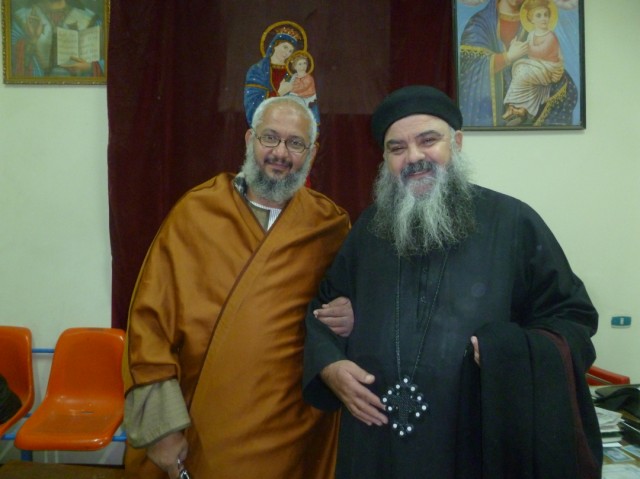

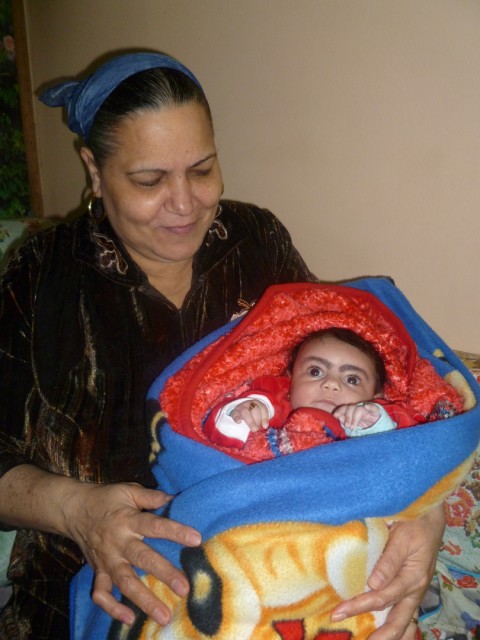
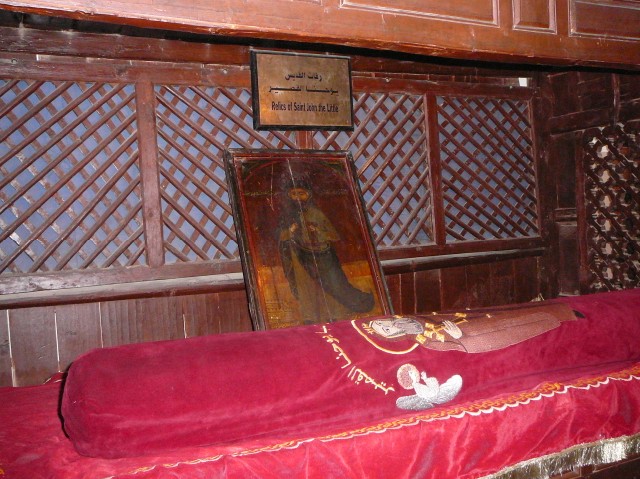


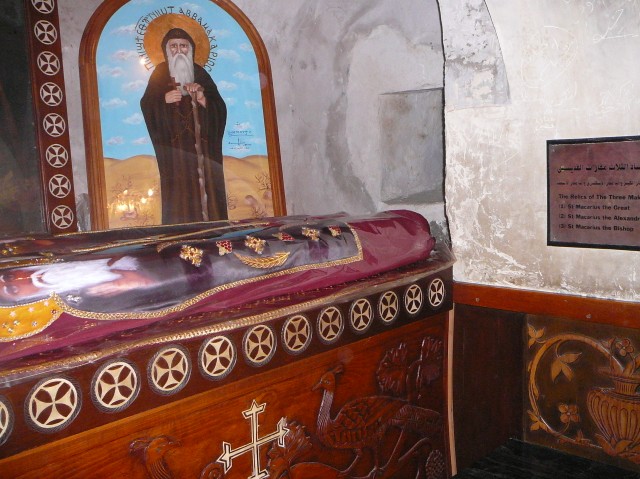

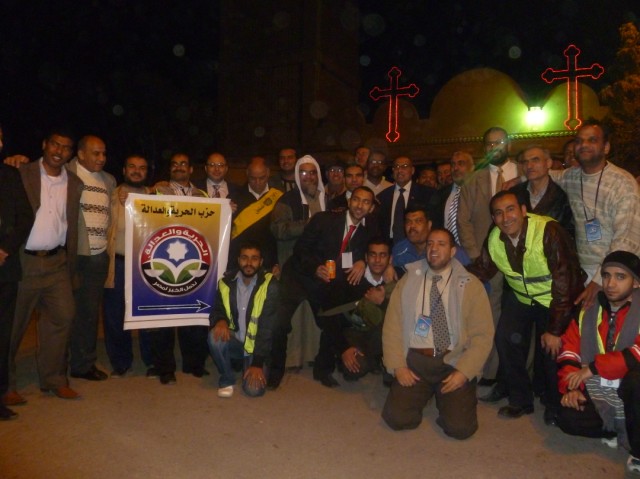

 Jayson Casper