Categories
Arab West Report Middle East Published Articles

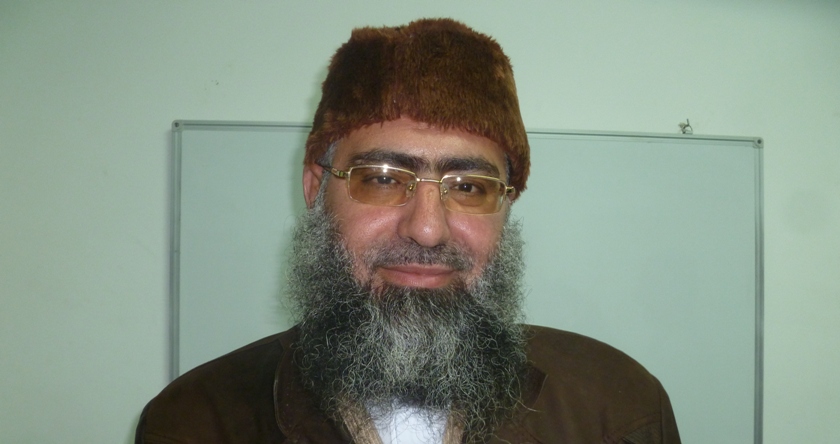
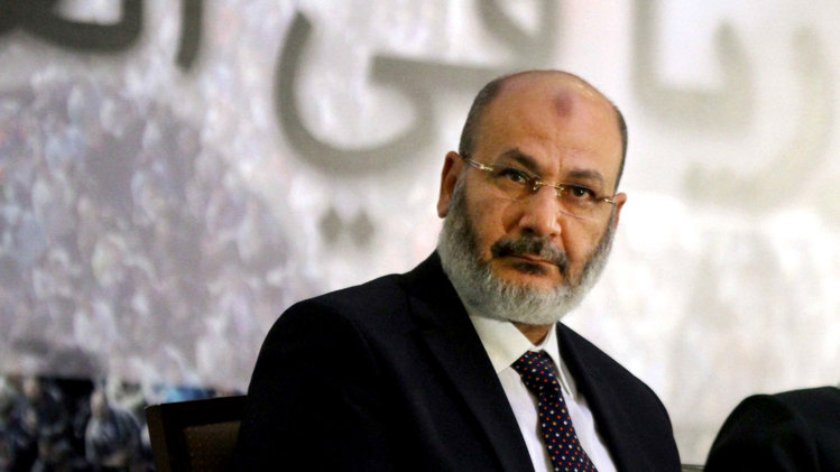
AWR Interview with Safwat Hegazi

Safwat Hegazi
Safwat Hegazi

The following is from the newsletter of Arab West Report. Unfortunately, it is not available at its website due to its recent hacking.

————————

On May 31, 2012, Jayson Casper wrote about the controversial preacher Dr. Safwat Hegazy (Safwāt Hijāzī) for Arab-West Report (AWR) on the basis of what he had found in media reporting and on the internet. Please click here to read this report.

Hegazy is controversial for statements through which he has been accused of inciting violence. On August 21 he was arrested in Siwa Oasis. He is demanded by the prosecution. The Cairo Appellate Court has scheduled a session on the 7th of September to start his trial. He has been recorded on the stage at Rāba’ah protests on July 28 saying, “if a person throws on Morsi water (figuratively: if someone approaches Morsi), we shall throw on him blood (figuratively: kill him).”

We met with Dr. Safwat Hegazy on Thursday, July 25, one day before the military initiated efforts to end the Rāba’ah protests. He made a very pleasant appearance and seemed secure.

Dr. Safwat Hegazy explained when, in his view, violence can be used: anyone can kill President Bashar al-Assad (Bashār al-Asad) because of his crimes against humanity. Also Israeli soldiers can be targeted since they are at war with Palestinians. By the same token, one can imagine what he could have said after the army used force to end the sit-ins—we are attacked and thus have the right to defend ourselves by force. He did not say this in this interview, but we have heard people expressing the opinion that violence is allowed to be used if attacked.

Several of his statements were different from what we had expected from the reporting about him. “Anyone has the right to insult Islam, oppose it or criticize it,” he says, but not the Prophet Muhammad. Safwat Hegazy has no problems with Coptic Christians in leading positions. He would not object to a Coptic governor or a Coptic president. He also stated that he helped to find an end of tensions in areas where churches had been attacked. But he also stated publicly that he believed that 60% of those who demonstrated against Mursi are Christians: “and this is the truth that we know and the Churches were calling for people to march and participate in these demonstrations, and the Churches and the priests and the chaplains, announced in many videos that they are against an Islamic president and against an Islamic parliament and that they refuse this system and that this system must change.”  That sentiment explains, but does NOT justify, the massive violence we have witnessed against churches and Christian institutions on August 15 and 16.

Dr. Safwat Hegazy also explained the Islamist point of view on what they call the coup d’état on July 3. He agreed with us that there should have been parliamentary elections, but blames the Egyptian judiciary and liberals for creating obstacles to holding elections. He demanded President Muhammad Morsi’s (Mursī) return—a view that we have also heard from many others we have met at Rābaʽah al-‘Adawīyyah. One notices from Safwat Hegazy and many others a strong feeling that they were wronged.

Dr. Safwat Hegazy did not object to any question being asked. As a basis for our questions we used Jayson Casper’s previous article that was based on a media research since at that time he was not accessible for an interview.

There are noted differences between what we knew from Safwat Hegazy through media reporting and this interview with him. He is a conservative Muslim scholar, a man with strong beliefs and ideals who appears not to have been very strong in documenting his own work (references to videos, but texts are much weaker. He gave one statement to the military but did not keep a copy).

Safwat Hegazy was presented as the firebrand who wanted the Coptic governor of Qena to be removed, but from Hegazy’s story one learns that he was asked by the SCAF to go to Qena and quell the unrest by telling the people that the governor would be removed.

On the church burning in Sūl (2011), he said he was opposed to the burning and asked for rebuilding the church. Church building “should be solved by law and that the law should be enforced on who is wrong and who is right, and investigate the issue and judge the guilty. If a Muslim is wrong he should be judged according to the law, and if a Christian is wrong he should be judged according to the law. That was our recommendation to the Prime Minister and to the Military Council and they didn’t take it into consideration.”

From Safwat Hegazy story one can ask about the relations between Islamists, security, and the military. It appears that the security and military have been using Hegazy to end unrest in the streets, but neglected several of his recommendations that, from hearing his side of the story, do not seem to be unreasonable.

Dr. Wafaa Hefny, granddaughter of Hassan al-Banna, the founder of the Brotherhood, was also at the Rāba’ah al-‘Adawīyyah and told us after the interview (that she did not attend) that Safwat Hegazy is not a member of the Muslim Brotherhood. Hegazy also did not claim this. He is an independent Islamist with sympathies for both Salafīs and Muslim Brothers.

Dr. Safwat Hegazy was arrested on August 21 for his fiery preaching against the sacking of Morsi and it seems he will not be accessible for some time to come for interviews. It is sad that obvious political differences could not be addressed in dialogue.

The interview took place in Arabic. Questions were asked by Cornelis Hulsman. It was recorded and later, in our office, translated by Daniela De Maria and Ahmed Deiab.

Cornelis Hulsman: I would like to know about your background. You are a member of the Association of Sunnah Scholars. What organization is this?

Safwat Hegazy (Safwāt Hijāzī): The members of this association are only ulamāʾ (scholars), and must be Sunnī ulamāʾ, from the Four Schools of Islamic Jurisprudence: Hanafite, Malikite, Shafi’ite, and Hanbalite. This is what the association is in brief.

CH: You are the Secretary-General of the Revolution’s Board of Trustees. What organization is this? You said that you are focused on preaching but this is politics.

SH: No, it’s revolutionary. I have no relation with politics. I am not a member of any party or any group, but I was elected as a member of the Revolution’s Board of Trustees because I participated in the January 25, 2011 Revolution as one of the leaders and main figures. The Revolution’s Board of Trustees in Mīdān al-Tahrīr (Tahrir Square) was responsible for organization at the square; responsible for its safety, food, night-camping, cleaning, and for everything that is related to Mīdān al-Tahrīr and it’s made of a big group of revolutionaries and they chose me to be their general secretary. It is not a political entity, but a revolutionary entity to protect…

CH: But isn’t revolution politics?

SH: Maybe.

CH: A revolution is a part of politics.

SH: A revolution is a political action, but [the board] only deals with the revolutionary operations and actions, so the Revolution’s Board of Trustees was the one that organized most of the actions going on in Mīdān al- Tahrīr before the 2012 parliamentary elections. The Revolution’s Board of Trustees was the one to make counter-propaganda to the members of the old regime’s National Democratic Party in the parliamentary elections or any election. The Revolution’s Board of Trustees is the one is the first revolutionary entities to announce its support to the candidacy of Dr. Muhammad Morsi [for the presidential elections] and it was the first revolutionary entity to reject the current coup d’état and to call for this sit-in and to participate to it.

CH: You were the first to reject the July 3 coup [explanation: Hulsman was not at all intending to go in a debate here on whether this was coup d’état or revolution. For Safwat Hegazy there was no question about this, this was a coup d’état.

SH: Yes.

CH: Ok. So, what about the Islamic Legitimate Body of Rights and Reformation that you are a member off?

SH: It is an Egyptian association, legitimate, also made by ulamāʾ [Muslim religious scholars], but it is only Egyptian, and it is local, inside Egypt. There is an Association of Sunnah Scholars, but the Islamic Legitimate Body of Rights and Reformation is only in Egypt. It is made of ulamāʾ and established during the Egyptian Revolution. In the January 25 Egyptian Revolution there were ulamāʾ who refused the Revolution and refused to take part in it and ulamāʾ who supported the Revolution and took part in it. This association is made by the ulamāʾ who supported the Revolution and took part in it. The association cares about the Islamic [sharī’ah] side and the scientific side of political rights and rights in general. And I am a founding member of it.

CH: About your membership of the last association, well-known in the West… you are a member of the National Council for Human Rights.

SH: The National Council for Human Rights is a council present in Egypt and founded by Hosni Mubarak (Husnī Mubārak), who set its rules and system, and at the time of Hosni Mubarak it had a basic task which was to make Hosni Mubarak regime look better in front of the world in the context of human rights. And its members were selected, and the rules and regulations were set for this purpose.

After the election of President Muhammad Morsi, there was a reforming of this council, and I was elected as a member. In this phase it had a main objective, which was changing the old laws of the old National Council for Human Rights and to make the council an effective entity that controls and monitors human rights in Egypt. And indeed it became effective, but then this coup came and everything stopped.

CH: What is exactly your role in the National Council for Human Rights?

SH: I did mainly three things. The first one is participating in creating the new law and the new organization for the council. Secondly, I presented to the council a project for an Egyptian Charter for Human Rights. The council has the project in which I mainly addressed the laws for Egyptian human rights. The third point is developing of the project for an Egyptian Court for Human Rights. The laws for its organization are complete, but the decision was being studied, until then came the coup. These are the three main things that I did. There was a fourth thing for which I was responsible, which is the Council for the Rights of Palestinian Refugees. Thank God we were able to do many things for the rights of the Palestinian Refugees in Egypt.

CH: Thank you. Are all your activities documented and would you be willing to share this with us?

SH: Yes, of course, everything is documented, but I don’t have it with me right now.

CH: No, I don’t mean now, but I am looking for documentation because we make a lot of studies.

SH: Yes, the laws of the council are documented, and hopefully we will be able to e-mail them to you. The project for the Egyptian charter is documented, as well as the project for the Egyptian Court for Human Rights.

CH: So maybe can you send them to me?

SH: Yes, I will.

CH: Thank you.

About Syria: Western journalists wrote about the fatwá that you pronounced on President Bashar al-Assad (Bashār al-Asad), saying that anybody can kill him. What do you mean exactly by this? Because people keep on mentioning this about you.

SH: Yes, I pronounced this fatwá. Bashar al-Assad, according to human rights laws, is a war criminal. According to the Hague Court…

CH: In the Netherlands.

SH: Yes. According to their classification, Bashar is a war criminal. In Islam war criminals must be executed.

CH: But who decides he can be executed?

SH: It is not Safwat Hegazy who says that. I’m not the only person to make this fatwá, many Islamic associations made it.

CH: Who?

SH: Like the International Union for Muslim Scholars, the Association of Sunnī Scholars, Islamic Legitimate Body of Rights and Reformation, the Syrian Association of Sunnī Scholars… many.

CH: Did they make the same fatwá or this is only from you?

SH: The same fatwá.

CH: In the news was also written that any Muslim could kill any Israeli walking in the street.

SH: No, this is not true. This dates back to 2007… they refer to the war of 2007, the war between Hezbollah (Hizb’allah) and Israel…

CH: Yes, in Gaza.

SH: Yes, Operation Cast Lead. And it was after the war of Hezbollah in Lebanon against Israel. And I said it about the Israeli army.

CH: The army. So, not civilians?

SH: Not any Jews (civilians), I said “the Israeli army”, because they are militants and kill our brothers and our sons and they have no right to take our land.

CH: But, we all know that most Israelis served in their army, so what about civilians who are in the reserve?

SH: As long as he is still a soldier in the Israeli army and can carry weapons at any moment and kill an Arab civilian, he is an enemy. And it’s the same in Israel: Meir Kahane, and other Rabbis in Israel, they made a religious decree saying that any Arab should be killed.

CH: And anyone who talks against Islam should be killed? The American film against Islam, “Innocence of Muslims”. There were protests in front of the American embassy in Cairo last year because of this movie. Your idea is that anyone involved in producing such a film should be killed?

SH: No, no, no. Anyone has the right to insult Islam, oppose it or criticize it. I can never say that he should be killed for it, never. It is anyone’s right: your right, this girl’s right [pointing to one of our interns], to say that Islam is bad, that it is terrorism, that it is an extremist religion, that you don’t like Islam, it is your right. I will not judge you, or punish you, or beat you, or kill you—it is not my right.

CH: Because this was in the news and also a Coptic youth in Asyūt was sentenced for blasphemy, he wrote something on Facebook and it attracted  a lot of media attention.

SH: No, no, no, I refuse these talks about killing a Copt or a Christian because he wrote something about Islam that I don’t like. No way, I refuse this. But there is a very crucial point and it is if a person says that [Prophet] Muhammad (peace be upon him) is crazy.

You have to respect me and my belief. This is the problem. But one who doesn’t like Islam, I could never kill him and if a Muslim kills a Copt because he doesn’t like Islam, he should be prosecuted.

CH: The thing is that the Copts in Egypt are scared.

SH: I’m not talking about the Copts in Egypt only, I’m talking about anybody in the world. Let alone the Copts in Egypt. They live with us and we live with them, they work with us and we work with them. Me, in my company, I have Coptic workers.

CH: You have Copts? Where?

SH: At work, I have Copts.

CH: Who?

SH: There is Jirjis Fawzi, who is the carpenter. We have a big contracting company, and the head of carpenters is Jirjis Fawzi. And he is an expert in carpentry, and he is the one who built my house, my villa, he is the one who made it. I have… the engineer (who made the aluminum windows)—he is Christian and his name is Tamir, Tamir Mikhael in my company, and he’s Christian. So there is no problem between the Copts and us, at all, not even daily life troubles. But as there are extremist Muslims, in the same way there are extremist Copts.

CH: But also about the Copts, you said that 60% of the….

SH: That 60% of the protesters in Ittihādīya were Copts.

Yes, I said that. And I say that 60% of those who joined the demonstrations on the 30th of June were Copts. Why do I say this? Because the Egyptian Church took this way. The Egyptian Church participated in the coup with the presence of Pope Tawadros, as well as al-Azhar took part in it with the presence of the Shaykh of al-Azhar. I object to the position of the al-Azhar Shaykh and Pope Tawadros in supporting the coup, and I request that the Shaykh and Pope Tawadros are dismissed. There is no difference for me between Muslims or Christians who took part in this coup. I said that 60% of who took part in the Ittihādīya demonstrations and the July 3 coup are Christians, and this is the truth that we know and the Churches were calling for people to march and participate in these demonstrations, and the Churches and the priests and the chaplains, announced in many videos that they are against an Islamic president and against an Islamic parliament and that they refuse this system and that this system must change.

CH: But do you understand why Copts are against an Islamic president and an Islamic parliament? Because they are scared. The problem is here in Egypt. I’ve been in this country for 35 years, but for the fear, there must be a dialogue. We must cooperate with each other. There is a great fear here, and fear is not good for anybody.

SH: What can we do to remove this fear? Shall we decide that Egypt will not have an Islamic president? Or shall we sit and talk and discuss and understand who has fear and what they have a fear of? Did we experience an Islamic president who oppressed the Copts? It did not happen. Did Muhammad Morsi, during the year of his ruling, oppress the Copts? Did he attack the rights of the Copts? Absolutely not. I am one of the people who suggested that we put in the Egyptian Constitution an article that says that when non-Muslims have a controversy it will be judged according to their religious law, in their beliefs and practices and in the individual personal status matters. I am the one who asked for it, I am the one who insisted for the presence of this article to guarantee the right for Copts in Egypt to worship according to their religion and deal with the civil matters, such as marriage and heritage, according to what their religion says.

CH: Is there a dialogue between you and any important Coptic figure, such as Bishop Moussa, for example? He has dialogues with many Muslims; he is very well known for it. I also know people who don’t want such dialogue, but he has a lot of dialogues with the Muslims. Do you know Bishop Moussa personally?

SH: Yes, I know him.

CH: What’s your opinion on Bishop Moussa and people like him?

SH: I absolutely have no problem in dialoguing or cooperating or living with the Copts. I strongly believe that we will solve any problem with the Copts from its bases, if there is any problem. However, we do have two or three main problems. The first problem is the media, the Egyptian media.

CH: Yes, I know [I know of several examples where Egyptian media have not given a fair picture of Islamists or Islamist views]

SH: The second problem is the old cultural heritage of the West. They act according to this heritage. The third problem is the fear, the fear from others, from any other person that is different. And it is human nature to walk away from things that scare me. I don’t see any problem. But there is a fourth problem, which is the Coptic emigrants, who want to create a big problem in Egypt. This is a very important problem.

CH: This is important but it comes from media. They don’t live here in Egypt, so it’s because they are influenced by the information on Egypt that comes from the media.

SH: Yes exactly, it’s the media.

CH: But Jirjis, who works with you, he knows you, so there is no problem.

SH: Yes Jirjis… After the Revolution, for a whole year the company didn’t have work, but the employees still receive their salaries. Jirjis, he got another job offer with a higher salary, so he came to me and said, “I received a job offer for a higher salary but I would like to stay with you, so paying for me a salary without me working, will it cause a problem?” I said, “No there is no problem”. He said, “Would you like me to stay here?” I said, “Yes, I want you to stay here”. So he refused the other job and continued with me. After one month he refused to take more than half of his salary and has been working with me for 8 years, and we’re getting along.

CH: Jayson mentioned in his article Shaykh Umar ‘Abd al-Kāfī. Who is he exactly and what is the relationship between the two of you?

SH: Umar ‘Abd al-Kāfī is one of the ulamāʾ who was living in Egypt in the eighties, and was giving weekly lectures in a mosque called Asad Ibn al-Furāt mosque. He had a huge audience, thousands of people, which caused a problem with the police. They accused him of incitement against Christians. I was a young boy and he was one of my teachers among the other Shaykhs, that’s it, that’s all the relationship between me and Umar ‘Abd al-Kāfī. After that he moved to the Emirates, where he lives until now.

CH: Until now?

SH: Until now.

CH: But he doesn’t talk about Egypt or the Revolution?

SH: No, absolutely. He has nothing to do with the Revolution or with the Christians in Egypt, nor with the leadership of Egypt, at all. He lives in the Emirates, in Dubai, and he is very close to the governors of the Emirates and to Muhammad Bin Rashīd, ruler of Dubai.

CH: I was befriended with Shaykh ‘Abd al-Mūatī al-Bayūmī. Do you know him?

SH: Yes.

CH: He was a great thinker.

[no response]

CH: Anyway, about Qena. In Qena there was a Christian governor, but it has been written that you opposed the presence of a Christian governor in Qena.

SH: It is absolutely not true.

CH: What exactly happened with the last Christian governor in Qena?

SH: In Qena, after the Revolution, Prime Minister ‘Issām Sharaf appointed a Christian governor. The people of Qena refused this decision and revolted against it in Qena, so the Military Council, which was governing the country at that time, represented by Colonel Hassan al-Rūīnī, called me and asked me to go to Qena to dismiss the revolt and solve the problem, because of my good relationship with Christians and Muslims, as there had been a previous problem between Muslims and Christian in a Church in ‘Atfīh, in the village of Sūl, and I was the one who solved it.

CH: I know the issue of Sūl. Let’s continue first on Qena and then we can talk about Sūl.

SH: So Hassan al-Rūīnī asked me and Shaykh Muhammad Hassan to go to Qena to solve the problem. So we went there and met the Muslims and we persuaded them that revolting and using violence is not a solution to the problem. Dr. ‘Issām Sharaf and Hassan al-Rūīnī called us and said that we could change the governor, but the people had to go back to their houses. So I told the people that we could change the governor on the bases of what the Prime Minister and the Military Council said. So people left and went back home and the governor was changed. That’s my whole story regarding Qena. But I never refuse that a Christian governor takes charge of any governorate in Egypt. That’s the story about Qena. I didn’t support the people’s revolt; I didn’t refuse the Christian governor, that didn’t happen. But it was according to the words of the Prime Minister and the Military Council.

Concerning the village of Sūl, what happened—without going into details—is that a church was destroyed and the Muslims revolted and clashed. I was also asked by the Prime Minister and the Military Council to go to Sūl, me and Shaykh Muhammad Hassan, to solve the problem. We convinced the people to dismiss and to rebuild the church and the army will rebuild the church. It’s not the right of Muslims to destroy a church owned by Christians. The youths listened to us, and left and the church was rebuilt. If Sawfat Hegazy opposed, hated or didn’t want the Copts in Egypt, would he have solved these problems?

CH: But on Sūl… I wrote about Sūl, I know people from Sūl—a Christian lawyer who is from Sūl, but lives in Cairo. There were mistakes there—that there was Christian man [in a relationship] with a Muslim girl that initiated tensions with Muslims

SH: That was our recommendation that we presented to the Military Council. The first problem was to get people [Christians] back to their houses and to leave the matter to the law, and this is the main point: that we got people back to their houses and that the church was rebuilt. And we wrote to the Prime Minister and to the Military Council that the problem should be solved by law and that the law should be enforced on who is wrong and who is right, and investigate the issue and judge the guilty. If a Muslim is wrong he should be judged according to the law, and if a Christian is wrong he should be judged according to the law. That was our recommendation to the Prime Minister and to the Military Council and they didn’t take it into consideration.

CH: Is that documented?

SH: Yes, it is documented, they have it.

CH: How? Our work needs documentation…

SH: That is documented in videos, we said that in videos. When I went to Hassan al-Ruiny, at the Military Council, he told me to write what I wanted to do, so I wrote what I wanted to do and I gave him the paper and this is why I don’t have a copy of it.

CH: Hopefully you will be able to give us the link to the video.

SH: Yes, if you go on YouTube and if you search the Sūl case, you will find my speeches in the village of Sūl.

CH: Now, Imbābah.  What do you think about the burning of the church in Imbābah?

SH: On the burning of the Imbābah church—in Egypt they call me “The Firefighter”, who extinguished the fire. In Imbābah there was a problem in the church, we went there as the Revolution’s Board of Trustees because this happened immediately after the Revolution. We had nothing to do with the issue and we found out that the Ministry of Interior was responsible for the problem.

CH: What did the Ministry of Interior do?

SH: The information that I have, I’m not sure if it’s right or wrong. As a habit, if the information that I have is right, I say it, while if the information that I have is not verified, I say I don’t know. The information that we got is that what happened there is that a police officer opened fire on the church and he had a group of thugs with him. They threw Molotovs at the church. So the Muslims and Christians inhabitants stood against this and the problem happened. At that time the Ministry of Interior was causing many of these problems to hinder the Revolution; it was playing the role of what was known as “the third party” [when there is two parts against each other and a third one comes up and pushes both sides to fight], and my role was… Imbābah has many churches, nearly four churches, and what I did is that we took some Muslims youths from the revolutionaries to protect the other churches. They protected the rest of the churches so no one would attack any other church. That’s my entire role in Imbābah. After that, one of the main tasks of the Revolution’s Board of Trustees was to stand in front of the gates of the churches and ceremonies of the Copts, so that they can prevent any extremist Muslim from getting near the church.

CH: In Egypt journalists and TV representatives are talking about civil war in Egypt. There are Islamists and non-Islamists, Muslims and non-Muslims. My opinion is that Egypt is a country for all Egyptians, not the Islamists only, not the Christians only, not the Liberals only; everybody.

SH: Let me tell you something about my political view, which you can find shown in some TV programs. Can a Christian run for the presidency of Egypt? I say “yes”. If the Egyptian people chose a Christian to govern Egypt, that’s it, this is the people’s will. This is my principle. The person who the people want to be the ruler, should rule. If the people chose an Islamist to govern, he should govern. We should all support that president. If the people chose a Liberal, if the people chose a Christian, a Copt, then he governs, that’s it; that’s the people’s will and we should respect it. This…

CH: Yes, that’s right.

SH: This is my opinion. Therefore, when an article was proposed for the Constitution–I had a strong relationship with the Constitutional Committee—that the President of the Republic must be Muslim, I said, “No”. The President of the Republic must be Egyptian. Muslim, Christian, Liberal, Communist…

CH: … Jewish

SH: Jewish, if there were any Jews living in Egypt. In Egypt there are no more than 50 Jews.

All of them older than 70.

CH: I know, I know.

SH: That’s why I didn’t mention the word Jews. But he must be Egyptian. This is my principle and my political view. Can the Prime Minister be Christian? Yes, the Prime Minister can be Christian. In front of the civil law, Christians are exactly like Muslims. This is my opinion. And on this basis, the issue is not about Morsi being an Islamic President…

CH: Is he an Islamic president or an Egyptian president?

SH: No, I’m clarifying this to you. The issue is not about Morsi being an Islamic [president]. Instead, it is about being a president—Egyptian, civilian, elected through fair, free elections. And I said on this stage [of Rāba’a al-‘Adawīyah] that if Hamdīn Sabāhī was the President of the Republic and the army staged a coup against him, I would refuse that coup and take this same position and fill the squares in support of Hamdīn Sabāhī. This is the issue.

CH: Now, the people of the coup are not with the Islamists…

SH: Excuse me, before you continue. The Military Council, Abdel Fatah al-Sisi (’Abd al-Fattāh al-Sīsī), wanted to make the matter a religious matter. The coup and al-Sisi wanted to make Morsi’s matter a religious one. How? He brought Church’s Pope and from the Azhar Shaykh.

CH:  I am sorry. That’s wrong.

SH: Isn’t it?

CH: That’s a mistake.

SH: Yes. So he changed the issue from a coup to a religious issue between Muslims and Christians. The Muslims were hurt by the fact that the Church’s Pope took part in deposing an Islamic President. Ahmad al-Tayyīb, Shaykh of al-Azhar, as a person, not as an authority, he is a man from the remnants of the old regime and sits in political committees and was supporting Ahmad Shafiq (Shafīq) in the presidential elections. And the presence of Ahmad al-Tayyīb gave a religious dimension to the issue and related it to the old regime. And this was the first step of al-Sisi leading to a civil war in Egypt. His second step, it’s yesterday’s speech, in which he invited his supporters to demonstrate in the streets. How do you invite your supporters to protest while your opposition is in the street? We are absolutely not considering going to Midān al-Tahrīr. Midān al-Tahrīr is our property from January 25. But we refused to go to Midān al-Tahrīr because there are some mercenaries. Concerning the possibility of a civil war in Egypt, we, as supporters of the President [Morsi], would never use a weapon against an Egyptian. Never.

CH: Yesterday al-Sisi made his statement. What is the situation now in Egypt? President Morsi obtained 51% of votes in the elections, while Shafiq got 49. Egypt now is divided. Some are with Morsi, some are against Morsi, but where is the dialogue in Egypt? For Egypt’s economy this is not good. All the people here… I see here, everyone wants to live, everyone wants to eat, this is the human being—that is the people.

SH: You are from the Netherlands, right?

CH: I have been living in Egypt for several years.

SH: But you are from Holland. And they are from Holland as well? [Referring to the interns.]

CH: No, no, they are from Italy and he’s from England.

SH: In Italy, in England, in Holland, do you accept that the army stages a military coup against democracy and takes over and oust the elected Prime Minister? Does anyone accept that?

CH: No, but in Europe, in England, in Italy, in Holland, there are democratic institutions and if anything happens the Parliament decides if the Prime Minister or the President will continue or not. Here, where is the parliament?

SH: This is what we are asking for and this is what the president, Muhammad Morsi, is asking for. President Muhammad Morsi says that we have been trying to run parliamentary elections and to constitute a parliament for a year now, but the Constitutional Court is hindering these elections, as are the Liberals. We want to continue the democratic experiment in Egypt. We elected a president and he became the elected president. With 51% or 50.5%, anyway what matters is he got the majority of votes and he became an elected president for Egypt. He must continue his term. The parliament is the only faction that can judge the president and depose the president and decide whether there should be early presidential elections or not. We told them to make elections and constitute a parliament and you as opposition to Morsi, since you claim to have 30 million people who went in the streets, you will surely win the elections. Depose Morsi according to the law. Am I wrong? This is what we asked for and what we are asking for. We will not go back again to the time of Gamal Abdel Nasser (Jamāl ‘Abd al- Nāsser) or Mubarak where the army rules. It’s impossible. You know that there is a temporary president for the country. Is he a real president? Does he do the tasks of the president? Does he have power? Does he get to make decisions? Who is ruling Egypt? Abdel Fatah al-Sisi. He is the one who is ruling. So this is what we are asking for.

We are asking for the following points: first, the return of the elected president to perform his tasks, without conditions or restrictions. Secondly, running parliamentary elections as soon as possible. Thirdly, the parliament gets to decide on the judgment or the deposal of the president. Whatever the parliament does, we will accept it. Fourth, forming a commission to amend the Egyptian Constitution. Fifth, forming a commission for national reconciliation. The return of the Egyptian Constitution; the return of the temporary Shūrá Council—this is what we ask for. Simple as that. We will go back to our houses and run elections and if they have the majority in the streets they will reach the majority in the parliament. If they have the majority in parliament they have the right to govern and to depose the president, and at that time we will support the deposal of the president, if it’s the parliament who deposes the president. But, if we go to the streets and claim to be 30 million or 20 million and we want to depose the president… I also can make the claim that we are 20 million, can you tell if I am honest or lying?

CH: But if there are parliamentary elections…

SH: This is what we are saying, me and the Revolution’s Board of Trustees, it’s what we are asking and this is what all the Islamic parties are saying.

CH: Thank you. About tomorrow: will something happen? [There were fears that on Friday July 26 there could be tensions and fights]

SH: Hopefully tomorrow nothing will happen. We don’t have weapons, we won’t carry weapons. We don’t know how to kill, we don’t kill anyone. This will continue being a peaceful revolution. I suggest that you take a walk in the square at night with Hussein from the Media Center or Walīd Haddād or anyone. You will see with your own eyes that there is no terrorism or weapons. Tomorrow I don’t expect anything to happen. I only think that there will be some thugs and those thugs are moved by the State Security. We are quite sure of this. They can cause some problems, as it happens every day. Some people from us might die and they could go to Tahrīr, the thugs, and kill some people so we are accused of it. If we wanted to take over Midān al-Tahrīr we would have done it long ago, but we don’t want that. And hopefully tomorrow everything will go fine.

CH: Hopefully. Our interns have questions.

Daniela De Maria: I read that you have been banned from entering France. Why?

SH: No, I’m not banned from entering France. In the time of Sarkozy there was an Islamic conference that me and a group of Shaykhs were invited to attend and to give a speech in. But the Ministry of Interior took the decision. The French Ministry of Interior or the French government was heading toward elections, so they wanted to win the votes of Jews and some French extremists in France…

CH: Did this happen during the time a Jewish school in France was attacked and children were killed?

SH: Yes.

So they wanted to prevent the Borjè conference from being held, but they failed because if they had done it they would have lost the votes of the Muslims in France so instead they decided to prevent from entering all the scholars that were supposed to participate in the conference that year, such as Shaykh al-Qaradāwī, Safwat Hegazy, ‘A’īd al-Qarnī, and a huge group, who don’t have any relationship with politics… Shaykhs like A’ed al-Qarnī or Mahmūd al-Masrī have nothing to do with politics, revolution, or anything else, but they were banned anyway for this trip only, but afterwards I went to France.

Rob Bental: What is your opinion on the role of foreign countries in Egypt right now and what do you think their role should be?

SH: In the current crisis?

RB: Yes.

SH: If this military coup was in any other country, would Europe or the European countries accept or recognize this coup or they would reject it? They would reject it, definitely. This is what we want from the European countries. We want the European countries to reject this coup and this government, and get back the elected president. I requested the European Union to come to supervise the next parliamentary elections. Europe must help and protect the Egyptian democratic experiment.

CH: Thank you very much.
Categories
Arab West Report Middle East Published Articles

Safwat Hegazi: Bellweather of Egyptian Islamism?

Safwat Hegazi
Safwat Hegazi

Safwat Hegazi has long been an interest of mine due to his inflammatory rhetoric in favor of Islamism. This article was written for Arab West Report before the removal of President Morsi from his office, in preparation for a hopeful interview. Cornelis Hulsman was able to secure this interview during the sit-in protest, and this will be published here in a subsequent post. Since then, Hegazi has been arrested for inciting violence.  Unfortunately, the database of AWR remains inaccessible due to hacking.

………….

The Islamist landscape in Egypt is often seen through the lens of two dominant groupings: The Muslim Brotherhood and the Salafis, the latter of which have splintered into several smaller political parties. But Sunni Islam, lacking an organizational hierarchy, facilitates the emergence of independent scholars on the basis of their knowledge and charisma. Though the Brotherhood and Salafi Nour Party are rightly understood as the prime movers in Islamist politics, the influence of individual actors must not be discounted. Among the most prominent is Safwat Hegazi.

Despite his general independence, Hegazi is often identified – rightly or wrongly – as a member of the Muslim Brotherhood. Regardless, his strident pro-revolutionary and pro-Islamist positions frequently place him in support of President Muhammad Morsi in general, and in support of an even larger Islamist project in particular, as will be seen. These positions are not just his own, but reflect his position as the secretary-general of the Revolution’s Board of Trustees, one of many revolutionary groupings, and from membership in two Islamist/Salafi organizations, the Legitimate Association for Rights and Reform, and the Association of Sunnah Scholars, which he heads.

Most controversial, however, is Hegazi’s membership in the National Council for Human Rights. This semi-governmental watchdog was reconstituted by Morsi to replace the Mubarak and NDP dominated council with twenty-five new members. Liberals and leftists received a share of the seats, but critics complained of Islamist domination and the appointment of figures with no experience or demonstrated commitment to international human rights norms. Hegazi was singled out as an example.

Among the complaints is Hegazi’s willingness to shed blood.

He issued a fatwa not only licensing the assassination of Syrian President Bashār al-Asad, but also declaring ‘a sinner’ anyone who did not do so. ‘Killing Asad is a duty of the Islamic nation,’ he declared, taking legitimacy from other organizations who issued similar statements.

While Syria can be considered a domain of war, Hegazi’s pronouncement of death extends further. lAnother fatwa urges Muslims to kill any Israeli found walking in the streets, saying the day will come when Muslims rule the world. He also announced he would personally kill someone who insults Islam or the Prophet Muhammad, though he was careful to emphasize he was not asking the public to assume this responsibility.

Finally, in the context of demonstrations at the presidential palace over Morsi’s controversial constitutional declaration placing his decisions beyond judicial oversight, Hegazi warned demonstrating Copts. Repeating Islamist claims that over sixty percent of protesters were Christians, he saw a conspiracy to overthrow the president. Copts share this country with us, he admitted, but declared there were red lines. ‘Whoever threatens it [presidential legitimacy] with water,’ he said, ‘we will threaten him with blood.’

An anti-Christian sentiment can be detected as well in earlier incidents. Upon return of the fiery and polemical Islamist preacher ‘Umar ‘Abd al-Kāfī to Egypt after thirteen years in exile, Hegazi was there to meet him at the airport. But it was his conduct in Qena which speaks more fully to the issue.

After the revolution the ruling military council replaced Mubarak-era governors and appointed new ones in their stead. Qena, with a large Christian minority, had been the one governorate with a Coptic head, and his replacement with another Copt sparked huge protests and cutting of the railway line. Some rejected him for his role in suppressing protests as a member of the police force during the revolution, but much of the protest centered on his religious identity.

Hegazi was part of a team dispatched by the military council to help calm the situation, but instead took the side of the demonstrators. ‘Your demands are our responsibility,’ he declared. ‘No one can impose on us something we do not want.’ In a later, unrelated incident, Hegazi also condemned Shia Muslims, declaring their faith to be blasphemy.

In the accessed media, the motivation for Hegazi’s stances is unclear, but there is space to see it primarily as revolutionary, rather than as sectarian. His is an Islamist activism, but it is revolutionary all the same. Sometimes, these come into conflict.

This was apparent during a summer demonstration in Tahrir Square in 2011 against military rule. Hegazi had earlier withdrawn from a national consensus conference due to the presence of old regime figures, and in this his action was similar to liberal response. But in the square it was non-Islamists who felt the need to withdraw as Salafi protestors used the occasion to chant decidedly Islamist slogans. Hegazi rejected claims there was an agreement among all revolutionaries to use only consensus slogans and demands. Other Islamists admitted there was, however, though they interpreted it differently. In any case, Hegazi became a part of the deteriorating unity of the revolution and the decent into political polarization.

In an earlier example, following the burning of a church in Imbaba in May 2011, representing the first major sectarian attack after the revolution, Hegazi appeared at a massive joint Brotherhood-Salafi rally. He interpreted the attack as part of the counter-revolution, saying it was carried out by thugs, rather than by Islamists. He also took the opportunity to declare the soon coming of the United Islamic States, with one caliph to rule all Muslims.

This theme appeared again during the presidential election campaign, which Hegazi declined to participate in – possibly on behalf of al-Jamā’ah al-Islāmiyyah – due to the large number of worthy candidates, mentioning specifically the liberal Ayman Nūr along with other Islamist candidates. But eventually he threw his support behind Muhammad Morsi, declaring him the only candidate who promised to implement sharī‘ah law.

But Hegazi’s rhetoric went much further. He declared Morsi to be a new Salāh al-Dīn who would unite the Muslims and liberate Jerusalem. A few days later at a huge rally in the Delta, in front of Morsi and Brotherhood leadership Hegazi called for ‘millions of martyrs’ to go to Jerusalem, establishing it as the capital of a new caliphate. The green flag bearing the Islamic shahādah, he defended, belongs to Islam and not to Saudi Arabia.

Part of Hegazi’s motivation is revolutionary. Prior to the first round of elections he called for people to reject the former regime candidates, labeling especially ‘Umar Sulimān, Ahmad Shafīq, and ‘Amr Mūsa. But it is also fully Islamist; a few weeks later he said it was ‘against religion’ to elect a candidate with a vision for liberal, secular, communist, or socialist state. As for the Salafi political parties which endorsed ‘Abd al-Mun’im Abū al-Futūh for president, Hegazi called their leaders agents of state security.

Hegazi’s support for Morsi has continued after his election. He defended the sacking of military council leadership, saying it was not to monopolize power but to secure the demands of the revolution. He supported the constitutional declaration, as described above, and has even approved the practice of kissing the hands of religious leaders, placing Morsi among their number. His partisan positions have earned Hegazi a good deal of opposition – and possible maligning – in the press. An admitted NDP thug has accused him and Brotherhood leadership of orchestrating the revolutionary Battle of the Camel. He was also quoted as seeking to turn the political struggle in Egypt into a civil war, as the opposition was against God and his caliph, a statement he subsequently denied.

As a controversial Islamist in Egypt, Hegazi is not alone. Many have made comments even more outrageous, but none have received such official government endorsement. Appointment to the National Council of Human Rights is a major statement of presidential approval, in which President Morsi implicitly signals toleration of Hegazi’s rhetoric, if not appreciation and approval. France, meanwhile, has barred him from entering the country.

More than likely, Hegazi’s appointment is a political reward for necessary support, keeping secure the president’s right flank. Policy makers in the West appear content to allow Morsi to nurture sectarian discourse as long as practical international obligations are kept sacrosanct. These obligations, however, include a measure of respect for human rights; how far Islamists can transform domestic religious realities is yet to be delimited.

But President Morsi is accountable for the views of Hegazi. Having chosen the politically expedient road of endorsing him domestically, he must endure the politically difficult road of explaining him internationally. Egypt is free to create the society it wishes, but the global community is free to criticize accordingly, and determine the level it welcomes and aids Egypt’s ongoing transition.

These matters are not easy, either for the president or the international community. Safwat Hegazi, however, symbolically stands in the nexus. By all appearances he enjoys his position.

Categories
Prayers

Friday Prayers for Egypt: Enforcing a Calm

Flag Cross Quran

God,

It is not as if this last week was encouraging. Many more died – including security forces in an alleged jihadist ambush and Brotherhood prisoners in an alleged escape attempt. But by comparison to the week before, it felt as if things were calming down.

If so, it wasn’t subtle. A state of emergency has been declared. Curfew begins at 7pm. Much of the Brotherhood leadership is in prison. But consequently, demonstrations in support of the deposed president have dwindled.

Or, perhaps the country is ready to move on, and the Brotherhood senses its defeat.

God, surely Egypt is not in a good place right now, but calm, at least, is a relative good. Justice and reconciliation are better; may they come soon and transparently.

Heal the psyche of the nation, God. This past week has left a deep scar among so many. Islamists suffer hundreds of fallen. Christians endure dozens of burned churches. Citizens across the country witness Egypt tearing apart, and many have yielded to the polarization.

God, in this period of calm, however brief or long, give Egyptians time to reflect. How did the nation get here? What went wrong? Where is my personal share?

In their reflection, God, help the Brotherhood to confess and seek forgiveness for any and all sins. Give them a spirit of deep questioning. Encourage a review among remaining leaders and youthful cadres. And to whatever level righteousness remains, help them to hold to it tenaciously.

In their reflection, God, help the revolutionaries to take stock of their country. If their ideals outpaced their possibilities, give them wisdom to see their errors, even as they champion their successes. But help them to favor principles over power, especially as power appears unavailable. Good principles will transform a nation over time, so may they not lose their focus.

In their reflection, God, help the people not to lose heart. Security is easier than freedom; apathy easier than commitment. Most people are not activists, nor is it asked of them. But they are citizens; may they not surrender to anything less.

God, engaged in enforcement, perhaps the government cannot reflect. But as they impose their will on events, may they do so humbly. May they not spoil the favor and patience the people currently lend them. But may they move quickly to provide security, economy, and political agency in return. May all benefit.

But a calm enforced is not calm at all. May it give space for reflection, and not remove it as a pressure cooker. Save Egypt from any coming worse.

Calm is not peace. God, may the two not be confused.

Amen.

Categories
Personal

This is What it Looks Like Just Before the Muslim Brotherhood Jumps You

From the publication Animal, a very interesting photo-journal documenting an attack on an individual in the days before the dispersal of the pro-Morsi sit-in protest:

I spot a dozen men on the sidewalk, walking parallel to us, writing graffiti — “Morsi is my president,” “No CC,” and “CC is a murderer,” phonetically referring to the current leader and coup-mastermind General al-Sisi. They’re hitting everything — walls, awnings, buses — bombing in broad daylight.

I jump down, run over and ask permission to shoot, in Arabic. “Yeah, we’re not afraid,” they say. Then, this burly man runs up to the door of the Saint Fatima Church which the nearby square is named after. He spray-paints “Islameya.”

Islameya means “Islamic” and is short for masr Islameya. In this context, on that door, it’s “Egypt is Islamic.” An older protester runs right up, pleading with him to stop: That’s against Islam, because Lakum deenukum Waliya Deen — “For you is your religion, and for me is mine.”

The vandal clocks him. Several others run up, drag him away and egg the vandal on: “Write it! Write it!”

I’m snapping away. I’m stepping closer. The photos are getting better. I have permission. I’m cool… Until he turns around.

“Why are you taking pictures of me?!” he yells. Before I have time to think, he lunges at me, spray-can aimed.

MB Spray Paint

The above paragraphs are interspersed with pictures, and then the account continues as the individual describes being attacked by the mob of protestors. Eventually they seize his camera and demand he go with them to the sit-in site to get it back.

What follows is very interesting, as it provides a street-level verification of Brotherhood complicity in the defacing of churches, something they have vehemently denied, especially after the numerous attacks on churches after the sit-in was dispersed. But the marking of ‘Islameya’ was meant to signal which buildings were to be attacked, according to Ramez Atallah of the Egyptian Bible Society.

Three more hours of this. Miles. We’re definitely not in my neighborhood anymore. Everyone’s screaming at everyone else. Chaos. Nothing happens, so I have to call my cousin who is in the Muslim Brotherhood. I don’t want to bother him on his brother’s wedding day, but I don’t want this story to end in Rabaa Al-Adawiya Square. I want my camera back.

“Well, why didn’t you say you were his cousin from the start, man?” Five minutes later, the camera’s in my hand, and the memory card too.

Please click here to read the full article and see the many photos at Animal.


Categories
Atlantic Council Middle East Published Articles

The People Chose Us: Inside the Mind of the Muslim Brotherhood

Ahmed Kamal
Ahmed Kamal

From my recent article at Egypt Source:

It is a simple matter, really. No matter how many people poured into the streets on June 30 to demand early presidential elections, Mohamed Morsi had a mandate to govern for four years. “We cannot accept the loss of legitimacy because this is not our demand to compromise,” said Ahmed Kamal, youth secretary for the Muslim Brotherhood’s Freedom and Justice Party (FJP) in Helwan. “It is the will of Egyptians who chose Morsi in the democratic process.”

Fair enough. But in the mind of his supporters in the Muslim Brotherhood, he had a mandate for far more. “The people chose us,” he continued. “The Islamic ideology is to apply to the whole of life, and this is the view of our party.” Kamal’s words are punctuated by one of the key issues Morsi’s supporters grasp at: legitimacy. “When Egyptians chose it – and we do not wish to impose it – we cannot accept the idea of jumping over its legitimacy.”

Many commentators over the past year have criticized the Brotherhood for a majoritarian view of democracy. Kamal’s comments appear to bear this out. Morsi’s narrow win in the presidential elections, perhaps coupled with the sizeable Islamist win in parliamentary elections, was enough to confirm and empower the triumph of Islam. In their view, opposing their political project, therefore, is opposing Islam itself.

The interview continues to include Kamal’s views on Christians, martyrdom, and the Brotherhood conception of peaceful protest. Please click here to read the rest of the article at Egypt Source.

Categories
Lapido Media Middle East Published Articles

Church Burning Reveals Ugly Contest over Truth and Victimhood

Copts Pray in Burned Church

What mentality of man will burn a church? In Egypt, what should be known as a house of prayer is now the symbol of civil strife amid conflicting accusations of blame.

‘Attacks on churches are being done by the former regime and their thugs, not pro-Morsi demonstrators,’ said Ahmed Kamal, youth secretary for the Muslim Brotherhood’s Freedom and Justice Party (FJP) in Helwan, an industrial district to the south of Cairo.

But this is nonsense to Bishop Thomas, the head of the Coptic Orthodox Church in Qussia, 340 kilometers south of Cairo. His church was attacked by pro-Morsi protestors, but neighborhood Muslims rallied to defend it.

‘We recognize their faces and know who they are,’ said Thomas. ‘The Brotherhood is using us as a scapegoat to blame us for their failures.’

Anti-Christian rhetoric has been prominent among Islamists. Since Pope Tawadros, along with the Grand Sheikh of al-Azhar, appeared with General al-Sisi to announce the deposing of President Morsi, many Islamists believe Copts to be part of a grand conspiracy against not just their movement, but Islam itself.

‘We don’t oppose Christians,’ said Kamal, ‘but we are against the pope – as we are against the head of the Azhar – who interferes to direct people to a particular political direction.’

This second half of this message is reinforced by Kamal’s local party representation. The Helwan FJP’s Facebook page notes that ‘burning houses of worship is a crime’, but then all but justifies it in an attack on the church.

After listing a litany of the pope’s offenses, it declares, ‘After all this people ask why they burn the churches.

‘For the Church to declare war against Islam and Muslims is the worst offense. For every action there is a reaction.’

Kamal recognizes this message may have been too general. The Brotherhood sees Islam as both worship and ideology, only the latter of which has been rejected by the church and anti-Morsi protestors.

Incoherence

But for Arne Fjeldstad, CEO of The Media Project to promote religious literacy in journalism, this error reflects the reality on the ground for Islamists.

‘Whatever the Brotherhood says [about nonviolence] is not listened to or communicated on the street,’ he said. ‘So there is a large incoherence among them.’

More than 50 churches were destroyed since Wednesday last week, including two Bible Society bookshops – the first time in Egypt’s recent history.  Some news organizations reported churches being marked for attack before the Brotherhood sit-ins were forcibly broken up.

Fjeldstad believes the Brotherhood will have a difficult time making theological sense about why God ‘turned against them’. But in the meanwhile, the sit-ins were filled with chants about martyrdom.

‘They have prepared the ground for future generations of warriors for Islam,’ he said.

Sarah Carr is an independent journalist and founder of mbinenglish.com, a web page which exposes the Arabic-only messages the Muslim Brotherhood, such as the FJP Facebook page above.

But she understands the rage of Islamist protestors, for she was a witness to the military-sponsored dispersal of the sit-in which killed over 600 people, not including 40 police personnel.

‘It was completely disproportional violence,’ she said, describing army vehicles mounted with automatic weapons firing into the crowds. Carr did not see any armed protestors, though she does not deny their presence.

‘The army needs to justify their terrorist narrative and use it to crush the Muslim Brotherhood,’ she said.

But the Brotherhood did resist. Political analyst Abdullah Schleifer notes that the Western tradition of nonviolent protest involves non-resistance to state-sponsored oppression.

‘Non-violence does not mean building barricades to hold off the Egyptian riot police and breaking up pavement stones to throw at them.’

Ahmed Kamal
Ahmed Kamal

Kamal freely admits the difference.

‘Gandhi is not necessarily our role model,’ he said. ‘He was good and his people were brave, but we have our peaceful model as well as per our book and principles.

‘We are unarmed in front of their weapons, but we will resist them. To be peaceful is not just to stay silent and wait for bloodshed. We must defend our lives even by throwing stones.’

But Emad Gad, a leading politician with the Egyptian Social Democratic Party, says they went far beyond throwing stones. His party is collecting evidence of protestors’ violent intent.

‘The army did not attack the people,’ he said. ‘They used tear gas and bulldozers and were attacked by armed protestors, and then they responded.’

For political analyst Eric Trager, both narratives make sense. The Brotherhood cannot win a battle against the security forces, but that may not be the point.

‘The Brotherhood seems to believe that if it can draw the military into a fight directly, it can create fissures within the military,’ he told World Affairs Journal.

To protect itself, the military must now push the issue to conclusion.

‘It [the army] entered into a direct conflict with the Muslim Brotherhood, perhaps even an existential one,’ Trager continued.

‘The military believes it not only has to remove Morsi, it has to decapitate the entire organization. Otherwise, the Brotherhood will re-emerge and perhaps kill the generals who removed it from power.’

Incitement

Bishop Mouneer of the Anglican Church in Cairo disagrees.

‘We witnessed bloodshed on our streets, vandalism and the deliberate destruction of churches and government buildings in lawless acts of revenge by the Muslim Brotherhood and their supporters,’ he said.

‘I appeal to everyone to avoid rushing to judge the authorities in Egypt.’

In attacking churches, though, Carr finds the Brotherhood playing into the hands of authorities – though society provides fertile ground.

‘We’ve seen for decades how you have one person with an agenda [to spark sectarian attacks] and then others are very happy to jump in,’ she said.

‘It doesn’t take much incitement from the Brotherhood or anyone else.’

Yet the authorities, she finds, are not innocent.

‘It is no good to go to conspiracy theories, but why did you break up the sit-in and not protect churches?’ she asks. ‘What should we conclude?’

The conclusion is a morass of relativity, reflective of a polarized society overlooking travesties on all sides.

‘The number of police killed is almost insignificant,’ said Kamal, ‘compared to the two thousand killed and ten thousand injured on our side.

‘This confirms our peacefulness.’


This article was originally published on Lapido Media.

Categories
Personal

Friday of Rage, No Signs of Reconciliation

The following is from the newsletter of Arab West Report, penned by Cornelis Hulsman. It is a good summation of events so far:

Cairo is burning. Normal Egyptians are scared and stayed as much as possible at home. The Friday of Rage was announced in a statement of the Muslim Brotherhood led Media team of the Anti-Coup, Pro-Democracy Alliance.

Statement: Friday of Rage

(Cairo, Friday, August 16)- Despite our deep pain and sorrow following the August 14 Rabaa massacre and others committed since the bloody coup, the crimes of the coup regime have only increased our steadfastness and firmness in rejecting it and determination to remove it.

The struggle to overthrow this illegitimate regime is an obligation, an Islamic, national, moral, and human obligation which we will not steer away from until justice and freedom prevail, and until repression is conquered.

Our revolution is peaceful, and we will continue to mobilize people to take to the streets without resorting to violence and without vandalism. Violence is not our approach. Vandalism only aims at distorting the image of our peaceful revolt and finding justifications for the coup leaders to continue to govern.

We call on the great Egyptian people to gather in all revolutionary squares on the Friday of Rage.

The starting points for the protests in Greater Cairo are the following mosques. (28 names of mosques were mentioned.)

Afterwards, all marches will meet at the nearest intersection, and will all head to Ramsis square. Meanwhile, million-man marches will be held in all other Egyptian governorates.

The anger of the Muslim Brotherhood is not unfounded. Maha Azzam, an associate fellow in the Middle East and North Africa programme at Chatham House (the Royal Institute of International Affairs) in London, explains in the Guardian of August 13the bitter irony. The January 25 Revolution was to bring democracy. Morsi (Mursī) was voted, albeit with a very small majority, as the first democratically-elected president.  He was deposed on July 3 by the military, feeling that they had sufficient support from the masses, but, she writes “the fact remains that the ballot box is an essential part of the democratic process. Politically, what Egypt lacked during its experiment in democracy was a loyal opposition. Instead, the opposition that came together under the umbrella of the National Salvation Front decided to back a military coup.” Muslim Brothers feel they were trapped. Maha Azzam is clear in her opinion, that is that “the military and police state has returned in full force to Egypt. A country that for a brief period after 60 years of dictatorship was on a path of democratic transition saw a reversal of that process with the coup on 3 July against Egypt’s first freely elected president.

Maha Azzam describes opinions that I hear often in talks with Muslim Brothers. They strongly feel they have been betrayed.  That feeling is important to understand for the violence we are witnessing now.

The demonstrations followed fiery preaching in line with the belief that they have done injustice to. Well-known Muslim leaders as Youssef al-Qaradawi and Selim el-Awa have preached in this line of thinking. They did not call for violence, but as we have seen in previous demonstrations, armed thugs and snipers use the masses of people to mix among unarmed demonstrators and fire on whoever they believe to be their opponents.

These demonstrators were a mix of Islamists and thugs of very different backgrounds. Of course it was Brotherhood-organized and thus large numbers belong to this organization, but there were also Jamā’ah al-Islāmīya, Salafīs, and radicals of all kinds present and thus it is extremely difficult to determine to what organizations the people who engaged in violence belonged.

We have seen on videos large amounts of weapons found in different places. That shows preparation and makes the claim that this was spontaneous anger impossible.

Volkhard Windfuhr, the well-informed chairman of the Cairo Foreign Press Association is angry and wrote on Friday:

Unfortunately, some of our colleagues succumbed to fatal attacks. They were not just victims of chaos or normal fire exchange, they had been fired at on purpose. Not by police or army officers, but by the self-proclaimed ‘peaceful demonstrators’. Today I myself happily escaped a mean sniper attack on the 15 Mayo bridge at Zamalek. The criminal was not a policeman either, I have witnesses for that fact – normal Egyptian citizen by passers. I was not there for press coverage, but just heading for a coffee shop to meet friends.

It is outrageous what these aggressive ‘protestors’ commit. They attack people at random, attack their own state – attack public buildings and an ever increasing number of churches und houses and shops of Christians.

Most violence was at Ramsis Square, the most important and busiest intersection in Cairo where also the railway and bus stations are located. If this square was blocked the consequences for traffic in Cairo would be far worse than closing Tahrir square.

The Arab Contractors building, the largest building at the square, went up in flames. What purpose does such violence have? Arab Contractors is a very large Egyptian construction company that, for example, has built most bridges in Egypt. The destruction of this building will cause thousands of engineers to lose work for at least a certain period to come. In a country that is already economically suffering this is not what Egyptians need.

Muslim Brotherhood statements speak about a peaceful revolution, but what we have seen in the streets is different. Was this Brotherhood-organized as the opponents of the Brotherhood believe? Or were these thugs? Perhaps even security agents who wanted to create havoc? Conspiracy theories are flourishing!

It is certain, however, that many Muslim Brotherhood leaders do not want to give up resistance. Morsi’s son declared on Facebook: “We will not give up. We will either win or die.”

That is not an approach of seeking a middle ground; a compromise in order to avoid more bloodshed and destruction of Egypt. Morsi’s son is not the only one using this rhetoric, but stating “either win or die” sounds heroic to his followers, but at the expense of Egypt. Continued  violence is also at the expense of the Muslim Brotherhood itself, which is rapidly becoming more closely associated with the carnage we are witnessing now and further validates calls to ban the organization.

Uncompromising attitudes will not only make the Brotherhood a loser of the conflict—the military and Egypt as a whole will suffer dearly as well. The conflict makes the role of the military domineering, but that may cost Egypt international support. Language of some people “that we don’t need this” is stupid. Foreign companies that had remained in Egypt thus far are now closing their doors, making the economic situation more difficult than it already is.

The Muslim Brotherhood is an organization with an estimated 1 million followers. Leaders in the past have told us they were proud of being so well organized. In the past two years well-informed Egyptians have told us on several occasions that the Brotherhood is capable of bringing at least 5.5 million voters to the ballot box. Just excluding such a large group of people from the political scene is not an option.

But what does the severe pressure on the Brotherhood mean for the unity in the group? Muslim Brotherhood member, Amr Amru, went public with a statement that there are around 200 Muslim Brotherhood members who want to file a complaint with the prosecutor against their own leaders because they have led them into this violence. Amr Amru spoke about the hierarchical Muslim Brotherhood structure with leaders giving instructions to branches that branches then have to simply execute.  But we don’t  know who Amr Amru and these 200 people are.  Many others will continue to follow their leaders.

Amnesty International came with a strong statement about Egypt: “There must be a full and impartial investigation into the violent dispersal of sit-in protests in Cairo this week, where security forces used unwarranted lethal force and broke promises to allow the wounded to exit safely, Amnesty International said today on the basis of its research on the ground.”

Of course, many may disagree with the conclusions of Amnesty International, but the call for a full and impartial investigation is certainly justified and needed in order to heal the very deep wounds in a deeply fractured Egyptian society.

Pope Tawadros had been criticized for sitting with Azhar Shaykh, Ahmed el-Tayib, when General al-Sisi announced the sacking of President Morsi on July 3, but on Friday he again went public with a statement in support of the security and military. I do not think that to be wise. I have been traveling in the past years through Egypt and have seen people suffering. The Pope knows the consequences of his words and he knows that his statements can be used as an excuse for more violence against Christians. Then why make statements that could make ordinary Christians victims of angry Islamists?

We appreciate the responses we get to our newsletters, in particular if they come from Egypt. Please continue writing about your own experiences. May God bless Egypt and give Egypt peace!

(Note: The website for Arab West Report was hacked several weeks ago; efforts to restore archival content and continue publication have not yet been successful.)

Categories
Christianity Today Middle East Published Articles

Despite 600 Deaths, Egypt’s Christians Support Military’s Eviction of pro-Morsi Protestors

Sit-In Dispersal

From my recent article in Christianity Today:

Despite the deaths of more than 500 Muslim Brotherhood supporters and the resulting retaliation against Christian targets nationwide, Egypt’s Christian community stands with yesterday’s decision by the military-backed transitional government to break-up the pro-Morsi sit-ins.

“If a peaceful sit-in took place in Times Square and locked down the city, how long would it take American authorities to disperse it?” said Ramez Atallah, head of the Egyptian Bible Society. “The government spent six weeks trying to solve this crisis, and finally used force. What were the alternatives?”

Youssef Sidhom, editor-in-chief of Coptic newspaper Watani, explained why one alternative—to simply allow the protests to continue indefinitely—was not a better choice.

“If it had been a peaceful protest, we should leave it there. Have the army encircle it to prevent more weapons from entering, and wait for their morale to falter,” he said. “But the sit-in surrounded 20 to 30 high-rise apartment buildings, and the people had to submit to daily checks by the Muslim Brotherhood simply to go in and out of their neighborhood.

“They were terrorists, holding hostage thousands of residents.”

Please click here to read the full article at Christianity Today.

Categories
Prayers

Friday Prayers for Egypt: Violence Spreads

Flag Cross Quran

God,

Many prayers have been offered for a winnowing of Egyptian politics. Are you now beginning this process? If so, will the wheat be yet known from the chaff?

Hundreds are dead, God, spawning both outrage and apathy. Churches are burned, spawning both outrage and condescension. Many prayers have been offered for unity and consensus. Have you now turned a deaf ear to this request?

The Muslim Brotherhood is now deemed a terrorist organization; are you pleased? They say the security forces have shown their true face as bloody putchists; do you agree? How many past sins must Egypt recompense in new blood, before her slate can be wiped clean? What will the new sins require of future suffering?

Or, if the Brotherhood is to be purged, have their sins fallen on themselves, giving now a new slate? Is this your answer to prayers past?

The response of pro-Morsi protestors to the dispersal of their sit-in was to attack churches throughout the nation. But, as security prepared to clear the grounds, they failed to prepare to guard religious institutions. God, is their sin of omission, or commission?

So, if the Brotherhood is to be purged, are they offered as a scapegoat to give now a new slate? Are they – with Christians – paying the price to undo the revolution?

Was the revolution wrong in the first place? If not, was it done the wrong way?

Was the mass movement to remove Morsi wrong in the first place? If not, was it done the wrong way?

God, there are too many questions. There are too many people who hold too strongly to their answers. Perhaps they are right there are too many failing to take sides in a moment of crisis.

Oh, God, give discernment for what is right. It is wrong to stand idly by and equivocate when truth contrasts with error. But give Egyptians wisdom to see clearly through the fog of misinformation and propaganda which seeks to obscure truth and highlight error.

This is a moment of crisis, God. Lift the fog. Help the people to stand firmly with the right, and not those who claim the right – either from truth or manipulation. Those men are necessarily a mix of sincerity and slime, as are all humanity.

But how can that be done, God? A principle cannot govern; only men can. If it must be that the most sincere must prosper, then make it so. Have mercy when their failings emerge.

Have mercy on the Muslim Brotherhood. If they must pay for their sins then spare those most innocent. Even of the guilty, may their punishment redeem and not torment. But if they are enduring the sins of others to any degree, may justice prevail.

Have mercy on the government. If they are enacting justice then may their hand be only as strong as necessary. But if they are cheating to any degree, expose them to the people and may justice come.

But God, oh God, have mercy on the people. Spare Egypt more violence. And do not turn your ear forever from the request: Help them find unity and consensus for their nation.

God, from this moment forward, spread peace.

Amen.

Categories
Personal

Anglican Bishop Mouneer on the Break-Up of pro-Morsi Sit-Ins

Bishop Mouneer Anis
Bishop Mouneer Anis

As violence continues in Cairo and cities throughout Egypt today, the Anglican Bishop Mouneer Hanna Anis has issued a statement urging people to pray. Here is his description of events:

Greetings in the Name of our Lord Jesus Christ!

As I write these words, our St. Saviour’s Anglican Church in Suez is under heavy attack from those who support former President Mursi.  They are throwing stones and Molotov cocktails at the church and have destroyed the car of Rev. Ehab Ayoub, the priest-in-charge of St. Saviour’s Church.  I am also aware that there are attacks on other Orthodox churches in Menyia and Suhag in Upper Egypt (see attached photo), as well as a Catholic church in Suez.  Some police stations are also under attack in different parts of Egypt.  Please pray and ask others to pray for this inflammable situation in Egypt.

Orthodox Church in Suhag

Early this morning, the police supported by the army, encouraged protestors in two different locations in Cairo, to leave safely and go home.  It is worth mentioning that these protestors have been protesting for 6 weeks, blocking the roads.  The people in these neighborhoods have been suffering a great deal—not only these people, but those commuting through, especially those who are going to the airport.  The police created very safe passages for everyone to leave.  Many protestors left and went home, however, others resisted to leave and started to attack the police.  The police and army were very professional in responding to the attacks, and they used tear gas only when it was necessary.  The police then discovered caches of weapons and ammunition in these sites.  One area near Giza is now calm, but there is still some resistance at other sites.  There are even some snipers trying to attack the police and the army.  There are even some rumors that Muslim Brotherhood leaders asked the protestors in different cities to attack police stations, take weapons, and attack shops and churches.

A few hours later, violent demonstrations from Mursi supporters broke out in different cities and towns throughout Egypt.  The police and army are trying to maintain safety for all people and to disperse the protestors peacefully.  However, the supporters of former President Mursi have threatened that if they are dispersed from the current sites, they will move to other sites and continue to protest.   They also threatened to use violence.  There have been a number of fatalities and casualties from among the police as well as the protestors, but it seems that the numbers are not as high as expected for such violence.  However, the supporters of former President Mursi claim that there are very high numbers of casualties.  The real numbers will be known later on.

Please pray that the situation will calm down, for wisdom and tact for the police and the army, for the safety of all churches and congregations, and that all in Egypt would be safe.

May the Lord bless you!

+Mouneer

In my quick reading of events, it seems clear that live gunfire is being exchanged on both sides. Either infiltrators were very quick to penetrate the protests and fire on police, or the lie is given that these demonstrations were completely peaceful. Reports the past few weeks indicated the protest organizers were keen to check the IDs and pat down everyone who entered the sit-in. Many, probably the great majority, of those present were unarmed. But apparently, reports which indicated weapons were present were also true.

As Bishop Mouneer stated, churches across the country are also being targeted. Interesting to note is this report:

The al-Gamaa al-Islamiya ultra-conservative movement called on supporters of toppled president Morsi to take to the streets to condemn what it termed “coup crimes.”

The statement by the hardline Islamist group – a close ally of Morsi’s Muslim Brotherhood – also urged its loyalists “enraged by police attacks on the Rabaa and Nahda sit-ins,” not to assault “Christians or their religious buildings.”

So at this point they read these attacks as actions of the pro-Morsi crowds, rather than a black flag of the security forces, which they warned about weeks earlier. The speculation would be if this is their public face covering over their own private rage and instruction. Anti-Christian rhetoric has been employed by several Islamist figures ever since the original protest movement against Morsi in December 2012 when he issued a constitutional declaration granting himself absolute power (later rescinded, but protecting of actions taken during that time).

But in this current climate, it is difficult to make sense of the situation. Patience is needed, for there will soon be a flood of propaganda.

Categories
Prayers

Friday Prayers for Egypt: Foreign Complications

Flag Cross Quran 

God,

Egypt’s problems are so big, other nations are getting involved. May their help be helpful.

Early indications, however, are mostly complicating. A number of foreign envoys met with government and Islamist leaders, supposedly to work out a compromise solution to the political crisis. None was reached and the sit-ins in support of Morsi continue, but each had differing perceptions of blame. The US, in particular, had mixed messages. The administration accepted Morsi’s removal as a protection of democracy and prevention of civil war, while a prominent senator visited and labeled it an out-and-out coup.

Good arguments can support either conclusion, but who makes the call? Encouraged by foreign intervention, the Brotherhood hardens its positions and continues the impasse. Understandably distrustful of government assurances of a safe exit if they disband and go home, local media and security sources reinforce the message of a zero sum game. Did foreign envoys buy time for credible negotiations, or stall a necessary resolution? Bless them, though, for trying.

Blessing is trickier to offer on the other front of foreign complications. An explosion occurred in the Sinai killing several militants, and all speculation immediately posited an Israeli drone. The Egyptian military denied foreign involvement, but a Sinai based terrorist group says they were hit in a joint Egypt-Israel action while planning a rocket launch across borders.

God, Egypt has enough problems. Give wisdom to her friends to know if they are helping or hurting.

But in the end, God, find Egyptian solutions to Egyptian problems. Even if others can come alongside, may this political crisis conclude in greater consensus for all.

Give Egypt peace on her borders, God. Israel is so complicating to Egyptian politics the propaganda will ramp up a hundredfold. Propaganda never helps consensus. Protect Israeli security, help the police and military clamp down on lawlessness, but save Egypt from both the horror and manipulation of terror.

God, give wisdom to the Brotherhood. Help them to hold on to what is right while discovering their wrongs. Grant them the ability to extricate themselves from this crisis, and mold them into that which is good for all of Egypt.

God, give wisdom to the government. Help them to pursue justice transparently and use this historical moment to find a grand solution for Egyptian ideological diversity. Grant them the ability to deftly respond to pressure with necessary political acumen.

God, make both humble. Purge all groups of their power-hungry manipulators, so that those who remain will serve Egypt with a pure heart. Reveal this to the people, and place sovereignty in their hands.

And for all outsiders who wish to help, God, make them honest as well. Allow Egypt to be a domestic mess for as long as necessary while as short as possible. But prevent foreigners from adding complications, God. Stability is greatly needed.

Amen.


Categories
Personal

A Sense of International Attention

One of the privileges of studying Egypt is to be able to be a resource for others who are studying and writing about the region. In recent weeks a few have inquired about my opinion or made use of resources here at A Sense of Belonging. If you wish, and if you have the language, please enjoy the following:

From the Spanish newspaper El Pais, on the relation between the Coptic Orthodox Church and the state in light of the Rebel movement which ousted Morsi:

“Como minoría religiosa, los coptos a menudo creen necesario aliarse estrechamente con el Estado, pues es este el agente de orden en cualquier sociedad”, explica Jayson Casper, un investigador especializado en minorías de Arab West Foundation, un think tank de El Cairo. Tawadros II fue entronizado a principios del pasado noviembre, y la mayoría de analistas subrayaron la dificultad de su labor. Y no solo por ocupar el puesto del carismático Shenuda III después de más de cuatro décadas de papado, sino por hacerlo en un momento de zozobra para la comunidad cristiana, acechada por un creciente número de ataques sectarios.

Durante el debate que precedió a la elección del nuevo patriarca, muchos coptos abogaron por que este tuviera una menor intervención en política. Sin embargo, muchos han ido cambiando de opinión a medida que avanzaba la presidencia de Morsi. “Las primeras señales de que [Tawadros II] sería menos político que su predecesor fueron desapareciendo a medida que los coptos sufrían bajo Morsi. Creo que la mayoría aprecian su posición clara, y estuvieron contentos de ver que está al lado del gran imán de Al Azhar y el consejo militar”, comenta Casper.

From a French blogger, A Student Defends His Faith, writing about this blog’s Friday Prayers:

Jayson Casper, originaire des Etats-Unis et diplômé en économie et en islamologie, vit au Caire en Egypte avec sa femme Julie et leurs trois enfants. Il travaille comme rédacteur pour le magazine Arab West Report et ponctuellement comme journaliste indépendant pour différents médias chrétiens. Sur son blog, il propose des analyses approfondies de la situation politique, sociale et religieuse en Egypte. J’ai découvert son blog lorsque je commençais à m’intéresser à Rafiq Habib (d’ailleurs sa réflexion sur celui-ci (partie 1 et partie 2) vaut vraiment le détour) et depuis, je le visite régulièrement et corresponds aussi avec son auteur. Sur la page de présentation du blog, il écrit (traduit par moi) : “Le souhait de notre famille est d’apprendre à connaître et à apprécier tout ce que l’Egypte a à offrir et de découvrir sa langue, ses habitants, sa culture et ses religions. Nous espérons contribuer, par nos vies, nos amitiés et notre emploi, à la lutte contre les préjugés de nombreux Egyptiens envers les Américains et les chrétiens, et par nos écrits et nos visites aux Etats-Unis, à la lutte contre les préjugés de nombreux Américains envers les arabes, les musulmans et les orthodoxes. Notre prière est que nos vies à l’étranger plaisent à Dieu, qui désire que tous puissent expérimenter sa grâce, vivre en paix et aimer leur prochain.” Leur blog s’inscrit tout à fait dans cette démarche.

Pourquoi un tel titre ? Parce que c’est ce qui résume son appel : parce qu’il vit en Egypte, Jayson Casper veut le meilleur pour l’Egypte et les Egyptiens ; parce qu’il n’est pas lui-même Egyptien, il ne sait pas ce qui est le meilleur pour eux et cherche donc à comprendre ce qu’eux-mêmes pensent plutôt que de leur imposer sa propre vision d’avenir d’Occidental. C’est ce qu’il appelle le “foreigner’s sense of belonging”, le sentiment d’appartenance de l’étranger.

Petit aperçu de quelques-unes de ses analyses les plus intéressantes :
– Le survol le plus complet que je connaisse, en 19 pages (avec un résumé en ligne, le reste étant accessible en PDF), du militantisme copte né de la Révolution égyptienne, avec une description fouillée de tous les principaux mouvements, leur idéologie, leurs alliances et rivalités et leurs relations avec les autres mouvements révolutionnaires.
– Une réflexion pertinente et nuancée sur ce que les chrétiens occidentaux devraient penser du coup d’Etat militaire contre Morsi, entre refus de l’islamisme et attachement aux principes démocratiques.
– Cet interview sur les motivations d’un citoyen égyptien lambda, engagé dans la campagne d’opposition demandant la démission de Morsi.

Par ailleurs, tous les vendredis (jour du culte dans l’islam), Jayson publie une prière pour l’Egypte. Ces prières sont rédigées de façon à ce que tout un chacun, quelle que soit sa religion ou son appartenance politique, puisse l’adresser à Dieu. Dans ses prières, il demande à Dieu de faire triompher la paix, la justice et la vérité, pour tous les Egyptiens. Exemple : le vendredi suivant le coup d’Etat, alors que la très grande majorité des chrétiens égyptiens (sauf certains mouvements de jeunes révolutionnaires, hostiles aux Frères Musulmans mais inquiets du retour de l’armée) ont soutenu le coup d’Etat (cf la photo de l’annonce du coup d’Etat, sur laquelle on voit le pape copte Tawadros apparaître aux côtés du général al-Sissi et du nouveau Président de la transition), Jayson demandait à Dieu de protéger les Frères Musulmans de toute injustice, des arrestations arbitraires et de la marginalisation ! Hier encore, dans sa dernière prière, il demandait la paix et la protection pour tous.

Bref, un blog très intéressant d’une personne très intéressante, que, vous l’aurez compris, je recommande chaudement à tous ceux désireux de mieux comprendre les enjeux complexes des événements actuels en Egypte et au Moyen-Orient.

And finally, Barry Rubin, a researcher and scholar of Islamist movments based in a private university in Israel, referenced this blog in his recent publication on Egypt’s Salafis. I get footnote number 39, on the Asala Party:

There are two other Islamist parties that ran jointly with al-Nour in the parliamentary election and took the same stance in the presidential election.[35] The Asala or Authenticity party was formed after the revolution by Abel Abd al-Maqsoud Afifi. He had an unusual previous career for an Islamist leader, having worked for 33 years in the Egyptian government, mostly in the Immigration and Citizenship Department.[36]

One distinctive aspect of the party’s platform was its foreign policy, advocating that Egypt take leadership in the Islamic world.[37]In general, though, it has no clear reason, other than its personalist nature, for remaining a separate organization.[38] Like the other Islamist political parties, it does not openly advocate violence.[39]

The third Islamist party allied with al-Nour is the Building and Development Party, many of whose key figures were involved as al-Jama’a cadre in the 1990s violence.[40] Indeed, some of its leaders were convicted in 1982 in the assassination of President Anwar al-Sadat and were released from prison by the armed forces’ junta in March 2011.[41] Like the other two, it demands both the implementation of Shari’a while promising Christians and women that their rights will be respected.[42]

Thanks for following along.

Categories
Middle East Middle East Institute Published Articles

Who are Egypt’s Salafi-Jihadis?

Ahmed Ashoush, Salafi-Jihadi leader

From my article at Middle East Institute, analyzing Egypt’s Salafi-Jihadis, but from before the recent deposing of President Morsi:

The Egyptian Islamist Mohamed al-Zawahiri is most famous for being the brother of al-Qaeda front man Ayman, but his story is also a gripping one. Zawahiri was arrested in 1999 for his alleged participation in the assassination of President Anwar Sadat. He spent 13 years in Cairo’s Tora prison, where he was tortured by the mukhabarat and did a five-year stint in solitary confinement. He was released in March 2012 when the Supreme Council of the Armed Forces, who ruled after Hosni Mubarak’s ouster, issued a general pardon for scores of political prisoners.

Just six months later, Zawahiri sent a message of peace when he offered to mediate a truce between the West and Islamists through his connections with al-Qaeda, promising cessation of global terrorist activity in exchange for non-interference in Muslim nations.

But Zawahiri’s doings aren’t limited to such an offer. As a leader of an Islamist organization called the Salafist-Jihadists, he is often in the public eye. Yet it is difficult to determine who he leads and what ideology the group espouses—and whether the United States and others should worry about the organization’s activities in post-uprising Egypt.

The group appears to thrive on such ambiguity. Ahmed Ashoush, a fellow leader, claims that the organization does not, in a sense, exist, as it has neither a leadership structure nor a membership count. “We know how wide our support is on the street,” he says, “but we don’t want to talk about it. We want you to see it, in the coming days, if God wills.”

As of yet, Egypt has not seen it. And as strong as the demonstrations in support of Morsi have been, they are far short of the ‘Islamic Revolution’ some predicted as a response to the Rebel Campaign collection of signatures for early elections.

Even so, this group of Islamists who graft ‘jihad’ onto their name bear watching for Egypt’s future. Please click here to read the rest of the article at Middle East Institute.

Categories
Prayers

Friday Prayers for Egypt: Murky Standoff

Flag Cross Quran

God,

Among the proposed solutions, none are pleasing to all. What then is the greatest common denominator?

An Islamist backed idea is to restore Morsi to the presidency, only to have him delegate all his powers to the cabinet, as possible under the now suspended constitution. The cabinet – presumably his original cabinet – would then call for parliamentary elections followed by presidential.

The current governmental idea is to begin dialogue officially with the Muslim Brotherhood, to invite them to participate in the new roadmap and contest elections. Morsi and other Islamist leaders could be offered a ‘safe exit’ for alleged crimes in exchange for ending the ongoing sit-ins.

Maximalists on both sides have other ideas. One calls for the arrest of ‘coup’ leaders and full restoration of the Morsi government. The other calls for full legal pursuit of Islamist ringleaders and a forced dispersal of the sit-ins. Perhaps both have softer messages behind the scenes, or, perhaps both have an itchy trigger finger.

Is it your will to cause one side to blink first?

God, teach Egyptians how to navigate in murky waters. Surely on one side there is more ‘right’ than on the other, but all seem mired in ‘wrong’.

May good principles prevail, God. Promote dialogue, justice, and consensus. Marginalize propaganda, deception, and manipulation.

But this is the same prayer as last week, God, and very similar to all offered recently. Perhaps in murky waters the people must persevere and never give up.

Do what is right in Egypt, God. Open the eyes of the people to weigh each person and movement. Give them humility to see what is good in their opponent, and what is evil in themselves. Then help them to act accordingly.

God, resolve Egypt’s standoff soon, but teach every lesson necessary in the process. May these two years in murkiness not be a failed education.

Amen.


Categories
Middle East Middle East Institute Published Articles

A Conversation with al-Gama’a al-Islamiya’s Hani Nour Eddin – Part Two, Non-Violence

Hany Nour Eddin 1

For Part One of this conversation, discussing Hani Nour Eddin’s background, please click here. For the full interview on Middle East Institute, please click here. Part Two explores Nour Eddin’s views on violence, and here is an excerpt from the published interview:

Al-Gama`a al-Islamiya is committed to nonviolence and has apologized for its past. In fact, you organized a demonstration recently to condemn political violence. 

We saw that others had taken over the streets and were now using them to express their views. People might thinkthat they are the voice of Egypt. We wanted to say that the Egyptian street is not about violence and sexual harassment. Unfortunately, beautiful Tahrir Square has lost its symbolism. So we [demonstrated in] another place to avoid any contact with them. Our demonstration invited all to come and express their opinions, whether for or against the Islamist project, but with a commitment to nonviolence.

I noticed many of the speeches and chants were very Islamic, and quite severe. Instead of “no to violence,” the demonstration became about “yes to political Islam.” 

Our demonstrations often take the color of the people who attend. Maybe this is because of our weakness in usingthe media; we use a strident voice to make our point and show we are strong. We are Islamists, and we do not accept separating religion from anything else, and the street welcomes this. And so they chant, “Egypt will remain Islamic!”

The protest also honored Khaled al-Islambouli [Sadat’s assassin].

Islambouli is considered one of the symbols of al-Gama`a al-Islamiya when it was in a period of resistance to the regime. We all saw Sadat as a dictator, especially in his last years when he used oppression and closed mosques. Islambouli has an honored place among us.

Even if you now confess that what he did was wrong.

If we could go back in history and reevaluate, perhaps we would not have chosen the path of violence. But what happened was necessary due to the situation. Unfortunately, the circumstances demanded it.

But this is the test of your principles. If nonviolence is a principle—not a means, not a strategy—you must commit to it. 

Yes, this is right. It is a principle.

Unfortunately, for space issues Middle East Institute had to cut the conclusion, which seeks to test their commitment to non-violence through recent domestic and international examples. This part is posted here:

A few weeks earlier than your ‘No to Political Violence’ protest, Mohamed al-Zawahiri demonstrated at the French Embassy in Cairo against their military intervention in Mali. There, Ezzet al-Salamony, a leader in GI, spoke saying, “Why are they fighting us in our lands? It is we who should be fighting them in our lands!”

There are two issues here: One, Islamist support for the rebels in Mali, and two, the statement of Salamony itself. Do these violate your non-violent commitment?

I see what you’re saying. From what I know GI has abandoned violence and we will not return to it. We also agree we will not interfere in the politics of other nations. But as for that statement, he is the one responsible for it, and must justify himself.

Ok, but tell us about Mali, especially before the French intervention. Do you support the rebels from the north?

To a degree, but we do not have complete information about the nature of the Mali jihadists. Their primary slogan is the application of sharia law and building an Islamic state on the basis of it. Their situation is different; to what extent is there democracy or other means of change? We don’t know.

But we support the idea of an Islamic entity if it is true they are committed to Islam. At times some people will raise the banner of Islam but transgress it in how they behave. But yes, if they live as Muslims and seek to apply the sharia, yes, we support them.

But for the real situation between them and the Malian government, we don’t know.

But should you not condemn their jihad, as it is violent? Even if it is true the political system has not opened up the way it has in Egypt?

Again, we can’t evaluate their experience in jihad because we don’t know enough.

But you don’t know? It is clear to the world their rebellion is armed. They were marching on the Malian capital.

In the beginning it was not like this. They were a number of jihadi groups that gathered together and the government confronted them, but they began expanding their territory and announced themselves as a political entity.

But even this, expanding their territory in the north was at the expense of the legitimacy of the government. What gave them the right to seek autonomy or declare independence?

Yes, but their situation is different from that of Egypt.

But this is the point, we’re talking about a principle. In Egypt there is no necessity for violence – you have won by votes. But there the Islamist is in a position of weakness. Perhaps he is even suffering pressure. Is he allowed to resist violently?

(Laughing) I cannot condemn them before I know the circumstances which drove them to violence. Maybe it is violence in response to a greater violence upon them. What if my life or existence is threatened and there is no other way? But rebelling against a leader by forming militias? No, we must expend all peaceful and preaching means first, before resorting to violence.

Before? But your ‘Revisions’ were a complete condemnation.

The issue of jihad in Islam is legitimate, but it is not something to begin with. In our ‘Revisions’ we defined that jihad has stipulations that prevent it from resulting in even greater harm upon the people, the sharia, and the country. The jurisprudence in measuring jihad in Mali is different than the measure in Egypt.

But how can their situation be seen as worse than what you experienced here? There was a tyrant in Egypt, he oppressed you, he put you in prison, he killed you. He distorted the sharia and laughed about it. And even under all this pressure you condemned your own violent confrontation.

Because it did not result in any fruit.

So forgive me if this isn’t the right word, but does this show your condemnation of violence was opportunistic? You made a deduction violence is not working, so you give it up. You still believe in violence as a possible means of change.  

No, in the reality in which we live it is not a means of change.

But maybe it is in Mali?

It depends on their circumstances; we cannot judge them.

So your commitment to violence…

We commit ourselves. We cannot compel others to be so committed.

So it is not a general interpretation of Islam. It is just your situation?

Jihad is legitimate in Islam; no one can deny this. The question is if you are engaged in it legitimately according to its stipulations.

So what are the domestic stipulations for jihad? The one in Mali is against the ruler.

Will our scholars permit their action? I don’t know. It depends on the type of ruler; it depends on the struggle between him and the various Islamic groups. I don’t have enough information to say.

Ok. Sudan.

Our party sent a delegation to Sudan shortly after it was created, to establish relations. We consider Sudan to be deeply important to Egypt, economically, socially.

What about the status of President Bashir as an international criminal?

No, there are other factors at play in these accusations. We don’t believe the government is complicated in any criminality.

So in a sentence, how do you understand what is happening in Darfur?

It began as a local tribal conflict, and then the government intervened. After that it became somewhat of a separatist movement. It was necessary for the state to preserve its authority.

As in Mali?

(Laughing) For example.

Please click here to read the whole article at Middle East Institute.

Categories
Prayers

Friday Prayers for Egypt: Syria Shades

Flag Cross QuranGod,

Egypt is taking a critical turn. The army has requested protests in its support, to combat ‘terrorism’. The Brotherhood and pro-Morsi demonstrators remain defiant, populating sit-ins and resisting calls to dialog with plotters of a ‘coup’. And the judiciary has opened investigations against Morsi and other Islamists for ‘crimes’ stretching back to the original revolution.

Some say, God, that these are all measures to pressure behind the scenes negotiations and secure maximum gains. If so, ordinary people are paying the price, though disputes exist as to how many have been killed.

This is how Syria got started, God. Keep Egypt from the same fate.

It is far too early for such a comparison, or even to know if it is fair in the first place. But while the Brotherhood accuses police of a ‘massacre’, the police respond they are ‘inventing crises’.

Credible reporting from trustworthy sources is needed from the ground, God. This was absent in Syria, but surely it is present in Egypt. Give courage to those doing this hard work. Give them integrity and space to publish their findings, in Egypt and abroad.

But God, find a better path to resolution, and cool heads who will pay the political price necessary to achieve it. Do not allow blood to be a bargaining chip, but for those offering it – honor their dedication, even if greater wisdom is needed. If this is a massacre, God, help them to stand strong and stay alive.

But if they are simply cannon fodder, pawns in pursuit of an objective, hold accountable those on both sides who are manipulating to place them there. For the people, God, help them to have discernment and stay alive.

In the crucial days to follow, God, give absolute impartiality to the judiciary. May transparent evidence decide the fate of those involved.

Place power in the hands of the good. Find them, God, and show them to the people. May they pursue the dual path of justice and reconciliation. Egypt needs consensus, and soon. Honor her, God, and bring her peace.

Amen.

Categories
Middle East Middle East Institute Published Articles

A Conversation with al-Gama’a al-Islamiya’s Hani Nour Eddin – Part One, Background

Hani Nour Eddin

A few months ago, before President Morsi was deposed, I had the chance to interview Hani Nour el-Din, a member of al-Gama’a al-Islamiya who was elected to the most recent parliament. His group is still considered a terrorist organization by the United States, but they formally gave up violence as a doctrinal strategy in the early 2000s.

This fact – indeed question – is very important now that Islamists find themselves outside the political spectrum. They gave up violence at a time when there was still no means to enter Egyptian politics. The revolution opened up political space, but now it appears closed. Will the group decide they made a mistake – that the only way to transform Egypt into a political state is through a violent seizing of power?

This is a very necessary question to put to al-Gama’a al-Islamiya now. But in the meanwhile, here is a window into the group’s thinking while they were on the winning side.

The interview was reduced and published by the Middle East Institute. Please click here to read the article.

But here on the blog I will post parts of the interview that had to be trimmed for space. Part One here will concern Nour Eddin’s personal history before his group gave up violence. Part Two, in a few days, will concern his views on violence, whether or not the party truly has abandoned the principle. Please enjoy.

Please introduce yourself to us:

My name is Hany Nour Eddin and I represent the Building and Development Party and serve on its high council, and was a member of parliament in 2011 before it was dissolved. I got to know IG in university, when I joined it and engaged in a number of student activities and preaching campaigns. After university I was arrested and spent many years in prison. This is where I became better acquainted with the group’s leadership.

I have read about this experience, and you maintain your innocence. What happened during this clash with police?

Here in Suez we were giving lectures in opposition to Hosni Mubarak and his remaining in the presidency. It was around 1993 and the GI organized a campaign called ‘No to Mubarak’. The state line was to forbid any opposition to the renewal of his presidency. We organized a large exhibition against him and spoke about the damage he was doing to the country, whether politically, economically, or otherwise. So he gave the order to security to stop the campaign, and to do so forcefully.

A large number of police arrived and we understood we needed to withdraw, but were surprised at the gunfire that began as we were doing so. One the bullets struck an officer accidentally, and a campaign was launched against us accusing us of killing him.

Who did kill him?

Someone from security, as the bullet hit him from behind. Part of their tactic was to disperse the crowd with gunfire, but he was hit from close range. Afterwards we all started getting arrested.

What was your role in GI at this time? Did you organize the exhibition?

Yes, I supervised it, collecting pictures and articles to help educate the people. The level of arrests practically stopped the work of GI in Suez, except for taking care of the families of those incarcerated.

So if you were imprisoned unjustly, why were you released later on?

When we were arrested they wanted to dissolve the Islamist movements, and especially our operations, targeting even our preachers. A violent clash took place between us and the police which became an armed struggle, targeting leaders on both sides, including Mubarak himself on many occasions.

By 1974 we realized the struggle was shedding the blood of the nation in general, and not just of the GI. We wanted to overthrow the state, but our violence was met by greater violence by the regime. We considered that we were defending ourselves, but it resulted in oppression and hostility, which reached even our families and relatives. It was not good.

So we undertook a campaign in the prisons, suggesting a unilateral cease-fire, stopping all violence against the regime, both inside and outside Egypt. It is important to note the whole time, even from outside, we targeted only Egypt and were working on its behalf alone. This is opposed to al-Qaeda, for example; we specified our conflict and goals were only against the regime. By 1979 we launched the non-violent initiative officially, opposing all violence against the regime, whether in the media or with weapons.

For a period of time we tried to send this message to GI members internationally, while we waited for a response from the government. Unfortunately the regime did many things to undermine our credibility, representing us falsely. But by 2000-01 they accepted the initiative. We published our ‘Revisions’, publicizing them first in the prisons and then internationally. They began releasing us from the prisons, and I got out in 2005.

So you found normal work to do?

Yes, after the necessary legal procedures, I returned to my job in the Suez Canal Company. I have a BA in Agriculture but my work with them is administrative.

But you have the time to take off work and talk to me today?

(Laughing) Yes, it’s normal, it’s ok.

So from 2005 until the revolution, what were you doing for GI?

We chose to work in preaching, rather than in organization. We would meet in mosques, talk to the people, and engage in social work – helping the poor, the orphans.

Were you a preacher in the mosque?

Sometimes, but not much. I served on the Shura Council of the GI in our governorate.

Served? But not any more?

Since we started the political party it has taken my priority and I left the Shura Council. Politics is different than preaching and social work. But we agreed to keep the party as the political arm of the GI for about two years until its administration is complete and mature. Then it will become independent, and when the appropriate laws are passed the GI will register legally also.

Please click here to continue reading the interview at Middle East Institute.

Categories
Prayers

Friday Prayers for Egypt: New Government, Again

Flag Cross Quran

God,

Amid continuing demonstrations by Islamists and supporters of President Morsi, the new Egyptian government is trying to get down to business. What that business should be is another matter.

They must rerun the election process. The country needs a constitution, parliament, and president, laws to set them in motion, and a campaign to convince the public it is worth their while to vote. Many are understandably skeptical.

They must solve the quandary of the economy. Newly received monies from the Gulf will buy some time, but the challenges Morsi could not solve will not go away. Maintain mountains of inefficient subsidies and the nation will go broke; eliminate them and the nation will buckle under.

They must achieve national reconciliation with a divided population. Most obvious are Islamists horrified by the turn of events, but in the background are old regime supporters demonized the past two years, and revolutionaries horrified by the reentry of the military. How can all these find common cause?

And within these three, God, they must prioritize. Perhaps it can also be said they must truly pursue each one – many doubt the rhetoric.

God, Egypt has been spinning its wheels, and a new set of men – some recycled – get at chance of getting things right. Help them, even as many argue over their legitimacy to be there in the first place.

Help them to amend the constitution to the approval of all, setting the rules of the game with fairness and equity. Encourage the people; help them to grasp the reins of government and not cede it idly through frustration.

Help them to make the hard decisions to put Egypt’s economy on solid footing. Give them wisdom for how that can be done, and wisdom on how to communicate it to the people. If sacrifices must be made, may they result in the betterment of the poor, the industrious, and the average man.

Help them to be humble with critics from all angles. What is reconciliation, God? Why should the Muslim Brotherhood engage again, except perhaps to win again and govern even more exclusively? Surely reconciliation is not this, nor is it their exclusion from the process. Help the Brotherhood, also, to be humble and recognize their mistakes and ambition. But whatever reconciliation is, it cannot be without all parties involved. For two years, God, they failed to come together; help them all to do so now.

Otherwise, God, we may soon see another government attempt all the above, again.

Whether them, this one, or any to come, God, give Egypt success.

Amen.


Categories
Personal

Christian Killed for Collecting Rebel Signatures

From the AP. Earlier I highlighted the Muslim grassroots leader of the Rebel Campaign which collected a reported 22 million signatures calling for early presidential elections. Here is one of his many activists – a Christian – who has now paid with his life:

With a mob of Muslim extremists on their tail, the Christian businessman and his nephew climbed up on the roof and ran for their lives, jumping from building to building in their southern Egyptian village. Finally they ran out of rooftops.

Forced back onto the street, they were overwhelmed by several dozen men. The attackers hacked them with axes and beat them with clubs and tree limbs, killing Emile Naseem, 41. The nephew survived with wounds to his shoulders and head and recounted the chase to The Associated Press.

The mob’s rampage through the village of Nagaa Hassan, burning dozens of Christian houses and stabbing to death three other Christians as well, came two days after the military ousted Islamist President Mohammed Morsi from power. It was no coincidence the attackers focused on Naseem and his family: He was the village’s most prominent campaigner calling for Morsi’s removal.

Naseem’s friends and family say he was targeted because of his activism against Morsi. In the months before Morsi’s ouster, he was energetically collecting signatures in the village for Tamarod, or “Rebel,” the youth-led activist campaign that collected signatures nationwide on a petition demanding Morsi’s removal. It organized the June 30 protests that brought out millions.

“Emile was the de facto Tamarod leader in the village and that did not escape the notice of the militants,” said Naseem’s best friend and fellow activist Emile Nazeer. “He, like other activists, received threatening text messages for weeks before he was killed.”

“Almost everyone in Nagaa Hassan loved my uncle. He spoke a lot about politics and people listened to what he had to say,” said el-Ameer, Naseem’s nephew. “He paid the price.”

Click here to read the rest of the article and its sordid details. Ugh.

Categories
Prayers

Friday Prayers for Egypt: Deja vu, Reversed

Flag Cross Quran

God,

The scenario in Egypt has flipped. The opposition previously accused Islamists of making a deal with the military to come to power, democratically. Now Islamists see a secular/liberal alliance with the army, with President Morsi pushed out, undemocratically.

The opposition debated whether or not to participate in politics after Morsi’s extra-legal efforts to pass a constitution. Now Islamists appear ready to refuse participation in politics after the extra-legal deposing of the president.

Islamists accused the opposition of giving political cover to violence during ongoing street protests during Morsi’s presidency. Now Islamists insist their protest to restore Morsi is peaceful, but they say violence throughout Egypt will continue until he is reinstated.

God, is it fair to laugh in prayer? If crying has run its course, does laughter suggest a surrender to irony, or worse, a gloating over just desserts? But Islamists only stand accused of cheating on their way to power; clearly, in losing Morsi, they were cheated, however revolutionary the claim may be.

God, perhaps for some you are finally in the process of exposing the sins of Islamists. For others, you are just beginning to expose the sins of the current victors. But none can honestly say you have put things right. With deep divisions between Egyptians, with vitriol exchanged instead of conversation or discourse, Egypt is not in a healthy place.

How is it to be fixed, God? Bring the nation to a place of consensus. A zero sum game is being waged and the possible consequences are dire. Keep Egypt from civil war; keep her from terrorism and sabotage.

But keep her also far from injustice. God, give wisdom to Islamist leadership. May their advocacy of nonviolence be a true and precious principle. Perhaps you are testing them, God, may they emerge from their trial pure and refined.

Give wisdom also to the interim president and those who benefit from his presence. Help them to bring the country together and reconcile with the aggrieved. Put together a good government who will rule well.

God, outcomes pleasing to all seem like an impossibility, and every week the chance appears more and more remote. But will your salvation come? Or will you let this war of attrition eventually purge one of the opponents? If the latter, God, may it be the least righteous who see their support fade from the Egyptian people.

But the former is better, so may it be. Let poor ideas morph, change, and dissipate, but let poor men be redeemed. May differing men find ways to embrace despite differing ideas.

Else, God, Egypt may see this déjà vu all over again, and again, and again – for years to come. Spare her; have mercy, and may she prosper.

Amen.