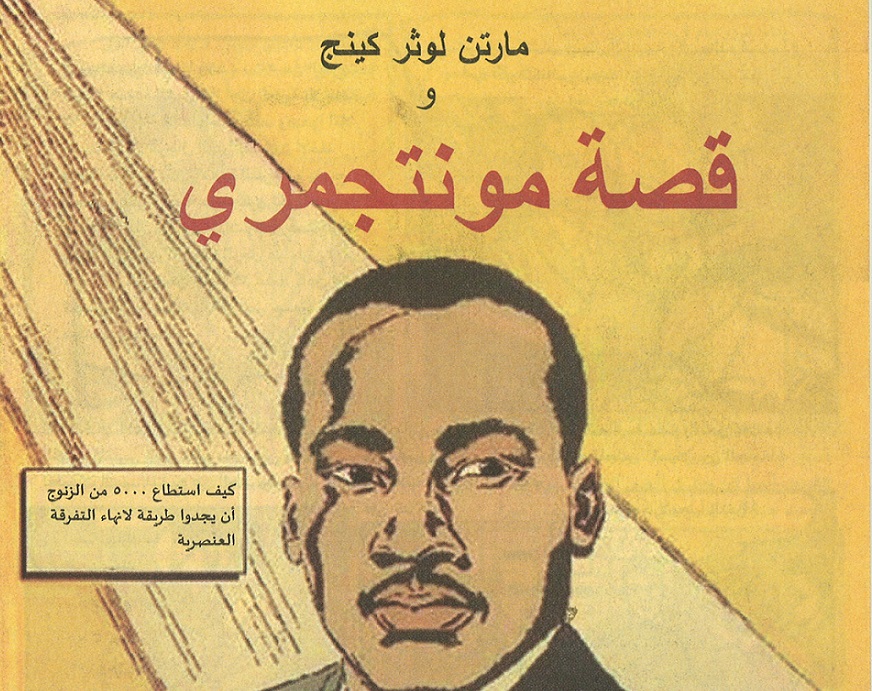
Translation: Martin Luther King and the Montgomery Story; how 5000 black men found a way to end racial discrimination
A day late, but in honor of Martin Luther King, Jr. day in the United States, here is a list of principles to which he had his fellow non-violent activists commit.
I hereby pledge myself—my person and body—to the nonviolent movement. Therefore I will keep the following ten commandments:
1. Meditate daily on the teachings and life of Jesus.
2. Remember always that the non—violent movement seeks justice and reconciliation — not victory.
3. Walk and talk in the manner of love, for God is love.
4. Pray daily to be used by God in order that all men might be free.
5. Sacrifice personal wishes in order that all men might be free.
6. Observe with both friend and foe the ordinary rules of courtesy.
7. Seek to perform regular service for others and for the world.
8. Refrain from the violence of fist, tongue, or heart.
9. Strive to be in good spiritual and bodily health.
10.Follow the directions of the movement and of the captain on a demonstration.
I sign this pledge, having seriously considered what I do and with the determination and will to persevere.
Let us pass on the first commandment, given the primary makeup of Egyptian revolutionaries as Muslim. Some Christians might argue that without the first, however, those following are devoid of their power and without foundation.
Whatever the merits of this argument, it certainly seems like many could be adopted by anyone. On some counts many Egyptians measure up well. On others, not so much.
The Egyptian revolution was largely peaceful. But not entirely. Many protests witnessed low-level violence such as the throwing of Molotov cocktails. This was front line action, though, and the masses of protesters remained behind.
But of #2: All were focused on justice, but some let the pursuit of victory get in the way. Few prioritized reconciliation.
#3: Love was almost never put forward as a theme. Most large protests were labeled ‘day of rage’ and themes of this sort.
#6: Courtesy was in short supply. Slogans tended to demonize the opponent, and graffiti was often insulting.
#8: Islam has a similar listing. A tradition of Muhammad states that if one sees a wrong that must be put right, he should strive to do so first with his hand, then with his tongue, and then if these are not possible, with his heart. Different schools of interpretation have allowed different levels of violence in this effort, or specified who can take this action under what circumstances. In any case, while most protestors avoided the violence of the hand, violence of the tongue and heart was plentiful.
#10: The Egyptian revolution had no leader, and certainly no commanding and inspiring figure like Martin Luther King. Many have identified this as a reason for the rapid divisions that dissipated its power after the fall of Mubarak.
The issues of the civil rights movement and the January 25 revolution were certainly different. But whereas American evils have largely (though not entirely) been put right and social peace achieved, the ills of Egyptian society and state threaten to continue.
Perhaps if Egypt’s peaceful protesters had adopted the spirit and convictions of MLK and not just his methodology, things would have been different. Then again, perhaps not. Your thoughts on the differences are welcome.
With decent regularity pro-Morsi supporters have conducted small protest marches around our Maadi neighborhood since his removal from office in July 2013. They do not tend to be violent but usually result in ugly graffiti insulting now-President Sisi.
Recently, new graffiti has emerged, calling the people to ‘man up’ and protest on January 25, the anniversary of the original revolution. And this past week I noticed posters – on the ground – calling for a new uprising.
The translation reads: Together for liberation and purging; The people want the fall of the regime; and 25 January, Egypt speaks revolution.
I do not yet have a good feel for whether or not people will respond. A recent effort to rally an Islamic revolution failed dramatically to attract numbers.
But what is significant to me about this poster is that it is printed in color. This means there is money behind the effort. Another version was even more colorful, but was in poorer condition.
Also significant is that it was on the ground, stomped upon. I did not see any such posters anywhere on the walls. Were they torn down? Did residents or police prevent their hanging?
January 25 is a week away. It will be interesting to monitor developments.
Words injure. Ideas have consequences. Give Egypt wisdom and strength of character to tread righteously in irreligious waters.
For Charlie Hebdo insists on staying in the headlines. The head of the Azhar called for Muhammad cartoons to be ignored, while a pro-Brotherhood scholar called for demonstrations and international blasphemy laws. Many expressed anger and warned of violent reactions, even as they condemned them.
And perhaps similarly, Egypt jailed a local citizen for being an atheist. He was harassed in his home town and complained to the police, but instead wound up arrested. His father testified against him, and his incarceration will last three years. He is not the only blasphemer in prison, and others are on trial.
God, all rights come with responsibility, and the law regulates limitations. Do you have an opinion on where to draw the line?
Moreover, do you wish mankind to police your honor?
Help Egypt to process these questions, God, protecting good, preserving liberty, for individual and society alike.
Give courage to speak a rebuke. Give humility to win the recipient. Give patience to bear an insult. Give confidence to respond in love.
Give the same to Egypt’s atheists, as to those offended by them. Guide both to what is true and right. Guide all in defining their place.
You are the word, God, how you respond when injured? You are the idea, from which all consequences follow. Help Egypt imitate your character, and in you find strength.
Muslims and Muslim majority nations, including Egypt, have roundly condemned the terrorist attack on the Charlie Hebdo satirical newspaper. But the ideology that informs such an attack is present not just among those with access to weapons. This Mada Masr article contains a full survey of Egyptian reactions, most of which stand against the murders. But interesting are the ordinary voices that express sympathy with the attack:
Many Egyptian social media users were not fully sympathetic toward the cartoonists killed in the incident. Business intelligence consultant Ramy Mahrous, 28, told Mada Masr that he only respects non-Muslims who are respectful of his religion.
“Otherwise, I wish anyone attacking my religion to burn alive, and I would be very happy seeing him burning,” he said.
Twitter user Ahmed Adel told Mada Masr that attacking religious symbols and religion in general is a “red line,” but Muslims generally do not take serious actions against such offenses, while the offending parties “reap the fruit of their actions.”
“Islam forced us to defend our sacred principles. [The shooting] is not an attack, it is self-defense,” he argued.
Adel recounted some incidents from Prophet Mohamed’s life that he interpreted as supportive of his position.
“All of this should make us more ardent [defenders] of our religion, if we love our religion in the first place,” he added.
In a similar vein, Sahar al-Sherbiny told Mada she believes that fervent belief could lead a Muslim to kill someone offending his or her religion.
“I don’t know many details of what happened in France, but if I saw someone offending Prophet Mohamed in front of me and I had a weapon, I would verbally warn him first. If he continued, I would kill him,” she tweeted.
Better would have been interviews with people on the street. Social media provides an artificial atmosphere that encourages the expression of more extreme views. But perhaps the relative safety also allows full disclosure.
It is wrong to generalize a people and their religion, either positively or negatively. But where there is such dissonance between cultures, it is important to see the other as a real person, and hear their real voice. It is only then that alternate policies and perspectives might make a real difference.
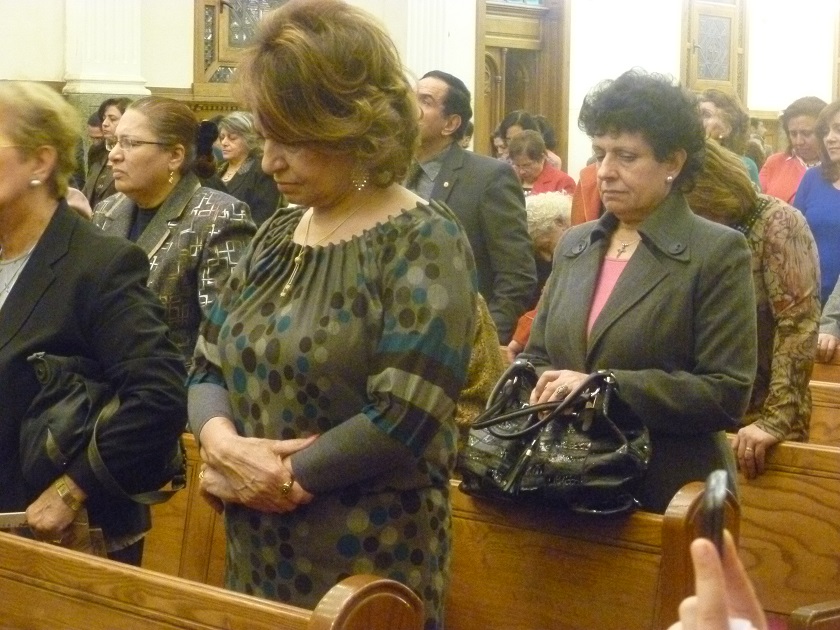
Members and friends of the St. Michael’s Church congregation gather to pray.
One child is dead and eight women are hospitalized following the Sunday explosion of three gas bottles, sparking a fire in the Kilo 4.5 neighborhood of Nasr City in Cairo. The group of ladies were preparing a meal for a meeting at the St. Gabriel Center, a Sudanese social center and ministry of St. Michael’s Anglican Church in Heliopolis.
Youssef Attiya, a nine-month-old infant, succumbed to smoke inhalation and died this morning. His mother Mona Ismail remains in critical condition in the Galaa Hospital of Nasr City.
Ikhlas Ali is also in critical condition, suffering burns over 90 percent of her body. She is two months pregnant and the wife of Rev. Hassan Jemes, associate pastor of St. Michael’s in charge of the Sudanese congregation. Hospital staff at the Nile Emergency Center in Nasr City said she has little chance to survive, according to Rev. Jos Strengholt, dean of East Cairo Anglican churches and priest-in-charge at St. Michael’s.
Another child, nine-year-old Sonita Musa, suffered a bad head wound but was discharged this morning. Her mother Aziza Ibrahim remains hospitalized but is in stable condition. According to Shawgi Kori, director of St. Gabriel’s Center, Ibrahim helped around eight other women and children escape the fire, pushing several through a window, before being injured herself.
The meal was to be in commemoration of a child relative of one of the church members who recently died in Sudan. The explosion blasted pots of boiling oil to the ceiling, which then sprayed onto several women. The church community is now organizing rounds of visitation to care for the injured and the needs of their families.
The St. Gabriel’s Center serves the large Sudanese refugee population of Nasr City without discrimination. It runs a clinic, a vocational training program, English lessons, and provides a social outlet especially for women and youth in the neighborhood. One of the injured women is a Muslim.
“These are women associated with our church,” said Rev. Strengholt, stating only two have medical insurance. “We are committed to helping them whatever we need to do.”
Prayers are requested for the injured at this time. For more and updated information please contact Rev. Strengholt through the church website.
This article was first published at the Anglican diocese website.
If you are the light, the good, and the pure, then it stands to reason that the closer one approaches you the more imperfections are visible. Furthermore, the accumulated wisdom in the approach to you – religion – is prone to the same exposure. Great virtue lies along your path, great vice looms a step awry.
And therefore man is a poor judge. Sometimes the deed seems obvious. Gunmen fire randomly into a newspaper office, or kill policemen guarding a church. Sometimes the act is contested. Religious leaders comment on politics, or political leaders comment on religion. And sometimes the symbol seems worthy. A president visits holiday mass, or a policeman is killed guarding a newspaper.
But in each one, God, man can find both honor or fault. Some difference stems from the choice of religion, some from the different visions of each. The path is important, God, as is the heart. Judge mercifully, but justly. May man imitate you as closely as possible.
For those who kill in your name, offended by the offense given to the revered, instill in them your own humility. For those who kill in your name, seeking retribution and reversal denied them in this world, instill in them a faith in your ordering of affairs.
For a pope who comments on politics, give him wisdom to discern reality, to speak judiciously, and to lead as a servant. For a president who comments on religion, give him wisdom to seek knowledge, to judge his limits, and to lead as a visionary.
For the symbol of state to recognize Christmas, bless intentions of unity amid accusations of politics. For the symbol of sacrifice in defense of another’s religious or irreligious voice, bless the faithfulness of duty amid uncertainties of criticism.
Should human freedom permit religious mocking? Should religious freedom permit divergence in the community?
Should Christianity stand with the powers-that-be, or simply pray for them? Does Islam need a renewal of religious discourse, or a better imitation of its origins?
God for so many the answers are obvious; for others these answers are obviously different. We are poor judges, especially in religion. Show us the light, the good, and the pure. Help us hold to conviction where our vision is true, but in our certainty show us our darkness, our bad, and our impurity.
Bless Egypt in these questions, God, as a nation may she draw closer to you. Reveal her imperfections. Give her the best wisdom in religion. Guide her on the right path. Keep her foot from slipping.
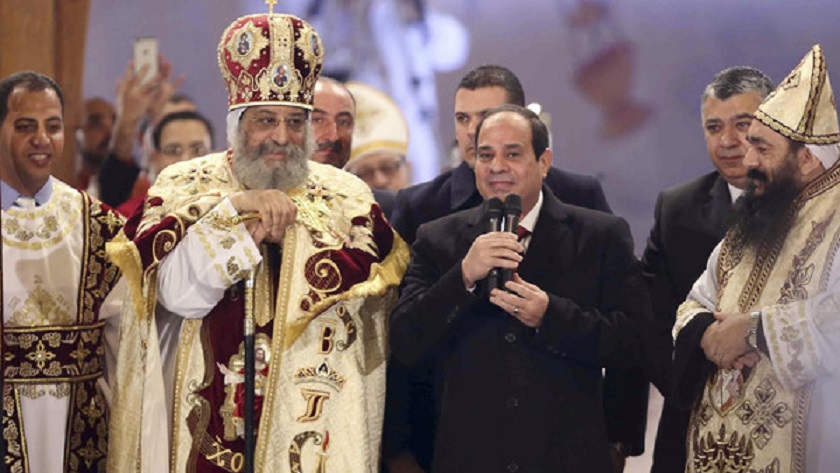
Last night on Christmas Eve according to the Coptic Orthodox calendar, President Abdel Fattah al-Sisi became the first ever Egyptian head-of-state to attend the holiday mass.
His appearance lasted for about ten minutes, during which he gave a short speech. The video selection and translation is provided kindly by Paul Attallah.
It was necessary to come and congratulate you for the feast
I hope that I did not interrupt your prayers
Egypt for years taught the civilization to the whole world
and taught the civilization to the whole world
I want to tell you that the world is now waiting from Egypt
in these circumstances…
The people: We love you
Sisi: We love you too!
I thank you because frankly the Holy Pope will be upset!
It’s important that the whole world watch us: the Egyptians.
You noticed that I am not using another word than Egyptians
It could not be something different
We are the Egyptians
Nobody says: what (type of) Egyptian are you?
Listen
We are saying things
We are writing to the world a meaning
and we are opening a window of real hope and light to the people
I am saying that Egypt taught to the world all over the years civilization and humanity
Today we are present to confirm that we are able another time
to teach the humanity
and to teach the civilization once again.
Starting from here
For this reason, we cannot say but: we the Egyptians
We must be only Egyptians
Yes Egyptians
The people: One hand
Yes one hand
I want just to tell you
that with God’s will
we will build Egypt together
we will contain one another
We will love each other
We will love each other in a good way
we will love each other really
so the people can watch
I want to tell again
Happy New Year
and for all Egyptians
and for all Egyptians: greetings for the feast
Holy Pope: Greetings for the feast
Thanks and I will not take from you more time
Greetings
It is certainly a historic occasion. Merry Christmas to all Egyptians.
Every new year brings new possibilities. But old issues linger. Help Egypt to find resolution.
What should become of Islamism? Criminals can be prosecuted, but what of citizens?
What will become of human rights? Stability is necessary, but is it sustainable without them?
What can become of the economy? Tourism and investment may return, but will all take an equitable share?
God, these and other issues continue. Trials are ongoing in an uncertain judiciary. Corruption hovers as a near insolvable specter. Reform is needed in countless sectors, each with strong institutional power to resist.
A revolution was launched with all the right slogans. Four years later little has changed. Yet while the hopes of many have been dashed, others see new hope finally emerging.
In this new year, God, give hope a grounding in reality. Strengthen state, society, and citizen together. May all three come together to answer the questions above.
The answers will come amid many possibilities. Where the answer is right, give Egypt the resolve to carry it out. Bless this new year, God, and all Egypt in it. May her people know peace.
Fr. Yu’annis sat in his small office waiting for a delegation to come, fearfully aware it might not. Having made all the arrangements, he was eager for a prominent Coptic businessman to visit the hundred year old church in his village, see the plot of land he had purchased, and envision together how a small hotel could lure religious pilgrims following the route of the Holy Family.
Being a practical priest, Yu’annis put aside the objection that his village of Qufada is not actually on the official route of the Holy Family. Several kilometers from the central city of Maghagha in the governorate of Minya, Qufada is a bit of a backwater. The nearby villages of Ishneen al-Nasara and Dayr al-Garnous are no closer, but they each boast a well from which the Holy Family is said to have sipped.
Unlike these, Qufada is not mentioned in the ancient manuscripts of the church. No matter, thought Yu’annis, given the geography it is certain they passed through. In any event neither Ishneen al-Nasara nor Dayr al-Garnous have a hotel either, so there is an opportunity to exploit. God knows his people need it.
After describing Qufada and Fr. Yu’annis’ local relations, here is a little more about his project and the man he hopes can implement it:
With this in mind, Yu’annis bought a plot of land next to the church in hope his hotel idea might result in tourist income and local employment. He secured Hamdi’s support and pays him a small sum of money each month to secure the premises. That this is necessary undermines somewhat an absolute understanding of Muslim-Christian harmony; Hamdi once remarked in frustration that though Christians are only 15 percent of the village, the one church is larger than all mosques put together. Correct or not in his estimation, it is personal relations and greased wheels which keep communal peace.
But the peace is present, so Yu’annis proceeds. And thus he sits in hope for the arrival of the delegation, which turns to frustration when it does not arrive.
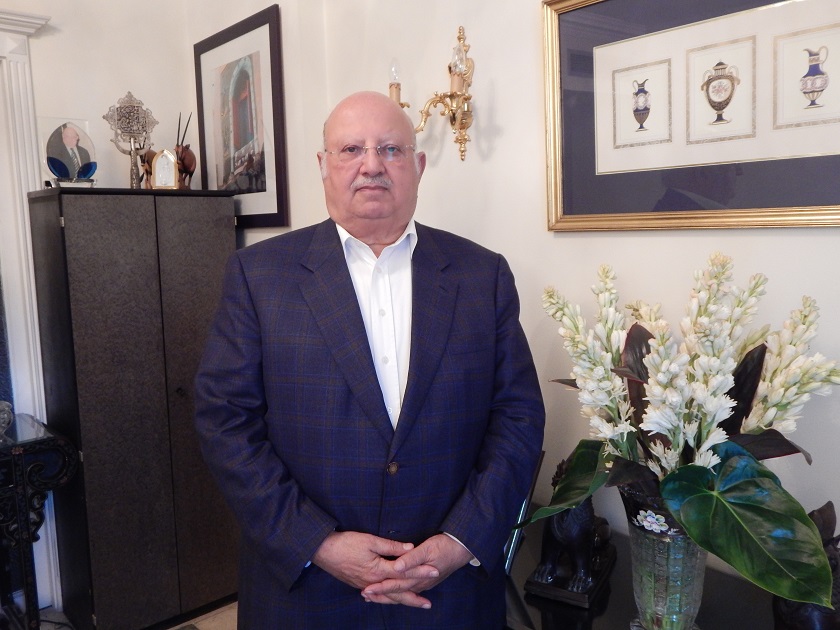
The awaited businessman is Munir Ghabbour, owner of the luxury Sonesta hotel in Cairo and a number of enterprises beside. Now 70 years old, Ghabbour wants to use his wealth to leave behind a Coptic legacy, strengthening that of the Holy Family. Many churches along their route are operational but decaying. Poignantly similar are the Christians; poverty and emigration, not to mention pockets of religious extremism, eat away at what was once a flourishing Coptic presence.
Mounir Ghabbour
I wrote about Ghabbour in reference to a new government initiative to promote Holy Family tourism here. The priest and businessman have a relationship stretching back many years, but the key to the project is support of the church:
But the lynchpin for the deal is a different person altogether. Bishop Aghathon heads the diocese of Maghagha for the Coptic Orthodox Church, responsible for all spiritual matters and many temporal ones beside. Yu’annis could not fail to inform his bishop of such a high profile visitor, who promptly requested to receive the businessman in the local cathedral.
Or rather, the old cathedral. Poorly built and suffering severe structural damage, Bishop Aghathon had long petitioned the government for a new building. For years he was frustrated, and thus he went political. Small demonstrations were held and the bishop complained in the press. His demeanor was much different than that of his predecessor Bishop Athanasius of Minya, who died in 2000 and had his diocese divided into several smaller dioceses. Bishop Aghathon was appointed to Maghagha, and proved less adept at fostering local relations.
This, at least, is the opinion of Yu’annis, who found his own success in securing building permits halted after the death of Athanasius and the ascension of Bishop Aghathon. Relations also faltered between the bishop and the priest, as the latter’s attention increasingly focused on his own village. Previously the twenty-four churches he facilitated were scattered throughout the area.
But Bishop Aghathon’s political approach finally proved successful after the revolution. In May 2011 the Maspero Youth Union formed during a massive Coptic sit-in near Tahrir Square, protesting the burning of a church in Cairo. Completely unrelated to events in Maghagha, during negotiations with the then-ruling Supreme Council of the Armed Forces, Coptic youth activists included Bishop Aghathon’s cathedral permit within their list of demands. It was granted, and construction of the new cathedral is currently ongoing.
But in the old cathedral he received Ghabbour and his delegation and planned the events of the day. First would be a visit to Ishneen al-Nasara, then to Dair al-Garnous, and finally, if time permitted, Qufada. Back in his village Yu’annis waited, unable to have a say in the bishop’s ordering of affairs.
He continued to wait, as the bishop showed the businessman other project opportunities. I describe the diocese and local conditions, but then come back to the priest:
All the while, Yu’annis waited in Qufada, making occasional phone calls about the delegation’s whereabouts. Bishop Aghathon urged the businessman back to the cathedral, and said Qufada was an hour away by car, at least. In this he appeared to pad his calculation over estimates in the original schedule, and told Ghabbour he could visit Qufada next time. That village was not on the Holy Family route, he persuaded, and the church had recently been renovated anyway.
It took a comparable amount of time to return to the cathedral, where a multi-course meal awaited. Delicious, time could have been spent in Qufada instead, had the bishop honored the priest’s original intention. Yu’annis himself then traveled to Maghagha, exchanged pleasantries with the bishop, and greeted his friend. They parted ways fifteen minutes later as Ghabbour needed to return to Cairo for an appointment. Yu’annis was disappointed, but understood how the formalities of church hierarchy needed to be honored first.
But it is not simply a matter of formality. In the Coptic Orthodox Church the bishop is one step removed from the pope and near-autonomous within his diocese. No priest can act without his approval; no church project can progress without his oversight. Ghabbour cares little for local squabbles, he simply wants to leave a legacy and assist area development. Working with the bishop can unlock any door.
But for Bishop Aghathon, working with Ghabbour can fund any door. The businessman remains in control of his own money, and will only pay for projects that are viable and fit his vision. The bishop’s pitch appeared to convince him, along with the appearance of the churches. If anyone comes to visit and sees this, he said, we will lose face. But Ghabbour’s vision is larger than churches, and includes his priestly friend. All he needs is land and an idea. Yu’annis has the former, but may need to modify the latter.
All three individuals are looking to intervene in an area of decline, through a tradition that may also be fading. From the conclusion:
Does this mean the Holy Family tradition itself does not have many days left either? To be sure this is not a warning for ‘days’ but years or decades, but as the Christians of Iraq are demonstrating, the existence of community is precarious. Coptic Christianity is not similarly threatened, but if trends continue toward poverty and emigration, will enough remain to care for the churches still being built and renovated? Or will they be the permanent reminder of a bygone era, symbols of a history cherished by believers elsewhere?
Perhaps then the tourists will come, and the hotel will be necessary.
Please click here to read the full article at Arab West Report.
Who should be allowed to preach in Egypt’s mosques? A recent exam offered by the Ministry of Religious Endowments is accused of seeking a selective answer:
Over the last two months, the Egyptian Ministry of Religious Endowments held two such exams. Many of the questions used are known for being disputed by Salafists, most notably those about the ruling of Islam regarding the military salute, standing during the national anthem, women in the judiciary, the concept of the caliphate, the reconstruction of places of worship for non-Muslims, bank profits, women wearing the veil and the establishment of museums for ancient Egyptian and Pharaonic artifacts. Salafists have well-known and radical opinions about all these issues, as they believe that Islam forbids such things. (from al-Monitor)
An issue-specific approach appears to have won the desired results:
The crisis between the Salafists and the Egyptian Ministry of Religious Endowments escalated when 600 Salafist imams took the ministry’s test and only 18 passed. Their disqualification prompted the Salafist Call to demand that the presidency resolve the crisis and support Salafist imams, who supported the road map on June 30, 2013.
Salafis bet on survival when the backed the overthrow of Morsi, and on this account have received their gains. They do not appear to have profited much beside, to this point. Their ultimate fate is still an open question, but it appears this institution is lined up against them. Should it be? One figure from the ministry is critical:
In a phone interview with Al-Monitor, Sheikh Salem Abdul Jalil, the former deputy minister of Religious Endowments, said the crisis is mostly political, as parliamentary elections are approaching in Egypt. The move is intended to ensure that Salafist clerics are kept away from the pulpits where they win popularity. “Salafist groups have always been a problem for the government, just like the Muslim Brotherhood,” he added.
……
“Unfortunately, both parties have a unilateral message. For instance, the Ministry of Religious Endowments wants the preachers to tell the people that growing a beard is not obligatory, while Salafists want to tell people that having a beard is obligatory. Thus, there are two parties — the first desperately wants to impose its views, and the other is a government party that has no vision and ideology.”
Stay tuned for more wrestling, and if things go sour, potentially for fireworks.
Two fronts are brewing, and both received a push. Egypt is trying to stabilize through its economy and elections.
For the first, President Sisi traveled to China and signed a number of trade agreements. For the second, just before leaving he signed into law the mechanisms for parliamentary elections.
In March is scheduled a major investment summit; around then the polls are expected as well. If both are clean and well supported it will be a sign the nation is moving forward.
God, move Egypt forward, but with more than money and ballots.
Bring investment, but distribute it well. Clean the centers of corruption and ensure fair return for both capital and labor. Egypt recently mandated electronic tax payments for corporations; help the state to receive – and use – its fair share, wisely.
Bring voters, but prepare them well. Give them worthy candidates who will represent their constituencies. Spread a culture of democracy that gives no one a blank check; help the state to facilitate its own accountability.
But God, others are not comfortable with Egypt becoming stable in its current shape. Some are looking to sabotage and disrupt, keep them from causing harm. But others wish for deeper or different justice. Honor the sentiment, God, and weigh the demands.
May Egypt more forward in that which is good.
Seek knowledge as far afield as China, says the hadith. Help the president find one source, but forsake the other. Not all stability is honorable.
The sound bomb exploded right behind the Egyptian Museum on Cairo’s Tahrir Square, throwing Ibrahim Morgan’s Swedish tour group into a temporary panic.
Then they settled back down and finished their tea.
This latest tactic in Egypt’s Islamist insurgency is meant to instill terror without harming civilians. It seeks to convey a message to citizen and tourist alike: Egypt is unstable.
This has been the dominant narrative abroad regarding Egypt, thanks to three years of instability, four presidents, and two revolutions. However, some locals like Morgan disagree.
“We know it is nonsense what the media says about Egypt,” Morgan said after the November 28 incident. “This group is here and they have had a great time.” The Swedes nodded in appreciation.
But relatively speaking, they are among the few. Since hitting a highwater mark of 14.7 million visitors in 2010, Egypt’s tourism numbers declined by a third, devastating the economy. The sector represented more than one-tenth of Egypt’s GDP, and tens of thousands have lost their livelihood.
Once stability—or its perception—returns, the numbers will likely rebound. The Giza pyramids, the temples of Luxor and Aswan, and the medieval mosques of Islamic Cairo will long attract international visitors.
But in October, the government launched a unique campaign to increase a segment representing only 1.9 percent of total tourists: Christian pilgrims. To do so, Prime Minister Ibrahim Mehlab and Coptic Orthodox Pope Tawadros II promoted the most noteworthy biblical example.
“Jesus was the first ‘tourist’ to Egypt,” said Tawadros at the launch event, according to AsiaNews. “For us, for our community, his stay in this land has been a blessing for the present and for the future.”
Please click here to read the full article at Christianity Today.
The debate is valid: What is the proper role of the Coptic Orthodox Church in the nation’s politics?
It is also an unavoidable debate. Once Pope Tawadros appeared with the Grand Sheikh of al-Azhar to back the popularly-backed military overthrow of President Morsi, he reasserted the church into the political scene.
The decision of the pope can be criticized, but in a recent article for the Carnegie Middle East Center, Georges Fahmi goes much too far. He writes:
With the election of Abdel Fattah el-Sisi as president in June 2014, the Church has attempted to reestablish itself as the monolithic voice of Egypt’s Coptic community. But that role, too, carries risks. Rather than trying to unify Egypt’s Christians under its leadership, the Church should withdraw from the political sphere and allow Copts to defend their interests themselves by joining political parties and movements. The Church should focus on being an institution of civil society that defends universal ideals such as human rights and social justice, and on supporting developmental projects for both Muslims and Christians.
In the essay which follows, Fahmi does an admirable job of summarizing the recent history of the Coptic Church in politics. Within a limited political sphere, President Mubarak allowed Pope Shenouda to represent the Coptic community outside the realm of law. After the revolution Pope Tawadros spoke against a political role for the church, but increasingly found himself drawn in during the Morsi administration. Famhi helps the reader track with an often neglected sub-theme in the Egyptian transition.
But in his summary critique, he makes statements that do not completely gel with my understanding of the situation.
Though the church does invest much charity in Christian focused projects, it also benefits local Muslims. Surely it could do more, of course.
He recommends the church defend universal ideals, but would this not also be a form of political engagement?
Perhaps his wording is poor, but is the church doing anything to disallow Christians from joining political parties and movements?
The church has always presented its participation in the overthrow of Morsi and the backing of the roadmap as a national decision, not a political one. It backed the constitution and the presidential election, but did not back a specific candidate. Again, its decision to speak at all can be criticized, but the nature of its speaking does not represent an attempt “to reestablish itself as the monolithic voice of Egypt’s Coptic community,” as the author accuses.
Here is his evidence:
The Church’s support for the military’s 2013 intervention has given it a privileged position in the new regime, prompting the Church to try to revive the old pact it had with the Mubarak regime. And changes carried out by the state have helped the Church regain its position as the only representative of the Coptic community.
As the new political authority has tightened its control over the public sphere, youth movements, including the Maspero Youth Union, have lost their ability to mobilize. Coptic politicians have also lost their influence, as the new regime seems to see little role for parties; President Sisi has not held any meetings with political parties.
What sort of privilege does the author intend? Is the church any more privileged than the judiciary, or the police, or the administration, or other institutional bodies that backed the overthrow? And where is the evidence of the church’s intention to “revive the old pact”? One can guess at their internal desire, but the author confuses the conduct of the state with the approval of the church.
The Maspero Youth Union lost its ability to mobilize long before the overthrow of Morsi. But it says that despite initial uncertainty it has a good relationship with the church. And within the political parties, Coptic politicians are still quite numerous and influential. Yes, the public sphere has shrunk, and political parties appear marginalized. Yes, the church has not spoken out against this, but few have. This is a national issue, and not one to lay at the foot of the church.
So should the church take a stand? Fahmi argues in his conclusion:
In terms of discourse, the Church needs to differentiate between defending universal values in the public sphere and engagement in deals with the state or political parties. While the first is needed and would improve the Church’s public image among Egyptians, the latter could have drastic consequences because it makes the Church a part of the political regime. The ideals of human dignity, social justice, and human rights need to be integrated into Church discourse. Only by struggling for a political regime that respects these principles will the Copts, together with all Egyptians, receive their full social and political rights.
In this and Fahmi’s other recommendations are found much wisdom. But where he wants to differentiate, I see simply a different involvement. To hold out a discourse for these values would be to very obviously criticize the current regime. Perhaps this prophetic voice is the burden of the gospel, but it is also very political. If the author wishes to accuse the church of hypocrisy for criticizing Morsi and not criticizing Sisi, let him do so. But the stakes for Christians were different, and as mentioned above, the church presented its approach in a national context, not one of religion or politics.
The consequence of its decision, however, is to put the Muslim Brotherhood and Morsi supporters outside the national context. Indeed, Egypt’s Christians are convinced of the terrorist designation with which the government labels them. And Christians suffered much terrorism, as their churches were attacked by Morsi supporters across the nation.
This is a high price to pay for the church, but the author comes very close to blaming the victim.
This leads to a situation in which Church decisions can put the lives and property of any individual Copt at risk, even if he or she did not actually participate in making a political choice.
Earlier he wrote:
The strategies of both the Muslim Brotherhood and the Church in this period have increased the level of religious polarization between Egyptian Muslims and Christians. The result has been a cycle of sectarian violence, with each side accusing the other of attacks on its followers.
Unfortunately, this critique is partially true, but is it a cycle? The Brotherhood has certainly accused the church of a conspiracy, but their manner is deeply sectarian and propagandist. If the church had stayed silent, if Christians were not among the many, mostly Muslim activists who campaigned against the Muslim Brotherhood, perhaps they would not have been targeted.
But did the church stand against Morsi for political gain only, to reset the Mubarak-Shenouda relationship? Or, did they place themselves in jeopardy because they thought it was right – for Coptic liberty, yes, but also for human rights and the good of the nation?
If their intentions were true, which can be debated, then this is exactly the situation Fahmi calls for now, with the church defending universal values as part of its discourse. Many Muslims have spoken positively of the church, for what it has suffered, and many Copts appreciate that the bulk of ‘moderate Muslims’, as they call them, now see Christians in a different and better light.
Like Fahmi, I can read into recent actions of the church a pattern of political engagement and representation of Copts as a community. I lean toward his perspective, wishing Copts as citizens would be in the forefront. But I try to watch carefully for evidence of this being the intention of the church, and I have not yet seen it. Fahmi links considerably to articles which trace history, but he can only interpret on this issue, and not link to any quotes.
Certainly I have not seen the church discourage its people from their own participation in politics. If movements are faltering and parties are weak, is this not their own fault? They have had three years since the revolution to assert themselves, to build apparatus and win support on the street. They have not done so. If Sisi ignores them, as mentioned above, is it because they do not yet have sufficient weight to force their hand.
The church does have weight. Fahmi’s correct question concerns how the church should wield it. The weight of the gospel does call for a prophetic voice, for self-limitation, and the promotion of the common good. Within the sharp political polarization and challenge to state authority, the church has a very difficult line to walk.
It is right to call the church to sublime ideals, but Fahmi’s article misrepresents in its critique. His opening sentence stated:
The Coptic Church’s recent involvement in politics in Egypt has harmed both the Church and the country’s Christian community.
If so, were he in Egypt, he would be one of the very few Christians to say so. Nearly everyone else is overwhelmingly positive about the status quo.
Perhaps this is why his own prophetic voice, even in overstatement, is needed. May his readers in Egypt bristle, but also consider.
In a recent article at Foreign Policy, Iyad el-Baghdadi described the near-eternal and present dichotomy hoisted upon the Middle East: Support a dictator, or his overthrow via violent Islamism. He finds an ironic symbolism in that the names of Sisi and ISIS are spelled backwards, and describes their evils as parallel.
Near the end of the article he reasserts the hope that motivated many in early 2011:
The Arab Spring is about believing that we don’t have to eternally choose between these two evils, and that we can present a real alternative. Arab Spring activists come from across the political spectrum, but they share a belief in fundamental individual rights, coexistence within one political system, and an open marketplace for ideas. These are the people who represent me — and whom I hope to have successfully, if briefly, represented in a public forum.
These are worthy values, and the author was briefly critical of others beside Sisi and ISIS in his critique:
Both extremes are born out of the same twentieth-century political culture that gave us authoritarian interpretations of just about every ideology: authoritarian Islamism, authoritarian nationalism, authoritarian socialism, and even, yes, authoritarian liberalism. Both view human rights not as inviolable or inherent, but as granted by the state, which can then reduce or suspend them at will. And both envision a state in which some people have less rights than others.
…..
Both sides have a deeply exclusionary, “with us or against us” worldview that manifests itself in a profound refusal to coexist with others. In the run-up to the 2012 elections, we saw the Mubarak-associated figure Shafik hint at banning Islamist parties should he get elected; during Morsi’s term we then watched Islamist discourse squeeze the space for civil society.
It would be worthy to dialogue with Baghdadi (the author, not the caliph!) about his opinion of the Muslim Brotherhood, for his criticism of them is far less severe, at least in this article. Indeed, he has tweeted and written prolifically, so his analysis is available.
But within the opening quote and listing of values comes a very poignant highlight: the open marketplace of ideas. Egypt did experience this open marketplace during its revolutionary period. With full respect to the diverse forces influencing public opinion, Egyptians overwhelmingly chose the Brotherhood and Salafis over the vision Baghdadi presents. Then, perhaps over and against his vision again, they overwhelming rejected Morsi.
The system that could tolerate this pendulum was never established, and perhaps this is Baghdadi’s lament. If left alone, would the Brotherhood have helped its establishment? Or are they just a milder version of ISIS, focused on a long term Islamization inconsistent with Baghdadi’s vision?
One problem is that the system the Brotherhood helped establish through their 2012 constitution enshrined an illiberalism antithetical to this vision. Shadi Hamid has explored this theme in his writing. Islamist organizations tend to moderate while in opposition, but then revert to their extremes when in power. But if such an illiberalism is what people vote for, if it wins the marketplace of ideas, how does it square with Baghdadi’s desire for fundamental individual rights?
He does not want to be forced back into a dichotomy, and this is noble. But would his vision have been able to triumph over time, allowing the people to reject Morsi four years later? Or eight? Or…
Perhaps, though the argument of urgency on the part of anti-Islamists is well known. To summarize, the Brotherhood would do all it could to sink its teeth into the existing system, to gain control of its levers and use it to their own advantage.
Fair or unfair, there is a distinction between the two current camps in the Egyptian struggle. The ideology of the Brotherhood — at its end goal, not necessarily through its stages or current rhetoric — does not support Baghdadi’s vision.
Fundamental individual rights: These are curbed by sharia, however variously defined.
Open marketplace of ideas: There are religious norms not allowed to be touched.
Coexistence within one political system: …
Here is the rub, and am I trying to find a comparison. A socialist versus capitalist vision of the economy can be very divergent. But European nations have navigated a path that has allowed various governments to traverse the path in different directions.
But how much allowance can there be for a democratic versus communistic approach to the state? Should the open marketplace of ideas, ostensibly welcomed in a democracy, allow momentum to build that would overthrow the system that enshrines it?
This later comparison seems closer to the struggle in Egypt. Liberal forces in Egypt have enshrined liberal values (to a degree) in the constitution, however much they recognize the violations used in putting down pro-Morsi protests, understanding also the violations on the part of certain protestors.
The question for this camp is if it will tolerate, or be able to resist, the continual violation. That is, will they accept reversion to Baghdadi’s dichotomy? The Mubarak regime held forward liberal values for thirty years — and all the while implemented a state of emergency that made it easy to circumvent them.
In all this, perhaps Baghdadi, like many, will find hope in Tunisia. The United States, two centuries ago, began a political experiment that removed religion from the sphere of the state, setting up a system meant to guard liberty and freedom. It has endured numerous contradictions along the years, but has been largely successful.
Now, Tunisia is beginning a political experiment that is seeking to integrate a religious, Islamist element. Will it be successful? Many Tunisians are worried, for in creating a system that allowed coexistence they had to beat back Islamist efforts to encode religion into the constitution. Efforts to do so in 2012 with the Brotherhood were not successful – the Brotherhood chose even more conservative Salafis as their partner. But the Brotherhood and the Tunisian Nahda come from the same family tree.
Is Nahda simply postponing a greater Islamizing goal? But more to the point, perhaps, of Baghdadi’s hope: Will the system created allow for the emergence and entrenchment of his Arab Spring values?
Consider the recent anti-liberal political moves of Turkey’s Islamist Erdogan, after an extended period of winning democratic elections. Will Tunisian Islamists consistently nudge and needle against values they have temporarily accepted? Will fear of a similar Islamist agenda lead to preemptive crackdown against them? Time will tell.
But the experiment is on, and perhaps Baghdadi and other activists frustrated with the dichotomy have a fledgling example of a third way.
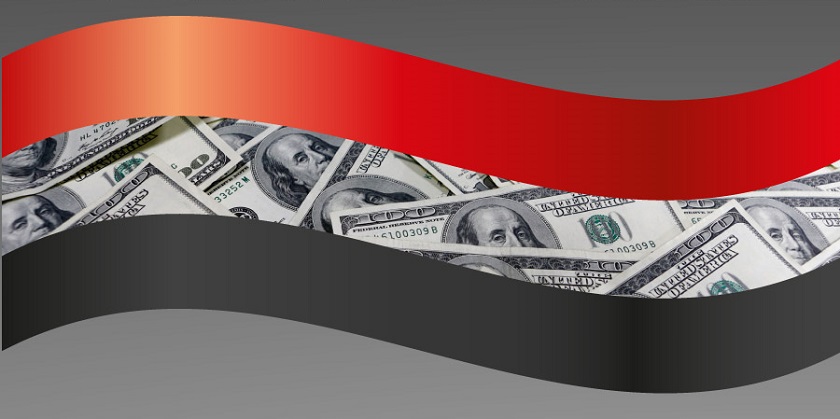
Curious about who is funding Egypt these days? American military aid gets all the press, but many have contributed to support Egypt’s economy. Daily News Egypt recently provided a detailed breakdown. Except for deposits made to the central bank, I have not listed loan agreements. In some cases it is not clear if the money has been received already or only pledged. For ease of access, here is a simplified list:
United Arab Emirates
$10.125 billion in grants, deposits, fuel shipments, and water and micro-enterprise projects
Saudi Arabia
$6.3 billion in grants, deposits, fuel shipments, and petroleum and electricity projects
Kuwait
$4 billion in grants, deposits, and fuel shipments
World Bank
$934.4 million in electricity, economic, and transportation projects
Arab Fund for Economic and Social Development
$412 million in energy projects
Joint European Aid
$260.7 million in clean water projects
European Union
$236.2 million in educational, economic, and various regional projects
France
$137.2 million in micro-enterprise projects
Italy
$78.5 million in agricultural projects
China
$24.4 million in economic projects
African Development Bank
$2 million in waste management and micro-enterprise projects
and finally…
Qatar
$7.5 billion demanded to be returned from assistance given under the Morsi administration
I suppose there is a fair question: How can anyone in Egypt still be poor?
Egypt is trying to redecorate. But beware the house swept clean if it is left unoccupied.
The police force had long been closed to the Muslim Brotherhood, but the revolution opened the door. This week forty students were expelled, for family ties to Brotherhood members. The state had always been wary of infiltration; after a year in public power, it is now easier to find them.
The Azhar was harder to close off to Islamists; conservative Islam can be similar but is not the same. This week 71 students were expelled, for participation in campus protests. The state is seeking calm and a reformed religious discourse; many in disagreement have self-identified.
Downtown Cairo reflected the ethos of the country. Unregulated but entrepreneurial, numerous street cafés catered to fun loving Egyptian. This week many were shut down, pursuant to the law but surely jeopardizing to livelihoods. One café in particular was targeted for its congregating atheists.
And the undercurrent of society had long been left there, undisturbed. But this week the Azhar conducted a ‘count’ of Egypt’s atheists, while the police raided a bathhouse and arrested alleged homosexuals. Politically, commercially, and morally, the nation is housecleaning.
Perhaps. Some say the problems are so entrenched these are only a minor dusting. Others say it misses structural problems altogether.
But even opponents of the state are looking to tidy. Rumors say the Brotherhood is trying to restructure, while Sinai jihadists split over Islamic State affiliation.
God, wash Egypt of all its stains. Repair what is necessary. Gut what is rotten.
Help the police to be of one vision, to serve the law while serving the people. Protect the expelled from unjust accusation, but uncover also if their intentions were ill.
Help the Azhar to be of pure vision, to serve you while serving society. May it navigate well between justice and peace.
Help the economy to stimulate growth, to serve the investor while serving the client. Protect the tax base, but also those of lesser means.
Help the society to stimulate freedom, to serve human rights while it serves cultural norms. May it navigate well between liberty and taboo.
And help state opponents to weigh well their struggle. May they submit to you while submitting to authority, knowing the sometimes difficult balance.
God, you warn when an evil spirit leaves a dwelling, it can come back with seven far worse than itself. No amount of tidying will do, if you do not inhabit it.
Dwell in Egypt, God, and in her people. Dwell in her government, laws, and institutions. Dwell in her culture and commerce. Dwell in her marginalized, and her opponents.
And transform them all. Redeem them. Make Egypt clean.
Egypt has a youth problem. According to official statistics, 31 percent of the population is under the age of 14, and 24 percent of the population is between 18 and 29. Integrating them into the social and political fabric of society is expected to be challenging, especially given the raised expectations of the revolution.
Egypt also has an education problem. According to official statistics, 25 percent of the population over 10 years old is illiterate. According to UNICEF, student participation is generally not encouraged by teachers, and less than ten percent of schools meet national standards for quality education.
Egypt, of course, is well aware of these problems. Twenty-eight year old Joyce Rafla is part of the government’s answer for both. Last May, presidential media advisor Ahmed al-Muslimani handed the ‘White Book’ to President Abdel Fattah al-Sisi. It represented the completion of a project started under interim president Adly Mansour, tajdid al-nukhba, seeking to find new talent to eventually replace the old guard.
The White Book contained the names of 152 Egyptian graduates of top notch universities worldwide. Joyce Rafla was included among ten from Columbia University, alongside Harvard, MIT, Stanford, Moscow, Tokyo, and the Sorbonne, among others.
A year earlier as the government was conducting its search, Rafla was invited with around twenty other graduates from the education field to produce a practical vision for the nation’s education system by 2030. The two month effort was part of an objective to design strategies to place Egypt within the top ten nations by 2050.
Rafla’s work in the committee must have caught the attention of important people. In August 2014 she received a phone call from the president’s office, asking her to be an advisor to Sisi. Three specialized councils have since been formed, all by presidential appointment, seeking balanced age and gender composition. Rafla is one of six females on the Education and Scientific Research Council, and lowers the average age of the eleven members to 40.
Rafla is a pedagogy and assessment officer at the American University in Cairo (AUC), and also a consultant for the Education Support Program funded by USAID. Her international connections may have been a factor in her selection, as with other AUC professors on the council. Tarek Shawki, the council head, has long experience with UNESCO. Malak Zaalouk is associated with UNICEF. And Amal Essawi worked as a researcher in the UK for ten years.
Other council members come from the universities of Cairo, Alexandria, and Ain Shams. Represented also are experts from the National Research Center and the ministries of Education, Higher Education, and Communications. All members on the council are volunteers. Twice weekly meetings and preparation requires nearly two extra days of work on top of their normal responsibilities.
The overall diversity of membership represents a new advisory approach in the Sisi administration. Rafla explained that traditionally the Egyptian president had one advisor in each specialized field, but by contrast, Sisi desires a multiplicity of perspectives coming to consensus. The council stands outside the cabinet ministries, but must seek buy-in from these and other relevant institutions before they present ideas to the president.
And within this body of advice, Rafla speaks for the youth. “I am there to disrupt the normal order of things,” she told EgyptSource, adding that she has never felt overlooked due to her age. “Sometimes there are suggestions that won’t resonate well with a young person, that’s when I jump in.”
But quickly the council faced the accumulated frustrations of previous educational reform efforts. AUC held a panel discussion in November with five members of the council, four of which, including Rafla, are among its staff. The poorly chosen title, ‘Three Immediate Solutions to Egypt’s Education Crisis’ attracted a large crowd, but then their ire.
“I went to an event about education in Cairo this week hoping to hear about solutions,” wrote Amal Abou-Setta in al-Fanar Media. “Instead I felt like, yet again, I only listened to an elaborate description of the problems.”
Rafla admitted the divergence between presentation and title, but clarified the three initiatives. Better investment in teacher training, a licensing system with ongoing testing for university graduates, and merit-based university education providing full scholarship primarily to students who continue to meet minimum benchmarks of success.
These are among 31 short, medium, and long-term projects the council submitted to Sisi on December 2. The meeting lasted two hours, during which the president gave extensive feedback and demonstrated genuine concern, Rafla said. It was their second meeting with Sisi, and they are scheduled to meet with him once every one to two months.
Rafla’s current role is to make an overview of all previous international education projects in Egypt, to recognize patterns of success and failure. She is also conducting field visits outside of Cairo and with relevant civil society organizations to strengthen the necessary cooperative environment.
But will it work? Rafla is optimistic, though fully aware of the challenges. The president has insisted that reform is needed urgently. But amid the criticism of some in her own generation, she sees one of her main tasks as encouragement. She can do so as long as she herself believes.
“If we have a good project, the president has the political will to reform education,” Rafla said. “The minute I feel it is not so, I will lose hope.”
This article was originally published on Egypt Source.
A condensed version of this article was printed in the December 2014 edition of Presbyterians Today. Please click the link below to open it in pdf, and here to view the magazine’s feature articles.
God’s planning is perfect. In 2008, long before the Arab Spring fixed world attention on the Middle East, the women of the World Day of Prayer International Committee designated Egypt to write the program for their 2014 event, held on March 7. In retrospect, God arranged for the more than 170 member nations to focus on Egypt during this critical time.
“All around the world people are praying for us today, and this should fill us with serenity and thanks,” announced Rev. Emil Nabil to the 300 mostly middle aged women at the main gathering in Cairo, one of over twenty locations hosting a WDP event. But off the podium the assistant pastor of the Heliopolis Evangelical Church, affiliated with the Presbyterian Synod of the Nile, had a somewhat different take.
“This event is not very well known here, even among Christians,” he said. “It has a following among women, but needs better communication.” Meanwhile at the English language service across town, Rev. Chris Chorlton announced tongue-in-cheek, “I asked ten Egyptian friends about the World Day of Prayer, and no one knew anything about it.”
The first World Day of Prayer was held in 1928, and even at that early date Egypt was among the participants. The local Presbyterian church led the efforts, with other denominations joining thereafter. By 1970 the WDP committee of Egypt drew from all national churches, but outside of individual participation the majority Orthodox – 90 percent of Egyptian Christians – remained largely aloof.
“Not many people are ecumenical, especially in the past,” stated Dalia Hanna, one of the younger Presbyterian WDP organizers. “It is getting better now, but there is some fanaticism in all denominations.”
Hannah was raised Orthodox but had a born-again conversion experience in her church sponsored Bible study group. But as her priests bickered over the legitimacy of their small fellowship, she decided to worship near her work at the American University in Cairo, at the famed Kasr el-Dobara, the largest Protestant Church in the Middle East. “The more I got involved the more the Lord led me back to build bridges with other denominations,” she said.
In the process Hanna was challenged with her own inner fanaticism. She traveled with the Egypt delegation to the June 2012 WDP quadrennial meeting in New York City, engaging with women from around the world about the Samaritan woman, the devotional prepared by her team. Hanna was shocked to find that not everyone present considered the object of Jesus’ attention to be a sinner. Similar debate about the nature of Islam confounded her.
“We had cultural differences that could lead to conflict,” she said, “but when you are exposed to such an environment you have to learn to be tolerant of others, even though your first reaction is to say, ‘You are wrong.’”
Similar, if easier transformations were witnessed back in Egypt as the working committees planned the program and the order of service. Mervet Akhnoukh, chairperson of the board of the Coptic Evangelical Organization for Social Service, cherished how Protestant, Catholic, and Orthodox women found common purpose.
“We prayed that our work would be of God, and we became friends,” she said. “The committee was a great ecumenical example, we became like one in the process of working together.”
Her committee included many Orthodox women, but the key toward wider knowledge of the World Day of Prayer rests with the clergy. In preparation for the yearly WDP, organizers hold monthly meetings to plan and pray, rotating through the different denominations. Orthodox priests welcome the group into their halls, but look to the pope for official sanction to be a part of a non-Orthodox service.
Hanna commended the recently deceased Pope Shenouda as a man of God, but described how doctrinal issues sometimes made Orthodox church leadership wary of the other denominations. But the new pope has brought a spirit of openness, she said, and this year it paid dividends.
The WDP committee presented their program to Pope Tawadros at the one year anniversary celebration of the Egypt Council of Churches (ECC), a landmark achievement he inaugurated with the other denominations. The pope gave his blessing, communicated publicly on the ECC Facebook page. And for the first time in many years, an Orthodox priest attended the main gathering, bringing along thirty women from his church, most of them from the younger generation.
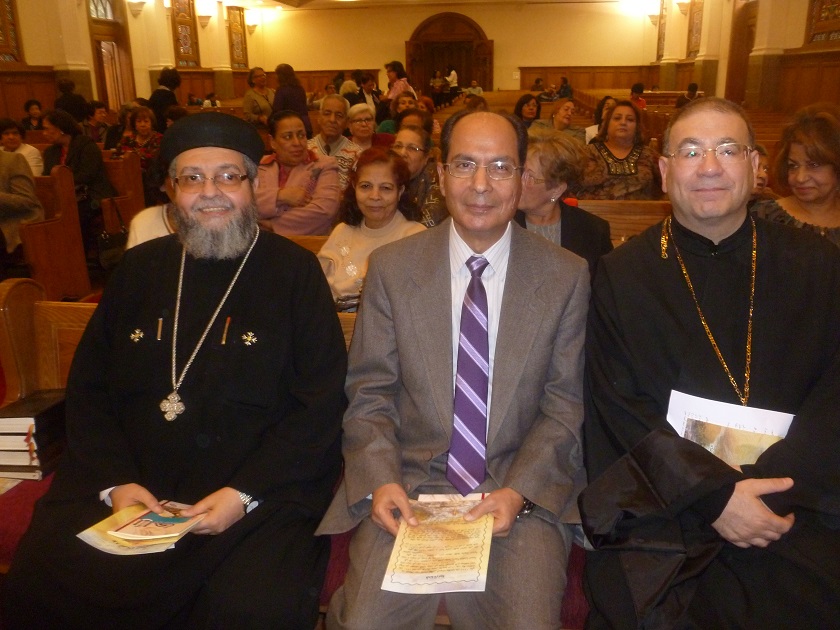
Fr. Bishouy of the Orthodox Church, Rev. Makram Naguib of the Heliopolis Evangelical Church (host), and Fr. Rafik Greish of the Catholic Church
“There is more cooperation and more unity among the churches, there is a new spirit to share with one another,” said Fr. Bishouy Helmy, general secretary of the ECC. “If the invitation was received earlier we could have done more, and hopefully next year we can host it in an Orthodox church.”
If Orthodox participation is poised to increase, this will go a long way in fulfilling the longstanding goals of these dedicated prayer activists.
“We want every woman to know she is a member of the body of Jesus and should serve him as much as she can, fully integrated in her family, her church, and her society,” said Nadia Menis, who personally won the papal endorsement and has been involved with the World Day of Prayer since 1967. “We want to uplift women concerning her health, her creation in the image of God, and her equality with men – creating awareness throughout the world.”
The World Day of Prayer is dedicated to such awareness, but this year as a byproduct helped make the world more aware of Egypt. Cinda, a PCUSA staff member working with the Evangelical Theological Seminary of Cairo, joined a WDP event in Canfield, Ohio by Skype video, and related her personal experiences in Egypt. She noted the official program told only of the revolution of 2011, and wanted the church in America to be up-to-date. She focused on the Christian example given after churches were burned throughout the country this past summer.
“These brave Egyptian Christians,” Cinda told them, “it was as if the biggest, meanest bully on the playground smacked that wiry kid with the glasses in the face and the playground monitor looked the other way. The victim just stood up with his bloody nose and his broken glasses and stared back at the bully. No raised fists. No running away.” She related how Pope Tawadros declared the buildings could be considered a burnt offering, if it was necessary for Egyptian freedom.
The troubled national situation dominated the prayers of Egyptian WDP participants. Egyptian Christians have joined the government in condemning the popularly deposed president’s Muslim Brotherhood as a terrorist organization, and deplore Western opinion that calls his removal a coup d’etat. They ask God now for a good president in the upcoming elections, for stability, and for improved economic conditions. They pray for the educational system, and against fanaticism and corruption. They pray for regional peace, the return of tourism, and for all Egyptians to know God’s love. And as appropriate for an ecumenical gathering, they pray for unity and the favor of God.
“Give us wisdom to know how to go through this difficult period,” prayed Fr. Bishouy to close the service. “Fulfill your promise: ‘Blessed be Egypt, my people’, where Jesus drank from our River Nile.”
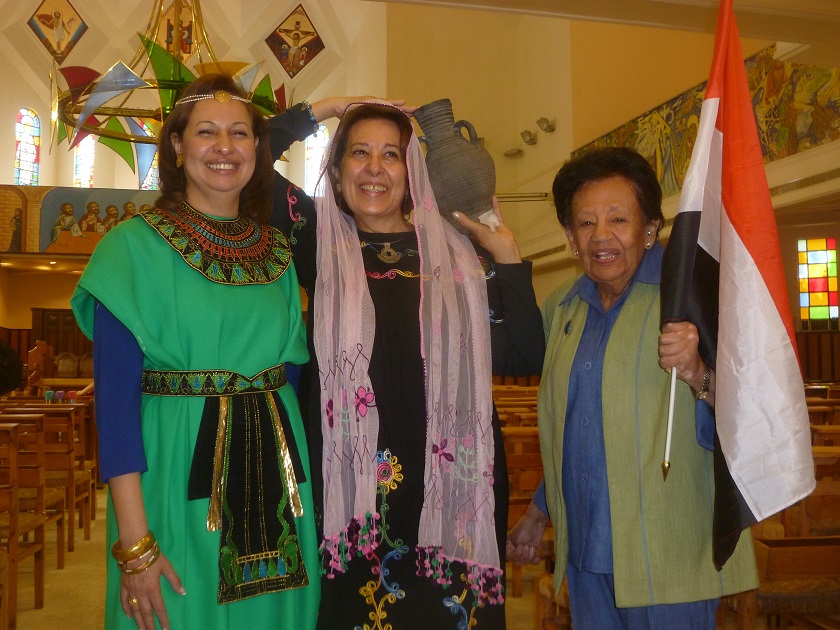
Three of the organizers led a presentation honoring Egyptian women through the ages
Keep Egypt safe, from both threat and rumor. Help her to distinguish between the two.
Several Western embassies closed their doors this week, citing security threats but giving few details. The government seemed offended, and some claimed conspiracy. Stability comes from both truth and perception.
Leaks were released, with the voice of an army general instructing falsification of documents to make legal the detention of former president Morsi. The government claimed the recording a fake, and some wondered about treachery. Unity in the military is both safeguard and question.
Interpol listed a pro-Brotherhood, elderly Egyptian sheikh in Qatar as wanted by Cairo on criminal charges of inciting murder. The government calls him a terrorist, and some call him a godfather. Polity in Islam is both support and threat.
God, rumors are rampant in Egypt, as are the threats. Defend her from both.
May embassies open, and leaks seal. May transparency serve, and justice rule. May terrorism cease, and stability flourish.
Oppose those who spread rumors, God. Bring their whispers to light and expose their ill intentions.
Oppose those who threaten with anything but justice. But support both a righteous order and a bold critique. Rumors are tools of those who lie, but truth is a threat to all who manipulate.
Rid Egypt of their sins, God, and restore to her sons of honest character. May she wisely distinguish between them.
Sara Hanna has spent her last five years in a desert oasis, but despite this she is as normal a young adult as you could find anywhere: a 29-year-old university graduate keen to make a difference with her life.
‘I want to do something with meaning, to give my life for other people,’ she told Lapido Media. ‘I have a good education but others haven’t had the chance. I must create these opportunities for others.’
Many restless youth will dabble in volunteer social work for similar reasons. Others will seek a career in the field. But few can match Hanna’s experience on the Cairo-Alexandria desert road, or hope to witness the transformation she will help create.
Her last five years were spent at Anafora, an experimental community created by Bishop Thomas of the Coptic Orthodox Church.
And on 23 November in Anafora, she was one of 26 Egyptian MA graduates of the Catholic University of Lyon, France, in a ceremony coordinated with the community’s fifteenth anniversary.
‘I have lived here because I believe in the vision of Bishop Thomas and the message of Anafora,’ Hanna said. ‘It is to lift up every person.’
The name Anafora means ‘to lift up’ in the ancient Coptic language, and is used of the sacrificial offering presented in the Orthodox liturgy.
Bishop Thomas presides over the diocese of Qusia, 270 kilometers from Cairo in the heart of Upper Egypt. The Asyut governorate where he is based suffers from 70 per cent poverty and 33 per cent illiteracy.
Couple these statistics with a traditional, conservative mentality, and Bishop Thomas concluded that drastic measures were necessary.
Bishop Thomas
‘We wanted to be more free, more relaxed,’ he told Lapido Media. ‘To do this we needed to have Anafora outside their local setting.’
Today around 100 people, mostly from Qusia, have come to work in the retreat centre and various farming and educational programs on the 120 acre property. Hundreds of young people come every year and mix with international visitors, cross-pollinating in cultural exchange.
And like Hanna, some of them stay.
She is from Cairo and now directs the educational programs at Anafora. She supervises the tutoring of 50 high school dropouts, aged 16-41, to prepare them to return to Qusia and complete their high school degree. Fifteen others are in a vocational training program, learning skills through which they can gain employment or start small businesses back home.
In development is a nine-month certificate course in addiction counseling, in cooperation with the NET Institute in Florida.
Sister Partheneya, Hanna’s fellow graduate, estimates 40 per cent of male students in the Qusia ‘Son of the King’ youth program suffer from addiction to drugs, alcohol, cigarettes, or pornography. Five priests are enrolled and plan to create Qusia’s first addiction recovery center, which will be open to all.
But the joint program with the Catholic University is Bishop Thomas’ highest level of educational investment. Hanna and her colleagues received the equivalent of an MA in Local Development and Human Rights.
Furthermore, within five years Hanna will become the leader of an Anafora team and take on all the training. Until then professors will come from France and adapt their teaching to the local context.
It is the first extension program offered by the university, but they hope to replicate it elsewhere.
‘Bishop Thomas is a visionary and helped create a new idea,’ Olivier Frerot, the vice-rector at the Catholic University of Lyon, told Lapido Media. ‘He is creating civil society from the bottom up.’
Among the graduates were 15 priests and two sisters. It is normal in Qusia for the better-educated priests to also serve as community leaders. The next batch of students has much more laity.
‘When you want to implement a new culture and elevate the whole society, you must convince the leaders first,’ said Fr. Angelos Faltas, one of the graduating priests. He partners with Muslim NGOs to combat illiteracy, and has begun an internship program with five local factories to train 100 men for the labour market every three months.
But it is not just the leaders that Bishop Thomas needs to convince. It took 10 years before Anafora finally saw local acceptance of his transformative vision.
One proof is in the prestigious American University of Cairo’s scholarship program. Each year since 2004 the university selects two students from each governorate, and 60 per cent of those from Asyut have come from the diocese of Qusia, said the bishop.
These students are honoured as role models for the community, representing Egypt at the highest levels. The only challenge is to get some to stay. Internal migration draws the best and brightest away from nearly all villages in Upper Egypt.
The priests will stay, as they are bound to the church. But from distant Anafora, Hanna explains her hope for the training.
‘It helps people know how to develop their local community,’ she said. ‘Now they will think how to stay and serve, rather than how to leave.’
This article was originally published at Lapido Media.







 Jayson Casper