Categories
Christianity Today Europe Middle East Published Articles

The German Theologian Bringing Protestants and Catholics Together

Image courtesy of Thomas Schirrmacher

Eleven American Pentecostal pastors sat nervously with Pope Francis at the Vatican in June 2016. The meeting, arranged by Thomas Schirrmacher, then chair of the theological commission of the World Evangelical Alliance (WEA), was an opportunity for the guests to ask the pontiff anything they wanted. Two years earlier, Francis had publicly apologized for past Catholic persecution of the charismatic movement.

At the time, the Italian Evangelical Alliance had cautioned against growing ecumenical openness where “insurmountable” doctrinal obstacles exist. The American delegation was similarly opposed to Schirrmacher’s engagement but had agreed to the meeting. No one wanted to ask the first question. Amid the awkwardness, Francis took the initiative.

He asked the delegation to pray for him.

Schirrmacher said what followed was a life-changing experience for the Pentecostals. They prayed for the pope. He prayed for them. By the end, he said, their theological concerns didn’t matter much anymore as they agreed with Schirrmacher that Francis was a genuine believer and had no intention to convert them to Catholicism.

Matters of theology and doctrine have always mattered to Schirrmacher, who turns 66 today. The German theologian has four doctoral degrees and authored more than 100 books, including a six-volume treatise on ethics. Committed to Christian unity, he served as general secretary of the World Evangelical Alliance from 2021 to 2024. Yet his life has been a lightning rod of controversy—particularly when he neared the halls of power.

Even seemingly straightforward truths, he finds, have prompted critical reaction.

“If I say, ‘God is love,’” said Schirrmacher, “it could start a global discussion.”

Born in 1960, Schirrmacher traces his family history to 18th-century Huguenots exiled from Austria to Prussia. His father served on the board of the missions agency World Evangelization for Christ, and Schirrmacher interacted with many visiting missionaries. He met Billy Graham as a child, and again in 1983. By then, Schirrmacher was a young pastor who had planted seven churches. Graham advised him to continue pursuing advanced theological studies.

Two years later, a covered-up scandal at his church led Schirrmacher to resign, he said. He and his wife Christine started a publishing house in Bonn. Secular titles sold, while religious books sustained his passion. Schirrmacher described these as “some of the best years of their lives,” as they focused on their business, child-rearing, and academics—he in ecumenical theology and she in Islamic studies. Her focus supported his fledgling interest in religious freedom, leading to a 1985 visit with the Orthodox ecumenical patriarch in Turkey.

But Schirrmacher did not only aim for unity abroad. In 1994, despite his cessationist upbringing, he brought Pentecostals into the Bonn Evangelical Alliance. Two years later, he also navigated opposition to integrating them into the national Evangelical Alliance of Germany. All the while, he continued his academic studies, teaching missions at the Reformed Episcopal Seminary in Philadelphia and founding the Martin Bucer Seminary in Bonn in 1996.

Then the Pentecostals tested his ecumenism.

The European Assemblies of God approached Schirrmacher to send its pastors to study at his newly formed institution. At first he refused, as their beliefs didn’t match with the school’s Reformed theology. Eventually he accepted, but first Schirrmacher asked to preach an anticharismatic sermon at the largest Pentecostal church in Germany.

He spoke against pride in the spiritual gifts while also validating God’s continued use of signs and wonders to draw people to Jesus—emphasizing they also point to the importance of the Scriptures and the church. After his closing prayer, the senior pastor ran up to the stage and asked, “When can you come back?” as the audience jumped and clapped in appreciation.

Schirrmacher felt convicted.

“I felt like Peter in that story, as if God told me directly, ‘I am using the Pentecostals to evangelize the world, so you cannot bypass them,’” he said, referring to Peter’s meeting with Cornelius in Acts 10.

The Assemblies of God were not the only outliers at Martin Bucer. Schirrmacher’s connection to Turkey led…

This article was originally published at Christianity Today on June 25, 2026. Please click here to read the full text.

And click here for a Q&A interview with Thomas Schirrmacher on his involvement with the Muslim world, published at Middle East Harmony. Among other topics, it asks how he views the region differently than most American Christians.
Categories
Middle East Presbyterians Today Published Articles

New Hope in Turbulent Times

A condensed version of this article was printed in the December 2014 edition of Presbyterians Today. Please click the link below to open it in pdf, and here to view the magazine’s feature articles.

New Hope in Turbulent Times (pdf)

WDP Women at Prayer

God’s planning is perfect. In 2008, long before the Arab Spring fixed world attention on the Middle East, the women of the World Day of Prayer International Committee designated Egypt to write the program for their 2014 event, held on March 7. In retrospect, God arranged for the more than 170 member nations to focus on Egypt during this critical time.

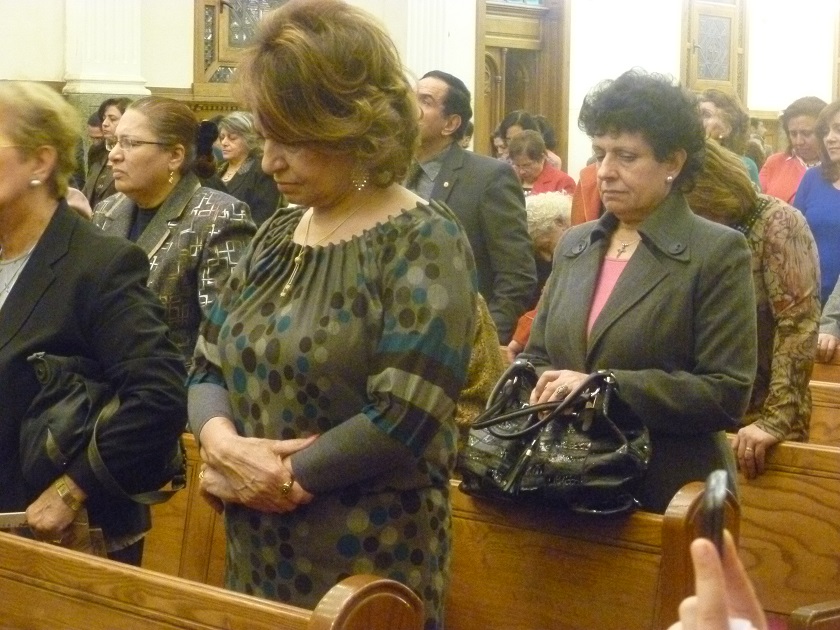
“All around the world people are praying for us today, and this should fill us with serenity and thanks,” announced Rev. Emil Nabil to the 300 mostly middle aged women at the main gathering in Cairo, one of over twenty locations hosting a WDP event. But off the podium the assistant pastor of the Heliopolis Evangelical Church, affiliated with the Presbyterian Synod of the Nile, had a somewhat different take.

“This event is not very well known here, even among Christians,” he said. “It has a following among women, but needs better communication.” Meanwhile at the English language service across town, Rev. Chris Chorlton announced tongue-in-cheek, “I asked ten Egyptian friends about the World Day of Prayer, and no one knew anything about it.”

The first World Day of Prayer was held in 1928, and even at that early date Egypt was among the participants. The local Presbyterian church led the efforts, with other denominations joining thereafter. By 1970 the WDP committee of Egypt drew from all national churches, but outside of individual participation the majority Orthodox – 90 percent of Egyptian Christians – remained largely aloof.

“Not many people are ecumenical, especially in the past,” stated Dalia Hanna, one of the younger Presbyterian WDP organizers. “It is getting better now, but there is some fanaticism in all denominations.”

Hannah was raised Orthodox but had a born-again conversion experience in her church sponsored Bible study group. But as her priests bickered over the legitimacy of their small fellowship, she decided to worship near her work at the American University in Cairo, at the famed Kasr el-Dobara, the largest Protestant Church in the Middle East. “The more I got involved the more the Lord led me back to build bridges with other denominations,” she said.

In the process Hanna was challenged with her own inner fanaticism. She traveled with the Egypt delegation to the June 2012 WDP quadrennial meeting in New York City, engaging with women from around the world about the Samaritan woman, the devotional prepared by her team. Hanna was shocked to find that not everyone present considered the object of Jesus’ attention to be a sinner. Similar debate about the nature of Islam confounded her.

“We had cultural differences that could lead to conflict,” she said, “but when you are exposed to such an environment you have to learn to be tolerant of others, even though your first reaction is to say, ‘You are wrong.’”

Similar, if easier transformations were witnessed back in Egypt as the working committees planned the program and the order of service. Mervet Akhnoukh, chairperson of the board of the Coptic Evangelical Organization for Social Service, cherished how Protestant, Catholic, and Orthodox women found common purpose.

“We prayed that our work would be of God, and we became friends,” she said. “The committee was a great ecumenical example, we became like one in the process of working together.”

Her committee included many Orthodox women, but the key toward wider knowledge of the World Day of Prayer rests with the clergy. In preparation for the yearly WDP, organizers hold monthly meetings to plan and pray, rotating through the different denominations. Orthodox priests welcome the group into their halls, but look to the pope for official sanction to be a part of a non-Orthodox service.

Hanna commended the recently deceased Pope Shenouda as a man of God, but described how doctrinal issues sometimes made Orthodox church leadership wary of the other denominations. But the new pope has brought a spirit of openness, she said, and this year it paid dividends.

The WDP committee presented their program to Pope Tawadros at the one year anniversary celebration of the Egypt Council of Churches (ECC), a landmark achievement he inaugurated with the other denominations. The pope gave his blessing, communicated publicly on the ECC Facebook page. And for the first time in many years, an Orthodox priest attended the main gathering, bringing along thirty women from his church, most of them from the younger generation.

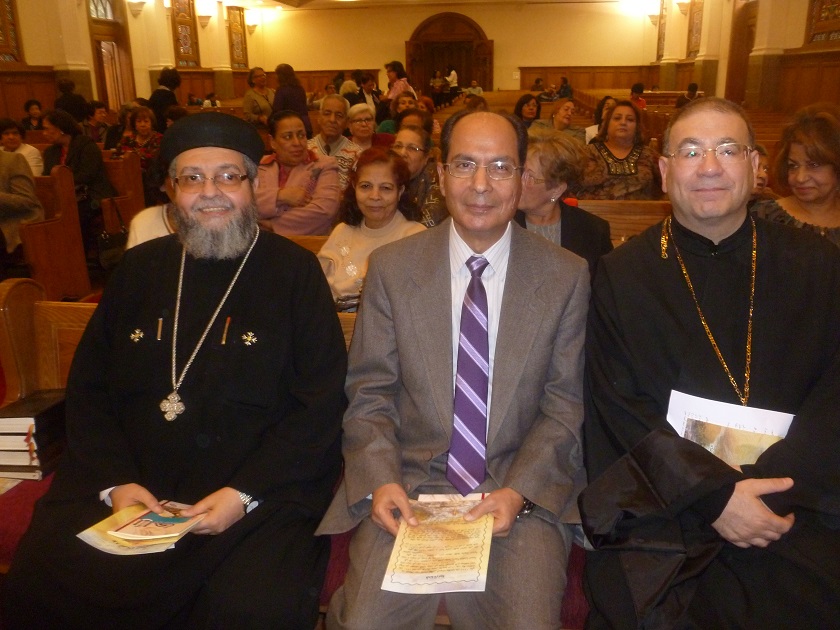
Fr. Bishouy of the Orthodox Church, Rev. Makram Naguib of the Heliopolis Evangelical Church (host), and Fr. Rafik Greish of the Catholic Church

“There is more cooperation and more unity among the churches, there is a new spirit to share with one another,” said Fr. Bishouy Helmy, general secretary of the ECC. “If the invitation was received earlier we could have done more, and hopefully next year we can host it in an Orthodox church.”

If Orthodox participation is poised to increase, this will go a long way in fulfilling the longstanding goals of these dedicated prayer activists.

“We want every woman to know she is a member of the body of Jesus and should serve him as much as she can, fully integrated in her family, her church, and her society,” said Nadia Menis, who personally won the papal endorsement and has been involved with the World Day of Prayer since 1967. “We want to uplift women concerning her health, her creation in the image of God, and her equality with men – creating awareness throughout the world.”

The World Day of Prayer is dedicated to such awareness, but this year as a byproduct helped make the world more aware of Egypt. Cinda, a PCUSA staff member working with the Evangelical Theological Seminary of Cairo, joined a WDP event in Canfield, Ohio by Skype video, and related her personal experiences in Egypt. She noted the official program told only of the revolution of 2011, and wanted the church in America to be up-to-date. She focused on the Christian example given after churches were burned throughout the country this past summer.

“These brave Egyptian Christians,” Cinda told them, “it was as if the biggest, meanest bully on the playground smacked that wiry kid with the glasses in the face and the playground monitor looked the other way. The victim just stood up with his bloody nose and his broken glasses and stared back at the bully. No raised fists. No running away.” She related how Pope Tawadros declared the buildings could be considered a burnt offering, if it was necessary for Egyptian freedom.

The troubled national situation dominated the prayers of Egyptian WDP participants. Egyptian Christians have joined the government in condemning the popularly deposed president’s Muslim Brotherhood as a terrorist organization, and deplore Western opinion that calls his removal a coup d’etat. They ask God now for a good president in the upcoming elections, for stability, and for improved economic conditions. They pray for the educational system, and against fanaticism and corruption. They pray for regional peace, the return of tourism, and for all Egyptians to know God’s love. And as appropriate for an ecumenical gathering, they pray for unity and the favor of God.

“Give us wisdom to know how to go through this difficult period,” prayed Fr. Bishouy to close the service. “Fulfill your promise: ‘Blessed be Egypt, my people’, where Jesus drank from our River Nile.”

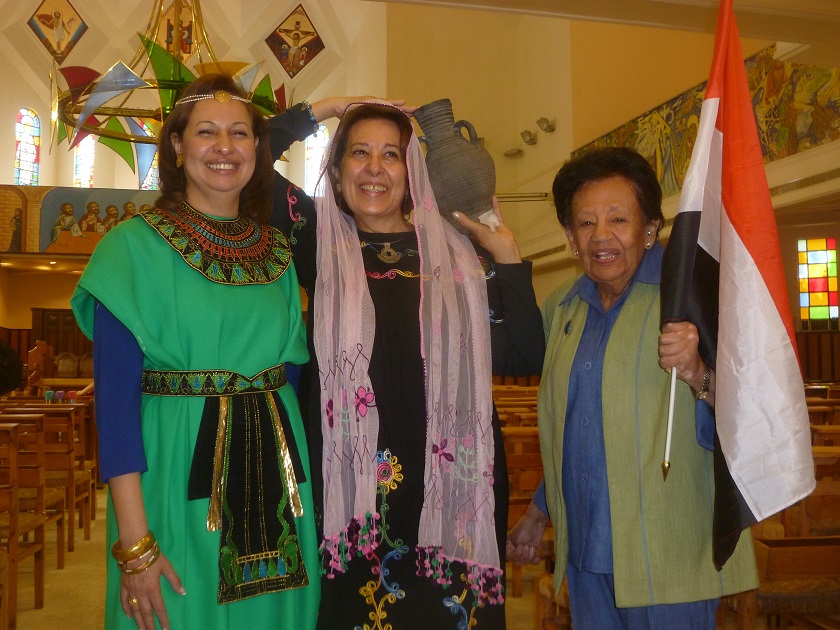
Three of the organizers led a presentation honoring Egyptian women throughout the ages
Three of the organizers led a presentation honoring Egyptian women through the ages