Categories
Christianity Today Middle East Published Articles

Syrian Christians Brave Insecurity to Stay Behind and Help

Syria Open Doors
via Open Doors USA

This article was first published at Christianity Today, on October 18.

Though most of the fighting has stopped for now, Turkey’s incursion on Kurdish-controlled northern Syria has left another humanitarian crisis in its wake.

Local churches as well as Christian organizations like Open Doors and Preemptive Love Coalition have prioritized caring for the citizens who took the risk to stay behind and helping the displaced return.

Last Saturday night, after three days of Turkish bombing, the Alliance Church of Qamishli met to make a decision. Would they flee for safety, or remain and help?

To some degree they had no choice.

Fadi Habsouna, a father of two, was injured when missiles hit his home and ruined his shop. His wife is in critical condition. His grandfather’s home was destroyed by a bomb. The pastor housed them in church-owned property, and decided to remain to assist the family, and others suffering similarly.

The church agreed; only eight families would leave.

“These are extremely brave people who want to be salt and light in their communities,” said David Curry, CEO of Open Doors USA, who relayed this story from his field staff. “They want to maintain the presence of Jesus and reach out.”

Open Doors is better known for its advocacy work on behalf of the persecuted; Syria ranks no. 11 on its World Watch List of places hardest to be a Christian. Its local partners keep a low profile in order to provide on the ground assessment. But the crisis in Syria has driven them to humanitarian aid.

It is not the first time. Following the rise of ISIS in 2014, Open Doors helped 150,000 Christians located in camps along the Turkish and Lebanese borders. Now their community hubs are providing food, medical care, hygiene kits, and temporary shelter in the northeast Syrian towns affected by the Turkish incursion.

“Christians have to make hard choices,” Curry said. “Leave the communities they were raised in, move inland, or …”

Please click here to read the full article at Christianity Today.

Categories
Christianity Today Middle East Published Articles

Jordan Evangelicals Push for Official Recognition

Jordan Evangelical Council
The King Abdullah Mosque in Amman, Jordan (via atlastravels.net)

This article was first published at Christianity Today on October 10.

Evangelicals in Jordan have a new leader. They just don’t have anything official for him to lead yet.

Five denominations, including Baptists, Assemblies of God, Evangelical Free, Nazarene, and Christian and Missionary Alliance (CMA) churches, met a month ago to elect Habes Nimat as president of the Jordanian Evangelical Council. They comprise 57 churches total.

“I would like to believe that they chose me because I am a team player,” said Nimat, who has led a CMA congregation in the capital city of Amman since 2017. “I have good relations with the evangelical society, the local society, and they know my work with Christians of all denominations.”

Established in 2006, the council is the fruit of nearly 100 years of evangelical outreach in Jordan. Numbering roughly 10,000 individuals, evangelicals remain a small minority among the 2.2 percent of Christians in Jordan’s overall population of 10 million, almost exclusively Sunni Muslims.

Nimat will need to rely on these good relations to achieve the most pressing evangelical concern—legal recognition of the council as an official Christian denomination.

Jordan currently recognizes 11 Christian denominations: Greek Orthodox, Roman Catholic, Armenian Orthodox, Melkite Catholic, Anglican, Maronite Catholic, Lutheran, Syrian Orthodox, Seventh-day Adventist, United Pentecostal, and Coptic.

They are organized into the official Council of Church Leaders (CCL), which functions as a government advisory body. The prime minister will confer with the CCL on whether or not to admit new representation.

“We have been working on registration for many years as one body,” said Nimat, “but so far, we have not heard an answer from them, neither positive nor negative.”

Representation on the CCL entitles the denomination to…

Please click here to read the full article at Christianity Today.

Categories
Christianity Today Middle East Published Articles

Christians Killed on Syria’s Front Lines

Turkey Shelling Syria
Smoke rises over the Syrian town of Tel Abyad, as seen from the Turkish border town of Akcakale in Sanliurfa province, Turkey, October 10, 2019. REUTERS/Murad Sezer

This article was first published at Christianity Today, on October 11.

Three Christians have been killed in Turkey’s assault on Kurdish-held areas in northeast Syria, reported In Defense of Christians (IDC), citing their sources on the ground.

In Qamishli, a Syriac Christian and his wife died, while in Ras al-Ain an additional Syriac Christian civilian was killed. Ten civilians were injured in the attacks.

“People were so scared, they were telling me, ‘They are bombing us right now!’” Bassam Ishak, president of the Syriac National Council of Syria, told NPR. “We think this is a message to the Kurds and Christians there to leave, so Turkey can move refugees there. We think it’s a form of ethnic cleansing.”

The Turkish operation focused initially on a 60-mile stretch of land between the two Arab-majority cities of Ras al-Ain and Tel Abyad, a sparsely populated area known as Syria’s breadbasket, reported BBC. IDC, which advocates for Christians and other religious minorities in the Middle East, said that this area has large concentrations of Christians.

In total seven civilians were killed, including two children, reported Channel 4. Retaliatory Kurdish mortar fire into Turkey killed…

Please click here to read the full article at Christianity Today.
Categories
Christianity Today Middle East Published Articles

Syrian Christians to US: ‘Don’t Abandon Us Now’

Kurds Syria USA
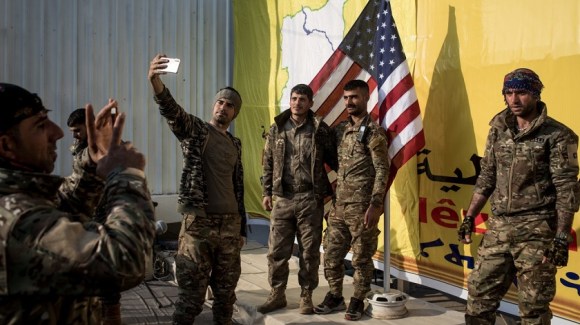
Image: Chris McGrath / Getty Images; The Kurdish-led and American-backed Syrian Defense Forces (SDF) announced the defeat of the Islamic State in at a ceremony in Baghouz in March.

This article was first published by Christianity Today on October 8.

Not long after the defeat of the Islamic State in the area, Syrian Christians warn that US military withdrawal from the Kurdish-controlled region, announced yesterday by President Donald Trump, will expose them to danger.

“The expected military invasion [by Turkey] and the possible confrontation with the Kurds might oblige Christians of the region to leave,” said Joseph Kassab, president of the Supreme Council of the Evangelical Community in Syria and Lebanon. “This means one more tragedy to the Christian presence in Syria.”

Seeking to honor his campaign promises to extract America from “endless war,” Trump yielded to Turkey’s demand to establish a “safe zone” along its southern border with Syria. Since August, the United States and Turkey administered a joint buffer zone patrol in the Kurdish-majority area.

Turkey’s objectives are two-fold. First, to resettle up to 2 million Syrian refugees currently residing in Turkey. Second, to clear the border of Kurdish fighters linked to the Kurdistan Workers Party (PKK), deemed a terrorist entity by both Ankara and Washington. Turkey’s President Recep Tayyip Erdogan had threatened to establish a 20-mile corridor unilaterally, frustrated by US cooperation with Kurdish fighters belonging to the PKK.

The Kurdish-controlled area of northeast Syria stretches 300 miles from the Euphrates River to the Iraqi border. Approximately 750,000 people live there, including estimates of between 40,000 and 100,000 Christians.

Over 700,000 Christians have fled Syria since 2011. And while some warn of further displacement, others fear a greater threat.

“Turkey aims to kill and destroy us and to finish the genocide against our people,” said a statement issued by…

Please click here to read the full article at Christianity Today.
Categories
Americas Christianity Today Published Articles

Duke-UNC Middle East Studies Center Flagged for Anti-Christian Bias

UNC-Duke
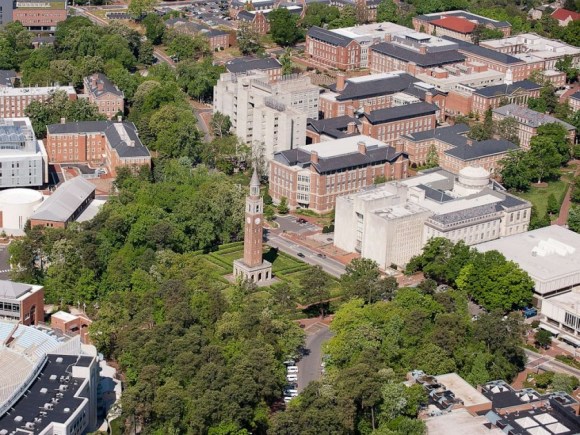
Lance King/Getty Images: An aerial view of the University of North Carolina campus including the Morehead-Patterson Bell Tower (center) on April 21, 2013 in Chapel Hill, North Carolina.

This article was first published at Christianity Today, on September 27.

Certain evangelicals have long complained about bias in American universities. The government may now be doing something about it, as Secretary of Education Betsy DeVos examines a prominent Middle East studies program for downplaying Christianity and other non-Muslim faiths.

A three-page letter sent by the Department of Education chastised the Duke-University of North Carolina Consortium for Middle East Studies (CMES), jointly administered by the two universities, for its “considerable emphasis placed on understanding the positive aspects of Islam.”

The complaint also found “an absolute absence of any similar focus on the positive aspects of Christianity, Judaism, or any other religion or belief system in the Middle East.”

At stake is the Duke-UNC consortium’s status as a “national resource center,” a term created by Title VI of the 1965 Higher Education Act. It authorizes Congress…

The school had its response:

The Duke-UNC consortium, though it agreed to establish an advisory board in compliance with the ministry’s letter, ultimately defended its Middle East program.

Enrollment in Urdu studies ranks first in the nation, they wrote in reply. Arabic and Turkish rank eighth. It listed the many events held on Middle East minorities, saying “positive appreciation … suffuses” their outreach activities.

And whereas government employment lags behind academia, if counting also the Title VI emphasis on business, 30 percent of graduates work in that field.

Meanwhile the items deemed inappropriate by the ministry were a small percentage of over 100 organized each year, none of which were supported by federal funds.

The academic establishment also came out in their defense, calling the inquiry “unprecedented and counterproductive.” Nineteen scholarly societies, including the American Academy of Religion, the Middle East Studies Association, and the Society of Biblical Literature, published a joint reply…

Please click here to read the full article at Christianity Today, including three evangelical professors who give their perspective.

Categories
Americas Christianity Today Published Articles

In UN Speech, Trump Announces New Religious Freedom Initiatives

Trump United Nations
UN Photo/Manuel Elias Secretary-General António Guterres and Donald Trump, President of the United States of America, attend the Global Call to Protect Religious Freedom briefing. (23 September 2019)

This article was first published at Christianity Today on September 23.

Speaking before the United Nations today, President Trump praised the country’s religious freedom record and cited figures that suggest the rest of the world has much work to do, as he announced new funding to protect religious sites as well as business partnerships to fuel the cause.

“Our nation was founded on the idea that our rights do not come from government, but from God,” said Trump. “Regrettably, the freedom enjoyed in America is rare in the world.”

Trump said he had asked Vice President Mike Pence to double-check the figure of 80 percent of the world’s population living in areas that restrict religious freedom. According to Pew Research, 83 percent of the population lives in places with “high” or “very high” restrictions, mostly targeting religious minorities.

“Today, with one clear voice, the US calls on the nations of the world to end religious persecution,” Trump said.

Pence stated that Trump was the first world leader to chair a meeting on religious freedom at the United Nations.

Seeking international consensus on religious freedom, he called out Iran, Iraq, China, Venezuela, and Nicaragua for their violations and mentioned the terrorist tragedies that struck down Jews in Pittsburgh, Muslims in New Zealand, and Christians in Sri Lanka.

Under Trump’s leadership, Pence said, the United States passed the Genocide Recovery and Persecution Response Act to protect religious minorities in the Middle East, and the State Department’s International Religious Freedom Fund dispersed 435 rapid response grants since 2018, aiding 2,000 victims of persecution. A year ago, the Trump administration doubled its funding for Christians and religious minorities returning to Iraq.

“As President, protecting religious freedom is one of my highest priorities, and always has been,” said Trump, who today pledged an additional $25 million to protect religious sites and relics around the world that are under threat. He urged the global community join in “measures to prevent the intentional destruction of religious sites and relics,” including attacks on houses of worship…

Please click here to read the full article at Christianity Today.

Categories
Americas Christianity Today Published Articles

Evangelicals Who Distrust Muslims Likely Don’t Know Muslims

Ramadan IHOP
How IHOP Became a Ramadan Favorite — image: Jason Hoffman/Thrillist

This article was first published at Christianity Today on September 12.

Earlier this week, a Baptist church in Michigan canceled an event titled, “9/11 Forgotten? Is Michigan Surrendering to Islam?” due to pushback from fellow Christians and politicians.

The pastor of Bloomfield Hills Baptist Church identifies as an Islamophobe and organized the gathering because he sees Islam as a growing threat in the US, The Washington Post reported.

While some fellow white evangelicals share his suspicions, research has shown that those who know Muslims in their communities tend to hold more positive views and are more likely to see commonalities between their two faiths.

“The personal relationships with Muslims, that’s a game changer,” Todd Green, Luther College professor and former Islamophobia adviser to the US State Department, told ThePost. “It tends to make you less Islamophobic.”

Yet surveys from various sources have noted the friendship gap between evangelicals and their Muslim neighbors. More than a third (35%) of white evangelicals knew a Muslim personally in a 2017 Pew Research Center release, fewer than any other religious group, and evangelicals surveyed rated Muslims more negatively than other faiths.

The Southern Baptist-affiliated LifeWay Research found in 2017 that 17 percent of those with evangelical beliefs reported having a Muslim friend, while the Foundation for Ethnic Understanding (FFEU) reported this year that only 22 percent of evangelicals say they interact frequently with Muslims.

FFEU, led by a rabbi seeking to improve Muslim-Jewish relations, also noted that 1 in 3 evangelicals with frequent interaction with Muslims viewed Islam as similar to their own faith compared to 1 in 4 evangelicals overall.

The latest research from the Institute for Social Policy and Understanding (ISPU), a prominent American Muslim organization, offers another look at the relationship between the two faiths.

The 2019 ISPU poll, released last spring, surveyed a representative sample of the US population along with a sample of Muslims and of Jews. The results may not offer as precise a picture of other religious subgroups due the higher margin of error, but still gives a valuable snapshot at broad trends between the faiths.

Here are five takeaways for evangelicals from one of the leading indicators of Muslim community sentiment in America.

1. White evangelicals lag behind in knowing and befriending Muslims; Jews excel.

When asked, “Do you know a Muslim personally?” 35 percent of evangelicals and 44 percent of Protestants said yes…

Please click here to read the full article at Christianity Today.

Categories
Americas Christianity Today Published Articles

When Islam is Not a Religion in America

Asma Uddin

This article was first published at Christianity Today on September 9.

Is Islam a religion?

This question is regularly posed by populists seeking to restrict Muslims in America. If Islam is not a religion—if it is a militant ideological system, for example—then some argue it is not subject to First Amendment protection.

At stake is the protection of religious liberty, writes lawyer Asma T. Uddin in When Islam Is Not a Religion: Inside America’s Fight for Religious Freedom. Her new book details recent legal cases involving Muslims, arguing that restrictions on one faith community affect the freedom of all.

Formerly a legal counsel with Becket, a leading religious liberty law firm, Uddin has worked with the US State Department to advocate against the former United Nations resolution on the defamation of religion, which was seen by many as an attempt at international cover for blasphemy laws. And through the Legal Training Institute, she has worked to extend the American understanding of religious liberty to several Middle Eastern, North African, and Southeast Asian countries.

Uddin, a Muslim of Pakistani descent, has worked on religious liberty cases at the federal and Supreme Court levels—including the Hobby Lobby and Hosanna-Tabor victories praised by conservative Christians—defending evangelicals, Catholics, Jews, Native Americans, and Muslims. Christianity Today, which recently editorialized on why religious freedom isn’t just for Christians, spoke with her on the sidelines of the recent US State Department Ministerial to Advance Religious Freedom.

CT: American evangelicals are often concerned that Christians have their religious liberty threatened around the world, often in Muslim-majority nations. The focus of your book is Muslim religious liberty, threatened in the United States. What sorts of challenges do Muslims face in America?

Uddin: I think it’s important to point out that the book doesn’t just look at attacks on Muslims. The book looks broadly at the attack on religious freedom, seen through the prism of attacks on Muslims. I discuss violence against churches, synagogues, and Sikh temples.

But in terms of threats to Muslim religious freedom specifically, I look at the nationwide anti-mosque controversy, which started in earnest after the so-called “Ground Zero mosque” fiasco. From there, it spread to Murfreesboro, Tennessee, which was the first community to be affected while attempting to build a mosque. That’s where the claim was made that Islam is not a religion.

To this day, there are ongoing struggles to build mosques. It’s not just litigation, but also arson and fire bombing. There is even a question about Muslim cemeteries, to the point where American Muslims are unable to bury their dead. That’s the challenge we’re facing to our human dignity…

Please click here to read the full interview at Christianity Today.

Categories
ERLC Light Middle East Published Articles

A Tale of Three Churches

New Capital Cathedral
U.S. Secretary of State Michael R. Pompeo visits the Cathedral of the Nativity in Cairo, Egypt, on January 10, 2019. [State Department photo/Public Domain]
This article was first published in the Summer 2019 print edition of Light magazine, produced by the Ethics and Religious Liberty Commission.

In January, President Abdel Fattah al-Sisi of Egypt stood side-by-side with Pope Tawadros II, patriarch of the Coptic Orthodox Church. Inaugurating the Cathedral of Nativity, the largest church in the Middle East, he uttered two remarkable words that reverberated through the national broadcast to Muslim homes throughout the nation.

“Merry Christmas.”

If some Christians find this phrase under siege in America, they have no idea the power unleashed by the president’s words. Eight years earlier, emboldened by the Arab Spring and empowered by the Muslim Brotherhood presidency of Mohamed Morsi, ultra-conservative Salafi Muslims sparked nationwide controversy by declaring no pious Muslim could utter the words.

Their point was theological—Christmas celebrates God becoming man in Jesus, and a Muslim cannot congratulate a Christian neighbor for such blasphemy. But the impact was social. Easygoing Egyptians had long wished each other good greetings on respective religious feasts. Salafis are better practicing Muslims than we are, many would admit, and a chill began to spread in community relations.

When then-defense minister Sisi overthrew Morsi following widespread protests against his rule, he did so with Pope Tawadros—and the head of al-Azhar, the leading Islamic institution in Egypt—standing nearby in support. As president he became the first to attend a Christmas mass, a practice he has continued. He speaks strongly about the rights of Christians and their place in the nation. And in building a new capital city he made sure the centerpiece landmarks would be the region’s largest mosque and church, built side-by-side. There is no Merry Christmas controversy today.

But do Sisi’s words fall on deaf ears? Are the arms of the state too weak? Or might he be of double mind, grandiloquent in gesture, apathetic in implementation? Two other church examples counterbalance the cathedral…

Please click here to download the print edition; my article is on page 54.

Categories
Christianity Today Middle East Published Articles

Why Muslims Love Mary

Muslim Mary
Annunciation, from Chronology of Ancient Nations by Al-Biruni, 1307.

This article was published in the July/August print edition of Christianity Today.

Mohammed, a pious PhD student from Egypt, sat guardedly in the “Community of Reconciliation.” Invited by David Vidmar, director of coaching for Peace Catalysts International, the middle-aged Muslim seemed soured on the idea of interfaith exchange at his northern California university.

Vidmar suspected Mohammed came to the jointly led Muslim-Christian dinners because he felt obligated to do da’wah, the Arabic word for spreading Islam. But over a shared meal and discussion about Mary, the Egyptian’s attitude shifted. “The deeper we got into the life of Mary and how Christians understand the virgin birth of Jesus, he became very enthused,” Vidmar said. “There are so many misunderstandings . . . it was wonderful to observe him see the similarities and be able to relax.”

Peace Catalysts is a Jesus-centered peacemaking effort, focused primarily on Christians and Muslims. Vidmar and his family worked for eight years with Uighurs in Kazakhstan and still wish Muslims would experience the love and forgiveness God reveals through Jesus. But now he works to help both sides experience heart transformation through deep and genuine friendship—and Mary proved a fruitful bridge.

“Since so many Muslims use the term ‘Jesus, Son of Mary,’ it would be helpful for evangelicals to think more deeply about this,” Vidmar said. “Muslims often excitedly tell me their favorite chapter in the Qur’an is Maryam, and women especially express appreciation for it.”

Mary is mentioned 34 times in the Qur’an—more than in the New Testament—and its only named woman. Islam upholds the virgin birth, the annunciation by Gabriel, and—mirroring the Ave Maria in Luke’s gospel—declares Mary to be “exalted above all women.”

Yet even Catholics have been slow to recognize the similarities…

Please click here to read the full article at Christianity Today.

Categories
Americas Christianity Today Published Articles

From DC to Mecca, Should ‘Human Dignity’ Be the New ‘Religious Freedom’?

Ministerial
Speakers address participants at a general session on Different Faiths Advancing Religious Freedom Together at the Ministerial to Advance Religious Freedom at the U.S. Department of State in Washington D.C. on July 17, 2019. [State Department photo / Public Domain]
This article was first published at Christianity Today, on July 22, 2019.

In his opening remarks at the second US Ministerial to Advance Religious Freedom, Secretary of State Mike Pompeo welcomed almost 1,000 participants from civil society and more than 100 invited foreign delegations. He challenged every major world religion and secular society—and also invited them in.

“We all agree that fighting so that each person is free to believe, free to assemble, and to teach the tenets of his or her own faith is not optional,” said Pompeo. “Indeed, it is a moral imperative that this be permitted.”

But do all actually agree? A change in human rights language might make the difference.

And could Saudi Arabia improbably become the next champion…?

Please click here to read the full article at Christianity Today.
Categories
Americas Christianity Today Published Articles

Should Christians Praise Partial Religious Freedom?

Partial Religious Freedom
Image: Illustration by Cornelia Li

This article was first published in the June print edition of Christianity Today.

…The tension over praising limited gains is also a factor in Uzbekistan, a Muslim-majority secular nation whose citizens have the right to convert but which the United States has designated a Country of Particular Concern (CPC) since 2006 over religious freedom violations.

At the US State Department’s inaugural Ministerial for Advancing Religious Freedom in July 2018, Uzbek leaders outlined how they were streamlining registration for religious groups and reviewing a law that restricted religion. Last December, the Central Asian nation was removed from the CPC list—only the second nation to ever come off—and put on a watch list instead. But it ranks No. 17 on Open Doors’ list of countries where it’s hardest to be Christian.

Chris Seiple, president emeritus of the Institute for Global Engagement, has worked behind the scenes for 20 years to promote religious freedom in the nation he did his dissertation on. He says activists should publish a list of nations showing the most progress, not just the greatest offenders.

Relational diplomacy involves public praise for small, tangible steps to build trust while communicating practical ways to improve in private, he said. There is a secret to engaging authoritarian contexts: create a rumor so that reality follows…

Please click here to read the full article at Christianity Today.

Categories
Christianity Today Middle East Published Articles

How Palestine Divides Messianic Jews

Messianic Jews
(Oded Balilty, AP)

This article was first published in the May print edition of Christianity Today.

Among Christians in America, Israel can be viewed as a fulfillment of prophecy, a democratic ally in a region of chaos, or an occupier oppressing stateless Palestinians. How to choose?

Given that 2 out of 3 US evangelicals have a positive perception of Israel, according to LifeWay Research, perhaps a better question is: How should evangelicals identify with the issues Israel faces?

Fortunately, there is a useful interpreter. “If the Christian community wants to understand Israel from a believing perspective,” said Jamie Cowen, an Israeli lawyer and a believer in Jesus, “going through Messianic Jews is best.”

However, the complexity of Israel divides even Messianic Jews in attitude toward Palestine, as illustrated by debate this year over an interview provocatively summarized as supporting ethnic cleansing.

“The only rights the Palestinians have are squatter’s rights,” Paul Liberman, executive director of the Alliance for Israel Advocacy (AIA), told The Intercept.

He described how the lobbying arm of the Messianic Jewish Alliance of America (MJAA) was pushing for a shift of US funding from UN–administered Palestinian aid ($364 million in 2017) to an Israeli-led effort offering money to relocate from the West Bank. The goal: eventual annexation of the territory in a one-state solution with fewer Palestinian citizens, maintaining Israel as a Jewish state.

First adopted by the MJAA in 2015, the idea reverberated within Messianic Jewish circles once TheIntercept highlighted efforts to harness evangelical influence in Congress and the White House.

“It is not a removal. It is an opportunity for a much better life,” said Joel Chernoff, CEO of the MJAA. “But the demographic issue is real.”

About 700,000 Jews and 1.5 million Arabs live in Judea and Samaria—the favored name in Israel for the West Bank. Chernoff desires more Jewish settlements there. And he believes many Palestinians already want to escape the territory’s corrupt Palestinian Authority. (A 2017 MJAA poll found half of residents were discussing a move abroad and were open to resettlement in exchange for about $5,000.)

The “ethnic cleansing” headline was a smear tactic by liberal and anti-Israel media, Chernoff said. The issue is not controversial among the MJAA’s 3,000 dues-paying members, 12,000 supporters, or 155 affiliated synagogues. But it is controversial to other Messianic Jews.

“There is not a consensus this is a good proposal,” said Monique Brumbach, executive director of the 75-member Union of Messianic Jewish Congregations (UMJC). “The Scriptures promised the land to the Jewish people. But there will always be other people within it.”

Nearly all Messianic Jews believe modern-day Israel is the fulfillment of biblical promises…

Please click here to read the full article at Christianity Today.

Categories
Christianity Today Middle East Published Articles

Cinema of God: Muslims Memorialize Augustine

Augustine
(from Augustine: Son of Her Tears)

This article was first published in the April print edition of Christianity Today.

The students at Wheaton College were surprised: Wait, Saint Augustine was African?

Shown the international award-winning Augustine: Son of Her Tears for a freshman seminar that reads his Confessions, they witnessed history brought to life beyond the text, said Sarah Miglio, dean of curriculum.

So did the Muslim actors who depicted the story of the Christian theologian. The cast and creators now want to remind the world—and especially their own people in North Africa—that the church father properly belongs to their heritage.

“The West is more acquainted with Augustine than we are in North Africa,” said Aicha Ben Ahmed, the Tunisian actress who played Monica, Augustine’s long-suffering mother. “We have a wine named after him here, and it is better known than the saint.”

The leading actor, Ahmed Amin Ben Saad, was similarly affected. “Saint Augustine is…

Please click here to read the full article at Christianity Today.

Categories
Asia Christianity Today Published Articles

Sri Lankan Sunday School Was ‘Willing to Die for Christ’ on Easter. Half Did.

Sri Lanka Sunday School
(Getty, via the Independent)

This article was originally published at Christianity Today, on April 25, 2019.

In most Sunday schools, the question is an academic exercise.

“How many of you are willing to die for Christ?” asked the teacher on Easter morning. Every one of the children dutifully raised their hands.

A few minutes later, the Sri Lankan class descended to Zion Church’s main service, passing through an outside courtyard where a stranger was speaking with church leaders. He had discovered there was no Easter morning Mass at the nearby Catholic church in Batticaloa, and was wondering when the service would begin here. He asked about the healing service.

Observers report he was sweating profusely. A pastor invited him to take off his backpack. Then, an explosion—many inside thought it was the generator.

Half the children died on the spot.

“All the children had responded [to their teacher’s question] by putting their hands up, and signaled their fresh dedication to Jesus by lighting a symbolic candle,” recounts a seminary leader [full testimony in sidebar below]. “For so many of those children, it would be their final act of worship.”

In total, at least 26 worshipers—including 16 children—were killed and 100 injured at Zion, a charismatic congregation in the Fellowship of Free Churches in Sri Lanka. Two Catholic churches in and near Colombo on the island nation’s opposite coast were also attacked by suicide bombers that morning, along with three hotels. The death toll currently stands at 253, revised down from 359.

But this is not the only Christian tragedy.

Sri Lankan authorities have now arrested 76 local Muslim extremists and one Syrian, placing the blame on the National Thowheeth Jama’ath (NTJ) movement. ISIS has claimed responsibility, calling it revenge for the massacre at a New Zealand mosque last month.

In response, gangs of young Christian men are now marauding Muslim neighborhoods. People have been assaulted. Shops have been destroyed. Hundreds of Pakistani refugees—mostly Ahmadis, a persecuted minority themselves—have fled the area around St. Sebastian’s, the Catholic church in Negombo where more than 100 worshipers perished.

“How we process this new reality and respond will determine the character and the witness of the Church of Jesus Christ in Sri Lanka,” Ivor Poobalan, principal of evangelical Colombo Theological Seminary, told CT…

Please click here to read the full article at Christianity Today.
Categories
Americas Christianity Today Published Articles

Pew: US Christians Like the Israeli and Palestinian People More Than Their Governments

Pew Israel Palestine
(via Vox)

This article was originally published at Christianity Today, on April 24, 2019.

When it comes to the longstanding Israeli-Palestinian conflict, do American evangelicals favor one side or the other?

Research Center finds one-third actually feel favorable toward both—when it comes to their peoples. And one-third feel unfavorable toward both governments.

Politico Magazine recently profiled Telos, an evangelical group dedicated to changing the narrative on Israel. “Christian faith communities persistently advocate for one-sided postures towards the conflict,” states the group, whose name means purpose in Greek, on its website. “Our telos is the freedom, security, and dignity of every human being in the Holy Land.”

But the profile prompted a strong critique from Mark Tooley of the Institute on Religion and Democracy (IRD), who describes such “ambivalence” as actually harming both Israelis and Palestinians. Without solid evangelical support buttressing the US alliance with Israel, all sides will only entrench and deepen the conflict, he argues—making negotiation less likely.

“Impartiality and avoiding polemical stances are now de rigeur in much of nouveau Evangelicalism, so the Telos appeal has resonance,” he wrote on IRD’s blog. “Aren’t Christians supposed to be on everybody’s side?”

Pew’s new survey aimed to measure exactly that.

For decades, Pew has asked which side Americans sympathized with more: Israel or the Palestinians? But this year, researchers recognized a problem: this approach compared a country (Israel) with a people (Palestinians).

It was not apples-to-apples, nor did it allow for respondents to signal sympathy for both. So this year, they instead used separate questions asking about a favorable or unfavorable opinion toward the Israelis and the Palestinians as peoples, as well as toward their respective governments.

About 1 in 3 evangelical church attendees (34%) reported favorable opinions of both peoples.

However, the weight is still on the Israeli side…

Please click here to read the full article at Christianity Today.
Categories
Christianity Today Middle East Published Articles

Arab Spring Again? Christians in Sudan and Algeria Cheer Regime Change

Bashir Bouteflika

This article was originally published at Christianity Today, on April 18.

…early signs are promising. On April 10, one day before Bashir’s arrest, the Sudanese Professionals Association (SPA) leading protests put out a call for Christian participation, acknowledging “you have suffered sectarian and psychological restrictions for years … [which have left you] without the right to worship freely.”

Shortly thereafter the SPA declared “Christ is the heart of the revolution,” and cited “blessed are the peacemakers.”

On April 14, Sudanese Christians responded.

Leaders from the Evangelical Presbyterian, Baptist, and Church of Christ denominations in Sudan appeared at a sit-in at military headquarters, offering hymns sung by both Christians and Muslims.

“This is a time to move away from the trenches of religious and ethnic discrimination and head towards an inclusive and unifying Sudanese national identity for all of us,” said Rafaat Masaad, head of the Evangelical Synods in Sudan.

“We must make a covenant that we will not withdraw or accept anything less than a new Sudan ruled by humanity and citizenship.”

Sudan, however, is not the only version of Arab Spring, Part Two. The military in Algeria removed their aged president on April 2 following widespread protests that began in February. The wheel-chair bound 82-year-old President Abdelaziz Bouteflika was attempting to secure his fifth term in office.

Unlike Bashir, Bouteflika was a beloved figure. A popular politician in his youth, he fell out of favor but returned in 1999 to put an end to the decade-long civil war that began when the military nixed an Islamist election victory that eventually killed up to 200,000 people.

A secularist of sorts, Bouteflika was an autocrat who allowed limited Islamist space of action. An Algerian Muslim Brotherhood figure was among the tentative opposition candidates against Bouteflika’s fifth-term ambitions. But al-Qaeda called from the outside for protests to impose an Islamic state, declaring Bouteflika was a friend of Christians and Jews.

The World Christian Database counts Christians as only 0.3 percent of the population, while Open Doors ranks Algeria No. 22 in its watch list, though one year earlier it ranked No. 42.

The Algerian Protestant Church, consisting mainly of former Muslims, and known by its French acronym EPA, was registered officially in 2011. But in practice it faces many restrictions, with houses of worship liable to be shut down.

“Since the beginning of the year, all the churches have begun to pray and fast for the elections,” said an unidentified Algerian Open Doors source, knowing the results are “unpredictable” but aiming for better legal standing.

“We hope that the Lord intervenes in our country.”

But on March 22, with the protests fully engaged, the EPA put out an official statement.

“We Algerian Christians, as equal Algerian citizens, fully share the aspirations and the legitimate demands of the Algerian people in their peaceful fight for a modern and democratic Republic,” it declared, “where the fundamental rights of the citizen will be respected and protected, no matter what their political and religious convictions may be.”

Will they receive their wish? Will Sudan? …

Please click here to read the full article at Christianity Today, with links to the supporting publications.

Categories
Americas Christianity Today Published Articles

Will Trump’s ‘Deal of the Century’ on Israel-Palestine Please Evangelicals?

Trump Deal Century Israel Palestine Evangelical
Image: Illustration by Rick Szuecs / Source image: Senior Airman Delano Scott / JBA via CT

This article was first published at Christianity Today, on April 12, 2019.

When it comes to Israel, nearly all evangelicals hold dear the biblical maxim: Pray for the peace of Jerusalem.

But what does it mean after a fiercely contested election?

President Donald Trump will soon propose his vision of practical exegesis.

Two years in the making, Trump’s “Deal of the Century” is slated to be released soon, now that Israel has reelected Prime Minister Benjamin Netanyahu. His Likud party secured a virtual tie with challenger Benny Gantz’s Blue and White party, but Bibi’s right-wing coalition will push him over the top.

Neither leading candidate made the peace process with Palestinians a major plank of their campaign as the entire Israeli electorate has shifted to the right, emphasizing security over negotiation.

Other American presidents have tried and failed to advance official US policy of a two-state solution. But while Trump has brought a new energy—and unpredictability—to forge an elusive peace between Israelis and Palestinians, he may face two very skeptical partners.

Even so, Trump has shaken the system.

Last year in May, he moved the US embassy to Jerusalem.

In February, he stopped US funding to Palestinian aid programs.

Last month, he recognized Israeli sovereignty over the Golan Heights.

And more than any president prior, he has courted evangelical opinion. LifeWay Research shows that 67 percent of American adults with evangelical beliefs have positive perceptions toward Israel, with 80 percent believing Abraham’s covenant is for all time.

But while analysts have panned Trump’s decisions as decidedly one-sided against the Palestinians, he has dangled his own deal-making reputation as—at times—a warning to the Israelis.

“Israel will have to pay a higher price,” he said after ordering the embassy’s relocation, for the Palestinians “will get something very good, because it’s their turn next.”

What does Trump expect? And will it cost him his carefully cultivated evangelical support?

Details of his plan have not been publicly released, but in February US officials Jared Kushner and Jason Greenblatt toured Arab capitals seeking support.

A month later Greenblatt, Trump’s chief legal officer and special representative for international negotiations, checked in with US evangelicals in a special meeting at the White House.

Axios reported that several “raised concerns.”

CT surveyed 11 evangelical leaders—7 from the US and 4 from the Middle East—to take their pulse on expectations and gauge their red lines.

“Don’t divide Jerusalem, It would disappoint me if that was President Trump’s decision,” said…

Please click here to read the full article at Christianity Today.
Related: The attempt to bring Judeo-Christian politics to Israel

Categories
Christianity Today Middle East Published Articles

Judeo-Christian Politics… in Israel?

Judeo Christian Politics Israel
Image: Amir Levy / Stringer / Getty via CT

This article was first published at Christianity Today on April 11, 2019.

In one of the most tightly contested Israeli elections in years, Benjamin Netanyahu appears poised to remain prime minister.

His Likud party is projected to win 35 seats in the 120-member parliament, the Knesset, tied with challenger Benny Gantz’s Blue and White party; but coalition partners will likely boost the incumbent Bibi to a governing majority of 65.

But for Christians in Israel, could the most significant electoral development have come from a new party that won a total of zero seats?

“We are the only party to give Christian and Messianic candidates parity in the candidates’ list,” said Avi Lipkin, the Orthodox Jewish head of the Bible Bloc Party, known as Gush Hatankhi in Hebrew.

“For the first time in 2,000 years, Jews and Christians are … brethren and allies.”

In Israel’s proportional system, a party must claim at least 3.25 percent of the nearly 6.4 million eligible voters—so roughly 200,000 votes total—in order to enter parliament.

The Bible Bloc only won 367.

The significance lies in their getting started. As a new party, Lipkin explains they had limited time to build a base. To legalize a party, 100 members are needed. The Bible Bloc recruited 150: roughly half Jewish and half Christian, as reflected in their candidate list.

Heading the list was…

Please click here to read the full article at Christianity Today.

Categories
IDEAS Published Articles

How to Grow in the Grief of Childhood Transition

Childhood Grief Transition

There is loss in leaving, and adults come to know it quickly. Experienced overseas workers learn how to make immediate friendships, grieve good-byes, and move on to the next wave of arrivals. There is a cycle, and most of us are transient. You get used to it.

But children get their hearts broken.

As they get older they learn the system also. Third-culture kids grow resilient overseas. But that first wave is painful, especially when life abroad is all they ever knew.

We stayed in the Arab world longer than many. Our oldest daughter arrived at age three and was twelve when it came time to leave. Her last year was difficult. Friends returned to their home country. Her grandmother in America passed away. And when we departed, she said goodbye to two local friends she met in kindergarten.

Anticipating a year in the United States before relocating elsewhere in the Middle East, we feared the pangs of middle school. But all was well. Teachers were welcoming; students were kind. There was only one problem: Our daughter didn’t make any friends.

Classmates invited her to sit at their lunch table. She preferred to read. Grades were fine, and she joined activities. Her smile never faded, and her spirit never wavered. At home all was normal, and at school all was fine. But nothing of friendship, and little effort to find it.

She knew she was leaving again, come end of school year.

At first we encouraged her to engage. “If you sit by yourself and read, people will think you’re a snob. Just join in, and learn how Americans talk, laugh, and play.” But she did, and she didn’t like it. “They were inappropriate,” she said, “and crazy.” This was without malice or judgment, but the conservative Arab culture left its mark. She was uncomfortable.

But it would be wrong to blame things wholly on society. It was her.

And it was ok. Natural. We comforted her and spoke of adjustments. Having lost friends once while abroad, why lose them again back home? And which place was home to begin with? But she was faithful in her responsibilities, accepting of her circumstances. As a family we grieved, mourning the past and anticipating the future. But this could not be the end of the conversation.

“Your choices are understandable,” we told her. “They are ok. We won’t push you.”

“But they are not best.”

Life involves pain, and there’s no way around it. If we seal ourselves off for a time to recover, we can then reengage. But if we steel ourselves to the world as a posture, we stop living. And worse, we stop giving.

“Others need us,” we counseled. “And we need them. If you make new friends, yes, you will leave them, and it will hurt afresh. But they will fail to experience God’s goodness through you if you keep yourself from their friendship.”

“Take your time; there is no guilt,” we comforted. “Just do not let yourself forget there is a better ideal God calls us to. He is patient, but also maturing you. Use this time to grow deeper into his image, love, and mission.”

We are still in process, and she has friends now. Probably just in time to leave—and grieve—once more. But next time it will be easier, and soon she too will know the cycles of overseas friendship.

Our daughter’s life lesson is also one for adults. These life cycles can mask God’s ideal just as easily as our daughter’s reticence. Happiness comes in communion; life flourishes when we give of ourselves.

Empty yourself, as God did for you. Then enter into the joy of his fellowship—overseas, anywhere, and forever.


(This reflection was written with the approval of our daughter and after her review. It was first published at IDEAS.)