Categories
Europe Lapido Media Published Articles

The Muslim Brotherhood in England and Egypt

MB England EgyptLondon and Istanbul have become the new base of operations for the Islamist Muslim Brotherhood.

Following the ouster of Brotherhood President Mohamed Morsi in 2011 and their subsequent banning in Egypt in December last year, the organization is recalibrating abroad.

An early base of operations was Qatar, where the al-Jazeera network was widely perceived, even by its own staff, as being biased toward the Brotherhood.

But the United Arab Emirates and Saudi Arabia joined Egypt in labelling the MB a terrorist organization, and their pressure on Qatar resulted in the expulsion of some leaders.

Now several office blocks on London’s A406 North Circular Road comprise one of the two main centres of operation, the other being Turkey.

An investigation into MB links to terrorism was completed by former Ambassador to Saudi Arabia, Sir John Jenkins in July 2014, but its results have not yet been made public.

And bar a few lone journalists keeping tabs on the story, there is little public accountability about the presence and growth of such a controversial movement in Britain.

The MB is accused of burning up to 50 churches and Coptic businesses following the violent dispersal of pro-Morsi sit-ins on August 14, 2013. In December, in an Asyut court 40 Morsi supporters were found guilty, while 61 others were acquitted.

Ian Black of the Guardian has followed the story, implying the inquiry is being leaned on by Gulf nations who have banned the MB.

Delay in its publication is attributed to their displeasure that the report clears the MB of terrorism.

Black quotes MB apologist Anas al-Tikriti, founder Director of the Cordoba Institute, who says Islamists like the MB must be seen as a middle ground in the fight against extremism. If allowed to govern, he says, they would liberalize and sideline their hardliners.

Shadi Hamid of the Brookings Institute debunks this theory, saying Islamists only ever moderate their behaviour under duress. Once enjoying democratic freedoms, they tend to revert to their original illiberal religious conservatism.

Tikriti, whose father was in the Iraqi Brotherhood, recently denied on Twitter being a member or lobbyist of the MB.

Al-Jazeera however describe the Cordoba Foundation as a Brotherhood front. And the Hudson Institute, in a study of UK-based Islamism, calls him one of their shrewdest activists.

But Ibrahim Mouneer, an MB senior leader in London, told the Times that if the group were banned it would result in increased terrorism at home, with moderate Muslims concluding that an irenic approach didn’t work.

Lapido Media has argued this purported dichotomy between Islamism and jihadism is a false choice, and the government should not be gulled.

According to Andrew Gilligan of the Telegraph, the UK inquiry will confirm that the MB is not a terrorist group and should not therefore be banned.

And a British security source told Lapido they prefer to turn a more or less blind eye within the law, believing this offers opportunities for ‘influence’.

But Gilligan provides extensive evidence the group is linked – directly and indirectly – with terrorist groups, in particular with Hamas, and is at least potentially outside the law.

Cordoba Foundation is named by Gilligan as one of 25 groups with Muslim Brotherhood links. The Muslim Charities Forum is mentioned also.

A June report by the UAE based The National linked Takriti, his family, and associates also to the Middle East Eye and Middle East Monitor.

The Egyptian foreign ministry has asked in vain that London shut down UK based pro-MB satellite channels and newspapers like Alarabi, al-Hewar, and al-Araby al-Jadeed, saying they incite terrorist activity in Egypt.

The BBC has examined this growing media outreach that fails to promote impartial journalism, and is said to be funded by Qatar.

According to the Washington Post, this incitement is clear in the MB’s other haven abroad, Turkey. It says the Masr al-An channel, funded and managed by the MB, warned that the families of Egyptian police officers would be ‘widowed and orphaned’.

Other Turkey-based pro-MB channels like al-Sharq, Mukammilin and Rabaa employ similar rhetoric, and even allowed one MB supporter to issue a fatwa during a live interview to assassinate Egyptian President Abdel Fattah al-Sisi. Others advocate the killing of media figures and warn foreigners to leave Egypt lest they become legitimate targets.

The fatwa caused uproar, leading the Brotherhood on its English language Twitter feed @IkhwanWeb to condemn it and deny endorsing the channel.

The call to kill Sisi was made to audible applause by grinning Egyptian cleric Salama Abd Al-Qawi who said: ‘Doing this would be a good deed that would bring (the killer) closer to Allah.’

Although Al-Qawi was official spokesman for the Endowments Ministry during the presidency of Morsi, it is hard to pin down his ‘membership’ in the Muslim Brotherhood.

The MB is a hierarchical organization with strict guidelines for who is in and who simply is like-minded. Those who are members follow policy. Others aid and cooperate. The MB does not publish its membership list.

Many MB self-identify. And the period in power gave the opportunity to see new faces emerge. But without an admissions policy, it is very difficult to identify ‘members’.

MB-watchers have not seen the sheikh identified either way. But clearly he is at least a supporter and often featured in their broadcasts.

On January 25 this year a delegation of the Egyptian Revolutionary Council and the so-called Parliament in Exile, including leading MB figures, visited Washington and met State Department and White House officials.

They asserted that the revolution was non-violent and the only way to undo the coup. The State Department had previously said Egypt had given it no evidence of MB links to terrorism.

Just two days later the MB released a statement urging its supporters to prepare for a long and uncompromising jihad, stopping just short of an outright call for violence.

Charl Fouad El-Masri, editor-in-chief of Egyptian daily al-Masry al-Youm said: ‘Egypt’s Copts suffered during the Muslim Brotherhood rule greatly.’

Anglican Bishop of Egypt Rt Revd Mouneer Hanna Anis had his Suez church attacked by pro-Morsi supporters following the dispersal of the Rabaa and Nahda sit-ins in August 2013. He strongly suspects the MB to be behind Egyptian violence and terrorism.

‘They may not be directly involved in terrorist attacks,’ he told Lapido Media, ‘but they encouraged the flourishing of terrorist groups in Egypt.’

This article was originally published at Lapido Media, as a press briefing service.
Categories
Lapido Media Middle East Published Articles

Islamism or Jihadism: A False Choice

Fadel Soliman
Fadel Soliman

In the year 1321 Muslim mobs, with tacit allowance from the Mamluk Sultan, destroyed 60 churches in Egypt and openly attacked Copts on the roads and in their homes. Incitement included accusations Christians supported the invading Mongols in their ‘coup’ attempt against the state.

According to UK-based Fadel Soliman, these days may soon return. Coptic support for President Sisi and his coup against the democratically elected Islamist presidency of Mohamed Morsi has resulted in a ‘poisoned atmosphere’ between religious adherents.

‘I am so worried about the future of Egypt,’ said Soliman, ‘especially about the reactions of Muslims toward you.’

Soliman issued this comparison in the context of a larger argument about restoring hope to Muslim youth who own the dream of ruling by sharia. Too many, he laments, are attracted by the success of the so-called Islamic State following the ‘betrayal’ of the democratic dawn.

‘Either give the way to Muslim youth to try to reach their dreams through peaceful means,’ he told Lapido Media, ‘or they will definitely seek violent means. This is normal, this was expected to happen.’

Soliman is the Egyptian founder and director of Bridges Foundation, a UK-based NGO that aims to overcome misconceptions about Islam. His work has been praised by diverse figures such as Representative Michael Doyle of Pennsylvania and the liberal satirist Bassem Youssef of Egypt. He has consistently condemned terrorism and appealed to the Islamic State for the return of Alan Henning, later beheaded.

He is also an Islamist, arguing sharia law supports and enhances the principles contained in the Universal Declaration of Human Rights. He wishes justice for Egypt, to which he has not returned since the dispersal of the pro-Morsi sit-in at Rabaa where he witnessed sixteen of his students killed.

Correct?

But the crucial question is – if his argument is correct will frustrated Islamists flock to a jihadist vision? And similarly, should policymakers encourage ‘moderate’ Islamists as a counterweight to al-Qaeda and the Islamic State?

The argument is very popular in academic circles, informing much of the enthusiasm of the initial Arab Spring. Khalil al-Anani of Georgetown University in Washington DC, writing in Foreign Affairs, speaks for many in his worry about a return to authoritarianism in Egypt.

‘Through its clampdown on political dissent, Cairo has created a fertile ground for ISIS and groups like it,’ he wrote,‘with the potential to recruit young people, Islamists, and moderates alike.’

Indeed, most Muslims in Egypt are religiously conservative. The 2013 Pew survey showed 74% want sharia to be the law of the land, with 56% believing Egypt’s current legal system is deficient. The Muslim Brotherhood and Salafi parties captured nearly three-quarters of the parliament in the 2012 elections. It would appear these numbers represent those are ripe for radicalisation.

But Soliman’s appraisal of Egyptian politics fails to account for the millions of Muslims and Christians who rejected the presidency of Morsi. Coup or not, the subsequent ‘yes’ votes for the constitution and Sisi’s presidency each exceeded the 13 million Morsi won in 2012.

These numbers do not negate the conviction of Islamists that they have been cheated out of gains fairly won. Their grievances have been buttressed by the 632 people killed at Rabaa, according to Egypt’s semi-governmental National Council for Human Rights. A minimum of 6,400 people have been detained for ‘rioting’, according to the Ministry of the Interior.

Bigotry

But the assumption these frustrations will drive Islamists to violence is simply a form of bigotry, according to Samuel Tadros of the Hudson Institute in Washington DC.

‘I disagree with this line of argument,’ he said. ‘It is shallow and insulting to Muslims. It is the bigotry of low expectations.’

Where Soliman sees the path to violence as normal—despite his firm rejection—Tadros sees responsibility.

‘Violence is a choice,’ he said. ‘It is not an inevitable one. Just as some have chosen the path of terrorism, there are millions of men and women who have chosen not to become terrorists, not to kill their enemies.’

Estimates of Egyptians fighting in Syria and Iraq range between 5,000 and 8,000. Islamist movement expert Ahmed Ban of the Nile Center for Strategic Studies believes this makes up 20-30% of their fighting force.

These are significant numbers. But according to two recent polls, only three to four percent of Egyptians view the Islamic State in positive terms. Viewed in light of a population of 90 million, small percentages cause considerable worry. But Egyptians, including the mass of Islamists, are not rushing headlong into jihadism.

Soliman says that every time he criticizes the Islamic State his Facebook and Twitter feeds light up in protest.

But Khaled Dawoud of Egypt’s Constitution Party, writing for the Atlantic Council, says the majority of Egyptians in Syria and Iraq travelled there during the presidency of Morsi. It was not the failure of Islamism that boosted jihadism, but its success.

Egypt has instituted travel restrictions to Turkey to prevent the further flow of citizens to the Islamic State. Terrorism continues in the restless Sinai where the Islamic State has formed a local chapter. The threat is real.

Prioritising values

But even peaceful Islamists have a distinct illiberal agenda, writes Shadi Hamid of the Brookings Institution in his acclaimed book Temptations of Power. The premise that democracy would moderate them did not prove true in Egypt. In an excerpt from the Atlantic he describes the conflict this makes for observers, but Egyptians bear the greater struggle.

‘The ensuing—and increasingly charged—debate over the role of religion in public life put Western analysts and policymakers in the uncomfortable position of having to prioritise some values they hold dear over others,’ he wrote.

In the ongoing debate about how to include Islamists in the political order, foreign governments and Egyptians will set their agenda according to particular interests and principles.

But the implicit threat of jihadism should not be given a place of priority. It is neither sufficiently true nor morally honorable.

This article was originally published at Lapido Media.

Categories
Lapido Media Middle East Published Articles

Experimental Egyptian Community Serving Dropouts Reaches Milestone

Sara Hanna
Sara Hanna

Sara Hanna has spent her last five years in a desert oasis, but despite this she is as normal a young adult as you could find anywhere: a 29-year-old university graduate keen to make a difference with her life.

‘I want to do something with meaning, to give my life for other people,’ she told Lapido Media. ‘I have a good education but others haven’t had the chance. I must create these opportunities for others.’

Many restless youth will dabble in volunteer social work for similar reasons. Others will seek a career in the field. But few can match Hanna’s experience on the Cairo-Alexandria desert road, or hope to witness the transformation she will help create.

Her last five years were spent at Anafora, an experimental community created by Bishop Thomas of the Coptic Orthodox Church.

And on 23 November in Anafora, she was one of 26 Egyptian MA graduates of the Catholic University of Lyon, France, in a ceremony coordinated with the community’s fifteenth anniversary.

‘I have lived here because I believe in the vision of Bishop Thomas and the message of Anafora,’ Hanna said. ‘It is to lift up every person.’

The name Anafora means ‘to lift up’ in the ancient Coptic language, and is used of the sacrificial offering presented in the Orthodox liturgy.

Bishop Thomas presides over the diocese of Qusia, 270 kilometers from Cairo in the heart of Upper Egypt. The Asyut governorate where he is based suffers from 70 per cent poverty and 33 per cent illiteracy.

Couple these statistics with a traditional, conservative mentality, and Bishop Thomas concluded that drastic measures were necessary.

Bishop Thomas
Bishop Thomas

‘We wanted to be more free, more relaxed,’ he told Lapido Media. ‘To do this we needed to have Anafora outside their local setting.’

Today around 100 people, mostly from Qusia, have come to work in the retreat centre and various farming and educational programs on the 120 acre property. Hundreds of young people come every year and mix with international visitors, cross-pollinating in cultural exchange.

And like Hanna, some of them stay.

She is from Cairo and now directs the educational programs at Anafora. She supervises the tutoring of 50 high school dropouts, aged 16-41, to prepare them to return to Qusia and complete their high school degree. Fifteen others are in a vocational training program, learning skills through which they can gain employment or start small businesses back home.

In development is a nine-month certificate course in addiction counseling, in cooperation with the NET Institute in Florida.

Sister Partheneya, Hanna’s fellow graduate, estimates 40 per cent of male students in the Qusia ‘Son of the King’ youth program suffer from addiction to drugs, alcohol, cigarettes, or pornography. Five priests are enrolled and plan to create Qusia’s first addiction recovery center, which will be open to all.

But the joint program with the Catholic University is Bishop Thomas’ highest level of educational investment. Hanna and her colleagues received the equivalent of an MA in Local Development and Human Rights.

Furthermore, within five years Hanna will become the leader of an Anafora team and take on all the training. Until then professors will come from France and adapt their teaching to the local context.

It is the first extension program offered by the university, but they hope to replicate it elsewhere.

‘Bishop Thomas is a visionary and helped create a new idea,’ Olivier Frerot, the vice-rector at the Catholic University of Lyon, told Lapido Media. ‘He is creating civil society from the bottom up.’

Anafora Graduation

Among the graduates were 15 priests and two sisters. It is normal in Qusia for the better-educated priests to also serve as community leaders. The next batch of students has much more laity.

‘When you want to implement a new culture and elevate the whole society, you must convince the leaders first,’ said Fr. Angelos Faltas, one of the graduating priests. He partners with Muslim NGOs to combat illiteracy, and has begun an internship program with five local factories to train 100 men for the labour market every three months.

But it is not just the leaders that Bishop Thomas needs to convince. It took 10 years before Anafora finally saw local acceptance of his transformative vision.

One proof is in the prestigious American University of Cairo’s scholarship program. Each year since 2004 the university selects two students from each governorate, and 60 per cent of those from Asyut have come from the diocese of Qusia, said the bishop.

These students are honoured as role models for the community, representing Egypt at the highest levels. The only challenge is to get some to stay. Internal migration draws the best and brightest away from nearly all villages in Upper Egypt.

The priests will stay, as they are bound to the church. But from distant Anafora, Hanna explains her hope for the training.

‘It helps people know how to develop their local community,’ she said. ‘Now they will think how to stay and serve, rather than how to leave.’


This article was originally published at Lapido Media.


Categories
Lapido Media Middle East Published Articles

Are Islamic Terror Plots in Egypt Just ‘Crazy Theories’?

Abdel Rahim Ali
Abdel Rahim Ali

A desperate Egypt reaches out to the West, trying to communicate the dire threat of terrorism.

A celebrity researcher ties this terrorism to the Muslim Brotherhood, and the West yawns.

But 33 soldiers died last Friday in separate brazen attacks on security personnel in Sinai, and now Egypt’s Christian leaders have picked up the mantle to call for help.

‘Egypt now needs the support of its friends,’ wrote Revd Mouneer Hanna, Anglican Bishop of the Diocese of Egypt, in an open letter on the diocesan website. ‘This support involves understanding of the real situation.’

One week earlier Revd Andrea Zaki, general director of the Coptic Evangelical Organization for Social Services, joined a semi-official Egyptian delegation to the United States. It was made up of diplomats, journalists, civil society members, and men of religion, who were eager to present Egypt’s perspective to a sceptical West.

On many issues Zaki found an agreeable reception. But their counterparts in Washington DC bluntly told the group that the Egyptian government has not provided ‘clear evidence’ linking the Muslim Brotherhood to the ongoing terrorism campaign.

Due process

Perhaps this is because Egypt appears to be giving this ‘evidence’ first to the people, and only later through judicial channels. This reversal of due process causes Western observers to be dismissive.

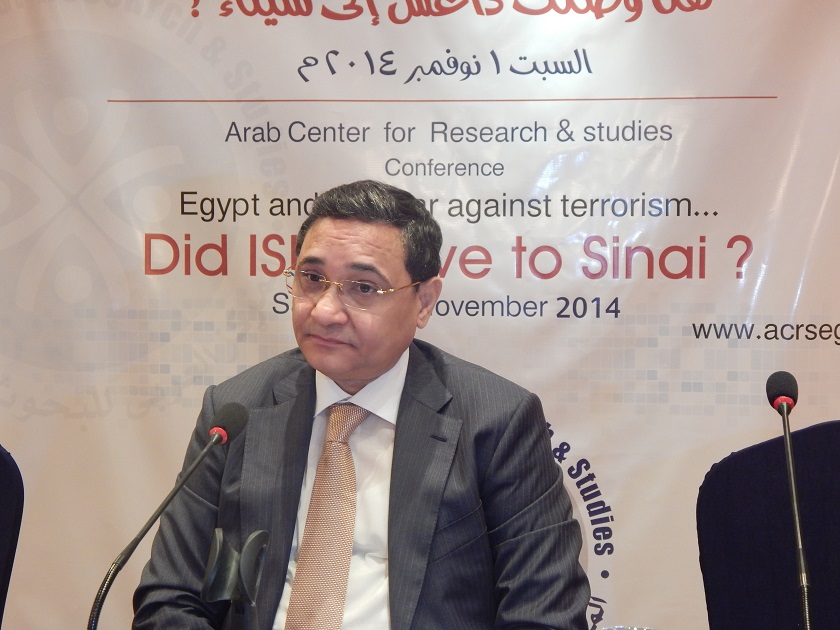
‘Isn’t he that guy on television with the crazy theories?’ remarked a European journalist as Abdel Rahim Ali walked into the room to hold a press conference on 1 November on the possible emergence of ISIS in Sinai. The mixed crowd of Egyptians and Westerners awaited his evidence.

Ali expects the ‘Supporters of Jerusalem’ – a home-grown terrorist outfit operating out of Sinai – to soon announce their allegiance to ISIS. Abu Hamza al-Muhajir, he said, was an associate of Abu Musad al-Zarqawi in the Islamic State of Iraq and believed to be killed by US forces in 2010.

But some evidence suggests he is still alive and operating out of the Sinai with the Supporters of Jerusalem, Ali said.

On 4 November, without mentioning al-Muhajir, Reuters confirmed Ali’s prediction of the merger with ISIS. But Egyptian state-run Ahram Online denied the news, quoting from what is alleged to be the Supporters of Jerusalem’s official Twitter account, @3Ansar_B_Almqds.

Leaked conversations

In Ali’s presentation, however, the source of his evidence was not provided, fitting with his general modus operandi. Host of the popular television show, ‘The Black Box’, and editor-in-chief of al-Bawaba newspaper, Ali regularly releases leaked conversations of revolutionary and Islamist figures.

Despite their illegal nature, Ali operates freely. And he freely admits his sources are connected to the security apparatus.

One of the most damning allegations concern leaked recordings of phone calls between President Morsi and Ayman al-Zawahiri, leader of al-Qaeda. In them an agreement is made to cease operations against Egypt while allowing jihadist groups to exist on Egyptian soil.

In this context, reference in Bishop Mouneer’s open letter about the Brotherhood finds verification. He spoke of the Muslim Brotherhood leader Mohamed el-Beltagi’s statement from the pro-Morsi sit-in at Rabaa in Cairo, prior to its bloody dispersal.

‘We do not control the situation on the ground,’ Beltagi said in a July 2013 video on YouTube. ‘But what is happening in Sinai …will stop the moment …the president [Morsi] returns to power.’

Bishop Mouneer told Lapido Media that, like many others, he is not happy that thousands of people are currently in prison without judicial rulings. He understands this makes the West feel Egypt is being very harsh with the Muslim Brotherhood.

But after listing a long litany of Brotherhood offenses – attacks on protestors, churches, and calls for jihad in Syria – he provides Egyptian perspective on this reversal of due process.

The courts are slow, he said, and Egypt is in a state of war against terrorism: ‘In times of war countries sometimes take extraordinary measures, such as America with Guantanamo Bay.

‘In order to educate the people and influence public opinion, [security] leaks some of these things.’

But of these recordings and allegations, Bishop Mouneer cannot say what is true and what is not, as long as Ali does not release his sources.

Similarly, Zaki does not feel compelled to make the case against the Muslim Brotherhood for the sake of his American audience. ‘This is the responsibility of the government,’ he told Lapido Media.

But he does want to convey Egypt’s general satisfaction with the situation following the post-30 June deposing of Morsi. The military answered the call of millions, he said, and the people ratified this action in subsequent elections.

Acceptance

This message is beginning to be heard. Zaki said the Americans expressed their acceptance of President Abdel Fattah al-Sisi’s government, as well as the necessary role of Egypt’s military in fighting terrorism.

Economic support will also be forthcoming at the expected 21 February economic summit in the resort city of Sharm el-Sheikh, the Americans told him. Egypt will present investment opportunities in fifteen projects worth $100 billion.

But the message of Egypt’s popular belief in Muslim Brotherhood culpability in terrorism is still awaiting judgment in the West. The Whitehall report authorised by the British government remains delayed.

‘I have no idea about the link between the Muslim Brotherhood and al-Qaeda,’ said Bishop Mouneer, expressing more caution than many Egyptians.

‘But I know one thing, we were going backwards during the time of Morsi.’

This article was originally published on Lapido Media.

Categories
Lapido Media Middle East Published Articles

Infighting Between Coptic Groups Not Helping Maspero Justice Campaign

Regla Gamal
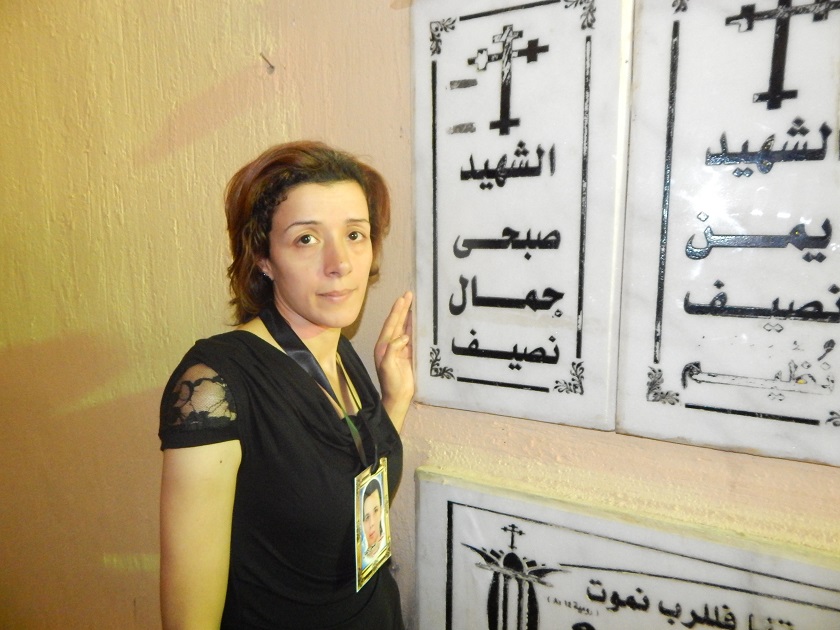
Regla Gamal, standing next to her brother’s memorial plaque, translated: The martyr, Subhi Gamal Nassif

Three years after Maspero and Regla Gamal is still wearing black.

On 9 October 2011 her 26-year-old brother, Subhi, was shot dead during a mostly Coptic demonstration in what became known as the Maspero massacre.

Twenty seven Egyptian Christians were killed by the army as thousands protested against attacks on their churches, the majority crushed under the wheels of swerving military vehicles.

To date only three lower ranking soldiers have been convicted, each being sentenced to between two to three years in prison. Despite the best efforts at justice by Coptic activists and relatives of the victims, their differences have led to infighting that is hindering their cause.

‘These are clothes of mourning,’ Gamal, 39, told Lapido Media. ‘I will not stop wearing black until justice comes and those responsible are judged.’

Egyptian tradition dictates female relatives of the deceased wear black for a period of 40 days, up to a maximum of one year. But at the memorial service held in the Cairo church where their remains are interred, most of the women among those now known as ‘the families of the martyrs’ were similarly dressed.

The night of the massacre Wael Saber, one of three official spokespeople for the Union of the Families of Maspero Martyrs (UFMM), watched horrified as his brother Ayman was hit by an army personnel carrier.

‘The state has dragged its feet,’ he told Lapido Media. ‘We demand transparency and justice, and will not be silent in front of their blood.’

Purposefully silent, however, were the mostly Coptic activists of the Maspero Youth Union (MYU). Formed in solidarity with Egypt’s revolution, they called for the march that ended in tragedy. To mark the anniversary the MYU braved Egypt’s current security crackdown with a candlelight vigil.

Sympathisers

Dozens of sympathisers gathered, but included only two relatives of those slain.

This is because the UFMM was formed in response to the MYU and other activists speaking in the name of the victims’ families and soliciting donations on their behalf, Saber explained.

Fady Yousef, president of the Coalition of Egypt’s Copts called the MYU a ‘corrupt entity’.

‘They are not loved because they have made profit off their blood,’ he said, referring to money raised by MYU that didn’t reach families of the victims.

Mina Magdy, a spokesman for MYU, denied any wrongdoing, stating they have spent countless hours with Saber and the families to demonstrate their innocence.

One of the founding members of MYU, Mina Thabet, attributes the discord to the corrupt media. ‘The regime depends on people repeating the same accusations [against activists] over and over until they believe it, and this is what is happening,’ he said.

Bickering

But the bickering between activists and families carried over into the memorial service, attended by busloads of relatives. The hubbub and media show offended many.

‘Ninety per cent of those here today have come to be seen and to have their picture taken,’ complained Wagdi Gamal, Regla’s brother.

Veteran Coptic activist Hany el-Gezery was there and also criticized the MYU. ‘They want to be a hero and to show they exist,’ he said. ‘But in this case the only voice that counts is of the families of the martyrs.’

Political father to many of the activists, Gezery recently dissolved his own Coptic movement to merge more fully into the national effort to support the current president, Abdel Fattah al-Sisi. But he wants the former top brass held accountable.

‘I saw General Hamdy Badeen [Egypt’s former head of military police] with my own eyes, standing there as it began,’ he told Lapido Media. ‘I accuse him directly.’

During the candlelight vigil, some protestors held a banner with Badeen’s picture, along with former leaders of the military council Generals Hussein Tantawi and Sami Anan, quietly calling for justice. President Sisi, though director of military intelligence at the time, was not mentioned.
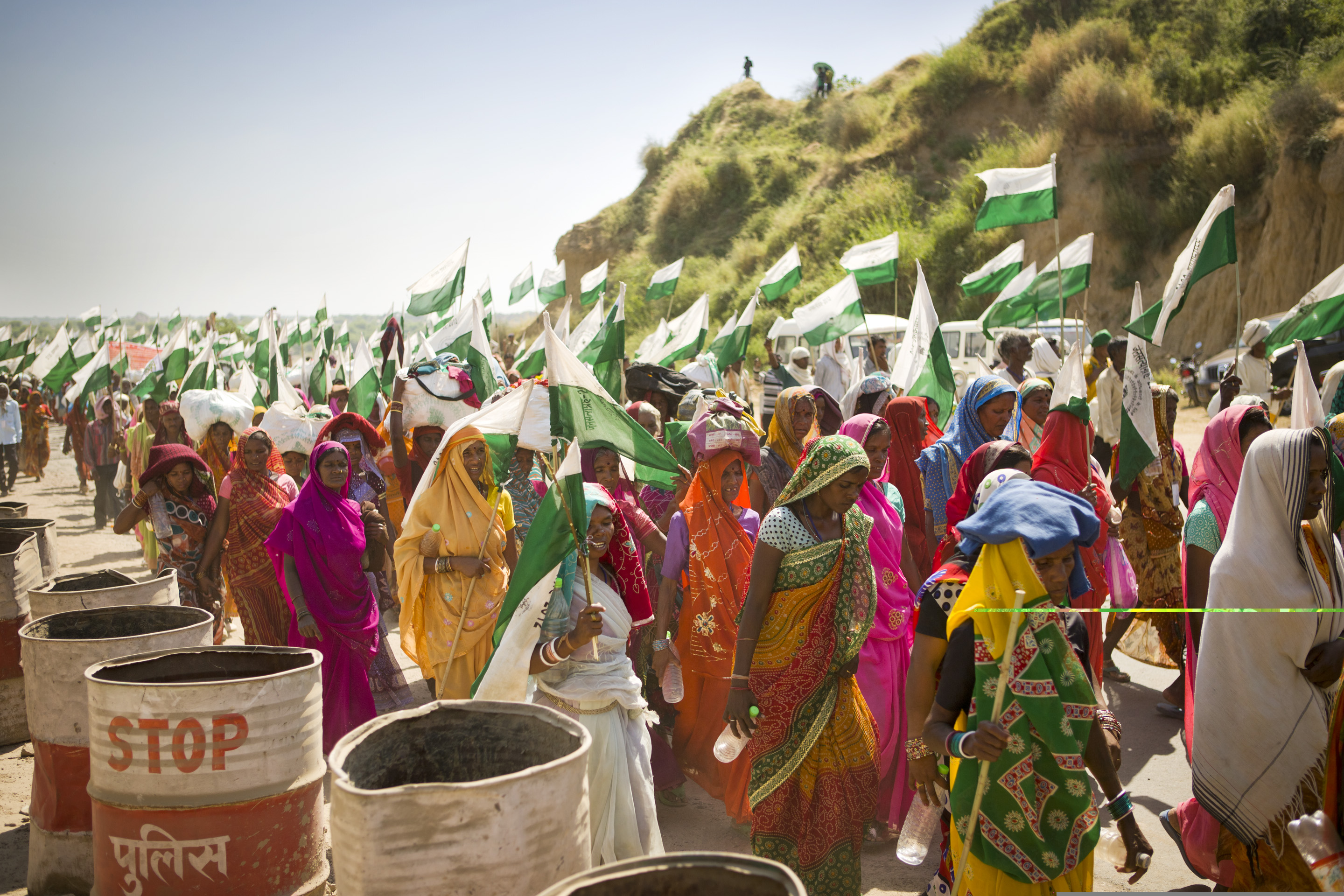
That is, until unaffiliated youth arrived and began chanting against him, calling for the end of military rule. The MYU got them to quickly quiet down and shortly afterwards ended the protest.

Saber, Gezery, and Magdy are all critical of the government for delaying attention to Coptic issues, but so far do not hold Sisi personally responsible.

‘Sentimental’

Youssef Sidhom, editor-in-chief of the leading Coptic newspaper Watani, notes that most Copts are still being patient with the new president, and believes it is a ‘sentimental’ accusation that activists accuse the former top officials without sufficient evidence.

The MYU did solicit donations, he recognizes, but knows of no lawsuit leveled against them for fraud.

Similar to both activists and families, however, he wants the Maspero case to reopen.

Until then, Regla Gamal will continue to wear black.

‘We have no hostility toward the army, but we want the case to reopen and if the military leaders are guilty they must be judged,’ she said.

‘Why this hasn’t happened yet we don’t know.’


This article was originally published at Lapido Media on October 15, 2014.

Categories
Lapido Media Middle East Published Articles

Church Relief Effort Highlights ‘1000s Left on Streets’ ahead of Iraqi Winter

Published September 23rd at Lapido Media:

Ehab el-Kharrat visiting refugee children in Erbil, Iraq (credit: SAT-7)
Ehab el-Kharrat visiting refugee children in Erbil, Iraq       (credit: SAT-7)

A former Egyptian member of parliament whose church is distributing aid to Iraqi refugees has spoken out about the gaps in humanitarian provision as the country heads into winter.

He expressed concern about underfunded UN campsites and thousands living on the streets.

Ehab el-Kharrat visited Erbil, a city in the Kurdistan region of Iraq that has attracted thousands of people fleeing conflict in the region.

His church, Kasr el-Dobara church in Cairo, works among relief heavyweights such as the UNHCR, Caritas, and Samaritan’s Purse.
It has sent a delegation to Iraq every ten days for the past two months, trying to stem the humanitarian tide. The congregation, which is made up of the middle and upper classes, has donated $180,000 to the relief effort with a further $120,000 from a fundraising trip to the United States.
So far it has distributed 2,500 mattresses with pillows and blankets, and it supports a network of 2,200 families that receive a food basket every two weeks.

This network is run in coordination with churches of Ankawa, a Christian neighborhood in Erbil. Ninety per cent of recipients are non-Christian – either Sunni Muslims also fleeing Islamic State, or else from the Yazidi minority.

Revd Fawzi Khalil is director of relief ministries at Kasr el-Dobara church.

He explained that the Chaldean Catholic Church of Ankawa has done an excellent job of caring for Christian refugees. Erbil’s population includes 160,000 Christians, and many have taken in fellow Christians.

As a consequence Erbil’s church grouds are packed. The Mar Eliya refugee camp is located on the grounds of the church-run school. Nearby Mar Yousef camp is in the church itself and hosts mostly Muslims and Yazidis.

Kharrat, a founding member of the Egyptian Social Democratic Party, described a pecking order of beneficiaries. After refugees living in camps in church grounds, the next most fortunate group is those taken in by Kurdish families, he said, followed by those in unfinished buildings but under the sponsorship of church groups. Kasr el-Dobara’s efforts are toward this group, primarily.

Underfunded

But thousands of Iraqis remain on the streets and in underfunded UN campsites in the desert. Kharrat noticed most tents were recycled from an earlier Syrian refugee camp, and are of deteriorating quality.

Erbil has a permanent population of 1.5m people, and UN figures show there are 1.8m displaced Iraqis. But according to UN-Iraq, the three established UN camps can host only eight per cent of the refugees.

Local families and churches take in the rest, but thousands sleep on the streets, under bridges, or in partially completed buildings, said Khalil.

In speaking to Kurdish officials, he related their complaint that under the Maliki government, Baghdad ‘failed’ to send Erbil its constitutionally guaranteed share of the budget. The new government, formed on 8 September, has promised to do so ‘but not yet delivered’, he said.

This has left the Kurdish regional government in a bind, as the UNHCR is a refugee agency, but those fleeing are technically considered internally displaced persons. With no agency possessing a clear mandate, the UN looks toward the government to lead.

Even so, UN documents detail over 346,000 people who have been reached to some degree, with Saudi Arabia touted as a particularly generous donor.

Grateful

But this effort has not impressed the Kurds, says Kharrat.

‘Kurds are grateful to the US in particular and the West in general,’ he said, ‘but are wondering why the Arabs are so slow – in both humanitarian and military aid.’

Khalil and Kharrat stated they were busy with their own work in the area but neither recalled seeing any Muslim groups among the refugees.

Islamic Relief, however, has been working in the Anbar province to the west of Baghdad. It also distributed food parcels to 1,500 Christian families displaced in Nineveh.

According to Eva Boutros, director of volunteer ministry for Kasr el-Dobara, the fact that Egyptian Christians have been present has made an impression on many.

‘Muslims and Yazidis appreciate very much that they are cared for,’ she said. ‘They know it is the church that is doing this in Iraq.’

But whether Christians, Muslims, or the UN, no one is doing enough. By December if no solution is found, the already tragic situation will turn catastrophic.

‘Hundreds of thousands are unprepared for winter,’ Kharrat said, anticipating average lows of three degrees Celsius.

‘Conditions are horrible. They survived the summer – the heat did not kill, but the freezing snow might.’


Categories
Lapido Media Middle East Published Articles

Christian’s Sexual Harassment Campaign Endorsed by Government

Props used in the children's awareness campaign. The Arabic reads: Bad Touch (L), Good Touch (R)
Props used in the children’s awareness campaign. The Arabic reads: Bad Touch (L), Good Touch (R)

It is not often a Sunday school teacher gets a call from the Egyptian government. But in a time of rampant sexual harassment, as highlighted by an assault in Tahrir Square posted and widely viewed on YouTube, creativity in protecting the rights of the most vulnerable attracts attention.

The video of the naked and bloodied women, which was taken during Abdel Fattah al-Sisi’s presidential victory celebrations, has been a wake-up call for a society where sexual assault of women seems to be culturally acceptable.

But one woman has been tirelessly working away at the root causes.

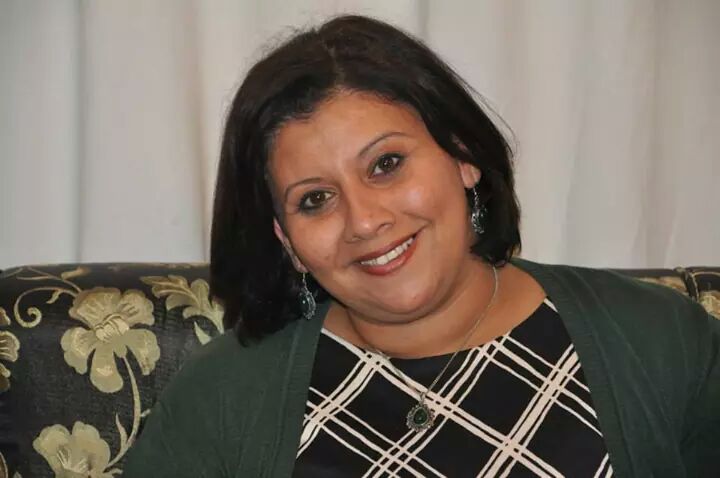
Eman Ezat
Eman Ezat

Eman Ezat is a children’s worship leader in Cairo who has worked with thousands of children to raise awareness about sexual harassment.

She and her team of 25 volunteers – both Muslim and Christian – have presented to over 10,000 students through skit and song. They have visited seven Egyptian governorates, working in churches, Islamic agencies, and government centers.

Training

In addition they have given adult training to over 1,500 parents and 500 teachers in ten different schools, both public and private. Their work has been featured on five different Egyptian TV stations, including the government’s Channel One.

The result of which was a phone call from Ghada Wali, recently reappointed as Minister of Social Solidarity in Sisi’s cabinet. She has invited Ezat to cooperate in the training of all government-supervised nurseries.

‘Our first song, which is written in the Arabic language, is about teaching sexual awareness to children,’ says Ezat.

‘Don’t let anyone touch you, here,’ the song says, to the tune of If You’re Happy and You Know it, Clap Your Hands. ‘It’s your body, no one has the right to do so.’

But Ezat is far more than a Sunday school teacher. A professor in the Faculty of Education at Cairo University, she has also been trained in the counseling of sexually abused children, and has worked with hundreds of cases.

In her unofficial tally, 70 per cent of sexual abuse cases originate from within the immediate family. A further 20 per cent are the victims of relatives.

In such a context, her song is revolutionary.

Shame

‘Our sexual culture is based on shame,’ Ezat told Lapido Media. ‘This creates pressure on everyone which then explodes into harassment on the street.’

According to a survey published by the United Nations Entity for Gender Equality and the Empowerment of Women, more than 99 percent of Egyptian women have been subjected to sexual harassment.

This goes far beyond playful catcalls, with 96 percent reporting their bodies have been touched and 55 percent of these having had their breasts groped.

The problem, Ezat believes, is that social taboos result in families leaving their children sexually unaware. As kids mature they pick up the worst attitudes from their peers as the sexual harassment culture reinforces itself.

Dignity without Borders recently produced video testimonies of attitudes towards harassment by male and female schoolchildren. Many of the children justified it as normal while others blamed the woman.

According to the UN survey, 37 per cent of adult women also held women primarily responsible.

Hemaya Arabic

Despite such cultural constraints, Ezat decided to educate children herself. In June 2013 she created Hemaya, Arabic for ‘protection’, to teach kids that their body belongs to them alone.

Political will

Government attention to sexual harassment is on the rise. In one of his first acts as president, Sisi visited the assaulted woman in the hospital, and gave her a rose.

‘This has never happened before,’ said Mona Salem, a researcher with the National Council for Women (NCW). ‘Before this they always blamed the woman. The political will is now present to address the issue.’

The State is beginning to address the issue culturally. The educational curriculum will be amended to raise awareness about harassment. An award will be given to the television series that best promotes women’s rights.

Salem also described recent NCW successes in opening a ‘Violence against Women’ unit in the Interior Ministry, helping police better deal with harassment reports. Specialised personnel will be present in every district.

But the best indication of government intention is Egypt’s first ever law specifically addressing sexual harassment. Punishments range from six months to five years imprisonment, in addition to hefty fines.

But there remains concern whether such amendments will be effective.

‘Egypt’s position has traditionally been dreadful in terms of lack of implementation of the law, victim blaming and a lack of reporting due to shame,’ says Mandy Marshall, director of Restored, an international charity campaigning to end violence against women.

‘There is clearly now a drive to do something about this but cultural attitudes take a long time to change and need to be consistently modeled by those in leadership and with power.’


This article was originally published on Lapido Media. I became aware of them when they came to Sunday School at our local church. Here are some more photos via
Hemaya.

Translation: It's my body, no one has the right to touch it.
Translation: It’s my body, no one has the right to touch it.

Hemaya Children

Hemaya Children Group

Categories
Lapido Media Middle East Published Articles

Coptic Activist Dissolves Movement ahead of Sisi’s Electoral Triumph

Hany al-Gaziri
Hany el-Gezery, on the streets of Shubra, a Cairo neighborhood with a high percentage of Copts

From my recent article in Lapido Media:

The founding father of modern Coptic activism retires a happy man.

Egyptian Christians celebrate the election of a new president in hope of a new dawn of equality.

Two days before the vote, Hany el-Gezery, the sixty year old founder of Copts for Egypt, announced the dissolution of his pioneering movement.

‘In light of our great confidence in the noble knight that will govern, whatever his name,’ he wrote in his final statement, ‘we call on all revolutionary and Coptic movements to follow our lead and stand as one to build the future of Egypt.’

Gezery began his activism in 2005 as one of the few Christians in the Kefaya movement opposed to then-President Hosni Mubarak. Throughout his activism he labored to involve Copts in the secular political struggle.

But in 2009 Gezery made a more direct religious appeal, partnering with an Orthodox priest to found Copts for Egypt. Fr. Mattias Nasr published a popular newspaper detailing cases of discrimination, but distributed it only within the church.

The alliance aimed to shift an emerging Coptic activism from church to street.

‘We were the first Coptic movement to work in the streets,’ Gezery told Lapido Media. ‘At that time no Christian was bold enough to even open his mouth, and any demonstration would be held inside the cathedral.’

Copts for Egypt differed by coordinating with opposition political parties to recognize and oppose discrimination within the Mubarak regime.

On February 14, 2010, they led the first Coptic protest outside church walls. On January 7, 2011 they concluded a week-long rally against the bombing of a church in Alexandria.

Eighteen days later the January 25 revolution erupted. Youth activists from Copts for Egypt were active throughout, going on to found or join many other diverse movements.

Gezery now calls for them also to end this stage of the struggle. ‘All Egyptians must dissolve back into society,’ he wrote, ‘which after June 30 is free from religious factionalism.’

On June 30, 2013 the popular revolt began against President Mohamed Morsi of the Muslim Brotherhood. After one year in office he was ousted by now president-elect Abdel Fattah al-Sisi, the landslide winner in last week’s elections.

In declining to name ‘the noble knight’ of his statement, Gezery was keen to emphasis his respect for both candidates, and rest his confidence on the era, not the man.

But the man causes worry among other Coptic activists, including his own disciples.

One of these activists is now the general-coordinator of the Maspero Youth Union. Another is an advocate for missing underage Coptic girls. Please click here to read their objections and the rest of the article at Lapido Media.


Categories
Lapido Media Middle East Published Articles

Divided Society Drives ‘Preacher of the Revolution’ to Lonely Hunger Strike

Hanny Hanna
Hanny Hanna

Sixteen thousand Muslim Brotherhood prisoners launched a mass hunger strike yesterday, protesting against torture and other human rights abuses, according to local sources. Haitham Abu Khalil, the movement spokesman, says many more individuals are unlawfully detained.

The same day a lone Coptic hunger striker, unaffiliated and unsympathetic to the Brotherhood, ended his own hunger strike after twenty two days.

Unlike the others, he did so as a free man.

‘People are dying, hatred is increasing, justice is absent, and prices are rising,’ said Dr Hanny Hanna, an archaeologist and general director in the Egyptian Ministry of Antiquities. ‘We have had no revolutionary government, the same regime is with us until now.’

Three years ago Hanna had more hope. As the world celebrated images of Christians protecting Muslims at prayer in Tahrir Square, less known was the reverse. One of the first Copts to join the revolution of 25 January, Hanna became known as ‘the preacher of the revolution’ for leading protestors in Christian prayers and songs.

Polarized

But these days of unity are long gone. ‘Everyone is tearing down the other no matter what side you are on,’ Hanna told Lapido Media. ‘The polarisation has become so high.’

And with it the body count.

According to figures reported by the Carnegie Endowment for International Peace last month, over three thousand Egyptians have been killed in political violence since 3 July, the day former president Mohamed Morsi was deposed.

Over 2500 of these deaths have been the result of protests and clashes, while over 500 have died from terrorism and other militant actions, according to government statements.

Seventeen thousand have been injured in these events, and nearly 19,000 have been arrested. Of these, several hundred have already been on hunger strike to protest their ill treatment in prison.


Hanna, during a brief hospitalization

Hanna, who while drinking only water continued his normal responsibilities, criticized the violence of many protestors which has landed them in detention. But he also condemned the government and its protest law which has imprisoned many innocents beside them.

As the revolution appeared to be slipping away with resurgent autocracy first under the Brotherhood and now more severely against them, the preacher in him grappled with a response.

‘Should I go to the media and just say, “Love each other?” he asked. ‘It is easy to talk but it is stronger to take an action.’

Hunger strikes have largely been an individual action in Egypt since the 1970s, said Osama el-Ghazoly, a senior Egyptian journalist. The mass prison protest is a more recent development, but few have done so outside of jail.

Unlike most, Hanna’s hunger strike had no demands. Instead, it was his chosen action to communicate a message that all is not well and the revolution has not succeeded.

He even takes aim at Egyptian icon General Abdel Fattah al-Sisi, the front running presidential candidate. Hanna resurrects the memory of the Maspero massacre when 28 Coptic protestors were killed, either shot or crushed under military vehicles in October 2011. Sisi was the director of military intelligence at the time.

‘If Sisi wants my support he should make it clear what was his role in these events,’ said Hanna. ‘If he is clean, then fine. If not, he can go to hell.’

Critisism

But these messages do not sit well with his fellow Copts. Most are overjoyed at Sisi’s popularly endorsed removal of Morsi’s Muslim Brotherhood government, and anticipate the new constitution will usher in a democratic order.

Even Hanna’s personal Facebook page, filled with good wishes about his intentions, drew criticism. Comments lamenting the timing, method, and relevance of his protest mirrored the responses of political, religious, and revolutionary Coptic leaders.

‘I wish he would be more patient,’ said Naguib Abadir, a Coptic founding member of the Free Egyptians Party, one of the leading liberal flag bearers. ‘We are in a very difficult period with people trying to hijack our roadmap before it can be achieved.’

‘The body is not our own, it is the temple of God and we are responsible to protect it,’ said Revd Fawzi Khalil of Kasr el-Dobara Church, located just behind Tahrir Square, who demonstrated with Hanna from the early days of the revolution.

‘We are able to express our views in ways that do not threaten our life.’

Abadir and Khalil both told Lapido Media that Hanna should save his strength and take up politics, criticising him for picturing everything as negative. But even revolutionary colleagues see him as an idealist, who is harming himself in vain.

Mina Magdy
Mina Magdy

‘He is a good person working for peace,’ said Mina Magdy, general coordinator of the mostly Coptic Maspero Youth Union, which suffered heavily in the massacre. ‘But he is giving slogans and this does not work, we need specific demands.

‘Hanna’s message will reach neither the regime nor the people,’ he said. ‘No one cares about him.’

But this unhappy critique is categorically untrue. His wife and three daughters have stood by his side, and over ten friends have promised to join him on a future hunger strike, if necessary, in exchange for stopping now.

Hanna believes most of his critics misunderstand him and have succumbed to a culture that neither values the individual nor believes one person can make a difference.

‘In the beginning no one listens,’ he said. ‘But as you continue more people start to pay attention.

‘The fruit is seen as they change toward the good.’

Still a preacher, but now with his body, this is Hanna’s contribution to continue the revolution.


This article was originally published at Lapido Media.

Categories
Current Events Lapido Media Middle East Published Articles

The Egyptian-Canadian Surgeon Going Home to Serve the Poor

Dr. Sherif Hanna
Dr. Sherif Hanna

From my new article in Lapido Media:

A new collaboration – in an old mission hospital – will train Egyptian surgeons to serve in rural settings.

Sixty per cent of Egyptian doctors work abroad – but a unique collaboration will fight this trend.

Incredibly perhaps, Egyptian Christian Dr Hanna Sherif is relocating from an élite life in Toronto, Canada to the small village of Menouf in the Nile Delta for the next five years, in defiance of a US State Department warning of ‘risks of travel’.

An acclaimed liver surgeon and academic, Sherif is returning to his country of birth after a forty three year absence to run a new in-country surgical training programme…

Here is a brief excerpt about what he will do, and the motivation thereof:

Harpur’s resident trainees will benefit from 10-15 visiting surgeons each year, and will spend six months of their programme in large hospitals in Kenya, Cameroon, and South Africa.

In exchange the residents will work at least one year in the handful of PAACS-accredited Christian hospitals in Egypt for every year they are financially supported.

Rural hospitals, including old mission hospitals, are often not well equipped and generally pay low salaries, said Hanna. As such they fail to attract well-trained surgeons.

In addition, Dr Amr al-Shoury, a leading figure in the ongoing partial doctors’ strike in Egypt, the government system pays abysmally poor wages to medical professionals.

He told Ahram Online this drives 60 per cent of doctors abroad.

Thompson believes maintaining the standards of care for the poor under these circumstances in the least attractive districts requires a special commitment.

‘Christian hospitals will go out of business if they cannot hire well-trained specialists that are committed to their values,’ said Thompson. ‘Ours is to honour and glorify Christ in his command to care for the sick.’

Please click here to read the full article at Lapido Media.

Categories
Lapido Media Middle East Published Articles

Church Burning Reveals Ugly Contest over Truth and Victimhood

Copts Pray in Burned Church

What mentality of man will burn a church? In Egypt, what should be known as a house of prayer is now the symbol of civil strife amid conflicting accusations of blame.

‘Attacks on churches are being done by the former regime and their thugs, not pro-Morsi demonstrators,’ said Ahmed Kamal, youth secretary for the Muslim Brotherhood’s Freedom and Justice Party (FJP) in Helwan, an industrial district to the south of Cairo.

But this is nonsense to Bishop Thomas, the head of the Coptic Orthodox Church in Qussia, 340 kilometers south of Cairo. His church was attacked by pro-Morsi protestors, but neighborhood Muslims rallied to defend it.

‘We recognize their faces and know who they are,’ said Thomas. ‘The Brotherhood is using us as a scapegoat to blame us for their failures.’

Anti-Christian rhetoric has been prominent among Islamists. Since Pope Tawadros, along with the Grand Sheikh of al-Azhar, appeared with General al-Sisi to announce the deposing of President Morsi, many Islamists believe Copts to be part of a grand conspiracy against not just their movement, but Islam itself.

‘We don’t oppose Christians,’ said Kamal, ‘but we are against the pope – as we are against the head of the Azhar – who interferes to direct people to a particular political direction.’

This second half of this message is reinforced by Kamal’s local party representation. The Helwan FJP’s Facebook page notes that ‘burning houses of worship is a crime’, but then all but justifies it in an attack on the church.

After listing a litany of the pope’s offenses, it declares, ‘After all this people ask why they burn the churches.

‘For the Church to declare war against Islam and Muslims is the worst offense. For every action there is a reaction.’

Kamal recognizes this message may have been too general. The Brotherhood sees Islam as both worship and ideology, only the latter of which has been rejected by the church and anti-Morsi protestors.

Incoherence

But for Arne Fjeldstad, CEO of The Media Project to promote religious literacy in journalism, this error reflects the reality on the ground for Islamists.

‘Whatever the Brotherhood says [about nonviolence] is not listened to or communicated on the street,’ he said. ‘So there is a large incoherence among them.’

More than 50 churches were destroyed since Wednesday last week, including two Bible Society bookshops – the first time in Egypt’s recent history.  Some news organizations reported churches being marked for attack before the Brotherhood sit-ins were forcibly broken up.

Fjeldstad believes the Brotherhood will have a difficult time making theological sense about why God ‘turned against them’. But in the meanwhile, the sit-ins were filled with chants about martyrdom.

‘They have prepared the ground for future generations of warriors for Islam,’ he said.

Sarah Carr is an independent journalist and founder of mbinenglish.com, a web page which exposes the Arabic-only messages the Muslim Brotherhood, such as the FJP Facebook page above.

But she understands the rage of Islamist protestors, for she was a witness to the military-sponsored dispersal of the sit-in which killed over 600 people, not including 40 police personnel.

‘It was completely disproportional violence,’ she said, describing army vehicles mounted with automatic weapons firing into the crowds. Carr did not see any armed protestors, though she does not deny their presence.

‘The army needs to justify their terrorist narrative and use it to crush the Muslim Brotherhood,’ she said.

But the Brotherhood did resist. Political analyst Abdullah Schleifer notes that the Western tradition of nonviolent protest involves non-resistance to state-sponsored oppression.

‘Non-violence does not mean building barricades to hold off the Egyptian riot police and breaking up pavement stones to throw at them.’

Ahmed Kamal
Ahmed Kamal

Kamal freely admits the difference.

‘Gandhi is not necessarily our role model,’ he said. ‘He was good and his people were brave, but we have our peaceful model as well as per our book and principles.

‘We are unarmed in front of their weapons, but we will resist them. To be peaceful is not just to stay silent and wait for bloodshed. We must defend our lives even by throwing stones.’

But Emad Gad, a leading politician with the Egyptian Social Democratic Party, says they went far beyond throwing stones. His party is collecting evidence of protestors’ violent intent.

‘The army did not attack the people,’ he said. ‘They used tear gas and bulldozers and were attacked by armed protestors, and then they responded.’

For political analyst Eric Trager, both narratives make sense. The Brotherhood cannot win a battle against the security forces, but that may not be the point.

‘The Brotherhood seems to believe that if it can draw the military into a fight directly, it can create fissures within the military,’ he told World Affairs Journal.

To protect itself, the military must now push the issue to conclusion.

‘It [the army] entered into a direct conflict with the Muslim Brotherhood, perhaps even an existential one,’ Trager continued.

‘The military believes it not only has to remove Morsi, it has to decapitate the entire organization. Otherwise, the Brotherhood will re-emerge and perhaps kill the generals who removed it from power.’

Incitement

Bishop Mouneer of the Anglican Church in Cairo disagrees.

‘We witnessed bloodshed on our streets, vandalism and the deliberate destruction of churches and government buildings in lawless acts of revenge by the Muslim Brotherhood and their supporters,’ he said.

‘I appeal to everyone to avoid rushing to judge the authorities in Egypt.’

In attacking churches, though, Carr finds the Brotherhood playing into the hands of authorities – though society provides fertile ground.

‘We’ve seen for decades how you have one person with an agenda [to spark sectarian attacks] and then others are very happy to jump in,’ she said.

‘It doesn’t take much incitement from the Brotherhood or anyone else.’

Yet the authorities, she finds, are not innocent.

‘It is no good to go to conspiracy theories, but why did you break up the sit-in and not protect churches?’ she asks. ‘What should we conclude?’

The conclusion is a morass of relativity, reflective of a polarized society overlooking travesties on all sides.

‘The number of police killed is almost insignificant,’ said Kamal, ‘compared to the two thousand killed and ten thousand injured on our side.

‘This confirms our peacefulness.’


This article was originally published on Lapido Media.

Categories
Lapido Media Middle East Published Articles

Coptic Palm Sunday Street Parade Axed to Keep the Peace

Bishop Thomas among the revelers

This article was first published on Lapido Media:

Joyous Copts raised palm leaves and shouts of welcome as Bishop Thomas, dressed in his regal red clerical robe, entered the Church of the Virgin Mary in Saragna, 325 kilometers south of Cairo.

But departing from tradition he arrived by car for the first time this year. For years local Copts would first parade him through the streets of the 90 percent Christian village.

For the first time in this Upper Egyptian diocese, the ancient parade on 28 April remained within church grounds to control the behavior of Christian youth.

‘It used to be that all churches would parade in the streets, but because of the pressures of the last few decades in most places it has stopped,’ explains Thomas.

Saragna was the last village of his diocese to maintain the parade. ‘We are mostly Christians here, so all is well,’ says Ramiz Ikram, the fourth generation Coptic mayor.

‘Some Muslims complain due to their fanaticism, but we don’t march in their areas so as not to make problems.’

Fr. Kyrillos of Saragna

But according to Fr Kyrillos Girgis, a Cairo-trained medical doctor who has served as priest in the village for 23 years, local youth recently began shouting offensive anti-Muslim chants.

He threatened to bar them from communion for a year, but eventually had to stop the procession entirely.

This past Sunday, as everywhere else in Egypt according to the Eastern religious calendar, palms were raised within church grounds instead of in the streets as of old. (Please click here for video.)

Bishop Thomas remains positive however. ‘The challenging religious situation in Egypt reinforces our religious identity,’ he says ‘and today we enjoy being in the kingdom of God.’

Fr Kyrillos can also see the silver lining in the dark clouds gathering over this country.  He is leading a vast expansion of the Church of the Virgin Mary, tripling its size and adding a second sanctuary.

The greatly expanded Church of the Virgin Mary in Saragna

Local authorities licensed the expansion before the revolution, along with construction of new churches in the roughly 50 percent Christian villages of Titaliya and Manshia.

‘We have good relations with security and with local people,’ said Thomas, ‘We prefer to obtain proper permissions because we do not want to take any risks.’

Illegal construction

Outside of his diocese, however, other bishops are less risk averse. The 22,000-strong village of Bayadia which is more than 90 percent Christian, had a single church for six different denominations, despite many applications for building permission.

‘We felt great injustice under Mubarak,’ said Orthodox priest Fr Girgis, ‘because we had only one church despite being the great majority of Christians.’

His solution was illegal construction of four more churches. Other denominations followed suit, and Bayadia now has fourteen churches.  In the nearby village of Dair Abu Hinnis which is 100 percent Christian, Fr Bemwa boasts of an increase of from five to ten churches since the revolution.

Bishop Thomas explains it can take up to fifteen years to gain a church building permit, whether from bureaucracy or discrimination.

Many priests take matters into their own hands.

With the collapse of government, this is increasingly the norm in Egypt. The Ministry of Housing and Local Development announced recently the existence of more than five million unlicensed buildings. A BBC report earlier this year documented the post-revolutionary surge in building, including many that have already collapsed.

But when Christians attempt such illegal church construction in Muslim majority villages, there is often resistance. Sometimes this is the case even when permits exist.

‘As long as it is a primarily Christian area there is no problem to build,’ said Cornelis Hulsman, editor-in-chief of Arab West Report (AWR). ‘But when it is in a mostly Muslim area it can cause clashes if neighbours are opposed.’

AWR investigated an attack on a church in Aswan in October 2011, and a February 2013 attack in Fayyoum. In both cases Muslims had been offended when local houses used for worship were expanded or renovated.

But on Palm Sunday, Egyptian Copts celebrate the success of a community which has maintained Christian roots since the visit of the Holy Family fleeing from Palestine.

The faithful flock to pilgrimage sites, such as the rural Serabamoun Monastery, believed by local Christians to house a tree which provided shade to Jesus and Mary.

Fr. Seraphim, offering a loaf of communion bread

Fr Seraphim, Coptic priest in the nearby city of Daryut, said, ‘Christians in Egypt have seen more persecution in the past than we see now.

‘And of course you have to make use of the opportunity: there is no government.’


Categories
Africa Lapido Media Published Articles

Ethiopia’s First Africa-Trained Pediatric Surgeon Gives Children a Glimmer of Hope

From my latest article in Lapido Media:

Surgeons

If not for Frehun Ayele, Fatima would still be wet with urine. The eleven-year-old native of war-torn Somalia traveled over 500 kilometers to Addis Ababa for an operation on her bladder, which was completely open to the skin since birth.

‘For children in need of surgery, it is a big challenge,’ Dr. Frehun told Lapido Media, describing waiting lists of over a year. ‘The most vulnerable in terms of disease severity, poverty, and distance, suffer much. Only the fittest survive.’

Frehun is unique as the first Ethiopian to be trained as a pediatric surgeon in Africa. Three months ago he halved the waiting list by opening the nation’s second pediatric surgery clinic, BethanyKids, in cooperation with the Korean-founded Myungsung Christian Medical Hospital.

‘Before the arrival of BethanyKids, there were three pediatric surgeons for over ninety million people,’ said Dr. Dan Poenaru, Frehun’s training surgeon and now partner in the clinic.

This was a very fun article to write. It was also a challenge, done remotely, relying on email. Many thanks to the people of PAACS for helping. PAACS, by the way, stands for the Pan-African Association of Christian Surgeons:

an organization dedicated to the training and discipling of African surgeons to provide excellent, compassionate care to those most in need.

Their work is for the good of the continent and all its religious adherents, but a very clear commitment to Jesus is part of their methodology, one which they believe makes all the difference:

Gray helped arrange the exchange of residents with the national training center in Addis Ababa University, which is open to students of all faiths. But according to Dr. Bruce Steffes, the executive director of PAACS, it may have been the organization’s Christian commitment which made the difference.

Speaking with a particular government minister who was suspicious of the missionaries, Steffes pointed out all twenty-eight PAACS graduates were serving in their local context, often in rural areas.

‘I may have influenced his decision,’ he said, ‘by pointing out that their desire to serve Jesus is what motivates them to serve in those areas.’

By contrast:

‘Many of the brightest and best medical students leave for training abroad, but after five years of training put down roots and stay there,’ he said.

Thompson said there is a greater than ninety percent attrition rate, a significant brain drain costing Africa the surgeons it needs. Even for those who do return, he says, most cannot function for more than a few years, as they were trained in ideal conditions in the West.

‘We train them in these resource poor environments,’ Thompson said, ‘so they know how to operate here.’

Please click here to read the entire article on Lapido Media, and have a look at the PAACS website as well. Do consider them for your support.

PAACS

Categories
Lapido Media Middle East Published Articles

Muslim Brotherhood Launches Development Campaign as Violence Rocks the Nation

MB Helwan Trees

Not all in Egypt is chaotic.

The Muslim Brotherhood are repairing schools, serving the poor and beautifying streets.

While violent protests and political impasse grab the headlines, the Muslim Brotherhood has launched a much quieter campaign to commemorate the two year anniversary of the January 25 revolution.

Hatem Abd al-Akhir is the leader of the Brotherhood’s Freedom and Justice Party (FJP) in the city of Helwan, to the south of Cairo.

‘We wanted to celebrate the revolution in a different way,’ he told Lapido Media. ‘But other parties are trying to interrupt society and start another revolution.’

The Muslim Brotherhood built its reputation on providing social service to the poor. As the economy declines and their popularity diminishes, they peg the opposition as agents of instability.

Ahmed Kamal is the FJP youth secretary in Helwan. ‘We’re trying to get Egypt into a new stage of building and development,’ he said to LM. ‘This is the message we want to convey both inside and outside Egypt.’

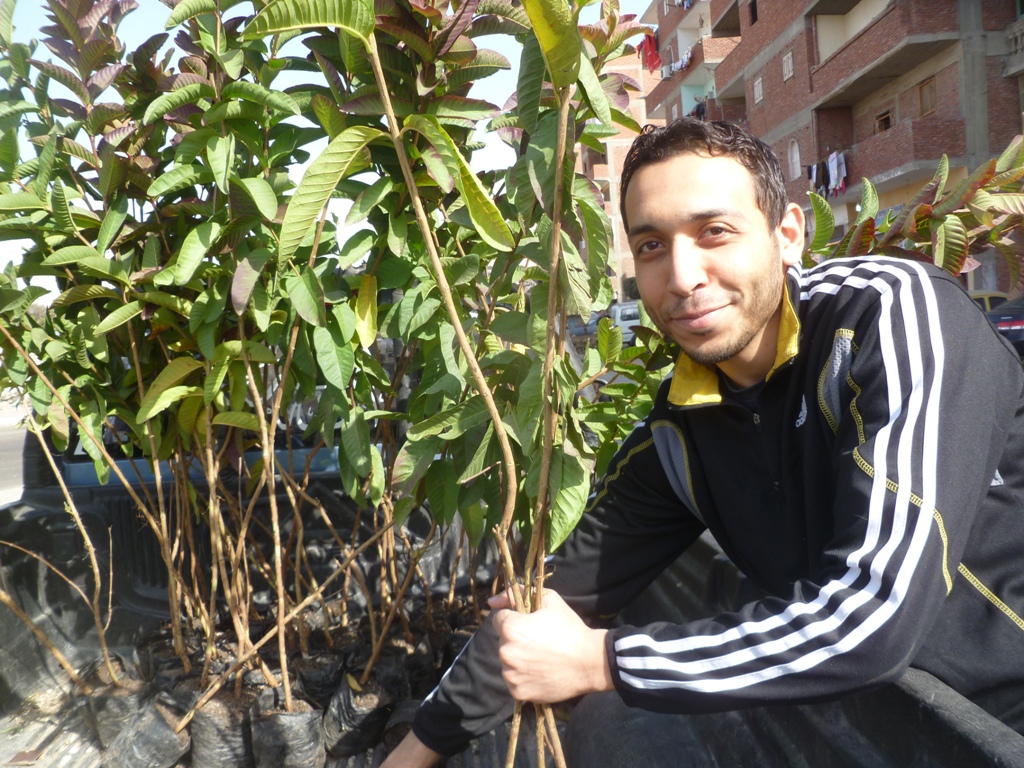
To do so, the Brotherhood is planting one million sapling trees throughout Egypt, one hundred of which are in Helwan. Kamal led teams of youth digging holes in the limited dirt of the urban landscape, boring even into the sidewalk.

Hatem Abd al-Akhir
Hatem Abd al-Akhir

Abd al-Akhir, meanwhile, participated in the effort to provide a million citizens with healthcare. An ophthalmologist, he offered free eye examinations to diabetic patients and at-cost treatment for any operation.

As the manager of the Helwan Eye Center, he assures normal costs for patients are 30 percent below market standard. Yet the centre still makes a small profit, illustrating a mix of business and charity, politics and social good.

‘The Muslim Brotherhood is a logistics service for advertising,’ he said describing the campaign. ‘We want to propagate values in our community which will help keep the peace.

‘When we offer low cost service we oblige others to not raise their prices above what is acceptable.’

But in a time of great social and political upheaval, it is unsurprising some are critical.

Ahmed Ezzalarab is the deputy chairman of the liberal, opposition Wafd Party. ‘They are trying to distract people by giving a different image of development, but it is too late,’ he told Lapido Media. ‘They are being exposed for their secret agenda which the people are rejecting.’

Ezzalarab does not dispute their social work, but recognizes it is necessary to oppose the Brotherhood for their poor record in power. In recent weeks train accidents and building collapses have claimed the lives of dozens of citizens.

‘Governance has never been worse in Egypt’s history,’ he said. ‘They cannot run the country administratively; everything they touch fails.’

But in describing a secret agenda, Ezzalarab appeals to conspiracy.

‘We are completely against the violence, which is working to distract the people from the peaceful nature of the opposition,’ he said. ‘It is being funded by Wahabi and Gulf money, because they are scared to see civil forces come to power.’

Ezzalarab believes the Brotherhood is panicking, fearful the army will step into the violence and unseat them from power. Perhaps he is right.  Brotherhood leaders are clearly propagating the conspiracy theory.

Anas al-Qadi, Brotherhood spokesman said on the official MB website, Ikhwanweb.com: ‘This is the difference between the Muslim Brotherhood marking the memory of the revolution with greatly appreciated services, and so-called civil forces celebrating the revolution with flagrant acts of arson and violence, spreading chaos and destruction and vandalism.’

The website also accused one of the newly organized vigilante groups, Black Bloc, of being an arm of the Coptic Orthodox Church.

Any of the various accusations may be correct, but they are presented without evidence and signal that both social service and social violence are a means to an end.

Ahmed Kamal
Ahmed Kamal

‘If you are trying to apply Islam as you understand it, you have to reach authority by all legal and peaceful means,’ said Kamal. ‘To do this you have to show people why they must support you.’

Kamal was responding to the charge that the Brotherhood is putting good works on display, contrary to Islam.

‘We need to differentiate between being a Muslim and being part of an Islamist program which competes with other parties,’ he said.

‘As a Muslim, you can choose to tell or not tell of your good works, it depends on your intention. If you tell you can be a role model that others will follow, but God will judge you in either case.’

But for now, Egypt is the judge, and the verdict is a cliff-hanger.

This article was first published on Lapido Media.

Related Posts:

Categories
Lapido Media Middle East Published Articles

Palestinian Children Languish under Israeli Occupation

Baghdad Declaration

Moves by the Arab League in concert with British activists, are putting pressure on Israeli authorities to observe international legal commitments on children detained, imprisoned and tortured in Israeli jails.

The Baghdad Declaration on the Palestinian and Arab Prisoners in the Israeli Occupation Prisons, issued on 12 December, 2012, includes a devastating critique of Israeli treatment of prisoners including children, and calls for legal sanctions against Israelis involved in their detention.

The 11-point Declaration issued on the second day of the 70-nation conference in the Iraqi capital includes the setting up of an Arab fund to support Palestinian and Arab prisoners and their families.

Hosted by the Arab League under the auspices of the Iraqi Government, it was addressed by both Iraqi President Galal Eltalibany, and Iraqi Prime Minister Nori Al Maliky as well as Palestinian Prime Minister Sallam Fayyad and Secretary General of the League of Arab States, Dr Nabil Elaraby.  British jurists, parliamentarians, and representatives of civil society organizations also attended.

The Declaration calls on the United Nations and the international community to hold Israel accountable for its treatment of Palestinian prisoners, especially children, using all available legal mechanisms.

Between 500 and 700 Palestinian children are arrested by Israeli soldiers every year, according to NGOs.

Rev. Stephen Sizer
Rev. Stephen Sizer

‘I chose to speak on child prisoners because it is there that I believe we see most blatantly human rights abuses,’ said the Revd. Stephen Sizer, vicar of Virginia Water in Surrey, England, a presenter at the conference, who helped assemble the sizeable British contingent.

A widely-published critic of ‘Christian Zionism’, he is currently under church investigation following a complaint – which he opposes – of anti-Semitism issued by the Board of Deputies of British Jews.

‘Israel breaches international law by transferring minors from Palestine to Israeli jails,’ said Mr Sizer to Lapido Media, referring to the Fourth Geneva Convention. ‘They should be returned to Palestine if they have committed offences.’

Stone throwing

Sizer’s report to the conference sponsored by the United Nations and Arab League says that most of the offences committed by children are throwing stones at soldiers or settlers in illegal Jewish settlements in the Occupied Territories.

‘Armed resistance of an illegal military occupation is legitimate in international law,’ said Mr Sizer.

Gerard Horton of Defense for Children International (DCI) who also attended the conference, does not deny children offend, but says that they have legal rights like anyone else.

‘Regardless of what they’re accused of, they shouldn’t be arrested in the middle of the night in terrifying raids, they should not be painfully tied up and blindfolded sometimes for hours on end, they should be informed of the right to silence and they should be entitled to have a parent present during questioning.’

A DCI-Palestine report found that among 311 sworn affidavits taken from children between January 2008 and January 2012, 90 percent were blindfolded and 75 percent suffered physical violence. A further 33 percent reported being strip searched, while 12 percent endured solitary confinement.

Mark Negev, spokesman for Israeli Prime Minister Benjamin Netanyahu has said in the past hat rock-throwing, throwing Molotov cocktails, and other forms of violence are ‘unacceptable’ – but stopping it should not be achieved illegally.

Israeli security agency Shin Bet denies the use of unlawful methods:  ‘No one questioned, including minors, is kept alone in a cell as a punitive measure or in order to obtain a confession,’ it says.

But one 16-year old Mohamed Shabrawi (16) of Tulkarem in the West Bank, cited by DCI, tells of soldiers seizing him in his home at 2:30am. He claimed he spent the first seventeen days of his detention in solitary confinement, and was told his family would be arrested if he did not cooperate.

After twenty days he first saw a lawyer. After twenty-five days he was formally charged. Finally, he confessed to being a member in a banned organization and was sentenced to forty-five days in prison.

Horton believes the abuse of children is meant as a deterrent, as many interviewed minors state they never wish to see another soldier or go near a checkpoint.

‘Human rights abuses occur on all sides,’ said Mr Sizer. ‘We are most concerned about the use of detention by the Israelis for political purposes.’

This article was first published on Lapido Media on January 2, 2012.

Related Posts:

Categories
Lapido Media Middle East Published Articles

Proposed Constitution Opens Door to an Islamic State

Ibrahim Eid, Students for Sharia

The proposed Egyptian constitution offers something to everyone, and its supporters know how to address the audience.

Article 3 gives Christians and Jews the right to govern their communities according to the internal rules of their religion. Articles 31-80 give liberally-minded citizens assurances on a litany of basic rights, including expression, belief, education, and even playing sports.

Less heard in the West, however, is the local message: articles designed for conservative Salafi Muslims may undermine every other guarantee.

‘This constitution has restrictions [on rights and freedoms] that have never been included in any Egyptian constitution before,’ said Sheikh Yasser al-Burhami, Egypt’s leading Salafi and founder of the Salafi Call, on a YouTube video attempting to convince his community to vote for a document many of them find not restrictive enough.

Ibrahim Eid is another leading spokesman for those who seek to return Egypt to the ancestral ways and beliefs of Arabia. An ophthalmologist and media coordinator for Students of Sharia, a Salafi association, he told Lapido: ‘There are two aspects to this constitution: that which designs a political system, and that which legitimizes it. I reject its legitimacy completely’.

Sovereignty belongs to God alone, he says.

Article 5 is therefore an anathema.  It states: ‘Sovereignty is for the people alone and they are the source of authority. The people shall exercise and protect this sovereignty, and safeguard national unity in the manner specified in the Constitution.’

‘Is it reasonable to justify God’s law by a constitution, or to submit it to a referendum? Not at all!’ he said.

‘But we agree to its political necessity for the sake of the stability of the nation.

‘Let’s move through this crisis, elect a new parliament, and then the first thing they will do is change the defective articles.’

Bishop Mouneer Anis of Egypt’s Episcopal (Anglican) Church finds defective articles as well, but of the opposite kind.

‘This constitution does not lead to social cohesion, but to division,’ he told Lapido Media, as preliminary results of the first round referendum suggested 43 per cent of the population reject it. ‘It does not ensure the freedom of the minority to the extent Egypt was expecting.

‘But it ensures the rule of the majority and has many questionable, vague expressions.’

These are the very expressions Burhami celebrates, witnessed chiefly in the dispute over Article 2, defining the identity of the Egyptian state.

In the previous constitution, Article 2 declared the ‘principles’ of Sharia law to be the primary source of legislation. Egypt’s High Constitutional Court consistently interpreted the word ‘principles’ in a general fashion, avoiding direct reference to specific Islamic laws.

Liberal members of the 100-person Islamist-dominated committee writing the constitution were able to fend off Salafi demands to remove the word ‘principles’ and force legislation toward Sharia alone.

But to satisfy the Salafis, the committee added Article 219, to interpret ‘principles’ in accordance with traditional Islamic jurisprudence. Furthermore, Article 4 assigns an unelected body of Islamic scholars the right of consultation on legislation.

Burhami’s chief pride, however, is in Article 81, concluding the extended section on rights and freedoms. It seeks an elusive compromise.

‘No law that regulates the practice of the rights and freedoms shall include what would constrain their essence,’ reads the text. But what follows defines this essence:

‘Such rights and freedoms shall be practised in a manner not conflicting with the principles pertaining to state and society included in Part One of this constitution.’

Part One however includes Article 2 which is defined by Article 219, subjecting all freedom to Islamic Sharia.

Gamal Nassar, Freedom and Justice Party

‘What is the problem with being an Islamic state? Egypt is Islamic and there is nothing else to be said,’ the Muslim Brotherhood’s Gamal Nassar tells Lapido.

Nassar is a founding member of the Brotherhood’s Freedom and Justice Party. He believes the discussion of these details ignores the agreement on 90 percent of the constitution.

‘No one, even among the liberals, opposes the Sharia. This is at heart a political struggle,’ he said.

‘All freedoms must be regulated and not go against the nature of Egyptian society, which is Muslim.’

Nassar sees the nature of the politics in the behaviour of the church, which resigned from the constitution writing committee.

He accuses church representatives of negotiating the agreement of all articles, including Article 219, and then withdrawing suddenly to cause controversy and discredit the committee’s work.

Revd. Safwat el-Baiady, president of the Protestant Churches of Egypt and one of these official representatives, disagrees – and strongly. He sees a different type of politics at play.

‘This article [219] was added late and not discussed in any sub-committee,’ he told Lapido Media. ‘Because of its controversy it was postponed until the end, and dealt with only in the concluding consensus committee.’

The problem with this he said was that this consensus committee was no consensus at all, but a small number of members handpicked by the assembly head. It included a Christian, but no official members of the church.

Church representatives, and liberal Muslim members, resigned in protest en masse only once it dawned on them that Article 219 and other controversial aspects were to be presented as if it were the will of the entire body – which was not the case.

A constitution is ideally built on consensus, but it is fleshed out though law. Egypt’s constitution, if it passes, gives something to everyone.

The gift to Salafis, offered freely by the Muslim Brotherhood, is an open door to Sharia law and the conformity of legislation to it.

Egypt’s future freedoms hinge on the make-up of the next parliament, tasked with the contentious business of interpretation.

Note: The 2011 Egyptian parliament, dissolved by court order, was led by the Muslim Brotherhood-led Democratic Alliance, claiming 45 per cent of 498 seats. The Islamist Bloc, led by the Salafi Nour Party, finished second with a quarter (25 per cent) of seats. Two liberal parties received roughly 7 per cent each. Two Copts were elected to parliament, and of the ten members appointed by the then-ruling military council, five were Copts.

Article 229 of the proposed constitution declares procedures for electing the new parliament will begin no less than 60 days after it is ratified, possibly this weekend, following the second referendum vote.

This article was first published on Lapido Media.

Related Posts:

Categories
Asia Lapido Media Published Articles

An ‘Arab Spring’ Moment in India

P.V. Rajagopal

This blog does not venture outside the Arab world very often, but today I will share a story I helped edit for Lapido Media. Sunny Peter is the author and reports on an ‘Arab Spring / Occupy Wall Street’ moment from India.

Of course, India is the originator of much non-violent theory and practice, and has much to teach the above mentioned imitators.

The story that follows is especially informative. Some of the Arab Spring has turned violent. The Occupy movement seemed like a party. Both relied simply on filling up a space and waiting.

By contrast, this India achievement is much more proactive. It starts as a march, requiring substantial effort on the part of protestors. Then, as a march, it takes time. Not only does this maximize media attention, it leaves room for negotiation.

Please enjoy the story that follows, and click here for the original article on Lapido.

———————-

Recalling the spirit of Mahatma Gandhi, 50,000 mostly lower-caste Indians marched over 120 kilometers to secure a comprehensive government agreement on land reform. A ten point document in lieu of a promised National Land Reform Act was signed by India’s Minister of Rural Development Jairam Ramesh and movement leader P.V. Rajagopal in the presence of cheering protestors.

Rajagopal is the founder and president of Ekta Parishad, a non-violent social movement working for land and forest rights. Several hundred other Indian and international community-based groups, civil rights organizations, NGOs, and aid organizations also supported the march.

It was a struggle ‘for dignity, security, and identity’, according to Rajagopal in an Ekta Parishad press release.

The connection to Gandhi was deliberate. The march began on October 2, Gandhi’s birthday, which is also the International Day of Non-Violence.

Imitating Gandhi’s 1930 Salt March to the Sea, Rajagopal assembled landless, lower caste Dalits and tribal Indians from throughout the country in the city of Gawlior, 350 kilometers south of New Delhi. By October 28 over 100,000 protestors were expected to present their demands in the capital city.

Dalits are traditionally regarded as untouchables within a largely Hindu social structure in India. Although a majority of them are Hindus, in several provinces they have converted to Buddhism or other religions.

Recently, several smaller civil anti-corruption movements have disrupted New Delhi and other cities. Not wanting to see another mass descent on the capital, the Indian government began negotiations even before the march commenced.

The agreement was signed along route in Agra, over 200 kilometers away. As the crowd celebrated and dispersed, the government bought itself a six month window for implementation.

Jan Satygraha: Non-Violent Protestors

‘The deprived people are often silent spectators to their own misery,’ stated Rajagopal in a movement blog. ‘They often need someone to help them voice their concerns and fight for their rights.’

In rural India land is both a means of economic sustenance and a denominator for citizenship. A lack of property deeds is a cause of poverty, often preventing citizens from obtaining insurance for crops, loans from banks, and access to other government services.

Though few would dispute the need for a better system, even government statistics do not present uniform data for analysis. The 2009 Report by the Committee on State Agrarian Relations and the Unfinished Task in Land Reforms is a prime example.

The report quotes surveys from different government studies, including the 1997 Draft Plan Paper. It establishes 77 percent of Dalits and 90 percent of the indigenous tribes are either de jure or de facto landless.

Despite its internal contradictions, however, the report reveals the appalling social gap inherent in rural India’s entrenched feudal hierarchy.  Large landowners invariably belong to the upper castes, while cultivators belong to the middle castes. As for lower caste agricultural workers, they found representation in the march.

Without land title, Dalits and others are subject to exploitation. Once uprooted from their homestead, many move to the slum pockets of urban centers as unskilled laborers.

Some take to violence and join armed rebel movements. In 2006 Prime Minister Dr Manmohan Singh called such insurgencies the ‘single biggest internal security challenge ever faced’.

These challenges and statistics belie the fact that India’s socialist-leaning policies are enshrined in the constitution, which guarantees indigenous people the right to own the land they live on. Yet according to a 2001 report from the Indian Rural Development Ministry, only 1.3 percent of arable land has been redistributed.

Past pressures on the government have not succeeded in enacting reform. Rajagopal’s October 2 march follows up on earlier non-violent protests organized by Ekta Parishad.

Dalit March

A 2007 march consisting of 25,000 people also marched 350 kilometers to highlight the plight of landless Dalits. They disbanded following a government promise to study the issue. Two different committees submitted reports to the National Land Reform Council in 2009, but it never met to examine the recommendations.

This time, government signatory Ramesh assured his personal support for the demands, though he cautioned not everything could be implemented. Still, the promise of a national land reform policy within six months is a significant improvement. An Ekta Parishad press release states this could assure land title for up to 2.5 million people.

An extra 75,000 protestors makes a difference. It also reflects the philosophy of Rajagopal.

‘A country like India where problems are so many will demand larger mobilization to bring about basic change,’ he states on Ekta Parishad’s website.

‘We are trying to address change at the social and economic level. We are also interested in strengthening a process of participatory democracy and responsible governance.’

Responsible government is best assured through transparent institutions, but Rajagopal is prepared to continue the mobilization as necessary.

‘If nothing happens in six months we will assemble here in Agra and march to Delhi,’ he stated to the Indian press.

Considering the abysmal record of land reform over 65 years of independence, it remains to be seen how much the government can accomplish in six months.

If not, Agra is just a hiatus in a long struggle.

All photos courtesy of Ekta Parishad

Related Posts:

Categories
Lapido Media Middle East Published Articles

The Islamist Theology of Protesting

The demonstrations and violence surrounding the anti-Muhammad film Innocence of Muslims reveals two worlds which could not be further apart.

The West cherishes freedom of expression and allows religious ideas to be subject to debate, denial, and even ridicule.

Meanwhile, efforts to enshrine blasphemy provisions in Egypt’s new constitution are well underway, surely to receive a boost from this most recent outcry.

Those most offended took to the streets and unleashed the vilest invectives against those who insulted their prophet. Lapido filmed people at the US embassy in Cairo who were noisy, though not riotous.

Of the involvement of a supposed Israeli-American Sam Bacile (now known to be an alias for an American Copt Nakhoula Bacile Nakhoula) the crowd shouted, ‘Khyber, Khyber, oh you Jews! The army of Muhammad will return!’ Khyber refers to Muhammad’s victorious 629 AD siege of a Jewish oasis in the Arabian Peninsula, where he imposed the jizia tax for the first time.

Of the involvement of Coptic-American Maurice Sadek in the movie’s promotion, the crowd shouted, ‘Copts of the diaspora are pigs!’ A sign held aloft declared, ‘We are all bin Laden, you [Coptic] dogs of the diaspora.’

And besides the ubiquitous ‘Allahu Akbar!’ protestors chanted, ‘With our lives and our blood we will redeem you, oh Islam!’

Lapido Media spoke with two Islamists about the recent protests, in a bid to understand.

Mohamed Omar Abdel Rahman

Mohamed Omar Abdel Rahman of the Islamic Group received Lapido the evening of the first day’s protest, when the flag of the US embassy was removed and burned.

His family has maintained a sit-in protest on the opposite side of the embassy for over a year, demanding the release of their father, Omar Abdel Rahman. Better known as the Blind Sheikh, he is in prison in America over his role in the 1993 World Trade Centre bombings.

Abdel Rahman is not a religious scholar, but a veteran jihadist from the wars in Afghanistan.

‘For any offence against Islam,’ he said, ‘the Muslim has the right to defend himself against the one who says it, and shouting “our lives and our blood” displays his love of his religion.

‘It does not mean to kill an embassy employee, but if the filmmaker comes to Egypt, he will be torn limb from limb. This is permitted in Islam.’

Concerning the signs praising bin Laden and calling foreign Copts ‘dogs’ and ‘pigs’, Abdel Rahman stated this was not meant literally, but ‘to scare them’.

‘They want to destroy Egypt and are its enemies, so this frightening is permitted in Islam.’

Asked about condemning all foreign Copts without distinction, Abdel Rahman stated this was a misunderstanding of Arabic rhetoric, where the general was meant to convey the particular, and exaggerate the grievance.

The use of insults was also misunderstood by the West, conveying not literal figuring but contempt.

‘This also is allowed in Islam,’ he stated, when invited to compare such contempt with the Qur’anic verse extolling ‘good preaching’ against a non-Muslim challenger.

‘Everything has its time and place,’ said Abdel Rahman. ‘It makes no sense to issue simple good preaching during jihad. If someone is attacking you, you resist and fight back, you do not just say a good word.’

Abdel Rahman al-Barr

Lapido then asked Abdel Rahman al-Barr, a member of the Muslim Brotherhood’s Guidance Bureau specializing in the shariah, to comment in a written interview.

By this time the American ambassador to Libya had been murdered, the embassy and school attacked in Tunisia, with outbreaks of violence in many other parts of the Muslim world.

‘Religion is one of the sanctities that man will protect and defend with all he has, even if this leads to giving his life,’ he said.

‘In the case of this offensive film it is necessary to announce refusal, condemnation, and anger with the most powerful expressions.’

To explain what makes this a religious obligation, al-Barr drew from a well-known tradition of the prophet.

‘Islam requires the Muslim to reject error and seek to change it with his hand, if he is able. If he cannot he must reject it with his tongue, and demonstrations are one of the ways to do so.’

Al-Barr noted that many of the demonstrators were ‘common people’, and Egypt did not have a culture of demonstrating. He hinted that the slogans used might be questionable.

‘Islamic morality is moderate in both satisfaction and anger,’ he said. ‘Powerful expressions of anger must respect justice. The Qur’an says: “God does not like the public mention of evil except by one who has been wronged” (4:148).

‘So if a man is oppressed he may use forceful phrases to express this oppression, but without triviality or debasement.’

Al-Barr blamed the media for taking an obscure film and throwing it in the face of Muslims. He gave no credence to the idea that religious scholars had a share in the blame for the excesses which took place, but did suggest some regret.

‘It is natural the scholars could not stay silent in the face of this rejected crime. Personally, if it was in my power I would not have given this subject any importance because it is a vile work.’

Instead, ultimate blame lay elsewhere, indicating the vast difference in cultural perspectives.

He concluded: ‘We request the government which allowed this film to appear – that is, the United States of America – to prevent [its showing] and to hold those who made it accountable, as they have instigated hatred and incited animosity between peoples.’

This article was first published on Lapido Media on September 19, 2012

Related Posts

Categories
Lapido Media Middle East Published Articles

Acts of Heroism Keep Sectarian Strife out of the Headlines

From Left: Fr. Musa, Mohamed Ali, and Fr. Daniel

If not for the wisdom of two men, the world would be aware of the village of Sheikh Masoud in Upper Egypt for all the wrong reasons.

This hamlet deep in the rural backwater south of Cairo would have been added to the well-publicized list of Egyptian locations torn apart by sectarianism.

As it is, you do not know about it – unlike Dahshur, Giza, which was the most recent casualty of religious division, and the first village to suffer under the new Islamist regime of Mohamed Morsy.

Located 40 kilometers south of Cairo and home to the famous Red and Bent Pyramids, on 28 July Muslims and Christians in Dahshur confronted each other with shouts and exchanges of Molotov cocktails.  It ended with a death and a devastated population.

The incident started when a local Christian laundryman burned the shirt of a Muslim client while ironing.

A stray Molotov cocktail accidently hit a Muslim passer-by. When he died from his burns a few days later, Muslims surrounded Coptic homes and businesses, setting fire to them. By 3 August, security forces had evacuated 120 Christian families from the village until calm could be restored.

Wisdom

The events in Dahshur however are part of a more complex pattern of sectarian relations that is often missed by the media. Sensationalist headlines and attention-grabbing pictures often start out as ordinary social problems that escalate, feeding on religious difference.

Far more common is local community wisdom snuffing out the tension, as happened in the village of Sheikh Masoud, 160 kilometers south of Cairo.

It could have gone either way in this sleepy countryside hamlet whose population recently surged to 25,000, 80 per cent of it Muslim.

The village also hosts an area church.  Here it was that on 5 August a wedding ceremony took place for Christians of a neighboring village that had no church. All proceeded well and the wedding guests got into cars to drive back home. But trouble developed when the bridal party rearranged the seating in their vehicles to allow the bride and groom to drive to Cairo on their own to begin their honeymoon.

To do so they stopped in the middle of the main street in the village, halting traffic. Only half an hour shy of sunset when hungry Muslims could break their Ramadan fast, an argument ensued.

According to Fr Musa Ghobrial, priest of the St George Coptic Orthodox Church in Sheikh Masoud, the street in question lies thirty meters from the church and is a public gathering area for local Muslim youth.

Muslim drivers tossed insults at the bridal party, shouting especially at the sister of the bride getting out of the car, unaware that she was blind.

Flustered, her uncle, unable to shout back as he happened to be mute, spat upon one of the youths. Within moments the argument spilled over into the church compound, with more than a hundred Muslims gathered inside.

Sheikh Masoud Church Grounds

‘I was absent at the moment of the event,’ said Mohamed Ali, a 43-year old power station manager and father of the youth who was spat upon.

‘I heard that Christians were attacking us, and came after five or ten minutes with my relatives and neighbours to stop the insults,’ he told Lapido.

Fr Musa states there was no violence in the church, but that the atmosphere was charged.

‘Muslims in our area look for opportunities to stir up trouble, especially the younger generation. We keep good relations with them, but other Muslims consider this village to be weak because it has a church,’ he said.

It was these good relations which averted the crisis.

‘What happened was a reaction from the Muslims,’ Ali said. ‘I told them to go home because this is a place of worship and there should be no problems here.

‘Then I saw Fr Musa and the other priests leaving the church and told the crowd, “I know these priests. They will take care of this.”’

As the scene quieted and the church courtyard emptied, Fr Musa sped off after the bride and groom, persuading them to return. He spent the next day sitting with Christian villagers convincing them of their need to apologize over the spitting.

The third day Fr Musa gathered the Christians in Ali’s home, and all drank tea together.

‘Nothing happened,’ Ali told his guests, ‘We are all one.’

According to Fr Musa, neither side issued a public apology, but the gesture in Upper Egyptian culture signified both sides owned their wrong and extended forgiveness.

If Mohamed Ali had been an extremist, or if Fr Musa had angrily shouted at the Muslims in his church, the situation in Sheikh Masoud could have escalated like Dahshur.

Instead, the village remains as unknown as thousands of others throughout Egypt. In each, Muslims and Christians negotiate the status quo, despite the increasing trend of religious polarity nationally.

At times the mixture leads to combustion, but more often than not, contrary to assumptions carried in the press, wisdom prevails.

Fr Musa and Mohamed Ali are courageous – but mercifully not unique – peacemakers.

This article was first published at Lapido Media on August 29, 2012. Please click here to access it.

Related Posts:

Categories
Lapido Media Middle East Published Articles

Copts Split over Boycott of Clinton over Support for ‘Islamo-Fascism’ in Middle East

This article was originally published at Lapido Media on August 1, 2012.

US Secretary of State Hillary Clinton declared religious freedom in Egypt to be ‘quite tenuous’ following the releaseof the 2011 International Religious Freedom Report. Despite chronicling several instances of sectarian violence against Coptic Christians, their community finds itself increasingly divided over its longstanding support for America.

At issue is Clinton’s alleged support for the nation’s first Islamist president, Mohamed Morsy.

The Orthodox Church and Coptic politicians boycotted a recent meeting with Clinton as she visited the fledgling democracy. Some Copts, meanwhile, demonstrated at the US Embassy against her visit.

Bishoy Tamry

‘We believe there is an alliance between the Obama administration and the Muslim Brotherhood, which supports fascism in the Middle East,’ said Bishoy Tamry, a leader in the primarily Coptic Maspero Youth Union, formed following post-revolution attacks on Cairo churches.

‘The US thinks the Brotherhood will protect their interests in the region but it will be over our bodies as minorities.’

President Morsy won a highly contested election rife with rumors of fraud and behind the scenes negotiation between the Brotherhood, Egypt’s military council, and the United States.

‘We knew the next president must have US support,’ said Tamry, ‘because the military council rules Egypt and the US pays the military council.’

Egypt receives $1.3 billion annually in US military aid, compared with $250 million in economic assistance.

Yet, according to Youssef Sidhom, editor-in-chief of the Coptic newspaper Watani, Copts have been disproportionately affected by these rumours.

‘Copts fell victim to the conspiracy theory that said Morsy did not win and Shafik [his opponent] was in the lead. I found no compelling evidence of this conspiracy.’

Nevertheless, Copts find reason to believe the US is taking sides in an Egyptian political question. Muslim Brotherhood deputy leader Khairat al-Shater stated his group’s priority is a ‘strategic partnership’ with the United States.

Clinton, meanwhile, urged President Morsy to assert the ‘full authority’ of his office. Egypt is currently undergoing a struggle between the Brotherhood and the military council over the political transition to democracy.

Bishop Thomas

Bishop Thomas of the Coptic Orthodox Church told Lapido Media, ‘We did not meet with Clinton because of the unclear relationship with the Brotherhood and the support they have given it.

‘Things are not settled in Egypt,’ he said. ‘Why was she in such a hurry to come?

‘The current administration does not understand the agenda of the Brotherhood which has been clear for decades – to revive the caliphate and apply shariah law.’

Emad Gad is one of two Copts elected to the now dissolved parliament. He received an invitation to meet with Clinton, but refused.

‘In exchange for Morsy’s being named president,’ he said, ‘the Brotherhood is expected to protect Israel’s security by pressuring Hamas – the Brotherhood’s branch in Palestine – not to launch military attacks against Israel, and even accept a peace agreement with Tel Aviv.’

Sameh Makram Ebeid

Sameh Makram Ebeid, the second Coptic parliamentarian, gives a different emphasis. Though not invited to the meeting with Clinton, he agreed with the refusal of Gad and other Coptic politicians.

He told Lapido: ‘There are two objections to her visit. The liberal forces say – true or false I don’t know – the Americans were in cahoots with the Brotherhood and handed them the country.

‘The second is that you should not meet with the Copts as Copts, but as part of the liberal movement, as the third way between military and Islamist.

‘She wanted to meet with individual liberal politicians, but they were all Christians,’ he said. ‘If you start segregating the country you’re making a big mistake.’

Segregating and dividing the country was also a concern of Revd. Safwat el-Baiady, president of the Protestant Council of Churches. In an interview with Lapido, he said the Orthodox clergy withdrew from the meeting only one hour before it started, but that Protestants, Catholics, and Orthodox laity attended.

Baiady told Clinton of Coptic fears of a repetition of Iraq, where Christians fled the country following American interference. He also spoke of Egyptian concerns the US would divide Egypt, especially the Sinai, using it as a solution for the problem of Hamas.

‘She is a good listener and took many notes,’ said Mr Baiady.

‘Clinton said we have to back the winners and those who lead the country. They have the best organization and power on the ground, based on the parliamentary elections.

‘We have to support the people, she said, and not oppose them.’

Raed Sharqawi, a reporter present at the Coptic demonstration, agrees with Clinton.

‘America has relations with every nation in the world,’ he said. ‘The US is also the shield for the Copts, and always will be. This protest is foolish.’

As Egypt’s transition muddles forward, there is ample room for confusion. The military and the Brotherhood emerged as the two strongest forces, making Copts wonder about their future. Within this mix, Clinton’s visit in support of Morsy has led to this near unprecedented rupture in Coptic-American relations.

‘The US will make us into another Pakistan,’ said Tamry as the protest continued. ‘We have come to say don’t interfere in our business.’

Related Posts: