In Egypt, sectarian conflict can be dizzying. When news breaks it explodes – Muslim mobs, churches burned, priests attacked. When the news crests it collapses – Muslim denials, church agreement, security clampdown. Only when the news settles can the situation be understood – however incomplete, contradictory, and subject to enduring confusion.
The recent incident at the Church of St. George in Sarsena, Fayoum, approximately 100 kilometers southwest of Cairo, contains all the above elements.
This is a somewhat lengthy report, but the basic summary (disputed) is this: A church in a small village was bothersome to its Muslim neighbor. Perhaps this was because the priest was looking to expand the building, perhaps because of the noise of the mass, perhaps because he simply did not want a church as a neighbor.
During a priest-arranged reconciliation session between the two, the family of the neighbor appears to have attacked the church with stones and handmade firebombs. During a second reconciliation session to settle this development, the attack began again. Eventually, the church agreed to a number of restrictions on its noise and future expansion, but was allowed to remain on it current plot of land.
This is the basic summary. The full report shows how this understanding developed, wading through the different versions which circulated in the media, including the denial of the local bishop that anything happened at all. The report also includes testimony from researchers who visited the village firsthand, as well as the account of the local priest.
Here is the conclusion:
At this point it is important to recall Allam’s editorial. Exaggeration and sensationalism do not serve the Coptic cause, let alone the cause of justice. Initial reports of hundreds of attackers, thrust from the mosque, recall the worst examples of sectarian tension since the revolution. As the reality appears much simpler, though still serious, media attention prompted immediate denial from the church.
The church denial now casts all in suspicion. Fr. Dimyadios appears a crusading priest. Nader Shukry appears an activist first, a journalist second. Coptic-focused news outlets appear more bent on discrediting Muslims than on reporting truth. Even the mostly corroborating testimony of the judicious EIPR appears doubtful – are they making a mountain of a molehill in service of their distaste for Islamist governance?
Of course, all the above may be true, even if only in degree. But EIPR’s Ibrahim states why this case is relevant, even in its less than exaggerated details.
“The law must apply to all,” he said. “The customary, traditional solution is only a temporary solution.
“Letting go of your rights through reconciliation sessions only provides encouragement to those who transgress, and shows Christians are less than full citizens.”
That is, unless nothing happened at all. Such is sectarian tension in Egypt.
February 18, 2013 may prove a monumental day in the modern history of Egyptian Christianity. Heads of the five largest denominations – Coptic Orthodox, Catholic, Protestant, Greek Orthodox, and Anglican – created the Egyptian Council of Churches. Since the dawn of Catholic and Protestant missions in the 17th and 18th Centuries, Egypt’s Christians stand united.
“I believe history will record this day as we celebrate the establishment of a council for all churches of Egypt,” said Pope Tawadros II of the Coptic Orthodox Church, which boasts approximately 90 percent of all Egyptian Christians. “I think such a step was delayed for years.”
The rest is a brief summary, in which participants actively deny any political role for the council, closing instead with these words of faith:
“The Lord has answered prayers which have been offered for thirty years,” said Baiady. “Our diversity must become a source of richness rather than a struggle.
“Unity is built on fruitful, humble love which favors the other over the self.”
Please click here to read the whole article, containing quotes also from the Catholic and Anglican representatives. It is a good step, a formal admission to the unity asserted by most Christians I know here.
Cynics throughout Egypt could only smirk. Thousands of Islamists protested against the recent wave of political violence, answering the call of one of its most notorious perpetrators, the Jama’a Islamiya. Throughout the 1990s they led an armed campaign against the Mubarak regime, as well as targeting tourists in a bid to discredit the state.
In the early 2000s, beaten and discredited themselves, the Jama’a Islamiya issued its famous ‘Revisions’. Jailed leaders reconsidered their violent philosophy, publishing tomes on the errors of their way. They also reconciled with the government, securing release from prison for many. Since then the group has largely laid low, at least until the revolution.
Like others in the formerly forbidden Islamist trend, the Jama’a Islamiya took advantage of new political freedom to form a party, Building and Development. They allied with the Salafi Nour Party but played second fiddle, offering their popular support especially in Upper Egypt in exchange for a handful of parliamentary seats. But as Egypt descended into a morass of political chaos and violence, it was the Jama’a Islamiya which took the lead in condemnation. The question is, why?
Cynical reasons abound.
The article then seeks to expose some of these cynical reasons through the testimony of protestors:
“When the Jama’a Islamiya says ‘no’ to violence, we have more credibility than anyone else,” said Sharaf al-Din al-Gibali, a party leader in Fayoum. “Why? We engaged in an armed struggle with the regime for over ten years. We finally realized violence is not a suitable path to power, under any circumstances.”
In fact, it is concern for the opposition that is a large part of their motivation. “We have tried this path already,” he continued, “so for those who are trying it now we are worried for them.”
But then other testimony reinforces the cynical:
“What is happening now is the empowerment of Islamists and if God wills he will help us soon to rise against Israel,” said Mohamed Ahmed, an unaffiliated clothes merchant who leans in support of the Jama’a Islamiya. “We are against violence among ourselves; God has forbidden a Muslim to shed the blood of another.”
By ‘among ourselves’ Ahmed meant all Egyptians, even though he labeled the opposition as troublemakers. He believed Mahmoud Shaaban’s recent fatwa authorizing their death was near-appropriate.
“ElBaradei and the others spread corruption in the land and call for rebellion against the authorized leader,” using a traditional phrase from Sunni Muslim jurisprudence. “Sheikh Shaaban simply mentioned the hadith that says such as these deserve death, but those with him on the program convinced him this issue must go to the Azhar.”
Ahmed has a distaste for politics in general, but the times are changing. “There is a jurisprudence of reality; if the people now want ballot boxes, we will use them,” he said.
“We entered into political parties to be able to reach the ability to govern, and not just preach. If you only preach they can shut you down.”
Please click here to read the whole article at EgyptSource.
Egypt is not Lebanon. Though the political transition leads increasingly to polarization and bouts of violence, almost no one seriously warns of a fate resembling Lebanon in the 1970-80s. Lebanon is a conglomeration of religious sects concentrated in distinct geographical areas and topographical terrain. Egypt is one people, with Muslims and Christians interspersed everywhere along the flatbed of the Nile.
Even so, former combatants from Lebanon’s civil war – now reconciled – are very concerned.
Muhi al-Din Shihab was a leader in one of the Sunni militias, while Assaad Chaftari was the number two man in the Falange, a Christian militia.
“We wanted to kill the Lebanese ‘other’, which was primarily the Christian,” he [Shihab] said. “But as the war went on we discovered more and more ‘others’ we had to fight – Israel, multinational forces, and various Islamic sects.”
…
“I went to see the Christian quarters and saw the results of the violence,” he said. “I had seen them as the enemy, as conspirers with Israel and sons of the Crusaders.
“But I was surprised to see how ignorant I was. Most of them were opposed to Israel. They were not wealthier than we were; they were not semi-French. They were Arabs just like we were.
“I thought I was engaged in jihad,” he said, “but who else was responsible for this bloodshed?”
Chaftari also tells his story:
“Our civil war was built on the prejudicial thoughts each one had toward the other,” Shaftarī said. “We thought Lebanon was ours because the French gave it to us, while they thought of Lebanon only as a transitory country until the Muslim ummah is established.
“We viewed Muslims as our guests. We called them our brothers, but accepted them as lesser brothers.”
…
“Eventually I looked in the mirror and stopped seeing myself as good and perfect.
“Instead, I saw the ‘other’ in the mirror. He had a name, a life, and a family. Like me, he loved Lebanon.”
But the most insightful comment concerning Egypt was a confession by Chaftari:
“I deliberately created spins and lies, especially filtering the data about our enemies,” he said. “I disregarded what did not help my cause and accepted, amplified, and spread data that confirmed my political vision of the others. I did this because I believed it was necessary to create fear of the other.
“Then I would turn fear into hate, and use hate to turn people in fighting machines.”
The article then briefly considers the contradictory narratives when Muslim Brotherhood members and opposition protestors clashed at the presidential palace in December:
Obviously, someone is lying. It is not the point here to determine the guiltiest party – there is testimony and video evidence aplenty on the internet. But like in Lebanon, locked in desperate political struggle, parties play fast and loose with the truth to support their objectives. It is an all too common human characteristic.
May God bring all guilty parties to account, but then, as in Lebanon with Shihab and Chaftari, to reconciliation. Lebanon has yet to fully recover, and Egypt is yet nowhere near its example.
The parallel, however, is worrisome.
Please click here to read the full article on Arab West Report.
The popular image of Salafi Muslims in Egypt is of a lower-class, older generation, perhaps limited in educational achievement. This is not their fault, many might patronizingly sympathize, as President Mubarak is blamed for letting the school system rot to keep the population ignorant, poor, and non-threatening to his rule. It is commonly stated as well he allowed the Salafi trend to prosper at the expense of the Muslim Brotherhood, because their religious orientation preached obedience to the Muslim ruler, no matter his flaws.
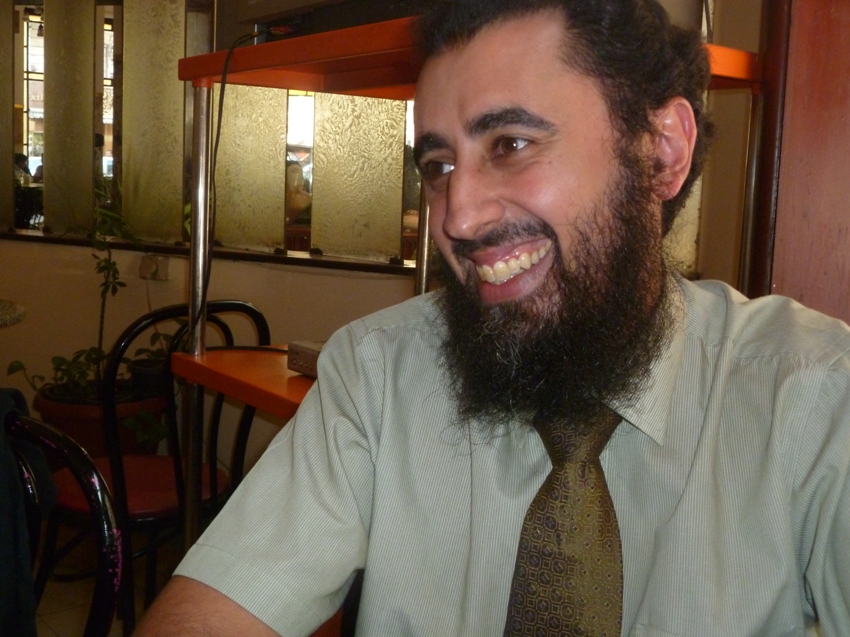
However useful this description may be, it does not comprise the whole of Egyptian Salafism, and a clear example is Ahmad al-Qadri.
At the time of this interview Qadri was an advisor to the Salafi Nour Party in energy affairs. He is now the official English language spokesman for the Salafi Watan Party, which recently split away. These political developments can be read here, but this article is more a profile of him and his worldview.
Here, for example, he describes how he became a Salafi:
For Qadri, his grayness was exposed by life abroad. He studied for his PhD at Strathclyde University in the UK from 2006-2009, and immediately found the local Muslim community to be either black or white, secular or religious. The psychology of minority status pushed immigrant Muslims either to seek integration with the larger culture, or else to dive deeply into their own religious heritage. Glasgow as a city was about 17% Muslim – mostly Pakistani – while the university could be as much as 30%.
From the beginning Qadri was tested. The university committee to welcome new students served wine at their reception. Women freely extended their hands to greet him. Upon polite refusal – as an ordinary Egyptian Muslim, not as a fanatic – he was politely asked why, and what relation Islam had to such social awkwardness.
These experiences pushed him to read subjects he cared little about while growing up. His personal studies led him to the books and YouTube sermons of popular Egyptian Salafi scholars like Muhammad Hassān and Muhammad ‘Abd al-Maqsūd. By 2007 he started growing out his beard. He eventually became vice-president of the Muslim Students Association at his university, which was composed primarily of Salafi students from the Persian Gulf and North Africa.
Qadri differentiates between Islamist groups, especially highlighting mainstream Salafis perspective on jihadists:
Even so, Salafis should be differentiated from other Islamist groups, though all agree on the necessity of applying sharia law. The Muslim Brotherhood has a Salafi orientation, but desires to change society from the top. For this reason they seek political power. The problem will be, however, if they do not perform well society will reject them. This may cause the loss of the whole sharia project.
There are other Islamists who have sought to live according to sharia law in other ways – ways rejected by Salafis. Some, such as Takfir wa Hijrah (Excommunication and Exodus), curse society as non-Muslim and form isolated communities to themselves. Some such groups then move further along into advocating violence to overthrow the government and seize power. Such jihadis are also ‘Salafi’ in the manner of viewing Islam through the lens of the Qur’an and Hadith, but are rejected by the mainstream Salafi movement. Salafi leaders such as ‘Imād ‘Abd al-Ghaffūr and Yūsrī Hammād have traveled to Sinai where many extremist have taken refuge to convince tribal leaders and the youth the jihadi perspective is wrong. Jihadis themselves, however, cannot be talked to at all, as Qadri finds them unwilling to accept anyone as a Muslim except themselves.
His views on religious defamation and the freedom of conversion seem to bounce back and forth between liberal and conservative notions, but where liberal they are surprising and muddle the waters:
Additionally, Salafis support a law against denigration of religions which would apply equally to Christians and Jews. This law, however, would not prevent conversion from one religion to another, or to none at all. Nor would such a law apply to the conversation, or even the printing, of one religion respectfully describing the other. A Christian can freely communicate that for them, Islam is a false religion and Muhammad was a liar. Several years ago a highly visible convert to Christianity, Muhammad Hijāzī, created a stir in the media. Salafi groups raised no case against him.
In this area Qadri was more difficult to understand, for he stated as well that there should be censorship of thoughts that harm the Islamic religion to keep sectarian strife from society. He also defended the case brought against Nasr Abu Zayd, who was sued for his academic writings on Islam. The court referred the case to the Azhar, which ruled they proved him a non-Muslim. As such, he was ordered to divorce his wife, and he fled to the Netherlands for asylum leaving his wife behind.
In explanation, Qadri stated a Muslim is free to become a non-Muslim, but if so he forfeits his rights. A family should be protected from the shame of having their daughter be married to a non-Muslim at any point in her life. Furthermore, the apostate will lose his Islamic inheritance rights. Yet he is free to join another creed, and even free to publish his reasons why.
This privilege does not extend to non-monotheistic religions, however. A Muslim may become a Buddhist in his heart, but no community of Buddhists may build a temple in Egypt. The same applies to Shi’a Islam.
Finally, from the conclusion, asking rhetorically the common doubt toward all articulate Islamsts:
Qadri presents these opinions as shared by the Egyptian Salafi community, many of which are not young, know no English, and are far more comfortable conversing over ancient texts. Is this accurate? Or has Qadri learned the art of speaking to the West, having been tested in the hallowed halls of Scotland academia?
Perhaps there are generational gaps. Perhaps there are educational gaps. Among all peoples there are frauds and charlatans, politicians and propagandists. The testimony here is only that Qadri was a very nice, pleasant individual, who appeared to speak sincerely and passionately about his faith. Judgment on the Salafi movement can only be rendered upon how they benefit – or damage – Egypt, but in his demeanor it is hoped that the Salafi community will demonstrate Qadri to be a standard representative.
Please click here to read the full article on Arab West Report.
The Muslim Brotherhood are repairing schools, serving the poor and beautifying streets.
While violent protests and political impasse grab the headlines, the Muslim Brotherhood has launched a much quieter campaign to commemorate the two year anniversary of the January 25 revolution.
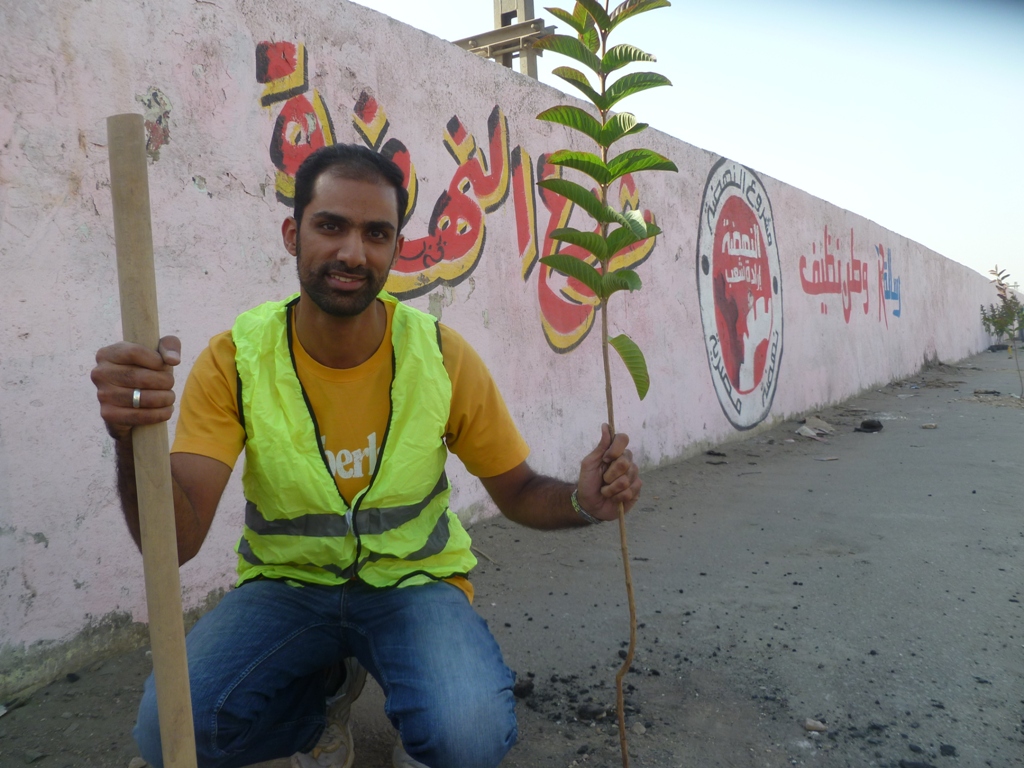
Hatem Abd al-Akhir is the leader of the Brotherhood’s Freedom and Justice Party (FJP) in the city of Helwan, to the south of Cairo.
‘We wanted to celebrate the revolution in a different way,’ he told Lapido Media. ‘But other parties are trying to interrupt society and start another revolution.’
The Muslim Brotherhood built its reputation on providing social service to the poor. As the economy declines and their popularity diminishes, they peg the opposition as agents of instability.
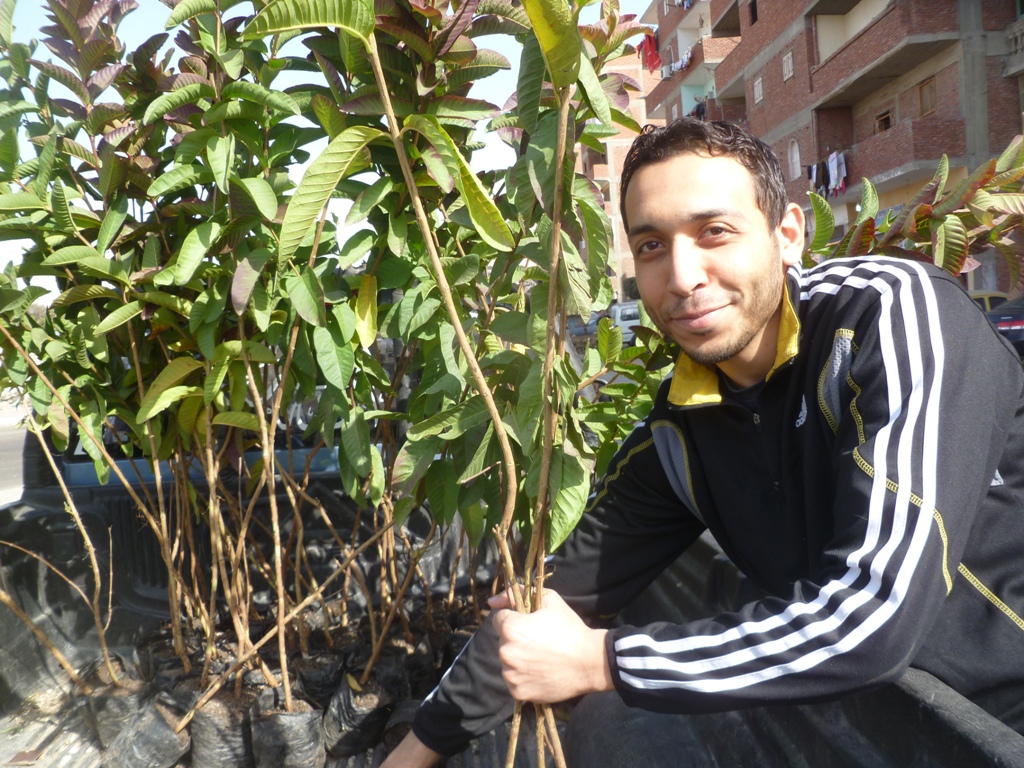
Ahmed Kamal is the FJP youth secretary in Helwan. ‘We’re trying to get Egypt into a new stage of building and development,’ he said to LM. ‘This is the message we want to convey both inside and outside Egypt.’
To do so, the Brotherhood is planting one million sapling trees throughout Egypt, one hundred of which are in Helwan. Kamal led teams of youth digging holes in the limited dirt of the urban landscape, boring even into the sidewalk.
Hatem Abd al-Akhir
Abd al-Akhir, meanwhile, participated in the effort to provide a million citizens with healthcare. An ophthalmologist, he offered free eye examinations to diabetic patients and at-cost treatment for any operation.
As the manager of the Helwan Eye Center, he assures normal costs for patients are 30 percent below market standard. Yet the centre still makes a small profit, illustrating a mix of business and charity, politics and social good.
‘The Muslim Brotherhood is a logistics service for advertising,’ he said describing the campaign. ‘We want to propagate values in our community which will help keep the peace.
‘When we offer low cost service we oblige others to not raise their prices above what is acceptable.’
But in a time of great social and political upheaval, it is unsurprising some are critical.
Ahmed Ezzalarab is the deputy chairman of the liberal, opposition Wafd Party. ‘They are trying to distract people by giving a different image of development, but it is too late,’ he told Lapido Media. ‘They are being exposed for their secret agenda which the people are rejecting.’
Ezzalarab does not dispute their social work, but recognizes it is necessary to oppose the Brotherhood for their poor record in power. In recent weeks train accidents and building collapses have claimed the lives of dozens of citizens.
‘Governance has never been worse in Egypt’s history,’ he said. ‘They cannot run the country administratively; everything they touch fails.’
But in describing a secret agenda, Ezzalarab appeals to conspiracy.
‘We are completely against the violence, which is working to distract the people from the peaceful nature of the opposition,’ he said. ‘It is being funded by Wahabi and Gulf money, because they are scared to see civil forces come to power.’
Ezzalarab believes the Brotherhood is panicking, fearful the army will step into the violence and unseat them from power. Perhaps he is right. Brotherhood leaders are clearly propagating the conspiracy theory.
Anas al-Qadi, Brotherhood spokesman said on the official MB website, Ikhwanweb.com: ‘This is the difference between the Muslim Brotherhood marking the memory of the revolution with greatly appreciated services, and so-called civil forces celebrating the revolution with flagrant acts of arson and violence, spreading chaos and destruction and vandalism.’
The website also accused one of the newly organized vigilante groups, Black Bloc, of being an arm of the Coptic Orthodox Church.
Any of the various accusations may be correct, but they are presented without evidence and signal that both social service and social violence are a means to an end.
Ahmed Kamal
‘If you are trying to apply Islam as you understand it, you have to reach authority by all legal and peaceful means,’ said Kamal. ‘To do this you have to show people why they must support you.’
Kamal was responding to the charge that the Brotherhood is putting good works on display, contrary to Islam.
‘We need to differentiate between being a Muslim and being part of an Islamist program which competes with other parties,’ he said.
‘As a Muslim, you can choose to tell or not tell of your good works, it depends on your intention. If you tell you can be a role model that others will follow, but God will judge you in either case.’
But for now, Egypt is the judge, and the verdict is a cliff-hanger.
Mohamed al-Zawahiri, brother of the al-Qaeda leader
From my recent article in EgyptSource, following up on the last post of pictures:
Zawahiri is the leader of what has been dubbed the Salafi-Jihadis. Long associated with Islamic Jihad and the Islamic Group, following his release from prison in March 2012 he has positioned himself to the right of the now politically engaged Islamists of the Muslim Brotherhood and traditional Salafis. But who does he represent?
“We are just Muslims, protesting the killing of civilians,” said Walid, one of about 400 demonstrating against French military activity in Mali. “We have no leadership and we don’t belong to al-Qaeda.”
‘Not belonging to al-Qaeda’ was a frequent refrain of protestors.
But there was plenty of sympathy, as well as conspiracy:
Ashraf, who declined to give his last name but consorted comfortably with al-Zawahiri, praised the Benghazi attack which killed the American ambassador, and said more of this nature was needed. But as to the nature of Salafi-Jihadis, he was circumspect.
“There is no such thing as Salafi-Jihadism,” he said. “This name is simply a creation of state security, used to divide Muslims.”
The Egyptian regime, he believes, has always conspired with the Americans to distort Islam. “Is there any Salafism without jihad?” he continued. “Who are the Salafis but the first generations of Muslims, and were these not engaged in jihad?”
By all appearances their numbers are few, but this may not matter much, and surely not all are visible:
Salafi-Jihadis appear to be less an organization than an idea. So while the idea of Islam violently reordering world relations – today focused on Mali – is unable to attract many, it does attract a dedicated few. For Zawahiri, this is enough.
“Over the centuries Muslims have been the victorious ones,” he said, “even when they have had small numbers.”
Please click here to read the full article on EgyptSource.
The Salafi political movement experienced massive transition in the past two weeks, enduring splits, recriminations, and leadership changes. Having long foresworn the political process, it is right and natural for growing pains to characterize their apparent embrace of democracy. Taking stock, three observations describe their current standing.
These are:
The process is transparent, but is the result foreordained?
The rhetoric is clear, but are they learning spin?
The inspiration is worrisome, but does it determine?
From the first:
The main question directed to Islamist politicians is if they truly believe in democracy or simply use it as a ladder to power. Egypt’s constitution declared its governing system to be both democratic and of an undefined shura (consultation). The shura provision was added at the request of Salafis, whose ideas of democracy issue from the selection process of the early Islamic caliphs, which was consensual. If internal elections are any indication, Salafis are willing to be transparent about their leadership choices, but greatly prefer the predetermined aspects of shura.
From the second:
There are reasonable reasons to reject quotas as well as to trust sharia provisions toward non-Muslims. Yet probing beyond the headlines exposes differences of nuance, if not outright contradiction.
Opponents of Salafis do credit them for being straightforward and sincere, unlike their opinion of the Muslim Brotherhood. As they develop political skill, however, it appears Salafis also are learning the unfortunate art of spin.
From the third:
Then effortlessly, unprompted, and without rancor, he slid into a passionless diatribe. “When we reach the stage of our empowerment, we will collect jizia from the Copts.
“Permissible for us are the blood and spoils of those who disbelieve in God and refuse his prophet,” he said. “This is not for the people of the book, as long as they do not fight us. But inside and outside Egypt they are fighting us, taking millions from America to accumulate weapons.”
…
So when Sheikh Abdel Khaleq Mohamed states at an official party function, “Democratic work is unbelief, but as long as it leads to the victory of God’s religion it is permissible to us,” does he represent its official line? Or does party president Ehab Shiha, who clarified the misquote, adding after ‘unbelief’ the words ‘… as a doctrine’ which were clipped in the article? On the contrary, Shiha accepts the definition of democracy as ‘government by the people, of the people, and for the people’ as long as it does not transgress the laws of God.
Please click here to read the full article on EgyptSource.
From my recent article on Christianity Today, published online on January 10, 2013:
The stakes have been raised for Christian satellite broadcasting in the Arab world.
On November 28, a Cairo court sentenced to death Nakhoula Basilli Nakhoula and six other Coptic Christians—who all live outside Egypt—for their alleged roles in producing The Innocence of Muslims. The film, which mocks the Prophet Muhammad, prompted violent protests worldwide.
Nakhoula is relatively safe since he and the Way, the satellite channel that broadcasted the film, are based in the United States. But the sentence drew attention to how such channels have proliferated in recent years, seeking to present the gospel to Arab Muslims by—in part—directly criticizing Islam.
“Since satellite TV is widespread across the Middle East and is uncensorable, it is obviously a key way to make the good news of the gospel available,” said Terence Ascott, CEO and founder of SAT-7.
Please click here to read the whole article, which includes testimony from Egypt based religious broadcasters SAT-7 and Coptic CTV, as well as internationally based Coptic Logos TV, and Life TV.
The location can make a difference. While the legal consequences vary from nation to nation, Islam as a religion highly discourages conversions away from the faith – certainly public ones. There is a range of response; some advocate death, others social estrangement, and some say (quoting the Qur’an, not necessarily definitively) there is no compulsion in religion.
I am comfortable with the fairness and objectivity of the article, and every source spoke on the record. But based in Egypt where almost everything religious is highly sensitive, there is one element of the story beyond my control – the title.
Every magazine takes the prerogative to title an article according to their best understanding of audience marketing. After all, it is the title which draws the reader to the content. I always suggest a title; sometimes it is accepted, sometimes it is discarded. Generally there is collaboration on the matter. Usually the choice of final title doesn’t make very much difference to me, and most often their wording is best.
This article originally was published in print, that is, for local distribution in the US market only. This means it would exist largely away from any local Egypt sensitivities.
But it was also purposed to publish online eventually. This means the article is open and available to all. The sensitivities remain.
My original suggestion was: ‘Broadcasting the Gospel in Arabic: For Christians or Muslims?’ One suggestion along the way, which I liked best, was: ‘Target Audience’.
In the print edition the final choice was: ‘Carrot or Stick?’ with a subtitle of ‘Broadcasters debate best way to reach Muslims’. And online the title became: ‘How Should Christian Broadcasters Evangelize to Muslims?’
I think these titles somewhat miss the point, because much of the existing Arabic language religious broadcasting is produced for the Christian audiences of the Middle East. Even the channels which speak more directly about Islam are watched extensively by Christians, featuring testimonies, for example, of Muslims who have become Christians. For a community in regional numerical decline, such ‘proof’ that their religion is truly from God is comforting amidst the challenges of being a minority.
Therefore, the balance necessary in choosing a title is certainly tricky. Each publication has its own standards and religious convictions, but for the evangelical audience of Christianity Today, it is a given that the message of Jesus is for all – including Muslims. Of course media should give them exposure of and invitation to the teachings of Christianity, in their own language.
Meanwhile, for most in Egypt, it is Islam which should draw the converts. It is anathema that a Muslim might leave Islam to any religion at all, and many are offended when others try to encourage the process. As the article points out, this is even more so when the attempt directly criticizes Islam or Muhammad.
Christianity Today also has another article on the subject, which highlights some navigating a middle ground. It is an interview unlikely to fully please either the Christian or the Muslim.
In America, religion is largely a private matter, with religious ideas being free game on an open market. One should respect the convictions of an individual, but religions themselves are subject to ridicule, criticism, indifference, allegiance, support, belief, or robust apologetic – as the case may be. Most Americans accept this as good and natural.
In Egypt, religion is largely a public matter, with religious ideas protected to preserve social harmony. One should allow, almost begrudgingly, an individual to harbor divergent views in his heart, but the religions themselves – at least concerning Islam and Christianity – are from God and not to be questioned. Most Egyptians accept this as good and natural.
In this light, the title options chosen for the article come from a very American perspective, designed to draw the most readership. My favored titles strive to be as neutral, yet descriptive, as possible. The content is the content, accepted by both. Hopefully all who read will get a fair picture of what is at stake.
When it comes to Egyptian education and Islam, Christiane Paulus is both a critic and supporter. So much so, she adopted both.
Paulus is a German national, resident in Egypt since 1998. She is currently a professor of Islamic studies and Protestant theology at the Azhar University, through the medium of the German language. Her journey here is a story all its own.
Paulus studied Protestant theology and postmodern philosophy in Marburg, Germany, with the intention of becoming a Lutheran minister. But in 1988, before her final tests, she married her husband, an Egyptian Muslim. Unless he converted to Christianity, the church ruled she could not receive her preaching license, as both spouses needed to be of the faith.
Years thereafter Paulus remained in her Christian faith, even after moving to Egypt with her family.
Paulus does describe what she finds are the culturally derived faults of the Egyptian education system, with consequences falling directly on religious and political relations:
Dialogue, Paulus believes, is a subject of the social sciences – a discipline largely ignored in Egyptian education. Curriculum, methodology, and pedagogy have remained stagnant since the Nasser era, when a resistance to new ideas was the norm. Since then, however, both students and teachers have sought to escape the system. At the basic level this involves the reliance on private tutors; for those able it means enrollment in private or foreign schools.
Women, she noted, are in general educated relationally. This equips them for dialogue more readily than men. But in addition to educational lacking, the Egyptian culture is bound by concepts of honor and shame. Together with pride, this produces an atmosphere of ‘not talking’. An Upper Egyptian husband, for example, will ignore his wife and stay silent with her when upset. Outside the family, discord produces the same result. The first casualty of Egypt’s political division is a lack of communication between liberals and Islamists.
But her focus in presentation was on what drew her to Islam as a religion. Much of this was due to the influence of her husband and his family, but it was also from historical study:
In 2005 Paulus read a book by the Egyptian Muslim theologian Amin al-Kholy, an active intellectual in the early 20th Century. ‘Islam and the Connection to Christian Reform’ summarized his presentation on the Protestant Reformation, representing the Azhar at the 1935 Brussels conference on the religious sciences.
Kholy noted that the early Protestant reformers – prior to Luther – emerged from areas long occupied by Muslims. From Spain under the Reconquista, Lyon, and Monaco, figures such as Peter Waldus and William of Ockham adopted ideas originating in Islam, translated them into Latin, and began applying them to criticize European Catholic Christianity. The Muslim populations of these areas had been forcibly converted into Christianity but retained their Islamic beliefs in secret. A few centuries later, Islamic-cum-Protestant ideas such as no mediation between man and God, private reading of the Scriptures, and clerical marriage began to take hold.
But she remains critical of prevalent Islamic thinking as well, which generally leaves their received religious heritage unquestioned:
Of course, a great deal of irrationality has entered the Muslim world, too. Where education is lacking the religious discourse takes over everything. Contrary to the prevailing religious spirit, Paulus says each individual Muslim has the right to read and evaluate Islam’s religious sources – the Qur’an and Hadith – weighing their value. The condition is to keep the Islamic culture of discussion respectful, objective, and academic.
This individuality also comes out in Paulus’ decision not to wear a headscarf.
Paulus is a charming person who is clearly a deep and sensitive thinker. Her testimony was given in a presentation with brief time for questions and answers; otherwise, it would have been useful to probe many of her arguments further. Please click here to discover them by reading the whole article on Arab West Report, and here for an Arabic language article on Paulus.
But less interesting than arguments is the story of an individual human being, seeking to make sense of the world. Tomorrow I hope to post a link to another recent article I have written, this time in the other direction.
The Nour Party, the political flagship of Egypt’s burgeoning Salafi movement, is in full damage control over scores of member defections to the new Watan Party. This is appropriate, as the damage is substantial.
The Nour Party lists why it is dismissive of its new rival, but Watan boasts impressive transfer:
According to Ahmed al-Qadri, the English language spokesman for the Watan Party and former vice-president of Nour’s energy committee, the resignations affect the great majority of leadership positions. Besides former party president Emad Abdel Ghaffour and spokesmen Mohamed Nour and Yousry Hammad, nineteen regional offices resigned collectively.
Furthermore, Qadri explained, every single member of Nour’s technical committees has resigned. Including the economic, political, agriculture, energy and other committees, these groups of experts facilitated the work of Nour’s members of parliament. Of Nour’s 107 MPs, 52 have joined Watan, along with sixteen current members of the Shura Council.
The problem is not over doctrine, but over the influence of religion over politics:
“Some people wanted to assign positions based on proximity to leading religious figures,” said Qadri. “One of Nour’s mistakes was that the Salafi Call had the right to interfere in the party and change job descriptions. We want to work to unite all Salafi schools but have a legitimate and independent political party.”
Some Salafis fear – and liberals hope – these divisions will damage the electoral campaign of Islamists. But Qadri sees it differently:
“If the main figures of a party make a mistake, it may cost them votes, but if we have variety in the Salafi trend then those votes can simply shift to another party,” he said.
“If you are only one party you will be too sluggish to promote yourself because there is no competition.”
And from the conclusion, he hinted that this multiplicity might actually distance religion from politics:
“You cannot simply say ‘sharia’ or ‘Islamic state’ because we all believe in this,” he said. “The Egyptian people have learned that no one will any longer give their vote to a flag, but only to those who offer them solutions.”
The coming elections will tell, but unity is always important. Just ask liberals worried over possible splits in the National Salvation Front.
Please click here to read the full article on EgyptSource.
Moves by the Arab League in concert with British activists, are putting pressure on Israeli authorities to observe international legal commitments on children detained, imprisoned and tortured in Israeli jails.
The Baghdad Declaration on the Palestinian and Arab Prisoners in the Israeli Occupation Prisons, issued on 12 December, 2012, includes a devastating critique of Israeli treatment of prisoners including children, and calls for legal sanctions against Israelis involved in their detention.
The 11-point Declaration issued on the second day of the 70-nation conference in the Iraqi capital includes the setting up of an Arab fund to support Palestinian and Arab prisoners and their families.
Hosted by the Arab League under the auspices of the Iraqi Government, it was addressed by both Iraqi President Galal Eltalibany, and Iraqi Prime Minister Nori Al Maliky as well as Palestinian Prime Minister Sallam Fayyad and Secretary General of the League of Arab States, Dr Nabil Elaraby. British jurists, parliamentarians, and representatives of civil society organizations also attended.
The Declaration calls on the United Nations and the international community to hold Israel accountable for its treatment of Palestinian prisoners, especially children, using all available legal mechanisms.
Between 500 and 700 Palestinian children are arrested by Israeli soldiers every year, according to NGOs.
Rev. Stephen Sizer
‘I chose to speak on child prisoners because it is there that I believe we see most blatantly human rights abuses,’ said the Revd. Stephen Sizer, vicar of Virginia Water in Surrey, England, a presenter at the conference, who helped assemble the sizeable British contingent.
A widely-published critic of ‘Christian Zionism’, he is currently under church investigation following a complaint – which he opposes – of anti-Semitism issued by the Board of Deputies of British Jews.
‘Israel breaches international law by transferring minors from Palestine to Israeli jails,’ said Mr Sizer to Lapido Media, referring to the Fourth Geneva Convention. ‘They should be returned to Palestine if they have committed offences.’
Stone throwing
Sizer’s report to the conference sponsored by the United Nations and Arab League says that most of the offences committed by children are throwing stones at soldiers or settlers in illegal Jewish settlements in the Occupied Territories.
‘Armed resistance of an illegal military occupation is legitimate in international law,’ said Mr Sizer.
Gerard Horton of Defense for Children International (DCI) who also attended the conference, does not deny children offend, but says that they have legal rights like anyone else.
‘Regardless of what they’re accused of, they shouldn’t be arrested in the middle of the night in terrifying raids, they should not be painfully tied up and blindfolded sometimes for hours on end, they should be informed of the right to silence and they should be entitled to have a parent present during questioning.’
A DCI-Palestine report found that among 311 sworn affidavits taken from children between January 2008 and January 2012, 90 percent were blindfolded and 75 percent suffered physical violence. A further 33 percent reported being strip searched, while 12 percent endured solitary confinement.
Mark Negev, spokesman for Israeli Prime Minister Benjamin Netanyahu has said in the past hat rock-throwing, throwing Molotov cocktails, and other forms of violence are ‘unacceptable’ – but stopping it should not be achieved illegally.
Israeli security agency Shin Bet denies the use of unlawful methods: ‘No one questioned, including minors, is kept alone in a cell as a punitive measure or in order to obtain a confession,’ it says.
But one 16-year old Mohamed Shabrawi (16) of Tulkarem in the West Bank, cited by DCI, tells of soldiers seizing him in his home at 2:30am. He claimed he spent the first seventeen days of his detention in solitary confinement, and was told his family would be arrested if he did not cooperate.
After twenty days he first saw a lawyer. After twenty-five days he was formally charged. Finally, he confessed to being a member in a banned organization and was sentenced to forty-five days in prison.
Horton believes the abuse of children is meant as a deterrent, as many interviewed minors state they never wish to see another soldier or go near a checkpoint.
‘Human rights abuses occur on all sides,’ said Mr Sizer. ‘We are most concerned about the use of detention by the Israelis for political purposes.’
This article was first published on Lapido Media on January 2, 2012.
On December 29, 2012, an unknown assailant killed two Egyptians praying in a service building attached to a Coptic Orthodox Church in Misrata, Libya. Located to the west of Tripoli, the attacker threw a homemade bomb into a midnight prayer service of 150 people, injuring two others.
According to Fr. Marcos, the Coptic priest in Misrata, the assailant appeared to have targeted the service, attacking the home rather than the more heavily secured formal church building. He did not have any prior warning of an attack, however, nor any knowledge if his church was targeted because it was a Coptic Orthodox Church in particular.
Fr. Marcos wondered if the attacker may have been confused thinking this prayer service was in celebration of the New Year. Two years earlier in Alexandria a Coptic Orthodox Church was bombed on December 31, 2011, killing 21. This prayer service had been ongoing for a month, however, so the priest offered the possibility of no connection at all.
The churches of Libya, however, are included in the Coptic Orthodox diocese of Beheira in western Egypt. This is the diocese from which the current patriarch, Pope Tawadros II, was elected.
The bombing represents an unfortunate continuation of the sufferings of the Coptic Orthodox Church since the Alexandria bombing. Fr. Marcos noted the two who died were the first Coptic martyrs outside of Egypt in the modern era.
Whoever did this, he assured, represented a very small percentage of people. Libyans, he declared, are good people who do not know religious fanaticism as they have only one religion, Islam. The church had lived in peace in Misrata for a long time.
During the Libyan Revolution at one point the church was hit by a bomb. On other occasions it was strafed by gunfire. None of these events targeted the church, and Fr. Marcos related that no injuries were suffered. The Coptic community gathered together as a community and managed as best they could.
Their management included offering service and grace to others. Soldiers connected to Col. Gaddafi at times demanded shelter in the church. This was freely offered, but with the request that all weapons be left outside. Sometimes this was followed, sometimes not.
Fr. Marcos remarked the Copts of Misrata are praying for their own salvation, the salvation of Libya, and the salvation of the world. They ask God to bring peace and love to their city, even to their enemies who committed this crime.
He remarked his church was a praying church, united in seeking blessing for all people, of which God heard their prayers. He wondered if the attack was orchestrated by the devil in an effort to stop them from praying. If so, he assured, this plan would fail.
May God bless their community, the people of Libya, Copts in Egypt and around the world, and the nations of the Arab Spring. May the upheavals they suffer result in peace, prosperity, and good governance in the near future.
From my new article on Christianity Today, published December 28, 2012:
Egyptian Christians spent this year’s Advent season awaiting more than the celebration of Jesus’ birth. Christmas Day dawned with Copts still processing the rushed passage of a new Islamist-backed constitution and its implications.
Days before voting began on the hastily completed charter—which, despite only 33 percent turnout and accusations of fraud, passed December 25 with 64 percent of the vote—more than 10,000 Christians gathered at an interdenominational prayer vigil in Cairo’s famous “Cave Church.”
Please click here and here for more information about this prayer gathering. But the article continues:
“Morsi has not kept his promises to be a president for all Egyptians when he had a chance to do so, and he is losing credibility,” said Ramez Atallah, president of the Bible Society of Egypt. “When the leader is not working for consensus, it makes it very hard for anyone else to do so.”
Yet Atallah still advises Christians to remain politically active while grounding their expectations in the necessary dual perspective of Christianity.
“We must be good citizens,” he said. “This panic is not justified in our faith, even if it may be justified in terms of politics.
And here is a section on liberal ‘hope’ for political reversal in the midst of anticipated economic difficulty:
But as liberals have consistently failed to win at the polls, some place a morose hope in Egypt’s expected financial difficulties to aid their parliamentary campaign.
“There is an economic disaster coming,” said Michael Nabil, an Egyptian accountant. Since the revolution, Egypt has lost more than half of its foreign currency reserve fighting inflation and devaluation. “This will affect the situation negatively for the Muslim Brotherhood and give the opposition more credibility,” he said.
I had hoped to write this week’s Friday Prayers for Egypt about the economy, but was unable to. Perhaps after the climax of the constitution nothing this week seemed so urgent for prayer. That is not true, of course, but like many in Egypt, I feel somewhat drained, and this week was a week of recovery. Western Christmas celebrations helped.
The main issue for the prayers would have been the feared coming economic collapse. It may well happen, but is also tinged with manipulative rumors that seem almost designed to produce a panic.
Finally, a quote on what seems a very proper perspective for Egyptian Christians:
“There is no connection to political stability and the success of the gospel,” said Atallah. “In fact, the opposite might be true: People depend more on God in difficult times.”Maybe God will use the Muslim Brotherhood to do his will in Egypt, even if we don’t want them to be in charge,” he said.
Please click here to read the entire article on Christianity Today.
Rarely has a constitution so divided a nation. Protests, both for and against and sometimes violent, have filled the street. Egypt’s Christians, meanwhile, are caught in the middle. Though united against the proposed draft, their responses have varied considerably.
“It was definitely right for Christians to protest,” said Youssef Sidhom, editor-in-chief of the Coptic newspaper Watani and a long time advocate of cooperation with the Islamist administration.
“But this was not a Christian move, it was a liberal Egyptian protest meant to save the civil state.”
Despite his conciliatory position toward the Muslim Brotherhood, Sidhom had warned the day might come to return to the street if Islamists tried to implement a religious agenda. When President Morsi assumed temporary dictatorial powers to push through this constitution, he believed it was time.
“There are many indirect clauses that can lead to an Islamic state, and a few direct ones as well,” he said. Chief among these is Article 219 which makes traditional Islamic jurisprudence the primary source of legislation. Article 4, furthermore, gives a role to unelected Muslim scholars who must be consulted on laws regarding their conformity with shariah.
But it was the Islamist response to these protests which makes Sidhom believe they have shown their true colors.
“They made vicious remarks stating the protests were 60-80 percent Christian,” he said. “This shows they realize the solidarity that exists between liberals, moderate Muslims, and Christians, and they are trying to break it.”
Indeed, in an effort to mobilize votes for the constitution, the official Muslim Brotherhood website featured a story alleging Christians exchanged SMS messages urging a ‘no’ vote because they wanted ‘a Coptic state’. Safwat Hegazi, appointed by Morsi to the National Council for Human Rights and a fixture during his presidential campaign, warned the church that if it threatened Morsi’s legitimacy Muslims will threaten them ‘with blood’.
Hegazi’s remarks were filmed at a Salafi Muslim sit-in protest at Media Production City, where they believe their image is being disfigured in the press.
“In the sharia, which people do not understand correctly, everyone takes their full rights – the woman, the non-Muslim, everyone,” said Ibrahim Eid, an ophthalmologist and the media coordinator of Students for Sharia, present at the protest. Salafis there were peaceful and friendly.
This message came across to Daniel Wahba, a Coptic taxi driver. Idling in the parking lot, Salafis engaged him winsomely.
“Is there anything in the constitution that will hurt us as Christians?” he said. “Won’t we still be able to go to the church and pray?”
But it was the fear associated with general Islamist domination that affected Susie Fayiz, a Coptic housewife. “I didn’t vote,” she said. “They are just going to rig the referendum in their favor anyway.”
Preliminary results show the ‘yes’ vote in the lead with 56 percent, amid accusations of fraud. Half of Egypt’s electorate is scheduled to vote next week.
Thousands of Christians took to the streets to protest, and thousands of Christians went to the polls to vote. In between, ten thousand gathered to go to their knees in prayer.
Fr. Simaan
“We are here tonight to pray for Egypt in all that it is going through, and let us pray with tears,” said Fr. Simaan, a Coptic Orthodox priest serving the city’s garbage collectors. Their expansive cathedral is built into a cave in the Muqattam Mountains east of Cairo.
One year earlier, Fr. Simaan conducted a similar prayer gathering for all of Egypt’s Christian denominations, which drew upwards of 40,000 people. Plans to repeat the expression of unity have been in the works for months, but this meeting was only announced one week earlier, scheduled for two days before the referendum.
If there was any intentionality it did not appear during the rally. From 6pm until 6am the next morning, not once was the referendum mentioned. The general state of Egypt, however, was on everyone’s mind.
“Some of us see demonstrations and conspiracies, but I see Egypt going right. I see great days ahead of us,” said Fr. Andrawus, an Orthodox priest from Damanhour in the Nile Delta.
“Some say this country is being destroyed or being stolen. I say God is coming and he will not be late. This coming year will be the best ever for the church. The heavens will open, the church will be united, and we will be freed from fear and learn to love.”
Love is Fr. Simaan’s great emphasis, and he wishes to tell the world Copts love their nation and their fellow citizens. As Egyptian flags flew everywhere, six different satellite channels carried his exhortation.
“We pray for our brothers, both Christian and Muslim. We pray for our brothers, the Salafis and the Muslim Brothers,” he preached to great applause.
“We pray for them that God will open their hearts and keep them from harm. We are not in a war, we are in prayer.”
The church took no official position on the referendum, other than to encourage people to vote. Many participants, however, freely interpreted the point of these prayers.
“We pray for stability, safety, and a constitution we can all agree on, not one from just one slice of the country,” said Michael Magdy. Others, however, were less specific of divine providence.
“We love Egypt because it is our country, and we love God,” said Amal Samy. “We’re confident he will stand with us and lift this crisis, giving a rescue no one can expect.”
Fr. Simaan does care for a good constitution, but his focus is elsewhere.
“Perhaps the current circumstances are permitted by God as part of his plan,” he said. The Islamists have their sharia and their plans, and God will hold them accountable according to what they have received.
“But he will hold us accountable for how we live with them.”
Protests and prayer have their essential place, but amid the crises of Egypt, perhaps this is the way to peace.
The proposed Egyptian constitution offers something to everyone, and its supporters know how to address the audience.
Article 3 gives Christians and Jews the right to govern their communities according to the internal rules of their religion. Articles 31-80 give liberally-minded citizens assurances on a litany of basic rights, including expression, belief, education, and even playing sports.
Less heard in the West, however, is the local message: articles designed for conservative Salafi Muslims may undermine every other guarantee.
‘This constitution has restrictions [on rights and freedoms] that have never been included in any Egyptian constitution before,’ said Sheikh Yasser al-Burhami, Egypt’s leading Salafi and founder of the Salafi Call, on a YouTube video attempting to convince his community to vote for a document many of them find not restrictive enough.
Ibrahim Eid is another leading spokesman for those who seek to return Egypt to the ancestral ways and beliefs of Arabia. An ophthalmologist and media coordinator for Students of Sharia, a Salafi association, he told Lapido: ‘There are two aspects to this constitution: that which designs a political system, and that which legitimizes it. I reject its legitimacy completely’.
Sovereignty belongs to God alone, he says.
Article 5 is therefore an anathema. It states: ‘Sovereignty is for the people alone and they are the source of authority. The people shall exercise and protect this sovereignty, and safeguard national unity in the manner specified in the Constitution.’
‘Is it reasonable to justify God’s law by a constitution, or to submit it to a referendum? Not at all!’ he said.
‘But we agree to its political necessity for the sake of the stability of the nation.
‘Let’s move through this crisis, elect a new parliament, and then the first thing they will do is change the defective articles.’
Bishop Mouneer Anis of Egypt’s Episcopal (Anglican) Church finds defective articles as well, but of the opposite kind.
‘This constitution does not lead to social cohesion, but to division,’ he told Lapido Media, as preliminary results of the first round referendum suggested 43 per cent of the population reject it. ‘It does not ensure the freedom of the minority to the extent Egypt was expecting.
‘But it ensures the rule of the majority and has many questionable, vague expressions.’
These are the very expressions Burhami celebrates, witnessed chiefly in the dispute over Article 2, defining the identity of the Egyptian state.
In the previous constitution, Article 2 declared the ‘principles’ of Sharia law to be the primary source of legislation. Egypt’s High Constitutional Court consistently interpreted the word ‘principles’ in a general fashion, avoiding direct reference to specific Islamic laws.
Liberal members of the 100-person Islamist-dominated committee writing the constitution were able to fend off Salafi demands to remove the word ‘principles’ and force legislation toward Sharia alone.
But to satisfy the Salafis, the committee added Article 219, to interpret ‘principles’ in accordance with traditional Islamic jurisprudence. Furthermore, Article 4 assigns an unelected body of Islamic scholars the right of consultation on legislation.
Burhami’s chief pride, however, is in Article 81, concluding the extended section on rights and freedoms. It seeks an elusive compromise.
‘No law that regulates the practice of the rights and freedoms shall include what would constrain their essence,’ reads the text. But what follows defines this essence:
‘Such rights and freedoms shall be practised in a manner not conflicting with the principles pertaining to state and society included in Part One of this constitution.’
Part One however includes Article 2 which is defined by Article 219, subjecting all freedom to Islamic Sharia.
Gamal Nassar, Freedom and Justice Party
‘What is the problem with being an Islamic state? Egypt is Islamic and there is nothing else to be said,’ the Muslim Brotherhood’s Gamal Nassar tells Lapido.
Nassar is a founding member of the Brotherhood’s Freedom and Justice Party. He believes the discussion of these details ignores the agreement on 90 percent of the constitution.
‘No one, even among the liberals, opposes the Sharia. This is at heart a political struggle,’ he said.
‘All freedoms must be regulated and not go against the nature of Egyptian society, which is Muslim.’
Nassar sees the nature of the politics in the behaviour of the church, which resigned from the constitution writing committee.
He accuses church representatives of negotiating the agreement of all articles, including Article 219, and then withdrawing suddenly to cause controversy and discredit the committee’s work.
Revd. Safwat el-Baiady, president of the Protestant Churches of Egypt and one of these official representatives, disagrees – and strongly. He sees a different type of politics at play.
‘This article [219] was added late and not discussed in any sub-committee,’ he told Lapido Media. ‘Because of its controversy it was postponed until the end, and dealt with only in the concluding consensus committee.’
The problem with this he said was that this consensus committee was no consensus at all, but a small number of members handpicked by the assembly head. It included a Christian, but no official members of the church.
Church representatives, and liberal Muslim members, resigned in protest en masse only once it dawned on them that Article 219 and other controversial aspects were to be presented as if it were the will of the entire body – which was not the case.
A constitution is ideally built on consensus, but it is fleshed out though law. Egypt’s constitution, if it passes, gives something to everyone.
The gift to Salafis, offered freely by the Muslim Brotherhood, is an open door to Sharia law and the conformity of legislation to it.
Egypt’s future freedoms hinge on the make-up of the next parliament, tasked with the contentious business of interpretation.
Note: The 2011 Egyptian parliament, dissolved by court order, was led by the Muslim Brotherhood-led Democratic Alliance, claiming 45 per cent of 498 seats. The Islamist Bloc, led by the Salafi Nour Party, finished second with a quarter (25 per cent) of seats. Two liberal parties received roughly 7 per cent each. Two Copts were elected to parliament, and of the ten members appointed by the then-ruling military council, five were Copts.
Article 229 of the proposed constitution declares procedures for electing the new parliament will begin no less than 60 days after it is ratified, possibly this weekend, following the second referendum vote.
Translation: Sharia, God protect it; Legitimacy, People Sacrifice for it
From my new article in EgyptSource:
Politics in Egypt has degenerated into the question: Who do you trust? A more critical question right now is: What was their plan?
President Morsi addressed the nation late Thursday evening and tied Wednesday’s violence at the presidential palace to undefined ‘political parties’. If the vagary was intended to present the clashes between supporters and opposition neutrally, his overall point was clear in labeling the ultimate culprit as the old, corrupt regime. Surely he was not implicating the Muslim Brotherhood.
Yet it is undeniable the recent violence would not have taken place if not for a decision made by the Muslim Brotherhood to protest at an opposition site.
So, why did they do it?
Of course, the size of the protest, eyewitness reports putting the number at “hundreds of thousands,” was important enough for the Brotherhood to argue it was no more than 2,000 people. The threat, though, was the increase, and the permanent presence of a sit-in Morsi’s doorstep. As the clock ticked toward the date of the referendum, it would be a constant reminder of the standing refusal of Morsi’s constitutional declaration.
This is the best reading of the official Brotherhood announcement of their stated intentions after clashes began. IkhwanOnline announced it rejected violence and went to the presidential palace to ‘protect legitimacy.’ Egypt Independent reported a Muslim Brotherhood Guidance Bureau decision to hold a sit-in at the presidential palace, while Essam al-Erian called on the people to “flood to squares in all governorates, especially at the presidential palace, to protect legitimacy.”
Already convinced there was a conspiracy to unseat them, it appears they could not allow a picture of popular support for the opposition
But was their motive more sinister?
This is the key question, and though the article weighs possibilities, it cannot be determined from located public or reported statements. Certainly if others have found them I would like to know.
Now, of course, their public discourse denies anything, claiming they were the victims. Their rhetoric, though, is telling – indicating a great conspiracy against them, their paranoia it exists, or their invention thereof:
The day of the clashes IkwanOnline collected round-ups on the events from newspapers around the world. They chose to headline this article, however, quoting a detail from the New York Times. “Wealthy and Christians Demonstrate at Ittihadiya [the name of the presidential palace],” it read.
Meanwhile, al-Fajr reports former Brotherhood parliamentarian Sayyid al-Atweil told the Islamic channel Hafez that Copts led the armed thugs in their confrontations. He claims to have seen Copts entering churches carrying weapons. Earlier, the Freedom and Justice newspaper reported Naguib Sawiris, a wealthy Coptic businessman and financier of the liberal Free Egyptian Party, was also being investigated for inciting insurrection.
And as mentioned above, President Morsi stated the violence was tied to ‘political parties’.
May Egypt traverse these waters safely. Please click here to read the whole article at EgyptSource.
For many in Egypt, conspiracies and manipulations are evident, none clearer than the current battle over the Supreme Constitutional Court. Many liberals are convinced Islamists are seeking to destroy the judiciary in order to establish control over all three branches of government.
But do Islamists see themselves this way? Setting aside any possible top level schemes and propaganda among Muslim Brotherhood and Salafi leaders, do their supporters believe they are involved in a pre-planned hijacking of the revolution? Or might their own assumed conspiracies of the liberals have a measure of legitimacy?
‘They are doing everything they can to keep the decisive voice from going to the people,’ Ezzat al-Salamony, a member of the Guidance Bureau of the Islamic Group in Cairo, said of the secular politicians.
Demonstrations on Sunday at the Supreme Constitutional Court led to its chief justice suspending all work in protest. The headline of Ahram Online read: ‘Besieged by Islamist protestors, court delays ruling on Constituent Assembly’. Attending this protest, I witnessed hundreds chanting against the court.
But I also witnessed scores of riot police securing the entrance, enabling anyone to go in or out.
I write next of what may represent a liberal effort to discredit Islamists via the protest at the court. But there may well be other games as well by the other side:
In his [Morsi’s] earlier declaration the president issued two more months for this assembly to complete its work. But in this closed door meeting the message was different.
‘Either we accept the declaration, or the constitution would be voted on tomorrow [Thursday, November 29],’ said Messiha, referring to the message delivered by the president’s legal advisor Mohamed Gadallah. The president was forcing their hand, and they refused. Just like that, the two months disappeared.
But most of the article is given to direct quotes from protesting Islamists, such as this one:
‘We can go outside the law if necessary for the public interest,’ said Adel Mohamed, ‘and the wali al-amr [Islamic terminology for the leading governmental authority] has the right to define the public interest.
‘Morsi walks righteously because he knows God, whereas Mubarak [also a wali al-amr] put those who mentioned the name of God in prison.’
Some of the quotes will resonate, others will infuriate. I can only hope, though, that all were sincere. For the most part I did not feel Islamists were trying to sell me a bill of goods.
Now, the country must make that determination. The referendum on the constitution is scheduled for December 15. The next two weeks will be very interesting.
Please click here to read the rest of the article at EgyptSource.
Addressing the nation in a televised interview Thursday, President Mohamed Morsi welcomed the sudden completion of Egypt’s draft constitution after months of gridlock.
Amid public outcry against his decision last week to grant himself immunity from judicial review, Morsi praised the constitution’s speedy completion as a necessary step in order to end the nation’s transition to democracy and reestablish separate executive, legislative, and judicial authority.
He also dismissed questions about the legitimacy of the document, especially given the withdrawal of Christian and many liberal members of the assembly drafting it.
“The withdrawal of the church from the constitutional assembly is nothing to worry about,” Morsi said. “It’s important to me that they be part of it, but not to worry.”
The article features the voice of Rev. Safwat el-Baiady, president of the Protestant Churches of Egypt, one of the church’s official representatives who withdrew from the constitutional assembly. His perspective is given on the more controversial articles, including the role of sharia law, the Azhar, and society in determining both law and social morality.
Please click here to finish reading at Christianity Today.
Gaber Saleh, a 16-year-old revolutionary activist, was killed in confrontations with police in Tahrir Square last Sunday. That same day, Islam Massoud, a 15-year-old Muslim Brotherhood member, was killed in clashes between supporters and opponents of President Mohamed Morsi in Damanhour, a city in the Nile Delta.
The deaths reveal a nation deeply divided by the decision of Morsi last week to appropriate all governing authority until a new Egyptian constitution is completed and a new parliament elected. Protests have broken out throughout the nation; Tahrir Square has once again filled to capacity. Many of Egypt’s judges have decried the attack on their independence, with the two highest appellate courts joining others in a nationwide strike.
The nation’s Christians are firmly in the opposition camp.
At least officially, Egypt’s Christians are not calling to depose Morsy:
“This is a national issue, not a Christian one,” says Safwat el-Baiady, president of the Protestant Churches of Egypt and a former member of the constitutional assembly.
“As Christians, we are not calling for the downfall of the president. And we do not fight against the authorities. As a church, we ask only for a suitable constitution for Christians and Muslims.
“But normal people have the right to be in the squares.”
Some, if not many, might hope for it, but the outrage is directed primarily at his constitutional declaration. It has led a vice president to resign from his administration:
Morsi’s opposition is not just in the street. Samir Marcos, Morsi’s vice president for democratic transition and the most prominent Coptic member of his administration, has resigned.
“I refuse to remain [in my position],” he told the international Arab newspaper Asharq Alawsat, “in light of this presidential decision that is crippling to the democratic transition process … and which is contrary to what I am trying to achieve through my position.”
One idea floated now is that his powers could be submitted to a referendum, or yield to a referendum on a rushed constitution:
This might also create a scenario where a weary public votes “Yes” in the constitutional referendum to follow, simply to end the deadlock and restore stability. In the process, liberals and Christians fear, the public would accept a flawed and religiously tinted constitution.
Of course, either way the people vote, a deadlock might continue. The Muslim Brotherhood will hold a rally on Saturday to support the president, whereas they previously canceled a competing protest out of fear for “bloodshed.”
“In order to save Egypt from going back to square one—dropping into chaos and nearly civil war—we have to think of a compromise,” said Sidhom. “But I fail to see how or where.”
Please click here to read the whole article at Christianity Today.










 Jayson Casper