Categories
Current Events

Do Egyptians Support ISIS? How about the Brotherhood?

Estimates say the number of Egyptian recruits in ISIS equal 8,000, perhaps 20-30 percent of their fighting force. A report indicates ISIS is in direct communication with Sinai-based terrorist groups to train in creating cells to attack security personnel.

But while some say the ISIS mentality is present among Egyptians, especially in Upper Egypt, there has been little quantifiable data to go by.

A recent poll published by the New Republic, relying on surveying efforts by the Fikra Forum, finds only three percent of Egyptians have a favorable opinion of ISIS. By contrast, and also noteworthy, 35 percent support the Muslim Brotherhood.

A few observations: First, three percent of 90 million people is still a very large number. How might you feel if your neighbor was one of the 2.7 million?

Second, the Egyptian government purports a link between groups like ISIS and the Muslim Brotherhood. Whether or not this is true operationally, on the ground there is a huge contrast. The great majority of Brotherhood supporters do not find common cause with the jihadis of Syria and Iraq.

Third, the common Western assertion is that Egypt following the coup is a polarized society divided against itself, while the common Egyptian assertion is that the country is united against the Muslim Brotherhood. This finding, if correct, undermines both claims.

If a full one-third of society rejects the political system, the claimed unity is an illusion that ignores or purposefully downplays a palpable frustration. On the other hand, if only one-third of an electorate opposes the majority political view, evidence is lent to the argument that Egypt was and still is greatly behind the June 30 revolution and the danger posed by Brotherhood leadership.

Of course, even here caution is needed. Some may have supported the removal of Morsi but still see the Muslim Brotherhood as an essentially good organization, serving society. And others may hold strong objections to the ideology of the Brotherhood yet believe they are still treated unfairly. The polling data released is not specific enough to nuance beyond the larger percentages.

But the percentages are significant even so. Egypt is mostly against the Brotherhood, and almost entirely against ISIS. The troubles lie in the many real people covered over by a minority statistic.

Important note: H.A. Hellyer, who has extensive experience in following Egyptian survey organizations and urges caution about their general reliability, does not recognize the Fikra Forum as a polling center.

Categories
Current Events Lapido Media Middle East Published Articles

The Egyptian-Canadian Surgeon Going Home to Serve the Poor

Dr. Sherif Hanna
Dr. Sherif Hanna

From my new article in Lapido Media:

A new collaboration – in an old mission hospital – will train Egyptian surgeons to serve in rural settings.

Sixty per cent of Egyptian doctors work abroad – but a unique collaboration will fight this trend.

Incredibly perhaps, Egyptian Christian Dr Hanna Sherif is relocating from an élite life in Toronto, Canada to the small village of Menouf in the Nile Delta for the next five years, in defiance of a US State Department warning of ‘risks of travel’.

An acclaimed liver surgeon and academic, Sherif is returning to his country of birth after a forty three year absence to run a new in-country surgical training programme…

Here is a brief excerpt about what he will do, and the motivation thereof:

Harpur’s resident trainees will benefit from 10-15 visiting surgeons each year, and will spend six months of their programme in large hospitals in Kenya, Cameroon, and South Africa.

In exchange the residents will work at least one year in the handful of PAACS-accredited Christian hospitals in Egypt for every year they are financially supported.

Rural hospitals, including old mission hospitals, are often not well equipped and generally pay low salaries, said Hanna. As such they fail to attract well-trained surgeons.

In addition, Dr Amr al-Shoury, a leading figure in the ongoing partial doctors’ strike in Egypt, the government system pays abysmally poor wages to medical professionals.

He told Ahram Online this drives 60 per cent of doctors abroad.

Thompson believes maintaining the standards of care for the poor under these circumstances in the least attractive districts requires a special commitment.

‘Christian hospitals will go out of business if they cannot hire well-trained specialists that are committed to their values,’ said Thompson. ‘Ours is to honour and glorify Christ in his command to care for the sick.’

Please click here to read the full article at Lapido Media.

Categories
Current Events

Egyptian Writer May Face Jail for Defaming Religion

From Ahram Online, telling a story that is not unusual:

Saber says those who filed the lawsuit took his words out of context, adding that he did not defame religion in his short stories.

“In my stories, the characters are wondering where God is in the face of all the grievances and evils that they face. It’s like they’re asking him to interfere; this is not in contempt of religion, it is merely posing a question,” Saber explained.

Here is an angle, though, what while also not unusual, is less known by many:

According to a statement made by a coalition of Egyptian right human rights organisations, the prosecutors undertaking the investigation consulted the church in Beni Suef as well as Al-Azhar to seek out their opinion as to whether the accusations were correct.

The church told the prosecution that the content of Saber’s literary work contradicted divine religions, ridiculed the divine, and invented stories that stray from noble and sophisticated literature.

Al-Azhar affirmed the church’s stance, stating that the work destroys intellectual values and tears apart the fabric of Egyptian society.

The church in Egypt is a very conservative institution that is not shy to seek the power of the state as a defense against encroachment on religious values. I do not know anything about the content of the book, if it targets Islam, Christianity, or religion in general. The author’s name also does not infer his religious background.

But the church would do well to review its own literature. Habbakuk the prophet does little but rail against God’s apparent inaction in the face of injustice:

How long, Lord, must I call for help,
but you do not listen?
Or cry out to you, “Violence!”
but you do not save?
Why do you make me look at injustice?
Why do you tolerate wrongdoing?
Destruction and violence are before me;
there is strife, and conflict abounds.
Therefore the law is paralyzed,
and justice never prevails.
The wicked hem in the righteous,
so that justice is perverted.

And his answer is simply to trust God, even when he does not ‘deliver’:

Though the fig tree does not bud
and there are no grapes on the vines,
though the olive crop fails
and the fields produce no food,
though there are no sheep in the pen
and no cattle in the stalls,
yet I will rejoice in the Lord,
I will be joyful in God my Savior.

It is unfortunate when religious leaders ‘protect’ their flock from the very same doubts and questions that fill their scriptures. But this, also, is not an unusual story.

Categories
Current Events

Friday Prayers for Egypt: Community Policing

Flag Cross Quran

God,

In the darkest days of the revolution, the police disappeared from the streets and neighborhoods across Egypt banded together to protect their properties. As criminals fled prisons, this spontaneous action contained the chaos and rallied the nation in support of Tahrir Square. Though many died, your grace was present, and Egypt avoided the fate of many of its neighbors. In less than three weeks, the revolution won.

Today, that opinion is deeply in question by many, even as circumstances tenuously repeat. In the two years that followed security was not restored, crime continued unabated, and political struggles began dripping into political violence. With police under attack and accused of attacking, many went on strike.

There are too many agendas at play to sort, God, but here is the recent development. The public prosecutor reminded the nation the penal code allows for citizens to make arrests under certain conditions, and Islamist groups responded by saying they would organize citizens to defend state institutions and curb crime.

God, bless the people of Egypt who will stand against crime and vandalism. Bless the Islamist leaders in their role of community organizers. Bless the prosecutor general, who reminded the people of their share in keeping the peace.

But God, so much seems wrong and manipulated. If this is a result of the media tarnishing good citizenship, then expose their discrediting campaign. May the people of Egypt take the reins of their nation, and steer it to the right path. As normal people act, God, multiply their effectiveness.

Yes, God, the police appear negligent, and fix this problem first and foremost. Wherever the will is lacking – officers or rank and file – strengthen their hand to police firmly and justly. Protect citizens, property, and institutions alike, through all official channels.

But has crime exploded exponentially in the last week? Is Egypt about to be burned to the ground? Or are Islamists flexing their muscles and seeking legitimacy as a power on the streets? Believing the conspiracy – not without evidence – that the police are against them, are they laying the groundwork for a parallel force?

This, even, amid accusations and denials they seek to infiltrate the Ministry of Interior, and amid ‘sources’ in the military harshly warning against the paragraph above.

God, may it not be. Egypt is in deep need of reform and an Islamist government presides over every institution. Grant the president wisdom to make hard and honest choices. Grant him thick skin to withstand the relentless criticism he faces no matter which way he chooses. Grant him advisors who will accurately represent the reality on the ground. Without these, God, he is lost.

May Egypt neither be lost with him, nor dependent upon him for her salvation. But protect him and use him, God, in service of the nation.

But in the end, strengthen each and every Egyptian community. In security and prosperity, grow this nation anew.

Amen.

Categories
Current Events

Friday Prayers for Egypt: A New Mufti

Flag Cross Quran

God,

The new realities of Egypt, buttressed by its new constitution, place religion front and center in politics and policy. This means a new and developed importance to all her religious leaders.

The newest of these is the mufti, elected for the first time by the council of senior scholars in the Azhar. The Azhar, of course, holds prominence among all sheikhs, first in history, now in law. The institution must be consulted on all matters which touch the Islamic sharia.

But the mufti also is influential. He heads Dar al-Ifta’, responsible for issuing hundreds of religious rulings each day, as Muslims inquire. These range from the mundane to the controversial; in the past, even the presidential.

As could be anticipated, God, the position was contested. A prominent Muslim Brother was a nominee, a less well-known Brother finished second. Not much is known widely about the winner, though he is suspected to be generally non-political. He may not be able to remain so much longer.

Give him wisdom, God. But give even greater wisdom to Egypt. Do you desire those who speak in your name to influence and possibly determine the path of the state? Will this bring the best scholars forward, or corrupt those who dare advance?

In light of his appointment, bless him and all others who serve you through their religious traditions. Political or otherwise, they help shape the worldview and ethics of many in Egypt.

For the pope of the Coptic Orthodox Church, guide his stewardship of Egypt’s Christians. Give him wisdom to spiritually guide his community amid the many challenges Egypt faces. Give him discernment for when his guidance must also be political – or if it should never be. May he be a man of peace and unity; bless him especially among his family of bishops. Help them to encourage their flock toward humility, grace, and love.

For Egyptian Christian priests and pastors of other denominations, encourage them in their particulars while remaining organic with the whole. May they honor and respect the Orthodox, even as they present alternatives. May their interactions mutually benefit the spirituality of all communities.

For the Grand Sheikh of al-Azhar, the Grand Mufti, and local imams within their oversight, grant them understanding of the changing nature of Egypt. May they lead their faithful in piety and prayer. May they study their sources to encourage right conduct toward state and society. May they present a vision of Islam that corresponds with your desire. Bless them and aid them in enriching the fabric of Muslim and interreligious relations.

For the Supreme Guide of the Muslim Brotherhood and Salafi sheikhs that have emerged politically, honor their insistence that values of religion belong in the public square. Guide them in their interactions with those who define this differently, that consensus and respect might result. Bless their efforts to encourage Egyptians to be upright, faithful, and God-fearing. May they nurture a renaissance that blesses all.

God, may all the above know your will for themselves and their communities. Endow Egypt with the virtue of faith; spare her the vice of fanaticism.

Help Egyptians to know the difference, to know you, and to know what you require of them – in this world and the next.

Amen.

Categories
Current Events

Egyptian Jeans under the Patronage of the Muslim Brotherhood

From Ahram Online, discussing Qualified Industrial Zones (QIZ) with Israel:

On 9 December, 2004, a report that was published on the Muslim Brotherhood’s website Ikhwan Online titled: “Muslim Brotherhood MPs: QIZ threatens Egypt’s security”, said the Brotherhood parliament bloc warned against the risks of the QIZ agreement that was then due to be signed within days.

The site reported that according to MP questionings and interpellations, “the agreement is a serious threat to national security because it is the first economic and industrial agreement with the Zionist enemy.”

At the time, Brotherhood parliamentarian Hamdi Hassan, said in an interpellation, that the agreement “achieved all that the enemy has sought for decades: controlling the region economically through interfering in the Egyptian economy after it controlled it politically in the wake of the Camp David agreement.”Hassan concluded by saying “you cannot make peace, promises or QIZ with Zionists”.

Earlier the article gives the detail:

On 9 September 2012, in an interview with economic news agency Bloomberg, Qandil [Egyptian prime minister, appointed by Morsi] said that Egypt will meet its commitment to the agreement which opens up the US market for Egyptian products if they have a 10.5 per cent Israeli component of added value (which Morsi’s Egypt wants to reduce to eight per cent).

Qandil also said that “a lot of people  are making good business out of that:  we want to make sure we do the right thing for them to flourish.”

Earlier Ahram Online reported the program was not only continuing, but expanding to new governorates. The current articles provides many figures to describe the economic impact is limited.

I have no idea if these Qualified Industrial Zones are a good idea or not. If one desires normalization with Israel, which it seems most Egyptians do not, the idea of integrating business opportunities seems like a good way to begin.

But with this current expansion, was previous MB opposition principled or rabble-rousing? Is their current support principled or kowtowing to US demands? Politics, politics, with religion added to stir the pot.

Related Posts:

Categories
Current Events

Unveiled Women’s Rights Pioneer Removed from Curriculum

More from the Education Ministry:

The picture of a women’s rights pioneer was deleted from a high school textbook because she was not wearing a hijab, prompting fierce condemnation from political parties, human rights organizations, feminist groups and a number of public figures.

Doriya Shafiq is one of the pioneers of the women’s liberation movement in Egypt from the first half of the 20th century. She campaigned for the rights of Egyptian women to vote and stand as candidates to be included in the 1956 Constitution.

Aside from campaigning against the British presence in Egypt, Shafiq also was a researcher and founded literary journals. She was granted a PhD in philosophy from the Sorbonne in France in 1940, after writing a thesis titled “Women in Islam, which claimed that women have twice the rights under Islam than they do under any other legislation.

Little snippets of news like this do not tell the whole story, of course. Is the curriculum changed frequently? Had this woman been included forever or only added recently? How are other women leaders treated? Was this the only unveiled women or are there several others still featured?

All the same, it is very important to follow changes to the educational curriculum. Despite the rancor it sometimes causes, I am glad American education is determined at the state level. But if this was the system here, what would the result be in traditional governorates? What authority should the central government have to shape the minds of young people?

Related Posts:

Categories
Current Events

Bahais and Egyptian Education

From Egypt Independent:

The education minister has repeated remarks that Bahais cannot enroll in public schools, saying it violates the Constitution.

“The Constitution only recognizes the three Abrahamic religions,” Ibrahim Ghoneim told Akbar Al-Youm newspaper Saturday. “And as religion is a subject taught in schools, they do not meet the requirements for enrollment.”

Ghoneim had told Al-Sabah newspaper the same statement in November, when he was asked, “What is the position of the ministry concerning the children of Bahais? Do they have the right to enroll in a [ministry-affiliated] school?”

The minister responded by saying, “The state only recognizes three religions, and the Bahai faith is not among them. Thus their children do not have the right to register in government schools.”

It is noteworthy the minister makes reference to the new constitution to justify his position. But it is also noteworthy this was his position before the constitution was approved. The ministry of education is not one of the institutions which has been headed by a member of the Muslim Brotherhood, indicating anti-Baha’i sentiment predates their takeover of government.

But, see this article for more intrigue:

In a statement issued on Sunday, the syndicate added that around 22 members of the Muslim Brotherhood were promoted to senior positions in the minsitry following the election of President Mohamed Morsy in June.

This week, the ministry denied news that it was “Brotherhoodizing” the ministry or curricula and dismissed as false claims that it had removed pictures of protesters killed during the 25 January revolution and those of unveiled feminist leaders in Egypt and inserted verses from the Quran in the national education book to advocate loyalty to the ruler.

In the statement, the syndicate mentioned the names of Brotherhood members who were promoted, saying that under the mandate of Education Minister Ibrahim Ghoneim, the ministry started implementing a plan to “Brotherhoodize” education, the first step of which was to control decision-making centers through the gradual replacement of ministry leaderships with members from the Brotherhood.

Things are very murky in Egypt, and much struggle is going on behind the scenes. These are not the battles that can demand demonstrations, but they may very well signal the direction Egypt is headed, without much media coverage.

Categories
Current Events

Did the Muslim Brotherhood Crucify its Opponents?

Alleged Crucifixion Victim

In the past few weeks the story has circulated in conservative news circles that the Muslim Brotherhood has crucified its opponents outside the presidential palace. This story is almost certainly a hoax.

I have been able to draw from elements in the media on both sides of this issues, combining all evidence I could find in a report. For the full text of this report, please click here to access it on Arab West Report. Here, however, are some excerpts:

A primary circulator of the story in the English press is WorldNetDaily, which published an exclusive report on August 17. The article in entitled: ‘Arab Spring Runs Amok: ‘Brotherhood’ Starts Crucifixions. It states ‘Middle East media confirm…’ and then links to a website called The Algemeiner.

Published on August 16, the website published a story written by Raymond Ibrahim, a Shillman Fellow at the David Horowitz Freedom Center. It is entitled: ‘Muslim Brotherhood Crucifies Opponents, Attacks Secular Media’.  It states, ‘Several Arabic websites … (listing four) … reported that people were being crucified.’

These websites are Arab News, Al Khabar News, Dostor Watany, and Egypt Now.

As I describe in the report, however, these sources do not ‘report’, but rather carry a single news outlet’s report, which it later retracted. Those holding to the truth of the story, however, are quick to point to evidence in the Quran and sharia law.

Websites supporting the accuracy of the story also give as corroborating evidence verse 5:33 of the Qur’an, which states:

Indeed, the penalty for those who wage war against Allah and His Messenger and strive upon earth [to cause] corruption is none but that they be killed or crucified or that their hands and feet be cut off from opposite sides or that they be exiled from the land. That is for them a disgrace in this world; and for them in the Hereafter is a great punishment.

They also quote Egyptians, including a parliamentarian Adel Azzazy from the Salafi-oriented Nour Party and a Salafi sheikh , who called for the crucifixion penalty to be applied in Egyptian law.

The evidence again this actually taking place is in the report, but the mere mention of crucifixion suggests the most horrific of pictures. Yet this is not the reality at all and, though those who circulate the story admit this, they play readily on the popular imagery. From the conclusion:

It should be noted that ‘crucifixion’ conjures notions of Jesus upon the cross in standard presentation, nailed to two perpendicular pieces of wood. What is alleged is simply that people were strung up upon a tree. Could it be they may have been only minimally tied to the trunk?

If there was an altercation that evening in front of the presidential palace, however, there are no names of victims provided. Furthermore, all that would be known was that the alleged attack would have been the work of ‘thugs’, as has been common during Egypt’s traditional period. It would be impossible to tie these thugs to the Muslim Brotherhood, or establish they were doing its bidding, except through due process of law.

In light of the assembled evidence, however partial, the best conclusion is that the stories circulated by Algemeiner and WorldNetDaily, and popularized by the Shoebats and others, are meant as propaganda pieces against the Muslim Brotherhood.

There is insufficient evidence to establish that crucifixions took place at all. While it appears there may have been an altercation, even imagining a possible victim tied to a tree, it is a far, far jump to label this as Muslim Brotherhood crucifixions.

While the Qur’an does contain of verse about crucifying a brand of criminal, and marginal Egyptian forces have called for its implementation, the linking of this possible event with these sources is a clear effort to demonize the Muslim Brotherhood as a political force. Even if someone was strung upon a tree, these websites know full well the image of crucifixion in the Western mind is of Jesus and his horrific killing, along the lines of the film ‘The Passion of the Christ’.

This is irresponsible and dangerous journalism. Such verses of the Qur’an deserve rational questioning. The quotations of Salafi politicians and preachers are unnerving. The agenda of the Muslim Brotherhood is under suspicion. But the websites in question have not simply failed to properly investigate a likely hoax; they have aided and abetted it.

Please click here to read the whole article. And, if you have come across this story in the media or from otherwise well meaning friends, please share this to help suppress a campaign of misinformation. Thank you.

Related Posts:

Categories
Current Events

Friday Prayers for Egypt: Parliament’s Brief Return

God,

President Morsy caused a stir this week by recalling parliament in defiance of the Supreme Constitutional Court which ruled it was illegal and the military council which implemented its dissolution. Many were up in arms, though the president explained he was not violating the court ruling, only delaying its implementation. Morsy promised new elections would be held after the new constitution is formed.

There are too many ways to view events, God. Give Egyptians the wisdom to know who tells them the truth, and who is working on their behalf.

It may be that Morsy is defending democracy against a recalcitrant military. It may be Morsy is angling for Islamists to control all state institutions in violation of the law. It may be Morsy is playing along with the military to present the president as a man of the people. Or it may be they agreed to give Morsy a chance to save face publically while submitting privately to ongoing military behind-the-scenes dominance.

For its part, parliament met for only fifteen minutes, taking action only to refer its legal standing back to the courts.

There is a place for play acting, God, but to symbolize an otherwise untenable situation. There is less place for spin, manipulating opinion, or outright deception.

Egypt deserves a parliament, God, and it also deserves the rule of law. But is this parliament what Egypt deserves, and is this rule of law one that is honest and just? These questions are harder to answer, and the balancing of principles is difficult.

Amidst this confusion, God, bring Egypt forward. Keep Egypt from conflict between the military and the Brotherhood, but keep Egypt’s future out of their backroom negotiations. If the United States is involved, may she be a neutral arbiter and not a further manipulator.

Guide President Morsy, God. May he make stands from right principle and defend the right of the people to rule. Guide the military council as well, God. May their stands also be right and good, guarding the democratic transition to democracy from the power of any one element, even their own.

Guide also those who are unaffiliated, God, whose numbers are many. May they find a voice and a worthy leader, to keep this struggle from being defined along two poles only. May they know with whom to take sides, when, and how to switch as necessary. May they be guided also by principle and what is right and best for Egypt.

Bless also the ongoing work on the constitution, God. May this document honor the nation.

Bless Egypt, her people, and her leaders – all together. Chasten as necessary, but spare them from harm.

Amen.

Categories
Current Events

Friday Prayers for Egypt: Presidential Elections

God,

Thank you for a successful first round of voting. Preserve Egypt these next three weeks and through the final run-off.

Thank you for the voice of the people being expressed, being free, and being diverse. May it still be heard, and may it still be decisive. May it stay free and diverse – though united – in the years and elections to come.

Yet as the election is worthy of celebration, the results – still preliminary – give pause to many. The top two candidates represent the Muslim Brotherhood and the old regime. This is the standard dichotomy, the voice of the people did not move away from it. Will a win for either be decisive, or simply prolong the struggle?

God, honor the partisans of both these sides. Recognize and honor their dedication, in many cases, to oppose their opposite. Each bears flaws, and each hosts virtue. May their struggle refine and not destroy.

But God, give wisdom to those of neither side. What would you have them do? If the see the choice as between two evils, which is the less? Must they choose? Does such a choice exercise the necessary wisdom and responsibility you give each person? Or does it make them complicit in the flaws of either?

Should love push them to embrace one or the other, clinging to the virtues they find? Is there any way to embrace both? Or is a boycott their best and most honorable option?

Egypt has succeeded today, God, but not completed its task. It is likely to remain unfinished even after the run-off. If the struggle continues, in either direction, may it not be lengthy, debilitating, or violent. May Egyptians honorably rebuild their state.

May they find you a help and support, and not a source of division. May all dichotomy end on the side of right.

Amen.

Categories
Current Events Prayers

Friday Prayers for Egypt: NGO Crisis

God,

You know what is in the hearts of men; you know what moves the engine of nations. Perhaps it is too much to ask international relations to be built on justice and principle – the world of interests is too strong a competitor. You turn the heart of the king as you will, but what design lies behind impersonal state mechanisms? Behind it all are human beings; men and women who know right from wrong.

God, guide them in it. You have conquered powers and principalities – what more are these than the laws, money, and treaties which seemingly bind whole states? Your manipulations are always just. Bring about outcomes necessary for the good of all involved.

Yet the manipulations of men and nations are rarely just. They bring about outcomes partial to power. Worse, they so often cloak themselves in the garb of principle. God, keep men from being deceived; keep nations from swallowing their own rhetoric.

God, you know who is right and wrong in this dispute, or, if both are wrong. Settle accounts, but as between friends. May they gain reconciliation before reaching the judge. Keep Egypt from being at odds with the world.

Yet at the same time, free Egypt from the grasp of the world. Grant her a noble sovereignty within which her people may also be free.

Furthermore, free the world from the necessity of control, from the ignobility of buying friendship.

God, grant this world peace – in this region, in this nation.

God, grant this people peace – in their government, in their politics, in their civil society.

God, grant Egypt honor, her and her citizens. Bless them and have them prosper.

Amen.


Related Posts:

Categories
Current Events Prayers

Friday Prayers for Egypt

God,

Things seemed calmer this week, so thank you. Yet it was probably a surface calm, in which tensions and frustrations linger, either unexpressed or else un-received. This can be even more damaging to trust; when communication stalls, assumptions can take over.

There were some efforts to connect between distanced parties, but it is hard to know what to make of them. God, help each to know their role, which is so difficult when all is subject to redefinition. Help the wise to listen; help the young to respect their elders. Help each to value the other, while keeping each accountable in their proper roles. Perhaps you alone, God, know what these are. Communicate your thoughts to all, for the blessing of Egypt.

Meanwhile, amidst internal questions, foreign diplomacy continues. So many wish to place Egypt within their defined interests; enticements abound. God you know what Egypt needs; you know what is right in this world. Help Egypt to know herself, and what she should be. Help her to play a role of peace in the region; help her to work for justice.

God, we don’t know what is coming. Some are hopeful, others fear. Yet in the present, Egypt needs safety; she needs security. We don’t know why it is sometimes lacking. We thank you that so often life proceeds as normal. Bless the people for their goodness of character; many others would have yielded to their baser natures already.

God, for those who have, deny them. Confuse them. Convict them. Change them. Forgive them. Do not allow them to spoil Egypt.

Stay with this country, God. Walk with her as she moves through troubling, but promising, times. Give patience, give wisdom, give hope. Give courage and conviction. Give humility. May Egypt reflect your desires for this world. May she be a beacon and encouragement to all.


Categories
Current Events

Copts Rally to Resist Salafis at Cathedral, while Salafis Laud bin Laden at US Embassy


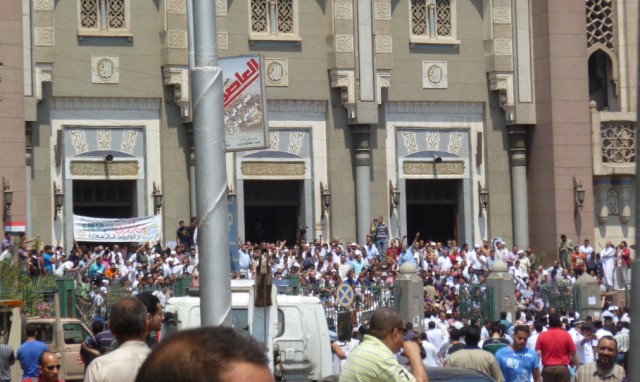
Thousands of Copts descended on the Orthodox Cathedral in Abbasiya, Cairo on Friday, May 6, in response to a Salafi Muslim demonstration at the same location a week earlier. Salafi Muslims represent a conservative current in Islam which calls for the strict application of sharia law and rejection of modern, democratic principles, believed to be Western in origin. The previous Friday, April 29, Salafis rallied for the release of Camilia Shehata and other Coptic women believed to have converted to Islam, yet allegedly held illegally in Coptic monasteries. Salafis conducted similar demonstrations repeatedly over the past several months, but this was the first time they gathered at the heart of Orthodox Christianity in Egypt – the papal seat of Pope Shenouda III. They called for the prosecution of the pope, and Copts interpreted many of their chants as insults against him and their community.

Feeling threatened, lay Coptic groups issued a call for a counter demonstration at the cathedral in anticipation of a subsequent Salafi protest. John, a Copt from Matariya, a town to the north of Cairo, stated the demonstration would be held within the walls of the cathedral, not outside. Groups would be stationed at the four gates, to prevent entry should the Salafis so attempt. Yet John instructed his delegation that if the Salafis remained outside and simply hurled insults, Copts should remain silent. Asked if there could be a positive reply, chanting words of blessing of the Salafis, John stated this would nevertheless be received as provocation. Silence would be the best response, and provide the best testimony. If attacked, however, Copts should resist and defend the seat of the pope.

Coptic fears are understandable, while also being an overreaction. Certainly Salafis engaged in provocation by marching at the cathedral. In weeks previous certain Salafi groups desecrated shrines erected at the tombs of Muslim saints, believing these to be heretical accretions to pure Islam. Yet sharia law calls upon Muslims to honor and defend churches and monasteries, and though they demonstrated at the cathedral, they inflicted no material harm. Nevertheless, Salafi groups stand accused of several grievances against the Copts perpetrated since the revolution, and there is a general sense, unproven, that remnants of the former ruling regime and its security forces intentionally stoke sectarian tensions. Yet despite the presence of rumors, it does not seem any threats were directly issued against the sanctity of the cathedral.

On Thursday, a day before the anticipated protest, Yassir Metwali, a leader of the Coalition to Support New Muslims, one of the chief post-revolution organizers in the defense of Camilia Shehata, declared there would be no demonstrations that day. The cancellation was issued late and was not widely known; in any case most Copts had already made their plans to gather. Metwali stated this was unrelated to the Coptic gathering. Unmentioned may have been another factor; Thursday morning the al-Ahram newspaper published photos of Camilia, her husband, son, and Coptic lawyer, seated together happily. The lawyer, well-known activist Naguib Gibraeel, produced documentation stating he was authorized to speak on Camilia’s behalf, who asserted she was happy in her Christianity. Surely this would not satisfy Salafi clamor, as claims and counter-claims of fraud have been exchanged between the two communities. All the same, it may have given them pause.

There have been two other issues dominating Salafi attention since the cathedral protest. The first was an attempt to usurp the pulpit at the Noor Mosque, the largest in Abbasiya. The second was the death of Osama bin Laden.

Shiekh Hafez Salama is a celebrated war hero in Egypt. In his retirement he had dedicated himself to religion, founding the Association for Islamic Guidance, through which the Noor Mosque was built. Yet since the 1970s the Egyptian government has attempted to bring all mosques under the supervision of the Ministry of Endowments. Ostensibly, this was to curb the potential for unaffiliated imams to use their pulpits to spread extremist or terrorist ideology. The effort has been mostly successful, with 95% of mosque imams receiving certification from the official ministry. The current imam, Sheikh Ahmad Turki, has been in place since 2002. Muhammad, a garage attendant in the neighborhood of the Noor Mosque, states he enjoys wide favor and is loved in the community. He also expresses admiration for Hafez Salama.

Hafez Salama, however, reflects Salafi trends, and has sought to inculcate them in the mosque since the revolution. For the first Friday prayers following the success of the revolution, he approached Ahmad Turki to allow popular Salafi preacher Muhammad Hasan to address the people. He acquiesced, provided Salama secure permission from the Ministry of Endowments. He did, it was approved, and all proceeded normally.

On April 22, however, clashes broke out between supporters of Hafez Salama and Ahmad Turki, in which sticks and knives were employed to force Turki to abdicate his position. He has called for intervention from the military to enforce ministry protocol, but in advance of this Friday’s sermon, Salama announced he would lead the Islamic funeral ‘Prayer for the Absent’, in honor of Osama bin Laden.

Police and military personnel maintained a heavy presence both inside and outside the mosque, assuring the ascent of a ministry-approved imam, though not Turki. There were no signs of altercation during the proceedings, but following the sermon and the exit of military personnel, Salama boomed with his powerful voice, honoring the hero and martyr, Osama bin Laden, calling for a march on the US Embassy. As he finished, chants began within the mosque and a crowd exited and assembled, waving banners extolling the fallen al-Qaeda head.

The size of the protest, in comparison to the expanse of the mosque which was filled to capacity, was rather miniscule. Perhaps around two hundred demonstrators committed to the approximately hour walk downtown to the embassy. As they departed, significantly slowing traffic patterns in front of the mosque, a driver stopped and shouted, “They are corrupting the image of Islam! Who are these people and what are they doing to our religion?”

Meanwhile, Copts at the cathedral seemed aimless as their expected challenge never materialized. Several hundred milled about outside the walls of the cathedral, unsure what to do next. A priest and cathedral lay leaders tried to usher them back inside, but to no avail. Military and police personnel kept to their positions, but shortly thereafter a contingent arrived from the Noor Mosque, only a five minute walk away, to guard the flow of traffic.

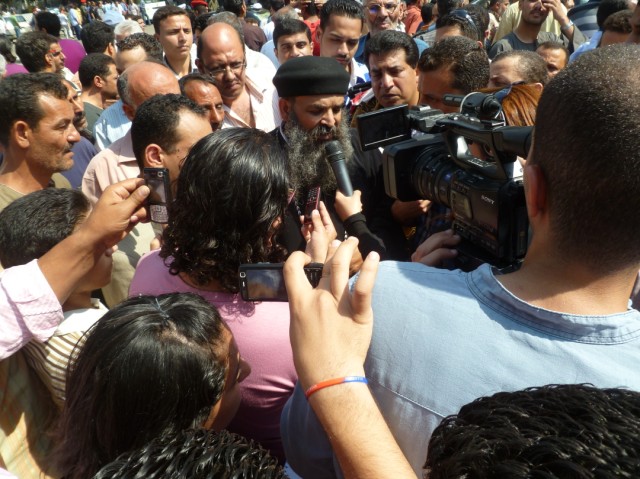
Within the commotion media began appearing and taking statements from various people. Fr. Basilius, who had arrived from Ma’sara, an area to the south of Cairo, provided commentary. “We are here only to defend our father’s house, as anyone would defend their father’s house,” he said. “The Salafis are not our enemy, only Satan is our enemy. We have no weapons except the cross, and God is our protector.” When asked if there was a way to return blessing upon accusing Salafi chants, he spoke similarly as John, quoted earlier: “If they revile us, we will remain silent. In this way they will see their actions in comparison to ours, and be affected.”
Shortly thereafter, perhaps prompted by the appearance of cameras, several Copts gave up their silence. Several dozen gathered together with placards and banners, and began chanting:

  • With our spirit and blood we will sacrifice for you, oh pope!
  • Christians and Muslims, one hand!
  • Not military and not religious, we want a civil state!
  • Long live Egypt!

Perhaps a hundred or two watched along, as the military kept the protest from blocking traffic. In comparison to the thousand or so protestors who had been inside the cathedral, this demonstration also appeared somewhat minor. Opinion, however, was that Copts would fill the cathedral again next Friday, to be ready should the Salafis return.

Click here for a video clip of the protest. The chanting heard is ‘Muslim, Christian, one hand!”

By now having arrived at the US Embassy, it was clear that the Salafis had maintained their numbers through the heat of the day, but had not increased them. Army personnel did not allow them to gather directly in front of the gate, yet their presence slightly down the street still took place in sight of the waving American flag. Chanting condemned the US military operation which assassinated bin Laden, and called for the release of Omar Abdul Rahman, the blind cleric held in an American prison for involvement in a pre-September 11 attempt to bomb the World Trade Center. Ominously, there was also a chant commemorating an Islamic-era victory over Jews in the Arabian Peninsula, warning Jews that the army of Muhammad would soon return.

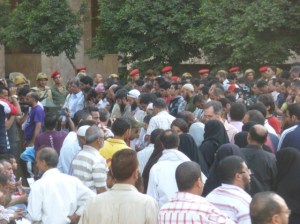
Click here for a video clip of the protest. Muslims are engaged in afternoon prayers in front of a military contingent guarding the embassy.

Ayman is a youthful, beardless protestor about twenty years old. He and Ahmad maintained that bin Laden was not involved in the September 11 attacks at all. Al-Qaeda, they said, was against the killing of civilians, though certainly some died as collateral damage in attacks on legitimate American military targets involved in Iraqi and Afghanistan occupations. Furthermore, he never killed other Muslims. Asked about the bombing of a Muslim wedding procession in a hotel in Jordan by al-Qaeda operative al-Zarqawi, they denied he was involved. Instead, in effort to discredit the organization American friendly Arab governments would commit such atrocities. The New Year’s Eve church bombing in Alexandria, they said, was orchestrated by the Egyptian Minister of the Interior, Habib al-Adly.

Tarak is an older protestor, though also beardless, in contradistinction to the great majority of bin Laden supporters present. His opinions were more nuanced: “Yes, Osama bin Laden admitted to the September 11 attacks, and we must not countenance the killing of innocent civilians. But I certainly support bin Laden for his courage in opposing the American military occupations in Iraq and Afghanistan, in which far more innocent civilians perished. For this, bin Laden is an Islamic hero, and he died a martyr.”

It should be noted all three individuals were civil and friendly in their conversation, taking no offense at the presence or questions of an American interlocutor.

As the day closed and the protest ended I walked five minutes from the US Embassy to Tahrir Square to take the metro home. The atmosphere was festive, with many protests going on simultaneously. One was for the release of demonstrators arrested following a military raid on Tahrir in which it appeared rogue soldiers were involved. Another was a sole woman surrounded by a handful of onlookers wailing over an issue I couldn’t quite understand. Another supported the recent Palestinian reconciliation and called for the end of the Israeli occupation. The largest was a rally in solidarity with Arab protests taking place around the region, complete with flags of the different nations of the Arab League.

As I reflected on the day’s events, I called to mind the words of Alaa’, a Muslim guard for a minor government office outside the Noor Mosque, where I purposed to take refuge should the bin Laden demonstration have turned violent. “For thirty years we had almost no freedom of expression. Now, the pressure has given way to an explosion. Soon, things will settle down and get back to normal.” Indeed, protests have multiplied and are scattered over a multitude of issues, many at odds with one another. So much so, any individual protest is lost in the sea of demonstrations, appearing irrelevant in the process. Yet each protest is imbued with utmost fervor, as the group seeks to make its demands and criticisms known.

That this has occurred with the utmost of civility is a testimony to the Egyptian people. May it so continue, and may the balance of justice, in the end, satisfy its many claimants.

Categories
Current Events Personal

Police Day Palpitations

Last year Egypt added a 16th day – Police Day – to its official list of public holidays. It may prove that this designation will backfire on the government.

The day was created to honor the memory of fifty police officers murdered by the British in 1952, which provoked an uprising eventually leading to the Free Officer’s Revolution and establishment of the modern Egyptian Republic. Since then, however, the police have been a primary object of contempt for opposition figures and the general man on the street, who consider them the enforcers of the Emergency Law, by which, it is said, the government squelches all opposition. Others say the Emergency Law is necessary to combat terrorism and drug trafficking, such as government supporters and members of the National Democratic Party. They believe the police allow the people to sleep soundly at night. Many Egyptian Christians, meanwhile, find the police and security forces to be biased and unresponsive when aggression is directed at their community or churches. Regardless of religion, though, the complaint of random arrests and brutality is circulated widely.

Inspired by the recent uprising in Tunisia, and frustrated by what were understood as deeply fraudulent legislative elections, Egyptian opposition figures have chosen to launch nationwide protests on the occasion of Police Day. The reverse symbolism is poignant – demonstrators will demand the repeal of the Emergency Law and the dismissal of the Interior Minister. Additionally, they call for a rise in the minimum wage and terms limits on the presidency. Activists hope that, as seen in Tunisia, initial protests for limited concessions might lead to a wholesale rejection of the regime.

Will they succeed? Over 80,000 Egyptian Facebook users have pledged to participate. So have leaders of the Muslim Brotherhood, the best organized opposition party in Egypt. They will be joined by the Wafd, Karama, and Ghad parties, the movements of April 6 and the National Association for Change, as well as representatives of the labor movement. Reluctant presidential hopeful Muhammad al-Baradei has signaled his approval of the protest, but will not participate.

Trepidation is understandable. The government has announced the demonstration to be illegal, and will deal strictly, though within the law, against any violators. At least three activists have already been arrested for promoting the campaign. Fresh in the minds of any protestor will be the recent deaths in police custody of Khalid Sa’eed, accused of drug dealing but purported to have informed against police corruption in drug deals, and Sayyid Bilal, an Alexandrian Salafi rounded up after the church bombing on New Year’s Eve. Investigations into their deaths are ongoing.

Other objections are raised. The Tagammu Party rejects the protests on the grounds that the nation’s policemen deserve a day of honor. Meanwhile, the ruling National Democratic Party has announced its intention to hold a counter demonstration of loyalty to President Mubarak, in which half a million of its younger members will participate. Additionally, the heads of the Orthodox, Catholic, and Protestant Churches in Egypt have urged their members not to join the protests, but instead to devote the day to prayer asking God to bless Egypt.

The weight and immediacy of the protest is in the air, especially in light of the events in Tunisia. One friend, an older gentleman, believes that nothing substantial will happen, though some may try to force the issue. He said this, however, on his way back from the bank, where he withdrew money ‘just in case’. Another friend spoke of the protest by listing a litany of common Egyptian complaints about the government. A sensible journalist, he spoke with a passion which betrayed his normal demeanor. Yet he has a wife and children, a reasonable income, and much to lose. Even so, he was itching to participate for the benefit of his country. Wisdom is necessary.

Yet where should wisdom lead? Certain factors suggest that a Tunisian style uprising is not imminent. First of all, the Tunisian demonstrations were by all appearances spontaneous developments arising from a disenfranchised lower class. Efforts at imitation in Egypt, however, are led by political elites looking to move the masses. Perhaps they will succeed; public frustration with government is widespread. More likely, however, is though the social media dissemination of dissent is spontaneous among the upper class, it will fail to mobilize greater society to any substantial degree.

Second of all, when the Tunisian demonstrations began to gain steam, they were joined by the middle class, which transformed an originally economic protest into one fully political. Critical mass was reached, and the president fled. Here, however, the middle class will be asked to lead, not support. Their cause is political, not economic. Though certainly the poor in Egypt could stand a drastic improvement in their condition – far more than in Tunisia – will they follow the comparatively rich into an unknown future, for political freedoms that do not generally concern them anyway? Can the family man mentioned above command their allegiance? Will he even be willing to try?

In which light, then, should the decision of the church to abstain from protest be understood? Church leadership is also frustrated with the government, especially following the use of live ammunition on Coptic protesters in Umraniyya, a suburb of Cairo. The Alexandria attack, however, may have served as a reminder that church security is tied to good, secure governance. Perhaps a known stability is preferable to a chaotic, unknown future.

The government can also be seen as solidifying its relationship with the church following the Alexandria bombing. The prime suspect in the Nag Hamadi Christmas killings from last year was recently sentenced to death – the first such sentence rendered against a sectarian criminal in modern Egyptian history. Furthermore, the government has stated that a new law to govern the contentious issue of church building will be introduced soon. For its part, the church has rejected the efforts of the US Congress to conduct a special hearing on the Alexandria attack as interference in domestic affairs – exactly the same language used by the government. The church’s longstanding position is that Coptic affairs are a matter of concern to Egypt only, interpreting even sincere international efforts at assistance as detrimental to the national unity between one people of two religions.

It can also be said that the Bible itself is an anti-revolutionary document. Many verses encourage believers to submit to the king, whether he is just or unjust. While undercurrents of protest exist in Biblical interpretation, the Egyptian church perspective is well within the mainstream of historical Christian understanding. It may well be within the mainstream of wisdom as well, but this is a pragmatic, political matter. Should the church throw its hat in with the uprising? Where will the repercussions be greatest should the effort fail, or succeed?

Fr. Matta al-Miskeen represents a minority position in the church today, but one that has been forged by an intense monastic spirituality. In his book ‘Church and State’, he urges Christians to become full participants in the life of society, and devote themselves spiritually in the life of the church. A mixing of the two identities, however, pollutes the two streams in which Jesus said to ‘render unto Caesar the things that are Caesar, and the things that are God’s, to God’. Though now deceased, he recognized the increasing politicization of the church, and warned against it.

As things stand now, the church is tied to the ruling political establishment, no matter how frustrated it is in this relationship. Alliance with government makes proper sense; after all, having suffered through sectarian and terrorist attacks over the past three decades, it is only the ruling power that controls the forces of security. Witnessing great police commitment to defend the sanctity of churches during Christmas Eve services testifies to this fact.

Yet Matta al-Miskeen hints at the greater strategy. If the church is apolitical, then individual Christians can be as political as they desire. The government can trust the church not to mobilize its members, either for or against government policy. Society, including the Muslim majority, can trust the church to urge its adherents toward morality and cooperation. Then, if a Christian becomes a government loyalist, he is free. If a Christian takes opposition leadership and calls for regime change, he is free. For his actions he is responsible to God, as well as the state and society. Yet this responsibility is his, it does not belong to the church. The church is responsible for nurturing the spiritual life of believers, not securing their political rights.

Police Day is January 25. Tension is afoot. Different strata of society have chosen sides, and the church has declared its allegiance. Perhaps the day will pass insignificantly; perhaps this is the first step towards Tunisia. Will society follow the lead of the elitist agitators, no matter how deep their dissatisfaction with government? Will Christians follow the lead of the church, and continue their submission to the ruling powers? For all involved, where does wisdom lie?

For the good of Egypt, may the right answers become clear. May all have the courage of conviction and the goodness of heart to act on such wisdom.