Categories
Personal

Incredulity and a Car Ride Home

I had two experiences at Emma’s preschool today which gave both a reminder that I don’t really belong, and a sense of belonging.

Thursdays at preschool is swim day.  The teachers set up a large inflatable pool and the kids can swim for about two hours.

They are always generous with Hannah participating in special things, and they have invited me to bring Hannah for the swim time each week.  Today Hannah and Emma were the only two kids to really spend much time in the pool because the water was a bit on the cold side.  I convinced Emma to get back in the pool, after she had changed into her play clothes, and that if she spent a couple minutes in the water, she would get used to it.  It worked, and the two girls played for about half an hour while I looked on.

At one point, a young woman came out from the classroom and was watching the girls as well.  I started talking to her as I had seen her at the preschool in the morning, but I didn’t recognize her.  That morning I heard her ask one of the teachers about Emma and Hannah, whether they were foreigners or not.  I answered yes in Arabic.  When she came outside I asked her if she was new working here or what exactly she was doing here, and she told me she was with her sister and nephew as it was his first day at preschool.  The whole time we talked she kind of looked at me with a look of incredulity and amazement.  She asked a typical question, “Do you like Egypt?  Is it nice?”  I answered in the affirmative.  “But isn’t it crowded?” she asked, implying it really wasn’t so nice.  “Yes, it’s crowded, but the people are good.  We like your culture and the Arab people and your language.”  She was taking this all in, but I could just see the wheels of her head spinning as I was not fitting her stereotype of an American living in Egypt.  It was a short conversation over all and one I have had many times, but the interesting part was watching her trying to figure me out.  Really I hope I am not too hard to figure out.  I am an American, living in Egypt with my family and looking to live life to the fullest here and participate in the culture as much as I can.  I must speak the language in order to do this, and my children need to as well.  But even as we try to participate fully, we are still “outsiders” who don’t really fit in, try as we might.

Just a couple minutes later I had a short conversation with another woman who was sitting in the coffee area, just a few feet from the pool.  She had been watching the girls too, and apparently had seen us before because she asked about Layla, who wasn’t even with me this time.  Unfortunately, I didn’t remember seeing her before, but I guess being foreigners we stick out and are easy to remember.  Anyway, she was asking about the girls, and each of her questions was in English, but each of my answers was in Arabic.  Sometimes that is a game we play.  We are eager to speak Arabic with Egyptians, and so if they speak to us in English, we try to insist on speaking Arabic.  We have learned that in whatever language you begin a relationship this is the language in which it will continue.  So, she persisted in English and I persisted in Arabic.  Again, it was a short conversation.

I went inside and gathered Emma’s things, as both girls had exited the pool and changed by this time, and then we left for home.  But as we left, this woman stopped me and asked how I was getting home.  I told her we would take a taxi.  She immediately offered to drive us home and accompanied us out the gate.  I didn’t think twice about accepting her offer, as I felt perfectly safe with her and didn’t think it strange for her to offer.  This is part of the Egyptian culture to be so generous with their time and resources.  Not only did she drive us to our home, but when Emma pointed out a ball in her trunk, she gave it to Emma as a gift.  Generous people, and something I hope I am learning as I live among them.  Thanks to a stranger for giving me a small sense of belonging today.

Categories
Personal

The World Cup and Objectivity: Scenes from the US Defeat

It has now been a few days since the US World Cup defeat against Ghana. While it is only about now that I could bring myself to write about it, recovering from the disappointment of shattered dreams, I must also apologize for opening old wounds for those of you now similarly recovered. Well, I’m sure there are a few-to-many non-soccer readers of this blog who wonder what the fuss is about. For you, hopefully the cultural scene will be entertaining; for those still mourning, all I can say is that we mourn together. Ah, the sting of what could have been.

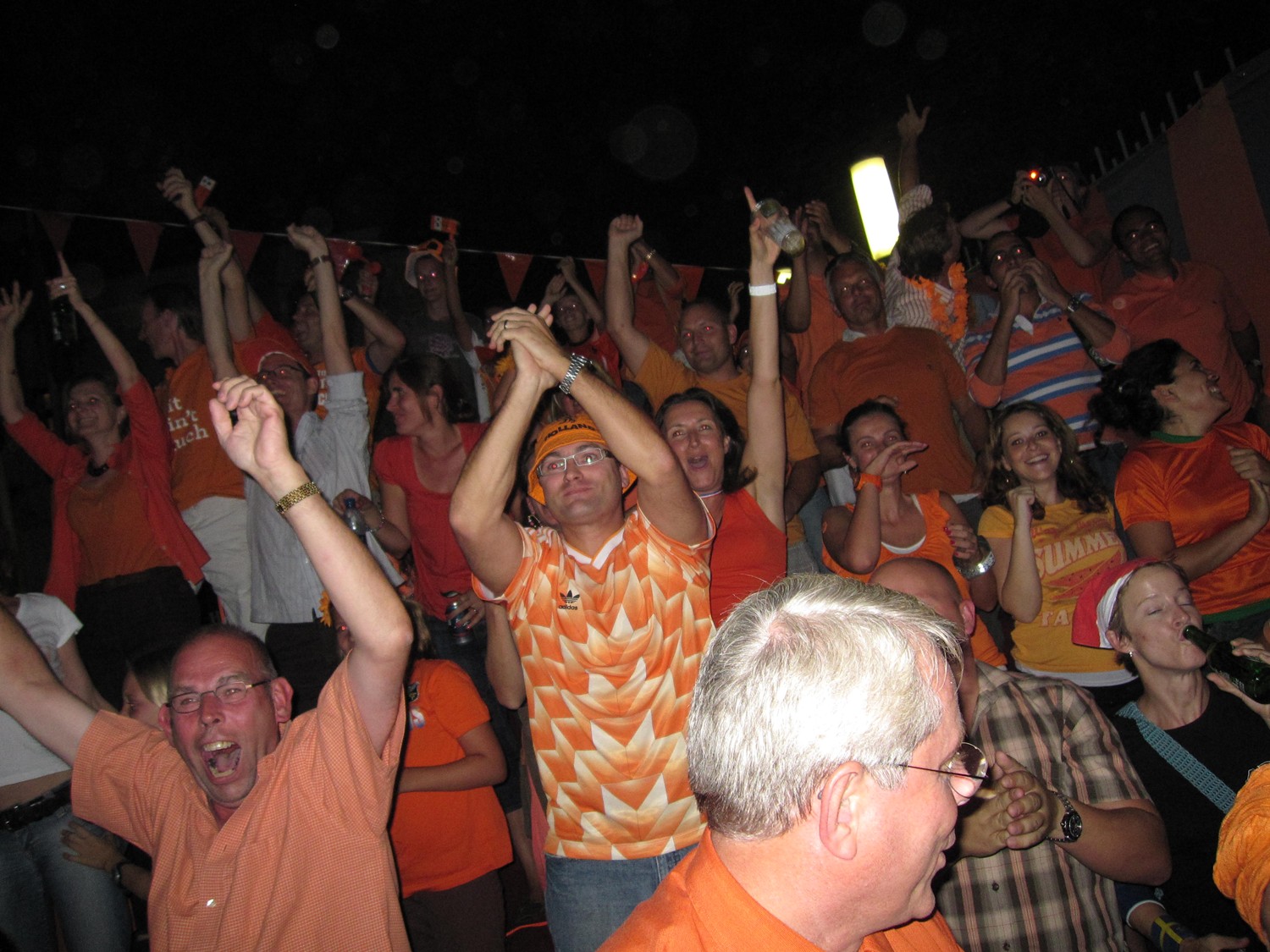
As mentioned last post, to watch the game I went to downtown Cairo, meeting up with friends who live there. Maadi, the affluent suburb in which we live is a far cry from the vibrancy of city life. Here, while I have enjoyed watching matches in the local coffee shops frequented only by Egyptians, there has never been fervor in the audience, which has ranged from five or six to a high of forty or so, for the England-Algeria match. Interested fans, yes; cheering for goals, sort of. The scene is one of subdued approbation, perhaps akin to that of an accompanying friend at a pee-wee soccer game. “Nice job, kid.”

Downtown was entirely different. I was met at the metro by my friend, who led me through the busy streets for several minutes. We passed by many shops with TVs tuned to the game, and not a few cafés which were starting to fill up. We, however, were heading to the big screen TV in the open air, found recently by my friend, who enjoyed also the inexpensive tea and hookah.

When we turned the corner we entered a wide promenade, and the masses emerged. Every few feet I expected us to stop, as we passed by open-air cafés with large TV screens. Midway through we reached our goal. This café, wherever the physical location may have been, had arranged perhaps two hundred chairs around a projection system casting the game on the outside wall of a building. As we took our seat I scanned the whole promenade – surely there were several hundred to a thousand people gathered to watch the match. Of course, this was the US vs. Ghana – not exactly a blockbuster fixture unless you care for one of the teams. I didn’t bother to watch Japan-Paraguay, for example. Imagine what the crowd could have been for the England-Germany or Spain-Portugal match. Having not yet returned, I cannot say. It is a bit of a hassle to get downtown, and I enjoyed these matches from Maadi.

As game time approached, however, we discovered that we were among partisans. There were scattered other Americans here and there, and a few from our office met up to watch with us. The Africans, though, were present in the dozens. A number cheered at the close of the Ghanaian national anthem, but everyone erupted with their first goal less than a quarter hour into the game. We were outnumbered, and greatly.

They may have been Africans of any nationality, but they were supporting the lone African team to emerge from group play. The Egyptians who filled in the rest of the crowd rediscovered their African identity as well, and cheered wildly as we sunk dejectedly into our seats following yet another early deficit.

The crowd quieted as the Americans eventually took the better of play and converted a penalty kick to tie the game. They were quite nervous as we pressed for the winner denied repeatedly by good goaltending or profligate finishing. In extra time they found cause to cheer again, having been gifted their second goal, and held out happily to victory. One voice cried out in English, in an accent I couldn’t place, “Good bye America!” and I felt like spitting water in his face – whoever, wherever he was. Amazing the evil that sport can summon.

We left walking back with our friends, some of whom were European sympathizers, who may have felt it odd to watch Americans lament the outcome of a soccer game, but offered comfort nonetheless. I was too downtrodden to really notice the reaction of the African / Egyptian crowd, so I am afraid I cannot report. This is the problem, I suppose, when a journalist gets involved in the stories he covers. Objectivity goes out the window.

It is true, though, that the episode gains the touch of humanity often missing in the nightly news. In our work I feel like a pseudo-journalist; I must tell the story, but I have a goal beyond objectivity. We wish to aid understanding and peace building both here in Egypt and in intercultural relations in general. You are free and invited to question the descriptions given above, or in any other reports offered. Yet at the same time, please receive the dual assurance: I will not manipulate stories, and I will strive to care about our subjects, investing myself wherever possible. If either one of these is neglected, then why bother at all?

A final note, to return to the soccer narrative: Looking back, I can identify two premonitions that tugged at me as the game was about to begin. First, I do not generally consider myself a patriot, but I increasingly coordinated my clothing with US colors as the tournament went on. That evening I wore my red t-shirt only to find that it was Ghana wearing nearly the exact same color. I thought of removing it, but propriety intervened. Should I have done otherwise?

Second, our oldest daughter has always had difficulty pronouncing the name of her Uncle Aaron. In her parlance, he becomes ‘Uncle Gyan’. Gyan, though, is the name of the Ghanaian forward, and the player who tallied the winning goal. Why did this thought enter my head in the minutes before kickoff? What cosmic effect did the failure to exorcize it have on the outcome of the game? Was it worsened by the fact I remained shirted? Amazing the lunacy that sport can summon.

So, another four year World Cup cycle awaits. Ecstasy to agony is the story for all but the champion, including the legions of fans who fall by the wayside. Fortunately, the metro stays open until 1:00am during the summer, so the miserable ride home cost only eighteen cents rather than a four dollar taxi fare. Egypt is a wonderful country, even if their soccer fans side against us. Alas.

Categories
Personal

Soccer, Twitter, and Electricity

With one day to go regarding the USA World Cup match tomorrow afternoon, I thought I would give a short summary of our experience with the last game, a last minute 1-0 triumph over Algeria.

I wish there was a lot to say. There could have been on two fronts.

On the first we are at fault. Having attended and reported on the England-Algeria match from a local coffee shop, I would have been curious to see who local Egyptians rooted for in the US-Algeria game. Would they finally find solidarity with their North African cousins, so that soccer animosity be overcome in antipathy against the United States?

I cannot say. A 5:00pm local start time suggested we end the day a little early at work, and my English colleague and I organized an office viewing at a local trendy restaurant, with few Egyptians present. It was a great place to watch the game – big screen TV and surround sound – but little cultural flavor.

On the second front the power grid is to blame. Our group from work, plus Julie and the girls and one other wife, numbered about ten, with seven Americans, but all pulling for the Yanks. For those who watched, you know the game was tense, and all were riveted to the screen.

(A drama reducing pause and clarification is needed, though. Shortly after intermission Julie and the girls went down to play on the playground, and were joined later by the other wife. So, not all were riveted. Even so, this was a good sign, for the US comeback against Slovenia commenced once my family similarly descended for the slides and swings.)

With about twenty minutes to play, the power went out. This is a frequent summer occurrence in Maadi. There is a disproportionately higher middle to upper class population, both foreigner and Egyptian, and the air conditioner use will overload the power grid, which will blackout a neighborhood or apartment building from anywhere to five minutes to an hour or longer.

This was not to be of the five minute variety.

Fortunately, Egypt is better equipped in another variety of technology. One colleague had a Blackberry and was able to pull in from the wide 3G network updates on his Twitter account. As the clock ticked, we stared at the black screen, waiting for resumption, but also getting 140 character status reports on the ever increasing missed American chances. Huddled mostly silent around a cell phone, we also lamented the loss of the air conditioning, trapped inside in 100 degree heat.

As all was lost, suddenly a colleague received a phone call from a friend informing of the winning goal. As we wondered in disbelief if it was a prank, seconds later Twitter confirmed the victory. Our cheer roared, informing the rest of the clientele about the result, and all went home happy, if bittersweet at missing the classic moment. Still, it is a story to be remembered forever.

Tomorrow I will bypass the restaurant in favor of a downtown café. With the US game not starting until 9:30pm local time, it will not be a family affair. Instead, I will join friends in the heart of Cairo, taking in my first game there, hoping also to find the pulse of the city for the World Cup in general. US-Ghana is not a powerhouse matchup, but will it take the imaginations of local Cairenes nonetheless? If there is a story to tell, be sure I will relate it. I just hope that the ending is happy.

Categories
Personal

The Government Bakery, Part Two

Note: For part one, click here; it was the first post Julie wrote on our blog. This post, for those concerned, was actually written before Julie gave birth, and is just being published now. I have stood in line myself by now a few times. Maybe as you read you will be more concerned, but that is for you to decide…

I went to buy some bread this morning.  I’ve been back to the government bakery many times since that first visit back in September.  We learned that really, it was the closest, and in some ways, most convenient place to buy bread.  I am almost feeling like an expert in this department, although I’m sure I have a lot to learn.  I’ve actually started shopping at a different government bakery than the first one with the bars and cockroaches, but those things are not the reasons I switched.  As I was learning my way in the neighborhood, one day I walked past the original government bakery and down a few blocks I saw more pita bread laying on the ground.  (Well, mostly on newspaper on the ground, or ledges above the ground.)  I thought it strange to see another bakery because this was literally less than three minutes walk from the first bakery, but I also noticed that the bread looked lighter than the other place.  I wasn’t too crazy about the other bread for some reason; it wasn’t like the bread we had in Jordan, maybe too much wheat?  Guess that’s more healthy, but when I saw this bread, it looked like it may be tastier.  So, I determined to try it the next time we needed bread.

Unfortunately, it took me a few trips to realize that this bakery does not have the same hours as the other one, and they close at 3 in the afternoon.  I had learned that if I visited the other bakery in the evening, maybe 6 or 7, I usually didn’t have to wait for bread at all.  That was wonderful, but it didn’t sound like I had that option here.  I would have to decide if the better taste was worth the longer wait.  So once I finally was able to visit this bakery while it was open, I found the order of things much the same as the other bakery.  When I asked the man who gave out the bread what time was the best to come, so as not to wait too long, he said that all times were the same … busy.  Oh well.

So, this morning I went to this second bakery to buy bread.  It opens at 7am, and as Egyptians in general like to stay up late at night, they don’t always rise so early in the morning.  I do think that the closer to 7am I can get there, the less wait time I will have.  Of course, I don’t really want to get up that early either, just to buy bread.  But, I got there around 7:30 and waited about half an hour before I got my turn in line.  This time also allows me to leave the girls at home with Jayson, if I go on a Saturday, and that saves them having to sit in the stroller for half an hour watching the people go by.  I noticed some new things this time.

First of all, they had a delivery happening at the time.  A large flatbed truck drove up with about 50 bags on it.  Two men walked back and forth with large hooks in their hands … carrying 50-kilo bags of flour (over 100 pounds).  They would stick the big hook in the bag then turn around as they kind of twisted the bag up onto their back and shoulders.  Looked like a lot of heavy work to me!  But they unloaded the whole truck before I got my bread.

When I first arrived, several ladies were sitting around waiting for their turn, and I walked to the line to get my place and one of the ladies there told me that two of the sitting ladies were before me.  I kind of liked how they had a system that allowed people to rest if they needed too.  Being 6 months pregnant, I wasn’t sure I wanted to stand in line for half an hour, but being American, I felt like I needed to keep my place in line.  I didn’t exactly trust their system.  It worked, though, although I noticed that I got a little more stressed as people ahead of me were getting their bread, and my place in line wasn’t moving too much, and I felt like those ladies who were sitting should come stand in their place so we could move forward and assure that no one else would take our spot.  I didn’t ever lose my spot, but I did discover that there are actually three sections to the line, rather than two that I noticed before.  There is a men’s line and women’s line, as I mentioned last time, but these lines are for the people who want to buy about 20-30 pitas.  For those who only want to buy five pitas (for 4 cents) they can go right to the front of the line calling out their small order.  When I was there today, there were several of those women and they made their own line in between the men’s and women’s lines.  I don’t think I’ve mentioned that besides being the only non-Egyptian there, I am also the only non-head covered woman in the line.  At least that has been my experience every time I’ve bought bread.  One of these days I will have to ask some of my Christian Egyptian friends if they ever visit the government bakery.  So far, I haven’t noticed any.

So that’s the update on the bakery.  It’s the best deal in town for bread, although it does cost a bit of time.

Categories
Arab West Report Middle East Published Articles

World Cup Role Reversal

Watching the World Cup matches in Egypt has been an experience. Games here are 2:30, 5:00, and 9:30pm, so while some fall during working hours, others have been able to be viewed. I have made less of it than I would have liked, but so has Egypt, for a reason to be explained.

One reason that Egyptians are having a hard time getting excited about the World Cup is that so few games are on television. Al-Jazeera (yes, the al-Jazeera many Americans complain about for supposed anti-US bias) has an extensive sports network, and they have bought the rights to Arabic language World Cup broadcasts. They have worked out a deal with network Egyptian television to grant access to some of the games, but they are not contractually obliged to say which ones. Egyptians without the resources to shell out the cash for the al-Jazeera package (most) can only hope their favorite nations will be televised that night.

For me, without a television at all let alone al-Jazeera, this mean going to the trendy restaurants or coffee shops populating Maadi which can afford an al-Jazeera subscription. For the cost of a plate of French fries or desert (I hate buying drinks – water is the best thing for you and provided free by God), I get to watch whenever I choose.

Julie, I, and the girls went this afternoon to a favorite trendy restaurant and watched the compelling US comeback against Slovenia. For the evening’s game – England vs. Algeria – given that I was getting a little tired of French fries, though, I set out on my own in hope of finding a traditional Egyptian coffee shop that perhaps was carrying al-Jazeera. Fortunately, find it I did.

At 9:30pm the crowd was a bit sparse, but within the first five minutes of the game the patio of the coffee shop had filled with patrons, all interested in watching the match, given the presence of the lone Arab squad to qualify for the tournament.

Here is the twist, however. Most Egyptian soccer fans hate Algeria’s national team. Egypt and Algeria finished tied in their World Cup qualifying group, and Algeria won the subsequent playoff match. The matches, though, were accompanied by nationalist fervor which spilled out of the stadium into the lives of normal people. The Algerian team bus was pelted with stones and their embassy in Cairo needed to be protected by riot police. Egyptians in Algeria, meanwhile, were being assaulted and a large Egyptian telecom company suddenly, mysteriously, was assessed millions of dollars in back taxes. Though Algeria edged Egypt for World Cup participation, Egypt returned the favor and walloped Algeria in the African Nations Cup on their way to their third consecutive title. Some of these reflections can be read here, here, and here.

Needless to say, with Egypt missing from the tournament local fervor has been muted. Egyptians are still soccer-crazy, and love watching their favorite stars no matter who they play for. So whereas one might have expected an outpouring of Arab brotherhood support for Algeria in their match against England, understood as an American lackey supporting neo-colonialist enterprises in Iraq and Afghanistan, there was nary a cheer when Algeria came close to goal. Every English touch, however, brought on cheers of expectation. As Algeria, surprisingly, carried the run of play, the atmosphere was rather tense and subdued.

Again, oddly, though the only foreigner in the crowd, and a Western Christian at that, I was also the only supporter of Arab Muslim Algeria. I like England, generally, and though I have nothing against Algeria, I was disappointed to see them put Egypt out of the Cup. An Algeria win or draw, however, would better the chances to see the United States advance to the knockout stages of the World Cup, predicated on a victory over Algeria six days from now. My support was silent, but real. The 0-0 draw at the conclusion was not an indicative byline for what had been an enjoyable and competitive match, but was among the best results possible for US rooting interests.

The telling tale will come in six days. The United States will play Algeria with both teams needing a win to advance to the round of sixteen. America does not draw the vitriol of the Arabs currently as it did during the Bush administration, but President Obama is not meeting the high expectations he set for a change in US policy when he spoke in Cairo early in his presidency. Overall, the US image in Egypt remains poor.

Will Sam’s Army receive the brunt of this geopolitical frustration? In the Arab world at large I would put their chances at 50-50. There is a good and legitimate chance that Arab solidarity backs the Algerians with just a little extra mustard. Still, since the US is not dominant in soccer the national team does not generally suffer from a backlash, and Arabs are generally quite astute at separating their opinion of government from their estimation of a person, or in this case, team.

In Egypt, however, hopefully, the coffee shop crowd may be composed entirely of Yankees. During the founding of the Egyptian Republic in the 1950s President Nasser mesmerized the masses with cries for Arab nationalism. The children of his revolution now only imbibe the fumes of his vision, dashed upon the realities of World Cup qualifying. Politics, it is said, makes for strange bedfellows. Sport, it seems, can do the same.

Categories
Arab West Report Middle East Published Articles

My First Editorial

Every week at Arab West Report we survey the Egyptian press for articles which concern either Muslim-Christian or Arab-West issues. These are translated into English and published with independent reports we or the interns who work with us write. Each week his headed by an editorial, which organizes a theme around key articles from that week, and expresses an opinion to speak into the news.

The editorial is usually written, appropriately, by our editor, but a little while ago he was traveling outside of Egypt and requested me to fill in for him. Several months ago I made reference to the first report I wrote for AWR; here below I can share my first editorial. Each article mentioned is linked to our full text publication, so feel free to click for more information. I hope you enjoy…

A few notable selections from Arab West Report this week have to do with the nature of sectarian tension in Egypt. While most would agree that Muslims and Christians live and have lived in peace and cooperation, these are also painfully aware of recent incidents of violence which threaten the validity of this status quo pronouncement. Needing to explain why this sectarian spirit exists itself is a source of division in the country.

One of the oft-repeated but infrequently demonstrated causes is that of foreign manipulation. Zionist or American/Western interests in destabilizing Egypt and the Arab world are cited as being behind the disturbance of traditional religious harmony. Bishop Marcos of the Shubra al-Khyma diocese disagrees in article 14. Instead, he blames poverty, illiteracy, and extremist television programs, harming all Egyptians, as contributing to the sectarian problem.

Another source of disturbance is often posited to exist among Egyptian Copts living abroad. These, it is said, have been influenced by the freedoms experienced in the West, hear only the negative examples of religious troubles, and then look to marshal their adopted governments to support the Coptic cause. In the process, they are accused, and sometimes guilty, of exaggerating the real circumstances of Christians. When the reports of activists recycle and return to Egypt, it deepens the sense of alienation experienced by Copts, thus continuing to degradation of relations.

In article 38 one such activist Copt is brought to attention, and then criticized for his opinions. Magdi Khalil is the director of the Middle East Freedom Forum, as well as an editor for the Coptic daily newspaper Watani. He has issued a call to American Jewry to intervene on behalf of the Egyptian Copts, stating such initiative is necessary to prevent Egypt from becoming a haven for terrorist activity which would rebound ultimately against Israel. The views of Khalil, however, are put in context in article 39. Here, the author states that activists who push their foreign communities toward public pressure on Egypt are in the minority. While 90% of expatriate Copts feel like their residence abroad is simply an extension of their Egyptian identity, their main complaint, he states, is that the Egyptian media exaggerates the Coptic problem.

A final culprit often blamed for sectarian tension is the controversial Muslim Brotherhood. The accusation against them is that they favor the implementation of a Muslim state to be ruled by sharia law, in which non-Muslims, it is claimed, become second class citizens. Article 9, however, highlights an invitation by Muhammad Badie, the newly appointed Spiritual Guide of the Brotherhood, issued to Egyptian Christians for an alliance between the two to challenge the lack of freedom experienced by both groups. The articles mentions, however, that church leadership rejected this offer out of hand, for the reasons given above. They see it as a clear political tactic in advance of the upcoming elections.

Finally, article 30 puts forward a positive vision about sectarian tension, finding the antidote in acceptance of all three strands of Egyptian identity: Pharaohnic, Christian, and Muslim. The article highlights the contributions of a number of leading thinkers who put forward the values of diversity, tolerance, and dialogue as necessary for instillation into the educational curriculum and national consciousness. While this goal is admirable, culminating this editorial only with this thought in summary of such wide divergence of opinion seems lacking.

Missing from the list of virtues given in article 30 is love. Through the lens of love each of the above explanations for sectarian tension can be exposed. There are issues in Egypt concerning the sectarian spirit; placing blame only on ‘foreign elements’ may shield Egypt from criticism, but love demands purification, and must be willing, however kindly, to confront. Where Magdi Khalil seeks to confront, however, love would find him in judgment as well. He seeks intervention from outside parties for the sake of one domestic interest, opening him to the charge that he does not care for the rights of all. Love seeks to unite, not divide, and puts the interests of the other above one’s own. Finally, in their outright rejection of a Brotherhood overture, church leadership fails to fulfill the mandate to love even those in opposition to you, as it appears the church views the Brotherhood in this way. Political cooperation may or may not be useful, but when asking for bread, should one be given a stone?

There are many good and necessary resolutions to help address sectarian difficulties; unless love be the motivation that holds them all together, the risk of ultimate failure is significant.

Categories
Arab West Report Middle East Published Articles

Shenouda Support Rally: Details and Reflection

Downtown, at the Coptic Orthodox Cathedral, surrounded by protest. Perhaps I am easily overcome, but my sincerest expression of belonging was represented in tears, three, four in number, but lingering on my cheek.

I was caught unawares by my surroundings, but I was not unprepared. Yesterday I was at this very same location participating in a press conference organized by Pope Shenouda in official church protest against the recent decision of the Supreme Administrative Court to compel the church to grant and sanctify second marriages following divorce. Finding the ruling contrary to the teachings of the Bible, Pope Shenouda stated in no uncertain terms that the church would not honor this ruling. He criticized the judiciary for interfering in religious matters which legal and Islamic precedent dictate should be left to the church. He stopped short of calling for the direct involvement of President Mubarak, but made it clear this was an act against the Coptic people and their faith, setting a stage of challenge between the church and state.

Following the press conference I had opportunity to interview many bishops of the church, among them Bishop Kyrillos of Nag Hamadi, who had attended an emergency session of the Holy Synod along with 82 other bishops from Egypt and around the world. At Arab West we have been following the events of Nag Hamadi, in which six Christians and a Muslim policeman were gunned down outside a church following the celebration of Christmas mass. Bishop Kyrillos was at the center of this incident and surrounding controversy, and I sought to arrange an interview with him. Not only would it be valuable to hear his version of the events and the current climate in the area, I also wanted to speak to him of peacemaking – what must be done to bring divergent parties together, and who might these parties be?

I was hardly expecting this opportunity, but having invested much ink and many prayers over the difficulties experienced in Nag Hamadi, an interview with Bishop Kyrillos represented the best opportunity to learn directly about the incident. Moreover, it was a chance to build a relationship with the central regional Christian figure, and possibly, humbly, be able to participate in the restoration of religious relationships in the area. How, I might ask him, have Christians responded since the murders? What can be done to show love and forgiveness in the midst of tragedy? How is the church preparing people to think and act in the spirit of Jesus? What would this even look like? Somewhat fearful that these questions are not being considered in Nag Hamadi, but with little evidence either way, here was a chance to hear from the source.

The series of coincides continues. At the press conference I met a friend who studies with me at a Coptic Bible Institute, who was also present on behalf of his media. Learning from him that he has cultivated relationships with many bishops which he would be willing to share, I phoned him that evening to ask for the bishops phone number. Late in the morning we connected, he remembered me from our brief encounter, and we set an appointment for 4:00pm. The next day he would return to Nag Hamadi, over eight hours away by train.

Not yet finished from cataloging and writing about the press conference I dropped matters in order to prepare for this interview, and shortly thereafter returned to the Coptic Orthodox Cathedral where he resides when in Cairo. Not sure where to find him I inquired of those who seemed official, who sat me and my two colleagues from Arab West in an office and told me he would join us soon.

Alternately, we were told he was upstairs resting. We also heard he had not yet even arrived at the Cathedral. Yet everyone told us he would be present at Pope Shenouda’s weekly lecture given every Wednesday night at 7:00pm. In Egypt one should be used to waiting, so we sat patiently, made occasional inquiries, and hoped for the best. Meanwhile, the bishop’s cell phone had been switched off, so it was impossible to alert him we were there.

In the bishop’s defense, I arranged this interview in Arabic, over the phone, and the bishop himself is elderly and from Upper Egypt, known for a dialect all its own. I may have gotten the time wrong, or he may have been waiting for us in an entirely different location, or even just elsewhere in the Cathedral. It is best never to assume you have understood things correctly as a foreigner.

At 5:00pm someone came to talk with us who seemed as official as those from whom we inquired earlier. Still, he represented himself as one with connections, so after a while he returned and told us the bishop was not around, but that he would attend Pope Shenouda’s lecture and perhaps we could see him there. Disappointed, but also completely unsure this gentleman had any sounder information than those we spoke to previously, it at least gave us the excuse to leave the room and inquire elsewhere for the bishop’s whereabouts. Yet he made an odd statement that seemed out of place – we needed to leave the sitting room we were in for security.

On our way into the Cathedral we noticed dozens of signs that were not there the day before. Each one expressed support for Pope Shenouda from different personalities or dioceses, or else expressed protest at the decision of the court and commitment to live by Biblical teaching. It seemed strange, for why were these not posted earlier for the press conference? They certainly were produced, assembled, and displayed very quickly thereafter.

As we exited the sitting room we received our answer. The signs formed a corridor defining a space for an emerging demonstration. Naguib Gabraeel, a well known Coptic lawyer and human rights activist, was delivering an impassioned statement to the television cameras, and leading vociferous chants in support of Pope Shenouda and the church’s stance against the judicial ruling. Yet at the same time, only twenty or so demonstrators were gathered behind him echoing his chants of protest. Twenty people still made quite a scene and a lot of noise, but I cynically wondered how this would be displayed in the newspapers the next day. Would the press play it up to be larger than it was?

Of course, to be remembered is that we were only here by coincidence. Still, it was an opportunity to experience in person the passion held by many in the Coptic cause. Yet, with pause – does twenty people represent ‘many’? I stayed on the outskirts but within the throng. To be fair, the number was growing, but to jump ahead in time, but the time we left around 6:30pm the active demonstrators numbered only around seventy-five, while the passive crowd around them was perhaps between five and seven hundred, attentive, but definitely not engaged.

I am not a man of protest, for good or for ill. I have great respect for pacifistic civil disobedience, but have not joined in demonstrations of any kind, to know of their ilk.

In these matters, then, my judgment is limited, or, being yet virgin perhaps I experienced the events of the day more fully than seasoned activists, like Naguib Gibraeel and those behind him, who know how to put on a show. If a show it be, then it was one which unnerved me completely. After all, this was a Christian protest.

Christians, like all citizens, should have the right to protest. When angry they, like all humans, can easily respond in kind. Given the enormity of the issue – judicial rulings seeking to manipulate sacramental marriage practice – a protest can be seen as completely justified. Active participants, however, displayed their anger, frustration, perhaps even contempt for the decision rendered against them. Simultaneously, they heaped praise and adulation on Pope Shenouda, celebrating him as their champion. Slogans chanted fidelity to the Gospel, as this is at the heart of the remarriage debate. Yet fidelity to the Gospel was absent from conduct, especially concerning passages commending the poor in spirit and commanding prayers of blessing for those against you. Instead, there was hero worship – “Pope Shenouda is the Athanasius[i] of the 20th Century”. There was disparaging of government concerning the president – “Mubarak, why are you silent?” and the judiciary – “Oh judge, where were you during Nag Hamadi?” There was even evocation of martyrdom – “We received this religion from our fathers; we will give it to our children even at the price of our blood.”

I have written about this wondering at the nature of Coptic protest before, but this time, I was on the inside. The anger felt rawer, the lack of grace more appalling. Yet, strangely, hinted above through confession of cynicism, a different response touched me more deeply. It was the sense of manipulation that stole even the sordid glory from this occasion.

By all accounts Naguib Gibraeel was playing to the cameras. Surely protest organizers must be ringleaders, and Gibraeel is sincere in his beliefs and care for the Coptic-Egyptian cause, if theatrical in his methods. Yet a protest, to be real, must draw on the pinched nerve of the community. Even if manipulated, or for a better word – organized – a rally cannot be sustained unless the crowds assemble and join in.

As hard as the sloganeers chanted, the troops did not fall in line. Hoisted above the throng on the shoulders of supporters, they took turns chanting from their composed poetry with the active crowd of seventy-five repeating their couplets. The hundreds more gathered around listened, watched, turned away, and though they filled the allotted square, they hardly filled the protest. Some were drawn into the chanting, others began to chant but then lost stamina. It was rather sad.

I have a desire to believe the sincerity of people in their words and actions. Even in those with whom I disagree can be found virtue if behind their cause they are pursuing good. Dramatics aside, these protest organizers were seeking to aid the Coptic cause. Yes, they were manipulating the news, even if flailing in manipulating the passion of those around. I am of a different sort, but I can recognize, through effort, that their hearts are good.

Until, that is, a source within both church and security circles confirmed my fears that this was a game. He offered me a scoop: The president has already decided to intervene in this matter and suspend the judicial ruling against the church. He is simply waiting until the Copts protest sufficiently so that he can be seen as coming to their rescue. Behind the scenes, I was told, he communicated this to demonstration leaders, who were giving the president what he needed. By the morning, the crisis would be over.

This source represents himself as being well placed; he has been correct previously and at other times he has been less so. On this occasion, however, his words met my impressions and the two became bedfellows. As I wandered through the crowds this was my one thought – insincere manipulation.

Incidentally, the next morning there was no announcement. Perhaps the source was off base; perhaps the demonstration just wasn’t good enough. Either way, the impasse between church and judiciary stands, but how many people really care? By reading our press review you can get the impression that this is consuming Coptic attention. By reading our report on the press conference you will see that Pope Shenouda almost never holds one. This is big; why then was the protest hollow?

It may be that Copts have so little experience in political participation having been – according to your favored interpretation – marginalized or self-isolated, that they did not know how to protest. The ringleaders ably followed a script; the average Copt knew something was going on. The result, though, was a fizzle. Indeed, in many of the protests implemented by disgruntled Egyptians, who are equally – according to your favored interpretation – marginalized or self-isolated, the picture, though I have only read of these in the news, is of a toddler frustrated he cannot yet say or do all that he knows is within him. Thus he flails, kicks, and starts, but to little avail. It is a stage of growth, cute when occurring in your own scion, but melodramatic otherwise.

The melodrama, mixed with manipulation and the absence of mercy, gave me heartache over the state of Christians. Yes, this ruling is against them, but they seem to be imitating in the wrong direction. Their proper object did indeed conduct a high profile demonstration of protest against the-powers-that-be in the ancient temple. As stated earlier, in doing so Christians are within their rights.

Yet are they within the spirit of their faith? Here, I am reduced only to questions, knowing neither the culture of demonstrations nor the culture of Egypt. What, though, would a proper Christian protest look like? How can the Coptic community stand up for its rights with courage and conviction, yet at the same time call down blessings upon their temporal adversaries? Can love and protest co-exist?

Following the murders at Nag Hamadi certain Christians filled the streets and smashed windows and vandalized cars. Following the protests at the Cathedral certain Christians looked to attack and overturn the automobile belonging to a Coptic member of the People’s Assembly, Nabil Luka Bebawi. He had appeared at the protest but is widely disparaged by Copts who see him as a traitor to their cause through his support of government policy.

By and large, Copts, like most Egyptians, are peaceful people who desire the absence of violence. Protest, however, usually draws on negative emotions and frustrations, and can easily lead to contempt and destruction. When Copts have protested, their conduct is generally salubrious, if sputtering. Incidents like the above are against the norm, but the manner of demonstration, lacking a widespread group commitment to love, enables the excess.

Politics, protest, or prayer? Surely there is room for all three. The proper mix, the proper spirit; may they, ideally in conjunction with their co-citizen Muslim brothers and sisters, find the proper way.

To view our video taken from the event, with translation, please click here.


[i] Athanasius (293-373 AD) was one of the greatest bishops from the See of Alexandria, and one of the central figures of Christian history for his role in defeating the Arian heresy. He was also celebrated as an Egyptian national hero for his role in resisting the political and religious machinations of the Roman empire and Byzantine church.

Categories
Arab West Report Middle East Published Articles

Mubarak, Shenouda, and Jesus: Remarriage on Whose Authority?

In the latest escalation of the crisis between the Coptic Orthodox Church and the national judiciary, Pope Shenouda yesterday convened a press conference in opposition to the Supreme Administrative Court ruling compelling the church to validate second marriages following divorce in all circumstances. Stating clearly the church’s respect for Egyptian law, it will nevertheless not execute any order which violates Biblical teaching or the consciences of church leadership.

Pope Shenouda delivered his statement, signed after an emergency meeting of the Holy Synod in which 83 bishops signaled their support, from his papal residence at St. Mark’s Church in Abbasia, Cairo. He delivered his remarks against a background of images ripe with symbolic meaning. On the Pope’s left was his own portrait, representing his authority as leader of the Coptic Orthodox Church. On his right was a portrait of President Mubarak, representing the authority of the Egyptian state. Above his head, central and lifted above the other two pictures, was Jesus Christ, seated on his heavenly throne, with the Coptic phrase ‘Our Lord is present’ over his head. Placed especially for this occasion were three Bible verses on which the church makes its case:

But I tell you that anyone who divorces his wife, except for marital unfaithfulness, causes her to become an adulteress, and anyone who marries the divorced woman commits adultery. (Matthew 5:32)

Heaven and earth will pass away, but my words will never pass away. (Luke 21:33)

We must obey God rather than men! (Acts 5:29)

Framing the issue furthermore was a headline in the Egyptian independent newspaper al-Dustur, which asked if this legal crisis would become the first clash between Pope Shenouda and President Mubarak. President Mubarak famously lifted the ban on Pope Shenouda placed by President Sadat, restoring him to the papacy and ushering in a period characterized in the large by cordial relations between the two leaders. While there have been rocky moments to be sure, Zachariah Ramzi of the Coptic newspaper Call of the Country stated that this is the first instance of government interference in the church that touches upon issues of Biblical ordinance. He added that whereas the Pope had been tolerant and forgiving over offenses committed against Christians in Egypt, in this issue involving doctrine he was both accurate and firm. Involving Holy Writ, must there inevitably be a clash?

In answering questions after this almost unheard of papal press conference, Pope Shenouda clearly stated that church refusal to implement this judicial ruling did not mean the church considered itself an independent state within a state. He also indicated, however, that marriage is a holy sacrament and not an administrative matter, and furthermore, he as pope is not a government employee. Pope Shenouda stated that he did not want to embarrass or put President Mubarak in a compromising position, but spoke also that while the president must be concerned with the independence of the judiciary, he must also be concerned with the millions of Copts who speak out against this ruling. Tellingly, throughout his remarks Pope Shenouda challenged the legal system, not the president. He spoke of Islamic sharia, from which Egyptian law is principally drawn according to the Constitution, stating it guarantees Christians freedom in managing their internal affairs. Additionally, the pope listed multiple civil laws and precedents which enshrine this dictate especially in the personal status codes. If a clash is coming, it is aimed at the judiciary; the government, but not the president.

Bishop Agathon of the diocese of Maghagha concurs. He noted that the leaders of the Orthodox, Catholic, and Protestant Churches together formulated a draft for incorporation into the personal status codes, in which the Biblical understanding of divorce is respected. Given to the People’s Assembly in 1979, the issue has been tabled without decision or explanation. Adoption of this proposal, states the bishop, would solve the problem completely. As it is, such judicial activism serves only to disturb all Copts, from leadership to the people.

Nabil Luka Bebawi is a Coptic member of the People’s Assembly. Sometimes criticized by Copts for not taking a firmer stance against perceived government neglect of Coptic affairs, during the press conference he also criticized the judicial ruling. Furthermore, he carried with him a tome, nearly ten centimeters thick, in which he chronicled Coptic difficulties in family law over the past several years. Entitled ‘Personal Status Problems of Christians in Light of the Egyptian Legal System’, he intended to present his study directly to Pope Shenouda. As a highly placed voice of opposition to the ruling, Bebawi nevertheless directs his effort through the church, but again, it is aimed at the judiciary.

What is not yet clear are the stakes in this contest. What does the church risk if it fails to act according to the judicial ruling? Dina Abd al-Karim, host of ‘House on the Rock’, a Coptic television program focusing on family and marriage issues, stated that this was the one item left open from the press conference. Father Ruweis, the patriarchal deputy of Alexandria, speculates that should the government press upon the church, he and his clerical colleagues are ready to go to prison. He clarified, however, that no such threat has been issued, privately or publically.

If the speech of the church is directed upon the judiciary, their eyes are on the president. Expectations, however, are different. Bishop Kyrillos of Nag Hamadi expects the government to do nothing, stating that Copts have no value. Bishop Bisenti of Helwan is more hopeful. The next step, he says, is simply to pray, hoping that President Mubarak will take care of this issue, and do so quickly. Pope Shenouda described the situation thus:

Imagine: This decision by the court has been rejected by the pope, the Holy Synod, by all the clergy, and by all the (Coptic) people. So what does this mean? This has to be reconsidered; otherwise it will mean that the Copts are under duress and suffering pressures concerning their religion.

This statement garnished the loudest applause of anything spoken during the press conference.

Returning to the above image, the symbolism runs deeper. President Mubarak on the right, Pope Shenouda on the left, but Jesus lifted above them both. For church imagery, this is entirely appropriate. Christ is Lord of the church, even as its governmental host and temporal head wrangle over the civil and ecclesiastical matter of divorce and remarriage. Upon closer inspection, however, the horizontal alignment of earthly equality is broken in the hands of Jesus. There, he holds a Bible on whose right hand page is a picture of Pope Shenouda himself. Jesus upholds the authority of the pope as the pope upholds the authority of the Bible. ‘Our Lord is present’ – and with him is Pope Shenouda.

May a clash not occur, but should it be so the press conference provided a clear picture of the church’s position vis-à-vis the government, and upon whose authority this matter must be decided.

If you like, please view a video clip we produced in association with this story.

Categories
Personal

Historic Public Dialogue

For the first time in the history of modern Egypt Muslims and Christians engaged in public dialogue at the popular level. On May 15 an evangelical pastor and a Muslim preacher discussed the topic: The Concept of Salvation in Christianity and Islam. Nearly 250 people crowded into the downtown lecture hall of the Sawy Culture Wheel on the banks of the Nile River in Cairo. They received a complete presentation, replete with Bible and Qur’anic verses, and were given ample time for questions and answers. An event with almost no precedent, it proceeded with both excitement and respect, in sharp contrast to general practices of inter-religious communication.

Representing the Christian position was Pastor Nagy Maurice of the largest evangelical church in Egypt and the Arab world, Qasr al-Dobara, located in the heart of downtown Cairo. Initiative for the seminar, however, came from the Muslim preacher Fadel Soliman, director of Bridges Foundation, an organization dedicated to the peaceful worldwide presentation of Islam, and long time leader of a mosque in New Jersey. Knowing the difficulty Islam has to gain a hearing in the Western world he did not want the same error repeated in Egypt. When first approached to lecture on this topic he insisted a Christian leader join him to speak about his faith. Perhaps normal in the West, the Sawy Culture Wheel agreed to take this risk.

An increasing religiosity among both Muslims and Christians has made the discussion of religion among the most sensitive topics in society. On the one hand, dialogue between top level religious dignitaries projects the image of national harmony, which correctly describes historic relations and official policy but downplays a growing sectarian tension. On the other hand satellite preachers from both religions frequently engage the opposing creed with polemics and occasional vitriol. The result is a wary culture that knows the topic can lead easily to troubles, and a government that desires to avoid these troubles at all costs.

Soliman first sought out a representative from the Coptic Orthodox Church, which composes 90-95% of the Christians in Egypt. His overtures were met with caution and then polite refusal, prompting his frustration. “They are missing an opportunity to speak of their faith. They have created in their minds a belief of persecution, and then act according to it.” Yet according to Sawsan Gabra, director of the Center for Arab West Understanding, “Orthodox would only welcome such an event if it were held in the church. They do not like public gatherings.” Indeed, there was no official Orthodox representation, even in the audience, reluctant to join an unsanctioned event. According to Sheikh Sa’d al-Din Fadel, director of religious programming at the Sawy Culture Wheel, though their events are published in advance, “We did not inform the authorities of this seminar, being unsure about their reaction.”

Each presenter was given twenty minutes to describe the position of his faith, and then five minutes for summation. The moderator emphasized this was a dialogue, not a debate, and pressed the need for respect upon the audience. Fadel estimated the crowd to be about 75% Muslim, but was likely more as it included over 100 Muslim women clothed in hijab, the head covering seen as normative by most Egyptian Muslims. By the time Maurice began his remarks the original chairs were all filled, and organizers were busy trying to accommodate the overflow, which spilled into the aisles making for standing room only.

The atmosphere was both expectant and curious, as people listened attentively to Maurice and Soliman present clearly the message of salvation as described in the divergent scriptures. Neither disparaged the beliefs of the other, and applause was given to all in the end. There was nary a disruption in the audience from either side.

During the question and answer period the majority of queries elicited further explanation about Christian theology. According to Mohamed Hassan, an Islamic Studies Masters student in the audience, this was appropriate. “Most people in Egypt are unable to discuss religion without it leading to trouble, because they are ignorant of the other’s beliefs. Today we started to break down this wall.” The normalization of religious dialogue is quietly but historically underway.

Categories
Arab West Report Middle East Published Articles

On Religious Tension in Egypt, from Leading Thinkers

Note: Sorry for a lack of new news and stories. There a number of good ideas floating around in my head, three texts in production, but nothing finalized yet. Instead, here is an interesting review I wrote for Arab West Report from a few months ago. It depicts the nature of discourse on the religious question in Egypt, as described by some of its leading thinkers. I hope you enjoy.

There is no religious strife (fitna) in Egypt, but there is religious tension; there is no Christian persecution in Egypt, but there is Christian discrimination. This, in summary, was the message presented in a seminar organized by the Coptic Evangelical Organization for Social Services (CEOSS), hosted by the Evangelical Church of Heliopolis, on February 17, 2010. The session was moderated by Dr. Nabil Abadir, secretary general of CEOSS, and included three prominent members of Egyptian society. Dr. Mustafa al-Fikki is the president of the committee for foreign relations in parliament, and was described as a leader in promoting national unity, being a member of the National Council for Human Rights. Dr. Abd al-Muti al-Bayoumi is professor of philosophy and Islamic law at al-Azhar University, and is greatly concerned with the renewal of Islamic thought in the modern age. Dr. Makram Naguib is pastor of the Heliopolis Evangelical Church, and maintains friendly relations with both of these figures. Each of these distinguished guests participated in the seminar under the title, “Social and Sectarian Tensions: Towards Societal Peace”.

Dr. Abadir opened the seminar by stating that Egyptian society is changing. Whether these changes come from inside or outside the country is open for debate and is often a point of contention; what is clear, however, is that these changes have religious implications. The tension which is gripping Egypt in many sectors is social tension. Though it cannot be tied directly to the religious differences which exist between Muslims and Christians, it takes residence within them, presenting the tension as a religious issue. The important question is how to resist these negative changes while keeping respect to society, culture, human rights, and civil society? How can national peace be preserved?

Dr. Fikki supported the words of Dr. Abadir that sectarian troubles are a part of social troubles in general, adding that these stem from a lack of political transparency and social stagnation. The government, he declared, bears responsibility over the long run for its failures to purify the educational curriculum and political discourse from sectarian spirit. Education and military service are the two primary means of instilling national unity into the population, as it provides a place of contact and cooperation between members of the two religions. Instead, the government has allowed the language of absolutes—religion, to mix with the language of relativism—politics. The government is not the primary perpetrator, but it has stood by while this societal transformation has taken place. Citizens, meanwhile, remain largely ignorant of one another and of the other’s religious beliefs. Such knowledge, however, are the building blocks of good relationships. Dr. Fikki ended his presentation with a renewal of the call for the government to pass a unified law for building houses of worship. This could be done within twenty-four hours if the will was found, and is a crucial step in signaling to the nation the equality of all citizens. Political changes can lead the way for subsequent social advancement.

Dr. Bayoumi opened his address by confirming that there is no religious strife in Egypt, but that tension certainly exists. He believed this was due to the national project being lost among many in society, having been replaced by certain elements[i] with a religious project for the nation. Islam, however, does not support this change. Religion, as Dr. Fikki mentioned, is the realm of absolutes, and Islam defines God and religion in these terms. At the same time, the religion demands interaction with the world, and as such there are elements of Islamic practice which are relative to ages, countries, and cultures. Dr. Bayoumi esteemed common origin of all Abrahamic religions, stating that God in Islam exhorted Christians and Jews to follow the teachings of their books. Muslims have erred in calling these groups ‘unbelievers’ and their books ‘corrupted’. They have erred further in seeking political rule over them in particular and over society in general. Prophetic government was a civilian rule; Islamic government is found in the application of its principles. As Muhammad Abdu has stated, Islamic government is often found among non-Muslims (Editor: Dr. Bayoumi wrote his PhD about Muhammad Abdu, an Islamic reformer of the first part of the 20th century). Dr. Bayoumi closed his remarks with a call for renewing the educational system, which currently focuses on rote memorization. Though this is necessary for all of society it is also imperative for Islamic scholars, that they may be freed from the tyranny of the text in order to share in a necessary cultural revolution, which allows religion to change with the times and ceases to divide its particular adherents.

Dr. Naguib confirmed the importance of Dr. Bayoumi’s religious remarks by asserting that the pattern of co-existence is the norm for human relations, from the first chapters of Genesis, but that it is so easily disturbed, as seen in the story of the Tower of Babel. The problem in Egypt is similar, as Muslims and Christians speak the same language but cannot understand each other. This is due to the fact that society has become increasingly religious, a process aided by government procrastination in taking real measures consistent with its positive rhetoric. The slowness in creating democracy and civil society is causing many to lose faith, and these take refuge in their religion, both Islam and Christianity. It is not that Egypt has made no effort in this direction; on the contrary it has a long history of liberal values. The problem is that Egypt is like Sisyphus; once it has nearly rolled the rock of a civil state to the summit it crashes back down. From here, the agenda of the civil state starts again, but unfortunately it begins at ground zero, with nothing gained from previous attempts. Dr. Naguib expressed his fear that the crisis of co-existence will only become more dangerous in the days to come, and urged the government to decisively reform the educational curriculum. All ideas of religious absolutism and particularism—for any religion—must be removed in favor of engendering the multiplicity of thought, which will lead to a culture which embraces all.

Following the presentations there was an extended time of audience participation, asking questions and presenting their comments. Though it seemed that Christians represented a majority of the audience as seen through the questions posed, the general theme of response was supported also by Muslim inquiries. These included criticism of the media, print and television, for failing to support national unity and educate about Christian belief. There was also a general questioning of the effort to insist on unity between the religions. Rather than seeking for commonality, would it not be better to simply admit differences but accept each other anyway? Egypt in general, it was said, lacked a culture of accepting differences. Finally, there were proposed various criticisms of the government, and wonderings about who would implement the fine words of this seminar.

This final point was my lasting impression of the time spent. Though I was pleased to hear the dialogue both from the presenters and from the audience, I wondered about the point of the meeting. What good would any of this do? My impression, given the location in upper class Heliopolis and furthermore in a church, was that it was a service for airing grievances among those discouraged but distant from the tensions in society, especially the Christians among them. The seminar provided an opportunity for prominent members in government linked agencies like the Azhar and the National Council for Human Rights to express their opposition to societal trends. Such a word could provide comfort for troubled hearts, as well as evidence that within government voices exist for co-existence, national unity, and social development. This is necessary and useful civil society behavior.

Yet what good will it do? I suppose that the voices which spoke today have been speaking for some time, and will continue to speak. Yet my focus is not on actualizing change in the government but in society. Specifically, how will the value of these words reach those who are engaged in sectarian tensions—the grassroots people who give worry to the denizens of Heliopolis? Proposed solutions offered included the reform of the education system, the passing of a unified law for building houses of worship, and changing the culture of traditional Islamic education. While each solution is good and will have an effect over time, who is preaching the message of co-existence to the masses? Government and civil society organizations bear much responsibility for the long term trends and the institutional constructs. Who, however, is touching human hearts? Seminars such as these renew the political discourse, but who is renewing social integration and cooperation? Furthermore, where are the plans to do so?

Certainly each sphere has its due, and is deserving of encouragement. Yet I am eager to meet those implementing such ideals on the ground. I was glad to have been in attendance, for I met some of the major spokesman of these ideals. It is the macro picture wherein power and influence lie. Perhaps becoming familiar with this world will assist in understanding how it works, and provide introductions to those who labor in the grassroots. It is in the micro that change and redemption take place. Though by the end I was weary of words, words play an important role in motivating deeds. May these words find connection with living hands and feet.


[i] It was not clear to the author, perhaps for language reasons, if he defined what these ‘certain elements’ were or who was behind them.

Categories
Arab West Report Middle East Published Articles

A Call to Coptic Weaponry, from Abroad

As a quick update, I am working on a new text concerning the development of Christianity in Egypt that could be ready in a little while. In the first days following a new birth, replete with requisite sleepless nights (worse for Julie than for me), it is a little harder to write. In the meanwhile, I remembered this text I wrote following the Nag Hamadi incident which we published in Arab West Report, but I neglected to post it until now. It exemplifies part of our work which is a media critique of the local press, along with a personal reflection. I hope you enjoy.

The January 27th edition of Akhir Sa’a, an Egyptian weekly newsmagazine affiliated with the government, printed the bold headline “Expatriate Copts Encourage Egyptian Christians to Carry Weapons against Muslims and Security.” The story, complete with pictures of handguns, rifles, and peaceful demonstrations both inside and outside Egypt, commands immediate attention from the reader, especially given the charged sectarian atmosphere following the tragedy of Nag Hamadi, in which six Christians were gunned down randomly upon exiting Coptic Christmas Eve mass, January 6, 2010. This incident has drawn condemnation from all sectors of Egyptian society, but many Copts view it as but one more example in an extended progression of violence against their community. Though this aggression is unorganized, its perceived increasing frequency is causing great alarm. It has not, however, caused any domestic call to arms.

Expatriate Copts are a controversial topic in Egypt. Wealthier and more politically active than their compatriots in Egypt, many seek to lobby their adopted governments to put international pressure on Egypt to defend Christian well being. Through their bilingual websites they are able to inform both Western and Egyptian populations of Coptic issues, but from a position of advocacy, not news. Pope Shenouda has at times condemned their excessive reactions and demonstrations, which threaten to disturb the generally peaceful, though at times uncertain, attitude that prevails between Christians and Muslims, and between Christians and the government. At the same time, the results of their advocacy are popularly seen in many Egyptian Copts who rely on their foreign ‘reporting’ over a distrusted local press, which results in an increasing attitudinal divide between them and their perceived ‘Islamic’ neighbors and government. Naturally, Muslims and government are disturbed by the generalist and sensationalist characterizations of these expatriate Coptic websites, and an article which exposes their stridency is certain to sell copy.

The article itself appears to be fairly balanced, but builds only on one article and one comment to a different article, both posted on the website of the ‘US Copts Association’ – www.copts.com. The comment comes from an article written by Rafat Samir, who identifies himself as a human rights activist, lamenting the November 2009 attack on Christians in the village of Farshut, in which shops were looted and homes were burned. Significantly, he does not call for Christians to arm themselves in response. The Akhir Sa’a article, however, quotes from a comment posted to the article, which states:

It is necessary for Copts to arm themselves as quickly as possible, with immediate training also for women in the use of weapons. Priests must also carry weapons to defend themselves against Muslim attacks and those from the Islamic police. The only solution is that every Christian martyr be followed by the killing of ten Muslims.

In choosing this comment, the most vitriolic reaction among the fourteen comments posted, Akhir Sa’a selects simply the voice of a common man, but amplifies him as a representative of ‘expatriate Copts’. The second source for the magazine comes from an article written by Father Yuta, a pseudonym used by an otherwise unknown figure, who represents himself as a priest of the Coptic Orthodox Church. Though official church pronouncements have stated that this voice in hiding does not represent church opinion, he is a frequent commentator to the US Copts Association website. Again, the magazine references him as someone who is calling for general armament to meet the threat posed by atrocities such as Farshut and Nag Hamadi. Though his statements will be presented later, it is interesting to note that of the 104 comments which follow Father Yuta’s article, of those which present a clear opinion, nearly 75% speak against him. Below it will be clear why this is the case.

The magazine is wholly out of line in transforming these two voices into the general headline ‘expatriate Copts’, but it can posit an excuse in the tagline of the US Copts Association: Representing all Christians of Egypt. This, however, is clear exaggeration on the part of the website, for which neither expatriate nor Egyptian Copts bear responsibility. While the article fails to quote an official church representative about the personality of Father Yuta, it does quote Sameh Fawzy, director of Citizens for Development and a well-known Coptic commentator who declares,

This type of language bears no relation to Christian identity, which forbids the use of violence or the answering of violence with violence. Certainly it is not possible for Copts to interact with these ideas.

It is interesting to note that among the team which prepared the article was an attendee of our recent media workshop, which trained in the techniques of balanced and objective journalism. The article was structured fairly, giving space to all sides for expression. That this was an article at all, however, is an example of irresponsible reporting. One article and a reader comment do not equate to the general ‘expatriate Copts’ proclaimed in bold lettering. Though the headline may not have been under his control, he is making a mountain out of a molehill. The voices he presents are worthy to be highlighted, but expatriate Copts do not deserve to be lumped together with them.

There is little story here at all. Egyptian journalist Osama al-Ghazoly notes that Akhir Sa’a is among the least influential and least read newsmagazines, and in the month since publication there has been no development of the story whatsoever. Yet a stark headline such as this one demands attention, as well as arrest of the idea. The call is shocking and immediately prompted our office to call for an article in response.

Regardless of the differing Christian stances toward self-defense, practical, social, and legal considerations all demand the condemnation of the call to armament. Copts represent less than 10% of the population of Egypt. These exceptional expatriate voices are calling for a general attitude of armed opposition toward both neighbors and government, and are urging wealthy expatriate Copts to fund the enterprise. Even if increasing, the acts of aggression against Christians almost always have an additional social interpretation, and represent isolated incidents from among thousands of peaceful villages. A general armament would likely be viewed by the population at large, living in peaceful coexistence if not complete social integration with Christians, as an act of aggression. Any exchange of violence would result in a bloodbath for the Copts. How much more so since the call is for Christians also to arm themselves against the government! It is the state which is best equipped to provide protection and equality of citizenship, yet these voices urge it to be viewed as the enemy.

It would be one thing to state that these voices call only for the use of weapons in self-defense, but even this is uncertain. Instead, Father Yuta states, in an article published on the US Copts Association website in Arabic, though noticeably absent in its English version,

I completely shoulder the responsibility before God, and I understand the Scriptures very well when I tell Copts that they have to respond strongly to Muslims’ attacks. Christianity prohibits its followers from attacking anybody; however, it does not prohibit them from defending themselves. Therefore I call on every Copt who finds himself before a Muslim who wants to assault or kill him, to kill that Muslim to defend himself. Similarly, if you find yourself before a Muslim trying to kill another Copt, you must hurry to prevent that Muslim from killing the Copt. If a Muslim attempted to burn a Copt’s home, Copts should put that Muslim’s home on fire. Every Copt should cooperate with the other Copts. If Muslims put a church on fire, then Copts should put the nearest mosque to that church on fire too.

Furthermore,

Copts should not hide in their homes leaving Muslims to burn their houses! They should go out and defend their homes using all the means and possible weapons to defend themselves. If a soldier shoots a Copt, all Copts should attack all the security officers and take weapons to shoot the security officer and police officer of the highest rank in the site, because he is responsible for giving fire orders against Copts. If this happened no officer will give a shooting order against Copts, because the price will be so high.

And finally, if anyone is concerned that in these actions he will be sinning against God,

I tell all Copts of Egypt that there is no absolution and no blessing for he who does not defend himself and the life of his Coptic brethren who are attacked or assaulted by Muslims or by the Egyptian security apparatus. To all Copts in Egypt I say: You have the absolution and the blessing if you defend yourselves against Muslims. To those who fear punishment if they are killed attacking Muslims I say: If you think you are committing a sin then I carry it for you on the Day of Judgment, and hence you are innocent before God who gave us the power to bind and to release.

A case can be made that there is logic behind this call, but it appears to be far from a Christian ethic. While Christians are divided about the right and extent of legitimate self-defense, Father Yuta is advocating an eye for an eye, and more. Yet Jesus declared in Matthew 5 that an eye for an eye was no longer valid, commanding his followers to not resist an evil person, but to turn the other cheek. It is correct that Christians should not shrink back from attack, but Father Yuta puts forward his idea of resistance in neglect of Hebrews 10:32-39, which speaks directly to the situations Copts have faced in Farshut and elsewhere:

Remember those earlier days after you had received the light, when you stood your ground in a great contest in the face of suffering. Sometimes you were publicly exposed to insult and persecution; at other times you stood side by side with those who were so treated. You sympathized with those in prison and joyfully accepted the confiscation of your property, because you knew that you yourselves had better and lasting possessions. So do not throw away your confidence; it will be richly rewarded. You need to persevere so that when you have done the will of God, you will receive what he has promised. For in just a very little while, “He who is coming will come and will not delay. But my righteous one will live by faith. And if he shrinks back, I will not be pleased with him.” But we are not of those who shrink back and are destroyed, but of those who believe and are saved.

While no Copt should submit meekly to the confiscation of a home, abandoning completely the rule of law in a modern state, these verses praise the Christians in question for maintenance of their joy during their trials. It calls for perseverance, not resistance, for their confidence in eternal possessions will be rewarded regardless of the state of their temporal goods. In fact, undue attachment, signaled through resistance, is the very ‘shrinking back’ which Father Yuta proposes. It results in God’s displeasure, not approbation.

Yet a proper question is addressed to the US Copts Association: Why have you published such an opinion? In their mission statement, accessible from both the Arabic and English webpages, they state:

We would like to make it very clear that we aim to realize these objectives solely through peaceful and legitimate means.

Instead, in this article it is clear that Copts are called, when attacked, to vigilante collective retributive justice. This call runs counter to common sense, Biblical mandate, and the website’s own mission statement. It deserves an official retraction.

As stated earlier, the call to armament is not heard in Egypt; it is only uttered by the few, frustrated voices which operate within the confines of safety and freedom of Western democracies, or else behind the mask of anonymity. Though their advice is clear, their judgment is in question. Yet at the same time, they make clear to Copts in Egypt the path that lies before them. Armed resistance in international geopolitics can at times be understood for oppressed and occupied ethnic minorities, seeking freedom from a dominating power. This is not at all the description of the situation for Copts in Egypt. Coptic Christians and their Muslim neighbors are equally Egyptian, and national law regards all with equality, however uneven in occasional misapplication.

Yet even if the situation did reflect ‘oppression and occupation’, Copts would need to choose their greater identity. Would they wish to exist as a political—even military—bloc, seeking rights and protection in the carnal ways of the world? Or would they wish to live and behave according to higher ethical ideals, as would be expected in their identity as Christians? It is not suggested that these positions are absolutely exclusive; Christians maintain membership in two worlds, the temporal and the eternal, and life demands negotiation between the two. Yet whereas Father Yuta urges Egyptian Christians in one direction, spokesmen are necessary to urge the opposite response, toward peace, forgiveness, and love. Unfortunately, as concerns publications like Akhir Sa’a and other media, this alternate formulation of Coptic identity sells far fewer newspapers.

Categories
Personal

Already a Part of Me

Born today was our third daughter, Layla Peace. She entered this world at 12:30pm. She weighed 6.8 pounds, and measured 19.3 inches. These are the statistics.

Of more importance is her reception. The lead-up to her birth was quite strange for us. Emma was anticipated to be a natural birth, but found the umbilical cord around her neck which prompted an unexpected but necessary c-section. With Hannah we knew that a c-section was a possibility, but walked and walked and walked in the days set before the deadline by the doctor. Not eager to exit, she was removed at knife point.

A second c-section meant that all subsequent children would be so delivered. From the first pregnant visit to the doctor we set the birth date, and waited for it to come. The soon arrival of our daughter was a number on a calendar, not a period pregnant with anticipation. Perhaps the excitement wanes for everyone after the miracle has been experienced more than once. Perhaps there are latter born children who have grown to resent their timing on the scene.

May God preserve us from such complacency; likely, he has already done so. In each of the previous two c-sections I have dutifully stood by Julie’s side, though positioning renders the expression more accurately as ‘sat by Julie’s head’. Draped between her neck and her bosom is large cloth, rendering mute any visual of the proceedings. I have not had inclination to peer beyond. On the one hand, it is best to stay behind and offer support. One the other, should I faint at the sight of my wife’s inner organs the complications added to major surgery surely would not be appreciated.

For baby number three, however, the cloth was barely the size of a handkerchief. While blocking Julie’s view, all was open and exposed for me to see. In order to avoid it I would have to cower nearly cheek-to-cheek at the level of her gurney.

Interestingly, Julie not only encouraged me to look, but also to take pictures. The conversation has not yet begun as to making these public, but we will start any such post with suitable warning. I suppose after three times behind the curtain, she was curious as to what they were doing to her. No shame in that, of course.

Now, I know. To be honest, it was fascinating. I will save the details for later, just in case we do write about it. Layla, though, will never lack for something special. She was the one I watched come out.

Of course, any parent will say – I believe – that they fell in love with their child the first he/she laid eyes on him/her. Keeping that sentence grammatically neutral somewhat ruins the sentiment, but maybe that is fair. Does not one have to say such things? Julie agreed, but put it more sincerely, less romantically, but more poetic: She was already a part of me; the love was already there. I agree.

Maybe you have been wading through this prose waiting to get to the pictures, so I will make you wait no longer. Please enjoy a few of Layla’s first photos.

Now, a video of Layla for 45 seconds in the first hour of her life.

Finally, one of Emma and Hannah enjoying their new sister.

Categories
Personal

Tabulations and Clues

One day left to go, so here are some statistics and a final picture.

There were 20 people who responded with guesses.

Among these there were 29 guesses.

None got both names right.

No one guessed the first name correctly.

The middle name was guessed correctly.

The most popular first name was Sarah, at 24%.

The most popular middle names were Grace (41%) and Joy (34%).

Neither of these choices are correct.

The correct first name contains two letters twice each.

One letter is found in Julie’s name, the other in both Emma’s and Hannah’s.

Another letter is found in Jayson’s name.

Further guesses are welcome.

The answer, God willing, to be given tomorrow.

Categories
Personal

Assigning Names

To be born on Thursday, God willing, will be our third daughter. Number one was born in the United States, though conceived in Jordan. Number two was born in Tunisia, and in a few days a third birthplace enters our family. The Arabs call such terminology ‘masqat ras’, or literally, ‘the place your head falls. If all goes well, it will simply be into the hands of the doctor.

In Julie’s family every child – five altogether – was born in the same town; in mine, three of four of us were born in different states. We are taking it a notch up by changing up the countries. While we don’t know the laws in detail, let us anticipate an oft-asked question: No, our children do not have dual citizenship. From what we have learned, our kids are Americans, though we hope of course that they will consider themselves more than that.

We are aware such nonchalance is open to critique: We get the privileges of our nationality, should we not take more pride in this association? We are glad to be Americans, and we look to represent her well overseas. There is a certain perspective, though, that moderates one’s patriotism while living overseas.

While this seems unavoidable to us, we have seen others who do their best to resist. This comes in two forms. Either one becomes a super-patriot, or else winds up near-denouncing every flaw exposed in cultural comparison.

We hope we can avoid either extreme, and the ‘sense of belonging’, we think, is an aspect of appreciation. Belonging need not be singular; since we have the freedom to belong to the place we reside, we can also belong to the place of passport. These are not mutually exclusive, though there is mutual negotiation between these and our other identities.

So when we say above that we hope our daughters ‘will consider themselves more than’ Americans, it is in hope that a particular identity will predominate. This is that they belong to God, even while they can belong to the cultures in which they live and move and have their being. We hope the names we give them contribute to this.

With daughter number one, we chose the name long before birth, and told everyone in advance to the point she became a relationship with all even at four or five months in utero. With daughter number two, we played a game letting family and friends guess between five names we liked, and the whole while we even wavered ourselves, privately, as to which we would choose. Daughter number three is a child of the blog, and thus we will put this out there for all to see and participate in. Poor girl.

In any case, please play along. The names we choose need to be at least somewhat manageable in both English and Arabic. That may not be a great clue for too many of you, but it is something to work with. The other hint is that it will follow the pattern set by our first two, though we leave it to you to figure out how. I’d say it’s a loose pattern, to save you mathematical minds from computing the numerology.

Emma Hope Casper

Hannah Mercy Casper

We really couldn’t think of a prize, especially given that this ‘contest’ is open to our general readership, so if you would like to suggest your reward along with your guess, all reasonable offers will be considered. Please leave your name choice in the comments, and everyone can join in the fun. Especially us.

Categories
Personal

A Hint of Belonging

A few days ago I came across some interesting articles in the newspaper that had to do with statistics on smoking in Egypt. The next day there was an article on a government program to encourage removal of high polluting older model taxis with more recent, higher efficiency models. Tie the two together under the title of ‘Exhaust’ or something like that, and I figured there could be an interesting blog post.

Today at the office we were discussing the design of a revised editorial policy we wish to highlight for our electronic magazine. Arab West Report has an emphasis in presenting and analyzing articles from the Egyptian press, and occasionally elsewhere, which encourage greater understanding in the twin realms of Arab-West relations and Muslim-Christian relations. Within this discussion I wondered if the blog post mentioned above would ‘fit’ under our revised policy. After all, neither smoking nor taxis are essential matters for increased understanding in our world.

On the one hand I was interested to know my audience. A blog post can be very informal, whereas a report for our publication should be written more academically. On the other hand I wanted to know when I should write it. If it is a blog post I should write on my own time, whereas a report can be researched and composed during office hours. It was a tongue-in-cheek conversation, as there is plenty of overlap between the two categories, but it was also a useful discussion for the application of our policy.

Both the editor and I were trying to find ways to make it work, during which time I had an enlightening moment elucidating our efforts to belong to Egypt. Searching for an angle, I mentioned that an aspect of life in Cairo is that it is very polluted, which can negatively impact the reputation of Egypt abroad. “An article like this,” I said, “highlighting efforts to reduce pollution levels, could help them understand us better over here.”

I do not smoke, and I do not often ride in taxis. Yet for some reason the stream-of-consciousness dialogue produced the pronoun ‘us’ in identification with Egypt’s problems and a concern to represent her well. I recognized this immediately, and both laughed and marveled, which may suggest this sense of belonging is not yet fully ingrained. Only when we are oblivious will we truly belong. Still, it was a small hint that progress is being made.

Note: By the way, we have a baby coming soon, in all likelihood one week from today. Watch for updates, including a contest to guess the name. Next posting, I’ll give some hints…

Categories
Personal

The New York Times in Cairo: Michael Slackman

Michael Slackman is the Cairo Bureau Chief for the New York Times, having served in this position for the past five years. Previously he worked in Albany, Los Angeles, and Russia, and this summer he will be ending his stay in Egypt to become bureau chief of Berlin. This move is forced upon him, as he has become blacklisted in Iran, and all but blacklisted additionally in Syria, Libya, and Algeria. Covering the Middle East is nearly impossible if the doors to these nations are closed. He leaves sadly, but with full appreciation for life abroad and the privileges it brings in being able to see the world through the eyes of another.

This is the perspective Slackman spoke of during a public lecture the evening of April 15 at the Abraham Forum. This initiative was developed by St. John’s Church as an effort to build bridges between East and West, Muslim and Christian, at the point of intersection in the church’s backyard of Maadi, Cairo. Rev. Paul-Gordon Chandler introduced Slackman with these words, believing the reflections of such a high placed journalist would help enlighten the local expatriate community about realities in the Middle East.

Slackman began his presentation by remarking that if those in attendance had done a Google search on his name, they may not have been interested to come. Spoken tongue-in-cheek, he explained how his work has come under much criticism. He has always made it his ambition to engage people in a free and open exchange of ideas, allowing the subjects he covers to be able to express themselves in a forum otherwise impenetrable. Unless the media carries their voices, the people of the Middle East will remain unheard.

Though Slackman emphasized he only reports, never advocates, this interest in conveying faithful representation has engendered significant controversy. He tries to show the cultural and political nuances of the word ‘terrorism’. He depicts wide questioning of the Holocaust. He even writes how the oft-perceived trash dump is in reality a loosely organized but effective recycling center. In all matters he defends his practice as both good journalism and in the interests of the United States. Should not a policy maker desire to know the reality of what people are thinking?

Slackman gains his perspective through the challenging but rewarding work of face-to-face journalism, certainly with political figures but primarily with people on the street. Though he requires the use of a translator he states that it is very easy to get to know Egyptians. As he has “hung out” with them he has sensed that they desire to make themselves known. Both here and elsewhere this gives him an appreciation for the “little things” that make such a difference in understanding a people and their culture.

Unfortunately, he states, these little things were lost on the United States during the invasion of Iraq. Everyone who lives in the Arab world understand that the hand signal for ‘slow down’ is to turn your palm upward and put your fingers together, bobbing it up and down. The US military signal, however, is to raise your fist and knock, as if against a door. Slackman stated he was reticent to say what this signal meant to the people of Iraq, as it was quite uncouth, but this failure to communicate caused countless incidents as Iraqis approached checkpoints and each misunderstood the ‘go slow’ signals of the other. Add this to the fact that the military could not comprehend that the “We love Bush” slogans they received were only the knee-jerk reaction mirroring the “We love Saddam” chants offered to the prior ruling power, and Iraq was a disaster waiting to happen, but could have been prevented.

A vital difference highlighted by Slackman which goes far beyond the “little things” is the role of religion in society. In the United States it is common that a newspaper have a religion reporter, who occupies a rather minor and generally limited sphere of importance. This pattern though is impossible in Egypt and the Middle East, where religion touches upon and intertwines with every subject imaginable. For most people of the region the first identity is ‘Muslim’, second is the particular nationality, and third is ‘Arab’. Any reporting must take these factors into consideration.

Unfortunately, not only is it difficult for many Western reporters to appreciate the primacy of religion, the nature of religious perspective is also incomprehensible to them. His first example was from conversation with Fayyoumi fisherman near the Cairo island of Manial. When asked what religion meant, they esteemed the traditional pillars of Islam – prayer, fasting, etc. – but emphasized it was that God had placed a ceiling on their life, and they were to be content therein. Questioned if this indicated they did not have to work hard they disagreed. Within their allotment they must work hard to succeed. Transcending their position in life, however, was impossible. It is, as is always heard, in sha’ allah – if God wills. Due to this fact, and the fleeting nature of life, the only solution is to pray.

The second example was from Saudi young men who accompanied him on trips to the desert. Over time he got them to open up and from them he learned much about their society. One such lesson, however, was quite disturbing. One young man accused Slackman of being reckless. When asked why, he responded that he did not consider the danger joining these young men in the desert accompanied by his female translator. Should he wish, the man stated he would get rid of Slackman and then sexually approach the woman, raping her if she resisted. The other young men all nodded along, none disturbed or offended by this line of communication. When asked how this fit into their understanding of morality and religion, they stated that the mistake of a man stays in his pocket, but the mistake of a woman shames the whole tribe. Apparently, for him, this was enough.

On a third occasion Slackman was being asked about his religion, and he responded with admirable notions: I try to be a good person, I look to help others, I maintain a good family. To his surprise this was responded to with the follow-up question, “So you don’t believe, then?” Since then Slackman has utilized his lesson from the fisherman, and now answers, “Life is fleeting, so what is there to do but pray?” This answer has received much better reception. Reflection on these episodes, however, has led Slackman to criticize much Western religious reporting as focused on ritual, rather than on spirituality; unfortunately, as he finds in many Middle Easterners, this is how they manifest their religion.

When asked specifically about religious relations in Egypt, Slackman compared the situation to race relations in the United States. When whites are polled about the state of relations most hold that things are just fine. Most blacks, however, state they are the same as always and not getting better. It is a matter of majority-minority difference in perceptions. Without confirming local Coptic opinion, he has experienced, and conveys, that they almost universally decry their position.

In proceeding to describe the murders committed at Nag Hamadi he indicated sympathy for some of their complaints. After the atrocities the government in issuing its condemnation clearly and unequivocally stated that this was not a sectarian incident. Yet when it put forward its explanation, it did so in clear and unequivocal sectarian language. They did not put it that an Egyptian took revenge against an Egyptian rapist, but instead it was for the Christian rape of a Muslim girl. Unless the government acknowledges that sectarian tension is a problem, Slackman insisted, things will never improve.

Throughout his lecture Slackman often reiterated his great privilege of living overseas in general and in the Middle East in particular. This has not been for the Pyramids, or the Nile, but because of the nature and friendliness of the people themselves. He ended his presentation, however, with a statement of disappointment. The first is that he had to leave the region due to blacklisting, and that in particular he would not again be allowed to enter Iran. It is such an interesting country, the most pro-American of any regional population.

His second disappointment was that he was never able to interview President Mubarak. Had he the chance, he would have asked two questions. First, what do you believe is your legacy? Secondly, with all seriousness, why can you not pick up the garbage? These questions best summed up the political and social coverage he has devoted to Egypt. Michael Slackman was faithful to the people of Egypt and devoted to cover both breaking news and slice-of-life stories. The next Cairo Bureau Chief will have big shoes to fill, and at least these two questions to pursue.

To read a recent article by Michael Slackman on the health of President Mubarak and the future of Egypt, click here.

Categories
Personal

Arrival Complications

In our last post we described the arrival of our moms to stay with us for a month during which time Julie will deliver our third child. Their flight was smooth enough, a direct flight from JFK airport in New York, landing about an hour and a half late, but with no complications.

Getting to the airport – and getting home again, was a bit more complicated. We have acquired a list of phone numbers for local taxi drivers and airport shuttles, so we called around and got the best deal. (Incidentally, the hour ride to the airport is only about $20 – round trip.) We stated the time, got the price, fixed the passenger number, declared the amount of luggage, and asked for a car with a roof rack to facilitate the ride home. Right on time the car parked at my office, and all was ready.

Except for the roof rack. The car was comfortable enough – four doors, roomy, and air conditioned. It even had a big trunk. Big, as it turned out, fit two large suitcases plus a smaller carry-on, but this left two other large suitcases and a smaller carry-on to be manipulated inside, around a driver, me, and two not-yet-elderly grandmothers. Perturbed at the failure to procure the requested transportation, we took off anyway, as the plane was due to land shortly.

As I mentioned earlier, the plane was late, we got there early, there was a mix-up with the airport restaurant lunch I bought to eat and pass the time, and when they finally arrived, I saw them behind the glass, just standing there, for what seemed like forever.

Our moms had successfully bought their visas, moved through passport control, and maneuvered through the twists and turns of the airport like professionals, putting to rest their initial fears about doing so without their husbands. Reaching baggage claim their suitcases rolled off the conveyor belt one right after the other, and they mounted them on the luggage cart, provided free by the Cairo airport. Except, that is, for one bag, for which they waited, and waited, and waited, and waited.

This is where I spied them through the tinted glass on the other side of customs. I could tell they had their bags, but wondered why they were just standing there. There was no official holding them up, and having waited far longer than I had planned already, I was getting both tired and anxious.

As it turns out, the last bag was held up in New York by the generally reliable (read on) Transportation Security Administration for a hand search. This was not discovered until they got home and opened it, finding a small note from the TSA describing the procedure. At the time they simply rejoiced that the bag finally arrived, as did I, and we stuffed ourselves into the car for the hour ride home.

The next day I went to work as normal, and did the same Thursday morning. I began the day by reading the daily Egyptian news, when among the regular musings about the Mubarak presidency and protests about this or that, I was astonished to find this headline:

NY Passenger with Lethal Weapons in Luggage Detained at Cairo Airport

As it turns out an Egyptian professor of botany in a New York university was arrested for trying to pass two handguns, hundreds of bullets, two swords, and eleven daggers through customs on his way out after picking up his bags. There is no speculation about his purposes, but there was never any fear he had intentions for the airplane. Nevertheless, there is an interesting question to ask:

How did he get these weapons past the formidable TSA? Score one for security in the Arab world!

On a personal note, what would this incident have done to the arrival process one day earlier with our moms on board? Reading the article put my trivial complaining described above in proper perspective. We are glad our moms are visiting, and thankful as well they arrived safe and sound.

You can read the original article here. (Don’t worry, it’s in English.)

Categories
Personal

Mother-in-Law x2

Hama Hama, Lo Malak as-Sama

A mother-in-law is a mother-in-law, even if she is an angel of heaven.

(Egyptian proverb)

As Julie is due to deliver our third child later this month, my mom and her mom arrived today to help out with whatever they can. They will stay with us two weeks before and two weeks after, raising the eyebrows of many of our Egyptian friends.

The attitude of Americans to a mother-in-law is probably well known to most of our readers; the proverb above signals this may be an international sentiment. In traditional Arab/Egyptian culture the mother-son bond is very strong, trumping even the relationship between a husband and wife. In fact, it is not uncommon (though this is changing) that a newlywed couple move directly into the housing compound, if not the family home of the husband itself. This puts a new wife in subjection to the mother of the groom, and a competition can develop for the son’s/husband’s affection. Furthermore, marriages traditionally were encouraged/arranged to be within the extended family or tribe. Close proximity of relatives is seen as a societal strength; it can also be a stimulant for mother-in-law friction.

No cultural explanation is necessary to wonder about how two mothers-in-law might jostle over the attention of grandchildren. Both will wish to help; both may have different ways of helping, or more dangerously, different advice about child rearing in general. The wife-mother-mother-in-law triangle can be difficult to navigate. Spread this out over a month … we have received sympathies from both sides of the Atlantic.

To put the reader at ease, and moreover any family which might be reading, my mom and Julie’s mom have a good relationship. They come from two different but neighboring states, but as they live near the common border the two families have exchanged visits even when we are not around. Both have left husbands behind to themselves; neither has traveled extensively alone. We anticipate this visit will have a positive bonding experience between the two, and with two and soon a third grandchild to go around, there will be ample opportunity to divide the affections. Both Julie and I enjoy the other’s family, including the mother-in-law. People raise their eyebrows, but we just chuckle and express our appreciation for them coming.

Of course, we will know better in a month. We think they are angels; might the Egyptians have a clearer perception?

Categories
Arab West Report Books Published Articles

What’s Right with Islam

A few weeks ago I had the opportunity to attend a public lecture given in Cairo, featuring Imam Faisal Abdul Rauf and his wife Sally Khan in a gathering sponsored by the US Embassy. Though not necessarily a household name, he has been in the news recently for efforts to build a mosque and community center near Ground Zero in New York City (see story here). Imam Faisal is the son of Egyptian Azhar scholars, but was born in Kuwait and raised in the United States. He is the chairman of the Cordoba Initiative which is an independent effort to engage both governmental and non-governmental entities in promoting a new vision of Islam for the modern age as well as breaking down barriers which exist between Muslim majority nations and the West. The initiative also sponsors programs to foster youth and women’s empowerment, in twin initiatives entitled Muslim Leaders of Tomorrow and Women’s Islamic Initiative in Spirituality and Equality. He is also the author of a book — What’s Right with Islam: A New Vision for Muslims and the West — of which an Arabic translation was presented free of charge to all in attendance. His book deals with explaining the basic message of Islam to a Western audience steeped in misunderstandings and suspicions. Yet it also speaks of the necessary modern translation of Islam into Western culture, many aspects of which will challenge the traditional interpretations held by so many in the Arab and Islamic worlds. The bringing together of all these diverse groups and ideas is a principle cherished by Imam Faisal, as well as the Sawy Culture Wheel, and the interview conducted between the imam and Mohamed Sawy, founder of the center, provided details about this vision.

Imam Faisal acknowledged that there were substantial forces opposing a broader rapprochement between the Islamic world and the West, but that even though the problems facing this goal are deep, he holds hope that there is no problem that cannot be solved if proper resources are dedicated to it. The scientific knowledge necessary for sending a man to the moon, he mentioned, existed over 200 years ago, but it took the vision, commitment, and resource allocation of President Kennedy to make it a reality. Imam Faisal hopes that he may play a similar role in creating a reality of peace between these two mutually misunderstood civilizations. Solutions are never easy, but history has shown they can sometimes appear out of nowhere, even from the unlikeliest of sources. If we do not commit our best thinkers to this goal, from every diverse ideology and interest group, we may find, somewhere, the ‘science’ to the solution, but the commitment to create the new reality will be missing. As in a soccer game, however, the closer a team comes to scoring a goal, the more resolute the defense becomes.

Imam Faisal has hope for this solution. He recognizes that the West already understands that Islam is not the enemy, as President Bush declared in a mosque shortly after September 11, 2001. On the contrary, whenever he speaks in churches, synagogues, universities, or think tanks, he is always impressed by the intellectual curiosity of Americans. They want not only to know what Islam is, but also what it ‘feels like’ to be a Muslim. Even those who have critical questions always do their best to understand and get to the root of the issues. This quality has also led some in the West to find spiritual peace in Islam. Having been disappointed by the material message preached in the West, they find the answer to their heart’s hunger for the face of God in the Muslim religion. Inevitably, through these but more so through the Muslim immigrants and their descendents in the West, Islam will become Western, in thought, culture, and values, all the while holding on to its Islamic essentials.

The obstacle to this mostly lies with Muslims themselves. Though 99% of the world’s Muslims, he claims, are peaceful people who only want a decent life for themselves and their families, the political movements in the Islamic world have increasingly borne a religious character. This frightens the West; though they understand political liberation movements of all varieties, this religious element leads many to believe such violent struggle is a necessary feature of the religion. This fear is amplified by the increasing demographic expansion of Islam in Western societies, especially Europe. Many believe they will be overrun by a foreign culture that is at odds with their own. These are legitimate fears, Imam Faisal believes, and Muslims must work hard to correct them.

This issue is seen in a nutshell over the controversy of building minarets in Switzerland. The government has decreed that minarets, though not mosques, may not be constructed, causing an uproar in many parts of the Islamic world. Rather than criticizing the Swiss for supposed intolerance—criticism in any sense only creates enemies and decreasing the chance for your message to be heard—he calls on Swiss Muslims to build Swiss mosques. What this should look like is unknown, but the challenge is not. In every country in which Islam took root the features of the religion adopted the culture, architecture, and ethos of the society. Yet in Western countries the features of Islam remain Eastern, as immigrant people transfer their culture abroad. Instead, they must strive to translate Islam to a new society, so that it can be acceptable and trusted among the majority people. This is the way Islam has always behaved, but modern Muslims are failing in this regard.

Towards the end of the presentation Imam Faisal and his wife spoke of their various initiatives, recruiting Egyptians to join their efforts. They spoke of their great desire to unite Muslims of all varieties, liberal and conservative, modern and traditional, Sufi and Salafi, so that their interactions would first produce understanding and acceptance, even amidst difference, and secondly spark a creativity which might locate solutions to problems faced by all, without demanding that one solution fit for all involved. Egyptians were invited to participate in this network, and many submitted their names for further information.

Imam Faisal spoke, however, to an Egyptian concern about himself. He stated unequivocally that he was not an agent of the US government. In fact, he has turned down a position offered him so that he may stay independent. Governments cannot take the lead in this cause, he said, because governments have their own interests which they must represent and protect. Nevertheless, he cooperates closely with government, since in finding resources for the cause these can aid substantially. He wishes to find friends wherever possible, and governments are among his friends, because they pursue together the cause of peace. Without peace there is no security and no development; increased peace in the world, especially between the Islamic world and the West, is a cause that everyone can rally around.

In a closing remark he illustrated the power of ideas within a collaborative network. In his book, What’s Right with Islam, he included a chapter on ideal American foreign policy, given the struggles which exist between the two civilizations, and the reaction which results in the defamation of America around the world. These ideas, he claimed, featured prominently in informing the speech of President Obama delivered in Cairo shortly after his election. While the American government will always follow its own interests—as it should—he was pleased that his ideas helped guide the current administration in determining these interests, and the manner in which they should be pursued.

In summary, Imam Faisal presented a picture of Islam translated into the Western world. While familiar to American ears, it prompted much thought and a bit of controversy among the mostly Egyptian audience. This, it is believed, was his very purpose. Time will illustrate if the gains he seeks will be realized, in whose interests these may be, and if from them further good may come to the world.

Categories
Personal

Microbus Fiasco

We have a microbus stop outside our apartment building.  What this means is that anywhere from one to twenty minivans are parked in one or two lines, just a few feet from our front door, and they snake around the corner toward the main road.  It sometimes means a lot of noise and people traffic as there are busy times for people to be riding this mode of public transport.  Also there are small scuffles at times among the drivers and perhaps passengers, which involve yelling and frequent honking of horns.  For us personally, it means more air pollution, and sometimes, a longer walk to the main road if we choose to take the clean-air route and go all the way around the block.  All in all, it’s not terribly inconvenient or bothersome most of the time, but it would be nicer if this microbus stop was in another location.

We have rarely ridden on this microbus line as it goes to a section of town that we usually have no need to frequent.  It’s a poorer, more crowded neighborhood a little north of Maadi.  But the other day, on Easter, in fact, we planned to ride the microbus to the end of the line to have dinner at the home of one of Jayson’s friends.  It was quite an experience.

We exited our building and found a long line of microbuses, as usual, but we also found our doorman, our landlord’s son, and a police officer right outside the gate of our building.  We didn’t notice right away that there was a problem, but as Jayson spoke with the officer, who has a friendly relationship with him, and I was briefly talking to the doorman, there was some commotion around us, and the officer told Jayson he was busy at the moment.  A minute later, our landlord’s son got into his large white car, and backed it up and parked it blocking the entire line of microbuses.  He got out of the car, slammed the door and walked away from it.  Meanwhile, the doorman is saying to him, “Hey, no, this is wrong.  Give me the keys.”  But the son ignored him and walked around in a huff.  I thought, hmmm, this is interesting, we were just ready to board the microbus to meet our friend.  Hope he moves his car soon.  Surely, the police officer will do something about this.

So, Jayson and I, with the two girls, our bag, and a bag of chocolates for our host, boarded the microbus and waited.  And waited and waited and waited.  The microbus was full, as were the four or five that were surrounding us, but no one was moving because the big white car totally blocked the possibility.  The landlord’s son was standing on the street yelling and talking with the doorman, and some of the microbus drivers were yelling too.  Many of the passengers were looking around wondering what was happening and what they should do.  Jayson and I just sat there, with our girls in our laps, watching the scene.  Another son came down from their apartment to either watch or help, but his car stayed parked there for about ten minutes while the people who wanted to ride the microbus waited and questioned and fumed and threw their hands up.  At one point, most of the people in our microbus exited and walked away to find another way to their destination.  We didn’t really know where our destination was; we just had instructions to ride the microbus to the end of the line, and besides, we were interested in what would happen in this situation, so we stayed put.

I wondered where our landlord was, and thought that she could intervene and talk some sense into her son.  I mean, it seemed he had some problem with the drivers, but what about all these poor passengers who were now stuck?  I was also getting nervous for him as the crowds were gathering and tensions were getting high.  Jayson wondered at one point if he should get out and ask what was happening, and perhaps the presence of a foreigner would kind of shame the son into doing what’s right.  I wondered if he knew we were sitting inside one of the microbuses waiting to go, if that would make him move.  I mean, this is a guy who is often sitting in his parent’s living room while I visit with his mom.  Would he want to inconvenience his parents’ tenants?  But, we thought it best to just watch and learn.

After about ten minutes, he got in his car and drove off, swerving a bit wildly, down the street and screeching around the corner.  Well, I thought, now he’s safe from the crowds for the time being, and we can finally get moving.  But, the microbuses did not move.  It seems the drivers were quite upset about this whole thing and kind of went on strike for a little while.  At one point, one of the drivers who had been yelling and very agitated, started to run back behind us in the line of vans.  Two of the girls in our microbus got very nervous at that point and were afraid he was going to get into his bus and do something drastic.  So they quickly exited, along with some others.  But just as they were getting out, he ran up the sidewalk with a club in his hand.  I thought it would be best to stay in the van!  As is typical in Egyptian fashion, some of the other men around calmed him down enough to keep him from doing anything with that club (click here for a cultural explanation and personal reflection).  It was a little scary for a minute, and as the crowds continued to gather, since the microbuses had now been standing still for fifteen minutes, I wondered what could happen.  The drivers were angry, and surely the passengers would start to get angry that now the path was cleared and the drivers refused to go.  What a mess.

Meanwhile, Jayson called his friend and apologized for our delay and tried to explain the situation to him.  After he hung up, and it seemed there was no movement to go anywhere, we finally got out ourselves, and walked to the end of the street where we found a taxi who was taking a few other passengers to our destination.  Once inside the taxi, we asked one of the other passengers if she knew what the problem was.  She explained that one of the people who lives in the building by the microbuses (we knew who that was) was upset because the microbuses are loud and bothersome day after day and he finally got fed up and parked his car in their way.  Wow, I thought.  Yes, I could agree that they are sometimes louder and more bothersome than they need to be, but what good did it do for him to put his car there?  Surely this would not encourage the drivers to be more concerned for his comfort and well-being by keeping things quieter and not beeping incessantly when it wasn’t necessary.  No, instead it seems he just made stronger enemies who would now probably go out of their way to bother him.

We don’t know how long things were at a standstill on our street.  We arrived at our destination via taxi and had a nice dinner and time with Jayson’s friend, and by the time we were ready to return home, the microbuses were up and running again.  We haven’t seen our landlord or talked to the doorman about the situation, and we probably wouldn’t bring it up.  It is a curious thing, though, and provided a bit of entertainment and cultural insight on an otherwise nice, normal holiday.  Happy Easter.

Footnote:  A few days later I visited another neighbor who lives upstairs.  It seems she may have been home during this fiasco, and perhaps watching from her balcony.  She explained that maybe the son had a little more justification in doing what he did.  It seems he was parked on the side of the street and a microbus hit his car.  Whether this was on purpose or just because the driver was being a little careless, I don’t know.  But when he yelled at the driver, it seems the driver hit it a second time, intentionally for sure.  So, that is what started the whole thing.  When I asked my neighbor about all the innocent passengers who were inconvenienced, that didn’t seem to matter too much to her.  Her feelings are that the microbus drivers are generally not nice people.  She says they talk crudely to each other, but I don’t notice it because I don’t understand what they are saying.  She complains that they cause a lot of problems on our street, and it would be best if they could go somewhere else.  She wants to write a petition, signed by the residents of our building, and if Jayson and I sign on, she thinks it will go a long way in moving this line somewhere else.  We’ll see if anything happens with this plan.