The Salafi political movement experienced massive transition in the past two weeks, enduring splits, recriminations, and leadership changes. Having long foresworn the political process, it is right and natural for growing pains to characterize their apparent embrace of democracy. Taking stock, three observations describe their current standing.
These are:
The process is transparent, but is the result foreordained?
The rhetoric is clear, but are they learning spin?
The inspiration is worrisome, but does it determine?
From the first:
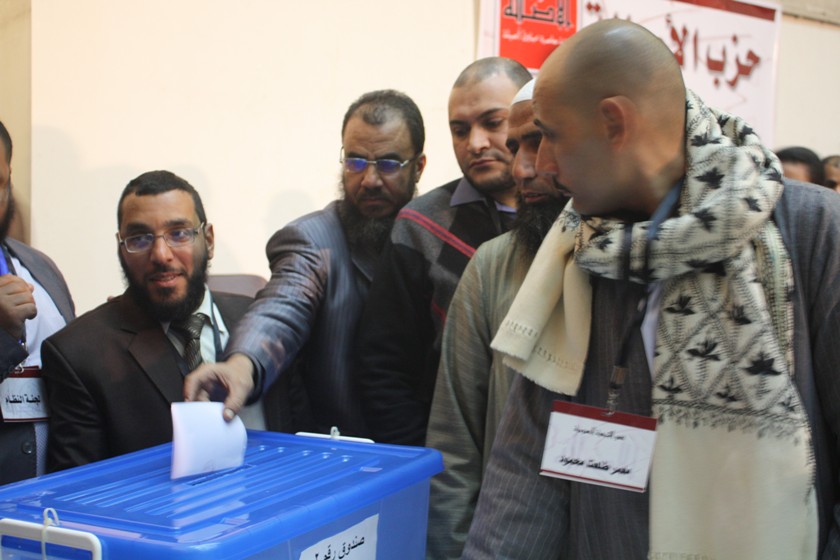
The main question directed to Islamist politicians is if they truly believe in democracy or simply use it as a ladder to power. Egypt’s constitution declared its governing system to be both democratic and of an undefined shura (consultation). The shura provision was added at the request of Salafis, whose ideas of democracy issue from the selection process of the early Islamic caliphs, which was consensual. If internal elections are any indication, Salafis are willing to be transparent about their leadership choices, but greatly prefer the predetermined aspects of shura.
From the second:
There are reasonable reasons to reject quotas as well as to trust sharia provisions toward non-Muslims. Yet probing beyond the headlines exposes differences of nuance, if not outright contradiction.
Opponents of Salafis do credit them for being straightforward and sincere, unlike their opinion of the Muslim Brotherhood. As they develop political skill, however, it appears Salafis also are learning the unfortunate art of spin.
From the third:
Then effortlessly, unprompted, and without rancor, he slid into a passionless diatribe. “When we reach the stage of our empowerment, we will collect jizia from the Copts.
“Permissible for us are the blood and spoils of those who disbelieve in God and refuse his prophet,” he said. “This is not for the people of the book, as long as they do not fight us. But inside and outside Egypt they are fighting us, taking millions from America to accumulate weapons.”
…
So when Sheikh Abdel Khaleq Mohamed states at an official party function, “Democratic work is unbelief, but as long as it leads to the victory of God’s religion it is permissible to us,” does he represent its official line? Or does party president Ehab Shiha, who clarified the misquote, adding after ‘unbelief’ the words ‘… as a doctrine’ which were clipped in the article? On the contrary, Shiha accepts the definition of democracy as ‘government by the people, of the people, and for the people’ as long as it does not transgress the laws of God.
Please click here to read the full article on EgyptSource.
On the horrible accident near Beni Suef in Upper Egypt, from Ahram Online:
Hours after the tragic train crash that killed at least 19 passengers and injured scores of others in the Giza suburb of Badrashin, victims’ relatives and police officials remained gathered at the scene and a military helicopter hovered overhead.
The 12-carriage train, which was carrying 1,328 Central Security Forces (CSF) conscripts, mostly around 20 years old, had been travelling en route to Cairo from Upper Egypt. The conscripts had been preparing for their first military training, when two railway cars – each carrying over 200 soldiers – derailed, hitting a cargo train sitting outside a storage depot.
According to one, the overcrowding may have saved his life, though it surely killed others:
“On the truck I was in, one injured passenger had a broken leg; his leg hung by the skin only. Another had his nose broken, while a third had suffered broken ribs. I’m one of the lucky ones who had been sitting with five others in seats fit for two. Others were crammed into the upper shelves usually reserved for baggage. Those are the ones who died.”
We have traveled by train several times to Upper Egypt, but always in first or second class. Even there, some passengers are allowed to enter and stand in the aisles and open spaces near the door. In other cars we see how people are crowded together, though never this severely.
But on the whole, we have always found train travel in Egypt to be smooth and economical, even when someone in the aisle has his elbow in your ear leaning on the back of the chair. Usually they are kind enough to adjust. I wonder what sort of ticket they bought, if any, and why the attendant allows them to stay.
On the other hand, there is weird and uncomfortable sense of entitlement when we see them crammed in, yet my six year old daughter has a seat. We did pay for it, right?
I remember my days in university, when I would sit in the corner of the train on a huge bag of laundry, traveling from Washington, DC back home to New Jersey. I wonder how many passengers I annoyed.
May God rest the souls of those who died and comfort the many injured. May he guide the government in fixing Egypt’s many problems. Mercy.
‘The church in Egypt is better resourced to participate in society than in other countries of the Arab world, whereas in Palestine/Israel it constitutes only 1% of the population,’ says Stephen Sizer, a renowned critic of Christian Zionism, who presented a series of lectures in Cairo, including at the Anglican Cathedral.
Sizer is an Anglican minister from the UK and directs most of his energy combating US evangelical Christians who find Biblical warrant for supporting the Zionist policies of Israel. Instead, Biblical theology should direct the Christian to support the oppressed and stand for justice, on both sides of the separation wall.
Yet local expressions of theology have failed Palestinian Christians as well. In an interview with Orient and Occident Sizer suspects a similar deficiency among many Egyptian Copts.
‘Theology that says, “Stay out of politics and worship quietly; don’t get in the way or cause problems” will lead only to a victim mentality,’ maintains Sizer. ‘We have to get out of our ghetto and show the rule of law applies to everyone.’
Please click here to continue reading the article on Orient and Occident.
Orient and Occident is the bilingual online magazine of the Egyptian Anglican Church, of which I am privileged to be the editor. We seek to highlight voices who are able to articulate how the values of faith – Christian in particular, shared widely with Islam – can be lived practically in society, and in particular the Arab world. We welcome contributions from Christians and Muslims alike.
Please click here to view the Winter edition homepage in English, and here in Arabic. This season’s edition also features the following articles:
While on this blog Julie and I always appreciate your sharing of our thoughts about Egypt, we would like to invite you particularly to share any of these articles you find enjoyable or challenging. We hope Orient and Occident will be a service to the Arab world – both by inspiring its readers inside and by sharing a vision with the world outside. Thanks for any small steps you can take to help it be better known.
The picture of a women’s rights pioneer was deleted from a high school textbook because she was not wearing a hijab, prompting fierce condemnation from political parties, human rights organizations, feminist groups and a number of public figures.
…
Doriya Shafiq is one of the pioneers of the women’s liberation movement in Egypt from the first half of the 20th century. She campaigned for the rights of Egyptian women to vote and stand as candidates to be included in the 1956 Constitution.
Aside from campaigning against the British presence in Egypt, Shafiq also was a researcher and founded literary journals. She was granted a PhD in philosophy from the Sorbonne in France in 1940, after writing a thesis titled “Women in Islam, which claimed that women have twice the rights under Islam than they do under any other legislation.
Little snippets of news like this do not tell the whole story, of course. Is the curriculum changed frequently? Had this woman been included forever or only added recently? How are other women leaders treated? Was this the only unveiled women or are there several others still featured?
All the same, it is very important to follow changes to the educational curriculum. Despite the rancor it sometimes causes, I am glad American education is determined at the state level. But if this was the system here, what would the result be in traditional governorates? What authority should the central government have to shape the minds of young people?
From my recent article on Christianity Today, published online on January 10, 2013:
The stakes have been raised for Christian satellite broadcasting in the Arab world.
On November 28, a Cairo court sentenced to death Nakhoula Basilli Nakhoula and six other Coptic Christians—who all live outside Egypt—for their alleged roles in producing The Innocence of Muslims. The film, which mocks the Prophet Muhammad, prompted violent protests worldwide.
Nakhoula is relatively safe since he and the Way, the satellite channel that broadcasted the film, are based in the United States. But the sentence drew attention to how such channels have proliferated in recent years, seeking to present the gospel to Arab Muslims by—in part—directly criticizing Islam.
“Since satellite TV is widespread across the Middle East and is uncensorable, it is obviously a key way to make the good news of the gospel available,” said Terence Ascott, CEO and founder of SAT-7.
Please click here to read the whole article, which includes testimony from Egypt based religious broadcasters SAT-7 and Coptic CTV, as well as internationally based Coptic Logos TV, and Life TV.
The location can make a difference. While the legal consequences vary from nation to nation, Islam as a religion highly discourages conversions away from the faith – certainly public ones. There is a range of response; some advocate death, others social estrangement, and some say (quoting the Qur’an, not necessarily definitively) there is no compulsion in religion.
I am comfortable with the fairness and objectivity of the article, and every source spoke on the record. But based in Egypt where almost everything religious is highly sensitive, there is one element of the story beyond my control – the title.
Every magazine takes the prerogative to title an article according to their best understanding of audience marketing. After all, it is the title which draws the reader to the content. I always suggest a title; sometimes it is accepted, sometimes it is discarded. Generally there is collaboration on the matter. Usually the choice of final title doesn’t make very much difference to me, and most often their wording is best.
This article originally was published in print, that is, for local distribution in the US market only. This means it would exist largely away from any local Egypt sensitivities.
But it was also purposed to publish online eventually. This means the article is open and available to all. The sensitivities remain.
My original suggestion was: ‘Broadcasting the Gospel in Arabic: For Christians or Muslims?’ One suggestion along the way, which I liked best, was: ‘Target Audience’.
In the print edition the final choice was: ‘Carrot or Stick?’ with a subtitle of ‘Broadcasters debate best way to reach Muslims’. And online the title became: ‘How Should Christian Broadcasters Evangelize to Muslims?’
I think these titles somewhat miss the point, because much of the existing Arabic language religious broadcasting is produced for the Christian audiences of the Middle East. Even the channels which speak more directly about Islam are watched extensively by Christians, featuring testimonies, for example, of Muslims who have become Christians. For a community in regional numerical decline, such ‘proof’ that their religion is truly from God is comforting amidst the challenges of being a minority.
Therefore, the balance necessary in choosing a title is certainly tricky. Each publication has its own standards and religious convictions, but for the evangelical audience of Christianity Today, it is a given that the message of Jesus is for all – including Muslims. Of course media should give them exposure of and invitation to the teachings of Christianity, in their own language.
Meanwhile, for most in Egypt, it is Islam which should draw the converts. It is anathema that a Muslim might leave Islam to any religion at all, and many are offended when others try to encourage the process. As the article points out, this is even more so when the attempt directly criticizes Islam or Muhammad.
Christianity Today also has another article on the subject, which highlights some navigating a middle ground. It is an interview unlikely to fully please either the Christian or the Muslim.
In America, religion is largely a private matter, with religious ideas being free game on an open market. One should respect the convictions of an individual, but religions themselves are subject to ridicule, criticism, indifference, allegiance, support, belief, or robust apologetic – as the case may be. Most Americans accept this as good and natural.
In Egypt, religion is largely a public matter, with religious ideas protected to preserve social harmony. One should allow, almost begrudgingly, an individual to harbor divergent views in his heart, but the religions themselves – at least concerning Islam and Christianity – are from God and not to be questioned. Most Egyptians accept this as good and natural.
In this light, the title options chosen for the article come from a very American perspective, designed to draw the most readership. My favored titles strive to be as neutral, yet descriptive, as possible. The content is the content, accepted by both. Hopefully all who read will get a fair picture of what is at stake.
When it comes to Egyptian education and Islam, Christiane Paulus is both a critic and supporter. So much so, she adopted both.
Paulus is a German national, resident in Egypt since 1998. She is currently a professor of Islamic studies and Protestant theology at the Azhar University, through the medium of the German language. Her journey here is a story all its own.
Paulus studied Protestant theology and postmodern philosophy in Marburg, Germany, with the intention of becoming a Lutheran minister. But in 1988, before her final tests, she married her husband, an Egyptian Muslim. Unless he converted to Christianity, the church ruled she could not receive her preaching license, as both spouses needed to be of the faith.
Years thereafter Paulus remained in her Christian faith, even after moving to Egypt with her family.
Paulus does describe what she finds are the culturally derived faults of the Egyptian education system, with consequences falling directly on religious and political relations:
Dialogue, Paulus believes, is a subject of the social sciences – a discipline largely ignored in Egyptian education. Curriculum, methodology, and pedagogy have remained stagnant since the Nasser era, when a resistance to new ideas was the norm. Since then, however, both students and teachers have sought to escape the system. At the basic level this involves the reliance on private tutors; for those able it means enrollment in private or foreign schools.
Women, she noted, are in general educated relationally. This equips them for dialogue more readily than men. But in addition to educational lacking, the Egyptian culture is bound by concepts of honor and shame. Together with pride, this produces an atmosphere of ‘not talking’. An Upper Egyptian husband, for example, will ignore his wife and stay silent with her when upset. Outside the family, discord produces the same result. The first casualty of Egypt’s political division is a lack of communication between liberals and Islamists.
But her focus in presentation was on what drew her to Islam as a religion. Much of this was due to the influence of her husband and his family, but it was also from historical study:
In 2005 Paulus read a book by the Egyptian Muslim theologian Amin al-Kholy, an active intellectual in the early 20th Century. ‘Islam and the Connection to Christian Reform’ summarized his presentation on the Protestant Reformation, representing the Azhar at the 1935 Brussels conference on the religious sciences.
Kholy noted that the early Protestant reformers – prior to Luther – emerged from areas long occupied by Muslims. From Spain under the Reconquista, Lyon, and Monaco, figures such as Peter Waldus and William of Ockham adopted ideas originating in Islam, translated them into Latin, and began applying them to criticize European Catholic Christianity. The Muslim populations of these areas had been forcibly converted into Christianity but retained their Islamic beliefs in secret. A few centuries later, Islamic-cum-Protestant ideas such as no mediation between man and God, private reading of the Scriptures, and clerical marriage began to take hold.
But she remains critical of prevalent Islamic thinking as well, which generally leaves their received religious heritage unquestioned:
Of course, a great deal of irrationality has entered the Muslim world, too. Where education is lacking the religious discourse takes over everything. Contrary to the prevailing religious spirit, Paulus says each individual Muslim has the right to read and evaluate Islam’s religious sources – the Qur’an and Hadith – weighing their value. The condition is to keep the Islamic culture of discussion respectful, objective, and academic.
This individuality also comes out in Paulus’ decision not to wear a headscarf.
Paulus is a charming person who is clearly a deep and sensitive thinker. Her testimony was given in a presentation with brief time for questions and answers; otherwise, it would have been useful to probe many of her arguments further. Please click here to discover them by reading the whole article on Arab West Report, and here for an Arabic language article on Paulus.
But less interesting than arguments is the story of an individual human being, seeking to make sense of the world. Tomorrow I hope to post a link to another recent article I have written, this time in the other direction.
The title is a little bit much (to be explained below), but it is a nice scene. The video is taken from a Christmas celebration in Kasr el-Dobara Church in downtown Cairo, right behind Tahrir Square. The imam of Tahrir’s mosque pays a visit to wish his Christmas greetings to a congregation that shared with him the trials and courage of the revolution. The video is 15 minutes long, and subtitled, but you don’t have to watch the whole thing to get the gist.
The gesture is very important in contemporary Egypt, as the Salafi current of Islam has forbidden Muslims to wish Christians a merry Christmas. On one hand this is fine – why should they honor a supposed incarnation they reject?
On the other hand it is horrible – it strikes at the fabric of national unity which has been nurtured in Egypt over generations, amid instances of sectarian tension. Every Egyptian knows their religions are not the same, but they greet each other warmly nonetheless.
But if there is one comment against the video, its production (not its content) strikes too much as propaganda in the other direction. ‘My Jihad’ is an English language campaign designed to redefine the American understanding of jihad.
Again, this is well and good. Jihad does encompass the meaning of warfare for the cause of Islam. But it also, and for most Muslims around the world who are at war with no one, signifies the struggle to improve one’s soul and the world around them. It would serve many Americans well to be more aware of this.
But using Egypt as an example to restore faith in humanity? Directly after a campaign for their constitution laden with religious rhetoric, much of which labeled their opponents – and sometimes Christians – as unbelievers and the enemy? As the war cry ‘Allahu Akbar’ rang out from podiums urging the triumph of God’s religion?
Do not make these worrisome developments out to be more than they are, but do not make this appearance of a sheikh in a church out to be more than it is, either. Yes, it is a necessary and valuable gesture, received to great applause by the Christian audience.
But if one wishes to be cynical, after Islamists used religion to divide Egypt and get their constitution, may they now want to use religion (and religious unity) to govern from the center amid expected economic difficulties? Even if not, forgive the nation’s Christians and non-Islamist Muslims for feeling rather jaded.
These events are far removed from the American consciousness, which is generally ready to move on from Egypt after being consumed with its transition for the past two years. It is hoped the My Jihad campaign, as necessary as it must be, is not painting a purposefully imprecise picture to take advantage.
A few ticks of foreign exchange rates seem very little to pray over. In fact, the impact so far seems to be nominal. But as the Egyptian pound has dropped against the US dollar, many forecast difficulty for the poor.
It may get worse. Some predict the current managed devaluation may spiral out of control. Currently Egypt and investors alike are in a holding pattern, awaiting the end of the political transition and conclusions on an IMF loan. Economics likes stability, which these would provide. Unfortunately, on both counts, what is best for Egypt is hotly debated.
God, politics cannot be set aside. But find a way to keep Egyptians fed and warm this winter. Help those well off to be creatively generous. Help those without to be creatively industrious. Help those who hold the reins of policy to spark investment and employment alike.
You know where the pound belongs, God, as perhaps do senior economists around the world. Help it to settle where Egypt – as a nation – profits best. If there are burdens in the interim give patience. But hold accountable those who will lay the cost of their profits and political success on the poor and future generations.
Provide Egypt with sound minds and good leadership. May her economy grow strong; may all rise together.
The Nour Party, the political flagship of Egypt’s burgeoning Salafi movement, is in full damage control over scores of member defections to the new Watan Party. This is appropriate, as the damage is substantial.
The Nour Party lists why it is dismissive of its new rival, but Watan boasts impressive transfer:
According to Ahmed al-Qadri, the English language spokesman for the Watan Party and former vice-president of Nour’s energy committee, the resignations affect the great majority of leadership positions. Besides former party president Emad Abdel Ghaffour and spokesmen Mohamed Nour and Yousry Hammad, nineteen regional offices resigned collectively.
Furthermore, Qadri explained, every single member of Nour’s technical committees has resigned. Including the economic, political, agriculture, energy and other committees, these groups of experts facilitated the work of Nour’s members of parliament. Of Nour’s 107 MPs, 52 have joined Watan, along with sixteen current members of the Shura Council.
The problem is not over doctrine, but over the influence of religion over politics:
“Some people wanted to assign positions based on proximity to leading religious figures,” said Qadri. “One of Nour’s mistakes was that the Salafi Call had the right to interfere in the party and change job descriptions. We want to work to unite all Salafi schools but have a legitimate and independent political party.”
Some Salafis fear – and liberals hope – these divisions will damage the electoral campaign of Islamists. But Qadri sees it differently:
“If the main figures of a party make a mistake, it may cost them votes, but if we have variety in the Salafi trend then those votes can simply shift to another party,” he said.
“If you are only one party you will be too sluggish to promote yourself because there is no competition.”
And from the conclusion, he hinted that this multiplicity might actually distance religion from politics:
“You cannot simply say ‘sharia’ or ‘Islamic state’ because we all believe in this,” he said. “The Egyptian people have learned that no one will any longer give their vote to a flag, but only to those who offer them solutions.”
The coming elections will tell, but unity is always important. Just ask liberals worried over possible splits in the National Salvation Front.
Please click here to read the full article on EgyptSource.
The education minister has repeated remarks that Bahais cannot enroll in public schools, saying it violates the Constitution.
“The Constitution only recognizes the three Abrahamic religions,” Ibrahim Ghoneim told Akbar Al-Youm newspaper Saturday. “And as religion is a subject taught in schools, they do not meet the requirements for enrollment.”
Ghoneim had told Al-Sabah newspaper the same statement in November, when he was asked, “What is the position of the ministry concerning the children of Bahais? Do they have the right to enroll in a [ministry-affiliated] school?”
The minister responded by saying, “The state only recognizes three religions, and the Bahai faith is not among them. Thus their children do not have the right to register in government schools.”
It is noteworthy the minister makes reference to the new constitution to justify his position. But it is also noteworthy this was his position before the constitution was approved. The ministry of education is not one of the institutions which has been headed by a member of the Muslim Brotherhood, indicating anti-Baha’i sentiment predates their takeover of government.
In a statement issued on Sunday, the syndicate added that around 22 members of the Muslim Brotherhood were promoted to senior positions in the minsitry following the election of President Mohamed Morsy in June.
This week, the ministry denied news that it was “Brotherhoodizing” the ministry or curricula and dismissed as false claims that it had removed pictures of protesters killed during the 25 January revolution and those of unveiled feminist leaders in Egypt and inserted verses from the Quran in the national education book to advocate loyalty to the ruler.
In the statement, the syndicate mentioned the names of Brotherhood members who were promoted, saying that under the mandate of Education Minister Ibrahim Ghoneim, the ministry started implementing a plan to “Brotherhoodize” education, the first step of which was to control decision-making centers through the gradual replacement of ministry leaderships with members from the Brotherhood.
Things are very murky in Egypt, and much struggle is going on behind the scenes. These are not the battles that can demand demonstrations, but they may very well signal the direction Egypt is headed, without much media coverage.
Moves by the Arab League in concert with British activists, are putting pressure on Israeli authorities to observe international legal commitments on children detained, imprisoned and tortured in Israeli jails.
The Baghdad Declaration on the Palestinian and Arab Prisoners in the Israeli Occupation Prisons, issued on 12 December, 2012, includes a devastating critique of Israeli treatment of prisoners including children, and calls for legal sanctions against Israelis involved in their detention.
The 11-point Declaration issued on the second day of the 70-nation conference in the Iraqi capital includes the setting up of an Arab fund to support Palestinian and Arab prisoners and their families.
Hosted by the Arab League under the auspices of the Iraqi Government, it was addressed by both Iraqi President Galal Eltalibany, and Iraqi Prime Minister Nori Al Maliky as well as Palestinian Prime Minister Sallam Fayyad and Secretary General of the League of Arab States, Dr Nabil Elaraby. British jurists, parliamentarians, and representatives of civil society organizations also attended.
The Declaration calls on the United Nations and the international community to hold Israel accountable for its treatment of Palestinian prisoners, especially children, using all available legal mechanisms.
Between 500 and 700 Palestinian children are arrested by Israeli soldiers every year, according to NGOs.
Rev. Stephen Sizer
‘I chose to speak on child prisoners because it is there that I believe we see most blatantly human rights abuses,’ said the Revd. Stephen Sizer, vicar of Virginia Water in Surrey, England, a presenter at the conference, who helped assemble the sizeable British contingent.
A widely-published critic of ‘Christian Zionism’, he is currently under church investigation following a complaint – which he opposes – of anti-Semitism issued by the Board of Deputies of British Jews.
‘Israel breaches international law by transferring minors from Palestine to Israeli jails,’ said Mr Sizer to Lapido Media, referring to the Fourth Geneva Convention. ‘They should be returned to Palestine if they have committed offences.’
Stone throwing
Sizer’s report to the conference sponsored by the United Nations and Arab League says that most of the offences committed by children are throwing stones at soldiers or settlers in illegal Jewish settlements in the Occupied Territories.
‘Armed resistance of an illegal military occupation is legitimate in international law,’ said Mr Sizer.
Gerard Horton of Defense for Children International (DCI) who also attended the conference, does not deny children offend, but says that they have legal rights like anyone else.
‘Regardless of what they’re accused of, they shouldn’t be arrested in the middle of the night in terrifying raids, they should not be painfully tied up and blindfolded sometimes for hours on end, they should be informed of the right to silence and they should be entitled to have a parent present during questioning.’
A DCI-Palestine report found that among 311 sworn affidavits taken from children between January 2008 and January 2012, 90 percent were blindfolded and 75 percent suffered physical violence. A further 33 percent reported being strip searched, while 12 percent endured solitary confinement.
Mark Negev, spokesman for Israeli Prime Minister Benjamin Netanyahu has said in the past hat rock-throwing, throwing Molotov cocktails, and other forms of violence are ‘unacceptable’ – but stopping it should not be achieved illegally.
Israeli security agency Shin Bet denies the use of unlawful methods: ‘No one questioned, including minors, is kept alone in a cell as a punitive measure or in order to obtain a confession,’ it says.
But one 16-year old Mohamed Shabrawi (16) of Tulkarem in the West Bank, cited by DCI, tells of soldiers seizing him in his home at 2:30am. He claimed he spent the first seventeen days of his detention in solitary confinement, and was told his family would be arrested if he did not cooperate.
After twenty days he first saw a lawyer. After twenty-five days he was formally charged. Finally, he confessed to being a member in a banned organization and was sentenced to forty-five days in prison.
Horton believes the abuse of children is meant as a deterrent, as many interviewed minors state they never wish to see another soldier or go near a checkpoint.
‘Human rights abuses occur on all sides,’ said Mr Sizer. ‘We are most concerned about the use of detention by the Israelis for political purposes.’
This article was first published on Lapido Media on January 2, 2012.
Division does not please you. You have created us differently and esteem these differences. We have different opinions and go our different ways. But when we break relationship – forgive us.
As many in the liberal and leftist and revolutionary camps have come together to oppose the Islamists, honor them, even if their unity is temporary and superficial. Help them, God, that it may be otherwise. If they part may they part as friends, having accomplished good for Egypt.
At the same time, many in the Islamist camps are coming apart. The reasons are unclear, but appear to be personal, political, and administrative – not ideological. You know the heart of these leaders, God, but heal the divisions that they have. If ambition or strife stands in the way of worthy ideals, keep their house in order. If they part, may it be as friends, having accomplished good for Egypt.
Judge, God, if the division between these camps is honorable or displeasing. Heal the wounds that exist; correct the assumptions which poison. May each esteem the good in the other, and expose all wrong. Unite them in discernment, that together they may accomplish good for Egypt.
And bless those, God, who are healing historical division. Certain Muslim Brothers have invited Jews of Egyptian origin to leave Israel and reclaim their property and heritage. You know, God, the purpose and sincerity of such remarks, which the presidency has distanced itself from and other Islamists have rejected. But honor at least the symbolism – if not more – that Egypt may be a place of welcome for all people.
Be with Egypt, God. Grant the people a common vision to rebuild their nation. May you be pleased with what they create.
At the end of each year, our blogging platform – WordPress – provides a summary of the year’s activity. It gives us the chance to say ‘thank you’ to all of you who read our blog, looking backwards while looking forwards. Please click here if you would like to see our review post from 2011. Strangely, as you’ll notice, there is some overlap.
The busiest day on the blog this year was September 12. This was around the time Salafi Muslims breached the US Embassy in Cairo, burned the American flag, and replaced it with a black flag of Islam. Many of you turned in to check our safety; others just came to see the news. All was well, as I hope our post conveyed. To review, please click here for Salafis, Muslim Youth Protest anti-Muhammad Film at US Embassy.
This post, however, was only the third most popular over the course of the year. Top honors went to:
Applying the Cross (On Your Wrist) – Written in April, this post featured a tattoo parlor in a local Coptic Orthodox church. Most Coptic Christians mark their religious identity with a permanent imprint, something our four year old daughter imitated with pen ink in 2010. Click here for that post, which was a favorite from 2011, falling to 6th in 2012.
Christians in the Sinai – Written in January, this post featured information gained from the Coptic Orthodox bishop resident near the Gaza border. At the time of its writing there was low level tension in the area, but as the year went on and troubles increased, Google searches brought many readers here. It may be one of the few articles that describes the Christian community there.
Statement of the Muslim Brotherhood and the Leaders of the Evangelical Church in Egypt – Written in April, this is simply a copy of an otherwise little-known agreement between the two. Many different publications picked up on it and linked to it from here, as it is not available elsewhere on the internet. But if tension continues to increase between the Brotherhood and Egypt’s Christians, it will be good to come back here and see if they are honoring their promise.
Rafik Habib: On Sharia, State, and Christianity – Written in April 2011, this is a repeat winner from last year’s most popular blogs. Habib has been in the news first as a Christian VP of the Brotherhood’s Freedom and Justice Party, and then again when he resigned during the controversy over President Morsi’s power grab to avoid judicial oversight. Perhaps he will not repeat again in 2013 if he drops out of the limelight, but please click here to read my essay lauding his presence among the Islamists.
2012 was a very noteworthy year for Egypt, and perhaps it brought more attention to this blog that would otherwise be warranted. But we can celebrate with you that daily viewership doubled over the same period from 2011, which had previously doubled over 2010. Thank you very much!
WordPress also began tracking the location of visitors starting in February of this year. The United States, perhaps fittingly given our nationality, was by far in the lead. Egypt, we are thankful to report, was second, followed by the UK, Australia, and Candad.
Among other Arab nations Jordan ranked 7th, the UAE 14th, Saudi Arabia 18th, and Lebanon 26th. Though not Arab, we even had one reader from Tajikistan.
Of course, the blogging highlight of the year was welcoming our son Alexander to Egypt. In this post we introduced his possible names, here we revealed the choice and first pictures, and here we shared his Subuu3 party with friends from around the world.
In the coming year we are trying to make up our mind about keeping or shelving the News Links and Arabic Links updates listed at the top of the blog. These are very useful for me to review, and don’t take that much time to copy and paste. But not too many people click on them, so if you find them helpful, please let me know.
We may also see about providing smaller updates featuring interesting news developments, without pictures. These would appear beneath the slideshow banner, which was fun to add this year. That section would continue to feature longer articles and excerpts from those published professionally.
Do you have any other suggestions for us this coming year? We’re happy to share what we learn about Egypt, reflecting the very precious sense of belonging we have for this nation. May God bless Egypt and all our readers in 2013.
On December 29, 2012, an unknown assailant killed two Egyptians praying in a service building attached to a Coptic Orthodox Church in Misrata, Libya. Located to the west of Tripoli, the attacker threw a homemade bomb into a midnight prayer service of 150 people, injuring two others.
According to Fr. Marcos, the Coptic priest in Misrata, the assailant appeared to have targeted the service, attacking the home rather than the more heavily secured formal church building. He did not have any prior warning of an attack, however, nor any knowledge if his church was targeted because it was a Coptic Orthodox Church in particular.
Fr. Marcos wondered if the attacker may have been confused thinking this prayer service was in celebration of the New Year. Two years earlier in Alexandria a Coptic Orthodox Church was bombed on December 31, 2011, killing 21. This prayer service had been ongoing for a month, however, so the priest offered the possibility of no connection at all.
The churches of Libya, however, are included in the Coptic Orthodox diocese of Beheira in western Egypt. This is the diocese from which the current patriarch, Pope Tawadros II, was elected.
The bombing represents an unfortunate continuation of the sufferings of the Coptic Orthodox Church since the Alexandria bombing. Fr. Marcos noted the two who died were the first Coptic martyrs outside of Egypt in the modern era.
Whoever did this, he assured, represented a very small percentage of people. Libyans, he declared, are good people who do not know religious fanaticism as they have only one religion, Islam. The church had lived in peace in Misrata for a long time.
During the Libyan Revolution at one point the church was hit by a bomb. On other occasions it was strafed by gunfire. None of these events targeted the church, and Fr. Marcos related that no injuries were suffered. The Coptic community gathered together as a community and managed as best they could.
Their management included offering service and grace to others. Soldiers connected to Col. Gaddafi at times demanded shelter in the church. This was freely offered, but with the request that all weapons be left outside. Sometimes this was followed, sometimes not.
Fr. Marcos remarked the Copts of Misrata are praying for their own salvation, the salvation of Libya, and the salvation of the world. They ask God to bring peace and love to their city, even to their enemies who committed this crime.
He remarked his church was a praying church, united in seeking blessing for all people, of which God heard their prayers. He wondered if the attack was orchestrated by the devil in an effort to stop them from praying. If so, he assured, this plan would fail.
May God bless their community, the people of Libya, Copts in Egypt and around the world, and the nations of the Arab Spring. May the upheavals they suffer result in peace, prosperity, and good governance in the near future.
From my new article on Christianity Today, published December 28, 2012:
Egyptian Christians spent this year’s Advent season awaiting more than the celebration of Jesus’ birth. Christmas Day dawned with Copts still processing the rushed passage of a new Islamist-backed constitution and its implications.
Days before voting began on the hastily completed charter—which, despite only 33 percent turnout and accusations of fraud, passed December 25 with 64 percent of the vote—more than 10,000 Christians gathered at an interdenominational prayer vigil in Cairo’s famous “Cave Church.”
Please click here and here for more information about this prayer gathering. But the article continues:
“Morsi has not kept his promises to be a president for all Egyptians when he had a chance to do so, and he is losing credibility,” said Ramez Atallah, president of the Bible Society of Egypt. “When the leader is not working for consensus, it makes it very hard for anyone else to do so.”
Yet Atallah still advises Christians to remain politically active while grounding their expectations in the necessary dual perspective of Christianity.
“We must be good citizens,” he said. “This panic is not justified in our faith, even if it may be justified in terms of politics.
And here is a section on liberal ‘hope’ for political reversal in the midst of anticipated economic difficulty:
But as liberals have consistently failed to win at the polls, some place a morose hope in Egypt’s expected financial difficulties to aid their parliamentary campaign.
“There is an economic disaster coming,” said Michael Nabil, an Egyptian accountant. Since the revolution, Egypt has lost more than half of its foreign currency reserve fighting inflation and devaluation. “This will affect the situation negatively for the Muslim Brotherhood and give the opposition more credibility,” he said.
I had hoped to write this week’s Friday Prayers for Egypt about the economy, but was unable to. Perhaps after the climax of the constitution nothing this week seemed so urgent for prayer. That is not true, of course, but like many in Egypt, I feel somewhat drained, and this week was a week of recovery. Western Christmas celebrations helped.
The main issue for the prayers would have been the feared coming economic collapse. It may well happen, but is also tinged with manipulative rumors that seem almost designed to produce a panic.
Finally, a quote on what seems a very proper perspective for Egyptian Christians:
“There is no connection to political stability and the success of the gospel,” said Atallah. “In fact, the opposite might be true: People depend more on God in difficult times.”Maybe God will use the Muslim Brotherhood to do his will in Egypt, even if we don’t want them to be in charge,” he said.
Please click here to read the entire article on Christianity Today.
Rarely has a constitution so divided a nation. Protests, both for and against and sometimes violent, have filled the street. Egypt’s Christians, meanwhile, are caught in the middle. Though united against the proposed draft, their responses have varied considerably.
“It was definitely right for Christians to protest,” said Youssef Sidhom, editor-in-chief of the Coptic newspaper Watani and a long time advocate of cooperation with the Islamist administration.
“But this was not a Christian move, it was a liberal Egyptian protest meant to save the civil state.”
Despite his conciliatory position toward the Muslim Brotherhood, Sidhom had warned the day might come to return to the street if Islamists tried to implement a religious agenda. When President Morsi assumed temporary dictatorial powers to push through this constitution, he believed it was time.
“There are many indirect clauses that can lead to an Islamic state, and a few direct ones as well,” he said. Chief among these is Article 219 which makes traditional Islamic jurisprudence the primary source of legislation. Article 4, furthermore, gives a role to unelected Muslim scholars who must be consulted on laws regarding their conformity with shariah.
But it was the Islamist response to these protests which makes Sidhom believe they have shown their true colors.
“They made vicious remarks stating the protests were 60-80 percent Christian,” he said. “This shows they realize the solidarity that exists between liberals, moderate Muslims, and Christians, and they are trying to break it.”
Indeed, in an effort to mobilize votes for the constitution, the official Muslim Brotherhood website featured a story alleging Christians exchanged SMS messages urging a ‘no’ vote because they wanted ‘a Coptic state’. Safwat Hegazi, appointed by Morsi to the National Council for Human Rights and a fixture during his presidential campaign, warned the church that if it threatened Morsi’s legitimacy Muslims will threaten them ‘with blood’.
Hegazi’s remarks were filmed at a Salafi Muslim sit-in protest at Media Production City, where they believe their image is being disfigured in the press.
“In the sharia, which people do not understand correctly, everyone takes their full rights – the woman, the non-Muslim, everyone,” said Ibrahim Eid, an ophthalmologist and the media coordinator of Students for Sharia, present at the protest. Salafis there were peaceful and friendly.
This message came across to Daniel Wahba, a Coptic taxi driver. Idling in the parking lot, Salafis engaged him winsomely.
“Is there anything in the constitution that will hurt us as Christians?” he said. “Won’t we still be able to go to the church and pray?”
But it was the fear associated with general Islamist domination that affected Susie Fayiz, a Coptic housewife. “I didn’t vote,” she said. “They are just going to rig the referendum in their favor anyway.”
Preliminary results show the ‘yes’ vote in the lead with 56 percent, amid accusations of fraud. Half of Egypt’s electorate is scheduled to vote next week.
Thousands of Christians took to the streets to protest, and thousands of Christians went to the polls to vote. In between, ten thousand gathered to go to their knees in prayer.
Fr. Simaan
“We are here tonight to pray for Egypt in all that it is going through, and let us pray with tears,” said Fr. Simaan, a Coptic Orthodox priest serving the city’s garbage collectors. Their expansive cathedral is built into a cave in the Muqattam Mountains east of Cairo.
One year earlier, Fr. Simaan conducted a similar prayer gathering for all of Egypt’s Christian denominations, which drew upwards of 40,000 people. Plans to repeat the expression of unity have been in the works for months, but this meeting was only announced one week earlier, scheduled for two days before the referendum.
If there was any intentionality it did not appear during the rally. From 6pm until 6am the next morning, not once was the referendum mentioned. The general state of Egypt, however, was on everyone’s mind.
“Some of us see demonstrations and conspiracies, but I see Egypt going right. I see great days ahead of us,” said Fr. Andrawus, an Orthodox priest from Damanhour in the Nile Delta.
“Some say this country is being destroyed or being stolen. I say God is coming and he will not be late. This coming year will be the best ever for the church. The heavens will open, the church will be united, and we will be freed from fear and learn to love.”
Love is Fr. Simaan’s great emphasis, and he wishes to tell the world Copts love their nation and their fellow citizens. As Egyptian flags flew everywhere, six different satellite channels carried his exhortation.
“We pray for our brothers, both Christian and Muslim. We pray for our brothers, the Salafis and the Muslim Brothers,” he preached to great applause.
“We pray for them that God will open their hearts and keep them from harm. We are not in a war, we are in prayer.”
The church took no official position on the referendum, other than to encourage people to vote. Many participants, however, freely interpreted the point of these prayers.
“We pray for stability, safety, and a constitution we can all agree on, not one from just one slice of the country,” said Michael Magdy. Others, however, were less specific of divine providence.
“We love Egypt because it is our country, and we love God,” said Amal Samy. “We’re confident he will stand with us and lift this crisis, giving a rescue no one can expect.”
Fr. Simaan does care for a good constitution, but his focus is elsewhere.
“Perhaps the current circumstances are permitted by God as part of his plan,” he said. The Islamists have their sharia and their plans, and God will hold them accountable according to what they have received.
“But he will hold us accountable for how we live with them.”
Protests and prayer have their essential place, but amid the crises of Egypt, perhaps this is the way to peace.
Perhaps this prayer is the same as before. As the rest of Egypt goes to the polls to cast their ballot in the constitutional referendum, give them wisdom. ‘Yes’ or ‘No’ – what is best for their country?
If ‘yes’, help Egypt to begin the path of rebuilding its representative institutions. Heal the stridency that has developed between the parties, between the people, and may politics return to the high road. May the Shura Council lay out a good roadmap to parliamentary elections, and may this eventual body interpret the constitution well. Hammer out the people’s differences with words, God, not with rocks and tear gas.
If ‘no’, help Egypt to start over. Heal the stridency mentioned above, and may the people elect representatives worthy to write a new constitution. Protect the nation in the interim period, which will necessarily stretch even longer. But if this is right, correct whatever errors may be present in the constitution through a deep, abiding, and respectful consensus.
Either way, God, place your hand on Egypt’s judiciary. Squeeze, comfort, or pat on the back – the institution is vitally important for the nation’s future. May it act honestly and with wisdom; may it be treated honestly and with wisdom.
But for referendum results, God, for those who win, help them to avoid triumphalism and exclusion. For those who lose, help them to avoid abdication and rancor. May the struggle continue; may the struggle subside. In either victory or defeat, Egypt is not yet built; the social contract is not fully accepted. For the sake of Egypt, help unity to be found again soon.
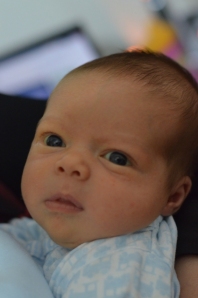
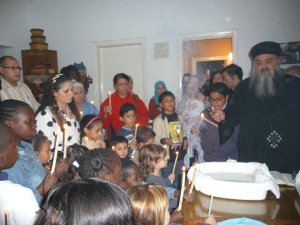
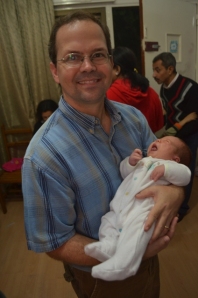
About six weeks ago, we welcomed baby Alexander into our lives. According to Egyptian tradition, one week later we should have given him a Subuu3.
Subuu3 is related to the Arabic word for ‘week’, and the number three at the end represents an Arabic letter absent in English. We delayed his party, however, until his eighteenth day of life, until both sets of grandparents could arrive. But this is acceptable according to the local traditions, as Egyptians tend to be very, um, flexible, on matters of time.
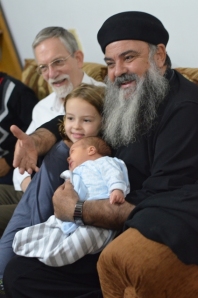
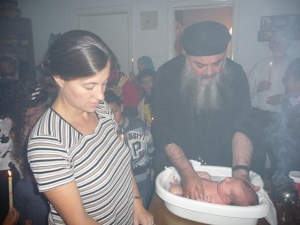
Our good friend, a Coptic Orthodox priest, Fr. Yuennis, traveled three hours one way from Upper Egypt to perform the religious rites of what is essentially a cultural baby party – received from the Pharaohs. We weren’t really sure what these rites included, though, until he was about fifteen minutes from our home.
My friend, who had already arrived, told me I needed to have a basin prepared for the priest to bathe Alexander in. I racked my brain, but couldn’t think of anything appropriate. Fortunately our neighbors upstairs had a foot bath which worked perfectly for the event.
I learned after the fact that we should have had a similar party the previous night where Alexander was also bathed. This time, all the guests would have thrown an Egyptian coin or two into the water, and the lucky woman who was chosen to bathe the baby would then collect that money. It is up to the family to choose, but the main criterion is that she is an older woman. My friend told me that for the Subuu3s done for her two children, the women took 100 and 150 Egyptian pounds (US $17 and $25) respectively. Not a bad fee for giving a baby a bath!
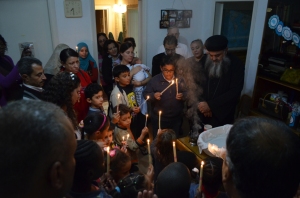
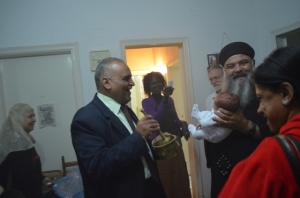
Instead, our party began with the arrival of the priest, who chanted prayers before taking Alexander from me to bathe him. The point is to bless the baby; it is not a baptism. In the Orthodox tradition boys are baptized forty days after birth, and girls eighty.
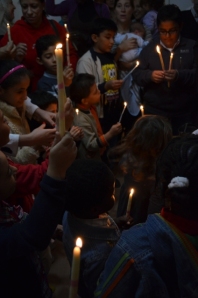
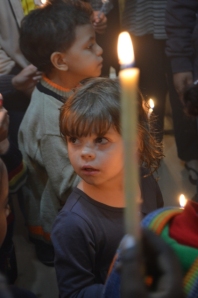
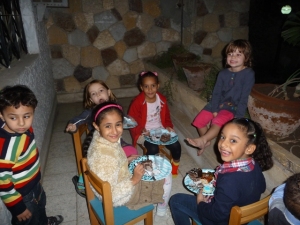
I have to admit that I was quite distracted during the priest’s words since we had about fifteen children, ages 3-9, holding lit candles and standing very close to each other and many other flammable items! Even when I took Alexander to get him ready for his bath, I was very conscious of the candles behind my back and prepared to catch on fire at any minute!
Later, when I asked my friend about the craziness of putting lit candles in young children’s hands, she just laughed and said this was a key part of the ceremony, and that, unlike our party, the children should have marched around the whole apartment holding the candles.
(Please click here to watch a video clip from the religious part of the ceremony. Translated subtitles are provided, though we are not yet able to translate the parts in Coptic. You may need to select ‘captions’ from the YouTube screen.)
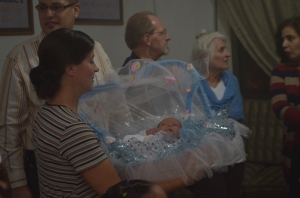
After getting cleaned up and dressed in white, as is customary, Alexander got to experience the most stimulating part of the evening. First, he was put into a special bed made for the occasion. Then we put him and his bed on the floor and I stepped over him seven times, showing my authority over him as his Mother. Next he was taken by my friend and shaken a bit in his bed.
If that didn’t wake him enough, another friend took a mortar and pestle and made lots of noise right next to him. As it rang out, she chanted something like, “Listen to your mother, listen to your father, listen to your aunt, but don’t listen to your grandfather.” They will say several variations on this, always joking around by adding the “don’t listen to” part. When I asked the ‘why’ behind all this, I was told that it helps him not be afraid in the future when he hears a loud noise. Having been put through this ordeal, the rest of life should be much easier.
This is all followed by walking around the room in a circle with the noisemaker in his ear while the guests chant something like, “Lord, be with him and grow him; may he have the prettiest gold in his ear.” This is said regardless of gender, for some reason.
(Please click here to watch a video clip from the cultural part of the ceremony. While there is lots of chatter, no subtitles are necessary – just take in the hubbub.)
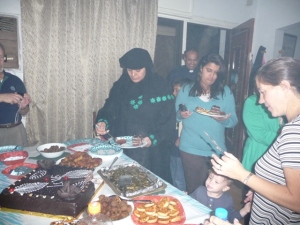
Once all this was done, it was time for the food. In general, Egyptians are very generous and great at hospitality, so we wanted to be sure we had more than enough food as well as a nice-looking spread. It probably wasn’t enough, but with a lot of help from the four grandparents, we mixed ready-made Egyptian favorites with American items.
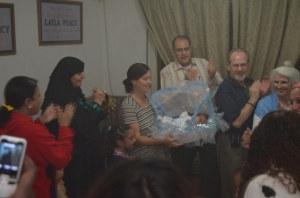
The final aspect of the traditional baby party is the party favor, also called a Subuu3, where we comically veered too much into American baby shower traditions. The Egyptian bag should be filled with peanuts, popcorn, and some hard candy, along with perhaps a baby-looking figurine or something similar and labeled with the baby’s name. But our friends were enamored by the favors we gave out as they weren’t the least bit traditional.
In preparation for this party, my mom came with American items. Our bags were filled with a lollipop and a couple pieces of candy – all wrapped in blue, of course – then tied together with a miniature pacifier and a card bearing Alexander’s vital statistics: name, date of birth, weight, and length — information all our stateside friends expect to hear at the birth of a new baby. This was far too much detail for our Egyptian friends, though. They only include the baby’s name and a written blessing. This is what happens when you combine two cultures!
All in all it was a great night. Our Egyptian friends had a chance to meet Alexander and we were able to share in Egypt’s unique cultural traditions. Perhaps most importantly our child received a blessing, as did we, of an ever deeper sense of belonging.
The proposed Egyptian constitution offers something to everyone, and its supporters know how to address the audience.
Article 3 gives Christians and Jews the right to govern their communities according to the internal rules of their religion. Articles 31-80 give liberally-minded citizens assurances on a litany of basic rights, including expression, belief, education, and even playing sports.
Less heard in the West, however, is the local message: articles designed for conservative Salafi Muslims may undermine every other guarantee.
‘This constitution has restrictions [on rights and freedoms] that have never been included in any Egyptian constitution before,’ said Sheikh Yasser al-Burhami, Egypt’s leading Salafi and founder of the Salafi Call, on a YouTube video attempting to convince his community to vote for a document many of them find not restrictive enough.
Ibrahim Eid is another leading spokesman for those who seek to return Egypt to the ancestral ways and beliefs of Arabia. An ophthalmologist and media coordinator for Students of Sharia, a Salafi association, he told Lapido: ‘There are two aspects to this constitution: that which designs a political system, and that which legitimizes it. I reject its legitimacy completely’.
Sovereignty belongs to God alone, he says.
Article 5 is therefore an anathema. It states: ‘Sovereignty is for the people alone and they are the source of authority. The people shall exercise and protect this sovereignty, and safeguard national unity in the manner specified in the Constitution.’
‘Is it reasonable to justify God’s law by a constitution, or to submit it to a referendum? Not at all!’ he said.
‘But we agree to its political necessity for the sake of the stability of the nation.
‘Let’s move through this crisis, elect a new parliament, and then the first thing they will do is change the defective articles.’
Bishop Mouneer Anis of Egypt’s Episcopal (Anglican) Church finds defective articles as well, but of the opposite kind.
‘This constitution does not lead to social cohesion, but to division,’ he told Lapido Media, as preliminary results of the first round referendum suggested 43 per cent of the population reject it. ‘It does not ensure the freedom of the minority to the extent Egypt was expecting.
‘But it ensures the rule of the majority and has many questionable, vague expressions.’
These are the very expressions Burhami celebrates, witnessed chiefly in the dispute over Article 2, defining the identity of the Egyptian state.
In the previous constitution, Article 2 declared the ‘principles’ of Sharia law to be the primary source of legislation. Egypt’s High Constitutional Court consistently interpreted the word ‘principles’ in a general fashion, avoiding direct reference to specific Islamic laws.
Liberal members of the 100-person Islamist-dominated committee writing the constitution were able to fend off Salafi demands to remove the word ‘principles’ and force legislation toward Sharia alone.
But to satisfy the Salafis, the committee added Article 219, to interpret ‘principles’ in accordance with traditional Islamic jurisprudence. Furthermore, Article 4 assigns an unelected body of Islamic scholars the right of consultation on legislation.
Burhami’s chief pride, however, is in Article 81, concluding the extended section on rights and freedoms. It seeks an elusive compromise.
‘No law that regulates the practice of the rights and freedoms shall include what would constrain their essence,’ reads the text. But what follows defines this essence:
‘Such rights and freedoms shall be practised in a manner not conflicting with the principles pertaining to state and society included in Part One of this constitution.’
Part One however includes Article 2 which is defined by Article 219, subjecting all freedom to Islamic Sharia.
Gamal Nassar, Freedom and Justice Party
‘What is the problem with being an Islamic state? Egypt is Islamic and there is nothing else to be said,’ the Muslim Brotherhood’s Gamal Nassar tells Lapido.
Nassar is a founding member of the Brotherhood’s Freedom and Justice Party. He believes the discussion of these details ignores the agreement on 90 percent of the constitution.
‘No one, even among the liberals, opposes the Sharia. This is at heart a political struggle,’ he said.
‘All freedoms must be regulated and not go against the nature of Egyptian society, which is Muslim.’
Nassar sees the nature of the politics in the behaviour of the church, which resigned from the constitution writing committee.
He accuses church representatives of negotiating the agreement of all articles, including Article 219, and then withdrawing suddenly to cause controversy and discredit the committee’s work.
Revd. Safwat el-Baiady, president of the Protestant Churches of Egypt and one of these official representatives, disagrees – and strongly. He sees a different type of politics at play.
‘This article [219] was added late and not discussed in any sub-committee,’ he told Lapido Media. ‘Because of its controversy it was postponed until the end, and dealt with only in the concluding consensus committee.’
The problem with this he said was that this consensus committee was no consensus at all, but a small number of members handpicked by the assembly head. It included a Christian, but no official members of the church.
Church representatives, and liberal Muslim members, resigned in protest en masse only once it dawned on them that Article 219 and other controversial aspects were to be presented as if it were the will of the entire body – which was not the case.
A constitution is ideally built on consensus, but it is fleshed out though law. Egypt’s constitution, if it passes, gives something to everyone.
The gift to Salafis, offered freely by the Muslim Brotherhood, is an open door to Sharia law and the conformity of legislation to it.
Egypt’s future freedoms hinge on the make-up of the next parliament, tasked with the contentious business of interpretation.
Note: The 2011 Egyptian parliament, dissolved by court order, was led by the Muslim Brotherhood-led Democratic Alliance, claiming 45 per cent of 498 seats. The Islamist Bloc, led by the Salafi Nour Party, finished second with a quarter (25 per cent) of seats. Two liberal parties received roughly 7 per cent each. Two Copts were elected to parliament, and of the ten members appointed by the then-ruling military council, five were Copts.
Article 229 of the proposed constitution declares procedures for electing the new parliament will begin no less than 60 days after it is ratified, possibly this weekend, following the second referendum vote.
Today Egypt witnessed a historic referendum over a highly disputed constitution. Two days earlier, Christians placed their nation in the hands of God.
Many did so hoping for a miracle. Egypt’s churches earlier withdrew from the committee writing the constitution, finding their voice sidelined amidst an Islamist super-majority. Noteworthy, however, was that not one speaker prayed against the constitution. Instead, they asked God to be with Egypt, give her peace and stability, and bless Islamists in particular.
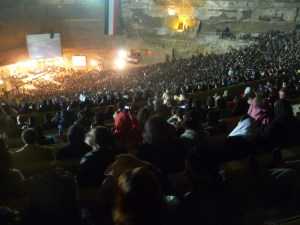
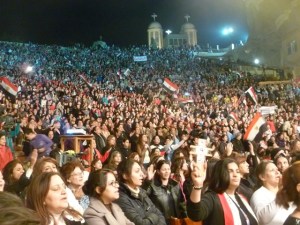
I will save more description for a few articles I hope to write in the coming days, but here is the essential fact: About 10,000 Christians from all Egyptian denominations interceded with God for their nation. Slightly less than half of these spent the whole night in prayer.
Here are the pictures, with links to video interspersed:
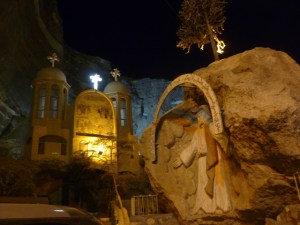
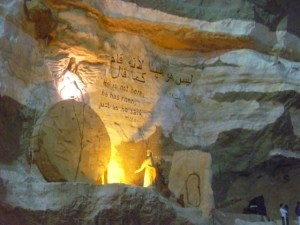
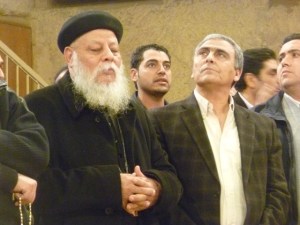
The entrance to a church, carved into a cave. It is a magnificent modern facility on an ancient Coptic site, where God saved his people by splitting the mountain in half.Throughout the area stone carvings illustrate Biblical scenes. This one overlooks those worshiping.The church is led by Fr. Simaan (Simon), who serves the Christian garbage collectors among whom he built this church.Most Egyptian Christians are Orthodox, and there has been tension between them and other denominations. Fr. Simaan’s heart is for Christian unity, however, and he organizes many meetings with Rev. Sameh Maurice, lead pastor of the largest Protestant Church in the Middle East.Fr. Simaan’s church is fully Orthodox – note the icons – but incorporates modern evangelical features such as a praise team.
Please click here for a medley of Arabic praise songs from the meeting. It includes the crowd’s favorite – chanting Yesuu’ (Jesus) over and over again.
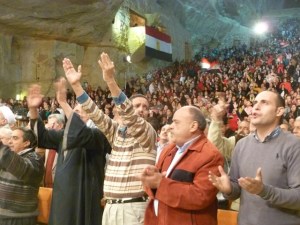
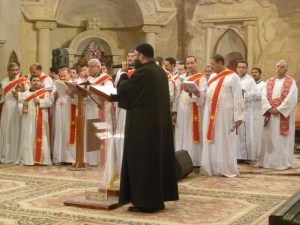
This particular choir was composed of members from various churches, of different denominations. All worship leaders, as well as speakers, however, were Orthodox.An Orthodox mass is a solemn, holy event. Many, however, have learned how to shout to the Lord in praise.One of the purposes of the event, besides praying for Egypt, was to broadcast the love Copts have for their nation. Note how many Egyptian flags filled the auditorium.
Please click here for a variation on the above link. One of the speaking priests urged the audience to add the word ‘Masr’ (Egypt) to their ‘Jesus’ chant. Boisterously, they went back and forth.
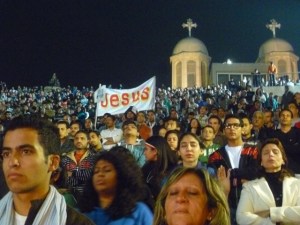
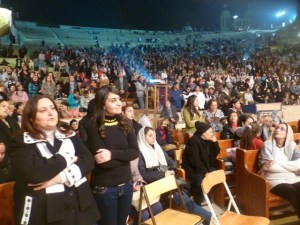
Here are a few pictures showing the size of the crowd:
The praise segment of the evening went from 6pm to about midnight. Thereafter the prayer took a more Coptic feel, with traditional hymns lasting until 6am, followed by morning mass.
Please click here to watch this choir perform and the crowd chant along.
Finally, this is about the size of the crowd that stayed to worship throughout the night.
Only God knows what is best for Egypt in terms of this current constitution. But may he honor the prayers of this community, of Muslims, and of Islamists, who pray for the peace of Egypt.













 Jayson Casper