Categories
Prayers

Friday Prayers for Egypt: Referendum, Part Two

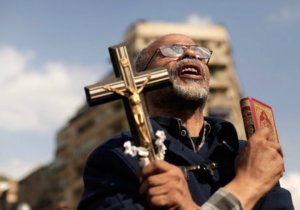
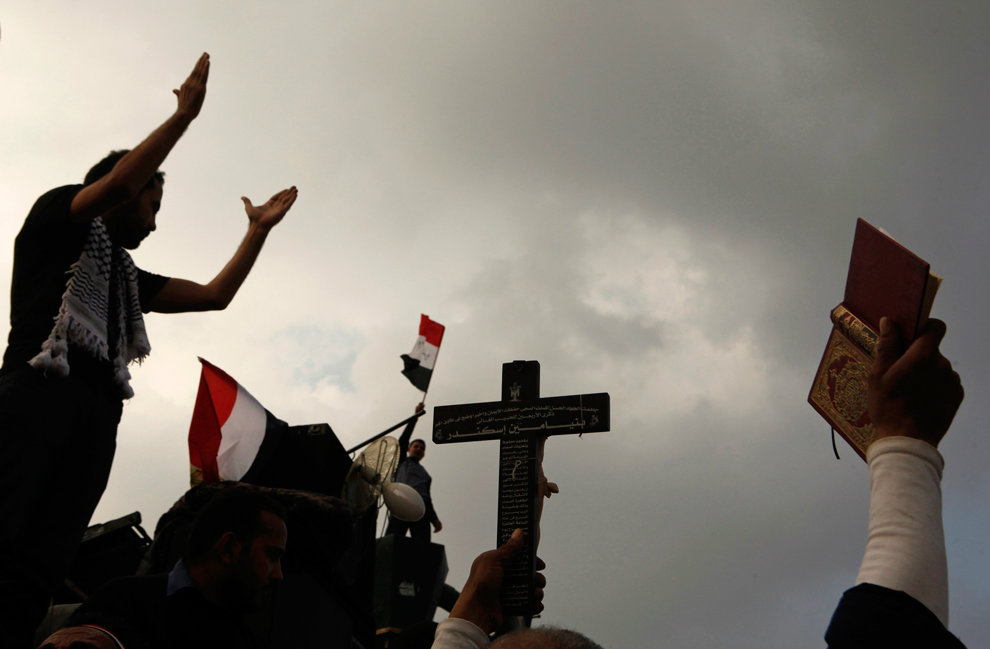
Flag Cross Quran

God,

Perhaps this prayer is the same as before. As the rest of Egypt goes to the polls to cast their ballot in the constitutional referendum, give them wisdom. ‘Yes’ or ‘No’ – what is best for their country?

If ‘yes’, help Egypt to begin the path of rebuilding its representative institutions. Heal the stridency that has developed between the parties, between the people, and may politics return to the high road. May the Shura Council lay out a good roadmap to parliamentary elections, and may this eventual body interpret the constitution well. Hammer out the people’s differences with words, God, not with rocks and tear gas.

If ‘no’, help Egypt to start over. Heal the stridency mentioned above, and may the people elect representatives worthy to write a new constitution. Protect the nation in the interim period, which will necessarily stretch even longer. But if this is right, correct whatever errors may be present in the constitution through a deep, abiding, and respectful consensus.

Either way, God, place your hand on Egypt’s judiciary. Squeeze, comfort, or pat on the back – the institution is vitally important for the nation’s future. May it act honestly and with wisdom; may it be treated honestly and with wisdom.

But for referendum results, God, for those who win, help them to avoid triumphalism and exclusion. For those who lose, help them to avoid abdication and rancor. May the struggle continue; may the struggle subside. In either victory or defeat, Egypt is not yet built; the social contract is not fully accepted. For the sake of Egypt, help unity to be found again soon.

Amen.

Categories
Personal

Alexander’s Subuu3

Alexander Eyes Open

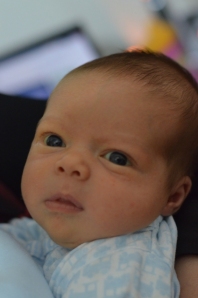
About six weeks ago, we welcomed baby Alexander into our lives. According to Egyptian tradition, one week later we should have given him a Subuu3.

Subuu3 is related to the Arabic word for ‘week’, and the number three at the end represents an Arabic letter absent in English. We delayed his party, however, until his eighteenth day of life, until both sets of grandparents could arrive. But this is acceptable according to the local traditions, as Egyptians tend to be very, um, flexible, on matters of time.

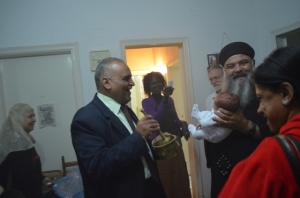
Yu'annis and Alexander

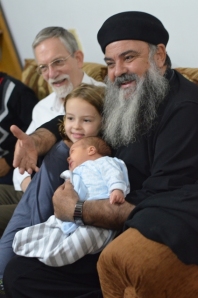
Our good friend, a Coptic Orthodox priest, Fr. Yuennis, traveled three hours one way from Upper Egypt to perform the religious rites of what is essentially a cultural baby party – received from the Pharaohs. We weren’t really sure what these rites included, though, until he was about fifteen minutes from our home.

My friend, who had already arrived, told me I needed to have a basin prepared for the priest to bathe Alexander in. I racked my brain, but couldn’t think of anything appropriate. Fortunately our neighbors upstairs had a foot bath which worked perfectly for the event.

I learned after the fact that we should have had a similar party the previous night where Alexander was also bathed. This time, all the guests would have thrown an Egyptian coin or two into the water, and the lucky woman who was chosen to bathe the baby would then collect that money. It is up to the family to choose, but the main criterion is that she is an older woman. My friend told me that for the Subuu3s done for her two children, the women took 100 and 150 Egyptian pounds (US $17 and $25) respectively. Not a bad fee for giving a baby a bath!

Yu'annis Leading Ceremony

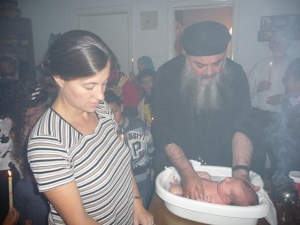
Instead, our party began with the arrival of the priest, who chanted prayers before taking Alexander from me to bathe him. The point is to bless the baby; it is not a baptism. In the Orthodox tradition boys are baptized forty days after birth, and girls eighty.

Yu'annis Bathing Alexander

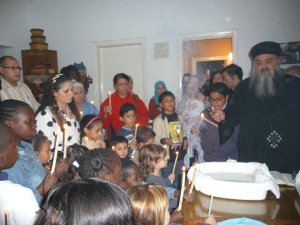
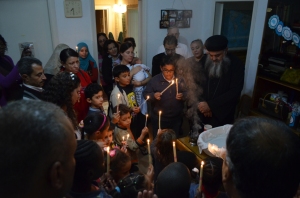
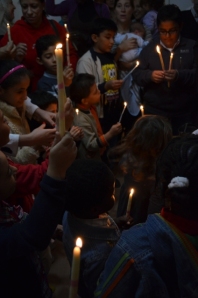
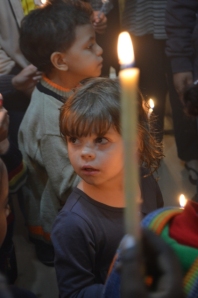
I have to admit that I was quite distracted during the priest’s words since we had about fifteen children, ages 3-9, holding lit candles and standing very close to each other and many other flammable items! Even when I took Alexander to get him ready for his bath, I was very conscious of the candles behind my back and prepared to catch on fire at any minute!

Later, when I asked my friend about the craziness of putting lit candles in young children’s hands, she just laughed and said this was a key part of the ceremony, and that, unlike our party, the children should have marched around the whole apartment holding the candles.

(Please click here to watch a video clip from the religious part of the ceremony. Translated subtitles are provided, though we are not yet able to translate the parts in Coptic. You may need to select ‘captions’ from the YouTube screen.)

Group with Candles

Kids and Candles

Hannah and Candle

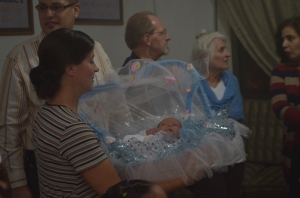
After getting cleaned up and dressed in white, as is customary, Alexander got to experience the most stimulating part of the evening. First, he was put into a special bed made for the occasion. Then we put him and his bed on the floor and I stepped over him seven times, showing my authority over him as his Mother. Next he was taken by my friend and shaken a bit in his bed.

Alexander in Basket

If that didn’t wake him enough, another friend took a mortar and pestle and made lots of noise right next to him. As it rang out, she chanted something like, “Listen to your mother, listen to your father, listen to your aunt, but don’t listen to your grandfather.” They will say several variations on this, always joking around by adding the “don’t listen to” part. When I asked the ‘why’ behind all this, I was told that it helps him not be afraid in the future when he hears a loud noise. Having been put through this ordeal, the rest of life should be much easier.

Making Noise

This is all followed by walking around the room in a circle with the noisemaker in his ear while the guests chant something like, “Lord, be with him and grow him; may he have the prettiest gold in his ear.” This is said regardless of gender, for some reason.

(Please click here to watch a video clip from the cultural part of the ceremony. While there is lots of chatter, no subtitles are necessary – just take in the hubbub.)

Circling the Room

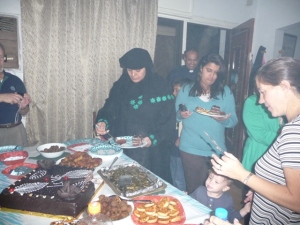
Once all this was done, it was time for the food. In general, Egyptians are very generous and great at hospitality, so we wanted to be sure we had more than enough food as well as a nice-looking spread. It probably wasn’t enough, but with a lot of help from the four grandparents, we mixed ready-made Egyptian favorites with American items.

Baby Party Spread

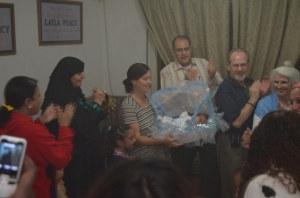
The final aspect of the traditional baby party is the party favor, also called a Subuu3, where we comically veered too much into American baby shower traditions. The Egyptian bag should be filled with peanuts, popcorn, and some hard candy, along with perhaps a baby-looking figurine or something similar and labeled with the baby’s name.  But our friends were enamored by the favors we gave out as they weren’t the least bit traditional.

In preparation for this party, my mom came with American items. Our bags were filled with a lollipop and a couple pieces of candy – all wrapped in blue, of course – then tied together with a miniature pacifier and a card bearing Alexander’s vital statistics: name, date of birth, weight, and length — information all our stateside friends expect to hear at the birth of a new baby. This was far too much detail for our Egyptian friends, though. They only include the baby’s name and a written blessing. This is what happens when you combine two cultures!

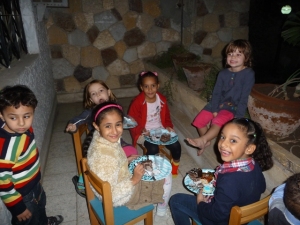
Baby Party Kids

All in all it was a great night. Our Egyptian friends had a chance to meet Alexander and we were able to share in Egypt’s unique cultural traditions. Perhaps most importantly our child received a blessing, as did we, of an ever deeper sense of belonging.

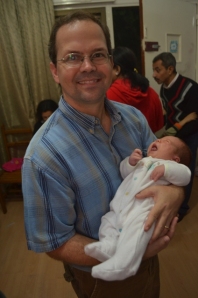
Alexander and Daddy

Related Posts:

Categories
Lapido Media Middle East Published Articles

Proposed Constitution Opens Door to an Islamic State

Ibrahim Eid, Students for Sharia

The proposed Egyptian constitution offers something to everyone, and its supporters know how to address the audience.

Article 3 gives Christians and Jews the right to govern their communities according to the internal rules of their religion. Articles 31-80 give liberally-minded citizens assurances on a litany of basic rights, including expression, belief, education, and even playing sports.

Less heard in the West, however, is the local message: articles designed for conservative Salafi Muslims may undermine every other guarantee.

‘This constitution has restrictions [on rights and freedoms] that have never been included in any Egyptian constitution before,’ said Sheikh Yasser al-Burhami, Egypt’s leading Salafi and founder of the Salafi Call, on a YouTube video attempting to convince his community to vote for a document many of them find not restrictive enough.

Ibrahim Eid is another leading spokesman for those who seek to return Egypt to the ancestral ways and beliefs of Arabia. An ophthalmologist and media coordinator for Students of Sharia, a Salafi association, he told Lapido: ‘There are two aspects to this constitution: that which designs a political system, and that which legitimizes it. I reject its legitimacy completely’.

Sovereignty belongs to God alone, he says.

Article 5 is therefore an anathema.  It states: ‘Sovereignty is for the people alone and they are the source of authority. The people shall exercise and protect this sovereignty, and safeguard national unity in the manner specified in the Constitution.’

‘Is it reasonable to justify God’s law by a constitution, or to submit it to a referendum? Not at all!’ he said.

‘But we agree to its political necessity for the sake of the stability of the nation.

‘Let’s move through this crisis, elect a new parliament, and then the first thing they will do is change the defective articles.’

Bishop Mouneer Anis of Egypt’s Episcopal (Anglican) Church finds defective articles as well, but of the opposite kind.

‘This constitution does not lead to social cohesion, but to division,’ he told Lapido Media, as preliminary results of the first round referendum suggested 43 per cent of the population reject it. ‘It does not ensure the freedom of the minority to the extent Egypt was expecting.

‘But it ensures the rule of the majority and has many questionable, vague expressions.’

These are the very expressions Burhami celebrates, witnessed chiefly in the dispute over Article 2, defining the identity of the Egyptian state.

In the previous constitution, Article 2 declared the ‘principles’ of Sharia law to be the primary source of legislation. Egypt’s High Constitutional Court consistently interpreted the word ‘principles’ in a general fashion, avoiding direct reference to specific Islamic laws.

Liberal members of the 100-person Islamist-dominated committee writing the constitution were able to fend off Salafi demands to remove the word ‘principles’ and force legislation toward Sharia alone.

But to satisfy the Salafis, the committee added Article 219, to interpret ‘principles’ in accordance with traditional Islamic jurisprudence. Furthermore, Article 4 assigns an unelected body of Islamic scholars the right of consultation on legislation.

Burhami’s chief pride, however, is in Article 81, concluding the extended section on rights and freedoms. It seeks an elusive compromise.

‘No law that regulates the practice of the rights and freedoms shall include what would constrain their essence,’ reads the text. But what follows defines this essence:

‘Such rights and freedoms shall be practised in a manner not conflicting with the principles pertaining to state and society included in Part One of this constitution.’

Part One however includes Article 2 which is defined by Article 219, subjecting all freedom to Islamic Sharia.

Gamal Nassar, Freedom and Justice Party

‘What is the problem with being an Islamic state? Egypt is Islamic and there is nothing else to be said,’ the Muslim Brotherhood’s Gamal Nassar tells Lapido.

Nassar is a founding member of the Brotherhood’s Freedom and Justice Party. He believes the discussion of these details ignores the agreement on 90 percent of the constitution.

‘No one, even among the liberals, opposes the Sharia. This is at heart a political struggle,’ he said.

‘All freedoms must be regulated and not go against the nature of Egyptian society, which is Muslim.’

Nassar sees the nature of the politics in the behaviour of the church, which resigned from the constitution writing committee.

He accuses church representatives of negotiating the agreement of all articles, including Article 219, and then withdrawing suddenly to cause controversy and discredit the committee’s work.

Revd. Safwat el-Baiady, president of the Protestant Churches of Egypt and one of these official representatives, disagrees – and strongly. He sees a different type of politics at play.

‘This article [219] was added late and not discussed in any sub-committee,’ he told Lapido Media. ‘Because of its controversy it was postponed until the end, and dealt with only in the concluding consensus committee.’

The problem with this he said was that this consensus committee was no consensus at all, but a small number of members handpicked by the assembly head. It included a Christian, but no official members of the church.

Church representatives, and liberal Muslim members, resigned in protest en masse only once it dawned on them that Article 219 and other controversial aspects were to be presented as if it were the will of the entire body – which was not the case.

A constitution is ideally built on consensus, but it is fleshed out though law. Egypt’s constitution, if it passes, gives something to everyone.

The gift to Salafis, offered freely by the Muslim Brotherhood, is an open door to Sharia law and the conformity of legislation to it.

Egypt’s future freedoms hinge on the make-up of the next parliament, tasked with the contentious business of interpretation.

Note: The 2011 Egyptian parliament, dissolved by court order, was led by the Muslim Brotherhood-led Democratic Alliance, claiming 45 per cent of 498 seats. The Islamist Bloc, led by the Salafi Nour Party, finished second with a quarter (25 per cent) of seats. Two liberal parties received roughly 7 per cent each. Two Copts were elected to parliament, and of the ten members appointed by the then-ruling military council, five were Copts.

Article 229 of the proposed constitution declares procedures for electing the new parliament will begin no less than 60 days after it is ratified, possibly this weekend, following the second referendum vote.

This article was first published on Lapido Media.

Related Posts:

Categories
Personal

Before Egypt Votes, Christians Pray

Today Egypt witnessed a historic referendum over a highly disputed constitution. Two days earlier, Christians placed their nation in the hands of God.

Many did so hoping for a miracle. Egypt’s churches earlier withdrew from the committee writing the constitution, finding their voice sidelined amidst an Islamist super-majority. Noteworthy, however, was that not one speaker prayed against the constitution. Instead, they asked God to be with Egypt, give her peace and stability, and bless Islamists in particular.

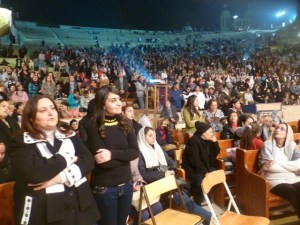
I will save more description for a few articles I hope to write in the coming days, but here is the essential fact: About 10,000 Christians from all Egyptian denominations interceded with God for their nation. Slightly less than half of these spent the whole night in prayer.

Here are the pictures, with links to video interspersed:

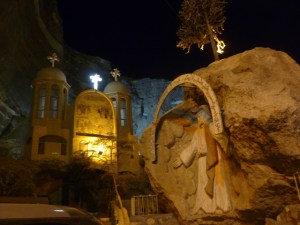
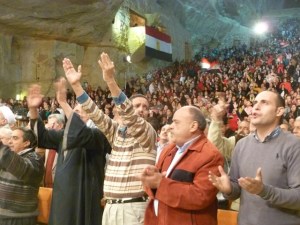
The entrance to a church, carved into a cave. It is a magnificent modern facility on an ancient Coptic site, where God saved his people by splitting the mountain in half.
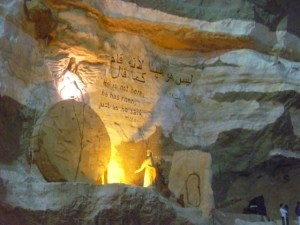
Throughout the area stone carvings illustrate Biblical scenes. This one overlooks those worshiping.
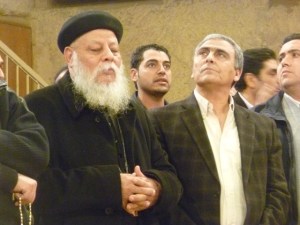
The church is led by Fr. Simaan (Simon), who serves the Christian garbage collectors among whom he built this church.
Most Egyptian Christians are Orthodox, and there has been tension between them and other denominations. Fr. Simaan's heart is for Christian unity, however, and he organizes many meetings with Rev. Sameh Maurice, lead pastor of the largest Protestant Church in the Middle East.
Most Egyptian Christians are Orthodox, and there has been tension between them and other denominations. Fr. Simaan’s heart is for Christian unity, however, and he organizes many meetings with Rev. Sameh Maurice, lead pastor of the largest Protestant Church in the Middle East.
Fr. Simaan's church is fully Orthodox - note the icons - but incorporates modern evangelical features such as a praise team.
Fr. Simaan’s church is fully Orthodox – note the icons – but incorporates modern evangelical features such as a praise team.

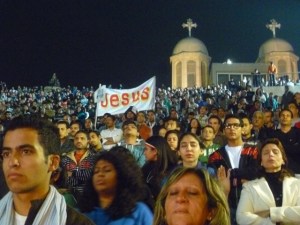
Please click here for a medley of Arabic praise songs from the meeting. It includes the crowd’s favorite – chanting Yesuu’ (Jesus) over and over again.

This particular choir was composed of members from various churches, of different denominations. All worship leaders, as well as speakers, however, were Orthodox.
An Orthodox mass is a solemn, holy event. Many, however, have learned how to shout to the Lord in praise.
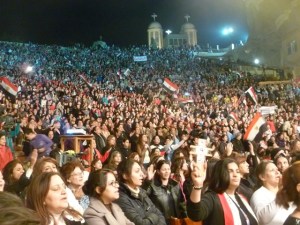
One of the purposes of the event, besides praying for Egypt, was to broadcast the love Copts have for their nation. Note how many Egyptian flags filled the auditorium.

Please click here for a variation on the above link. One of the speaking priests urged the audience to add the word ‘Masr’ (Egypt) to their ‘Jesus’ chant. Boisterously, they went back and forth.
Here are a few pictures showing the size of the crowd:

Crowd 5

Crowd 4

Crowd 6

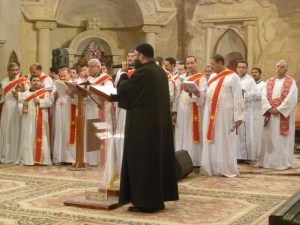
The praise segment of the evening went from 6pm to about midnight. Thereafter the prayer took a more Coptic feel, with traditional hymns lasting until 6am, followed by morning mass.

Please click here to watch this choir perform and the crowd chant along.

Finally, this is about the size of the crowd that stayed to worship throughout the night.

Only God knows what is best for Egypt in terms of this current constitution. But may he honor the prayers of this community, of Muslims, and of Islamists, who pray for the peace of Egypt.

Categories
Prayers

Friday Prayers for Egypt: Referendum

Flag Cross Quran

God,

Tomorrow, Egypt will vote. Many say she should not be, as the process was rushed, non-consensual, and dictatorial in its final stages.

Others say the opposition hopes Egypt never votes, fearing the real choice of the people.

God, whatever the reality which brought Egypt to this point, the people have a choice. The problem is their choice is framed differently.

Is the choice ‘for’ a vote for stability? Is it a vote for sharia? Is it a vote for the revolution?

Is the choice ‘against’ a vote for consensus? Is it a vote against the Muslim Brotherhood? Is it a vote for the revolution?

God, you know. You know what is best. You know what Egypt needs. You know what is right and good and honorable.

In framing this choice, God, it appears many have been less than these. Each accuses the other of unrighteousness, and you know, God, if all are right.

Yet as you do the king, God, you hold the heart of these men in your hand. Forgive them, have mercy on them, and bring them to repentance. But for the referendum tomorrow, God, it is too late.

Therefore, turn the heart of the people towards you. Turn them to what is best, to what is needed, to what is right and good and honorable. Turn them to check the box of your choice.

But Egypt needs far more than several million boxes, God. She needs trust, dialogue, and commitment to a common will. Regardless of tomorrow’s outcome, may the result push people closer to each other. All political momentum is driving them apart; for the health of the nation, reverse this.

Have mercy, God. Give Egypt stability, justice, integrity, and consensus. Tomorrow, and in all that follows, give her wisdom and peace.

Amen.

Categories
Personal

Clarity in the Midst of Mud: Taking Stock of Egypt’s Situation

Clarity in the Midst of Mud

I wish I was able to succinctly summarize what is happening in Egypt these days. Instead, I am a victim of information overload and competing media narratives. Bear with me and I’ll do my best.

On one side, the president and his Muslim Brotherhood supporters have claimed a conspiracy against them. On the other, liberals see the working of an Islamist plot to seize control of the state and enforce a religious agenda through their flawed constitution.

But if understood only this way, it enforces the narrative that Egypt is witnessing a struggle between Islamists and liberals. Supporters of democracy around the world might say, ‘Didn’t the Islamists win? Don’t they deserve their agenda? It appears they are not nearly the bogeymen we thought them to be.’

Yes and no. Morsi won the election by the smallest of margins, and many of his supporters did so mainly to oppose the other candidate, of whom they feared a return to the former regime. The main youth movement of the revolution, called April 6, and his primary Islamist competitor for the presidency, Aboul Fotouh, now campaign against him and this constitution, after earlier lending their support.

One major complaint is the constitution and its formation. Liberals withdrew from the writing process, believing it was dominated by Islamists. Morsi then preached conspiracy to assume (allegedly temporary) dictatorial powers to preempt the courts from striking it down before a referendum. Amid the outrage Morsi gave up these powers but kept in place all decisions he took while possessing them. Among them was control over public prosecution and immunizing the constitution from judicial review.

The other major complaint is the conduct of Islamists during the protests against Morsi’s decisions. Though the Brotherhood swears innocence, they sent pro-Morsi demonstrators to an area occupied by the opposition. When violence erupted, they claimed to be the victims. Certainly their headquarters were attacked across the country, and they assert members of their group were killed. But testimony and video is plentiful that during the clashes they apprehended their opponents and, well, extracted confessions.

Furthermore, Islamists are camped outside the Supreme Constitutional Court, leading judges to suspend work at the offense toward and interference in the judiciary. They also surround Media Production City, where satellite channels and their popular talk shows are produced. They demand the media be cleansed for spreading lies about them, but so far, both Islamist sit-ins have been peaceful. They state, however, they are ready to act if Morsi is unseated.

Is there an effort to do so? Demonstrators have certainly chanted for his regime to fall like Mubarak’s, but political leaders say they wish only to delay or cancel the referendum and achieve a consensual constitution. For the reasons given above though, they claim his legitimacy is either gone or hanging by a thread. And, it is evident some in the liberal media speak with extreme hyperbole and perhaps manipulate the narrative in their favor.

So today, two rival, thousands-strong demonstrations are set to square off within a distance of several city blocks. Protestors will march to and encamp at the presidential palace in Heliopolis; supporters will gather in nearby Nasr City. Both sides assure their intentions are peaceful and will keep separate to avoid sparking violence. Yet just this morning the ongoing sit-in protest at Tahrir was attacked by unknown assailants.

Islamists insist the protests against the constitution are manufactured and reflective of a small minority of Egyptians. Morsi shows no sign of backing down, insisting to hold the referendum in four days. Indeed, no matter their numbers, it seems opponents can do little to stop what they believe to be an illegitimate process. Unless the army intervenes or social strife erupts, their only recourse will be to vote ‘no’.

It is hard to imagine good liberals justifying either military intervention or national riots to achieve their goals. It is also hard to imagine what Islamists have to gain by assaulting their opponents, as they own the status quo momentum. Perhaps the hardcore and corrupt old regime supporters have had a hand. Islamists certainly claim this, as they paint with broad strokes accusing them of collusion with the liberals. Presented evidence, meanwhile, is scant.

But despite the assurances of all, the threat of violence is in the air. Each side warns of violence if Egypt continues down this path, yet Egypt continues all the same. Perhaps nothing will come of today’s events but passionate demonstrations. Maybe there is only a narrative of violence, either to scare others from participation or tarnish reputations. Or, perhaps, further turmoil will soon ensue.

Above I warned about interpreting events as a continuing contest between liberals and Islamists. Taking much from the analysis that followed, many others prefer the description as a struggle between the cultures of democracy and authoritarianism.

But here is where you start to drown. Each event has so many subplots and possible interpretations. Narratives come through media, or experts, or partisans – all tinged, if not outright colored, by bias, unnamed sources, and simply lack of complete information. Throw in the strategic importance of Egypt in world politics, and the story is complicated even further.

So is it all a mess? Well, that is another proposed narrative. Is it a power struggle? There is another. Is it a fight for freedom? Take your pick.

But as you pick, I advise you to pick according to what is right and good, with all humility. As much as I struggle to define this, I excuse you from the certainty necessary to speak in these terms. The following days may change Egypt for years to come; let us pray that which is best for her people prevails.

Related Posts:

Categories
Atlantic Council Middle East Published Articles

Why did the Brotherhood Protest at the Palace?

Translation: Sharia, God protect it; Legitimacy, People Sacrifice for it

From my new article in EgyptSource:

Politics in Egypt has degenerated into the question: Who do you trust? A more critical question right now is: What was their plan?

President Morsi addressed the nation late Thursday evening and tied Wednesday’s violence at the presidential palace to undefined ‘political parties’. If the vagary was intended to present the clashes between supporters and opposition neutrally, his overall point was clear in labeling the ultimate culprit as the old, corrupt regime. Surely he was not implicating the Muslim Brotherhood.

Yet it is undeniable the recent violence would not have taken place if not for a decision made by the Muslim Brotherhood to protest at an opposition site.

So, why did they do it?

Of course, the size of the protest, eyewitness reports putting the number at “hundreds of thousands,” was important enough for the Brotherhood to argue it was no more than 2,000 people. The threat, though, was the increase, and the permanent presence of a sit-in Morsi’s doorstep.  As the clock ticked toward the date of the referendum, it would be a constant reminder of the standing refusal of Morsi’s constitutional declaration.

This is the best reading of the official Brotherhood announcement of their stated intentions after clashes began. IkhwanOnline announced it rejected violence and went to the presidential palace to ‘protect legitimacy.’ Egypt Independent reported a Muslim Brotherhood Guidance Bureau decision to hold a sit-in at the presidential palace, while Essam al-Erian called on the people to “flood to squares in all governorates, especially at the presidential palace, to protect legitimacy.”

Already convinced there was a conspiracy to unseat them, it appears they could not allow a picture of popular support for the opposition

But was their motive more sinister?

This is the key question, and though the article weighs possibilities, it cannot be determined from located public or reported statements. Certainly if others have found them I would like to know.

Now, of course, their public discourse denies anything, claiming they were the victims. Their rhetoric, though, is telling – indicating a great conspiracy against them, their paranoia it exists, or their invention thereof:

The day of the clashes IkwanOnline collected round-ups on the events from newspapers around the world. They chose to headline this article, however, quoting a detail from the New York Times. “Wealthy and Christians Demonstrate at Ittihadiya [the name of the presidential palace],” it read.

Meanwhile, al-Fajr reports former Brotherhood parliamentarian Sayyid al-Atweil told the Islamic channel Hafez that Copts led the armed thugs in their confrontations. He claims to have seen Copts entering churches carrying weapons. Earlier, the Freedom and Justice newspaper reported Naguib Sawiris, a wealthy Coptic businessman and financier of the liberal Free Egyptian Party, was also being investigated for inciting insurrection.

And as mentioned above, President Morsi stated the violence was tied to ‘political parties’.

May Egypt traverse these waters safely. Please click here to read the whole article at EgyptSource.

Related Posts:

Categories
Prayers

Friday Prayers for Egypt: Presidential Palace Clashes

Flag Cross Quran

God,

Protect Egypt. Protect her from descending into social and political polarization. Protect her from leaders who risk mixing the good of the nation with particular agendas. Protect her from her own people, who have turned violently against each other. Protect her from apathy, as many look on from afar.

Perhaps above all, God, protect Egypt from manipulation. Following the deaths of several and the injury of scores, each side blames the other as the propaganda multiplies. Establish the truth of the recent clashes and expose all wrongdoers and opportunists. No free state of liberty can be built on anything but transparency.

Draw back each party from their entrenched positions, without compromising any notion of conviction. There are values and virtues on all sides, surely mixed with the blinders of partisanship. Liberate their minds from prejudice and generalization; replace rejection with a will to dialogue and consensus.

But where there is evil, God, stamp it out. Raise men who will act from simplicity of heart and humility of spirit, but with the power of discernment between right and wrong. Spare the rod from striking the guilty too harshly, that they in their remaining good intentions may be redeemed.

May there be no winner in this standoff, but rather a renewed commitment to work together for the good of all. The goal is a constitution that honors all Egyptians. As difficult as this task may be, it must not be impossible.

God, their conflicting non-negotiable principles appear irreconcilable by human standards. Even if all are called to seek your wisdom, they seek it differently. If as a lowest common denominator in finding your will jointly, may they seek you in each other. May they not cease from wrestling until they secure a blessing from their opponent.

Heal the divisions of the people, God. Bring leaders to discussion even as they rebuke one another. Bless the president and give him wisdom. Bless those who stand in opposition. May these men advance the cause of Egypt and not retard it. May the people do likewise.

Forgive the nation her sins, God. Lead her to repentance. Lead her to peace.

Amen.

Categories
Atlantic Council Middle East Published Articles

The Common Islamist: Principle, Pragmatism, or Triumphalism?

Islamist Giza Protest

From my new article on EgyptSource:

For many in Egypt, conspiracies and manipulations are evident, none clearer than the current battle over the Supreme Constitutional Court. Many liberals are convinced Islamists are seeking to destroy the judiciary in order to establish control over all three branches of government.

But do Islamists see themselves this way? Setting aside any possible top level schemes and propaganda among Muslim Brotherhood and Salafi leaders, do their supporters believe they are involved in a pre-planned hijacking of the revolution? Or might their own assumed conspiracies of the liberals have a measure of legitimacy?

‘They are doing everything they can to keep the decisive voice from going to the people,’ Ezzat al-Salamony, a member of the Guidance Bureau of the Islamic Group in Cairo, said of the secular politicians.

Demonstrations on Sunday at the Supreme Constitutional Court led to its chief justice suspending all work in protest. The headline of Ahram Online read: ‘Besieged by Islamist protestors, court delays ruling on Constituent Assembly’. Attending this protest, I witnessed hundreds chanting against the court.

But I also witnessed scores of riot police securing the entrance, enabling anyone to go in or out.

SCC Islamist Protest

I write next of what may represent a liberal effort to discredit Islamists via the protest at the court. But there may well be other games as well by the other side:

In his [Morsi’s] earlier declaration the president issued two more months for this assembly to complete its work. But in this closed door meeting the message was different.

‘Either we accept the declaration, or the constitution would be voted on tomorrow [Thursday, November 29],’ said Messiha, referring to the message delivered by the president’s legal advisor Mohamed Gadallah. The president was forcing their hand, and they refused. Just like that, the two months disappeared.

But most of the article is given to direct quotes from protesting Islamists, such as this one:

‘We can go outside the law if necessary for the public interest,’ said Adel Mohamed, ‘and the wali al-amr [Islamic terminology for the leading governmental authority] has the right to define the public interest.

‘Morsi walks righteously because he knows God, whereas Mubarak [also a wali al-amr] put those who mentioned the name of God in prison.’

Some of the quotes will resonate, others will infuriate. I can only hope, though, that all were sincere. For the most part I did not feel Islamists were trying to sell me a bill of goods.

Now, the country must make that determination. The referendum on the constitution is scheduled for December 15. The next two weeks will be very interesting.

Please click here to read the rest of the article at EgyptSource.

Related Posts:

Categories
Christianity Today Middle East Published Articles

What Egypt’s Christians Think of Hastily Completed Constitution

Christian Constitution

From my recent article on Christianity Today:

Addressing the nation in a televised interview Thursday, President Mohamed Morsi welcomed the sudden completion of Egypt’s draft constitution after months of gridlock.

Amid public outcry against his decision last week to grant himself immunity from judicial review, Morsi praised the constitution’s speedy completion as a necessary step in order to end the nation’s transition to democracy and reestablish separate executive, legislative, and judicial authority.

He also dismissed questions about the legitimacy of the document, especially given the withdrawal of Christian and many liberal members of the assembly drafting it.

“The withdrawal of the church from the constitutional assembly is nothing to worry about,” Morsi said. “It’s important to me that they be part of it, but not to worry.”

The article features the voice of Rev. Safwat el-Baiady, president of the Protestant Churches of Egypt, one of the church’s official representatives who withdrew from the constitutional assembly. His perspective is given on the more controversial articles, including the role of sharia law, the Azhar, and society in determining both law and social morality.

Please click here to finish reading at Christianity Today.

Related Articles:

Categories
Prayers

Friday Prayers for Egypt: Constitution Presented

Flag Cross Quran

God,

You never spare man from difficult choices, but you always prepare a way out. Help Egypt to find it.

Months of wrangling over the constitution ended this week as majority Islamist members of the assembly brought a final text to vote. Without boycotting liberal and Christian parties, it passed easily, and would have even if they were there.

Against this backdrop are the promises of the president to rescind his declaration granting himself immunity from judicial review, once the constitution is passed.

Of course, God, for many in Egypt, perhaps even most, there is not even a choice here. But these see the issue in wildly different manner.

For those completely pleased with the president and the constitution, God, challenge their way of thinking. Do they permit defying the law because the president is of their line of thinking? Do they play with words, granting freedom and human rights in one article and limiting them in another? Do they wish to use the state as decisively as it was once used against them – to shape society according to a particular vision? God, have mercy, forgive, and restore.

For those completely opposed to the president and the constitution, God, challenge their way of thinking. Do they wish Egypt to falter endlessly in transition? Is this the strategy to defeat the president? Do they disdain the common person so that they dare not let the constitution come to a vote? Do they wish to keep religion from the public square? God, have mercy, forgive, and restore.

But perhaps there is not equality in wrongs, God. Support those whose aims for Egypt are pure in heart. Expose those who manipulate, even for worthy ends.

And where these ends are worthy – on all sides, God – honor them. Help Egypt achieve an end to its revolutionary struggles. Help her to have a constitution of consensus. Give leaders determination to take hard decisions against entrenched interests. Give them determination to always do so according to the right.

God, all in Egypt need your wisdom in these days. Save her from chaos; save her from authoritarianism. Bridge the divide between those who define these so differently. May they find this salvation in each other.

Bring the nation’s suffering to an end, God. Restore to her the joy of salvation.

Amen.

Categories
Christianity Today Middle East Published Articles

Egypt Erupts Again: Christians Resist Muslim Brotherhood President’s Power Grab

Cross and Quran Held Aloft at Tahrir

From my new article on Christianity Today:

The recent deaths of two teenagers best communicate the situation in Egypt today.

Gaber Saleh, a 16-year-old revolutionary activist, was killed in confrontations with police in Tahrir Square last Sunday. That same day, Islam Massoud, a 15-year-old Muslim Brotherhood member, was killed in clashes between supporters and opponents of President Mohamed Morsi in Damanhour, a city in the Nile Delta.

The deaths reveal a nation deeply divided by the decision of Morsi last week to appropriate all governing authority until a new Egyptian constitution is completed and a new parliament elected. Protests have broken out throughout the nation; Tahrir Square has once again filled to capacity. Many of Egypt’s judges have decried the attack on their independence, with the two highest appellate courts joining others in a nationwide strike.

The nation’s Christians are firmly in the opposition camp.

At least officially, Egypt’s Christians are not calling to depose Morsy:

“This is a national issue, not a Christian one,” says Safwat el-Baiady, president of the Protestant Churches of Egypt and a former member of the constitutional assembly.

“As Christians, we are not calling for the downfall of the president. And we do not fight against the authorities. As a church, we ask only for a suitable constitution for Christians and Muslims.

“But normal people have the right to be in the squares.”

Some, if not many, might hope for it, but the outrage is directed primarily at his constitutional declaration. It has led a vice president to resign from his administration:

Morsi’s opposition is not just in the street. Samir Marcos, Morsi’s vice president for democratic transition and the most prominent Coptic member of his administration, has resigned.

“I refuse to remain [in my position],” he told the international Arab newspaper Asharq Alawsat, “in light of this presidential decision that is crippling to the democratic transition process … and which is contrary to what I am trying to achieve through my position.”

One idea floated now is that his powers could be submitted to a referendum, or yield to a referendum on a rushed constitution:

This might also create a scenario where a weary public votes “Yes” in the constitutional referendum to follow, simply to end the deadlock and restore stability. In the process, liberals and Christians fear, the public would accept a flawed and religiously tinted constitution.

Of course, either way the people vote, a deadlock might continue. The Muslim Brotherhood will hold a rally on Saturday to support the president, whereas they previously canceled a competing protest out of fear for “bloodshed.”

“In order to save Egypt from going back to square one—dropping into chaos and nearly civil war—we have to think of a compromise,” said Sidhom. “But I fail to see how or where.”

Please click here to read the whole article at Christianity Today.

Related Posts:

Categories
Arab West Report Middle East Published Articles

In Memoriam: Dr. Baha Bakry

Dr. Baha Bakry

With Egypt possibly on the brink of a new uprising tomorrow, I have not written much having had other projects. Among them, though, is this worthy one – honoring the memory of a good man who passed away recently. Here is the introduction:

With the passing of Dr. Baha Bakri, the world has lost a friend. Among those mourning are the universities of Cairo and Sinai, the Moral Rearmament Association, the Egyptian Green Party, and Arab West Report.

Dr. Baha Bakri was an environmental architect and a professor of urban ecology whose passion for uplifting the human condition was matched only by his devotion to his students. They loved him as a father, receiving even his rebuke as if from a familial hand. He encouraged without distinction, caring little for appearances, personal glory, or financial gain.

Nagwa Raouf, one of his former students, related the following anecdote. When asked one why he did not write to preserve his wisdom for future generations, he replied, ‘If anyone desires this let them proceed. As for me I don’t have time.’

Indeed, he did not.

Please click here to read the rest of the eulogy at Arab West Report.

Related Posts:

Categories
Prayers

Friday Prayers for Egypt: Morsy’s Inviolability

God,

Egypt is once again divided, perhaps more visibly now than in some time. President Morsy issued a decree to shield both his past and present decisions from judicial review, until a new constitution and parliament appear.

He promises not to abuse this authority, claimed as necessary to stabilize Egypt and complete the revolution. He also sacked the public prosecutor and declared retrials for Mubarak and those acquitted of killing protestors. He additionally sealed the current constitutional writing committee from any possible legal dissolution.

Opponents call him a new pharaoh; supporters defend his revolutionary legitimacy. God, protect Egypt.

Protect her from deepening divisions between the people. Egypt has been on edge since the revolution. Frustrated in the political process, some may take to violence. Buoyed by their political success, some may sanction violence. Forces manipulating on either side may provoke violence. And violence has a way of spiraling out of control.

Protect her from men with designs on power. God, you know the hearts of men. You know why Egypt has suffered up until now, and what is necessary to move her forward. Help Egyptians to know how to interpret Morsy’s decision within this context.

Protect her from international intrigue, but also from paranoia. On the heels of the Gaza crisis Egypt’s role in world affairs has only increased. Are the powers that be turning Morsy into a new dictator to be relied upon, or are they working to undermine him and undo the revolution? Both sides find larger forces as work; grant Egypt alone to forge her sovereignty.

God, in looking to you, help Egyptians to find strength and conviction amidst their divisions. Where there is good, may it be honored. Where there is wrong, may it be purged. Where both are found in the same people; God, have mercy.

Have mercy and do not allow simplification. Have mercy and prevent manipulation. Have mercy and give Egypt a singleness of purpose that respects her complexity.

No man is inviolable, God, but test the president and prune him accordingly. May all that is good in his purposes remain. Give him wisdom; bless Egypt through him.

In the end, God, be just, but let your mercy triumph over judgment.

Amen.

Categories
Christianity Today Middle East Published Articles

Egyptian Churches Give Up on Helping Create New Constitution

From my new article on Christianity Today:

In another blow to Egypt’s democratic transition, representatives of the Muslim nation’s three main Christian bodies jointly decided to end their participation in writing a new constitution.

“The constitution … in its current form does not meet the desired national consensus and does not reflect the pluralistic identity of Egypt,” said Bishop Pachomious, acting patriarch for the Coptic Orthodox Church. The announcement was made one day before Pope Tawadros II assumed the papal throne of St. Mark, the gospel writer.

A primary complaint is over the role of shari’ah. Article Two of Egypt’s 1971 constitution, as well as the current draft of the new constitution, enshrines the “principles” of shari’ah to be the primary source of legislation. Pope Tawadros does not dispute the article as currently defined—including its designation of Islam as the religion of the state. But all churches reject its expansion.

“They left Article Two as is, but then added another article defining the principles of shari’ah.”

Please click here to continue reading at Christianity Today.

Related Posts:

Categories
Atlantic Council Middle East Published Articles

Solemn Ceremony and Contentious Politics Surround the Papal Throne

Pope Tawadros

From my new article on EgyptSource:

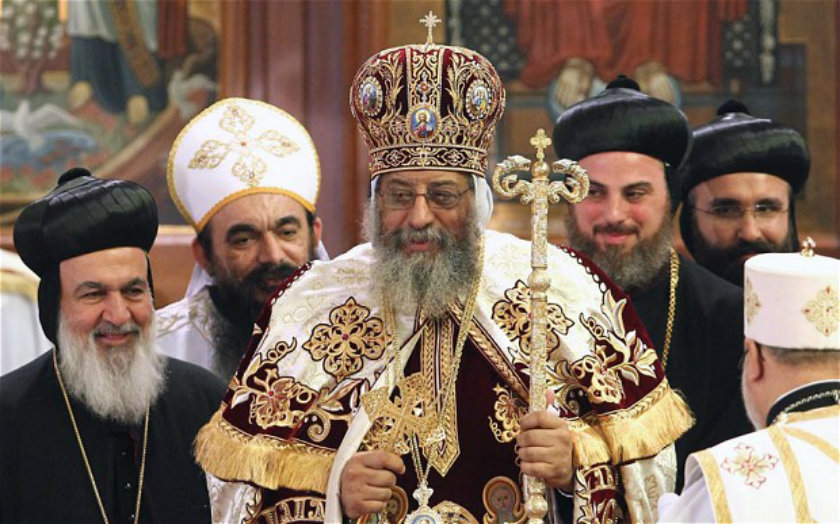
In a solemn, emotional ceremony, Pope Tawadros II was enthroned as the 118th Coptic Orthodox patriarch on Sunday, November 18.  Only one day earlier, a different atmosphere prevailed. Acting Patriarch Bishop Pachomious announced the withdrawal of church representation from the constituent assembly writing Egypt’s new constitution.

As Pope Tawadros took his seat on the papal chair of St. Mark, he was the picture of spiritual reflection. His demeanor was subdued, almost resigned to his new responsibilities. On a few occasions he shed a tear.

Two days prior, the church – behind closed doors – was the picture of enflamed political discussion.

Tawadros is the disciple of Pachomious, who spoke of his protégé:

Following the reading of the gospel, Pachomious introduced the new pope. Tawadros’ gravity was matched by Pachomious’ triumphal proclamation. “I tell him I will be his son and his servant,” stated Pachomious, “for we know the meaning of spiritual fatherhood.” He then exclaimed, driving home an intended contrast, “There is no struggle for authority in the Coptic Orthodox Church!”

The contrast, of course, is with the Egyptian political system, which the church strove hard to rise above.

But why would Pachomious make such a critical decision a day before the new pope, presumably, should start guiding these matters?

According to Bishop Yohanna Golta, Deputy Patriarch of the Coptic Catholic Church and its representative in the constituent assembly, the pope’s distance was deliberate. “The goal of Bishop Pachomious’s announcement … was to avoid entangling the new pope in this matter,” he said.

Politics entered the papal ceremony through another route – the decision of President Morsy not to attend. Many saw this as a failure to assuage the Copts amid an Islamist presidency, but others were relieved.

Perhaps Morsi, like Pachomious, also spared Tawadros the difficulty of political complications. The pope may prefer a non-politicized papacy, but this luxury may not be afforded until Egypt’s government stabilizes, if then.

And finally, here was the lead-up to the conclusion which needed to be edited out to fit with EgyptSources political focus:

Regardless of the explanation, during the ceremony Bishop Pachomious publically thanked President Morsy for sending a deputy, but focused on the spiritual definition of leadership.

‘We are the children of St. Mark,’ he said, ‘who taught us to wash each other’s feet.’ In this he referred to the example of Jesus, who took the place of a servant to wash the feet of his disciples.

Perhaps Pachomious and the church did so for Pope Tawadros, leaving him enough room to change the decision positively should circumstances warrant.

Though only speculation, perhaps it was these wranglings which produced Tawadros’ tears.

Please click here to read the whole article on EgyptSource.

Related Posts:

Categories
Atlantic Council Middle East Published Articles

Israel’s Gaza Escalation Puts the Question to Brotherhood Rhetoric

Egypt Prime Minster Visits Hospital in Gaza

From my recent article on EgyptSource:

Yet from my perspective in Egypt, I wonder if the Israeli motivation is to test Cairo more than Hamas. Of course, domestic factors always outweigh international ones. But at the least Tel Aviv may wish to discover what sort of president it faces in Mohamed Morsy, if not seek to discredit him altogether.

Muslim Brotherhood rhetoric during the Mubarak administration was always to harshly condemn the state’s refusal to take decisive action against Israel vis-à-vis Palestine. Yet Mubarak was not shy to issue strong verbal condemnations against Israel, nor did he refrain from withdrawing his ambassador to Tel Aviv. Morsy’s government, to prove consistent, must do more.

Morsy is not the Muslim Brotherhood, officially, which allows for an undefined relation of influence and agency:

Interestingly, the Muslim Brotherhood called for massive protests on Friday, as did every other political force rallying behind Gaza. Opposition to Israel has always been a hallmark of every Egyptian political movement, but it is ironic to see liberal parties now in condemnation of an Islamist presidency’s failure to stand up to Israel. But the Brotherhood is not falling behind: It has called for cutting all ties.

Do they mean it? How much effort will they pour into protest mobilization? Are they forcing the hand of the president? Or are they simply covering themselves should Morsi’s obliged inaction have to be explained away later?

But maybe Israel is seeking more definition:

Perhaps Israel is nudging at one of these contradictions. Morsi and the Brotherhood built their power base on anti-Israeli rhetoric. Yet seeking the approval of the international community and commercial interests also pledged to respect all treaties. There is little wiggle room. If they imitate Mubarak’s outrage they risk losing the people. If they take decisive steps against Tel Aviv they risk losing credibility. Such are the demands of leadership; can they step up to the plate?

The full text notes also the domestic considerations of Israel’s actions, and notes as well certain conspiratorial factors involved. Please click here to read the article at EgyptSource.

Related Posts:

Categories
Prayers

Friday Prayers for Egypt: Gaza

God,

Above all, bring peace to Israel and Palestine. Stop rockets, stop killing, stop assassinations, and stop injustice. Allow all sides to argue over who most deserves these accusations, but draw them to a halt.

As for Egypt, where these arguments are few, give wisdom to the president and political leadership on how to intervene for peace. May he stand with victims and against oppression. Help him to mediate between his allies in Hamas and his oft-political targets in Tel Aviv. Help him to encourage the Americans to play a positive role. But guide him to the transcendence of politics to the resolution of conflict. May he do what is right, whatever that is.

Egypt needs unity and solidarity, God, but caution the people about rallying against an enemy. Bless all those who express concern for innocent Palestinians, and who seek to condemn the asymmetry of the strife. But for those who are angling for political gain, cause their efforts to come to naught. Grant Egyptians legitimate outrage over what has befallen their neighbors, and discernment to weigh injustice against propaganda.

And as Israel and Palestine confront their internal issues, limit the repercussions from spilling over into Egypt. Guard the border, God, and keep militancy from spreading to Sinai and beyond. For would-be militants already here, honor their sense of resistance and sacrifice. But direct their devotion to the cause of peace and justice, not to arms and invectives. May they harm no lives, be they Egyptian, Israeli, or their own.

Beat swords into plowshares, God. May those who love you lead the way.

Amen.

Categories
Christianity Today Middle East Published Articles

Can Egypt’s Christian Assistant President Get Democracy Back on Track?

Samir Marcos

Four and a half months into Mohamed Morsy’s presidency, much of Egypt’s democratic transition is still on hold. Parliament remains dissolved. A new constitution is still pending, beset by legal challenges. In this political limbo, Morsy has appropriated even more power than former dictator Hosni Mubarak enjoyed before the January 2011 revolution.

However, alongside Morsy in this limbo is Samir Marcos, a Coptic intellectual serving as assistant president for democratic transition.

This is the opening of my new article on Christianity Today, discussing if it was wise for him to join an Islamist administration, and, if he will have a real voice. Please click here for the full article, featuring diverse Coptic answers to these questions.

“We told him, ‘Accept the position and be involved in the administration, and we will be behind you and support you. But if you feel you are being marginalized and not listened to, resign and make this clear to everyone,'” said Gaziri.

Of course, others disagree.

“The Muslim Brotherhood’s reputation in the international community will improve with him there, but Copts will not gain anything,” said Mamdouh Nakhla, head of the Word Center for Human Rights. “It is very difficult to change the regime from the inside.”

But I appreciate this perspective:

“The most unwise thing to do would be to refuse working with the administration due to its ties to the Muslim Brotherhood,” he said. “Despite our different perspectives concerning the civil state, we must maintain at least the minimum of dialogue so that we can work together for the good of Egypt.”

It is well and good to play politics, and Christians, like all people, can disagree about how to play it properly. But at the end of the day, the defining criteria must be to do what is right, even if others will take advantage.

There are degrees of right and wrong, so one must be very careful before rejecting the political stance of another. For someone like Nakhla, who is convinced the Muslim Brotherhood is a hypocritical, power hungry organization, it can certainly be ‘right’ not to aid or abet them.

Still, for good or for ill, they are currently entrusted with running the state for the good of the country. Succeed or fail, all citizens must work for the same aim. I believe Marcos is doing well.

Related Posts:

Categories
Personal

Little Pink Chicks

We had not noticed it in years past, somehow, but apparently it is the season for pink chicks in Egypt. Really, they are hard to miss.

Mixed among the cutlery, shoes, and fruit offered by illegal street vendors up and down the road leading to the local Maadi metro station are tiny little chicks crowded into plastic boxes. They sell for a pound apiece, the equivalent of eighteen US pennies. They fit snuggly into the palm of a hand.

Many are also painted pink. Demonstrated by the interest taken by our children, this serves to attract customers.

Street vendors have proliferated since the revolution as police have stopped enforcing whatever codes prevented them from being there. They crowd the sidewalk, spill over into the street, and generally increase pedestrian and vehicular traffic. It is practically bedlam in front of the metro station, as taxis congregate as well, awaiting customers.

The vendors are nice enough and do not impose or shout out prices. Elsewhere, tourist market peddlers are notorious for calling out their wares, hoping to prey on naïve foreigners and help separate them from their money. Most seek to be funny, but the economic situation forces the hand of both groups of aspiring entrepreneurs. It is hard not to be sympathetic when the poverty rate exceeds 40%.

A friend tells us, though, that chicks-as-gifts have been popular since she was a girl. The pink seems to be a recent novelty, but Egyptian kids have always loved having an alive toy. Most die after a few days; lack of proper care is certainly a contributing factor.

Laugh, cry, or shrug it off? How would you respond?

Update: My friend tells me that sometimes street vendors will place the chicks on a heated surface, then market them as dancing chicks from Tanzania. But she also tells me that many Egyptians will raise these chicks, and eventually benefit from either a mature rotisserie or egg-laying hen.

Related Posts:

  • Sheep – December 15, 2009