Categories
Excerpts

Street Music as Solution

One of the reasons given for the weakness of liberal values in Egypt is that political parties are not active on the street. Politicians tend to be elite, it is said, and are much more comfortable appearing on television and holding conferences in hotels.

This makes a difference, of course, as the media has great influence over the general political atmosphere. But it is not as successful at winning converts and changing culture. Here, the argument goes, Islamist politicians have been much more successful as they win their support through charitable activity.

In this sense, then, this initiative covered by Mada Masr is a step in the right direction:

Balcony Music 1

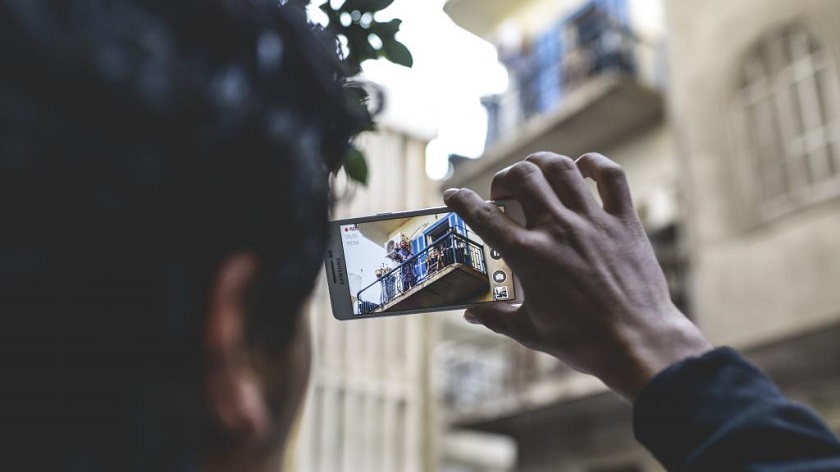
In four Egyptian cities over a weekend this month, one could be walking down the street and all of a sudden hear a violin, a percussion beat and the soulful singing of a trained soprano. This is what’s been happening in Port Said, Damietta, Mansoura and Cairo as part of Mahatat’s third Art of Transit tour, which took place between March 12 and 16.

Here is their goal:

“The idea is very important — to break the barrier of theaters and cinemas, which are closed spaces and charge money to bring art to the people,” Ziad Hassan says. “To reclaim public spaces for the public, so when you walk around you find all kinds of activities, are exposed to different sorts of art and deal with various people.”

Music and culture are not the exclusive domain of liberals, of course, though in Egypt the Islamists show much less interest and at times opposition.

But this outreach and similar efforts are clearly necessary. Anyone with a message must respect the target audience, best shown by going to them.

Balcony Music

Egyptian liberals could learn a lesson.

Categories
Christianity Today Middle East Published Articles

Identity Politics: Israeli Election Squeezes Arab Christians

Ariel Schalit / AP, via CT

From my article at Christianity Today, published March 18, 2015:

Israel’s election wasn’t easy on its Arab Christian citizens.

From one direction, Prime Minister Benjamin Netanyahu rallied his base by warning, “The Arabs are flocking to the polls in droves.” From the other, Ayman Odeh, a Palestinian-Israeli politician from Haifa, led an unprecedented but disjointed coalition of Arab secularists, communists, and Islamists, and received the endorsement of Hamas.

The tension illustrates the struggle of Arab Israeli Christians to craft a national identity between the increasing clamor of Zionism and Islamism. The result, according to evangelical leaders: a “ghetto mentality” among Christians and fewer opportunities for public witness and ministry.

Netanyahu’s Likud emerged victorious over its left-of-center rivals, the Zionist Union, buoyed by promises to abandon prospects for a Palestinian state. Foreign Minister Avigdor Lieberman, a Likud ally, told Odeh during campaigning, “You’re not wanted here.”

As voter turnout surged, however, so did Arab participation. Odeh’s “Joint List” placed No. 3 among the 10 parties that captured seats in the Knesset, Israel’s parliament. “I’m very wanted in my homeland,” Odeh replied.

But where is this homeland for Arab Christians? The answer is quite contested.

Please click here to read the full article at Christianity Today.

Categories
Christianity Today Middle East Published Articles

Forgiving ISIS: Christian ‘Resistance’ Videos Go Viral in the Arab World

Myriam, photo from SAT-7

From my new article at Christianity Today, published March 17, 2015:

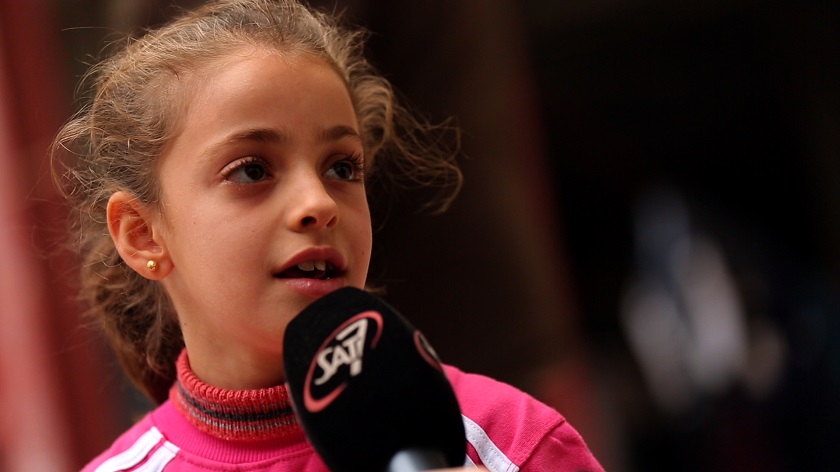
A prime example of Ghalab’s wish for loving children: 10-year-old Myriam from Mosul, Iraq.

Her family fled their home last July with hundreds of thousands of other Christians, finding safety in Kurdistan’s Irbil. Essam Nagy of SAT-7 Kids visited the refugee camps and connected with Myriam, a faithful viewer who praised God for not allowing ISIS to kill them.

Asked about her feelings toward those who drove her from her home, Myriam wondered why they did this. Then she said: “I will only ask God to forgive them. Why should they be killed?”

To date, more than 1 million people have seen her witness online. [Full video at the bottom]

SAT-7’s five channels reach an audience of 15 million in North Africa and the Middle East, though it’s impossible to measure how many people watched Myriam. However, numbers can be tracked through the social media campaign, which has reached 25 times its normal audience, with subtitles of the video provided in English, Spanish, Turkish, and Chinese. Word spread not only through SAT-7 affiliates, but also in the local secular press.

Pan-Arabic al-Arabia praised Myriam for confronting ISIS with love. “Everyone who listens to her is astounded,” echoed the Egyptian Youm 7. Leading Lebanese daily al-Nahar called for the clip to be shown in the nation’s schools as a lesson in humanity.

Please click here to read the full article at Christianity Today.

Here is the link directly to the YouTube video of Myriam.

And here is the second video featured, of a brother to two of the Coptic martyrs in Libya, calling in to SAT-7 to both thank and pray for the murderers of ISIS.

Categories
Excerpts

Why Egypt Crushes at Squash

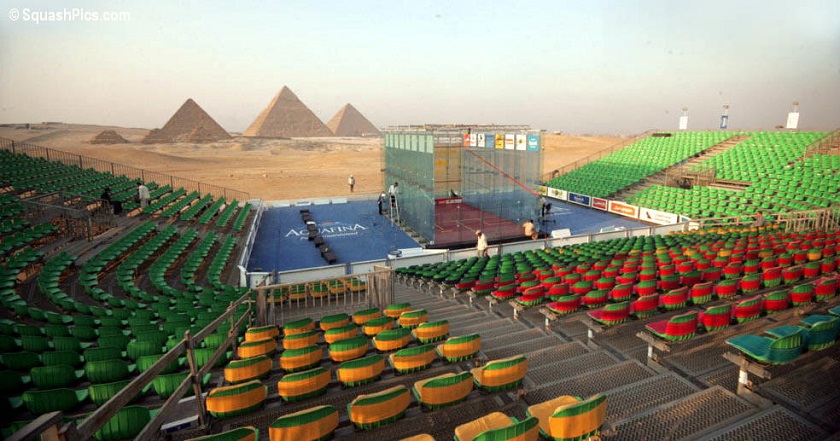
From a tournament Egypt hosted in 2006

From the Atlantic, seeking to explain Egypt’s odd dominance of a sport few Americans play:

On Friday, Egypt’s Ramy Ashour won the squash World Open—basically the Wimbledon of squash. The tournament attracts the best players from around the world. But the final game lacked a certain element of suspense: Both players, Ashour and Mohamed El Shorbagy, were Egyptian.

Even that was predictable. Egyptians dominated the international rankings this year—including El Shorbagy and Ashour, three of the Professional Squash Association’s top five players based on tournament results are Egyptian. As of Friday, Egypt has won seven of the past 12 World Opens—in the history of the tournament, which began in 1976, only Australia and Pakistan have more World Open titles.

Egypt’s prowess in the sport is beginning to extend to international women’s tournaments, junior tournaments, and even American college sports: Egyptian men have won the last three U.S. Intercollegiate Individual Championships, a tournament for the best players attending U.S. universities.

How did so many Egyptians get so good at squash?

Please see the article for details, but then go play yourself, if you can. I learned the game in college. It is far more technical and strategic than racquetball, but a great workout all the same.

Congratulations to Egypt for being the best; if only America cared.

Update: The World Squash Federation decided on March 20 to cancel the world junior championships scheduled this summer in Cairo. The cited concern is the ‘extreme radicalism in the region, not specific to Egypt.’ Unfortunate.

Categories
Prayers

Friday Prayers for Egypt: Economic Execution

Flag Cross Quran

God,

So much of a nation’s economic strength depends on perception. Egypt is poised to receive a boost this weekend, as it hosts a massive investment conference attracting business leaders and heads-of-state the world over.

But let it be real, God, and let it be good.

To be real, let it address infrastructure and corruption. Let it develop entrepreneurship and employment. Let it move beyond photo-ops and sign on the dotted line.

To be good, let it address poverty and environment. Let it develop education and benefits. Let it move beyond tycoons and strengthen both lower and middle classes.

For there are those, God, who warn this conference aims to ‘sell off’ the nation. Some are wary of neoliberalism, others of consumerism.

But some move beyond concern to sabotage. The Muslim Brotherhood seeks to raise the risk of investment calling all contracts with the coup government to be void. Allied movements push further, bombing local branches of companies in attendance.

They too want to change the perception, showing Egypt unstable and a bad investment. God, you know the reality.

For economy demands more than perception, it requires execution. But in the political sphere, Egypt recently employed the other sense of this word.

During post-Morsi violence, a pro-Morsi mob threw youths from a rooftop during widespread clashes. A year and a half later, one of this mob was executed by the state.

Some cry foul, saying they got the wrong man, or he was guilty in the mob but not of the murder.

God, so many are guilty of so much. Bring justice, but have mercy. Establish order, but bring consensus. Every man dead is a tragedy, every assault on another is a sin.

After four years of revolution, God, there is so much clean-up. Give transparency to the justice system, and courage to the prosecutors. Hold accountable all who have done wrong, and hold close the victims of injustice.

Sort them clearly, God, in this life as well as the next.

In the next life your economy is perfect. But in this one stability, justice, and rule of law are necessary prerequisites. They have been in short supply in Egypt, but grant them soon, and now.

Let them be real, God. Let them be good. And in them help all Egypt to prosper.

Amen.

Categories
Arab West Report Middle East Published Articles

The Educational Initiative of the Family House

Rasmy Abdel Malak
Rasmy Abdel Malak

Dr. Rasmy Abdel Malak is the head of the educational committee of the Egyptian Family House, an independent institution created by government decree. It is run by the grand sheikh of the Azhar in partnership with the pope of the Coptic Orthodox Church, involving Egypt’s other Christian denominations as well.

The Family House is authorized to create branches in the governorates, so that the effort to protect and reinforce national unity between Muslims and Christians will be felt at the grassroots. But it is also authorized to interact directly with government ministers, so that their suggestions will be taken into serious consideration in the framework of national policy.

It is in this second capacity Arab West Report met with Dr. Rasmy Abdel Malak Rostom, who describes the work of the educational committee of the Family House in formulating recommendations to the minister of education. The interview was conducted on November 10, 2014, by Jayson Casper and Adel Rizkallah, board member of the Center for Arab-West Understanding.

Please describe the basics of your educational work in the Family House.

The Egyptian Family House was established by a decision by the prime minister in 2012. There are a number of committees, approximately eight or nine, including one for education which I am honored to lead.

It is well known in Egypt, like in any nation of the world, that education forms the person. We have noticed instances of extremism and fanaticism among the students that come from the religious discourse in the mosques. But there are no question marks concerning the churches, it would be very rare to see similar problems.

We have begun to think how we can build up a person from youth. It is very important, from nursery and preschool certain things influence Muslims and Copts to be against each other.

The idea of the Family House is that we are a family, all together. But how can we live together when each one is raised in an incorrect way? We have witnessed this, and in the education committee we are trying to do something about it.

Please click here to read the full text of the interview at Arab West Report.

Categories
Excerpts

A Regime-Islamist Reconciliation?

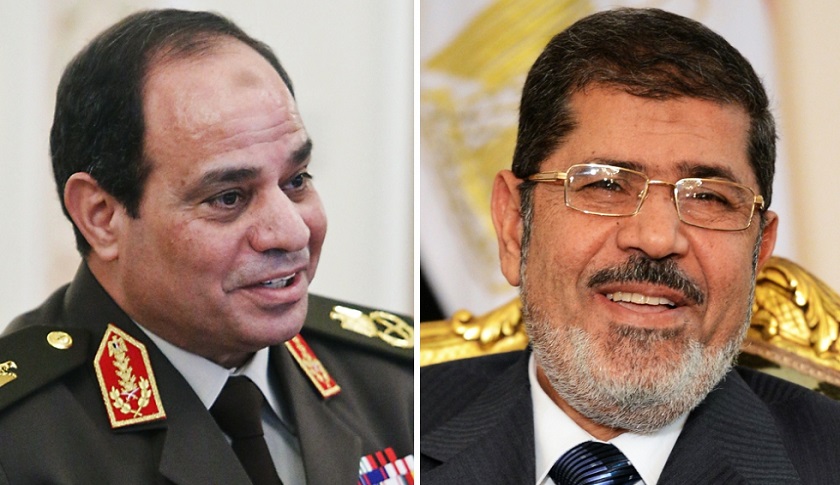
morsi-sisiVery important but under-reported news in this article from al-Ahram Weekly:

Recent developments suggest the possibility of a thaw in relations between the state and political Islam. President Abdel-Fattah Al-Sisi recently met with three members of the Dissident Muslim Brothers, a breakaway group from the Muslim Brotherhood.

There is also a reconciliation initiative, proposed by Tarek Al-Bishri, between the government and the Muslim Brotherhood. The legal scholar, known to be close to the Islamist trend, hopes the initiatives will attract Saudi backing.

After describing recent incidents of terrorism, the article provides perspective from the former Brothers:

Speaking to the press following the meeting between Al-Sisi and Dissident Muslim Brothers, Tharwat Al-Kharbawi said those attending agreed that a reconciliation with the Muslim Brotherhood is unrealistic.

Al-Kharbawi described the three-hour meeting as “an extraordinary meeting with an extraordinary man …You can rest assured that Egypt is in good hands. But we all have to work together to ensure he is not left alone.”

In the background are discussions with Brotherhood members in detention:

Al-Zafrani (ex-MB) told the press that the statements of repentance issued by some detainees was discussed. He said Al-Sisi welcomed the recantations. He quoted the president as saying that the principle of revision, admission of mistakes and repentance is acceptable as long as those issuing the declarations have not committed criminal acts.

Security sources report a growing number of imprisoned Muslim Brotherhood members are renouncing their membership of the group. Muslim Brotherhood leaders deny there is any such trend.

As for the reconciliation initiative, Bishry revealed it to a Turkish newspaper:

He also spoke of the January revolution, parliamentary elections and the importance of safeguarding the Egyptian state. “The continued existence of the state in Egypt is vital … we must preserve and perpetuate it through the participation of the people,” he said.

Al-Bishri argued that the ongoing conflict in Egypt is between three forces: the state and its backbone the army; Islamists and their grassroots organisations; and liberal elites who control the media. “The state, which is the strongest, should reach out to all,” he said.

Brotherhood dissidents dismiss Al-Bishry, finding him inclined to the Brotherhood above all.

After describing the long prison sentences given to many Brotherhood leaders, the article concludes with its analysis. The two sides are simply positioning:

In the confrontation between the state and political Islam, pressure is being sustained, on the one side, by long prison terms for Muslim Brotherhood leaders. On the other, there are bombings and violence being carried out by anti-state, pro-Islamist forces, considered by the state to be linked to the now-banned Muslim Brotherhood.

It is a game of nerves in which each side is seeking to strengthen its hand for whatever negotiations eventually ensue.

Certainly, Al-Sisi’s meetings with leaders from breakaway Muslim Brothers and reports that the new Saudi monarch is eager to settle the situation in Egypt suggest some form of social, if not political, reconciliation is increasingly likely.

Right or wrong in this conclusion, the article is worthy of consideration.

Categories
Prayers

Friday Prayers for Egypt: Parliament, Police

Flag Cross Quran

God,

News this week prompted both a sigh and a gasp. The Supreme Constitutional Court struck down provisions of the law to elect parliament, further delaying the process. And a cabinet reshuffle appointed a new minister of the interior, with speculations on the impact.

The parliament delay was almost expected, as there appears little political or popular will to complete the democratic roadmap. Some politicians accused the state of such, as the president holds the right of legislation until parliament sits.

The new police chief was quite unexpected. A number of non-Islamist revolutionary forces demanded his dismissal over ongoing violence and neglect of human rights. The new head has a background in combatting religious extremism and is tasked as new blood in the fight against terrorism.

God, set the state right. It has shuffled and wobbled for four years now, in desperate need of stability.

As parliament laws are redrafted, make the process inclusive and legal. When a parliament sits – and may it be soon – may it be representative and effective.

As the police reconfigure, make the process professional and reformist. When the chief sets his agenda, may he train, educate, hold accountable – and stamp out the violent menace that threatens Egypt.

God, in time, reverse the reaction to these institutions. May the workings of parliament produce the gasp of achievement. May the conduct of police produce a sigh of relief.

Bring peace to Egypt, God. Bring a functioning government. Through both law and order, may the country breathe normally.

Amen.

Categories
Audio

Podcast: On the Middle East, Christians, and ISIS

The Way Home - Dan DarlingThis week I had the opportunity to appear on ‘The Way Home‘ podcast, hosted by Dan Darling. Darling is the Vice President for Communications at the Ethics and Religious Liberty Commission of the Southern Baptist Convention, and he invited me to share about current events in the Middle East and in particular how they are impacting Christians. Here is his introduction:

All of us have reacted with horror at the atrocities committed by the terrorist group ISIS upon Christians in the Middle East. How can Christians pray? How should we think about ISIS?

Today on The Way Home I talk with Jayson Casper, a Christianity Today journalist who has been covering this story. He called me from Cairo to discuss how Christians in places like Egypt, Jordan, and other countries are reacting to the atrocities of their brothers and sisters in Syria and Iraq and Libya. He also gives a thorough analysis of ISIS and Islamic extremism.

Our conversation lasted about half an hour, touching on various questions. Is ISIS Islamic? How are Christians responding? How should Western Christians pray?

Please click here to open a new window and listen to the podcast.

Categories
Lapido Media Middle East Published Articles

Who are the Copts?

Muharraq MonksWorld attention has turned to the Coptic Christian community of Egypt, following the beheading of 20 of their migrant workers in Libya at the hands of the so-called Islamic State.

The Coptic Orthodox Church considers them martyrs. A new icon venerates their death and their names have been added into the Synaxarion, the liturgical church history commemorating the saints.

But who are the Copts, and what is their understanding of martyrdom?

The word ‘Copt’ derives from the Pharaonic word ‘gypt’, which through the Greek ‘Aigyptus’ became the modern-day ‘Egypt’.

Copts are therefore Egyptians, descendants of the ancient Pharaonic civilization. As such, the Orthodox, Protestant, and Catholic Egyptians call themselves Copts, as do some Muslims.

Coptic population figures are highly contested. Some Muslims estimate as low as 3-4 percent; some Christians as high as 20-25 percent. The CIA world factbook estimates 10 percent. Official Egyptian ID cards list the religion of every citizen, but these figures are not released. Roughly 90 percent of Copts belong to the Orthodox denomination.

Coptic tradition says the church was planted through the missionary preaching of St. Mark, writer of the second Gospel in the New Testament. He was martyred in Alexandria in 68 AD.

The Coptic Orthodox Church dates its calendar from the year 248 AD, the first year of Roman Emperor Diocletian. His reign witnessed up to 800,000 Christian martyrs in Egypt.

According to Islamic tradition, Muhammad said that after conquering Egypt [649 AD] the Muslims should treat its inhabitants well. To come under the protection of the new rulers Copts had to pay the jizya tax. Those unable had to either convert or risk death.

Historian Phillip Jenkins, author of The Lost History of Christianity, says that periods of persecution waxed and waned until the end of the 12th century, when Islam became the dominant religion.

Islam considers a martyr to be one who is killed while striving in the path of God, often interpreted as participation in jihad.

In Christianity, the early church defined martyr as a technical term to mean one who was put to death for their faith, in imitation of Jesus.

Christology was an issue that divided Coptic Orthodoxy from emerging Roman Catholicism. In 451 AD at the Council of Chalcedon the Copts were anathematized over the issue, but in 1998 the two churches reconciled. Copts prefer to be known as ‘miaphysites’, where Jesus’ humanity and divinity unite to make one nature.

In many issues the Coptic Orthodox are similar to Roman Catholics, following a traditional liturgy, holding to seven sacraments, and believing that during Eucharist the bread and wine become Jesus’ actual body and blood.

They differ in that the Copts have their own patriarch. Pope Tawadros II is the 118th in a line stretching back to St. Mark. Coptic priests are free to marry, though bishops must be celibate and are drawn from monastic communities.

Coptic ascetic spirituality is exhibited through the practice of fasting. But unlike complete abstinence as in Islam’s Ramadan, faithful Copts maintain a vegan diet while fasting 210 days of the year.

Monasticism as a Christian expression is traced back to St. Anthony in the Third century. St. Benedict and John Cassian visited the Egyptian desert monks and introduced the practice to Europe.

Being a bishop-led church independent from Rome has also contributed to close relations with the Anglican Church in the UK. According to Heather Sharkey, author of American Evangelicals in Egypt, the Church Missionary Society worked to revive the Orthodox Church in the Nineteenth century, as opposed to US Presbyterians from whom most of today’s Egyptian Protestants are descended.

Competition between denominations has often led to tension, but especially since the Arab Spring Copts have deemphasized distinctions in light of the challenges of Islamism.

It has also resulted in a surge in spirituality. The late Pope Shenouda III encouraged biblical literacy and winsome preaching. Today the Bible Society of Egypt is the fourth largest in the world.

Over the past 30 years the Coptic Orthodox Church has spread throughout the world, establishing over 15 dioceses in Europe, Australia, and the Americas. Commenting on the martyrs in Libya, Bishop Angaelos of the UK demonstrates Coptic—and biblical—spirituality.

‘As a Christian and a Christian minister I have a responsibility to myself and to others to guide them down this path of forgiveness,’ he said to CNN. ‘We do forgive the killers from the depths of our hearts. Otherwise, we would become consumed by anger and hatred. It becomes a spiral of violence that has no place in this world.’

This article was first posted at Lapido Media.

Categories
Europe Lapido Media Published Articles

The Muslim Brotherhood in England and Egypt

MB England EgyptLondon and Istanbul have become the new base of operations for the Islamist Muslim Brotherhood.

Following the ouster of Brotherhood President Mohamed Morsi in 2011 and their subsequent banning in Egypt in December last year, the organization is recalibrating abroad.

An early base of operations was Qatar, where the al-Jazeera network was widely perceived, even by its own staff, as being biased toward the Brotherhood.

But the United Arab Emirates and Saudi Arabia joined Egypt in labelling the MB a terrorist organization, and their pressure on Qatar resulted in the expulsion of some leaders.

Now several office blocks on London’s A406 North Circular Road comprise one of the two main centres of operation, the other being Turkey.

An investigation into MB links to terrorism was completed by former Ambassador to Saudi Arabia, Sir John Jenkins in July 2014, but its results have not yet been made public.

And bar a few lone journalists keeping tabs on the story, there is little public accountability about the presence and growth of such a controversial movement in Britain.

The MB is accused of burning up to 50 churches and Coptic businesses following the violent dispersal of pro-Morsi sit-ins on August 14, 2013. In December, in an Asyut court 40 Morsi supporters were found guilty, while 61 others were acquitted.

Ian Black of the Guardian has followed the story, implying the inquiry is being leaned on by Gulf nations who have banned the MB.

Delay in its publication is attributed to their displeasure that the report clears the MB of terrorism.

Black quotes MB apologist Anas al-Tikriti, founder Director of the Cordoba Institute, who says Islamists like the MB must be seen as a middle ground in the fight against extremism. If allowed to govern, he says, they would liberalize and sideline their hardliners.

Shadi Hamid of the Brookings Institute debunks this theory, saying Islamists only ever moderate their behaviour under duress. Once enjoying democratic freedoms, they tend to revert to their original illiberal religious conservatism.

Tikriti, whose father was in the Iraqi Brotherhood, recently denied on Twitter being a member or lobbyist of the MB.

Al-Jazeera however describe the Cordoba Foundation as a Brotherhood front. And the Hudson Institute, in a study of UK-based Islamism, calls him one of their shrewdest activists.

But Ibrahim Mouneer, an MB senior leader in London, told the Times that if the group were banned it would result in increased terrorism at home, with moderate Muslims concluding that an irenic approach didn’t work.

Lapido Media has argued this purported dichotomy between Islamism and jihadism is a false choice, and the government should not be gulled.

According to Andrew Gilligan of the Telegraph, the UK inquiry will confirm that the MB is not a terrorist group and should not therefore be banned.

And a British security source told Lapido they prefer to turn a more or less blind eye within the law, believing this offers opportunities for ‘influence’.

But Gilligan provides extensive evidence the group is linked – directly and indirectly – with terrorist groups, in particular with Hamas, and is at least potentially outside the law.

Cordoba Foundation is named by Gilligan as one of 25 groups with Muslim Brotherhood links. The Muslim Charities Forum is mentioned also.

A June report by the UAE based The National linked Takriti, his family, and associates also to the Middle East Eye and Middle East Monitor.

The Egyptian foreign ministry has asked in vain that London shut down UK based pro-MB satellite channels and newspapers like Alarabi, al-Hewar, and al-Araby al-Jadeed, saying they incite terrorist activity in Egypt.

The BBC has examined this growing media outreach that fails to promote impartial journalism, and is said to be funded by Qatar.

According to the Washington Post, this incitement is clear in the MB’s other haven abroad, Turkey. It says the Masr al-An channel, funded and managed by the MB, warned that the families of Egyptian police officers would be ‘widowed and orphaned’.

Other Turkey-based pro-MB channels like al-Sharq, Mukammilin and Rabaa employ similar rhetoric, and even allowed one MB supporter to issue a fatwa during a live interview to assassinate Egyptian President Abdel Fattah al-Sisi. Others advocate the killing of media figures and warn foreigners to leave Egypt lest they become legitimate targets.

The fatwa caused uproar, leading the Brotherhood on its English language Twitter feed @IkhwanWeb to condemn it and deny endorsing the channel.

The call to kill Sisi was made to audible applause by grinning Egyptian cleric Salama Abd Al-Qawi who said: ‘Doing this would be a good deed that would bring (the killer) closer to Allah.’

Although Al-Qawi was official spokesman for the Endowments Ministry during the presidency of Morsi, it is hard to pin down his ‘membership’ in the Muslim Brotherhood.

The MB is a hierarchical organization with strict guidelines for who is in and who simply is like-minded. Those who are members follow policy. Others aid and cooperate. The MB does not publish its membership list.

Many MB self-identify. And the period in power gave the opportunity to see new faces emerge. But without an admissions policy, it is very difficult to identify ‘members’.

MB-watchers have not seen the sheikh identified either way. But clearly he is at least a supporter and often featured in their broadcasts.

On January 25 this year a delegation of the Egyptian Revolutionary Council and the so-called Parliament in Exile, including leading MB figures, visited Washington and met State Department and White House officials.

They asserted that the revolution was non-violent and the only way to undo the coup. The State Department had previously said Egypt had given it no evidence of MB links to terrorism.

Just two days later the MB released a statement urging its supporters to prepare for a long and uncompromising jihad, stopping just short of an outright call for violence.

Charl Fouad El-Masri, editor-in-chief of Egyptian daily al-Masry al-Youm said: ‘Egypt’s Copts suffered during the Muslim Brotherhood rule greatly.’

Anglican Bishop of Egypt Rt Revd Mouneer Hanna Anis had his Suez church attacked by pro-Morsi supporters following the dispersal of the Rabaa and Nahda sit-ins in August 2013. He strongly suspects the MB to be behind Egyptian violence and terrorism.

‘They may not be directly involved in terrorist attacks,’ he told Lapido Media, ‘but they encouraged the flourishing of terrorist groups in Egypt.’

This article was originally published at Lapido Media, as a press briefing service.

Categories
Christianity Today Middle East Published Articles

How Libya’s Martyrs are Witnessing to Egypt

Two Rows by the SeaThis article was published first on Christianity Today, on February 23, 2015.

Undaunted by the slaughter of 21 Christians in Libya, the director of the Bible Society of Egypt saw a golden gospel opportunity.

“We must have a Scripture tract ready to distribute to the nation as soon as possible,” Ramez Atallah told his staff the evening an ISIS-linked group released its gruesome propaganda video. Less than 36 hours later, Two Rows by the Sea was sent to the printer.

One week later, 1.65 million copies have been distributed in the Bible Society’s largest campaign ever. It eclipses even the 1 million tracts distributed after the 2012 death of Shenouda, the Coptic “Pope of the Bible.”

The tract contains biblical quotations about the promise of blessing amid suffering, alongside a poignant poem in colloquial Arabic:

Who fears the other?
The row in orange, watching paradise open?
Or the row in black, with minds evil and broken?

“The design is meant so that it can be given to any Egyptian without causing offense,” said Atallah. “To comfort the mourning and challenge people to commit to Christ.”

The Bible Society distributed the tract through Egypt’s churches, but one congregation went a step further.

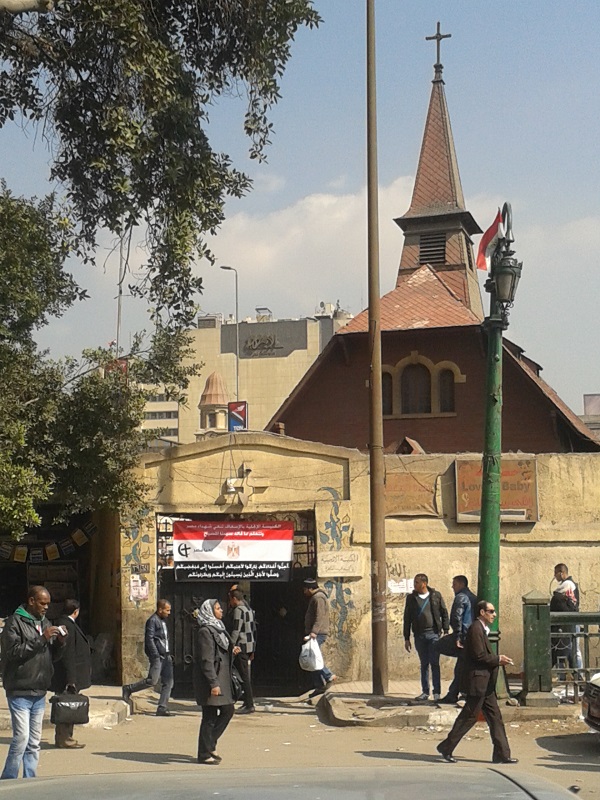
Isaaf Evangelical ChurchIsaaf Evangelical Church, located on one of downtown Cairo’s busiest streets, hung a poster on its wall at eye-level with pedestrians. “We learn from what the Messiah has said,” it read over the background of an Egyptian flag. “‘Love your enemies, do good to those who hate you….’”

Pastor Francis Fahim said the poster was meant to express comfort to all Egyptians, Muslim and Christian.

Please click here to read the rest of the article at Christianity Today.

Categories
Prayers

Friday Prayers for Egypt: Beheadings

Flag Cross QuranGod,

After a few days the spirit risks becoming calloused. One more tragedy amid a litany of offense. But the beheading of 21 Egyptian Christians in Libya might strike a nerve that runs deeper. It might awaken a nation to danger, or deaden further a decayed humanity.

For some, God, are blaming the victim. There is talk that the church can only expect such treatment after its support for Morsi’s removal. There is talk that all is faked to further this conspiracy and extend it to Libya.

But there is also action. Two would-be bombers blew themselves up accidentally in the Upper Egyptian city where the victims are from.

God, let not those frustrated with Morsi’s removal descend into hatred and violence. Let them not draw sectarian readings and exact revenge on the innocent. Let not their seeking of justice lead to embrace of chaos. In their struggle, God, save their humanity.

For many are expressing their humanity anew. Government and Muslims alike have poured out sympathy on their Coptic fellow-citizens. A new church will be built in the Upper Egyptian city where the victims are from.

God, let not this moment pass without touching permanently the Egyptian soul. Let not the forgiving example of the Christian families be lost in the outrage against their killers. Let not a desire for justice lump all pro-Morsi together. In their struggle, God, deepen their humanity.

For callousness is still quite possible. So-called Islamic State partisans have been beheading tribesmen in the Sinai for months. May directed targeting of Christians not become as normal. That atrocity is normal at all is a stain on all humanity.

But what should a spirit do to avoid callousness? Do strikes on Libya and a call for international intervention signal a spirit that is hardening? Or is it rather a conscience awakening? Guide Egypt and the world with wisdom to meet this threat.

Whatever the solution, God, limit the blood. Speak alike to presidents and jihadists, that peace, reconciliation, and justice might somehow meet between them.

God, the offenses multiply daily among Egyptians of every persuasion. In their desire to see the world put right, help them hold tenaciously to the humanity of the other. May they forgive, that they be forgiven.

It may be the only way to save their own souls, and Egypt alongside. Be merciful, God, be merciful.

Amen.

Categories
Christianity Today Middle East Published Articles

Libya’s 21 Christian Martyrs: ‘With their Blood, They are Unifying Egypt’

(credit Mohsen Nabil / AP Images, via CT)

From my new article in Christianity Today:

Late Sunday night at an otherwise quiet curbside café in Cairo, customers put down their tea and backgammon. They sat riveted, watching Egypt’s president pledge retaliation against the Islamic State in Libya.

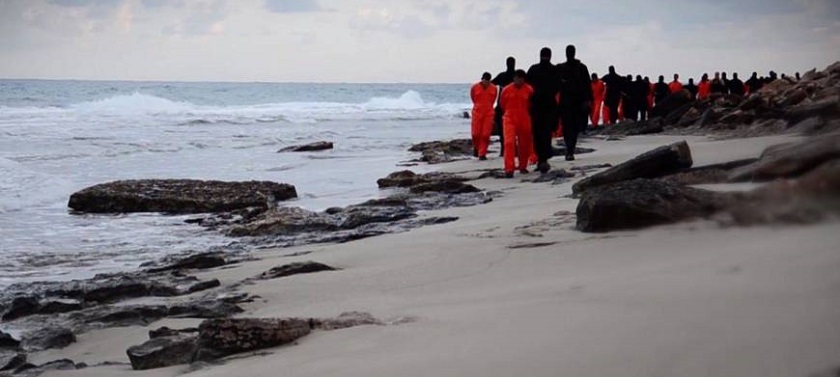
Earlier in the day, jihadists released a video of the beheading of 21 Coptic Christians. Following President Abdel Fattah al-Sisi’s declaration of a week of mourning, the channel switched to images of the orange-clad victims, walking to their death on the shores of Tripoli.

“Do you see that?” one customer exclaimed, rising to point out the scene to his friend. “They dressed the Copts like in Guantanamo. This is horrible!”

The remark demonstrates the gut-level reaction of Egyptian Muslims, contrary to the desires of the Islamic State.

“There has been a very strong response of unity and sympathy,” said Andrea Zaki, vice president of the Protestant Churches of Egypt. “People are describing Copts as Egyptians, first and foremost, and with their blood they are unifying Egypt.”

The article then provides commentary from other Christian leaders, and ends with a very direct message:

This thought is the central feature of nearly all Coptic advice to Christians in the West: Support Egypt.

Sidhom speaks openly of his “grudge” against the US administration, and no longer holds hope that American organizations can help. Zaki asks Western citizens to pressure their governments to see the “reality” and designate the Brotherhood as a terrorist entity. Kharrat asks for tourism and investment, especially in Upper Egypt.

But all ask for prayer.

“We are praying for God to change the hearts of those who have been raised on extremist thoughts,” said Anton, “and that this generation of Sisi will be different.”

Please click here to read the full article at Christianity Today, published February 18, 2015.

Categories
Atlantic Council Middle East Published Articles

Strong Egypt: A Party in the Middle

As party president Abdel Moneim Aboul-Fotouh speaks (2nd from L), the children of Mahmoud Shalan plead for his release from prison.

On an uncontested electoral list at the Strong Egypt Party’s first general conference on February 13, Abdel Moneim Aboul-Fotouh was confirmed as president along with his running mate for general-secretary, Ahmed Fawzi.

But this was the least remarkable event of the day. Their acceptance speeches set the tone for the controversy to follow.

“I have a dream,” said Fawzi, purposefully echoing Martin Luther King, “that Egypt will be a modern nation with a strong economy that exports ideas to the world.”

But no one was paying attention. As he spoke family members gathered in the aisle and silently held up posters of party members still in jail.

When Aboul Fotouh invited them to the front, activists seized the moment.“Yuskut, yuskut, hukm al-‘askar,” they chanted angrily: Down with military rule. Aboul Fotouh stood quietly, allowing the zeal of younger members to buttress his earlier remarks. “This regime is more oppressive than Mubarak’s,” he thundered. “How can we participate in parliamentary elections when people are killed in soccer games and in the streets?”

Strong Egypt had announced its boycott nine days earlier, but the rhetoric at the conference was far stronger than the official statement, which cited “a “lack of adequate democratic standards,” as the reason for the party’s decision.

The chants against the military prompted Zamil Saleh, a photographer for Sawt al-Umma newspaper, to rush forward in criticism, shouting at the offense. Other Strong Egypt members contained him, holding him back and ushering him out the hall. The process was calm, but al-Bawaba News quickly published he was beaten and his equipment smashed.

Shortly after the incident, party spokesman Ahmed Emam noticed the headline, published online before the conference had ended, and told the audience it was just one more piece of evidence of official state and media bias against the party. Twenty-seven locations had declined to host the conference, he said, many citing concern about security displeasure.

The Strong Egypt Party was licensed officially on November 12, 2012, and has roughly 400 voting members in its general conference, around 250 of whom were present for the election. In addition to the confirmation of the president, 87 candidates ran for 49 seats in the high committee, which in one month will vote on the ten-member political office.

A more contentious referendum item concerned integrating leadership with the Egyptian Current, formed in June 2011 by revolutionaries expelled from the Muslim Brotherhood. Their merger was announced October 1, and at the conference a roughly two-thirds majority approved the agreement to add two Egyptian Current members to the political office, and fifteen to the high committee.

Following the conference, former parliamentarian Mustafa Bakry called for the High Committee of Political Parties to ‘erase’ Strong Egypt as a legal entity, accusing Aboul Fotouh of attacking the Egyptian government. Mohamed Moussa of the Conference Party, founded by Amr Moussa, accused Aboul Fotouh of carrying out the instructions of the Muslim Brotherhood.

Conspiracy aside, Strong Egypt does support the return of the Brotherhood’s Freedom and Justice Party (FJP) to political life. Mamdouh al-Shaib, a member of the political office, told EgyptSource that the FJP should be allowed back into the political playing field, as long as it operates separately and independently of the Brotherhood itself.

Shaib believes social reconciliation must precede political, and be followed by transitional justice and a return of the army to its barracks. “Sisi is the ambassador of the army in the presidential palace, just as Morsi was the ambassador of the Brotherhood,” he said.

Fekry Nabil, also of the political committee, distinguished between legality and legitimacy. Morsi was the legal president, Nabil explained to EgyptSource, but through his performance in office he lost his legitimacy. Strong Egypt called for new presidential elections as early as March 2013, and was part of the June 30 demonstrations to remove him from office.

“But no one has the legality to call for the army to remove him,” Nabil added.

From the beginning, Strong Egypt suspected the July 3 removal of Morsi was a coup d’état, but were quiet about it until their transitional suggestions were ignored. Nabil described how in early negotiations after Morsi’s removal, Aboul Fotouh demanded the FJP not be eliminated from the political scene, and a referendum be submitted to the people to legalize the proposed roadmap. If agreed, Strong Egypt offered to mobilize for a ‘yes’ vote.

But subsequent killings at the Republican Guard and in the dispersal of pro-Morsi sit-ins confirmed their suspicion, and since then they have tried to balance between support for June 30, and rejection of July 3.

For Strong Egypt, an essential part of this balance is demanding the right to demonstrate, as in the licit protests of June 30, while not calling for them now, in light of the crackdown against them. They would prefer dialogue to resolve the ongoing crisis and return Egypt to democracy, for current protests carry too high a price in incarceration and blood. But Shaib anticipates another revolutionary wave is probably necessary.

So despite Sisi’s overwhelming victory in presidential elections, which Strong Egypt boycotted, the party considers his conduct in office and suppression of the political scene as confirming his lack of legitimacy following the coup. As to the legality of this election and his right to four years in office, it doesn’t much matter to Strong Egypt.

“Sisi was ruling the country after July 3 in actuality,” said Shaib. “We don’t accept his legitimacy, we recognize his reality.”

This article was originally published at Egypt Source on February 17, 2015.

Categories
Personal

Photos: The Orthodox Church and the Tragedy in Libya

As Egypt mourns the victims killed by the so-called Islamic State branch in Libya, the Coptic Orthodox cathedral has been a center of attention. Every day the official spokesman has issued press releases and pictures updating the situation; all photos that follow are credited to the Coptic Media Center.

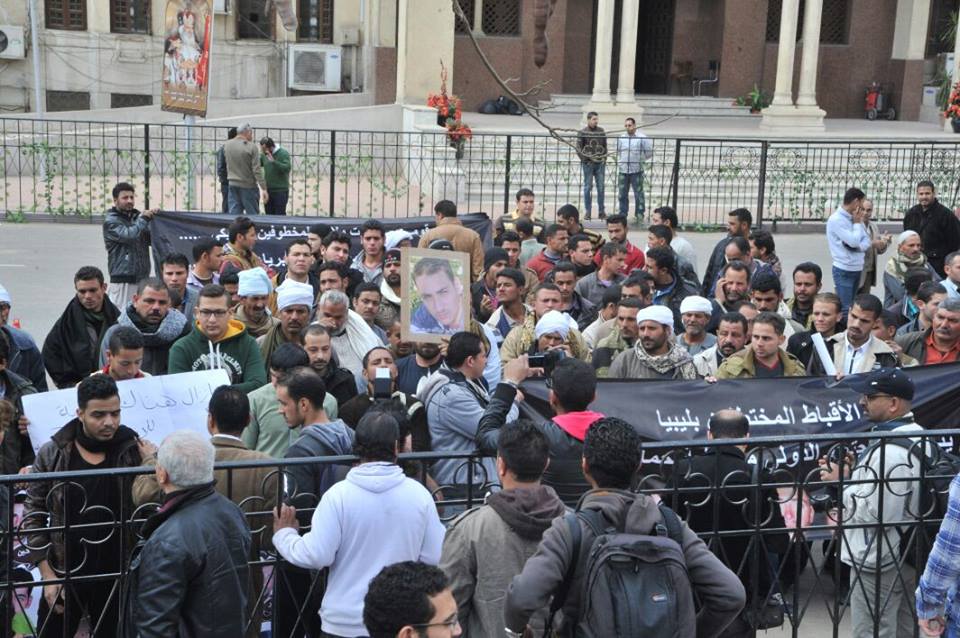
On Friday, February 13, following the announcement by the Islamic State that they were holding 21 Coptic Christians, the cathedral permitted their families to hold a small protest.
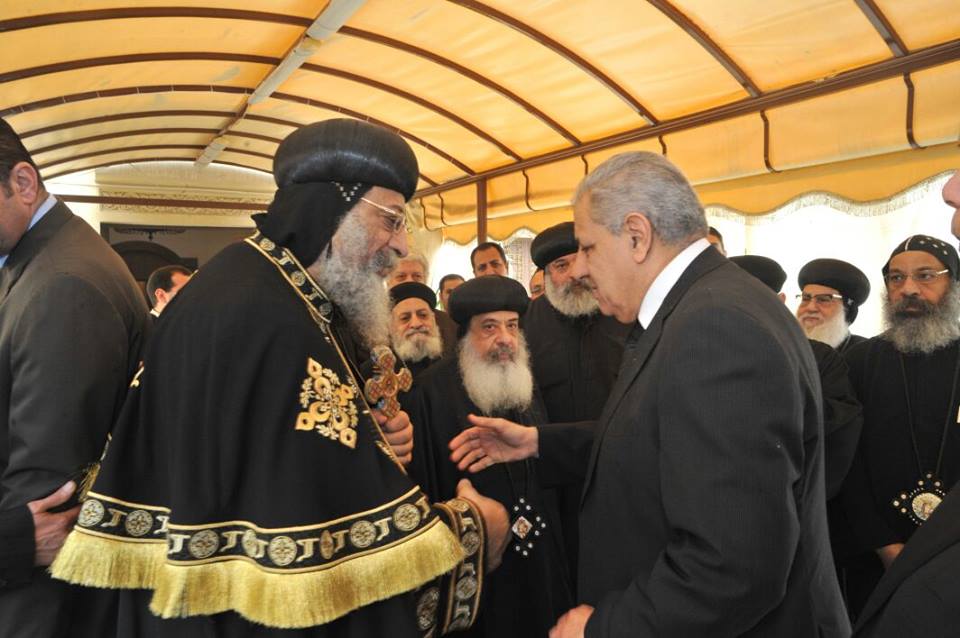
On February 14, Prime Minister Ibrahim Mehlab met with the families, promising best efforts and to take care of them while in Cairo.
On February 16, after the Islamic State released its video of beheading its victims, President Sisi visited Pope Tawadros to express his condolences.
He was followed by Prime Minister Ibrahim Mehlab.
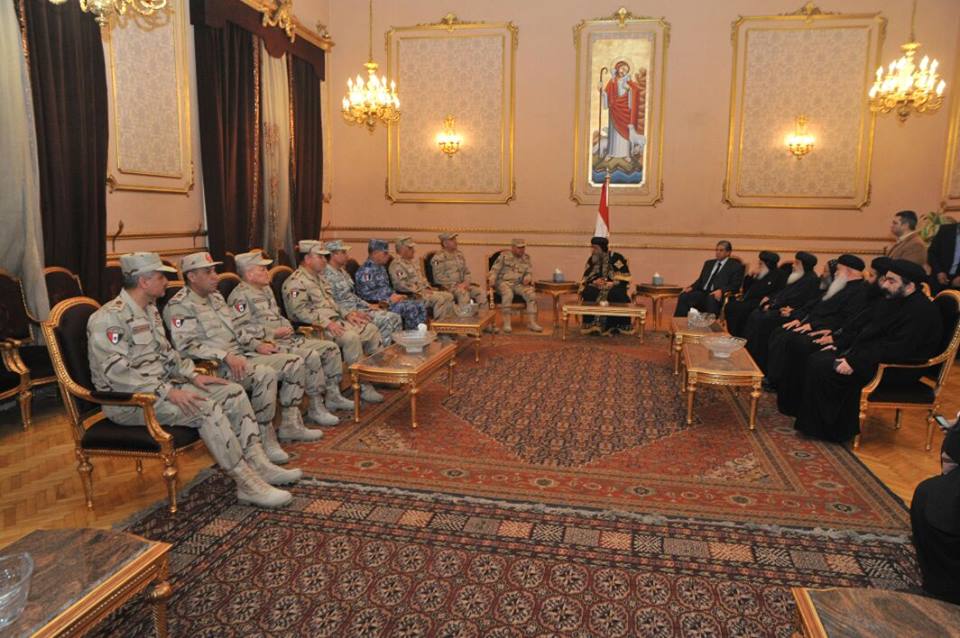
Also offering condolences was a delegation from the military, including the Minister of Defense, Sedki Sobhi.
Also paying condolences were the ministers of social solidarity, health, and youth.
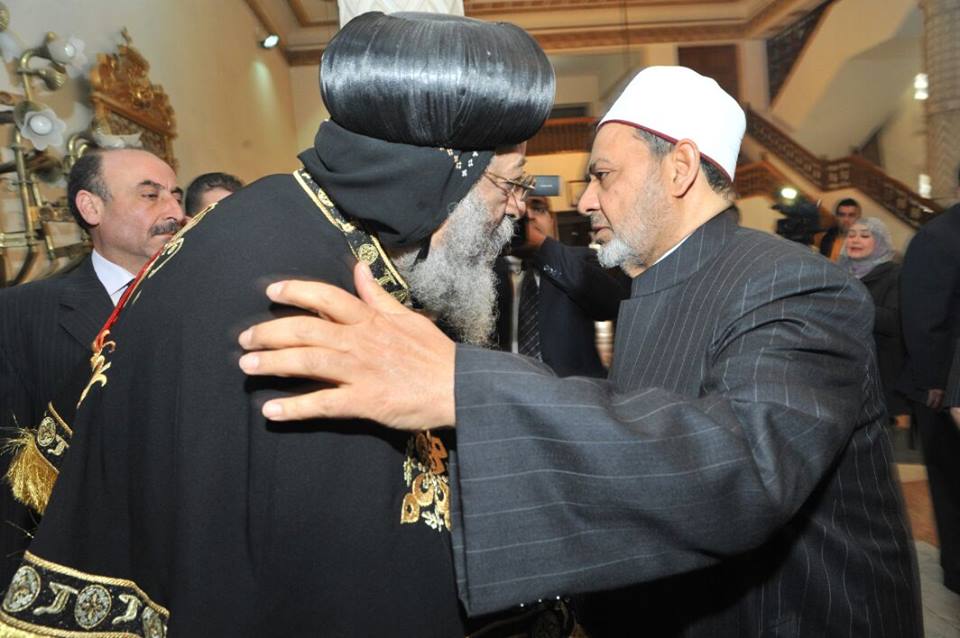
Following these was a delegation from the Azhar, including the Grand Sheikh Ahmed al-Tayyeb.
Later that evening Pope Tawadros received the condolences of the US ambassador, R. Stephen Beecroft.
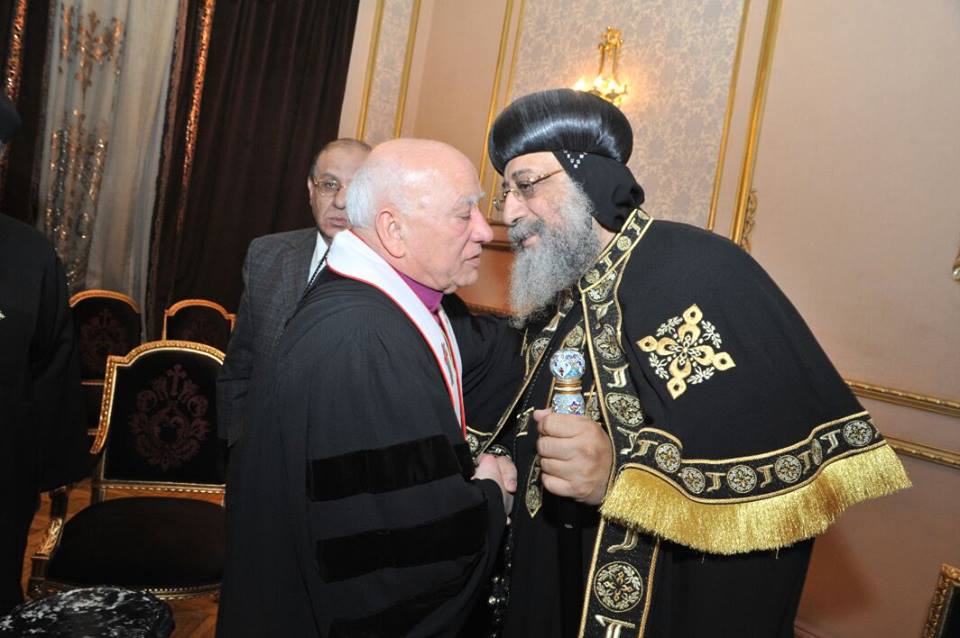
Also offering condolences was a delegation from the Protestant Churches of Egypt, headed by Safwat al-Baiady.
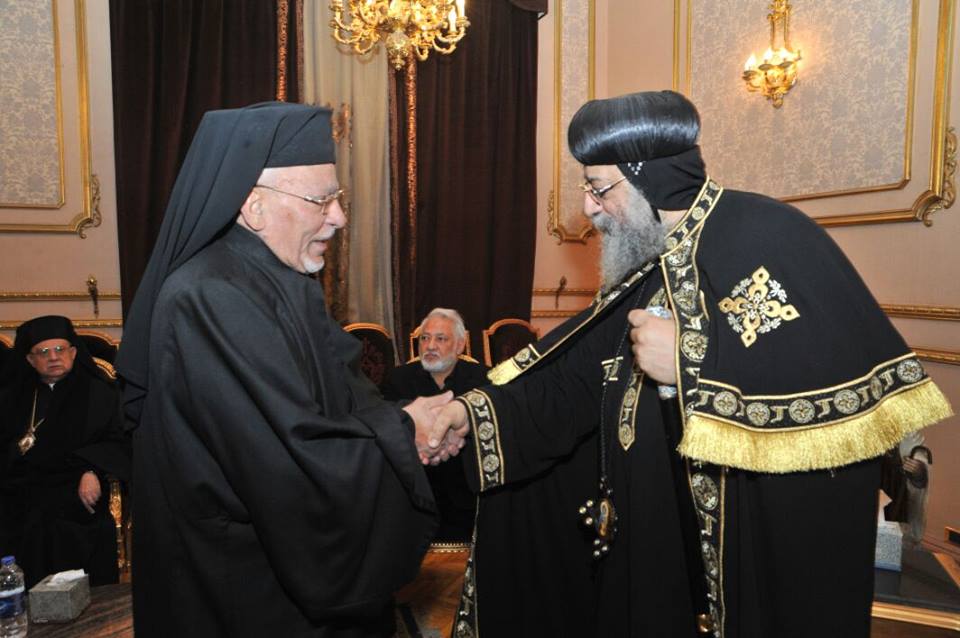
Many other churches also paid condolences, including Coptic Catholic Bishop Yohenna Qulta.
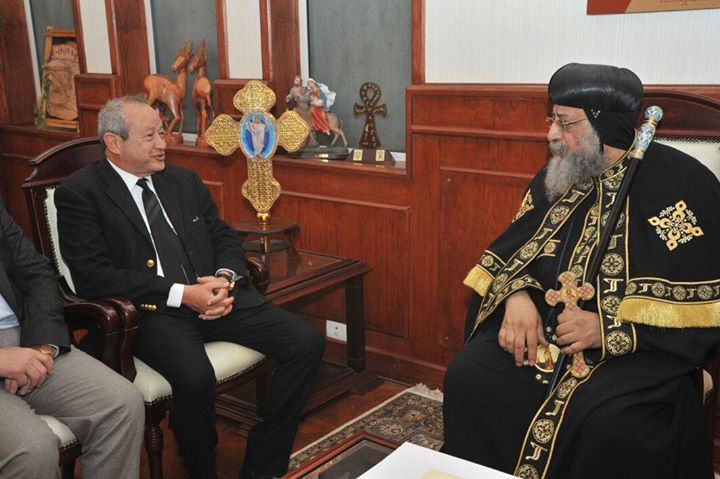
Also visiting the pope was prominent Coptic businessman Naguib Sawiris.
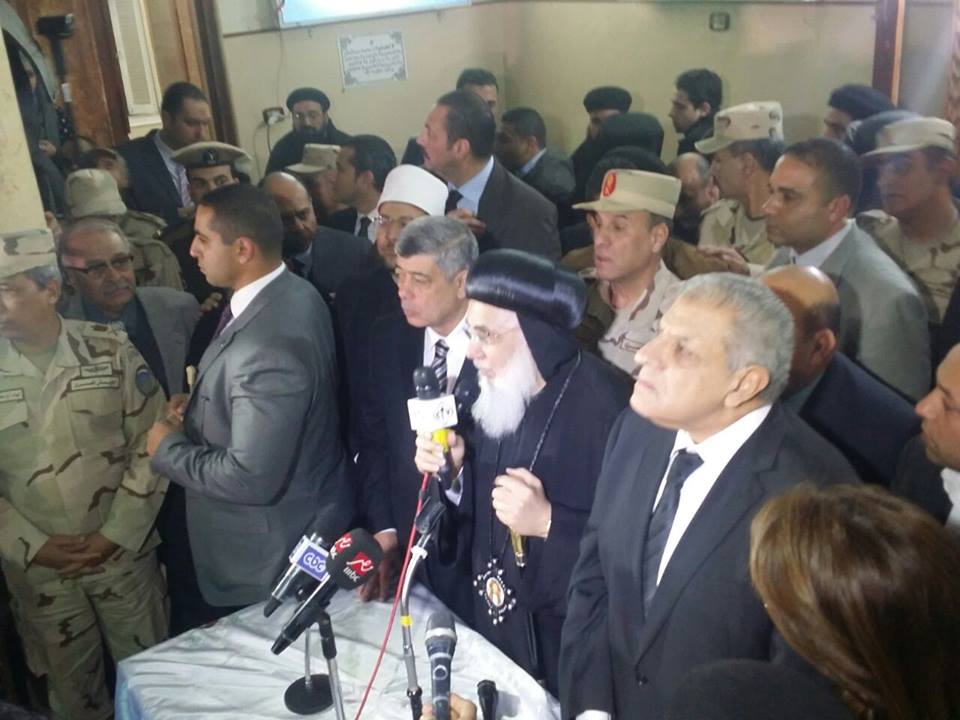
Prime Minister Ibrahim Mehlab and Minister of the Interior Mohamed Ibrahim and the governor of Minya visited Bishop Paphnotius of Samalout to console the families and promise the state would build a new church in the name of the martyrs.

The link given above is to the Facebook page of the official spokesman of the Coptic Orthodox Church, which contains pictures of many other visits.

Christians in Egypt have taken great comfort in the expressions of sympathy from state and Muslim citizens alike. It is a difficult time for the church, but the tragedy is serving to unite the nation.

‘in all things God works for the good of those who love him, who have been called according to his purpose.’

Categories
Diocese of Egypt (Anglican) Middle East Published Articles

Bishop Mouneer on the Beheading of Egyptian Copts in Libya

Copts Killed in LibyaDear Friends,

It is with great sadness I write you today about the heinous murder of 21 Egyptian Christians at the hand of the so-called Islamic State branch in Libya. These men from the Upper Egyptian city of Samalout are no different from thousands of other Muslim and Christian Egyptians in Libya, seeking employment to support their families back home.

Except that these 21 were specifically chosen for their Christian faith. The video of their beheading expressed the Islamic State’s intention to increasingly target the Copts of Egypt.

This morning the Egyptian government launched airstrikes on Islamic State positions. It has declared a week of mourning, banned further travel to Libya, and will work to facilitate the return of all Egyptian citizens. The foreign minister has been dispatched to the United Nations to discuss the necessary international response.

The Anglican Church in Egypt and the world expresses its deep condolences to the families of these men, and also to his Holiness Pope Tawadros II, patriarch of the Coptic Orthodox Church.

Please join me in praying for peace in Libya, Egypt, and the entire Middle East. Please pray the international community will act in wisdom, correctly and efficiently, and support Egypt in its war on terror. Please pray the churches of Egypt will comfort their sons and daughters, encouraging them to resist fear and hatred. And please pray for the perpetrators of this terrible crime, that God would be merciful to them and change their hearts.

Jesus tells us in John 16:33, “In the world you shall have tribulation: but be of good cheer; I have overcome the world.”

Such cheer may seem impossible, but it is God’s promise. Please pray for us, that we may live lives worthy of his name, and hold to the testimony exhibited by the brave Egyptians in Libya.

The Most Rev. Dr. Mouneer Anis
Archbishop of Episcopal / Anglican Diocese of Egypt
with North Africa and the Horn of Africa
Primate of the Episcopal / Anglican Province of Jerusalem and the Middle East

Categories
Prayers

Friday Prayers for Egypt: Russia, Gulf, Zamalek

Flag Cross Quran

God,

As Egypt tries to bolster its foreign policy and economic stability, she can’t help but trip over her own feet. With help, that is, of someone tripping deliberately.

The president of Russia visited Cairo, pledging investment and a possible nuclear reactor. Egypt then mangled Russia’s national anthem.

The president of Egypt contacted the heads of Gulf nations, following alleged leaks of internal conversation on how to milk their financial support. All is well, they assured. But who released the tapes, or fabricated them?

Despite the slip-ups, Russia and the Gulf represent foreign policy advances. But domestically twenty Zamalek soccer fans died in a stampede brought on by poor crowd control, unruly behavior, and hasty resort to tear gas.

God, much has not worked well in Egypt for years, and entrenched patterns of behavior contribute to self-sabotage. Some call conspiracy in Zamalek, but comfort first the families. Then, establish those responsible, and hold them to account.

Help police to lay off the trigger, and help society learn how to queue.

Conspiracy, though, is clear with the leaks. If true, and you are revealing the private face of public leaders, then as often prayed bring all things into the light. May Egypt see clearly the character of her officials.

If false, then you are allowing still the manipulators to hide. Bring them into the light, and reveal the character of those who slither.

But either way, it sows discord. All men need sanctuary for private speech and planning. Leaks ruin trust, the most precious of commodities. May the source be found with minimal rupture, and may none turn against the other in suspicion.

Set Egypt’s ship right, God. Help her president, and give him wisdom. Even as far as Russia. Help Egypt to be strong in herself, in good relation with all around. Keep her from the dangerous game of intrigue, where few honorable principles can operate.

In it, God, it is easy to trip up. Especially when some are trying. Especially when Egypt, far too often, is clumsy.

Bolster her nimbleness, grant her stability. She is in dire need of training.

Amen.

Categories
Personal

Egypt’s Struggle to Return to Normal

Four years have passed since Egypt’s revolution began in 2011. They have been inspiring years; they have been difficult years. Some say they have resulted in much good; some say they have resulted in a restoration of the bad.

But millions of Egyptians simply a desire a restoration of the normal. The state is striving to deliver, as stability will cement the current political reality. Those opposed are trying to disrupt it, and herein lies the clash.

The news is full of evidence on both sides. Jihadist groups are waging a war against the state, killing policemen and soldiers with unfortunate regularity. And a day before the revolution anniversary a peaceful leftist march to Tahrir square was met with the violence of the state, in which one female activist died.

Between these two is the Muslim Brotherhood and its sympathizers. They claim no relation to violence, but are actively seeking to prevent stability. Their principle tool is demonstration.

The state has left them to conduct small demonstrations in local neighborhoods. But whenever they seek a sizable gathering they are met with the resistance of the police, often with arrest, and sometimes with casualties. It is worthy to note their marches are illegal, as a law exists to regulate them which requires prior announcement to the authorities. Many across the Egyptian political spectrum find this law to be repressive, but it is the law all the same. Brotherhood protests ignore it, not wishing to acknowledge the authority of the state after the removal of President Morsi. Even if they did, would they receive a permit?

But it is in this context that the quiet struggle to return to normal is being waged.

In our local neighborhood of Maadi there is a foot bridge over the Metro tracks. One one side it is located between upper- and lower-class areas, and on the other is a relatively middle-class area stretching to the Nile River. Ever since the revolution began and police enforcement deteriorated, small tuk-tuks have traversed all economic sectors, and barely squeeze into the foot bridge as they complicate passage for all pedestrians.

A tuk-tuk is a three wheel vehicle like a rickshaw. It is very useful in poorer neighborhoods where taxis cannot navigate the narrow streets. But drivers are often underage, reckless, and a hazard for driving everywhere else. The state has not yet shut them down in our neighborhood, though there have been some threats to do so.

In recent days the local government has repaired the foot bridge, and placed a large cement block at the entrance. Pedestrians can easily pass by, but tuk-tuks are barred. Motorcycles can still make it, but at least it is an improvement.

So far, this discussion has nothing to do with national politics. But the effort of the state to bring the neighborhood back to normal, however slowly, is clear. They even covered the foot bridge with a fresh coat of paint.

Maadi Foot Bridge Graffiti

But not a few days later was it covered with graffiti. ‘Man up and hit the streets on January 25,’ it urges. ‘Sisi is a pimp,’ is written in blue. It is ugly, crass, and defaces public property. It is also one of the few methods they have to get their message out.

This is the quiet struggle, not covered in the news. It shows why so many people dislike the Brotherhood and revolutionaries in general these days. They want life to go back to normal, they want stability for their country, and they want to walk over a nice bridge.

Of course, in its efforts, the local government didn’t even do that great a job. A few baseboards are not laid quite right, threatening to trip the pedestrian if his foot lands falsely. It is this lack of commitment to quality that contributed to revolutionary conditions in the first place, and may lend some sympathy to the protesters. In recent days it appears the bridge is under repair again.

As the outside world watches the larger struggle, sympathy is asked for the normal citizen. If in the end this revolution yields a transparent and accountable system of liberty and democracy, they stand as the passive beneficiaries. But in the process of getting there, excuse them for saying a pox on all your houses.

Categories
Excerpts

Talk Peace, Broadcast Violence

Mekameleen TV, a pro-Brotherhood satellite channel broadcast from Turkey

The Washington Post recently published an excellent article detailing the escalation of violent rhetoric between the Muslim Brotherhood and Egyptian state. Language is shocking on both sides, but the government crackdown on the Brotherhood is well-known and admitted, even as accusations of terrorism in the Sinai remain unproven in the eyes of many.

But the Brotherhood actively presents itself in English as committed to a path of non-violent resistance. Consider then this extended excerpt:

In a broadcast from Istanbul, for example, a slick haired television presenter on the Muslim Brotherhood funded and managed Masr al-An (Egypt Now) channel recently delivered an ominous message, “I say to the wife of every officer…your husband will die, your children will be orphaned…these kids [“revolutionaries”] will kill the officers in Egypt.”

This was not an isolated incident of open incitement on Masr al-An. Three other Turkey-based pro-Brotherhood channels (al-Sharq, Mukammilin and Rabaa) echo similar incendiary rhetoric and cheer on the “popular resistance,” hunkering down for confrontation with the regime.

Meanwhile, in Cairo, there is a similar level of vitriol, with the regime-driven media linking the Muslim Brotherhood with the Sinai-based Ansar Bayt al-Maqdis – which refers to itself as the Sinai Province of the Islamic State. The regime has labeled the Brotherhood as an enemy of the Egyptian state, which must be combated, and blames it for various plots against Egyptian interests.

The Islamist and Brotherhood embrace of confrontational rhetoric was evident in a recent “Message to the Ranks of Revolutionaries: ‘and Prepare’” uploaded to an official Web site of the Brotherhood. After a helpful reminder that the group’s logo of two swords and “Prepare” are all “synonyms of strength,” the message continued to remind, “Imam [Hasan] al-Banna [Brotherhood founder] equipped jihad brigades he sent to Palestine to fight the Zionist usurpers. And the second Guide, Hasan al-Hudaybi, restored the ‘secret apparatus’ [paramilitary] formations to attrit the British occupiers.”

It concluded, “We are at the beginning of a new phase where we summon our strength and evoke the meaning of jihad, and prepare ourselves, our wives, our sons and daughters and whoever follows our path for relentless jihad where we ask for martyrdom.” While this controversial essay did not directly call for violence, many Egyptians interpreted it as a departure.

This is exacerbated in that the Brotherhood, in its bid to make its cause a pan-Islamist one, has allowed radical former Brothers and other Islamists to join it on the platform. Inflammatory preachers like Wagdy Ghoneim – who virtually beat everyone else to the punch by deeming Sissi an apostate even before the Rabaa massacre – are hosted on the new pro-Brotherhood channels.

Following Sissi’s January speech on revolutionizing Islam, charges of apostasy are now standard fare on pro-Brotherhood channels. A Brotherhood-tied cleric who served in the Ministry of Religious Endowments under Morsi, Sheikh Salamah Abd al-Qawi, even gave a fatwa that Sissi’s death is permissible and that whoever kills him and dies in the act is a martyr; he received applause from the studio audience.

In another segment, viewers were urged to come out to protest for the “sake of their religion,” a not too surprising refrain after the Brotherhood’s endorsement of the radical call for a “Muslim Youth Intifada” in November 2014. The attempt to make the current conflict one about Islam was casually explained only months following the coup as part of a strategy to rile up quietist Salafis.

Pro-Brotherhood channels also help increase the profile of radical conspiracy theorists like journalist Sabir Mashhur who labels the army as “occupiers” and “crusaders” fighting the “Egyptian Muslims.” He offers such violent advice to the “revolutionaries” that if they hit the first and last tank in the column with rocket propelled grenades (RPGs) the division will melt away. Furthermore, he echoes other increasing calls to follow the path of the Iranian revolution.

Over the past year groups calling themselves “Popular Resistance,” “Execution Movement,” and recently a group called “Revolutionary Punishment,” have carried out everything from drive-by shootings of police officers, sabotage of public utilities and private businesses, to planting small improvised explosive devices (IEDs) that are increasingly deadlier and more sophisticated.

In the weeks leading up to January 25, the fourth anniversary of the Egyptian revolution, the pro-Brotherhood channels fully embraced these groups and even called on them to execute pro-regime media figures.

The article goes to great lengths to show the context of this escalation, as each side blames the other. It also suggests the Brotherhood is trying to straddle the fence between a long-standing policy of de-emphasizing their violent source material, while giving space to enraged youth bent on revenge for slain colleagues.

Perhaps. But as the excerpt above indicates, the Brotherhood is licensing far more than space for troubled youth. It is filling the space with incitement, at least by proxy. They must clearly condemn, and quickly.