Categories
Christianity Today Middle East Published Articles

Iranians Gain 12 New Ways to Read the Bible

Image: Courtesy of Korpu

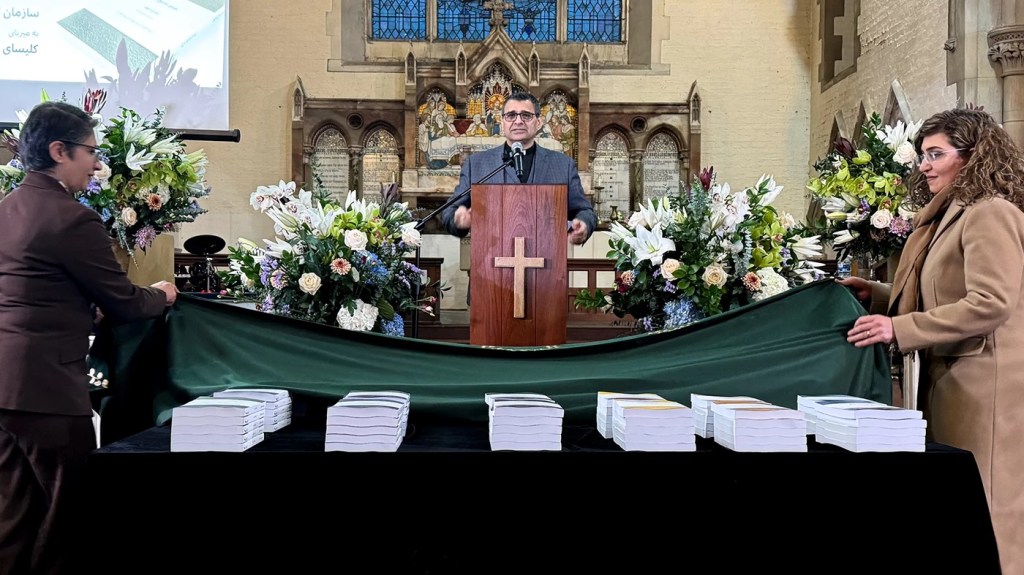
Home to the world’s fastest-growing church, with up to an estimated 1 million Christians, Iran has many underground fellowships that had previously worshiped in the Farsi language. But according to a 1991 survey of new mothers in Iran, only 46 percent reported Farsi as their mother tongue.

Minority Gilaki, Mazandarani, and other citizens can now read the New Testament in their own language, thanks to the publication of 12 new Bible translations. Far from a Persian monolith, Iran has 62 distinct languages, according to the Korpu translating agency, 9 of which number more than 1 million speakers.

And God’s concern for Iran goes beyond their individual souls.

“Translating the Bible is God’s way not simply to save people,” said Yashgin, a Korpu exegete-in-training, “but to return glory to humiliated minority peoples.”

Now living in Turkey and a Christian since 2007, Yashgin requested anonymity to protect her believing family back in Shiraz, 525 miles south of Tehran. A member of the Qashqai Turkic minority of Iran, she fled the country after two brief detentions in jail for her faith, connecting with Korpu in 2017.

Seven years later, she helped birth the first Qashqai New Testament.

Yashgin said she was mocked as a child over her accent and Turkish name. (Minority Rights Group (MRG) states that Iran represses its minority languages, mandating Farsi alone in education and civil affairs.) But studying the Bible, she learned that God called Israel as a minority people (Deut. 7:7), and translation, she said, proves the truth of John 3:16.

God loves the world, not just the majority.

“No one cares for us more than our mother,” Yashgin said. “God showed us he cares also, by speaking her language.” Language and ethnicity figures are contested in Iran, whose 88 million people reside in a territory roughly the size of…

This article was originally published at Christianity Today on January 24, 2024. Please click here to read the full text.

Categories
Americas Christianity Today Published Articles

Report: Support for Religious Freedom Rebounds in America

Image: azulox / Getty / Edits by CT

American support for religious freedom is trending in the right direction.

Rebounding from COVID-19 lows in 2020, the Becket Religious Freedom Index registered a new high in 2023 in its annual monitoring of “first freedom” resilience in the United States. Amid widespread political polarization, core support for the right of individuals to live according to their faith remains strong.

“Despite some efforts to turn religion into a scapegoat for our nation’s problems, most Americans believe that religion—and religious freedom—are key to solving them,” said Mark Rienzi, president and CEO of Becket. “As we celebrate Religious Freedom Day, we should remember that religious liberty remains the cornerstone of our effort to form a more perfect union.”

Results were released on January 16, marking Virginia’s 1786 passage of the statute for religious freedom which became the basis for the establishment clause of the First Amendment. Initially led by Thomas Jefferson and James Madison, the day has been commemorated in the United States ever since a presidential proclamation in 1993.

Either three centuries or 30 years later, there should be no “sky-is-falling narratives about American culture,” summarized the report.

Featuring 21 questions across six categories, the annual index measures perspectives on the First Amendment. Now in the report’s fifth year, Becket polled a nationwide sample of 1,000 Americans in October, scoring their opinions from 0 (complete opposition) to 100 (robust support).

The composite score is 69, one point higher than last year and up three points from 2019.

Becket’s report asserts the religious impulse is natural to human beings, and therefore, religious expression is natural to human culture. Through its law firm, the group defends religious rights. Through its index, Becket discovers if Americans agree.

Questions are repeated each year to measure consistency across detailed application:

  • Support for “religious pluralism” measured 84 on a 100-point scale. Experiencing a 7-point increase since 2020, this category gauges popular support for holding beliefs about God, adhering to a religion, and living out the basic tenets of religion in daily life.
  • Support for “religious sharing” measured 72. This second-highest category explores the extent to which people should be free to share their religious beliefs with others, but shows sharp divides between the religious and non-religious.
  • Support for “religion in action” measured 68. With statistically significant half-point gains since 2019, this category studies the freedom to practice beliefs beyond the walls of the home or place of worship.
  • Support for “religion and policy” measured 66. The only category not to score an all-time high, it probes the proper place of religion in crafting law and public policy.
  • Support for “religion and society” measured 65. Up 3 points from last year, this category reviews the contributions of religion and people of faith to the creation of healthy communities.
  • Support for “church and state” measured 59. Also up 3 points from last year, this most controversial category examines the boundaries of interactions between government and religion.

Beyond the questions that populate these categories, the index also gauged religious liberty opinions on three additional topics that test the levels of overall support. Two suggest pushback against a liberal ethos.

First, the Religious Freedom Restoration Act, 30 years after its passage in 1993, still…

This article was first published at Christianity Today on January 19, 2024. Please click here to read the full text.
Categories
Christianity Today Published Articles Religious Freedom

The 50 Countries Where It’s Hardest to Follow Jesus in 2024

Image: Illustration by Kumé Pather

Almost 5,000 Christians were killed for their faith last year. Almost 4,000 were abducted.

Nearly 15,000 churches were attacked or closed.

And more than 295,000 Christians were forcibly displaced from their homes because of their faith.

Sub-Saharan Africa—the epicenter of global Christianity—remains the epicenter of violence against followers of Jesus, according to the 2024 World Watch List (WWL). The latest annual accounting from Open Doors ranks the top 50 countries where it is most dangerous and difficult to be a Christian.

The concerning tallies of martyrdoms and abductions are actually lower than in last year’s report. But Open Doors emphasizes they are “absolute minimum” figures. It attributed both declines to a period of calm in advance of Nigeria’s last presidential election. Yet Nigeria joined China, India, Nicaragua, and Ethiopia as the countries driving the significant increase in attacks on churches.

Overall, 365 million Christians live in nations with high levels of persecution or discrimination. That’s 1 in 7 Christians worldwide, including 1 in 5 believers in Africa, 2 in 5 in Asia, and 1 in 16 in Latin America.

And for only the fourth time in three decades of tracking, all 50 nations scored high enough to register “very high” persecution levels on Open Doors’ matrix of more than 80 questions. So did 7 more nations that fell just outside the cutoff. Syria and Saudi Arabia, meanwhile, entered the tier of “extreme” persecution, raising its count to 13 nations.

The purpose of the annual WWL rankings is to guide prayers and to aim for more effective anger while showing persecuted believers that they are not forgotten.

The 2024 version tracks the time period from October 1, 2022, to September 30, 2023, and is compiled from grassroots reports by teams of Open Doors workers and partners across more than 60 countries. The methodology is audited by the International Institute for Religious Freedom.

When the list was first issued in 1993, only 40 countries scored sufficiently high to warrant tracking. This year, 78 countries qualified.

Where are Christians most persecuted today?

North Korea ranked No. 1, as it has every year except for 2022 when Afghanistan briefly displaced it. The rest of the top 10 reshuffled but remained the same: Somalia (No. 2), Libya (No. 3), Eritrea (No. 4), Yemen (No. 5), Nigeria (No. 6), Pakistan (No. 7), Sudan (No. 8), Iran (No. 9), and Afghanistan (No. 10).

The deadliest country for Christians was Nigeria, with more than 4,100 Christians killed for their faith—82 percent of the global tally. Overall, 15 sub-Saharan countries scored “extremely high” on Open Doors’ violence metric. In Mali (No. 14) and Burkina Faso, jihadists exploited breakdowns in government security, while attacks on churches grew sharply in Ethiopia (No. 32).

Open Doors scores each nation on a 100-point scale. Increases of more than 4 points were recorded in…

This article was originally published at Christianity Today on January 17, 2024. Please click here to read the full text.
Categories
Christianity Today Middle East Published Articles

The Middle East’s Favorite Christmas Carol Is About War and Hate

Image: Illustration by Elizabeth Kaye / Source Images: Getty / Youtube

This past holiday season—like many before it—the Arab world’s favorite Christmas carol spoke directly to war and suffering.

With Orthodox Christians observing their 12 days of Christmastide from January 7–19, their churches in the Middle East were the latest to sing “Laylat al-Milad” (On Christmas Night). Written in the 1980s during Lebanon’s civil war, the song has been performed by classical divas, worship leaders, and children’s choirs alike. It has offered comfort during the regional conflicts since, from the Syrian civil war to ISIS’s reign of terror to the current war between Israel and Hamas in Gaza.

Its haunting melody and lyrics speak less about a baby in a manger than the life that baby demands that we live. And also of the life that baby makes possible:

Chorus:
On Christmas night, hatred vanishes
On Christmas night, the earth blooms
On Christmas night, war is buried
On Christmas night, love is born

Verse 1:
When we offer a glass of water to a thirsty person, we are in Christmas
When we clothe a naked person with a gown of love, we are in Christmas
When we wipe the tears from weeping eyes, we are in Christmas
When we cushion a hopeless heart with love, we are in Christmas

Verse 2:
When I kiss a friend without hypocrisy, I am in Christmas
When the spirit of revenge dies in me, I am in Christmas
When hardness is gone from my heart, I am in Christmas
When my soul melts in the being of God, I am in Christmas

The Christmas season in the Middle East can be a double blessing. Advent begins one month before the Catholic and Protestant holiday on December 25, while festivities continue weeks further until the Orthodox celebration on January 7 and its Epiphany on January 19. But this season, in sympathy with a muted Christmas in Gaza, Holy Land Christians canceled their public revelry.

Yet they still gathered to sing and worship in church.

In Israel’s northern town of Kafr Yasif, the Baptist church “kissed their friends” in congregational greeting as the praise band led a joyous rendition of “Laylat al-Milad.” In Amman, Jordan, an evangelical orphan ministry gathered around 300 Muslim and Christian at-risk children to celebrate, as the Baptist school choir serenaded their parents. And in Erbil in Iraq’s Kurdistan region, the Alliance church included the carol in a merry gathering of potluck fun and gift exchange.

The Syrian-born manager of Lebanon’s BeLight FM radio station said he played “Laylat al-Milad” at least once daily. And an Egyptian director of SAT-7, the Christian satellite TV network, called it a clear holiday favorite.

CT asked evangelical leaders in each location for their reflection on the seasonal standard:

George Makeen, ministry content consultant for SAT-7:

To get a sense of how this song resonates with Arab Christians, picture the end of World War I, when churches were full of people celebrating the end of conflict despite the destruction all around them. They knew the suffering was over and could anticipate the future rebuilding. But for us, we are fragile and see no way out of our situation. We ask: God, how long? But we don’t think it will end any time soon.

Yet in Christ, we celebrate anyway.

This song conveys the true meaning of Christmas. It reminds us of hard realities, and that as soon as we become aware of these realities—this is when we are most aware of Christmas. This paradox is not what is usually heard in Christmas songs, but like everything else in our faith…

This article was originally published at Christianity Today on January 12, 2024. Please click here to read the full text.

Categories
Christianity Today Europe Published Articles

Azerbaijan Added to US List of Religious Freedom Offenders

Image: Mozar / Getty / Edits by CT

For the first time, the United States has recognized Azerbaijan as a violator of religious freedom.

Inclusion on the State Department’s second-tier Special Watch List (SWL) subjects the oil-rich Shiite Muslim–majority nation to the possibility of economic sanctions.

The US Commission on International Religious Freedom (USCIRF) has called for the Caucasus nation’s censure each year since 2013. Created by the 1998 International Religious Freedom Act (IRFA), USCIRF’s bipartisan yearly report evaluates “systematic, ongoing, and egregious” violations independent of US foreign policy concerns and tracks government implementation of its recommendations.

Complicating any consequences, Azerbaijan aligns with US foreign policy in certain areas: It cooperates closely with Israel, is aligned against Iran, and agreed to increase oil exports to Europe in the wake of Russia’s invasion of Ukraine.

In a brief statement, US secretary of state Antony Blinken kept unchanged all other 2022 designations mandated by the IRFA. Azerbaijan joins Algeria, the Central African Republic, Comoros, and Vietnam on the SWL, cited for “engaging in or tolerating severe violations of religious freedom.”

Twelve nations—China, Cuba, Eritrea, Iran, Myanmar, Nicaragua, North Korea, Pakistan, Russia, Saudi Arabia, Tajikistan, and Turkmenistan—again received designations as first-tier Countries of Particular Concern (CPC).

USCIRF “welcomed” the designation of Azerbaijan. But it stated there was “no justification” for failing to follow its advice to also label India and Nigeria as CPCs.

India was first recommended from 2002–2004 as a CPC, from 2010–2019 for the SWL, and then again from 2020 onward as a CPC. Nigeria was recommended for the SWL from 2003–2008, and as a CPC since 2009.

While the State Department has never included India, former president Donald Trump listed Nigeria on the SWL in 2019 and as a CPC in 2020. President Joe Biden removed it entirely the following year.

USCIRF called for a congressional hearing over these omissions and further criticized the State Department for issuing sanction waivers for CPC violators Pakistan, Saudi Arabia, Tajikistan, and Turkmenistan.

In a statement to CT, Lilieth Whyte, public outreach chief of the State Department’s Office of International Religious Freedom, cited three main factors.

Azerbaijan’s laws place “onerous registration requirements” on religious groups to register nationally, restricting them further in their right to worship freely and select their own clergy. The government physically abuses, arrests, and imprisons religious activists, she added, while conscientious objectors are not permitted to serve their country in accordance with their beliefs.

Not mentioned was Azerbaijan’s months-long blockade of its Armenian-populated enclave of Nagorno-Karabakh—which Armenians call “Artsakh”—which culminated in an invasion last September that displaced more than 100,000 people.

At the time, Blinken “urged” Azerbaijani president Ilham Aliyev to “immediately cease military actions.” In November, assistant secretary of state James O’Brien told a congressional committee that “there cannot be ‘business as usual’” in US relations.

But last December, the State Department press service clarified that cessation of interaction with Azerbaijan would be…

This article was originally published at Christianity Today, on January 8, 2024. Please click here to read the full text.

Categories
Africa Christianity Today Published Articles

Christmas Massacres Challenge Secular Explanations of Nigeria Conflict

Image: Kim Masara /AFPTV / AFP / Getty Images

At least 140 Nigerian Christians were killed over the Christmas holiday.

Attacks on 26 villages in Plateau State began December 23, led by suspected extremists among Fulani Muslim herdsman against Christian farming communities. Some media reports cite nearly 200 dead, with many missing as local residents fled from gunmen into the bush.

Grace Godwin was preparing Christmas Eve dinner when her husband burst in with news from the neighboring village, ordering her and the children into the fields. Rebecca Maska similarly took cover but was shot and bled for three hours until help arrived, while her son had his hand chopped off with a machete before escaping. Magit Macham dragged his wounded brother to safety and hid overnight until the attackers moved on.

“These attacks have been recurring,” Macham told Reuters, having returned home from the regional capital of Jos to celebrate Christmas. “They want to drive us out of our ancestral land.”

For years, violence has plagued the West African nation’s Middle Belt, where a predominantly Muslim north intersects with a predominantly Christian south. Land right issues are also contested, as semi-nomadic cattle herders press against settled agrarian hamlets in Africa’s most-populous nation.

The Christmas massacres were the worst attacks since 2018. A local publication tallied an additional 201 deaths in Plateau State in the first half of 2023. Across the Middle Belt, at least 2,600 people were killed in 2021, according to the most recent data by the Armed Conflict Location and Event Data Project.

The Northern Governors’ Forum called the attacks “reprehensible and heinous.” It was further condemned by the national Muslim organization Jama’atu Nasril Islam, which called the attacks “barbaric” but within the context of a “cycle of violence.”

The chairman of the Miyetti Allah Cattle Breeders Association, however, blamed the “whole problem” on…

This article was originally published at Christianity Today on December 29, 2023. Please click here to read the full text.

Categories
Current Events

Top Stories from 2023

Christianity Today ends every year with a survey of its most-read and most-important stories in several categories. Click here for the home page, and in the link above to see the Top 10 overall — for which mine did not qualify.

But for the Top 10 news stories, several of mine were grouped at #4 under the Israel-Hamas War heading. This one was signaled out among the most pivotal:

Amid Israel-Hamas War, Local Christians Seek Righteous Anger and Gospel Hope

The Top 20 international stories were listed by most-read, with the attacks on churches in Manipur, India ranking #1. The Israel-Hamas war was grouped together at #2, with this article highlighted:

Palestinian Evangelicals Call Western Church to Repentance, Criticized in Return

Here is the list of the most popular other articles I contributed:

#3 — Turkish Christians Plead: Don’t Distribute Bibles After Earthquake

#7 — ‘We Are Not in Heaven’: Niger Analyst Explains Christians’ Concern After Coup

#8 — Saudi Arabia Embraced Coptic Christmas. Could Its First Church Be Next?

#11 — Train Up a Child: Ukraine’s Christian Schools Model Wartime Education

#19 — Quran Burning in Sweden Singes Muslim-World Christians

In another category, 12 articles were chosen by the editor of audience engagement for favorite less-read stories she wanted to re-circulate. This one was listed first:

From Dust to Lunch: Jordanian Christians Decry Cost of Funeral Feast

Finally, 13 stories were selected to highlight from the Greater Middle East, arranged in chronological order. Click here to see the list, or on select individual articles from Iran, Lebanon, Morocco, Sudan, Syria, and others.

Thank you for reading along faithfully this past year. Your prayers are appreciated for better reporting in 2024, and more importantly, for a better world.

Categories
Christianity Today Europe Published Articles

Ukraine’s Top 10 Bible Verses of 2023

Image: Dmytro Larin / Global Images Ukraine / Getty Images

Perennial favorite John 3:16 may have nothing to do with the war against Russia.

Isaiah 41:10 speaks more clearly to times of conflict—though it boasts a leading position in many other nations as well.

But missing from the top 10 list in Ukraine—and no other nation highlighted by YouVersion—is Jeremiah 29:11: “‘For I know the plans I have for you,’ declares the Lord, ‘plans to prosper you and not to harm you, plans to give you hope and a future.’”

Evangelical leaders shared their reflections on why millions of citizens in the Orthodox majority country may have found inspiration in the top 10 verses, not others, and suggest personal favorites that shed light on life in a war-torn nation:

Igor Bandura, vice president of the Baptist Union of Ukraine:

The results released by YouVersion are informative, inspiring, and challenging. My heart cries out in unison with all of them, as they reflect God’s love as the source of life within our deep search for meaning under the pressure of war. It is no wonder that John 3:16 ranks first, giving comfort against the power of darkness in the midst of loss, suffering, and simple exhaustion.

The Bible remains our most powerful source of encouragement, wisdom, and strength.

Perhaps Jeremiah 29:11 is left out because while God plans not to harm us, Russia does—and the imaginable near-term consequences keep Ukrainians from contemplating an unimaginable future. Certainly, this is a challenge for faith. But mine has been strengthened through a different unlisted inspiring verse in Zechariah 9:12: “Return to your fortress, you prisoners of hope; even now I announce that I will restore twice as much to you.”

There are two possible interpretations. First, that despite being prisoners of our overwhelming circumstances, there is still hope available to us. And second, that God’s hope has made us prisoners, and that we cannot live any other way. Both are true—and we await the “double” that God has promised.

Maxym Oliferovski, a Mennonite Brethren pastor and project leader for Multiply Ukraine, Zaporizhzhia:

That these 10 Bible verses have been shared the most in Ukraine does not surprise me at all. The first five focus on love, protection, and strength, communicating God’s care for us during the many hardships caused by the invasion. Most meaningful to me has been 1 Peter 5:7, “Cast all your anxiety on him because he cares for you,” because I tend to live in the future. But in the uncertainty of war, even short-term plans become impossible. God then reminds me I must rest in him, greatly decreasing my worry and stress.

The second five verses, taken together, strike me as a prayer for faith, holiness, and bravery. It is so easy to lose focus and get depressed. Certainly, we need healing, which comes through his Word.

But we also realize that…

This article was originally published at Christianity Today, on December 22, 2023. Please click here to read the full text.
Categories
Christianity Today Middle East Published Articles

Sharia Law Makes a Solid Case for Christ

Image: VladyslavDanilin / Getty

For 1,400 years, Christians have wrestled with how to defend their faith to Muslims. While Islam accepts Jesus as a prophet, it denies his divinity. And as for his sacrifice for sin on the cross, the Quran denies the crucifixion and by extension the resurrection, claiming instead that God took him directly to heaven.

Christian responses have often been polemical, seeking to invalidate the message and morality of Muhammad. They have also been apologetic, sometimes employing legal arguments that Muslims view as manmade and changeable—thus lacking authority to adjudicate matters of eternal significance.

Baptist pastor Suheil Madanat seeks instead to ground the authenticity of the gospel account within Islam itself. In Evidence for the Crucifixion and Resurrection of Jesus Christ Examined through Islamic Law, the former president of the Jordan Baptist Convention (2016–2022) consults expert sharia compendiums and relevant scholarly works to learn sharia’s criteria for validating relevant evidence—including eyewitness testimony, confession, expert opinion, and circumstantial evidence—and examines the New Testament accounts against it.

Endorsed by scholars at Southwestern Baptist Theological Seminary, Southern Baptist Theological Seminary, Fuller Theological Seminary, and Jordan Evangelical Theological Seminary in Amman, the book is a new resource for Muslim apologetics and comparative religion. CT interviewed Madanat about liberal source criticism, the divergence in resurrection accounts, and his ultimate hope for Muslims who read his book.

How does traditional Islam look at the Bible?

In principle, they accept both the Old and New Testaments as the word of God, but they believe that they have been largely corrupted. Though they accept that some accounts read today still have some truth, they do not accept the Bible as authentic. This is especially the case for the parts that contradict Islam—mainly the divinity, crucifixion, and resurrection of Jesus.

How do Arab Christians tend to address these objections?

Most of what I read in Arabic is a polemical approach rather than apologetic. They are more concerned about attacking the ethics of Muhammad and the teaching of the Quran rather than defending the Scripture. I have not seen much done to vindicate the authenticity of the Bible, though some is done in academic circles.

But I must add that Muslim scholars do not provide solid testable evidence that can be argued against. They say the Bible is corrupt, but what is the alternative? The Quran speaks about preserving the divine text, but where then is the authentic text? How did God allow this? When did the corruption happen exactly? To be sure, they do tell a story of the alleged corruption, but it contradicts plain historical facts.

They do not give objective answers to these questions, inviting the polemical reply.

Is this why you wanted to defend the Bible through an Islamic framework?

My task here is not to defend the whole Bible but the reliability of the accounts of crucifixion and resurrection, the backbone of our Christian faith. The libraries of the West are full of conservative responses to liberal source criticism and other critiques, but they do not mean much to most Muslims. Since the Quran says that the Bible is corrupt, they ask: Why should we care about an intra-Christian dispute?

But when I say I want to examine evidence for Chistian claims through the filters of divine Islamic law—it immediately catches their attention.

What is your method?

Islamic law has established strict criteria to examine eyewitness testimonies, but those who experienced the crucifixion and resurrection of Christ are long deceased. Their evidence exists only in documentary form—the Gospels. These must be first authenticated, so they can be equivalent to live eyewitness accounts, and then examined. The problem is that…

This article was originally published at Christianity Today, on December 22, 2023. Please click here to read the full text.

Categories
Americas Christianity Today Middle East Published Articles

Four Views on What American Christians Think About the Israel-Hamas War

Image: Stephanie Keith / Stringer / Getty

In an age of polarization and strong opinions, a sizable share of American Christians are still “not sure” what they think about issues within the Israel-Hamas war.

A recent Lifeway Research survey, sponsored by the Philos Project, found significant convictions among self-identified believers: Strong majorities support Israel’s right of self-defense (83%), but also the Palestinian right of self-determination (76%) and the goal of a two-state solution (81%).

But many questions revealed uncertainties about the complexity of the conflict:

  • 15% are not sure about the optimal outcome.
  • 17% are not sure if Gazans are responsible for Hamas’s attacks.
  • 18% are not sure if armed Palestinian rebellion is a natural response to mistreatment.
  • 24% are not sure if Israel’s blockade of Gaza has oppressed Palestinians.
  • 24% are not sure if Israeli control of the West Bank and Gaza is illegal occupation.
  • 26% are not sure if most Gazans support Hamas’s fight against Israel.
  • 31% are not sure if Israeli settlements beyond agreed-upon borders are illegal.

Furthermore, 41 percent hover between somewhat positive (25%) and somewhat negative (16%) in their overall perception of Israel, while 11 percent are not sure at all.

For each of these issues, of course, pluralities had an opinion on one side or another, as CT noted last week. To parse out the meaning of these diverse American Christian perspectives, CT asked four evangelical experts—two from peace-focused organizations in the US, and a Palestinian Christian and a Messianic Jewish leader from Israel—to describe what they found most surprising, concerning, and encouraging about the survey results…

This article was originally published at Christianity Today, on December 21, 2023. Please click here to read the full text. Contributions from:
  • Robert Nicholson, president of the Philos Project (“promoting positive Christian engagement in the Near East in the spirit of the Hebraic Tradition”)
  • Todd Deatherage, executive director of the Telos Group (“a pro-Israeli, pro-Palestinian, and pro-peace movement seeking dignity, freedom, and security for all”)
  • Dan Sered, chief operating officer of Jews for Jesus and president of the Lausanne Consultation on Jewish Evangelism
  • Botrus Mansour, Nazareth-based chairman of the Convention of Evangelical Churches in Israel, in his personal capacity as a Palestinian Israeli Christian writer and lawyer
Categories
Books Christianity Today Published Articles

The Best Books for Understanding Islam and Connecting with Your Muslim Neighbors

Image: Illustration by Christianity Today / Source Images: Wikimedia Commons / Getty

The world’s second-largest religion, Islam has long exercised the minds of Christians. Dating to A.D. 610, when Muhammad is said to have received his first revelations from God, the faith quickly conquered Christian lands in the Middle East, North Africa, and Europe, establishing the two faiths on an adversarial basis that has continued through eras of caliphates, crusades, and colonization.

Muhammad originally viewed his communications with God as a continuation of the message received through the biblical tradition, calling Jews and Christians “People of the Book.” But though the treatment of non-Muslims cycled through periods of peace and persecution, the teaching of the Quran ensured theological distinction. Islam esteems Jesus only as a human prophet and denies his crucifixion.

Yet there is much that unites Christians and Muslims. The five pillars of Islam espouse monotheism, prayer, fasting, almsgiving, and pilgrimage. Certain expressions desire mystical communion with God, while others pursue pietistic fidelity to his law. Both religions seek to spread the faith and care for society, anticipating the judgment to come. And while adherents to each faith debate the place of militancy, history clearly testifies to the blood shed in the name of God.

While Islam has not experienced the same levels of schism as Christianity, Muslims debate within—and divide asunder—what they call the umma, the worldwide community of Islam.

Muslim diversity is also cultural. Though Islam was birthed in present-day Saudi Arabia and is generally associated with the Arab Middle East, the most populous Muslim nation is Indonesia, and its greatest rate of growth is in Africa. Nearly 50 nations boast Muslim majorities, while large minorities exist in India and China, with Islam established through migrating communities and individual conversion in Europe and the Americas. Each region has put its unique imprint on the religion, and Muslims encounter the same popular tendencies toward syncretism and secularism as experienced by Christians.

In the series of book lists that follows, CT has asked regional experts to select the best resources for evangelical Christians to understand and learn about Islam, both from Muslims themselves and from Christians who have devoted years to building relationships with the community.

The selected books not only offer paths of evangelism but also encourage cooperation for the common good. They reflect the diversity of Islam and, to some degree, the diversity of evangelical approaches toward Islam. While none bear the stamp of our full endorsement, we offer them—to Muslim and Christian alike—in the hope of better understanding, peace, and love between our two communities.

Read well, pray, and discern.

This article was originally published at Christianity Today, on December 18, 2023. Please click here to read the expert bios and to explore the different geographic regions. I contributed additional reporting for the article introduction.

Categories
Christianity Today Middle East Published Articles

For Messianic Jews, Debate Over Hamas Gets Biblical

Image: Illustration by Christianity Today / Source Images: WikiMedia Commons / Getty

When Benjamin Netanyahu announced the launch of ground operations in Gaza on October 28, weeks after Hamas terrorists murdered 1,200 civilians and abducted 240 hostages on October 7, he summoned the memory of an ancient foe.

“Remember what Amalek did to you,” the Israeli prime minister stated. “We remember and we fight.”

It was a reference his audience would understand.

In the Exodus narrative, the Amalekites attack the Hebrew people in the wilderness and are defeated in a dramatic conflict where Moses raises his arms over the battlefield. Later, in Deuteronomy 25:17–19, Moses exhorts the Israelites to “remember what the Amalekites did to you” and, after they have come into possession of the Promised Land, to “blot out the name of Amalek under heaven.” Finally, in 1 Samuel 15, God ordered King Saul to “totally destroy” the Amalekites, including women, children, and infants. Saul defeats the enemy, but is condemned for sparing their king and cattle.

Rabbinic commentary came to identify Amalek as a kind of paradigm for any enemy of the Jews that seeks their total destruction. Netanyahu had previously hinted the “new Amalek” could be a nuclear-armed Iran, and one of his advisors explained the word is used as a stand-in for “existential threat.” It has been invoked in reference to the Romans, the Nazis, and the Soviets.

Christians made the biblical comparison with Hamas even before Netanyahu, however, prompting discussion of responsible biblical interpretation in the midst of war.

Shortly after October 7, the International Christian Embassy Jerusalem (ICEJ) said the Hamas attack was “rooted in the demonic realm as a manifestation of the Spirit of Amalek.” The ICEJ invited Christians around the world to “ascend to our spiritual vantage point and join in this battle, just as Moses prayed while Joshua was fighting Amalek on the ground.”

Some Messianic Jewish leaders have agreed.

“In every generation the hatred of Amalek rises up in an attempt to annihilate the Israelites,” said Ariel Rudolph, director of operations for Jerusalem Seminary, citing Exodus 17:16. “Once one understands the spirit of hatred for God’s chosen, that originates from Satan, one understands that evil of hatred must be eradicated.”

Rudolph criticized Christians who call for mercy on Hamas and the salvation of terrorists as failing to recognize the biblical principle to eliminate any threat that would wipe out the people of Israel.

Other Messianic Jewish leaders are more conflicted.

“On the one hand, something must be done to prevent Hamas from repeating anything like what happened on October 7,” said Ray Pritz, a retired pastor of a Messianic Jewish congregation between Tel Aviv and Jerusalem. “But on the other hand, the great loss of life in Gaza is sad beyond words.”

With a PhD in early Jewish Christianity from Hebrew University, Pritz clearly critiqued Hamas’s equation with Amalek. “Anyone making the connection must rely heavily on interpretation,” he said. “With a preconception and a concordance, it is possible to prove almost anything you want from the Bible.”

The text does not say that…

This article was originally published at Christianity Today, on December 15, 2023. Please click here to read the full text.

Categories
Christianity Today Published Articles Religious Freedom

How 1 in 4 Countries Restrict Religious Conversion

Image: Pradeep Gaur / AP Images

To share your faith—or change it to another—first check your citizenship.

The US Commission on International Religious Freedom (USCIRF) has released a new report on anti-conversion laws around the world. Providing the legal text for 73 separate laws, the compendium notes that 1 in 4 nations (46 total) restrict the right of its people to either adopt or propagate a religion.

“The right to convert from one religion or belief to another, or to no religion or belief at all, is central to [the] protection for religious freedom,” said Susie Gelman, a USCIRF commissioner. “And in countries with anti-conversion laws, religious minorities tend to be broadly targeted for harassment, assault, arrest, and imprisonment.”

Gelman, a three-term president of the Jewish Federation of Greater Washington, cited the example of pastor Keshav Acharya, sentenced by Nepal to one year in prison for allegedly attempting to convert Hindus to Christianity. But he is not the only example.

Last week in India, 9 Christians were arrested for allegedly evangelizing the poor.

Last summer in Iran, 106 Christians were arrested for their religious beliefs.

Last spring in Libya, an American Christian was arrested for alleged missionary activity. The USCIRF report grouped the laws into four categories. First, anti-proselytizing laws restrict witnessing of one’s faith in 29 nations, including in Indonesia, Israel, and Russia.

In Morocco, for example, it is illegal…

This article was originally published at Christianity Today, on December 8, 2023. Please click here to read the full text.

Categories
Christianity Today Published Articles

The Orthodox Church Is More Evangelical Than You Think

Image: Illustration by Christianity Today / Source Images: Getty / Lightstock

Are evangelicals and Orthodox allies in the faith?

While both confess the Nicene Creed, Orthodoxy’s smaller population in America remains obscure to most US believers, especially when compared with Catholics. Many think of Orthodoxy as a nominal religion with empty cathedrals in Eastern Europe and Russia.

Yet there is also an awareness of not-insignificant numbers of evangelical conversion to Orthodoxy, drawn by its ancient roots and sacramental practice.

Bradley Nassif knows both words. Raised in Kansas, where his Lebanese immigrant grandparents helped establish St. Mary’s Antiochian Orthodox Church, his spiritual transformation came through his local congregation, a Billy Graham sermon, and participation in a high school Bible study. But though he remained in his church of origin, he became an academic director at Fuller Seminary and is now professor of New Testament and Orthodox-Protestant dialogue at the California-based Antiochian House of Studies.

Oxford University professor John McGuckin said that Nassif, a leader in the Lausanne-Orthodox Initiative (LOI), is “the leading world expert” on Orthodox-Evangelical dialogue. CT talked with Nassif about his 2021 book, The Evangelical Theology of the Orthodox Church.

You have said, “I am Orthodox, and therefore evangelical.” How does Orthodoxy address the general markers of evangelical faith?

Eastern Orthodoxy embraces the classic Bebbington quadrilateral of biblicism, crucicentrism, conversionism, and activism, but transcends it through a maximalist vision of the Incarnation in its liturgical, sacramental, and spiritual life. The gospel permeates the church—not only about Jesus dying for our sins and the need for personal faith but including the whole story of Jesus from creation to consummation. This implies that the fullness, the catholicity, of the faith is formally present in the Orthodox church. So, yes, I am Orthodox, and therefore evangelical, in an incarnational, Trinitarian, wholistic sense of the word gospel.

What are the most significant theological differences between us?

Many are found in the way we appropriate the past and in our understanding of the nature of the church. Evangelicals and Orthodox share a common interest in Christian history, but the Orthodox are more organically linked to the past than our evangelical brothers and sisters, whose communities are only loosely connected to the fullness of the faith and polity of historic Christianity.

Evangelicals seem unaware that the early church is the Orthodox church. The congregations they meet in the pages of antiquity are treated as if they were an invisible body of believers, instead of a visible community of local Orthodox churches. Those churches shared the same faith and sacraments, led by bishops in communion with each other in apostolic succession, continuing to the present day.

In contrast, evangelicals stress the invisible body of Christ as the basis of unity and seem content to permit the visible disunity that exists in Christianity today. The Orthodox, however, maintain that this is a detrimental counter-witness to the truth of the gospel.

Another critical difference in mindset lies in the hermeneutics of biblical interpretation. We agree on the Bible as the source of divine revelation and the standard by which all claimed Christian belief must be evaluated. But we disagree on the role of the Christian community in testing our exegetical conclusions, in light of the apostolic tradition that has been handed down in the life of the church. The Holy Spirit inspired not only the writing of the Scriptures but also their interpretation.

That difference helps to account for why Orthodox churches have escaped the destructive aspects of liberal Protestant theology that permeate mainline denominations and progressive circles today. A reliance on Holy Tradition keeps biblical interpreters from an idolatrous confidence in their own exegetical conclusions, by testing them against the common faith of the wider Christian community.

Can there yet be an ancient and preserved consensus of error?

Not everything received from the past is of equal value or necessarily true. The Orthodox mind “follows the holy Fathers,” as stated in the preamble of the Chalcedonian Definition (A.D. 451), but it does not merely appeal to the past as if that alone is the source of truth. Antiquity itself is no proof of truth; it may simply be old error! To “follow the holy Fathers” is to embrace not only their witness to the faith, but also their method of theological reasoning.

For example…

This article was originally published at Christianity Today, on December 1, 2023. Please click here to read the full text.

Categories
Christianity Today Middle East Published Articles

Should Gaza’s Christians Flee South, Evacuate East, or Stay in Church Shelters?

Image: Ahmad Hasaballah / Getty Images

Two weeks ago, two Christian women sheltering at the Catholic church in Gaza received phone calls from the Israeli Defense Forces (IDF). The soldiers told them—and by extension the rest of their Christian community—to flee their places of shelter within five days. They must go south, like the rest of Gaza’s civilian population.

Today is Day 15, and a four-day temporary cease-fire has now been extended.

An IDF official told CT there was no specific directive given to Gazan Christians. Those who remain will not be targeted, but their safety cannot be guaranteed.

But despite the calm of the last six days, most are choosing to remain in the two largest churches that shelter Gaza’s roughly 1,000 Christians. Some believers briefly returned to their homes to gather supplies and warmer clothes, according to CT sources. Several found their homes destroyed.

Both Saint Porphyrius Greek Orthodox Church and Holy Family Catholic Church are located in the north end of the strip, in its capital of Gaza City.

Under original terms of the truce, 50 Israeli hostages will be traded for 150 Palestinian prisoners. Israel stated a one-day extension is possible for every additional 10 hostages released—but that it will continue its military pursuit of Hamas once the truce expires.

Despite the danger—in fact, because of it—one Christian leader in regular contact with Christians in Gaza wants them to stay put.

“The body of Christ all over the world should work hard on maintaining, providing for, protecting, and helping the Christians inside the Gaza Strip,” Nashat Falamon, director of the Palestinian Bible Society, told CT prior to the truce. “I don’t think they should be encouraged to leave, because leaving is extremely scary and dangerous. There are no guarantees they will make it. Their protection should be our top priority.”

For Gaza’s Christian community, fleeing south had been a near-impossible demand. War is raging, fuel is scarce, and transportation networks are disabled. Sources said about 75 people have managed to evacuate on foreign passports, including the wife, children, and parents of the former pastor of Gaza Baptist Church. Others have relocated to functioning hospitals, while about 20 have died—either from an October 19 airstrike or from disease and illness.

“Our hearts are broken, and we are full of fear and sadness,” said a Palestinian Christian mother of two whose testimony was circulated by a US-based Gaza ministry. “We are peaceful Christians and reject violence from both sides. Love, as Christ taught us, is the most effective weapon for peace.”

The woman, who requested anonymity in order to protect her family, lost her best friend, cousins, nieces, and nephews when an Israeli missile struck near Saint Porphyrius. She bemoaned the psychological state of her children, impacted especially by the lack of sufficient food. Sources said much of the reserve stock was damaged in the blast.

“We see death everywhere. We smell death everywhere,” she said. “[But] in the midst of sadness, pain, and heartbreak, we look at the face of Jesus Christ.”

The Palestinian Bible Society has been able to…

This article was originally published at Christianity Today, on November 29, 2023. I contributed additional reporting, and please click here to read the full text.

Categories
Christianity Today Middle East Published Articles

Christmas Celebrations Canceled in Bethlehem, Jerusalem, and Jordan

Image: Uriel Sinai / Stringer / Getty Images

There will be no Christmas lights in Bethlehem this year.

In solidarity with the suffering in Gaza due to the Israel-Hamas war, last week Christian leaders and municipal authorities in the West Bank city decided to cancel all public festivities. For the first time since modern celebrations began, the birthplace of Jesus will not decorate the Manger Square tree.

It is “not appropriate,” stated local authorities.

But the Bethlehem decision is only the most recent. One week earlier, the Patriarchs and Heads of the Churches in Jerusalem asked Christians in the Holy Land to refrain from “unnecessarily festive” Christmas activities. Catholic churches in Galilee requested the same, as did the Council of Local Evangelical Churches in the Holy Land.

“Due to the thousands killed—and in prayer for peace,” said its president, pastor Munir Kakish, “we will only hold traditional services and devotionals on the meaning of Christmas.”

The initiative, however, came first from Jordan, home to the world’s largest concentration of Palestinian refugees—many of whom have become citizens. On November 2, the Jordan Council of Church Leaders (JCCL) announced the cancellation of Christmas celebrations.

Christmas is a public holiday in the Muslim-majority nation, with many city squares and shopping malls feted with seasonal decorations. But congregations throughout the country will now forgo the traditional festivities of public tree lighting, Christmas markets, scout parades, and distribution of gifts to children.

Religious services in all locations will continue.

“In our homes we can celebrate, but in our hearts we are suffering,” said Ibrahim Dabbour, JCCL general secretary and a Greek Orthodox priest. “How can we decorate a Christmas tree?”

The formal Jordanian Christian declaration reflected respect for the “innocent victims” and denounced the “barbaric acts” of the Israeli military. It recognized the “difficult time” in both Gaza and all Palestine, noting the destruction of homes, schools, hospitals, and places of worship.

It pledged that offerings collected last weekend would be donated to Gaza.

Dabbour, whose parents were refugees from the now-Israeli cities of Ramla and Jaffa in the 1948 war, was born in Amman and serves as the chairman of the Jordan Bible Society. He linked the current war to that original displacement, calling for dialogue rather than further fanaticism-inducing violence.

But beyond solidarity within the depressed national mood, Dabbour said the council, representing 130,000 Christians in the Hashemite kingdom, had another purpose in the declaration.

“Many Muslims do not know the history of Christianity, thinking we are a people of the West,” he said. “But we are the sons of St. Peter, here for 2,000 years. We want to show society that we are one people.”

Jordan’s evangelicals believe they have a further obligation.

“We have a role to speak to our friends in the West,” said David Rihani, president and general superintendent of the Assemblies of God Church of Jordan. “Jesus did not teach us to blindly side with anyone against another.”

He cited a widely shared video of Tennessee-based pastor Greg Locke calling on Israel to turn Gaza into a “parking lot” and to blow up the Dome of the Rock to make room for the Third Temple and usher in the return of Jesus. Local evangelicals, Rihani said, refuse to be associated with such Christian Zionism.

Adherence to the Christmas decision, however, issues from Jordanian culture.

Growing up 10 miles northwest of Amman in the traditional city of Salt, a UNESCO World Heritage site, Rihani recalled that both Muslims and Christians would frequent any neighborhood wedding celebration—no invitations necessary. But if there was a funeral, any previously scheduled wedding would be either postponed or held quietly among the family.

Weddings mid-war are now treated the same.

“The announcement was not even necessary,” said Imad Mayyah, president of the Jordanian Evangelical Council (JEC). “No Jordanian is celebrating anything.”

Founded in 2006 and representing the Assemblies of God, Baptist, Nazarene, Free Evangelical, and Christian and Missionary Alliance denominations, the JEC released its own statement on Tuesday.

“The Christmas holidays, when we remember the birth of our savior Jesus Christ, comes upon us while we are in the midst of a human tragedy that is ravaging our region,” stated the evangelical council. “In obedience to the Holy Word of God and in line with [both Christian and public sentiment, the JEC] has decided to limit the celebrations of Christmas to religious ceremonies and church prayers within our churches.”

The JEC also prayed for…

This article was originally published at Christianity Today on November 22, 2023. Please click here to read the full text.
Categories
Christianity Today Middle East Published Articles

Flight to Egypt: How Pastor’s Wife in Gaza Church Got Out

Janet Maher is out of Gaza.

The Palestinian wife of the Egyptian former pastor of Gaza Baptist Church had been sheltering in the Saint Porphyrius Greek Orthodox Church with her three children and 350 others—but not her husband. Two weeks before the October 7 Hamas terrorist attack on Israel, Hanna Maher had traveled temporarily back to Egypt, where he had to remain after the war broke out.

Despite the horrors of suffering 43 days of bombardment by herself, as CT previously reported, the family separation is the reason why Janet and her children are now safely in Egypt, reunited with Hanna. But first they had to undergo a harrowing journey that began with tearful goodbyes to a hallowed community.

“I spent weeks with these people and am broken by the experience,” Janet said. “But everyone pleaded: If you get out, tell the world about our situation.”

The death toll in Gaza exceeds 11,000, including more than 5,000 children, according to statistics released by the ministry of health in the Hamas-run enclave and last updated November 10. But save for the shrapnel and scattered remains of human carcasses flying over the walls of the church compound, little of this was known to the Christians inside.

With no television or internet and only intermittent connection to the cell phone network, Janet and her fellow sheltering Gazans knew only the daily reality of war. Most of the day was spent trying to figure out how to procure food, with the young men tasked with trips outside to the local market.

Most often, the day would begin with bombing—sending the people scurrying away from windows and doors to the center of the room. Three times a week, the priest would lead morning prayers. Frequently, they would gather for impromptu singing, simply to calm their nervous spirits. Some would read the Bible; others cried alone in the pews.

They would clean often. Dust and debris settled after every explosion, while most people suffered some form of illness—coughing, fever, stomachaches—with flies everywhere, flitting about from the corpses in the street.

With no breakfast or dinner, most daily meals consisted of lentil soup with occasional rice or macaroni. Water was seldom clean, though the clergy obtained some by trading available gasoline to the neighboring mosque, which used the fuel to run its well-pumping generator.

“Once, the priest was able to find chocolate,” Janet said. “It was like Christmas.”

But after eating around 4 p.m., the darkness settled. With no electricity, everyone moved to their mattresses for a fitful night of sleep. As 100 other people in the funeral hall of the church tucked in, Janet read Psalm 23 to her children. But she relied on the more militant realities of Psalm 91 to settle her own anxious thoughts.

A thousand may fall at your side, ten thousand at your right hand,” Janet recited. “If you say, ‘The Lord is my refuge,’ and you make the Most High your dwelling, no harm will overtake you, no disaster will come near your tent.”

She has ample personal experience to prove it. Before moving her family to the shelter, Janet left her apartment in search of food. Finding none at the market, she returned home. Five minutes later…

This article was originally published at Christianity Today on November 22, 2023. Please click here to read the full text.

Categories
Christianity Today Middle East Published Articles

Displaced from Israel Border, Lebanese Christians Wrestle with Whom to Blame

Alma al-Shaab Presbyterian Church

Rabih Taleb looked out from the pulpit at the 30 nervous believers gathered at the Evangelical Presbyterian Church of Alma al-Shaab in southern Lebanon, located less than one mile from northwest Israel. One day earlier, Hamas terrorists had killed 1,200 mostly civilian Israelis 125 miles south on the Gaza border.

That Sunday morning, Hezbollah, the Lebanese Shiite militia designated as a terrorist entity by the United States government, fired rockets into the disputed Sheba Farms enclave occupied by Israel but claimed by Lebanon. And as Israel began its massive bombing campaign against Hamas in Gaza, it also shelled Hezbollah positions 35 miles east of Alma al-Shaab.

A few families immediately fled, including the elder who leads worship, forcing the hymns into a cappella. The rest of the congregation pressed Taleb for a shortened service, all eager to return home and prepare for the worst. But the sermon topic—the second in a series on distinctives of Reformed faith—appeared divinely appointed. Little adjustment was needed to discuss original sin, suffering, and pain.

“They ask me: Why are we always facing these difficulties?” Taleb said. “We are believers. Why is there always war, war, war?”

Sources said this was their seventh displacement in the last 50 years.

Alma al-Shaab, one of about a dozen entirely Christian villages near the Israeli border, has a year-round population of about 700 people, Taleb said. Today only about 20 remain, including the Maronite Catholic priest who conducts services—now welcoming all sects—when there are lulls in the fighting.

Taleb and his family left Alma al-Shaab on October 9 when a bomb fell in a field only a three-minute drive from his church, rattling his parsonage home. Most of its 40 Presbyterian families relocated to stay with relatives in Beirut, with others fleeing within Lebanon to the biblical cities of Sidon or Tyre. The local synod, serving seven Presbyterian churches near the border with Israel, opened its retreat center in Zahle in case of further escalation.

So far, only three families have stayed behind.

Taleb has returned to his home village in Minyara, 115 miles north near the border with Syria. But every day he consults with elders about the condition of his scattered flock, and every 7–10 days he returns to visit Alma al-Shaab, violence permitting.

While the war rages in Gaza…

This article was originally published at Christianity Today on November 16, 2023. Please click here to read the full text.

Categories
Christianity Today Middle East Published Articles

As Erdoğan Goads on Gaza, Turkish Christians Prefer Peace

Image: Burak Kara / Stringer / Getty / Edits by CT

Defending Hamas, Turkish president Recep Erdoğan upstaged his own nation.

One day prior to last month’s 100th anniversary of the modern state of Turkey (now formally called Türkiye), an estimated 1.5 million people gathered for a pro-Palestinian rally October 28 and heard their Islamist-leaning leader denounce Israel as a “war criminal.”

“Hamas is not a terror organization,” Erdoğan had previously stated October 25. “It is an organization of liberation, of mujahedeen, who fight to protect their land and citizens.”

Observers noted that immediately after the October 7 terrorist attacks by Hamas that killed 1,200 mostly civilian Israelis and took 240 hostage, Erdoğan had struck a cautious tone. Reports circulateddenied by Ankara—that Turkish officials quietly asked Hamas leaders to depart the EU candidate country. And in advance of the rally, the president reiterated that he could never excuse acts that target civilians.

Then something changed.

Despite efforts over the past year to heal a diplomatic rift with Israel, Erdoğan now questioned its existence.

“What was Gaza and Palestine in 1947, what is it today?” he asked rhetorically, in reference to the establishment of Israeli statehood in 1948. “Israel, how did you get here? How did you get in? You are an invader.”

And widening his scope, the head of the NATO-member nation impinged his allies in religious terms, calling the Gaza attack “revenge” for the 15th century fall of Constantinople.

“Oh, West, I cry out to you, do you want to start your crusade against the Crescent again?” Erdoğan asked. “If you are making such efforts, know that this nation is not dead.”

The next day, in a muted celebration, he laid a customary wreath at the grave of Mustafa Kemal Atatürk, who abolished the Ottoman caliphate and established a secular republic in 1923. In attendance was the ecumenical patriarch of the Eastern Orthodox Church, Bartholomew I.

Two weeks prior, Erdoğan attended the inauguration of Mor Ephrem Syriac Orthodox Church, honoring the estimated 25,000 Assyrian Christian citizens of Turkey. It was the first church to be built with state funding since Atatürk’s founding.

And since Erdoğan’s party took power in 2002, 20 churches have been restored.

“The church we have built is a symbol of freedom of religion and belief in our country,” Erdoğan stated. “At a time when divisions, conflicts, and hate crimes based on religious and ethnic origin are increasing in our region and the world, this embracing attitude of Turkey is very important.”

His October 15 remarks were poignant, with the Israel-Hamas war raging. In between the church ceremony and the Palestinian rally, Erdoğan sent Sweden’s NATO application to the Turkish parliament for ratification. And this month, the Incirlik air base in southeast Turkey received the deployment of a pair of United States B-1 Lancer long-range bombers.

Last week, Turkish protestors tried to storm it.

Turkish Christians have had a complicated relationship with Erdoğan, and generally do not speak out on political matters. But one believer voiced his strong displeasure with the president’s comments.

“It is not acceptable. Hamas is a terrorist organization,” said Gokhan Talas, founder of Miras Publishing Ministry. “Calling its attack anything else could cause another painful trauma for victims and their families.”

The small evangelical community in Turkey, he said, has diverse views about Israel—stemming from both political and eschatological differences. Some speak in terms of unconditional support for the prophetically reconstituted Jewish state. Others, rejecting such theology, find justification for the Palestinian militant response.

But Ali Kalkandelen, president of Turkey’s Association of Protestant Churches, made clear their unified position.

“As Christians, we believe that God is the judge over everything,” he said. “We are against any war, killing, and the death of innocent people.”

They are praying for both sides, he added. And also Erdoğan.

Talas believes that Israel’s first reactions were…

This article was originally published at Christianity Today, on November 14, 2023. Please click here to read the full text.
Categories
Christianity Today Middle East Published Articles

First Graduates of Persian Seminary Prepared to Serve a Traumatized Iran

Image: Courtesy of Pars Theological Centre

Iran’s Islamic republic is driving its citizens away from religion—and into trauma and depression. But as Christianity grows among a disillusioned public, the church is not exempt from complications, whether at home or in the extensive diaspora.

“Many Iranian Christians struggle with high levels of anxiety and post-traumatic stress disorder, stemming from persecution but also from the general oppression of a totalitarian regime,” said Shadi Fatehi, associate director of Pars Theological Centre. “We see the marks in many of our students.”

Last month, the London-based institute celebrated its first graduating class.

Fifteen students completed the Farsi-language, three-year bachelor’s in theology degree. Accredited as an institution by the World Evangelical Alliance–associated European Council for Theological Education, nearly half of Pars’s over 600 students live in Iran, with almost a third in Turkey.

Its hybrid education model is primarily online, with a yearly residential program.

Located in 23 nations overall, the seminary launched the Pars Counseling Centre five years ago and began deliberately integrating it within the academic program. While the World Health Organization estimates five percent of the world population suffers from depression, peer-reviewed studies describe far greater numbers in Iran.

Between 15–31 percent of Iranians experience some form of mental disorder, with that number increasing to 37 percent in Tehran. Saeed Moeedfar, president of Iran’s Sociological Association, described a “terrifying despair” gripping society, as one in five prescriptions are issued for antidepressants or sleep-inducing medications. And a 2021 study found that political repression “contributes significantly” to mental health problems.

Meanwhile, a 2020 GAMAAN study found that nearly one million Iranians called themselves Christian, while only 32 percent of Iranians identified as Shiite Muslim. Officially, however, Iran puts that number at 95 percent.

Citing oppression and economic troubles, one anonymous secular Tehran-based NGO came up with a somewhat spiritual solution. Fighting a culture of mental health stigma, it combines both pro- and anti-regime patients within group counseling sessions. Alumni describe a “second household” atmosphere and readily volunteer to extend what they call “the chain of love.”

Pars similarly calls its theological model “the centrality of love,” centered around spiritual (love of God), personal (self), communal (church), and missional (world) formation. Many converts to Christianity suffer rejection from their family, Fatehi said, and new life in Christ does not automatically heal their wounds. In fact, given the nature of the Iranian underground church, it can even amplify them.

“Believers often suddenly find themselves as leaders in a house church,” she said. “But only having seen authoritarian models, traumatized people tend to exert controlling power over others out of self-preservation.”

Pars offers three courses in servant leadership, she said.

“Our background in Shiite Islam leads us to believe that the pastor represents the image of God and that we should accept his teachings without question,” said Samira Fooladi, a graduating student in Turkey. “My goal now is to develop healthy women’s leadership.”

Experts say the Iranian church is largely female, reflected in 57 percent of Pars students.

Despite growing up in a religious family in Isfahan, Fooladi followed her older sister to underground services during university studies in Tehran. Non-practicing herself, she compared the Quran and Bible while praying that God would show her the right way. She gave her life to Christ in 2000 at the age of 18. Fooladi quickly became a cell group leader, but it was not until…

This article was originally published at Christianity Today, on November 8, 2023. Please click here to read the full text.