Categories
Middle East Published Articles Religion Unplugged

Copts Pick Up the Pieces: An Interview with Bishop Thomas

A condensed version of this interview was first published at The Media Project on May 4, 2017.
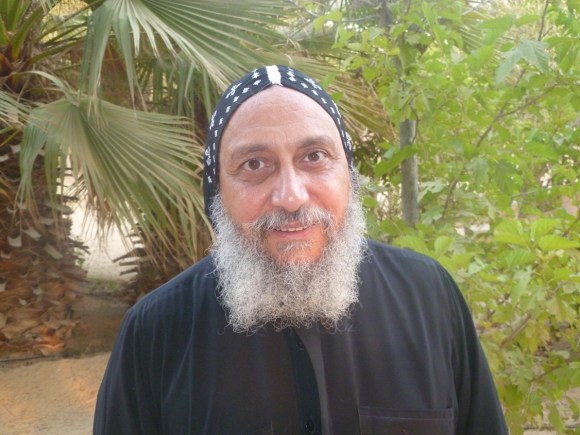
Bishop Thomas
Bishop Thomas

Coptic Christians, the Middle East’s largest Christian community, account for roughly ten percent of Egypt’s population and have endured generations of exclusion and restrictions. Their struggles for equality have been aggravated by a series of gruesome and deadly attacks carried out by ISIS criminals. The latest act was a pair of bombings on Palm Sunday targeting packed churches in Alexandria and Tanta, which took the lives of 45 Christians and wounded more than 100 others, according to Human Rights Watch. ISIS previously targeted Copts in Cairo in a December, 2016, bombing that killed 30 and in a January, 2017, attack in the Sinai peninsula that killed eight. ISIS has stated its intention to extirpate Christianity from the Middle East.

TMP Egypt contributor Jayson Casper spoke to Bishop Thomas, head of the Coptic Orthodox diocese of Qusia and Meir, 170 miles south of Cairo, to find out how Copts are reacting to the latest attacks and what they expect for the future. Born in 1957, Thomas became a monk in 1985 and bishop in 1988. In 1999 he founded Anafora, a retreat center along the Cairo-Alexandria desert road, which became a community dedicated to ecumenical welcome and human development. Fluent in English alongside his native Arabic, he is a key source of insight on the situation of Christians in Egypt.

The Easter holiday is a joyous occasion but Egypt and her Christians are going through a difficult time after the Palm Sunday bombings. How are Copts doing these days?

There was a blend of grief, shock, anger, and question marks about what’s happening. People recall similar incidents from the past – the December bombing at St. Peter and St. Paul Church in Cairo, the 2010 Alexandria bombing, and further back in history. There has been a development in the attacks against Christians, and people are comparing it to what is happening in Syria and wondering if this will come to Egypt.

But the church holds to Christian principles, giving the people a Christian message. Love, and conquer evil through good. If we believe in the forgiveness Christ gave to us, we have to give it to others. Think positively, and do not be afraid. Don’t generalize but be fair. We cannot put the work of Islamic extremists on normal Muslims who haven’t done anything.

And normal people from the families of the victims have made statements that are very powerful. The widow of the doorman at St. Mark’s Cathedral in Alexandria said she forgives them. There is the question: How can Copts forgive like this? We are trying to nurture a holistic faith in society. Believing our life is not limited to this world makes it becomes stronger.

It will be good to come back to the teachings of the church, but first I want to ask about what is seen in the media. Coptic reactions are portrayed as fear, anger, and disillusionment. Things aren’t getting better and the government isn’t taking care of us. Is this an accurate picture? How strong and widespread are these feelings?

The Copts have a clearer understanding because we know the growth of Islamic fundamentalism has to be dealt with in a deeper way than just police or military forces. Security measures are only a part. The foundation is the ideology, needing the reformation of education. Copts are angrier at the education system than the security situation.

We look at things realistically, even though we were hoping for a calmer, more peaceful situation with the new government after the Muslim Brotherhood regime. We hoped it would be more active in reform. Some Copts are disappointed, but we are aware it is a long-term change, needing the support of the private sector, NGOs, and the religious sector. The curriculum of al-Azhar has to be looked at, in how they portray Christians, as does the public school curriculum.

We see also two kinds of media. One is trying to understand the situation and sympathize in the tragedy. The other is condemning Christians and encouraging more of the same. This must be dealt with firmly. If someone encourages attacks on others this is a crime against humanity, and it must be declared as such.

These things are being discussed among the youth and on the Coptic street. Even still, we are saying we love and we forgive—Jesus told us to love our enemies and do good to them—so his love encompasses the whole world and our fight is not against flesh and blood. It is against evil principles and thoughts; it is a struggle of ideology. Humanity must be linked with religion, and not to a particular religious group. As Christians we view everyone within the circle of God’s love, so we must love everyone, even those who persecute and attack us. We are against evil, but not against human beings. Instead we pity them.

There are some voices in Egypt who are promote this idea, but will it always be within the elite? It has to be implemented at the grassroots through the educational system.

You mentioned the importance of ideology. The president has spoken many times about the importance of reforming religious rhetoric, it seems he is aware of the comprehensive nature of this issue, beyond a military solution. But we see crimes against Copts go unpunished and a failure to pursue educational reform. Do the Copts still have optimism the government will move in this direction so that it will reach the grassroots, over time? Or is their frustration it is either only talk and politics, or that the state is unable to address ideological reform?

There is a group of people who hope it will change, who say we should encourage the process of reformation. There is another who says it will not happen, it is too long-term and the ideology is fixed among too many scholars. Personally, I think those who are disappointed are thinking about emigration, and I think another wave will come very soon, which is very bad. Christians have to stay in Egypt and be empowered here.

The process of reformation goes beyond just a president. He is trying to do his best but the society has many layers, and the undercurrent is stronger than what the official government says. What we need is to focus more on the undercurrent, which requires lots of work.

This gives Christians the responsibility to build up society. We have to be more active in peacemaking. This is an art that needs training, and helps build trust in the community. But we must also address the power balance, which aids the stability of society. Christians abroad and the international community can help Copts achieve this. We must work on projects and fill professions that the society needs.

Such as?

In my area of Qusia we created a school that provides education in languages and an open, creative atmosphere, not dictation. Many Christians and Muslims started to come. It is run by the church, but society needs it, and it is unique in the area.

People meet and interact, but not in a religious framework. They come for the sake of their children, and discuss ethics and childrearing. We create many educational programs through this platform, and this gives us hope that these meeting points help give us status in society.

Similar things like hospitals and social events help society unite, and the church should take the lead. It presents us to society in a new way and counters disinformation against us.

But this problem is bigger than Egypt, and we have to look at it from a global perspective. Islamic fundamentalism and political Islam must be addressed. We have seen the results over several decades, in addition to the recent developments in Syria and Iraq and Lebanon and Palestine. The Middle East has been almost depopulated of its Christians, and in Egypt we are the largest community left. Will these conservative forces succeed in pushing our Christians to the West, or not?

Let’s return shortly to immigration, but first address some of the spiritual teachings you mentioned earlier. The wife of the doorman in Alexandria gave a phenomenal testimony of forgiveness, that came from her faith. But as we judge the Coptic mentality between anger and frustration and the church teachings to resist fear and hold on to joy, to what degree does the Christian message of hope truly permeate them as people?

One of the spontaneous reactions has been the full attendance of Sunday evening prayers, right after the Palm Sunday morning bombings. All during Holy Week our churches have been packed. People are praying with enthusiasm and demonstrating persistence that we are here, we’re staying here, and this is our faith. Through their actions they are demonstrating their hope.

No doubt there have been tears, but still they come. There is sadness in their hearts, but they still hold to the responsibility that God has given: We are not afraid, we love, and we ask for justice. These are the three folds the church has been teaching, and the people’s reaction has been a beautiful portrayal.

Many people see only the church teaching suffering and martyrdom, but within this there is justice, a very important aspect that balances with love. Love and forgiveness create peace and positive attitudes, but at the same time love is not weak, it is strong, that is why there is no fear. Love and justice must be intertwined. I love, but I ask for my rights. I’m a human being, and I must be dealt with in my home country like a citizen, with security and equal rights.

The heritage of martyrdom in the Coptic Church promotes acceptance and forgiveness. But what is its connection with justice?

There have been many saints who were martyred because they asked for their rights. St. George, St. Mina, St. Mercorious – they stood up for their faith, defending other people. This is why it was their fate to become martyrs. Martyrdom is not just someone putting a bomb in a church. It is mainly people declaring their faith, hold to their rights, asking for justice, but ending in death.

So I don’t see a contraction, and many in the Coptic community are asking what we must do to achieve justice. I don’t know how it will be implemented. Communication with scholars, writers, and journalists from the Muslim side, to empower the cause?

If I take an American example, in achieving justice for the black community there were three main aspects. The first is Rosa Parks, and how she was made able to ask for her rights. Our teachings can help prepare the individual and create many more.

The second is Martin Luther King, who was a man of faith, but also of truth. He was able to communicate love and Christian principles in a context of injustice. The church has to give the message.

The third, which is very much needed, is Elanor Roosevelt. She represents the political arena and media, which were not of the black community. If the Christians in Egypt make a better effort to reach out to the Muslim community, its intellectuals and scholars, and discuss with them in more openness to empower them to join in the faithful fight for justice, it will be a great help.

But it is also needs an international effort, for the ideology is global. If conservatism is strong in the world there must be collaboration in the reformation of thought and the interpretation of texts in light of citizenship and humanity. There is much work ahead of us, and if it is not undertaken we may end up in a worse situation.

Is there something that makes the Copts of Egypt different from the Christians of the rest of the region, something that has enabled them to survive and resist the temptation to violence?

We don’t want to blame the victims, which is important to state clearly. We stand in sympathy and solidarity with the people of Syria, Iraq, and the region. We have seen what happened in Sinai, when the Christians evacuated from the area. We don’t know if this will continue.

A faithful attitude of ‘love your enemies’ and forgiveness gives a positive message to the other side, but we don’t know what will happen. It is a big question mark. Allow me to be spiritual and say it is the hand of God that is protecting this people here for a reason. I don’t know why, but keeping the Christian community in stability in Egypt may give a message of stability to the whole Middle East.

Yet over the past few decades, as you mentioned, Coptic immigration to the West has increased dramatically.

And it will continue to increase, no one can say it will stop. This makes us weaker, because who emigrates? Those who are able – the rich, the educated, those able to make a living outside. But they leave behind the weaker ones. If someone wants to care for their family we cannot tell them stop, to stay. We can encourage them it will get better, but if they have decided to go, they will.

But we recognize the negative impact. Still, Copts in the diaspora help with financial support, educational programs, and are a voice in the international community. This is very much appreciated. The presence of Christians in the Middle East remains a big question mark these days. If things continue, I don’t know how long we can last.

Yet in Egypt we have a very strong belief in the promise found in Isaiah 19, that there will be an altar in the land of Egypt. This gives the Christians a very strong hope that we will always be here and nothing can break us. This belief gives us power and helps explain why the church is flourishing despite difficulties, attacks, and persecutions. The church is strong, and people are determined to stay and stand firm in their faith.

Thank you, Bishop Thomas.
Categories
Prayers

Friday Prayers for Egypt: Judges, Tribes

Flag Cross Quran

God,

Two feuds escalated this week. One reached a preliminary conclusion, the other a concerning jolt. It may not be proper to pray mend the fences, but rather in wisdom to put all things right.

After months of debate and clear judicial opposition, the president signed a parliament-ratified bill to select the chief judge of major courts from three nominations. Viewed as anti-constitutional interference and a blow to seniority, it is nonetheless law, pending further developments.

After months of tense but nonmilitant local opposition, the Islamic State struck against a major tribe in Sinai. Recriminations followed, and the fight is threatening to move beyond the licensed violence of army and police and involve the well-armed Bedouins.

God, politics is often contentious. Ensure efficiency in policy. Define limitations of power. Where there is manipulation, cause it to cease. Where there is exaggeration, cause it to settle.

In the effort to strengthen both state and society, give wisdom. Give humility.

God, violence is often compounding. Empty the Sinai of terrorism. Rebuild the region in hope. Where there is insult, curb retribution. Where there is injury, increase resolve.

In the effort to defeat the Islamic State, give wisdom. Give clarity.

All men are brothers, God, and it is not right to feud. But perhaps a fight is sometimes necessary. Settle scores quickly, and justly. Limit escalation, mend fences.

Put all things right, God. Put Egypt right.

Amen.


Categories
al-Monitor Middle East Published Articles

Is Sufism the Answer to Extremism in Egypt?

Egypt Sufism Extremism
(Peter Crawford)

This article was first published at al-Monitor.

If the Egyptian government wants to combat the spread of radical religious ideology, it would do well to return to its Muslim roots. At a conference held at the headquarters of the Azamiyah Order in Cairo on April 21, which Al-Monitor attended, presenters argued that Sufi Islam is the authentic expression of Egypt’s Muslims.

The conference emphasized the brotherly bond between Muslims and Christians, following the Palm Sunday bombings on April 9. But Sufis are singled out as infidels by the Islamic State (IS), too.

“I have told President [Abdel Fattah] al-Sisi to take care of the Sufi leaders,” Sheikh Alaa Abu al-Azayem told Al-Monitor. “We are the ones who stand against terrorism, fighting not with weapons but ideas.”

Sufism is widely considered the default setting for Egypt’s Muslim community, and tombs of popular Sufi saints dot the landscape up and down the Nile…

Please click here to read the full article at al-Monitor: http://www.al-monitor.com/pulse/originals/2017/04/egypt-sufism-tolerance-radical-islam.html#ixzz4fkjJoUzm
Categories
Prayers

Friday Prayers for Egypt: Pope

Flag Cross Quran

God,

The pope is here. Of course, Egypt already has a pope. But this one is different.

To most Egyptian Christians he is not. In the ancient world Rome and Alexandria were equals. But since then the Tiber has far eclipsed the Nile.

God, to you your church is one. Give humility to one and all, a spirit of brotherhood between servants of servants.

For joining them also is the heir of Constantinople. As the visible symbols of Christianity convene, fix their eyes on you the invisible. Give them wisdom for leading their flock. Give them encouragement for the small portion here.

Middle East Christians are under pressure, God. Evil men target them for death. Seductive dreams target them for immigration. Guide each one individually in the path you desire. But guide them together toward local flourishing.

For the sake of your name, God. For the sake of their peoples.

For with the three symbols is a powerful fourth. The Grand Sheikh of al-Azhar unites most of the world’s Muslims. He is the host, and their partner in peace.

May it be so, God. Certain forces wish to pit one religion against the other.

Some say it comes from texts. Some say it comes from power. Some say it comes from the devil.

Regardless, they say it should not be.

Strengthen their voice and witness, God. Unite them in purpose and friendship. May those who follow them follow their example. And with them, all peoples and nations beside.

For it is the state, God, with power to implement. Guide all who bear your sword, to wield it rightly.

And through men like these four, but only in accordance with your spirit and truth, may they hear from you.

The pope is here, God. May your peace come with him. May things thereafter be different.

Amen.


Categories
Current Events

Friday Prayers for Egypt: Aya, Easter

Flag Cross Quran

God,

Easter passed peacefully, but not Egypt. Though there were no troubles on the holiday, others sandwiched.

A few days earlier Copts praying in a village were pelted with stones, as police looked on. A few days later terrorism struck at St. Catherine’s Monastery in the southern Sinai, as police responded.

One officer died, a few others were injured.

God, protect the nation. Protect her churches. Protect her people. Protect her police.

The disturbing fact in the latest incident was the reach of ISIS to the south. Cells have perpetrated terrorism in various places on the mainland, but it was believed the group had no presence save northern Sinai.

So hem them in, God, and squeeze. Aid the security forces. Grant bravery, justice, and fidelity to law.

It was law also that settled justice for Aya Hegazi, a dual Egyptian-American citizen. After three brave years in pretrial detention, the court ruled against charges filed. She and her husbanded had opened a children’s center, and were accused of exploitation.

President Trump claimed intervention, and flew her home before meeting at the White House.

God, protect the judiciary. Protect its independence. Protect civil society. Protect its people.

If Aya was innocent, how many others? In a congested legal system give all their day in court, in fidelity to the constitution. As Egypt responds to the pressures against her, help her hold to the right and the true.

So steady her institutions, God, and strengthen. Aid the social entrepreneurs. Grant creativity, license, and fidelity to law.

Whether religion, state, or society, give stability and peace. Too many make trouble. Root out, vindicate.

Amen.

Categories
Christianity Today Middle East Published Articles

Forgiveness: Muslims Moved as Coptic Christians Do the Unimaginable

This article was first published by Christianity Today on April 20, 2017.

Coptic Forgiveness
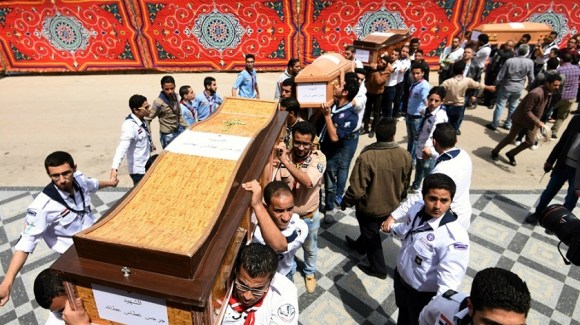
Image: MOHAMED EL-SHAHED / AFP Coffins are carried to funeral of Egyptian Christians killed in Palm Sunday bombings.

Twelve seconds of silence is an awkward eternity on television. Amr Adeeb, perhaps the most prominent talk show host in Egypt, leaned forward as he searched for a response.

“The Copts of Egypt … are made of … steel!” he finally uttered.

Moments earlier, Adeeb was watching a colleague in a simple home in Alexandria speak with the widow of Naseem Faheem, the guard at St. Mark’s Cathedral in the seaside Mediterranean city.

On Palm Sunday, the guard had redirected a suicide bomber through the perimeter metal detector, where the terrorist detonated. Likely the first to die in the blast, Faheem saved the lives of dozens inside the church.

“I’m not angry at the one who did this,” said his wife, children by her side. “I’m telling him, ‘May God forgive you, and we also forgive you. Believe me, we forgive you.’

“‘You put my husband in a place I couldn’t have dreamed of.’”

Stunned, Adeeb stammered about Copts bearing atrocities over hundreds of years, but couldn’t escape the central scandal.

“How great is this forgiveness you have!” his voice cracked. “If it were my father, I could never say this. But this is their faith and religious conviction.”

Millions marveled with him across the airwaves of Egypt.

So also did millions of Copts, recently rediscovering their ancient heritage, according to Ramez Atallah, president of the Bible Society of Egypt which subtitled and recirculated the satellite TV clip.

“In the history and culture of the Copts, there is much taught about martyrdom,” he told CT. “But until Libya, it was only in the textbooks—though deeply ingrained.”

The Islamic State in Libya kidnapped and beheaded 21 mostly Coptic Christians in February 2015. CT previously reported the message of forgiveness issued by their families and the witness it provided.

“Since then, there has been a paradigm shift,” said Atallah. “Our ancestors lived and believed this message, but we never had to.”

Please click here to read the full article at Christianity Today.

Categories
Christianity Today Middle East Published Articles

ISIS Attacks Major Christian Monastery in Egypt

St. Catherine's Monastery
Saint Catherine’s Monastery (Photo: Shaul Golan)

This article was first published by Christianity Today on April 19, 2017.

Two weeks after killing 47 Egyptians in twin church bombings on Palm Sunday, the Islamic State claimed a fresh attack on the ancient monastery of St. Catherine on the southern Sinai peninsula.

One policeman was killed and four injured during an exchange of gunfire at a checkpoint about half a mile from the monastery entrance. Police were eventually able to gain control and force the militants to flee, according to the Ministry of Interior as reported by Ahram Online.

ISIS claimed responsibility in a terse statement via their official news agency, Amaq. However, local speculation suggested it may have been a result of skirmishes between disgruntled tribes and the government.

St. Catherine’s is named after the fourth-century martyr from Alexandria, and was built in the sixth century by the Byzantine Emperor Justinian. The monastery belongs to the Greek Orthodox Church, and was declared a UNESCO world heritage site in 2003.

In the mid-19th century, the fourth-century Codex Sinaiticus was discovered in St. Catherine’s ancient library, at the time the oldest near-complete text of the Bible. The library boasts more than 8,000 early printed books, and is considered second only to the Vatican in collection of early biblical manuscripts.

“We admire the monastery for digitizing its collection for research,” said…

Please click here to read the full article at Christianity Today.

Categories
Prayers

Friday Prayers for Egypt: Palm Sunday

Flag Cross Quran

God,

Easter is coming. May it be safe for Egyptian Christians.

Sunday is coming, and Monday after that, and Tuesday… May it be safe for Egyptians.

Forty-five people are dead after twin suicide bombings at churches on the start of Holy Week. Among them are Muslims, though only one faith was targeted.

This time. Some attacks have targeted Muslims of particular ilk. Many have targeted police, army, and other men of state.

But the nation responded as if it was an attack on national unity, and so should the prayer follow.

Bless the Christian martyrs, God, yes. Bless the Egyptian dead.

And may this prayer be echoed in the hearts of Egyptians nationwide.

It is too little to pray hold the nation together, for it does not show signs of being torn asunder.

But national unity is a slogan that is neither empty nor full. It is a reality, yet still an aspiration.

So bring together Muslim and Christian in the aftermath, and help them to know each other. Let this be a mark that undoes terrorist intention.

Yet what is the fullness of the aspiration? Citizenship? Protection? Accommodation? God, there are differing visions among different Egyptians.

Let them come together, and let them discuss. Let them bare their hearts and find your way.

Respect. Honor. Justice. Peace. Love.

There are those who actively work against these, God. Silence them. Redeem them. But put their ideas to rest. Too much exists even on the margins, seeping ever closer to the mainstream.

Until then, defend.

Equip the government to ensure both security and rights. Alert the people to threats both tangible and notional. Uplift society to immunize with both economy and education.

And above all, through the fear of God and the bond of humanity.

On the day of the bombs your Messiah was lauded. If Egypt must follow him in suffering provide also his triumph.

Give new life to the troubled soul.

Amen.

Categories
Christianity Today Middle East Published Articles

An Eye on Egypt after the Palm Sunday Bombings

This article was first published at Providence Magazine.

Church Bombing Above
Church of Saint George in Tanta, Egypt, after Islamic State’s Palm Sunday bombings. By Omar Elhady, via Twitter.

Episode one. “They are just following the teachings of their book, and the example of their prophet,” said a Coptic friend following the twin church bombings in Tanta and Alexandria on Palm Sunday, killing dozens. I refrained from rolling my eyes, as this was a moment for comfort amid tragedy. Such a refrain is not uncommon among some Egyptian Christians, that while not all Muslims are terrorists, Muslims who follow their religion tend in that direction.

But then he continued. “Just a little while ago my friend told me that those men are now in heaven, because they killed non-Muslims.”

If my eyes weren’t rolling, they were now bulging from their sockets, aghast. Your friend? He would say such a thing to you, to your face?

Episode two. “I am praying for the Copts,” said another Egyptian Christian friend. “When you know your enemy you can retaliate. But who are these terrorists? If the Copts explode we could become like Lebanon, and no one wants that.”

My eyes have never had so much activity, astounded again. Lebanon? Is that in play? I can’t recall ever hearing such sentiment from a Copt. Over the past several years, the polarized Egyptian narrative has warned of civil war, of forces internal and external wishing to divide the nation. But it always seemed exaggerated, and never sectarian. Islamist and non-Islamist forces might collide, but Egypt has no Christian pockets of population that might form a regional militia. The country is integrated and homogenous, Muslim and Christian living side-by-side.

Taken together these episodes illustrate a worrisome development within a longstanding reality. Muslims and Christians tend to be friends, neighbors, and quite similar in common culture. At the same time, there is a latent but tangible reservoir of mistrust. It activates occasionally, especially when community issues turn into matters of honor over houses of worship, land, or women. But for the most part among a 90 million plus population, religious distinction is managed relatively well.

Therefore, the most disturbing aspect of the bombings is that it has now happened twice. Last December the Islamic State ran a suicide bomber into a chapel adjacent the papal cathedral, killing 29 mostly women and children. They vowed it was just the beginning.

But to say “twice” is misleading. Palm Sunday was the second of two major bombings targeting Christian civilians, amid scores of previous attacks against security personnel. But other smaller acts less well reported have left the sadly repetitive “community” pattern and veered into clearly sectarian motivation.

Last February hundreds of Copts fled their homes in northern Sinai as the Islamic State went on a killing spree. But prior to this in various locations across Egypt, there were several unexplained murders of Coptic citizens. And in Alexandria a Coptic merchant had his throat slit on a crowded public street, by a Muslim offended at his sale of alcohol.

No evidence has yet emerged that the individual incidents were explicitly planned by the Islamic State. But research by Mokhtar Awad and others have revealed an emerging strategy within the group to spark an Iraq-style sectarian war in Egypt. As their project wanes in the self-proclaimed caliphate, the land of the Nile becomes a new field to mine.

Will it work? It is a more different bet than before, when the sectarian divide was between Shia and Sunni, who also inhabited distinctive majority areas. But Awad notes that a sectarian mentality has long been cultivated in Egypt by Islamists and overlooked if not abetted by the state. Copts have responded and nurtured religious distinction as well, though within their traditional Christian ethos of monasticism, martyrdom, and loving your enemy.

Perhaps the Islamic State is betting their resilience cannot hold out forever, that an explosion against somebody is coming. Perhaps they hope the Muslim keenness on national unity will erode over time, should Copts—even a Copt—lash out in retaliation or appear too “uppity” in the demand they be treated as equal citizens.

So far it is a bad bet. The church counsels patience and the eternal crown of glory. Each attack against Copts has prompted a firm re-insistence of togetherness from state and society. Similar militant attacks in the 1990s turned the Muslim street decidedly against the jihadis.

But the world now is a different place, and the tactics exceed anything witnessed previously in Egypt. A second incident suggests there will be a third, and fourth, and so on. Even if Egypt is unlikely to become Syria, Palm Sunday suggests more bloodshed is coming.

Any American policy response will be fraught with difficulty, mixed up in the morass of Middle Eastern politics. Support too closely and risk accusation of backing repressive governments. Step away and risk accusation of empowering illiberal Islamists. Either one will beg claims of interference and violation of sovereignty. God bless the diplomats who must navigate carefully.

But in lieu of policy, the eyes can be put to better use than described above. One, dart vigilantly. Scan surroundings, beware of trouble, and look for solutions. Two, tear liberally. Tragedy demands we weep with those who weep, in sympathy and solidarity.

Otherwise, amid ongoing violence they may glaze over. Otherwise, amid religious distinctiveness they may grow jaundiced. Jesus demanded that our eye be “single”, lest the whole body be full of darkness.

It may be an apt metaphor for Egypt, a nation with many troubles and contradictions. The Islamic State is trying to exploit them. Be keen not to fuel the polarization, for the eyes of the Lord are everywhere, keeping watch on the wicked and the good.

Categories
Christianity Today Middle East Published Articles

ISIS Church Bombings Kill Dozens at Palm Sunday Services in Egypt

Tanta Bombing
Photo: Nariman El-Mofty, AP

This article was first published at Christianity Today on April 9, 2017.

Attacks at two Coptic Orthodox churches in Egypt’s Nile Delta killed more than 40 people and injured more than 100 others during Palm Sunday services—including the one where Pope Tawadros II was worshiping.

ISIS claimed responsibility. In February, the Egypt chapter of the Islamist extremists had released a threatening video calling Coptic Christians “our priority and our preferred prey.” Soon after, about 100 Christian families fled their homes in the Sinai Peninsula amid a string of murders.

Reuters reports more details on the bombing in Tanta at Mar Girgis (St. George) Church, which killed at least 27 and injured more than 70. CNN reports more details on the Alexandria bombing at St. Mark’s Cathedral, which killed at least 16 and injured more than 40. [Before ending its live updates, state media outlet Ahram Online put the final toll from Egypt’s health ministry at 29 dead in Tanta and 18 dead in Alexandria.]

Nader Wanis, director of the Arkan Cultural Center in Alexandria, was worshiping at the Anglican Pro-Cathedral only two streets from St. Mark’s when the bomb went off. “It was only a few minutes before serving communion and it shook our whole church,” he told CT. “We were scared, but insisted to continue.”

Please click here to continue reading at Christianity Today.

Categories
Asia Christianity Today Published Articles

They Will Know We are Christians by Our Drinks

This article was first published in the April print edition of Christianity Today.

Muslim World Alcohol

The deadliest incident faced by the persecuted church last Christmas wasn’t radical Islamists. It was alcohol.

Liquor mixed with aftershave killed about 50 people at Christmas parties in a Pakistani village, and sickened about 100 more.

In Pakistan, as in many Muslim-majority nations where Shari‘ah law forbids drinking, alcohol is closely identified with Christianity. The nation’s primary alcohol producer, for example, riffs on the Bible in advertisements. Founded in 1860 by the British, Murree Brewery’s slogan, “Eat, drink, and be Murree,” echoes the repeated biblical idiom for short-term pleasures.

Perhaps as surprising as the existence of a Pakistani brewery is the fact that 12 Muslims were among the victims of the fatal Christmas parties. But in 2007, then–Murree CEO Minnoo Bhandara told The Telegraph that 99 percent of his customers are Muslims. And in the Middle East, alcohol sales increased 72 percent from 2001 to 2011, according to market research.

Still, in most Muslim countries only Christians may buy or consume alcohol. But not all do. Wilson Chowdhry, chairman of the British Pakistani Christian Association, estimates that about half of Pakistani Christian men drink. Roman Catholics are slightly more inclined; Protestants less so. But the women of both branches of Christianity, he says, are fully opposed.

Chowdhry, an evangelical, believes alcohol is licit for the Christian; but in deference to his wife, he does not drink. Common arguments in Pakistan will feel familiar to Americans…

Please click here to read the full article at Christianity Today.

Categories
Excerpts

Does Egypt Still Matter?

Egypt drawn on gray map.

As America under Trump re-determines its policies in the Middle East, the feelings of the region’s people matter very little. ‘Hearts and minds,’ sure, but cold-calculating interests generally rule geopolitical considerations.

All the same, I can imagine the Egyptian angst in reading this recommendation by the Hoover Institute for Washington to re-up its cooperation with Cairo. Most of the article is an essay in explanation of why Egypt no longer matters, at least in the manner it once did.

Does Egypt today still matter? Some in Washington have been arguing otherwise.

True, rights of passage through the Suez Canal are helpful and so are flights over Egyptian airspace, but the United States can survive without both. Egypt’s control of the Arab League is no longer as strong as in the past and in all cases the Arab League is irrelevant anyway.

Maintaining the peace treaty with Israel is in Egypt’s own interests and not dependent on U.S. support. Al Azhar holds no sway over the world’s Muslim population, and Egypt’s cultural decline leaves it with limited soft power capabilities over Arabic speaking peoples.

From Syria to Yemen and even in neighboring Libya, Egypt has lost its ability to impact its surroundings. Even regional allies are growing frustrated with Egypt and its president. Those in the Gulf dreaming of Egypt becoming a counterbalance to Iran are realizing the futility of their investments.

In all cases Egypt is increasingly deteriorating under the weight of its own troubles and Washington has no ability to change that.

So cut the cord? Absolutely not.

Is it time then for the United States to abandon Egypt? The answer is a resounding no.

It is precisely because of Egypt’s movement towards the regional abyss that the United States needs to reinvest in the American-Egyptian relationship. Egypt is no longer a regional player but rather a playing field where local, regional and international powers are in competition over the country’s future.

The country may no longer be a contestant for regional hegemony, but it is today the primary contested prize in a struggle over the region’s future. If the Westphalian order is to be defended in the Middle East amidst state collapse and the rise of Caliphate revivalist movements, this defense has to start with the most natural of the Arabic speaking states. With ninety two million people, a state collapse in Egypt would lead to a refugee crisis of historical proportions.

No one wants a Somalia on the Nile, a Libya on Israel’s borders, or a Syria in control of the Suez Canal, the United States least of all.

This would require a policy shift, oddly enough, away from the traditional cold-calculating interests of Camp David and the Suez Canal. Instead, the US must strengthen (read: prop up?) the state.

U.S. interests in Egypt are [in] … strengthening state institutions to make sure a regime collapse does not lead to a state collapse.

Instead of focusing on military cooperation, the United States needs to develop a new partnership with Egypt that addresses the growing terrorist threat in the country, the collapse of the rule of law, the failed economic policies, the educational vacuum, and the growing sectarian hatreds that threatens the fate of the Middle East’s largest Christian community.

If US banks can stomach a ‘too large to fail’ bailout strategy, why can’t Egypt? This is easy enough to imagine from an ocean away, but locally many liberal-leaning Egyptians feel US ‘assistance’ (read: interference) has been too much, not too little.

But at the same time, this type of Egyptian assesses the problem similarly. The state is weak, they say, the economy is faltering, and education is low on the totem pole of priorities. They imagine, perhaps rightly, that sectarian issues will dry up if these failings are addressed.

So calling it a ‘bailout’ likely isn’t right. It is a call to strengthen a weakened longstanding partner, in a manner that moves beyond one or two points of American national interest.

So how to cooperate? The article referenced is meant to persuade Americans, not Egyptians. But in Cairo the tone taken risks being tone-deaf to local pride, let alone a legacy of bilateral mistrust.

Perhaps Trump, with his shock-value strategy of resetting all relations, can change that. And as stated earlier ‘feelings’ don’t matter. That’s good, because Trump puts little stock in the value of tactful rhetoric.

Just don’t imagine Egypt will be happy about it. ‘You matter because you’re a headache’ is an insult not an encouragement. The author, who identifies himself as a ‘native son of the land’, can swallow it.

I suspect few other Egyptians can do so readily. If America wishes to pursue this policy, it calls for a task even greater than the discredited ‘nation-building’ efforts seen elsewhere.

It calls for culture-influencing. And that requires real mutuality and engagement, much of it without control. Culture requires freedom, and freedom requires trust.

Whether or not Egypt warrants these in US policy eyes is one thing. Whether or not Trump’s ‘America first’ can prioritize it is another.

Egypt matters. So does every other nation and people. How any state relates to another is an indication of national character. Whatever policy chosen — and diplomats must be nimble — may both America and Egypt prove worthy.

Categories
Excerpts

What Jesus Can Teach Muslims Today

muslims-love-jesus

The New York Times carried a very Christian op-ed recently, penned by a Turkish Muslim.

Mustafa Akyol is one of Turkey’s leading journalists, and argues that the crisis in the Muslim world today can be solved by turning to Jesus as example.

But first, a primer for those who don’t know the basics:

While Muslims respect and love Jesus — and his immaculate mother, Mary — because the Quran wholeheartedly praises them, most have never thought about the historical mission of Jesus, the essence of his teaching and how it may relate to their own reality.

Here is the historical comparison. The Jews of Jesus day, he said, were frustrated by their domination by Rome. Remembering well their former political golden era and ongoing religious claim of God’s favor, they found it very hard to adjust to their status as an oppressed client state in a global empire.

There were two primary reactions: the Zealots who resisted and the Herodians who collaborated. And these patterns mirror the current Muslim world:

The Islamic world has been in a crisis since the 19th century … because it was outperformed, defeated and even besieged by Western powers. Islam, a religion that has always been proud of its earthly success, was now “facing the West with her back to the wall,” causing stress, anger and turmoil among Muslims.

…

Modern-day Muslims, too … are haunted by the endless struggles between their own Herodians who imitate the West and their own Zealots who embody “archaism evoked by foreign pressure.” He pointed to modern Turkey’s founder, Mustafa Kemal Ataturk, as an “arch-Herodian” and the “Central Arabian Wahhabis” as arch-Zealots.

Into the divide steps Jesus, he said, but also the Pharisees who are well represented in Islam today:

While being pressed by a foreign civilization, they are also troubled by their own fanatics who see the light only in imposing a rigid law, Shariah, and fighting for theocratic rule. Muslims need a creative third way, which will be true to their faith but also free from the burdens of the past tradition and the current political context.

And here, Jesus is necessary:

No Muslim religious leader has yet stressed the crucial gap between divine purposes and dry legalism as powerfully as Jesus did. Jesus showed that sacrificing the spirit of religion to literalism leads to horrors, like the stoning of innocent women by bigoted men — as it still happens in some Muslim countries today.

He also taught that obsession with outward expressions of piety can nurture a culture of hypocrisy — as is the case in some Muslim communities today. Jesus even defined humanism as a higher value than legalism, famously declaring, “The Sabbath was made for man, not man for the Sabbath.”

And Akyol’s closing plea:

Can we Muslims also reason, “The Shariah is made for man, not man for the Shariah”? Or, like Jesus, can we also suggest that the Kingdom of God — also called “the Caliphate” — will be established not within any earthly polity, but within our hearts and minds?

If Jesus is “a prophet of Islam,” as we Muslims often proudly say, then we should think on these questions. Because Jesus addressed the very problems that haunt us today and established a prophetic wisdom perfectly fit for our times.

The wisdom of Jesus transcends Christianity. Gandhi is perhaps the best example of successful application outside of faith. There is no reason Muslims cannot also benefit.

But can wide transformation come through Jesus’ teaching alone, apart from his equally weighty assertions of his (and through him, man’s) unique relation to God? Can those who rightly see themselves as God’s slaves advance in Jesus’ mission of civilization and spirit, unless also seeing themselves as his sons?

All success to Akyol and other Muslims who walk this path. May they find Christians to be an encouragement along the way.

Categories
Prayers

Friday Prayers for Egypt: Bread and Entry

Flag Cross Quran

God,

Facing a severe decline in tourism, Egypt doubles the entry fee.

Facing corruption in the bread market, Egypt scales back supply.

Both decisions can be seen as sensible, God, but outcry is loud and execution haphazard. Give wisdom for right policy.

Immediately the government postponed the visa price hike, and hints a final decision has not been made.

Immediately the government distributed thousands of smart cards, to better document the citizen ration.

The tourism sector protested, and the government responded. The lower class demonstrated, and the government acted.

But God, aid in better pre-consultation. Widen the circles of policy discussion that all stakeholders might first come to consensus.

And aid in better administration. Wise projects poorly implemented can sometimes double disorder.

May tourists come. May people eat.

Open the gate that leads to peace; supply the bread that leads to life.

God, preserve Egypt as she finds her way.

Amen.

Categories
Christianity Today Middle East Published Articles

Egypt’s Anglicans Face ‘Existential Threat’… from Fellow Protestants

Egypt Anglican Protestant
Image: KC McGinnis / Lightstock

This article was first published in the March print edition of Christianity Today. I provided additional reporting.

Egypt’s top Anglican leader is accusing its top evangelical leader of attempting a “hostile takeover” to prevent Egyptian Anglicans from achieving state recognition as an independent national church.

The dispute first surfaced in 2001, but this past summer Egypt’s High Administrative Court ruled against Anglican independence. This means the Anglican Diocese of Egypt must function as a full member of the Protestant Churches of Egypt (PCE).

Representing 18 denominations, the umbrella group coordinates the registration of marriages, deaths, property ownership, visas, and other legal—but not doctrinal—matters.

“The most important thing for me is the unity of the Protestant community,” said Andrea Zaki, president of the PCE and a Presbyterian pastor. “I don’t want it to be divided. This would weaken Protestants, and not develop the strengths we have.”

The Anglicans originally filed their case against the Egyptian government. The PCE says soon after, the court obliged them to join as defendants in the Anglican effort at independence.

After the June 2016 ruling, Anglican bishop Mouneer Anis filed a new suit in a lower court. Zaki followed up with key Egyptian agencies to apply the ruling, and the Ministry of Interior informed the Anglican diocese in September that it needed PCE approval for a visa application for an overseas worker.

At a December court hearing, Anglican attorneys addressed procedural faults in the June ruling. That court did not address their petition for the Egyptian president to recognize their denomination as independent, as they believe the law gives him the right to do.

“We were in Egypt before the Protestant church formed,” said Anis, one of the top leaders among conservative Anglicans in the Global South. When he took office in 2000, the Ministry of Interior ratified his documents; this continued until September 2016, after the PCE asked the ministry to stop.

Please click here to read the full article at Christianity Today.

Categories
Diocese of Egypt (Anglican) Middle East Published Articles

Archbishop Mouneer Consecrates First Arab Anglican Bishop for North Africa

bishop-fawzy-north-africa

In a moving ceremony at All Saints Cathedral, Cairo on February 27, 2017, Archbishop Mouneer Hanna Anis consecrated his ‘dear brother’ Rev. Samy Fawzy as the first Arab area bishop for North Africa.

Bishop Fawzy succeeds Bishop Bill Musk, who presided over the diocese encompassing Algeria, Tunisia, and Libya since 2008. Bishop Musk was honored and thanked for his time of service, and participated in Fawzy’s consecration.

Joining also to lay hands on the new bishop was Bishop Grant LeMarquand of the Horn of Africa and Bishop Michael Lewis of Cyprus and the Gulf.

Also present were Archbishop Foley Beach of the Anglican Church in North America, Archbishop Rennis Ponniah of Singapore, and other Anglican representatives from around the world.

Bishop Lewis conveyed the congratulations of Archbishop Justin Welby of Canterbury, welcoming Bishop Fawzy into the fellowship of Anglican servant leadership.

Archbishop Welby also praised the Diocese of Egypt for its role as a bridge between Muslims and Christians as well as among the various Christian denominations.

He also issued a firm plea to the government of Egypt to continue recognizing the Anglican Church as an independent denomination, in light of ongoing legal disputes that jeopardize this status.

Archbishop Beach also welcomed Bishop Fawzy, greeting him in the name of GAFCON, and celebrating their partnership in the gospel while assuring of his continued prayers.

Archbishop Ponniah encouraged Bishop Fawzy that in the ‘boat’ of Christian service, it is the Lord Jesus who brings it safely to shore. He also welcomed him into the Global South effort that is catching many fish for the Kingdom of God, celebrating the recent accomplishments in Egypt of a new conference center and administrative buildings for the Alexandria School of Theology.

Congratulations were also offered by Fr. Bishoy Helmy, representing Pope Tawadros of the Coptic Orthodox Church, Rev. Rifat Fehmy, representing Rev. Andrea Zaki of the Protestant Churches of Egypt, and Bishop Kyrillos William of Asyut, representing Patriarch Ibrahim Ishak of the Coptic Catholic Church.

Fr. Helmy in particular praised the appointment of Bishop Fawzy, recognizing him as one with humility, an ecumenical spirit, and dependence upon the Word of God.

Bishop Fawzy graduated from the Faculty of Engineering at Cairo University in 1985, but set aside his career to pursue Christian ministry. Later he obtained a Doctorate in Theology from the University of Wales, and upon returning to Egypt was ordained to serve the church in Alexandria, where he was appointed dean in 2013.

Archbishop Anis remarked Bishop Fawzy was distinguished in his pastoral care, especially “among the wounded, oppressed, and marginalized.” He shared a quote which was dear to him at his own consecration as bishop, written by St. Augustine of Hippo, also from North Africa.

“For you, I am a bishop. But with you, I am a Christian. The first is an office accepted; the second is a gift received. One is danger; the other is safety. If I am happier to be redeemed with you, than to be placed over you, then I shall as the Lord commanded, be more fully your servant.”

Archbishop Anis told Bishop Fawzy he reviews this quote each day, and encouraged him to do the same.

“Truly the church needs trustworthy shepherds who love the Lord with all their hearts, and who will exert every effort to guide the people of God to live out the message of Christ, the message of love,” said Archbishop Anis.

“I have seen this in Dean Samy.”

This article was first published at the Anglican diocese.

Categories
Prayers

Friday Prayers for Egypt: Sadat, Mubarak, and Sinai

Flag Cross Quran

God,

One is expelled from parliament, for alleged wrongs.

One is released from confinement, alleged wrongs dismissed.

Hundreds are displaced from home, for no alleged wrong but existence.

God, intervene.

If Sadat is a criminal may he have his day in court. If he is simply silenced direct his voice.

If Mubarak is a criminal give justice to the protestors. If he is rightly judged restore his reputation.

If Copts flee crime in Sinai preserve all left behind. If they are vilely treated vindicate their faith.

God, contest.

Defend the weak and innocent. Promote the pure in heart. Discern the truth from falsehood. Dismiss the chaff from wheat.

In politics, justice, and civility guide.

Give her good men to govern.

Give her wise counsel to rule.

Give her your peace to compose.

High and mighty, poor and lowly – humble, strengthen.

Where there is allegation, prove. Where there is wrong, right.

Where there is existence, bless. For Egypt and all Egyptians.

Amen.


Categories
Christianity Today History Published Articles

The Forgotten Final Resting Place of William Borden

william-borden
Courtesy of Bethany House

This article was first published at Christianity Today on February 24, 2017.

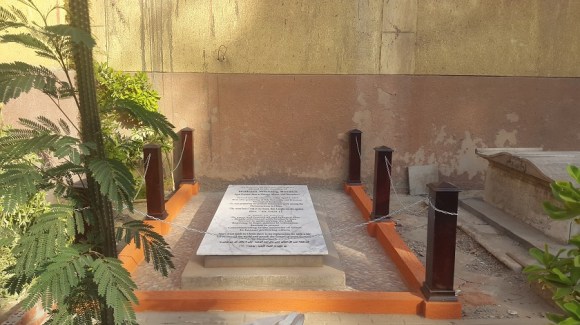
Tucked away in the northwest corner of the American cemetery in Cairo lies the neglected grave of William Borden, one of the most celebrated missionaries of the 20th century Student Volunteer Movement. Heir to a family fortune, the Yale graduate instead devoted his life to Christ, pledged in service to the Muslims of China.

But at age 25 Borden died in Egypt, having contracted spinal meningitis while studying Arabic in preparation. His will distributed nearly everything to mission groups and Christian ministries, leaving him only a cement slab as a gravestone. Engraved at the bottom were words uttered in memorium, “Apart from Christ, there is no explanation for such a life.”

That is, if anyone could read them. A recently erected wall in the poorly tended cemetery pressed square up against his plot. This meant that the gravestone now faced the wrong direction, requiring the rare pilgrim to slither in between the wall and the grave to read the inscription. It was an ill testament for one whose death was mourned from Chicago to New York to Cairo to China.

Even stranger is the fact that what Borden is perhaps most known for—the inspirational quote that he is reputed to have written into his personal Bible, “No reserves. No Retreats. No Regrets”—has not been found by historians or biographers.

Is the central anecdote of Borden’s life a case of hagiography? That it has not been found does not mean it is not true. But as with many Christian heroes, the reality is more inspiring than any potential fiction.

Please click here to read the full article at Christianity Today.

william-borden-grave

Categories
Christianity Today Middle East Published Articles

Egyptian Exodus: 100 Christian Families Flee ISIS in Sinai

christians-flee-sinai
Fayed El-Geziry/NurPhoto / Sipa USA via AP A Christian who fled ISIS brings belongings into the Evangelical Church in Ismailia.

This article was first published at Christianity Today on February 27, 2017.

As Coptic Christians flee Egypt’s Sinai Peninsula in unprecedented numbers, a Protestant church is there to receive them.

“We were the first to respond,” said Atef Samy, associate pastor at Kasr el-Dobara Evangelical Church in Cairo. “Two of those killed were very dear to our church.”

In the last few days, more than 100 families have left their homes in Sinai for the Suez Canal city of Ismailia, 125 miles west.

On February 19, the Egypt chapter of ISIS released a video calling Copts “our priority and our preferred prey.” Three days later, one man was shot and his adult son burned alive.

“This is sheer terrorism,” Samy said. “They want to embarrass the government and claim they can cleanse the Christian presence.”

In recent weeks, seven Copts have been killed. Witnesses say they were murdered in cold blood, with no negotiation, theft, or attempts to convert to Islam.

Hit lists are also reportedly being circulated, warning Christians to leave or die.

“I am not going to wait for death,” Rami Mina, who left Arish on Friday morning, told Reuters. “I shut down my restaurant and got out of there. These people are ruthless.”

Samy declined to name those killed, but identified them as born-again Christians active in ministry. His church quickly mobilized to help others leave, and provided support to the Ismailia church that has assisted dozens. Mattresses, blankets, food, and medical supplies are the most pressing needs.

Adel Shukrallah, responsible for youth ministry in the Evangelical Church of Ismailia, is heading the Protestant relief effort locally.

Please click here to read the full article at Christianity Today.

Categories
Prayers

Friday Prayers for Egypt: Blind Threat

Flag Cross Quran

God,

As one era passes, another begins. One died, and then two others. There is no connection, save a pernicious idea.

Defeat it, God, and save the people – target and targetter alike.

Far away in America, the Blind Sheikh passed away after many years of incarceration. Linked to terrorism in the first World Trade Center bombing, the Sadat assassination, and the plundering of Copts, he was the beloved spiritual guide of the Islamic Group.

Egypt received his body and permitted a gathering at his funeral.

Far away in Sinai, two Copts were murdered by the Islamic State. A father shot, his son burned alive. A video was issued calling for many more.

Egypt continues its assault against them.

Many years ago she subdued the Blind Sheikh’s disciples; God, as the idea morphs further grant success again.

But the cost is so high. Win their hearts and dry their ground.

Perhaps the funeral helped?

Some chafed, God, that people would celebrate one deemed a criminal. Others nodded at respect for the dead.

Egypt offered dignity to his family, God. Preserve her dignity in turn.

But strengthen her also in the dignity of her citizens, especially the threatened, neglected, and disadvantaged among them.

God, may this new era be short. May the old era be remembered. Long forgotten let be the idea.

Amen.