Categories
Asia Christianity Today Europe Published Articles

Christians Fret as Muhammad’s Family Comes Under Fire

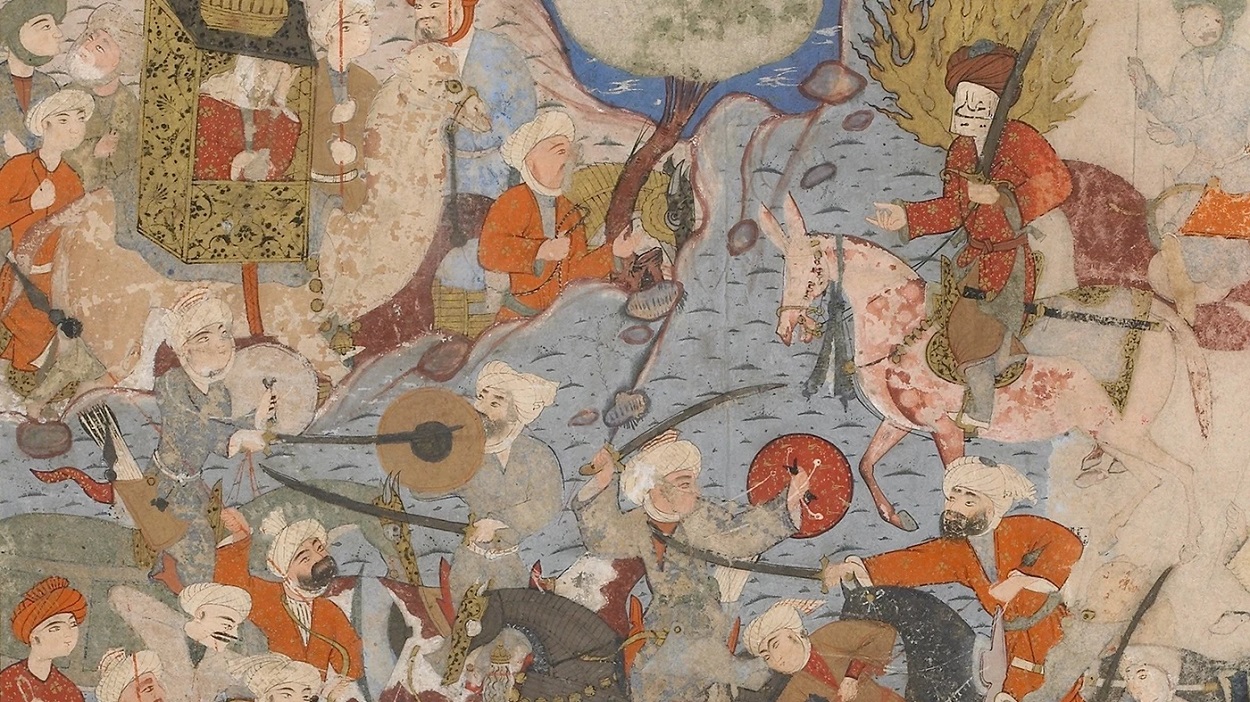
Aisha (L), at the Battle of the Camel

Founding fathers are often sacred, but not sacrosanct.

In recent years, Americans have wrestled with the slave-owning legacies of George Washington and Thomas Jefferson. Confederate statues have been toppled, ideologically refighting for some the Civil War. Pilgrims have become pillagers; Plymouth Rock equated with imperialism.

Muslims are having a similar moment.

Their prophet is called a pedophile. Their miracles, a myth. Successors to Muhammad are compared to ISIS. And it is not just Islam’s historic men. Two current global controversies concern two of the faith’s celebrated founding females: Aisha and Fatimah.

The International Union for Muslim Scholars has renewed its call for an international ban on insulting religions. And from India to England, Muslims have poured into the streets this month in protest.

Christians—whether leading such polemics or suffering under blasphemy accusations—have often been embroiled in such Muslim controversies. These latest episodes, many are relieved, are centered elsewhere.

“But Christians in both India and Pakistan are quite frightened,” said Juliet Chowdhry, a trustee for the British Asian Christian Association. “It is inevitable that as a vulnerable religious minority that is incorrectly perceived to be in league with the West, Christians will find themselves caught up in the anger.”

Thus they are keeping silent, said a Christian leader in Pakistan who—illustrating the point—requested anonymity due to the sensitivity of the situation.

Last month [May 26], a spokesperson for the ruling Bharatiya Janata Party (BJP) in India cited Aisha, often considered the favorite wife of Muhammad. Appearing on a talk show with Muslims, the Hindu official responded passionately when chided about a disputed temple.

Her prime minister, Narendra Modi, has led India in the direction of Hindu nationalism, stoking tensions with its 15 percent Muslim community. Though always a minority religion there, Islam ruled the subcontinent for centuries, with some ancient temples turned into mosques.

In one location, shivling idols were allegedly discovered last month. The Muslim talk show guests said no, their shape—holy to Hindus in honor of Shiva—resembled instead a fountain. The panel then descended into a heated discussion over the mocking of gods and goddesses.

“Should I start mocking claims of flying horses … and having sex with [Aisha] when she turned nine?” exclaimed the official. “Should I start saying all these things that are mentioned in your scriptures?”

Buraq is the name of the winged animal mentioned in Islamic tradition as carrying Muhammad on a night journey from Mecca to Jerusalem. Similar traditions quote Aisha on her tender age at the time her marriage was consummated, while some more contemporary scholars cite evidence to argue she was in her teens.

At least 15 majority-Muslim nations—led by those in the Arabian Gulf—have condemned India, which in turn censured both the BJP spokesperson and another offending official. The grand mufti of Oman called the comments a “war on all Muslims,” while Egypt’s al-Azhar mosque described them as “real terrorism.”

Muhammad was 53 when he married Aisha, and Islamic sources indicate a happy existence together. Aisha grew up to become a scholar and a military leader, often honored by modern day Muslims as an example of feminist egalitarianism.

But she is also a center of controversy—resurrected in a recent British film.

After the death of Muhammad, a faction of Muslims believed leadership should remain in the bloodline of the prophet. Known as Shiites, this sect believes the caliphate was promised to Ali, the prophet’s nephew and husband to his daughter, Fatimah. About 10–15 percent of Muslims are Shiites, with the great majority residing in Iran, Iraq, India, and Pakistan.

Sunnis, the majority sect, believe Muhammad did not designate a successor. The community then met to elect one, a caliph, and the first three were chosen from among Muhammad’s closest companions. Ali became the fourth caliph, but in a clash known as the Battle of the Camel, Aisha rode the Arabian dromedary in a rebellion against him.

The Lady of Heaven builds its story around Fatimah, who Muslims esteem as akin to Mary, the mother of Jesus.

In a poignant introductory scene, Fatimah is introduced as the first victim of terrorism, paralleled as an elderly woman comforts an Iraqi child whose mother was killed by ISIS. Winning awards for visual effects, the $15 million partisan film relates a Shiite perspective that the famed daughter of Muhammad died in childbirth—due to injuries suffered earlier in a raid ordered by his first successor.

Sunni orthodoxy honors the first four caliphs as “righteous.” Thereafter the community descended into civil war, with Ali and Fatimah’s children on the losing end. Hussain, the younger of two sons, was killed in battle, and his commemoration by Shiites is often accompanied by mourning and ritual self-flagellation.

Though Shiite-dominated, Iran banned the film as divisive to the Muslim community, while Pakistan, Egypt’s al-Azhar, and the Muslim Council of Britain all condemned it also. Following large-scale Sunni protests, most UK cinemas canceled upcoming screenings. According to Rotten Tomatoes, the film’s approval rating…

This article was originally published at Christianity Today on June 24, 2022. Please click here to read the full text.

Categories
Prayers

Lebanon Prayer: Maritime Power, Made Perfect

God,

We pray for resolution.

Mixed up in politics, here and afield,

Lies a field beneath the sea.

It is yours.

We claim it as ours. They claim it as theirs.

As lines are drawn in subterranean sand.

Then shift. And move. Ignored. And filed—

Or not.

Negotiating is not easy.

And then there are three presidents, each with a share of a weakening state,

Taking on the behemoth.

But there is a fourth, God. Very well armed.

A factor in the equation.

We pray for resolution.

But not just finality – justice, and fair.

Preserve us our rights. But what are they?

Who says this angle? No, two degrees more. Stretch the line out for a thousand.

Bend it here for this field, then split it at that.

Can we speak of the moral in mathematics?

Power.

If your word is true, we are mighty.

Because we are weak. And in that, our strength.

Unpredictable. Wild. Unyielding.

We are masters in exploiting system.

There are few rules in power.

But there are morals.

They don’t keep them—but do we?

For your word to be true we must meet it.

Our weakness is strength, but is it of you?

Is it just? Is it fair? Is it righteous?

Is it humble?

We pray for resolution.

Not one that seeks a mealy peace—

Trades principle for interest.

We need the gas. So does the world.

In double want find outcome.

God, we desire real strength.

Unity. Consensus.

But to find them we must each bend low—

A power, made perfect, in weakness.

Bless it, God. We need the gas.

We need a resolution.

Amen.


To receive Lebanon Prayer by WhatsApp, please click this link to join the closed comments group.

Lebanon Prayer places before God the major events of the previous week, asking his favor for the nation living through them.

It seeks for values common to all, however differently some might apply them. It honors all who strive on her behalf, however suspect some may find them.

It offers no solutions, but desires peace, justice, and reconciliation. It favors no party, but seeks transparency, consensus, and national sovereignty.

How God sorts these out is his business. Consider joining in prayer that God will bless the people and establish his principles, from which all our approximations derive.


Sometimes prayer can generate more prayer. While mine is for general principles, you may have very specific hopes for Lebanon. You are welcome to post these here as comments, that others might pray with you as you place your desires before God.

If you wish to share your own prayer, please adhere to the following guidelines:

1) The sincerest prayers are before God alone. Please consult with God before posting anything.

2) If a prayer of hope, strive to express a collective encouragement.

3) If a prayer of lament, strive to express a collective grief.

4) If a prayer of anger, refrain from criticizing specific people, parties, sects, or nations. While it may be appropriate, save these for your prayers alone before God.

5) In every prayer, do your best to include a blessing.

I will do my best to moderate accordingly. Thank you for praying for Lebanon and her people.

Categories
Christianity Today Middle East Published Articles

Pew: Israelis and Palestinians Find Favor in the Eyes of Americans

Americans prefer a less polarized Holy Land. But they themselves are as polarized about it as ever.

A new survey by the Pew Research Center—three years removed from when Donald Trump and Benjamin Netanyahu led the political scene—reveals rising favorability ratings for Israel and Palestine, across nearly every segment of Americans.

Most, however, still prefer Israel.

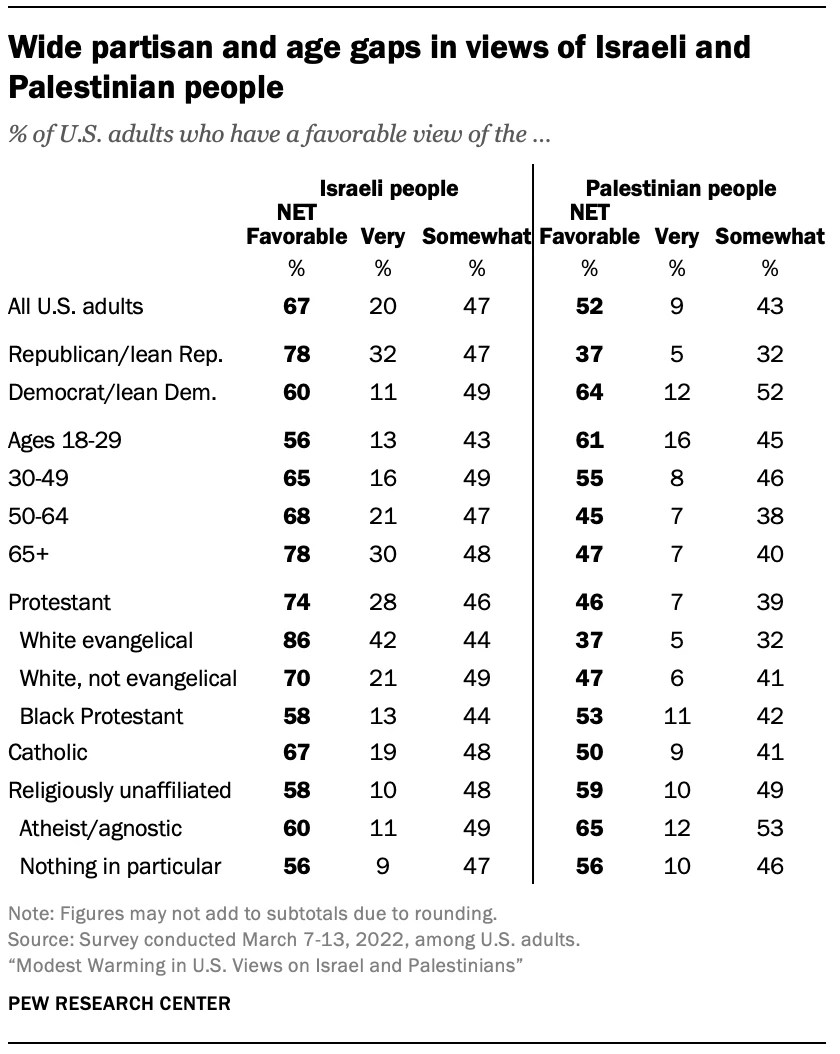
White evangelicals lead the way, with 86 percent viewing the Israeli people favorably and 68 percent viewing Israel’s government favorably, compared to 37 percent favorability for the Palestinian people and 14 percent favorability for their government.

Overall, 1 in 3 white evangelicals view both peoples favorably, but only 1 in 10 favor both governments.

These believers are out of step with the wider US, however.

Among Americans at large, the Israeli people have a 67 percent favorability rating, up from 64 percent. The Israeli government’s favorability rating increased from 41 to 48 percent. And a narrow majority of Americans now view Palestinians positively (52%, up from 46%), though less so their government (28%, up from 19%). Overall, 2 in 5 Americans view both peoples favorably (42%), but only 1 in 5 favor both governments.

“Americans naturally want to be favorable toward other peoples,” said Mark Tooley, president of the Institute on Religion and Democracy (IRD). “I’m surprised it is not higher.”

Theology may have something to do with the affinity. In a new question, Pew asked Americans if God gave the land that is now Israel to the Jews. White evangelicals agreed at a rate of…

This article was originally published at Christianity Today, on June 9, 2022. Please click here to read the full text.
Categories
Christianity Today Published Articles Religious Freedom

Will US List Nigeria Again After Latest Religious Freedom Report?

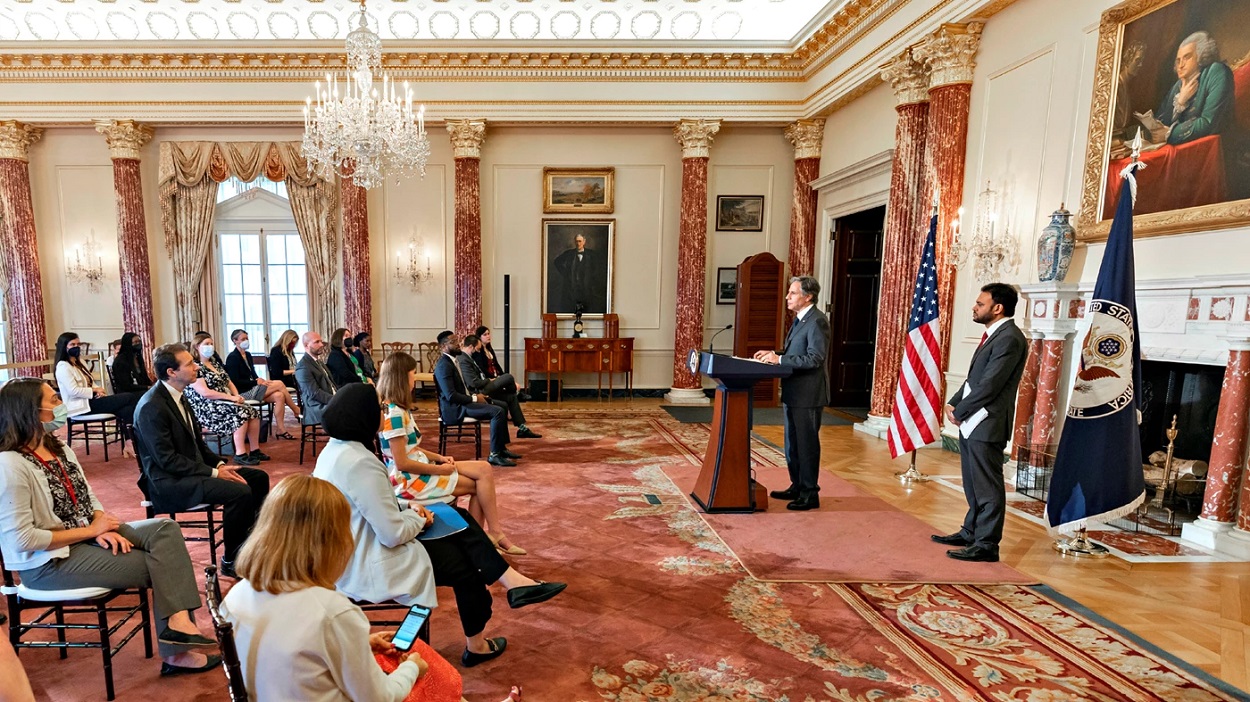
Image: Ron Przysucha / US Department of State

Nigeria—and a few other nations—are on alert.

The US Department of State released its 2021 annual report on international religious freedom (IRF) last week, describing conditions in nearly 200 nations. Delivering remarks from the Benjamin Franklin room—where US ambassadors are sworn into service—Secretary of State Antony Blinken presented a litany of well-known offenders.

China, he said, continues its genocide against Uighur Muslims.

Saudi Arabia makes illegal the practice of any faith besides Islam.

Pakistan sentences people to death for blasphemy.

And Eritrea demands renunciation of faith to release the arrested members of religious minorities.

“Respect for religious freedom isn’t only one of the deepest held values and a fundamental right,” Blinken stated. “It’s also, from my perspective, a vital foreign policy priority.”

Last November, these four nations were among the 10 Blinken designated as countries of particular concern (CPC). A separate special watch list (SWL) listed four more: Algeria, Comoros, Cuba, and Nicaragua.

But three days after the IRF report release, a terrorist attack in Nigeria highlighted its omission. Dozens of Christians were gunned down in a Catholic church on Pentecost Sunday. And one month earlier, a Christian college student was murdered by a mob over her alleged blasphemy against Islam.

Back in April, the independent US Commission on International Religious Freedom (USCIRF) released its own list of nonbinding CPC recommendations, reminding Blinken it was “appalled” at the omission of Nigeria. After listing Africa’s most populous nation as a CPC for the first time in 2020, the State Department removed…

This article was originally published at Christianity Today, on June 6, 2022. Please click here to read the full text.

Categories
Africa Christianity Today Published Articles

Owo Church Attack Kills Dozens of Nigerian Catholics on Pentecost Sunday

Image: AFP

Terrorists launched a gun and bomb attack at the end of a Catholic Mass in southwest Nigeria on Sunday, killing an estimated 70 worshipers according to residents and church leaders.

The terrorists attacked the St. Francis Xavier Catholic Church in Owo, Ondo state, at about 9 a.m., church leaders and residents told Morning Star News (MSN) though text messages. The carnage could have been greater. The church, one of the largest in the area, can hold up to 1,200 people, and was full at the time of the attack.

A priest at the church, Andrew Abayomi, told MSN that as the worship service was coming to an end, the terrorists threw explosive devices and shot at worshipers.

“We were in worship Mass when the terrorists attacked us. They shot at the congregation while breaking into the church by throwing improvised explosive devices at the church building,” Abayomi said. “Some of us hid inside the church as they shot randomly at us. This lasted for about 20 minutes before they retreated.”

He said it was difficult to give details about the number killed and injured, as leaders were focusing on transferring the wounded to hospitals. Circulated videos showed bloody images of men, women, and children strewed among the pews. Among other Owo residents, Loye Owolemi said about 70 worshipers were shot dead and others abducted when terrorists…

This article was originally published at Christianity Today on June 5, 2022. Please click here to read the full text.

Categories
Prayers

Lebanon Prayer: White Heart Leaders

God,

Mandate renewed. White votes aplenty.

Give him the white heart proclaiming.

And with him a deputy, narrowly won.

The same total elected odd partners.

Deal or no deal? God, only you know.

The voting is maintained clandestine.

Opposite camps, but yet status quo—

The devil you know bests the stranger.

Opinion of many: Devils them all.

Has anything changed since the polling?

A tighter result but no serious threat,

Unless in the laws—coalitions.

Prime minister soon. President maybe.

Will any foundations be shaken?

Industrious spirit, accountable charge.

Renewal within, from the margins.

We pray, God, for more. Renewal at the top.

A white heart to lead every leader.

Transform the whole, the new blood and old.

The nation to follow—then prosper.

Amen.


To receive Lebanon Prayer by WhatsApp, please click this link to join the closed comments group.

Lebanon Prayer places before God the major events of the previous week, asking his favor for the nation living through them.

It seeks for values common to all, however differently some might apply them. It honors all who strive on her behalf, however suspect some may find them.

It offers no solutions, but desires peace, justice, and reconciliation. It favors no party, but seeks transparency, consensus, and national sovereignty.

How God sorts these out is his business. Consider joining in prayer that God will bless the people and establish his principles, from which all our approximations derive.


Sometimes prayer can generate more prayer. While mine is for general principles, you may have very specific hopes for Lebanon. You are welcome to post these here as comments, that others might pray with you as you place your desires before God.

If you wish to share your own prayer, please adhere to the following guidelines:

1) The sincerest prayers are before God alone. Please consult with God before posting anything.

2) If a prayer of hope, strive to express a collective encouragement.

3) If a prayer of lament, strive to express a collective grief.

4) If a prayer of anger, refrain from criticizing specific people, parties, sects, or nations. While it may be appropriate, save these for your prayers alone before God.

5) In every prayer, do your best to include a blessing.

I will do my best to moderate accordingly. Thank you for praying for Lebanon and her people.