Categories
Christianity Today Middle East Published Articles

Christians Killed on Syria’s Front Lines

Turkey Shelling Syria
Smoke rises over the Syrian town of Tel Abyad, as seen from the Turkish border town of Akcakale in Sanliurfa province, Turkey, October 10, 2019. REUTERS/Murad Sezer

This article was first published at Christianity Today, on October 11.

Three Christians have been killed in Turkey’s assault on Kurdish-held areas in northeast Syria, reported In Defense of Christians (IDC), citing their sources on the ground.

In Qamishli, a Syriac Christian and his wife died, while in Ras al-Ain an additional Syriac Christian civilian was killed. Ten civilians were injured in the attacks.

“People were so scared, they were telling me, ‘They are bombing us right now!’” Bassam Ishak, president of the Syriac National Council of Syria, told NPR. “We think this is a message to the Kurds and Christians there to leave, so Turkey can move refugees there. We think it’s a form of ethnic cleansing.”

The Turkish operation focused initially on a 60-mile stretch of land between the two Arab-majority cities of Ras al-Ain and Tel Abyad, a sparsely populated area known as Syria’s breadbasket, reported BBC. IDC, which advocates for Christians and other religious minorities in the Middle East, said that this area has large concentrations of Christians.

In total seven civilians were killed, including two children, reported Channel 4. Retaliatory Kurdish mortar fire into Turkey killed…

Please click here to read the full article at Christianity Today.

Categories
Christianity Today Middle East Published Articles

Syrian Christians to US: ‘Don’t Abandon Us Now’

Kurds Syria USA
Image: Chris McGrath / Getty Images; The Kurdish-led and American-backed Syrian Defense Forces (SDF) announced the defeat of the Islamic State in at a ceremony in Baghouz in March.

This article was first published by Christianity Today on October 8.

Not long after the defeat of the Islamic State in the area, Syrian Christians warn that US military withdrawal from the Kurdish-controlled region, announced yesterday by President Donald Trump, will expose them to danger.

“The expected military invasion [by Turkey] and the possible confrontation with the Kurds might oblige Christians of the region to leave,” said Joseph Kassab, president of the Supreme Council of the Evangelical Community in Syria and Lebanon. “This means one more tragedy to the Christian presence in Syria.”

Seeking to honor his campaign promises to extract America from “endless war,” Trump yielded to Turkey’s demand to establish a “safe zone” along its southern border with Syria. Since August, the United States and Turkey administered a joint buffer zone patrol in the Kurdish-majority area.

Turkey’s objectives are two-fold. First, to resettle up to 2 million Syrian refugees currently residing in Turkey. Second, to clear the border of Kurdish fighters linked to the Kurdistan Workers Party (PKK), deemed a terrorist entity by both Ankara and Washington. Turkey’s President Recep Tayyip Erdogan had threatened to establish a 20-mile corridor unilaterally, frustrated by US cooperation with Kurdish fighters belonging to the PKK.

The Kurdish-controlled area of northeast Syria stretches 300 miles from the Euphrates River to the Iraqi border. Approximately 750,000 people live there, including estimates of between 40,000 and 100,000 Christians.

Over 700,000 Christians have fled Syria since 2011. And while some warn of further displacement, others fear a greater threat.

“Turkey aims to kill and destroy us and to finish the genocide against our people,” said a statement issued by…

Please click here to read the full article at Christianity Today.

Categories
Americas Christianity Today Published Articles

US Catholics Now as Concerned About Persecution as Climate Change

Aid to the Church in Need Iraq
Decapitated statue of Our Lady in the destroyed St Addai’s Church, Karemles, northern Iraq, via ACN-UK.

This article was first published at Christianity Today, on March 22.

American Catholics are growing more concerned about the fate of the world—and with it, Christian persecution.

More than 9 in 10 now identify persecution as either “very” or “somewhat” severe. This is roughly the same percentage as an identical poll last year, both sponsored by the US branch of Catholic charity Aid to the Church in Need (ACN). But over the last 12 months, the share choosing the “very severe” category rose from 40 percent to 46 percent.

And their level of concern went with it, rising 9 percentage points. Last year, 49 percent of Catholics described themselves as “very concerned.” This year, 58 percent.

The poll surveys 1,000 American Catholics across the spectrums of age, politics, and piety, conducted by McLaughlin & Associates.

It showed that intense Catholic concern is growing on several global issues. Those “very concerned” about human trafficking rose from 72 percent to 82 percent. Poverty climbed from 68 percent to 74 percent. The refugee issue jumped from 50 percent to 60 percent. And climate change nudged forward from 55 percent to 57 percent.

So while those unconcerned about Christian persecution fell by half (from 18% to 9%), overall the “church in need” only ranked No. 4 among the list of issues.

But last year, it was…

Please click here to read the full article at Christianity Today.

Categories
Excerpts

What Next for Syria?

Syrian city of Aleppo

The conflict has turned a corner as the Syrian government regained control of Damascus and begins pushing into rebel-held areas.

LobeLog interviewed Josh Landis of Syria Comment to ask him what happens next. The full interview is worth reading, but here are a few excerpts on competing regional policies.

Turkey:

Idlib was one of the poorer regions of Syria. It was a Muslim Brotherhood and rather Salafi place before the revolution. Now it’s become a dumping ground for all of the defeated rebel forces that have been pushed out of the various rebel pockets. They’ve all been pushed into Idlib, and it’s become this very unhappy collecting point.

Today we’re seeing lots of violence there internally, between militias that are vying for supremacy. But also, Turkey is protecting Idlib. Turkey does not want it to be conquered, because in doing so Assad would push tens of thousands of militia fighters into Turkey. That will make the refugee problem much more difficult for Turkey and saddle Turkey with up to 100,000 hardened rebel fighters, many of whom have links to al-Qaeda.

This gives Turkey a lot of incentive to take Idlib province and try to set up a satellite statelet that can act as a holding province for these rebels.

Israel:

Israel wants Syria to remain weak. The civil war has opened up a lot of potential for advances on Israel’s northern border. It’s destabilized that border, but at the same time it’s weakened Assad tremendously. He’s no longer a military threat to Israel, and the militias that are now along the border also don’t pose a threat.

Even if they have links to the Islamic State or al-Qaeda they’re small and have no missile capabilities or other advanced military technology. Israel would like to be able to preserve those gains and consolidate its control over the Golan. It’s now pressing the United States to follow up on its Jerusalem recognition by recognizing the Golan as Israeli territory.

United States:

The U.S. has closed off all of the major highways out of Syria to the east. International trade for Syria has been blocked off and sanctions tightened. The U.S. is dead set against international organizations playing any role in Syrian redevelopment so the U.S. can continue to strangle Syria and keep it extremely poor.

You might argue that this is bad from a counterterrorism perspective because it will create more instability, but I think the U.S. is willing to pay that price because it won’t hurt the U.S. directly.

We’re not sure exactly what the U.S. is promoting in Syria, but all the talk coming out of Washington reflects an effort to squeeze Syria politically, economically, diplomatically, and militarily in order to unseat Assad and replace him with a government that’s going to be pro-West and anti-Iran.

Any favorites?


Categories
Christianity Today Middle East Published Articles

Mideast Christians See Russia–not the US–as Defender of their Faith


Russia Middle East Christians
Image: John Holcroft

This article was first published in the July print edition of Christianity Today.

War was swirling in Syria. Rebels were pressing. And Maan Bitar was the only hope for American help.

“Because I am evangelical, everyone thinks I have channels of communication,” said the pastor of the Presbyterian Church in Mhardeh. “Syrians believe the United States has the power to stop the conflict—if it wants to.”

In the early years of the civil war, Bitar’s Orthodox neighbors were desperate to convince the US and its allies to end support of rebel forces. Mhardeh, a Christian city 165 miles north of Damascus, was being shelled regularly from across the Orontes River.

But salvation came from a different source. Russian airpower turned the tide, and Syrian government-aligned troops drove the rebels from the area.

Russian intervention on behalf of Mideast Christians has pricked the conscience of many American evangelicals. Long conditioned to Cold War enmity, the question is entertained: Are they the good guys in the cradle of Christianity? Or are persecuted Christians just a handy excuse for political interests?

“The news tells us Russian troops are bringing peace to the region, said Vitaly Vlasenko, ambassador-at-large for the Russian Evangelical Alliance. “Maybe this is propaganda, but we don’t hear anything else.”

Please click here to read the full article at Christianity Today.

But here also is testimony from Egypt, unfortunately cut due to word count:

“If Russia helps anyone to save them from death and danger [in Syria], we welcome this,” said Boules Halim, spokesman for the Coptic Orthodox Church. “Not just for Christians, but for humanity.”

Halim had no comment on Russian political developments with Egypt. But despite technically not being in communion over disagreements with the fifth-century Chalcedonian Creed, relations with the Russian Orthodox Church are growing increasingly strong.

Pope Tawadros has met Putin. Theological students are being exchanged. Russian monks are touring Egyptian monasteries.

“We are coming together in dialogue,” Halim said. “Better communication leads to better understanding.”

Categories
Middle East Published Articles World Watch Monitor

Christians to “Maintain Presence” and “Avoid Victimhood,” Says Syria Expert


Syria Middle East Concern
Children playing in Beit Sakhour, a neighbourhood in East Aleppo largely destroyed in Syria’s ongoing conflict (World Watch Monitor)

Following up on my recent article for World Watch Monitor, here is Part II of my interview with Miles Windsor, head of advocacy for Christian charity Middle East Concern.

These questions and answers were cut for length from the original, but I am pleased to share them here for the consideration of readers.


If you have your own viewpoint on who Syrian Christians support, even if in a personal capacity, please share.

It is important to recognize the extent to which situational dynamics influence statements of political allegiance, including by church leaders. Most Syrian Christians are in areas controlled by the Assad regime. The conflict situation also heightens the extent to which communities rely on patronage, a significant factor in Middle Eastern society even in peaceful times.

So we should not be surprised that church leaders readily voice support for President Assad. That is not to suggest that such articulations are empty, but rather that nuanced interpretation is usually necessary.


It can be simplistic to suggest ‘what the Bible says’ Syrian Christians should do. But are there Biblical principles you would counsel for them in the midst of a complicated state of difficulty? Might there be multiple options of God-honoring response?

We must guard against simplistic or overly prescriptive approaches. There is biblical basis and precedent for a range of responses to danger and persecution. The Apostle Paul who explained that ‘everyone who wants to live a godly life in Christ Jesus will be persecuted’ (2 Tim 3:11,12) is the same Apostle who fled from Damascus to escape murderous plots (Acts 9:23-25). Other times he challenged the injustice and brutality of an imminent public flogging based on his citizenship rights (Acts 22:25).

It can be tempting to offer reminders of basic principles such as “trust in God and his promises,” and “do not deny your faith.” Although well-intentioned, true, and important, such advice is usually obvious and can come across as crass over-spiritualization, especially if offered by outsiders.

Better is to defer to our Syrian and other Middle Eastern sisters and brothers who are ministering in the heat of conflict and refugee situations and whose profound theological reflection is now shaping their own ministry approaches.

For example, two themes that are regularly emphasized in relation to the Middle Eastern church are the importance of presence and the danger of victimhood. The importance of Christian presence in Syria is the prophetic role of the Church and the calling of Christ’s people as agents of reconciliation and transformation. The imperative of maintaining a witness to the love, hope, peace, and life of Christ in a context of hatred, hopelessness, conflict and death, helps to understand how vital it is for the salt and light of Christ’s people to permeate and help shape a post-conflict Syria.

To rise above the mentality of victimhood is to reject the vicious cycles of blame, demonization and revenge, to acknowledge the comparable suffering of many others, to build alliances with the majority which also strives for peaceful coexistence, and to reject the label of ‘minority,’ whether imposed by those seeking to control, or to protect.

These are rich seams to mine as Syrian Christians seek to respond in ways which honor God, but they should also be a challenge to the more comfortable and complacent parts of the global church!


Describe a little bit about how MEC can speak authoritatively on the subject.

An association of many Christians and Christian ministries in the Middle East and North Africa, Middle East Concern (MEC) supports those in the region who are marginalised, discriminated against or persecuted for being or becoming Christians. Through a wide network of church and ministry partnerships in the Middle East and North Africa (MENA) region, MEC seeks to provide support which is led by the priorities of MENA Christians. This support includes advocacy – challenging injustice and seeking to ensure that the voice of MENA Christians is heard and understood.


Please click here to read an excerpt of Part I, or here for the full article published at WWM.


Categories
Middle East Published Articles World Watch Monitor

“Avoid Persecution-of-Christians Label,” Says Syria Expert

Syria Middle East Concern
Children playing in Beit Sakhour, a neighbourhood in East Aleppo largely destroyed in Syria’s ongoing conflict (World Watch Monitor)

From my new article for World Watch Monitor:

As the conflict in Syria continues, Jayson Casper sat down with Miles Windsor, head of advocacy at Christian charity Middle East Concern, to discuss where Syrian Christians’ allegiance lies, whether those who fled the country may return, and how Christians in other countries can help.

Jayson Casper: There has been much reporting about how Syrian Christians supposedly support the regime, the opposition, or are neutral. There is also reporting about how their stance may have shifted over time. What is your perspective on how the hard-to-define majority of Syrian Christians should be described?

Miles Windsor: The first point to stress is that within Syria’s sizeable Christian communities, there are both supporters of the Assad regime and supporters of opposition groups, so it’s important to avoid blanket generalisations. And a second basic point is that for most Syrian Christians, and indeed most Syrians generally, political allegiance is usually nuanced or qualified.

“Improved security alone will not be sufficient to facilitate large-scale return of IDPs”

Although there are Syrian Christians who support, and are active within, opposition groups, most Syrian Christians tend to favour the Assad regime. This is certainly the public position articulated by most Syrian church leaders.

Such support has historical roots. The Assad regime has traditionally granted a significant degree of freedom to the diverse religious communities of Syria.


Please click here to read the full article at World Watch Monitor.

Categories
Prayers

Friday Prayers for Egypt: Russia, Air and Chemical

Flag Cross Quran

God,

For the first time in two years, Aeroflot returned to Cairo. Russia had suspended all air travel following a terrorist attack on a tourist carrier, and security precautions still prevent direct flights to the popular Red Sea resorts.

Let it not happen again, God.

But as Russian-Egyptian relations return to normal, give discernment in current affairs.

How should the government consider accusations of poison in the UK, and gas in Syria?

Let the truth be known, God, if only to the privy of world leaders. Let Egypt’s president act accordingly.

But give knowledge also to the world community.

Allow heads-of-state the discretion to maneuver. But disclose secret deeds done in darkness. Give no cover to illness in conduct.

None can stand on your holy hill, God. But the heart of a man may yet be made pure. May such men lead their nations well.

Help Egypt stand with many. As necessary, help Egypt stand alone.

Strong. In peace.

Amen.


Categories
Excerpts

The Genesis of Salafi-Jihadism

Salafi Jihadi Surur

Did you know that not all Salafis are jihadis?

Often in popular understanding they of the long beard are the chief perpetrators of religious violence and terrorism.

Many are, but it does not have to be so. Another popular version of Salafism adopts political quietism, believing Islam commands them to obey the ruler — almost no matter what.

The ‘almost’ is because the ruler is required to allow the practice of prayer, and in some fashion implement sharia. If he willingly flaunts this, he forfeits his rule.

But they also believe that Islam teaches that the chaos of rebellion far outweighs the chance that a revolution against defects might possibly be successful.

But where is the sharia line to be drawn, and what calculation of chance might animate a Salafi toward jihad?

Meet Muhammad Surur, a Syrian recently deceased and commemorated in the National as the one who normalized extremism.

Surur was a leader of the Muslim Brotherhood in Syria until the 1960s. He broke away from the Muslim Brotherhood and moved to Saudi Arabia, where he was influenced by Salafism there.

A decade later, he left Saudi Arabia for Kuwait. In the 1970s, he was part of a leaderless and unorganised religious movement that combined traditional and revolutionary ideas, dubbed the Islamic awakening.

The Sahwa, as the movement was known in Arabic, led to the transmutation of Salafism from a traditional school of thought (dawa) to an activist one (haraki), through the foreign influence of political revolutionaries such as Surur.

In short, political quietism met political Islam.

Still, this doesn’t mean his movement was bloodthirsty. The author notes jihadis and anti-jihadis both hurl insults against one another in Surur’s name.

Even so, Surur believed the Shia were not true Muslims, says the author, and praised himself for anticipating the intra-Muslim divides characterizing the post-Iranian revolution Middle East.

Surur also embraced the Syrian uprising, and was eulogized by the Syrian National Coalition, the political arm of the Syrian Islamic Council.

“He focused in his work on activism and traditionalism, rejecting apathy and passivity, and established a current that combines intellectual work with political activism, in addition to religious knowledge.”

The coalition’s statement is an example of the dangerous tendency to misconceive of the man’s legacy. The political body ignores the impact Surur had on the kind of extremism that sweeps his country five decades after he left it.

Praise for his movement shows the rampant normalisation of extremist ideas prevalent not only by the opposition’s bodies but also by watchers of the conflict.

The article is noteworthy for highlighting an individual who nuances our understandings.

But I find it lacking in one way: Why did the Salafism side of the equation produce such wanton violence?

Traditional political Islamic groups have a more nebulous approach, sometimes embracing non-violence or defined, forceful actions for revolutionary goals. Perhaps I’m being too generous.

Salafi-jihadis have been shaken into political activism, certainly, but where then does the violence come from?

Salafis esteem the earliest Muslim ages and seek to replicate as much as possible. Does the new revolutionary fervor spark imitation of early Islamic wars?

Or does the Salafi tendency to reject the other and the modern world simply explode when driven to an activist cause?

Political Islamists might utilize violence, or pursue insurrection, but there is something very different about Salafi-Jihadis. Why?

Surur himself is not enough to explain this, however much he may have set it in motion. The author does well to bring us his example, but the article is too short to articulate everything.

But everything is what we need to know, to properly understand and appreciate the other.

Inasmuch as that is impossible, let us try within the space we have. For now, just realize that not all Salafis are violent, even if many have long beards.


Categories
Personal

God in the Little Things, For Us

Car Keys Syria

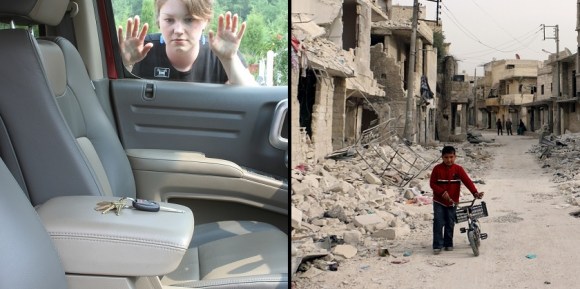
For the first time in my life, I locked the keys in the car. Worse, it was borrowed. All the movie tricks with wire hangers came into my mind, but none seemed like they’d work. I was stuck.

Stuck an hour away from home. With two of my kids, picking them up from camp. One eager dorm leader suggested we break the back window. It would be cheap and easy to fix, he said. He’d do it right now with his fist. Seemed like the only way out at the time.

But then one after another, God brought solutions.

There was a spare key back in Cairo, but in the apartment of our friends who let us borrow the car. I called my wife, who was at Bible study in the international church offices.

She quick asked a friend, who coincidentally was right then going to that apartment to take the house sitter to the beach for the weekend.

My wife got a ride over, and got the key. Fifteen minutes later and we would have been lost.

Back at the campsite, another father overheard the dilemma and offered us a ride home.

Once there, spare key in hand, our whole family piled into the Uber. I had planned to take the two girls to the near-to-camp expansive mall to hear about their experience. Now, we could all go, and experience their joy all at once.

And this week, Uber even offered a 30 percent discount.

An hour later we unlocked the car. Several hours later, we came home exhausted.

It could have been a disaster. But one small coincidence after the other had the handprint of God, making the day even better than we expected.

It also came with a valuable lesson to discuss with the kids: All things work together for good, to those who love God. Let’s not complain, but wait expectantly.

I believe this.

But don’t you think it is also a little crass and self-serving? One day later marked the four-year anniversary of several hundred protestors killed, as their sit-in camp was cleared by authorities.

Our nation borders a territory that is hemmed in on all sides, an open-air prison. One nation over is torn by civil war and terrorism.

Yet God arranged quick access to a spare key, so I could get home more conveniently. So I could take my whole family to a food court.

That’s a different lesson to share with the kids, isn’t it? Believe me, I tried. Their eager celebration of God’s goodness shifted into sullen confusion. Death and destruction can do that to a dinner conversation.

We talked through the possibilities. A Syrian refugee opened our favorite ice cream shop across the street, and is doing great business. God did well to work that out for good, right?

Our good, absolutely. Best and cheapest ice cream in town. But I’m sure he’d rather be back home.

The Syrians are Muslims, was one possibility. Maybe God worked things out for us because we’re Christians?

Perhaps there is some fidelity there to the verse above. But a good number of those Syrians are Christians, too. One kid shot it down more broadly. God would want to do good to everyone.

Maybe that’s it? There are bad people in the world, destroying God’s good? Certainly, but is God’s good coming? It’s hard to see, and a long time in coming.

One child recalled the Israelites in the wilderness. Already in a tough situation, God sent snakes to kill many when they grumbled. Sometimes disaster is discipline, even punishment.

True, but hardly satisfying when we consider the tragedies of another.

Sullen, and glum. There are no easy answers.

There are things we don’t understand, I told them. Even more so, Jesus foretold difficulties for those who follow him. He was not saved from the cross, and this should not be forgotten in the hope of ‘all things good’.

God has given different promises to those who suffer. He is with them in the middle of it. Many have said their fellowship with him has been closest during the harshest times of trial.

And we must not forget, in heaven, one day, all will be good. The resolution is coming.

Until then, we have a choice.

Was the car key episode simply a series of well-timed coincidences? Yeah, maybe.

Or was it the loving hand of a personal God upon his wayward creation and adopted son?

Which would you rather?

We do not need to extrapolate the universe to find his favor in the little things. But neither should we believe the universe revolves around us.

There is blessing, and there is suffering. In faith we hold that both work out for good, even when we cannot see it.

It is not my place to find the good in Syria. That is up to the Syrians. It is up to God. I can help as I am able, but I dare not interpret.

Sometimes lessons are simpler for children than adults; I don’t think this is one of them. But best they hear them now, I think, than struggle with them later. There is mystery in our faith, and it cannot be avoided forever.

But likely, a child will take it to heart much more readily than we will.

If this is the good from a neglected car key, it is sufficient. Far better than a ride home and a family night out.

But thank you, God, for those little things also. For us.

And, take care of the Syrians. Amen.


Categories
Excerpts

A Primer on Salafism III

Salafis Studying
(Image by Tariq Mir. Kashmir, 2011.)

Salafism is often wrongly criticized. But it can be rightly criticized also. The first post in this series emphasized how it is often a popular (meaning of the people) expression of Islam. The first essay here shows how this happens, though I think it errs in conclusion.

The second doesn’t even err, because it doesn’t even say anything. It just is hell-bent on Salafism winning in one particular corner of the world.

Salafism and the Politics of Free Market Religion’ takes an economic approach to the question.

Like economic forces, some ideologies may be best explained as different approaches to the marketplace of religion. In applying this idea to Salafism, we see that it promotes a free market “faith economy.” Salafism seeks to break the monopoly of state religion over Muslim identity, analysis of texts, and daily religious life.

Ok… benefit of the doubt so far. It is an interesting premise.

Salafism, until very recently, was not formally invested in politics. It was, as such, largely distinct from larger Islamist organizations, like the Muslim Brotherhood, Hizbul Tahrir, and others. Salafism is not, however, agnostic to the societies in which it operates; many Salafis engage in social education and proselytization programs.

Yes, largely true. He goes on to make the point that most governments in the Middle East have a particular brand of sponsored religion – often not Salafi.

Because the state enjoys a monopoly, it does not need to ensure that its product, state religion, is adequate or appealing to this audience. This usually means the quality of that product suffers, which is why most monopolized religious economies have low levels of popular participation.

While the people yearn for more direct religious participation, the ulema [religious scholars]—at the behest of governments—often support the status quo. This has caused popular resentment toward the scholarly class, which is viewed as backward and obscurant.

‘Yearning’ seems a word too close in sympathy with its analysis. But ok. I’ve often heard this criticism.

Salafism focuses more on an individual’s principles and ethics. It is not enough for the state and scholars to protect the faith. The individual must also “establish the state of Islam in his heart,” which will result in “the state of Islam being established in the land.”

According to Salafism, the individual is elevated above more imperial notions of allegiance and dedication to state. The focus is on individual dedication to a broader set of values, including duty to self, family, and neighbors. In short, Salafism is about a kind of personal transformation.

Much like the Protestant Reformation, Salafism has been able to personalize religion for the masses.

A bit too harsh on state-sponsored religion, perhaps, sometimes. But it is an interesting window into how Salafis see themselves.

But here is the author’s conclusion and recommendation:

In a “faith economy” free from state regulation, greater levels of religious participation, and possibly even civic duty, become possible. By heeding Salafism’s call to deregulate religious identity, authority, and interpretation, greater religious freedoms can be enjoyed by all.

This seems an idea to celebrate – but do you dare? Does Salafism really believe in the deregulation of religion and the state? Does Islam? People should be free to choose what religion to follow? This is the heritage of Ibn Taymiyya and Abdel Wahhab?

Salafis believe in religious freedom? What if they win? It’s a horrible question, but one so many Muslims are afraid of. That’s one reason why there is state-sponsored religion in the first place. And for 1400 years, it’s almost always been that way.

Perhaps in conversation some Salafis might surprise me. In many other ways, several have. But this is not the discourse I’m used to.

The following, though, is rampant in some sections of the Muslim word. It just doesn’t belong as academic analysis.

Syria, the War on Terror, and the Left’s Salafiphobia’ is an impassioned plea to get rid of Assad and call out the hypocrisy of the American left. I get it, Assad’s a bad guy. And I get that that there is likely a whole lot of misinformation about ‘moderate rebels’, ‘extremists’, ‘secular government’, and the like.

I don’t understand Syria, but if you want to pick a side, go for it.

But why here? It’s not really worth excerpting anything except the opening and concluding paragraphs:

The spontaneous, massive protests against President Donald Trump’s Muslim ban were an inspiring display of solidarity between non-Muslim and Muslim Americans. As encouraging as public backlash against this draconian policy has been, however, it strongly contrasts with the lack of public support Muslims have received during the past fifteen years of the so-called “War on Terror.”

We cannot truly defeat destructive far right policies and structural Islamophobia if we tolerate these same positions among individuals and groups that label themselves as progressive. Now is the time to make clear that the left will not tolerate anti-Muslim bigotry even within its own ranks.

I’m quite sympathetic to parts of what the author is arguing. Does the war on terror mean perpetual militarism? And there is a great danger. Given that much of this war is being fought against Muslims, it risks ramping up the rhetoric against Muslims in general.

As we have seen in part one, that can be directed against Salafis in particular, even by other Muslims.

But why is this essay even here? The last of six in a series on Salafism, it teaches nothing about its subject. Has Muftah inserted an endorsing editorial?

It was a disappointing ending to a very helpful series. I hope you have benefited from their scholarship, and my piddling comments here and there.

Salafis are human beings. Tear apart or adopt their ideas as you will. But treat them with the honor given them by their Creator, and recognize the fidelity they wish to give back. Just remember, as Paul wrote, “My conscience is clear, but that does not make me innocent.”

Please click here to review part one and part two of this primer on Salafism.

Categories
Excerpts

Islam, Jihad, and Syria

An image distributed by Islamic State militants on social media purports to show the destruction of a Roman-era temple in the ancient Syrian city of Palmyra
Translation: Blowing up a pagan temple in Palmyra.

Two days ago I shared my new article at Christianity Today contrasting Muslim and Christian polls about eschatology. As ISIS surged in the Middle East, it activated also Christian visions of Armageddon.

But it is good also to look at the raw material. This article by Josh Landis contains many interesting tidbits on how Syria ignites the Muslim imagination. Not only the sometimes jihad-bent Salafi trend can be animated, but the generally assumed peaceful Sufis also see the early centrality of Sham, as greater Syria is called in Arabic.

If some judge this as confirmation of Islam’s essential violent core, here is one passage to highlight. I suppose it could be read either way, but it does show the focus of the early community on empire-building:

Salafi-Jihadis may be very different from classically conceived Jihad but they believe that they are continuing in the footsteps of an old tradition which goes all the way back to the earliest days of the Prophet.

Whilst it is noteworthy that Jihad occupied a very small part of the Prophet’s life, the first books written about his life was about his battles. From there a whole literary genre called maghazi developed.

Moreover, there are historical compendiums such as Futuh al-Buldan of al-Baladhuri, one of the earliest surviving texts on how Islam conquered the classical world with offensive jihad.

Apart from the jurisprudence dealing with the legal issues surrounding the concept of religious warfare, there are plenty of works written on the battles of the Companions, as well as books dealing with the concept of Futuwwa, martial and spiritual chivalry, and of course there are biographies of famous warriors.

Contrast, perhaps, with the Civil War and WWII literature popular among Americans. Yes, it is a contrast between a nation and a religion, and therefore not exact.

But it also highlights the difficulty of examining Islam, which stands in between ‘religion’ and ‘nation’.

Let it at least be an example of the shared propensity of mankind to glorify battle. Most Muslims, and Americans, would quickly defend the rightness of their particular historical cause. Perhaps they are not wrong.

But allow it to give pause in defending the rightness of any particular current cause –  religious, national, or otherwise.

And if you like, review again the CT link showing how some read forward the battle into the future, perhaps the near future, perhaps even the present.

Categories
Prayers

Friday Prayers for Egypt: Falling Short

Flag Cross Quran

God,

Egypt was almost happy. Perhaps she was a little. The national soccer team came close to reclaiming its heritage as ‘best in Africa’, but fell short in the final.

But so also seemed many of Egypt’s actors this week, for good or for ill.

A women’s labor strike at a textile factory abandoned the effort. Pushing for unpaid bonuses they thought the law mandated, they succumbed either to pressure or better information, depending on the source.

But a pharmacists’ strike was called off after seeming success. The minister of health agreed to their demands to ensure profits and secure medicines. Still, princes increase.

And accusations in parliament raise ire but fail to settle. Tales and explanations of corruption and foreign meddling sully the whole, but none yet succeeded in seizing the upper hand.

Even a terrorist could not complete the task. Allegedly aiming to mar the treasures of the Louvre in protest of Syria, the knife-wielding Egyptian was subdued while attacking the guards at the entrance.

God, each event is complex and begs for your wisdom. Each actor the same and subject to your judgment. Of both Egypt stands in need of discernment.

Give good wages. Protect investments. Supply medications. Settle disputes.

Cover no corruption. Allow no defacement. Draft laws. Save Syria.

God, honor the soccer team in their success. Honor the actors who similarly strive.

You are pleased by integrity more than result. But where Egypt is close, and within your will, give her success.

She has fallen often these past few years. Soon may she stand, tall and righteous.

Amen.

Categories
Excerpts

Why Aleppo Fell

aleppo-fall
(via Business Insider)

I can’t pretend to know the answer to why Aleppo fell, but Juan Cole tells us only part of it did. The more populous section, says the University of Michigan professor, may well have been glad to see the rebels go.

There had been 250,000 Sunni Arabs of a more religious mindset and from a working class background living there under rebel control since 2012. But next door in West Aleppo, which our television stations won’t talk about, were 800,000 to a million people who much preferred to be under the rule of the regime.

This numerous and relatively well off population took occasional mortar fire from the slums of East Aleppo. They weren’t in the least interested in saving the rebels from the Russians or the Iraqi Shiite militias or from the regime itself.

Syria is an incredibly diverse society, he says, guesstimating:

Alawite Shiites: 14%
Christians: 7%
Druze: 3%
Ismailis: 1%
Twelver Shiites: 0.5%
Kurds: 10%
Secular Sunni Arabs: 30%
Religious Sunni Arabs: 34.5%

And basically, the rebels alienated the people as they drifted further and further toward the better funded and more capable Salafi-Jihadi fighters.

But when the regime used heavy weaponry on the revolutionaries, the latter militarized their struggle. They weren’t able to get funding from democratic countries for their militias or for the purchase of weapons.

Many turned to Turkey and the Gulf countries like Saudi Arabia, and these patrons wanted them to adopt a clear Muslim fundamentalist identity. Most Syrians are not Muslim fundamentalists. But that is the mindset of the Saudi elite.

Maybe Western nations should have funded the struggle, then? Throughout the article Cole condemns Assad, Russia, and Hizbollah. He seems to harbor some sympathy toward the original revolution and the moderate factions.

But at the same time, this is how he describes the Muslim Brotherhood:

Many of the fighters in the rebel opposition were Muslim Brotherhood, a relatively moderate fundamentalist group in Syria which nevertheless does want to impose a medieval version of Islamic law on the whole country.

If this is moderation, what to make of that rhetoric overall? Nevertheless it was the al-Qaeda linked Nusra Front that subjected the Syrian regime to the most damage, and twice almost cut off Damascus from key supply lines before outside intervention relieved the pressure.

Why then did the Syrians not rally behind the rebels against the likes of Hizbollah (first) and Russian (second) intervention?

Most people in Syria don’t trust the Muslim Brotherhood and they really, really dislike the Salafi Jihadis.

He boils down to this:

So you get 70% of the people in the country who, having been given the unpalatable choice between the Baath regime of al-Assad and being ruled by Salafi Jihadis, reluctantly chose al-Assad.

That is why the Aleppo pocket fell.

I can’t say if he is correct or not. But amid the horrible images of Aleppo broadcast in the media, it is wise to consider a lesser heard explanation.

And then, look again at the photo above. No matter their orientation, there are still innocents among them. And even the less innocent are human, including the far from innocent.

War is sad.

Categories
Excerpts

Redraw the Map: A Christian Call for Middle East Peace

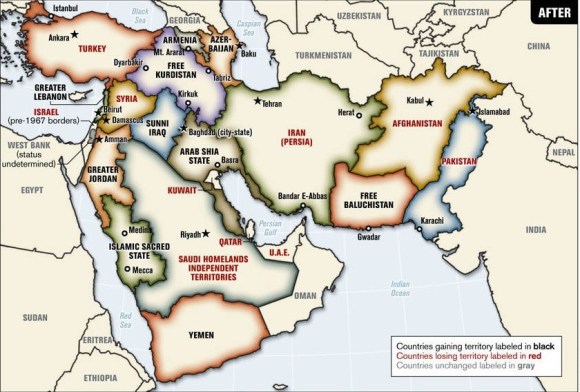
Map of New Middle East

This article was published at Providence, on March 4, 2016.

The carnage is so severe, the atrocities so barbaric, and the impasse so intractable. Even when violence targets fellow Christians and their ancient communities, the morass of the Middle East can silence any moral response. Believers are tempted to throw up their hands in despair, for any proposed solution creates further uncomfortable complications.

If America stands with Assad in Syria we back his barrel bombs. If we side with the rebels we empower Islamism. If we stay neutral the killing continues, as friend and foe alike meddle on behalf of their favorite proxy. If we bomb only the Islamic State the core political issues remain. If we commit ground troops the specter of Saddam looms over all. Propaganda shrouds analysis in conspiracy, and regardless of action refugees pour out of a tinderbox ready to spark further war.

It is no wonder Christians are paralyzed to suggest anything.

Into the morass wades Terry Ascott, desperately seeking a way forward. And his solution tramples over one of the region’s most sacred cows, one only the Islamic State has dared address: Redraw the map.

Terry Ascott is the founder and CEO of the Arabic Christian satellite network SAT-7, though he is clear these remarks are personal in nature, unrelated to the work of the SAT-7, which I have written about in the past such as here and here.

I have also previously summarized an article from the London Review of Books that suggests the United States has conspired to create exactly the situation Ascott is calling for.

The article in Providence touches on the fact that a few others have suggested a solution in political division, but in purpose reflects Ascott’s Christian heart and rationale to stop the bloodshed. It also reflects his pessimism that the region can do this on its own.

Please click here to read the full article, and brainstorm with him.


Categories
Christianity Today Middle East Published Articles

Christian TV Helps ISIS Survivors

This article was published at Christianity Today on January 7, 2016.

SAT-7 Myriam and Sandra
Myriam (L) and her friend Sandra reunite at school (via SAT-7)

Last spring, a 10-year-old Christian girl famously forgave ISIS for driving her family from their home in Mosul, Iraq’s second-largest city. Myriam’s video interview with Christian broadcaster SAT-7 went viral, witnessed by more than 3 million people on television and social media.

When Myriam fled from ISIS, so did her friend Sandra. Sandra’s family first took refuge in Lebanon, while Myriam’s family headed for Erbil, the capital of the Kurdish region of Iraq. Eventually, both families settled into a refugee camp at Mar Elias Catholic Church in Erbil.

Myriam previously told SAT-7 she had three wishes. The first: For her message of forgiveness to reach the world.

Now her second and third wishes have also been fulfilled. She has returned to school, and Sandra has joined her. She now shares a desk with her childhood friend.

“I can’t describe the joy that I felt,” Myriam told SAT-7.

But the joy of school is unknown to most of the approximately 3.5 million internally displaced children of Syria and Iraq. World Vision estimates that 2.5 million Syrian children—including both the internally displaced and refugees—are not attending school.

Terry Ascott, CEO of SAT-7, told CT that without school, money, or dignity, these children are at great risk.

Please click here to read the full article at Christianity Today.

Categories
Excerpts

The Return from Syria

(from Sputnik news)
(from Sputnik news)

Writing for Carnegie, Mukhtar Awad writes a long but thorough history of Islamist radicalization since the movement to oust Morsi as president. Towards the end he issues a warning that might not be on everyone’s radar:

The eventual return of Egypt’s many itinerant jihadists—probably several thousand—is another factor that will likely increase jihadists’ recruitment of Islamist youth and the possibility that nonjihadi violent groups embedded in the Egyptian mainland will turn into active cells of the Islamic State and al-Qaeda. There is a precedent for this. When Egyptian fighters returned from jihad in Afghanistan in the 1980s and 1990s, their actions precipitated the bloodiest years of the previous insurgency.

The brutal and successful Islamic State has inspired many young Islamists to wage jihad, particularly after its conquests in Iraq and Syria and its infliction of significant casualties on the ranks of the Egyptian military. An increasing number of Islamists have joined its ranks, and others have fought under the banner of jihadi groups in Libya. Al-Qaeda also remains a popular touchstone among those who reject the Islamic State’s claim to the caliphate and its gross barbarity. Its branch in Syria, the Nusra Front, is another successful model in the view of young Islamists, and some Egyptians have traveled to join its ranks.

Many Egyptian jihadists who left in the 1980s stayed overseas to fight in regions like the Arab Maghreb—one estimate by a pro-government center run by a retired senior officer puts the number at anywhere between 8,000 and 10,000 Egyptians, though these numbers could not be independently verified.47 Egyptian authorities claim that at least 3,000 Egyptians have traveled to join the Syrian jihad since 2012, a number that peaked during Morsi’s presidency.48 This number is also impossible to verify, but an Egyptian Islamic State fighter based in Syria interviewed for this paper confirmed that the number is likely close to several thousand.

As escalating as Russia’s intervention in Syria has been, having them at the table could ironically serve as a basis for an eventual political solution. Far too much blood has been shed to offer even the faintest praise to anyone, but at least there is coordination among the major powers, including efforts to involve Turkey and Saudi Arabia as well.

If peace can eventually take hold, where will all the foreign fighters go? As Awad states, Egypt has dealt with this scenario already. But in the ongoing effort to regain stability, it would be the oddest of consequences that peace in Syria might throw Egypt off kilter again.

Categories
Prayers

Friday Prayers for Egypt: Regional Balance

Flag Cross QuranGod,

Help Egypt to honor her neighbors, near and far. Help her to satisfy commitments, repay debts, and work for peace.

Help her toward a wise and sovereign foreign policy.

Egypt is alive economically because of Saudi aid. Egypt supports their offensive in Yemen. Saudi Arabia desires the fall of Syria’s Assad. Egypt backs Russian strikes against Assad’s enemies.

Egypt appoints a culture minister who speaks against Wahhabism. Saudi welcomes a pro-Brotherhood luminary.

There are interests in international relations, God, but there are also principles. There is balance of power, but also use of power. Hard as it may be to determine, there is right and wrong.

Right is to honor neighbors. Right is to satisfy commitments. Right is to repay debts.

Right is to work for peace.

On Syria, Egypt has called for a political solution. Is this right, God? Has too much wrong been waged that might must impose from the outside?

God, find a peaceful solution. Too many have died. Too many have suffered. Too many are implicated.

There is compromise, God, but there is also hypocrisy. There is the lesser of evils, but also evil. Help Egypt, her neighbors, and the international community to conduct themselves rightly.

Bring balance to the region, God. Bring peace, justice, and stability. Bless Egypt with sovereignty. May she use it to bless others.

Amen.

Categories
Excerpts

Remember the Captive Assyrian Christians

Elderly Syrian ChristiansThere is so much bad news, often repeated, that five months later it is easy to forget. On February 23, 253 Assyrian Christians from the Hassaka area of Syria were taken captive by the so-called Islamic State.

Unlike others, they were not executed for propaganda. It appears the jihadis desire ransom instead.

On March 1, a group of mostly elderly captives were released. Al-Monitor was able to secure an interview with one of them, describing their conditions. She is presently in Lebanon with her daughter’s family.

Al-Monitor:  Where did they take you afterward, and how were you treated?

Assyrian:  The first thing they did was to separate the men from the women. Children under 11 years old would stay with the women. From that moment on, we never saw the men and boys again. We were allowed, however, to send letters over to the men and receive theirs. They crammed all of us into a room with a single window. There was so little room we would take turns lying down to sleep. We would take turns by the window to breathe better.

Al-Monitor:  You spent over four months in these conditions. How did you and the other women survive? Did you suffer physical abuse by IS while in captivity?

Assyrian:  I am an elderly woman. What I feared, what we all feared, was abuse to the girls. Fortunately, that did not happen. We lived in the constant fear of it but while I was there we were not beaten, nor were there other forms of physical abuse. The psychological fear was tremendous. We were all held together in the same room: all women and children up to age 11. We slept very little and were constantly trying to cover our faces from the captors. We prayed six times a day. This gave us hope.

She describes most of her captors as local Syrians, though there were foreigners among them. She described a particularly poignant ritual:

An IS jihadist would come to the room where we were kept hostage every Saturday and tell us that if we agreed to convert, we would be set free. It became a ritual, every week on Saturday. One day a jihadist directed this offer to me and, debilitated and exhausted, I answered, “Look at me, I could be your mother. You stay with your religion and I stay with mine.”

In our group no one accepted the IS “offer” to convert to be freed. But we knew that those who put up physical resistance from other villages were killed.

When released, she was driven by truck to a nearby church. The priest offered money to pay for her transport, which was first refused, then accepted.

This seems like an odd detail, but it fits with the Arab culture as we know it. One must first refuse an offer of payment, after which it is received when insisted upon. It speaks to the deep patterns of behavior that persist, even under great stress and upheaval.

I wonder if it might also speak to the dignity of the Christians, insisting on behaving as equals, according to cultural norms, even when receiving back a captive.

Whether or not this is true, the article concludes with a priest in Lebanon joining the elderly Assyrian woman in lamenting how the world neglects them:

Georgio:  We receive no support. We feel completely abandoned. I try to support the Assyrian refugees with my church but there were a total of 1,400 families at a time, between those who fled from Mosul in Iraq and from Syria. It was impossible to provide the needed support to everyone. Europe is silent, not hearing our pleas for help.

Al-Monitor:  How are you able to live here in Lebanon? Do you have family here, or do you have the help of the Assyrian community here?

Assyrian:  I am lucky to have one of my daughters here. She moved to Lebanon years ago and lives here with her family. I live with her at her house. We receive some help from the Assyrian community. Father Georgio helps us. We do not receive any help from the government or from other institutions dealing with refugees.

Ah, but what can be done? At the least, remember.

Categories
Excerpts

Debate: Genocide for Syria’s Alawites?

Alawite Genocide al-JazeeraIf you think American news is polarized, check out al-Jazeera. If you think American news pushes boundaries and aims to shape a narrative, check out al-Jazeera.

If you think news in general reflects the attitudes of its audience, then God have mercy, check out al-Jazeera.

I remember many years ago, when the channel was first becoming known to American audiences, I defended its professionalism and boldness to give voice to opposition figures often excluded by government and traditional media.

Since then the accusations have piled on that al-Jazeera is little more than a tool for Qatari foreign policy. Even journalists jailed in Egypt rail against the unprofessionalism and bias of the station.

But this video reaches a new low. The transcription is not complete, but it is fair. It is a heated debate on whether or not a minority religious segment in Syria should be wiped out entirely.

To be noted: al-Jazeera selects a Christian to defend the Alawites, further aiding the sectarian nature of discussion. Also to be noted, Syrian president Bashar al-Assad comes from the Alawite community, which stands strongly behind his continued rule.

https://youtu.be/ULtNYSUqYHw

Thank God the debates in America are about gun control or marriage equality. But there is also a worrying fringe debate, creeping into the mainstream, against Muslims in general. God spare America this development. Look at al-Jazeera, and Syria, for the alternative.

Video via the Clarion Project. Click here if there is any difficulty in accessing the clip.