Categories
Middle East Middle East Institute Published Articles

A Conversation with al-Gama’a al-Islamiya’s Hani Nour Eddin – Part Two, Non-Violence

Hany Nour Eddin 1

For Part One of this conversation, discussing Hani Nour Eddin’s background, please click here. For the full interview on Middle East Institute, please click here. Part Two explores Nour Eddin’s views on violence, and here is an excerpt from the published interview:

Al-Gama`a al-Islamiya is committed to nonviolence and has apologized for its past. In fact, you organized a demonstration recently to condemn political violence. 

We saw that others had taken over the streets and were now using them to express their views. People might thinkthat they are the voice of Egypt. We wanted to say that the Egyptian street is not about violence and sexual harassment. Unfortunately, beautiful Tahrir Square has lost its symbolism. So we [demonstrated in] another place to avoid any contact with them. Our demonstration invited all to come and express their opinions, whether for or against the Islamist project, but with a commitment to nonviolence.

I noticed many of the speeches and chants were very Islamic, and quite severe. Instead of “no to violence,” the demonstration became about “yes to political Islam.” 

Our demonstrations often take the color of the people who attend. Maybe this is because of our weakness in usingthe media; we use a strident voice to make our point and show we are strong. We are Islamists, and we do not accept separating religion from anything else, and the street welcomes this. And so they chant, “Egypt will remain Islamic!”

The protest also honored Khaled al-Islambouli [Sadat’s assassin].

Islambouli is considered one of the symbols of al-Gama`a al-Islamiya when it was in a period of resistance to the regime. We all saw Sadat as a dictator, especially in his last years when he used oppression and closed mosques. Islambouli has an honored place among us.

Even if you now confess that what he did was wrong.

If we could go back in history and reevaluate, perhaps we would not have chosen the path of violence. But what happened was necessary due to the situation. Unfortunately, the circumstances demanded it.

But this is the test of your principles. If nonviolence is a principle—not a means, not a strategy—you must commit to it. 

Yes, this is right. It is a principle.

Unfortunately, for space issues Middle East Institute had to cut the conclusion, which seeks to test their commitment to non-violence through recent domestic and international examples. This part is posted here:

A few weeks earlier than your ‘No to Political Violence’ protest, Mohamed al-Zawahiri demonstrated at the French Embassy in Cairo against their military intervention in Mali. There, Ezzet al-Salamony, a leader in GI, spoke saying, “Why are they fighting us in our lands? It is we who should be fighting them in our lands!”

There are two issues here: One, Islamist support for the rebels in Mali, and two, the statement of Salamony itself. Do these violate your non-violent commitment?

I see what you’re saying. From what I know GI has abandoned violence and we will not return to it. We also agree we will not interfere in the politics of other nations. But as for that statement, he is the one responsible for it, and must justify himself.

Ok, but tell us about Mali, especially before the French intervention. Do you support the rebels from the north?

To a degree, but we do not have complete information about the nature of the Mali jihadists. Their primary slogan is the application of sharia law and building an Islamic state on the basis of it. Their situation is different; to what extent is there democracy or other means of change? We don’t know.

But we support the idea of an Islamic entity if it is true they are committed to Islam. At times some people will raise the banner of Islam but transgress it in how they behave. But yes, if they live as Muslims and seek to apply the sharia, yes, we support them.

But for the real situation between them and the Malian government, we don’t know.

But should you not condemn their jihad, as it is violent? Even if it is true the political system has not opened up the way it has in Egypt?

Again, we can’t evaluate their experience in jihad because we don’t know enough.

But you don’t know? It is clear to the world their rebellion is armed. They were marching on the Malian capital.

In the beginning it was not like this. They were a number of jihadi groups that gathered together and the government confronted them, but they began expanding their territory and announced themselves as a political entity.

But even this, expanding their territory in the north was at the expense of the legitimacy of the government. What gave them the right to seek autonomy or declare independence?

Yes, but their situation is different from that of Egypt.

But this is the point, we’re talking about a principle. In Egypt there is no necessity for violence – you have won by votes. But there the Islamist is in a position of weakness. Perhaps he is even suffering pressure. Is he allowed to resist violently?

(Laughing) I cannot condemn them before I know the circumstances which drove them to violence. Maybe it is violence in response to a greater violence upon them. What if my life or existence is threatened and there is no other way? But rebelling against a leader by forming militias? No, we must expend all peaceful and preaching means first, before resorting to violence.

Before? But your ‘Revisions’ were a complete condemnation.

The issue of jihad in Islam is legitimate, but it is not something to begin with. In our ‘Revisions’ we defined that jihad has stipulations that prevent it from resulting in even greater harm upon the people, the sharia, and the country. The jurisprudence in measuring jihad in Mali is different than the measure in Egypt.

But how can their situation be seen as worse than what you experienced here? There was a tyrant in Egypt, he oppressed you, he put you in prison, he killed you. He distorted the sharia and laughed about it. And even under all this pressure you condemned your own violent confrontation.

Because it did not result in any fruit.

So forgive me if this isn’t the right word, but does this show your condemnation of violence was opportunistic? You made a deduction violence is not working, so you give it up. You still believe in violence as a possible means of change.  

No, in the reality in which we live it is not a means of change.

But maybe it is in Mali?

It depends on their circumstances; we cannot judge them.

So your commitment to violence…

We commit ourselves. We cannot compel others to be so committed.

So it is not a general interpretation of Islam. It is just your situation?

Jihad is legitimate in Islam; no one can deny this. The question is if you are engaged in it legitimately according to its stipulations.

So what are the domestic stipulations for jihad? The one in Mali is against the ruler.

Will our scholars permit their action? I don’t know. It depends on the type of ruler; it depends on the struggle between him and the various Islamic groups. I don’t have enough information to say.

Ok. Sudan.

Our party sent a delegation to Sudan shortly after it was created, to establish relations. We consider Sudan to be deeply important to Egypt, economically, socially.

What about the status of President Bashir as an international criminal?

No, there are other factors at play in these accusations. We don’t believe the government is complicated in any criminality.

So in a sentence, how do you understand what is happening in Darfur?

It began as a local tribal conflict, and then the government intervened. After that it became somewhat of a separatist movement. It was necessary for the state to preserve its authority.

As in Mali?

(Laughing) For example.

Please click here to read the whole article at Middle East Institute.

Categories
Christianity Today Middle East Published Articles

Is Coptic Evangelism in Africa Really on the Rise?

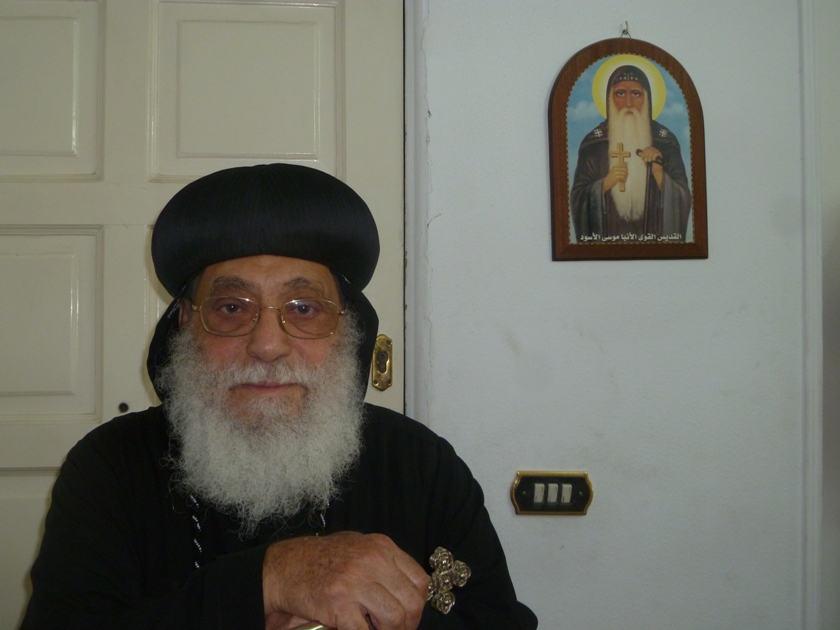
Bishop Antonious Marcos, missionary bishop for Africa. Behind him is a picture of the Coptic saint know as St. Moses the black.
Bishop Antonious Marcos, missionary bishop for Africa. He served first in Kenya and now in South Africa. Behind him is a picture of the Coptic saint known as St. Moses the black.

From my latest article on Christianity Today, published March 28, 2013:

Many Egyptian Christians wear their faith on their sleeve—literally. The cross tattooed on the wrist of Coptic Orthodox believers is a public display which marks their identity for all to see.

Such a quiet witness usually avoids reproach. But recently in Libya, radical Muslim militias detained dozens of expatriate Christians in Benghazi. Amid allegations that captors seared off such tattoos with acid, one Christian died from medical complications during the ordeal, and a Libyan church was repeatedly attacked.

Accusations of evangelism have been at the heart of a series of recent incidents of violence—including the first Coptic martyrs of the modern era—against Copts in Libya, Sudan, and Egypt. Which raises the question: Are Copts starting to recover their missionary heritage?

This article was co-written with a colleague from Sudan, who mentioned the following incident:

Last December, two Coptic Orthodox priests were arrested after baptizing a female convert from Islam. Since the arrests, stories about arrests of Westerners and other Christians attempting to spread the faith circulated in media linked to the state security apparatus, although the accuracy of the reports is hard to ascertain.

Though some Sudanese Copts have enjoyed business success under the Islamist government of President Omar al-Bashir, other denominations have seen their churches destroyed either by mobs or by the state, which cites the breaching of planning laws. With the independence of South Sudan removing the great majority of the nation’s Christians, Bashir has promised a 100-percent Islamic constitution.

Tensions are high also in some Egyptian villages:

There are signs Muslims feel threatened in Egypt as well. Recently churches have been attacked in Beni Suef and Aswan over female converts to Christianity alleged to be hidden inside. Generally this is understood as a Muslim community effort to save face when a woman breaks community traditions or runs away with a lover. Others think true faith might have a role.

“It is an untold story that every now and then a Muslim can be convinced and convert to Christianity,” said Youssef Sidhom, editor-in-chief of the Coptic newspaper Watani. “It is always done secretly, but somehow here it became public. In Upper Egypt especially, this creates a social scandal regardless of the direction of the conversion.”

But far from politically and religiously sensitive conversions in Muslim lands, the Coptic Orthodox Church maintains missionary bishoprics in sub-Saharan Africa:

The reality is the Coptic Orthodox Church remains committed to planting churches—just not in the direction of Muslims. In the 1970s, Pope Shenouda consecrated the first of two bishops for service in sub-Saharan Africa. Today, 65 churches serve more than 400,000 Copts in Kenya, Zambia, Congo, and other nations.

“The early riches of the Orthodox tradition are spreading again in Africa,” said Antonious Marcos, appointed missionary bishop to Kenya in 1976 and now based in South Africa. “Our church is a missionary church, because it was started by a non-Egyptian: John Mark.”

This was a very interesting article to research and write, showing a side of Coptic Christians often not well known in the West. As for the question in the title, are they recovering their evangelistic impulse: Well, they are accused, it seems some are, and reality is just as murky as with Christians around the world.

Please click here to read the full article on Christianity Today.

Categories
Aslan Media Middle East Published Articles

Cultural Imperialism: Egypt, America, and Sudan

Salafi campaign banner in the shade of a church

Egyptian Salafi parliamentarian Mohamed al-Kurdi created a minor stir last week while testifying before the education committee. He declared his opposition to a USAID program to encourage English language teaching in government schools, beginning in grade two as opposed to grade four. Kurdi found this to be an example of ‘cultural imperialism’ and urged the government to cancel the grant.

The Salafi Nour Party, for its part, distanced itself from Kurdi, consenting to their member’s referral to a disciplinary hearing.

Amina Nossair, professor at the Azhar University, criticized:

‘We definitely should not neglect our mother tongue but I would remind Mr. Kurdi that learning foreign languages was advised by Prophet Mohamed.’

Nevertheless, through conversations with many Muslims in the Arab world, I have felt there is a palpable discomfort with the dominance of Western culture. Many of these conversations were conducted in English, so few would argue the language itself should be stricken from education.

Many other conversations, often in their language, have flipped the sentiment arguing Arabic is the language of God. Exasperation at Western culture is often awkwardly articulated as a desire for the reassertion of Islamic cultural dominance. In these cases the issue is seen as one of struggle, rather than respect for the uniqueness of each cultural expression.

But really, why argue in any direction? After all, who can resist the flow of culture? It is above us all.

Such a statement threatens to undo the reality of education as a shaper of values. It is this which Kurdi is addressing in reality, and reflects why the Salafi Nour Party maneuvered to receive the education file in the distribution of parliamentary committee leadership.

An example more akin to Western sensibilities may help win Kurdi sympathy, along with others frustrated over ubiquitous Pepsi commercials starring scantily clad Arab women.

Rev. Emmanuel Bennsion is the pastor for Sudanese ministries at the Anglican Cathedral in Cairo. Sudanese himself, he has lived the past twenty-four years in Egypt. Unlike many of his parishioners, however, he did not arrive as a refugee. In fact, he was a privileged student selected to study in Zagazig University in the Nile Delta.

‘Privileged’, however, is adjoined to the word ‘politicized’. Bennsion is a non-Arab Christian Sudanese from what is now the independent nation of South Sudan. He explains the independence movement is quite old, and the Arab leadership in the north moved to diffuse it as standard policy.

Bennsion stated Sudanese officials targeted bright students from the south to study in Egypt so as to assist in soft, low-key Arabization. During the 1970s up to 300 students a year were selected for the program. They would learn Arabic, gain a picture of Arab civilization from friendly interactions with colleagues, and increase their sense of belonging to Sudan-as-Arab nationality, even though they were ethnically, linguistically, and in some cases, religiously different.

Is this wise policy to unify a diverse population, or cultural imperialism of the sort which Kurdi would decry if applied in reverse?

Consider how many university students from around the world come to the United States. While many come of their own accord, seeking the best preparation for their fields, US policy actively facilitates many programs to give the best and brightest minds a taste of America. If they stay, we profit from brain drain. If they return, they have gained insight into American freedom and values, winning, perhaps, their hearts and minds.

Cultural imperialism, generous welcome, enlightenment sharing, or mere education? It is not a simple question.

Bennsion continues, however, to give what would appear to be a more sinister Sudanese cultural manipulation. All students wishing to enter government elementary schools must first complete two years of preschool in the ‘Kharwa’. Education here, he maintained, consisted entirely of Quran recitation and study of hadith.

This requirement could be avoided if the student entered a private school, but this was cost prohibitive for many. To receive a free education, all students, Christians included, needed to learn the Quran.

In Egypt, all schools teach religion, but separate Muslims and Christians into different classes, taught by approved members of the religious establishments.

Even so, many Christians complain that it is always the Christians who must leave the room, while Muslims remain behind in the normal classroom. Furthermore, the secular curriculum – science, math, and especially Arabic – is laced with Islamic concepts which all are required to learn.

Of course, Islam is the religion of the vast majority and a major shaper of cultural values. In Sudan, this was subjected upon a non-Islamic geographical region. In Egypt, there is no ‘Christian’ area, though Christians are everywhere. Should not Egyptian Copts simply adapt to their cultural setting?

How might your opinion of such issues shape your response to these American questions:

  • Teaching of Spanish versus English-only educational systems
  • Mandatory inclusion of ‘intelligent design’ theories in school textbooks
  • Providing financial vouchers to poor students to attend private/religious schools
  • Allowing Muslims students to absent themselves during class for prayers
  • Sponsoring school prayers or moments of silence before football games
  • Reciting the Pledge of Allegiance, including the phrase ‘under God

The parallels are not exact, but evaluation of the question shapes the search for consistency. What is the proper relation between culture, religion, and freedom? Must we allow for the other what we desire for ourselves? Or is this itself a sentiment derived from a particular cultural-religious framework?

Even if so, is the sentiment superior to cultural imperialism, whether in its Western or Islamic form? Or does appeal to the sentiment itself reflect a return to the zero sum ‘clash of civilizations’ narrative?

Kurdi, however lamentably, reminds us that while we may flail at unwanted cultural expressions, education plays a real role of determination. Egypt, much like America, is in struggle to set its course.

Sudan, meanwhile, has divided over the issue. Is this lamentable? So much depends on perspective, shaped by education, the common collection of which forms a culture.


note: This article was originally published on Aslan Media.


Related Posts: