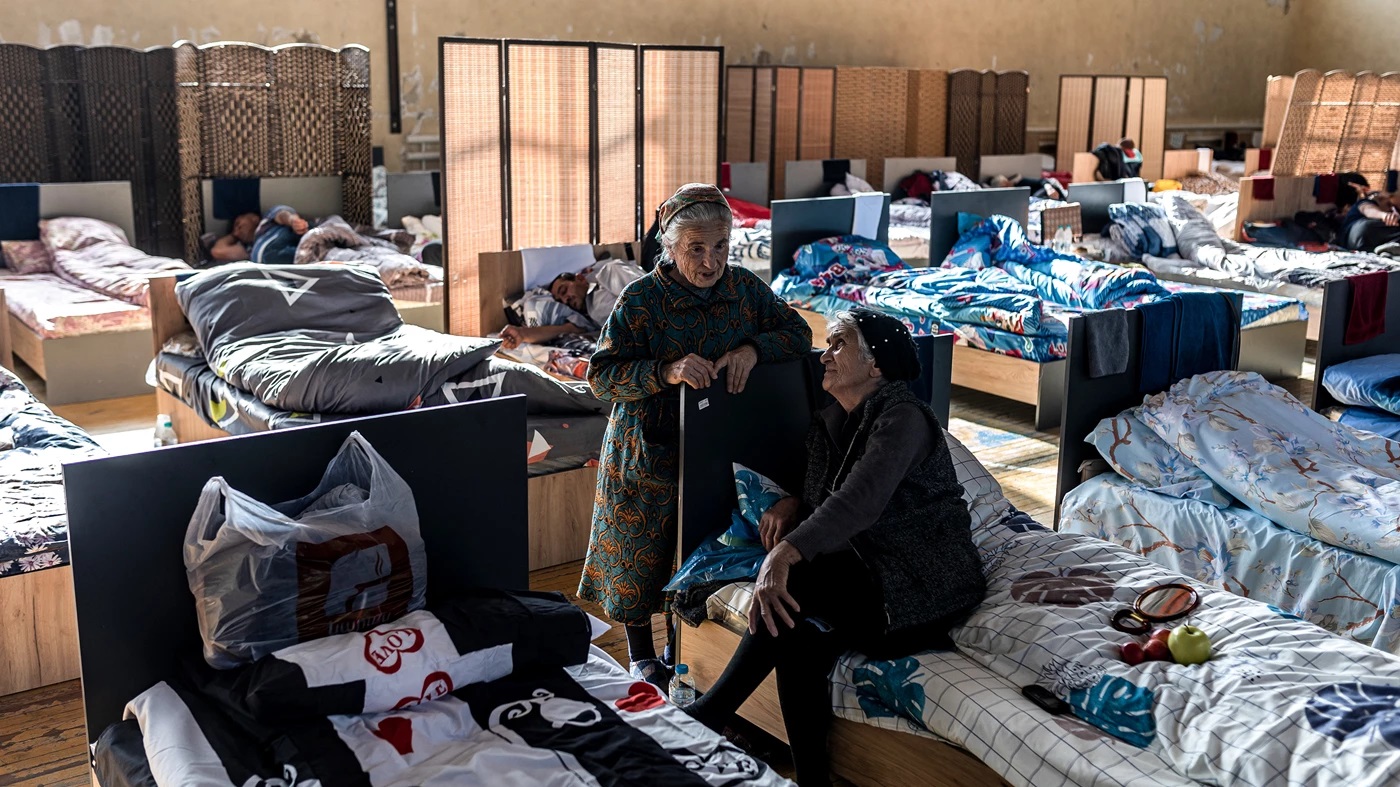
Karolin is one of 30,000 Armenian children without a home—again.
Fleeing the mountainous enclave of Nagorno-Karabakh in the face of Azerbaijan’s assault last month, the 12-year-old girl had an unexpected encounter. After crossing the Lachin corridor westward to Goris in Armenia proper, she found her beloved social worker waiting.
Arpe Asaturyan, founder of Frontline Therapists (FLT), was astounded as well. Amid the 100,000 refugees from what Armenians call their homeland of Artsakh, she had found the very same child displaced three years earlier. A special bond formed with then-9-year-old Karolin, who had gripped her tightly before returning home.
Located within internationally recognized Azerbaijani territory, the Armenian enclave suffered a bloody 44-day war in 2020. Over 6,000 soldiers died before a Russian-backed ceasefire left local Armenian authorities in control of only a portion of formerly held Artsakh land.
Karolin and her family went back anyway, vowing to continue their multigenerational presence. But after suffering malnutrition during an Azerbaijani-imposed nine-month blockade, they trudged three days in the slow-moving convoy of cars and buses across Lachin—the only road connecting the enclave with Armenia.
Over the week-and-a-half exodus, Artsakh residents crossed at a rate of 15,000 per day.
But the bittersweet reunion with Karolin is far from the worst of Asaturyan’s ordeal. Suffering in the chaos of relocation and the fog of war, several mothers told their children they would find their daddy in Armenia.
As counselor, Asaturyan was asked to tell them that their fathers had died.
“It is heartbreaking, and you know this will be the worst day of the rest of their lives,” Asaturyan said. “With all that has happened, it is hard to find faith.”
When the 2020 war broke out, the California native left behind a successful practice in trauma counseling to join her ethnic kin in ministering to returning soldiers and new widows. Funded by the Armenian diaspora, she oversees a small staff of paid and volunteer therapists providing free mental health services.
But in the weeks following last month’s conflict, her office turned into a humanitarian hub. Already, 20 truckloads of aid have been sent to Goris and the summer camp refuge in central Armenia where she first met Karolin.
“They know their life there was tenuous—they even laminate their documents,” Asaturyan said. “This is still the shock phase, but grief is set aside as bereft mothers must struggle now to find a job.”
The Armenian government initially prepared to receive 40,000 displaced from Artsakh; that was the single-day inflow on September 27 alone. The total number represents 3.4 percent of Armenia’s population, added to an existing refugee population of about 35,000. This does not include at least 65,000 Russians who fled to Armenia due to the Ukraine war, driving up real estate prices by 20 percent with skyrocketing rents.
The Armenian government is providing a relocation payment of $260 per person, with a promised monthly support of $100 to assist with rent and utilities. The UN High Commission for Refugees has called for $97 million in international assistance, and the United States has led the way with a pledge of more than $11.5 million.
“Peanuts,” said Marina Mkhitaryan, executive director of the Armenian General Benevolent Union (AGBU), a 180-year-old organization with institutional links to the Armenian Apostolic Church. “The level of support only adds insult to injury.”
Partnering with World Central Kitchen, AGBU has helped provide 80,000 nutritious hot-food boxes to those in greatest need. Soon AGBU will shift to dry-food packages so families can cook their own meals for up to four days. But a strong focus is on integration, equipping the displaced to live on their own.
A logistics center assists with mundane matters like official documentation, establishing bank accounts, and understanding taxes. And AGBU has partnered with a local employment agency to help the displaced find jobs and to provide training in entrepreneurship and the skills necessary for entry-level positions in Armenia’s strong IT sector.
But, being careful with terminology, Mkhitaryan wants more for Artsakh’s former residents than current stability.
“These are displaced persons who will eventually return to our historic homeland,” she said. “Refugee implies a state of no return, and that is not our stance.” Pastor Vazgen Zohrabyan believes this will only be possible…
This article was originally published at Christianity Today, on October 16, 2023. Please click here to read the full text.



 Jayson Casper