Categories
Excerpts

A Brotherhood Upbringing, Christian Compared

From EgyptSource, a personal testimony of growing up in the Muslim Brotherhood:

The Guidance and Light School, in which I spent my third year of preparatory school after our return from Kuwait, was a Brotherhood school which my father helped establish. Since the 1980s, schooling and educational services had become a key aspect of Brotherhood activities and a means of proselytizing. We followed the same curriculum as the public schools, except that we took two additional courses twice per week; one was entitled ‘The Holy Quran’ and the other was a mixture of Islamic stories and proverbs. The only other change was that Music class was replaced with another class titled ‘Hymns.’

Except for drums and tambourines, musical instruments were banned and discouraged. Flyers and posters hung on the school’s walls warning about the dangers of listening to stringed instruments. The hymns which we were forced to memorize consisted of the most widely known nationalist melodies and songs except any mentions of ‘Egypt’ were replaced with ‘Islam.’ The school was of course populated with the children of local Muslim Brotherhood leaders in addition to other Muslim students of diverse backgrounds.

Only now do I realize that until the age of fourteen, I had never once met a Christian. I was in an exclusive world with its own moral values, worldviews, and perspectives on what it meant to be a good person.

There are many similarities to traditional Christian upbringing in the United States. I never found it to be as insular as described here, but there are parallels. It is important to remember that there is a good and proper place for the inculcation of values, which should happen early before being balanced by a broad and diverse education. Of course, it matters what values are being inculcated.

Here is an example of what the author learned, and why he finally broke from the group:

A Brother brought several copies of the newspaper Elshaab and placed them beside him. Like any other meeting, that day’s session began with one Brother reciting from the Holy Quran, followed by a second interpreting a hadith, and a third explaining an aspect of Islamic jurisprudence. Then the Brother opened the newspaper and read it aloud to the group.

He read that the Egyptian Ministry of Culture had published a novel by the Syrian writer Haidar Haidar. Aside from sexual references, the novel contained heretical insults directed at God and the Prophet Muhammad (Peace be upon him). In response, preparations for public rallies were made which would protest the publication of the novel and demand it be burned.

Word for word, this is what the Brother demanded, and I instantly objected. At that time I was the group’s writer, and I refused to write any chants which called for the burning of this book or any other book for that matter.

To this day, I do not know what compelled me to take this firm stance.

I showed one of them some excerpts from Haidar Haidar’s novel which were published in Elshaab. From what I read, I found his writings ridiculous, but I insisted that this in no way justified it being burned. I entered into a long discussion with the Brothers which developed into shouting. The argument between me and the group’s leader grew increasingly sharp, and in an angry outburst he forbade me from taking such a stance. The argument grew even more hostile, and he told me, “Either give up these books you read and your stance on them, or do not meet with us!”

I left the room, and never went back.

I remember growing up in a culture where the ‘secular humanists’ were out to destroy religion, where popular music was a tool of the devil, and I felt like a rebel because I did a report on Jean-Paul Sarte in high school.

Looking back, I am very thankful for my upbringing, which was full of love and nurture. I went to youth group, memorized Bible verses, attended Christian summer camps, and idealized Ronald Reagan. I recognize in my adult worldview many shades of agreement with the pronouncements of danger I received growing up. I can only imagine many of the Muslim Brothers have similar experiences and warm memories. I’m sure this author does.

There are many points to compare and contrast, and I hope to do so later on in a full essay. But I’m glad to read this very human picture of what it is like to grow up in the Brotherhood. Please do read the whole article.

Related Posts:
Categories
Excerpts

How the Brotherhood Differs from Egyptian Culture

From the Arabist:

Nawara Nagm is a revolutionary activist who believes one of the main flaws of the Muslim Brotherhood as an organization is that they do not know how to talk to the Egyptian people. Correct or not in her assessment of the Brotherhood, her article is very humorous and offers great insight into Egyptian culture. There are many lessons here for those willing to learn (and, God forbid, exploit).

Here is a good excerpt:

The Muslim Brotherhood’s problem is that they do not resemble the Egyptian character in any way, they don’t have the Egyptians’ light touch and don’t understand the nature of the Egyptians whom they are trying to rule amidst this turbulence. They don’t understand Egyptian taste in food, clothes or arts. It is a “yes, master” organization ruling a people that only park their cars under “No Parking” signs; a highly organized group ruling a people who spray water in front of shops to cool things off; a dour organization ruling a people that never stops laughing at its own misfortunes; an organization that says “die in your rage” ruling a people that does not fear death even when crossing the street and that does not die when it is in rage, but takes revenge on those who inspired their rage and makes a joke out of them; it is a bureaucratic organization ruled by an official with a family, branch and bureau[3] all above him ruling a people that manages things on the fly.

What’s worse, the Brotherhood deals with us on the basis that we’re an “ill-bred” people and they want to teach us some manners. There’s no greater proof of that than the text of the constitution that the Brotherhood drafted, putting in every article expressions like “cultivation,” “morals,” and “values.” The only thing left for them was to put: “The people must brush their teeth and clip their nails.”

I don’t know what the reason is behind this naïveté on the part of the Brotherhood. Your Excellency the President, Mr. General Guide [of the Brotherhood], Mr. Khairat al-Shater, have you never driven a car on the streets of Egypt? If you do something wrong, smile at the person you wronged and say: “Sorry, I owe you an apology,” he will break out in a smile and say: “May God ease things for you, brother!” And if the other person is in the wrong and you open your yap at him, he’ll say: “Why are you shouting? Don’t I have a voice same as you…that’s not the way to do things…to hell with you.”

Easy… easy… Showing one’s anger doesn’t work with Egyptians. Egyptians are not afraid of a raised voice, since God has blessed them with a throat such that when they whisper in your ear in Imbaba, they’re heard in al-Tagammu al-Khamis,[4] and they don’t get startled or shaken. It’s through gentle coaxing that you gain our affection.

Related Posts:

Categories
Personal

Egypt Conflict Alert

From the International Crisis Group, trying to find a solution to the current political mess:

Reversing these dynamics requires efforts on two fronts. Politically, the key is mutual acceptance of two realities: that the Brotherhood’s electoral victories give their rule legitimacy, but that a historic, complex transition in a challenging security and economic context requires exercise of power to be tempered by meaningful consensus-building.

Several steps would help: an end to opposition calls for the president to step down and agreement by Morsi that the constitution, whose adoption was marred by boycotts and low voter turn-out, ought to be revised to allay the apprehensions of non-Islamists and notably the Coptic community. Likewise, the process for designing the elections law — another topic of sharp disagreement, especially on district boundaries and the representation of women — should be revisited to reflect broader agreement among factions. Finally, in the wake of approaching parliamentary elections, parties should seek to form a national coalition, a result that would serve both the Muslim Brotherhood (which would gain from the opposition becoming a responsible stakeholder) and the opposition (which would be better positioned to impede what it views as efforts to institute single party rule).

Very good analysis (if you read the whole thing), and workable solutions. The main monkey wrench could prove to be the Salafis. Amending the constitution implies making it more liberal and less religious. If the Brotherhood signs off on this the Salafis could turn against them quickly, and it is unlikely middle-ground liberals would come to their electoral rescue.

The concerning point is that the best path to power for the Salafis could be in a full chaotic rupture of society, requiring a full military-religious partnership simply to restore order. Certainly not publicly, but does the Brotherhood implicitly threaten the liberals that they (the MB) are the best bet going? Otherwise, we turn the Salafis on you?

But if this is part of the Brotherhood negotiation tactic, it will certainly ring hollow for liberals when the MB turns consistently to Salafis for support. Their rubber-band-like moves from the right to the center must be wearisome to the opposition. What does the Brotherhood want, and what do they represent, truly?

Not that the opposition plays clean or consistently, either, as the article makes clear. But the constitution has soiled all trust and destroyed the middle ground. It would be a shame if the constitution itself is, in fact, the best middle ground that can be obtained. Ugh, as illiberal as portions of it might become.

Related Posts:

Categories
Personal

Albert Saber: The Brotherhood will Drive the People to Secularism

From Daily News Egypt:

Albert Saber recently fled Egypt on the eve of his conviction to a three year prison sentence for blasphemy. He is of Christian background, but is a public atheist. The following are quotes from the article, do read the whole thing.

How did you decide to become an atheist?

My journey towards this decision was in the period between 2001 and 2005. I had decided that I would not simply inherit religion. Faith here is hereditary; if your parents are Christian, you’re Christian. You have it written on your birth certificate before you can even think. And it is the same for Muslims.

In 2001 I decided to read about other religions. My thinking at the time was that I was born a Christian but I had not actually decided that for myself nor had I considered other religions. I felt like there could be a chance that my religion is the wrong one and that God would punish me for it since I did not seek out all the options first.

I spoke to a lot of people, including religious leaders and clerics from several faiths, I read a lot of books, and eventually I realised that religion was merely a way to find God, but that there were so many different religions, and even inside each religion there were many sects, so why did each claim a monopoly on God? Why did they all claim they were going to heaven and everyone else was not?

The circle then started to get wider. When I first started this journey I felt that religion could be easily disputed but I still believed in the existence of a god, so I had a limit, which was the existence of a creator deity. After reading and researching the issue I started to break out of this limit and think that there might not even be a god at all. I eventually decided that it did not make sense to me and I became an atheist.

Did you face any difficulties in the decision to go public with it?

The Islamists in university subjected me to three assassination attempts.

Their leader and I had a political discussion once on the train and we became friends, I did not know who he was but my friends told me later.

After that I started to gain a reputation for my views that are critical of religion, mostly because of what I said in comparative religion classes. The Islamist youth leader decided that I was too dangerous.

He started sending members of his group after me, they constantly tried to start fights with me so that they could beat me up but I would not rise to their taunts and my friends were also looking out for me.

How, realistically, can Egypt become a secular state, especially in light of Islamist domination of the public sphere?

We have a movement here in Egypt called “secularists” for example and they take to the streets and raise awareness about the issue. I believe in confrontation. I used to debate Muslim Brotherhood members on secularism before the presidential elections.

However, the way to achieve state secularism is through raising awareness. It is the same way we were able to revolt. We raised awareness amongst the people that we are not just silly youth and that our demands were for their benefit. Eventually they joined us or at least stopped opposing us.

Everyone in Egypt is talking politics right now. We should start political campaigns explaining what the word “secularism” actually means. We need to explain separation of religion and state and how the state is an institution and cannot adopt a specific religion. We need to explain things like dictatorship of the majority and how democracy also means protecting the rights of minorities.

Will Muslim Brotherhood rule lead to a religious state, or will it backfire and lead the people to reject religious rule and form a secular state?

I think this has already started. As soon as the Brotherhood appeared openly on the political scene they needed allies such as the Salafis, Al-Jama’a Al-Islamiya, and jihadist groups. They all allied because they speak in the name of religion.

These allies started making a lot of mistakes due to their political inexperience. The people started to reject their domination and move towards secularism. The people are now much more critical of religious leaders and feel that they no longer have a monopoly on religion.

This will lead to a secular state without the people even calling it that.

Categories
Lapido Media Middle East Published Articles

Muslim Brotherhood Launches Development Campaign as Violence Rocks the Nation

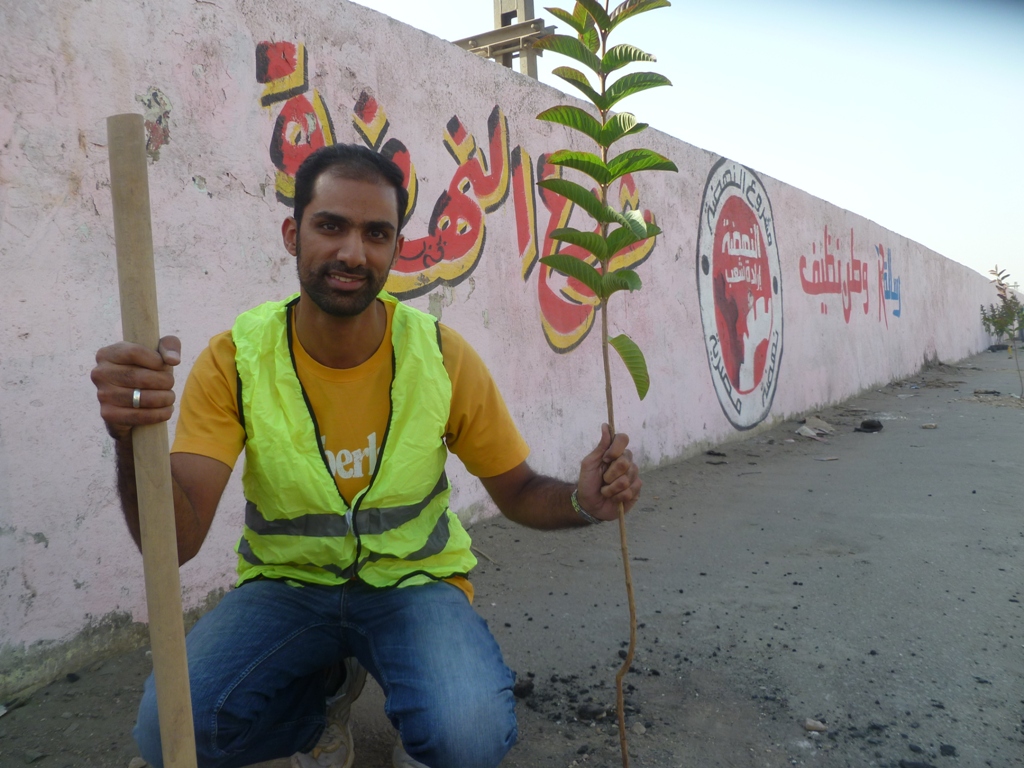
MB Helwan Trees

Not all in Egypt is chaotic.

The Muslim Brotherhood are repairing schools, serving the poor and beautifying streets.

While violent protests and political impasse grab the headlines, the Muslim Brotherhood has launched a much quieter campaign to commemorate the two year anniversary of the January 25 revolution.

Hatem Abd al-Akhir is the leader of the Brotherhood’s Freedom and Justice Party (FJP) in the city of Helwan, to the south of Cairo.

‘We wanted to celebrate the revolution in a different way,’ he told Lapido Media. ‘But other parties are trying to interrupt society and start another revolution.’

The Muslim Brotherhood built its reputation on providing social service to the poor. As the economy declines and their popularity diminishes, they peg the opposition as agents of instability.

Ahmed Kamal is the FJP youth secretary in Helwan. ‘We’re trying to get Egypt into a new stage of building and development,’ he said to LM. ‘This is the message we want to convey both inside and outside Egypt.’

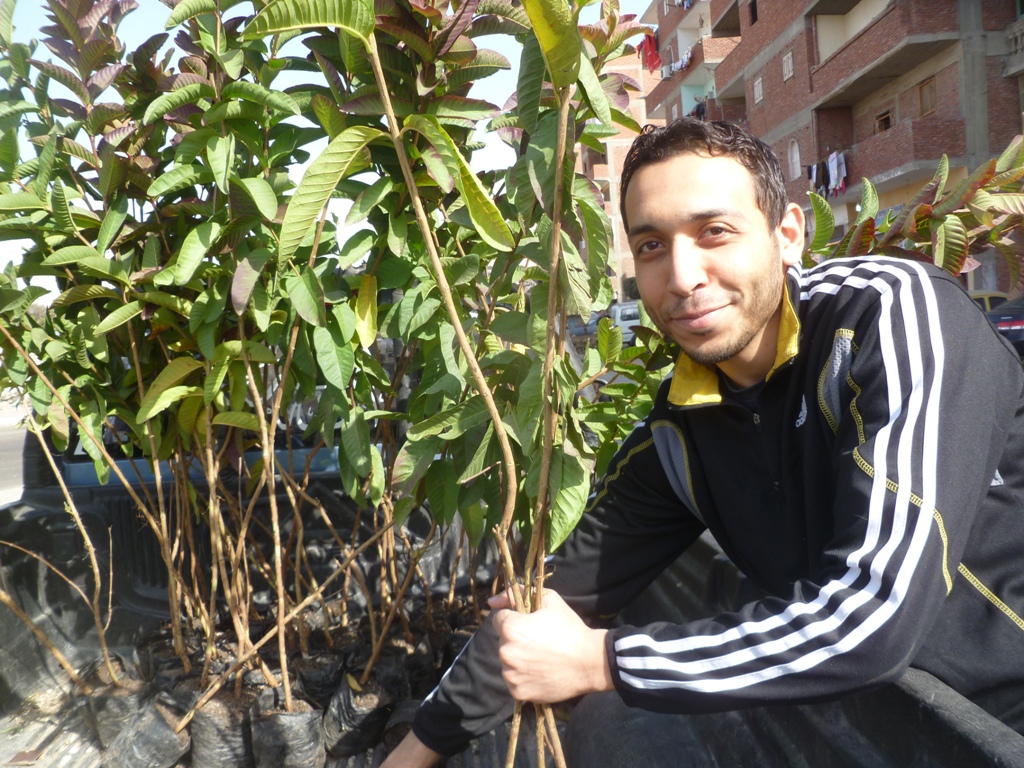
To do so, the Brotherhood is planting one million sapling trees throughout Egypt, one hundred of which are in Helwan. Kamal led teams of youth digging holes in the limited dirt of the urban landscape, boring even into the sidewalk.

Hatem Abd al-Akhir
Hatem Abd al-Akhir

Abd al-Akhir, meanwhile, participated in the effort to provide a million citizens with healthcare. An ophthalmologist, he offered free eye examinations to diabetic patients and at-cost treatment for any operation.

As the manager of the Helwan Eye Center, he assures normal costs for patients are 30 percent below market standard. Yet the centre still makes a small profit, illustrating a mix of business and charity, politics and social good.

‘The Muslim Brotherhood is a logistics service for advertising,’ he said describing the campaign. ‘We want to propagate values in our community which will help keep the peace.

‘When we offer low cost service we oblige others to not raise their prices above what is acceptable.’

But in a time of great social and political upheaval, it is unsurprising some are critical.

Ahmed Ezzalarab is the deputy chairman of the liberal, opposition Wafd Party. ‘They are trying to distract people by giving a different image of development, but it is too late,’ he told Lapido Media. ‘They are being exposed for their secret agenda which the people are rejecting.’

Ezzalarab does not dispute their social work, but recognizes it is necessary to oppose the Brotherhood for their poor record in power. In recent weeks train accidents and building collapses have claimed the lives of dozens of citizens.

‘Governance has never been worse in Egypt’s history,’ he said. ‘They cannot run the country administratively; everything they touch fails.’

But in describing a secret agenda, Ezzalarab appeals to conspiracy.

‘We are completely against the violence, which is working to distract the people from the peaceful nature of the opposition,’ he said. ‘It is being funded by Wahabi and Gulf money, because they are scared to see civil forces come to power.’

Ezzalarab believes the Brotherhood is panicking, fearful the army will step into the violence and unseat them from power. Perhaps he is right.  Brotherhood leaders are clearly propagating the conspiracy theory.

Anas al-Qadi, Brotherhood spokesman said on the official MB website, Ikhwanweb.com: ‘This is the difference between the Muslim Brotherhood marking the memory of the revolution with greatly appreciated services, and so-called civil forces celebrating the revolution with flagrant acts of arson and violence, spreading chaos and destruction and vandalism.’

The website also accused one of the newly organized vigilante groups, Black Bloc, of being an arm of the Coptic Orthodox Church.

Any of the various accusations may be correct, but they are presented without evidence and signal that both social service and social violence are a means to an end.

Ahmed Kamal
Ahmed Kamal

‘If you are trying to apply Islam as you understand it, you have to reach authority by all legal and peaceful means,’ said Kamal. ‘To do this you have to show people why they must support you.’

Kamal was responding to the charge that the Brotherhood is putting good works on display, contrary to Islam.

‘We need to differentiate between being a Muslim and being part of an Islamist program which competes with other parties,’ he said.

‘As a Muslim, you can choose to tell or not tell of your good works, it depends on your intention. If you tell you can be a role model that others will follow, but God will judge you in either case.’

But for now, Egypt is the judge, and the verdict is a cliff-hanger.

This article was first published on Lapido Media.

Related Posts:

Categories
Personal

Two Years of a Shrunken State

From the Arabist:

This is a useful follow-up to the previous post on diplomacy:

Perhaps the only viable way to get the state to function is for the Brothers to offer the opposition enough reassurance that major political forces together could reach consensus on the illegitimacy of violent protest. If Egypt’s political forces acted in unison — a general appeal for order, or for justice to take its course, or for disputes to be resolved in parliament rather than in the street — these have a powerful calming effect. The Interior Ministry, for example, has called for such an appeal to “patriotic forces” to calm Port Said.

The opposition would probably not try to coax protesters out of Tahrir, nor would it be necessary — the square can probably remain an open-air museum of the revolution as the state rebuilds itself elsewhere. But a joint appeal for order would at least contain street violence and push Egypt’s flare-ups of violence to become less frequent and bloody.

The opposition knows however that to stand alongside the Brothers would be handing Morsi a major concession. The National Salvation Front has demanded as the price for its cooperation that a committee be empowered to amend the constitution. If Morsi’s objective in pushing through the constitution in December was to provide some security for his administration — ie, to prevent the Supreme Court’s from topping off its dissolution of parliament by pushing Morsi out of office, as Brothers said they suspected might happen — then perhaps he would take that risk.

But the first articles targeted would be ones that circumscribe civil rights with religion. The Brothers have in theory agreed to revisiting the constitution. If the Brothers are committed to aggressively Islamicizing society, or if they are worried about having their Islamic credentials challenged by the Salafis, they aren’t going to give the opposition what it wants.

This is an excellent analysis of why the opposition is being somewhat mum on all the street violence. Conspiracy will say they started it, but they are not standing in the way. In fact, rightly in a sense, they lay the burden of responsibility on the state. Ongoing violence is a function of state ineptitude and political intransigence.

So after sidelining the opposition to get what they wanted (i.e. the constitution), Morsi now calls them back for dialogue – but as above – will he be willing to pay the price? It is as if the opposition is saying: You cheated to get your constitution, we’ll cheat to take it back.

Islamists may say the opposition has been cheating from the beginning, but this only opens up the conspiracies even further, which most liberals are happy to slap back at the Brotherhood. It gets Egypt nowhere.

The only thing that will, as the author suggests, is consensus. Can it be found? If not, what is the price?

Categories
Personal

Diplomacy is Dead

From the New York Times:

DIPLOMACY is dead.

Effective diplomacy — the kind that produced Nixon’s breakthrough with China, an end to the Cold War on American terms, or the Dayton peace accord in Bosnia — requires patience, persistence, empathy, discretion, boldness and a willingness to talk to the enemy.

This last point is crucial. One must always talk, and listen. Yes, even the fact of talking grants a measure of legitimacy, and it can be said this should not be freely offered. One reason why Hamas refuses to acknowledge the Jewish State of Israel is that they feel this is must be an end result of negotiation, not its starting point. But even so, Israel and Hamas have been communicating for years, through back channels.

Speaking of Hamas:

Breakthrough diplomacy is not conducted with friends. It is conducted with the likes of the Taliban, the ayatollahs and Hamas. It involves accepting that in order to get what you want you have to give something. The central question is: What do I want to get out of my rival and what do I have to give to get it? Or, put the way Nixon put it in seeking common ground with Communist China: What do we want, what do they want, and what do we both want?

Earlier in the article the author mentioned Egypt as a mini-success of Obama’s diplomacy, and he may have a point. Many here in Egypt’s opposition see the current situation as a negotiated settlement between the US, the military, and the Muslim Brotherhood. Each one has gotten something that they want. The opposition, meanwhile, feels left out in the cold.

But here is where diplomacy’s rubber meets the road. For the idealist, it is painful. But did the opposition get what it wants? There is the beginnings of a democratic system which can be continually contested. They just didn’t win.

Maybe. But to voice their complaint, what did the Brotherhood get? Access to the reigns of power has limits – the army is off limits, as is any real tension with Israel – but comes with great privilege. Some see this privilege extending to be able to manipulate the situation (democratic as it may remain) for their own benefit. What does this give America? As goes the theory, stability in the region.

So, diplomacy, if this picture is true, is it good enough?

For America, perhaps. The task of international diplomacy is to secure the interests, and not the ideals, of the home nation. If Egyptians only get a manipulated democracy that allows the US to check off the accomplishments of its own internal ideals, of what major concern is this to America?

But that is no reason for the Egyptian opposition to accept the situation. They have their own diplomacy to worry about. And part of diplomacy is overstating your case in negotiation. It is conceivable they have quite exaggerated the manipulations of the Brotherhood.

But do the events of yesterday, the second anniversary of the revolution, suggest that the opposition is abandoning diplomacy?

Diplomacy achieves an imperfect solution, but tends to avert war and violence, which usually are far less perfect for all parties involved. But goodness, is it maddening.

Categories
Prayers

Friday Prayers for Egypt: Second Anniversary

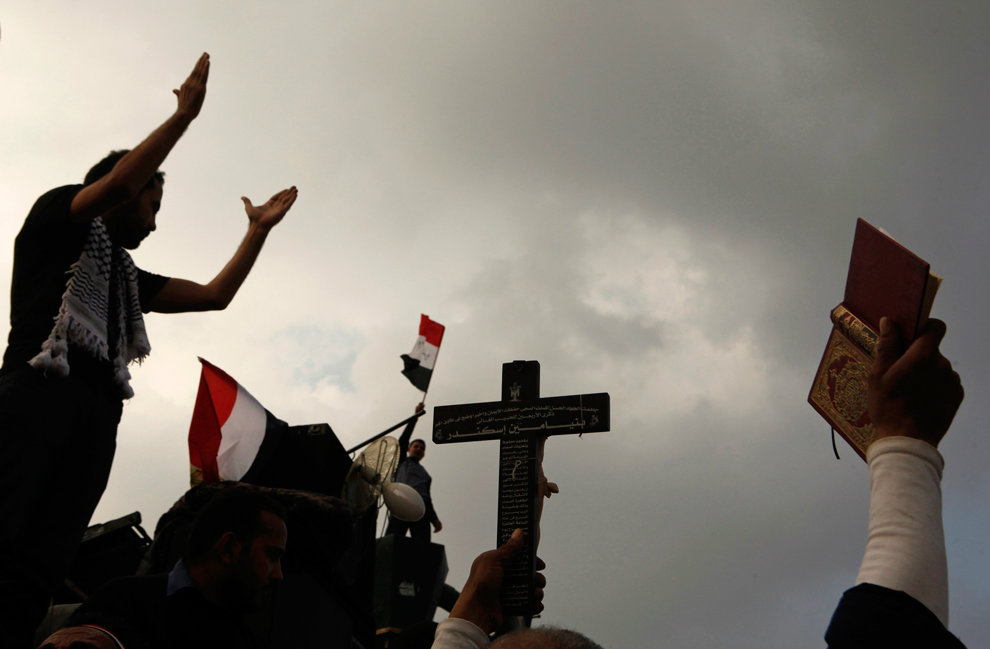
Flag Cross Quran

God,

Who will win? Who is fighting? Is the revolution discredited? Is the revolution succeeding? Does this aid Morsi and the Brotherhood? Will it overthrow him/them? Is the National Salvation Front orchestrating? Are they carried along? Is chaos coming?  Is a crackdown coming? Is Egypt being destroyed? Is the old regime being destroyed? Who will win?

God, when so much has been wrong – when so much is wrong – it is not easy to put right. But right can only be built with right. There has been right – there is right – in Egypt. But it has not all been right. A good bit of right doing has been done wrong.

But where, God? Call out righteousness and justice and proclaim it to the people. Anoint men of clear conscience and pure heart to place pure good above all else. Men who will not compromise on the right. Men who will accept failure over hypocrisy. Men who will stand aside that principle may triumph over personality. If these men are already here, God, aid and support them.

Ah, but are such thoughts hopelessly idealistic? Are they futile and self-defeating? Do they pave the way for men of cunning and ambition?

God, bless politics. Bless revolution. Bless every good intention men possess.

Give wisdom. Give courage. Give the power necessary to the necessary people.

But also purge.

Purge good men from the evil within them. Purge good movements from those who seek profit. Purge good ideas from flaw and error. And as purging is always painful, be merciful.

But then restore. May no purge be permanent. May none be excluded. May Egypt rise in cooperation of all her people, all her movements, all her ideas.

God, prayer is not the place for the hard work to make this possible; this is for men in all their counsel. But might it be? If they pray, will you bless Egypt with this solution? If only some pray, will you give it anyway?

God, give Egypt this solution, and give it quickly. Spare her more trouble, but do not leave her with only partial good. Remake her to reflect your perfection, through only that which is good and right. And as long as she falls short, may she repent, regroup, and try again.

Who will win, God? May it be according to your righteous knowledge, however messy it must be to those waiting, striving, and suffering.

Amen.

Categories
Personal

Family in Tahrir

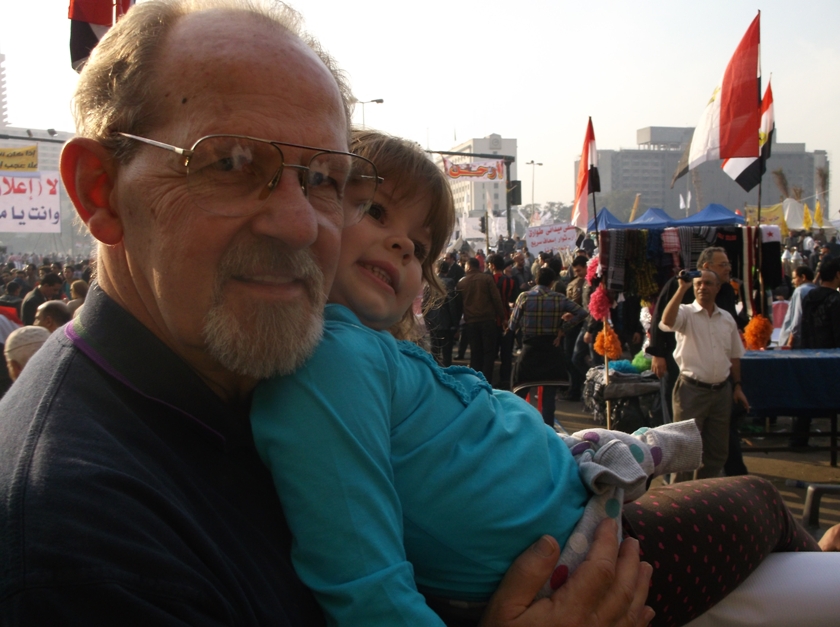
Sidu and Hannah
Sidu and Hannah

With Egypt on the eve of another potentially massive demonstration, it is time to pull these pictures out from the archive. They are from the day I took my four year old daughter and her grandfather to Tahrir. I didn’t post them immediately, as I didn’t want to scare the rest of the extended family. And to set hearts at ease, I don’t plan to take anyone tomorrow.

It is hard to recall all the events of Tahrir, but on that occasion there were once again clashes – the night before. My parents were visiting to help assist with the birth of our new son; of course my father had to see the famous square. The best time to avoid violence is morning, when all are exhausted from fighting through the night.

‘I smell nail polish remover,’ said Hannah, my daughter. She was sort of right; I had never noticed how it resembled the scent of lingering tear gas.

‘What pretty decorations,’ she said. I looked all around, wondering if she was referring to the graffiti, some of which is rather creative.

‘No, the shiny ones,’ and she pointed toward the middle of the road. Ah, barbed wire.

With a local protestor

Some lessons I explained, others were left unsaid. My children are getting quite an education in Egypt.

As for my father, he was particularly impressed by an incoming march as we exited the square along Kasr al-Nile Bridge. ‘Such passion,’ he remarked. We even got a quick glance of Hamdeen Sabbahi’s silver locks as he accompanied the procession to Tahrir.

(Sabbahi not visible)

As for tomorrow, the two year anniversary of the start of the revolution, expectations are meaningless. Tahrir could be packed, or victim of protest fatigue and sullen resignation. It could spark a second revolution against the Muslim Brotherhood, or descend violently into anarchy and chaos.

Here’s hoping for a protest without nail polish and decorations.


Related Posts:

Categories
Current Events

Egyptian Jeans under the Patronage of the Muslim Brotherhood

From Ahram Online, discussing Qualified Industrial Zones (QIZ) with Israel:

On 9 December, 2004, a report that was published on the Muslim Brotherhood’s website Ikhwan Online titled: “Muslim Brotherhood MPs: QIZ threatens Egypt’s security”, said the Brotherhood parliament bloc warned against the risks of the QIZ agreement that was then due to be signed within days.

The site reported that according to MP questionings and interpellations, “the agreement is a serious threat to national security because it is the first economic and industrial agreement with the Zionist enemy.”

At the time, Brotherhood parliamentarian Hamdi Hassan, said in an interpellation, that the agreement “achieved all that the enemy has sought for decades: controlling the region economically through interfering in the Egyptian economy after it controlled it politically in the wake of the Camp David agreement.”Hassan concluded by saying “you cannot make peace, promises or QIZ with Zionists”.

Earlier the article gives the detail:

On 9 September 2012, in an interview with economic news agency Bloomberg, Qandil [Egyptian prime minister, appointed by Morsi] said that Egypt will meet its commitment to the agreement which opens up the US market for Egyptian products if they have a 10.5 per cent Israeli component of added value (which Morsi’s Egypt wants to reduce to eight per cent).

Qandil also said that “a lot of people  are making good business out of that:  we want to make sure we do the right thing for them to flourish.”

Earlier Ahram Online reported the program was not only continuing, but expanding to new governorates. The current articles provides many figures to describe the economic impact is limited.

I have no idea if these Qualified Industrial Zones are a good idea or not. If one desires normalization with Israel, which it seems most Egyptians do not, the idea of integrating business opportunities seems like a good way to begin.

But with this current expansion, was previous MB opposition principled or rabble-rousing? Is their current support principled or kowtowing to US demands? Politics, politics, with religion added to stir the pot.

Related Posts:

Categories
Current Events

Bahais and Egyptian Education

From Egypt Independent:

The education minister has repeated remarks that Bahais cannot enroll in public schools, saying it violates the Constitution.

“The Constitution only recognizes the three Abrahamic religions,” Ibrahim Ghoneim told Akbar Al-Youm newspaper Saturday. “And as religion is a subject taught in schools, they do not meet the requirements for enrollment.”

Ghoneim had told Al-Sabah newspaper the same statement in November, when he was asked, “What is the position of the ministry concerning the children of Bahais? Do they have the right to enroll in a [ministry-affiliated] school?”

The minister responded by saying, “The state only recognizes three religions, and the Bahai faith is not among them. Thus their children do not have the right to register in government schools.”

It is noteworthy the minister makes reference to the new constitution to justify his position. But it is also noteworthy this was his position before the constitution was approved. The ministry of education is not one of the institutions which has been headed by a member of the Muslim Brotherhood, indicating anti-Baha’i sentiment predates their takeover of government.

But, see this article for more intrigue:

In a statement issued on Sunday, the syndicate added that around 22 members of the Muslim Brotherhood were promoted to senior positions in the minsitry following the election of President Mohamed Morsy in June.

This week, the ministry denied news that it was “Brotherhoodizing” the ministry or curricula and dismissed as false claims that it had removed pictures of protesters killed during the 25 January revolution and those of unveiled feminist leaders in Egypt and inserted verses from the Quran in the national education book to advocate loyalty to the ruler.

In the statement, the syndicate mentioned the names of Brotherhood members who were promoted, saying that under the mandate of Education Minister Ibrahim Ghoneim, the ministry started implementing a plan to “Brotherhoodize” education, the first step of which was to control decision-making centers through the gradual replacement of ministry leaderships with members from the Brotherhood.

Things are very murky in Egypt, and much struggle is going on behind the scenes. These are not the battles that can demand demonstrations, but they may very well signal the direction Egypt is headed, without much media coverage.

Categories
Prayers

Friday Prayers for Egypt: Egyptian Jews and Salafi Splits

Flag Cross Quran

God,

Division does not please you. You have created us differently and esteem these differences. We have different opinions and go our different ways. But when we break relationship – forgive us.

As many in the liberal and leftist and revolutionary camps have come together to oppose the Islamists, honor them, even if their unity is temporary and superficial. Help them, God, that it may be otherwise. If they part may they part as friends, having accomplished good for Egypt.

At the same time, many in the Islamist camps are coming apart. The reasons are unclear, but appear to be personal, political, and administrative – not ideological. You know the heart of these leaders, God, but heal the divisions that they have. If ambition or strife stands in the way of worthy ideals, keep their house in order. If they part, may it be as friends, having accomplished good for Egypt.

Judge, God, if the division between these camps is honorable or displeasing. Heal the wounds that exist; correct the assumptions which poison. May each esteem the good in the other, and expose all wrong. Unite them in discernment, that together they may accomplish good for Egypt.

And bless those, God, who are healing historical division. Certain Muslim Brothers have invited Jews of Egyptian origin to leave Israel and reclaim their property and heritage. You know, God, the purpose and sincerity of such remarks, which the presidency has distanced itself from and other Islamists have rejected. But honor at least the symbolism – if not more – that Egypt may be a place of welcome for all people.

Be with Egypt, God. Grant the people a common vision to rebuild their nation. May you be pleased with what they create.

Amen.

Categories
Christianity Today Middle East Published Articles

Egyptian Christians Face the Future Under New Islamist Law

Face the Future

From my new article on Christianity Today, published December 28, 2012:

Egyptian Christians spent this year’s Advent season awaiting more than the celebration of Jesus’ birth. Christmas Day dawned with Copts still processing the rushed passage of a new Islamist-backed constitution and its implications.

Days before voting began on the hastily completed charter—which, despite only 33 percent turnout and accusations of fraud, passed December 25 with 64 percent of the vote—more than 10,000 Christians gathered at an interdenominational prayer vigil in Cairo’s famous “Cave Church.”

Please click here and here for more information about this prayer gathering. But the article continues:

“Morsi has not kept his promises to be a president for all Egyptians when he had a chance to do so, and he is losing credibility,” said Ramez Atallah, president of the Bible Society of Egypt. “When the leader is not working for consensus, it makes it very hard for anyone else to do so.”

Yet Atallah still advises Christians to remain politically active while grounding their expectations in the necessary dual perspective of Christianity.

“We must be good citizens,” he said. “This panic is not justified in our faith, even if it may be justified in terms of politics.

And here is a section on liberal ‘hope’ for political reversal in the midst of anticipated economic difficulty:

But as liberals have consistently failed to win at the polls, some place a morose hope in Egypt’s expected financial difficulties to aid their parliamentary campaign.

“There is an economic disaster coming,” said Michael Nabil, an Egyptian accountant. Since the revolution, Egypt has lost more than half of its foreign currency reserve fighting inflation and devaluation. “This will affect the situation negatively for the Muslim Brotherhood and give the opposition more credibility,” he said.

I had hoped to write this week’s Friday Prayers for Egypt about the economy, but was unable to. Perhaps after the climax of the constitution nothing this week seemed so urgent for prayer. That is not true, of course, but like many in Egypt, I feel somewhat drained, and this week was a week of recovery. Western Christmas celebrations helped.

The main issue for the prayers would have been the feared coming economic collapse. It may well happen, but is also tinged with manipulative rumors that seem almost designed to produce a panic.

Finally, a quote on what seems a very proper perspective for Egyptian Christians:

“There is no connection to political stability and the success of the gospel,” said Atallah. “In fact, the opposite might be true: People depend more on God in difficult times.”Maybe God will use the Muslim Brotherhood to do his will in Egypt, even if we don’t want them to be in charge,” he said.

Please click here to read the entire article on Christianity Today.

Categories
Arab West Report Middle East Published Articles

Protest and Prayer in Egypt

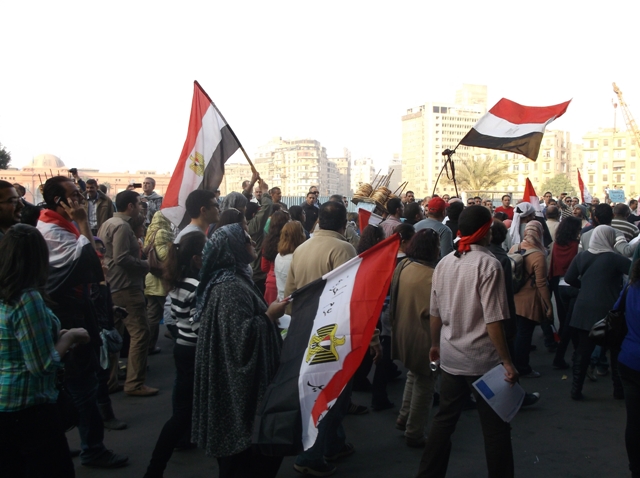
Crowd 6

Rarely has a constitution so divided a nation. Protests, both for and against and sometimes violent, have filled the street. Egypt’s Christians, meanwhile, are caught in the middle. Though united against the proposed draft, their responses have varied considerably.

“It was definitely right for Christians to protest,” said Youssef Sidhom, editor-in-chief of the Coptic newspaper Watani and a long time advocate of cooperation with the Islamist administration.

“But this was not a Christian move, it was a liberal Egyptian protest meant to save the civil state.”

Despite his conciliatory position toward the Muslim Brotherhood, Sidhom had warned the day might come to return to the street if Islamists tried to implement a religious agenda. When President Morsi assumed temporary dictatorial powers to push through this constitution, he believed it was time.

“There are many indirect clauses that can lead to an Islamic state, and a few direct ones as well,” he said. Chief among these is Article 219 which makes traditional Islamic jurisprudence the primary source of legislation. Article 4, furthermore, gives a role to unelected Muslim scholars who must be consulted on laws regarding their conformity with shariah.

But it was the Islamist response to these protests which makes Sidhom believe they have shown their true colors.

“They made vicious remarks stating the protests were 60-80 percent Christian,” he said. “This shows they realize the solidarity that exists between liberals, moderate Muslims, and Christians, and they are trying to break it.”

Indeed, in an effort to mobilize votes for the constitution, the official Muslim Brotherhood website featured a story alleging Christians exchanged SMS messages urging a ‘no’ vote because they wanted ‘a Coptic state’. Safwat Hegazi, appointed by Morsi to the National Council for Human Rights and a fixture during his presidential campaign, warned the church that if it threatened Morsi’s legitimacy Muslims will threaten them ‘with blood’.

Hegazi’s remarks were filmed at a Salafi Muslim sit-in protest at Media Production City, where they believe their image is being disfigured in the press.

“In the sharia, which people do not understand correctly, everyone takes their full rights – the woman, the non-Muslim, everyone,” said Ibrahim Eid, an ophthalmologist and the media coordinator of Students for Sharia, present at the protest. Salafis there were peaceful and friendly.

This message came across to Daniel Wahba, a Coptic taxi driver. Idling in the parking lot, Salafis engaged him winsomely.

“Is there anything in the constitution that will hurt us as Christians?” he said. “Won’t we still be able to go to the church and pray?”

But it was the fear associated with general Islamist domination that affected Susie Fayiz, a Coptic housewife. “I didn’t vote,” she said. “They are just going to rig the referendum in their favor anyway.”

Preliminary results show the ‘yes’ vote in the lead with 56 percent, amid accusations of fraud. Half of Egypt’s electorate is scheduled to vote next week.

Thousands of Christians took to the streets to protest, and thousands of Christians went to the polls to vote. In between, ten thousand gathered to go to their knees in prayer.

The church is led by Fr. Simaan (Simon), who serves the Christian garbage collectors among whom he built this church.
Fr. Simaan

“We are here tonight to pray for Egypt in all that it is going through, and let us pray with tears,” said Fr. Simaan, a Coptic Orthodox priest serving the city’s garbage collectors. Their expansive cathedral is built into a cave in the Muqattam Mountains east of Cairo.

One year earlier, Fr. Simaan conducted a similar prayer gathering for all of Egypt’s Christian denominations, which drew upwards of 40,000 people. Plans to repeat the expression of unity have been in the works for months, but this meeting was only announced one week earlier, scheduled for two days before the referendum.

If there was any intentionality it did not appear during the rally. From 6pm until 6am the next morning, not once was the referendum mentioned. The general state of Egypt, however, was on everyone’s mind.

“Some of us see demonstrations and conspiracies, but I see Egypt going right. I see great days ahead of us,” said Fr. Andrawus, an Orthodox priest from Damanhour in the Nile Delta.

“Some say this country is being destroyed or being stolen. I say God is coming and he will not be late. This coming year will be the best ever for the church. The heavens will open, the church will be united, and we will be freed from fear and learn to love.”

Love is Fr. Simaan’s great emphasis, and he wishes to tell the world Copts love their nation and their fellow citizens. As Egyptian flags flew everywhere, six different satellite channels carried his exhortation.

“We pray for our brothers, both Christian and Muslim.  We pray for our brothers, the Salafis and the Muslim Brothers,” he preached to great applause.

“We pray for them that God will open their hearts and keep them from harm. We are not in a war, we are in prayer.”

The church took no official position on the referendum, other than to encourage people to vote. Many participants, however, freely interpreted the point of these prayers.

“We pray for stability, safety, and a constitution we can all agree on, not one from just one slice of the country,” said Michael Magdy. Others, however, were less specific of divine providence.

“We love Egypt because it is our country, and we love God,” said Amal Samy. “We’re confident he will stand with us and lift this crisis, giving a rescue no one can expect.”

Fr. Simaan does care for a good constitution, but his focus is elsewhere.

“Perhaps the current circumstances are permitted by God as part of his plan,” he said. The Islamists have their sharia and their plans, and God will hold them accountable according to what they have received.

“But he will hold us accountable for how we live with them.”

Protests and prayer have their essential place, but amid the crises of Egypt, perhaps this is the way to peace.

Related Posts:

Categories
Lapido Media Middle East Published Articles

Proposed Constitution Opens Door to an Islamic State

Ibrahim Eid, Students for Sharia

The proposed Egyptian constitution offers something to everyone, and its supporters know how to address the audience.

Article 3 gives Christians and Jews the right to govern their communities according to the internal rules of their religion. Articles 31-80 give liberally-minded citizens assurances on a litany of basic rights, including expression, belief, education, and even playing sports.

Less heard in the West, however, is the local message: articles designed for conservative Salafi Muslims may undermine every other guarantee.

‘This constitution has restrictions [on rights and freedoms] that have never been included in any Egyptian constitution before,’ said Sheikh Yasser al-Burhami, Egypt’s leading Salafi and founder of the Salafi Call, on a YouTube video attempting to convince his community to vote for a document many of them find not restrictive enough.

Ibrahim Eid is another leading spokesman for those who seek to return Egypt to the ancestral ways and beliefs of Arabia. An ophthalmologist and media coordinator for Students of Sharia, a Salafi association, he told Lapido: ‘There are two aspects to this constitution: that which designs a political system, and that which legitimizes it. I reject its legitimacy completely’.

Sovereignty belongs to God alone, he says.

Article 5 is therefore an anathema.  It states: ‘Sovereignty is for the people alone and they are the source of authority. The people shall exercise and protect this sovereignty, and safeguard national unity in the manner specified in the Constitution.’

‘Is it reasonable to justify God’s law by a constitution, or to submit it to a referendum? Not at all!’ he said.

‘But we agree to its political necessity for the sake of the stability of the nation.

‘Let’s move through this crisis, elect a new parliament, and then the first thing they will do is change the defective articles.’

Bishop Mouneer Anis of Egypt’s Episcopal (Anglican) Church finds defective articles as well, but of the opposite kind.

‘This constitution does not lead to social cohesion, but to division,’ he told Lapido Media, as preliminary results of the first round referendum suggested 43 per cent of the population reject it. ‘It does not ensure the freedom of the minority to the extent Egypt was expecting.

‘But it ensures the rule of the majority and has many questionable, vague expressions.’

These are the very expressions Burhami celebrates, witnessed chiefly in the dispute over Article 2, defining the identity of the Egyptian state.

In the previous constitution, Article 2 declared the ‘principles’ of Sharia law to be the primary source of legislation. Egypt’s High Constitutional Court consistently interpreted the word ‘principles’ in a general fashion, avoiding direct reference to specific Islamic laws.

Liberal members of the 100-person Islamist-dominated committee writing the constitution were able to fend off Salafi demands to remove the word ‘principles’ and force legislation toward Sharia alone.

But to satisfy the Salafis, the committee added Article 219, to interpret ‘principles’ in accordance with traditional Islamic jurisprudence. Furthermore, Article 4 assigns an unelected body of Islamic scholars the right of consultation on legislation.

Burhami’s chief pride, however, is in Article 81, concluding the extended section on rights and freedoms. It seeks an elusive compromise.

‘No law that regulates the practice of the rights and freedoms shall include what would constrain their essence,’ reads the text. But what follows defines this essence:

‘Such rights and freedoms shall be practised in a manner not conflicting with the principles pertaining to state and society included in Part One of this constitution.’

Part One however includes Article 2 which is defined by Article 219, subjecting all freedom to Islamic Sharia.

Gamal Nassar, Freedom and Justice Party

‘What is the problem with being an Islamic state? Egypt is Islamic and there is nothing else to be said,’ the Muslim Brotherhood’s Gamal Nassar tells Lapido.

Nassar is a founding member of the Brotherhood’s Freedom and Justice Party. He believes the discussion of these details ignores the agreement on 90 percent of the constitution.

‘No one, even among the liberals, opposes the Sharia. This is at heart a political struggle,’ he said.

‘All freedoms must be regulated and not go against the nature of Egyptian society, which is Muslim.’

Nassar sees the nature of the politics in the behaviour of the church, which resigned from the constitution writing committee.

He accuses church representatives of negotiating the agreement of all articles, including Article 219, and then withdrawing suddenly to cause controversy and discredit the committee’s work.

Revd. Safwat el-Baiady, president of the Protestant Churches of Egypt and one of these official representatives, disagrees – and strongly. He sees a different type of politics at play.

‘This article [219] was added late and not discussed in any sub-committee,’ he told Lapido Media. ‘Because of its controversy it was postponed until the end, and dealt with only in the concluding consensus committee.’

The problem with this he said was that this consensus committee was no consensus at all, but a small number of members handpicked by the assembly head. It included a Christian, but no official members of the church.

Church representatives, and liberal Muslim members, resigned in protest en masse only once it dawned on them that Article 219 and other controversial aspects were to be presented as if it were the will of the entire body – which was not the case.

A constitution is ideally built on consensus, but it is fleshed out though law. Egypt’s constitution, if it passes, gives something to everyone.

The gift to Salafis, offered freely by the Muslim Brotherhood, is an open door to Sharia law and the conformity of legislation to it.

Egypt’s future freedoms hinge on the make-up of the next parliament, tasked with the contentious business of interpretation.

Note: The 2011 Egyptian parliament, dissolved by court order, was led by the Muslim Brotherhood-led Democratic Alliance, claiming 45 per cent of 498 seats. The Islamist Bloc, led by the Salafi Nour Party, finished second with a quarter (25 per cent) of seats. Two liberal parties received roughly 7 per cent each. Two Copts were elected to parliament, and of the ten members appointed by the then-ruling military council, five were Copts.

Article 229 of the proposed constitution declares procedures for electing the new parliament will begin no less than 60 days after it is ratified, possibly this weekend, following the second referendum vote.

This article was first published on Lapido Media.

Related Posts:

Categories
Prayers

Friday Prayers for Egypt: Referendum

Flag Cross Quran

God,

Tomorrow, Egypt will vote. Many say she should not be, as the process was rushed, non-consensual, and dictatorial in its final stages.

Others say the opposition hopes Egypt never votes, fearing the real choice of the people.

God, whatever the reality which brought Egypt to this point, the people have a choice. The problem is their choice is framed differently.

Is the choice ‘for’ a vote for stability? Is it a vote for sharia? Is it a vote for the revolution?

Is the choice ‘against’ a vote for consensus? Is it a vote against the Muslim Brotherhood? Is it a vote for the revolution?

God, you know. You know what is best. You know what Egypt needs. You know what is right and good and honorable.

In framing this choice, God, it appears many have been less than these. Each accuses the other of unrighteousness, and you know, God, if all are right.

Yet as you do the king, God, you hold the heart of these men in your hand. Forgive them, have mercy on them, and bring them to repentance. But for the referendum tomorrow, God, it is too late.

Therefore, turn the heart of the people towards you. Turn them to what is best, to what is needed, to what is right and good and honorable. Turn them to check the box of your choice.

But Egypt needs far more than several million boxes, God. She needs trust, dialogue, and commitment to a common will. Regardless of tomorrow’s outcome, may the result push people closer to each other. All political momentum is driving them apart; for the health of the nation, reverse this.

Have mercy, God. Give Egypt stability, justice, integrity, and consensus. Tomorrow, and in all that follows, give her wisdom and peace.

Amen.

Categories
Personal

Clarity in the Midst of Mud: Taking Stock of Egypt’s Situation

Clarity in the Midst of Mud

I wish I was able to succinctly summarize what is happening in Egypt these days. Instead, I am a victim of information overload and competing media narratives. Bear with me and I’ll do my best.

On one side, the president and his Muslim Brotherhood supporters have claimed a conspiracy against them. On the other, liberals see the working of an Islamist plot to seize control of the state and enforce a religious agenda through their flawed constitution.

But if understood only this way, it enforces the narrative that Egypt is witnessing a struggle between Islamists and liberals. Supporters of democracy around the world might say, ‘Didn’t the Islamists win? Don’t they deserve their agenda? It appears they are not nearly the bogeymen we thought them to be.’

Yes and no. Morsi won the election by the smallest of margins, and many of his supporters did so mainly to oppose the other candidate, of whom they feared a return to the former regime. The main youth movement of the revolution, called April 6, and his primary Islamist competitor for the presidency, Aboul Fotouh, now campaign against him and this constitution, after earlier lending their support.

One major complaint is the constitution and its formation. Liberals withdrew from the writing process, believing it was dominated by Islamists. Morsi then preached conspiracy to assume (allegedly temporary) dictatorial powers to preempt the courts from striking it down before a referendum. Amid the outrage Morsi gave up these powers but kept in place all decisions he took while possessing them. Among them was control over public prosecution and immunizing the constitution from judicial review.

The other major complaint is the conduct of Islamists during the protests against Morsi’s decisions. Though the Brotherhood swears innocence, they sent pro-Morsi demonstrators to an area occupied by the opposition. When violence erupted, they claimed to be the victims. Certainly their headquarters were attacked across the country, and they assert members of their group were killed. But testimony and video is plentiful that during the clashes they apprehended their opponents and, well, extracted confessions.

Furthermore, Islamists are camped outside the Supreme Constitutional Court, leading judges to suspend work at the offense toward and interference in the judiciary. They also surround Media Production City, where satellite channels and their popular talk shows are produced. They demand the media be cleansed for spreading lies about them, but so far, both Islamist sit-ins have been peaceful. They state, however, they are ready to act if Morsi is unseated.

Is there an effort to do so? Demonstrators have certainly chanted for his regime to fall like Mubarak’s, but political leaders say they wish only to delay or cancel the referendum and achieve a consensual constitution. For the reasons given above though, they claim his legitimacy is either gone or hanging by a thread. And, it is evident some in the liberal media speak with extreme hyperbole and perhaps manipulate the narrative in their favor.

So today, two rival, thousands-strong demonstrations are set to square off within a distance of several city blocks. Protestors will march to and encamp at the presidential palace in Heliopolis; supporters will gather in nearby Nasr City. Both sides assure their intentions are peaceful and will keep separate to avoid sparking violence. Yet just this morning the ongoing sit-in protest at Tahrir was attacked by unknown assailants.

Islamists insist the protests against the constitution are manufactured and reflective of a small minority of Egyptians. Morsi shows no sign of backing down, insisting to hold the referendum in four days. Indeed, no matter their numbers, it seems opponents can do little to stop what they believe to be an illegitimate process. Unless the army intervenes or social strife erupts, their only recourse will be to vote ‘no’.

It is hard to imagine good liberals justifying either military intervention or national riots to achieve their goals. It is also hard to imagine what Islamists have to gain by assaulting their opponents, as they own the status quo momentum. Perhaps the hardcore and corrupt old regime supporters have had a hand. Islamists certainly claim this, as they paint with broad strokes accusing them of collusion with the liberals. Presented evidence, meanwhile, is scant.

But despite the assurances of all, the threat of violence is in the air. Each side warns of violence if Egypt continues down this path, yet Egypt continues all the same. Perhaps nothing will come of today’s events but passionate demonstrations. Maybe there is only a narrative of violence, either to scare others from participation or tarnish reputations. Or, perhaps, further turmoil will soon ensue.

Above I warned about interpreting events as a continuing contest between liberals and Islamists. Taking much from the analysis that followed, many others prefer the description as a struggle between the cultures of democracy and authoritarianism.

But here is where you start to drown. Each event has so many subplots and possible interpretations. Narratives come through media, or experts, or partisans – all tinged, if not outright colored, by bias, unnamed sources, and simply lack of complete information. Throw in the strategic importance of Egypt in world politics, and the story is complicated even further.

So is it all a mess? Well, that is another proposed narrative. Is it a power struggle? There is another. Is it a fight for freedom? Take your pick.

But as you pick, I advise you to pick according to what is right and good, with all humility. As much as I struggle to define this, I excuse you from the certainty necessary to speak in these terms. The following days may change Egypt for years to come; let us pray that which is best for her people prevails.

Related Posts:

Categories
Atlantic Council Middle East Published Articles

Why did the Brotherhood Protest at the Palace?

Translation: Sharia, God protect it; Legitimacy, People Sacrifice for it

From my new article in EgyptSource:

Politics in Egypt has degenerated into the question: Who do you trust? A more critical question right now is: What was their plan?

President Morsi addressed the nation late Thursday evening and tied Wednesday’s violence at the presidential palace to undefined ‘political parties’. If the vagary was intended to present the clashes between supporters and opposition neutrally, his overall point was clear in labeling the ultimate culprit as the old, corrupt regime. Surely he was not implicating the Muslim Brotherhood.

Yet it is undeniable the recent violence would not have taken place if not for a decision made by the Muslim Brotherhood to protest at an opposition site.

So, why did they do it?

Of course, the size of the protest, eyewitness reports putting the number at “hundreds of thousands,” was important enough for the Brotherhood to argue it was no more than 2,000 people. The threat, though, was the increase, and the permanent presence of a sit-in Morsi’s doorstep.  As the clock ticked toward the date of the referendum, it would be a constant reminder of the standing refusal of Morsi’s constitutional declaration.

This is the best reading of the official Brotherhood announcement of their stated intentions after clashes began. IkhwanOnline announced it rejected violence and went to the presidential palace to ‘protect legitimacy.’ Egypt Independent reported a Muslim Brotherhood Guidance Bureau decision to hold a sit-in at the presidential palace, while Essam al-Erian called on the people to “flood to squares in all governorates, especially at the presidential palace, to protect legitimacy.”

Already convinced there was a conspiracy to unseat them, it appears they could not allow a picture of popular support for the opposition

But was their motive more sinister?

This is the key question, and though the article weighs possibilities, it cannot be determined from located public or reported statements. Certainly if others have found them I would like to know.

Now, of course, their public discourse denies anything, claiming they were the victims. Their rhetoric, though, is telling – indicating a great conspiracy against them, their paranoia it exists, or their invention thereof:

The day of the clashes IkwanOnline collected round-ups on the events from newspapers around the world. They chose to headline this article, however, quoting a detail from the New York Times. “Wealthy and Christians Demonstrate at Ittihadiya [the name of the presidential palace],” it read.

Meanwhile, al-Fajr reports former Brotherhood parliamentarian Sayyid al-Atweil told the Islamic channel Hafez that Copts led the armed thugs in their confrontations. He claims to have seen Copts entering churches carrying weapons. Earlier, the Freedom and Justice newspaper reported Naguib Sawiris, a wealthy Coptic businessman and financier of the liberal Free Egyptian Party, was also being investigated for inciting insurrection.

And as mentioned above, President Morsi stated the violence was tied to ‘political parties’.

May Egypt traverse these waters safely. Please click here to read the whole article at EgyptSource.

Related Posts:

Categories
Atlantic Council Middle East Published Articles

The Common Islamist: Principle, Pragmatism, or Triumphalism?

Islamist Giza Protest

From my new article on EgyptSource:

For many in Egypt, conspiracies and manipulations are evident, none clearer than the current battle over the Supreme Constitutional Court. Many liberals are convinced Islamists are seeking to destroy the judiciary in order to establish control over all three branches of government.

But do Islamists see themselves this way? Setting aside any possible top level schemes and propaganda among Muslim Brotherhood and Salafi leaders, do their supporters believe they are involved in a pre-planned hijacking of the revolution? Or might their own assumed conspiracies of the liberals have a measure of legitimacy?

‘They are doing everything they can to keep the decisive voice from going to the people,’ Ezzat al-Salamony, a member of the Guidance Bureau of the Islamic Group in Cairo, said of the secular politicians.

Demonstrations on Sunday at the Supreme Constitutional Court led to its chief justice suspending all work in protest. The headline of Ahram Online read: ‘Besieged by Islamist protestors, court delays ruling on Constituent Assembly’. Attending this protest, I witnessed hundreds chanting against the court.

But I also witnessed scores of riot police securing the entrance, enabling anyone to go in or out.

SCC Islamist Protest

I write next of what may represent a liberal effort to discredit Islamists via the protest at the court. But there may well be other games as well by the other side:

In his [Morsi’s] earlier declaration the president issued two more months for this assembly to complete its work. But in this closed door meeting the message was different.

‘Either we accept the declaration, or the constitution would be voted on tomorrow [Thursday, November 29],’ said Messiha, referring to the message delivered by the president’s legal advisor Mohamed Gadallah. The president was forcing their hand, and they refused. Just like that, the two months disappeared.

But most of the article is given to direct quotes from protesting Islamists, such as this one:

‘We can go outside the law if necessary for the public interest,’ said Adel Mohamed, ‘and the wali al-amr [Islamic terminology for the leading governmental authority] has the right to define the public interest.

‘Morsi walks righteously because he knows God, whereas Mubarak [also a wali al-amr] put those who mentioned the name of God in prison.’

Some of the quotes will resonate, others will infuriate. I can only hope, though, that all were sincere. For the most part I did not feel Islamists were trying to sell me a bill of goods.

Now, the country must make that determination. The referendum on the constitution is scheduled for December 15. The next two weeks will be very interesting.

Please click here to read the rest of the article at EgyptSource.

Related Posts:

Categories
Christianity Today Middle East Published Articles

Egypt Erupts Again: Christians Resist Muslim Brotherhood President’s Power Grab

Cross and Quran Held Aloft at Tahrir

From my new article on Christianity Today:

The recent deaths of two teenagers best communicate the situation in Egypt today.

Gaber Saleh, a 16-year-old revolutionary activist, was killed in confrontations with police in Tahrir Square last Sunday. That same day, Islam Massoud, a 15-year-old Muslim Brotherhood member, was killed in clashes between supporters and opponents of President Mohamed Morsi in Damanhour, a city in the Nile Delta.

The deaths reveal a nation deeply divided by the decision of Morsi last week to appropriate all governing authority until a new Egyptian constitution is completed and a new parliament elected. Protests have broken out throughout the nation; Tahrir Square has once again filled to capacity. Many of Egypt’s judges have decried the attack on their independence, with the two highest appellate courts joining others in a nationwide strike.

The nation’s Christians are firmly in the opposition camp.

At least officially, Egypt’s Christians are not calling to depose Morsy:

“This is a national issue, not a Christian one,” says Safwat el-Baiady, president of the Protestant Churches of Egypt and a former member of the constitutional assembly.

“As Christians, we are not calling for the downfall of the president. And we do not fight against the authorities. As a church, we ask only for a suitable constitution for Christians and Muslims.

“But normal people have the right to be in the squares.”

Some, if not many, might hope for it, but the outrage is directed primarily at his constitutional declaration. It has led a vice president to resign from his administration:

Morsi’s opposition is not just in the street. Samir Marcos, Morsi’s vice president for democratic transition and the most prominent Coptic member of his administration, has resigned.

“I refuse to remain [in my position],” he told the international Arab newspaper Asharq Alawsat, “in light of this presidential decision that is crippling to the democratic transition process … and which is contrary to what I am trying to achieve through my position.”

One idea floated now is that his powers could be submitted to a referendum, or yield to a referendum on a rushed constitution:

This might also create a scenario where a weary public votes “Yes” in the constitutional referendum to follow, simply to end the deadlock and restore stability. In the process, liberals and Christians fear, the public would accept a flawed and religiously tinted constitution.

Of course, either way the people vote, a deadlock might continue. The Muslim Brotherhood will hold a rally on Saturday to support the president, whereas they previously canceled a competing protest out of fear for “bloodshed.”

“In order to save Egypt from going back to square one—dropping into chaos and nearly civil war—we have to think of a compromise,” said Sidhom. “But I fail to see how or where.”

Please click here to read the whole article at Christianity Today.

Related Posts: