Categories
Christianity Today Middle East Published Articles

Why Israel’s Most Pious Jews Refuse Military Service

Image: Amir Levy / Stringer / Getty / Edits by CT

Amid the war in Gaza, Israel’s most religious Jews threatened to emigrate.

The statement issued by the chief rabbi of the Sephardic community in March had nothing to do with fear of Hamas rockets or the continuing fight against them. Neither was it related to protests over the remaining hostages or calls for ceasefire.

The concern instead was the forced conscription of Haredi Jews, popularly known as the ultra-Orthodox, into the military.

On Tuesday, the Supreme Court of Israel ruled unanimously against them. Though a plan must still be formulated, about 66,000 ultra-Orthodox of draft age are now eligible for enlistment.

Israel requires three years of service for most men and two years for most women. But in 1947, then-prime minister David Ben Gurion exempted 400 yeshiva students who wished to dedicate themselves to prayer and Torah study.

Marked by traditional black-and-white garb with a hat, long beard, and side curls, they call themselves Haredim—derived from Isaiah 66:2, which says God favors those who “tremble” at his Word. The success of Israel, they believe, is tied to Leviticus 26:3, where national flourishing is dependent on their “careful” observance of the law, interpreted as strenuous engagement with the Scriptures.

Today, however, the Haredi community is the fastest-growing in Israeli society and constitutes 13 percent of the population, estimated to increase to one quarter by 2050. Yet while 540 military-eligible Haredi men voluntarily enrolled to fight since October 7, tens of thousands have continued to avoid the draft under Ben Gurion’s exemption.

In 1998, the Israeli Supreme Court ruled a law was necessary to codify this policy, and it was passed in 2002. Israel also established a yeshiva that included military service as well as a special battalion for Haredim males. While thousands have joined, the vast majority rejects the secularizing influence of the Israeli Defense Forces (IDF) as a threat to the uniqueness of their separate religious community.

Most Haredi do not celebrate Independence Day, observed from sundown to sundown May 13–14 this year. While they are not anti-Zionist, they believe that only the coming messiah can reconstitute the nation of Israel in the land. In the meantime, they support the current human endeavor through their prayers.

But in 2017, the Supreme Court ruled the 2002 law was discriminatory and ordered the government to address it. Given strong Haredi influence on politics, the issue was left unresolved until March 28, when judges barred the state from continuing payment of stipends to yeshiva students eligible for the draft. Authorities have stated they will not engage in a mass conscription, but an estimated 55,000 Haredi in over 1,200 yeshivas will lose their funding.

The controversy has sparked protests and counterprotests pitting religious and secular Jews against each other. CT asked Samuel Smadja, the leader of a Messianic Jewish synagogue in Jerusalem, to provide a biblical perspective.

His father, who came to faith among the small Jewish minority in Tunisia, was one of the first messianic believers in Israel, immigrating in 1956. Today Smadja is the regional director for Trinity Broadcasting Network. He founded Sar-El Tours to connect Christians with their Holy Land heritage. He also has Haredi relatives within his family.

Smadja discussed how yeshivas fit within current Israeli politics, whether Haredi prayers are effective, and the best methods to speak about Jesus with an isolated community that equates proselytizing with the agenda of Adolf Hitler.

How do Messianic Jews view the IDF?

The children of Messianic Jews are fully enlisted and striving to be the best soldiers they can be. This is not only to demonstrate our social legitimacy, but to be a light for the gospel and to put forth our testimony.

We want our children to be promoted to the highest posts, as an example.

How do Messianic Jews view the Haredim?

It is better to discuss Orthodox Judaism, as the Haredim are a subset and there is diversity within both. Some join the army, some don’t, and it is hard to generalize since so much depends on which rabbi they follow.

But in general, like Paul said, they fear God but not from knowledge. The Orthodox Jews try to keep the commandments and do their best to climb the ladder of righteousness to get closer to God. And they are willing to pay the price for their convictions, especially during these times of war.

I believe we should respect them.

Yet we disagree with them, even though we have much in common on moral issues such as abortion and the traditional understanding of Judeo-Christian ethics. With many secular Jews, you have to prove God’s existence. But the Orthodox accept the truth of the Bible, and if they are willing to talk, it demands of us a deep knowledge of Scripture.

They know the Old Testament very well, especially the first five books of Moses.

Are they willing to talk?

Much more than they used to be. I grew up in Israel, and 25 years ago the name Yeshua (Jesus) was a terrible word. Messianic Jews were not recognizable because we were so few. Now people know we exist, and that we believe Yeshua is the Messiah.

It makes for an interesting discussion. The debate centers on how to prove the concept of a suffering messiah, and not just from Isaiah 53, for which they have a different interpretation. And then we address God’s complex unity—the Trinity—and the language of John that “in the beginning was the Word, and the Word was with God” (1:1). This concept is mentioned frequently in rabbinic literature, and we discuss if John aligns with it.

Was God’s messiah meant to be divine, or an elevated rabbi? What the average Christian takes for granted we must prove to the Orthodox—just as Jesus did on the road to Emmaus when he opened the Law and the Prophets.

Why is Isaiah 53 insufficient?

Jews say this chapter speaks…

This article was originally published at Christianity Today on June 26, 2024. Please click here to read the full text.

Categories
Christianity Today Middle East Published Articles

For Messianic Jews, Debate Over Hamas Gets Biblical

Image: Illustration by Christianity Today / Source Images: WikiMedia Commons / Getty

When Benjamin Netanyahu announced the launch of ground operations in Gaza on October 28, weeks after Hamas terrorists murdered 1,200 civilians and abducted 240 hostages on October 7, he summoned the memory of an ancient foe.

“Remember what Amalek did to you,” the Israeli prime minister stated. “We remember and we fight.”

It was a reference his audience would understand.

In the Exodus narrative, the Amalekites attack the Hebrew people in the wilderness and are defeated in a dramatic conflict where Moses raises his arms over the battlefield. Later, in Deuteronomy 25:17–19, Moses exhorts the Israelites to “remember what the Amalekites did to you” and, after they have come into possession of the Promised Land, to “blot out the name of Amalek under heaven.” Finally, in 1 Samuel 15, God ordered King Saul to “totally destroy” the Amalekites, including women, children, and infants. Saul defeats the enemy, but is condemned for sparing their king and cattle.

Rabbinic commentary came to identify Amalek as a kind of paradigm for any enemy of the Jews that seeks their total destruction. Netanyahu had previously hinted the “new Amalek” could be a nuclear-armed Iran, and one of his advisors explained the word is used as a stand-in for “existential threat.” It has been invoked in reference to the Romans, the Nazis, and the Soviets.

Christians made the biblical comparison with Hamas even before Netanyahu, however, prompting discussion of responsible biblical interpretation in the midst of war.

Shortly after October 7, the International Christian Embassy Jerusalem (ICEJ) said the Hamas attack was “rooted in the demonic realm as a manifestation of the Spirit of Amalek.” The ICEJ invited Christians around the world to “ascend to our spiritual vantage point and join in this battle, just as Moses prayed while Joshua was fighting Amalek on the ground.”

Some Messianic Jewish leaders have agreed.

“In every generation the hatred of Amalek rises up in an attempt to annihilate the Israelites,” said Ariel Rudolph, director of operations for Jerusalem Seminary, citing Exodus 17:16. “Once one understands the spirit of hatred for God’s chosen, that originates from Satan, one understands that evil of hatred must be eradicated.”

Rudolph criticized Christians who call for mercy on Hamas and the salvation of terrorists as failing to recognize the biblical principle to eliminate any threat that would wipe out the people of Israel.

Other Messianic Jewish leaders are more conflicted.

“On the one hand, something must be done to prevent Hamas from repeating anything like what happened on October 7,” said Ray Pritz, a retired pastor of a Messianic Jewish congregation between Tel Aviv and Jerusalem. “But on the other hand, the great loss of life in Gaza is sad beyond words.”

With a PhD in early Jewish Christianity from Hebrew University, Pritz clearly critiqued Hamas’s equation with Amalek. “Anyone making the connection must rely heavily on interpretation,” he said. “With a preconception and a concordance, it is possible to prove almost anything you want from the Bible.”

The text does not say that…

This article was originally published at Christianity Today, on December 15, 2023. Please click here to read the full text.
Categories
Christianity Today Middle East Published Articles

Amid Israel-Hamas War, Local Christians Seek Righteous Anger and Gospel Hope

Image: picture alliance / Ahmad Hasaballah / Stringer / Getty / Edits by CT

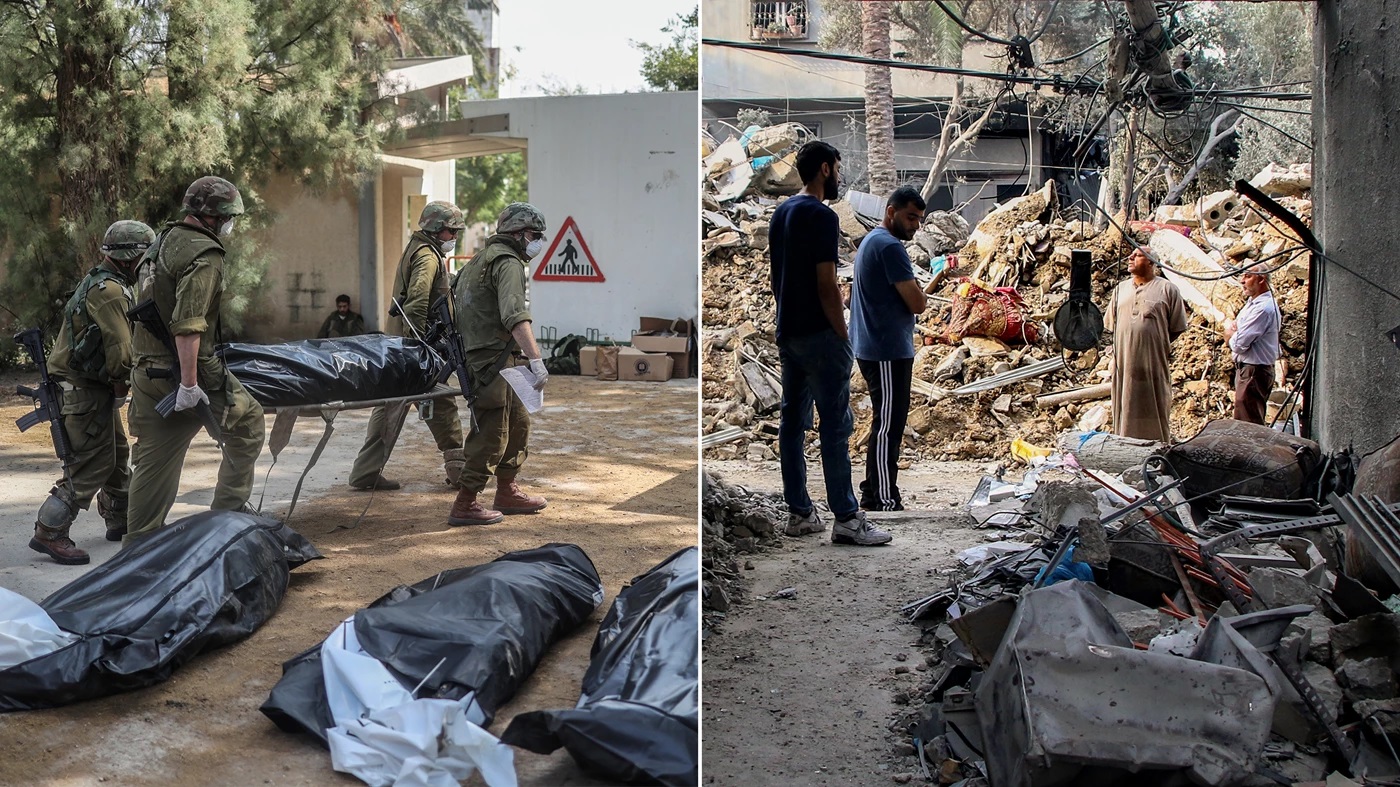
With at least 1,200 Israelis and 1,100 Palestinians slain, it is not simply the Israel-Hamas war’s stunning casualty total that has outraged the world, but also the brutality of Hamas.

More than 200 youth were killed at a concert festival, villages and farms were raided and terrorized, and an estimated 150 hostages have been threatened with death if Israeli air strikes on the coastal strip do not cease.

With such cessation unlikely, casualty numbers will most assuredly increase.

Israel has called up 360,000 reservists, poised to begin a ground campaign into Gaza. Consistent with military strategy to meet terrorism with overwhelming force, past conflicts in the beleaguered 25-mile strip have previously produced striking totals, including 2014 clashes that resulted in 73 Israeli and 2,100 Palestinian deaths.

All the while, many Israelis have lived in fear. Since the September 2005 unilateral Israeli withdrawal from Gaza, the Jewish Virtual Library has counted 334 terrorism deaths and at least 20,648 rockets and mortars launched into Israeli territory.

Amid the stark tallies, there are signs of balance between local believers across the ethnic divide. Christianity Today interviewed three Messianic Jews, three Palestinian evangelicals, and two Gazan Christians currently outside their native strip.

Shared astonishment

“The level of hatred and evil displayed in these acts is truly shocking,” said Eli Birnbaum, a branch director for Jews for Jesus in Tel Aviv and Jerusalem. “It is unlike anything we have seen in decades and has deeply shaken the population.”

Attacks in his neighborhood have been so intense, he said, that people are remaining indoors. In constant communication with family, friends, and 50 full-time staff members, he said his community is doing its best to stay connected and offer encouragement.

On the Saturday of the attack, Birnbaum’s congregation came together to pray. Unsure of what to do, they distributed prayer sheets for the safe return of hostages. Some members simply lit candles.

Jews for Jesus collected supplies for displaced families and soldiers at the border.

At least one Messianic Jew has died for his nation. David Ratner was called a war hero by his commander, saving the lives of five fellow soldiers as their post was stormed by 400 Hamas fighters. Shot in the neck, he continued in combat for the next eight hours.

Birnbaum counseled his children to stand strong against the desire for hatred. He challenged Israelis to seek justice without vengeance. And he asked everyone to remain genuinely concerned for Jew and Palestinian alike—while praying for Gaza and its liberation from Hamas.

“What can we do to represent the Lord as our nation is in crisis?” he asked. “Please pray for us, that we choose wisely how to shine his light in a very dark place right now.”

Grace Al-Zoughbi, a Palestinian theological educator, is also searching for his light.

“The church is trying to cling to any glimmers of hope it can find,” she said. “The situation is deeply disturbing, the atrocities appalling.”

She also was shocked by rocket fire, landing from the opposite direction near her home in Bethlehem. Families rushed to the grocery store to stock up on goods, fearful of escalation. Representative of an already struggling population under lockdown, she said the loss of tourism will further devastate the economy as the church seeks to help as much as possible.

Its immediate reaction was fervent prayer to end the conflict.

“Lord, take all the evil, smash it as glass, and grind it to nothing,” Al-Zoughbi pleaded. “In this we hold our hope, that one day soon your ways will prevail.”

She asked believers on both sides to be peacemakers. She asked international Christians to avoid “evil misrepresentations.” And for herself, she focused on Psalm 122: Pray for the peace of Jerusalem. May all who love you be secure.

Shared distance

Hanna Massad, the former pastor of Gaza Baptist Church, turned himself to the terse psalm that follows: Have mercy on us, Lord, have mercy on us, for we have endured no end of contempt (123:3). Following 30 years of service as the first locally born pastor…

This article was first published at Christianity Today on October 11, 2023. Please click here to read the full text.

Categories
Christianity Today Europe Middle East Published Articles

Should Messianic Jews Return to Israel from Russia and Ukraine?

Image: Illustration by Christianity Today / Source Image: Pexels / Unsplash

Jews should leave Russia if they can.

The stark warning was issued by Pinchas Goldschmidt, the former chief rabbi of Moscow, as 2022 came to a close. After 30 years in office, he left two weeks after the invasion of Ukraine and later revealed the Kremlin pressured him to support the war—“or else.”

A student of history, he fears Jews will again become scapegoats as the government tries to “redirect the anger and discontent of the masses.”

The resulting question: Where does God want them to go?

Goldschmidt, currently in Israel, has been joined by 41,813 Russian Jewish immigrants since the war began a year ago, according to recent data released by the Knesset. Another 90,000 arrived without immigrant status. Israel’s immigration minister stated 600,000 Russians are currently eligible.

But according to its 2010 census, Russia has only 156,000 Jews.

The discrepancy comes from the concept of aliyah—the Hebrew word for “ascent”—in which Israel grants automatic citizenship to anyone who has at least one Jewish grandparent and has not converted to another religion. A controversial coalition deal in the new government includes revising the Law of Return to ensure these olim (immigrants) qualify under religious law—and thus reduce intermarriage. Over 70 percent of last year’s war-induced immigrants are not considered Jewish per Orthodox law, stated the Aliyah and Integration minister.

In many cases, Messianic Jews have been disqualified, and their status is disputed. But last September, the seventh World Conference of Russian-Speaking Messianic Leaders overwhelmingly declared the return to Zion to be a “blessing.”

The only dispute was whether it is also a commandment.

Russian Jews are not the only aspirants. The Knesset stated 13,490 Ukrainian Jews have also immigrated to Israel, as “Operation Homecoming” opened 18 aid centers in Ukraine and neighboring countries. An additional 1,990 Jews immigrated from Belarus.

A 2020 study identified 43,000 Jews in Ukraine—making it one of Europe’s largest Jewish communities—though those eligible to make aliyah could be as high as 200,000.

An estimated 5,000 worship Jesus as Messiah.

Of these, about 1,000 have gone to Germany, where they doubled the local community.

“Aliyah is a certain type of coming home—to the land that belongs to us,” said Vladimir Pikman, executive director of Beit Sar Shalom. “But I don’t see a direct commandment to go to Israel.”

Centered in Berlin, his is the largest Messianic Jewish organization in Europe. Its Hebrew name translates to “House of the Prince of Peace,” and has been a refuge to Ukrainian Jew and Gentile alike, providing translation, logistical help, and trauma care counseling. Of the Jews, believers in Jesus included, they took…

This article was originally published at Christianity Today, on March 7, 2023. Please click here to read the full text.

Categories
Christianity Today Middle East Published Articles

Messianic Jews Say ‘Fake Rabbi’ Was Wrong Way to Reach the Ultra-Orthodox

Image: Illustration by Rick Szuecs / Source Images: Blake Campbell / Tanner Mardis / Unsplash / Ktoytor / Getty / Envato

How far can one go to “reach the Jews”?

The apostle Paul put himself “under the law” to give the gospel to his Hebrew brethren (1 Cor. 9:20).

Allegedly a Gentile, Michael Elkohen did the same to reach the modern Jews most fastidiously under the law—the Haredim, often known in English as “ultra-Orthodox.”

Approximately 1.2 million Haredim live in Israel, jealously guarding their traditions.

Dressed in black-and-white garb with a hat, long beard, and side curls, in 2011 Elkohen appeared next to an Iranian Christian on MorningStar TV and prayed for a Muslim world revival.

“When Jesus walked the earth, he was Jewish,” Elkohen told the host, Rick Joyner. “The church, the non-Jewish part of the body, is supposed to stir us to jealousy.”

For more than a decade, his would-be jealous Haredi neighbors were completely unaware. To the insular community in the French Hill section of Jerusalem, Elkohen was a beloved rabbi, scribe, and mohel—performing circumcisions.

In April, the Israeli anti-missionary organization Beyneynu sent shockwaves through the Haredi world with a report claiming that Elkohen was in fact a missionary from New Jersey, whose father is buried in a Mennonite cemetery.

“Other anti-Semites attack the Jews as individuals or as a people,” said Tovia Singer, a rabbi and founder of Outreach Judaism. “But the missionaries are attacking the Jewish faith and working to erase it from the planet.”

The spiritual damage is considerable.

Though there is no evidence anyone was converted in Elkohen’s community, Singer claims that the alleged missionary’s manuscripts and religious services are all invalid. And his presence at prayer may have falsely achieved minyan, the necessary quorum of 10 adults, prompting Torah readings that to Haredi Jews now constitute speaking God’s name in vain.

The 42-year-old Elkohen first moved to Israel with his family in 2006, obtaining citizenship after presenting papers as a Jew related to a famous mystical rabbi in Morocco. Having obtained rabbinical ordination through an online Orthodox US institution, in 2014 he went on to study at a yeshiva in the West Bank.

It was then he gained the attention of the anti-missionary organization Yad L’Achim, who confronted him. Confessing his evangelistic purpose, Elkohen replied that he had since “repented” and “chose Judaism.”

A few years later, Elkohen was living quietly among the Haredim when they rallied around him as his wife—who said she was descended from Holocaust survivors—died from cancer. The community raised money to support the husband and five children in need.

But in April, Elkohen’s 13-year-old daughter told classmates about Jesus.

Beyneynu investigated and felt it had to act. There are 30,000 missionaries in Israel, the organization estimates, and 300 organizations dedicated to evangelizing Jews.

Messianic Jews were quick to distance themselves.

Michael Brown, a popular radio host, author, and apologist, circulated statements from Jews for Jesus, Chosen People Ministries, and One for Israel that deplore deception.

“I know of no Messianic Jews who support what he did,” Brown told CT. “We are open and forthright about our faith.” Tsvi Sadan, an author, stated that Elkohen was “probably…

This article was originally published at Christianity Today on June 23, 2021. Please click here to read the full text.

Categories
Christianity Today Middle East Published Articles

GOD TV Dispute Has Israel Talking About Messianic Jews

God TV

This article was first published at Christianity Today, on May 22, 2020, in cooperation with the Associated Press. I contributed some additional reporting.

The Messianic movement, which emerged in its modern form in the 1970s, incorporates Jewish symbols and practices—including referring to Jesus by his Hebrew name, Yeshua—but is widely seen as a form of Christianity. All major Jewish denominations reject it, and Israel considers Messianic Jews to be converts to another faith.

Messianic Jews in Israel push back against the accusations.

“In Israel and in Jewish circles, conversion is a loaded word. It is understood as leaving something to become something else,” said Lisa Loden, co-chair of the Lausanne Initiative for Reconciliation in Israel-Palestine.

“Messianic Jews avoid the term, and maintain that they remain fully Jewish when accepting Yeshua as Messiah and Lord,” she said. “But the average Jewish Israeli does not distinguish between Jews who believe in Jesus and Christians.”

Both sides in the conflict are sincere, suggests Mitch Glaser, president of New York City-based Chosen People Ministries.

“GOD TV is attempting to honestly state what they are doing,” he said. “The religious Jewish people opposed to its Hebrew programming are trying to protect secular Jewish people from becoming converts, and therefore ‘lost’ to the Jewish community.”

Many Messianic Jews, however, are rejoicing at the opportunity to demonstrate their sincerity (of still belonging to the Jewish community) to their fellow Israeli citizens. Shelanu has stated 70 percent of its content will be locally produced.

And on a popular website for the community, some are even praising the “amazing free publicity.”

“If the show was produced by a US or European Christian organization, the argument is very strong that the aim is conversion,” said Jaime Cowen, an Israeli lawyer and former president of the Union of Messianic Jewish Congregations.

“The reality is that Jews believe all kinds of different things and are subject to all kinds of programming that pushes various views.

“This is a huge open door—as long as the government doesn’t shut it down.”

But this is exactly what one Christian Zionist has petitioned Israeli Prime Minster Benjamin Netanyahu to do, fearing that the GOD TV backlash will threaten Jewish-evangelical cooperation…

Please click here to read the full article at Christianity Today.

Categories
Christianity Today Middle East Published Articles

How Palestine Divides Messianic Jews

Messianic Jews
(Oded Balilty, AP)

This article was first published in the May print edition of Christianity Today.

Among Christians in America, Israel can be viewed as a fulfillment of prophecy, a democratic ally in a region of chaos, or an occupier oppressing stateless Palestinians. How to choose?

Given that 2 out of 3 US evangelicals have a positive perception of Israel, according to LifeWay Research, perhaps a better question is: How should evangelicals identify with the issues Israel faces?

Fortunately, there is a useful interpreter. “If the Christian community wants to understand Israel from a believing perspective,” said Jamie Cowen, an Israeli lawyer and a believer in Jesus, “going through Messianic Jews is best.”

However, the complexity of Israel divides even Messianic Jews in attitude toward Palestine, as illustrated by debate this year over an interview provocatively summarized as supporting ethnic cleansing.

“The only rights the Palestinians have are squatter’s rights,” Paul Liberman, executive director of the Alliance for Israel Advocacy (AIA), told The Intercept.

He described how the lobbying arm of the Messianic Jewish Alliance of America (MJAA) was pushing for a shift of US funding from UN–administered Palestinian aid ($364 million in 2017) to an Israeli-led effort offering money to relocate from the West Bank. The goal: eventual annexation of the territory in a one-state solution with fewer Palestinian citizens, maintaining Israel as a Jewish state.

First adopted by the MJAA in 2015, the idea reverberated within Messianic Jewish circles once TheIntercept highlighted efforts to harness evangelical influence in Congress and the White House.

“It is not a removal. It is an opportunity for a much better life,” said Joel Chernoff, CEO of the MJAA. “But the demographic issue is real.”

About 700,000 Jews and 1.5 million Arabs live in Judea and Samaria—the favored name in Israel for the West Bank. Chernoff desires more Jewish settlements there. And he believes many Palestinians already want to escape the territory’s corrupt Palestinian Authority. (A 2017 MJAA poll found half of residents were discussing a move abroad and were open to resettlement in exchange for about $5,000.)

The “ethnic cleansing” headline was a smear tactic by liberal and anti-Israel media, Chernoff said. The issue is not controversial among the MJAA’s 3,000 dues-paying members, 12,000 supporters, or 155 affiliated synagogues. But it is controversial to other Messianic Jews.

“There is not a consensus this is a good proposal,” said Monique Brumbach, executive director of the 75-member Union of Messianic Jewish Congregations (UMJC). “The Scriptures promised the land to the Jewish people. But there will always be other people within it.”

Nearly all Messianic Jews believe modern-day Israel is the fulfillment of biblical promises…

Please click here to read the full article at Christianity Today.

Categories
Christianity Today Middle East Published Articles

Under the Law: Israeli Christians Worry About Secondary Status in Jewish Nation-State

Israel Nation State
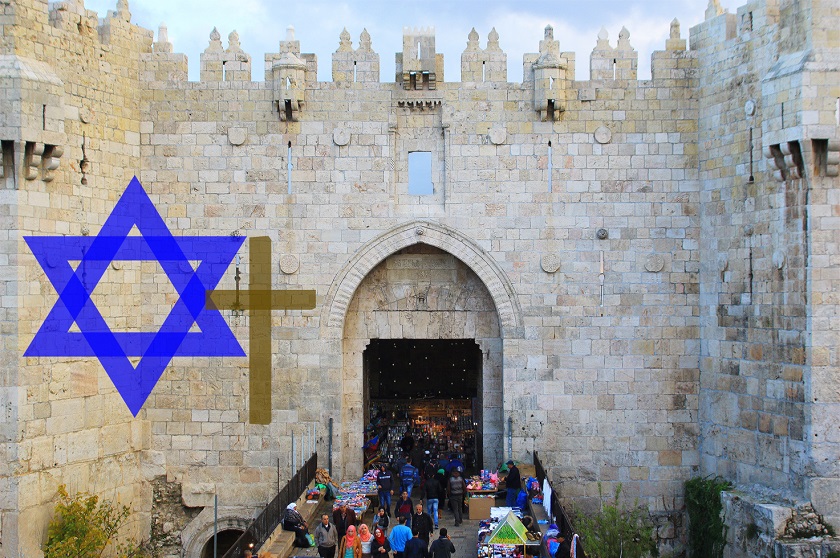
Judaism and Christianity symbols on the Jerusalem old city gate – MyHolyShop

This article was first published at Christianity Today, on July 31, 2018.

In a legislative act both obvious and inflammatory, this month Israel cemented its nature as a Jewish state.

By a narrow vote in the Knesset, Israel’s legislature, the law entitled “Basic Law: Israel as the Nation-State of the Jewish People” was adopted to serve alongside over a dozen other “basic laws” that serve as Israel’s de facto constitution.

A key clause states that national self-determination is “unique” to Jews. Other provisions formally establish the nation’s flag, emblem, and anthem. Jerusalem is confirmed as the complete and united capital. The Sabbath and Jewish festivals are declared official days of rest.

But two other clauses have raised considerable concern. Jewish settlement is a “national value” to be promoted. And Arabic is downgraded from an official language to one with “special status.”

“This law outlines that Israel’s democratic values are secondary for non-Jews,” said Shadia Qubti, a Palestinian evangelical living in Nazareth. “It sends a clear message that my language is not welcome and consequently, neither is my cultural and ethnic identity.”

Her fears are echoed by an Israeli lawyer.

“While the idea of the law is straightforward—it’s hard to argue that Israel isn’t a Jewish state—the actual provisions are controversial, discriminatory, and possibly racist,” said Jaime Cowen, former president of the Union of Messianic Jewish Congregations…

Please click here to read the full article at Christianity Today.

Categories
Christianity Today Middle East Published Articles

In Shadow of Death, Palestinian Christians and Messianic Jews Relapse on Reconciling


Embassy Gaza
AP, via Japan Times

This article was first published at Christianity Today, on May 21.

Hanna Maher’s wife is nine months pregnant, due any day now, with only four hours of daily electricity. Her two older boys scurry about in the dark, kept ignorant by parents about the dead at the border.

But it is hard to be ignorant in Gaza.

A Norwegian charity estimates 56 percent of children in the Palestinian territory suffer from traumatic nightmares. Suicide, rarely seen culturally, is a growing concern. Maher, an Egyptian-born Baptist pastor, says some at the border see death as the best option.

Two million people are squeezed into a coastal strip roughly the size of Philadelphia. Exit is severely restricted on one side by Israel. The waiting list into Egypt is 40,000 names long.

Unemployment is over 40 percent. Clean drinking water is hard to come by. And on May 14, as tens of thousands massed near a chain link fence demonstrating for their “Right to Return,” Israeli snipers picked off dozens.

“Monday was a hard day. But at least it is quiet now,” Maher said. “It has been bad for years. But conditions now are the worst I have seen.”

Maher went to Gaza in 2011, and married his local Palestinian wife a year later. His congregation is the strip’s only evangelical church, with about 60 regular members. Overall, Gaza’s Christian population is about 1,000, mostly Greek Orthodox; in the last 10 years, it has declined by a third.

Maher provides food aid to about 120 families. His marriage preparation classes are a crash course in how to nurture a family amid poverty.

And he says local Christians are critical of just about everyone…

Please click here to read the full article at Christianity Today.