Categories
Excerpts

Sisi, ISIS, Tunisia, and Arab Spring Values

Sisi - ISIS

In a recent article at Foreign Policy, Iyad el-Baghdadi described the near-eternal and present dichotomy hoisted upon the Middle East: Support a dictator, or his overthrow via violent Islamism. He finds an ironic symbolism in that the names of Sisi and ISIS are spelled backwards, and describes their evils as parallel.

Near the end of the article he reasserts the hope that motivated many in early 2011:

The Arab Spring is about believing that we don’t have to eternally choose between these two evils, and that we can present a real alternative. Arab Spring activists come from across the political spectrum, but they share a belief in fundamental individual rights, coexistence within one political system, and an open marketplace for ideas. These are the people who represent me — and whom I hope to have successfully, if briefly, represented in a public forum.

These are worthy values, and the author was briefly critical of others beside Sisi and ISIS in his critique:

Both extremes are born out of the same twentieth-century political culture that gave us authoritarian interpretations of just about every ideology: authoritarian Islamism, authoritarian nationalism, authoritarian socialism, and even, yes, authoritarian liberalism. Both view human rights not as inviolable or inherent, but as granted by the state, which can then reduce or suspend them at will. And both envision a state in which some people have less rights than others.

…..

Both sides have a deeply exclusionary, “with us or against us” worldview that manifests itself in a profound refusal to coexist with others. In the run-up to the 2012 elections, we saw the Mubarak-associated figure Shafik hint at banning Islamist parties should he get elected; during Morsi’s term we then watched Islamist discourse squeeze the space for civil society.

It would be worthy to dialogue with Baghdadi (the author, not the caliph!) about his opinion of the Muslim Brotherhood, for his criticism of them is far less severe, at least in this article. Indeed, he has tweeted and written prolifically, so his analysis is available.

But within the opening quote and listing of values comes a very poignant highlight: the open marketplace of ideas. Egypt did experience this open marketplace during its revolutionary period. With full respect to the diverse forces influencing public opinion, Egyptians overwhelmingly chose the Brotherhood and Salafis over the vision Baghdadi presents. Then, perhaps over and against his vision again, they overwhelming rejected Morsi.

The system that could tolerate this pendulum was never established, and perhaps this is Baghdadi’s lament. If left alone, would the Brotherhood have helped its establishment? Or are they just a milder version of ISIS, focused on a long term Islamization inconsistent with Baghdadi’s vision?

One problem is that the system the Brotherhood helped establish through their 2012 constitution enshrined an illiberalism antithetical to this vision. Shadi Hamid has explored this theme in his writing. Islamist organizations tend to moderate while in opposition, but then revert to their extremes when in power. But if such an illiberalism is what people vote for, if it wins the marketplace of ideas, how does it square with Baghdadi’s desire for fundamental individual rights?

He does not want to be forced back into a dichotomy, and this is noble. But would his vision have been able to triumph over time, allowing the people to reject Morsi four years later? Or eight? Or…

Perhaps, though the argument of urgency on the part of anti-Islamists is well known. To summarize, the Brotherhood would do all it could to sink its teeth into the existing system, to gain control of its levers and use it to their own advantage.

Fair or unfair, there is a distinction between the two current camps in the Egyptian struggle. The ideology of the Brotherhood — at its end goal, not necessarily through its stages or current rhetoric — does not support Baghdadi’s vision.

  • Fundamental individual rights: These are curbed by sharia, however variously defined.
  • Open marketplace of ideas: There are religious norms not allowed to be touched.
  • Coexistence within one political system: …

Here is the rub, and am I trying to find a comparison. A socialist versus capitalist vision of the economy can be very divergent. But European nations have navigated a path that has allowed various governments to traverse the path in different directions.

But how much allowance can there be for a democratic versus communistic approach to the state? Should the open marketplace of ideas, ostensibly welcomed in a democracy, allow momentum to build that would overthrow the system that enshrines it?

This later comparison seems closer to the struggle in Egypt. Liberal forces in Egypt have enshrined liberal values (to a degree) in the constitution, however much they recognize the violations used in putting down pro-Morsi protests, understanding also the violations on the part of certain protestors.

The question for this camp is if it will tolerate, or be able to resist, the continual violation. That is, will they accept reversion to Baghdadi’s dichotomy? The Mubarak regime held forward liberal values for thirty years — and all the while implemented a state of emergency that made it easy to circumvent them.

In all this, perhaps Baghdadi, like many, will find hope in Tunisia. The United States, two centuries ago, began a political experiment that removed religion from the sphere of the state, setting up a system meant to guard liberty and freedom. It has endured numerous contradictions along the years, but has been largely successful.

Now, Tunisia is beginning a political experiment that is seeking to integrate a religious, Islamist element. Will it be successful? Many Tunisians are worried, for in creating a system that allowed coexistence they had to beat back Islamist efforts to encode religion into the constitution. Efforts to do so in 2012 with the Brotherhood were not successful – the Brotherhood chose even more conservative Salafis as their partner. But the Brotherhood and the Tunisian Nahda come from the same family tree.

Is Nahda simply postponing a greater Islamizing goal? But more to the point, perhaps, of Baghdadi’s hope: Will the system created allow for the emergence and entrenchment of his Arab Spring values?

Consider the recent anti-liberal political moves of Turkey’s Islamist Erdogan, after an extended period of winning democratic elections. Will Tunisian Islamists consistently nudge and needle against values they have temporarily accepted? Will fear of a similar Islamist agenda lead to preemptive crackdown against them? Time will tell.

But the experiment is on, and perhaps Baghdadi and other activists frustrated with the dichotomy have a fledgling example of a third way.
Categories
Excerpts

Baghdadi, the Prince of Criminals

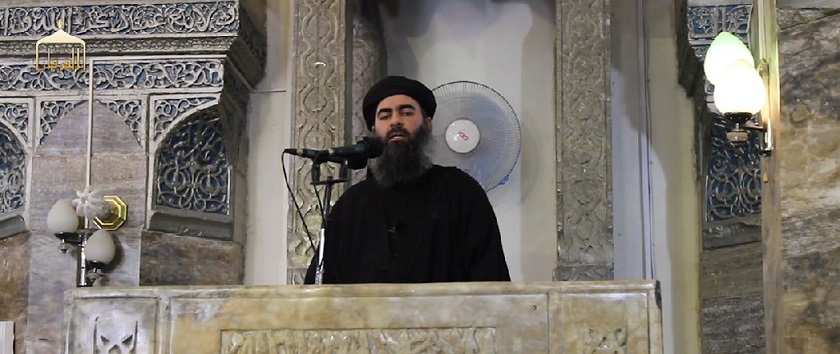
Abu Bakr Bagdadi

In traditional Islamic terminology the caliph is known as amir al-mu’mineen, or, the prince of the believers. In this new music video, Shaban Abdel Rahim adjusts the Arabic slightly to call him amir al-mugrimeen, the prince of criminals.

https://www.youtube.com/watch?v=6HmGv5BMLAk

The video blasts the Islamic State for its conduct, and declares Islam to be innocent of their crimes. But there is political commentary also. Baghdadi is asked how much money he is receiving from Qatar, and the world is asked why Egypt is being left to fight its local terrorism alone.

These concerns are not unique to Egypt but certainly reflect much popular sentiment about the group. The video also hails the Egyptian army for its role in fighting terrorism in Sinai, where Ansar Bait al-Maqdis (Supporters of Jerusalem) has pledged its allegiance to ISIS. Egypt, however, has committed no troops to the coalition effort in Syria or Iraq.

In my opinion neither the song nor the satire is all that good, but the message is not missed by Baghdadi. According to Paul Attallah, to whom thanks are given for sharing the video and adding English subtitles, Abdel Rahim has already received death threats for his mocking.

Here is another humorous offering, from the Lebanese band, the Great Departed. It is called ‘The moulid of Sidi Baghdadi’, using phrases that laud him as a Sufi saint, an interpretation of Islam he vigorously opposes. The crowd laughs in delight.

Thanks to Arabist for this link, as well as a partial translation:

The song starts out showering traditional blessings and titles on Baghdadi, but quickly takes a turn into mockery. It has lines like this:

علشان الإسلام رحمة، رح ندبح ونوزع لحمة، وعلشان نخفف زحمة، حنفجر في خلق الله

عشان لا إكراه في الدين فلنقض عالمرتدين والشيعةوالسنيين والنصارى يا خسارة

(In Arabic it rhymes. My awkward translation is “Because Islam is merciful… we’ll butcher and hand out meat/To make it less crowded/We’ll blow folks up/Because there’s no compulsion in religion/we’ll kill unbelievers..and Shia and Sunnis and Christians, what a loss!”)

Arabist makes an interesting point. There is no doubting the cruelty of the group and its desire to be feared. Perhaps the best remedy, therefore, is not to take it seriously. Deny ISIS the strength it seeks.

Surely there are other more practical responses, but the response of humor to crisis is a particularly characteristic Egyptian trait. Military and religious efforts have their place, perhaps, but the cultural struggle may be paramount. It is here these two videos offer their contribution.


Categories
Prayers

Friday Prayers for Egypt: Allegiances

Flag Cross Quran

God,

Two declarations were issued this week, at complete opposite ends of the spectrum. From Sinai, Ansar Bait al-Maqdis pledged to obey the caliph of the Islamic State. From the Chamber of Commerce, a business delegation pledged to recruit other American companies to invest in Egypt.

One allegiance is to you, God, the other is to mammon. Both may be confused.

Therefore, guide them both.

A few days after the pledge to ISIS, terrorists struck at the Egyptian navy. Four boats in the Mediterranean targeted a naval vessel, opening a new chapter in the insurrection.

A few days before the pledge of investment, a UN hearing blasted the Egyptian record on human rights. But sixty-six companies targeted the private sector, opening a new chapter in the transition.

God, help Egypt to rebuild. Bring investment from abroad and from within, that a creative entrepreneurship might employ many. From a stronger economy build a stronger middle class. From a stronger middle class build a stronger civil society. And from a stronger civil society build a stronger respect for human rights.

But do not let it take that long. Amid the many troubles, hold the government accountable in treating people justly. And within these coming companies, may their corporate culture model good governance in the economic sphere.

And God, help Egypt to repel. Bring support from abroad and from within, that a humane determination might resist terrorism. From a deeper respect for human rights build a deeper sense of patriotism. From a deeper sense of patriotism build a deeper commitment to neighbor. And from a deeper commitment to neighbor build a deeper understanding of religion.

God, set the single-minded idealists of the Islamic State on the right path. Set the single-minded capitalists of the United States on the right path.

Once there, may their respective zeal and wealth benefit Egypt, the region, and the world. For without your guidance, God, they may trample it all.

Declare your goodness to Egypt, and recruit many to her aid. From abroad and from within, may all demonstrate allegiance to your principles.

Amen.

Categories
Lapido Media Middle East Published Articles

Are Islamic Terror Plots in Egypt Just ‘Crazy Theories’?

Abdel Rahim Ali
Abdel Rahim Ali

A desperate Egypt reaches out to the West, trying to communicate the dire threat of terrorism.

A celebrity researcher ties this terrorism to the Muslim Brotherhood, and the West yawns.

But 33 soldiers died last Friday in separate brazen attacks on security personnel in Sinai, and now Egypt’s Christian leaders have picked up the mantle to call for help.

‘Egypt now needs the support of its friends,’ wrote Revd Mouneer Hanna, Anglican Bishop of the Diocese of Egypt, in an open letter on the diocesan website. ‘This support involves understanding of the real situation.’

One week earlier Revd Andrea Zaki, general director of the Coptic Evangelical Organization for Social Services, joined a semi-official Egyptian delegation to the United States. It was made up of diplomats, journalists, civil society members, and men of religion, who were eager to present Egypt’s perspective to a sceptical West.

On many issues Zaki found an agreeable reception. But their counterparts in Washington DC bluntly told the group that the Egyptian government has not provided ‘clear evidence’ linking the Muslim Brotherhood to the ongoing terrorism campaign.

Due process

Perhaps this is because Egypt appears to be giving this ‘evidence’ first to the people, and only later through judicial channels. This reversal of due process causes Western observers to be dismissive.

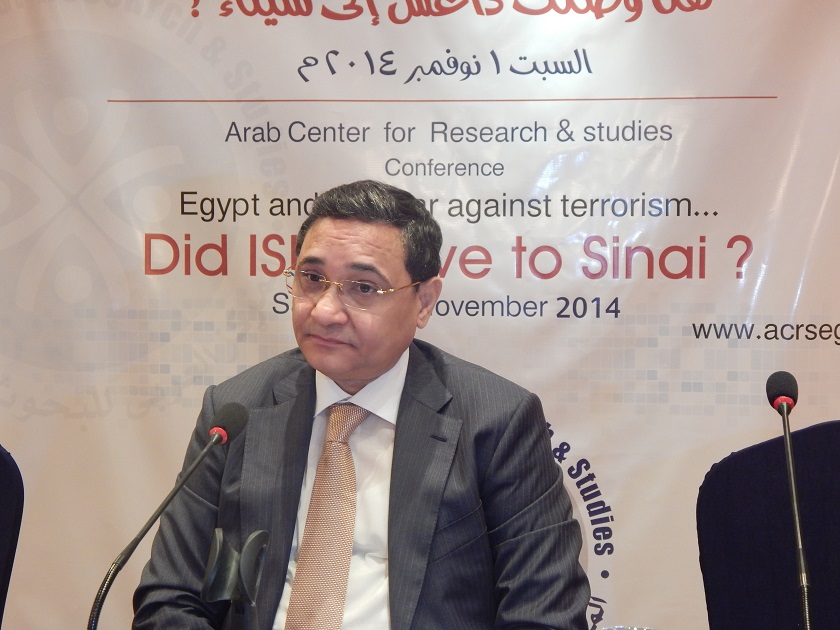
‘Isn’t he that guy on television with the crazy theories?’ remarked a European journalist as Abdel Rahim Ali walked into the room to hold a press conference on 1 November on the possible emergence of ISIS in Sinai. The mixed crowd of Egyptians and Westerners awaited his evidence.

Ali expects the ‘Supporters of Jerusalem’ – a home-grown terrorist outfit operating out of Sinai – to soon announce their allegiance to ISIS. Abu Hamza al-Muhajir, he said, was an associate of Abu Musad al-Zarqawi in the Islamic State of Iraq and believed to be killed by US forces in 2010.

But some evidence suggests he is still alive and operating out of the Sinai with the Supporters of Jerusalem, Ali said.

On 4 November, without mentioning al-Muhajir, Reuters confirmed Ali’s prediction of the merger with ISIS. But Egyptian state-run Ahram Online denied the news, quoting from what is alleged to be the Supporters of Jerusalem’s official Twitter account, @3Ansar_B_Almqds.

Leaked conversations

In Ali’s presentation, however, the source of his evidence was not provided, fitting with his general modus operandi. Host of the popular television show, ‘The Black Box’, and editor-in-chief of al-Bawaba newspaper, Ali regularly releases leaked conversations of revolutionary and Islamist figures.

Despite their illegal nature, Ali operates freely. And he freely admits his sources are connected to the security apparatus.

One of the most damning allegations concern leaked recordings of phone calls between President Morsi and Ayman al-Zawahiri, leader of al-Qaeda. In them an agreement is made to cease operations against Egypt while allowing jihadist groups to exist on Egyptian soil.

In this context, reference in Bishop Mouneer’s open letter about the Brotherhood finds verification. He spoke of the Muslim Brotherhood leader Mohamed el-Beltagi’s statement from the pro-Morsi sit-in at Rabaa in Cairo, prior to its bloody dispersal.

‘We do not control the situation on the ground,’ Beltagi said in a July 2013 video on YouTube. ‘But what is happening in Sinai …will stop the moment …the president [Morsi] returns to power.’

Bishop Mouneer told Lapido Media that, like many others, he is not happy that thousands of people are currently in prison without judicial rulings. He understands this makes the West feel Egypt is being very harsh with the Muslim Brotherhood.

But after listing a long litany of Brotherhood offenses – attacks on protestors, churches, and calls for jihad in Syria – he provides Egyptian perspective on this reversal of due process.

The courts are slow, he said, and Egypt is in a state of war against terrorism: ‘In times of war countries sometimes take extraordinary measures, such as America with Guantanamo Bay.

‘In order to educate the people and influence public opinion, [security] leaks some of these things.’

But of these recordings and allegations, Bishop Mouneer cannot say what is true and what is not, as long as Ali does not release his sources.

Similarly, Zaki does not feel compelled to make the case against the Muslim Brotherhood for the sake of his American audience. ‘This is the responsibility of the government,’ he told Lapido Media.

But he does want to convey Egypt’s general satisfaction with the situation following the post-30 June deposing of Morsi. The military answered the call of millions, he said, and the people ratified this action in subsequent elections.

Acceptance

This message is beginning to be heard. Zaki said the Americans expressed their acceptance of President Abdel Fattah al-Sisi’s government, as well as the necessary role of Egypt’s military in fighting terrorism.

Economic support will also be forthcoming at the expected 21 February economic summit in the resort city of Sharm el-Sheikh, the Americans told him. Egypt will present investment opportunities in fifteen projects worth $100 billion.

But the message of Egypt’s popular belief in Muslim Brotherhood culpability in terrorism is still awaiting judgment in the West. The Whitehall report authorised by the British government remains delayed.

‘I have no idea about the link between the Muslim Brotherhood and al-Qaeda,’ said Bishop Mouneer, expressing more caution than many Egyptians.

‘But I know one thing, we were going backwards during the time of Morsi.’

This article was originally published on Lapido Media.

Categories
Personal

Update from Mhardeh, Syria

In my recent article for Christianity Today, I described one of the strategies Middle Eastern Christians are employing to face the threat from ISIS: Fight.

Sometimes, though, talking isn’t enough. This reality has driven Syrian pastor Maan Bitar to urge his congregation to take up arms and fight. His Presbyterian congregation is among the 22,000 all-Christian residents of Mhardeh in Syria. Their city is besieged by Islamist militants.

Mhardeh is shelled every day, Bitar said, killing at least 50 civilians and injuring hundreds more. The city’s Christians, alongside government forces, have so far been successful in preventing the militants from entering the city.

“I know I have the right as a human being to defend myself,” he said, “but I try to give my people a Christian justification.… Still, if I kill someone I need to say to Jesus, ‘I know I have sinned. I have not met your perfection.’”

This above article is recently updated based on an email received from Rev. Bitar. Here is his message in its entirety:

The city is besieged by FSA and Al Nusra, who drove away the civilian population of the neighboring villages to take over Mhardeh and make it their stronghold to fight the regular army from Mhardeh.

Now Mhardeh is shelled everyday by the Syrian rebels and Al Nusra fighters who have given dozens [of] ultimatums [and] threats: Leave your homes. Mhardeh is ours. It’s Halal (permissible under Islamic Sharia to conquer).

Mehardeh has been hit so far by 1500 mortar shells and rockets. The death toll of civilians has exceeded 50, and there are hundreds of injured, among the deaths and injured [are] women and children. Sometimes rockets are deliberately launched when school children are leaving school.

The Syrian regular army, with Mhardeh civil defense and volunteers, has prevented them from invading Mhardeh and has driven them away, and now it is targeting their strategic positions in other farther towns. However, they number [in the] thousands and are intent on causing much harm and damage to [the] Mhardeh population and town.

Categories
Personal

Other Stories from Kurdistan

The situation for refugees in Erbil, Kurdistan, Iraq is dire. I was pleased to be able to convey this perspective in a recent article for Lapido Media, highlighting the relief efforts of a local Cairo church, Kasr el-Dobara.

But there are other interesting stories to be told, more than could be honored in a reasonable word limit. Here then are a few other anecdotes that had to be cut in the editing:

KD Christian refugee

Coordinated with US airstrikes, Kurdish Peshmerga forces have begun to reclaim villages overrun by ISIS. But many displaced Christians in Erbil, the Kurdish Iraqi city which has received hundreds of thousands of refugees, have little confidence to return.

‘I don’t want to go back to the same neighbors who betrayed me,’ a roughly 60 year old blind man from Nineveh told Revd. Fawzi Khalil. ‘They surrendered me to the terrorists.’

Khalil is the director of relief ministries at Kasr el-Dobara Church in Cairo, Egypt, and is part of the church’s efforts to deliver much needed aid. He has spoken to dozens of individuals with similar stories; names and faces begin to blend together.

The man in the photo above is the blind man, supplied by Rev. Khalil. It is amazing to have met so many with such terrible stories.

KD Erbil refugees

Khalil explained that the majority Chaldean Catholic Church of Ankawa has done an excellent job of caring for Christian refugees. Erbil’s population includes roughly 160,000 Christians, and many have taken in their religious brethren.

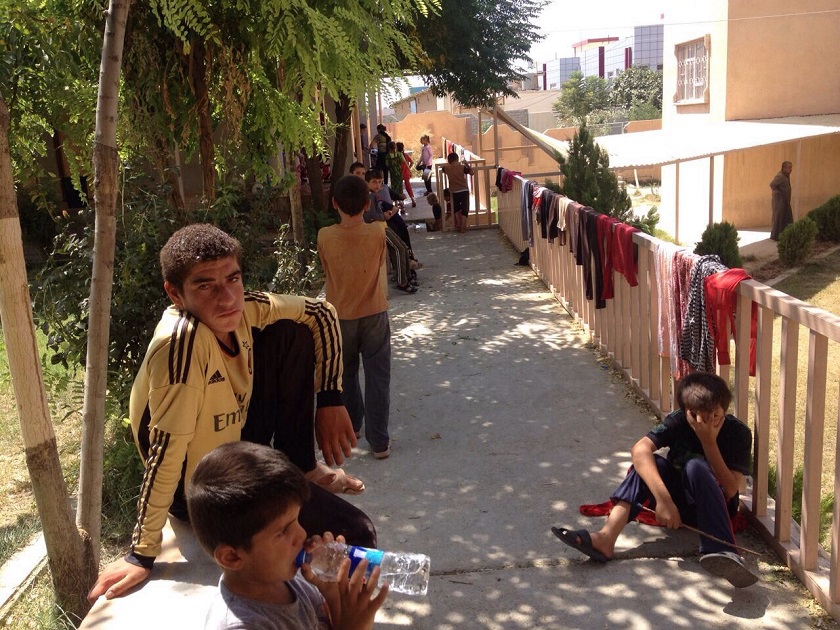
As a consequence Erbil’s churches are packed, and the Mar Eliya refugee camp is located on the grounds of the church-run school. Nearby Mar Yousef camp is in a church itself, and hosts mostly Muslims and Yazidis.

The photo above, also from Khalil, pictures what these campgrounds are like. People and their scant belongings sit around idly. I was surprised by how green the area is. But from another photo, not all refugees are so fortunate:

SAT7 refugee camp

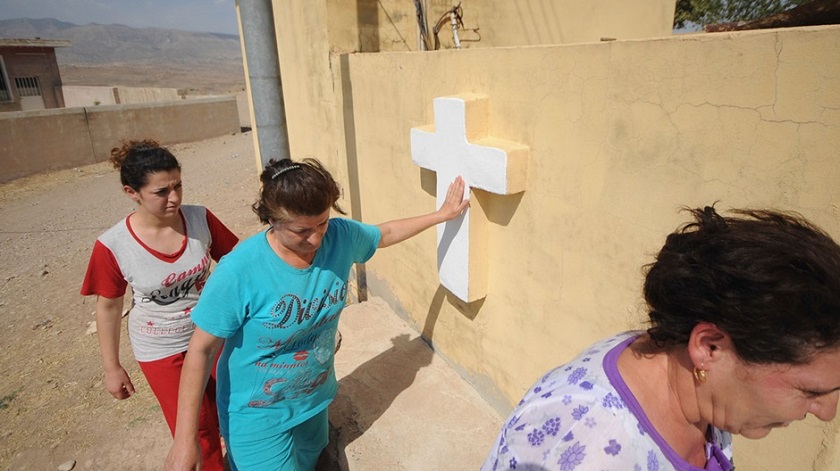
This photo is from SAT-7, whose Ehab el-Kharrat was quoted extensively in the original article. Many campgrounds are located in the desert, and according to Eva Boutros, who was also interviewed, many have inadequate water supplies. Dozens of children gathered around a sole faucet, she witnessed, trying to get clean.

But Boutros also told a story of other children, who enjoyed with her relief team a special break from the agony of refugee life:

One of the Christian refugees is named Soha. Age 22, she graduated from university and was looking forward to her new job in Mosul before the ISIS onslaught. Now she must care for her brother’s three children who have been separated from their mother.

‘Now, all I have is a mattress, a donated plate of food, and two pairs of clothing,’ she told Eva Boutros. ‘This is the end of my youth.’

Boutros is the director of volunteer ministry for Kasr el-Dobara, but accompanied a joint Orthodox-Catholic-Protestant team organized by the Chaldean Church in Heliopolis, Cairo.

This team brought tents, medical supplies, blankets, and children’s underwear, all donated by Egyptian companies.

But Boutros recognized many of the refugees needed something more, and took 280 young women, including Soha, shopping at the local mall.

‘It was fun for us, and fun for them,’ she said, describing a moment of happiness amid a desperate situation.

Perhaps her woman’s touch gives her greater memory for personal detail, as opposed to Khalil. But she praises a different source.

‘I remember each person, their face and their story,’ she said. ‘The Lord sent us to tell them, we are suffering with you.

‘They need you to hug them, stay with them, and listen, listen, listen.’ Kasr el-Dobara’s team included a professional psychiatrist, who spent hours counseling women and children in their trauma. Childcare specialists did their best to entertain the kids each evening.

Finally, here is an amateur video made by the Kasr el-Dobara team, showing their team in action and giving thanks to those who have donated.

Categories
Current Events

Do Egyptians Support ISIS? How about the Brotherhood?

Estimates say the number of Egyptian recruits in ISIS equal 8,000, perhaps 20-30 percent of their fighting force. A report indicates ISIS is in direct communication with Sinai-based terrorist groups to train in creating cells to attack security personnel.

But while some say the ISIS mentality is present among Egyptians, especially in Upper Egypt, there has been little quantifiable data to go by.

A recent poll published by the New Republic, relying on surveying efforts by the Fikra Forum, finds only three percent of Egyptians have a favorable opinion of ISIS. By contrast, and also noteworthy, 35 percent support the Muslim Brotherhood.

A few observations: First, three percent of 90 million people is still a very large number. How might you feel if your neighbor was one of the 2.7 million?

Second, the Egyptian government purports a link between groups like ISIS and the Muslim Brotherhood. Whether or not this is true operationally, on the ground there is a huge contrast. The great majority of Brotherhood supporters do not find common cause with the jihadis of Syria and Iraq.

Third, the common Western assertion is that Egypt following the coup is a polarized society divided against itself, while the common Egyptian assertion is that the country is united against the Muslim Brotherhood. This finding, if correct, undermines both claims.

If a full one-third of society rejects the political system, the claimed unity is an illusion that ignores or purposefully downplays a palpable frustration. On the other hand, if only one-third of an electorate opposes the majority political view, evidence is lent to the argument that Egypt was and still is greatly behind the June 30 revolution and the danger posed by Brotherhood leadership.

Of course, even here caution is needed. Some may have supported the removal of Morsi but still see the Muslim Brotherhood as an essentially good organization, serving society. And others may hold strong objections to the ideology of the Brotherhood yet believe they are still treated unfairly. The polling data released is not specific enough to nuance beyond the larger percentages.

But the percentages are significant even so. Egypt is mostly against the Brotherhood, and almost entirely against ISIS. The troubles lie in the many real people covered over by a minority statistic.

Important note: H.A. Hellyer, who has extensive experience in following Egyptian survey organizations and urges caution about their general reliability, does not recognize the Fikra Forum as a polling center.

Categories
Christianity Today Middle East Published Articles

Facing ISIS, Middle Eastern Evangelicals Exchange Strategies

Christian refugees from Mosul find a home in Merga Souva Iraq. -- Gail Orenstein / AP Images
Christian refugees from Mosul find a home in Merga Souva Iraq. — Gail Orenstein / AP Images

From my article at Christianity Today, published October 14, 2014:

“God is allowing ISIS to expose Islam,” said Khalil’s fellow pastor, Atef Samy. “They are its true face, showing what Islam is like whenever it comes to power.”

But the savagery of ISIS, which has overwhelmed Kurdistan with more than 850,000 refugees, has prompted other Middle Eastern Christians to embrace their Muslim neighbors. This theme was heard often from members of the Fellowship of Middle Eastern Evangelical Churches (FMEEC), who met in Cairo last month for a conference on the dwindling Christian presence in the region.

“We must be a voice for Islam,” said Munib Younan, bishop of the Evangelical Lutheran Church in Jordan and the Holy Land. “We must not allow the West to see ISIS, the Muslim Brotherhood, or others like them as the face of Islam.”

Others were more reflective of the diversity among both Muslims and non-Muslims.

The article opens with a brief description of an evangelical relief trip to help refugees in Kurdistan, which I also wrote about here. It also describes cooperation attempts in the Egyptian Family House, uniting Muslims and Christians, which I hope to profile in a few days. There are other strategies described by those who attended a recent conference in Cairo, whose opinions on US-led military action I wrote about here.

But please click here to read the full article at Christianity Today.


Categories
Excerpts

The Case against Qatar

Qatar

A recent Foreign Policy investigative report details Qatari foreign policy. It describes a strategy of intervention-by-proxy, which keeps its hands clean officially while funneling money to groups it deems ideologically similar, that is, those they can trust.

Primarily, this has been the Muslim Brotherhood and various activist Salafi factions.

The article is long but worthy, and one interesting section describes how Qatar has helped the US disengage from the region. This was evident in Libya, when Qatar not only provided crucial Arab support for the operation, but also took the lead in sponsoring militia groups against Gaddafi.

But now that the US is reengaging the region, this time against the Islamic State (ISIS), officials are examining anew the sponsorship by Qatari individuals and charities which have gone to the al-Qaeda affiliated al-Nusra Front. Following three years or more of looking the other way, the dispute has become public:

In Syria, meanwhile, it wasn’t until the Islamic State gained prominence that Washington sat up and took notice. In March, David S. Cohen, the Treasury Department’s undersecretary for terrorism and financial intelligence, took the unprecedented step of calling out the Qataris in public for a “permissive terrorist financing environment.” Such stark criticism, counterterrorism experts say, is usually left for closed-door conversations. A public airing likely indicated Doha wasn’t responsive to Washington’s private requests.

But if initial requests were private, that means the US – for a long while, at least – tolerated and possibly approved of the general strokes of Qatari foreign policy. Two key aspects of Qatar’s leverage over the United States include its hosting of the US Central Command air base, as well as the usefulness of its network to liaison with otherwise disreputable characters. Discussions with the Taliban in particular have often flowed through Qatar. Without them, back-door channels would not be possible; hostages released might still be held.

Has the US, therefore, been a partner in the wanton destruction of Syria? President Obama has forcefully spoken against Assad, but has never decisively moved against him. The article deems the chaos there less to be a result of coordinated conspiracy, than uncoordinated incompetence:

In other words, there was no one winner. Qatar and other international powers haphazardly backed dozens of different brigades and let them fight it out for who could secure a greater share of the funding. They had few incentives to cooperate on operations, let alone strategy. Nor did their various backers have any incentive to push them together, since this might erode their own influence over the rebels.

Says one analyst:

“One of the things about Qatar’s foreign policy is the extent to which it has been a complete and total failure, almost an uninterrupted series of disasters,” says Hussein Ibish, a senior fellow at the American Task Force on Palestine. “Except it’s all by proxy, so nothing bad ever happens to Qatar.”

Except its reputation in much of the Arab world. Egyptians in particular have been furious at Qatar over its support for the Muslim Brotherhood. Saudi Arabia and the United Arab Emirates have signaled displeasure in manners unusual among Gulf monarchies.

Long ago Qatar made a bet on the Islamist factions becoming the prominent power players in the region. For a while they seemed vindicated; now they appear in retreat. Qatar has been publicly acquiescing to the criticism, sending away top Brotherhood figures it has long hosted, for example, but it is unclear if its long term strategies have changed.

Were Qatar and its allies-by-proxy simply outmaneuvered? How much of the Arab Spring was manipulated by the regional and international power struggles? What role did America have is a key question. Most Arabs view Washington as the chief puppet master, allowing its public allies – the Saudis, Turks, UAE, Qatar, and Israel, of course – to mess around with local sovereignty.

Or, did the US just pull back, and allow others to run the show? Either way, the result is a disaster, however many parties share in the blame.

One other controversial point converges with this article. Many Egyptians see the Muslim Brotherhood as one aspect of an Islamist agenda that includes and coordinates with groups like ISIS, on the far end of the spectrum. The point is not necessarily that the MB keeps its hands clean while sending out clandestine orders to others to ferment chaos – though this is certainly believed locally.

But if the Brotherhood is one part, and a key part, of Qatar’s proxy network, a linkage does seem to exist. This article does not make the accusation, and I do not wish to lend it weight in the mentioning. But it bears consideration.

Of course, Brotherhood sympathizers simply turn the equation on its head. They see Qatar as the good guy, standing with the people and the forces of democracy, against fearful Gulf monarchies, their own proxies, and the US.

God bless this part of the world. Maybe one day the oil will run out and they can all be left alone again.

Categories
Lapido Media Middle East Published Articles

Church Relief Effort Highlights ‘1000s Left on Streets’ ahead of Iraqi Winter

Published September 23rd at Lapido Media:

Ehab el-Kharrat visiting refugee children in Erbil, Iraq (credit: SAT-7)
Ehab el-Kharrat visiting refugee children in Erbil, Iraq       (credit: SAT-7)

A former Egyptian member of parliament whose church is distributing aid to Iraqi refugees has spoken out about the gaps in humanitarian provision as the country heads into winter.

He expressed concern about underfunded UN campsites and thousands living on the streets.

Ehab el-Kharrat visited Erbil, a city in the Kurdistan region of Iraq that has attracted thousands of people fleeing conflict in the region.

His church, Kasr el-Dobara church in Cairo, works among relief heavyweights such as the UNHCR, Caritas, and Samaritan’s Purse.

It has sent a delegation to Iraq every ten days for the past two months, trying to stem the humanitarian tide. The congregation, which is made up of the middle and upper classes, has donated $180,000 to the relief effort with a further $120,000 from a fundraising trip to the United States.

So far it has distributed 2,500 mattresses with pillows and blankets, and it supports a network of 2,200 families that receive a food basket every two weeks.

This network is run in coordination with churches of Ankawa, a Christian neighborhood in Erbil. Ninety per cent of recipients are non-Christian – either Sunni Muslims also fleeing Islamic State, or else from the Yazidi minority.

Revd Fawzi Khalil is director of relief ministries at Kasr el-Dobara church.

He explained that the Chaldean Catholic Church of Ankawa has done an excellent job of caring for Christian refugees. Erbil’s population includes 160,000 Christians, and many have taken in fellow Christians.

As a consequence Erbil’s church grouds are packed. The Mar Eliya refugee camp is located on the grounds of the church-run school. Nearby Mar Yousef camp is in the church itself and hosts mostly Muslims and Yazidis.

Kharrat, a founding member of the Egyptian Social Democratic Party, described a pecking order of beneficiaries. After refugees living in camps in church grounds, the next most fortunate group is those taken in by Kurdish families, he said, followed by those in unfinished buildings but under the sponsorship of church groups. Kasr el-Dobara’s efforts are toward this group, primarily.

Underfunded

But thousands of Iraqis remain on the streets and in underfunded UN campsites in the desert. Kharrat noticed most tents were recycled from an earlier Syrian refugee camp, and are of deteriorating quality.

Erbil has a permanent population of 1.5m people, and UN figures show there are 1.8m displaced Iraqis. But according to UN-Iraq, the three established UN camps can host only eight per cent of the refugees.

Local families and churches take in the rest, but thousands sleep on the streets, under bridges, or in partially completed buildings, said Khalil.

In speaking to Kurdish officials, he related their complaint that under the Maliki government, Baghdad ‘failed’ to send Erbil its constitutionally guaranteed share of the budget. The new government, formed on 8 September, has promised to do so ‘but not yet delivered’, he said.

This has left the Kurdish regional government in a bind, as the UNHCR is a refugee agency, but those fleeing are technically considered internally displaced persons. With no agency possessing a clear mandate, the UN looks toward the government to lead.

Even so, UN documents detail over 346,000 people who have been reached to some degree, with Saudi Arabia touted as a particularly generous donor.

Grateful

But this effort has not impressed the Kurds, says Kharrat.

‘Kurds are grateful to the US in particular and the West in general,’ he said, ‘but are wondering why the Arabs are so slow – in both humanitarian and military aid.’

Khalil and Kharrat stated they were busy with their own work in the area but neither recalled seeing any Muslim groups among the refugees.

Islamic Relief, however, has been working in the Anbar province to the west of Baghdad. It also distributed food parcels to 1,500 Christian families displaced in Nineveh.

According to Eva Boutros, director of volunteer ministry for Kasr el-Dobara, the fact that Egyptian Christians have been present has made an impression on many.

‘Muslims and Yazidis appreciate very much that they are cared for,’ she said. ‘They know it is the church that is doing this in Iraq.’

But whether Christians, Muslims, or the UN, no one is doing enough. By December if no solution is found, the already tragic situation will turn catastrophic.

‘Hundreds of thousands are unprepared for winter,’ Kharrat said, anticipating average lows of three degrees Celsius.

‘Conditions are horrible. They survived the summer – the heat did not kill, but the freezing snow might.’


Categories
Atlantic Council Middle East Published Articles

Christians Question Obama’s ISIS Strategy

Participants in the FMEEC conference in Cairo

From my recent article in MENA Source:

In his efforts to build a coalition to strike militarily Islamic State in Iraq and al-Sham (ISIS) targets in Iraq and Syria, President Barack Obama has been careful to avoid an overly religious discourse. Part of his appeal, however, is for the protection of Christians and other religious minorities. In his speech on September 10, Obama promised “humanitarian assistance to innocent civilians who have been displaced,” mentioning specifically tens of thousands of Christians. But his concern pushed far beyond relief: “We cannot allow these communities to be driven from their ancient homelands.” It is a noble sentiment. Obama would do well to consider, however, the many Middle Eastern Christian voices who see beyond these words something ignoble.

“In the American culture you need an evil, to fight an evil,” said Fr. Michel Jalakh, the newly appointed Lebanese Catholic general secretary of the Middle East Council of Churches. “ISIS did not come from nothing, they have lots of money and a large army, who is giving this to them? How did they emerge in one year?” If there must be a military response, Jalakh desires it come from within the Muslim world itself. Still, he sees a much simpler solution. “It is enough to shut off the water faucet,” he said. “Many of America’s allies are helping ISIS.”

Jalakh was a participant in the September 8-10 conference of the Fellowship of Middle East Evangelical Churches (FMEEC), held in Cairo. FMEEC president Reverend Andrea Zaki, also general director of the Coptic Evangelical Organization for Social Services, did not express conspiratorial origins to ISIS, but feared a similar practical outcome. “Who will define the moderate groups?” he stated in response to arming Syria’s rebels. “I’m afraid that any militarization will go again to the radicals.”

Please click here to read the full article at MENA Source, including more quotes, both con- and somewhat pro-, sprinkled with a brief analysis.