Categories
Arab West Report Middle East Published Articles

Stubborn Ideologies and Uncertain Details

In the wake of the Nag Hamadi killings prevailing Egyptian sentiment has asserted the essential unity between Muslim and Christian, presenting the Christmas massacre as an aberration of the norm. The dominating idea is that Egypt is a country with two religions, but one culture. Muslims and Christians have studied and worked, suffered and prospered, and lived and died as one people, sharing in communal bonds of fraternity, celebrating jointly their religious feasts. Though this is an idealized presentation, it is also largely the truth, and the promotion thereof can be a powerful reminder to all sides as they reel from the weight of this tragedy. Easily the Christian can now see himself under attack; easily the Muslim can see his religion being hijacked. If the idea of ‘two religions but one culture’ can take hold of the popular consciousness it can prove to keep these communities united in the face of sectarian dissent or denial, as will be seen below. The ideologies of the two communities, however, may prove a stubborn barrier. 

Popular unity can only be celebrated if it is believed, and many Coptic sentiments lament its absence. For these, the events of Nag Hamadi are simply further confirmation of the deteriorating state of Coptic acceptance in society. They see a culture and governance which is increasingly Islamic, and picture themselves outside of it. They believe the cries of national unity to be hollow, uttered by politicians worried more about preserving the national image than preserving the safety and rights of its Coptic citizens.

Indicative of this ideological stranglehold is a conversation recently conducted with a prominent Coptic intellectual. This is a fine man with interreligious friendships and respect for his government. In discussing the Nag Hamadi incident, however, he was adamant about this being an example of persecution against Christians by militant Islamist elements within his country. He is careful not to label the action ‘Islamic’, for he esteems the Muslim interpretation of faith offered by his colleagues, which he admits is known as ‘liberal’. Whereas many have seen the aggression instead as an expression of tribal sentiment in reaction to the shame incurred from the rape of a 12 year old girl in a nearby village, he rejects this explanation. He has heard it said—and from a Muslim source—that it was not a rape but consensual relations, and not with a minor, but a legal adult. He has heard this; he has no confirmation. Nevertheless the ‘refutation’ of the claim of rape takes away the possibility of tribal honor killing. The only possible scenario remaining is that of religious extremism. Inasmuch as the killing took place at a church on the holiest of holidays, the subtleties of the rape account are easily brushed aside in the preservation of a prevailing ideology. 

While many Muslims have a real belief in their essential unity with Christians in the fabric of their country, they have other issues to confront. Namely, how could such a crime be committed by Muslims, with that religious identification emphasized over the epithet ‘Egyptian’ as the attack was upon a church, during Christmas? The external appearance of the incident is entirely sectarian; having moved through a period of active and admitted Islamic violence in the previous decades, the average Muslim is loathe to witness its reappearance. They believe their religion to be essentially peaceful and such aggression to be against the faith. Acts such as Nag Hamadi, if understood in sectarian light, could provoke a crisis of faith.

Indicative of this ideological stranglehold is a conversation recently conducted with an average but pious Muslim young woman. This is a fine woman with interreligious friendships and respect for the Christian religion. In editing a text from the Coptic intellectual I asked her to help me supply some of his missing references to Qur’anic verses. The author had identified several verses which encourage Muslims toward peace and coexistence, for which he had supplied the references, but also spoke of other messages which some extremists utilize to preach violence. Here he gave no references, and the process of editing required they be supplied. 

My colleague became very reluctant. Rightfully claiming that she was not a scholar, she was slow to state what verses might be intended, lest a wrong understanding be given of her religion. “Of course,” I said, “we just need references, you know, the verse that says ….” “But that verse does not mean violence,” she defended, “the Prophet said …” “It is not our viewpoint, we are only editing,” I replied, “we carry the voices of everyone, no matter what their opinion.” She continued to demur, wondering if in doing this work we would be aiding the writer in this wrong interpretation of Islam. She did see enough of the writer’s text to admit that he was being balanced and only describing the views of certain Muslims, but the simple motion toward anything which might attach violence to Islam was nearly paralyzing.

This attitude can be seen specifically in the popular rush to identify the attack at Nag Hamadi with the rape of the 12 year old girl. If such a heinous crime can be attributed to distant tribal customs then Islam bears no responsibility, only the Muslim—if he can be called that—who perpetrated it. The general, peaceful Muslim then can carry on in the conviction that his religion is peaceful without having to be disturbed by an act of violence that carries all the markings of sectarianism. This is not to say that Islam supports violence, it only suggests the complications in the text for crafting one’s internal theology. As concerns the attack on the church and motivations involved, the subtleties of the crime can be easily brushed aside in the preservation of a prevailing ideology. 

The facts of Nag Hamadi are not clear. The motivations of those involved are less so. The facts of the rape in the nearby village are not clear. The connections to the killings in Nag Hamadi are less so. This scenario has not stopped pundits, commentators, lawyers, human rights activists, expatriate Copts, politicians, journalists, priests, and foreign media from pronouncing their opinion. This chorus has been joined by others who issue statements without sources, and others still who labor to report only the facts. This is normal in such a tense and explosive atmosphere; it will take time to sort through the chaff to get to the wheat. Even then, among many the official pronouncements will lack credibility, sending the issue back into the morass of presuppositions and rumors.

Who among us does not hold to an ideology through which he or she interprets reality? The reader is invited to critique the ideology which has informed this article. Nevertheless, in an issue as charged and vital to Egyptian peace as Nag Hamadi, it proves difficult for even the best of humanity to set aside an ideology before the facts are in place. Instead, indications and deductions, however logical, cement the established viewpoint and establish the discourse of each community. Egypt is a country of two religions; the analysis of reactions of both demonstrates that it is also a country of one culture.
Categories
Personal

Press Review of Nag Hamadi — Catch-up Summary

As promised, here is the latest, and currently last installment on press articles on the Nag Hamadi shootings. Today I attended a press conference hosted by an Egyptian NGO which sent an investigative team to the area, conducting interviews and drawing conclusions, or at least further questions. Two of my colleagues are working on a report about their presentation, and I can post that when they are finished and it goes online. In the meanwhile, unless we produce another catch-up press review tomorrow, I will likely post a reflective piece I composed about this incident which we emailed out along with other reports to both our paid and unpaid subscribers. Should you wish to be on such a list you can follow the links through the Arab West Report link on the right, or if you email me at Jayson (dot) Casper (at) ideasworld (dot) org, I can take care of it for you.

After that post, unless there is new news to relate, as I mentioned yesterday I hope we can intersperse some ordinary stories about our lives here. Julie has written a wonderful piece, for example, about our refrigerator. If you can stand the anticipation, I will try to post that one soon.

Here is the link to the press review.

Categories
Personal

Press Review of Nag Hamadi — Part Six

As I mentioned yesterday, this is the last of the original daily updates following the Coptic Christmas murders at Nag Hamadi. Tomorrow I will post the piece added to our webpage today, which summarizes the news as recorded in the press up to today. Thereafter we will only do summary press reviews every couple days as there is news to report. I will seek to keep you up to date, but hopefully in a few days we might return to our normal blog activity, letting you read reflections about our normal life, including work, every couple days or so. Normal is nice, but active can also be fun.

Please click here for the press review: http://www.arabwestreport.info/HotNews.php?NId=204.

Categories
Personal

Press Review of Nag Hamadi — Part Five

Current plans for this press review series have slowed on the daily edition at part six, but there is another cumulative press review in the works today. In my estimation tomorrow I will link to part six, perhaps the next day to the weekend summary, and then see what happens thereafter.

Here is the link to part five: http://www.arabwestreport.info/HotNews.php?NId=203.

Categories
Personal

Press Review of Nag Hamadi — Part Four

I have supplied the next link in the series of media summaries about the events in Nag Hamadi. I am a couple of days behind, but I think that is ok for now. The news is slowing down, so we may not need to continue the practice of daily summaries for much longer, though of course we will continue to chronicle the news. We currently have these reviews posted through day six, and I will post links to these day-by-day until it runs out. Should you wish to be as up-to-the-minute as possible, the link in the right-hand column to Arab West Report will bring you to our homepage, where you can follow this and other news.

Here is the link to the Day Four press review: http://www.arabwestreport.info/HotNews.php?NId=201.

Categories
Arab West Report Middle East Published Articles

A Priest’s Opinion on Nag Hamadi

During our stay in Maghagha for Coptic Christmas, we got to see Christian reactions first hand as the news about the killings in Nag Hamadi began to spread. We discussed this somewhat in our reflections on Day One and Day Two of our Christmas celebration. There was shock, discouragement, and resignation. Sadly, many Copts believe that they lack the necessary concern of the authorities to prevent such atrocities, and even to respond by arresting and prosecuting the perpetrators.

I do not wish to comment about the validity of these perceptions, but they are widely held. One of the results is that many Copts suffer from a disengagement with society; having been let down so many times they are reluctant to participate anew, and put no trust in government to intervene positively. Though these reactions can be seen as natural and potentially legitimate, it can also be said that this will lead to only further rupture between Muslims and Christians, and between Christians and the state. Many Copts recognize this, and are fervently urging their fellow believers to re-engage.

In the wake of such despair it is difficult for many Copts to find a positive vision. We were fortunate, however, to be staying in the home of one such priest. I asked Fr. Yu’annis (John in the Coptic language) what he would do if he were a priest in Nag Hamadi. He answered in three parts, addressing the government, Muslim leaders, and the Christian community. A summary of the conversation which followed has resulted in a report, and is now presented here…

During the Coptic Christmas celebrations I had the opportunity to stay with my family in the home of Fr. Yu’annis in Maghagha. Fr. Yu’annis is a priest for the Coptic Orthodox Christian community in Qufada, but maintains his residence in Maghagha, the seat of the bishopric, about fifteen minutes away by car. We were able to witness with him the events of January 6, in which gunmen waited in ambush outside a church in Nag Hamadi, Qena, and shot dead six Christians as they exited Christmas mass. One Muslim police officer was also killed in the attack.

Fr. Yu’annis has been a longstanding friend of Arab West Report, which has noticed his exceptional manner in relating to government officials and Muslim neighbors. He has been instrumental in securing permission to build or expand over twenty churches in the bishoprics of Maghagha, Beni Mazar, and Mattai, during a time in which many Egyptian Christians complain of difficulties in this regard. Based on this background, I asked Fr. Yu’annis what he would do if he were a priest in Nag Hamadi. How should a Christian leader respond to such a violent act against the community?

Fr. Yu’annis answered in three parts. The first and immediate action would be to go to government officials, ask questions, and listen. These would include the governor, mayor, and leaders of the police force. He would ask them, simply, what they plan to do about this. He would not interfere, but he would continue to inquire. It would be hoped that through these interactions he might craft good relationships with these officials, but also signal to them that he is following the events and will not let the matter drop. Ultimately, authority and responsibility lie in the hands of the government, and it is best to remain in good communication with all its representatives.

The second action should be directed toward Muslim community leaders, including the mosque preachers but not limited to them. The point here is not to level accusations but to strengthen relationships. Even so, a rebuke could be in order, though it must be properly delivered.

Fr. Yu’annis remembered the Biblical story of David, after he had committed adultery with Bathsheba and had her husband killed by sending him to the front lines of battle. God sent to him the prophet Nathan, who told him of a poor villager whose one sheep was taken from him to be slaughtered for the guest of his rich neighbor, even though this man had many sheep of his own. David was outraged and ordered that this man be taken and put to death. Nathan replied promptly, “You are the man!” David was caught in condemnation through his own words and made conscious of his sin, for which he then repented.

Though the parallel is not complete, this is the manner with which Fr. Yu’annis would approach Muslim leaders. Nathan came to David as a friend; so would Fr. Yu’annis approach the Muslims. Nathan refrained from displays of anger and outright accusation; Fr. Yu’annis would similarly recognize the futility of such an effort. Instead, like Nathan he would ask a question: If we had done this to you, killed your worshippers exiting a mosque, what would be your response toward us? In seeking to help these leaders understand the event from the perspective of the other, he would also seek to establish their own claim of responsibility for the climate in which this atrocity was committed. Accepting this responsibility, he hoped, might lead not only toward initiatives of rapprochement, but also toward personal and community repentance.

Finally, Fr. Yu’annis would direct his third action toward the Christian community. He would urge the people toward patience and forgiveness, but would also give a harder command. Though it would be easy to retreat in frustration at the tensions present between the two communities, the Christians of Nag Hamadi must resist this temptation. Instead, they must make certain to preserve the normal and natural relationships they have with individual Muslims of their community. Where these do not exist Christians should be active to craft them. The atrocity was committed by one to three individuals, who may or may not have been connected to other elements in the area. Regardless of a possible wider scope, they do not represent the majority Muslim sentiment, which would condemn this crime. If Christians retreat, however, they would give Muslims cause to doubt them, and where there is little relationship, there is little concern. Instead, by preserving and strengthening the relationships that do exist they send a powerful statement of community unity in the face of difficulty and potential sectarian strife.

Fr. Yu’annis was powerfully affected by the events at Nag Hamadi, and as we discussed them and listened to the incessant media reporting from which it was impossible to turn away, his eyes welled up with tears. Not only were these for families torn asunder, but also for a community which appears about to suffer the same fate. In such cases, it is far better for policy to be determined by sadness than by anger; may his thoughts also be conjured by the priests of Nag Hamadi.

Categories
Personal

Press Review of Nag Hamadi — Part Three

I have little commentary to offer today; we continue to follow the story and think about what we might do, if anything. The last thing I would like to do in presenting this information is put forward a false hope in ourselves. As an Egyptian friend here recently told us, as we asked his advice and wondered if he might go and play a role, the most important thing to do now is to pray. Please join us in this effort.

Click here for today’s link.

Categories
Arab West Report Middle East Published Articles

Coptic Christmas: Day Three

Today we visited two “Holy Family Sites” near Maghagha.    For those who know the Bible story, you may remember that due to the threat of Herod’s soldiers coming to kill the babies under age 2 in Bethlehem, Joseph took his small family down to Egypt before returning to Nazareth.  From what I know and remember, the Bible doesn’t say much more than, “They went down to Egypt,” but here in Egypt, there is a whole route mapped out where Joseph, Mary, and Jesus, i.e. The Holy Family, went.  I am not sure where all the information comes from, but just about a month ago, I learned that Maadi, the town where we live in Egypt, was one of the Holy Family stops.  There is now a church built on the spot, right along the banks of the Nile.  In some ways, this reminds me of our visit to Jerusalem a few years ago where we walked along the Via Delarosa … the path Jesus took to the cross.  There is a lot of history and archeology that could map a basic route he walked, but there are also places along the way that seem impossible to believe, like the place where Jesus stumbled and fell and his hand print is embedded in the wall.  But, the Holy Family tour is one of the important Coptic things in Egypt, and since Maghagha is near two of these sites, we took the opportunity to visit.

Our gracious host, a priest in a village near Maghagha, was unable to go with us this morning, but he did provide a driver, and another priest, to accompany us.  Not only that, but we rode in the Bishop’s private van … complete with air conditioning and curtains on the windows.  We felt a little like secret service or something since no one could see in.  It was very clean and comfortable … at least before we started the trip.

Traveling to the first site, Dair al-Garnous, took about 40 minutes.  I had been prepared for Emma to get car sick because she sometimes does, and I warned her that if she started to feel sick, she should close her eyes and lay her head back.  After about 30 minutes, she said she wasn’t feeling good, so she actually laid down in the empty back seat.  Hannah laid on my lap most of the time, not sleeping exactly, but resting.   I should have taken that as a clue that she wasn’t feeling well, but I didn’t think of it.  With about ten minutes left in the trip, although we didn’t really know how much longer it would be, Hannah wanted to join Emma in the back.  I didn’t mention yet that the road we traveled on was sometimes just dirt, very bumpy, and required lots of stopping to let the donkey carts, people, or other animals pass by, so it wasn’t a very smooth ride.  I took Hannah back myself because I didn’t want her to fall over.  A couple minutes after getting to the back, Hannah lost her breakfast all over herself and me.  I quickly called for Jayson’s assistance and he got me the bag I had prepared for Emma.  It didn’t do too much good since Hannah didn’t give us the warning that Emma usually does, and my clothes and hers were pretty much a mess.  I sent Emma toward the front because I didn’t want her to get sick from the smell, and I would have liked to get out of there at that point too since my stomach wasn’t doing too well either from all the bumping around.  Jayson offered me his undershirt to wear under my sweater; fortunately I had taken off my sweater since it was warm in the van, so I could wear his undershirt under my still-clean sweater.  I had a change of clothes for Hannah since she is still being potty trained, so I took off her dirty clothes and let Jayson hold her in her dressed-down state while I changed and cleaned up.  All in all, we didn’t get too much in the van itself.

When we were about one minute away, Hannah and I were changed and Jayson was holding Emma when she said “bag.”  We quickly grabbed the bag Hannah had used and caught Emma’s breakfast.  Poor kids!  She managed to stay quite clean thanks to her forewarning, and Jayson did too.  Good thing as we didn’t have any more clothes to spare!  And with that, we arrived at the site, all four of us feeling a bit queasy, and glad to get out, walk around a bit in the fresh air.

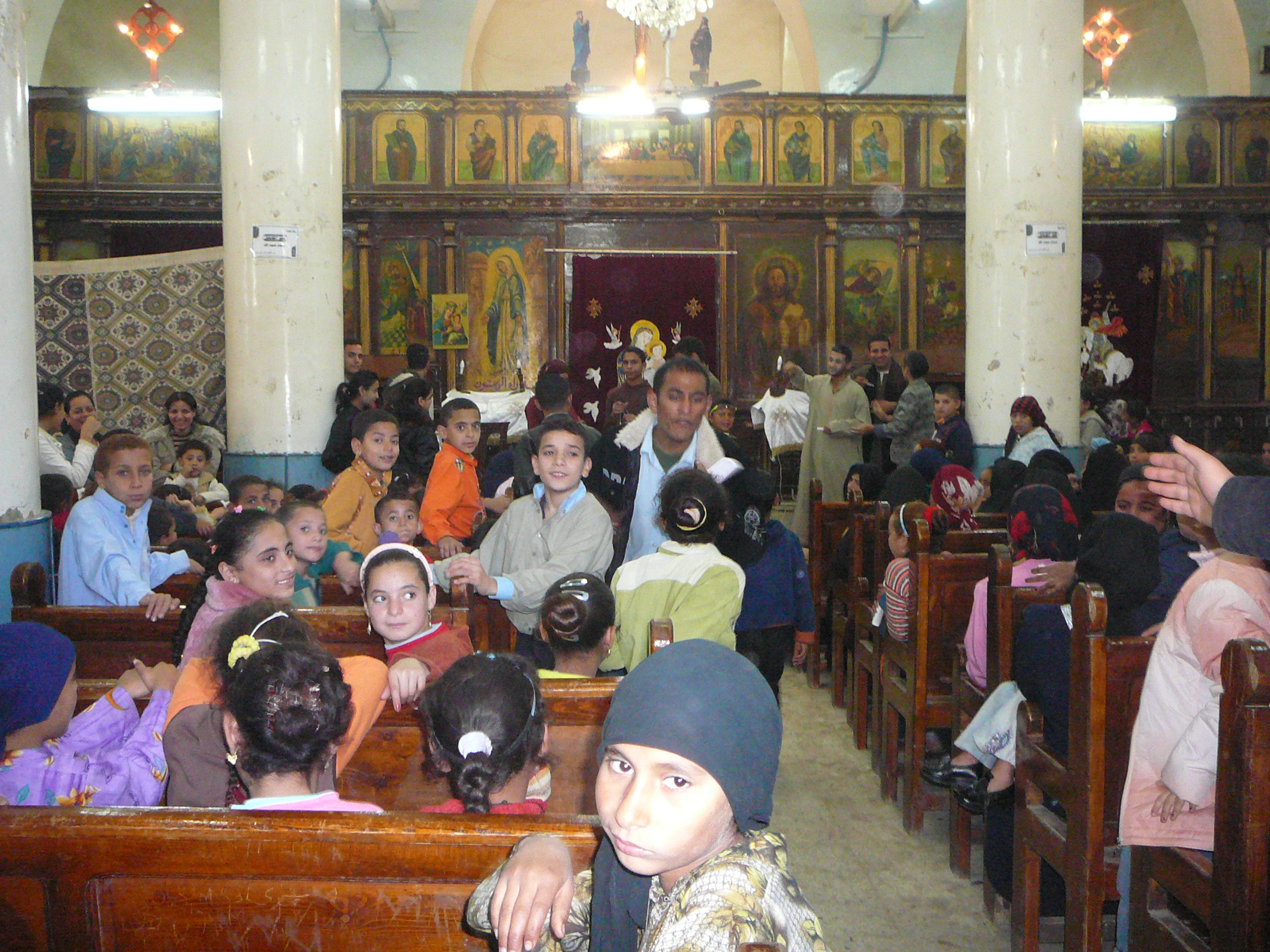
This first site was actually the second of the two in order of Jesus’ visits.  Since it was Friday morning, the day of worship for most Egyptians, the church at the site was filled with children having Sunday school.

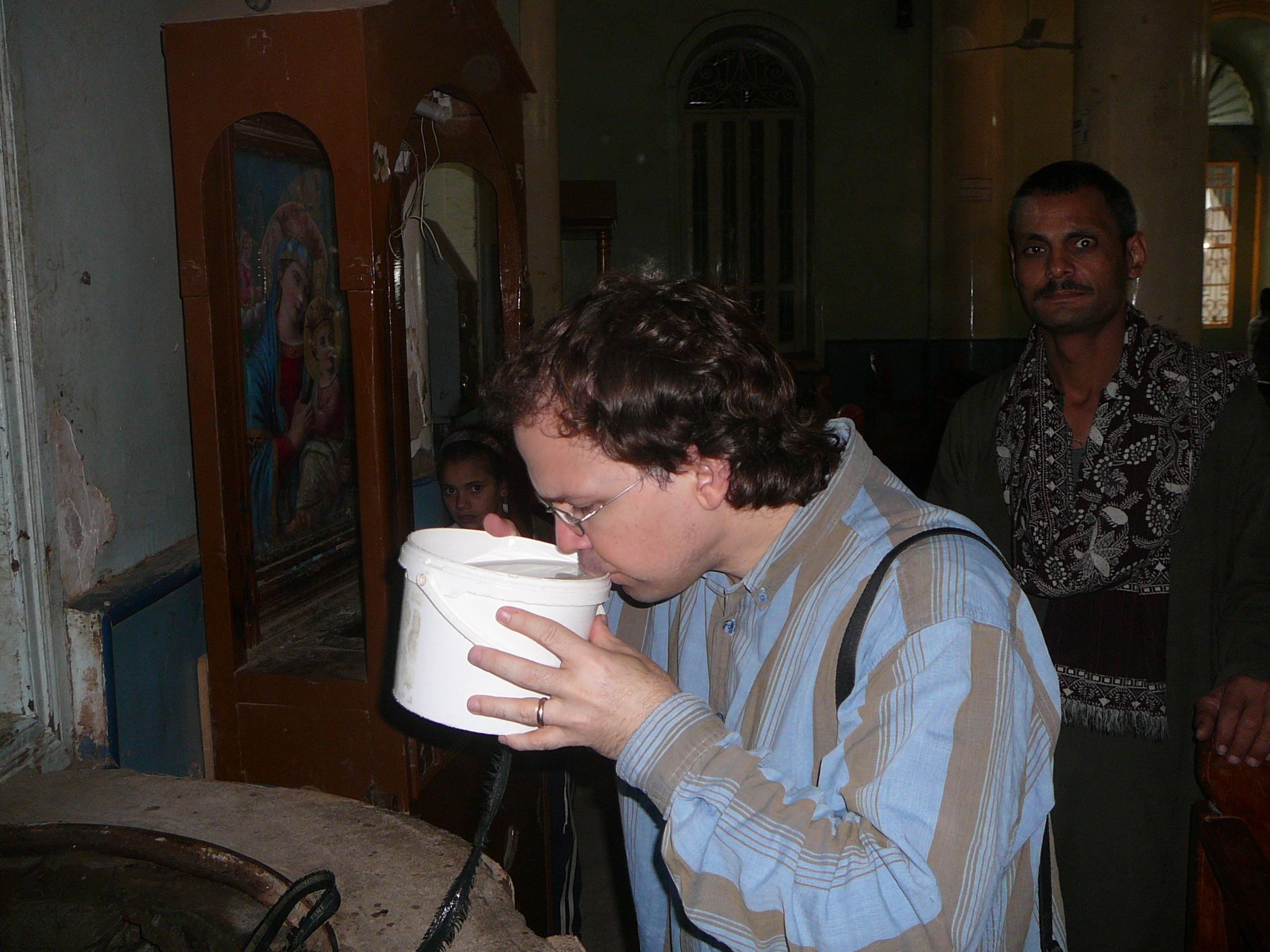
This place was interesting because it was in an entirely Christian village of about 12,000 people.  No Muslims live in this town.  The well where Jesus’ family drank from was locked up, but we saw it, and by the end of our time there, they found a key so Jayson could drink from it. 

We all drank some Sprite to settle our stomachs, and I visited the bathroom while Jayson and Emma climbed the steps to the top of the under-construction new church

so they could see the whole village.  Since this post has been graphic enough, I won’t share too many details of the bathroom.  It wasn’t the most pleasant experience, and they didn’t have anything but a hole in the ground, and I did think to myself while I was in there, “Oh boy, what a trip this has been,” but we made the best of it, and Hannah and I soon joined the other two at the top of the building.  I remember being glad that both girls lost their breakfast in the van, as I thought they might have trouble using the facilities if they needed them. 

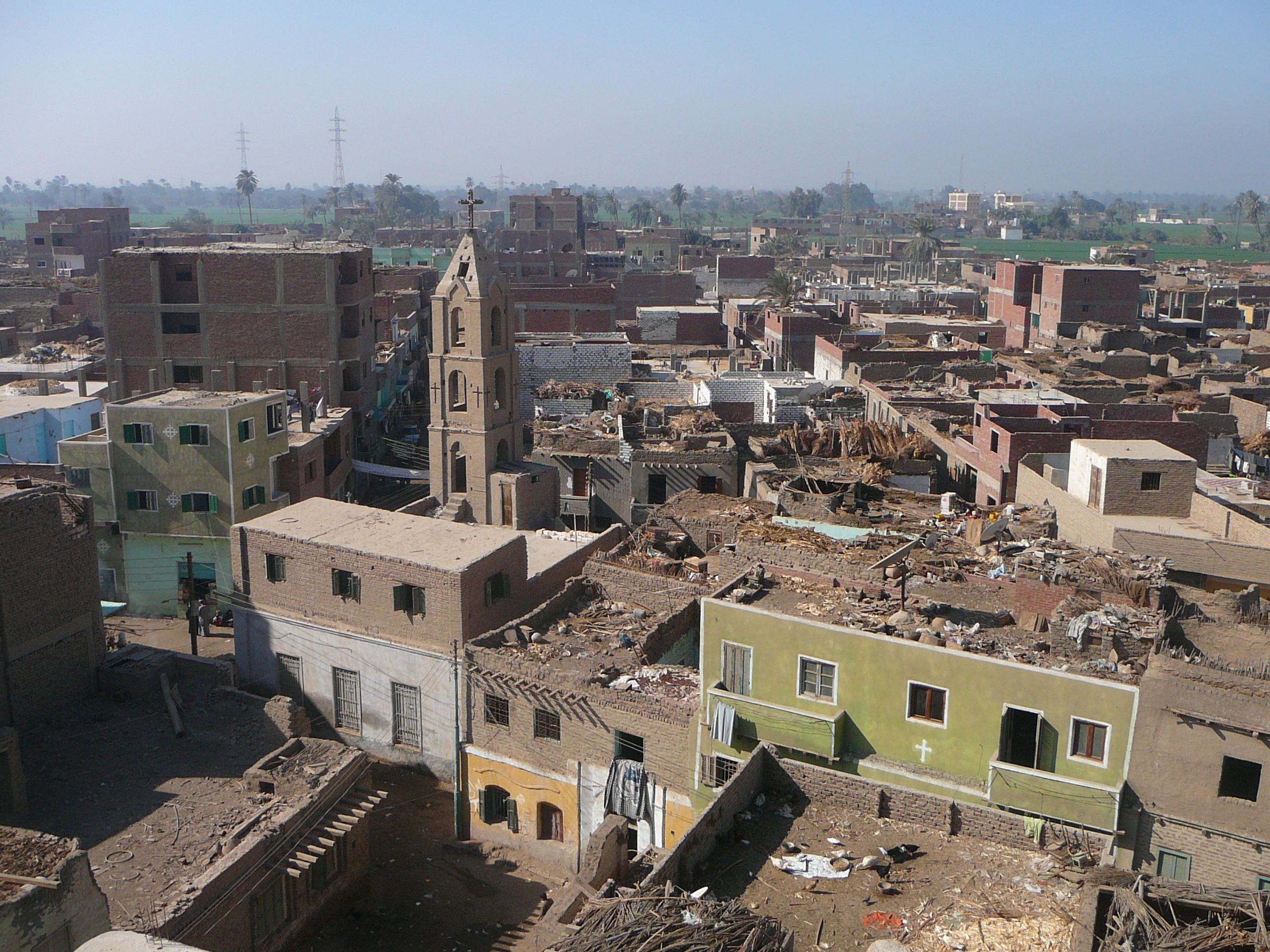
The view was very interesting with lots of unique things on people’s roofs like pigeons, chickens and ducks, which people raise to sell.   The roofs here are flat so that allows for people to store things, or raise things on them until they may decide to add another floor to their existing building. 

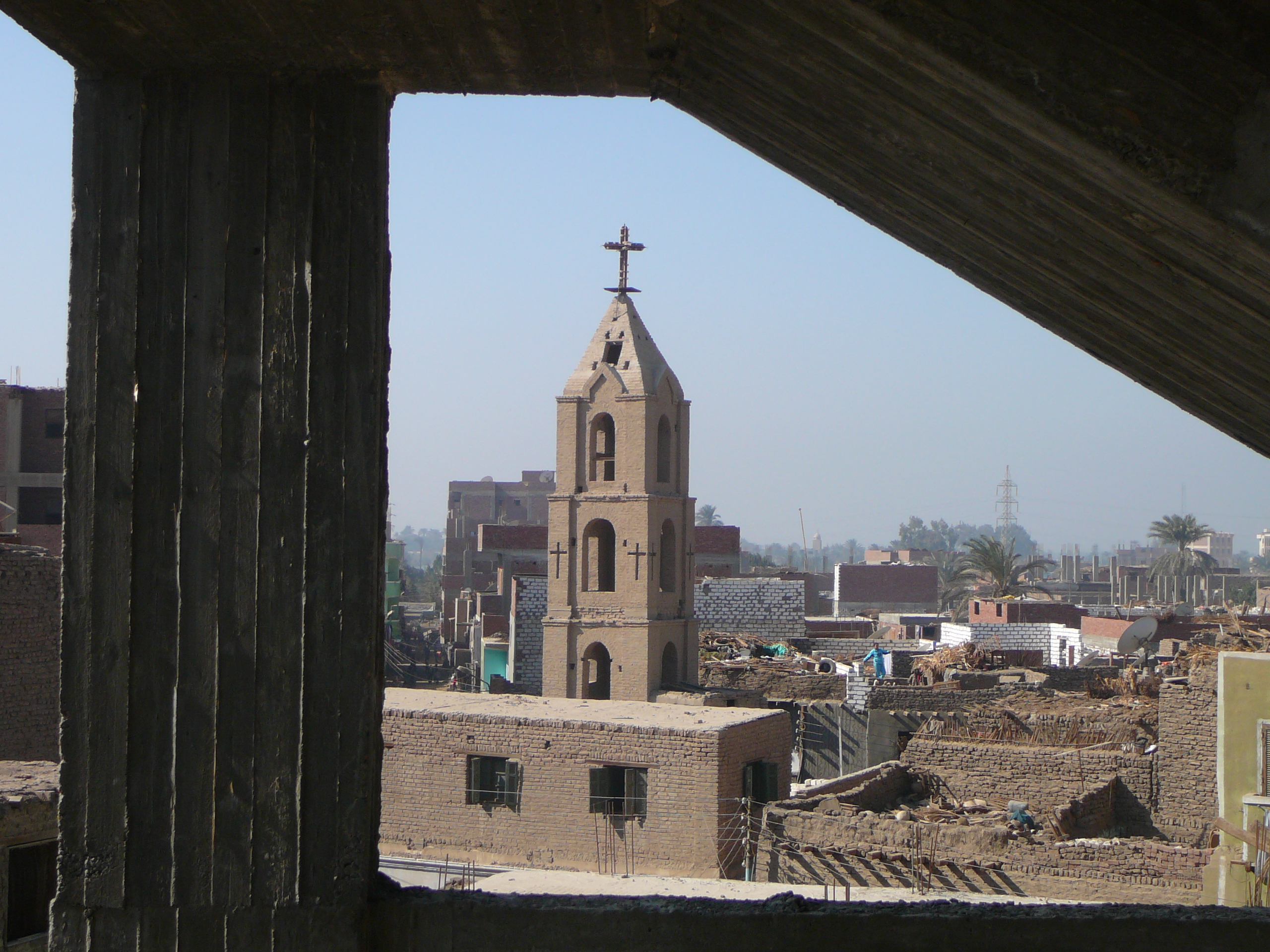
The steeple of the evangelical church in town was not too far from this site. 

The one unique thing about what we saw from our view was that there were no mosques … a rare thing in Egypt.

But, as I said, this was an entirely Christian village, and we later found out that when a Muslim family wanted to move in, they were refused.

After looking around for a bit and taking some pictures, we climbed back into the van … somewhat hesitantly.  We knew the ride to the next place would also be bumpy, but we hoped for the best.  We all sat as close to the front as we could, and each held a daughter on our lap.  The girls took a short nap and Jayson and I kept our eyes closed as we rode to the next place.  Fortunately it didn’t take too long to get to Shineen al-Nasara, which means ‘garden of the Christians’ in the Coptic language, where the Holy Family had come directly from Maadi (our current town) and spent seven days before traveling on.  This was an interesting place for us to visit because this is where our host had been priest for about 20 years. They had a life-size manger scene set up and the girls enjoyed getting close to baby Jesus and the animals, cardboard, though they were. 

Then we entered the church where Jayson took pictures and the girls played “church,” and I just sat and rested.  The church was decorated with streamers and balloons for the holiday celebrations of New Years and Christmas.

It was an interesting look considering Coptic churches are filled with icons of Jesus, Mary, the apostles and other saints; the streamers and balloons didn’t quite fit in.  The church also houses a 500-year old baptismal, a small one, since it is for infants.

We couldn’t stay in the church too long since a funeral was about to take place.  Just 30 seconds after we exited, the wailing women came into the church followed by a group of men carrying a coffin high above their heads.  We went to a different building in the complex where they had two smaller churches, a guesthouse and a large reception room. 

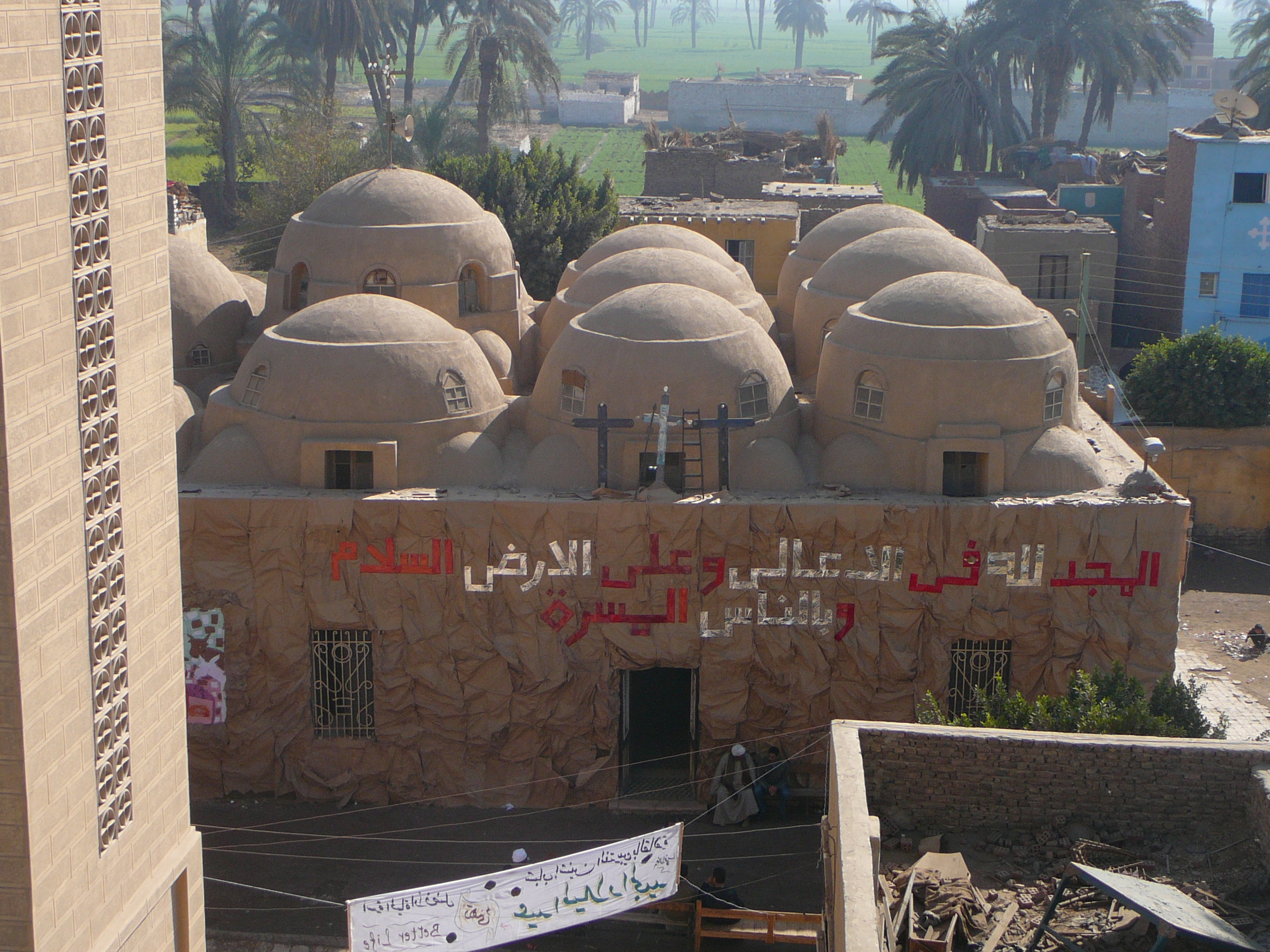
We climbed to the roof to get a better view of the surrounding area and we could see the thirteen domes on top of the church—representing the twelve apostles, with a larger one representing Jesus. 

We climbed back down the steps and saw another well which the Holy Family drank from, and also the plaque on the wall with the names of the people who helped to build the building, our priest being one of them.

Then it was time to climb back in the van for our return trip to the priest’s house for lunch.  We had planned to visit a third site after lunch, but seeing what the long car rides did to the girls, and knowing they really needed afternoon naps, especially as we planned to go to someone else’s house for a 9:30pm dinner, we decided to split responsibilities and let Jayson visit the site while I stayed home and napped with the girls.  So Jayson may write about his visit in a later post.

The rest of the day was somewhat restful—after too big of a lunch, the girls and I, along with the priest’s wife, all took naps, while Jayson and the priest went to visit the site of a modern day saint, whose lowly dwelling place has now been transformed into a massive church as a place for local pilgrimage. It was a late nap for Emma and Hannah, but we figured a late night was coming up, and we were right.

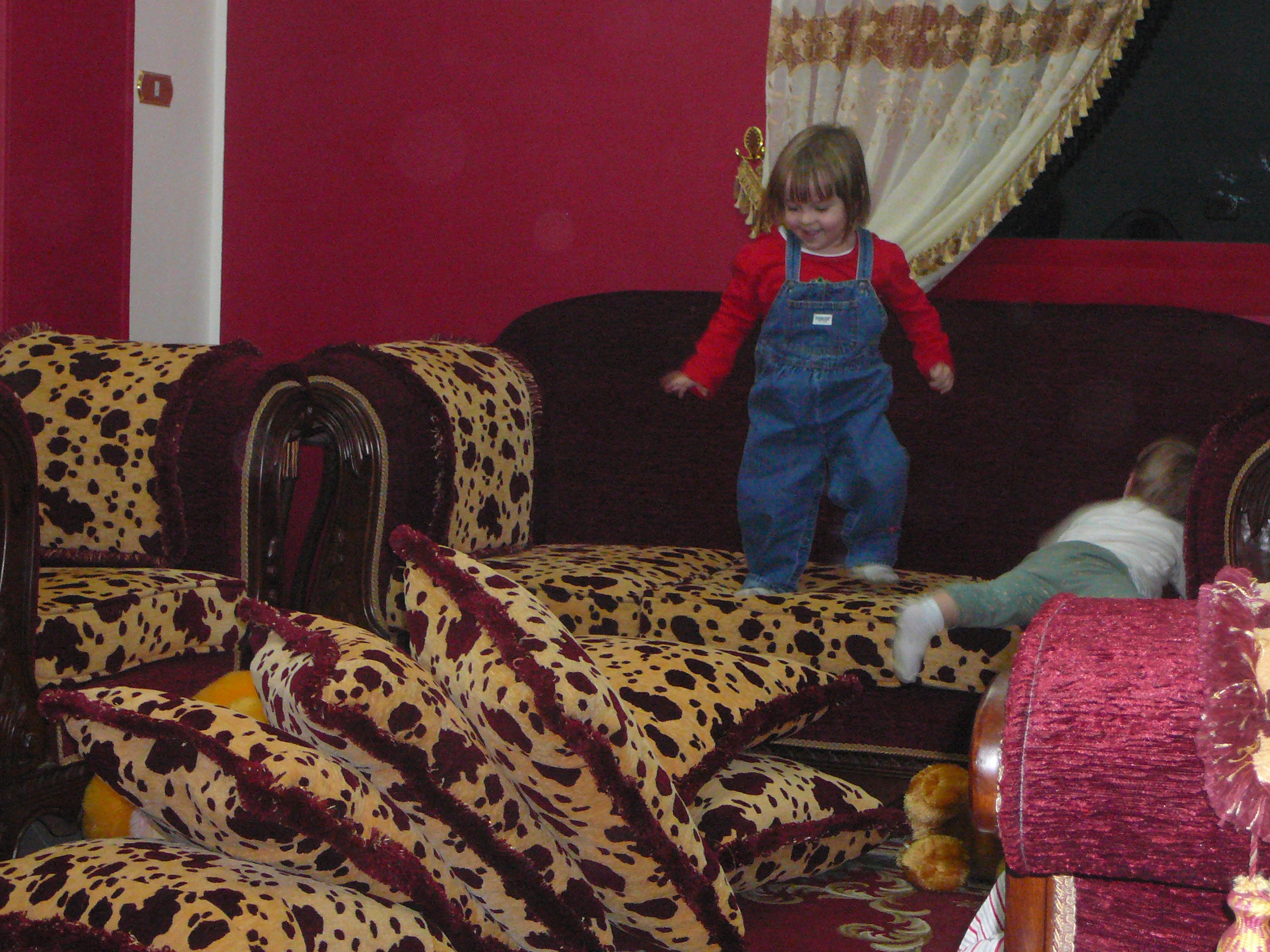
Around 8:15pm, the priest and Jayson finally returned home to pick us up to take us a few blocks to one of his daughter’s houses.  She had visited us the night before and really wanted to meet the girls, but they were already in bed.  It worked out for our schedules to visit and have dinner with her and her husband on this night so we climbed 8 floors to their new apartment as they are still waiting for their elevator to be installed.  Everyone was quite concerned for me, being pregnant, but the steps didn’t bother me at all.  Even Emma and Hannah walked the whole way up.  The apartment was very nice, and we enjoyed some nice conversation as Emma proceeded into a separate living room where she eventually put all of the pillows from the couches, maybe 6 or 7 large pillows and 3 or 4 smaller ones in all, on the floor and created a pillow train to jump on. 

She was having a blast, and Hannah joined her. 

Even though I am sure the furniture was brand new, our hosts didn’t mind and in fact, enjoyed the entertainment the girls provided.  At around 9:15, they asked if we wanted to eat dinner yet, or just feed the girls, and I said that we were ready to eat dinner, but I guess it was still early for them.  They kind of agreed as 10pm is more normal for them, so we compromised and said between 9:30-9:45 we could aim to eat.  Good thing the girls got late naps! 

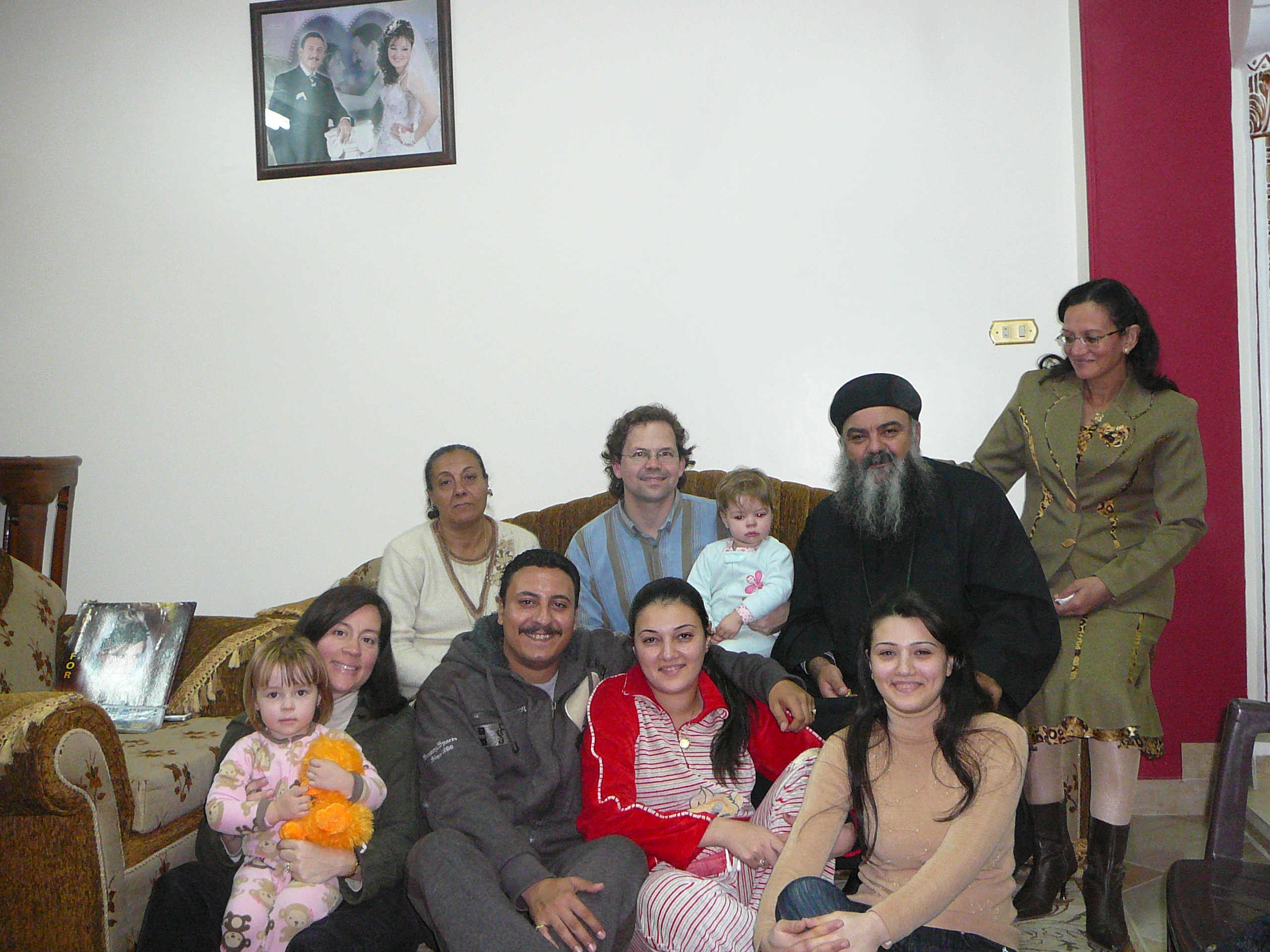
Dinner was delicious, but once again, way too big!  We had a plate full of rice, large pieces of chicken, kefta, another meat dish, cut up raw vegetables and okra.  At just about every meal, we had to eat some of everything, and I felt like I ate quite a bit, yet at each meal they asked me, “Why haven’t you eaten anything yet?  Why does your plate look the same as when you started?”  We really had to insist that we had enough, everything was delicious, and thank you, thank you, thank you!  We sat and talked and drank Pepsi and ate fruit for another hour or so after dinner was over, as the priest fell asleep on the couch after his very busy few days. 

Finally, after 11pm, we were able to take a group picture

and then leave their house, descending the 8 flights of stairs and returning to our hosts’ house.  Fortunately, our next day wasn’t starting too early, and we could sleep in.  But for now, the Christmas celebrations were over and therefore Day 3 ends this series of posts!

Merry Christmas to all and to all a good night.

Categories
Personal

Press Review of Nag Hamadi — Part Two

In an effort to keep you up-to-date with the news, I will continue to post the media summaries we provide as long as the subject is dominating the Egyptian press. As you read in the last update, it is difficult to sift the wheat from the chaff in these reports. The true and accurate often stands side-by-side with the exaggerations and inventions, and it is hard to know which is which. Right now, it is important just to listen and record. If we are able to investigate this situation further, these reports will be the foundation from which we can ask further questions. If any of you have the time to help us play detective, please feel free to read along and keep track of the names, crimes, insinuations, and accusations. Other perspectives are always helpful.

Click here for the link. Thank you.

Categories
Personal

Press Review of Nag Hamadi

We hope you have enjoyed our accounting of Coptic Christmas; there is still one more day to come, and hopefully some pictures to be shared thereafter. In the background of our Christmas stories, however, has been the events of Nag Hamadi, in which six Christians and a Muslim policeman were killed in a drive-by shooting while exiting the Christmas Eve mass. The incident has received international attention, and has dominated the Egyptian media consciousness in the days which have followed.

Our work at Arab West Report translates articles from the Egyptian newspapers and provides detailed summary thereof. In addition, we review these articles as necessary to provide fact checks and analysis. Due to the sheer number of articles on this topic, however, we have instead provided a press review, which we often do when there is a topic which dominates the news. This press review summarizes all the relevant articles from the major newspapers and combines them in one report. This manner of summary allows all voices to be heard, no matter how contradictory. This sampling may not clarify our understanding—our minds prefer a simple sound bite we can digest and process—but it does establish the complexity of the situation. It is hoped that by beginning from complexity clarity can emerge.

I have provided a link here to the press review. The assembly and analysis you will read is not my personal work, rather, it is that of my colleagues. The larger question for us here is what can we do about this? Do we have a role in encouraging reconciliation in the area? If so, how and when? I cannot say we have the answers to these questions yet, and even when we do, it may take a while to share them. I will look to link to further press reviews as we develop them, however, that you can follow along. If you care also to pray for peace in this region, and wisdom for us on how to contribute, that would be greatly appreciated.

Categories
Personal

Coptic Christmas: Day Two

The lack of sleep did cost us the next morning, though, as we were due to pay a visit to the area bishop for breakfast at 8:00am sharp. In the Coptic Orthodox Church the bishop is only one level below the pope, and carries great authority and responsibility. Christmas duties pressed on everyone, but he allowed us about an hour of his time, and the exchange of greetings was necessary on both sides. For us and the priest, it would have been an offence if we did not honor him with a visit, however short. The same would have applied if he failed to receive the foreign visitors in his area. Needing to receive the governor in only an hour, however, he allowed us a few questions, gave us Christmas gifts of wooden and cloth crosses in addition to an icon of the Virgin Mary, and allowed us our leave. The priest himself was due at his church in the village, so we left promptly.

The responsibilities, however, were simple. All he had to do was sit in his office and receive Christmas greetings. It made for little conversation as every two minutes in the morning another child would enter, kiss his hand, and then leave. This continued for about two hours, interspersed with a phone call of Christmas greetings every minute in between. It was somewhat boring, to tell the truth, but it was a complete cultural experience.

All during this time the church grounds were an open playground. As parents enjoyed a morning of rest their kids gathered and exploded miniature firecrackers one after the other. They were clearly enjoying themselves, but as I sat in the office I could only imagine the chaos outside, except for when the kids threw their fireworks inside. Surrounded by walls, the noise was deafening, but the priest did not seem to mind at all. I got increasingly perturbed, but what can you do when this is normal and accepted behavior? I have noticed that priest may have a slight hearing problem; after twenty-plus years of service, these bi-yearly celebrations can perhaps take their toll. My imagination of the chaos, however, can be presented as reality by Julie, who was outside with the girls, and will take over the authorship of this next session.

I don’t think Emma enjoyed herself too much.  I wasn’t exactly sure what it meant that we would go sit at the church and “play” all day.  I knew Emma liked to play with kids, but the sheer number of the kids would probably overwhelm her.  What I imagined came true.  We arrived to a crowd of children, dressed in their new Christmas clothes.  They surrounded our car, knocking on the windows and holding out bags of chips to our children who were behind the closed windows.  It really felt like a Hollywood star experience, and we were the celebrities.  As we entered the courtyard through the church gates, the kids followed the car.  We parked and got out and they just kind of stared and smiled at us as we exited the car.  I offered typical Christmas greetings, “May you be well all year,” as I carried Hannah and Jayson carried Emma.  Wherever we walked with them, the kids followed, not saying much, but not leaving us alone either.  Emma was overwhelmed, but handling it okay.  Jayson and the priest went into the office, and told us we could play out in the courtyard.  So, holding Emma’s hand, and Hannah in the other arm, we walked around, surrounded by kids.  We eventually went to a ledge that was in the sun and sat down in the warmth.  The kids surrounded us, some of them saying in English, “What’s your name?” or, “How are you?” to the girls, and not getting much of a response.  The firecrackers either started then or else that was when we noticed them, and from that moment on, Emma’s hands were up on her ears every time she was outside the office.  It probably looked kind of funny to the kids, but I felt bad for her.  They offered her the firecrackers; I’m not sure what their thought was: Does she hold it as its lit and then throw it, or is it just something for her to hold in her hand?  I kept refusing and told the kids that she doesn’t like noise; it scares her and hurts her ears.  This seemed a foreign concept to them.  They offered chips or cookies, which was about the only thing the girls responded to positively.  They asked me their names and I told them.  An older girl asked if I knew a certain game, and I didn’t understand her.  She said they wanted the girls to play with them.  I said, “Okay, we can try.  If you all start playing, the older one may join you.”  But everyone just stood there.  I wasn’t sure what they wanted us to do.  How do fifty children play exactly?  I didn’t see a ball and it didn’t seem they were going to organize a big game, yet, we had the directive to “play.”  One of the older boys started trying to disperse the crowd to go play so maybe we could move around or get up, so I took both girls by the hands, well, Emma by the elbow because her hand was covering her ears, and we walked around the courtyard, looking for people playing, yet still being followed by a crowd of children who were NOT playing.  The noise of the firecrackers was really getting to Emma, and at some points, the kids would throw the lit noisemaker near us.  I don’t really think it was malicious, but it did seem intentional.  I think it just enthralled them to see someone so affected by the noise, as they obviously weren’t.  Emma said she wanted to go to daddy, so we all went into the office, where we finally could sit in peace for a bit.  For the next few hours, we either sat in the office, where we usually had some sort of snack from someone, or we walked around the courtyard, Hannah’s hand and Emma’s elbow in my hands, walking around, followed by children and the sound of firecrackers.  When it got too much, we would reenter the office and sit for awhile again.  After awhile, the thought of “playing” all day at the church, didn’t sound too fun!

Ok, Jayson is back. Around noon the priest’s brother came into the office and offered to take us to his house in the village where we were to have lunch around 3:00pm. That seemed a very good idea for the girls, but I thought it best that I stay there in the office. I walked with them to his home, about five minutes away, to keep all propriety, promising the priest I would be back shortly. All seemed fine with the brother’s family, and by the time I came back the ATM had opened. The priest had stacks of bills which he was distributing one by one as each child entered, kissed his hand, and received his $0.045 cents. This apparently was a custom for the holidays.

When this ended the sitting became much more enjoyable. The men of the village now came to pay their Christmas greetings, and several of them would sit and talk for a while, especially the ones who were working abroad or in Cairo and came home for the occasion. I even met someone who was working in Jordan, as a gardener in the church we worshiped in way back when. Many of these people only return home once a year, but some can come more frequently. It is especially hard because most have left their families in the home village.

Julie and the girls were able to take a nap before lunch, and I took mine afterwards. By this time, though, the news was filling the village. Six Christians were gunned down as they existed Christmas mass. Not everyone really knew what was going on, but all expressed concern, though not surprise. Many Christians have surrendered themselves to the idea that the country is against them, and this was just the latest confirmation. Even at that early point, however, there were complicating features, or at least rumors. This event was said to be connected to an ongoing controversy related to a nearby village, in which a Christian was said to have raped a Muslim girl, and the Muslims then responded against the Christians at large as the perpetrator of the crime escaped. In Upper Egypt the practice of revenge killings is not uncommon, and this may have been a continuation. Or, it may have been terrorism clear and simple. ‘Terrorists’ was the word on most of the Christians’ lips.

After lunch ended we left the village, returning to Maghagha, and things were quiet as the priest had to leave for family responsibilities, allowing me to write much of this summary. We had dinner earlier that night, at around 11:00pm, but we had put the girls to bed around 9:00pm. With a full stomach once again we weren’t much in the mood for sleep, and enjoyed good theological conversation until 2:00am, taking full advantage of our time together. It was another long but good day, but with a pall over the events of the day.

The events also could threaten us, as surely the security would be increased throughout the country. Would we be able to continue our program? The next day we were to visit two places reputed to be visited by the Holy Family during their escape to Egypt, and another place which was a pilgrimage site for a modern day saint. Would we be sent home immediately? Would we be confined to the priest’s home? There was no worry about safety whatsoever, but as we finally did collapse into sleep, there were concerns aplenty. The ones highlighted here in this last paragraph pertain to us, but may our prayers highlight those concerns of the country, pertaining to all.

Categories
Personal

A Coptic Christmas of Joy and Sorrow

There is complicating news today. It is significant enough that you may already know about it. Six Christians and a policeman were killed today in an ambush as they were exiting midnight mass in an Upper Egyptian town to the north of Luxor. I wish to be careful in conveying information because I have been far from the news in our relative isolation in Maghagha, over ten hours away from the attack, but it has been the talk of the community since we awoke this morning.

Our day began in Maadi, as we fought through Cairo traffic to get to the train station in Giza. We left a full hour to arrive, thinking this would be plenty as the station is just on the other side of the Nile River. We should have known better. We left on the 6th of January, a Wednesday, but in addition to all the Christians who would be in transit to get to their homes and churches, there was weekend traffic with which to contend. Coptic Christmas, the 7th of January, is a national holiday, so whereas Thursday night is often prime traffic with the Friday-Saturday weekend, Christmas led to a three day weekend for the entire country, and it seemed like the nation had emptied onto the streets.

We did arrive on time, but with only about fifteen minutes to spare. We appeared to be the only foreigners at the location, asked about how and where to board the train, had a policeman direct us informing him we were traveling to Maghagha, and settled into our seats, which were reserved by number. The train was very comfortable and we by coincidence sat next to another couple also traveling to Maghagha, and enjoyed pleasant conversation with them the entire two and a half hour journey.

Upon our arrival I am afraid we may have offended some. It was fairly comical, at least from our perspective. It is a bit complicated to descend from a train with two small children, a pack-and-play, suitcase, and backpack, but we managed, and it was no surprise to find a willing porter ready to help us with our bags. If any of you would wish to visit us, please be prepared for this at the airport. They can be friendly, helpful, and by comparison inexpensive, but they can also be insistent.

The first thing we should have noticed is that this porter was not very insistent. He offered to help me with the suitcase, and per custom I refused, with a quick ‘no thank you’, barely an exchange of glances, and began advancing. It may not be the most polite manner, but you get used to the necessity of not getting drawn into conversation, lest you be forever unable to escape.

My advancement, however, was quickly halted as I found the gentleman who was to receive us. Our stay was arranged with the priest of a village not far from Maghagha, but due to our late arrival (now about 9:30pm) he was already involved in leading mass. In his place he sent his brother, who now began helping us with our bags, but only for a moment.

Within two minutes he was surrounded by the police, among them the ‘porter’ who earlier tried to help us as we got off the train. It was all very friendly, and no one was unnerved, but Julie counted seven people who were involved in our arrival. Who are you? Who are they? Why are they coming? Where are they going? Each question had a very simple answer, and the appropriate people recorded the information, finally taking a look at our passports and recording our names. They continued to escort us to the priest’s brother’s car, with a small diversion as I remembered it would be better to purchase tickets for our return trip before we departed the station. It turned out this was rather unfruitful, for the trains were sold out on the day we had purposed to leave as well as the next day, except for either the 5:00am train or the one leaving at midnight. At this point we have no return ticket, but the police assured everything would be taken care of. As great as their attention had been to this point, it seemed the best thing to trust their word. They indicated, if I understood correctly, that we should just show up at the normal time of departure at 10:30am or 1:00pm, and we would (likely) find a place. In any case, the priest would take care of everything.

Here is the background, some of which is known, some of which is conjecture, all of which is the normal and expected procedure. My boss has been friends with this priest for many years, and he selected him for our visit to Upper Egypt in part because he has a very good manner with his Muslim neighbors and the regional authorities. In securing the priest’s agreement for us to visit, he then informed the police in our area, who also gave their approval. This is the known. The conjecture is that the policeman I inquired with concerning how to board the train likely conveyed his knowledge to the station in Maghagha. Therefore it should have been no surprise to find the concerned authorities as part of our official welcome.

The normal and expected procedure has been in place for many years. Egypt has had sporadic violence against foreign tourists who visit the Pharonic heritage sites in Upper Egypt, and consistently sends all tourists with a police escort. Foreigners who go to places like Maghagha, however, are much less frequent, and generally have very limited reasons to be there. Their presence attracts attention, and Egypt is concerned about their security. In a country which depends to a great extent on tourism and outside investment, the death of a foreigner could have wide ramifications. Upper Egypt has a reputation as being a haven of Islamist activity, and while the vast majority of people are against violence of any kind, including the vast majority of Islamists, there are pockets of extremist sentiment. Though the government has made great strides in combating these elements, they do still exist, as was seen today.

The police presence takes some getting used to, but it is very friendly. At the station the officer who recorded my passport information apologized several times. One of their number joined us in the car and accompanied us to the church in the village fifteen minutes from Maghagha, where the mass was in progress, and then joined with his colleagues who make up the normal guard outside the church during every mass, but especially during holidays. He came in a few times to check in on us, and when everything ended two officers joined us on the trip back to Maghaga. One sat on the lap of the other in the passenger seat, and they joked with the priest almost the entire trip home. The next day we returned to the village to join in Christmas day celebrations, and though they checked regularly with the priest about our program, they generally left us to ourselves, as best we knew. Even so, it is now 10:00pm, and an office just knocked on the door of the priest’s home to inquire if we are going out again tonight. After assuring him we were done for the day, we may have allowed him an early evening home.

In terms of the chronology of the day, however, we return to the Christmas Eve mass. We arrived about 10:30pm with an hour and a half of a four hour service remaining. Our girls were doing remarkably well given the hour, and though Hannah largely stayed quiet (but not sleeping) on Julie’s lap, Emma was having a great time. Automatically becoming the guests of honor we were ‘seated’ in the first row of the church, directly in front of the altar boys. Seated is a misnomer as most of the mass requires standing, and as I held Emma she preferred standing on the dividing wall between the congregants and the altar boys, and quite attracted their attention. Three of them in particular paid no further care to the mass and played with her the whole time. Emma was alternatingly shy and engaging, but was causing no stir. There were several children milling about in the pews, and the worshipper standing next to us was goading her the whole time, and was even father of one of the three altar boys. It was fun to join in the chants while at the same time catching Emma as she turned from the attention, slipped off the wall, and fell into my arms. It may not be acceptable behavior for most masses, but on this occasion we fit right in.

As the mass ended the priest left rather quickly and we returned to his home with the aforementioned escort. In the car our girls finally fell asleep, but of course woke upon arrival, which may have been good since food was waiting for all. Though actual practice varies, Orthodox Egyptians fast for fifty-five days before Christmas. The fast is of a vegetarian variety, as all meat beside fish is prohibited. Christmas then becomes the worthy celebration, and the meat flows freely. In addition to a plate of rice and a bowl of salad, there was chicken and the most delicious beef I have ever eaten. It did make me wonder, however, how many ‘foolish’ things we do in our celebrations of which we are unaware. After fifty-five meatless days, it seems strange to gorge on such a feast, especially at 1:00am. We did not have the most pleasant sleep that evening (morning?), but there were no regrets concerning the consumption.

To be continued…

Categories
Personal

Tomorrow is Christmas Eve

You may remember Jayson’s post from Dec. 25 entitled “Today is Not Christmas”.  Well, we have been able to extend our celebration of Christmas being here in Egypt, and finally, tomorrow, January 6, we will celebrate Coptic Christmas Eve.  We are still establishing our traditions, as he mentioned, but for this first Christmas in Egypt, we decided to travel to a town about 3 hours south of Cairo, called Maghagha.  We will travel by train tomorrow evening, arriving around 10pm as the Coptic Church is in full swing for their very special Christmas Eve service.  All over Egypt, Christians will be worshipping God in their churches until midnight, at which time they will return to their homes for the big Christmas meal.  One of the reasons the meal occurs directly after the midnight mass is that traditionally, Copts fast for 40+ days prior to Christmas.  This fast includes abstaining from all animal products, and thus, once midnight of Christmas Eve hits, the fast is broken, and the Christians can celebrate the birth of their Savior with food and fellowship.

I am sure we will have more to say about this when we return from our trip on Saturday, but for now, just know that we will participate as best we can in this midnight mass, with our two little ones in tow, and then in the Christmas feast at someone’s house, again, with our two little ones preferably sleeping in tow.  I am sure we will have many stories and adventures to share following four days of celebration outside of Cairo.  Stay tuned.

Categories
Personal

Brown Bear, Brown Bear

This classic children’s book has been a favorite of our girls specifically during potty training for some reason.  I guess we introduced it as a new book when they were learning to use the potty, and it takes long enough to read to give them a chance to do something on the potty.  They both learned to read along with the book, at least somewhat, fairly quickly, and we recorded both of them at different times, with their Brown Bear book.

Emma was about 2 years old when she started with Brown Bear.  She could identify all the colors and animals fairly well by then.  One word of translation, when Emma says “oo-hoo” it means “give me.”  She wanted to see herself on the camera.

Hannah started with Brown Bear at about 19 months of age, so her words aren’t as clear, but she definitely knows the animals.  She, too, wanted to see herself on the camera, so she is a bit distracted, but it is fun to compare the two.

For Emma, click here.

For Hannah, click here.

To purchase from Amazon, click here: Brown Bear, Brown Bear, What Do You See?

Categories
Arab West Report Books Middle East Published Articles

Two Thousand Years of Coptic Christianity

Two thousand years of Coptic Christianity is the title of a book by Otto Meinardus, a renowned scholar on the history, practice, and theology of the Coptic Orthodox Church. His work is widely accepted as the standard reference book for all inquiries into the development of this particular expression of faith. Upon reading it, I could only agree.

My strongest agreement, however, is expressed in its description as a reference book. When I asked a well read friend to recommend me a book with which to understand the Coptic Church, he immediately thought of Meinardus. While gladly loaning me his copy, though, he added, but this is a book you must eventually buy for yourself. I didn’t understand this at the time; like with most books I wished to read it, profit from it, and then give it back to its owner. Rarely if ever does a book get read twice – why should anyone ever purchase?

Upon my reading I discovered why, though the jury is still out if I will eventually buy it for myself. The first half of the book is a comprehensive survey of Coptic history, beginning not even with Mark—believed to be the founder of Christianity in Egypt—but with Jesus. The Gospels tell the story of the Holy Family’s flight to Egypt to escape the sword of King Herod. While the Gospel details are few, Coptic legend-slash-history thoroughly establishes their itinerary, proceeding even to sites hundreds of kilometers from Palestine in Upper Egypt. At each significant place of their travel there is a church dedicated to the event. These churches have an ancient history, lending credibility to antiquity of the tradition.

Meinardus does not judge. Though he comments often on this progression, he generally presents the details and leaves the historical queries to other works. His treatment of subsequent Christian development is similar. He tells the tales that surround the preaching and martyrdom of Mark, and of the first communities of Christians that began the transformation of the Pharaohnic character of Egypt. Elements of this story involve the miraculous, which does not stop with the end of the apostolic age. Meinardus continues to list the traditions surrounding the acts of prominent bishops and monks, and especially the martyrs from the eras of persecution. Monasteries and martyrdom are among the pillars of Coptic Christianity, and Meinardus provides a window into the worldview of the church.

He also delves into the development of theology, which is easier to document. Treatment is given to the great Christological debates which divided the early church, but proceeds into the production of Coptic canon law. The great figures who wrote these documents and the ancient liturgies, so obscure to Western readers, are given their names and accomplishments in print. Meinardus has respect to the cloud of witnesses which has gone before, and honors their legacy.

Yet not all the names are obscure. Athanasius, the great champion of orthodoxy against the Arian heresy and compiler of the Biblical canon of Scripture, was the pope of the Coptic Church. Cyril and Gregorius are not as well known, but are still familiar names to students of church history. St. Anthony, the founder of monasticism, was Egyptian, as was the Thebian Legion whose memory is enshrined in many European cities for their refusal to deny their Lord and subsequent martyrdom. Coptic Christianity, in fact, lies behind much of the history of Christianity in Europe, as their monks and missionaries carried the Gospel throughout the continent, and to Ireland especially. Many people are aware of the vital role played by the Irish in the Christianization of Europe; less known is that the origin is Coptic. Meinardus supplies the names and stories of the Egyptian contributors.

Meinardus continues the story into the middle and modern ages, describing the interactions of the church with Islam, during both its tolerant and repressive epochs. Less detail than I desired was given to the question of why the church declined over time, but this is a difficult issue to address; histories are written of triumph and progression—who records the record of loss? Nevertheless, Meinardus provides a window into this near-unknown era, and understanding of the history will take many readings simply to establish familiarity. This becomes easier as modernity approaches, and Meinardus describes Coptic dealings with successive Turkish, French, and British empires. Special attention is given to the deep revival of the church during the 20th Century, which continues to this day. A blog post all its own is necessary, however, to do justice to this phenomenon.

All that is listed above was both interesting and worthy of owning as a personal record, though the story in its broad strokes may be told elsewhere. The second half of Meinardus’ book, though, both establishes and possibly condemns it to serve as a reference book. From here on Meinardus becomes a list-maker, as nearly every monastery, church, and saint’s shrine is given a place in his text, complete with details of the relics therein. I read the majority of the book while I was staying at Makarius Monastery in Wadi Natrun, which is home also to additional historic monasteries established as early as the 4th Century. It was fascinating to read the history of where I was. The other chapters were a chore to read, however, simply because I have no context to appreciate them. If I anticipate a future visit to such-and-such village in Upper Egypt I will open Meinardus and read of the churches there, but otherwise, what good does this information do me?

I hope, however, to visit such-and-such village. I imagine that our work will take me throughout Egypt to discover the many different facets of Egyptian life, Christian and otherwise. To view the foundational facts will require reference to Meinardus, and for this his book seems essential to own. I would recommend the first half of the book to anyone interested in Coptic Christianity, but I will likely in time find better, or at least equal, books to recommend. As a reference book, however, Two Thousand Years of Coptic Christianity will likely stand alone. It is recommended to anyone desiring to study Coptic Christianity, and for long term life in Egypt, if there is a desire to honor its Christian heritage, it is a must.

Click here to purchase from Amazon: Two Thousand Years of Coptic Christianity

Categories
Personal

Today is Not Christmas…

… but neither am I Scrooge. Well, that could be interpreted as a matter of opinion, as may be seen.

Perhaps many of you are aware that in Egypt, Christmas is celebrated on January 7. I imagine there are deep and profound historical reasons for this, but to date I have not cared particularly enough to research them. Coptic Orthodoxy split apart, or rather was expelled, from the to-become Catholic faith at the time of the Chalcedonian creed, I believe in 451. One of the consequences was a divergence in fixing the celebration of Jesus’ birth, which for early Christians was never regarded with any importance. Easter also became separately marked, though this was of greater import, both biblically and liturgically.

We discovered while living in Jordan that the Christians there created a novel solution. The Coptic and Orthodox branches of Christianity, about evenly split in the country, agreed to celebrate Western Christmas on December 25, and Eastern Easter according to the lunar rites of the Orthodox Church. I would wish that the worldwide church might make such an agreement as well. For our part in America I imagine this would be easy. Ubiquitous Western culture has established December 25 as Christmas even throughout the non-Christian world, and none of us can ever figure out when Easter is going to be anyway. What would be the difficulty in uniting with our Eastern brothers in faith by celebrating Easter according to their calendar? I doubt anyone would even know the difference.

This could be harder for the Orthodox, however, as it could be seen as yielding to the very unchristian culture which surrounds the birth of Jesus. What should stop the Western world, however, from making a unilateral gesture of unity to Orthodoxy by taking up their Easter? Perhaps the Pope could champion this cause from the Catholic side; if he did, would Protestants go along? Or, under what scenario could the initiative emerge from the Protestant community; who might lead us forward? Might any of you propose such a measure this year in your churches? Might you develop a sufficient sense of belonging to the worldwide church so as to contemplate it?

Our sense of belonging to Egypt, however, has created in us a bit of a quandary. When is our Christmas? Most foreigners here simply celebrate December 25 as they always have, and the local expatriate community churches host Christmas Eve services and have times of caroling. For those spending time abroad away from home, certainly this is a welcome reminder of valued traditions.

But it completely misses Egypt. The non-Orthodox Egyptian Christian community is but a small percentage of the millions of Coptic faithful. Again, I lack the history of why and if this was always so, but the Egyptian Catholic and Protestant Churches celebrate Christmas in unity with their brethren, on January 7. Though Jordan also was a predominantly Muslim country, there were still Christmas lights hanging from the windows of Christian apartments and manger scenes set up among the families we would visit. Here, there is nothing. Not only is there no Christmas cheer, but the Orthodox precede Christmas with fifty-five days of fasting. As we went to sleep last night, it was almost eerie to imagine the excitement among children back in America, and the labors of parents to run the gauntlet through that most sacred of national institutions, the mall. Here, save for the sounding of the call to prayer, there is silence.

This is not quite true, however, and it creates a confusion that is quite palpable. The Orthodox are proud of their traditions and history; why then are there so many trappings of Western Christmas? Last Friday at the Orthodox Church we attend was held the annual church bazaar. There were Santa Clauses being sold, wreathes to buy, and a big sign proclaiming, “Merry Christmas and Happy New Year!” Why was this not reversed in order? Are the Egyptians yielding in fact to the inevitability of Western cultural dominance? Or, is there simply no escape?

There is a possible explanation in that this church in particular was consecrated on either December 24th or 25th, and from the coincidence of Christmas the two celebrations blend together. Another explanation is that the Christians also celebrate New Year, and the holiday festivities start early, continue through the end of 2009, and pick up steam as true Christmas approaches. Perhaps, but later this evening we will attend the choir concert at this church, which will feature carols in both Arabic and English. We do not have the benefit of familiarity over time; is this normal, both here and throughout Egypt?

In any case, what should we do? The principles of belonging suggest that we should do as the Egyptians do and celebrate according to their calendar. No one claims that Jesus was actually born on this day, so what does it matter? We also have the benefit of having children young enough not to be traumatized by a different date. We could just ignore the 25th and then let the momentum build in both family and country in expectation of the 7th. Yet if this can be interpreted as the noble solution, what do we do in the face of the ignoble bowings to yuletide found among so many Copts? Do they themselves open our door to the legitimacy of Western celebrations?

 Regardless, the noble solution may not be the easiest, or even healthiest. While our children may be able to switch with little difficulty, we ourselves cannot. Furthermore, what of the phone calls back to family in America? These will not stop, but how will they be defined? We have taken to saying, “It is Christmas in America,” but this is forced. I nearly prayed this morning at breakfast, both unconsciously and with a smirk on my face, “Thank you God that Jesus was born in America today.” Of course I will not play with such blasphemy, but is this a duality that can be maintained?

If only for year one in Egypt, we will try to maintain it. Perhaps our children will grow up bragging, “We get to celebrate two Christmases!” Our current solution is to avoid the expatriate church focus on the 25th, in the manner which we generally avoid this church anyway. Still, we will wake on Western Christmas and have a special breakfast, after which we will open our stockings. Before lunch we will participate with other foreign friends by taking a boat ride on the Nile. Later in the day we will call our families to join in their celebrations, and will close the day at the aforementioned Orthodox choir sing. All this will be Christmas, in very nature and being.

Yet it will not be Christmas, amen and amen. Eastern Christmas is still to come. I am not sure what this will entail in terms of participation in the greater life of the Coptic community. For ourselves, though, we will leave the opening of presents until this day, when we will also have a cake to celebrate Jesus’ birthday. Perhaps this suggests that we will treat the 7th as ‘true Christmas’. So be it. We can never leave behind our own culture, nor should we try. Yet we should give ourselves as completely as possible to those we live among, and the sole celebration of the 25th would be tantamount to insisting, “We are not of you, we remain foreigners.” It is doubtful that anyone would care; they expect foreigners to remain so. Yet we hope that if only in a symbolic way some might see our holiday adoption, albeit short of transfer, as an expression of love and appreciation.

The celebration of Christmas, on either the 25th or the 7th, is a celebration of incarnation. The word of God took on flesh, and dwelt among us. Following this pattern, all who follow him can take on the flesh of those they live among. As he remained God, so we will remain American, and all will keep the identity they possess. None of this need be set aside, but so much more can be added. For the good of Egypt, for the good of all the communities in which we live, and for the good of our very souls, may such incarnation take hold.

Categories
Books Personal

A Grief Suppressed?

A few days ago I started writing a blog post about our doorman’s wife, Aaza, a woman I mentioned in a blog post before (click here).  The idea for the post came because she has been in the hospital for at least three weeks awaiting an operation for a second brain tumor.  Her first tumor was removed in mid-August.  After that, she seemed to have some ups and downs.  Some days I would see her hanging laundry, walking around her yard, drinking tea, talking with her girls … slowly and sometimes in pain, but recovering nicely.  And then other days she couldn’t talk, her tongue seemed numb.  She couldn’t move her hands; she walked only very slowly and with great help from her husband who seemed desperate to help her regain her full strength.  She took lots of medicine and stayed in bed most of the day, and then we heard, her brain tumor was back and she would go for another operation—this time at a better hospital with a better doctor.  Yet, the next news I got was she went to the hospital, and then the operation was postponed one week as the doctor went to a conference?!  It sounds crazy to my western ears.  Each time I asked a family member, it was the same story.  “No, she hasn’t had an operation yet.  They keep postponing it.  I don’t know why.” 

She died on Sunday, December 20, and that made me wonder if they postponed it because the doctors knew she didn’t have a chance, or if it was because she was in a government hospital getting free medical care and perhaps she had to “wait her turn,” which, unfortunately, didn’t come soon enough.

That same day, before the news came, her two youngest children, Wilaa (age 10) and Omar (age 4) were here visiting.  You may remember Omar from an earlier post (click here).  Ever since their mom has been in the hospital, the three school-aged girls have basically missed a lot of school.  It seems the oldest, Yasmine (age 16), has attended fairly regularly.  She is older and missing school makes it difficult for her.  The next youngest, Hibba, seems to have spent most of her days at the hospital with her mom.  I am happy for her in that.  Usually Hibba is the one who works very hard in our building … two times a day coming to our door to run errands for us or take our trash out … and this for everyone in our building … probably about 12 apartments.  So I am glad she got to spend these last days with her mom.  I have seen the two older sisters with their mom … it seems their bond was very strong.  I don’t know how they will handle this loss.  The youngest daughter, Wilaa, told me she has only been going to school for tests.  She has basically taken over the job of her sister running errands for everyone in the building, taking her 4 year-old brother along with her.  Anyway, I think the two youngest have been bored around home and yesterday they finally came here to play.  As far as I know, they didn’t know of their mother’s death at the time, and perhaps she was still alive at that hour.  But they had a good time and maybe they will come again.  I hope so.  Jayson and I want to help this family any way we can, and maybe giving the younger kids a place to play will be a help to them.  Time will tell.

I learned of her death on Sunday afternoon.  Hibba came to the door dressed in black, and I definitely noticed she was dressed differently, but it didn’t register with me exactly.  She asked if we needed anything, and I said “No,” then asked “How is your mom?” 

At that point, she told me she died … however, she used a word I didn’t know, so I didn’t understand. 

I asked, “Did she have her operation yet?” 

Again, she told me she died, but I didn’t understand. 

“Did they postpone it again?  Do you know when?” 

This time, she used a word I knew, and it all sunk in. 

“Oh Hibba, I am so sorry. When?” 

 I was ready to cry and hug her, but she said, “Today. Oh, it’s normal.  Praise God.” 

“It’s not normal … she’s your mom.  I am so sorry.” Then I added, as is customary, “May God have mercy on her.”

She left and I closed the door and felt so stupid.  I should have noticed the black.  The poor girl had to tell me three times that her mother died.  Sometimes it is very hard to be in another culture and I feel the language barrier keenly in a situation like this.  I want to tell her how very sorry I am that she has lost the most important person in her life.  I want to tell her to cry, cry, cry and if she needs a place to cry or a person to be sad with, I can be that person.  I have seen her cry before one of the times her mom couldn’t talk or walk, and I saw one of her uncles reprimand her and tell her to be strong.  I want her to be free to grieve.  Still, I am not of this culture, so there is so much I don’t understand.  There are things I want to say, and yet I either don’t know quite how to say it or I stumble over it, and someone who is grieving doesn’t need to expend extra energy to try to understand a foreigner.  So, I pray for wisdom and for God to give me the right words for this situation.  We pray that God would show us ways we can help this family.  We are the foreigners who barely knew their mom, and yet, we’ve connected somewhat with the kids.  I hope we can help in some way.

I have so many questions about what happened and what will happen.  I don’t know if the younger kids will be sent to the village with relatives to be raised there.  I am guessing the two older girls will stay here with their father, and continue to study and work and run the house.  I have no idea how Muhammad, the husband, will grieve.  I worry about Omar.  He is such a difficult child already.  How much does he understand that his mommy is never coming back?  And the burial/funeral procedures are very different here.  They buried their mom the same day she died, and then spent that evening and the next morning preparing their house and yard for the visitors who will come for the next three days to offer their condolences.  God help them through this time.  And God help us to do what we can.

On Monday I attended the first night of the condolence giving, and what I learned bothered me deeply.  I went downstairs and entered the yard of the family and was directed to the women’s section.  Yasmine, the oldest daughter was there looking very sad.  I greeted her and said, as per custom, “May what remained of her life be added to yours.”

And she replied, as expected, with, “May it be to yours.”

Hibba was inside but came out to greet me.  I guess I feel the closest to her just because I see her the most.  I felt so sad for her and gave her a big hug and was near tears as she was.  I repeated the customary phrase, then added that I was so sorry for her loss and if she needs anything, or a place to cry just come up to our apartment.  Her little sister, Wilaa, was nearby, and Hibba said something to me along the lines of … “because Wilaa.” 

I am not sure what that meant, but at first I thought she meant to greet her as she was nearby.  So I did.  I said some of the same things … please come up anytime you want.  Then it seemed Hibba was encouraging Wilaa, who was near tears, not to cry.  I kind of stepped in and said, “No, cry, cry.  This is sad. This is hard.  Cry.  I’m so sorry for you.” 

All the while, Hibba was saying something to me that I didn’t understand.  What I did catch was, “No, don’t be sorry.  This is normal.” 

Ugh.  More of that “normal” stuff.  It’s not “normal” to lose your mother at age 10 or 14.  I kind of argued the point, “No, it’s not normal.  She was the closest person to you.” 

Then Hibba said something which I thought meant that her mother was in heaven so praise God for that, meaning, we shouldn’t be sad. 

Again, I had a rebuttal, “Okay, but the problem is she’s not HERE with YOU.  This is why you can be sad.  Yes, praise God she is out of pain, but cry because she’s not with you any longer.”

At this point, we kind of all sat down, and a few minutes later, as I was sitting feeling very sad for this family … these girls especially, Hibba once again tried to explain to me why they won’t cry.  And this is where I felt the language gap because there is so much I don’t understand, but from what I gathered, she believed that for every tear they cry for their dead mother, a drop of fire will fall on her skin.  Now, understand that I may not have heard that right.  But I think the principle was there, that if they cry because she died, she will suffer more in the grave.

Whoa.  That blew me away.  It made me angry.  What!  Before, I thought maybe they were just trying to be strong and somehow culturally it’s not okay to cry.  But, to be forbidden!  To be told that IF you cry, you will cause your mom more pain!  So what do they do with that?!  They need to cry, they want to cry, but if they do, they have hurt their mom.  Did you ever try to keep yourself from crying when you really need to cry?  It physically hurts!  Wow.  I was even more sad for them now.  What could I do?  I wanted to be there to cry with them, but now, if I cried, it was actually going to harm them!  I sat there for another 15-20 minutes listening to the conversation around me, watching young Omar repeatedly hit his brand new car toy with a stick, and just thinking about how I could get around this “rule.”

When one of the relatives came and sat with me, I tried to ask her about what Hibba just told me.  Again, I wasn’t sure if I understood correctly.  In answering me, at first it seemed this relative said it was okay to have tears, but not to make sound when crying.  But then it did seem, she basically summed it up with, “It’s forbidden to cry.”

So I would love to hear from some Egyptians who know this culture and this language.  Did I hear and understand correctly?  Can you explain the ideas behind this?    I believe that all cultures have harmful ideas of what to do with grief.  A few years ago, Jayson and I received training in coping with grief (The Grief Recovery Handbook), and we began our course with learning many of the wrong ideas that we have adopted in American culture regarding grief.  I could totally see those things when we studied it.  And now I know that it’s so important to feel your loss strongly.  To cry.  To grieve.  To wail.  To sit in silence.  To be with people.  To be alone at times.  To remember.  To laugh.  To cry some more.  To pray.  To rejoice.  To mourn.  I don’t mean to be judgmental of Egyptian culture, but I want to understand it better and better, and especially now as I see my neighbor girls hurting, and it seems they aren’t able or allowed to express their deep grief.  Must they suppress it?

Categories
Personal

A Special Surprise

Our daughter, Emma, loves surprises, and loves getting something special. Hannah loves just about anything Emma gets excited about. In this short video series:

Part one gets her guessing about what it will be (click here)

Part two is the answer and her response (click here)

Part three is Emma wanting to play the game herself (click here), and is a bit of a postscript.

We hope you enjoy these peeks into our life and work; thanks for sharing in our special surprise.

Categories
Personal

Sheep

Emma has spent most of her life living outside the US.  However, since she is only three, she also doesn’t yet remember “most of her life.”  So when we moved to Cairo, after living in the states for six months, I was concerned about her adjustment. She had learned some Arabic words in Tunisia, but at that point even her English vocabulary was very limited.  I was concerned that now that she could communicate any idea she wanted to, she may get very frustrated not being able to do that with Egyptians.  I also thought she would really miss her family members that she left in the states after getting to know them so well over the six months.  Now, she does miss them, I don’t want any Caspers or Van Dames to wonder otherwise, but for the most part, she seemed to go with the flow right away.  Perhaps it’s because at age 3, as long as your mom, dad and sister (in her case) are with you and they are comfortable where they are, then you can be too.

Raising kids has been a lot of fun.  Yes, a lot of work.  But a lot of fun too.  What a privilege as parents to see a character take shape, and a personality form; skills develop and ideas sink in.  We’ve enjoyed watching both girls grow and change.  But as we consider our girls, we think they are a little different than others.  Of course, everyone thinks that, right?  But as we watch Emma play and listen to her conversations, we wonder how much of her being a TCK has affected who she is.  TCK stands for Third Culture Kids.  This is basically defined as any child who has spent a significant part of their formative years living in a country other than their parents’ home or “passport” country.  So since they don’t live in the passport country and therefore don’t quite “fit in” there, and they spend most of their lives in another culture where they are obviously different, they kind of develop a “third culture” within themselves…one that is neither of the two cultures they know best, but a mix of the two.  Now, Emma is only three, and she still has a lot of formative years to go, but being a TCK has definitely affected her. 

One example Jayson and I were commenting on the other day has to do with sheep.

 Ask a 3-year old about sheep and they might say, “They say baa.”  Ask Emma about sheep and she’ll tell you how they get “cut up.”  It all started last year in Tunisia when we visited friends for their annual holiday of the sacrifice.  We took pictures with the live sheep before the sacrifice,

 and then I watched the slaughter while Jayson kept Emma and Hannah entertained.  We didn’t think Emma should watch being just a little over 2 years old.  So she missed the actual killing part, but wanted to watch what was happening as it was cut up and put on the grill.

Fast forward to this year when we came to Egypt.  About two months ago we were in a shop where I was visiting a friend.  Right next door was a butcher.  It turns out they were slaughtering a sheep at that time, and as I talked to the girl in the shop, Emma watched the butcher take care of the sheep.  I encouraged her a few times to come closer to us, but she was very interested in what was happening at the butcher.  After it was finished and we were walking home, she started thinking about it and said she was sad for the sheep because it got “cut up.”  And after waking up a few times with bad dreams about the sheep, she decided she didn’t want to watch a sheep get cut up again.  I told her that’s just fine. 

A few weeks ago we were walking somewhere and saw some sheep in the bottom floor of an abandoned or half-constructed building.  We took this walk regularly and looked for the sheep each time after this.  Once or twice they weren’t there and while I suggested they may have gone somewhere to get some food, Emma thought they were out visiting their cousins.  (See, she does miss her family in America!)  On our most recent walk past this building, the sheep were again absent.  This time I figured they got “cut up” since the holiday of the sacrifice had recently passed.  But Emma again suggested they were visiting cousins.  However, on the return trip, she concluded that yes, they probably got cut up.

Speaking of the holiday, we stayed home this year.  However, our landlord slaughtered one cow and a few sheep in the courtyard just below our balcony.  We didn’t mention it to Emma who had already decided she didn’t want to watch this anymore, but we did go out to Sunday school, and on the way back, we rushed inside when we saw them cutting up a sheep.  Emma said, “That gives me bad dreams.  I don’t like that.”  The slaughtering went on for several hours and at some points there were one or two animals hanging from our balcony, but Emma didn’t see anything else or have any bad dreams that night.

And just today, while I was hanging laundry on our balcony, I noticed some of our doorman’s livestock “grazing” in their yard.  Turns out it was four sheep.  First I picked Hannah up to see and she said “Sheep!”  Then I picked Emma up.  “It’s sheep!  Why didn’t they get cut up?”  Guess it’s a theme with her!

Categories
Books Personal

Egypt and the Triumph of Islam

Egypt and the Triumph of Islam is the subtitle of “No God but God”, written by Geneive Abdo, chronicling the ascendancy of the Islamic spirit in the land of the Nile. The Islamic creed declares, “There is no god but God,” uniting all of Egypt’s believers, but continues, “and Muhammad is his prophet,” isolating Egypt’s non-Muslim community. For centuries Egypt has existed in between these two statements of the creed, reflecting a society which is united in the primacy of religion, providing space for the monotheistic general, yet leaning toward the Islamic particular. Yet in scaling down the creed even further, “No God but God” highlights the transformation that is taking place in Egypt. No god, no philosophy, no political system, no economic theory – may take the rightful place of God as master of human existence.

Islam has always declared God’s ultimate authority, as has Christianity of course, but Egypt until recently has always accommodated a less than perfect Islamic ideal. Since the Islamic period began, and in fact since Alexander the Great, Egypt has been governed by foreigners. Romans, Byzantines, Arabs, Turks, French, and finally British have occupied the throne for 2,000 years. The majority of these two millenniums have been under at least tacit Islamic governance. The first Egyptian to rule since the Pharaohs, Gamal Abd al-Nasser, came to power in a military coup in 1952, but like the rulers before him moderated between the Islamic identity of the masses and his own political agenda. He preached secular socialism and Arab nationalism, seeking to modernize Egypt while balancing between the Cold War East and West. His successor, Sadat, tried to welcome Islamic sentiment while economically titling Egypt into the capitalist orbit. While both for long periods enjoyed great public popularity, there was a lingering discontent that existed beneath the surface.

There is within Islam an understanding that God’s favor implies civilizational superiority. This is natural to explain from history, as following the death of Muhammad within 100 years his political successors established an empire which stretched from Spain to India. From the fall of the Roman Empire to the end of World War I the Islamic Empire, though suffering sporadic periods of decline, was constituted the dominant power on earth. Then, all of a sudden, Europe was king. Muslims asked internally, what happened to God’s favor? The answer tended in one of two directions. First, it was said that Muslims had neglected their religion. As such, God withdrew his favor. Second, it was said that Muslims had become too religious. Instead of pursuing the technological creativity which had characterized them for centuries, they entered instead into divisive theological controversies, and neglected the developments going on in the rest of the world. So while some urged religious revival, others urged imitation of the West. Most, of course, sought a balance.

This time of questioning coincided with, or rather was engendered by, the period of French and British colonization. This chafed at the Egyptian psyche, for while they had always been ruled by foreigners, at least they were ruled by Muslim foreigners. France’s colonial age in Egypt was very short, but the British, though seen as seeking the modernization of Egypt, were also seen as completely self-serving. The foreign Islamic powers simply demanded the payment of a yearly tax, which, though at times oppressive, generally did not disturb the regular patterns of traditional life. In addition, if anyone cared, it was in the service of Islam and the predominance of its order. The British, however, upset everything. While the elite learned to play along, and profited exorbitantly, their modernization efforts touched the soul of society. Furthermore, the best of the profits were pocketed by the foreign carpetbaggers and their international companies, with their upper-class lackeys in tow. When World War II ended and colonialism collapsed in the wake of United States preaching about the right of each people to self-determination, enshrined in membership in the United Nations, the former colonial powers assisted their elitist allies in accession to power, ensuring their continued economic dominance, if not exactly their political.

Gamal Abd al-Nasser was the one to finally succeed in throwing off this yoke, but inherited the same condition. As a Muslim, as an Egyptian, and aided by the fact of being a very charismatic leader, he was celebrated by his people, and in fact by many Arabs around the region. Egyptians, like all people at the time, were awash in a newly celebrated nationalism. Nasser did not emphasize religion; he, of course, ruled over both Muslims and Christians, and the latter had played a substantial part in the long struggle for independence (though not in the coup). It seemed based on his initial successes that Egypt was entering a new and successful age. The religious question of God’s favor was muted, though never jettisoned by all. For his part, Nasser answered it implicitly by continuing Egypt’s modernization. He crafted a modern military. He built the Aswan dam, touching the lives of the Egyptian peasants far more than any Brit had ever done, by ending the eternal cycle of Nile flooding. The effect, though, sent a boom through Egypt’s economy, and Nasser’s socialist impulses made effort to see that all would benefit. God’s favor had returned; Egypt was a major player on the international scene, in the forefront of leadership among the Cold War non-aligned states. All this, furthermore, was done without the banner of religion, let alone Islam.

The favor, should it be so called, would not last. The revamped Egyptian army was routed by Israel in the 1967 war. The socialist economy went flat. Nasser floundered though his sheer force of personality kept most Egyptians rallied around him. The voices that began calling for a deeper return to religion became more strident, only to be silenced by crackdown. The tide was starting to turn.

Nasser’s successor, however, reversed course and kept the Islamist voice at bay. Sadat took over the state and turned Egypt both toward a resurgent religiosity and then toward the capitalist West. In the first he waged the 1973 war against Israel under the cry of ‘Allahu Akbar’, the Muslim chant, and great gains were won as he broke through to reclaim Sinai. In the second he propped up the faltering economy by encouraging private ownership and opening the country to significant foreign investment. Like his predecessor, Sadat also enjoyed great popularity.

The successes, however, were superficial, and soon faded. Careful analysis would show that though far more capable than previous military exploits, the gains in Sinai were tenuous, and the ‘no peace, no war’ situation that followed was a constant reminder of the lingering Israeli presence. The religious element originally welcomed by Sadat was shown to be only for political expediency. It helped rally the nation—though not the Christians—for the war, and was a foil to the leftist politics of Nasser from which Sadat needed to escape. The economic gains were also only partial; the upper class benefited far more than the common Egyptian, and the middle class seemed pressed at both ends. Though still enjoying the support of the people, Sadat realized he was teetering. This led him to take his boldest move yet, for which he would be both praised and vilified, the implications of which are still felt in Egypt today.

The motivations of Sadat are hotly debated today. Was he a champion of peace or a Machiavellian politico? Regardless of the answer the outcome is the same. In 1978 Sadat visited Jerusalem, and in 1979 he signed the Camp David Accords with the Israeli Prime Minister through the brokerage of the American President Jimmy Carter. The advantages were enormous. The economically and psychologically draining policy of ‘no war no peace’ with Israel could be put to an end. Egypt recovered unequivocally all land previously lost in Sinai during the 1967 war. Sadat was hailed as a visionary in the Western press, resulting in increasing confidence in the soundness and stability of the Egyptian economy. The peace accord also was encouraged by millions of dollars in foreign aid, received year after year.

The disadvantages, however, were disastrous on the regional and domestic front. The Arab League broke with Egypt which resulted in complete political and economic isolation. The Egyptian population also roundly condemned the pact, for Israel was the sworn enemy, the oppressor of the Palestinians. While ordinary Egyptians could see the benefits of the peace with Israel, and the more affluent could profit from the ensuing calm, even those in favor could only interpret it as a deal with the devil, so no popularity emerged from his historic risk.

The religious element in Egypt was horrified. Already frustrated with Sadat for not following through on his initial openings for an increased role for Islam in society, this drove them over the edge. Like Nasser before him, Sadat responded harshly, jailing many in large sweeps taking in those with Islamist sympathies, examining later if they were truly guilty of any crimes. By this time Islamist voices were fully in division with their identity. While some urged jihadist aggression to violently overthrow an infidel government, many others were eschewing violence for preaching, hoping to win over the masses for a gradual transformation of society. Again the question of motivation can be asked: Was this sincere or pragmatic, idealistic or calculating? The resulting split, however, became clear in the months which followed.

In 1981 Sadat was gunned down during a military parade by elements of the militarist faction within the Islamists. Though there was little mourning for the fallen leader, there was also round condemnation of the assassination. The jihadist ideas fell increasingly out of favor with the Egyptian people, though they were never popular to begin with, but the moderate Islamist voice emerged victorious. As those with religious leanings were often grouped in one lump with the criminals, society began to see them as martyrs. At the least they were perceived as sincere believers who were being punished by the government for their beliefs. A persecuted idealism is always attractive.

This sums up the background for the ‘triumph of Islam’ as proclaimed by “No God but God.” In answering the question of where was God’s favor, society leaned toward the latter religious answer. For two centuries the political leaders tried to recapture old glory by imitation of the West. Certainly to a great degree their policies were successful; Egypt was transformed into a modern nation. Yet the promise of civilizational superiority was never fulfilled; Egypt and the Arab World together lagged behind the United States, Europe, and even emerging economies in Asia. They played by the rules established for nation-states, why at least were they not as successful as Japan, Korea, China, and the like? The only wealthy Arab nations were Gulf States, and they were religiously conservative in orientation. Pre-revolution Egypt was run by the heirs of colonialist puppets, Nasser led the nation in Arab nationalism and socialism, Sadat pushed his people into Western-leaning capitalism—all failed. Muslims of all stripes began asking, “Why such imitation of foreign ideologies, why not give Islam a try?”

“No God but God” continues this story, showing how the Islamist voice has become so influential in Egypt today. Abdo is careful to insist that the Islamist voice is moderate, not militant, but all the same it is unceasing in its demand that all of life, including politics, economics, and dress code, be governed by the commands of God. She highlights Islamist gains on the street, in al-Azhar seminary, in the unions, in the universities, in the courts, and among women. Though not claiming Islamists have captured the hearts and minds of the majority, she does highlight how much better primed for success is the Islamic experiment in Egypt than in Iran. In Iran the revolution was imposed from the top down. Though welcomed by many, it was achieved politically. In Egypt the vision of the moderate Islamists is bearing true; by transforming individuals, families, and neighborhoods first the political victory can come later. Let God rule in the heart, and then in the hearts of others. Only then can he rule properly in the heart of society.

Click here to purchase from Amazon: No God but God: Egypt and the Triumph of Islam