Categories
Arab West Report Middle East Published Articles

Christian Responses to Alexandria: Irony, Violence, and Love

Irony can emerge from the midst of tragedy. While the world awaits the emergence of good – from somewhere, somehow – irony is often first to make its appearance on the scene.

On Monday, January 3, two days after the horrific bombing at the Church of Two Saints, St. Mark and Pope Peter in Alexandria, the government sent a construction crew to repair damage caused to the church by the blast. Christian demonstrators, however, prevented them from entering the premises, stating that damage and blood must remain until the perpetrators are brought to justice. While their response is understandable in light of the circumstances, other observers may notice another angle: Christians often criticize the government for complicating or preventing church construction, repair, or renovation. In this instance, it is the Christians who prevent the government from restoring the church to its original state.

Since the bombing there have been angry Christian demonstrations throughout Egypt, many of them violent. A representative video, with English subtitles, can be found on the al-Masry al-Youm website. The following is a sampling of recent events. All statements are as reported in various Egyptian newspapers; sources can be tracked by following the links.

Immediately after the bombing area Christians swarmed to the scene and clashed with security forces. It is also reported that they stoned a nearby mosque.

On Monday the demonstrations began in earnest. During the funeral of the deceased, Christians chanted anti-government slogans. Demonstrations broke out at the papal cathedral in Cairo, in which 43 policemen were injured. Three of the most prominent Islamic leaders in the country had come to pay their condolences to the cathedral to Pope Shenouda, but their cars were assaulted while there. 90 people were injured during demonstrations in Shubra, a section of Cairo with a large Christian population. Thousands of Christians joined with activists in a protest in downtown Cairo, during which time 47 were arrested and 20 cars smashed in. One headline read: “Angry Coptic demonstrations sweep Cairo and governorates.” A popular protest chant was: “With our souls and our blood, we will defend the cross.”

On Tuesday the violence continued. In Giza protestors blocked the ring road around the city. In one location in Cairo demonstrations led to the injury of 20 Christians and 37 policemen. Throughout the country 125 policemen were injured.

Immediate context can be traced not only to anger stemming from the bombing, but to Christian anger that has been swelling for some time. The action in Giza to block the ring road is the very same strategy employed a month earlier in late November, to protest what was understood as government interference in a church building project. This, and other more violent Christian protest, eventually led to government security forces using live ammunition which resulted in the death of two protestors and the hospitalization of dozens.

Other events could be summoned in which Christians have been largely passive recipients of violence, at times accusing security forces of lending a hand. Other times still they have been left wondering why justice was never served to perpetrators. In many of these cases the violence was due, at least partially, to normal community tensions, during which religious differences caused the spark that exploded the conflict. All the same, many Christians view security as their problem, rather than their protection.

There is substantial irony in the Christian community, self-understood to be beleaguered by security violence, now violently confronting the security apparatus. Elsewhere, there are emerging signs of good. The sources above also describe significant outpourings of interreligious protest against the bombing. Thousands of Muslims and Christians demonstrated together, in both Cairo and Alexandria. They carried signs uniting the cross and the crescent, lifting high their Bibles and Qur’ans.

Certain Muslim groups have even responded creatively. Eight thousand Muslims have signed up for an initiative to ‘go to the churches and die with them’, proposing to create human shields around church locations. In the aforementioned neighborhood of Shubra, Muslims went to the churches and distributed sweets and flowers to entering churchgoers.

It must be understood that the majority of violent Christian protestors come from poorer and underdeveloped sections of urban Egypt. These tend to be young, and their poverty and lack of education, shared by all Egyptians in their areas, contributes to their easy radicalization. In one particularly disconcerting scene, depicted on the video at about the 3:50 mark, Muslim counter-protestors chanted at Christians, “With our blood and our souls, we defend you Prophet Muhammad.” Though not captured on the video, clashes erupted between Muslims and Christians in circumstances like these. Religion plays a role, but social, political, and economic factors lay the groundwork.

Christian leadership has done its best to counsel patience and calm. Bishop Bisanti of Helwan, a large area on the southern outskirts of Cairo, states that this agitation of Coptic youth is due to shock, and is a temporary phenomenon. Pope Shenouda urges the Christians to have self-control, and priests in general have been urging their congregants to resist anything which leads to further sectarian tensions. This is necessary advice, absolutely required given the circumstances.

It would be difficult to expect more, but the thousands of Christians who have joined Muslims in denouncing the action are beginning to act upon the advice of Bishop Musa, bishop of youth. Imagining the bomber to be an Egyptian, he declared him to be a traitor to the nation, not just a criminal against Christians. Furthermore, he urged the people: Love is the answer.

It is an act of love to join with fellow citizens to set aside religious differences, even religious tensions, and project one voice to renounce violence and assert national unity. But it is also true that this author has not yet seen reports of Christian creative love, such as that evidenced by the Muslims mentioned above. There is little fault, for who can think of blessings when the natural human instinct is to curse?

Yet it is hoped that Christians might be able to find expressions of creative love to offer to those beyond their natural Muslim allies who rallied together with them. Here is one idea:

Currently, collective Christian anger and frustration is aimed at security. Rightly or wrongly, many Christians view the security apparatus as negligent, if not complicit, in their sufferings over the last few decades. Following this attack, one week before Coptic Christmas, the government is sure to place the maximum security presence around each and every church, to prevent a subsequent attack.

Though intensified, this is not a new procedure. Each week as my family goes to church, we pass by two or three security guards at the entrance. These have been assigned their post in precaution; there have been attacks, though far less severe in scale, on churches before. Most all worshippers enter church without giving the slightest pause to their presence. Most often these guards sit idly and stare out into space. They have become part of the established church architecture.

This coming Thursday evening, January 6, Coptic Christmas Eve, everyone will be on full alert, and no Christian will enter church unmindful of the security presence. What will their visceral emotions be?

One year ago to the day, six Christians were shot dead exiting Christmas Eve mass in an attack on a church in Nag Hamadi in Upper Egypt. In this attack a Muslim security guard was also killed. One week ago to the day, a bomb exploded and killed 22 worshippers at a church in Alexandria.

For Christians, will your church be next? For security, will your church be next?

Christians have legitimate space to be frustrated with security as a system, but on January 6, they and the individual security guards at their churches will all be in the same boat. These guards are not volunteers; they are on assignment. All the same, their life is on the line.

Imagine the goodwill that might develop if each Christian worshipper shook the hand of a security guard on his way into the service. Imagine if he stopped, looked the guard in the eye, and thanked him for his service. What if they took a moment, realized the gravity of the situation, and cried together? What if this occurred in every church throughout Egypt?

I am not under the presumption that many Egyptian Christians will read this text. But if you do, and you believe this idea has merit, please sow this seed among your fellow believers. In times like these, hope must be found in creative expressions of love. Egyptian Muslims have taken the lead in certain places; it is fully understandable that Egyptian Christians are lagging behind. More than anything else, they need now to be the recipients of love.

Their faith, though, calls them to more. They believe they have been loved undeservedly by God. Having received, they must now give. In many of their eyes, security is among the least deserving of all Egyptians. May they embrace them unconditionally. May they find greater and deeper expressions that ring far more powerfully than this simple idea. May they transform evil into good.

Otherwise, it is only irony and sadness which will continue to emerge from this tragedy.


Categories
Arab West Report Middle East Published Articles

Reflections on the New Year’s Eve Massacre in Alexandria

By now much of the world has heard of the horrific attacks perpetrated against Coptic Orthodox Christians in Alexandria, Egypt. As of the latest count, 21 people are dead and another 170 are injured following an explosion outside the Church of St. Mark and St. Peter, as the New Year’s Eve mass ended and people were filing out into the streets. It is yet unclear if it was a car bomb or the work of a suicide bomber. Various international terrorist groups have claimed responsibility on the internet, and Alexandria Governor Adel Labib claims that foreign hands are behind the massacre. Investigations, however, are ongoing.

In the aftermath of the October 31 attack on the Our Lady of Salvation Church in Baghdad, al-Qaeda in Iraq issued threats against the Egyptian Coptic Orthodox Church. They warned that due to the presence of Christian women converts to Islam held in monasteries against their will, attacks would commence if their freedom was not granted. The church denied this report, stating that the women in question, Wafa Constantine and Camilia Shehata, both wives of priests, remained Christians of their own free will. Both women were apparently fleeing bad marriages, disappeared, and Christians raised protests about their abduction. While Wafa officially began the process of conversion to Islam before yielding to church admonition, and Camilia is understood to have released a video confirming her adherence to Christianity, neither has appeared publically since the church intervened in their cases. The Coptic Orthodox Church has strict regulations concerning divorce, making allowance only for adultery or conversion to another religion.

While most analysts deny that al-Qaeda has any operational capability in Egypt, there has been intense Muslim protest against the church in certain quarters of the country, especially in Alexandria. This city is known as a stronghold of Salafism, which is a conservative, traditional interpretation of Islam calling for imitation of the Prophet Muhammad and his early companions, as well as reconstruction of society based on the order they created. While not inherently violent, many Salafis recognize Christians as Ahl al-Dhimma, a protected minority which accepts Islamic societal predominance. This was the arrangement for much of Egyptian history, though the modern secular state has disrupted their understanding and crafted equality on the basis of citizenship. Many Christians complain this concept is unevenly applied, but many Salafis see the church’s ‘comeuppance’ as defiance of God’s order. Certainly when Muslim women are prevented from living their faith freely, as they see in the cases of Wafa and Camilia, society has gone wrong.

Certain eyewitnesses in Alexandria have claimed that they heard the cry ‘Haya al-Jihad’ coming from the nearby mosque Sharq al-Madina. The typical closing call from the early morning minaret microphones is ‘Haya al-Salat’, or ‘Come to Prayer’. There is no similar call during the remaining prayer times, making this call to jihad, if accurate, especially chilling.

Rev. Radi Atallah, pastor of the Attarine Evangelical Church in Alexandria, knows nothing about this call, whether it was issued or not. He does report, however, that several non-government affiliated area mosques had preached recently that Muslims should not associate with Christians, a very conservative interpretation of verse 5:51 in the Qur’an:

O you who believe! do not take the Jews and the Christians for friends; they are friends of each other; and whoever amongst you takes them for a friend, then surely he is one of them; surely Allah does not guide the unjust people.

This, however, has rarely been the practice in Egypt, where Muslims and Christians have maintained strong bonds for centuries. Sayyid al-Qimni and Muhammad Sacīd al-cAshmāwī, are among the prominent Egyptian intellectuals who declare this verse is taken out of context, and that other verses in the Qur’an establish the basis of respect, cooperation, and friendship between Muslims and Christians. Nevertheless, it is clear that al-Qaeda figures such as Ayman al-Zawahiri utilize such verses in defense of their ideology. Again, though not equivalent with violence, such Salafi thought is noted to be on in the increase in Egypt.

Coptic Orthodox ideology is rarely understood to conjoin with violence, but recent events have demonstrated that the ideals of faith can run up against the tensions and frustrations of reality. Following the massacre in Alexandria Christians rioted in the street outside the church, near the hospital where many victims were taken, and outside the Sharq al-Madina mosque, with some pelting it with stones. Several policemen were also hit with stones. These demonstrations were broken up by security with tear gas and rubber bullets.

The emphasis on rubber bullets is necessary in light of the recent riots in Giza, only one month earlier.  Christians, protesting security interference in their building of a church service center rumored to be converted into a place of worship, exited church grounds en masse and blocked traffic in a major thoroughfare of the area. They also damaged government buildings and vehicles, and sources claim they also threw Molotov cocktails at security forces which had come to subdue the protest. In their efforts live ammunition was used, resulting in the death of two Christian young men and the injury of dozens more. This incident sparked deep Christian resentment against the government, and even Pope Shenouda expressed his discontent by voting for an opposition party candidate in the recent parliamentary elections.

While in the Giza incident Christians were the aggressors against understood government discrimination, a better parallel is found in the Christian reaction to the Nag Hamadi killings which took place at Coptic Christmas on January 6 of this current year. Three Muslim gunmen randomly fired at worshippers exiting mass, killing six and a Muslim policeman stationed outside the church. In response the Christians there took the street and vandalized the local hospital where they believed the bodies of the victims were being mistreated.

Claims of mistreatment are also associated with the massacre in Alexandria. Some sources quoted the hospital public relations director stating that the Red Crescent refused to give blood bags to the victims. Other sources, however, quoted a hospital physician stating that the hospital ran out of blood bags.

The scene is said to be one of sectarian tensions. Christian protestors are quoted as chanting religious slogans, such as “With our body and blood we will defend the cross!” Meanwhile, Muslim groups are quoted as chanting “Allahu Akbar!” (God is great), which is an historic Islamic battle cry. Christians are also said to have attempted to burn down the local mosque. Christians claim that security beat them with batons in response to their chanting.

Christian testimonies of suffering and injury set the stage for this violence. A YouTube video captured inside the church at the time of the blast also shows the chaos that erupted. It is chilling, but noteworthy, to notice the cries of the priests. “Don’t fear, it’s nothing!” was repeated over and over. Finally, at the end, they respond by spontaneously breaking out into religious psalmody.

The priest is understandably trying to calm the crowd, but the refuge in religious worship is symbolic of an earlier age in Coptic negotiation with state and society. During periods of difficulty Copts were encouraged to respond in prayer and quietism. Thoughts turned to God, and perhaps also to the dangers of taking on a majority culture. In recent years many Copts have imitated an overall, though still marginal, Egyptian trend toward activism. The freedom, and perhaps excesses, of Coptic communities abroad have also encouraged Christians to voice their complaints and strive for their political rights. Within this rubric, confrontation has emerged as a viable Christian option. While usually attempted through legitimate channels, the attitude has opened an avenue for frustrations to boil over into violence.

President Mubarak has noted that both Muslims and Christians died in the massacre, and that this gives evidence that terrorism knows no religion. He vows that the perpetrators of this crime will be found and prosecuted, also alluding to the fact that the origin of the crime comes from outside Egypt. Many Copts will likely receive his words as an empty paean asserting national unity in the middle of obvious sectarian tensions. Yet Copts would do well to not give up the cause, and the overall reality, of national unity. After al-Qaeda issued its warning to the Egyptian Church and the government responded quickly to denounce the threat, Pope Shenouda praised God that the effect of the terrorists was to rally all Egyptians together as one people. Though the government failed in its promise despite measures to bolster security should not result in the wholesale dismissal of the social contract.

The universal human constitution is to cry for justice. This is an unassailable pillar of civilization, that law is respected and lawbreakers punished. Yet at times like this, people of faith must supersede the desire for justice with the cry for love. Justice must not be neglected, and Christians have worthy fears they may once again be disappointed. The mob attacks in al-Koshh in 2000 resulted in 21 deaths, but only the lightest of sentences were meted when individual culprits could not be adequately identified. Furthermore, the trial of the three accused in the Nag Hamadi killings are still awaiting trial one year later, after multiple postponements. Will justice come in Alexandria? If so, who will receive it?

The cry for love demands pause. If this is the work of a foreign infiltrator then there is no direct comment on Egypt’s sectarian issues. If it was a sole Egyptian influenced by al-Qaeda rhetoric then the larger community is to be excused. Regardless, many in the Muslim community have immediately expressed their condolences, with Nagwa Raouf, professor at Cairo University, even apologizing on behalf of her co-religionists. A Muslim, in all likelihood, is guilty. Some Muslims may have been accomplices. Many Muslims may hold an ideology which contributed to the atmosphere of tension in Alexandria. But most Muslims decry violence in the name of their religion, and more generally in the name of humanity. A cry for love must include justice, but it must carefully differentiate.

A cry for love must also seek reconciliation and unity. A fine example of this is demonstrated by Rev. Atallah, who in addition to his pastoral work is a member of the Alexandria Intercultural Dialogue Committee, and the local parliamentary committee on conflict resolution and crisis. In response to the attacks he met with his dialogue group and issued a statement condemning the massacre, urging reconciliation, and petitioning for a clear law against religious discrimination. Furthermore, the group announced the following six steps it would take in light of the incident:

1.       All imams and Muslim leaders in the city are invited to attend the funeral.

2.       A group has been formed to visit the injured in the hospital

3.       The families of those killed or injured will be consulted for any financial support needed in the wake of their suffering and the losses incurred

4.       University leaders will be asked to lead blood donation campaigns

5.       The governor will be asked to designate a citywide moment of silence to honor the slain

6.       On January 26 the first of monthly meetings will be held to unite Muslims and Christians in changing the sectarian climate of Alexandria. Currently, 35 people, including journalists, religious leaders, and young people are committed to attend.

Steps like these are necessary, and provide opportunity for moderate, peace loving people of both faiths to use this tragedy for good and knit relationships of cooperation that will marginalize extremism. May it be that the monthly meetings will create further good ideas to promote understanding and national unity.

Yet the cry for love must not stop there. While many Salafis can likely participate with full sincerity in condemning the massacre and binding together with Christians in dialogue, others will not. The imams, for example, who were recently preaching non-friendship with Christians will likely remain venomous. Average Muslims under their tutelage may condemn the violence but harbor animosity against Christians or Christianity, or even the secular developments of the nation. Somehow, these must be engaged. They will not come to meetings; people of faith must go to them. And when they go, they must go in full commitment to love, to understand, to bless, and to do good. Efforts to change their mindset must be wholly secondary. Perhaps the dialogue groups can consider how.

Yet these Muslims are not the only ones harboring resentment. Christians, too, must be engaged with this cry for love. Many of them have chosen the path of violence in response to their victimization. Those they have harmed, including moderate leaders of their own faith, must treat them with the same patience and commitment necessary for hard-line Salafis. They must walk with them through the difficulties of forgiveness.

This is a monumental, perhaps superhuman task. But in times of crisis the choices are clear. Members of both faiths will shrink back into their own communities and assumptions about the other, or, less negatively but equally futilely curse the darkness that is encompassing them as they band together with interreligious friends. Or else they may find the only meaning possible in suffering, which is the hope of redemption. It is the cry for love that can prevent a heart-hardening emphasis on justice and seek the freedom of those enslaved by violence and its various ideologies. Justice is necessary; interreligious friendship is vital. But love expressed tangibly to the least deserving is transformational.

May Alexandria receive this hope.


Categories
Personal

Weekly Meeting with the Pope

His Holiness Pope Shenouda III, Pope of the Co...

Pope Shenouda (87), head of the Coptic Orthodox Church, is a busy man. For 39 years he has presided over the spiritual – and often political – affairs of Egypt’s Christians, having become pope in 1971. Underneath him are over 100 bishops who administrate local and international dioceses as well as specific programs and activities of the church. He spends [in theory] three days a week in Alexandria, the seat of the historic papal see, three days in Cairo, the center of church governance, and one day in the Monastery of St. Bishoy in the desert of Wadi Natroun, for isolation and prayer, though in practice it is sometimes more. Yet each week he takes one evening – Wednesday at 6pm – to be with the people, answer their questions, and deliver a short homily. This past Wednesday we at Arab West Report had the privilege of attendance.

St. Mark’s Cathedral is located in downtown Cairo and is the central church building for the Orthodox of Egypt. It can accommodate several thousand worshipers and was filled to near capacity during our visit. We arrived about one hour early and slipped into the throng which was bottle-necking at the metal detector. Two weeks earlier al-Qaeda in Iraq issued threats against the Coptic Christians of Egypt, and security has been vigilant since then. Entrance was granted only upon presentation of the national identity card with the marking of ‘Christian’ for the religion field, or else the tattoo of a cross on one’s hand. Once inside, however, the masses organized themselves into an orderly line, stretching from the door of the church, out into the courtyard, around the bend and across the top of the stairs, and then down into the parking lot.

Having neither the identity card nor the tattooed cross, our substituted foreign passports afforded us special privilege. We were advanced to the front of the line, were ushered through a second metal detector, and brought to the very first pew, replete with listening devices for translation.

The evening began with the chanting of a choir. Each week a church is selected to supply this ancient Coptic art during the meeting; representation today was from Akhmim, nearly 300 miles to the south of Cairo. About thirty young men and women dressed in purple presented praise to God and prayers for Pope Shenouda. After about an hour of intermittent performance, they moved in procession past the pope, who greeted them individually.

The evening’s events are televised regularly on two Coptic channels – CTV, affiliated with the church and founded by Christian businessman Tharwat Basily, and Aghabi (the Coptic word for ‘love’), owned by Bishop Botros. You can watch online, if desired, at www.ctvchannel.tv. The station honors the pope with the title ‘the teacher of generations’. Certainly in this generation the title is appropriate, as Pope Shenouda, though 87 years old, enjoys rock star status among many Coptic Christians. Egged on by the mounted extension cameras operated by the networks as they scanned the audience, those in attendance would stand, cheer, and wave pictures of the pope above their heads. The scene resembled a professional sporting event more than a religious gathering.

As the pope prepared to speak, however, all were quiet. During the choir performance the pope was handed small slips of paper from the audience, and he read them over as they sang. Over the next hour and a half he read personal questions and gave answers as his wisdom dictated. The pope is known for his sharp wit and sense of humor; though most of the time we failed in translation to appreciate the joke, the audience chuckled regularly.

Pope Shenouda selected a wide range of questions, perhaps forty in all. Some were theological. Question: What will happen to the bodies of those saints who were translated directly into heaven? Answer: They will appear in the last days, be killed, and then rise again in the resurrection.

Question: My priest said that if a man repents of his sin there will be no punishment for it, is he correct? Answer: If a priest says there is no punishment, he himself should be punished. There is forgiveness for sin, but there are also consequences.

Some were political / ecclesiastical.

Question: I read in the paper that the trial of so-and-so had taken place and he was found guilty, is this correct?

Answer: You shouldn’t believe everything you read in the papers (this line generated the greatest applause throughout the night).

Question: My priest says that there are two tithes that must be paid, is this correct?

Answer: No, there is only one tithe, but additional offerings are welcome and blessed by God, but voluntary. Furthermore, priests and bishops also have to pay the tithe, as they are not exempt and should serve as your models (this line generated the second greatest applause throughout the night).

Some were personal.

Question: My brother asked me to quit my job and work with him, but once I did so he failed to pay me my share of the money; what should be done?

Answer: Your brother should pay you the money.

Question: It is very difficult for my mother in Upper Egypt to take care of housework, especially now that her washing machine has broken; what can be done?

Answer: We can buy her a new washing machine, but she should take better care of it than she did the old one.

Eventually, the pope set the papers aside. There was a short break, but then he began his closing meditation. Entitled ‘Its end will come’, he spoke of how our problems in this world may be troubling, but that as our faith tells us God will eventually put everything right, we can endure with patience. He laced his message with several stories taken from the Bible and church history, including Job, David, and Athanasius facing multiple exiles during the Arian controversy.

The end was abrupt. The pope delivered his closing sentence, stood, and was ushered away – slowly, of course, as is appropriate for an 87 year old man. The bishops filtered out in turn, and many in the audience also stood to leave. An official of some nature rose and gave the closing benediction, but few were paying attention. Pope Shenouda had left the building.

Now, the audience faced the same challenge. Several thousand people cannot leave an area quickly. They all filed out into the parking lot, moving like sand in an hourglass trying to pass through the main gate back out into the Cairo streets. A small group of ten to twenty stood on the steps of the building adjacent to the church and chanted for Pope Shenouda, as if they wanted an encore (they received none). Eventually, we found our way out the gate as well, and proceeded home, thankful for the experience, but somewhat out of sorts with what took place.

There is always much to learn, and as foreigners, we must remember it takes us longer than normal to do so here. I was raised in a low church tradition, without religious hierarchy. I know the celebrity certain pastors in the United States have attained, but this surpassed them all. I cannot recall that even the Catholic pope has been so openly adored. Pope John Paul II had the admiration of many, but this level of affection was more akin to that given to Michael Jordan in the NBA.

Furthermore, I cannot say that I was won over by his ‘performance’. The pope’s answers did not seem especially profound, and the homily was simply a listing of stories rather than a deep theological treatise or affecting discourse. Most likely I am yet insufficient in appreciating Coptic spirituality; perhaps it was simply an off night. After all, on occasion even Michael Jordan shot 6 for 19 from the field, but was still applauded wildly. Pope Shenouda has authored over 100 books; his theological and spiritual stature should not be questioned.

Even so, an explanation for the wild approbation may be found in similarity to the aforementioned saint in Pope Shenouda’s message. Athanasius was the 20th pope of the Coptic Orthodox Church (Shenouda is the 117th), but was much more than that. At a time in which Egypt was feeling imperial pressures from Constantinople, the largely Christian population of Egypt found in him a rallying point and embodiment of national sentiment. Arianism as a heresy doubted the divine nature of Christ, but political maneuverings in the post-Constantine Roman Empire raised the question of who was responsible for local ecclesiastical affairs. Athanasius was the people’s choice – defending orthodoxy made him a saint; defending his flock made him a hero.

Many Coptic Orthodox Christians today applaud Pope Shenouda in a similar manner, even though they are now a minority, and  his cause is not the nation. Rather, the pope speaks of himself as ‘the father of his children’, and he is looked to as the defender of Christian interests. Religious identity is on the rise among many Egyptians in both Christianity and Islam, which can almost be explained as a near-nationalism. Very few Egyptians, in fact, speak of a sense of pride in their country. It has been replaced, rightly or wrongly, with religious sentiment.

Pope Shenouda therefore, is at the crest of this sentiment. As many Christians believe their community to be beleaguered by Muslims and government alike, they look to the pope as the one figure who can represent them. Copts have little widely regarded secular leadership; only the pope can fill this role.

During his weekly meeting Pope Shenouda did not appear to pay much attention to his applause. On occasion he waved his hand to quiet them down. Another time he announced that people should descend from the scaffolding (as Zacchaeus with Jesus) so as to avoid injury. Most of the time, he had a wry smile on his face, but never seemed to revel in the moment. At the same time, he did little to stop it, and I had the impression that this happens every week.

Similarly, I am still too inexperienced to know Pope Shenouda’s attitude toward his leadership of the Christian community. Does he know the reality and shoulder the burden? Has he sought this position and defended his territory? As noted, he lays claim to being the spiritual father for his children, but does this go beyond their Christian faith into their public lives?

Good analysis can try to untangle these questions; much analysis has attempted it already. For now I am content in the ambiguity of the question, but being content does not mean being at ease. With Pope Shenouda as with the weekly meeting, there is much to appreciate, but there is a lingering unsettledness. Surely this is natural, as no Christian life is perfect. Yet for the Copts of Egypt, finding that note of serene balance is essential in navigating the challenges before them. May God guide them, and with them all of Egypt.

Categories
Personal

How Many Days of Christmas?

The Christmas season is upon us and we are enjoying watching Emma and Hannah learn about the Christmas story.  We are doing a few new things this year with them in mind, and it’s been fun to watch.  At the same time, I wonder what confusion they may be experiencing, particularly with the “days of Christmas” in the land of Egypt. First, a new song.

Last month, a good friend gave the girls a new book called, “The Twelve New Days of Christmas”, by Bonnie Fite.  It’s a great new rendition of the old song many of us are familiar with, but it uses elements from the Bible story instead of some odd combination of birds and musicians.  Emma already has the whole thing memorized and Hannah is close behind (see video here).   What a perfect way to learn all the different parts of Jesus’ story of arrival on this earth.

The song goes like this:

  • On the first day of Christmas, my true Lord gave to me, the Babe in a manger bed.
  • 2nd – two earthly parents
  • 3rd – three wise men
  • 4th – four elder saints (referring to Elizabeth and Zechariah, parents of Jesus’ cousin, John; and also, Simeon and Anna, two saints at the temple)
  • 5th – five Roman guards (referring to the only sad part of the Christmas story where King Herod sends his soldiers to kill the babies in Bethlehem)
  • 6th – six chickens clucking (the author admits to taking some liberties here, but says that certainly there were chickens in the stable with Jesus)
  • 7th – seven kings in waiting (referring to seven good kings in the line of Jesus in the Old Testament days)
  • 8th – eight shepherds praising
  • 9th – nine sheep a-bleating
  • 10th – ten prophets predicting (referring to those who prophesied the coming Messiah)
  • 11th – eleven people sleeping (referring to all the people visiting Bethlehem for the census)
  • 12th – twelve thousand angels (with the shepherds at the manger)

So this started our “days of Christmas” with the idea of twelve days.

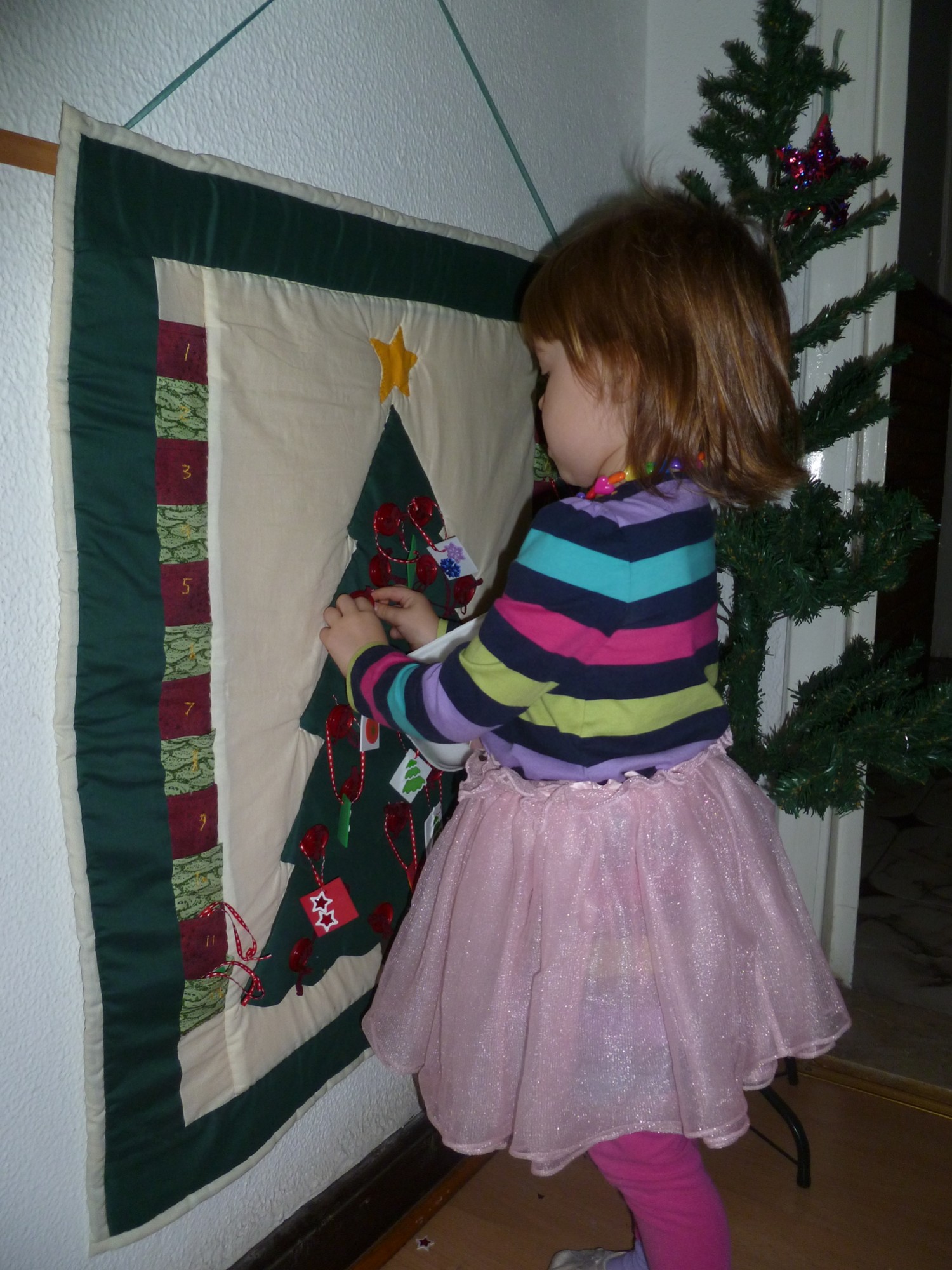
Meanwhile, last year we bought a wall hanging Christmas tree that also works as an advent calendar.  We bought it from the people who do handiwork at the recycling center in Muqattam, otherwise known as ‘Trash City’, here in Cairo.   But last year we didn’t use it as an advent calendar as it required some thinking about what could actually fit on the hanging.  My mom and niece and nephews helped out this year and sent us some great little ornaments to pull out each day, so now we can use it and count down the twenty-four days until Christmas!

To add to this number confusion, in Egypt, we will celebrate Christmas on two different dates, December 25 and January 7. Most of Egypt’s Christians belong to the Coptic Orthodox church, and they celebrate Jesus’ birth on January 7.  However, we are Western Christians and have always celebrated on December 25 as much of the world does, and so, we will have some sort of celebration on each of the days.  One other item that is mildly confusing is that many of our Egyptian Muslim friends, and even some Christian ones, seem to assume that we celebrate Christmas on December 31; I suppose this is because the televised celebrations in America are much more pronounced on that day.  They see fireworks and big parties and people “counting down to the New Year” and assume this is our big holiday.  You might say we have three Christmas dates to consider.

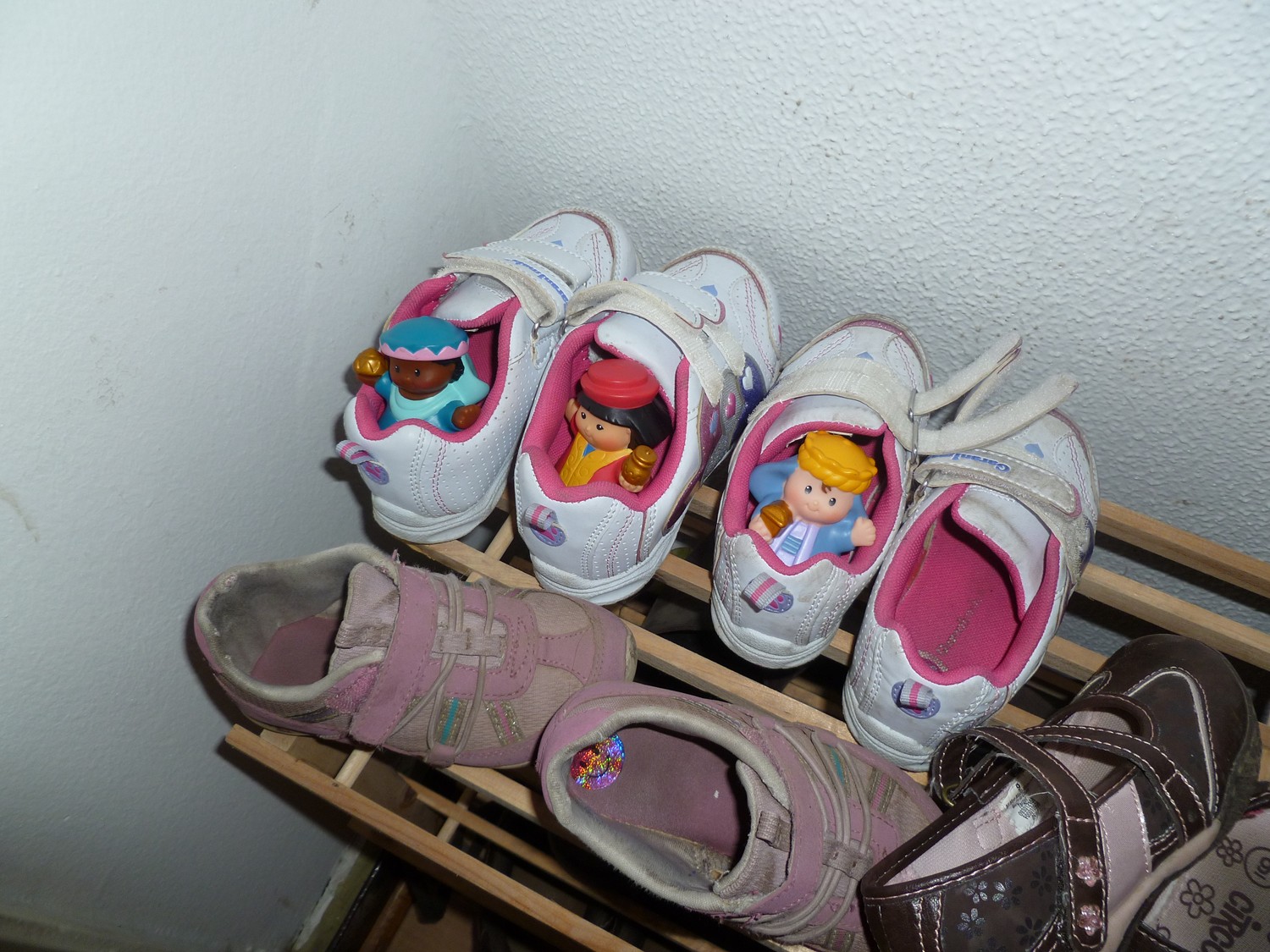
So all these things may confuse our preschoolers as to when Christmas actually is, but we’re thankful they are learning more about the Biblical story and less about the ever-present Santa Claus.  This is the first year we put out a play nativity scene which they enjoy every morning, acting out Mary and Joseph in the stable, the angels announcing the baby’s birth, the shepherds coming to see the baby and the wise men going on a long journey to find baby Jesus in Bethlehem.  (We hide the wise men somewhere in the house after they go to sleep.)

Emma and Hannah are learning familiar Christmas carols like “Away in a Manger” and “Joy to the World,” and belting them out for all to hear.  Emma even may sing in her first Christmas concert this year, appropriately enough, on New Year’s Eve.  So whatever date you celebrate and whatever your traditions may be, our family wishes you all a Merry Christmas and a Happy New Year, and then another Merry Christmas.

Categories
Personal

Stopped by a Policeman

Policeman on duty ... sort of.
Image by Ed Yourdon via Flickr

The other day I rode a microbus.  It’s not something I do too often, but there are certain places I go which are on a microbus route so I choose this cheapest option when I can.  On this particular day, I was going to the Carrefour Express market located in nearby “New Maadi.”  The cost for a microbus is 75 qirsh (or about 15 cents) which is significantly cheaper than my return trip which I must do by taxi since I’m laden down with bags of groceries.  By taxi, the cost is usually 10 LE (or approximately $2)—a big difference.

When I took the microbus to Carrefour Express last week, I had a new experience, and one which I can only guess at its meaning.  I arrived at the microbus station and found a vehicle not yet full, but anxious to begin its route and find customers along the way.  I sat in the third bench seat back from the driver with another woman.  Sometimes these microbuses get crowded, and it is best as a woman, if at all possible, to sit next to another woman, which leaves less room for trouble.  So, this driver seemed to take a slightly different route than I was used to, but since I don’t ride it enough to know all the variations, I didn’t think too much of it.  However, while driving down a street which was unfamiliar to me, a police officer walked up to the van and stopped the driver.  This is one of those situations where I wish I could understand when two Egyptians speak to each other.  As a non-native Arabic speaker, it is much easier for me to understand an Egyptian speaking to me because they slow down and say things more simply so I can understand.  However, when two Egyptians are speaking to each other, it’s almost impossible to follow along.

One of the things that made this somewhat easier, was that the officer kept repeating the same thing over and over again, “License … give me your license.  Where’s your license?”  And the driver kept answering, “I’m sorry.  This was the first time I did this.  I won’t do it again.  I’m sorry.”  But it seemed the driver was either without a license or really didn’t want to give the license to the officer.  I can only guess here, but I was thinking the latter was true.  Sometimes, these exchanges can be less than “above par.”  If the driver did have a license with him, and gave it to the officer, it could mean a trip to the station to get it back, or a small payment (aka, bribe) to the officer to return it.  This driver was just hoping to get away without a scratch.

As they continued to exchange the same words over and over again, I began to wonder what to do.  This was the second time I was stuck in a microbus wondering what to do.  The other passengers weren’t making any moves to get out, and I was really hoping, along with the driver, that the officer would just let him go so we could get where we were going.  But then a strange thing happened.  One of the passengers in the front seat got out of the van, and walked over to the officer and asked to talk with him.  Now, I didn’t really know if this was just any passenger, or a friend of the driver or if maybe he was the regular driver of this van and the other guy was just driving a few shifts for some reason.  I had no idea.  But he and the officer walked to the side of the road and talked for a few minutes before the officer returned to the driver and told him to turn the van around and get back on the route and not to deviate again.  (At least, that’s what I think he told him in Arabic.)  So the driver got away without a scratch, and it seems it’s all because a passenger helped him out.

Why?  I have no idea.  Did he just want to get where he was going?  Was the driver a friend?  Why would the officer listen to him?  Did he have some sort of clout?  It’s common in this society to have mediators work things out, rather than working directly with the affected parties.  Did he pay a bribe?  If so, why would he?  I didn’t notice much discussion among the other passengers as we just finished the route in silence and all exited along the way.  The passenger that helped out got out of the van a little while before me, and his leaving didn’t indicate anything special about him or his relationship to the driver.  So, I’m left with many questions about what exactly happened there.  But I am glad I got to the store and back home again without too much of an extra delay.

Categories
Personal

Control Freak

Cairo taxi

Jayson and I had a conversation the other day which confirmed something I had been thinking about for awhile.  He’s been taking the girls to preschool some mornings, and they told me that when they ride the taxi with him, Hannah sits next to the door in the back seat.  However, when they ride with me, which is most of the time, Emma sits next to the door.  Our conversation went something like this:

Me:  When you take the girls to preschool, does Hannah go into the taxi first?

Him:  I guess. Sometimes.

Me:  You mean you don’t tell them who should go in first when the taxi pulls up? (with a hint of incredulity).

Him:  Um, no.  They just get in.  (with a hint of “why would I need to do that?”)

Me:  Oh.  (pause)  I tell them exactly what to do every time the taxi is pulling up.  I say, ‘okay girls, the taxi is coming…when it stops, Emma will go in first and climb all the way to the door and then Hannah you climb in and sit right next to her, and don’t put your feet on the seat, just walk on the floor.  Make sure you move all the way over because I need room with Layla.’  I say that every time!  And then when the taxi stops, I say, ‘okay girls, we are almost home.  When the taxi stops, climb out as quickly as you can so the taxi doesn’t have to wait.’

Him:  (with both of us chuckling at this point) Yeah, I just let them get in the taxi.

Me:  And it works?

Him:  Yeah.

Me:  Hmmm, I guess I am a little controlling.


This is one good example of my type A personality coming out in my mothering.  It started to occur to me that not all moms do things the same when we visited some American friends a few months ago.  This mom has two boys around my girls’ age.  At one point, she brought out finger paints and let her oldest and my two girls go to town.  I was a little nervous at first, wanting to get up and give detailed instructions to my girls about not getting paint anywhere except the paper and not mixing colors up, etc.  But I refrained and just watched, partly in amazement that the mom of the house wasn’t giving more boundaries.  But you know what?   The kids had great fun painting all over their papers, mixing colors and of course, getting paint on their hands, arms and clothes.  But, it’s washable.  So who cares?  They had fun.  I didn’t analyze myself at the time, but later realized that first of all, we don’t even have paint.  (That’s at least partially intentional).  We have markers, but they are only used under supervision!  If I did have paint, I would probably only let one kid paint at a time, they would strip down to their skin, I would carefully explain that they should keep the colors nice and clean, and I would be tense the whole time they had access to paint with their fingers!  Sound like fun?  Not really.

It’s good to have these experiences and conversations as it is showing me some places where I can ease up a bit.  The same friend who let the kids finger paint freely, also encouraged me that I wasn’t too over-the-top with the taxi thing.  She reminded me that it is good for the girls to know what to expect and be prepared for what they should do.  After all, I am the one who is with them most all the time when they are riding the taxi and it is good to have some order.  So, thanks, friend, for your encouragement.  And thanks, Jayson, for laughing with me about this.  And thanks, girls, for being flexible and following my detailed orders most of the time, and teaching me a little more about how to have fun.

Categories
Personal

Islamic Televangelists

Joel Osteen, Joyce Meyer, T.D. Jakes, Amr Khaled. To American Christian readers of this blog, the last name may not be as familiar as the first three. All the same, the phenomenon is similar. Amr Khaled is a popular Islamic television personality, very different than the traditional sheikh dressed in a robe and speaking of fatwas. He dresses sensibly, encourages his listeners in Islamic morality, and relates stories from the Qur’an and hadith to the everyday life of the middle class. In short, he and others like him present Islam to Muslims of the modern age.

As such, he can be very controversial. Islamic sermons are still disproportionately the domain of traditional scholars who may view these modern preachers as a liberal compromise with a culture becoming increasingly ‘Western’. On the other hand, secular Muslims may be troubled by the fervor such preaching instills for Islamic orthodoxy among the middle and upper classes who might otherwise be ‘untroubled’ by religion. Popularity breeds both followers and detractors, and the charge is made that such personalities profit handsomely from their spiritual work.

The topic of these Islamic Televangelists was taken on by one of our interns here at Arab West. The result is a brief but informative study that examines their message and impact on the Arab World. It even includes YouTube footage, though without translation, so you can watch and see if the presentation reminds you of programming available on a Sunday morning or Christian cable television. The link to read the report is here. I hope you enjoy, and get a good picture of what the talented interns at our center can produce.

Categories
Personal

Slaughter and Laughter

Double slaughter
Image by zz77 via Flickr


I never realized how close in spelling those two words were until just now when I wrote them.  Interesting, huh?

I chose this title after walking down a busy street here in a poorer section of Maadi.  This is the season of the Holiday of the Sacrifice, when Muslims who can afford it slaughter a sheep or goat or cow to commemorate the sacrifice that God provided for Abraham when he was about to kill his son.  It’s a good thing to remember, I think.  God can provide the sacrifice when we need it.  Abraham obeyed God’s command to sacrifice his son … crazy as that command must have felt to him.  Abraham trusted God enough to obey him.  The Bible even says that Abraham believed God could raise his son from the dead if need be, so even though he didn’t know why God would ask him to do such a crazy thing, he believed God would still spare his son somehow.  As a Christian, it makes me remember the ultimate sacrifice that God provided through Jesus – the sacrifice that can save all of us from eternal slaughter.  But as Christians, we don’t have vivid ceremonies such as slaughtering a sheep to remind us of God’s provision.  This makes the holiday here a bit hard to stomach at times.  Seeing carcasses hanging from balconies, watching a group of men stripping the skin from a cow, noticing the blood running in the streets, hearing the bleating of the sheep before it’s their turn — all these things are a bit repulsive to my western senses.  After all, I usually buy my meat wrapped in plastic wrap sitting on a Styrofoam plate from the grocer’s shelves.  It doesn’t resemble an animal at all.  And so, as I walked down the street, on this, the second day of the holiday, I kind of chuckled as I noticed two things, almost side by side.

First, I saw the children on the swings.  I remembered that this is common during holiday times.  Someone will come to a busy area of town and set up some amusement rides.  They aren’t so much like the ones we see in America sometimes, that have roller coasters and Ferris wheels set up for a week at a  time for some festival.  These are more basic — a trampoline or large swings … nothing motorized.  I don’t know the cost of a ride as I warned my girls long before they saw them that we aren’t going to go on any rides, we’re just walking by.  I would guess they cost 1-3 Egyptian pounds (.20 – .50 cents) per ride.  And the kids were enjoying themselves on these rides.  Laughter.

And then, as I got closer to the swings, which were easily seen from a distance, I noticed, less than a block from the swings, a small area where people were butchering their sheep.  I made sure not to look too closely, but did see a sheep’s head, complete with round horns, hanging on the front of the little stand.  Slaughter.

I don’t think either station was bothered by the other.  It’s a major religious holiday.  It’s not a holiday without the slaughter.  And since it’s a holiday, it should contain laughter.  In time, proximity, and spelling – it’s interesting that the two words go so well together.

Categories
Personal

Out on the Island

Last week we had a fun opportunity with a small group from the Coptic Church in Maadi.  I have been attending a “family Sunday school” class which consists mostly of women.  This class meets during the time Emma and Hannah are in their Sunday school class, and it is conveniently located in the same building.  This allows me to be available if Emma or Hannah needs something from me during class time.  I have enjoyed in this class, although since Layla was born, it is harder for me to attend and actually listen and understand what is being said.  It has allowed me to get to know a few more people, at least by face, and perhaps not be so strange to them.  When I received an email mentioning a class trip, I got excited for two reasons.  First of all, trips like this always make it easier to get to know people at a deeper level.  Even though people in the class are friendly to me, we haven’t actually talked very much.  Spending all day in a different setting would definitely provide time for conversations.  Secondly, the location of the trip was to be “Jazeerat al-Maadi” or the Maadi Island.  This was a place we had seen on the Nile, and Jayson and I had recently been unsuccessful in visiting it ourselves, as we were not allowed without Egyptians accompanying us.  We would now have an opportunity to visit what looked like a really nice spot.

We were not disappointed in either of our expectations.  When we arrived at the church at 8:30 on Friday morning, my friendly classmates said how glad they were that we were going with them for the day.  They were glad to meet Jayson and see the girls.  Some seem surprised we were attending, but happy nonetheless.  Around 9am, we boarded the bus to take us on the ten-minute drive to the island, and were surprised that the organizer of the trip (who is also responsible for the class in general) seemed quite upset about the few people who were late for the bus.  We have learned that Egyptian appointments aren’t exactly punctual, and didn’t really expect many to be there for the 8:30 meeting time.  But apparently we were supposed to be at the island by 9 for a tour, and the one responsible was not happy that we would be late.  She gave a short lecture about punctuality and how we need to be punctual if we expect our kids to respect this trait themselves.

We left the church and arrived at the island very quickly.  We took the three girls down with our backpacks as we had brought a few snacks and drinks for the kids.

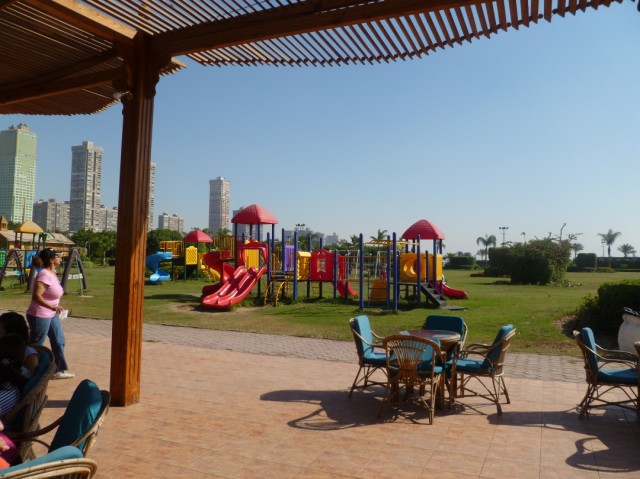
We all just walked right onto the island, although somehow, we stuck out as foreigners because one man did stop us briefly.  We told him we were with the group and he waved us on.  It was nice and quiet on the island as no other Egyptians were there so early in the morning.  In fact, I wondered if we had a private party because I didn’t see anyone outside our group until around 11 or 12.  We all went to a shaded area of tables and chairs right next to a modern and clean playground on grass!

The girls were so excited and immediately began to play.  We found some chairs to sit in and settled Layla, who was sleeping in her carseat, in a quiet corner.  It was a comfortable spot to spend the day.

We took a short ride around the island in what looked like a very long golf cart which could seat about 10-12 people.

There wasn’t too much to see outside of a couple restaurants, lots of green grass, some nice flowers and the Nile.

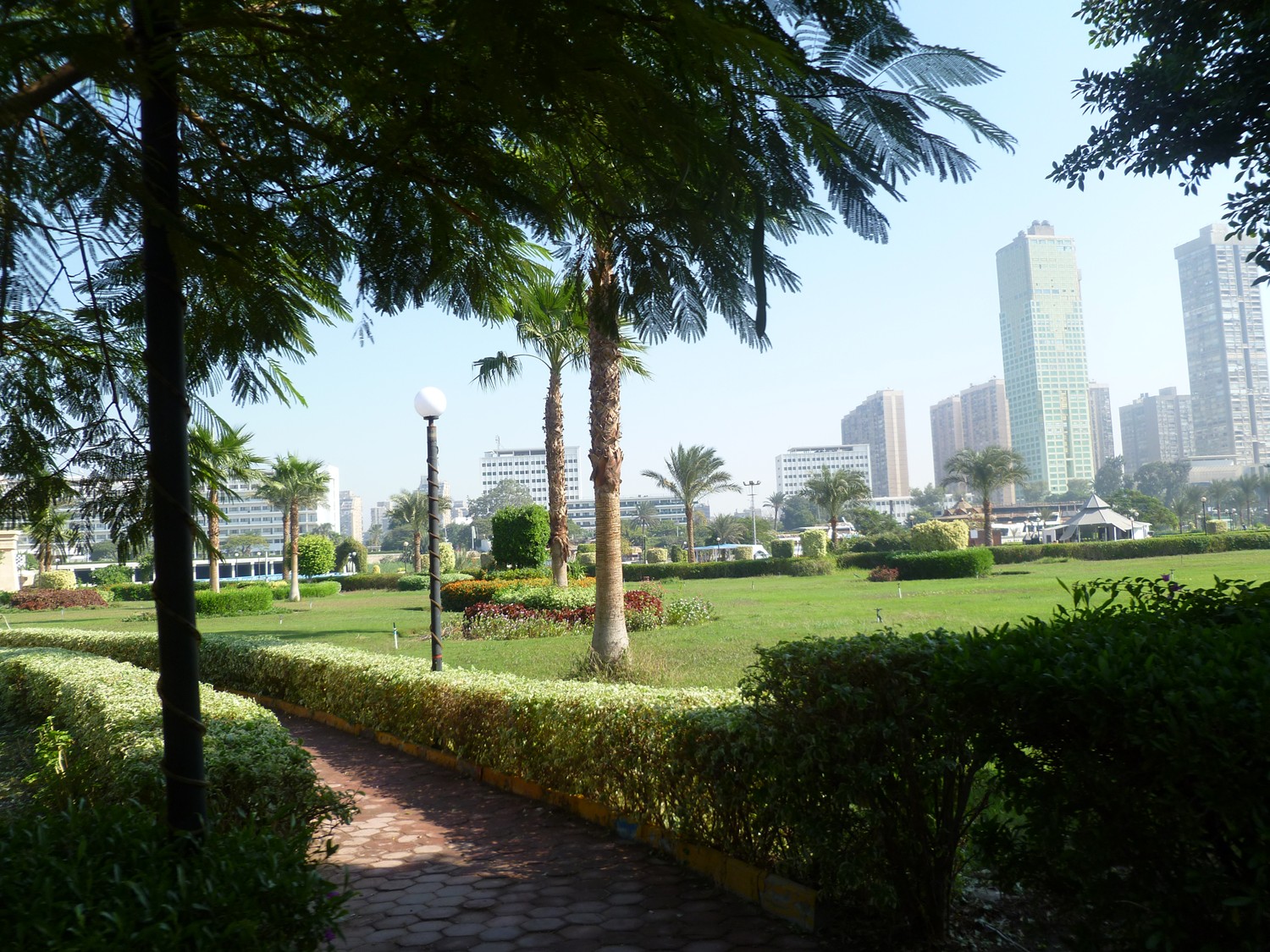
It was an interesting view … the quiet, serene green of the island with the backdrop of the high-rise apartment buildings right across the busy road.

It seems where we were situated was the main activity hub of the island.  It was good to get a view of the rest of the place, but we didn’t have any need to go there on this day.

Our whole family enjoyed a leisurely afternoon participating in different activities:

Jayson has been teaching the girls how to play chess, so they played a little game with him.

Hannah is learning the names of the pieces … here she wonders where to move the pawn.

Jayson was also challenged to three good matches from some of the men in the group.  He won them all, and even had an audience by the end.

We were surprised at the large collection of bikes they had available to ride.  I think there was normally a charge for them, but ours was included in the cost of the trip.

Emma spent hours riding bikes and jumping on the trampoline.  She came home exhausted and sunburned and got pretty sick that night!

Hannah enjoyed the bikes too, although she couldn’t quite pedal.  She mostly climbed on the playground and went on the swings.  Most of the time she had a few older girls following her around and helping her.  This was a great help for me too as I got to sit and chat with some of the other women.

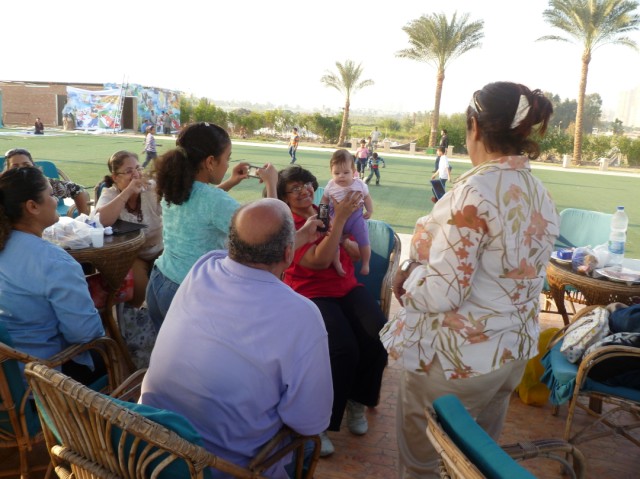
Even Layla got in on the action.  Whenever she was awake and not eating, she was in someone else’s arms.  She was a big hit, being passed around and photographed.  There are at least three phones taking a picture here.

It was a great trip that we all enjoyed very much. It’s just a shame we can’t visit on our own, but may help us make sure we’re on the lookout for more Egyptian visits!

Categories
Personal

The Concept of Time

The other day I called a doctor’s office to make an appointment for Emma.  The receptionist asked if I would like a morning appointment or an afternoon appointment.  I thought an afternoon appointment could be as late as 4:30 or 5 which would work well after their naps so I asked for an afternoon appointment.
The receptionist said, “Okay, how about eight o’clock.”  Eight o’clock?  Since when is that afternoon?  To me, that’s definitely evening, perhaps nighttime, and besides, its bedtime for the patient, Emma.  So I changed my mind and asked for a morning appointment instead.  After all, 10 or 11 a.m. would still give us plenty of time to get home and get ready for lunch.

“One o’clock,” the receptionist suggested.  One o’clock?  Since when is that morning?!  I agreed to this morning appointment of one o’clock in the afternoon and hung up the phone.  Remember the whole conversation was in Arabic, but she was definitely using the words for morning and afternoon.  I guess for a culture who likes to start the parties at nine p.m. when I am ready to go to sleep, one p.m. could qualify for the morning.

I also realized, after hanging up the phone, that the receptionist didn’t ask for my name or number or anything.  Did I just make an appointment or not?  I guess we’ll see when I show up at their office next week.

Categories
Personal

School Slogans

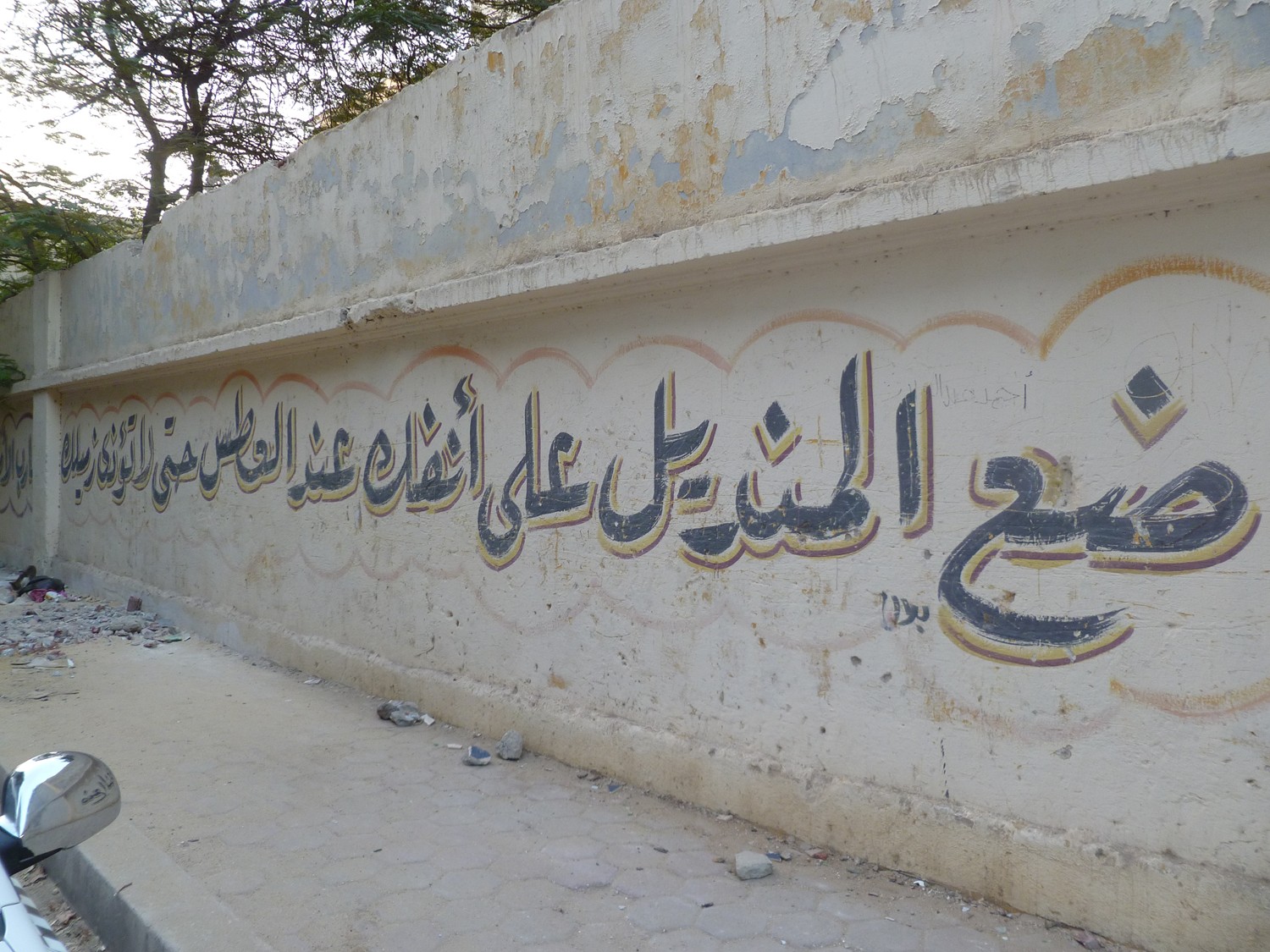
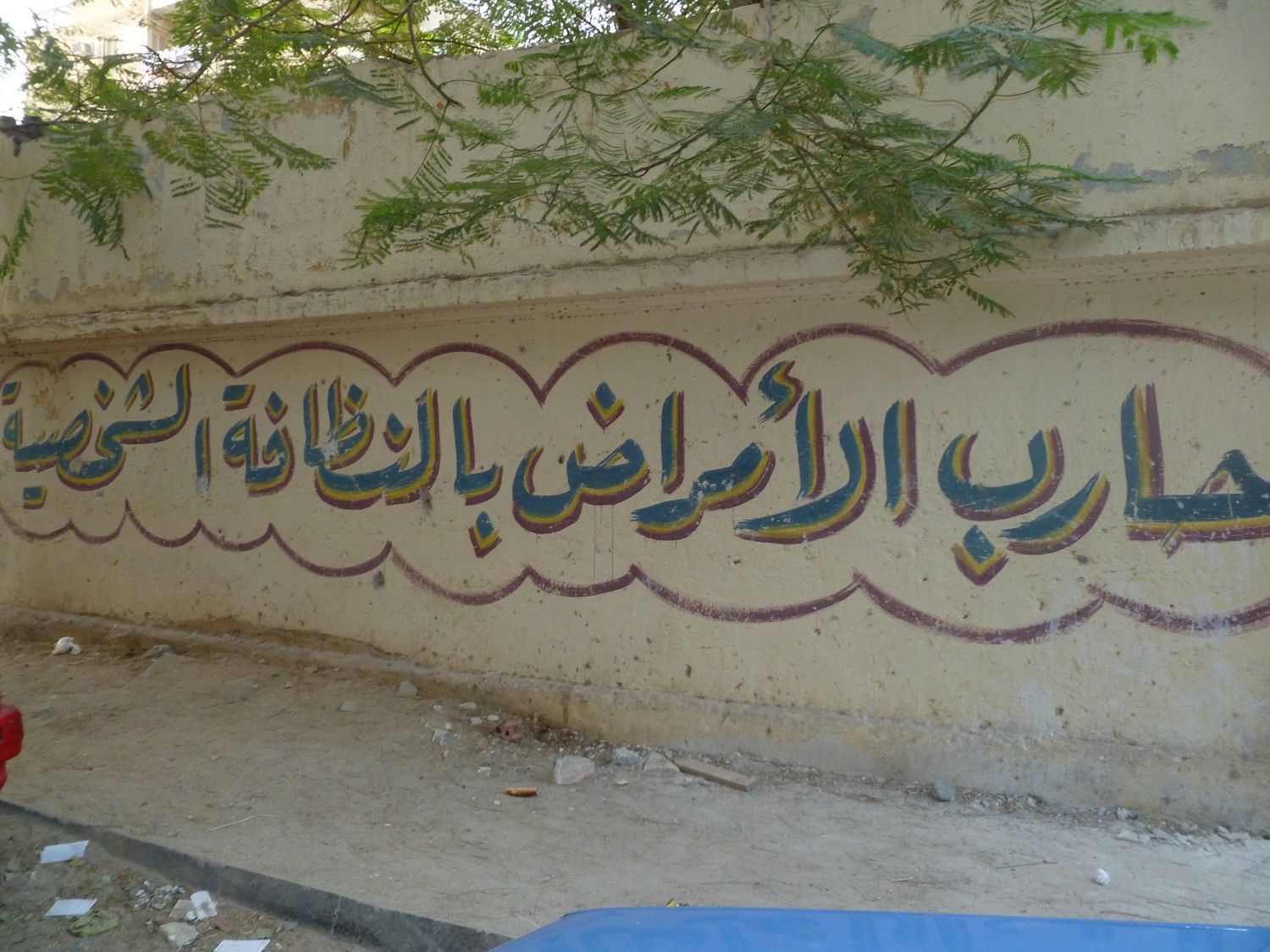
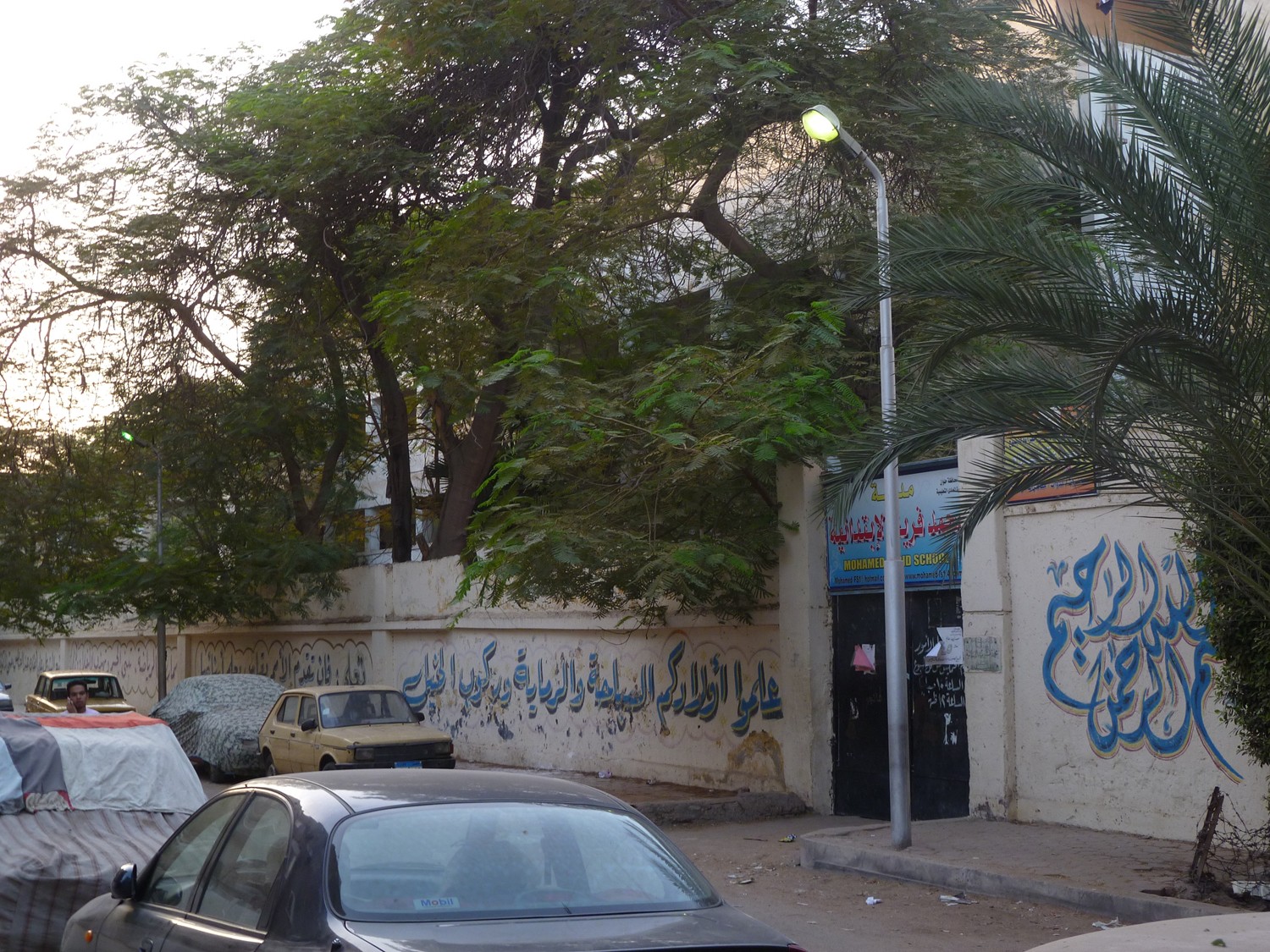
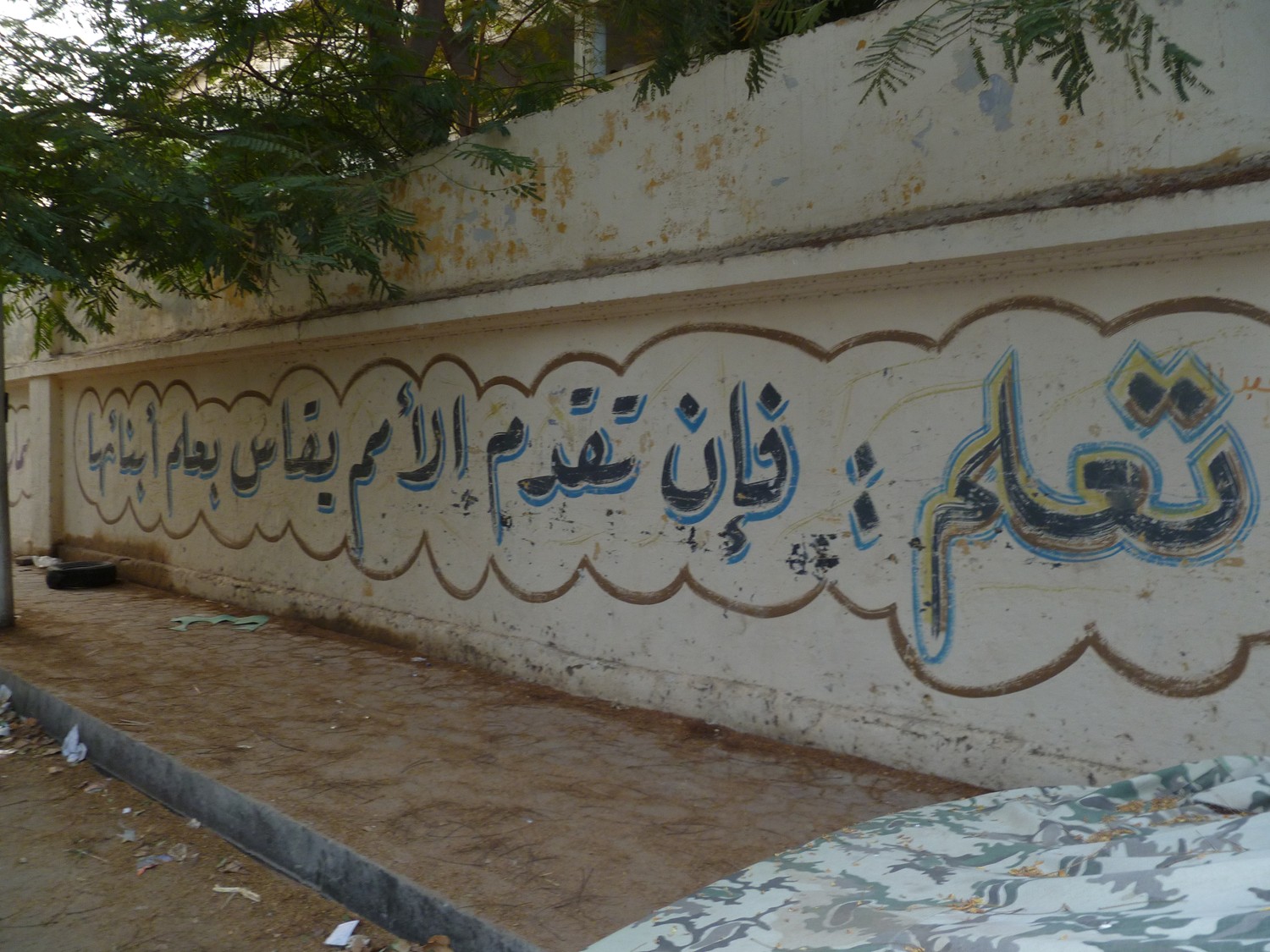
On my walk to work these days I pass a local school, whose walls are covered with brief slogans promoting morality, health, and other social virtues. This seems to be quite common, actually, and it is interesting to read the messages promoted by the administration. Here are a few pictures highlighting each phrase, with a fairly literal translation underneath.

This is the entrance to the school, and the elaborate calligraphy to the right of the door reads: In the name of God, the merciful, the compassionate. This is a common Islamic invocation, used often to begin a speech or introduce a text. As best I can tell, though, this school is a government school, and therefore consists of both Muslim and Christian students. Government education has mandatory religious classes, which are divided according to religion. So while there is nothing in the invocation on the wall that would offend Christian sensibility, it is recognized as a distinctive Muslim formulation.

In a similar vein, the school near our old apartment was also public in nature, but each day the students were led in opening exercises which included the choral shouting of Allahu Akbar – God is great. Again, while every Christian student would agree, this phrase is recognized as distinctively Islamic. Many Christians, if they can afford it, will pay to put their children in private schools. In addition to being regarded as providing superior education, many of these parents will also complain about a perceived bias towards Islam in the school system. Are their worries legitimate? We have much to learn.

Teach your children swimming, archery, and how to ride horses.

This is a phrase believed to have originated with Omar Ibn al-Khattab, the second caliph of the Islamic state following the death of Muhammad. Omar was among the leaders most successful for spreading Arab governance throughout the Middle East and North Africa. The military implications of his saying are obvious enough. Equally obvious is that no swimming, archery, or equestrian activity whatsoever takes place within the walls of this school.

Today by all appearances the phrase is utilized to demonstrate the early importance of education in the Arab world. The military applications, common to early education practices of many empires throughout history, have given way to the more general invocation to care for the development of children. This will be seen further in the generic phrases given below.

Education: The development of nations is measured by the knowledge of their children.

Fair enough. I imagine there would be a good correlation between test scores in essential subjects and rankings on the world GDP index.

Exercising builds the body and refines one’s morals, so do it!

Despite the appearances, this is not a take on the Nike slogan. Such scholastic marketing would probably be more akin to the American system.

Put a tissue on your nose when you sneeze so you don’t infect your colleagues.

And also this one below:

Fight sickness with personal cleanliness.

The swine flu virus terrified Egypt. I do not know if this slogan predates its onset or not, but there were extensive public education campaigns on how to avoid contagion. Many schools were shut down if certain children tested positive. Upon arrival, airline travelers were asked to submit to a special medical card, and those with fever were pulled aside for further testing. Less effectively, they also killed all the pigs in the garbage district, complicating natural recycling methods. These slogans were meant to promote good hygiene among the students.

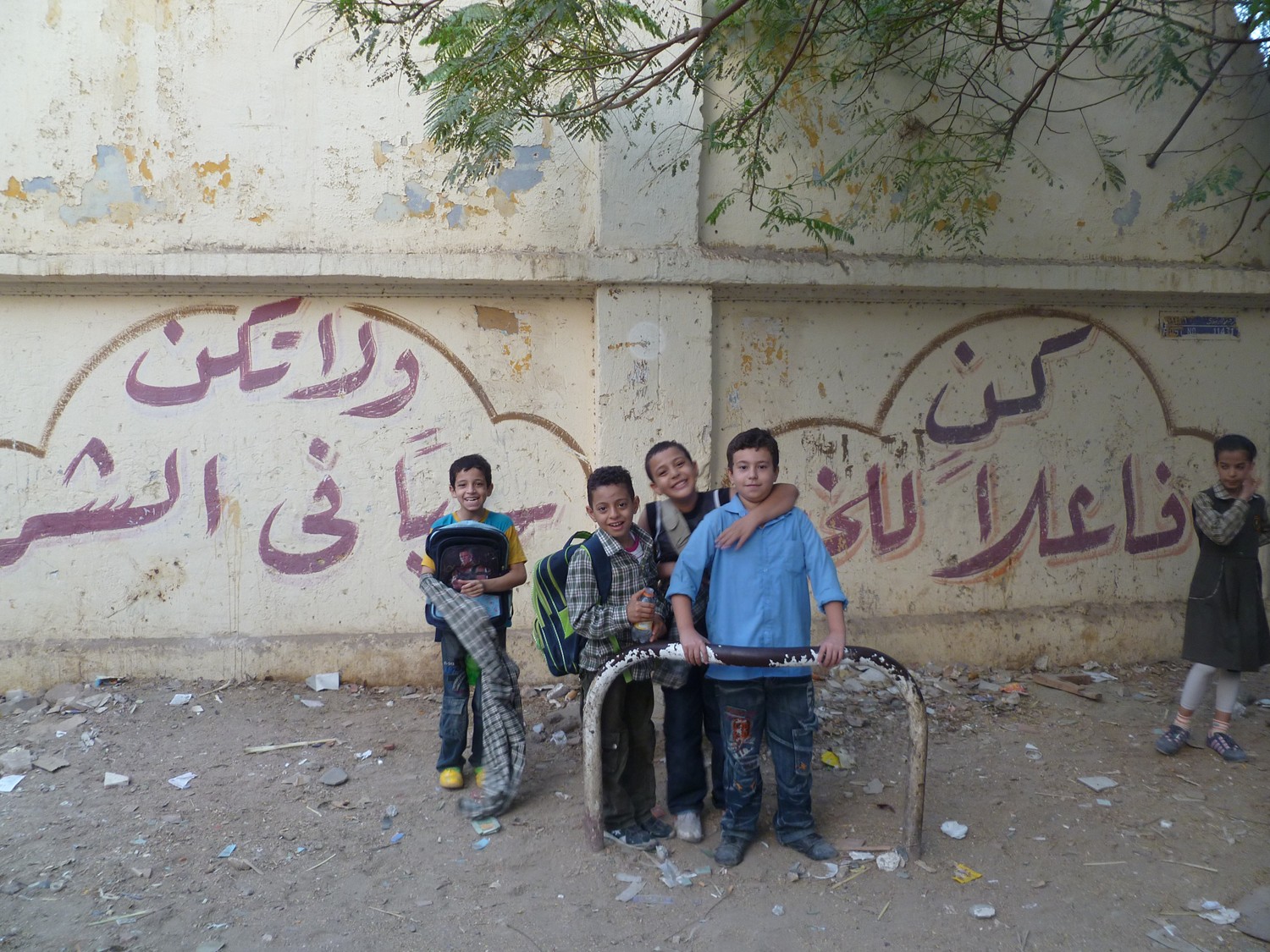
Concerning all of these slogans, a colleague of mine remarked that schools are notorious for putting forward a public image that serves to mask the deficiencies – often in the very slogans – of what goes on inside the walls. The hope is that this does not prove true for the final picture:

Be an agent for good and not a reason for evil.

With these children, and all else in Egypt, may it be so.

Categories
Personal

Sexual Harassment

750 - Young Arab woman.
Image via Wikipedia

During the past few weeks much of my activity at the office has focused on the supervision of others’ work and report writing. While this, unfortunately, has limited my own contributions, especially in this blog, I have missed the opportunity to link readers here to the reports we have produced. These are published on the Arab West Report home page; I will look to update these a little more regularly.

One such effort we have made is a short report about sexual harassment in Egypt, and some of the recent statistics and new technological efforts that help address the problem. Should we call it a problem? Is it a problem in America? I suppose wherever there are men and women this phenomena will occur, but this paper shows some of the cultural aspects unique to Egypt. Please enjoy, if it is correct to say so…

Click here for the link.


Categories
Personal

A New Wife

Some of you who have been following our blog may remember some of the stories we’ve told about our doorman and his family.  When we moved into our first apartment in Maadi, our doorman’s wife was just recovering from having a brain tumor removed.  That didn’t stop her from inviting us to dinner! (click here)  Unfortunately, we didn’t have much opportunity to get to know her, as a couple months later, the brain tumor returned and eventually took her life.  That was a very sad day when her daughter told me the news, made even more poignant since I didn’t understand what she said the first two times in Arabic (click here).  I attended the “funeral” of sorts, or rather, visitation of the family and was hurting for the two older girls especially as they lost their best friend and didn’t seem allowed to grieve about it.  Shortly after their mother’s death, I talked with different people in the building, and even the two girls about their father remarrying.  It was almost assumed by the Egyptians I spoke with, that he would remarry fairly quickly as he still had kids to raise.  In talking briefly with the doorman himself, he seemed resistant to the idea.  After all, he just lost his wife and it seemed the two had a good, loving relationship.  No one wants to replace their lost love.  Also, he didn’t want another woman coming into his house and making his daughters do all the hard work.  As it was, though, without a mom in the house, the two oldest girls had a lot of responsibility, including cooking, cleaning and helping to care for the two younger kids.  They certainly didn’t want a new mom, but it seemed they wanted a new wife for their father’s sake.

Now that we don’t live in the same apartment building, we don’t naturally see this family and hear their news.  But a few weeks ago, after returning from some time in the states, we visited them to catch up and pass on a few gifts.  I noticed that they had some of the furniture from our old apartment in their house, and I asked about it.  I’m not quite sure what the answer was, but I did understand that they passed on the news of their father’s upcoming marriage next month.  The girls seemed excited as it is a woman they know and knows them.  She is actually the niece of their mom.  She is a bit younger than the doorman, but not unreasonably so.  The girls were happy with the choice, and when I congratulated their dad later, (he was outside with Jayson as I visited the girls inside), he said that he wasn’t marrying for himself, but for the children.  So it kind of seems all of them are being unselfish in this endeavor!

Jayson found out some information about the new wife-to-be.  She had been married before, but it seems she unknowingly became the fourth wife of a man.  Once she found out he had three other wives, she quickly divorced him and returned to her village.  From what the doorman and his daughters say, she’s a good woman.

And so, next month, their Dad will travel to a village outside of Cairo for a small legal ceremony without any pomp and circumstance.  He will marry a new wife and bring her back to Cairo to live in the house next to the apartment building.  In the meantime, he is preparing by buying new bedroom furniture for him and his wife, and probably cleaning and reorganizing the house.  When I asked the girls if they will go with their dad, it seemed they said the younger kids would go, but they would stay.  It sounded like they didn’t really want to go, but I doubt he would leave them at home on their own.  I look forward to meeting this woman and I pray that she fits right into this household and brings some joy to this house once again.

Categories
Personal

Orthodoxy, Year Two

St. Mary & St. Antonious Coptic Orthodox Church
Image by Number1Son via Flickr

How long do experiments last? What does commitment mean in an experiment? Is it right to experiment with church?

Having returned from a short vacation in America, we are now beginning our second year of life in Egypt. The first year was very good, and we are happy to return. While acknowledging our status as foreigners, we like to live as Egyptian a life as possible, which includes worshiping in the Orthodox Church. Orthodoxy is the denomination of the vast majority of Egyptian Christians, and though it is not our own, last year we joined in as best we could. God’s church is one, and though we may or may not agree with all of Orthodoxy’s distinctive tenets, we desire to signal our support and serve Christ’s body.

Our reception has been welcoming, but tepid. While we have described this in the past, beginning again in year two we face again the same reality. By now more than a few people know and greet us, and we have learned better the rhythm of the service and the liturgical year. We are not yet comfortable, in the way an old shoe is comfortable, but we are still not sure if the new shoe fits. Still, it is better than being barefoot.

In our estimation, being a Christian is expressed in a significant way through commitment to a local congregation of believers. Namely, we go to service, we get to know people, we explore opportunities to serve. These actions, and others, are necessary, but they are not the essence of commitment. Rather, commitment is an attitude that says, ‘This is my church.’ The response of others may make this easier or harder, but commitment is a decision dependent only on one’s self.

But have we committed? We began our attendance as an experiment, to see if the church could serve as our spiritual home in Egypt. We desired it to be; it is consistent with the sense of belonging that drives our attitude toward overseas life. I think it is clear, though, that experimentation and commitment are not synonyms. Perhaps beginning year two, we are realizing this. What does it mean for us?

An attitude of experimenting can be a means of resisting full commitment, but it is not the only one. I have previously described the non-uniform Coptic tendency to leave early or come late. In fact, it is a common habit of many Copts here to enter the Mass near its conclusion, partake of communion – necessary as the literal body and blood of Jesus – and then leave, or, enjoy meeting up with their friends and socializing.

Today one of the priests deviated from the timeless repetition of the Mass. As the congregants were approaching to receive the host, he announced that the entire Mass was holy, and the Bible readings and sermon (done earlier in the service) were also necessary for the life of the Christian. One should not take communion unless he attended the whole Mass.

The whole Mass is very long. It begins around 7am, and ends around 11am. Perhaps aware of this, yet frustrated by the many deliberate latecomers, he did not speak absolutely. Rather, he ended his interjection by saying that no one would be denied Christ’s body and blood, but that each person was responsible for himself.

We, meanwhile, may not partake, as we have not been baptized Orthodox. By now we are quite used to this, and I do not write from frustration. Neither do I wish to trigger in the reader any sense of injustice. I mean, perhaps, to highlight that belonging depends on more than commitment.

As a note, we aim to arrive at Mass at least by 9am, in time for the Gospel reading and sermon. Our commitment, as exposed by the priest, is partial at best.

The latecomers, technically, in the Orthodox theological sense, belong to the church, even if their commitment is lacking. Yet their commitment is there – they do come. We, in the Orthodox theological sense, do not belong to the church, even if our commitment is present and our belonging is desired.

We are not Orthodox, but we are able to accept them as fellow Christians. By and large, they are able to do the same with us. Yet we are not the same, and in this reality there is that which keeps us viewing ourselves as if in a glass, darkly. Will it keep us ever experimenting, no matter our commitment? Must belonging at church involve mutual acceptance? If we are barred from communion, the central act of Orthodox worship, can we belong? We can commit, we can serve, we can attend. Can we be one? Is the church truly so? Is it all an experiment? Is this appropriate, for either them or us?

Year two begins with such questions. Please feel free to share your impressions.

Categories
Personal

Motherhood

As I sat in the middle of the baby pool the other day, and let my daughters and some other kids pour water over my head and giggle with delight, I thought to myself, “Ah, this is the life.  My kids are happy.  I am making other kids happy.  Today I am a good mom.”  Of course, it wasn’t too hard to sit there and get cold water poured on me when it was 90 degrees out.  So at that moment, it wasn’t too hard to be a “good mom.”

However, the day before, I spent about 20 minutes holding onto my crying, screaming 3½ year old as she said over and over again, “I want to go swimming RIGHT now.  I want to go swimming RIGHT now.”  And even then I was pretty calm, “No, Emma, I have already told you we aren’t going swimming right now.  We have other things to do today and we will swim tomorrow.”  But no matter how many times I said it or how calmly I spoke, her message was the same over and over again.  And the ironic thing was, she was about to be disciplined for continuing to say this once we told her the answer was no.  But I couldn’t discipline her in her current state.  I had to wait until she calmed down.  Even after I left her for a few minutes, and found that the wading pool had been taken down for the day, she insisted that, “No, it’s still there and I want to go swimming RIGHT now!”  She wasn’t thinking or speaking rationally.  But hey, she’s a 3 year old in the midst of a tantrum.  This was not “the life” and I was not enjoying this at all.

Motherhood has its ups and downs.  I watch and listen as my two older girls play together so nicely and hear my 2 year old offer her sister some cookies or pretzels. “Oh how great it is that they play together like that.  And Hannah is sharing without being told!  Yeah!  We’re doing something right.”  And then, less than five minutes later, I hear screams coming from the same room as Hannah teases Emma about being “this” or “that” or Emma grabs a toy from Hannah that she deems hers.  “Ugh, why can’t you two get along?” is my thought which I often voice in a louder than necessary voice.

Recently I’ve noticed Emma being the Mom as Hannah is the child.  Nice game.  Except when I hear Emma speaking harshly to Hannah about something.  “Emma, you don’t talk to your sister like that!”  And then I realize, she is being the mom, and who does she learn that harsh voice from?  It must be me.  Surely I don’t speak like that all the time?  And yet, when I do, is it necessary?  I want the girls to know I’m serious, but am I loving at the same time?  I don’t want Emma to speak that way to Hannah, but in truth, I speak that way to both of them at times.

I always considered myself an easy-going person.  And yet, if my children knew the meaning of easy-going, and you asked them if that described me, I doubt the answer would be yes!  How can I lose my patience with them so quickly?

Sometimes I get so frustrated when they disobey or forget a rule for the 100th time.  “How many times do I have to tell you not to jump around Layla?!”  And yet, God quickly reminds me that I disobey Him or “forget” his laws way more than 100 times.  “Julie, they are my children, just like you are.  Show them mercy.  Give them grace.  Speak the truth…in love.  Nurture them.”

It’s a 24-7 job, and sometimes I feel I am not cut out for it.  Yet my children are so forgiving.  Less than five minutes after I lose my cool and speak harshly with them about something, they come running to me for comfort when they fall and hurt themselves.  Why would they want to come to ME for comfort?  I’m the mom, I suppose.  It’s one of the perks of the job.

Sometime I apologize to the girls for not being patient.  And a few times, when Emma notices that I am getting angry, she says, “Mommy, pray to God so you won’t get angry.”  It’s funny the emotions that come when she says that.  I am often not ready for such a word at that moment, and it makes me more angry.  Angry that she is right.  At the moment, I don’t want to let go of my anger and let God change me, but I want Emma to learn to pray to God in situations like this, so I try to pray, and it calms me down.  Out of the mouth of babes…

I have a lot to learn and a long way to go in this journey of motherhood.  God, give me wisdom.  Protect my children from my faults.  Guide me in the way I should go.  And, oh yes, thank you for the three wonderful blessings you have given me to teach me all about motherhood.

Categories
Personal

American Interest in Egypt

A surefire way to determine a person’s priorities is to look at his or her budget and expenditures. The necessities of life demand their share, to be sure, but what becomes of disposable income? Check your own most recent bank statement, and take stock of the results. Are they what you would wish, or did you stumble into a situation you would like to revise?

Can the same test hold true for nations? If so, do the results reflect determined policy or simple inertia?

Many Egyptian activists have criticized the decision of President Obama’s administration to cut funding for the promotion of democracy by $5 million. Furthermore, these funds must be directed to NGOs and civil society organizations registered and approved by the government. On one hand this seems only natural – should the US government allow foreign donations to be received by quasi-legitimate Islamic charities, for example, which may or may not have ties to terrorist agencies?

On the other hand these same Egyptian activists would flip this comparison in their favor, stating that the government views ‘civil society’ as a threat in the same manner the US would look at these under-the-radar charities. Though this is a stretch, they maintain that Mubarak’s government only admits registration to those organizations which will not contest its rule. By funding only registered NGOs, it is said, the US ‘promotion of democracy’ only further entrenches the effective one party system which has existed since the military revolution of 1952.

The $5 million reduction is a full one-fifth decline from the previous allotment of $25 million. For all the grief President Bush received in Egypt for his policy in Iraq, Afghanistan, and Israel, many of these activists will praise him for the pressure he placed on the Mubarak government which, they say, genuinely opened the civil society field and resulted in greater freedoms across the board. Conversely, President Obama stands accused, at least by one prominent activist, as returning to the days in which the US openly ‘coddled dictators’.

When one discusses numbers in the millions a sense of precision can be lost. I live here; I have a general sense of what civil society organizations do. I have no idea, however, where even a reduced figure of $20 million is being expended. Though I don’t know who does or does not receive US aid, there are good organizations doing good work. $20 million is a staggering sum; add it up here and there and surely it can be found. It would be a fair question to research, though: However defined, does the investment result in $20 million of ‘good’?

This discussion is interesting enough, but the opening thought begged a look at priorities. A $5 million reduction suggests the Obama administration is less interested in the promotion of democracy than his predecessor. ‘Less interested’ is found to be a matter of degree, however, when the rest of US government aid to Egypt is considered:

$20 million – promotion of democracy

$35 million – education ($10 million of which is for Egyptians studying in the US)

$250 million – economic aid

Now wait…

$1.3 billion – military aid

Suddenly, $5 million becomes a drop in the bucket.

Israeli prime minister Menachem Begin and Egyp...
Image via Wikipedia

Egypt solidified its status as a close ally of the US with the signings of the Camp David accords, resulting in the reception of such aid packages every year thereafter. Since that time Egypt has fought no wars, with Israel or anyone else; why is this aid necessary?

While the Obama administration has been accused in the US as favoring Arab interests over Israeli, longstanding American policy, Obama’s rhetoric notwithstanding, has given Israel almost free reign to extend its will in the Palestinian territories. Those who push the envelope, however, suggesting Israel to be America’s 51st state, or more cynically, America’s boss, do not realize the significance of this military aid.

A strong Egyptian military is a necessary counterbalance to the weight of Israeli forces. Both are bankrolled by the US, of course, but if there was not a readiness in Cairo to engage in military combat, Israel would have to pay no attention whatsoever to international (including US) cries for a just settlement of the Palestinian issue. US military aid to Egypt maintains at least a semblance of regional balance of power.

Returning to cynicism, however, there can be another deduction from the breakdown of US aid to Egypt. Where are US priorities? Promotion of democracy? Yes. Education and economics? Yes.

Stability of a regional player? Absolutely. The US maintains genuine interest in political reform and expansion of freedoms. Why else would it invest millions of dollars otherwise available to domestic interests? Cynicism may respond that when differentiation is lost in the understanding of ‘millions and billions’, even the drop in the bucket can appear as a sizeable investment. This number can be paraded to US voters who view America as the city upon a hill with missionary mandate to make the world safe for democracy. At the same time, the other (larger) number can assure the establishment that such idealism will only go so far.

I wish never to surrender to cynicism. Accounting, however, is another matter. As an idealistic American, I do not wish to believe our pangs for worldwide freedom are insincere. A brief look at our foreign policy, however, makes hopeful belief difficult. How do idealism and the pursuit of national interests mix in Iraq, Afghanistan, or Yemen? The world is a complex place, and realpolitik is the mastery of complexity.

If, however, these international engagements have been completely devoid of pure motivation underneath its justifying rhetoric, faith in our system, this great experiment, is severely tested. Let us then surrender to the ways of the world, the quest for empire, and ultimately, a few pages in the textbook of history for the coming centuries.

No, America is good. I will hold this like a tenet of faith. When faith is measured, though, will it be found to equal $20 million? Slightly more (if adding in education funding), or slightly less (after accounting for inefficiency and corruption)?

What does this mean for Egypt? I’m sure this is not a revelation to experts in the field who have followed US-Egyptian relations for years, but it can be disheartening for the idealistic neophyte wishing good for all. America does care (I trust) for the gradual political reform of Egypt, but it cares far more deeply for the preservation of the existing state of affairs. President Mubarak is aging, there is no clear successor, and no viable opposition. The only candidate currently attracting attention (legitimately mobilizing a popular longing for change) is constitutionally bound from running for president unless he joins an existing political party, which he has stated he will not do. What is coming next?

There is no need for fear, or hope. The ruling system stems from the power of the military, whose strongest ally is the US government. A radical departure from the status quo is highly unlikely.

Simply balance the checkbook and see.

Categories
Personal

Ramadan Wanderings

Ramadan lanterns from below, Road 9, Maadi, Ca...
Image via Wikipedia

It was 11pm and I had 40,000 Egyptian pounds (approx. $8000) in my bag sitting on the seat beside me in the taxi, which was stuck in traffic.  This was another night out during Ramadan.

Having three young children, I don’t go out much after dark as their bed time is 8pm.  But during the month of Ramadan here in Egypt, stores change their schedules to accommodate the fasting that occurs during daylight, and feasting that takes place during dark.  Whereas the best time for me to run errands is in the morning after dropping Emma off at preschool, some stores don’t open until noon or 2pm, and then they close for a few hours as people break the fast and conduct their special Ramadan prayers, only to open again from 9pm until midnight or later.  So a few times this month, I found myself walking the streets of Maadi after dark running errands.

A couple times I ventured into a slightly lower class area in north Maadi, not far from our new home, where I was trying to get a blender fixed and some pants shortened.  My attempts to buy ice cream at a place I recently found had mixed results.  I was successful two times when I went around 10pm, but the day I went during daylight I was told they only sold ice cream at night after everyone broke their fast.

I had an idea that our family should take a walk one night after fast-breaking so the girls could see some of the lights that decorate the houses during Ramadan, and so Jayson could see one of the main streets in our new neighborhood.  The plan was to walk to the main street around 7:30pm, an hour after fast-breaking, and then get ice cream at the local shop which has great ice cream for only two Egyptian pounds a scoop (approx. 40 cents).  Can’t beat that deal when it comes to an ice cream store!  So, all day long, I told the girls we were going for a walk that night and would have a “surprise.”  So after dinner, the girls climbed into the big stroller (double) and the small stroller (umbrella) and took off north for about a ten minute walk.  We pointed out the decorations on people’s houses and the girls enjoyed that.  Every time she saw a light on a house, Hannah would say, “Ramadan!”  Jayson got to see the main street which was only starting to liven up now that people had eaten their main meal.  After another hour or so, the street would be busy with people shopping and drinking tea.  Unfortunately, when we arrived at the ice cream store, the surprise was on me!  They weren’t going to open until after Ramadan prayers … maybe 8:30 or so, and we really didn’t want to wait for half an hour or more at that point.  So, I walked across the street and bought some nasty ice cream novelties which saved the surprise for the girls, but didn’t really appease my sweet tooth!  Chalk it up to a learning experience.

Another night Jayson and I got to enjoy the spirit of Ramadan as his work colleagues took a trip downtown to break the fast all together.  We met at some outdoor tables right outside Khan-al-Khalili, the famous market bazaar of Cairo, and enjoyed a delicious and quickly-served meal.  As the call to prayer sounded, everyone in the whole courtyard began to eat at once.  It was a fun atmosphere and surprisingly good food.  We topped the evening off with a wonderful performance by the Tannoura group not too far from where we ate dinner.  This was a free show of Sufi singing, dancing, twirling, and instrumentalists.  Some of their stuff was pretty amazing.  I would definitely recommend it.  All in all, the night wasn’t too late as we were home by about 11:30.

And now onto this night.  We would be traveling in just a few days, and Jayson needed some help with work errands as he had more than he really had time for before leaving.  I offered to take the Euros he withdrew from the bank for work expenses, and exchange it at the moneychanger.  Again, hours of operation weren’t totally conducive to my schedule with three young girls.  So, this was the night I could venture out at 10pm to change the money.  Unfortunately, with all of the shopping and feasting at night, the traffic is pretty heavy, so as we slowly crawled along, I considered getting out and walking home.  I could probably walk it in about half an hour.  But since I had so much money in my bag and it was 11pm, I thought it would be safer to stay in the taxi.  Besides, I didn’t really feel like walking by this point in the day; I would rather have been sleeping!

I eventually made it home on this, my last night of Ramadan wanderings.  Or, at least until next year, when we may attempt another night out for ice cream, and see what errands take me out on the streets of Maadi way past my bedtime!

Categories
Americas Arab West Report Published Articles

Legality, Appropriateness, and Engagement

Dr. Martin Luther King giving his "I Have...
Image via Wikipedia

Today Glen Beck led a rally in Washington, DC on the steps of the Lincoln Memorial where Martin Luther King, Jr. gave his famous ‘I have a dream’ speech. In fact, today was the anniversary of that speech, which came to symbolize the struggle and eventual triumph of the civil rights movement. Beck denied he knew about the congruity of dates until after he planned the rally, but this denial has not stopped many from labeling this rally as an offense to the legacy of King.

I will confess to not following this issue too closely. I understand Beck to be a conservative and religion-friendly newscaster, but do not know exactly what he does or does not support in detail, outside of the fairly obvious battle lines in American politics. Furthermore, I have no insight as to whether or not he is playing games with the civil rights history of our nation, but I do also see what appears to be a highly symbolic convergence of imagery. Is he honoring the legacy, exploiting and redefining it, or just, as he confessed, ignorant of the whole matter?

Perhaps given that I have not closely followed this controversy, I can easily connect it to another controversy I have not followed closely: the Ground Zero mosque. (It is an advantage of living overseas that the headline dominating news stories in the US are received with considerably fewer decibels.)

In both cases it is clear that those engaged in the controversial activity have the right to do so. Glen Beck obtained the necessary permits to conduct a rally on national property, and the mosque/community center organizers own the land on which they seek to build and have received zoning clearance to do so.

It is also clear that those who are protesting do not challenge the legality of these endeavors, but their appropriateness. Many African-Americans and their then-liberal supporters in the civil rights struggle do not share the conservative worldview of Glen Beck. They find it offensive that he advance his agenda on the same day, at the very spot that their hero’s dream is most enshrined.

Meanwhile, many New Yorkers and Americans of all stripes have defined Ground Zero as sacred ground, after the devastating attacks perpetrated there in the name of Islam. Most of these would not oppose a mosque being built elsewhere, regardless of what they think of Islam as a religion. Why, however, build it there? Even if the mosque represents Islam of another stripe, why plant its flag at the gate of such an atrocity?

The response of an individual to the sense of appropriateness may vary, as may the ‘logical’ assessment of these claims. What is disturbing in both cases, however, is that opponents are seeking either to stop or sully the endeavors through loud and distant protest. Consider: If those in favor agreed their efforts were inappropriate, would they have undertaken them? And since they do not, will they be convinced by rancor and misinformed assumptions of intent, cast from afar?

Certainly the masses feel helpless. What can a patriot in Virginia do to influence Imam Faisal in New York? How can an activist in California effect Beck in DC? Let the cry be heard in the media, on the radio, in a blog. None of this, however, has any influence on law. Worse, it has contrary affect on the people involved.

Opposition and controversy, especially when loud and public, generally serves only to cement someone in their opinions. If there is a way forward, however, imagining for a moment that these endeavors are not appropriate, it can only be found in engagement. It is possible to change the mind of a friend. Very little in the public discourse concerning either Glen Beck or Ground Zero, however, is contributing toward bridge building. On the contrary, all seems polarizing.

Here in Egypt there is a similar, though not identical, issue surrounding church building. The law is ambiguous; there is no formal discrimination but the process of gaining approval is universally acknowledged as difficult. In places a church can be constructed quickly and easily; in others the plans labor for years waiting for the governor (the governor!) to give his approval.

Oftentimes Christians decide to go ahead and build anyway (as will Muslims, at times, with a mosque), knowing that if they can get the building up then the government will not knock it down. There is far less public relations damage for a stalled authorization process than for the demolition of a house of worship. The former will languish on the desk of a bureaucrat; the latter may attract international condemnation.

Very few Egyptian Muslims would argue that there is no place for a church in a Muslim nation. It is not uncommon, however, to hear their protest that this church is too close to a mosque, or that the church steeple equals or exceeds the height of the tallest minaret in a village. Frustrated by delays in authorization Christians will often proceed without consulting their Muslim neighbors. Feeling threatened or dishonored, Muslims have sometimes reacted in violence, damaging the building that has been constructed as an affront.

Many Christians and Muslims will argue that the situation must be remedied by law – that is, a clear and impartial system must be created to govern the building of all houses of worship. There is much merit in this discussion. Unfortunately, many of these same advocates for religious freedom stop there. They press the need for legal reform, but do not continue to engage the opposite community on the ground, in real relationships.

For people on the ground, however, the issue of church building is not one of law, but of appropriateness. The law may force their hand, but this only results in furthering community tension. Neither Muslims nor Christians profit from this situation. Yet since few Muslims would oppose the right of Christians to build a church, overcoming the issue of its appropriateness can only be done through engagement.

There are examples in which Christians have taken the sensibilities of Muslims into account and have won full, legal authorization to build churches. There are also examples where they have acted independently, and have stoked the fires of sectarian tension.

The din of struggle and opposition will always be heard over the quiet, dogged pursuit of relationship. In both the cases of Glen Beck and Ground Zero, there may have been extensive efforts at engagement that have gone unreported, since engagement is not conducted in front of cameras.

At the same time, engagement is insincere if it is only seeking its own interest. I might sit down with my opponent once for tea to hear his argument, but if he only repeats his position each and every time, I will no longer invite him over. Engagement is willing to see the other side, validate, and appeals in humility to that which it desires.

Many today, both inside and outside of Egypt believe that sectarian tension is increasing rapidly. This is due to the same phenomena that dominate media coverage of Glen Beck and Ground Zero. These polarizing images ignore the many efforts at racial reconciliation engaged in by both liberals and conservatives. They ignore the fact that most Muslims in America live a normal middle class lifestyle in complete peace and tolerance with their neighbors.

Similarly, most Muslims and Christians in Egypt live together in peace. Where there is tension it must be addressed. Where an issue arises the media must cover it. In the face of real difficulties in certain places, though, the assertion of peace may ring hollow. If so, it does reflect a growing pattern, not of tension, but of disengagement. While percentage-wise the troubles are few, the level of harmonious interaction between Muslims and Christians decreases ever so slightly, but steadily.

This is the risk America now faces in the issues of Glen Beck and Ground Zero. Polarizing voices and opinions only serve to lessen consensus and engagement. On either racial or religious grounds, the genuine peace which exists between all Americans may ring increasingly hollow. If so, it is because these normal Americans have disengaged from their diverse communities, finding fellowship only with their kin.

Though God is often portrayed as the one with the loudest voice of all, silencing his opposition by power of miracle, he is also characterized by stillness and whisper. Jesus spoke of God’s Spirit as a gentle wind, with man knowing not from whence it came or where it is going. Many today in pursuit of their agendas

usurp God’s right of bombastic pronouncement. We would do better to search instead for his whisper, finding places where he is at work, but quietly, and ignored by most of those around.

Categories
Personal

Bureaucracy and a Baby

A few days ago, I remembered something just before falling asleep.  I’m so glad I did because who knows what problems it would have caused in September when we try to travel to the states for a few weeks.  I remembered that we needed to get our 10-week old baby girl, Layla, an Egyptian entry stamp in her passport.  Without it, she may not leave the country.  And seeing as our flight is at 3am, I don’t know what would have happened if her passport was blank.

When Layla was born here in Cairo a couple months ago, we followed the procedures that were clearly outlined on the US Embassy page about obtaining a US birth certificate and passport for her.  It required three trips to the embassy, but not too much hassle.  At the time, we also read that an American baby born in Cairo requires an entry stamp in her US passport in order to leave the country.  We had a lot going on at the time we picked up her new passport, though, so we forgot about that little detail until the other night.

Today was the day I tried to take care of that detail, and it required a trip to the dreaded “mugamma” in downtown Cairo.  This was my first time to experience the place where all foreigners must go to renew visas, apply for residency, etc.  Apparently, it is also the place for Egyptians to go for marriage licenses and the like, so, a lot of paperwork goes through that place in a day.  Previously Jayson has taken care of visas and such at the mugamma, but this is a very busy time at work for him, and it just wasn’t possible for him to take care of this errand.

So, this morning, I packed Emma and Hannah a breakfast and lunch and sent them both to preschool.  Hannah is always looking for opportunities to stay with Emma at preschool, and today was the perfect time for that.  I took Layla with me and boarded the metro for the quickest and cheapest ride downtown.

I’ve written about the metro before (click here) and once again, boarded the women’s car for the ride.  Immediately, a woman rose from her seat for me to sit down, and as I was sitting down, she preceded to try to cover Layla with the thin blanket I had.  I thanked her, but unwrapped Layla right away as the temperature here is in the 90s, and I felt that Layla was plenty warm.  Later on in the trip, another woman asked me to reposition Layla as she felt like her head was not comfortable.  Very kind and doting women watching out for my baby.  It’s nice.

We arrived at Sadat square without a problem and took the exit that brings you up right in front of the massive building which is the mugamma. I went to the entrance where they had walk-through metal detectors which didn’t seem to be on, as well as bag screeners which I almost had to put my backpack on until I told the woman I didn’t have a camera.  Apparently that was the only security concern.  I went inside and up the stairs where Jayson had described is the Immigration and Visa section.  I got to know the path up the stairs and around the winding hallway past about 50 windows very well as I walked it several times in the next few hours.

After walking almost to the end of the hallway, reading the signs above the 50 windows and trying to figure out which one applied to me, I finally talked to someone at window 12.  She sent me downstairs to make copies of some papers first of all, then told me to fill out the application and take it to window 32.  So, I went all the way back down the hallway, past the 50 windows and downstairs to the copy center for my copies.  Then back up the steps, past 32 windows until I came to the one she told me about which said “refugee” processing.  Wasn’t sure that’s what I needed, but the person in window 33 was helpful.  Unfortunately, it seemed I needed another document.  She told me to go to “Ism Abdeen” to get a computerized birth certificate for Layla.  We had the written one we received shortly after her birth here, but apparently that wasn’t good enough.  After asking the name of the place several times so I could tell a taxi driver where I needed to go, I took my envelope of passports and important documents, my backpack and little Layla down the stairs, outside and to the street to find a taxi.

The taxi driver was helpful, but not sure exactly where I needed to go.  We decided to go to the police station in Abdeen and ask from there.  We then realized that we needed to go to “qism Abdeen” whose name makes more sense.  Arabic speakers may be familiar with the Egyptian habit of dropping the “Qaph” sound which in this case made it sound like a different word to my untrained ear.  Anyway, we found the place and the driver told me it should just take me 5 minutes, that it is a simple procedure to get the computerized document.

I went inside and up two flights of steps to the one place in all of Cairo where you must go for a computerized birth certificate.  It wasn’t too crowded, but the woman behind the window told me the computer wasn’t working currently and to sit and wait.  In the meantime, though, I could walk to the post office, about two blocks away, to buy a 20 pound stamp (about $4) for my original copy.  So, I went back down the flights of stairs, outside and followed her directions, stopping in one store to be sure I was going the right way, and after five minutes, arrived at the post office.  This was the nicest building I was in all day … not too crowded, air-conditioned, and very clean.  It was easy to purchase the stamp and head back to the other building.

When I arrived, I checked with the woman again who told me it still wasn’t working, but that I should keep waiting.  By this time it was about 10am and close to Layla’s feeding time.  She was sleeping peacefully on my shoulder and I wasn’t sure how much time I would have to sit and feed her there.  It was a fairly comfortable spot and it could have been done, but I opted to wait a bit and feed her later.  I was hoping to do all the running around necessary and then feed her while I waited for any processing they had to do at the mugamma.

In the meantime, I had a nice conversation with the woman sitting next to me who told me it was her third trip to this office in the last few days as each time the computers weren’t working and she needed a certificate for her son by tomorrow for college.  She told me this was the only place that printed this document which was a problem since there was no recourse if the computers didn’t work.  What I gathered from talking to her was that you need this document for many things: school registration, college entrance, or even registering for the army.  But it seems like it’s a more recent requirement as previously all birth certificates were hand-written.  I’m not sure how long the computerized ones have been around, but she recommended getting several copies to have them just in case.

After about 20 minutes, there was some movement in the room as somehow someone learned that computers were working again.  A line quickly formed and I had just decided to start feeding Layla, so I figured I would do that, then the line would die down and I would get my papers and go.  Instead, the initial woman I talked to behind the window, came out to me, got the handwritten certificate and took it behind the counter where she immediately printed me 5 copies.  It was very kind and very quick, but I felt a little uncomfortable with the seemingly preferential treatment.  Here I was getting my copies, while everyone else stood in line next to me.  I’m not sure why she did that.  Was it because I was the only foreigner in the room, or because I was carrying my 10-week old baby?  Either way, I was grateful, postponed Layla’s feeding longer, and headed downstairs to catch a taxi back to the mugamma.

I went in the entrance, once again telling the security there that I had no camera in my backpack, and back upstairs, and past the first 32 windows.  This time the place was considerably more crowded than earlier.  All the seats lining the walls were filled, and people were standing everywhere.  I wondered where I might sit to feed Layla when I got the opportunity.  At window 32, the woman I had talked to previously, looked at my papers, did some arranging, and then directed me to an officer at a desk slightly behind me for a signature.  This is where the “waiting in line” became a bit annoying—mainly because there weren’t really any lines.  A crowd was gathered around the desk, each one pleading his case, and I was just standing there waiting for a signature.  I didn’t speak up, but held my spot by the desk, trying to show I had a baby in my arms, and eventually I got noticed.  He signed my paper and sent me to window 6.

An interesting thing I noticed in the mugamma was the “No Smoking” signs posted all over the walls.  I saw them earlier, but had also smelled smoke, but wasn’t sure I had actually seen anyone smoking.  When I was waiting in line for the officer to sign my paper, there was a “No Smoking” sign directly behind him, and a cigarette in his mouth.  I realized that if I visited the mugamma the very next day, which was the first day of Ramadan, there would be no smoking in the whole place.

As I waited in the next several lines, I have to admit, I wanted preferential treatment once again.  After all, I was holding a baby.  However, my baby was very content even though it was getting more and more past her regular feeding time, she slept or sucked her thumb the whole time.  At the same time, I had to remind myself, that everyone waiting here probably had a reason that they, too, should get preferential treatment.  And besides, I had just been treated to a bump-up in line that probably saved me half an hour back at the other office.  These were good things to remember as the pushing and line-jumping and general standing and waiting got long at times.

I arrived at window 6 and waited for a couple minutes wondering if this would be my last window to wait at, but when I got to the front, they told me I was supposed to be at a different window 6 down a different corridor.  Ugh.  So, I went to the other window 6 and eventually, it was my turn.  The woman did some things and gave me some directions for what was next in rapid Arabic, and all I really understood was that I needed another signature from an officer, but not the same one as before.  So, I went around the corner and found an officer sitting at a nice desk in an air-conditioned office speaking to another couple.  After a couple minutes, I hesitatingly entered the office, and sure enough, this was the right place.  He signed something and sent me to window 41.

When I got there, several people were in line and I wasn’t positive this was the right window.  By that point, I really didn’t want to wait in any wrong lines, but after a couple minutes, I got to the front, the woman wrote some things on the paper and said “you’re finished” in English.  I questioned her as no one had put anything in Layla’s passport yet and that’s what I came for, and apparently what she meant was that I was finished with this window and could go back to the window 6 I had recently come from.

So, back to window 6, but fortunately, an officer was standing in that area trying to expedite things.  He gave my application to a young soldier who went to find out where I needed to go next.  I ended up back near the “refugee” window where I had started out, and the woman behind the counter wrote some things in a couple different books and asked when we were traveling.  Meanwhile, the six or seven ladies behind her, sitting at a table, noticed Layla and started talking about her.  After a couple minutes, one of the ladies came out to where I was and took Layla from me, and walked away.  I kind of asked where she was going, but I also knew.  Layla was getting her turn behind the counter.

Kids attract a lot of attention in these countries, and I remember Emma being taken behind the counter at the telephone company in Tunisia multiple times.  She would sometimes sit on the counter while one of the employees let her play with the phone or a pen.  A couple times, she was taken behind a door and came out a few minutes later with a cookie or cake or something sweet.  These ladies who worked at the telephone company watched my belly grow when I was pregnant with Hannah so after she was born and finally came out of the stroller, they took her back there to show her off as well.  This is why I didn’t react too strongly when they came and took Layla from me.  We’re kind of used to it.

So finally after about ten minutes at this window, the woman handed me Layla’s passport and told me to come back in one week to get the stamp.  In the meantime, they have the application and a copy of the passport.  I’m not sure what they are going to do in a week’s time, or why they couldn’t just put a stamp in the passport right there, but I am hoping that my trip to the mugamma next week is short and sweet.  It was a lot of hassle, but not as dreadful as some have said.  And when I thought about why I was there, it’s a small price to pay to be able to take our baby with us when we leave the country!

Categories
Personal

Communion

Tonight I attended the weekly service at the local international evangelical church.  We attend there sporadically, maybe once every three months, as we have been worshipping at the Orthodox Church, hoping to learn more and participate in the primary church of Egypt.

Since it was the first Sunday of the month, as is typical in many evangelical churches I know, it was also communion Sunday.  It was the first time in awhile that I had taken communion, which is somewhat strange since this is offered every week in the Orthodox Church.  Due to doctrinal differences, however, but mainly to the fact that we haven’t been baptized Orthodox, while we are welcome to attend the service, we are not welcome to partake in communion.

It was an interesting experience for me after being away from it for so long, and witnessing a different tradition in the meantime.  Many thoughts ran through my head:

“Oh yes, the first Sunday of the month … communion Sunday.”

“The pastor said we would come to the front to take communion … something a little different.  Why is it that the churches who do communion less frequently (such as evangelical churches who often do this once a month) are the ones who find the need to ‘change up’ the method of distributing communion? Meanwhile, the church which does this every week, or even more than that, will never change the way it is done.  Ironic.”

“The Orthodox firmly believe that the elements become the physical body and blood of Jesus.  They believe they are participating in Jesus’ suffering on the cross as they take into themselves the holy body and blood of Jesus.  They can’t let a crumb drop to the ground so they cover their mouths with a napkin after the priest puts a piece of bread in their mouth.  And yet that is not my tradition.  I simply see these elements as representing Jesus’ body and blood.  Something He told us to do to remember His suffering.  So as I put the juice-dipped bread in my mouth, I asked myself, or rather, asked Jesus, ‘Who is right?  Are you pleased with this?  What is the point of this ceremony?’”

I have often struggled with seeing Jesus’ death on the cross in a real way.  Sure, I believe it happened and I believe He did it for me, and it was a horrible, painful thing for Him.  But I’ve rarely been able to really appreciate what He went through for me.  I think it comes from growing up in the church and Jesus’ death on the cross being part of my life from childhood … it has become so familiar.  So I understand my evangelical friends who try to “change up” the way communion is presented so that it doesn’t become rote and without meaning.  We don’t want to be passive and do things out of habit.  Making us get out of our seats and walk to the front of the church gets us somewhat involved, rather than waiting for the elements to be passed to us.  And yet, we can still remember Jesus’ death in a real way, as we wait for the elements to come to us in their silver plates and miniature cups.

Another experience I’ve had was in Jordan.  Jayson and I really enjoyed our times of communion at the church we attended there.  This evangelical church followed many Brethren practices, so we had communion every week.  It was a small, intimate service which included hymn-singing and a short challenge, followed by all of us, anywhere from 15-40 people, gathered around the Lord’s table, passing along a piece of bread and breaking off a bit for ourselves.  Then we would pass around the common cup of wine, drink a sip, and wipe off the cup for the next believer to partake.  There was something special about standing there in a circle, being able to see the faces of our fellow worshippers, reciting together the passages from Corinthians regarding Paul’s teaching on the Lord’s Supper and partaking from the same loaf of bread and common cup.  Maybe I felt more of the fellowship of the saints, rather than the suffering of the Saviour, but it was a special time.

And now, unable to be part of such a fellowship on a regular basis, does this keep me from remembering Jesus’ death?  How often should I specifically seek to remember his death?  He told us to “remember His death ‘til he comes.”  My tradition seeks to do this once a month.  Others partake of the Lord’s Supper each week.  Either method leaves room for forgetting Him in between, or doing this out of habit.  Lord, let me remember your death daily, thanking you and serving you for your sacrifice for me.

Postscript: Following a post a few days ago on a similar subject – This Also is True – an Orthodox reader from the United States commented with an impassioned and Biblical defense of their view of communion. For those interested in this subject, I encourage you to take a look and consider what he says. Unfortunately, we cannot provide a link directly to his comment, but if you click on the title above and scroll down, you will find the dialogue between us. Here or there, please feel free to join in, be it to reflect and consider, support, or challenge what he has to say.