The pace of popular protest and change in the Middle East has been bewildering. In such cases limited information, new realities, and subtle biases make the resort to conspiracy theory understandable. Tunisia caught everyone by surprise. When the demonstrations erupted in Egypt suddenly a connection was seen, and widely feared. Who was running the show? What forces were at work?
We had the privilege of being eyewitnesses to much of what took place in Egypt, and we can state that if there were greater forces at work, we did not see them. But, this is the nature of conspiracy theory; it is below the surface, unseen.
Conspiracy theories work off of truths, and therefore have merit. But they also tend to look for unified solutions, and I would argue this often betrays them. Life is complex; multiple forces are at work, a grand narrative is near impossible.
Yet while due to our experiences I believe we have a decent handle on the complexity of Egypt, the situation in Bahrain is beyond me. The Egyptian English website of the popular independent newspaper al-Masry al-Youm carries two articles on the situation there. The first is an analysis of the return of ‘stability’ as the protests have largely come to a halt. It seems that security forces have succeeded in driving back the momentum of the demonstrators, and may be undertaking a quiet crackdown against key leaders.
The second is an interview with Dr. Abdullatif al-Mahmood, the spokesman for the National Unity Gathering proposed by the government to lead dialogue between oppositional forces. The situation has certainly moved past dialogue as a solution, but some of his words may betray his status as a neutral, trusted interlocutor.
The problem with the Shias is that most of them have no loyalty to the homeland. Their loyalty to the sect and its plots comes first. How can we trust them when they put up pictures of Khomeini everywhere they go when he was the military leader of Iran, as well as the religious and secular political leader? How can the state trust them?
A quick primer on the issues at stake: Bahrain has been ruled by a Sunni monarchy for the past two hundred years, supported by Saudi Arabia and other Gulf states. It rules, however, over a majority Shia population. I am unable to say if its rule has been just, or if it has been successful in developing a sense of national unity. Nor am I able to say if the Shia population is loyal to Iran, or if there has been Iranian interference in Bahraini sovereignty. In his interview Dr. al-Mahmood raises interesting points, which are worthy for consideration.
Yet now we run into the problem of lack of familiarity and information. Can his words be trusted? Within the article he makes this startling accusation:
This is all within the framework of a US plan to create a vast Shia state loyal to Iran in the Gulf and in Iraq.
Al-Masry: How is the US aiming for the region to become governed by Shias loyal to Iran, despite the hostility between the two countries?
Al-Mahmood: This is not true. The truth is that there is no hostility between Iran and the US. There are mutual interests and roles between the two. International relations are governed by interests and not by good or bad relations.
And the conspiracy theory deepens. But it deepens in an unexpected way. Not only is this particular uprising (at least) directed by Iran, it is orchestrated in conjunction with the United States.
Before outright dismissal, where might the truth in such an assertion lie? The United States’ interest lies firmly, if uneasily, with Saudi Arabia as the dominant regional power, if only for the open pipeline of oil supplies. Moreover, media coverage of Bahraini protests, from both al-Jazeera and CNN, has been significantly less than what was given to Egypt. Furthermore, US administration comments took President Mubarak harshly to task, whereas pressure on Bahrain’s monarchy has not moved significantly beyond the call to respect human rights. When Gulf Cooperation Council forces landed in Bahrain to help pacify the situation, the US hardly blinked. This conveys the conventional wisdom in Bahrain. Saudi interests dominate, especially since it has a minority population of Shia, and the first domino must not fall. The US will back Saudi Arabia, especially in curbing an Iranian urge to increase its regional influence.
Where then is the deeper, conspiratorial narrative? If it exists, it could go like this. In this part of the world I have heard just enough US-Iran rumors as well as assumed Western anti-Islamic biases to see a logic:
If united, the Arab world, or, variously constructed, the Islamic world could be a powerful competition to Western hegemony. Following World War I and the abolition of the Ottoman Caliphate, the Western powers, namely Britain and France, divided the region into little nation-states. These were reared on the principles of nationalism, in order to give them separate identities and keep them squabbling among themselves. The British, it is said, also nurtured radical Islamic ideologies (Muslim Brotherhood in Egypt and Wahabbism in Saudi Arabia) to further divide internal populations along religious lines. Extending the thought, the state of Israel was also planted to be a thorn in the side of the Arab world.
The biggest fault line in the Middle East, however, is the Sunni-Shia divide. (I have even heard one voice saying that modern Shiism itself is a British invention.) 90% of the world’s Muslims are Sunni, and the remaining 10% is concentrated in Iran and Iraq, with pockets elsewhere such as Lebanon, Syria, and the Arabian Peninsula. Shia Islam believes that Islamic leadership should remain within the family of Muhammad, whereas Sunni Islam developed a political theology that was more egalitarian, or, interpreted differently, justified obedience to whoever usurped leadership in the Muslim community. At one point in history a minority Shia power emerged from Tunisia and ruled much of the Arab Sunni population from Egypt. Today, it is minority Sunni governments which rule over Shia populations in Bahrain, and formerly, in Saddam-era Iraq and previously.
Returning to the conspiracy theory, then, in terms of good relations with the Islamic world and unhampered flow of oil, the US would do well to favor Sunni nations such as Saudi Arabia. Yet, if the US inherits what was (if indeed it was) British policy of divide-and-conquer, under-the-table arrangements to strengthen the minority Shia and promote Iranian interests can make sense too. After all, Iran has abundant petrol resources also, as does Bahrain.
Crazy, you might say? Isn’t Iran ruled by a maniacal despot bent on the destruction of Israel and the Great Satan of America? It certainly seems so. Does anyone believe Iran is not seeking nuclear weapons, despite their statements to the contrary? But, in the Middle East, there has often been a vast difference between public posturing and private sentiment. Could it not be so in the US as well?
Egypt is seen as a bulwark in defense of the Israeli state, being a signatory to the Camp David Accords. With the fall of Mubarak many worry that an anti-Israeli popular sentiment may undue this historic peace. Yet what is often not realized is that all the while Mubarak reaped the benefits of US support upon which preservation of peace hinged, his administration allowed if not promoted the popular sentiment against normalization of the Egyptian-Israeli relationship. The same can possibly also be seen in Syria, where President Assad’s popularity is supported by a strong anti-Israel rhetoric. Yet some analysis sees Israel currently worried if the ongoing demonstrations there unseat this ‘enemy’.
Could the official and popular sentiment in the United States against Iran also be manufactured? If so, it would provide the administration cover to maintain good ties with Saudi Arabia while it fans the flames of Shia-Sunni conflict, laying the groundwork in case a formal shift in ties to Iran ever becomes necessary. Such a scenario is easy to imagine: Saudi Arabians have links to al-Qaeda, and the nation has little semblance of democracy or respect for human rights. Iran, meanwhile, is also undergoing popular demonstrations. Should these topple Ahmedinijad, or at the least lead to a coup d’etat, might we find among the Persians a better civilizational friend? Would not the virtues of their people compare favorably to the (now labeled) backward Bedouin terrorists and debauched sheikhs of Saudi Arabia?
I am not arguing for the conspiracy theory by any means. But all conspiracy theories, at some level, make sense. What I am putting forward, especially as it concerns Bahrain, is that I don’t know much of anything. This ignorance, plus a little knowledge, is fertile ground for conspiracy. But just because you’re paranoid, doesn’t mean they’re not after you, either.
Unfortunately, this is where our world is these days. In time the confusion will dissipate and we will get used to the new realities, becoming comfortable in our illusion of understanding. Yet paradoxically, it is understanding that is vitally necessary. What I have written above is a narrative current in the Middle East. I hope I have carried it forward in a manner respecting its plausibility. Why? Not so that we might lend it credence, but so that we understand and better respect those who hold to it. They are struggling to make sense of the rapid pace of change as much as we are.
Or, they may be manipulators. If so, better understanding will help us to navigate a tricky world of power and self-interest. Those committed to good must be able to see clearly through deceit and ill motivation. Yet they themselves must not yield to the power of an overarching conspiracy theory, neglecting the complexity of each situation. Where demonstrated manipulation exists, it must be rejected. Yet they themselves must know their own heart, that in their commitment to good they are often tempted similarly to smaller manipulations. At least, they are believed smaller. Are others any different?
Among the demonstrators in Bahrain are human rights activists who appear to be committed to democracy and liberal principles of government. Perhaps they are not, or perhaps these are being manipulated by others with more sinister motivations. It is hard to know the right from the wrong. May we have humility in all we profess, conviction to profess what is good, and hope that the profession of good may be mirrored even by those of whom we doubt. Above all, perhaps faith is necessary, that God will sort out our human mess, and redeem every impulse of good, so that all intertwine in a mosaic of his good, just, and eternal principles. May we aid, and not stand in the way.
There is nothing, or more properly rendered, no one in this photo that suggests Egyptian-ness. Perhaps we are not blue-eyed and blond, and thus may not stand out immediately as foreigners in a crowd. But any casual glance from a local resident would eye us as ‘khawaga’ – a dialectical word stating that one is not from around here, yet lives here all the same.
The only suggestion of Egyptian-ness comes from our assertion: We are foreigners, but we wish to live with a sense of belonging to the people here. We do not belong, nor can we, ultimately. Yet we hope that our lives will intertwine with theirs that we might contribute to the greater good of all.
This idea is one we have written about before, but this post generated from the need to update the ‘About the Caspers’ section of this blog, especially the photo. Our third daughter, Layla, was born in Egypt eleven months ago, yet we still pictured ourselves as a family of four. Laziness and procrastination, really – but who clicks on the sidebar links anyway?
The above picture was selected as the best representation of our family, even though Layla has grown considerably since then. Yet the careful reader will notice something which illustrates our efforts to belong will forever run into unintended faux pas. Layla’s foot is extended, sole-showing.
The reader may remember the confusion in the Western world when then-President Bush visited Iraq only to be greeted by a shoe-throwing assailant. Or, he or she may remember the images from Tahrir Square where the protesters removed their shoes and held them high in defiance of President Mubarak. Even in Mauritania, where adults routinely sit on cushions six inches or less from the ground, one of the first lessons I learned was never to extend your legs in the direction of someone sitting opposite you in the room. Showing the sole of your foot or shoe is among the biggest insults in the Arab world.
Layla does not know this, but we do. Should we then discard this photo lest we offend any Arab readership? Perhaps. But it seemed better to use it specifically, in humble demonstration of our sense of, and not true or essential, belonging. We stand in a long line of khawaga; some have been honorable, some have not. We hope our heart and conduct might make this designation as limited as possible, increasing our ‘sense of’ all the more. To the degree we achieve, Layla can enjoy. Even if her parents keep stepping on her feet.
One of the disturbing aspects of Egyptian politics pre-revolution has been the use of paid thugs to intimidate and disturb the democratic process. Violence had been a recurring feature; counter-thugs were sometimes hired to defend ballot boxes, even as others were used to ensure manipulation.
Thugs also feature prominently in the life of Upper Egyptian tribal relations. An underclass exists within each tribe which will do the dirty work requested by more prominent members. This was one aspect of the murders in Nag Hamadi last year, when six Christians and a Muslim police guard were gunned down exiting Christmas Eve mass. Some say there were political forces at work here also; others allege it was a revenge killing for illicit sexual relations between a Christian man and a Muslim girl. Regardless, it was a well known thug who was convicted and sentenced to death. Did he operate under orders? It is not known, but thugs usually act only under behest – there is no money otherwise.
Certainly poverty plays a role in allowing this underclass to exist; so does the failure to extend fully the rule of law. Will the practice continue post-revolution? It was certainly employed during the ‘Battle of the Camel’ at Tahrir Square at the height of the demonstrations.
The Egyptian newspaper al-Masry al-Youm (English edition) published a very informative interview with two thugs who were involved in those events. The first, actually, was a volunteer on the pro-Mubarak side, but had the wisdom to withdraw before implicating himself. The second claims he along with many others was paid by a local politician to scatter the demonstrators and remove them from the square. He gives an account of the unexpected resolve they encountered, and how quickly he fled once met with resistance. The article can be accessed here.
While these testimonies can be taken at face value, there needs to be care taken that ‘thuggery’ not become the accusation in vogue. When sectarian violence engulfed a Christian neighborhood in Cairo, some blamed it on thugs hired by the now discredited security forces in order to stoke tensions and resist the revolution. This is entirely possible. Or, it could be an effort to preserve the revolution notion, true in its essence, that Muslims and Christians have been at peace during these times.
Others, particularly democratic activists, are accusing the Egyptian military of thuggery. Demonstrations, while allowed on the whole, have at times been broken up by thugs, who have then been arrested by military personnel. Some claim that these ‘thugs’ have been demonstrators themselves, labeled as such to preserve a now known narrative in which the army protects the right of protest. Meanwhile, the arrested complain of torture in military custody. This story has been reported here on CNN.
Is there any credibility to these reports? Or are they invented in the service of competing interests in this transition period? Is the army discredited in order to speed a return to civilian rule and democratic elections, through early elections in which Mubarak’s old National Democratic Party and the Muslim Brotherhood may make gains? Or is thuggery blamed on old regime security forces and political apparatchiks in order to extend military rule, so that new liberal political parties can coalesce and win power later?
Will there be thuggery during the March 19 referendum?
Old habits die hard. It may be that the purity of the revolution may transform Egyptian politics. Or, will the newly politicized population become infected by a longstanding virus? Will they adopt its tactics, or fall away disillusioned? Instead, may they have the strength to do what is right and build credible institutions of transparent democracy, even if the results move against their interests. Even if this is their will, does the power exist to make it happen?
On March 19 Egypt is slated to enjoy its first free election in decades. Following the resignation of President Mubarak the Supreme Council for Military Affairs appointed a committee to draft amendments to the Constitution, according to the demands of the people. The proposed amendments will be put to a nationwide vote in only three days. Yet many of the voices which led the revolution are calling for a ‘no’ vote to be cast. Why would this be?
Many of the amendments reflect exactly the demands made during the protests. Term limits are proposed, allowing an elected president two terms of four years each. Furthermore, there are stipulations putting supervision of elections under the purview of the judiciary – a generally well respected institution whose rulings were routinely ignored by the executive branch. Additionally, the restrictive rules determining eligibility for a candidate for president have been loosened considerably, allowing for greater opposition and independent opportunities. These and other proposals will go a long way to curbing the power of the president, which is in line completely with the demands of the people.
Yet a ‘no’ vote has been urged by many of those who struggled for these changes. Incidentally, the referendum does not allow consideration of individual amendments; the proposal must be accepted or rejected wholesale. Among those rejecting are the traditional opposition parties – Wafd, Tagammu, and Nasserist – who have often been understood to provide window dressing support for the democratic posture of the Mubarak regime. Yet the more dynamic and loosely related youth coalitions which led the revolution have also come down against the changes. So have independent candidates for president, such as Mohamed el-Baradei and Amr Moussa.
Noteworthy in the discussion are those groups which have publically called for a ‘yes’ vote. These are led by the remnants of the discredited National Democratic Party, which governed Egypt during the entire tenure of Mubarak, and the Muslim Brotherhood, their officially banned yet primary opposition. Strange bedfellows are par for the course in politics – what brings these forces together?
While there is a lawsuit pending to dissolve the NDP altogether, there is no necessary reason why it could not reform itself and participate actively in the new Egypt. The NDP was less an ideological grouping than an association of opportunism – it was the best and easiest way to advance in politics. As such, it attracted many who craved privilege and access to facilitated business opportunity. Yet this fancy phrase for corruption should not be leveled at all its members, many of which are understood to have sought the reform of the party from within. Can new leadership purge its dead weight? Or is the ‘dead weight’ still in charge, waiting out the reforms until its network of connections and nationwide organizational structure is free to rule the day through democratic means? After all, politics and money go hand in hand; even a reformed NDP would be well versed in both.
The Muslim Brotherhood, meanwhile, faces internal challenges. It has formed an official political party – named Freedom and Justice – but suffers a fissure between its old guard and youth. The former was cautious during the revolution and negotiated with Vice-President Suleiman when he called for ‘dialogue’ with the forces on the street. The youth rejected this along with their Tahrir Square compatriots. Meanwhile, a breakaway moderate Islamist party from the 90s – Wasat – has also been granted political license, and it is possible other trends will separate from the Muslim Brotherhood proper. Even so, the Brotherhood maintains the best organized political structure of all opposition parties, and stands to make gains in the coming democracy.
These gains seem to factor in to the movement for a ‘no’ vote. It is not purely pragmatic, however, as technical reasons are issued about why certain amendments are flawed. The major argument for ‘no’ however is not with the amendments themselves, but with the resulting Constitution.
Following the resignation of Mubarak the military council suspended the Constitution and dissolved Parliament. If a ‘yes’ vote succeeds, this will result in the reactivation of the Constitution, which was rejected by all as a flawed document designed to cement the powers of the executive branch, and president in particular. While the amendments go far, many state they do not go far enough. The revolution discredited the entire ruling system, including the Constitution; these voices believe an entirely new charter should be drafted through national consensus. These amendments, they say, were crafted behind closed doors by members appointed by the military. Though better representing society than anything in the previous regime, they do not reflect the creative, free voice of the people.
The second step following a ‘yes’ vote would be the holding of parliamentary elections. Though an exact timetable has not been promised – and even if delineated might yet be changed – these elections could be as early as June. Some voices call for presidential elections to be held first, but this does not appear to be the desire of the military council. It can be rightfully argued that a president without a legislature could become a new dictator, and at the least would have a powerful hand to guide the supposedly democratic transition.
Yet the ‘no’ party contests this timeline, stating that early legislative elections would lead to great gains by the NDP and Muslim Brotherhood, as the free and nascent political movements will not have had time to canvas nationwide. Many of these favor the formation of a temporary presidential council, composed of both civilian and military figures, to guide the nation until civil society can accommodate all candidate parties. Added to their concern is the understanding, if not promise, that the new government will indeed craft a new Constitution. While this is desired, if a legislature dominated by former regime members and the Brotherhood has a leading role, liberal forces fear what may develop.
In any scenario, neither the Constitutional amendments nor the military are clear about the next steps. All that is known is that the referendum will be held on March 19. Many oppositional parties desire greater clarity, but they do celebrate the opportunity at hand. Rather than calling for a boycott, they urge wide participation – for a vote of ‘no’. Operating under a newfound freedom, they hope that practices such as these will lead to a deepening of the democratic impulse. Even so, their fears are more than whispers, but the decision, at long last, rests in the hands of the Egyptian people.
note: About a week before the revolution, our family took a trip to Maghagha in Upper Egypt. Whereas normally we would have liked to post about our experiences shortly after returning, events took a turn that did not allow much time for reflection. Two months later, Julie is finally able to share our experiences, with quite a few pictures as well.
I am learning more and more that I am not a very flexible person. I like my schedule, knowing where I will be and what I will be doing, keeping my kids on a normal sleep schedule and having an idea of what is around the next bend. Sometimes, though, we all know that life isn’t dependable. This may be compounded by living in another culture, and is especially the case when we take trips out of Cairo.
A year ago, during Coptic Christmas, we traveled for the first time to Upper Egypt, to the town of Maghagha, to stay with a priest’s family for four days. This priest is a friend of Jayson’s work, and he graciously offered to host us for an “out-of-Cairo” experience. We learned a lot while there and really enjoyed getting to know his family, and as is always the case with such hospitable Egyptians, the invitation to return was put forth multiple times.
We finally had the chance to return last week for the Orthodox celebration of Jesus’ baptism, or eid il-ghataas. Since we visited many of the Holy Family sites last year (parts one, two, and three), I imagined that this visit would be more casual and relaxed. I thought that while Jayson might go out and about with the priest, the girls and I would hang out at the house, talking with the women and learning more about their lives in this Upper Egyptian city. However, I was in for three surprises.
The first one came as soon as we arrived. The train ride was fairly uneventful, but our seven-month old Layla, was definitely ready for a nap by the time we pulled into the station. I was keeping her awake imagining we would be at their home soon so I could set up her crib, and she could get a normal nap while we got reacquainted with the family. Instead, as we were loading the car, Jayson informed me we would be going directly to the village, about 20 minutes away, where the priest’s church is. I deduced this meant we would spend the whole day there, including the four-hour service at night which ends at midnight. I was not a happy camper on the ride to the village!
I was right about spending the entire day and half the night at the church, and there were some periods of stress while there, but all in all, it was not so bad. Layla napped in the car and later on the floor of a reception room we had to ourselves for the day. We tried to get Emma and Hannah to nap while watching a movie, but the electricity went off and the movie stopped working. However, they were fairly content to wander around the church grounds, mingling some with the people there, coloring, exploring the church and checking in on Daddy as he talked to various people.
We had an opportunity to visit the mayor of the village’s sister’s house which was a very interesting building to see, and even observed something new at the mass that evening. There was an added element of water to commemorate Jesus’ baptism. The priest went around with a towel soaked in the water and touched each congregant’s head with it. The bottles were taken home by people to use and mix in their normal consumption.
Layla slept almost the whole service, and Hannah slept about half the time. Despite being about the opposite of what I had expected that day, it didn’t turn out so bad.
The night was a little challenging as we returned to the priest’s house around 11:00pm and after greeting the family members, I got the room and crib ready for sleeping as quickly as I could. Layla transferred to her crib well, but really struggled with sleep for several hours, and ended up sleeping in our bed to give me some shut-eye, and not wake up the rest of the house. Emma and Hannah joined us for the midnight meal before they went to bed and actually slept well.
It was great seeing this family again, and meeting the newest member, one-month old grandson, Jason. The mom informed us they named the boy after my husband.
After a leisurely morning, we drove to another priest’s house to spend some time with his family of four. We had a meal with them during our visit last year, and planned to do the same this time. Just before our host priest dropped us off, however, he mentioned he would be going to the local hospital for some tests on his heart. He then planned to pick us up and take the girls and I back to hang out at his home while he and Jayson saw some more sites. I was very happy with this arrangement as I was hoping to give Layla a normal day so that we could all have a normal night. I figured we would be at visiting the second priest’s family for about 4 hours, leaving us plenty of time to get all three girls in bed much closer to their 7pm bedtime.
However, such perfectly laid plans were not to be. We had a good time with the family as we visited with his wife, two children, and some extended relatives. They were typically hospitable serving us tea upon our arrival and again about an hour later, followed by a delicious meal that was more than we could eat, after which we had bananas, oranges and more tea. Meanwhile, the kids were having a great time together once our girls warmed up.
It was fun watching Emma speak with the kids in Arabic and really be able to communicate together with them. I was glad they were enjoying themselves, and it freed me to be with Layla and also visit with the family members.
After about five hours, I started getting a little uptight. I wondered what happened to the priest and why he wasn’t calling to come pick us up. I’m sad to say that he wasn’t my main concern, but the clock was ticking and I really wanted to get Layla in her bed early. Around 6:30 or so, he called and informed us that he would travel to Cairo the next day for a heart procedure so we should stay with the other priest for the night. Once again, my main concern was for my own little family as I realized that this restless baby would not be in her bed anytime soon! I thought also of the priest, and was concerned for his health, but my face gave away my frustration at this surprise number two. By the time we would get our things from the other house and move them here, it would be well past the normal bedtime. Unfortunately, our new hosts read my face and asked if I was unhappy to stay with them. I tried to explain that I was very happy to stay with them, but I just needed to get my kids in bed. It sounded hollow, and I felt bad to have offended them. For one, most Egyptians think our child-rearing methods are very strange, particularly in the way we feed the kids, and the way they sleep so early. So they couldn’t understand my concern about the hour, after all, it was only 7pm – not late at all! Secondly, earlier they had mentioned how they wanted us to stay with them on our next visit, and so they were very excited about hosting us, even though it was a surprise to them too. To see my visible disappointment was probably quite hurtful.
And once again, this surprise turned out to be better than expected. Layla did not get into her own bed by 7pm, but at this apartment, the bedrooms were set in the back of the house, away from the living room. The other apartment was difficult for sleeping because the living room, with all of its noise and light, was just a doorway away from my children who were supposed to be sleeping. Also, while we really enjoyed our original host’s family, he didn’t have any young kids. This house came complete with a nine-year old girl and five-year-old boy, and my two girls played happily with them for the next 24 hours. We all slept better that night, and got some decent rest for the third surprise the next day.
The plan the next day was to visit the younger priest’s father in a nearby village. This sounded like a nice idea, and through conversation I discovered that even though he is in his 80s, he still farms his fields every day. Jayson told me we would visit him on the farm, and for some reason, I pictured a nice farmhouse to sit in while the girls ran through the fields. What a nice treat after living in the city.
When we arrived at the priest’s father’s plot of land, I realized I was right in half of my thinking. We were surrounded by green fields in every direction—a site for sore eyes coming from the smog of Cairo.
But the surprise was that there was no farmhouse to speak of. Instead there was a small stone structure built on his land, but the house where he slept at night was a distance away. So, we had a very casual visit, sitting on bamboo sticks, a log, a white folding chair and a large cloth bag.
Fortunately I had brought Layla’s car seat so she could be contained in a clean place. But feeding her and trying to encourage the girls not to step in any animal droppings, and then wondering just how long we would be visiting here as Layla’s naptime came and she started to cry heightened my frustrations.
And yet once again, there is a bright side to all of this. Our girls did enjoy walking through the fields with their friends. Emma saw a water wheel that irrigates the land.
All four kids rode on a donkey.
Jayson got to learn more about a village farmer’s life from the 80 year old man. And for some reason, Layla fell asleep on my shoulder—something that rarely ever happens. We got to breathe some fresh air and bask in the green of the land. And in typical Egyptian fashion, we were even served tea, cooked over a fire, as well as bread with cheese.
You just can’t beat Egyptian hospitality.
In some ways, it was a trying and tiring trip, mainly as I was concerned with the behavior and schedules of our three little ones. But overall, the girls did well being flexible with eating and sleeping, and got to have some new experiences. As for me, looking back has helped me see the good things that come with surprises, and will help me remember in the future to be a little more flexible, and expect great things.
This is the conclusion to this report, dealing with coverage of the issue by other media sources. For Part One, which outlines the story in its broad strokes, please click here. For Part Two, which covers contextual information, please click here.
Media Critique
At Arab West Report, we have had the benefit of time in order to research this issue and gather and compare multiple sources. This is done in commitment to nonpartisanship and objectivity, and the reader is invited to judge our analysis for any bias. Many news agencies, however, must rely on their immediate sources and produce reports as quickly as possible. Other agencies are organized in defense of worldwide Christian interests, often legitimately so, but can display a bias in their reporting that misconstrues the issues for their readership. In light of this and the above descriptions, this report will conclude in critique of two recent articles produced on this topic. Issuing organizations are the Assyrian International News Agency and Compass Direct.
The Assyrian International News Agency
Under the headline ‘EgyptianArmed Forces Fire At Christian Monasteries, 19 Injured’, the AINA uses language which does not accurately reflect events as they transpired. The opening sentence reads, ‘Egyptian armed force stormed the 5th century old St. Bishoy monastery,’ but the word ‘stormed’ paints a picture of a violent incursion into guarded territory. Rather, as video depicts, the military gathered at the point of the newly constructed wall, which was on government territory, not monastery land, and then proceeded no further.
Monk Fr. Ava Bishoy is then quoted, ‘When we tried to address them, the army fired live bullets, wounding Father Feltaows in the leg and Father Barnabas in the abdomen,’ but here the action is presented as immediately sequential, whereas several rounds were fired into the air before anyone was wounded. Then another monk, Fr. Hemanot Ava Bishoy is quoted, ‘The army was shocked to see the monks standing there praying ‘Lord have mercy’ without running away. This is what really upset them. As the soldiers were demolishing the gate and the fence they were chanting ‘Allahu Akbar’ and ‘Victory, Victory’.’ Yet other testimony denies these chants take place, and they cannot be heard on the monastery recorded YouTube video. While this may represent the word of one man against another, or simply conflicting but not necessarily contradicting statements, the tenor of the article in highlighting the Islamic ‘Allahu Akbar’ cry goes beyond the events in question.
Later in the article AINA references the statement of the military. ‘The Egyptian Armed Forces issued a statement on their Facebook page denying that any attack took place on St. Bishoy Monastery.’ Yet the word ‘denying’ paints a picture that the statement is untrue. Yet as described above, the military used force to demolish a newly constructed wall, and took no action against the monastery itself. Then Fr. Hedra Ava Bishoy is highlighted in the collection of bullet casing, with which the number of wounded, used ‘to prove otherwise’ against the military denial.
Compass Direct
The Compass Direct article begins with the headline ‘Monk, Workers Shot in Monastery Attack in Egypt’, and the opening sentence reads, ‘One monk and six church workers were shot and wounded last week when the Egyptian Army attacked a Coptic Orthodox monastery.’ Yet as above, the word ‘attacked’ is an inaccurate description, as the army never attacked the monastery. The paragraph goes on to report, ‘After a brief argument with monks and workers outside the monastery wall, soldiers opened fire on the crowd, sending them running for cover.’ Yet again, the opening of fire was directed initially into the air. While several did run for cover, others stood safely a short distance away. No mention is made that the crowd acted as a human shield.
Later in the article the context of the demonstrations, withdrawal of police forces, and escaping of prisoners is highlighted, but then a wrong context is established in providing reasons for the wall construction. The article states the monastery ‘had come under increasing attacks from raiders and criminals set free from prisons’. This, however, was described above as criminals who benefited from (albeit uninvited) monastery hospitality, which later morphed into the rumors of ‘thousands’ of criminals raiding the grounds.
Further, the interaction between the army and the monastery is described, along with the deadline issued to remove the wall. ‘The army later claimed the monastery had not acquired the proper permits’, but here the word ‘claimed’ is deceptive, since it implies the claim is not true. Yet the wall at the very least was partially on government property, and no permits had been issued for the wall to be built, let alone the land to be obtained. No one argues otherwise.
The article continues, ‘The army denied conducting the attack, despite a video widely circulated on the Internet in which Egyptian soldiers can be seen firing AK-47 assault rifles.’ Again, ‘denied’ needs to be highlighted, and if ‘attack’ is used it must be written the army attacked the wall, not the monastery. Furthermore, ‘despite’ in reference to video proof suggests to readership that the military has been caught red handed in its denial. The video, however, shows quite the opposite; military action was limited to the demolition of the wall, and had nothing to do with the monastery itself.
Further on the article describes the incident at the Monastery of St. Macarius the Alexandrian. ‘The army claimed the wall was built on land set aside for a nature preserve.’ Again, the word ‘claimed’ places the army statement on trial with the burden of proof upon them. Yet it is a given fact that this monastery was illegally constructed on land belonging to the National Park Authority. Casting doubt upon this gives the reader the wrong impression.
Conclusion
It is difficult in journalism to produce reports that are timely, comprehensive, and contextual. The above examples may reflect work that aimed to be fast, relied on sources which were misinformed or biased, and did not have access to background information which would cast doubt upon the main line of the story. Journalism, however, often suffers from a temptation to sensationalism, and the word choice implied in the above examples suggests this story – an important news item in its own right – was transformed into a sectarian incident through the pen of the authors. It may also suggest bias or deliberate distortion, but this can only be known in the heart of the writer. The possibility, however, deserves to be raised. At the very least, what may have been a rush to judgment in the bustle of meeting deadlines must be reevaluated in light of further information, such as is brought out in this report.
This text began with the assertion that all parties were at fault, though the actions of all were understandable. It is reasonable that the monasteries would fear following the withdrawal of police forces. It is reasonable they would build additional walls for their protection. Yet, is it reasonable they would fail to abide by military directives to demolish their temporarily necessary structures? May they have been concerned also that having built a wall, they might later lay claim to the land? Were the monks and monastery workers provocative in making a human shield, placing the army in a very difficult position?
From the other side, it is reasonable that the military would seek to demolish illegally constructed walls on government territory. It is reasonable they would fire into the air to disperse a crowd gathered to prevent the execution of their orders. Yet, is it reasonable that live ammunition be used at all, some of which would strike unarmed civilians? Might some of the soldiers been caught up in the struggle, and acted with impropriety? Could some have born a particular grudge against ‘Christians’, even without an extremist agenda? Certainly this side deserves condemnation and rebuke for any casualties suffered at all. The military is used to being obeyed, and is inexperienced at government, politics, and public relations. Yet, if only due to their difficult position of running a country, restraint would have been the better policy.
Therefore, this report counsels all to exercise patience in discovering facts, humility in asserting unknown intentions, and charity in dealing with an oppositional party. Egypt faces a very tense situation in which security is lax, the stakes are high, and the future unknown. These types of incidents at the monasteries are likely to be repeated often in the coming days, in which misunderstandings or conflicting agendas could threaten to lead to deep conflict and venomous accusations. This statement is independent of any sectarian emphasis, though along religious lines the consequences can be even more severe. Where facts point to injustice, condemnation must be issued. Yet a more important value in these days is mercy, especially where confusion reigns and reality is disputed. Some will seek to take advantage of this situation for their personal benefit. Yet the majority must treat each other with kindness, sympathy, understanding, and a desire for the greater good. Otherwise, the gains won during the Egyptian revolution may descend into petty partisanship. Egypt is widely acknowledged as a highly religious society; may the grace and virtue of each religion prevail, especially in the inevitable disputes to come.
Note: This report was written through information gained by Cornelis Hulsman, editor-in-chief of Arab West Report, and Hani Labib, managing director of the Center for Intercultural Dialogue and Translation. At the website of AWR the report is listed accurately as having been co-authored with Hulsman.
For Part One, which outlines the story in its broad strokes, please click here.
Contextual Information
The details of the stories above, not all of which have been confirmed, raise the following questions:
Why were the monks in these monasteries in such fear while they lived in relative isolation?
Was this fear justified?
Might the monks have been attempting a land grab, no matter their level of fear?
Was the army response fitting with its traditional conduct?
While other questions may be posed and deserve attention as well, information is available to provide perspective on these issues. The following section will address the general threat recently issued by al-Qaeda against the Monastery of St. Bishoy, the security situation in the desert following the withdrawal of police, previous efforts by monasteries to create ‘facts on the ground’ in order to expand their lands or erect buildings, and the subsequent response of the army.
Al-Qaeda and the Monasteries
In the fall of 2010, following an attack on a church in Baghdad, al-Qaeda issued a warning to the Copts of Egypt. This community in particular was threatened due to the understanding that the church was holding Coptic women converts to Islam against their will within the desert monasteries. Specifically, Wafa Costantine and Camilia Shehata were wives of priests who, in the case of Costantine, took initial steps to convert, and in the case of Shehata, allegedly appeared in photographs wearing a hijab. Following church intervention these were turned over by the state to ecclesiastic authorities, and have not been seen publically since. Wide protests were held by Muslims in Egypt, and though no one outside the church knows their whereabouts, it was believed they were being held in one of monasteries of Wadi al-Natrun.
Though Egypt rallied around the church in its condemnation of the al-Qaeda threat, on New Year’s Eve there was a horrific bombing at a church in Alexandria in which twenty-three people died. Such a brazen attack was not fitting with the usual troubles that surface during internal sectarian tensions, and though many elements of the bombing remain unclear, the Egyptian authorities fingered a Gaza-based al-Qaeda offshoot as the culprit. Again, Egyptian Christians and Muslims demonstrated their solidarity in response, but the fulfillment of the earlier warning put the Copts on alert.
Then, on January 14 there was an incident at the Monastery of the Syrian. The personal vehicle of Bishop Mattias, head of the monastery, exploded in the garage after having been parked for an hour. Damages were limited to the car and the immediate area, no one was hurt, and the monastery chose to downplay what happened. Media coverage was minor, and the report was that the car exploded due to a leakage of gas.
The German Coptic engineer, however, investigated matters and ran a computer simulation of the event. He noted that the fuel necessary to run the car was different than published reports, and that an idle car would lack the necessary spark for combustion. Furthermore, even if it were to occur, it would cause an implosion, yet the pictures which reveal the damage clearly indicated to him evidence of a bomb.
Was this the work of al-Qaeda, or related to the suspected presence of captive converts to Islam? No one knows. Even if the engineer is mistaken, it represented another reminder of the general threat under which the monasteries existed. Certainly, after the withdrawal of police forces from the country in general and the monastery in particular, great fear on the part of the monks is understandable.
The Security Situation
While fear is justified, did it need to be amplified to the point of erecting new walls for security? More directly, had monasteries come under attack by criminal or sectarian elements in the days following the withdrawal of police? Evidence is inconclusive because it is incomplete. Yet there are reports which discourage the reader from over-generalizing the state of chaos imagined in the absence of police forces.
Most looting took place in the major cities, as would be expected. Some of it, however, expanded to the desert regions in search of antiquities. The German Coptic engineer reports that on February 28 the Pharaonic pyramids of Sakkara were raided by men with machine guns. Certainly this is indicative of instability that would worry any Egyptian anywhere.
Yet the general atmosphere between Muslims and Christians was highly positive even in the absence of security. Leaders from both communities celebrated that during the demonstration period and afterwards, the churches of Egypt – left unguarded – remained safe. It is true that during the period of lawlessness some took advantage of blood feuds across religious lines. One Christian family was slaughtered a year after a Christian man was discovered in illicit relations with a Muslim woman. Yet this type of violence affected the Egyptian population as a whole, and was not directed against the Christian community at large.[1]
In fact, evidence at the St. Macarius Monastery in Wadi al-Natrun, not far from St. Bishoy, indicates quite the opposite. Following the outbreak from the prison of Wadi al-Natrun, 31 escapees scaled the walls of the monastery, and requested food and drink. This was given freely, as the monastery offers all visitors, and then they were asked to leave, and they complied. There was no violence, no compulsion, and though the intrusion and trespassing were surly worrisome to the monks, the incident revealed only an example of hospitality, even to criminals.
Fr. Ruiess related the incident after receiving the news by telephone in the presence of Cornelis Hulsman on January 31. Fr. Ruiess resides at the Monastery of St. Anthony along the Red Sea coast, not far from the previously described Monastery of St. Paul. Hulsman was staying at this monastery while traveling with a group of European Christians, including four clergy, before the demonstrations began, and continued the tour in Upper Egypt despite the lack of security suffered in the country. The events at St. Macarius being known in St. Anthony indicate they were known also at St. Paul, for Hulsman relates that there were frequent contacts in these days between the neighboring monasteries. Hulsman stayed at both sites from January 30 – February 2, and describes that until this time there were no attacks on either monastery, or elsewhere in Upper Egypt, as confirmed by the numerous priests and laypeople with whom he conversed.
Later that day, the story of the escapees at St. Macarius was confirmed by Fr. Basilius, earlier described, a monk resident at the monastery, through a phone call by Hulsman. He also refuted rumors going around, passed on to Hulsman by expatriate Copts in Europe, that thousands of escaped prisoners had attacked the monastery.[2] There is no evidence of any monastery in all of Egypt which suffered damage during the period of general instability.
Were these three monasteries in question, then, justified in building new walls to protect themselves from lawlessness? This question must be left open for now, especially since the answer lies only in the heart of those involved. While fear was understandable, and precaution is always wise, and al-Qaeda related threats were in the air, general reporting about the danger faced appears to have been exaggerated. Perhaps the monasteries were justified in building the walls; were they then justified in resisting demolition?
Creating Facts on the Ground
In general, the Egyptian government suffers from an inability to extend the rule of law throughout its vast territory, much of which is desert. This is specifically seen in the area of land registration. As the population explodes upon limited arable land, citizens accede to the temptation to simply secure territory through traditional means, claiming land and building upon it even though their ownership would officially be in question, and without the necessary permits. Often unable to prevent such action, and appreciating the benefit of developed desert territories, the government frequently overlooks the means of acquisition and accepts the building / development as ‘facts on the ground’ which demonstrate ownership.
In general, Egyptian Christians suffer from an inequitable policy governing the building of churches. New construction has to be approved at least at the level of the governor, and the process of obtaining permits can be long with no certainty of approval. As a consequence, many Christians have resorted to a strategy of circumventing the law by building their church structure as quickly as possible, banking on the fact that the government would not risk local and international outrage should they destroy a place of worship. Again, ‘facts on the ground’ can establish reality, as Bishop Marcos of Shubra al-Khayma has related.[3] Interestingly, this strategy is employed equally by Muslims and Christians,[4] though Christians are usually in greater recourse since permits for mosques face fewer restrictions.
Documented Examples
The Christian strategy of creating facts on the ground has been documented by Arab West Report. A comprehensive survey of church building details many such examples,[5] and the case of the Abu Fana Monastery in Upper Egypt demonstrates how some monks also may seek the expansion of their grounds.[6] This next section, however, will focus on two examples: first, the Monastery of St. Anthony,[7] described above, and second, the Patmos Monastery, established by Bishop Butrus.[8]
The Monastery of St. Anthony is situated in barren, desert, mountainous land near the Red Sea coast. It is an environment suitable for ascetic monasticism far from the bustle of life. Likely in effort to preserve their sanctuary, in 2003 the monks built a wall encompassing much desert land owned by the government. This expanse was suitable neither for agricultural development nor for personal meditation, as it lay under the desert sun, lacking the historically favored caves of Coptic hermits.
Shortly thereafter the governor of the area sent bulldozers to demolish the wall, as it was built illegally on state property. The monks prepared for this with cameras and videos, and circulated the operation internationally among Coptic communities abroad. Though the governor was angry, the ensuing controversy led to negotiations in which the monastery purchased the land from the government.
The Patmos Monastery is located near the Cairo-Suez road, and was established on land Bishop Butrus bought through family members for the stated purpose of agricultural development. The monastery he created in actuality, however, was located adjacent to an army camp. In December 1996 the army issued a warning, and then returned to destroy the walls and building which were constructed without permit. The bishop complained that the military could have pursued legal action against the project, so that the matter be settled in court. Legal procedures in Egypt, however, are long and complicated, and certainly the military represents its own culture of dealing with problems. Like many Egyptians, they are more likely to resort to force to achieve their objectives, even, and perhaps especially, when they believe themselves to be in the right.
Bishop Butrus’ response cemented Coptic strategy oft-repeated, pursued in imitation by the monks of St. Anthony. He sought international media attention. In the ensuing controversy he won not only the right to establish the monastery, but also compensation to rebuild the demolished structures. Furthermore, the media attention helped with fundraising in order to further develop the monastery. Though disputes continued through the years with the military, each time the monastery was able to assert its claims.
To return to the three monasteries whose walls were demolished in recent days, it would be improper to accuse their monks of attempting a land grab by creating facts on the ground. At the same time, context suggests that this has been a strategy used by Coptic monasteries in the past, and pause should be given before insisting the walls were built solely for defense of the community during times of fear.
Would monks be troublemakers? Perhaps this is not the right word. Monks are often single-minded and independent, dedicated to the pursuit of God as they understand this. Like many Egyptians, many maintain a mistrust of government, even as they withdraw from the world. Further context, however, demonstrates that of the three monasteries of this report, one may deserve the reputation of being a troublemaker. At the least, its independent and uncompromising spirit may be noted.
Fr. Alisha and the Monastery of St. Macarius the Alexandrian
The Monastery of St. Macarius the Alexandrian is located in Wadi al-Rayyan near Fayyum, and was established by Fr. Alisha in 1998.[9] He chose the location in devotion to his spiritual hero, Matta al-Miskeen, who resided with his disciples in the area in the 1950s and 60s, before being ordered to rebuild the then-decaying Monastery of St. Macarius in Wadi al-Natrun. Today, the Monastery of St. Macarius in Wadi al-Natrun is a thriving community with over 100 monks in residence. One such monk, Fr. Basilius described above, relates its opposition to the efforts of Fr. Alisha. There is no relation between the two communities; indeed, the Monastery of St. Macarius the Alexandrian is not recognized by the Coptic Orthodox Church.
One reason for the opposition of the Wadi al-Natrun monastery is that they wish to preserve the cave dwellings inhabited by their spiritual father Matta al-Miskeen in their original state. Yet the spiritual son of Fr. Alisha, Amir Milad, stated, ‘I suspect that he does not want to work under the authority of either the Monastery of Macarius or Pope Shenouda. He does not want to be told how the monks should live, what rules to follow.’ The new monastic community now boasts 15 monks, all consecrated without proper authorization by Fr. Alisha. He has developed relations with Copts in Germany, and through donations has invested over US$ 10 million in making suitable cells in the local caves, and in construction of a massive church building.
One further contextual piece of information is necessary, this one more relevant than all that has preceded it. In the 1950s Fr. Matta al-Miskeen lived in the wilderness, troubling no one, building nothing. Fr. Alisha is in the same wilderness, but today that land is designated as part of the National Park Authority. Every building constructed has been done without permit, and he has additionally employed several Christian workers originally from the city of Minia in Upper Egypt. The monastery is an expanding community, without license from the church, at odds with the government park service on which it has established itself illegally.
Since 1998 Fr. Alisha has been able to create facts on the ground without violent opposition from the authorities. On this occasion, however, the army proceeded to demolish the newly constructed wall. Again, it is impossible to know the monastery’s intention, and the accusation of a land grab cannot be substantiated over and against the desire for protection in times of instability. At the very least, however, given the history of the monastery, the question does deserve to be raised.
Army Conduct
It was mentioned above that the army pattern of issuing a warning and then returning to accomplish its task fits within its modus operandi. As such, the method in which it demolished the walls recently constructed by the three monasteries does not suggest any form of anti-Christian behavior. Even so, did their manner reflect anti-Christian sentiment, in particular with the violence and force employed to achieve their ends? Additionally, if the monasteries had requested official protection, why did the military not station at least a soldier or two in front of the gate?
This question was posed by Cornelis Hulsman to a diplomat in the Egyptian Embassy in The Hague. The diplomat asked that his name not be used in any official report, but even so, he provided little information. Basically, he referred to the statement of the Supreme Council of the Armed Forces, referenced above. This worked in line with the tenor of that statement itself: Provide no clarification. The army is not used to governance or politics; therefore, it says as little as possible.
At the same time the diplomat surmised a few reasons why there could be at least slight tension between the army and the church. One, unlike with the government, there has been no dialogue between the two parties. Whereas President Mubarak and Pope Shenouda maintained a relationship and channels of communication, the army has remained silent, as it has with many. Furthermore, it was not until after the incidents at the three monasteries that the church in its three Christian denominations issued on February 25 declaring loyalty to the current military rulers, while promoting the ideal of a civil state.[10]
Two, reflective of the above, Christians have been slow to embrace the revolution. The diplomat believed that in all only three bishops[11] visited Tahrir Square, while many Muslim imams were present throughout the demonstrations. Though Christians participated as individuals in the uprising, which never revealed a religious character, church leadership was clear in counseling its community not to get involved.
Three, there has been general discontent in society concerning the conduct of the church vis-à-vis the state. In 2010 there was a court ruling compelling the church to allow remarriage to its divorcees. After the pope publically made clear he would not abide by the decision, the government intervened and shelved the issue after the church paid a hefty fine of 100,000 LE (approximately US$ 18,000). In addition, the manner in which Copts have build churches and gained land in the monasteries, described above, has also caused friction in society.[12] Like many others, perhaps the military also disapproves of this conduct, and made it clear it would not tolerate the practice of placing ‘facts on the ground’.
If this is true, has the military been dismantling other ‘facts’ which were quickly created following the breakdown of security? If not, it would appear to be an action directed solely against these Christian efforts. Multiple sources[13] in the Egyptian press, however, describe the elimination of over 2800 encroachments against state owned land or other instances of illegal activity during the period of insecurity.
What then about the level of violence employed? The use of violence should be condemned in any and all circumstances against unarmed civilians. It should also be condemned here. Yet it does not appear that the objective of the army was to use violence; their objective was the simple demolition of the wall. It was only when they met resistance did the conflict occur.
It is unlikely the military was prepared to have to deal with a human shield. To dismiss the blockade they fired shots in the air, fired shots above the level of the head, and apparently, in a very limited proportion in comparison to the rounds fired, some shots struck civilian bodies. Was disproportionate force employed? Likely. Might there have been other ways to end the standoff? Perhaps. Is the military used to negotiations? No. In all, they appear to have sought only the accomplishment of their objective. Had they wished bloodshed, it would have been simple to produce multiple casualties. The military is understood to be a largely secular organization, very resistant to infiltration by extreme Islamist elements. While this possibility cannot be ruled out on the part of a few individual participants, the decisions to move against the three monasteries would have been made and coordinated at a higher level than ‘infiltration’ could have obtained. As for the account of binding the monks at the Monastery of St. Paul, and leaving them after the operation was completed, independent verification would be needed to establish this claim above and beyond the level of rumor.
[2] On February 3, Dr. Otmar Oehring of Missio forwarded to Hulsman a copy of an email sent by a German Copt to German Prime Minister Angela Merkel, in which it was reported that thousands of freed prisoners had attacked the monastery. Hulsman again called Fr. Basilius who denied this account, and was very displeased since he found this exaggeration to be dangerous, for it upsets people and makes things worse. Hulsman then wrote the Coptic author of the email who responded in an email on February 5, “The alarm started as one active person of the Coptic community in Germany called me last Monday/Tuesday [January 31 / February 1] and told me about that in detail (severity and that the number is thousands!). Tuesday this important person called me once again and confirmed this case from another independent person from Egypt, which has very close contact to the monastery.” The email, however, made also clear that the source had not come from the Monastery of St. Macarius itself.
[11] Though the diplomat stated ‘bishops’, it is likely that the religious figures were priests. Muslims often confuse bishops and priests in media articles, which is understandable as both wear long black robes and are differentiated only by headgear. It would be extremely unlikely, however, that a bishop would travel alone; generally they are accompanied by a number of priests, which would have been noted by the diplomat.
[12] A recent email, circulated among Muslims and was obtained from a Muslim friend of AWR in December 2010, describes the great expanse of land owned by monasteries throughout Egypt, revealing Muslim frustration with Christian complaints about discrimination. To list only one example from this email, the Monastery of St. Macarius in Wadi al-Natrun occupies 11.34 km2 of land, whereas by comparison Vatican City rests upon 0.44 km2 and the mosque of the Azhar only 0.012 km2. This monastery is only one of dozens of such monastic landholdings, many with majestic churches and numerous buildings, factories, and agricultural facilities. The email provides photos of these majestic churches. The authors of this report respond to this: To be clear, most monastic land has been obtained legally, and these figures have not been independently verified. Nonetheless, the figures help temper the notion of the impossibility for Christians to maintain religious presence in Egypt. The tone of the email also reveals that Muslim frustration with Christian complaints in lieu of these figures can border on the violent. The email was forwarded with an introduction which reads: ‘This report reveals great danger, and we ask God to make those responsible for the protection of our country aware of these strongholds and the widespread power of the church these last thirty years. This fang-toothed power is both domestic and foreign, and its followers resemble the Zionist gangs of Palestine.’ Certainly this introduction represents the opinion of its author only, but that it circulates in Egypt reveals the latent tensions which exist between certain Muslims and Christians.
On January 29, following four days of massive popular demonstrations[1] and the withdrawal of police personnel throughout the country, the military has been deployed on Egyptian soil, keeping the peace and maintaining neutrality during the political crisis. On February 11, following the resignation of President Mubarak, the military command assumed authority to govern the country through a transitional period of political reform toward democratic rule. The conduct of the military has been widely praised in Egypt, and from their initial deployment the demonstrators chanted ‘the people and the army are one hand!’ Politics and governance, however, do not come naturally to the military, and within the past few weeks their conduct, including that in regard to Christians, has come under question.
Beginning on February 23 the military undertook a series of operations to demolish recently constructed walls at three Coptic Orthodox monasteries in three separate locations. This action resulted in a number of Christian injuries and widespread outcry in the Coptic community, both in Egypt and abroad. As with many events that concern religious affairs in Egypt, the accounts are diverse and context is necessary to properly understand what has taken place.
This report will describe the incidents at the monasteries, explore the background events which shed light on the actions of the principles, and critique the reporting of certain agencies which brought the events to public knowledge. It will rely on firsthand testimony of eyewitnesses, details as reported in the press, YouTube footage of the operation, the understanding of expatriate Copts,[2] and previous reporting of Arab West Report. It will seek to demonstrate that fault is shared among all parties, but that each faced substantial difficulties which help make their conduct understandable, though not excusable. Final judgment on motivations, however, is not possible outside the inner workings of each person’s heart.
The Unfolding of Events
The three monasteries in question are St. Bishoy in Wadi al-Natrun, 120 km northwest of Cairo, St. Macarius the Alexandrian in Wadi al-Rayyan near Fayyum, 100 km southwest of Cairo, and St. Paul along the mountainous coast of the Red Sea. Events are best documented for the Monastery of St. Bishoy, and as such, this account will serve as a template for the understanding the three incidents as a whole. Each incident is unique, however, and known details will be integrated into this text.
The General Story
Following the withdrawal of police forces throughout Egypt, a period of lawlessness ensued with widespread rioting and the empting of several state prisons. Accounts differ as to whether prisoners took advantage of the situation and escaped, criminal, Islamist, or Bedouin elements attacked and freed prisoners among their constituency, or government-aligned forces allowed the evacuation of the prisons in order to spread chaos in society and develop antipathy toward the demonstrators. In any event, the violence that followed spread fear throughout the country, including the distant and generally isolated monasteries in question.
In what could be understood as a natural reaction to this fear, the monasteries began to build security walls in defense. Yet these monasteries already have walls around their territories, though not protective of all their lands. Additionally, these new walls were not built on monastery land, but on state land owned by the government.[3] This prompted the military to act, issuing an ultimatum for the walls to be demolished. When the monasteries failed to adhere to the directive, the military conducted the operation itself.
Monks and Coptic Egyptian workers, however, did not stand idly by. Their resistance and protest, though passive, was met by the use of ammunition. The army discharged several rounds into the air, seeking to clear the area in order to begin demolition. Rounds were both of the live and rubber bullet variety, and some struck the Christians in question, causing injury. Eventually military control was established, and bulldozers dismantled the walls.
The YouTube Footage
The account above has been written with an attempt to sanitize the information, so as to provide general facts without controversial commentary. Of course, such presentation itself may lead to controversy, as supporters of either the military or the monasteries may protest at the failure to judge misconduct on either side. Though this will be dealt with later in the text, pro-Coptic reporting and sentiment may be seen through links provided in the footnote below.[4]
These videos were filmed at the Monastery of St. Bishoy. Though some editing is obvious, and necessary, the following YouTube links offer a window to witness the events as they unfolded. Each will be accompanied by a running commentary in the text.
The video begins with a monk standing between a soldier and a monastery worker in an effort to prevent the soldier from hitting the worker. The reason for his anger is not clear. Five armored personnel carriers are seen with armed soldiers as well as a group of soldiers discussing with a group of Christians, including the monk described above. Meanwhile an officer is seen giving the armored cars instructions to move into position. At 1:16 shooting starts. It appears that officers had given Christians instructions to leave the area which they probably refused to do. The situation becomes chaotic. A number of Christians start running away while others remain. At 2:20 one sees the building material and the newly constructed gate. A man comes from the gate to the cameraman, carrying a wounded young man, apparently hit by a bullet. At 2:28 a civilian sits on the ground as two soldiers with batons stand beside him. A few seconds later, one of the soldiers beats him with his baton. At 3:00 a tank is seen demolishing a wall. At 3:20 a soldier (or officer?) with a gun, sitting on top of a tank, gives instructions to soldiers on the ground. Shooting has been continuous since it started. At 4:20 the military armored car runs into the metal gate. Copts realize that the gate will be destroyed and start chanting ‘Kyrie Eleison’, translated ‘Lord have mercy’. For a moment there is no shooting, but there is no indication this was because of the chanting. At 4:50 two armored vehicles hit the two concrete pillars of the gate. The chanting stops. At 4:58 a shout is heard, probably a soldier or officer, saying ‘Tahya Masr’, translated ‘Long live Egypt!’ At 5:26 soldiers are seen damaging the nameplate of the monastery, and later the chanting of Kyrie Eleison is heard again. The film shows vehicles and soldiers near the destroyed objects but the soldiers do not progress forward. It seems their task of destroying walls and the gate was accomplished. At 6:40 a soldier is seen cutting at a tree. The producer of the film narrates that the army even cuts trees, but this does not appear to be a fair comment. If one watches carefully the solder is cutting barbed wire which had been nailed to this tree. At 7:07 the sign with the name of the monastery is shown, riddled with bullet holes. A priest shows empty bullet casings, a clear proof that the army had been shooting. Other priests show additional empty bullet casings and say these must be collected as proof. At 7:40 there is depicted a young man who points to a wound in his belly. At the conclusion the army moves out.
This video opens with a red Toyota, the shooting of guns, and at a distance of perhaps a hundred meters a view of the wall and gate built near a line of trees. During the shooting a priest walks calmly across the street, apparently unafraid of the shooting as it was not directed towards him or the cameraman. At 0:28 two civilians, one apparently wounded, come running from the wall that is being destroyed. A military armored car moves toward the wall. At 0:48 a young man throws stones at the soldiers but he is much too far away to hit anyone. At 1:06 a man comes from the gate to the cameraman, carrying a wounded monastery worker, apparently hit by a bullet. Shooting continues to be heard until 1:23, with images of young civilian men, some throwing stones. At 1:28 while the wall is being torn down an older monk approaches the young men and instructs them to leave. The language he uses indicates he did not want them to be there. They do not leave, but instead argue with the priest. Shots are heard sporadically, but gunfire is no longer constant as it was earlier. Soldiers on foot destroy to wall with ease, revealing it to have been built rapidly and with poor quality. At 2:03 a young man, probably wounded, walks towards the camera crying as soldiers destroy the wall. At 2:30 a young monk is videoed filming the soldiers. At 2:55 there is more stone throwing from a distance. At 3:21 gunshots are heard again, perhaps because some young men had come too close to the soldiers. No one, however, runs from the location of gunfire. At 4:00 and afterwards a military vehicle destroys a wall close to the gate, as some watch on, others throw stones, but no one is running away. At 7:20 a car is heard honking, drives in the direction of the gate, and receives a bleeding young man carried by others. At 8:20 the door of the gate is forced open by soldiers, and a few seconds later much shooting is heard. The film ends with a quotation from the Gospel, in which Jesus tells his followers, ‘In this world you will have trouble, but take heart, I have overcome the world.’
Commentary
This footage accompanied several reports which decried the conduct of the army. Some of these reports will be analyzed more closely later in the text. Certainly the incident involved violence, which has not been characteristic of military behavior since they assumed responsibility for the country. Why then did it occur now? How should this be interpreted? These questions will be addressed as the text continues, but for now, a few observations are necessary:
The wall destroyed was a recent construction, and the scope of military action did not move beyond its demolition, certainly not to the monastery proper, which is never in view.
While gunfire was frequent, it appears to be localized at the point of demolition. From here young men are seen to be running, while elsewhere they stand around undisturbed.
Some people were certainly injured in the altercation, and at least one person was beaten.
Monks appeared to be working to prevent clashes between soldiers and workers.
Other Information Unique to Each Monastery
The Monastery of St. Bishoy
Information provided on the Monastery of St. Bishoy is primarily gained from Fr. Timon al-Suriyani,[5] a monk in residence. It is supplemented by reports from Fr. Basilius,[6] a monk from the nearby Monastery of St. Macarius, also located in Wadi al-Natrun. Hani Labib, managing director of the Center for Intercultural Dialogue and Translations, provided further investigations. The text also relies on public statements issued by the monastery[7] and the armed forces,[8] putting forth their version of events.
According to the monastery statement, the wall in question was constructed following the withdrawal of police, and after an official request to the military for protection. When the military responded, ‘Protect yourselves!’ the monastery proceeded to build the wall on land previously sought for purchase from the state. This construction proceeded within sight and hearing of local military personnel.
When the army arrived to demolish the wall, monks and workers ‘emerged to see what was happening to their monastery’. They were met by seven armored vehicles, military police vehicles, and at least 150 soldiers who fired ‘an enormous quantity of ammunition, live, blanks, and rubber, and two RPG projectiles used for military training’. This resulted in one monk being injured, and four workers sustaining ‘penetrative injuries, including shots and gashes’. Among these four ‘one had his spleen removed and another his right kidney, which had three shots in it’. Two monks and three workers were arrested, following an incident in which ‘the monks were treated with the utmost violence, insults, and bad language’.
The monastery statement also makes it clear it believes this action to be untypical ‘of the mannerisms of the valiant armed forces responsible for protecting the nation’, and therefore appeals
to the Supreme Council of the Armed Forces, which is responsible for the safety of all Egyptians, to investigate this insulting crime that does not fit with the honor of the Egyptian military, which we trust to the utmost and support completely. The monastery asks the honorable council to speedily release the monks and other persons still detained with them.
These were set free after a few days.
Fr. Timon adds a few more details to the narrative. The new walls (plural) were constructed on two sides of the monastery, ½ km out from the existing walls. The first week of February the army came to investigate, and they returned a week later to request the walls be torn down, since, they said, the police would soon return to provide protection. The monastery did not comply. Then, on February 19 at 10am, the army returned and began demolishing walls without negotiation. They followed this up on February 23,[9] the day in question, with seven armored vehicles and at least 50 soldiers. After about 90 minutes the walls and gate were leveled, and seven monks and workers were injured in the altercation.
According to some reports, the soldiers were said to have shouted ‘Allahu Akbar!’ and ‘Victory!’ as they fired their rounds and destroyed the wall. They quoted Fr. Hemanot Ava Bishoy, who stated, ‘The army was shocked to see the monks standing there praying, ‘Lord have mercy’ without running away. This is what really upset them.’ Fr. Timon[10] refutes this accusation, having seen no shock from soldiers at the monks’ prayer, nor heard any utter such cries. He also adds details to the accounts of the injured. The two youths critically injured (one was a worker, and the other a monastery visitor) while they rushed to the walls following the ringing of the church bells by the monks. One monk was running (not stated why), and then fell and broke his leg. Another monk received a superficial wound from a rubber bullet, and two others were detained in the hospital due to a herniated disc condition and high blood pressure.
Fr. Basilius adds the confirmation that the wall was built upon state land, but also a significant detail: The monks and workers made a human shield in defense of the wall. The activities of the monastery were later described as ‘unwise’ by Pope Shenouda III, head of the Coptic Orthodox Church.
Following the outcry, the Supreme Council of the Armed Forces put out an official statement in which they declared they undertook no aggression against the monastery and that their action was limited to the demolition of ‘a number of walls that were built on the road and on state-owned land without legal justification’. Furthermore they stated they had ‘absolutely no intention to demolish the monastery, out of our belief in the freedom and sanctity of Egyptians’ places of worship’.
Final investigations by Hani Labib revealed that though the monastery stated it has previously sought to purchase the land in question, some sources say since as long ago as 1992, there is no documentation to prove this claim. He also discovered that the public prosecutor, Abd al-Majid Mahmud, transferred the case to the military judiciary.
The Monastery of St. Macarius the Alexandrian
Information gained from the military operation against the newly constructed wall at the Monastery of St. Macarius the Alexandrian is taken primarily from the report of the Assyrian International News Agency (AINA). In a first article they related the incident at St. Bishoy, and referenced that the army had also visited St. Macarius the Alexandrian, in reference to their wall. This was built due to the attacks of thugs and Bedouins following the withdrawal of police forces, resulting in the injury of six monks. At that time the monastery was given the 48 hour ultimatum to demolish their wall. In a second article they describe the incident itself, when the army returned, demolished the wall, but in addition destroyed a room of the actual monastery and confiscated building materials.[11] During the operation one monk was shot and ten suffered injury while beaten by batons.
While we were not able to obtain other sources to verify, supplement, or contradict this account, there is highly relevant contextual background information which will be described later.
The Monastery of St. Paul
Information provided about the Monastery of St. Paul is gained from reporting by the agencies whose links have been noted above, but also from a German Coptic engineer[12] (who prefers not to be mentioned by name) who relates the news story as received from Free Christian Radio. Contextual background information was received by a visit to the monastery by Cornelis Hulsman on January 30, before the military operation, and will be described later.
Following the withdrawal of police forces, a catering car on its way to the monastery was stopped by escaped prisoners. While one person was killed, the second was able to escape and make his way into the monastery. Upon receiving news, the monks responded to this threat by constructing a wall and posting at the gate two or three monks with cell phones.
According to the engineer’s testimony, recalling the radio report, the army arrived later and stayed one week at the guesthouse of the monastery. The general himself stayed in the residence of the bishop. While undertaking the demolition of the wall, the army then bound the hands of the monks on guard, make them to lie face down, and then left them in this position while they left. One of these monks had been ill, and did not survive the ordeal.
Thereafter, the engineer was able to speak directly with Fr. Ya‘qūb, a monk from the Monastery of St. Paul, who was visiting Germany. The monk confirmed the story as the engineer recalled from the radio report, except for the detail of the monk dying. He also related that after demolishing the wall, the army recognized the legitimacy for the monastery to have a control gate, which they then allowed to be built in the same location.[13]
We were not able to obtain other sources to verify, supplement, or contradict this account.
note: Part Two to this report, describing contextual information to these incidents, will be posted next.
[1] Demonstrations began on Police Day, January 25, continued the next two days, and then greatly increased in number on Friday, January 28, as Egyptians exited their mosques, proceeded toward Tahrir Square and centers of town in many other Egyptian cities.
[2] As will be seen within the report, expatriate Copts often find their Egypt-based colleagues to downplay the severity of sectarian events. Conversely, many domestic Copts believe that their colleagues in the West exaggerate their claims. This report recognizes the legitimacy of their diverse opinions, but will weight most strongly the sources which are closer to the events in question, and therefore, within Egypt. This draft text has been seen by Dr. Mourad Lotfih in Germany. He his comments have proved valuable but where they conflicted with local Coptic witnesses we favored the opinions of local sources.
[3] Some suggest that the new walls were built partially on monastery land and partially on state land. While possible, no sources close to the event have been found in our investigation to substantiate this claim.
[6] His testimony was obtained through email correspondence with Cornelis Hulsman, editor-in-chief of AWR, February 28, 2011. Hulsman and Fr. Basilius are long time personal friends. As a consequence Fr. Basilius has been willing to comment on issues for AWR, and he has always proven to be very reliable.
[9] The timeline of military visits does not match their pattern of issuing an ultimatum and then returning to accomplish the job in one setting. While there is no necessary reason to doubt the accuracy of the dates provided by Fr. Timon, we were unable to reach him again to confirm these details.
[10] Information gained through phone call of Hani Labib with Fr. Timon, February 23, 2011.
[11] The actual monastery is built on the location where Father Matta al-Miskeen stayed with his first followers in the 1950s. Father Alisha started building here in the second half of the 1990s.
[12] Testimony gained through telephone calls and email correspondence with Cornelis Hulsman.
[13] According to email correspondence with Cornelis Hulsman, March 8, 2011.
Since we left Egypt during the demonstrations our time in the United States has had its ups and downs, and we have not yet decided when to return. It is always fun to return to family and friends, and we have taken great encouragement through times of sharing about our experiences. It has also been difficult to watch events in Egypt from afar, lacking interaction with the people who give depth and reality to the news.
It has also proven difficult to write. Our blog has suffered during this time away. Throughout the world people are familiar with the disruption and disorientation of transition. On the one hand, this blog should continue no matter our location. ‘A sense of belonging’ has no bearing on GPS. Rather, it is our hope to belong to the society in which we find ourselves. For the past year and a half, it has been Egypt. Over the past decade it has been various different Arab states. Why should it not now be America?
Perhaps we taking belonging here for granted. The familiarity level is such that no attention is given to the newness of experience or the lessons learned in life. If so, it is a dangerous warning. Soon, Egypt will also grow familiar. Will we then stop appreciating or learning from life? Will there be no reason to write and share?
On the other hand, transition is time consuming in ways that escape a normal accounting. Routine is disrupted and reflection is shortchanged. This is another factor that has caused our blog to go blank for a short while.
Your patience is appreciated, and we hope it will soon be satisfied. I have been working on a piece for work to describe the recent Egyptian military activity undertaken at three Coptic Orthodox monasteries. It has been a very controversial matter in Egypt, especially among Christians, and has caused a minor stir in the West as well. Tomorrow I will post part one of the report, which will outline the basic story. Part two will establish context to understand deeper issues which influenced each actor. Finally, part three will critique two news reports which were circulated in the English speaking world, revealing how headlines – and perhaps bias – can misrepresent a situation.
It felt good to be writing again; we hope you enjoy following along with our lives and perspectives once more. Thank you.
February 11, 2011 is a day that will go down in history. The man who has been president of Egypt for 30 years finally took the cue from his people after 18 days of protests and stepped down. Having lived in Egypt for the past 18 months, we were heavily invested in this story. We rejoice with the Egyptian people at what they have accomplished and how they have accomplished it. We admire their steadfastness and their commitment to peace over these last two weeks. And we quietly mourned as we watched the celebrations because we were not there to join them on this joyous day.
In some ways, this is a very selfish reaction. How can we possibly mourn when the people that we have come to love and identify with are rejoicing? At the same time, this may show some of the depth to which we wish to belong to them. How could we leave them in the midst of their suffering? As Jayson said, “If we didn’t stay with them in their suffering, we don’t deserve to celebrate.” He agrees this may not be the truth exactly, but it sums up how we feel.
The last 18 days have been an interesting journey for our family. We anticipated the first day of protests on January 25, police day. We didn’t really know what to expect. We had followed the events in Tunisia with interest because we had lived there previously and had many friends there. We were excited for their successes, but also glad not to have been stuck in some of the unrest that took place. We didn’t really know what might happen in Egypt; would this day be an isolated incident? And so, we listened to our neighbors and friends and followed the Twitter feed to see what was happening in Tahrir Square on that first day. More or less, the day went by without too much hype. Many people showed up for protests in a few parts of Egypt, and most of the population went on with life as normal. Wednesday morning came, Jayson went to work, the girls went to preschool, and I went shopping. Would this fizzle out? Was this a one-time event that didn’t have much effect?
On Thursday we started to hear about the call for nationwide protests following Friday prayers. There was a hope that people would leave their mosques on Friday and join the protests all over the country. Again, we weren’t sure what to expect, but we noticed more fear this time among some of our Egyptian friends. Emma’s afternoon Sunday School class was cancelled in anticipation of the unknown. I went to a choir practice on Thursday night at our local Coptic church, and while I didn’t understand all the Arabic conversation going around, I definitely sensed fear that things could get out of hand.
Friday morning was the first day of the blacked-out internet. Not only that, but all cell phones were shut off for the entire day too. We went to church in the morning as normal, but the crowds were definitely smaller and the priests were urging the people to go straight to their homes following mass, as we didn’t know what would happen by noon. We obeyed the edict and made ourselves comfortable inside our house. We have a large mosque right across the street from our house and we noticed the police barricades and extra officers stationed in the area. Jayson was interested in seeing first-hand what might happen, and walked out the door around 1pm to watch what was coming. The girls and I stayed inside, watched movies and played. We didn’t hear anything unusual outside when the prayers were ending, so I figured this thing that was hyped up basically fizzled out before it started. However, I learned more later after Jayson was able to go along with the protesters and witness both the peacefulness and some of the conflict that occurred when they met up with the riot police.
While he was with the protesters, I was with the girls hanging out in our house. I actually felt pretty isolated because the internet and cell phones were off; I had no way of communicating with anyone, or finding out what was happening outside of our house. After a few hours, I packed the girls up in our stroller and walked down the street to a friend’s house. We had planned to have dinner and a playdate with them that evening, so we kept the appointment even though I couldn’t contact them to confirm. My friend was home alone with her boys as her husband had been out of the country when the unrest began and was unable to get back into Egypt. She felt for me as well since there was no way for me to contact Jayson in the last four hours since he left the house. It was comforting to have some fellowship as the kids played together, unaware of both the personal and national events taking place around them.
Fortunately, the TV wasn’t shut down by the government, so we could follow the events through CNN and al-Jazeera English. We watched as Tahrir Square filled up more and more, as violence increased in clashes with police, and as ultimately, the army rolled into the square and the police disappeared! It was a little scary to watch as we heard news of tear gas and water cannons, and watched the NDP building burning. It seemed that things were getting out of control, and even though the square was not that close to our homes in Maadi, we didn’t know how the effects would trickle down. I was greatly relieved when a little while later, Jayson showed up at the door. We watched the news together, he ate some dinner, and we packed up to walk back to our house even though it was past the newly established 6pm curfew.
The next few days were a bit crazy, but we did settle into somewhat of a routine. In the mornings and early afternoons, we tried to get out of the house and walk around our neighborhood. Jayson went out of his way to say thank-you to the local militia who had organized themselves to protect the houses and shops in the area. We saw some of the burned out cars and broken glass that were the result of the looting and fighting that was occurring during curfew hours.
I did some shopping and saw most of the shops closed down and boarded up to prevent looting.
The few stores that were opened reminded me of the pre-snow rushes that we’re familiar with in New Jersey when news of a big storm comes. We tried to schedule play dates for the girls each morning as the preschool was closed and some of our friends were feeling the strain of broken routines with their kids stuck inside all day. Not only did the kids enjoy the company, but being able to talk together with the other moms was comforting. We all had our news, stories and questions for each other. Once the cell phone service resumed, I tried to call many of my friends, both Egyptians and foreigners, to see how they were weathering this storm. My Egyptian friends thanked me for the call, made sure we were all okay, reminded me NOT to open the door in our home for any stranger, and seemed a little nervous about where things were headed. Many of my foreign friends were making plans to leave the country as the US started sending evacuation planes for any citizens who wanted to leave. It was a disconcerting time as we tried to weigh what we should do in this situation. We felt safe, but more and more people seemed to be leaving, and the protests had a different flavor each day. It was confusing.
Our curfew times were spent inside the house of course. Some days this started at 5pm, other days it was 3pm. People in our building were intent on securing the place and making sure we were all safe.
Some friends who lived closer to a more volatile area in Maadi came to stay with us for two nights before they left Egypt. The camaraderie was nice. Jayson took periodic trips upstairs to our neighbor’s house to watch the news as the internet was still off and we had no television. One night we were warned that the water would be shut off in half an hour, so while trying to get our very tired girls into bed, we were also filling every container we could find with water. Cooking was tricky as we tried to conserve food in case grocery stores started to run out of food, while at the same time use up perishables in case the electricity was shut off. We tried not to eat too much food, but didn’t want to waste food if we ended up leaving the country quickly. For someone who likes to plan ahead, it was hard to not be able to do that.
Jayson had a great experience on Tuesday when he visited Tahrir Square and got to witness first-hand the peaceful and unified protesters. He really got to feel the spirit of the Egyptians who were gathered in the square … some for the first time, and others who hadn’t left for several days. He saw the signs and heard the slogans, noticed the families having picnics and talked with some religious scholars about their philosophy. He took lots of pictures and was eager to share these positive images with others. On the way back home, though, he was stopped by some local militia who made him delete ALL the pictures on the camera. This was a huge disappointment for him, and a disconcerting conversation overall, but one that he learned from. We couldn’t believe the scene just one day later in the square as we watched on television as pro-Mubarak demonstrators began attacking the protesters with rocks, clubs, horses, and camels. Once again, it felt like things were really getting out of control, and we didn’t know how far this would extend.
During this whole time, we were in conversation with parents and people from our organization regarding the situation on the ground. I felt like my emotions were all over the place at times, one minute thinking that things were just too unpredictable here and we should get out of Egypt right away. And the next minute, seeing the stores reopened and men filling the coffee shops, it seemed like life was back to normal and there would be no reason to leave. We would watch the news and hear from friends about the US encouraging and then urging their citizens to leave Egypt, and we would wonder what information they had that we didn’t know. It was really hard to know what to do, but in the end, on Thursday morning, Feb. 3, we made the decision to take the last guaranteed US evacuation plane out of Egypt. There were various factors that went into that decision, but once made at 7:30am, we packed very quickly and left our house by 11am headed for the airport. Our landlord graciously offered to drive us there, and once there, we were processed quite quickly for the next flight out to Frankfurt, Germany.
Our evacuation experience was really quite smooth, all things considered, and we are grateful to the US embassy workers in Cairo and Frankfurt for all their work.
After deciding to leave Cairo at 7:30am on Thursday, we touched down in Philadelphia by 4pm (local time) the next day. All four of our parents were there to greet us, and following an hour-long drive where two of the three girls got car sick and three of the three girls fell asleep, we arrived at my parent’s home for the night. We’ve now had about a week to adjust to the time change and get over our colds and enjoy time with extended family. We definitely appreciate being here and all the positives that are here. At the same time, we watch the news and talk to friends in Egypt and wonder if we still shouldn’t be there.
Yesterday was one of those days that we really wished we were in Egypt. Mubarak’s resignation brought a mixture of joy and sorrow for us. Joy for the Egyptian people as their commitment to peaceful demonstrations finally brought the downfall of the regime. And sorrow because we watched from our living room in the US. We wish we could have been there during the celebrations; maybe not among the tens of thousands in Tahrir Square, but at least among the hundreds in our neighborhood of Maadi. We rejoiced with them from far away, and hope soon, that we can celebrate with them on their own soil once again.
Translation: Islam is the Solution / Together towards Reform / The Muslim Brotherhood / We Bring Good to All People
According to the Pew Research Center, US media attention for the Egyptian protests has exceeded every foreign policy story over the last four years, commanding 56% of all news coverage. While initially surprising, upon reflection this story hits at the conjunction of many popular flashpoints: Israel, Islam, and popular democratic movements. It also takes place in a familiar civilization from Biblical storytelling, and involves to a lesser degree ancient Christian populations which can attract foreign sympathies. Yet one of the primary angles within Western media coverage has been the role, suspected or actual, of the Muslim Brotherhood. The dominance of this narrative has threatened to obscure the monumental shifts occurring in Egypt. At the same time, the specter rises and cannot be ignored.
In analyzing this issue it is best that I place my biases up front for the reader to consider. I am a Christian living in Egypt with my wife and three young daughters. I work for the Center for Intercultural Dialogue and Translation, a media and translation center in Cairo, dedicated to improving understanding between the Arab and Western worlds, as well as between the Muslims and Christians of Egypt. I believe that groups and individuals believed to be opposed to American interests or Christian freedoms should be specially designated recipients of Christian love, service, and favor. Their ideas, if necessary, should be rigorously opposed; utmost care, however, should be taken that they never be misrepresented or thoughtlessly rejected. They must not be feared, for perfect love casts out all fear. And love, we are told, hopes all things, believes all things, and keeps no record of wrong. Love never fails.
I confess also that I am not an expert on the Muslim Brotherhood. They are a multi-faceted organization with a long history. As such, there is more information about them, even from their own sources, than can be easily digested in a short time. Complexity does not lend toward clarity. I hope to gain deep familiarity over time; I cannot yet claim it.
My background approach to this topic therefore suggests that I may be more openhearted and sympathetic toward the Muslim Brotherhood than they deserve. Though possible, it is not my intention. What follows will be my perspective, first hand and otherwise, in observing the role of the Brotherhood or other Islamist elements in the recent Egyptian protests.
To begin at the most basic level, I have heard Americans express sentiments worrying about these demonstrations, wondering what would happen ‘if the Muslims took over’. Egypt is more than 90% Muslim; the Muslims took over a long time ago. What is intended, of course, is the worry that a specifically Muslim government would employ sharia law and take away rights recognized in the Western world as universal, and assumed to be antithetical to Islamic law. The statement, however, betrays a deep unfamiliarity among many Americans about the diversity which exists among Muslims, and within Islam. Sharia law means different things to different people, and many Muslims do not favor its implementation in any form. The current Egyptian constitution states already that all laws must be based on principles derived from sharia law. Some Egyptian Muslims oppose this article in its entirety; others believe that its implementation has not gone nearly far enough. There is no monolithic Muslim entity.
Therefore, in the context of a greater than 90% Muslim population, the vast majority of those protesting have been Muslim. The key question is what kind of Muslims are they? Before considering this question, however, it is useful to take note that not all protestors have been Muslims. Among their number have been thousands of Egyptian Christians.
Christian participation has by and large taken place against the will of church leadership. The Coptic Orthodox Church, by far the largest Christian denomination, has counseled its members not to take part. The Catholic and Protestant churches have not been as unequivocal, but have looked as well to substitute organized prayers for organized protests, while leaving the decision to demonstrate to the conscience of the individual believer. These prayer meetings have been very well attended, and the majority of Christians look askance at the protests. They fear that they are being driven by Islamist forces such as the Muslim Brotherhood, and will only lead to instability and an eventual worse outcome for Christians in Egypt if they succeed. Orthodox Church leadership, as well as the common Egyptian Christian, is inclined to support the state from which it derives its protection, even if they simultaneously complain about discrimination and neglect.
What puts this confidence to question, at least temporarily, is the fact that churches have not been attacked during this period in which nearly all law enforcement personnel have disappeared.[1] Every church in Egypt is assigned a police security contingent, and these vanished as well with the rest of their colleagues. Sectarian tensions have been rampant for years in the lead-up to these demonstrations, most notably seen in the bombing of a church in Alexandria on New Year’s Eve in which 20 Christians died. At that time many Muslims poured out their sympathies and joined Christians in their churches the next week for Coptic Christmas celebrations, willing to stand in their defense and die with them if attacked.
During the protests, this spirit of interreligious unity has been reciprocated. As Muslims bow to pray in Tahrir Square, Christians have surrounded them in protection. Last Sunday witnessed a Christian prayer and praise service in the square, and Muslims joined in abundance. Signs and slogans assert that Muslims and Christians are ‘One Hand’, and the cross and crescent are intertwined, as Bible and Qur’an are lifted high together. These images and pictures are commonplace.
But they are not everywhere. This is not to say that they are opposed in sentiment by other strands of protestors, only to assert that there are many other strands of protestors. As Muslims in Egypt are not monolithic, neither are the protests at Tahrir Square. Never do all the protestors share in one chant; among hundreds of thousands of people this is not possible. Rather, groups are formed, mostly organically, as chant ringleaders shout out their messages. Around each will form a following of a few hundred, but these are fluid and roll one into the other. For the most part the chants repeated are the same throughout:
The people want the downfall of the regime!
Leave!
Illegitimate!
Fall, fall, Hosni Mubarak, Saudi Arabia is waiting for you!
Coward, coward, beloved of America!
And, to a lesser degree, there have been cries of ‘Allahu Akbar’.
I was able to attend demonstrations on two occasions. The first was on January 28, when demonstrators departed from their local mosques to begin their descent on Tahrir Square and other locations. I lingered near the tail end of the demonstrators from my neighborhood, and walked with them for an hour and a half as they joined with others merging into the demonstration path. There was an attitude of joy and freedom among the participants, as if they were enjoying something never before conceived of. Chants were in the manner listed above, but included clever additions to cajole the onlookers to join them. ‘Descend! Descend!’ ‘One, two, where are the Egyptian people?’ Many enrolled.
After a brief pause in my saunter I took a taxi down the path to rejoin them, but found instead a smaller group of about fifty youths. These were from a poorer neighborhood, and had a bit of an edge about them. ‘Allahu Akbar’ was heard a bit more frequently from their lips, whereas it had been absent entirely in the group of thousands I witnessed earlier. My neighborhood is composed more of middle to upper class Egyptians, but the route taken wove through many poorer neighborhoods. While representing a cross-section of Cairo, it appeared to be dominated by educated citizens, with at least sufficient means of livelihood, if not more. This was not true of the second group I encountered.
After walking behind this group for a while, I veered off and took another taxi in effort to get closer to downtown. When I finally arrived on foot after a circuitous route due to many road closings, I found thousands of protestors jammed into an artery leading towards Tahrir Square. These were under fire by tear gas and water cannon, blockaded by riot police. It was an impasse, and there was minimal violence on either side. No one was bent on destruction, and the police were using restraint. At the same time, tear gas is not pleasant. I witnessed demonstrators convulsing from the intake, and colleagues carrying them to the local hospital. On a side street I wondered why no one was using this path in their approach. I took a few steps and staggered backwards from gas used earlier that lingered unnoticed. Immediately my eyes watered and I began to choke. Quickly in retreat, I found fresh air and the symptoms subsided. Back on the main artery, however, the front lines refilled as some colleagues were evacuated. Most came prepared with surgical masks and onions. The people were not giving up.
As curfew approached I headed home, though the demonstrators remained. That evening the police disappeared, jails were opened by unknown forces, and looters descended upon the city, setting fire to the NDP headquarters and ransacking police stations throughout Cairo. Neighborhood militias were formed, and we barricaded our doors and slept unsoundly. This scenario followed for the next few days, as curfew obliged all to be home my mid-afternoon. Having by now taken Tahrir Square, the demonstrators ignored curfew, reticent to give up their hard won gains. Local militias in each neighborhood did so as well, reticent to surrender their properties to looters.
To return to the original question, then: Who are the demonstrators? First of all, it is important to assert that they were categorically not the looters. Those who took advantage of the police absence were either organized gangs of criminals or else ordinary Egyptians seeking quick profit. By distinction, the demonstrators, at least in the group I observed, had no inclinations toward violence or destruction of any kind. Even when under fire, there were no efforts against the shops which lined the streets of the artery. To be noted, however, a few Molotov cocktails were thrown at the feet of the police.
Second of all, though at this point it should be remembered that the crowd of my observation emerged from a middle to upper class neighborhood, they appeared educated, cultured, and aware of the new political import of their actions. They realized they were enjoying a freedom late discovered after the removal of fear. They were users of social media – Facebook, Twitter – and aware of freedoms enjoyed in other countries, and pursued by Arab colleagues in Tunisia. As I attempted to figure out the social makeup of the protestors, I wondered if they represented also the disenfranchised, largely depoliticized lower classes of Egypt. I did not notice these in abundance, though it is perfectly possible they emerged from other locations. Yet from my readings and following of the news, the protests appeared to be largely a middle class phenomena, to its credit or discredit. It was also disproportionately young, and there were significant numbers of women.
Third of all, there were no observable manifestations of religion. Many, if not most women wore the hijab, but this is representative of Egyptian society as a whole. Though it may be interpreted by many women as a religious statement, it is also the culturally mandated fashion at large. Not wearing a hijab in Egypt, for a Muslim, is more of a statement than wearing one. Christian women, to note, do not cover their heads.
As for men, a Muslim is indistinguishable from a Christian unless he chooses to identify himself. For a Muslim this can be through a particular dress – long robes and a beard – or by a callous mark on one’s forehead, indicating frequent prostrations. For a Christian this can be through wearing a cross around one’s neck or by a tattoo on the hand or wrist. These markers are harder to observe unless made obvious, and few of them were obvious to me. The crowd I followed appeared to have no religious identity, either in dress, appearance, or slogan. For a population in which religious identity is near paramount, this was remarkable.
Returning specifically to the Muslim Brotherhood, they took a very cautious approach to the protests. The movement emerged rapidly, but there was advance warning. Social media sites began spreading the word that protests would be held against police brutality, in deliberate irony, on Police Day, January 25. A few months earlier a Facebook group had formed around the memory of Khalid Said, a young man allegedly killed while in police custody. This group mobilized the early demonstrations, and other non-establishment political movements, such as the one labeled April 6, carried forward the call.
The Muslim Brotherhood did not. Some members made statements that they would attend the Police Day protests, and then more official voices denied their participation. While in all likelihood there was involvement on the part of individual members, there was no leadership provision. Certainly the Muslim Brotherhood took no role in mobilization, which is significant as this is one of the strengths of their organization. Earlier, would-be presidential candidate Mohamed El Baradei, an established secular reformist figure, conducted a signature campaign to press for constitutional amendments, and the greatest number in support by far was brought by the Brotherhood. El Baradei expressed his support for the protests, though he initially did not attend. The Brotherhood, by contrast, was far from clear in their position, but noticeably absent in any tangible way.
Much like the Orthodox Church, the Muslim Brotherhood has maintained an ambiguous relationship with the state. The church maintains official and public support of the ruling system, though it harbors complaints over its handling of Coptic affairs. Conversely, the Muslim Brotherhood is officially a banned political party at odds with the ruling system, though it is widely suspected of making back door deals with the government to secure political gains for each. Over the past few decades there have been alternating periods of severe repression and relative openness toward the Brotherhood, with repression being the prevailing stance. Brotherhood members are routinely arrested and jailed, even if they are released shortly thereafter. This is especially common in periods preceding electoral contests, which bolsters their opposition to the state.
During the 2005 parliamentary elections the Brotherhood experienced a slight opening vis-à-vis the state. President George Bush was actively pressing President Mubarak for political reforms, and in a manner, Mubarak relented. While few will maintain that the election was free and fair, ‘banned’ Muslim Brotherhood candidates running as independents won nearly one-quarter of the seats. Had the elections been open it is possible that many of these candidates might have won anyway; the suspicion, however, was widespread that the Brotherhood made a deal with the regime. For the government, one-quarter representation would pose no threat toward legislative intransigence toward executive policies. Furthermore, the challenge posed by Bush was given an answer: If you don’t like our governance, look at the alternative. Shortly thereafter, Bush’s public stance toward the promotion of democracy began to wane.
For the Brotherhood, if a deal was reached, the benefit was a major step towards legitimacy. Their ‘independent’ candidates could monitor and criticize government policies from the inside, and achieve a national presence with several perks of position. Over the following years, many Brotherhood members became household names. Their grassroots activities of mobilization and social service provision continued, but they added a political platform from which to make their message known.
What was this message? I confess that here my lack of expertise in Muslim Brotherhood affairs will limit my ability to speak authoritatively. My impression, however, is that they behaved as a typical political party, and as such had a message that vacillated. Voices emerged in defense of a civil state; others preferred greater implementation of God’s laws. Voices asserted that Copts and women had equal rights with all other citizens; others stated that Copts would need to submit to Islamic law as dhimmis , in which they are tolerated, protected, but not equal. It was clear among all, however, that the movement had renounced violence, and while it opposed vigorously the ruling party, it did not want to be seen as an imminent threat to stability.
Fast forward to the 2010 parliamentary elections, and it will be clear that this time a deal was not in the works. Though observers imagined final results would shift the minority opposition from the Brotherhood to the liberal Wafd party, the results were astounding. A mere 3% of opposition candidates won seats, which included only one ‘independent’ candidate affiliated with the Brotherhood. Though several candidates advanced to the runoff stage, by this point the Brotherhood was ready to denounce the elections as fraudulent, boycotted the runoff, and decertified the one winning candidate who refused to give up his seat. Incidentally, El Baradei has urged all opposition parties to boycott the entire election. Muslim Brotherhood leadership which had supported him in his signature collection campaign ignored his advice, believing it better to work within the system and expose any fraud which emerged in the election process. Their position was not illegitimate, but the results were far from what they expected.
Given this reality, why did the Muslim Brotherhood not take an active role in advancing the Police Day demonstrations? Like most Egyptians, they were probably not anticipating the great turnout that emerged. Protests in Egypt had by this point become common. Though limited in size and cause, nearly every day downtown could be heard the chants of this or that group, protesting wages, housing, or some other issue. Yet it was clear that the Police Day protests were political, and the authorities gave ample warning they would not tolerate it. If the Brothers were present, in their likely estimation this would only increase the clampdown. Hundreds of Brotherhood members had been arrested in the recent parliamentary elections, and organizational focus was concerned with survival, as well as internal fissures that had emerged as younger members favored the boycotting position of El Baradei. Surely they figured these ‘social media’ protests would pass, and their battles would be best pitched at another time. Besides, though the parliamentary option was closed for now, might true political legitimacy be better won in cooperation with the state, rather than in outright antagonism? As an old and venerable organization founded in the 1920s, they could afford to take a long term view. Certainly, the power of the state showed no signs of enfeeblement.
As the protests gained steam, however, opposition parties across the board began taking notice. Observers generally posit that all legal opposition political parties have made similar deals with the government throughout the years, and do not have a broad base of support. This is not quite true among the Egyptian elite, but their reach does not generally extend to the street, to the common Egyptian. The Muslim Brotherhood does, though their appeal is debated. Substantial numbers of observers do not believe their political agenda is favored by the majority of Egyptians, even though their work in social service provision is appreciated. In any event, the Brotherhood operates in this regard as a quasi-political party that does deal with the ruling system, even if it is not aligned with it as the other parties are believed to be. Everyone, however, began making cautious statements in support of the protestors, waiting to see if some sort of spoils could emerge.
As I observed the demonstrations for the second time, I could sense the changes. On February 1 the protestors had taken firm positions in Tahrir Square, and the army had taken to the streets to reassert some control and stability, welcomed enthusiastically by the protestors. By and large the crowd was the same as I had experienced earlier. Though the majority was young and apparently middle class, all segments of society were present. Women were out in abundance; several bald heads were present; families held children on their shoulders with placards calling for the downfall of the regime. Several signs bore particularly Christian messages. Many asserted national unity. All exclaimed they were Egyptians, and flags flew with pride. It was a carnival atmosphere, though very serious. The people anticipated winning, and were reveling in their newly discovered political power.
From some quarters, however, the main chant began to change. Now it was ‘the people want the execution of the president’. By no means did this replace ‘… the downfall of the regime’; by no means was it present everywhere. But, neither was it isolated. It caught me off guard; nearly did I approach one of the chanters and ask him to reconsider. If there is to be a new system, it should be based on mercy and forgiveness, which are completely compatible with Islamic values. Yet the situation, as described before, was so fluid that by the time I considered raising the issue the group had changed chants again, this time to one of the more familiar slogans. Yet if you looked up, there dangling from a lamppost was an effigy of President Mubarak, hung from a noose. It must be emphasized that these were simply elements of the protest, they did not characterize it. But they were there.
It was impossible to tell if the sporadic groups chanting for the execution of the president bore any Islamic marks. This time as well, most men were indistinguishable as per religious affiliation. But in one particular section of the square 30 to 50 Muslim sheikhs had gathered, and were leading their own version of the chants. One changed the popular slogan into ‘The Azhar wants the downfall of the regime’.
These men were Azhar graduates, proclaiming in their dress and demeanor that they were Muslim scholars. It seemed the majority were employees of the Ministry of Endowments, which oversees the regulation of mosques and religious properties. Yet despite their proclamation, they did not represent the Azhar, which is the highest institution of Islamic learning in Egypt, and widely credited as chief in the whole Muslim world. It is also a state-run body, and the Grand Sheikh is appointed by the Egyptian president. These protestors wanted him removed as well.
Were these sheikhs members of the Muslim Brotherhood? It was impossible to say; within the Azhar there are scholars allied with the Brotherhood, while others are opposed to their agenda. Clearly, however, their chanted slogans were Islamic. They proclaimed ‘Allahu Akbar’. They cried for the implementation of God’s law. Yet they also preached that God’s laws brought freedom, to Muslim and non-Muslim alike. They carried signs that stated no church had been attacked during this period of lawlessness. They asserted that this was an Egyptian revolution, and they were simply one segment of the Egyptian population, and certainly not in leadership. They were frustrated with the government for corruption, for violation of Islamic rules of governance in terms of justice and equality. Allahu Akbar, they explained, was not meant as an Islamic cry of identity, but as a religious challenge to the regime. It was purposed as jihad in all its proper manifestations – an effort to put right what is wrong. I sensed deep anger; I did not sense violence or any anti-Christian sentiment.
Yet the mood in the square was slightly different, and in a way that was somewhat disturbing. The next day the horses and camels descended on the protestors, and a night of violence engulfed Tahrir. Pro-government gangs led a charge against the demonstrators, but by the breaking of dawn they had held their ground. Some of the chants the next morning reflected a night under siege: ‘The people want the execution of the murderer.’
Afterwards the government began reaching out and inviting the opposition groups into dialogue. The first day all of the traditional political parties rejected the overture, demanding first the resignation of President Mubarak. The next day, they agreed to talk. The Muslim Brotherhood was among them, though they insisted they were participating as a ‘feel out’ process to test the sincerity of the government, as well as to make sure the demands of the protestors were heard.
Regardless of the wisdom or sincerity of the Brotherhood position, it was at sharp odds with the amorphous, leaderless reaction of the protestors. They consistently rejected each and every concession as a simple effort to placate the protests and keep ultimate control over the system. Their rejection also stemmed from fear that if they would give up in this stage the government would find them later and punish them. Certainly the Brotherhood by this time was part of the protests, but their interaction with the government cost them much legitimacy among the majority of their colleagues, who had engineered these demonstrations on their own. How much legitimacy lost is yet to be seen, as the story is not yet over and this analysis describes a situation only a few days old.
Therefore, the big question remains; the specter over the entire proceedings: What is the Brotherhood up to, and will they emerge victorious in the end? Will the pangs for democratic change result ultimately in an Islamic state constructed by the Muslim Brotherhood? Are they taking over the movement? Are they hijacking it?
Again, it is impossible to say, for the story is ever evolving. Only yesterday, however, I received testimony from an evangelical pastor who visited the square. He related that he went not to protest, but to observe what was being said, what attitude was manifest. There were no signs, he related, of a peculiar Islamic character to the demonstrations. There were no Islamic slogans; there was no sectarian spirit. Instead, he declared it to be a fully Egyptian movement, with many Christians present. It is focused on freedom, not sharia. Did he misread the situation? It is possible; Tahrir Square is wide and its denizens are diverse in perspective. Yet he went wary of Islamic tendencies, and he found none.
This essay does not argue on behalf of the protestors or in defense of their demands. It takes no position on the question of whether President Mubarak should step down, or if his government will sincerely negotiate. It makes no statement on US policy objectives, or on legitimate political reforms. Rather, it is a description of the nature of the protests. Many concerns are expressed that these demonstrations are the work of the Muslim Brotherhood and an effort to achieve an Islamic state. From the perspective described here, this is highly doubtful.
What cannot be asserted with similar certainty is the outcome of these demonstrations. Is the Muslim Brotherhood waiting in the wings? If there is democratic transformation will their organizational prowess and social service reputation be sufficient to win governing majorities? Once in governance, will they reject pluralism and consolidate power, violating principles of freedom and human rights for which they now clamor? Will they marginalize Copts and restrict Muslims with opinions other than their own?
Or, if they win majorities, will they work sincerely according to their mainstream voices that reject violence and believe in a civil state? Will they incorporate the participation of women and Copts? Will their version of sharia be a moderate and inclusive interpretation of Islamic law? Will they create a political system different from the objectives of the West, but in accordance with the reasonable will of their own people? Widespread among Christians as well as secular leaning Muslims is the fear that the outcome will be a turn for the worst.
The Muslim Brotherhood should not be trusted, but on the account of their being politicians, not on account of their being Islamists. The West is rightfully wary of the outcome of these demonstrations, but Egyptians themselves appear to be more so, as is their prerogative. These are their efforts, and they do not wish to see them hijacked by anyone – the West, the government, opposition forces, or Islamist opportunism. Anyone of these forces may succeed in wrestling control of the movement in the end. Good analysis and political calculations must be employed by all in defense of their understood interests. Egyptian interests must be honored chiefly among all, as determined by Egyptians in their collective struggle.
This essay does not wish to outline the proper opinions, reactions, or policy positions to be adopted by Westerners. There are a variety of responses that are legitimate and logical. What is necessary is that the movement be understood for what it is. So far, it is not an Islamist movement; the Muslim Brotherhood is not in control. Attempts to paint the picture otherwise are suspect and perhaps manipulative.
They may gain control. This is a fair an open question. Similarly fair is the policy question of the balance between favoring popular democratic movements and controlling the results to ensure a government that favors Western interests, however defined. May the West have wisdom to advise and influence properly; may Egypt have the wisdom to decide best its own course in accordance with popular will and respect for basic freedoms and essential stability.
May all understand each other properly, and from the ensuing respect make their independent decisions, each to intend the good of all.
[1] In the town of Rafah, February 5, on the border with Gaza there was a fire set in a church while it was empty. Damage was limited and no one was harmed. This situation is believed to be unique due to the border tensions between Egypt and the Gaza Strip.
Sunday, February 6 witnessed a peculiar exhibition amidst the drama unfolding in Tahrir Square. Christian Egyptians publically conducted a prayer service, honoring their fallen co-demonstrators who have died in the effort to topple the Mubarak government. Calling them ‘martyrs’, as is common Egyptian custom to designate all who perish in a cause or as a result of oppression, the opportunity was also used to demonstrate religious cohesion among all protestors. ‘Eid Wahida!’ – ‘One Hand!’ was the most popular chant uttered, exclaiming the essential unity between Muslims and Christians. Within context, a similar chant began when the Egyptian army took to the streets to restore order to society after the disappearance of the police, and was greeted with open arms by the protestors. They cried, ‘The people and the army are one hand.’ No less was the sentiment today confessed along religious lines.
This text was not composed based on first-hand experience, although the author was able to personally witness two days of previous demonstrations. Rather, it is compiled based on nearly eighteen minutes of footage posted on YouTube by the Coptic website Yar3any.com, and an additional two and a half minutes posted by BBC Arabic. It is also bolstered by the first-hand account of Dr. Amin Makram Ebeid, a board member of the Center for Arab West Understanding, which cooperates with Arab West Report.
It is noteworthy to begin by stating that each day’s protests have not been monolithic. Tahrir Square is a large area, and protestors have by necessity grouped together in several ‘stations’, each pressed up against the next. Other protestors ring the square in procession, and the chants that break out in one location soon dissipate into the cries of the next one over. Dr. Ebeid, who went specifically to attend the announced prayer service, had much difficulty finding the right location.
Nevertheless, the YouTube videos demonstrate that the crowd assembled was very sizeable. Christians, despite the Orthodox Church stance against participation, and the statements of Pope Shenouda on state television to end the protests and support President Mubarak, have joined in the thousands from the very beginning. During the service these were accompanied by many Muslims, who stood with their Christian co-demonstrators, holding the Bible and Qur’an aloft together.
This spirit of unity was exhibited by the service leaders. The popular Christian chorus ‘Peace, Peace’ had a line changed from ‘Peace to the people of the Lord in every place’ to ‘Peace to the Egyptian people’. Jesus was addressed as both ‘Yesua al-Masih’ (Jesus the Messiah, in Christian parlance) and ‘Eisa ibn Maryam’ (Eisa, the son of Mary, the preferred Islamic title). Some of the chants were political in nature, including the ubiquitous ‘Irhal’ – Leave! Others emphasized common human rights, proclaiming ‘Life, freedom, and the principles of humanity’, and the nationalistic ‘Egypt for all Egyptians’.
Excerpts from the spoken portions of the service included:
Egypt is free: Muslims, Christians, and those of no particular faith. Freedom and peace to everyone; we are looking for a civil state.
Let us pray together for the martyrs, help us to love each other and to love Egypt. Preserve Egypt, and its Muslims and Christians.
Quoting John 10:10 – I have come that they may have life and have it more abundantly. Christianity, Islam, and all religions want this; we are all together, we do not fear each other.
Many of these types of statements led to the repetition of Eid Wahida, Eid Wahida, and the Christians celebrated together with their Muslim partners. One statement, however, led to an odd proclamation. When the speaker proclaimed, ‘We stand with the martyrs, in a spirit of love, chanting for peace, standing for peace’, the crowd erupted in ‘Allahu Akbar’, the typical Muslim chant confessing ‘God is great!’ Apparently, as is possible theologically, both Christians and Muslims asserted this truth.
It seemed that this chant unnerved the service leaders somewhat, and they proceeded to lead the crowd once more in singing the popular Christian chorus, ‘Bless my country’. Other aspects of the service were more distinctively Christian, which did not seem to unnerve the crowd at large. One song declared ‘Son of God, you are our king’, despite the Muslim abhorrence at the thought that God might have a son. A prayer invoked ‘Our Lord and Savior Jesus Christ’, despite the Muslim belief that Jesus was only a prophet, however elevated. Even so, it seemed the organizers were very careful to be Christian yet not offensive and supportive of the protests. A main line in the sermon quoted I John 4:18, proclaiming, ‘The Gospel says that perfect love casts out all fear; we saw this love on January 25[1] and on January 28.[2] Let us cast out all our fear in the name of the martyrs’.
Yet even so, Christian principles cannot simply serve the celebrated status quo. At one point the service leaders spoke the Lord’s Prayer, and after each line the people responded ‘Amen’. Upon the conclusion, however, the leader asked for God to forgive President Mubarak, and the people shouted, ‘No, no, no!’ Again, apparently, Christians and Muslims in attendance were united.
At this point it will be fair to introduce the service leader. He was Dr. Hany Kharrat, a psychologist and an elder in the Anglican Church. The flavor of the meeting was fully evangelical, lacking the gravity of the Orthodox mass, as well as its identifiable priestly leadership with its black robes and long beards. Instead, the service employed a guitar and was led by youth, representative of the makeup of the protests in general. It resembled a revival meeting in its fervor and participation. Yet it insisted on speaking on behalf of all Christians in Egypt, as Dr. Kharrat insisted, ‘All denominations of Egyptian Christians have come to share with you and to pray with you’.
This is less clear in conversation with official leadership. The bishop of the Anglican Church in Egypt is Bishop Mounir Anis, also a board member of CAWU. He has also taken a cautious approach to the protests, stating that most Christians fear that extremist elements will take these peaceful demonstrations in ultimately untoward directions. Instead of shouting slogans, he has encouraged his people to pray, which they have done in abundance. He believes people should be gracious to President Mubarak, though he supports a civilized transfer of authority. Otherwise, there might be chaos.
Rev. Radi Atallah is an evangelical pastor in Alexandria, who has worked extensively with local Muslims to secure dialogue and understanding, especially following the bombing in his city on New Year’s Eve. He also expressed concern that the protests were the organizational work of the Muslim Brotherhood, and worried they could go down a wrong path. Even so, he encouraged individual Christians to follow their conscience concerning participation. Meanwhile, the Egyptian Committee for Peace and Justice, associated with the Council of Catholic Patriarchs and Bishops, has stated that these peaceful demonstrations are as important as the nonviolent resistance of Gandhi in India and as the emancipation of American slaves. Ezzet Boules, a Coptic Orthodox activist living in Switzerland, believes that if Christians shy away from participation, it will lead only to their further isolation from society. Church efforts to prevent this, he believes, are counterproductive.
As such, the absence of Coptic Orthodox official representation at the Tahrir prayer service is noteworthy, especially given Bishop Anis’s comments that some were present at the pro-Mubarak rallies organized on behalf of the government. What should be made of their abstention?
The Coptic Orthodox Church represents the vast majority of Christians in Egypt, who represent perhaps 6-8% of the overall population. Since sectarian troubles began plaguing Copts in the 1970s, Pope Shenouda has taken a leadership role in speaking on behalf of the Christian community, seeking to secure its political rights and its protection against extremist Muslim elements. Though the relationship has been wobbly, Pope Shenouda has largely succeeded in crafting a positive political stance vis-à-vis the government of President Mubarak.
Having molded Coptic opinion behind his leadership, however, Pope Shenouda has faced accusations of turning the church into ‘a state within a state’, while President Mubarak has been accused of allowing the inflammation of sectarian tension when necessary to achieve political goals, either against the church or in larger society. Whether or not these opinions have merit, they do not mask the essential reality that all groups in society depend on the power of the state for police protection and preservation of order. Neither do they mask the Biblical reality that calls Christians to ‘honor the king’.
Therefore, though the reasons and motivations behind abstention may be many, it may be true that Pope Shenouda early on expressed sentiments similar to Hillary Clinton when she declared the Egyptian government to be ‘stable’, and when Vice-President Joe Biden declared President Mubarak to be a longstanding ally. Inertia in relationships is difficult to overcome. Falling on the wrong side of the state could be a great miscalculation.
Yet as a hierarchical organization, the Coptic Orthodox Church is built upon obedience and respect for the positions of its pope and bishops. In this regard some bishops have condemned the ‘spirit of insurgency’ that is pitted in some quarters against Pope Shenouda. The spontaneous and widespread Christian riots following the bombing of the church in Alexandria was interpreted by some as church leadership losing its grip on its youth. Youth participation in the Tahrir protests may rightly be seen as a second blow. Whether or not the Coptic Orthodox Church is right or wrong in its decision to abstain from the demonstrations, on February 6 they yielded ground to the evangelicals.
Long term, and even short term, this should not be understood as a significant challenge to Orthodox hegemony in Egypt. Although occasional flare-ups occur between the leaders of the Christian denominations, many ordinary Egyptian Christians dismiss the importance of distinctions. For these, when Christians represent less than 10% of the population, insistence on doctrinal divisions takes on less importance. They will not deny the specifics of their peculiar creed, but they will also not shy away from cross-participation in different congregations, and especially not from warm individual relationships of respect. A Christian, they believe, is a Christian.
In Tahrir, this has been extended to assert that a Christian, like a Muslim, is an Egyptian. What does this mean for the widespread fear that these demonstrations bear an Islamic stamp that will marginalize Christians in the end? Bishop Anis reflected the testimony that over time the composition of the protests has changed, and that some groups are trying to ‘take advantage of the youth’. Is this the case?
During the protests on February 1, the March of a Million, I witnessed one of the changes. As compared to the demonstrations on January 28, the Day of Rage, there was this time a large contingent of Muslim sheikhs, distinguishable by their deep crimson fez. Between 30 and 50 such individuals grouped themselves together in a section of the square, and led those around them in chants of ‘Allahu Akbar’ and calls for the implementation of God’s law (sharia). Yet they declared at the same time that this was a demonstration representing all of Egypt, and that God’s law grants freedom to Muslim, Christian, and non-religious alike. A sign upheld celebrated the fact that since the protests began, not one church in all of Egypt had been attacked.
After Islamic prayers there was a pause, and I sat down to discuss their message with Sheikh Mukhtar, one of the primary chant leaders. He is an employee of the Ministry of Endowments, which oversees mosques and religious establishments in Egypt. His particular position is as a ‘caller’ to Islam, that is, to full practice of Muslim religious requirements.
His testimony reflected anger at the government and its corruptions. He called for the deposing of all figures appointed by the government, including the Grand Sheikh of the Azhar, Ahmad al-Tayyib, the highest Muslim religious authority in Egypt. He bore no malice whatsoever toward Christians or non-practicing Muslims, but, emboldened by the successes of the demonstrations, now desired to take part. As an Egyptian, no matter an Islamist, he wished to display his share. He recognized, though, that leadership was in the hands of the youth, and he was a latecomer.
I asked him about his chanting of ‘Allahu Akbar’. I confessed that many either through ignorance or willful distortion seek to disfigure the Islamist position, especially in reference to these protests and this chant. Yet all the same, Allahu Akbar is an Islamic cry. If he was insisting that these demonstrations were Egyptian, and not Muslim, why employ it? Would it not only serve to confuse Westerners and scare Egyptian Christians? Would this not be against your own interests?
His reply initially suggested that he had never considered such a question. Among Muslims, the Allahu Akbar cry is near-instinctual, and does not necessarily convey a call to jihad. When there is a cause to rally behind, however, it is jihadic in all positive senses (and at times negative as well), and comes quickly to their lips.
Upon reflection, though, he stated that in this situation Allahu Akbar does not express a sense of belonging to a particular creed. Rather, it is a challenging directive against the government. It is meant to state deep, religious dissatisfaction against a power believed to have violated the Islamic principles of justice, equity, and good governance. Besides, in its meaning, he stated, a Christian should not disagree. God is great. Apparently, at the February 6 prayer service, many Christians agreed, and cried Allahu Akbar all the same.
The impression received across the board is that protestors are eager, even desperate, for validation. They know their movement is subject to suspicion, criticism, and accusation – certainly from the government but also from Western liberal supposed allies who fear an Islamist imprint. For the past several decades religion has been a dividing point between Muslims and Christians. Many, however, have insisted these difficulties are invented or engineered, not reflecting the essential national unity that exists between the two groups. Among the makeup of Tahrir protestors, this certainly reflects their reality.
Yet they go forward to make certain this message is heard. When Muslims bow during their prayer times, Christians have encircled them to offer protection. Now, when Christians conduct a prayer service, Muslims participate freely. Has protection been necessary? Yes, but have attacks been immanent? No. Are such sentiments sincere? Yes. Are they meant to be a picture representation before the outside world, and therefore at least partially staged? Perhaps. Should they be criticized for this? No. Should the outside world consider its guilt in assuming religious relations are bad, therefore making these exhibitions necessary? Probably.
What does all of this mean for the uprising? What does it mean for Christian participation? As throughout Egyptian society, opinions are divided. The question now appears to be congealing into a discussion for the long haul. Protestors have established control over Tahrir Square, and the government is in negotiations over demands and concessions. The atmosphere, only a few days earlier a war zone, is now conducive to church services. Things change rapidly, and wisdom is necessary. Will good come about, and if so, who should define it? What should a Christian do? What should an Egyptian do? These are monumental, historical days for a six thousand year old civilization. Rarely does life have such weight. When it does, what is demanded?
Perhaps the Western reader’s life does not bear such weight at the moment, but allow your mind to process the questions as if you shared in the Egyptian experience. How should you think? Who should you support? How should you pray?
We do not share in their struggles, but we share in their humanity. Where does the good of all lie?
So far the demonstrations in Egypt have been remarkable in that there have been few signs of religion. Though widely reputed as one of the most religious countries in the world, protests have been absent of either Muslim or Christian slogans. Tens of thousands of people have taken to the streets in cities throughout the nation to call for economic reform, lifting the state of emergency, dissolving the Parliament, and dismissing the president. The effort has been driven by social media-savvy youth from the disenfranchised middle and upper classes, but has also involved the urban man on the street. It has not involved Allahu Akbar.
The reality of the secular nature of these protests provides both its strength and its potential weakness. The strength is seen in the unmasking of the typical government plea and Western fear that if democratic change is introduced in the Arab world, the result will be Islamic rule and law, detrimental to Western interests. This position was articulated recently by Egyptian Finance Minster and Copt, Yūsuf Butrus Ghālī, in an op-ed to the Washington Post in the lead-up to the legislative elections. He wrote concerning his ruling National Democratic Party,
The main alternative to our vision is offered by those who would steer the country away from economic liberalism, religious tolerance and social progress and toward greater fundamentalism, eventually creating a religious state in a country that has always embraced diversity. Imagine for a moment an Egypt in the hands of fundamentalist mullahs, fomenting instability and allied with rogue regimes.
Certainly it is too early to tell in which direction these protests will evolve, or if they will succeed at all. The fact that they have not been religious, however, has prevented the government and its allies from squelching the outcry in defense of a secular state. Instead, their call is clear – it is a vote of no confidence in the ruling system, a pining for freedom and democratic reform. Whether they are right or wrong is another matter, but without religious overtones there is no confusion about their purpose.
The potential weakness in the secular nature of the protests is that Egyptians are largely not secular people. This is not to say that the average citizen favors an Islamic state or Christian independence; rather, it is that events and their importance are filtered through a religious lens. Will they rally behind a secular cause?
It is difficult to be precise about the makeup of the demonstrations. Certainly, tens of thousands of people are bound to include elements of every stripe. Yet observations suggest that poorer, lower class Egyptians – the majority of society – have not dominated the scene. This is in line with the general assessment of Egyptian character as anti-revolutionary and fatalistic. Though a generalization to be sure, until sixty years ago Egyptians endured the presence of foreign rulers on their soil since the days of Alexander the Great. Are they liable to join an uprising now? Can an uprising succeed without them?
In the past few days of protests the numbers have dwindled as the opposition has fortified. Friday, however, portends as a decisive day, potentially in one of two directions.
The first direction is signaled by the return of Muhammad al-Barād‘ī. The Egyptian statesman and would-be presidential candidate has drawn the ire of many opposition figures for his extended periods abroad, away from the struggles of the Egyptian street. For his part, he has stated that if the people lead, he will follow, but that otherwise, he cannot take on the ruling party alone. Apparently, enough people are leading, and al-Barād‘ī has announced he will participate in the protests on Friday, and seek to manage the anticipated transitional change. Himself a secular figure, he could prove to be a rallying point and titular head of an otherwise largely leaderless movement. Yet will the Egyptian street support him? It is an open question.
Yet, why return Friday? The second direction is signaled by the social media call of protestors to conduct a nationwide demonstration following the conclusion of Friday prayers. In and of itself, this is not a call to religion, simply to organization. The youth movements driving the protests tend to be secular in orientation in comparison to the population at large. Yet as millions of Muslims gather to pray in the mosques, if mobilized they would be an unstoppable force exiting en masse in demonstration against the government. Here is the key question: What slogans will they be chanting?
Before exploring this question it is useful to survey the few expressions of religion that have emerged around the demonstrations. Following the self-immolation that spurred on the uprising in Tunisia several Egyptians acted similarly. Islamic authorities here, however, were quick to condemn such economic or political suicide on religious grounds. Meanwhile the Muslim Brotherhood put forth an Islamist perspective that the Egyptian regime must quickly reform to preserve its control.
Yet despite initial indications, the Muslim Brotherhood maintained that it did not organize a presence during the Police Day protests. Another group that declined to participate was the church of Egypt in all its denominations, which, though no official statement was made, urged through senior bishops, priests, and pastors that Christians not join in such sedition. Instead, the Orthodox Church held an exceptional mass on Police Day to pray for Egypt. Meanwhile, many Islamic scholars from the Azhar ruled that participation in the protests did not conflict with Islamic law.
As the demonstrations continued but waned in numbers, Twitter chatter created a strategy to regroup from a position of strength, suggesting the next large demonstration organize around Friday prayers. Today this sentiment picked up steam. The Muslim Brotherhood, of which individual members joined in protest but had no official participation, declared it would join in but not seek to dominate the Friday gatherings. The rumor-slash-plan then prompted the government to warn protestors against using the mosque as a launching pad for anti-government activity. Meanwhile, there has been significant Christian backlash against the stance of the church, and many Twitter postings of solidarity with Muslims, to ‘guard their backs’ as they pray. Perhaps some were inspired to reciprocate Muslim efforts to stand as human shields and participate in Christmas mass following the bombing of the church in Alexandria.
It is interesting to note the unique religion-state relationship that exists in Egypt, which makes ironic much of the above news. Islamic institutions such as the Azhar, Dār al-Ifta’, and the Endowments Ministry which supervises all mosque activity are all under the authority of the government. As such, no matter their attainment in scholarship and erudition, these high officials and most imāms in the country can be understood as civil servants. Their job involves representing the government. As such, the allowances granted to join in the protests represent a significant departure from the government position. No one would maintain that official Islamic scholars always toe the line, but in the middle of a crisis of legitimacy, their statement is substantial.
From an opposite perspective, so is the stance of the church. While Islamic institutions and mosques are in some sense an extension of government bureaucracy, the church is fully independent. Its churches and financial endowments exist outside the sphere of government control and supervision. So while the church and state have maintained an often strained but inherently stable relationship of cooperation, the decision of church leadership to abjure participation in the protests was fully voluntary, at least officially. As Rev. Radi Atallah of the Attarine Evangelical Church in Alexandria explained, there are nervous wonderings that these protests could be an activity of the Muslim Brotherhood, but that as a rule, if minorities join protests in the wrong direction, they could lose everything. It is the wiser course of action, he believed, for the church to simply observe. Individual Christians, though, should be allowed diversity of thought and action, as long as their participation remained peaceful at all times.
This comparison calls for a return to the original question: What slogans will they be chanting? Given that the majority of mosques are overseen by government affiliated imāms, it is fully unlikely that Muslims will receive encouragement to protest during the Friday sermon. Scripting guidelines for the sermon will be a tremendous task for the government, which must walk a fine line between not becoming overly political as if it were a press release, while urging the faithful to personal piety and respect for order. In all likelihood, the sermon will be received by most of those itching for protest as irrelevant. Their minds are made up, but will the sermon help or hinder the expansion of the movement? Perhaps for these it will be irrelevant also. The movement has been largely secular; the exit from the mosque as a location will not change this.
Yet, there are hundreds of mosques that are not affiliated with the government. In these the imām simply represents the makeup of his constituency. Many perhaps are simply pious Muslims with no Islamist leanings, but many others are decisively such. These will rally hard against the government, and may whip their followers into a religious frenzy. If these began chanting Islamic slogans, will other normal Muslim protestors follow? Might it marginalize Christian supporters? Could it lead to sectarian clashes?
Some Twitter statements have encouraged Christians to exit their churches into demonstrations, but timing issues will complicate matters. Friday mass typically ends around 11am, while during winter months the mosque sermon and prayers finish around 1pm. Christian numbers will likely be statistically insignificant in and of themselves, if indeed they protest. Yet if they move toward the mosque to wait and possibly defend, how will this be received by security forces? Will there be an effect on the national unity of the protests? Will it change the nature of the slogans?
These are some of the issues at stake for the protestors on Friday. If calmer heads prevail, unofficial leaders of the movement will take all steps possible to limit the religious nature of the demonstration. Having a religious nature is part and parcel of being Egyptian, and thus the addition of religious sanction, no matter how unofficial, can only aid their chance of success. But religious fervor in a charged, highly emotional climate can easily get out of hand. There has been significant sectarian tension in Egypt in recent years, even weeks. There have also been efforts to combat this through emphasized national unity. But if things go wrong, especially in poorer areas, there is potential for clashes. This must not be overstated lest it fuel the fears of authorities and Western analysts. Egyptians, like all human beings, tend towards rationality and moderation. Yet like all human beings, they are capable of error and excess. There is no Egyptian or Islamic predisposition to violence, but all should be wary of simple human nature.
In this vein, to end the text where it began, it is of utmost importance for protestors that their image on Friday does not yield to a preponderance of Islam. This is to speak nothing against the faith; it is that many – through misunderstanding or deliberate distortion – may seize on this transformation to label the demonstrations as a threat to the prevailing world secular order. A sectarian clash would spell the end of world sympathy; even simple Muslim slogans with no vitriol towards Christians could be interpreted as evidence of a sinister plot for Islamic regional dominance. It is understood that in suppressing the protests the government has shot itself in the foot; on Friday, protestors will have opportunity to do the same. In coordinating activity at the mosque they stand the chance to multiply their numbers and influence; they also stand the chance, however limited, that things could spiral out of control.
Besides, the world waits for what will come. Is the Muslim Brotherhood lurking in the background, allowing the idealistic youth the stage so that they with their greater organizational prowess and appeal to religion may win the popular struggle in the end? This is the fear of many Christians. Is it legitimate? Is the Brotherhood democratic, or do they play at democracy? If successful, will the protests lead to greater freedom, or to chaos? Is the ruling system in Egypt the best guardian for the interests of the Egyptian people? On Friday, answers may begin to appear. The day may be decisive, in any number of directions. Religion has been on the sideline of this story so far, but on Friday, it may make an appearance. Tension is high, as are expectations. Let us pray for the good of all. This is right religion; it must also be the foundation for decisive conduct.
It has been a very surreal two days for us here in Egypt. We live in Maadi, and though there was one early account of a protest, the area has been quiet. Yesterday and today I have been monitoring the Twitter feeds, even after the service went down, allegedly at government behest, though they officially deny this. For those of you who are not Twitter-savvy, like myself, you can follow second-by-second coverage if you go to Google, type #Jan25 into search, and then watch people’s ‘tweets’ scroll down your screen.
Not everything here can be verified, of course, but it puts the urgency and immediacy of the moment right before your eyes. Yet, all around is calm and quiet. Certain websites have live feeds of news reports, carrying the stories that journalists and ordinary citizens report. Whereas yesterday, on Police Day, the protests were large-scale and generally tolerated until late in the evening, today’s reports tell of smaller numbers but greater resistance on the part of security forces.
My take, however ignorant: On Police Day I posted my expectations about the event, written the day before. I spoke about how Egypt was not like Tunisia, because while in Tunis the protests were driven by discontent with economic conditions led by the poor, and only later on joined by the middle class, in Egypt these protests seem to me to be upper and middle class driven. This can be seen by the great role Twitter and Facebook have played in rallying the cry for protest. But I also thought that the impact would fall short of Tunisia for this very reason. Frustrations of the middle class here run deep, but can they gain the numbers and sustain the pressure needed for wholesale change? I wondered, doubting.
As the protests swelled yesterday I, like everyone, including the government apparently, was surprised by the turnout. I was impressed by the generally peaceful nature of demonstrations – opposed to certain signs in Tunisia – as well as the restraint shown by the security forces. By the evening as nightfall came, greater efforts were made to displace the protestors, who seemed determined to stay the night in Cairo’s central square. Tear gas, water cannons, and rubber bullets were employed. At the same time, it could well be interpreted as reasonable efforts to preserve public order. Not that the protestors threatened violence, but that the government was keen to stop the event as carefully as possible, yet stop it all the same.
Today began very quietly. Early efforts to protest fizzled against opposition, but on a day to return to work, the numbers did not seem grand. Whereas the day before I wondered if my posted analysis would be rendered foolish very quickly, by the afternoon it seemed the efforts at demonstration represented an attempt to force the issue, to keep alive a fading spirit.
Yesterday afternoon Julie and I took the girls out to go shopping and for a bit of a walk. We live in a nice neighborhood in Maadi, which is certainly an upper class neighborhood by all standards. But we live not far from where the area blends into a lower class section, which is where Julie often shops at lower prices than if she walks in the opposite direction. As thousands of people were rallying downtown, we enjoyed a normal stroll in the busy streets, the same scenario played out day after day. There were no rumblings of protest, no efforts to stir trouble. It confirmed my thoughts further that this social media revolution might largely be akin to a spoiled teenager railing against a dysfunctional family. The issues are surely serious, but the stakes are not so large.
Further confirmation came with a phone call to the Upper Egyptian city of Maghagha, where we had visited for a few days. We enjoyed time again with our priest-family friends there, and will write about this soon. But in this sleepy, poorer town three hours south of Cairo, there were no demonstrations whatsoever. Most protests have been in Cairo and Alexandria; certainly there are many desperately poor people here, but it is also home to the middle class. Protests elsewhere have been in a Mediterranean costal city known as a labor stronghold, and in the Sinai where there are longstanding issues with the Bedouin. Much of Upper Egypt was quiet, which was not the case during recent legislative elections, when protest demonstrations against alleged electoral corruption were widespread.
Finally, more confirmation came in a visit to the area of Kozzika, which is a poorer neighborhood to the south of Maadi where I go twice weekly for my class in a Coptic Orthodox institute. Again, no signs of anger, trouble, or concern with the world. A local coffee shop had al-Jazeera broadcasting live coverage of an emerging protest in downtown Cairo, and no one paid any attention, as domino tiles slammed down against the table.
But after a few hours away from the computer and Twitter addictions, I came home to survey the news. Protests, it seems, are gaining steam as the night goes on. Security repression seems rather severe, but the result perhaps is to spur on more people to join in. As you follow the news you can get wrapped up in it – here is an especially chilling audio link from a foreign British journalist who was rounded up in the back of a police truck with dozens of protestors. It makes it seems as if the world is on fire.
Perhaps it is – there. Not here. In all I am about 12 kilometers away from what is happening. It might as well be worlds apart. Those there have such passion and fury from their cause in the moment; those here are sleeping peacefully, including my three young daughters. Do I wish to be there? Not really, exciting as it would be. Am I content here? Not quite. Egypt could be changing, or it could be a blip on the screen. Either way, I am disconnected, and the feeling of disconnection is fueled by the constant surveying of others’ passion and fury. Is it true? Is it widespread? Is it good?
Still, it is smaller than yesterday. Will tomorrow be smaller still? It is said that Egyptians are not revolutionary by character. Until about 60 years ago, the nation had been ruled by foreigners since the days of Alexander the Great. They move along in life, deal with economic realities, and do not rock the boat. Yesterday and today, they are trying to. Some, that is. Thousands, actually. Will it make a difference against a resolute government? A government backed by American support?
But, on the other hand, even thousands are but a drop in the bucket. In their non-participation, do the majority of Egyptians signal content relative enough to prove this is not an internal rumbling for democracy, but rather the pining of a frustrated middle class earning to imitate Tunisia and, however legitimately, increase its sphere of freedoms? The government does not do a great job of eradicating poverty, but it heavily subsidizes basic goods. Are the majority of the poor content enough along their historical pattern, unconcerned by exclusion from political life? Will the protests eventually fizzle as the middle class aspirations are beaten down?
By and large, these have been secular protests, and notably, Egypt is a religious society. I would like to explore this question further tomorrow, if possible, but the call is circulating on Twitter that protestors are regrouping, and calling for nationwide participation following Friday prayers. Will Egyptians emerge from the mosque and take to the streets? This is looking like the next big question, unless tomorrow has more surprises. But will the population rally around a non-religious cause? It remains to be seen.
So what is my take, after all of this? It is best to hold judgment. I would encourage all to pray. The president needs wisdom, as do advisors, police chiefs, and protestors. There are deaths and injuries, and these cannot please God. Yet there are aspirations and hopes, and perhaps these do. May he sift the chaff from the wheat and bring about a society pleasing to all. Far less importantly, may he also give armchair observers sitting in Maadi the ability to be as constructive as possible.
Last year Egypt added a 16th day – Police Day – to its official list of public holidays. It may prove that this designation will backfire on the government.
The day was created to honor the memory of fifty police officers murdered by the British in 1952, which provoked an uprising eventually leading to the Free Officer’s Revolution and establishment of the modern Egyptian Republic. Since then, however, the police have been a primary object of contempt for opposition figures and the general man on the street, who consider them the enforcers of the Emergency Law, by which, it is said, the government squelches all opposition. Others say the Emergency Law is necessary to combat terrorism and drug trafficking, such as government supporters and members of the National Democratic Party. They believe the police allow the people to sleep soundly at night. Many Egyptian Christians, meanwhile, find the police and security forces to be biased and unresponsive when aggression is directed at their community or churches. Regardless of religion, though, the complaint of random arrests and brutality is circulated widely.
Inspired by the recent uprising in Tunisia, and frustrated by what were understood as deeply fraudulent legislative elections, Egyptian opposition figures have chosen to launch nationwide protests on the occasion of Police Day. The reverse symbolism is poignant – demonstrators will demand the repeal of the Emergency Law and the dismissal of the Interior Minister. Additionally, they call for a rise in the minimum wage and terms limits on the presidency. Activists hope that, as seen in Tunisia, initial protests for limited concessions might lead to a wholesale rejection of the regime.
Will they succeed? Over 80,000 Egyptian Facebook users have pledged to participate. So have leaders of the Muslim Brotherhood, the best organized opposition party in Egypt. They will be joined by the Wafd, Karama, and Ghad parties, the movements of April 6 and the National Association for Change, as well as representatives of the labor movement. Reluctant presidential hopeful Muhammad al-Baradei has signaled his approval of the protest, but will not participate.
Trepidation is understandable. The government has announced the demonstration to be illegal, and will deal strictly, though within the law, against any violators. At least three activists have already been arrested for promoting the campaign. Fresh in the minds of any protestor will be the recent deaths in police custody of Khalid Sa’eed, accused of drug dealing but purported to have informed against police corruption in drug deals, and Sayyid Bilal, an Alexandrian Salafi rounded up after the church bombing on New Year’s Eve. Investigations into their deaths are ongoing.
Other objections are raised. The Tagammu Party rejects the protests on the grounds that the nation’s policemen deserve a day of honor. Meanwhile, the ruling National Democratic Party has announced its intention to hold a counter demonstration of loyalty to President Mubarak, in which half a million of its younger members will participate. Additionally, the heads of the Orthodox, Catholic, and Protestant Churches in Egypt have urged their members not to join the protests, but instead to devote the day to prayer asking God to bless Egypt.
The weight and immediacy of the protest is in the air, especially in light of the events in Tunisia. One friend, an older gentleman, believes that nothing substantial will happen, though some may try to force the issue. He said this, however, on his way back from the bank, where he withdrew money ‘just in case’. Another friend spoke of the protest by listing a litany of common Egyptian complaints about the government. A sensible journalist, he spoke with a passion which betrayed his normal demeanor. Yet he has a wife and children, a reasonable income, and much to lose. Even so, he was itching to participate for the benefit of his country. Wisdom is necessary.
Yet where should wisdom lead? Certain factors suggest that a Tunisian style uprising is not imminent. First of all, the Tunisian demonstrations were by all appearances spontaneous developments arising from a disenfranchised lower class. Efforts at imitation in Egypt, however, are led by political elites looking to move the masses. Perhaps they will succeed; public frustration with government is widespread. More likely, however, is though the social media dissemination of dissent is spontaneous among the upper class, it will fail to mobilize greater society to any substantial degree.
Second of all, when the Tunisian demonstrations began to gain steam, they were joined by the middle class, which transformed an originally economic protest into one fully political. Critical mass was reached, and the president fled. Here, however, the middle class will be asked to lead, not support. Their cause is political, not economic. Though certainly the poor in Egypt could stand a drastic improvement in their condition – far more than in Tunisia – will they follow the comparatively rich into an unknown future, for political freedoms that do not generally concern them anyway? Can the family man mentioned above command their allegiance? Will he even be willing to try?
In which light, then, should the decision of the church to abstain from protest be understood? Church leadership is also frustrated with the government, especially following the use of live ammunition on Coptic protesters in Umraniyya, a suburb of Cairo. The Alexandria attack, however, may have served as a reminder that church security is tied to good, secure governance. Perhaps a known stability is preferable to a chaotic, unknown future.
The government can also be seen as solidifying its relationship with the church following the Alexandria bombing. The prime suspect in the Nag Hamadi Christmas killings from last year was recently sentenced to death – the first such sentence rendered against a sectarian criminal in modern Egyptian history. Furthermore, the government has stated that a new law to govern the contentious issue of church building will be introduced soon. For its part, the church has rejected the efforts of the US Congress to conduct a special hearing on the Alexandria attack as interference in domestic affairs – exactly the same language used by the government. The church’s longstanding position is that Coptic affairs are a matter of concern to Egypt only, interpreting even sincere international efforts at assistance as detrimental to the national unity between one people of two religions.
It can also be said that the Bible itself is an anti-revolutionary document. Many verses encourage believers to submit to the king, whether he is just or unjust. While undercurrents of protest exist in Biblical interpretation, the Egyptian church perspective is well within the mainstream of historical Christian understanding. It may well be within the mainstream of wisdom as well, but this is a pragmatic, political matter. Should the church throw its hat in with the uprising? Where will the repercussions be greatest should the effort fail, or succeed?
Fr. Matta al-Miskeen represents a minority position in the church today, but one that has been forged by an intense monastic spirituality. In his book ‘Church and State’, he urges Christians to become full participants in the life of society, and devote themselves spiritually in the life of the church. A mixing of the two identities, however, pollutes the two streams in which Jesus said to ‘render unto Caesar the things that are Caesar, and the things that are God’s, to God’. Though now deceased, he recognized the increasing politicization of the church, and warned against it.
As things stand now, the church is tied to the ruling political establishment, no matter how frustrated it is in this relationship. Alliance with government makes proper sense; after all, having suffered through sectarian and terrorist attacks over the past three decades, it is only the ruling power that controls the forces of security. Witnessing great police commitment to defend the sanctity of churches during Christmas Eve services testifies to this fact.
Yet Matta al-Miskeen hints at the greater strategy. If the church is apolitical, then individual Christians can be as political as they desire. The government can trust the church not to mobilize its members, either for or against government policy. Society, including the Muslim majority, can trust the church to urge its adherents toward morality and cooperation. Then, if a Christian becomes a government loyalist, he is free. If a Christian takes opposition leadership and calls for regime change, he is free. For his actions he is responsible to God, as well as the state and society. Yet this responsibility is his, it does not belong to the church. The church is responsible for nurturing the spiritual life of believers, not securing their political rights.
Police Day is January 25. Tension is afoot. Different strata of society have chosen sides, and the church has declared its allegiance. Perhaps the day will pass insignificantly; perhaps this is the first step towards Tunisia. Will society follow the lead of the elitist agitators, no matter how deep their dissatisfaction with government? Will Christians follow the lead of the church, and continue their submission to the ruling powers? For all involved, where does wisdom lie?
For the good of Egypt, may the right answers become clear. May all have the courage of conviction and the goodness of heart to act on such wisdom.
On November 23, 2010, clashes erupted between security forces and Christian demonstrators at the construction site of a church service building in Umraniyya, Giza, just outside of Cairo. The protests began when authorities halted the construction process of a building which was rumored to be transformed into an unauthorized church. The protests were subdued by a show of force resulting in the death of two Christian protestors and the injury of dozens, including security personnel. The clashes attracted national attention, and as with many sectarian incidents, adduced differing interpretations.
This paper will focus on the interpretation of the Coptic Orthodox Church. The official church television channel ‘Aghabi’ devoted the bulk of two episodes of Nabd al-Kanisa (Heartbeat of the Church) to special reporting on the Umraniyya incident. Nabd al-Kanisa is hosted by Shenouda Victor, and describes itself as ‘the official church voice’, bringing ‘the truth from the church to you’. The first episode aired on November 26, and the second a week later on December 3. Supervision for the programming is provided by Bishop Armiya, secretary to Pope Shenouda III.
Reporting on episode one lasted about thirty minutes, twenty of which consisted of an interview with Bishop Theodosius, General Bishop of the Churches in Giza. The rest of the time provided video footage from the scene, clips from Pope Shenouda’s weekly meeting in which he answered questions about the incident, and commentary from the host. Episode two was devoted entirely to Umraniyya, with over an hour of video footage, statements from eyewitnesses, a survey of media coverage, and further commentary. The following will provide the presented summary of events:
The Official Church Perspective
Four years ago the church purchased the land on which the building in question stands. Though there were some complications at that time, the permissions were given to build a church service building, and Bishop Theodosius explicitly denied that there were Muslim-Christian tensions in the area over the issue. Then, in 2009 the church received official license to construct a service building. He also emphasized, though, that many of the common people in Giza cannot differentiate between a service building and a church, and assumed the building was to be a church, as it was on church property. Incidentally, this particular building had no distinguishing church characteristics such as crosses or domes.
Construction proceeded normally, until a violation was recorded and a work stop order given by the local Umraniyya district authorities. The violation concerned a second staircase, anterior to the building, which was not approved in the original blueprints. The bishop questioned why, with building violations all over the city, should an extra safety measure stop the whole project. A local Muslim was also filmed stating the original issue concerned only this secondary staircase.
When the work stop order was issued the workers and craftsmen began their protest. The program emphasized that it was composed of Christians and Muslims together, depicting one holding a sign stating, “I am a Muslim and I refuse the persecution of Copts.”
When the bulldozers came it was interpreted as a threat to destroy work on the building. The workers then, according to the bishop, quickly constructed a dome on the building to give it the appearance of sanctity.
They hoped that demolition workers would respect work done on a building with a ‘churchy’ appearance. During this time the protest began to swell. Certain vehicles from the district government entered the premises to investigate, but were attacked and had their windows smashed in. The bishop emphasized, though, that many of the people there were unknown to the church, and church officials immediately apologized for the damage and offered to replace the car.
As the protest continued, certain of the church priests went to visit the governor, with whom the church, it was stated, had good relations. They returned with a decision of the governor to turn the building into a church as soon as the proper papers were presented to him. The announcement of this decision to the protestors was met with great applause. Footage shown captured the enthusiasm.
That evening, November 22, however, security started to assemble. Dozens of policemen cordoned off the area, and also perched above on an overpass. Early the next morning, the order was given to attack. The bishop stated that he doesn’t know who issued this order. Tear gas was employed, and live ammunition was used. Rocks were thrown, both by protesters and by security. Chaos ensued, and everyone dispersed. Police began arresting the protestors, and eyewitnesses claimed they went around yelling, “You have ‘Christian’ on your identity card? Get in!” Over 100 people were taken into custody. Video and pictures captured that several of these were handcuffed to their beds in the hospital while being treated for their wounds. Two of the wounded later died.
Analysis and Questions
The above sequence of events was culled largely from the interview with Bishop Theodosius. Five eyewitnesses also presented testimony, but none of their names were given, and three were given in silhouette. For one of these, an eye patch – presumably from the attacks – was visible in the black and white profile. In addition, three priests provided brief statements, and official church press releases were read, addressed to the president, parliament, and others. In addition, three different newspaper articles were read, selected from al-Masry al-Youm, al-Uyun, and Nahdat Masr.
Music played a central role in the presentation of images and video. During scenes of violence it was presented in staccato, ominously highlighting shots of police firing tear gas or throwing rocks. During the aftermath of events the music shifted into quieter, mourning melodies, audible against the backdrop of bloody victims or hospitalized patients.
Coverage on the program revolved around three themes:
First, this was not a sectarian conflict. Christians and Muslims worked together in building the church, and protested together when the stop work order was given. Given the preponderance of sectarian issues in recent weeks, and also against the backdrop of elections widely believed to be fraudulent, the program emphasized this was an issue between government and people, not between Muslim and Christian.
Second, this was initiated by security, responding to administrative matters with disproportionate violence. Rumors about changing the building into a church were based only on popular misunderstandings, and violations in the agreed upon blueprints were necessary for safety reasons. A telling segment on the program offered video footage of police violence under the heading ‘for every action…’ followed by scenes of protesters throwing rocks with the heading of ‘there is a reaction’. The main question, however, asked but unanswered, is why such violence was necessary. Even had there been countless violations, could the situation not have been handled differently?
Third, this is a matter to be solved by President Mubarak. Bishop Theodosius stated his confidence in the wisdom of political leadership to solve this crisis. The building under construction displayed large banners with an image of the president, following the governor’s decision to initiate a procedure to license it as a church. One of the anonymous eyewitnesses also dramatically expressed his desire to see President Mubarak’s intervention, stating the president enjoyed ‘all respect, esteem, and love.’
The perspective of the church given during the program served effectively to create a narrative of events that makes sense of what happened. Yet, like any perspective, it left out elements potentially detrimental to the narrative. For example:
It is confusing to determine the status of the building. The bishop emphasized it was not originally meant as a church, and that the dome was not built as part of a transformation project. But when exactly was the dome built? The bishop stated it was after the threat of demolition, but other sources indicate it was the building of the dome which sparked the clashes. Furthermore, if the church did not intend it to be a church, why did the governor issue a statement that he would authorize it to become a church? Additionally, columnist and author Hany Labib notes that only the president can issue license for a church building; governors only have the authority to license repairs or reconstruction. How is the narrative affected by this fact?
It is confusing to determine the size of the crowd and their activity. Videos on the program show gathered protesters in the tens, or perhaps hundreds, and it is implied these were composed mainly of the construction workers engaged in building. The only act of violence admitted is the damage done to visiting vehicles. Yet other sources describe up to three thousand protesters. These are described as marching out to block traffic on the busy overpass near the church, and vandalizing government buildings and property. Without gauging the accuracy of these reports, there is no mention of them at all in the program. Yet a crowd this size, engaging in civil disobedience, might well qualify for a large contingent of security to subdue it. Whether or not the security response was warranted, these details cast doubt on the church narrative of innocent protesters being met by government thuggery.
It is confusing to determine the exchange of violence. The program represents the use of live ammunition as flagrant excess of force, but admits to an exchange of stone throwing between the two sides. Yet other sources picture the protesters as hurling Molotov cocktails at police. Hany Labib, however, emphasizes that Molotov cocktails result in conflagration, and there is no evidence of burned damage from the scene, nor reports of fire in the locality. The program contains no scenes of Molotov cocktails; is this because it would do damage to the greater narrative, or because there were none at all? If absent, who is trying to craft a different narrative of Christian weaponry, and why?
Finally, it is confusing to determine the nature of the protests. The program suggests that they emerged randomly, as workers and local residents took issue with government threats to stop their labor. Hundreds of people, however, and certainly thousands if that number is correct, suggests organization of presence. Furthermore, why were there so many so early in the morning? In addition, the protests took place over a few days, and sources indicate they drew attention to their cause by blocking traffic. Again, organization appears likely, but at the least, could not church authorities have stopped the protests had they wished this? Premeditation offers a different perspective on the narrative than spontaneity.
There is also the larger contextual issue of church service buildings themselves. These began to emerge in the late 1970s and early 1980s in reaction to the sectarian crisis at that time. Beginning on university campuses, there was a trend for students to segregate themselves by religion for social activities. As such, the church began providing places for Christian students to congregate. Mirroring also the actions of the Muslim Brotherhood and others, the church expanded the use of service buildings to provide education, training, and material support for Christians throughout the nation. As these buildings do not have the traditional appearance of a church, they tend to be less controversial in society and receive more easily official government authorization. At times, due to the difficulties in church building regulations, they have been transformed into places of worship.
So while aspects of the church presentation require greater research, some of their questions raised do so as well. For example:
Why did these building violations attract the attention of the government, when so many go unheeded throughout the city?
Why did security assemble in the dark of night, and why did they attack early in the morning?
Why would policemen throw stones at protestors, even if provoked (as seen in video footage)?
Why was live ammunition used?
Why were so many protestors arrested?
Is there any relation between these events and the parliamentary elections scheduled five days later?
Answering the questions raised in this text, unfortunately, are beyond the current resources of the AWR office. Raising the questions, however, serves to highlight a consistent theme: Easy answers and polemic accusations rarely reflect the reality of events. Should the government issue clear regulations for building houses of worship? Likely. Does security react with more force than necessary when dealing with protests? Often. Is the loss of life regrettable, and should those responsible be held accountable? Absolutely.
With this program the church, however, is walking a fine line. On the one hand it seeks to portray itself as an innocent sufferer at the hands of an aggressive security force. On the other hand it seeks to reiterate fidelity to the ruling regime on which it depends, it believes, for protection. Toggling between criticism and loyalty, while ignoring worthy considerations of its culpable role, the church risks giving evidence of acting as a state within a state. This is a damaging accusation against it, and the church would do well to work stridently against the perception.
Even Pope Shenouda has undone part of the greater church narrative. During the parliamentary elections he voted for the oppositional Wafd party candidate, signaling his displeasure with the government’s NDP party. With what, however, is uncertain. Is it simply a protest against government handling of the Umraniyya crisis, or reflective of a deeper change in his convictions? In any case, his personal vote and voice always signal more than that of one man, given his developed representation of all things Coptic.
In his response to a question on the Umraniyya crisis during his weekly meeting, Pope Shenouda quoted Colossians 3:21, applying it to the role of government – “Fathers, do not exasperate your children, so that they do not lose heart.” Though questions abound about the role of the church, ‘exasperation’ – with government, with society – accurately describes the condition of many Copts. Will they lose heart? Only they can decide.
While sectarian issues exist, the church does well in emphasizing this particular conflict is not sectarian in nature. Muslims and Christians alike oppose violence, and express shock at the level of aggression meted out in Umraniyya. As such, perhaps the antidote to losing heart can be found in a Muslim voice, highlighted during the program from an article in al-Masry al-Youm. Recalling the Christian values described in the Sermon on the Mount, Fatima Naout wrote: “We pray for all those who practice violence … so that from us the great love of God may be revealed.” In times of exasperation, greater purpose is needed to lift the sufferer from despair to hope. Perhaps a positive commitment to demonstrate God’s values can suffice. There is no loss of heart in love.
Since the 1970s Christians in Egypt have felt under pressure from a perceived Islamization of society and patterns of discrimination from the government. In recent years they have registered complaints about restrictions in church building, irregularities in prosecuting crimes against their community, and other issues. Until recently, however, Christian criticism was expressed only within their community or with the media. On the rare occasions when they have demonstrated, it has been almost exclusively restricted to within church grounds.
The murder of six churchgoers in Nag Hamadi on Coptic Christmas, January 6, 2010, provoked small scale demonstrations of Christians in that Upper Egyptian town. This vulgar attack, however, precipitated the beginning of public protest elsewhere, as was witnessed in a peaceful demonstration in downtown Cairo in February. Over the course of the year other events – Christian homes burned in Abu Tisht, public polemics between religious leaders, conversion cases concerning wives of priests – all contributed to a deepening of tensions and a feeling of isolation among Christians. If tinder is present in abundance, only a small spark is necessary to cause an explosion.
November 2010, one month prior to the attacks in Alexandria, the first spark occurred in Umraniyya, a poor, traditional living quarter in a Cairo suburb. Rumors abounded that the church was attempting to transform a service building into a place of worship, and government authorities interfered and stopped the proceedings. This is a common occurrence in Egypt; church building regulations are restrictive, and there is often much subtle maneuvering between the circumvention of law and its enforcement. This time, however, violence exploded. Again, though not regular, this is not uncommon; what distinguished this event was that the violence began with Christian initiative.
At first the demonstration was led by disgruntled Christian workers, according to sources from within the church. Media reports, however, state that they were joined by up to 3,000 area Christian youth. They did not remain on the church grounds, but instead exited and blocked the ring road not far from the church. Reports also describe vandalism against local government buildings and vehicles.
When the security forces arrived to subdue these riots, the result was an exchange of stone throwing between the protestors and the police. Reports also describe Christians hurling Molotov cocktails at the guards. In an excessive show of force, the security responded by using tear gas and live ammunition. Two Christians were killed, dozens wounded, and scores were arrested.
As with most news events in Egypt, determining facts and placing guilt is a difficult matter. Whether or not the Christians, or even the local priests, bear fault, the overwhelming Christian response to the Umraniyya incident was horror at the unnecessary death of two individuals. Many Muslims and other activists also condemned the heavy hand of security in putting down otherwise containable protests, as had happened repeatedly in all nature of demonstrations over the previous year. Christians in particular, however, viewed it as one more piece of evidence that their community is beleaguered, if not persecuted.
This is the prevailing attitude among many Christians of all classes. Yet where this sentiment exists among the lower class and uneducated segments of society, it mixes with the problems of poverty and unemployment to create a dangerous tinderbox. This was seen on a minor scale in Umraniyya. The explosion was witnessed in Alexandria, and then elsewhere in Cairo.
The unprecedented bombing that took place at the church sent immediate shockwaves through the Christian community. How should one react when a place of worship has been desecrated, when fellow religionists have been ripped to pieces? Even if most victims were unknown to the majority of rioters, Alexandria represented an attack on the Christian community, and the spontaneous response in defense of Christian identity was to take to the streets.
Again, it is difficult to be precise. Did security fear the worst and clamp down, provoking the violence which ensued? Were the Christians bent on destruction, and thus needed to be subdued? Were local Muslims agitators, or innocent bystanders swept up in the fury? Certainly the combination of these factors intertwined to produce the riots widely held in Egypt’s urban centers. What is clear is that the preparation of tinder had been underway for some time.
Now that it has burned itself out, will Egypt – Muslims, Christians, and government – be able to find avenues to legitimately express grievances and seek common solutions? If not, the collection of tinder will quietly begin anew.
note: Shortly after the Umraniyya incident I wrote an article for Arab West Report summarizing the official church version of events. Having neglected to post that here originally, if you desire to read more I will look to do so in the next day or so.
Note: I wrote this piece shortly after Western Christmas, but a few lines needed more consideration, and we delayed publishing. Then, Alexandria happened, and I forgot all about it. Even so the theme, if not exactly the title, is fitting with what has taken place in this country.
——
One of the topics I am most interested to discover here in Egypt is how the Christian population might begin to love and serve their Muslim neighbors without agenda, especially those who are understood to oppose them, such as the Muslim Brotherhood or other Salafi / Wahhabi influenced groups. Characteristic of most Christians I have met here is an attitude of suspicion and a pattern of withdrawal. This is not to say that good relations do not exist between many Muslims and Christians, of course, but the general Coptic community perspective is negative.
Most of my Christian relationships here, however, have been with the Orthodox community. This is not unusual, as most Egyptian Christians are Orthodox, and we have been worshipping at the local Orthodox Church in our neighborhood. On Christmas we joined some foreign friends for a dinner celebration, and they invited two of their Protestant Egyptian Christians along. I love learning perspectives, and with them individually I raised this greater question.
The interesting angle is that each one almost immediately spoke of Muslims becoming Christians, though in a very disjointed manner. Neither one spoke of any personal involvement or activity to promote conversion, either on their part or of the church in general. Yet the topic of love and service prompted a conversation leap directly into the fact of religious identity change. Notably, there was little considered on how to get there.
With the first Protestant conversation developed toward the Muslim Brotherhood, and I asked if he thought they were an organization of crooks. I have heard this not infrequently among both Christian and Muslim Egyptians, who see them as businessmen who use religion to either line their pockets or make political gains.
This gentleman stated this was his perspective as well. I countered, though, that perhaps some of them were sincere. Perhaps many, even, were dedicated to God as they understood him, even if their ideology is to be rejected.
He did not disallow the possibility, but the thought shifted him in another direction. Unprompted by the flow of conversation, he stated that if a Muslim Brother was truly sincere, if he was truly trying to serve God, then God would make clear to him the path of Jesus upon which salvation rests. Up until this point, I did not know the denominational adherence of the gentleman, but this language was certainly Evangelical. I wondered if he might be an unusual sort of Orthodox, but when I asked if he was Protestant, he responded ‘Baptist’.
The second individual, a lady, never clearly revealed her particular denominational affiliation, but her history revealed a mixed heritage of Orthodoxy and Protestantism, some in America, with an admiration for both. Our conversation was much more in depth, and she spoke of the good old days in Egypt when there was both more religious tolerance and personal initiative in pursuit of development. She commented that many Christians have given up hope that things would get better, but that she, though tempted to do the same, felt that as a Christian she was bound to behave as if she had hope, and press on.
Her attitude intrigued me, and when I asked about tangible actions of love and service, she offered simple but poignant advice – interact with them, and do not disparage them. Apparently, she thinks the Christian community is failing here.
Perhaps I have grander ideas unformulated in my head, but the basic humanity expressed in her words is at least the minimum of what is called for, and any more could become a deprecating ‘strategy’. Yet while I as a foreigner might have an awareness of the need for community-wide responses of love, only an Egyptian can say what this would look like. So I pressed on – what love and service could Christians in general offer to those whose ideologies desire conservative application of sharia law?
Again, a jump occurred. I do not fault any Egyptian Christian for not having an answer; it is hard for them to imagine possibilities so opposite of their prevailing mindset. Her answer, though, was education, but through the means of Christian satellite television. She immediately began telling stories of Christians on these broadcasts who had formerly been Muslims. Though some were harsh in their manner of conversation about Islam, there were hundreds, she related, who were learning about the true nature of Islam and the comparable attractiveness of Christianity, Jesus specifically.
Many, perhaps most Egyptians are satisfied in their religion and content to let their neighbors believe their personal doctrines in peace. Yet it is not uncommon for believers of any religion to be interested in the conversion of others. This can be from genuine concern for eternal destiny or temporal happiness, or from a baser instinct of community ‘rightness’ as opposite the other. On the whole, however, Egyptians are aware of the high social cost faced by any convert in either direction.
Yet I was a bit confused by the speed of connection between the initiative of love and the result of conversion, offered independently in separate conversations. By any standard, Muslims in Egypt are not rapidly converting to Christianity, if at all, so it is not as if they are describing a trend. Why then would the conversation move so abruptly in this direction?
If the reason lies in denominational difference, it could be that Orthodox have been a minority in Egypt for hundreds of years, and as such are more focused on preservation of their community, rather than expansion. Not a few Orthodox I have met have also spoken of these satellite channels and the Muslim converts they portray. Most of these have also had some experience in the West with greater levels of freedom, and specifically religious freedom. Protestants, meanwhile, have comparatively greater Western exposure, and with it a more natural connection with the Evangelical focus on evangelism.
Perhaps the Protestant religious priority of evangelism, coupled with a generally perceived Coptic experience of religious difficulties, causes the jump. The presumably real stories of Muslim converts on satellite television nurture the evangelical dream, and talk of ‘love’ reminds such Protestants of their religious obligations, along which the path of conversion treads. That they do not know this path may reflect why the abrupt connection between love and conversion has few details of action.
Or it may be specifically that almost no one even considers loving the more conservative groups of Muslims. Therefore, if conversation suggests this, it will be God’s miracle to bring them to Christianity. As such, details of action are not even necessary, and have never been contemplated.
I certainly have had far too few conversations with Egyptian Protestants to confirm these musings. Yet the congruity of conversation in this instance was striking. Perhaps the best conclusion is found in the thought of the Egyptian lady of mixed denominational heritage. Interpreting her words, engage one another as neighbors, and respect one another’s views. In a society of much religious distrust, these simple ideals have become somewhat revolutionary. Is this sufficient, for either Muslims or Christians, to fulfill the words of Jesus to love the supposed enemy? Interestingly enough, Jesus’ words in context are unconnected to the issue of conversion. Instead, his followers are to imitate God, who sends rain to both the just and unjust. Certainly God desires all to become just, but sometimes his followers can run ahead of him. Or, more consistently with this text, jump.
Jayson and I attended St. Mark’s Coptic Orthodox Church here in Maadi, Egypt on Coptic Christmas Eve. This is not so unusual, as it is the main church we attend weekly, but this particular night was a little different. You may have heard in the news about the suicide bomber who attacked a Coptic Church in Alexandria, Egypt on New Year’s Eve. Egypt’s churches had been threatened by terrorists back in November, and on New Year’s Eve, that threat became reality! The week that followed was interesting reading the news reports and hearing about the heightened security as Coptic Christmas approached. Each day as I took my girls to preschool across the street from the Coptic Church, I noticed more and more security measures. The teachers told me about bomb-sniffing dogs and scanners to be put in place for the Christmas Eve service. We had planned to take a trip three hours south of Cairo for the holiday to celebrate with the same priest’s family we had celebrated with last year, but were advised to change our plans due to the threats. And yet, we couldn’t forsake the place where we had been striving to belong over the last year. It was Christmas Eve, the second biggest Christian holiday, and threats or no threats, it was time to attend church.
It was a long day in many ways. I began work making a “contingency plan” over a year ago, and yet, with the immediate cares of everyday, I usually forgot about it and certainly didn’t make it a priority. And yet, that day, with the thought of attending church under threat of attack, my thoughts turned to our three little girls, and what information people would need if something happened to Jayson and me. I finally got around to writing down where our important documents are kept, phone numbers of parents in the states, and contact information for other connections we have. I even wrote down phone numbers of friends in the country who I knew would be able to help with babysitting, even though I never asked them if they would be on my contingency plan. It was necessary, but foreboding, to be writing down the girls’ daily schedules: Emma and Hannah go to bed at 7pm, Layla is eating squash and peas … things people would need to know IF something happened. But yet, the thought of this information being needed was very disturbing!
I lived that day a little differently I think. I prayed more. I hugged my girls more. I had realized in the past that I didn’t have many pictures of me with the girls simply because I am usually the one taking the pictures. And I knew I didn’t have any recent pictures of me with Hannah, my second girl. So, one of the things I did that day was take some self-portrait shots with Emma and with Hannah. I figured IF something happened, at least the girls would have these photos to hang on to. How depressing! But it was the first time I really went through a day thinking, this COULD be my last day.
I even taught the girls a song that day which I had recently remembered when reading Psalms. I heard this song years ago on one of Steve Green’s Bible Verse Song tapes and it goes, “When I am afraid I will trust in You, I will trust in You, I will trust in You….” I thought it a perfect song, not only for when they wake up at night with bad dreams, but especially today … IF something happened to me, I wanted them to have a song to sing as they were afraid without their Mommy and Daddy.
I tried not to think about the possibility of this being my last day on earth too much, but it really was a strange feeling. I wasn’t overcome with fear, but I really did want to be prepared … or have my girls prepared for what COULD happen, without letting them think about what COULD happen. My “I love you’s” to them when we put them to bed had a little more weight behind them than normal, and I looked at them just a few seconds longer than usual as I left their room.
I wasn’t sure if I would be nervous the whole time we were in the church, as the best time for the attack would be as people were exiting the building, but while I thought about it some, it wasn’t at the forefront of my mind. I was impressed by the security presence at the entrance. I was impressed by the number of people who were in the church, and the numbers who just kept coming and made it standing-room-only for a time. I felt proud to be there and proud of the others who came despite the threats. I was grateful to the Muslims I noticed in the crowd, for their standing with their Egyptian brothers in a possibly dangerous place. And I enjoyed what I could understand of the sermon.
I got a little nervous toward the end as the priest made several announcements to the congregants to exit and go straight to their cars following communion. They reminded them not to stand around and chat either inside or outside the building. They wanted to cooperate with security as much as possible and get people home safely. I felt comfortable inside and couldn’t imagine something happening at that point, but still, we had to leave the church and walk through the barriers before we were “safe.”
And you all know, since I am writing this post after the fact, that nothing happened and I am still alive and well and still able to be a Mommy to Emma, Hannah and Layla, for which I am very grateful. But I now have a good start on our contingency plan, and a good reminder of what it’s like to live more “in the moment,” realizing that any day COULD be my last day here. I don’t want to live in the depressing “what if’s” of thinking about death, but I want to hug my kids hard each day, tell them I love them truly each day, teach them songs and take pictures with them each day.
I’m thankful for the days God gives me here, but I don’t want to live in awareness of this only when the thought of death becomes a possibility. Though there are many good things to live for, sometimes we only recognize it when the status quo is threatened. Terrorism can do that to you, but it can also lead to paralysis. Hopefully, in the days to come, we can find the balance.
How is Christmas held in mourning? For the Coptic community of Egypt, Christmas is traditionally a time of celebration. Midnight on Christmas Eve ends a forty-three day period of fasting, concluded during mass in which the Eucharist is served. Afterwards, families congregate and break the fast joyfully, eating the meat, fish, milk, and eggs from which they had previously abstained. Early the next morning parents return to church with their children, who play games and receive gifts, all wearing their new holiday outfits. And since 2003, Christmas has been a national holiday, with all Egyptians receiving a day off from work. Along with Easter, it is a centerpiece of the religious year.
Yet all this merriment was threatened one week earlier when a bomb ripped through worshippers at a Coptic Orthodox Church in Alexandria at the conclusion of the New Year’s Eve mass. Twenty-three people were killed, dozens more injured, and threats were issued for continuation at Christmas. At first Pope Shenouda, pope of the Coptic Orthodox Church, considered cancelling Christmas celebrations altogether. In the end, the church decided to push forward, although the churches of Alexandria decided only to conduct the Christmas Eve mass, and cancel the next day celebrations. How can Christmas be held in mourning?
If one returns to the Biblical story, there was little joy in the coming of the first Christmas. Forced into a difficult period of travel, Mary gave birth to her child in the dingiest of circumstances. Later, that child would grow, and warn his friends of his coming death, promising them their grief would turn to joy. Approaching Christmas, few Copts could anticipate a similar transformation. Even if they attended mass in defiance of terrorist threats, it would be in the shadow of death and the fear of repetition. Grief, not joy, would mark Christmas 2011.
A woman giving birth to a child has pain because her time has come.
St. Mark’s Coptic Orthodox Church in Maadi, Cairo has become our church home in Egypt. It has not been easy adjusting to Orthodox traditions, and though an open, friendly spirit exists among the congregants, they are not used to making foreigners welcome in their midst. Over time, though, our girls have attended the church preschool, and we have made friends. Of course we would attend Christmas Eve mass.
The newspapers had warned that extensive security procedures would be in place, so as we walked to church, passports in pockets, we did not know if we would be allowed entry. There had been a groundswell of support from Muslims in Egypt, condemning the bombing and seeking to stand in solidarity with their brother Christians. Many had expressed a desire to attend Christmas Eve mass, either in defense of the church, or else to die together. Yet rumors abounded that either security or the church would not allow Muslims entrance. Pope Shenouda strongly refuted their rejection, but who could know? If Muslims were to be barred, what about foreigners? While we are known to church leadership, and the regular guards outside the church see us every week, what about their amplified staff? Would they risk the death of foreigners on top of all the other bad press associated with this terrorist crisis?
Approaching the church, we marveled at its military headquarters-like appearance. St. Mark’s Church occupies a place on al-Nahda Circle, between two side roads which receive regular, but minimal, traffic. Since the Alexandria attack took place outside the church, originally believed to be from a car bomb, traffic barriers were placed along a full half of the circle. No cars were allowed to park anywhere, and the two side roads were cordoned off entirely. The barriers were erected to also serve as a channel for approaching pedestrians. As we stepped forward, we were asked for identification.
The checkpoint experience was strangely odd. Security personnel were all around, but we were inspected by plain clothes individuals with badges hanging from their necks. As it turns out, the church had organized its own security team, which helped identify regular congregants from questionable interlopers. We did not recognize the woman who took our passports, but in retrospect there seemed a note of awareness in her eye. Whatever the reality, we were allowed to pass.
But when her baby is born she forgets the anguish because of her joy that a child is born into the world.
We arrived at the church about 8:00pm, hopeful that by arriving early we would secure a good seat in the balcony. Instead, there was hardly a place to be found. Though we found a place in the last row of the side balcony, by the end of the evening every place was taken, as well as every step in every ascending aisle. Two lower rooms were also packed, watching the mass projected live on screen. Terrorist threats, security concerns – at St. Mark’s, at least, Copts were observing, if not celebrating, Christmas.
I have heard reports that in many churches the congregants wore black, to symbolize their mourning. Here, the term ‘celebrating’ may not be inappropriate. Many people were dressed to the nines; new outfits were visible in abundance. St. Mark’s in Maadi has a reputation as one of the more well-to-do churches in Cairo; economic stability allows festive possibilities. All the same, people seemed determined to defy terrorism not only through presence, but also through insistence on celebration. Surely their hearts were heavy, but life, including holiday, must continue unabated.
As we scanned the audience we noticed what appeared to be two Muslim women, distinguishable by hijab, seated in the upper opposite corner from us. We wondered if there were others, as religious identity is not determined by physical characteristics. Everyone else seemed to blend together. As will be seen, this was quite appropriate.
The mass continued as it always does, and always has, for hundreds of years. There seemed to me to be more Coptic language chanting than normal, which could result from a desire during times of crisis to reassert original community identity. As a language, Coptic fully gave way to Arabic in about the 14th Century, and the tongue withered away until its liturgical revival in the 20th Century. Or, the Coptic chants may have meant nothing special in particular – I should reemphasize our newness to the tradition. All the same, along with the Muslims in the corner, it felt like a slight divergence from the norm.
As the time for the sermon approached, it was introduced, as normal, by a reading from the Psalms and the Gospels. Then, an unusual but timely procession advanced. Twenty-three individuals, each carrying a lone candle, advanced toward the pulpit and sat down in a vacated pew. One, we noticed, was wearing a hijab.
When they sat Fr. Boutrus began his sermon. This Christmas was wrapped in sorrow, he spoke, but we must always look in hope for good to arise from evil. Indeed, he continued, Jesus promised his followers that there would be grief, but that grief would be turned to joy. Just as a mother suffers labor pains, so Egypt is groaning under the weight of this tragedy. The newborn baby, however, displaces the pain. What will displace the pain of Egypt? Where is the new baby to be born? It is here, in this church, in churches throughout Egypt. It is Muslims greeting us in peace and consolation. It is a national unity that will emerge from the challenge of sectarian tension. I have received so many phone calls and messages, he said, from Muslim friends who have wanted to be a part of our celebration tonight. It is their presence here that fills me with joy. In fact, I must say, today is the happiest Christmas I have had in my life.
Fr. Boutrus acknowledged that there were differences, but he spoke of Jesus on the cross demolishing the dividing wall of hostility, making the two one. We each have our faith, and we must respect each other. Yet we may all follow Jesus in good works, among which is the ministry of reconciliation. Fr. Boutrus thanked the Muslims who had joined us, and reiterated his feelings again: It is right that Egypt is in a period of mourning, but today, in what develops, this is the happiest Christmas of my life.
Ask, and you will receive, and your joy will be complete.
As Fr. Boutrus ended his sermon, the procession of twenty-three, representing those who perished in the bombing, exited down the center aisle from which they came. As they did, tens of others from around the sanctuary also rose and exited. Caught off guard, we realized, these were Muslims seated everywhere in our midst.
It is traditional in the Coptic Orthodox mass that non-Christians are welcome. Visible in the ancient monasteries, but not so much the modern churches, the sanctuary was divided into sections. Up front is the place for the priests to administer sacraments, and behind them are the deacons who facilitate. Next come the believers, who are in fellowship with the church, living Christian testimony. Behind them are other Christians, but mixed also with the curious of other or no faith. These Christians are the ones who do not partake of the Eucharist, due to issues of unconfessed sin and evidence of broken fellowship. Known as the ‘Preached-to Ones’, they with non-believers listened to the Bible readings and the sermon. Immediately afterwards in the liturgy proceeds the preparation for the Eucharist and the transubstantiation of the host. Only baptized Orthodox believers may partake. Traditionally, everyone else leaves.
The tradition is not hard and fast in the modern world. We are not baptized Orthodox, and as such we do not advance for Communion, but neither are we expected to leave. In fact, not all Muslims left either; a few hijab-ed women were seen remaining in the pews. Yet it is customary for figures of state to attend Pope Shenouda-led masses during holidays, and at the appropriate moment, he acknowledges them, and they leave. For years this was a perfunctory, if admirable, feature of church-state relations; today, at St. Mark’s, it seemed poignant and appreciated. Officials from the governorate and district, friends of the priests, friends of the people – all were welcomed, and present in abundance.
In this world you will have trouble, but take heart, I have overcome the world.
After the Muslims’ exit, the liturgy proceeded as normal, but towards its conclusion we were reminded of reality. Before serving the Eucharist the priests asked each congregant not to leave their shoes behind in their seat as is customary. (Coptic Orthodox remove their shoes at Communion.) Instead, they distributed plastic bags in which they could carry their shoes while taking Communion. Following the bread and wine, they were to exit the church, don their shoes, and leave quietly one by one.
It is common following a midnight mass for the Copts to congregate outside the church as they wait for their friends to finish Communion. Having fasted, having waited through a lengthy liturgy, they finally meet up together and begin Christmas celebrations. It was this fact that led to so much destruction in Alexandria. Many people had exited church early, and were just hanging around outside when the bomb detonated. Anxious to avoid the same fate, the priests and security agreed to have each person leave immediately after their Eucharistic share.
Not all did, but many obliged. As we left we filtered through a subdued, porous crowd amidst reminders from the priests to leave. We passed through the gate, navigated the erected corridor, thanked a few security guards as we left, and headed home. It was a somber evening, despite the signs of hope and promise. The questions could not be dismissed: Will this same encampment be present next week? Will the terrorists simply delay until the next mass when both people and security let their guard down? Can the guard ever be let down? What about tomorrow morning, when celebrations should take place?
We woke early to bring our girls to the festivities. Indeed, they were festive. A puppet show was arranged for the youngest children. All age groups had activities going on. The high school students prepared to visit a local home for orphans. As before, people were dressed well, decked out in new outfits. It was enough to make me forget the circumstances; upon seeing some friends, I asked an impertinent question.
One’s guard is lowered quickly. The same security layout was present as the day before. Once again we presented our passports for a security check. At the gate Fr. Boutrus greeted each coming congregant, standing with a contingent of policemen. One policeman, though, produced a pink flower he offered to our four year old daughter. Throughout the day I saw several sporting theirs somewhere on their person. Greetings were exchanged; children played and laughed. Christmas was here, held amidst mourning.
I stumbled. “Are you having a joyous holiday?” My friends lost their smiles produced upon our meeting and replied, “Half and half.”
—–
Perhaps Jesus has overcome the world. Perhaps if these Copts ask, their joy will be complete. Did Fr. Boutrus speak from a sincere heart, or was he trying to will his words into reality? Has a newborn baby entered into the world?
One year ago six Christians and a Muslim security guard were killed in Nag Hamadi when alleged Muslim assailants opened fire upon Christian worshippers exiting Christmas Eve mass. Following the incident many similar expressions of condolences were offered by Muslims, and national unity was asserted in the face of tragedy. One knowledgeable Muslim journalist friend stated that he felt something was changing in society. The outcries were louder, more sincere; he expected the sectarian situation to improve. Yet the year that followed was filled with incident after incident of tension and conflict. This can be traced to a number of factors, far broader than religious difference. If at that time, though, the baby was stillborn, what gives hope this one will survive?
Certainly this occasion is different. The scale is far more serious and the stakes far higher. The past year was filled with recriminations, each to the other. Perhaps, on their part, the Copts never asked. They rallied, they worked, they sought legislation – did they seek God?
In his sermon Fr. Boutrus praised the Muslims, quoting Scripture: “He who loves, knows God.” He continued, expressing his wish, “May they be brought to complete unity to let the world know that you sent me and have loved them even as you have loved me.”
The message is Christian, but its borders are porous. Have Copts sought unity? Have they loved? The tragedy in Alexandria has brought substantial love to them; what will they do with it?
Certainly some of this love is perfunctory. Some of it is surface level condolence. But much of it is sincere. It is a love that brought Muslims to enter a church so as to express their solidarity, in the middle of heightened tensions and personal risk.
A Christian skepticism is warranted. They came, but they left early; the bomb would have gone off near the end. If they don’t condemn the massacre they will be perceived as supporters of it. It is the reputation of Islam they are concerned to defend primarily, not us. If they entered a church under normal circumstances, they would run afoul of security, and we would be accused of evangelizing.
Perhaps. But what Copts do next is of the utmost importance. If rebuffed, those Muslims who have sought reconciliation will have little reason to try again. The cycle of mistrust and mutual accusation will begin anew. Can they, with Jesus, overcome the world? Can they overcome themselves?
It is no easy task, but the life of a newborn baby is at stake. The mother, however, remains in critical condition.


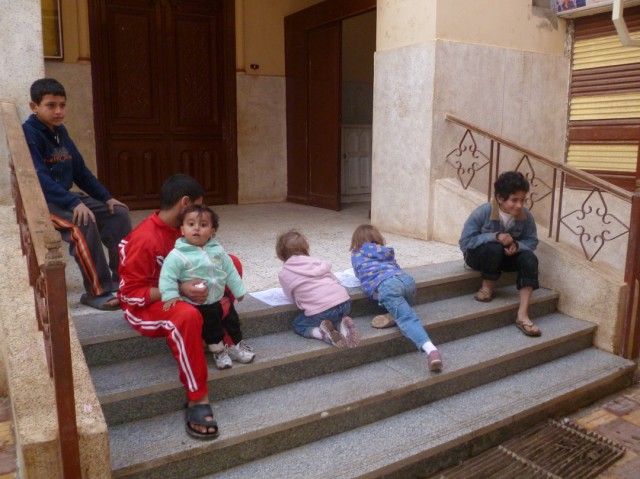

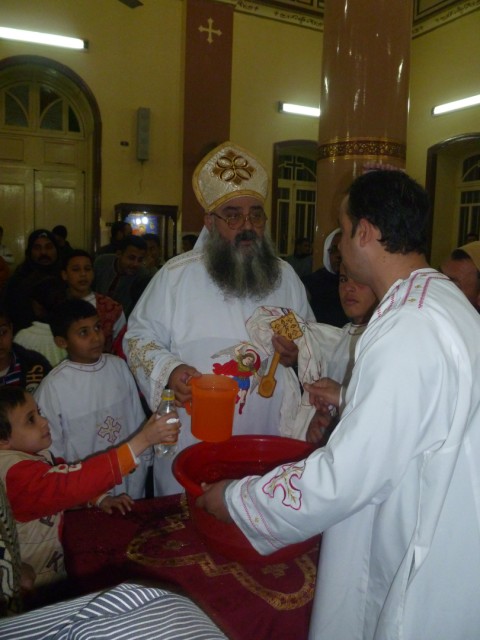
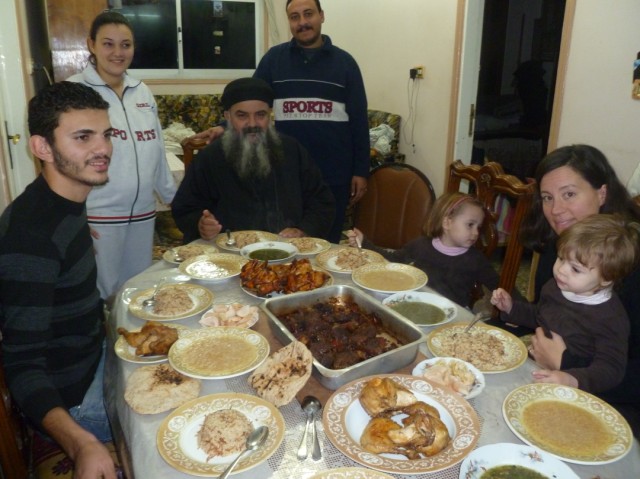
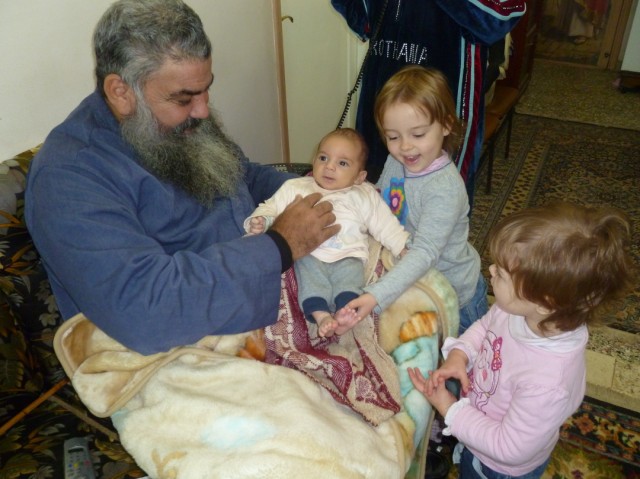
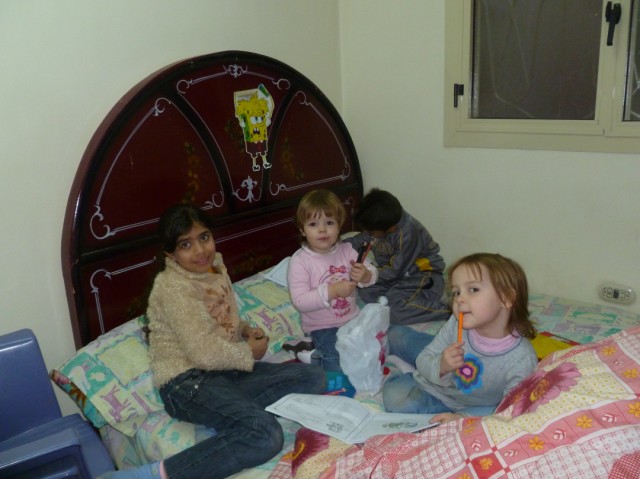


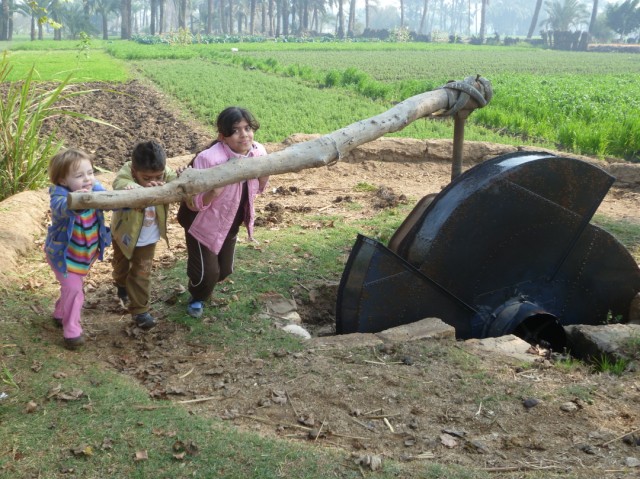
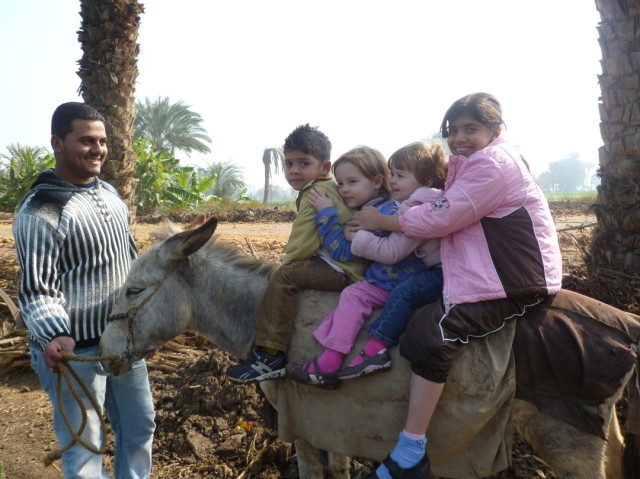
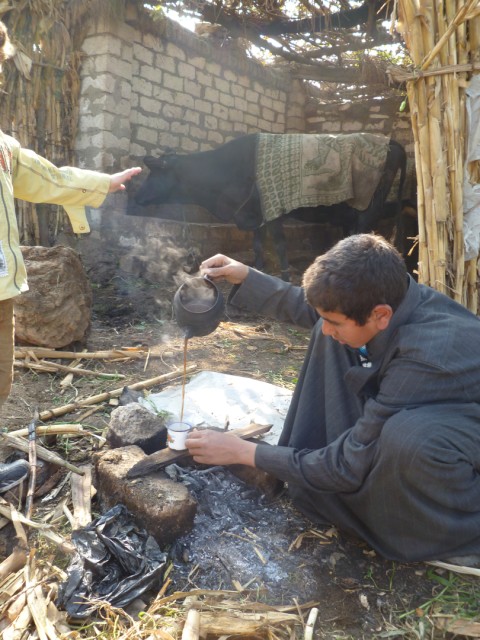
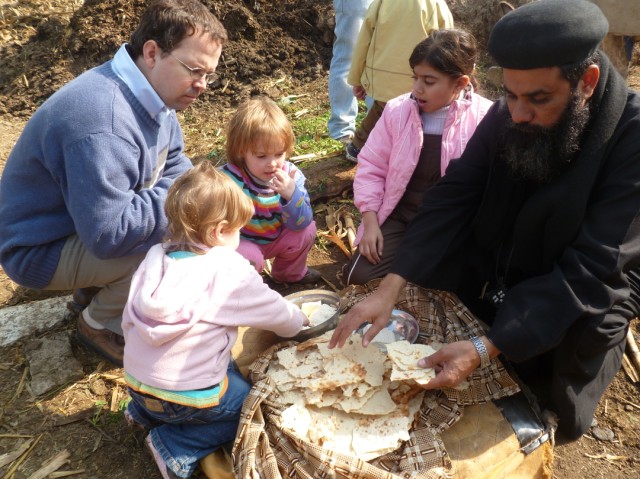


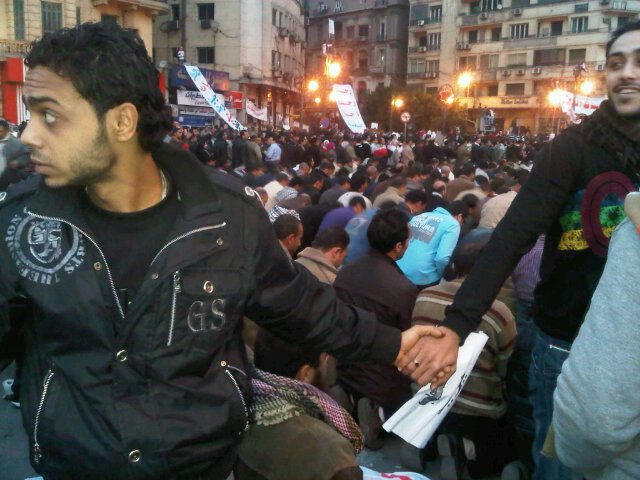


 Jayson Casper