Categories
Personal

Photos from the Aftermath of Tahrir Clashes

Cornish Tree
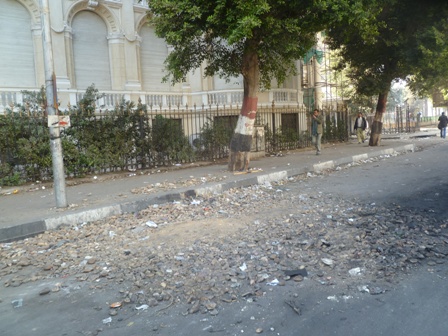
An uprooted tree on the Nile Cornish, just outside of Tahrir Square. Muslim rules of war forbid the wanton destruction of nature.

Egypt has just witnessed some of the fiercest clashes in the revolutionary era, as many protestors appear radicalized. There are still peaceful demonstrations, to be sure, but even these appear to be violently resisted by police. It is hard to blame the police, though, as the lines are blurred.

I missed out on the latest battles. I spent January 25 in Helwan, a city to the south of Cairo at the end of the Metro line. The Muslim Brotherhood was conducting an outreach campaign to counter-program the message of demonstrations and unrest offered in Tahrir. I planned to take the Metro downtown to see these protestors, but on the way the car stopped and sat for five minutes – at the very stop nearest our home in Maadi.

Demonstrators in Tahrir had cut the tracks, causing a backup. Rather than waiting what could be an hour or more, based on previous examples, I left and went home, seeking to catch up on the news of the day, and perhaps go down after a bit.

A minute later, before I was able to exit the station, the Metro started up again. Perhaps it was propitious I had left.

These pictures taken this morning are from my first visit back to Tahrir. The worst clashes occurred in the Suez Canal cities of Port Said, Ismailia, and Suez, where a state of emergency has been declared. It is hard to know precisely what happened anywhere – the consequence of sitting home and following news updates and Twitter bylines. But the pictures to follow give a disturbing indication of where Egypt stands at the moment.

Is this the last gasp of resistance to a new order, or a sign of worse things yet to come? Please pray for Egypt, either way.

The worst clashes took place on the Nile Cornish. This rock pile is on the road leading there from Tahrir, where protestors would retreat to reload in the volleys against the police.
The worst clashes took place on the Nile Cornish. This rock pile is on the road leading there from Tahrir, where protestors would retreat to reload for their volleys against the police.
At one point during the fighting, armed criminals broke in to the Semiramsis Hotel, smashing this door. According to reports, protestors intervened and beat them off.
Outside on the Cornish clean up crews were hard at work collecting the debris, preparing the road for traffic
Outside on the Cornish clean up crews were hard at work collecting the debris, preparing the road for traffic.
Traffic into Tahrir, however, was blocked by these makeshift barricades.
And on the bridge across the Nile leading into Tahrir, group of protestors were trying to block traffic, as they had over the previous few days. This attempt petered out after about five minutes.
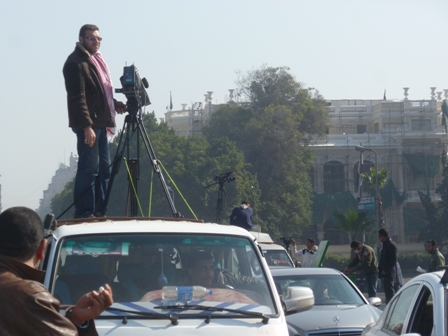
Meanwhile, camera crews were already in place, awaiting the next round of violence.
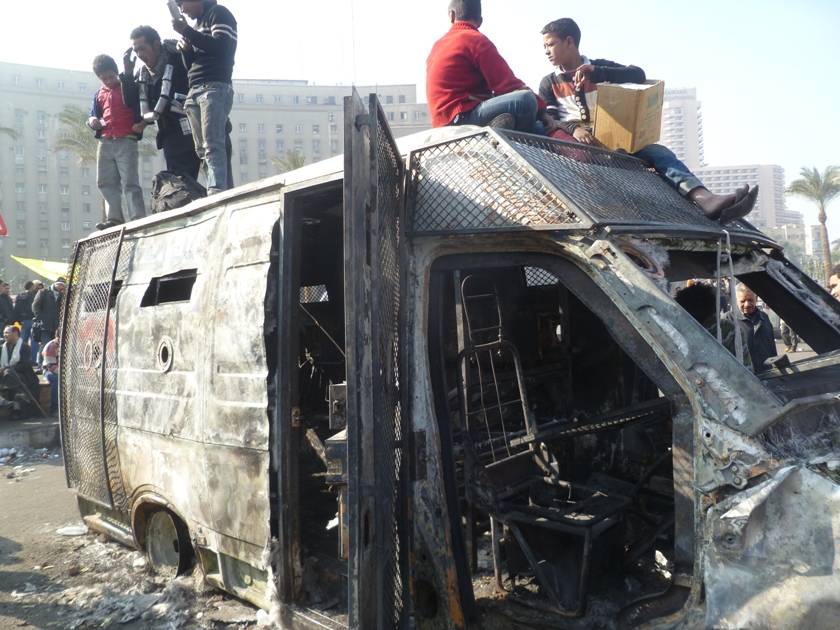
Back in Tahrir, things were calm, as protestors celebrated their previous night's capture off a police van.
Back in Tahrir, things were calm, as protestors celebrated their previous night’s capture off a police van.
Even the local Pizza Hut was open for business - sort of.
Even the local Pizza Hut was open for business – sort of.
Protestors opened their very own Tahrir Museum in the center circle of the roundabout.
Protestors opened their very own Revolution Museum in the center circle of the Tahrir roundabout.
The celebrated statue of Omar Makram had a new round of graffiti.
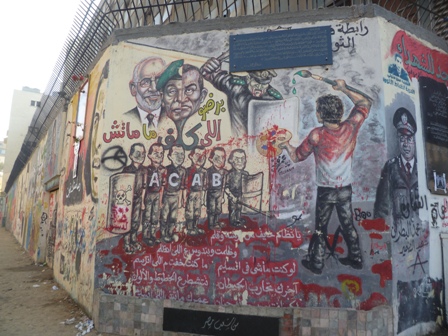
And the walls were updated with the pictures of the latest martyrs and targets of political rejection. Here, the Muslim Brotherhood's General Guide hovers behind a split image of Mubarak and former army General Tantawi.
And the walls were updated with the pictures of the latest martyrs and targets of political rejection. Here, the Muslim Brotherhood’s General Guide hovers behind a split image of Mubarak and former army head General Tantawi. A plaque has been affixed bearing a verse from the Quran.
But at some point since my last visit a huge Egyptian flag had been draped on the side of this building. Perhaps it can be read as a sign of hope.

Related Posts: 

Categories
Personal

Two Years of a Shrunken State

From the Arabist:

This is a useful follow-up to the previous post on diplomacy:

Perhaps the only viable way to get the state to function is for the Brothers to offer the opposition enough reassurance that major political forces together could reach consensus on the illegitimacy of violent protest. If Egypt’s political forces acted in unison — a general appeal for order, or for justice to take its course, or for disputes to be resolved in parliament rather than in the street — these have a powerful calming effect. The Interior Ministry, for example, has called for such an appeal to “patriotic forces” to calm Port Said.

The opposition would probably not try to coax protesters out of Tahrir, nor would it be necessary — the square can probably remain an open-air museum of the revolution as the state rebuilds itself elsewhere. But a joint appeal for order would at least contain street violence and push Egypt’s flare-ups of violence to become less frequent and bloody.

The opposition knows however that to stand alongside the Brothers would be handing Morsi a major concession. The National Salvation Front has demanded as the price for its cooperation that a committee be empowered to amend the constitution. If Morsi’s objective in pushing through the constitution in December was to provide some security for his administration — ie, to prevent the Supreme Court’s from topping off its dissolution of parliament by pushing Morsi out of office, as Brothers said they suspected might happen — then perhaps he would take that risk.

But the first articles targeted would be ones that circumscribe civil rights with religion. The Brothers have in theory agreed to revisiting the constitution. If the Brothers are committed to aggressively Islamicizing society, or if they are worried about having their Islamic credentials challenged by the Salafis, they aren’t going to give the opposition what it wants.

This is an excellent analysis of why the opposition is being somewhat mum on all the street violence. Conspiracy will say they started it, but they are not standing in the way. In fact, rightly in a sense, they lay the burden of responsibility on the state. Ongoing violence is a function of state ineptitude and political intransigence.

So after sidelining the opposition to get what they wanted (i.e. the constitution), Morsi now calls them back for dialogue – but as above – will he be willing to pay the price? It is as if the opposition is saying: You cheated to get your constitution, we’ll cheat to take it back.

Islamists may say the opposition has been cheating from the beginning, but this only opens up the conspiracies even further, which most liberals are happy to slap back at the Brotherhood. It gets Egypt nowhere.

The only thing that will, as the author suggests, is consensus. Can it be found? If not, what is the price?

Categories
Personal

Diplomacy is Dead

From the New York Times:

DIPLOMACY is dead.

Effective diplomacy — the kind that produced Nixon’s breakthrough with China, an end to the Cold War on American terms, or the Dayton peace accord in Bosnia — requires patience, persistence, empathy, discretion, boldness and a willingness to talk to the enemy.

This last point is crucial. One must always talk, and listen. Yes, even the fact of talking grants a measure of legitimacy, and it can be said this should not be freely offered. One reason why Hamas refuses to acknowledge the Jewish State of Israel is that they feel this is must be an end result of negotiation, not its starting point. But even so, Israel and Hamas have been communicating for years, through back channels.

Speaking of Hamas:

Breakthrough diplomacy is not conducted with friends. It is conducted with the likes of the Taliban, the ayatollahs and Hamas. It involves accepting that in order to get what you want you have to give something. The central question is: What do I want to get out of my rival and what do I have to give to get it? Or, put the way Nixon put it in seeking common ground with Communist China: What do we want, what do they want, and what do we both want?

Earlier in the article the author mentioned Egypt as a mini-success of Obama’s diplomacy, and he may have a point. Many here in Egypt’s opposition see the current situation as a negotiated settlement between the US, the military, and the Muslim Brotherhood. Each one has gotten something that they want. The opposition, meanwhile, feels left out in the cold.

But here is where diplomacy’s rubber meets the road. For the idealist, it is painful. But did the opposition get what it wants? There is the beginnings of a democratic system which can be continually contested. They just didn’t win.

Maybe. But to voice their complaint, what did the Brotherhood get? Access to the reigns of power has limits – the army is off limits, as is any real tension with Israel – but comes with great privilege. Some see this privilege extending to be able to manipulate the situation (democratic as it may remain) for their own benefit. What does this give America? As goes the theory, stability in the region.

So, diplomacy, if this picture is true, is it good enough?

For America, perhaps. The task of international diplomacy is to secure the interests, and not the ideals, of the home nation. If Egyptians only get a manipulated democracy that allows the US to check off the accomplishments of its own internal ideals, of what major concern is this to America?

But that is no reason for the Egyptian opposition to accept the situation. They have their own diplomacy to worry about. And part of diplomacy is overstating your case in negotiation. It is conceivable they have quite exaggerated the manipulations of the Brotherhood.

But do the events of yesterday, the second anniversary of the revolution, suggest that the opposition is abandoning diplomacy?

Diplomacy achieves an imperfect solution, but tends to avert war and violence, which usually are far less perfect for all parties involved. But goodness, is it maddening.

Categories
Prayers

Friday Prayers for Egypt: Second Anniversary

Flag Cross Quran

God,

Who will win? Who is fighting? Is the revolution discredited? Is the revolution succeeding? Does this aid Morsi and the Brotherhood? Will it overthrow him/them? Is the National Salvation Front orchestrating? Are they carried along? Is chaos coming?  Is a crackdown coming? Is Egypt being destroyed? Is the old regime being destroyed? Who will win?

God, when so much has been wrong – when so much is wrong – it is not easy to put right. But right can only be built with right. There has been right – there is right – in Egypt. But it has not all been right. A good bit of right doing has been done wrong.

But where, God? Call out righteousness and justice and proclaim it to the people. Anoint men of clear conscience and pure heart to place pure good above all else. Men who will not compromise on the right. Men who will accept failure over hypocrisy. Men who will stand aside that principle may triumph over personality. If these men are already here, God, aid and support them.

Ah, but are such thoughts hopelessly idealistic? Are they futile and self-defeating? Do they pave the way for men of cunning and ambition?

God, bless politics. Bless revolution. Bless every good intention men possess.

Give wisdom. Give courage. Give the power necessary to the necessary people.

But also purge.

Purge good men from the evil within them. Purge good movements from those who seek profit. Purge good ideas from flaw and error. And as purging is always painful, be merciful.

But then restore. May no purge be permanent. May none be excluded. May Egypt rise in cooperation of all her people, all her movements, all her ideas.

God, prayer is not the place for the hard work to make this possible; this is for men in all their counsel. But might it be? If they pray, will you bless Egypt with this solution? If only some pray, will you give it anyway?

God, give Egypt this solution, and give it quickly. Spare her more trouble, but do not leave her with only partial good. Remake her to reflect your perfection, through only that which is good and right. And as long as she falls short, may she repent, regroup, and try again.

Who will win, God? May it be according to your righteous knowledge, however messy it must be to those waiting, striving, and suffering.

Amen.

Categories
Personal

Family in Tahrir

Sidu and Hannah
Sidu and Hannah

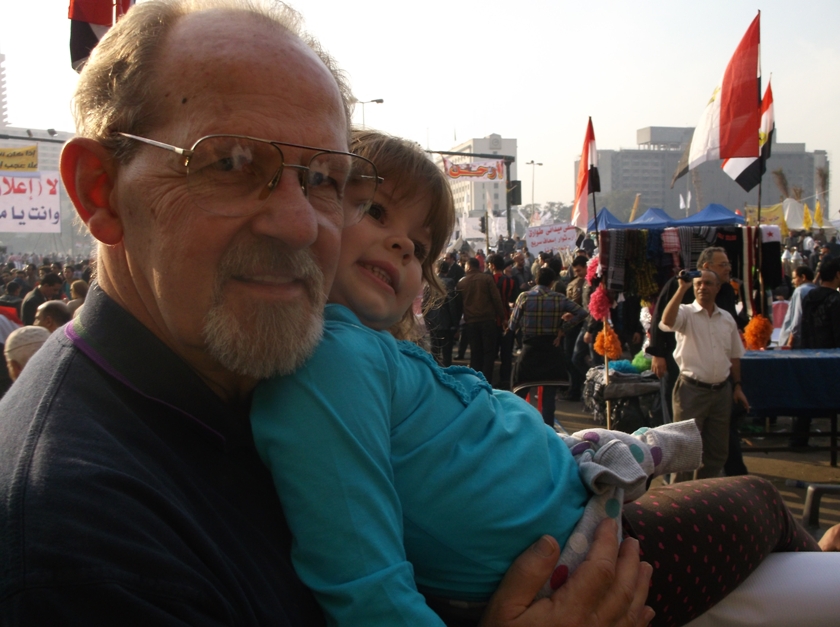
With Egypt on the eve of another potentially massive demonstration, it is time to pull these pictures out from the archive. They are from the day I took my four year old daughter and her grandfather to Tahrir. I didn’t post them immediately, as I didn’t want to scare the rest of the extended family. And to set hearts at ease, I don’t plan to take anyone tomorrow.

It is hard to recall all the events of Tahrir, but on that occasion there were once again clashes – the night before. My parents were visiting to help assist with the birth of our new son; of course my father had to see the famous square. The best time to avoid violence is morning, when all are exhausted from fighting through the night.

‘I smell nail polish remover,’ said Hannah, my daughter. She was sort of right; I had never noticed how it resembled the scent of lingering tear gas.

‘What pretty decorations,’ she said. I looked all around, wondering if she was referring to the graffiti, some of which is rather creative.

‘No, the shiny ones,’ and she pointed toward the middle of the road. Ah, barbed wire.

With a local protestor

Some lessons I explained, others were left unsaid. My children are getting quite an education in Egypt.

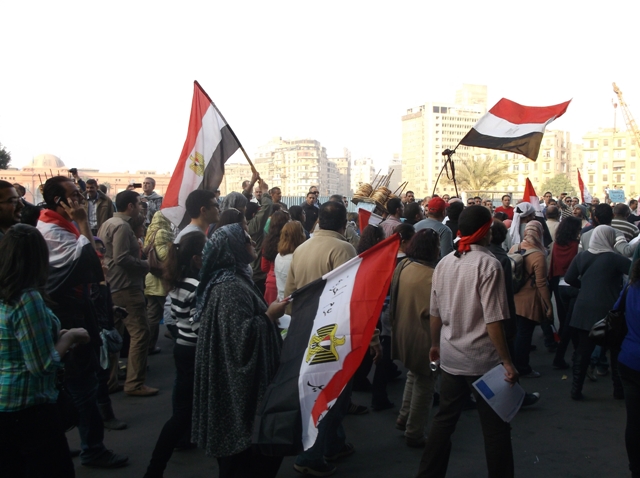
As for my father, he was particularly impressed by an incoming march as we exited the square along Kasr al-Nile Bridge. ‘Such passion,’ he remarked. We even got a quick glance of Hamdeen Sabbahi’s silver locks as he accompanied the procession to Tahrir.

(Sabbahi not visible)

As for tomorrow, the two year anniversary of the start of the revolution, expectations are meaningless. Tahrir could be packed, or victim of protest fatigue and sullen resignation. It could spark a second revolution against the Muslim Brotherhood, or descend violently into anarchy and chaos.

Here’s hoping for a protest without nail polish and decorations.


Related Posts:

Categories
Atlantic Council Middle East Published Articles

Who are the Salafi-Jihadis?

Mohamed al-Zawahiri, brother of the al-Qaeda leader

From my recent article in EgyptSource, following up on the last post of pictures:

Zawahiri is the leader of what has been dubbed the Salafi-Jihadis. Long associated with Islamic Jihad and the Islamic Group, following his release from prison in March 2012 he has positioned himself to the right of the now politically engaged Islamists of the Muslim Brotherhood and traditional Salafis. But who does he represent?

“We are just Muslims, protesting the killing of civilians,” said Walid, one of about 400 demonstrating against French military activity in Mali. “We have no leadership and we don’t belong to al-Qaeda.”

‘Not belonging to al-Qaeda’ was a frequent refrain of protestors.

But there was plenty of sympathy, as well as conspiracy:

Ashraf, who declined to give his last name but consorted comfortably with al-Zawahiri, praised the Benghazi attack which killed the American ambassador, and said more of this nature was needed. But as to the nature of Salafi-Jihadis, he was circumspect.

“There is no such thing as Salafi-Jihadism,” he said. “This name is simply a creation of state security, used to divide Muslims.”

The Egyptian regime, he believes, has always conspired with the Americans to distort Islam. “Is there any Salafism without jihad?” he continued. “Who are the Salafis but the first generations of Muslims, and were these not engaged in jihad?”

By all appearances their numbers are few, but this may not matter much, and surely not all are visible:

Salafi-Jihadis appear to be less an organization than an idea. So while the idea of Islam violently reordering world relations – today focused on Mali – is unable to attract many, it does attract a dedicated few. For Zawahiri, this is enough.

“Over the centuries Muslims have been the victorious ones,” he said, “even when they have had small numbers.”

Please click here to read the full article on EgyptSource.


Related Posts:

Categories
Current Events

Egyptian Jeans under the Patronage of the Muslim Brotherhood

From Ahram Online, discussing Qualified Industrial Zones (QIZ) with Israel:

On 9 December, 2004, a report that was published on the Muslim Brotherhood’s website Ikhwan Online titled: “Muslim Brotherhood MPs: QIZ threatens Egypt’s security”, said the Brotherhood parliament bloc warned against the risks of the QIZ agreement that was then due to be signed within days.

The site reported that according to MP questionings and interpellations, “the agreement is a serious threat to national security because it is the first economic and industrial agreement with the Zionist enemy.”

At the time, Brotherhood parliamentarian Hamdi Hassan, said in an interpellation, that the agreement “achieved all that the enemy has sought for decades: controlling the region economically through interfering in the Egyptian economy after it controlled it politically in the wake of the Camp David agreement.”Hassan concluded by saying “you cannot make peace, promises or QIZ with Zionists”.

Earlier the article gives the detail:

On 9 September 2012, in an interview with economic news agency Bloomberg, Qandil [Egyptian prime minister, appointed by Morsi] said that Egypt will meet its commitment to the agreement which opens up the US market for Egyptian products if they have a 10.5 per cent Israeli component of added value (which Morsi’s Egypt wants to reduce to eight per cent).

Qandil also said that “a lot of people  are making good business out of that:  we want to make sure we do the right thing for them to flourish.”

Earlier Ahram Online reported the program was not only continuing, but expanding to new governorates. The current articles provides many figures to describe the economic impact is limited.

I have no idea if these Qualified Industrial Zones are a good idea or not. If one desires normalization with Israel, which it seems most Egyptians do not, the idea of integrating business opportunities seems like a good way to begin.

But with this current expansion, was previous MB opposition principled or rabble-rousing? Is their current support principled or kowtowing to US demands? Politics, politics, with religion added to stir the pot.

Related Posts:

Categories
Personal

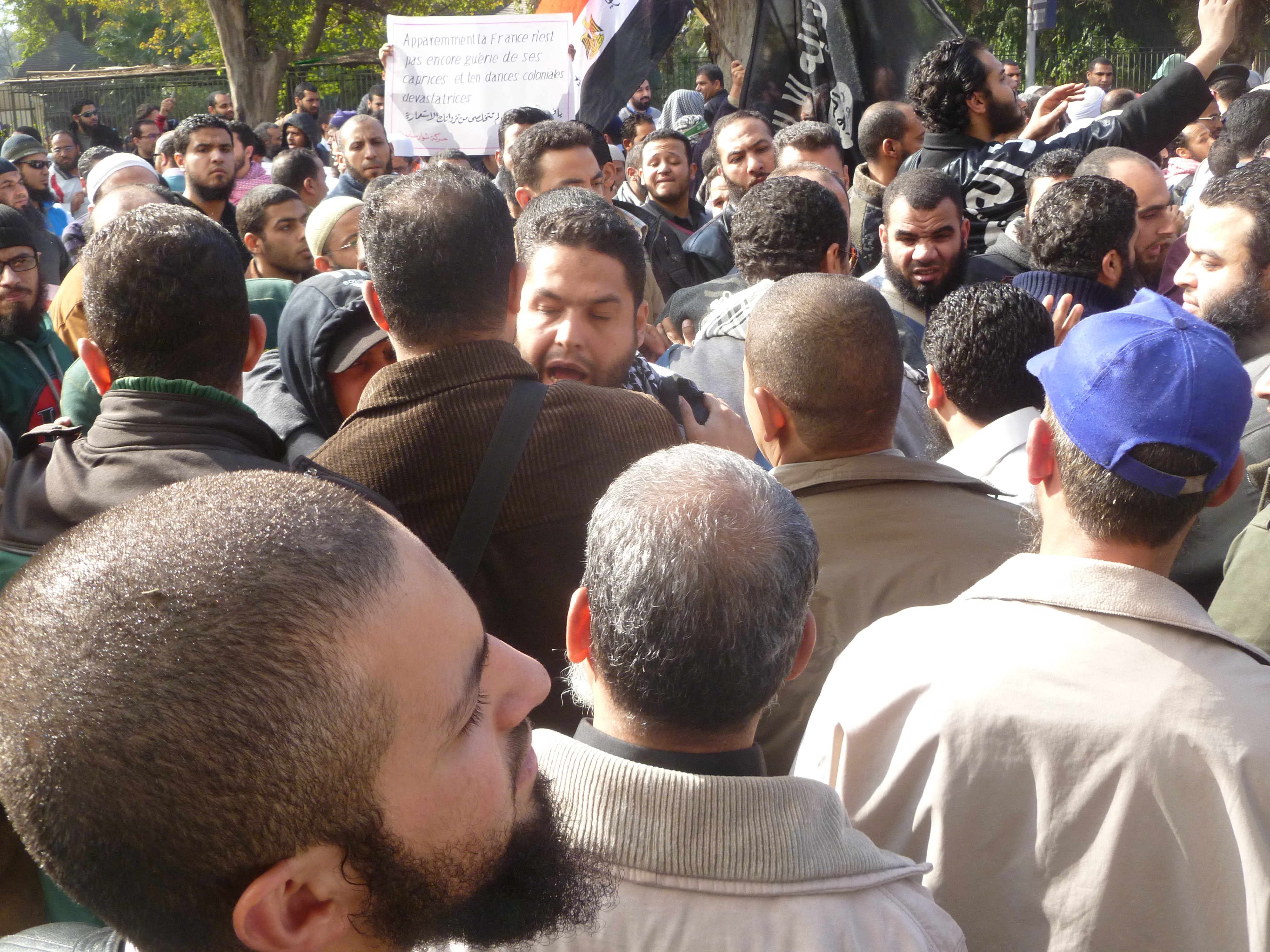
Photos from the Salafi-Jihadi Protest at the French Embassy

There are several strands of Salafism in Egypt, and the differences are not easy to understand. The group which is called Salafi-Jihadi – they do not necessarily call themselves this – is differentiated easily by the second part of their moniker. While many Salafis have joined the political, democratic process in Egypt, these reject it outright. Instead, they favor the continuation of a violent struggle against the Egyptian regime, of which they see the Muslim Brotherhood and other Salafis as selling out to the world anti-Islamic system.

This group held a protest on January 18 against the French military intervention in Mali. In Mali criminal-cum-jihadists have piggybacked onto a tribal Tuareg rebellion in the north. The central government, along with many surrounding Arab and African nations, has sanctioned France’s effort to resist them through force of arms. Salafi-Jihadists, however, support them due to their desire to implement sharia law.

I hope to write more about Salafi-Jihadis soon, but for now, please enjoy the protest through these pictures and video.

Click here for the first video. It is only two minutes long because it represents the length of time necessary for their full march to approach the site. There were only a couple hundred protestors in total.

Click here for the second video. It also is only two minutes because this was about the length of time the protestors jostled with police who had set up a barricade preventing them from reaching the embassy. After that they accepted their place about 100 yards further down the street.

Crowd Pressing

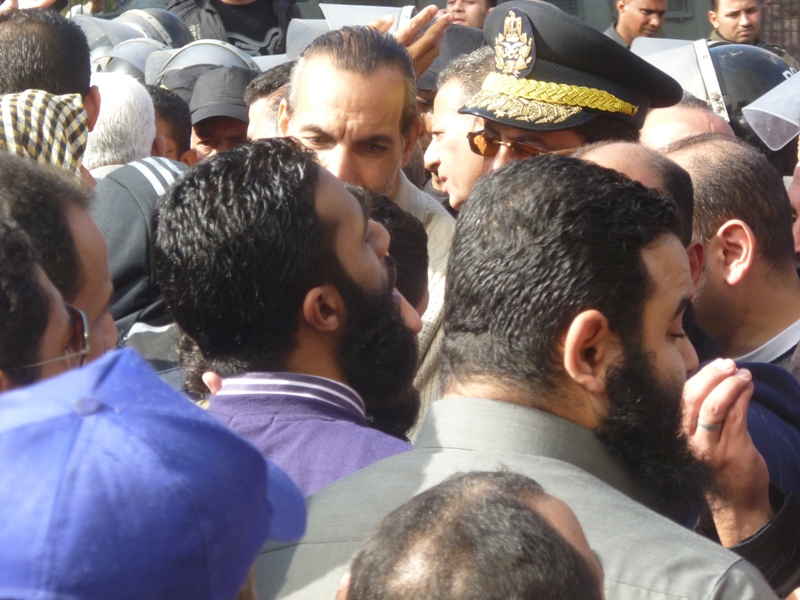
Next to the man in the police cap is Ezzat al-Salamony. He is a leader with the Islamic Group, not the Salafi-Jihadis, and worked to restrain the crowd. He later gave a rousing speech against the French, though, calling for jihad in the lands of the infidels.


Eventually a car drove up with speakers to serve as a platform for speakers. The police maintained their line, but were left in peace from then on.
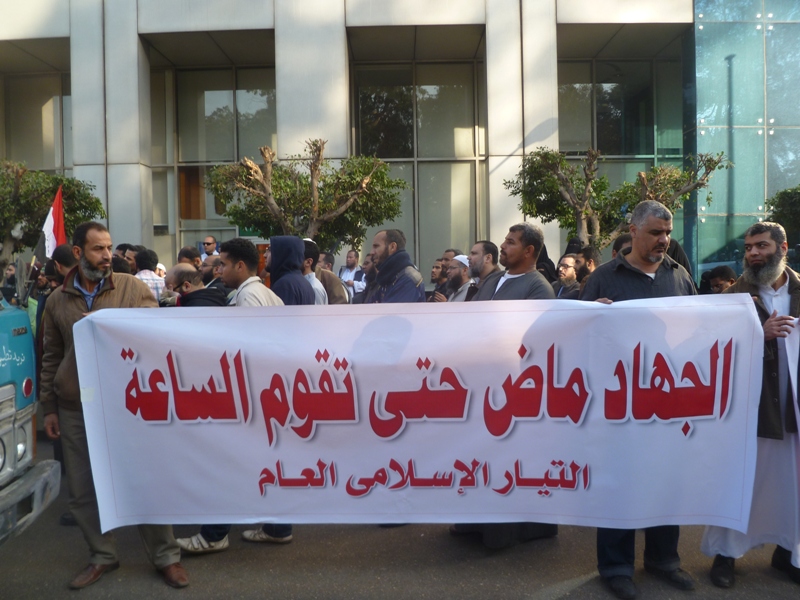
As speakers condemned France, other protestors set up their banners. This one reads: Jihad will continue until the Day of Judgment.
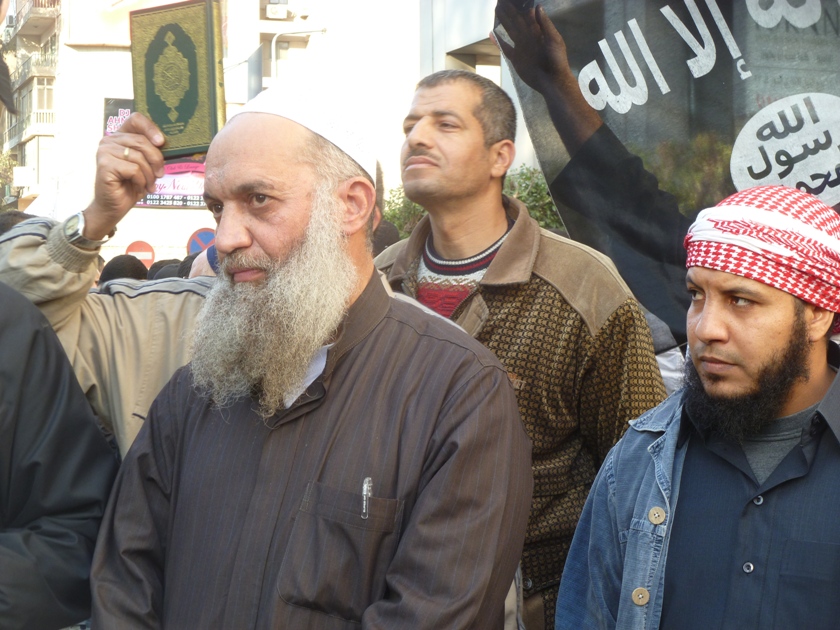
After a little while the star of the show arrived. Mohamed al-Zawahiri is the brother of Ayman, the leader of al-Qaeda. Everyone pressed around him.
As he hung around for hours, eventually the crowds dissipated around him. Here is awaits giving an interview to al-Jazeera.
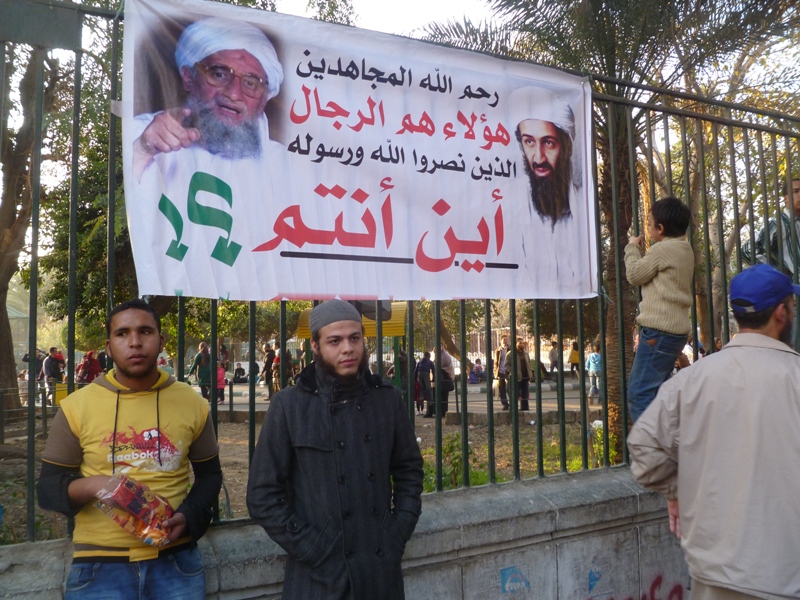
Around 5pm, the police relented and allowed the protestors to advance and demonstrate in front of the embassy, though the police presence guarded it and otherwise surrounded them. Graffiti and other banners were hung in the area, this one across the street on the wall of the Giza Zoo. Pictured are Osama bin Laden and Mohamed's brother Ayman. The sign reads: God have mercy on the jihadists. They are the men who gave victory to God and his prophet. Where are you?!
Around 5pm, the police relented and allowed the protestors to advance and demonstrate in front of the embassy, though the police presence guarded it and otherwise surrounded them. Graffiti and other banners were hung in the area, this one across the street on the wall of the Giza Zoo.
Pictured are Osama bin Laden and Mohamed’s brother Ayman. The sign reads: God have mercy on the jihadists. They are the men who gave victory to God and his prophet. Where are you?!


Related Posts:


Categories
Prayers

Friday Prayers for Egypt: Derailing

Flag Cross Quran

God,

Despite the protests of many, perhaps it can be said that Egypt is now on a political path forward. A constitution is adopted, a legislature is in session, and parliamentary elections are being planned.

But elsewhere, if only symbolically, Egypt is pulling apart at the seams.

A train carrying security conscripts derailed, killing many. Overcrowded, creaking the whole way, it is as if Egypt’s infrastructure is decaying. It follows a similar accident weeks before when dozens of children were killed at a crossing.

Meanwhile, apartment buildings collapse and boats are lost at sea. It has not been a good week.

These accidents are not new, but who can fix them?

From a different direction, sectarian issues threaten to reemerge. A family was arrested for seeking to reconvert to Christianity, allegedly forging identity cards in order to do so. And rumors of child molestation led a crowd of Muslims to surround a church and smash Coptic-owned shops.

On each of these, details are still emerging. But in the sectarian atmosphere from which political ‘stability’ emerged, actual sectarian conflict makes an ill appearance. May it quickly fade.

God, repair Egypt. It is not just the rails, but those who watch over them, build them, and assign the contracts. Teach the people to be accountable, and help them design a system to enforce it.

In each sector of society, give eyes to see where decay exists. Give both courage and know-how to report problems forever ignored. Grant receptivity on the part of authorities to create a culture of responsibility and improvement.

May no more needless deaths occur.

And this is especially so, God, when it comes to neighborly, religious relations. Accidents will always happen. Misunderstanding is common. But spare Egypt more examples of those who rise up as a group against those who believe differently. Allow all to live not only in freedom of conscience and belief, but also in freedom of place and well being. Why must so many fear what is coming?

God, help Egypt get back on track. Where did she get off of it? Was it recently or long derailed? Have mercy, God. Comfort and encourage the people. Help all be well. Preserve her, but more – build anew. May that which is crumbling be renewed before it collapses.

Amen.


Categories
Atlantic Council Middle East Published Articles

The Growing Pains of Salafi Politics

Asala Party Elections (photo: Clara Pak)

From my latest article in EgyptSource:

The Salafi political movement experienced massive transition in the past two weeks, enduring splits, recriminations, and leadership changes. Having long foresworn the political process, it is right and natural for growing pains to characterize their apparent embrace of democracy. Taking stock, three observations describe their current standing.

These are:

  • The process is transparent, but is the result foreordained?
  • The rhetoric is clear, but are they learning spin?
  • The inspiration is worrisome, but does it determine?

From the first:

The main question directed to Islamist politicians is if they truly believe in democracy or simply use it as a ladder to power. Egypt’s constitution declared its governing system to be both democratic and of an undefined shura (consultation). The shura provision was added at the request of Salafis, whose ideas of democracy issue from the selection process of the early Islamic caliphs, which was consensual. If internal elections are any indication, Salafis are willing to be transparent about their leadership choices, but greatly prefer the predetermined aspects of shura.

From the second:

There are reasonable reasons to reject quotas as well as to trust sharia provisions toward non-Muslims. Yet probing beyond the headlines exposes differences of nuance, if not outright contradiction.

Opponents of Salafis do credit them for being straightforward and sincere, unlike their opinion of the Muslim Brotherhood. As they develop political skill, however, it appears Salafis also are learning the unfortunate art of spin.

From the third:

Then effortlessly, unprompted, and without rancor, he slid into a passionless diatribe. “When we reach the stage of our empowerment, we will collect jizia from the Copts.

“Permissible for us are the blood and spoils of those who disbelieve in God and refuse his prophet,” he said. “This is not for the people of the book, as long as they do not fight us. But inside and outside Egypt they are fighting us, taking millions from America to accumulate weapons.”

So when Sheikh Abdel Khaleq Mohamed states at an official party function, “Democratic work is unbelief, but as long as it leads to the victory of God’s religion it is permissible to us,” does he represent its official line? Or does party president Ehab Shiha, who clarified the misquote, adding after ‘unbelief’ the words ‘… as a doctrine’ which were clipped in the article? On the contrary, Shiha accepts the definition of democracy as ‘government by the people, of the people, and for the people’ as long as it does not transgress the laws of God.

Please click here to read the full article on EgyptSource.

Related Posts:

Categories
Uncategorized

Witnesses, Survivors Recount Egypt’s Deadly Badrashin Train Crash

On the horrible accident near Beni Suef in Upper Egypt, from Ahram Online:

Hours after the tragic train crash that killed at least 19 passengers and injured scores of others in the Giza suburb of Badrashin, victims’ relatives and police officials remained gathered at the scene and a military helicopter hovered overhead.

The 12-carriage train, which was carrying 1,328 Central Security Forces (CSF) conscripts, mostly around 20 years old, had been travelling en route to Cairo from Upper Egypt. The conscripts had been preparing for their first military training, when two railway cars – each carrying over 200 soldiers – derailed, hitting a cargo train sitting outside a storage depot.

According to one, the overcrowding may have saved his life, though it surely killed others:

“On the truck I was in, one injured passenger had a broken leg; his leg hung by the skin only. Another had his nose broken, while a third had suffered broken ribs. I’m one of the lucky ones who had been sitting with five others in seats fit for two. Others were crammed into the upper shelves usually reserved for baggage. Those are the ones who died.”

We have traveled by train several times to Upper Egypt, but always in first or second class. Even there, some passengers are allowed to enter and stand in the aisles and open spaces near the door. In other cars we see how people are crowded together, though never this severely.

But on the whole, we have always found train travel in Egypt to be smooth and economical, even when someone in the aisle has his elbow in your ear leaning on the back of the chair. Usually they are kind enough to adjust. I wonder what sort of ticket they bought, if any, and why the attendant allows them to stay.

On the other hand, there is weird and uncomfortable sense of entitlement when we see them crammed in, yet my six year old daughter has a seat. We did pay for it, right?

I remember my days in university, when I would sit in the corner of the train on a huge bag of laundry, traveling from Washington, DC back home to New Jersey. I wonder how many passengers I annoyed.

May God rest the souls of those who died and comfort the many injured. May he guide the government in fixing Egypt’s many problems. Mercy.


Related Posts:


Categories
Personal

Orient and Occident: Winter Edition

Orient and Occident

From my latest article on Orient and Occident:

‘The church in Egypt is better resourced to participate in society than in other countries of the Arab world, whereas in Palestine/Israel it constitutes only 1% of the population,’ says Stephen Sizer, a renowned critic of Christian Zionism, who presented a series of lectures in Cairo, including at the Anglican Cathedral.

Sizer is an Anglican minister from the UK and directs most of his energy combating US evangelical Christians who find Biblical warrant for supporting the Zionist policies of Israel. Instead, Biblical theology should direct the Christian to support the oppressed and stand for justice, on both sides of the separation wall.

Yet local expressions of theology have failed Palestinian Christians as well. In an interview with Orient and Occident Sizer suspects a similar deficiency among many Egyptian Copts.

‘Theology that says, “Stay out of politics and worship quietly; don’t get in the way or cause problems” will lead only to a victim mentality,’ maintains Sizer. ‘We have to get out of our ghetto and show the rule of law applies to everyone.’

Please click here to continue reading the article on Orient and Occident.

Orient and Occident is the bilingual online magazine of the Egyptian Anglican Church, of which I am privileged to be the editor. We seek to highlight voices who are able to articulate how the values of faith – Christian in particular, shared widely with Islam – can be lived practically in society, and in particular the Arab world. We welcome contributions from Christians and Muslims alike.

Please click here to view the Winter edition homepage in English, and here in Arabic. This season’s edition also features the following articles:

While on this blog Julie and I always appreciate your sharing of our thoughts about Egypt, we would like to invite you particularly to share any of these articles you find enjoyable or challenging. We hope Orient and Occident will be a service to the Arab world – both by inspiring its readers inside and by sharing a vision with the world outside. Thanks for any small steps you can take to help it be better known.

Related Posts:

Categories
Current Events

Unveiled Women’s Rights Pioneer Removed from Curriculum

More from the Education Ministry:

The picture of a women’s rights pioneer was deleted from a high school textbook because she was not wearing a hijab, prompting fierce condemnation from political parties, human rights organizations, feminist groups and a number of public figures.

Doriya Shafiq is one of the pioneers of the women’s liberation movement in Egypt from the first half of the 20th century. She campaigned for the rights of Egyptian women to vote and stand as candidates to be included in the 1956 Constitution.

Aside from campaigning against the British presence in Egypt, Shafiq also was a researcher and founded literary journals. She was granted a PhD in philosophy from the Sorbonne in France in 1940, after writing a thesis titled “Women in Islam, which claimed that women have twice the rights under Islam than they do under any other legislation.

Little snippets of news like this do not tell the whole story, of course. Is the curriculum changed frequently? Had this woman been included forever or only added recently? How are other women leaders treated? Was this the only unveiled women or are there several others still featured?

All the same, it is very important to follow changes to the educational curriculum. Despite the rancor it sometimes causes, I am glad American education is determined at the state level. But if this was the system here, what would the result be in traditional governorates? What authority should the central government have to shape the minds of young people?

Related Posts:

Categories
Christianity Today Middle East Published Articles

Titling a Story on a Religious Divide

Believe TV

From my recent article on Christianity Today, published online on January 10, 2013:

The stakes have been raised for Christian satellite broadcasting in the Arab world.

On November 28, a Cairo court sentenced to death Nakhoula Basilli Nakhoula and six other Coptic Christians—who all live outside Egypt—for their alleged roles in producing The Innocence of Muslims. The film, which mocks the Prophet Muhammad, prompted violent protests worldwide.

Nakhoula is relatively safe since he and the Way, the satellite channel that broadcasted the film, are based in the United States. But the sentence drew attention to how such channels have proliferated in recent years, seeking to present the gospel to Arab Muslims by—in part—directly criticizing Islam.

“Since satellite TV is widespread across the Middle East and is uncensorable, it is obviously a key way to make the good news of the gospel available,” said Terence Ascott, CEO and founder of SAT-7.

Please click here to read the whole article, which includes testimony from Egypt based religious broadcasters SAT-7 and Coptic CTV, as well as internationally based Coptic Logos TV, and Life TV.

The location can make a difference. While the legal consequences vary from nation to nation, Islam as a religion highly discourages conversions away from the faith – certainly public ones. There is a range of response; some advocate death, others social estrangement, and some say (quoting the Qur’an, not necessarily definitively) there is no compulsion in religion.

I am comfortable with the fairness and objectivity of the article, and every source spoke on the record. But based in Egypt where almost everything religious is highly sensitive, there is one element of the story beyond my control – the title.

Every magazine takes the prerogative to title an article according to their best understanding of audience marketing. After all, it is the title which draws the reader to the content. I always suggest a title; sometimes it is accepted, sometimes it is discarded. Generally there is collaboration on the matter. Usually the choice of final title doesn’t make very much difference to me, and most often their wording is best.

This article originally was published in print, that is, for local distribution in the US market only. This means it would exist largely away from any local Egypt sensitivities.

But it was also purposed to publish online eventually. This means the article is open and available to all. The sensitivities remain.

My original suggestion was: ‘Broadcasting the Gospel in Arabic: For Christians or Muslims?’ One suggestion along the way, which I liked best, was: ‘Target Audience’.

In the print edition the final choice was: ‘Carrot or Stick?’ with a subtitle of ‘Broadcasters debate best way to reach Muslims’. And online the title became: ‘How Should Christian Broadcasters Evangelize to Muslims?’

I think these titles somewhat miss the point, because much of the existing Arabic language religious broadcasting is produced for the Christian audiences of the Middle East. Even the channels which speak more directly about Islam are watched extensively by Christians, featuring testimonies, for example, of Muslims who have become Christians. For a community in regional numerical decline, such ‘proof’ that their religion is truly from God is comforting amidst the challenges of being a minority.

Therefore, the balance necessary in choosing a title is certainly tricky. Each publication has its own standards and religious convictions, but for the evangelical audience of Christianity Today, it is a given that the message of Jesus is for all – including Muslims. Of course media should give them exposure of and invitation to the teachings of Christianity, in their own language.

Meanwhile, for most in Egypt, it is Islam which should draw the converts. It is anathema that a Muslim might leave Islam to any religion at all, and many are offended when others try to encourage the process. As the article points out, this is even more so when the attempt directly criticizes Islam or Muhammad.

Christianity Today also has another article on the subject, which highlights some navigating a middle ground. It is an interview unlikely to fully please either the Christian or the Muslim.

In America, religion is largely a private matter, with religious ideas being free game on an open market. One should respect the convictions of an individual, but religions themselves are subject to ridicule, criticism, indifference, allegiance, support, belief, or robust apologetic – as the case may be. Most Americans accept this as good and natural.

In Egypt, religion is largely a public matter, with religious ideas protected to preserve social harmony. One should allow, almost begrudgingly, an individual to harbor divergent views in his heart, but the religions themselves – at least concerning Islam and Christianity – are from God and not to be questioned. Most Egyptians accept this as good and natural.

In this light, the title options chosen for the article come from a very American perspective, designed to draw the most readership. My favored titles strive to be as neutral, yet descriptive, as possible. The content is the content, accepted by both. Hopefully all who read will get a fair picture of what is at stake.

Related Posts:

Categories
Arab West Report Middle East Published Articles

Egyptian Education and the Journey to Islam

Christiane Paulus
Christiane Paulus

From my new article on Arab West Report:

When it comes to Egyptian education and Islam, Christiane Paulus is both a critic and supporter. So much so, she adopted both.

Paulus is a German national, resident in Egypt since 1998. She is currently a professor of Islamic studies and Protestant theology at the Azhar University, through the medium of the German language. Her journey here is a story all its own.

Paulus studied Protestant theology and postmodern philosophy in Marburg, Germany, with the intention of becoming a Lutheran minister. But in 1988, before her final tests, she married her husband, an Egyptian Muslim. Unless he converted to Christianity, the church ruled she could not receive her preaching license, as both spouses needed to be of the faith.

Years thereafter Paulus remained in her Christian faith, even after moving to Egypt with her family.

Paulus does describe what she finds are the culturally derived faults of the Egyptian education system, with consequences falling directly on religious and political relations:

Dialogue, Paulus believes, is a subject of the social sciences – a discipline largely ignored in Egyptian education. Curriculum, methodology, and pedagogy have remained stagnant since the Nasser era, when a resistance to new ideas was the norm. Since then, however, both students and teachers have sought to escape the system. At the basic level this involves the reliance on private tutors; for those able it means enrollment in private or foreign schools.

Women, she noted, are in general educated relationally. This equips them for dialogue more readily than men. But in addition to educational lacking, the Egyptian culture is bound by concepts of honor and shame. Together with pride, this produces an atmosphere of ‘not talking’. An Upper Egyptian husband, for example, will ignore his wife and stay silent with her when upset. Outside the family, discord produces the same result. The first casualty of Egypt’s political division is a lack of communication between liberals and Islamists.

But her focus in presentation was on what drew her to Islam as a religion. Much of this was due to the influence of her husband and his family, but it was also from historical study:

In 2005 Paulus read a book by the Egyptian Muslim theologian Amin al-Kholy, an active intellectual in the early 20th Century. ‘Islam and the Connection to Christian Reform’ summarized his presentation on the Protestant Reformation, representing the Azhar at the 1935 Brussels conference on the religious sciences.

Kholy noted that the early Protestant reformers – prior to Luther – emerged from areas long occupied by Muslims. From Spain under the Reconquista, Lyon, and Monaco, figures such as Peter Waldus and William of Ockham adopted ideas originating in Islam, translated them into Latin, and began applying them to criticize European Catholic Christianity. The Muslim populations of these areas had been forcibly converted into Christianity but retained their Islamic beliefs in secret. A few centuries later, Islamic-cum-Protestant ideas such as no mediation between man and God, private reading of the Scriptures, and clerical marriage began to take hold.

But she remains critical of prevalent Islamic thinking as well, which generally leaves their received religious heritage unquestioned:

Of course, a great deal of irrationality has entered the Muslim world, too. Where education is lacking the religious discourse takes over everything. Contrary to the prevailing religious spirit, Paulus says each individual Muslim has the right to read and evaluate Islam’s religious sources – the Qur’an and Hadith – weighing their value. The condition is to keep the Islamic culture of discussion respectful, objective, and academic.

This individuality also comes out in Paulus’ decision not to wear a headscarf.

Paulus is a charming person who is clearly a deep and sensitive thinker. Her testimony was given in a presentation with brief time for questions and answers; otherwise, it would have been useful to probe many of her arguments further. Please click here to discover them by reading the whole article on Arab West Report, and here for an Arabic language article on Paulus.

But less interesting than arguments is the story of an individual human being, seeking to make sense of the world. Tomorrow I hope to post a link to another recent article I have written, this time in the other direction.


Related Posts:

Categories
Personal

My Jihad: This Video will Restore your Faith in Humanity

The title is a little bit much (to be explained below), but it is a nice scene. The video is taken from a Christmas celebration in Kasr el-Dobara Church in downtown Cairo, right behind Tahrir Square. The imam of Tahrir’s mosque pays a visit to wish his Christmas greetings to a congregation that shared with him the trials and courage of the revolution. The video is 15 minutes long, and subtitled, but you don’t have to watch the whole thing to get the gist.

Please click here to go to YouTube.

The gesture is very important in contemporary Egypt, as the Salafi current of Islam has forbidden Muslims to wish Christians a merry Christmas. On one hand this is fine – why should they honor a supposed incarnation they reject?

On the other hand it is horrible – it strikes at the fabric of national unity which has been nurtured in Egypt over generations, amid instances of sectarian tension. Every Egyptian knows their religions are not the same, but they greet each other warmly nonetheless.

But if there is one comment against the video, its production (not its content) strikes too much as propaganda in the other direction. ‘My Jihad’ is an English language campaign designed to redefine the American understanding of jihad.

Again, this is well and good. Jihad does encompass the meaning of warfare for the cause of Islam. But it also, and for most Muslims around the world who are at war with no one, signifies the struggle to improve one’s soul and the world around them. It would serve many Americans well to be more aware of this.

But using Egypt as an example to restore faith in humanity? Directly after a campaign for their constitution laden with religious rhetoric, much of which labeled their opponents – and sometimes Christians – as unbelievers and the enemy? As the war cry ‘Allahu Akbar’ rang out from podiums urging the triumph of God’s religion?

Do not make these worrisome developments out to be more than they are, but do not make this appearance of a sheikh in a church out to be more than it is, either. Yes, it is a necessary and valuable gesture, received to great applause by the Christian audience.

But if one wishes to be cynical, after Islamists used religion to divide Egypt and get their constitution, may they now want to use religion (and religious unity) to govern from the center amid expected economic difficulties? Even if not, forgive the nation’s Christians and non-Islamist Muslims for feeling rather jaded.

These events are far removed from the American consciousness, which is generally ready to move on from Egypt after being consumed with its transition for the past two years. It is hoped the My Jihad campaign, as necessary as it must be, is not painting a purposefully imprecise picture to take advantage.

Categories
Prayers

Friday Prayers for Egypt: Devaluation, Further?

Flag Cross Quran

God,

A few ticks of foreign exchange rates seem very little to pray over. In fact, the impact so far seems to be nominal. But as the Egyptian pound has dropped against the US dollar, many forecast difficulty for the poor.

It may get worse. Some predict the current managed devaluation may spiral out of control. Currently Egypt and investors alike are in a holding pattern, awaiting the end of the political transition and conclusions on an IMF loan. Economics likes stability, which these would provide. Unfortunately, on both counts, what is best for Egypt is hotly debated.

God, politics cannot be set aside. But find a way to keep Egyptians fed and warm this winter. Help those well off to be creatively generous. Help those without to be creatively industrious. Help those who hold the reins of policy to spark investment and employment alike.

You know where the pound belongs, God, as perhaps do senior economists around the world. Help it to settle where Egypt – as a nation – profits best. If there are burdens in the interim give patience. But hold accountable those who will lay the cost of their profits and political success on the poor and future generations.

Provide Egypt with sound minds and good leadership. May her economy grow strong; may all rise together.

Amen.

Categories
Atlantic Council Middle East Published Articles

Do Salafi Splits Signal Weakness or a Different Kind of Strength?

Ahmed al-Qadri
Ahmed al-Qadri

From my latest article in EgyptSource:

The Nour Party, the political flagship of Egypt’s burgeoning Salafi movement, is in full damage control over scores of member defections to the new Watan Party. This is appropriate, as the damage is substantial.

The Nour Party lists why it is dismissive of its new rival, but Watan boasts impressive transfer:

According to Ahmed al-Qadri, the English language spokesman for the Watan Party and former vice-president of Nour’s energy committee, the resignations affect the great majority of leadership positions. Besides former party president Emad Abdel Ghaffour and spokesmen Mohamed Nour and Yousry Hammad, nineteen regional offices resigned collectively.

Furthermore, Qadri explained, every single member of Nour’s technical committees has resigned. Including the economic, political, agriculture, energy and other committees, these groups of experts facilitated the work of Nour’s members of parliament. Of Nour’s 107 MPs, 52 have joined Watan, along with sixteen current members of the Shura Council.

The problem is not over doctrine, but over the influence of religion over politics:

“Some people wanted to assign positions based on proximity to leading religious figures,” said Qadri. “One of Nour’s mistakes was that the Salafi Call had the right to interfere in the party and change job descriptions. We want to work to unite all Salafi schools but have a legitimate and independent political party.”

Some Salafis fear – and liberals hope – these divisions will damage the electoral campaign of Islamists. But Qadri sees it differently:

“If the main figures of a party make a mistake, it may cost them votes, but if we have variety in the Salafi trend then those votes can simply shift to another party,” he said.

“If you are only one party you will be too sluggish to promote yourself because there is no competition.”

And from the conclusion, he hinted that this multiplicity might actually distance religion from politics:

“You cannot simply say ‘sharia’ or ‘Islamic state’ because we all believe in this,” he said. “The Egyptian people have learned that no one will any longer give their vote to a flag, but only to those who offer them solutions.”

The coming elections will tell, but unity is always important. Just ask liberals worried over possible splits in the National Salvation Front.

Please click here to read the full article on EgyptSource.

Related Posts:

Categories
Current Events

Bahais and Egyptian Education

From Egypt Independent:

The education minister has repeated remarks that Bahais cannot enroll in public schools, saying it violates the Constitution.

“The Constitution only recognizes the three Abrahamic religions,” Ibrahim Ghoneim told Akbar Al-Youm newspaper Saturday. “And as religion is a subject taught in schools, they do not meet the requirements for enrollment.”

Ghoneim had told Al-Sabah newspaper the same statement in November, when he was asked, “What is the position of the ministry concerning the children of Bahais? Do they have the right to enroll in a [ministry-affiliated] school?”

The minister responded by saying, “The state only recognizes three religions, and the Bahai faith is not among them. Thus their children do not have the right to register in government schools.”

It is noteworthy the minister makes reference to the new constitution to justify his position. But it is also noteworthy this was his position before the constitution was approved. The ministry of education is not one of the institutions which has been headed by a member of the Muslim Brotherhood, indicating anti-Baha’i sentiment predates their takeover of government.

But, see this article for more intrigue:

In a statement issued on Sunday, the syndicate added that around 22 members of the Muslim Brotherhood were promoted to senior positions in the minsitry following the election of President Mohamed Morsy in June.

This week, the ministry denied news that it was “Brotherhoodizing” the ministry or curricula and dismissed as false claims that it had removed pictures of protesters killed during the 25 January revolution and those of unveiled feminist leaders in Egypt and inserted verses from the Quran in the national education book to advocate loyalty to the ruler.

In the statement, the syndicate mentioned the names of Brotherhood members who were promoted, saying that under the mandate of Education Minister Ibrahim Ghoneim, the ministry started implementing a plan to “Brotherhoodize” education, the first step of which was to control decision-making centers through the gradual replacement of ministry leaderships with members from the Brotherhood.

Things are very murky in Egypt, and much struggle is going on behind the scenes. These are not the battles that can demand demonstrations, but they may very well signal the direction Egypt is headed, without much media coverage.

Categories
Prayers

Friday Prayers for Egypt: Egyptian Jews and Salafi Splits

Flag Cross Quran

God,

Division does not please you. You have created us differently and esteem these differences. We have different opinions and go our different ways. But when we break relationship – forgive us.

As many in the liberal and leftist and revolutionary camps have come together to oppose the Islamists, honor them, even if their unity is temporary and superficial. Help them, God, that it may be otherwise. If they part may they part as friends, having accomplished good for Egypt.

At the same time, many in the Islamist camps are coming apart. The reasons are unclear, but appear to be personal, political, and administrative – not ideological. You know the heart of these leaders, God, but heal the divisions that they have. If ambition or strife stands in the way of worthy ideals, keep their house in order. If they part, may it be as friends, having accomplished good for Egypt.

Judge, God, if the division between these camps is honorable or displeasing. Heal the wounds that exist; correct the assumptions which poison. May each esteem the good in the other, and expose all wrong. Unite them in discernment, that together they may accomplish good for Egypt.

And bless those, God, who are healing historical division. Certain Muslim Brothers have invited Jews of Egyptian origin to leave Israel and reclaim their property and heritage. You know, God, the purpose and sincerity of such remarks, which the presidency has distanced itself from and other Islamists have rejected. But honor at least the symbolism – if not more – that Egypt may be a place of welcome for all people.

Be with Egypt, God. Grant the people a common vision to rebuild their nation. May you be pleased with what they create.

Amen.